

Welcome to iGrow News, Your Source for the World of Indoor Vertical Farming

Kimbal Musk’s Square Roots is On A Mission To Feed The World — And Eventually Astronauts On Mars
Elon Musk’s brother, Kimbal, is on a mission to feed the world and train the next generation of farmers. He co-founded Square Roots with CEO Tobias Peggs to grow non-GMO crops in reclaimed shipping containers, even in urban areas. The company is installing its container farms at Gordon Food Service facilities and other grocery stores across the U.S. Square Roots made CNBC’s 2019 Upstart 100 list, released Tuesday
NOV 12 2019
KEY POINTS
Elon Musk’s brother, Kimbal, is on a mission to feed the world and train the next generation of farmers.
He co-founded Square Roots with CEO Tobias Peggs to grow non-GMO crops in reclaimed shipping containers, even in urban areas.
The company is installing its container farms at Gordon Food Service facilities and other grocery stores across the U.S.
Square Roots made CNBC’s 2019 Upstart 100 list, released Tuesday.
Kimbal Musk meets with Square Root farmers at the company’s Brooklyn headquarters, home to farms housed in shipping containers.
Mary Stevens | CNBC
One-third of the world’s food supply is wasted, according to research from the UN Food and Agriculture Organization. Now a start-up called Square Roots, co-founded by Kimbal Musk (Elon Musk’s brother) and Tobias Peggs wants to reduce that waste by growing food as close as possible to the point of use.
Based in Brooklyn, New York, Square Roots has developed and installs “modules” — hydroponic farms in reclaimed shipping containers that can grow certain non-GMO vegetables around the clock and without pesticides. Today they are producing mint, basil, other herbs, and leafy greens. The company made CNBC’s 2019 Upstart 100 list, released Tuesday.
The modules, which employ software-controlled LED lighting and irrigation systems, can be set up in the parking lot of a grocery store or even inside a large warehouse or industrial building, enabling a food maker to access fresh ingredients locally for use in their dishes or packaged products.
According to CEO Peggs, raising at least some crops close to where they will be eaten helps reduce the food damage and spoilage that occurs during shipping from a point of harvest to a faraway destination.
Growing food in a tightly controlled microclimate also means those crops can have better flavor and yield than counterparts that are grown in traditional farms, said Peggs, who added that in the great but unpredictable outdoors, everything from changes in soil acidity to humidity can harm crops.
Square Roots CEO Tobias Peggs is redefining urban farming. | Square Roots
Those who buy Square Roots produce can scan a QR code on the packaging to read a “transparency timeline,” with details about their fresh food, like the identity of the farmers who grew it and when it was harvested and delivered to the store.
One day Square Roots aims for its technology to work off-world. Kimbal Musk, who is Square Roots’ executive chairman and also holds board seats at SpaceX and Tesla, said: “I’m focused on bringing real food to everyone (on Earth), but the farming technology we are building at Square Roots can and will be used on Mars.”
Peggs, who has a Ph.D. in artificial intelligence from Cardiff University, has a history of building businesses with Kimbal Musk. Peggs was the CEO of a social media analytics firm called OneRiot, which Musk co-founded. They sold it to Walmart in the fall of 2011.
Peggs and other OneRiot employees joined Walmart Labs and helped the retail giant roll out mobile apps and analytics in international markets. That was when Peggs became intrigued with the potential for software to help feed the world.
Square Roots faces significant competition in what’s known as indoor ag or sunless farming, including venture-backed competitors Bowery Farming, Plenty, Freight Farms, Gotham Greens and AeroFarms, among others. Their potential to reduce the environmental footprint of agriculture is yet to be determined.
Modern agriculture accounts for 24% of greenhouse gases and is the No. 1 source of pollution on the planet, according to environmental researcher Paul Hawken, the founder of Project Drawdown, a nonprofit that points to ways global warming can be reversed.
Hawken told CNBC, “Indoor ag may or might not pencil out with respect to sustainability when all the energy and inputs are totaled.” That’s because indoor farming requires more human-made energy but less transport and distribution energy.
Square Roots container farms can grow fresh mint and basil, year-round, in Brooklyn.
https://squarerootsgrow.com/
Moreover, crops from indoor farms might not match the nutrition of soil-grown crops, because the medium the plants are grown in is either hydroponic or assembled substrates. Hawken wrote:
“What makes plants superfoods and nutritious is stress, not ‘perfect’ temperature-controlled growing environments. Phytonutrients that are vital to human health do not develop to the same extent indoors. Sun, UV radiation, insects, dryness, competition, wind, and wide temperature variations ultimately make plants strong, delicious and nutritious.”
But it will bring locally grown, organic produce — part of a healthy diet — to markets that may not have much of it otherwise, he said.
Inspiring a new generation of farmers
Square Roots is aiming to work with partners that use renewable energy as much as possible to power their modular farms, said Peggs. One recent example is Square Roots’ partnership with Gordon Food Service in Grand Rapids, Michigan, which runs its business partly on wind power.
The company has agreed to roll out Square Roots modular farms across their network of hundreds of retail stores and food production and distribution facilities in the U.S. in the coming years.
“Rather than a plant factory, where you’d spend tens of millions to build an industrial-scale facility that could take two to three years, we pop up in a new city in a matter of weeks.
Tobias Peggs
SQUARE ROOTS CO-FOUNDER
Another objective of Square Roots is to inspire more people to become farmers. Wherever it installs its modules, crops are grown and systems are managed by employees who have enrolled in Square Roots’ Next-Gen Farmer Training Program. Throughout the year, the trainees get to learn about everything from plant science to computer science from Square Roots, while also earning a salary and health benefits — which aren’t always available from similar internships and apprenticeships.
Because Square Roots is supplying fresh-grown herbs to more than 70 stores in New York City, that means a significant number of its next-gen farmers are city dwellers who never expected to be working in agriculture.
Peggs said he’s betting on modular farms over other indoor agriculture approaches precisely because of their flexibility. “Rather than a plant factory, where you’d spend tens of millions to build an industrial-scale facility that could take two to three years, we pop up in a new city in a matter of weeks.”

Produce Grown Is Served In On-Campus Dining Locations
Housing and Food Services, along with the student organization OUr Earth, have joined together to bring the Leafy Green Machine to campus

Freight Farms
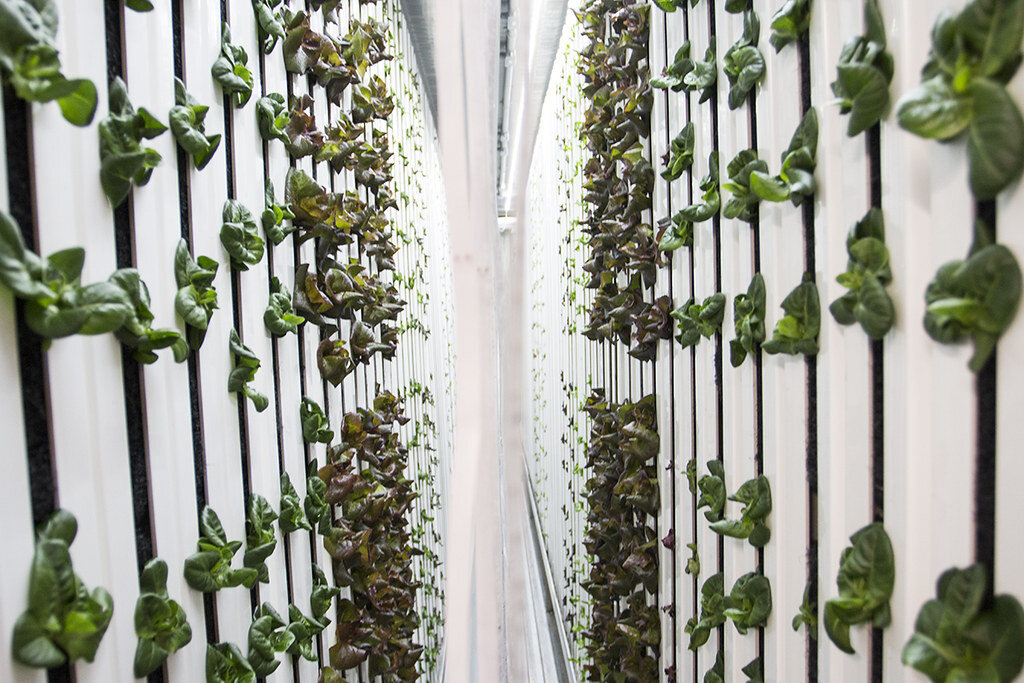
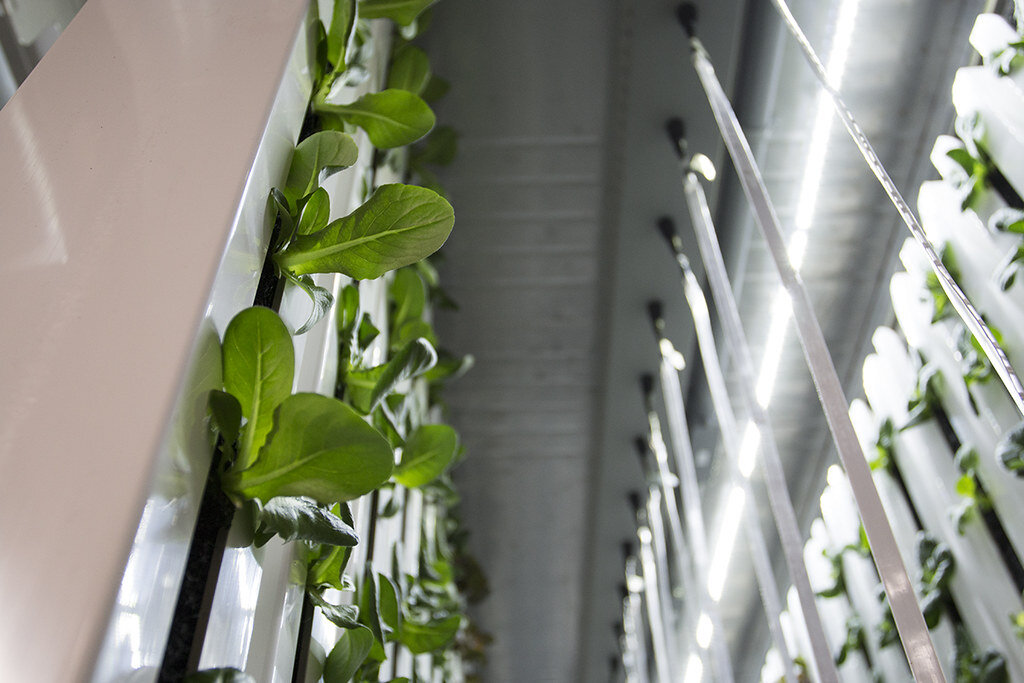
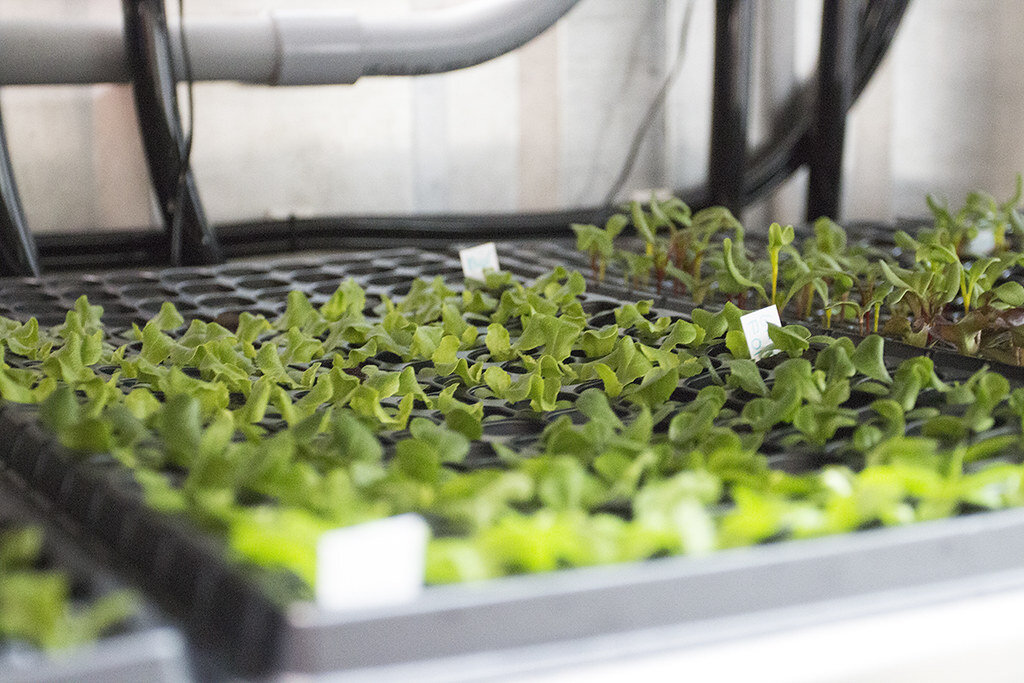
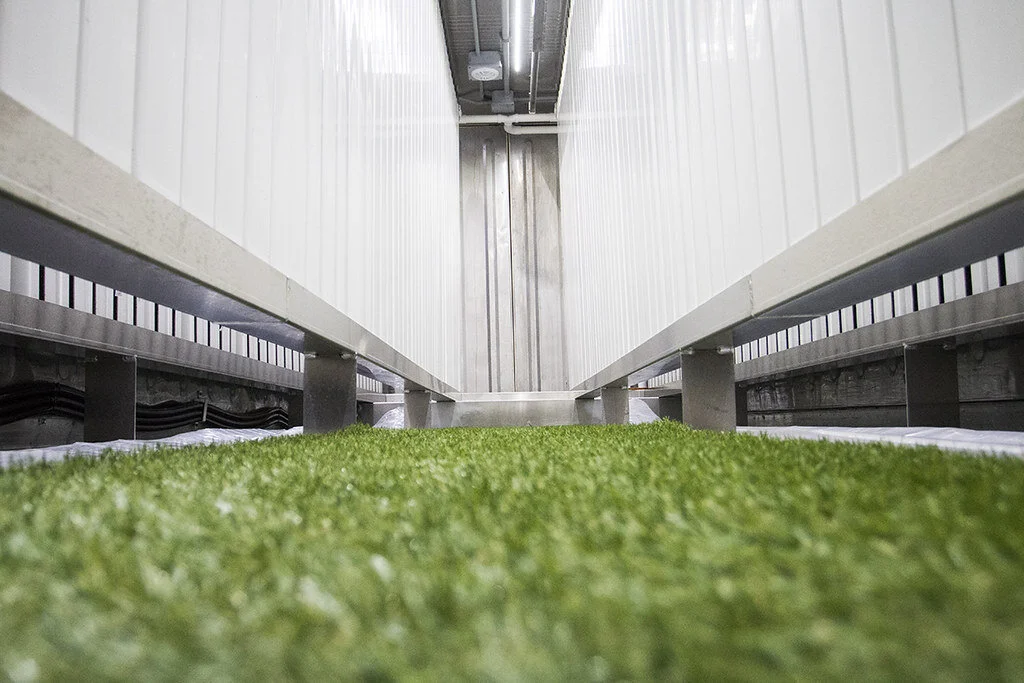
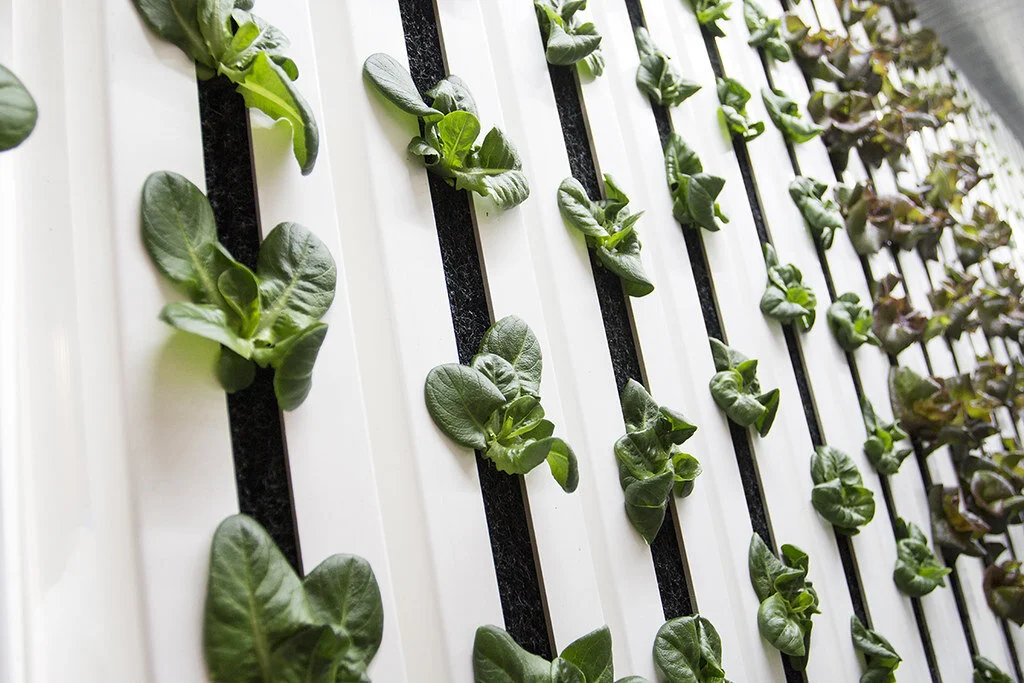
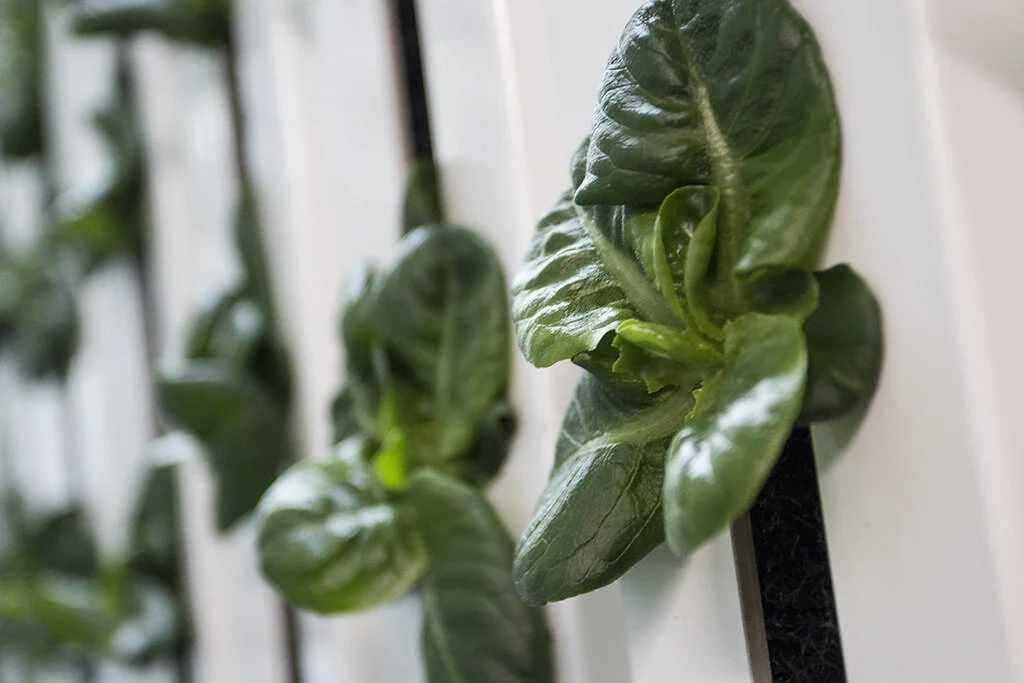
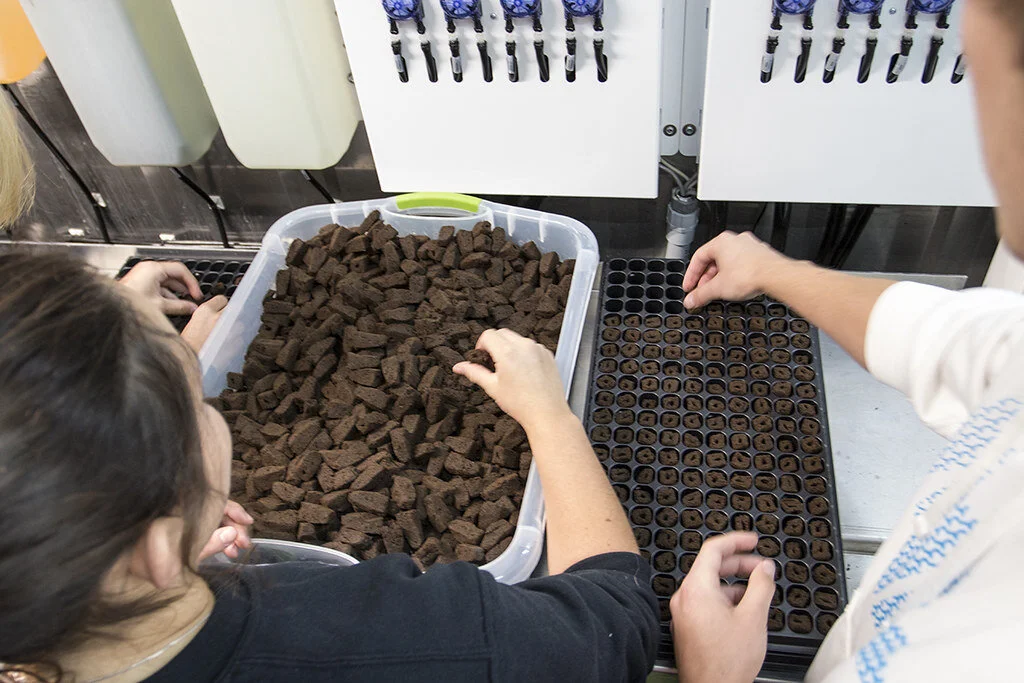
Housing and Food Services, along with the student organization OUr Earth, have joined together to bring the Leafy Green Machine to campus. Housed in an upcycled shipping container, it is the first hydroponic farm at a Big 12 university. Produce grown is served in on-campus dining locations.

An Analysis of Vertical Vegetable Farms
Until recently, vertical farms were an exception in the market, but now this high-tech agricultural sector is rapidly gaining ground in urban centers of Asia, North America, and Western Europe
"Huge Investments, Confident Markets, But Still Many Uncertainties"
Until recently, vertical farms were an exception in the market, but now this high-tech agricultural sector is rapidly gaining ground in urban centers of Asia, North America, and Western Europe. However, their economic viability and agronomic interest, compared to field crops or greenhouses, are far from established. Why, then, do some investors choose to follow this path of innovation? What, exactly, are the technical solutions required to produce in confined buildings, without natural sunlight? And, does this business model have future prospects?
The French Centre for Studies and Strategic Foresight, part of the Ministry of Agriculture and Food General Secretariat, published an analysis on the market.
Urban agriculture is now promoted as a vector of sustainable food, quality of life and community engagement. Most often, though, it consists of small-scale home and leisure activities: shared neighborhood gardens, potted crops on balconies or green
rooftops, etc. These “initiatives” are confined to a niche by the lack of land and the intermittence of citizen involvement. The artificial
environment of the city, with its soil and air pollution, building shadows, and impermeable pavement hinders any large-scale deployment of urban gardens. Thus, their contribution to the populations’ food supply seems doomed to remain marginal.
On the opposite side of the social and market spectrum is urban agriculture for industrial and production purposes, and more specifically on vertical farms. With advancements in LED lamps, robotics, and information technology, multi-level indoor production units with reduced footprints are being created, dedicated to the intensive cultivation of plants and vegetables, mostly salads.
Contrary to greenhouses, these high-tech farms do away with natural light and cut all dependance to their outside environment. This version of urban agriculture has strong ambitions: mass production of quality food products, at any time, under any climate, close to consumers, and without the use of pesticides, all at market prices.
Download the full analysis here
Publication date: Thu 7 Nov 2019
Singapore Agritech Startup Sustenir Now Serving Hong Kong With Locally Grown, Low Emissions Kale
Earlier this year, Singapore-based agri-tech company Sustenir made headlines with its lab-grown strawberries and arugula in its hydroponic facility. Now, the startup has just expanded into Hong Kong to start vertical farming in the city, producing two kinds of kale at their Tuen Mun facility
By Sally Ho November 12, 2019
Earlier this year, Singapore-based agri-tech company Sustenir made headlines with its lab-grown strawberries and arugula in its hydroponic facility. Now, the startup has just expanded into Hong Kong to start vertical farming in the city, producing two kinds of kale at their Tuen Mun facility. Sustenir’s vertical farming technology presents an alternative to the current food system operating in hot and humid climates like Hong Kong and Singapore. By growing non-native crops in lab-controlled settings, the startup hopes to alleviate dependence on foreign food imports, which generates additional carbon emissions, and food waste in the transportation process.
After its latest round of Series A funding, which attracted US$15.4 million in investment from venture capital firms including Grok Ventures and Tamesek Holdings, Sustenir has recently launched a new 30,000 square foot hydroponic farming facility in Tuen Mun, Hong Kong. The produce currently launched in the city include “Kinky Kale” and “Toscano Kale”. The company is also looking to bring in new offerings in the near future, including kale juice and pesto, both of which they sell in Singapore.
Commenting on the reasons behind their launch in Hong Kong, co-founder and CEO of Sustenir Benjamin Swan told Green Queen that “Hong Kong has similar constraints to space as Singapore and has a similar reliance on imported produce. Our mission has always been to be present in countries and communities with heavy reliance to imports, so we can produce locally and lessen carbon emissions from import transportation.”
The company, which was founded in Singapore in 2013, produces crops that are in local demand using laboratory-controlled vertical farming methods based on artificial intelligence and LED lighting, which helps photosynthesis in plants. Using this technology, the shelf-life of Sustenir’s farmed crops can be extended, which helps to reduce food wastage. In addition, by growing non-native crops in a local facility, the concept minimizes the carbon footprint involved in transporting foods, as well as wasted food that often results in the logistical process of importing fresh produce. This is particularly relevant for Hong Kong, where over 90% of the city’s food supplies are imported from abroad, and for the wider Asian region, which is responsible for over half of global waste.
To cater to Hong Kong tastes specifically in their first launch outside of Singapore, Swan said to Green Queen: “When we enter a country, we always make sure that we tailor our products to the tastes and wants of the people so we can truly give a product made in Hong Kong for Hong Kong.”
Now that their first international foray under their belt, Sustenir hopes to be able to first increase their product offerings in the facility, including growing other leafy greens like lettuce, spinach, arugula and basil, and to continue to launch more urban vertical farms across Asian cities.
Lead image courtesy of ST Photo/ Lim Sin Thai.

The Next Hot Tech Career? Farming
Back in 1870, almost half the U.S. workforce was employed in agriculture — today just two percent of Americans work on farms
Shutterstock
Back in 1870, almost half the U.S. workforce was employed in agriculture — today just two percent of Americans work on farms. Over the decades, some people were driven away by mechanization or lured to cities by the promise of better-paying jobs. More recently, trade wars, tariffs, volatile crop prices, and declining profit margins have increased risk for farmers — and then there’s the impact of climate change on crop yields, chronic labor shortages and increasing debt. Add to that the perception of farming as unsophisticated, undesirable work and it’s no wonder family farms, once the backbone of America, are now in crisis.
According to the 2017 USDA census, the average American farmer is 57 years old and with few young people entering the field, farming is in desperate need of new blood. There’s much more than centuries of tradition at stake. The UN estimates that the world population will reach 8.5 billion by 2030, and as high as 9.8 billion by 2050, requiring a 70 percent increase in global food production. With that many mouths to feed, farming may well be the most important job on the planet.
As the CEO of an AgTech company working to help farms transition to more sustainable practices, I’ve seen firsthand the effort and dedication farmers put into stewarding the land and feeding the world. I’ve also seen misperception about what farming is (and isn’t) hold the sector back from attracting younger generations and adopting technological innovations that can improve the lives and livelihoods of farmers.
It seems to me that what’s needed is a rebrand of sorts — a concerted effort to separate myth from fact and promote the potential farming holds for fulfilling impactful careers. So, how do we give agriculture an image makeover? I don’t have all the answers, but I do have a few ideas on where to start.
Farming is a Tech Industry — Let’s Treat it Like One
Twenty years ago, it wasn’t cool to work at a car company, but today companies like Tesla are attracting some of our best and brightest by reframing auto manufacturing as a sophisticated, futuristic field. Farming has the potential to do the same.
Agriculture might be perceived as old-fashioned and low-tech, but farmers have worked hand-in-hand with technology for generations — whether it’s large machines like tractors and combines or complex chemicals, fertilizers and pesticides. Right now the field is in the midst of profound change as advanced technologies including green chemistries, robotics, artificial intelligence, IoT, autonomous vehicles, machine learning, regenerative agriculture, and biomimetics transform how farms look and function. It might seem like the stuff of science fiction, but autonomous vehicles, indoor farming, and drone pollination are becoming more common throughout the sector.
Looking at, and more importantly, talking about farming as a part of the tech revolution has the potential to ignite the curiosity and imagination of the next generation. In fact, it’s already happening in many countries in Africa, where millennials are using apps and other inexpensive technologies to improve profits and elevate the image of farmers from peasants to professionals. North America would do well to follow suit with an updated image of farmers wielding smartphones rather than American Gothic-era pitchforks.
Create Better Economics — and Education — for Farmers
Advanced technologies may be poised to revolutionize farming, but the reality is they don’t come cheap — at least not yet. Most farmers don’t have the budget for a strawberry-picking robot much less the skillset to maintain or repair one. What’s needed is an industry-wide, gradual integration of affordable AgTech, accompanied by education and mentorship. Traditional farming co-ops could be revitalized to help bring farming into the digital age by pooling funds and sharing resources to offset the cost of emerging technologies — while still providing vital networks for knowledge sharing and a sense of community.
Meanwhile, farming knowledge, once passed down from generation to generation, needs to include people who weren’t necessarily raised on farms. Programs like Square Roots and New Entry are starting this wave with courses like plant science, indoor farming and business foundations that aim to teach next-generation farming skills to a new generation and lineage of farmers.
Right now farmers can test and iterate on a crop season maybe 50 times in their life. New tools will allow them to experiment and optimize much more rapidly. Startups like Prospera, Iron Ox, and Farmer’s Edge are utilizing sensors, analytics and machine learning to capture the interest of younger generations and improve predictability, precision, and profits. My own company is working to reduce reliance on synthetic chemical fertilizers and pesticides while increasing yields by gathering data on how inputs like crop protection products, nutrients and water can be used more effectively to naturally boost a plant’s resistance to pests, disease, and drought. By augmenting farmers’ intuition with informed cause and effect, we can use technology to take the guesswork out of farming and decrease risk.
Deepen Our Connection with Food
There’s something special about the gift of food. If someone takes the time to bake you a pie, it’s a gift from the heart. If someone bakes you a pie made with strawberries and rhubarb that they grew themselves? Now that’s a whole new level of love.
From food bloggers posting plates on Instagram to the explosion of TV shows exploring everything from street food to obscure ingredients, foodie culture has deepened our appreciation of good food. But there’s still a disconnect with how it’s grown, or more importantly, who grew it.
Fortunately, we’re headed in the right direction. The increasing popularity of plant-based products such as Beyond Meat and the skyrocketing demand for organic, natural and local produce has people asking what’s in their food. The next step is to connect the dots with how it’s grown.
Education of this sort needs to start at a young age, with school community garden projects and field trips to farms. The Clinton Foundation’s Students for Eco-Education and Agriculture program provides a hands-on agricultural literacy that helps kids understand the food journey – from farm to table – and teaches them about healthy eating, sustainable farming practices and the fragility of our ecosystem. Michelle Obama’s White House Kitchen Garden, meanwhile, sparked a nationwide conversation about nutrition and exposed a generation of kids to the joys of growing their own food. We need to build on that legacy.
Emphasize the Purpose of Farming
We’ve heard time and again that millennials want meaningful careers that help make the world a better place. Often that interest is funneled towards jobs in CleanTech, non-profits, the environment or the arts. But farming is an overlooked industry with incredible potential to help improve the world.
Farmers are stewards of the land, with huge potential to restore damaged ecosystems by employing sustainable and regenerative agricultural practices. As the world grapples with the effects of climate change, the next generation of farmers has a pivotal role to play in correcting the mistakes of the past. Companies like Ingleby Farms have tapped into this ethos by promoting their focus on long-term care of the land, green energy and biodiversity. They’re walking the talk, providing food with a conscience and farms with a future.
Somewhere along the line, we started to devalue farmers and take them for granted, but it’s hard to think of a career that’s more important for our collective survival. Feeding the planet isn’t simplistic or base, it’s multifaceted, complex and sophisticated. Farmers are the original experimenters, hackers, makers and problem-solvers; they’re biologists, chemists, engineers, entrepreneurs and inventors. Perhaps if we talked about them like that, young people would be inspired to continue their legacy, and proudly bring the field into the future.
This article was originally featured in Agfunder and LinkedIn.
— Published on November 4, 2019
Karn Manhas
CEO and Founder of Terramera, Karn Manhas is a leader in the AgTech industry, pioneering the application of revolutionary technologies that transform how we grow food and solve other world-scale challenges. A biotechnologist, entrepreneur and environmentalist, Karn’s mission is to reduce global synthetic chemical loads in agriculture by 80% while improving global farm productivity by 20% by 2030.
Karn was inspired to start Terramera after winning a friendly argument over whether pests like bed bugs could be controlled using non-toxic, natural ingredients. What started as curiosity-fueled research in the summer of 2009—exploring how a natural extract he’d read about, neem oil, could be used to control insects — evolved into a new area of science and the beginning of Terramera and their Actigate™ Targeted Performance technology. Today, Terramera is pairing its Actigate technology with AI, data science and machine learning, to allow natural alternatives to become more effective, reduce global synthetic chemical loads, and revolutionize agriculture in the process.
Karn is an accomplished public speaker who has appeared at TEDx Vancouver, Unreasonable, and Singularity University. He is also a former MLA in the B.C. Legislature in the riding of Port Coquitlam-Burke Mountain. Karn holds a Bachelor of Science in Biology from McGill University and a law degree from the University of British Columbia.

Produce Will Grow On Site At Kroger's QFC Stores.
The Kroger Co. is teaming with urban farming network Infarm to bring modular living produce farms to North America, which will result in offering produce picked so fresh that consumers will be able to see the roots
Kroger Launching Living Produce Farms This Month
11/19/2019
Produce will grow on-site at Kroger's QFC stores.
The Kroger Co. is teaming with urban farming network Infarm to bring modular living produce farms to North America, which will result in offering produce picked so fresh that consumers will be able to see the roots.
The partnership between Cincinnati-based Kroger and Berlin, Germany-based Infarm marks the first-of-its-kind in the United States, according to the two entities.
The living produce farms will launch this month at two of the 15 stores planned at QFC, a Kroger banner, at locations in Bellevue and Kirkland, Washington. Using hydroponic technology, the produce will grow on site at the participating QFC stores, removing the need for extended transportation and storage and producing a more eco-conscious product, according to Kroeger. The farms are designed to scale and will provide shoppers the freshest and most sustainable living produce options available.
"Kroger believes that everyone deserves to have access to fresh, affordable and delicious food, no matter who you are, how you shop or what you like to eat," said Suzy Monford, Kroger's group vice president of fresh. "Our partnership with Infarm allows us to innovate by combining ground-breaking in-store farming technology with our passion for fresh, local produce and ecological sourcing. Kroger is excited to be first to market and offer the best of the season."
"We want to make fresh, pure, tasty and nutritious produce available and affordable for everyone," said Erez Galonska, CEO and co-founder at Infarm. "Kroger's commitment to innovation, quality and flavor makes them the perfect partner with which to launch our business in the United States and for the first time in North America."

Grow Lettuce Indoors All Winter
There’s nothing better than biting into a nice, crunchy salad made with homegrown lettuce leaves, but with frost covering the backyard garden, you’re going to need to move production indoors. Luckily, lettuce is one of the easiest crops to grow inside, even if you’re new to indoor gardening
Kathleen Marshall | November 11, 2017
Takeaway: There’s nothing better than biting into a nice, crunchy salad made with homegrown lettuce leaves, but with frost covering the backyard garden, you’re going to need to move production indoors. Luckily, lettuce is one of the easiest crops to grow inside, even if you’re new to indoor gardening. Just follow these simple steps.
Buying fresh salad greens in the winter can be a pretty pricy endeavor. Fortunately, you can easily grow your own indoors, even if you’ve never tried indoor gardening before.
Choosing the Right Variety of Lettuce to Grow Indoors
You might think that lettuce is all the same, but loose-leaf varieties grow best in indoor gardens, especially in colder temperatures. This is important because even though you can control the temperature when you are growing indoors, the less heat you have to add to the grow space, the more economical your growing endeavor will become.
Varieties especially suited for growing indoors include black seeded simpson and tom thumb. Mesclun mixes, arugula, and baby spinach also do well but don’t be afraid of experimenting with other varieties or you might miss out on a special favorite you haven’t discovered yet. Loose-leaf lettuce grows quickly, can produce multiple yields and comes in a variety of colors to create a colorful salad.
Selecting the Right Location
If you can, choose a room that gets lots of natural light, but even if the room you choose has lots of natural light, your plants will need the help of artificial lights.
Lighting isn’t your only consideration when choosing where to grow your lettuce. Choose a room that isn’t too hot or freezing cold. Make sure you have easy access to water, as running from one end of the house to the other transporting water loses its fun-factor quickly.
Easy access to electricity is also important. You don’t want extension cords running through the house to power your supplemental heat or light sources.
Heat and Light Considerations for Growing Lettuce Indoors
To successfully grow lettuce, you’ll need a minimum of 12 hours of light, with 14-16 hours of light being ideal for most plants. If you are relying heavily on windows for some of your lighting needs, you’ll need to rotate your growing containers or your plants will lean towards the light as they grow
Keep in mind there are fewer daylight hours in the winter, so a supplemental lighting source is necessary. A wide array of grow lights will provide full-spectrum lighting, but some of the more advanced systems may seem pricey to novice indoor growers.
To start out your indoor gardening adventures, you can opt for a simple T5 grow light from your neighborhood hydro store. As you gain more experience and confidence in your abilities, you can always upgrade your equipment to match your needs. Make sure your light source is adjustable and keep it 4-6-in. above your plants. As the plants grow, you’ll need to raise the lights.
Most types of lettuce thrive in cooler temperatures and go to seed when it gets hot, but there are several varieties bred to be slow to bolt. Lettuce thrives in temperatures between 60 and 70˚F during the day, and about 10 degrees cooler at night. You can grow lettuce in cooler temperatures than these, but it will grow more slowly.
Picking the Right Medium
A seed-starting mix is ideal to use when you are growing lettuce indoors. It is lightweight, which makes it easy for seedlings to pop through the surface of the soil. A soilless potting mix is also a good choice. You can make your own with equal parts peat moss or coir, vermiculite or perlite, and sand.
Growing containers can be shallow, as lettuce does not have a deep root system. You can use growing trays from your local garden center or even recycle containers from home, like empty yogurt cups or egg cartons.
If you have an assortment of flowerpots or planter boxes, those will work just fine, too. It isn’t necessary for each plant to grow in its own container.
Fill your containers with moist potting mix and you are ready to plant.
Planting Lettuce
Plant your seeds about an inch apart, or about four seeds per pot if you are growing in seed-starting trays. Lettuce seeds are small, but if you sow seeds a little thicker than desired, you can simply pull any excess seedlings.
Once your seeds are in place, cover lightly with potting mix and mist with a spray bottle. It’s important to water gently so you don’t wash away the tiny seeds.
If you have a seed-starting tray, put the cover on it and keep it moist until the seedlings sprout. You can achieve the same effect by covering containers with plastic to create a greenhouse effect.
Moisture from the soil accumulates on the plastic and then drips onto the seeds. Once seeds have germinated, remove the plastic covering.
Fertilize when the first real leaves appear on your plants. I like to use an organic fertilizer that’s diluted by half. Avoid getting fertilizer on the leaves so you don’t burn your plants.
Harvesting Your Indoor Lettuce
You can expect to start enjoying the fruits of your labor within several weeks—in 20-30 days, your lettuce will have grown to about 4-in. tall. To harvest, cut the larger outer leaves. If you cut what you need just above the soil and allow the smaller parts to grow, you can extend your harvest to 2-3 cuttings.
For a continuous harvest all year, sow seeds every two weeks. You might have plans to grow lettuce outside when the weather warms up, but if you continue growing indoors, you won’t have to worry about slugs and rabbits eating your salads. And no one says you can’t do both! Experiment and decide what fits your needs the best.
Growing lettuce indoors is a rewarding project for beginners because it offers quick results with little effort. It’s also an excellent learning opportunity for children.
Once you’ve enjoyed a fresh, homegrown salad in the middle of winter, you may be inspired to try other indoor gardening projects like culinary herbs. Start small and add more as your experience allows.
Read More: Winter Lettuce Production Tips
Written by Kathleen Marshall
Kathleen Marshall has been gardening since she was old enough to hold a shovel. She is a master gardener through the University of Florida and likes to experiment with various types of growing, indoors and out. Her passion is self-reliance. Currently, she resides on a 100-acre homestead with her family, where she works on growing as much of her family's food as possible. Full Bio
Bowery Farming's $50 Million Financing Tops Recent Funding News In New York
New York-based agriculture company Bowery Farming has secured $50 million in Series B funding, according to company database Crunchbase, topping the city’s recent funding headlines. The cash infusion was announced Nov. 6th
Photo: Paul Arps/Flickr
November 12, 2019
New York-based agriculture company Bowery Farming has secured $50 million in Series B funding, according to company database Crunchbase, topping the city’s recent funding headlines. The cash infusion was announced Nov. 6.
According to its Crunchbase profile, "Bowery is the modern farming company growing the purest produce imaginable. We are on a mission to grow food for a better future by revolutionizing agriculture. By combining the benefits of the best local farms with advances made possible by technology, our indoor farms create the ideal conditions to grow post-organic produce you can feel good about eating."
The four-year-old startup has raised three previous funding rounds, including a $90 million Series B round in 2018.
The round brings total funding raised by New York companies in food and beverage over the past month to $55 million. The local food and beverage industry has seen 65 funding rounds over the past year, securing a total of $786 million in venture funding.
In other local funding news, lending and point of sale company Octane Lending announced a $45 million Series C funding round on Nov. 4, led by Valar Ventures.
According to Crunchbase, "Octane Lending is a point of sale financing platform focused on niche consumer lending markets. They are currently focused on the recreational market (motorcycles, ATVs, UTVs, personal watercraft, boats, RVs and snowmobiles). Their web-based platform helps dealers save time by eliminating the need to re-key customer information and helps move more units by opening dealerships to more prime/subprime lending sources."
Founded in 2014, the company has raised 11 previous rounds, including a $50 million debt financing round earlier this year.
Meanwhile, cloud data services and recruiting company Papaya Global raised $45 million in Series A funding, announced on Nov. 5. The round's investors were led by Insight Partners.
From the company's Crunchbase profile: "Papaya Global is a global HRIS that transforms global payroll, payments, and workforce management. Papaya Global's automated platform helps companies hire, onboard, manage and pay people in more than 100 countries. The cloud-based solution is easy to use and scale ensures full compliance and provides industry-leading BI and analytics."
Papaya Global last raised $3 million in funding in 2018.
Also of note, innovation management company Eight Sleep raised $40 million in Series C funding, announced on Nov. 6 and led by Founders Fund.
From Crunchbase: "Eight Sleep is the first sleep fitness company. It leverages innovation, technology, and personal biometrics to restore individuals to their peak energy levels each morning. Backed by leading Silicon Valley investors including Khosla Ventures and Y Combinator, it was named by Fast Company in 2018 as one of the Most Innovative Companies in Consumer Electronics."
The company previously raised $14 million in Series B funding in 2018.
Rounding out the city's recent top local funding events, rental property company SquareFoot raised $16 million in Series B funding, announced on Nov. 6 and led by DRW Venture Capital.
From Crunchbase: "SquareFoot serves companies that are looking for their next office and care deeply about finding the right next home. Growing companies require flexible lease options, a stress-free process, and transparency throughout the leasing journey. SquareFoot provides a seamless experience supported by easy-to-use technology and a highly responsive team of real estate professionals working to match specific client needs with a strong knowledge of what the market has to offer at any given moment."
The company previously raised $7 million in Series A funding in 2018.

Data Analytics: The Newest Tool of Aquaponic Agriculture
Colleges across the country are looking for creative ways to give students hands-on, real-world experience using technology to solve problems. It makes sense: Proficiency in this area is one of the most in-demand skills in the workforce
The University of Connecticut taps Splunk to improve operations at a student-run farm.
Calvin Hennick is a freelance journalist who specializes in business and technology writing. He is a contributor to the CDW family of technology magazines.
Colleges across the country are looking for creative ways to give students hands-on, real-world experience using technology to solve problems. It makes sense: Proficiency in this area is one of the most in-demand skills in the workforce.
Jonathan Moore, academic director of the management information systems program at the University of Connecticut, developed a program that teaches data analytics and, in a unique twist, lets students hone their skills by helping fellow students.
Previously, Moore ran the school’s student IT help desk, working with undergraduates who provided technical support to students for campus technologies such as email, software, wireless connections and learning management systems.
Today, Moore’s students are using data analytics to support peers in another academic program at UConn. The initiative is illustrative of how far analytics use cases have come in just the past few years — and the ways in which vendors like Splunk are making their tools accessible and intuitive enough to be used not just by data scientists but also by learners still finding their footing in IT.
“It’s giving students relevant skills, moving the needle on curriculum and academia, and breaking down academic siloes,” Moore said in an interview with EdTech at Splunk’s recent .conf19 conference in Las Vegas.
UConn Business School Workshops Focus on Emerging Tech
Several years ago, Moore launched a program at the University of Connecticut School of Business called OPIM Innovate (the moniker refers to the school’s operations, information and decisions department). The program aims to give students experience with new, business-changing technologies, including augmented reality, 3D printing, the Internet of Things, microcontrollers and data analytics.
OPIM Innovate started as a series of workshops, where students came to nosh on free pizza while learning about topics in IT and business. Over time, the school began developing pilot — and then permanent — classes based on popular workshops.
That’s how UConn’s MIS students came to use data analytics to help support an aquaponics facility at the school. The aquaponics greenhouse is part of Spring Valley Student Farm, which sits 5 miles from the main campus and fosters student learning around environmental and sustainability issues. (It also grows organic produce for use in the school’s dining facilities.)
Hydroponics is the cultivation of plants in water, while aquaponics involves the rearing of aquatic animals in a hydroponic environment. The idea is that plants will use nitrogen-rich fish waste products as fertilizer. However, when the facility first opened, students didn’t see the positive agriculture outcomes they were expecting, and the farm turned to MIS students to bring data analytics to bear on the problem.
Ryan O’Connor, a Splunk engineer and adjunct faculty member at the school, designed a class project that used sensors and Splunk software to monitor conditions at the aquaponics facility. The program was supported by Splunk4Good, which donates millions of dollars each year in software licenses, training, support and education to nonprofit organizations and educational institutions around the world.
Connected Sensors and Analytics Software Track Farm Metrics
Over the summer, before the class started, Moore and O’Connor put the infrastructure in place to support analytics, expanding wireless connectivity at the farm and building a prototype system to track metrics. Then, once the class started, MIS students began collecting, monitoring and analyzing data from IoT sensors to provide real-time insights on metrics such as pH balance, water temperature, water quality and UV light.
The students quickly pinpointed simple problems affecting the facility’s success. For one, the greenhouse got colder at night than previously thought. Also, students were leaving the door open when they weren’t supposed to, which allowed animals to get in overnight and damage the plants.
O’Connor noted that Splunk allows students to crunch months’ worth of data in less than a second. But, perhaps just as important, the Splunk AR mobile tool lets students see real-time metrics on their smartphones.
“It’s great for instantaneous readings,” said O’Connor. In a typical aquaponics setup, he notes, students would have to take time to individually measure and record different metrics — using a variety of tools to measure, say, temperature and pH balance. “But if you have sensors already in there, and they’re sending the data to Splunk, that’s saving a lot of time.”
GUTER/GETTY IMAGES

GLASE Webinar Series: Off-Season Strawberry Production Under Controlled Environments
Strawberries production in greenhouses and indoor farms represents an uprising market that offers the potential for CEA growers to diversify and remain competitive. In this webinar, Dr. Chieri Kubota from Ohio State University will discuss the opportunities of off-season strawberry production under controlled environments
Title: Off-season strawberry production under controlled environments
Date: November 21, 2019
Time: 2 p.m. - 3 p.m. EST
Presented by: Chieri Kubota
Description:
Strawberries production in greenhouses and indoor farms represents an uprising market that offers the potential for CEA growers to diversify and remain competitive. In this webinar, Dr. Chieri Kubota from Ohio State University will discuss the opportunities of off-season strawberry production under controlled environments.
Registration link: https://cornell.zoom.us/webinar/register/WN_BW_p9oDyS7Cmx1DllSCLbA

The Registration For The 4th Annual International Investment Greenhouse Complexes Russia And The CIS Forum 2019 Closes In A Week.
The event will be held on 4-5 December, at Baltschug Kempinski Hotel Moscow. Don’t miss the opportunity to be part of the flagship event in greenhouse farming industry of Russia and the CIS!
Register now
Greenhouse Complexes Russia and the CIS 2019 in facts and figures:
The Forum is supported by the Ministry of Agriculture of the Russian Federation; Industry Partner: the Association “Greenhouses of Russia”.
500+ confirmed participants, senior executives of major commercial greenhouses, agricultural holdings and farms from Russia and the CIS, among them: Eco-Culture, Agro Management, Greenhouse Complex Lipetsk Agro, Greenhouse, Agro-Invest, Agricultural Complex Gorkovskiy, Agricultural Complex Ivanisovo, Agricultural Complex Yuzhny, Belaya Dacha Trading, IGS Agro, Agricultural Complex Rodina, Vyborgec, Greenhouses of Belogorie, Agricultural Complex Churilovo, Chekhov Garden, Flowers of Udmurtia, Yug-Agro, YugAgroholding, Ryazan Vegetables, Seim-Agro, Ozelenenie, Prompark, Penzenskiy Greenhouse Complex, Agrocomplex, Agricultural Complex Volzhskiy, Agricultural Complex Doskino, Teplichnoe (the Republic of Mordovia), Teplichnoe (Tambov), Teplichnoe (Ulyanovsk), Teplichny (Blagoveshchensk), Greenhouse Complex Andropovskiy, Greenhouse Complex Zavyalovskiy, Greenhouse Complex Podosiniki, Greenhouse Complex AgroPark, Greenhouse Complex of Belogorie, Greenhouse Complex Aleksandrovskiy, Greenhouse Complex Belorechenskiy, and a lot more
50+ top managers of commercial greenhouses from the CIS countries: Kazakhstan, Belarus, Azerbaijan, Uzbekistan, Armenia, Turkmenistan, Tajikistan, Moldavia: AGRO TRADE, FOOD EXPORT SHAMKIR, GreenEco, GREEN-FOOD-EXPORT, Grow Group Azerbaijan, MONTANA GARDEN, AGROFIRM KUILIK, Andruserra Agro, Arokhch Sunk, Butarustrade, Green Tech, Green Farmer, Green Food, Grodno Vegetable Factory, DORORS, JASMINA-AZIZBEK, Maria Dairy Farm, Yagodka Farm, IFTIKHARI, Pavlodar Greenhouse complex, Semirechye Nursery, Raisagroholding, Rock Berry, Spaika, Greenhouse Complex Green Line, Greenhouse Complex Berestie, XO Yigit, and a many others
80+ speakers, discussion participants and honoured guests: Aleksey Sitnikov, President, the Association “Greenhouses of Russia”, Aleksandr Rudakov, President, Eco-Culture; Dmitry Lashin, Chairman of the Board of Directors, Lipetskagro; Vladimir Chernyshov, General Director, Agrokultura Group; Aleksandr Solodaev, General Director, Agricultural Complex Gorkovskiy; Guriy Shilov, General Director, Greenhouse; Pavel Dyakov, Chairman of the Board, Agricultural Complex Rodina; Sergey Yastreb, General Director, Yagodnaya Polyana; Andrey Lepekhin, General Director, Chekhov Garden; Aleksandr Khrenov, General Director, Russian Mushroom Journal; Andrey Fatuev, Commercial Director, Agricultural Complex Ivanisovo, and a lot more
AGRONOMY DAY – specialized workshops on tomato, cucumber and salad farming. Modern ways to boost yield and plant resistance to pest and diseases, efficient application of LED lighting, new growth technologies
AWARD CEREMONY OF THE GREENHOUSE INDUSTRY LEADERS & GALA DINNER – great opportunity to establish new business relations and strengthen the existing connections in an informal setting
Gold Sponsors: Signify, Sananbio; Silver Sponsors: Green Automation Export, SVETOGOR; Bronze Sponsors: Royal Brinkman, Rijk Zwaan, Megaphoton; Video Sponsor: Richel Group
Specialised exhibition of high-end equipment and technologies from major companies: 2Grow, 3М Russia, AB Energy Rus, AgroSustain SA, ALMECO S.p.A., Bato Plastics, Ceilan Coir Products, COCOGREEN GROUP, Coinsa, Fluence Bioengineering, FPHU MARYNIACZYK, GAUTIER Semences, Grodan, Horti XS BV, Hortilux Schreder, Ludvig Svensson, Lycopersicon cvba, Meteor Systems, Mprise Agriware, MWM RUS, Paskal Greenhouse Solutions, Pylot, Shenzhen Number Energy Saving Corporation, URBINATI, Agrisovgaz, AGRITECHNO FERTILIZANTES, Agrosencenter, Agrosoil, Trade, I-Plast, Astron Buildings, BOSCH REXROTH, Walzmatic, Viessmann, Koppert Russia, LUMEX M, MASSA-K, FITO GROUP, Reflux, Greenhouse Systems, TehnoStroy Agro, Ulma Packaging, Formos TK, ELEKS+, EMIS, and others.
Register now
Organised by: Vostock Capital
Elvira Sakhabutdinova,
Project Producer
Tel: +44 207 394 30 90 (London)
Email: ESakhabutdinova@vostockcapital.com

In A Seoul Subway Station, A Smart Farm Sprouts
The future could see farms without farmers – automated agriculture, boxed up and set to go anywhere, anytime
The farm of the future – in a Seoul metro station. Photo: Asia Times/Andrew Salmon
The future could see farms without farmers – automated agriculture, boxed up and set to go anywhere, anytime
By ANDREW SALMON
With agricultural sectors massively subsidized globally, with threats posed by pesticides and herbicides raising international concerns and with chemical-free organic farming a hugely risky undertaking, could the future see the sector move off the farm and into a box?
An underground, vertical smart farm established last month in – of all places – a Seoul subway station points to one possible solution.
In Sangdo, a subway station serving a southern Seoul residential neighborhood, Korea’s first “Metro Farm” – an urban, underground smart farm – opened on September 23. A second has just started operation and two more are under construction and will open by the end of the year.
The metro farms are a partnership between the sustainability- centric administration of Seoul Mayor Park Won-soon and commercial smart farm firm company Farm 8.
“Seoul was looking for a company that would grow, and which had the capability to operate a system,” said Kim Sung-un, a senior manager at Farm 8. “We had 10 years of history, so Seoul received applications and they chose us.”
Making Sangdo Station sustainable
The result in Sangdo is an impressively futuristic-looking space that would not look out of place on a spacecraft – which is, incidentally, one potential future application of smart farms.
Covering 394-square meters, it is divided into four separate zones. There is the main facility, a glassed-in, vertical farm, a smaller, self-contained smart farm in a shipping container, an education space for children and an outlet where produce is sold and consumed on-site.
Inside the air shower. Photo: Asia Times/Andrew Salmon
Sterilized outwear – lab hats, coats, and overboots – are donned before entering the vertical farm. After being wafted by an “air shower,” trays of herbs and lettuce, at various stages of cultivation and stacked floor-to-ceiling, can be seen in the pinkish, artificial light.
Eight vegetables are being cultivated in Sangdo, under LED lighting, in trays of hydroponics – composed of algae, water, and nutrients – that take the place of soil.
The smaller container farm displays Farm 8’s smart farm-in-a-box product. Here, the farm’s digital monitoring and control panels can be seen, close up, in addition to the growing produce.
“People in Korea are very concerned about fine-dust pollution,” said Kim who, together with a Seoul City official, recently showed foreign reporters around the farm. “We are not pulling in dirty air from outside or from the subway. We have a filtration system.”
Inside the container smart farm. Photo: Asia Times/Andrew Salmon
Thanks to this sealed, sterile environment, vertical farms have no need for widely-demonized herbicides or pesticides. Moreover, the vegetables grown boast slightly higher amounts of vitamins and minerals than regular vegetables, Kim said.
These messages are being promulgated to a small audience.
“These are not only farm facilities, these are places where children can see urban farming for education purposes,” Kim said. A classroom includes puzzles, stickers, workbooks that teach about balanced diets.
“At the end of the sessions, the children get the chance to harvest some vegetables, and we finish with a quiz,” Kim said. Signup is online.
Sangdo’s metro farm is a full nose-to-tail operation – its salad bar sells cartons of produce to eat on-site or to take home, together with juice drinks. While Seoul City may have partnered with Farm 8 for reasons of sustainability, the concept is not simply about being smart and doing good, Kim insisted.
“The most important thing is that the facilities must be able to make a profit without [government] support,” he said, although he admitted that Farm 8 benefits from generous government energy subsidies for farms. “That is what makes us competitive.”
The end product had the thumbs up from one customer dining at the café.
“I live in this area and this was my first time to see this kind of thing,” said Kim Ji-eun, 30, a teacher dining on a salad with bulgogi topping, a Korean beef dish that translates as “fire meat.”
Describing herself as “an avid veggie lover” she added: “I’d prefer more toppings, though.”
Alas, Farm 8 does not do cattle farming. But it offers plenty of other budding ideas.
Packaged salads on offer in Seoul’s first ‘Metro Farm.’ Photo: Asia Times/Andrew Salmon
Down on the smart farm
Unlike traditional farming work, with its requirement for spadework and heavy machinery, smart farming labor is light. With almost all processes – bar seeding and harvesting – fully automated or using robots, the main job is monitoring.
According to Kim, Seoul’s four metro farms require only three monitoring staff – and disabled people were hired for the job. “The good thing about smart farming is that we can include those who are socially excluded, and that is why Seoul City is so proactive,” Kim said. “And these systems are something women can work on, there is no hard labor.”
These characteristics make smart farms suitable for a generation that has turned away from traditional agriculture, Kim said, referencing the lack of young people entering the farming sector in heavily urbanized and industrialized South Korea.
The farms are also applicable in environments where traditional farming is not feasible – such as deserts and arctic climate zones. “There is a smart farm in the Korean base in Antarctica,” Kim said. “Theoretically, smart farms could operate on spacecraft, but we have not had the chance to try that.”
Sangdo Station’s vertical farm maximizes the use of space. Photo: Asia Times/Andrew Salmon
Farm 8
Farm 8 is headquartered in the port-industrial hub of Pyeongtaek on the Yellow Sea coast south of Seoul. The company, founded as an agribusiness in 2008, has seen approximately 20% growth per year, Kim said.
Under the “wellness” trend, which is prompting growth in areas such a premium mineral waters and organic vegetables, the salad market is on the rise – hence the firm’s main business is salad production and distribution.
In partnership with about 70 farms nationwide, Farm 8 grows about 50 vegetables, selling roughly 30 tons of packaged salads per day. Clients include Starbucks and GS25, a leading nationwide convenience store chain.
Salad is 80% of Farm 8’s business. Retailing and servicing smart farms is the other.
Inside the container smart farm. Photo: Asia Times/Andrew Salmon
Eat greens, get smart. Photo: Asia Times/Andrew Salmon
That breakdown offers the business two prongs: domestic produce supply and global hardware supply. While salad distribution is only feasible in the domestic market – due to the short sell-by dates of fresh vegetable products – the smart farm market is global, Kim said. Farm 8 is now selling its container farms to Japan as well as in South Korea.
“Our main focus is our LED light technology,” Kim said – appropriate, given South Korea’s strengths in that industry. “We own the technology. These are the best LED lights for plant growth,” he claimed.
Under the brand “Cultivate the Future,” Farm 8 operates the largest number of smart farms in South Korea. Customers who buy a smart farm unit from Farm 8 get a monthly service visit.
Units vary from refrigerator-sized vertical farms, suitable for in-home use, to 40-foot containers, which are more appropriate for restaurants, canteens or actual farms. The container farms retail at 150,000,000 won (US$129,000) – about half the price of a downtown Seoul apartment.
Still, Kim admits that smart farms are not suited to every kind of vegetable. “We can produce potatoes or tomatoes, but they are not cost effective,” Kim said.
However, they are ideal for lettuce – widely used in Korean cuisine as wraps for barbequed meat and fish – and herbs – widely used in Korean cuisine and medicine.
In these areas, Farm 8 boasts real competitiveness. “Compared to ordinary farmland, we are 40% more profitable as we are stacked in layers,” Kim said. “Our system uses less space and offers faster growth.”
Moreover, smart farms bridge a seasonal gap in Korea’s traditional farming calendar. “In Korea, in summer, it is too hot to cultivate greens, so prices fluctuate,” Kim said. External heat, however, does not impact temperature-controlled smart farms.
Another advantage is risk-management. “The agriculture sector is risky. Even if there is a lettuce problem in Europe, people stop eating lettuce here,” he said. Smart farms, however, are firewalled from both blights and fear of blights.
Farms of the future
Farm 8 is thinking outside the box when it comes to its future business lines.
In its next subway outlet – in central Seoul’s super-busy Euljiro Station – Farm 8 is planning a produce café complete with salad vending machines for on-the-go Seoulites.
It is also planning to install allotment-style smart farms in upmarket apartments, where families would be able to grow their own vegetables at a central, managed facility in the complex.
With Farm 8 being largely a B2B company with limited human resources, the plan, Kim said, would see the operation of the apartment complex farms outsourced to a rental company.
Looking to the broader future, the company is peering beyond salads and toward the cosmetic and medical sectors.
“They need special herbs and other ingredients for both cosmetics and drugs,” Kim said, noting the rising demand for pesticide-free herbal face packs. “We are researching this with both government and universities, and expect to see results in three years.”
Buds in a box: Checking out the station’s container smart farm. Photo: Asia Times/Andrew Salmon
Vertical Farming: On The Up
The cost of energy – financially and environmentally – remains the greatest challenge to scaling up vertical farming. Even using off-peak energy, and with ever more efficient LEDs coming on the market, the energy requirements are high
Ramona Andrews Author
24th April 2019
Standing 12 metres high and with 17 stacked levels of indoor growing space, lit with LEDs in a mixture of red, white and blues – is this really the future of farming?
Lincolnshire-based Jones Food Company’s (JFC) vertical farming system is capable of producing over 400 tonnes of baby leaf salad a year in about 5,000 square metres of indoor space. While there has been development in growing berries, tomatoes and other fruiting plants through these systems, the technology is not yet there to make these crops scalable and JFC is concentrating efforts on baby leaf and herbs. As co-founder Paul Challinor explains, the intention is to make the business commercial from the beginning “rather than having a trial shipping container to look at how it could develop”.
Other city hydroponic growers, such as New York’s Sky Vegetables, a rooftop farm in The Bronx and Growing Underground, a hydroponic farm located 33 metres below the streets of Clapham in London, see their role as an incredibly short supply chain for produce directly into the city.
But not everyone has the same end goal – Grow Bristol has built a vertical farm inside a shipping container on disused land, offering an opportunity for public engagement and connecting urban communities to food, rather than to provide high quantities of salad to the city.
The Jones Food Company grows over 400 tonnes of salad a year. Image Holly Challinor
The sky isn’t the limit
The cost of energy – financially and environmentally – remains the greatest challenge to scaling up vertical farming. Even using off-peak energy, and with ever more efficient LEDs coming on the market, the energy requirements are high.
Jaz Singh of Innovation Agri-Tech Group, behind an indoor farm in Bracknell, Berkshire, says: “It doesn’t really matter what time of day your energy is getting produced. It’s about how you cycle it. You can turn the evening into effectively daytime if you’re doing it in a fully closed environment.”
For Grow Bristol’s Oscar Davidson, the future of vertical farming must be in renewables, such as biogas or through anaerobic digestion, and ideally on-site generation. This is echoed by another hydroponics expert Kate Hofman, of GrowUp Urban Farms, who says: “From my point of view, the only purpose of doing this kind of farming is to be able to grow food more sustainably…you’ve got to use renewable energy and at the moment it’s too expensive to buy off the grid, so we’ve got to be co-located.”
GrowUp tested a pilot aquaponics urban farm (aquaponics combines raising fish with hydroponics, feeding the plants fish waste), but the system has not proved financially sustainable in its original East London location due to high land rental costs. For Hofman, in theory, the more production moved indoors, the more land can be freed up for other uses, less intensively farmed and even used for carbon sequestering.
Moving beyond salad
Described by Davidson as a “gateway crop to the technology”, salad greens are easy and quick growing (baby leaf salad takes four to five weeks to mature, microgreens just over two weeks), require minimal nutrients and provide multiple crops per season.
Oscar Davidson and Dermot O’Regan of Grow Bristol
But will we be seeing more than just baby leaf and herbs anytime soon? There has been researching into crops including sweet potatoes and broccoli, and Singh says he has had some success trialing strawberries. But this poses a greater financial risk with the longer growing time required, and the extra light hours needed.
It all comes back to considering the whole cycle of growing and supply, including energy use. Vertical farming is becoming ever more environmentally and economically sustainable, and if these startups continue to develop at the current rate, a lot more of the food in our fridge could be grown in the tower block down the road.
Is vertical farming organic?
Vertical farming often uses hydroponic growing systems that do not use soil
The Soil Association does not currently class hydroponic growing as organic – in the UK, plants classified as organic need to be grown in soil, whereas in the US, the United States Department of Agriculture (USDA) does not make this requirement.
That said, there are no pesticides involved in the growing at JFC and other hydroponic farms, and the no pesticide factor is often a major motivator for people choosing organic. Hofman says: “I would wonder that the organic movement’s reliance on soil was good for the time it was created, but there’s actually the opportunity to think a bit more broadly about how both systems might be able to coexist or work together.”
Davidson adds: “There are other things to consider, where has that been grown, what was the conditions of the workers who have grown that crop? So yes, we use a lot of energy to grow our crops with our lighting, but we don’t use big agricultural machinery that uses diesel, we don’t use petrol fertilizers, and we don’t use endless amounts of groundwater.”
How Indoor Ag Is Growing A Resilient Food Revolution
We're at a pivotal moment in an important trend for sustainable food systems: the emergence of sustainably grown food in urban environments. As the growth and maturity of these operations continue, they could play a critical role in food security amid a changing climate as well as the continuing shift in global trade patterns

November 12, 2019
We're at a pivotal moment in an important trend for sustainable food systems: the emergence of sustainably grown food in urban environments. As the growth and maturity of these operations continue, they could play a critical role in food security amid a changing climate as well as the continuing shift in global trade patterns.
They also could be key in eliminating food deserts, neighborhoods that lack a supermarket selling produce, serviced only by convenience stores that stock nutrient-poor packaged foods and beverages.
A great deal of the technology that enables indoor growing was developed and honed over the past two decades by cannabis farmers, who learned how to grow plants at scale in confined (and usually hidden) spaces. They use controlled-environment agriculture, including hydroponics — growing plants without soil — a technology as ancient as the fabled Hanging Gardens of Babylon thought to be the first example of soilless gardening.
Today, such technologies are used on the International Space Station to study plant growth outside the Earth’s atmosphere and how best to supply food and oxygen for future colonization missions to Mars and beyond.
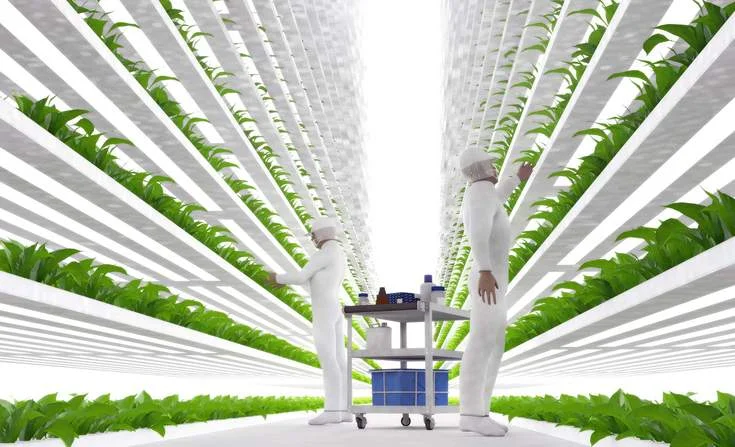
Growing leafy greens, specialty herbs, tomatoes and other produce indoors using hydroponics consumes up to 95 percent less water than growing them outdoors and uses fewer pesticides.
Even on Spaceship Earth, such technologies make a lot of sense. Growing leafy greens, specialty herbs, tomatoes and other produce indoors using hydroponics consumes up to 95 percent less water than growing them outdoors and uses fewer pesticides — sometimes none at all. Hydroponics has long been central to the Dutch and Japanese food systems, but the relatively cheap cost of land and water in the United States, combined with the costly energy intensity of lighting, made hydroponics too expensive for growing anything but high-value cash crops (such as cannabis).
That’s changing. Today, there is the new breed of indoor ag companies sprouting up all over, many using tricked-out shipping containers, LED lighting and a simple continuous-flow watering system. Environmental controls ensure that temperature, airflow, carbon dioxide, and humidity levels remain optimized.
In the East Ward neighborhood of Ironbound in Newark, New Jersey, for example, AeroFarms built the world’s largest vertical farm using aeroponics, in which racks of crops are grown indoors using neither soil nor water. Most of the seed money for the operation came from Goldman Sachs’s Urban Investment Group.
AeroFarms' 69,000-square-foot facility, in a former steel factory, can grow 2 million pounds of leafy greens annually, all without using a speck of dirt or a ray of sunlight. The company says the same seed that would take 30 to 45 days to grow in the field can grow in 12 to 16 days indoors, enabling up to 30 crop turns a year.
Rising tide
Operations such as AeroFarms are a perfect example of the need for a distributed network that can provide security and resilience in the face of societal shocks — in particular, extreme weather events.
Case in point: Most of the food that finds its way into New York City — cabbage from New York, oranges from California, blueberries from Chile, bell peppers from the Netherlands, beef from Australia, fish from Nova Scotia — passes through a single facility: the Hunts Point Food Distribution Center in the South Bronx. Opened in 1967, and home to 8,500 workers at 115 companies, it is the largest food market in the United States, feeding more than 23 million people throughout the region.
The million-square-foot facility is not just critically important, but also vulnerable. It sits on a peninsula with the East River on two sides and the Bronx River on the third and is subject to storm surge during high tides.
If Hurricane Sandy had hit 12 hours earlier, during high tide, the food supply for all five boroughs would have been disrupted.
In fact, if Hurricane Sandy had hit 12 hours earlier, during high tide, Hunts Point would have been flooded, the facility would have lost power and the food supply for all five boroughs would have been disrupted. As a result, AeroFarms offers an additional route to bring food into New York — food produced locally, indoors, year-round — enabling the region's food supply chain to be more adaptive to challenging circumstances.
It’s important to note that few of these operations rely on federal dollars or subsidies to grow their businesses. (As Haggerty notes, the 2018 U.S. Farm Bill allotted $10 million annually to develop an Office of Urban Agriculture and Innovative Production at the U.S. Agriculture Department, a pittance but a start. Among other things, it requires the ag secretary to conduct a census of urban, indoor and other emerging agricultural production sites). Indeed, when it comes to creating the new menu for how America grows and consumes food, Uncle Sam is largely absent from the table.
Instead, these companies were built by innovators and entrepreneurs chasing market opportunities, helped along by nonprofit and for-profit incubators, food aggregation and distribution centers catering to smaller operators, and local tax breaks for landowners who lend or lease their property to urban farmers.
And, of course, a healthy appetite for locally produced food that will only continue to grow.
For more on these topics, I invite you to follow me on Twitter, subscribe to my Monday morning newsletter, GreenBuzz, and listen to GreenBiz 350, my weekly podcast.
Topics: Food & Agriculture Climate Change Cities Risk & Resilience
Netherlands: Bankrupt 58 ha Organic Facility Acquired By Best Fresh
"The purchase is a logical next step for Best Fresh in its strategic development and brings an end to a period of uncertainty for employees and customers of A.C. Hartman", the companies say
Best Fresh has reached an agreement with the administrator handling the bankruptcy of greenhouse horticulture company A.C. Hartman on acquiring its assets. The 58-hectare greenhouse facility was declared bankrupt almost two weeks ago.
"The purchase is a logical next step for Best Fresh in its strategic development and brings an end to a period of uncertainty for employees and customers of A.C. Hartman", the companies say. "For many years, A.C. Hartman has been an absolute top performer in the greenhouse horticulture sector, growing cucumbers, tomatoes, and peppers for major customers in the Netherlands and abroad. Founded almost half a century ago, it recently encountered financial difficulties when its Belgian parent filed for the company’s bankruptcy."
Mart Valstar, the owner of Best Fresh, states: “We are delighted to have acquired the assets of A.C. Hartman. The company delivers quality products and is a welcome addition to our company, especially our organic foods division. With A.C. Hartman, we will be better able to meet the needs of customers who want direct delivery.”
End of a turbulent period
Kenaad Tewarie, acting director of A.C. Hartman, says: “We are now reaching the end of a turbulent period. We have guided the company through a process of restructuring and bankruptcy ultimately became unavoidable in order to ensure a healthy future. Best Fresh will benefit from a great company with motivated employees, high-quality products and loyal customers. Everyone involved deserves this fresh start with a strong new owner.”
During the takeover talks, which started after the bankruptcy order on 1 November, the grower of cucumbers, peppers, and tomatoes 'just' continued to grow on the full 58 hectares. "A big advantage, which made a quick restart possible", says curator Hillie Lunter the day after the news about the restart. "Best Fresh has taken over the assets, i.e. the real estate such as the glass stands and all movable property such as machines and suchlike, and can make a fresh start.
Ongoing investment
The bankruptcy has not yet ended. "After a period of intensive acquisition discussions, we are now going to investigate the causes of the bankruptcy. In accordance with the rules, I will make an initial report within four weeks, followed by an update every three months." And of course, the creditors will also be listed. "Best Fresh isn't a part of this", assures Lunter.
Acquintancy
Over the next few weeks, Best Fresh will acquaint itself with the staff, customers, and methods of cultivation. As a result of the takeover, the import and export company will become the owner of a large nursery, as spokesman Dick Braakhekke, on behalf of Best Fresh, has stated. "That's what the company wanted and with Hartman, the opportunity arose."
The aim is to continue the company as far as possible in its current form, retaining jobs and preserving the sense of community and pride in Friesland. Currently, under administration, A.C. Hartman employs 70 permanent staff and supplies such leading names as Bakker Barendrecht and Albert Heijn.
Ongoing delivery
The 'normal delivery' of the customers will continue via Hartman. "With the advantage that Best Fresh can also be used to deliver directly to retailers if customers want to," said Braakhekke. The management of Best Fresh did not want to go into further details yet. "The ink has just dried." In the coming period, it will have to become clear what investments will be made.
Financial information about the takeover of assets will not be released.
Publication date: Thu 14 Nov 2019

Jeff Bezos-Backed Vertical Agriculture Startup Plenty ‘Hibernates’ Plans For Seattle Farm
The indoor agriculture startup backed by high-profile tech executives — including Amazon CEO Jeff Bezos — has canceled plans to open a major Seattle-area farm, GeekWire learned this week
By inventiva - November 15, 2019
Plenty Is Rethinking Its Growth Strategy
The indoor agriculture startup backed by high-profile tech executives — including Amazon CEO Jeff Bezos — has canceled plans to open a major Seattle-area farm, GeekWire learned this week. Plenty said it changed plans because the Kent, Wash., facility could no longer accommodate its next-generation vertical farm. The company is continuing to grow in its home state of California but has no plans in the immediate future to launch a farm in Washington.
“We decided that the best course of action would be to hibernate Seattle,” said Christina Ra, Plenty’s senior director of integrated marketing.
In the two years since announcing plans to build a 100,000 square-foot vertical farm in the Seattle region, Plenty developed Tigris, a new facility near its San Francisco headquarters. Tigris is too tall to fit in the Kent facility that Plenty leased in 2017, according to Ra.
“As a relatively lean company, we had to just make a decision about where we were going to put our focus and we felt like building Tigris, while also focusing on Seattle as a new and really important market, was something that we couldn’t do well,” Ra said.
Plenty grows its plants in tall towers inside a climate-controlled facility with LED lights. It does not use pesticides, herbicides, synthetic fertilizers, or GMOs. The system uses thousands of infrared cameras and sensors to collect data in the farms that is analyzed using machine learning to optimize growth.
The five-year-old startup promises its new Tigris farm can produce fruits and vegetables using less than 5 percent of the water and 1 percent of the land required in traditional agriculture.
It’s a prospect that has attracted some of the biggest names in tech. Backers of the company’s last fundraising round include SoftBank (via its Vision Fund); Alphabet Chairman Eric Schmidt (through Innovation Endeavors); Bezos (through Bezos Expeditions); DCM Ventures; Data Collective; Finistere Ventures; and Louis Bacon. Plenty has raised more than $200 million in venture funding.
Ra said Plenty ceased operations in Kent a year ago. Some employees were given the opportunity to relocate to San Francisco. Today, none of the employees who worked in Kent are still with Plenty. Ra said it is unlikely that Plenty will circle back to the Kent facility but the company still maintains its lease on the building.
Last month, Plenty announced plans to open a next-generation farm in Los Angeles. With the Seattle-area operation defunct, LA will be Plenty’s first expansion beyond its home markets in South San Francisco and Wyoming.
“Seattle’s still on our roadmap,” Ra said. “It’s a really important market for us. It was just a decision we had to make to prioritize and focus as a small company and the limited resources that we had.”
Indoor farming remains an untested industry with plenty of casualties.
Local Garden Vancouver, a similar crop-yielding greenhouse concept, declared bankruptcy a few years ago. Another startup called Aerofarms pledged to build 25 indoor farms over five years in 2015. To date, it has only built one farm outside its headquarters, according to Fast Company. Other startups in the space have struggled over the years.
Source: Geek Wire

US: Pennsylvania - Indoor Aquaponics Farm To Bring Jobs (Plus Fresh Fish And Veggies) To Duquesne
Pittsburgh isn’t exactly known for its seafood. Not having a sea nearby slows us down a bit in that regard. This could change (well, no, we’re not getting a sea) if all goes according to plan for a new aquaponics farm in Duquesne.
Aquaponics farm. Rendering courtesy of In City Farms.
November 13, 2019
Pittsburgh isn’t exactly known for its seafood. Not having a sea nearby slows us down a bit in that regard.
This could change (well, no, we’re not getting a sea) if all goes according to plan for a new aquaponics farm in Duquesne.
“I’ve raised fish since I was a 12-year-old kid,” explains entrepreneur Glenn Ford, the Minnesota-based founder of In City Farms. What attracted Ford to aquaponics was the need for a different kind of food system that can reliably provide food in the year 2050 and beyond — no small challenge, given the potential impacts of climate change.
Ford plans to open his new indoor farm on vacant industrial land within Duquesne’s riverfront, and he expects to employ 130 people in the first phase. The second phase will employ 100 more, and a third phase is being planned.
In City’s building will be 180,000 square feet, and cost $30 million for the first phase.
“It’s going through permitting now,” says Ford. “We estimate that we’ll have this thing started in the spring.”
Here’s how it works: Aquaponics begins with raising edible fish (the Duquesne farm will likely include trout and Arctic char) in indoor pools. The fish are then sold commercially, and the waste stream from the water then fertilizes vegetables that are also grown indoors.
“Essentially, it takes the nutrient stream from fish and runs it through a biological filter which has a bunch of positive bacteria in it, much like the soil has,” Ford says. In the process, he explains, the bacteria eat away all the ammonia and turn it into nitrates that plants can consume.
Aquaponics farm in Duquesne. Rendering courtesy of In City Farms.
“There is a balance between the amount of fish you can raise and the plants that can be supported,” he says. “It’s a mathematical and scientific loop.”
Growing plants indoors under optimal conditions gives the region a source of produce all year long, beyond the typical outdoor growing season. Traditionally, restaurants that want to source ingredients locally have few options in the winter.
“We are predominantly focused on the wholesale trade,” Ford says. “But we’ll also sell to restaurants directly if they come to us with requests for things they can’t find in the market.”
Ideally, he says, the plants will be consumed within 20 or 30 miles from where they’re grown, lowering the carbon footprint.
The former Duquesne Steel Works site was chosen because it fits a profile of a community that industry has largely left behind. In City Farms has also purchased land in five other cities, says Ford.
“I come from inner cities and so do several of the people on my management team,” says Ford. “We’re looking at ways to give back. We’ll hire as many people as we can to fill those jobs from the community. There’s a pretty high percentage that can come from directly from Duquesne.”
The jobs will start at about $35,000 for entry-level and will include management positions.
Aquaponics farm in Duquesne. Rendering courtesy of In City Farms.
This is just one part of an effort called Food21, which imagines creating a thriving economy based around food in the region. It could involve creating jobs through food production and logistics.
The jobs aren’t the byproduct of this venture — they’re the whole point: “This is a catalyst to use food to employ people and give them jobs,” says Ford.
“Obviously we have to run a successful business to keep employing people and keep the business growing,” he says. “In order to do that, products have to be produced that have market value at market rates. But it’s really an opportunity to look at the resources that are present inside a community, and to figure out how to turn those resources into opportunities.”
This isn’t the only high-tech non-traditional farm startup in the Mon Valley. Braddock has a robotic vertical farm in the works from tech firm Fifth Season.
ABOUT THE AUTHOR
City Design editor
Michael Machosky is a writer and journalist with 18 years of experience writing about everything from development news, food and film to art, travel, books and music. He lives in Greenfield with his wife, Shaunna, and 8-year old son.
Nature Fresh Farms Celebrates 20th Anniversary
On November 8th, 2019, Nature Fresh Farms celebrated its 20 years of growing with an anniversary event that marked a major milestone for the company along with the announcement of an exciting addition of a Group Retirement Plan to their existing benefits plan
On November 8th, 2019, Nature Fresh Farms celebrated its 20 years of growing with an anniversary event that marked a major milestone for the company along with the announcement of an exciting addition of a Group Retirement Plan to their existing benefits plan.
The special event was organized at their Phase 3 facility where 270 employees were present to commemorate the company’s 20 years of success. With everyone in high spirits and enjoying the afternoon event, General Manager, John Ketler, and CEO Peter Quiring, took the opportunity to extend their gratitude to all Nature Fresh Farm employees for their hard work and dedication over the last 20 years followed by the announcement that Nature Fresh Farms will be offering their employees a Group Retirement Plan.
The Group Retirement Plan allows employees to conveniently contribute to the plan through payroll deductions before tax is calculated. The amount is then matched by Nature Fresh Farms allowing employees to save more for their retirement and receive immediate tax relief from those savings. Nature Fresh Farms hopes this new benefit will help existing employees plan for their future but also act as an incentive attracting new hires since this benefit is uncommon within the industry.
“The 20th anniversary celebration gave us the perfect opportunity to express our appreciation to our employees by announcing the extension of their current benefits plan which now includes the Group Retirement Plan,” shared John Ketler, “Nature Fresh Farms most valuable asset is its employees and we want to help provide for our amazing team.”
Beginning as a buy and sell project in 1999, Nature Fresh Farms has transitioned into a large independent greenhouse produce growers in Canada. Within their 20 years of innovation and growth, Nature Fresh Farms has had many accomplishments including their recent 32-acre expansion bringing their total family-owned facilities to 200 acres advancing their operations to year-round growing in Leamington. They have taken significant steps to further integrate sustainability within their operations exemplified this year by the successful introduction of their new compostable cucumber trays.
Temasek Leads $50m Funding Round In US Indoor Farming Startup Bowery
“We are excited to share that Bowery’s third (and biggest) farm yet is launching in the DC-Baltimore area in early 2020. Along with this expansion, our team is elated to announce an additional $50 million in funding led by Temasek that will drive further innovation and scale across our organization,” it said on its Linkedin page
Southeast Asia India Greater China Rest of Asia World E-Commerce & Internet Economy Technology Real Estate and Infrastructure Financial Services Social Infrastructure Temasek leads $50m funding round in US indoor farming startup Bowery Farmers work at the Bowery Farming Inc.
indoor farm in Kearny, New Jersey. Photographer: David Williams/Bloomberg By Quynh Nguyen
November 7, 2019
Singapore state investor Temasek has led a $50-million Series B extension round for Bowery Farming Inc, a four-year-old startup that uses robotics to cultivate crops indoors.
“We are excited to share that Bowery’s third (and biggest) farm yet is launching in the DC-Baltimore area in early 2020. Along with this expansion, our team is elated to announce an additional $50 million in funding led by Temasek that will drive further innovation and scale across our organization,” it said on its Linkedin page.
Launched in 2015, Bowery is the modern farming company that uses robotics, LED lighting and data analytics to grow leafy greens indoors.
The company is currently operating two indoor farms in Kearny, New Jersey. Its new farm in Baltimore is around 3.5 times larger than the last, the company said.
The fresh funding brings the New York-based company’s total capital raised to $172.5 million. Last year, the indoor agriculture startup raised $90 million in Series B funding led by GV (formerly Google Ventures). Temasek, restaurateur David Barber’s Almanac Insights, and Uber CEO Dara Khosrowshahi joined the round.
Singapore-based investment firm Temasek last year participated in a $70-million Series B funding round in Pivot Bio, a US agriculture startup that combines machine learning and computational modeling to help microbes in providing plants with a daily supply of nitrogen, eliminating pollution in the process.
The round was led by Breakthrough Energy Ventures, a venture supported by billionaires.

Early History of Indoor Agriculture & Associated Technology Development
This month’s Indoor Ag Science Café was about the history and current technology status of indoor farming. The beginning seems to be in Syracuse, NY, where General Electric developed an indoor hydroponic farm funded by DoD in 1973
By urbanagnews
October 17, 2019
By Dr. Cary Mitchell (Purdue University)
This month’s Indoor Ag Science Café was about the history and current technology status of indoor farming. The beginning seems to be in Syracuse, NY, where General Electric developed an indoor hydroponic farm funded by DoD in 1973. Then there was a large commercial indoor farm for leafy greens in Dekalb, IL, owned by General Mills, which was closed in the 1990s. The longest survived may be the one in Japan (TS Farm by Kewpie Co.) where they use HID lamps and aeroponics since 1989. Most significant technological improvements are two ways – one in lighting and another in rack/shelving systems. Dr. Mitchell also introduced the contributions that NASA indoor farming studies made over the past 30+ years, as one of the contributors in the space.
Indoor Ag Science Café is supported by the USDA SCRI grant program and designed to create a precompetitive communication platform among scientists and indoor farming professionals. The Café presentations are available from YouTube channel. Contact Chieri Kubota at the Ohio State University (Kubota.10@osu.edu) to be a Café member to participate.