


Welcome to iGrow News, Your Source for the World of Indoor Vertical Farming

Our Cultural Need To Integrate Local Food Production And Artificial Intelligence
While we know that AI can be a force for positive change where, for instance, failures in food growth can be detected and where crops can be analyzed in terms of disease, pests, and soil health, we must wonder why food growth has been so divorced from our culture and social reality
September 14, 2019
Julian Vigo Contributor
Social Media I cover the anthropological intersections of tech, politics & culture.
Matt Barnard, chief executive officer and co-founder of Plenty Inc., speaks at the SoftBank World 2019 event in Tokyo, Japan, on Thursday 2019. Barnard said the company's high-tech approach to growing crops indoors results in plants that yield more without pesticides, use a fraction of water of their counterparts in the field and taste better, to boot. Photographer: Akio Kon/Bloomberg Photo credit: © 2019 Bloomberg Finance LP © 2019 BLOOMBERG FINANCE LP
The use of AI (artificial intelligence) in agriculture is not new and has been around for some time with technology spans a wide range of abilities—from that which discriminates between crop seedlings and weeds to greenhouse automation. Indeed, it is easy to think that this is new technology given the way that our culture has distanced so many facets of food production, keeping it far away from urban spaces and our everyday reality. Yet, as our planet reaps the negative repercussions of technological and industrial growth, we must wonder if there are ways that our collective cultures might be able to embrace AI’s use in food production which might include a social response to climate change. Similarly, we might consider if new technology might also be used to educate future generations as to the importance of responsible food production and consumption.
While we know that AI can be a force for positive change where, for instance, failures in food growth can be detected and where crops can be analyzed in terms of disease, pests, and soil health, we must wonder why food growth has been so divorced from our culture and social reality. In recent years, there has been great pushback within satellite communities and the many creations of villages focussed upon holistic methods of food production. Indeed, RegenVillages is one of many examples where vertical farming, aquaponics, aeroponics and permaculture are part of this community's everyday functioning. Moreover, across the UK are many ecovillages and communities seeking to bring back food production to the core of social life.
Lammas is one such ecovillage which I visited seven years ago in Wales which has, as its core concept, the notion of a “collective of eco-smallholdings working together to create and sustain a culture of land-based self-reliance.” And there are thousands of such villages across the planet whereby communities are invested in working to reduce their carbon footprint while taking back control of their food production. Even Planet Impact’s reforestation programs are interesting because the links between healthy forests and food production are well known as are the benefits of forest gardening which is widely considered a quite resilient agroecosystem. COO & Founder of Planetimpact.com, Oscar Dalvit, reports that his company’s programs are designed to educate as much as to innovate: “With knowledge, we can fight climate change. Within the for-profit sector, we can win this battle.” Forest gardening is a concept that is not only part of the permaculture practice but is also an ancient tradition still alive and well in places like Kerala, India and Martin Crawford’s forest garden in southwest England where his Agroforestry Research Trust offers courses and serves as a model for such communities across the UK.
But how can AI help to make sustainable and local farming practices over and above industrial agriculture? Indeed, one must wonder if it is possible for local communities to take control of their food production. So, how can AI and other new tech interfaces bring together communities and food production methods that might provide a sustainable hybrid model of traditional methods and innovative technology?
We know already that the IoT (internet of things) is fast becoming that virtual space where AI is being implemented to include within the latest farming technology. And where businesses invested in robotics are likewise finding that there is no ethical implementation of food technology, we must be mindful of how strategies are implemented which incorporate the best of new tech with the best of old tech. Where AI is helping smaller farms to become more profitable, all sorts of digital interfaces are transmitting knowledge, education and the expansion of local farming methods. This means, for instance, that garden maintenance is continued by others within the community as some members are absent for reasons of vacation or illness. Together with AI, customer experience is as much a business model as it is a local community standard for communication and empowerment.
The reality is that industrial farming need not take over local food production and there are myriad ways that communities can directly respond to climate change and the encroachment of big agriculture. The health benefits of local farming practices are already well known as are the many ways that smartphone technology can create high-yield farms within small urban spaces.
It is high time that communities reclaim their space within urban centers and that urban dwellers consider their food purchasing and consumption habits while building future sustainability which allows everyone to participate in local food production. As media has recently focussed upon AI and industrial farming, we need to encourage that such technology is used to implement local solutions that are far more sustainable and realistic instead of pushing big agriculture.
Follow me on Twitter or LinkedIn. Check out my website or some of my other work here.
I am an independent scholar and filmmaker who specializes in anthropology, technology, and political philosophy. My latest book is "Earthquake in Haiti: The Pornography of Poverty and the Politics of Development" (2015) and I am a contributor to Quillette, TruthDig, Dissident Voice, Black Agenda Report, The Morning Star, The Ecologist, HuffPost UK and CounterPunch.
New Jersey: Riker Danzig Digs In At Urban Farm
Grow It Green Morristown is an earth-friendly community organization with a mission to create sustainable farms and gardens. Its goal is to provide access to fresh, local food and educate communities through programs focused on healthy eating and environmental stewardship
From left are Silva Dechoyan, Meagan Buckle, Collette Vassallo, Hayley Meigh, A.J. Banks, Anne Shulman, Rita Janson, Lynn Madden, Iryna Kastsiuk, Nora Juzefyk, Benjamin Gehlbach and Richelle Delavan of the law firm Riker Danzig Scherer Hyland & Perretti. The law firm pitched in to help Grow It Green Morristown to prepare for the fall season
September 15, 2019
MORRISTOWN - The Morristown-based law firm Riker Danzig Scherer Hyland & Perretti teamed up with Grow It Green Morristown for a volunteer event at the Urban Farm on Hazel Street on Tuesday, Sept 10.
Riker Danzig employees were given the afternoon off to assist with preparations for the fall growing season. The Urban Farm is New Jersey’s largest public school garden and is managed by a small staff, part-time interns and community volunteers.
Riker Danzig partner Jeffrey M. Beyer, an insurance litigator and board member of Grow it Green Morristown, coordinated the volunteer day at the Urban Farm in Morristown.
A group of 12 Riker Danzig volunteers comprising attorneys, paralegals, and administrative staff weeded and cleared garden beds and compost, weighed and bundled fresh radishes, harvested hops, and even fed the chickens, all under the direction of Grow It Green’s Director of Agriculture and Education, Shaun Ananko, and Assistant Farmer, Megan Phelan, otherwise known as “Farmer Shaun” and “Farmer Megan.”
Grow It Green Morristown is an earth-friendly community organization with a mission to create sustainable farms and gardens. Its goal is to provide access to fresh, local food and educate communities through programs focused on healthy eating and environmental stewardship.
For more information on Grow it Green Morristown, go to growitgreenmorristown.org.

LA & 8Minute Solar Ink Lowest Cost Solar-Plus-Storage Deal In US History
The Los Angeles Department of Water and Power has signed a groundbreaking 25-year power purchase agreement with 8Minute Solar. The deal will make possible the largest municipal solar plus storage facility in the US
September 11th, 2019 by Steve Hanley
The Los Angeles Department of Water and Power has signed a groundbreaking 25-year power purchase agreement with 8Minute Solar. The deal will make possible the largest municipal solar plus storage facility in the US. But the best part is the combined price for solar energy plus storage is just 3.3 cents per kilowatt-hour, the lowest ever in the US and cheaper than electricity from a natural gas-powered generating plant.
Credit: 8Minute Solar
The electricity will come from a massive solar power plant located on 2000 acres of undeveloped desert in Kern County, just 70 miles from the city. Known as the Eland Solar and Storage Center, it will be built in two stages of 200 MW each, with the first coming online in 2022 and the second phase scheduled to be switched on the following year.
Los Angeles DWP will take 375 MWac of solar power coupled with 385.5 MW/1,150 MWh of energy storage, according to PV Magazine. Neighboring Glendale Water and Power will take 25 MWac of solar plus 12.5 MW/50 MWh of energy. The electricity from Eland I and II is expected to meet between 6 and 7% of Los Angeles’ needs, according to PV Magazine.
The Eland Solar & Storage Center has been engineered by 8minute to provide fully dispatchable power under control of the LA DWP to meet its customers’ demands with reliable and cost-effective power — a capability previously reserved for large fossil fuel power plants. Eland’s ability to provide fully dispatchable power for less than the traditional cost of fossil fuels effectively positions solar PV as an attractive candidate to be the primary source of California’s 100% clean energy future.
In case you didn’t know, the company takes its name from the amount of time it takes the sun’s rays to reach the Earth at the speed of light. In an e-mail to CleanTechnica, Jeff McKay, VP of marketing for the company, says, “Today was a big win for the city of Los Angeles, the people of California and the renewable energy industry as well.
“The project offers a glimpse of the future, with zero-carbon sources providing energy cheaper than fossil fuels to households throughout Los Angeles and the San Fernando Valley — at the lowest combined solar and storage prices on record. While further final regulatory approval is still needed, today was a big step in ensuring this project becomes a reality, and we feel very strongly that this project is a win-win for everyone involved.”
The Eland PPA was supposed to close a few months ago, but the IBEW local that represents the workers at the city-operated natural gas power plants complained their needs were not being addressed properly. It now appears those concerns have been addressed, according to the LA Times.
If the transition to renewable energy is to take place in an orderly and expeditious fashion, it is vital that the needs of workers in legacy industries not be ignored and that positive steps are taken to protect the interests of those who will feel the economic impact of the changes coming for the utility industry.
Tags: 8Minute Energy, Eland Solar, and Storage Center, Los Angeles Department of Water and Power
About the Author
Steve Hanley Steve writes about the interface between technology and sustainability from his home in Rhode Island and anywhere else the Singularity may lead him. His motto is, "Life is not measured by how many breaths we take but by the number of moments that take our breath away!" You can follow him on Google + and on Twitter

Explore Future of Food In Virtual Reality At University of Cambridge Festival of Ideas
Did you know that only 20 per cent of the fish we harvest each year actually ends up in our stomachs? Now Natural Machines is using its Foodini 3D printing technology to create an edible product from offcuts that would otherwise be wasted
By Paul Brackley- paul.brackley@iliffemedia.co.uk
08 September 2019
Did you know that only 20 percent of the fish we harvest each year actually ends up in our stomachs?
Now Natural Machines is using its Foodini 3D printing technology to create an edible product from offcuts that would otherwise be wasted.
Future Kitchen VR workshop in the Botanic Garden's classroom, Esme Booth with a device being placed on Emanuel Bernardo. Picture: Keith Heppell. (15994444)
And, in an immersive virtual reality video that you can see at the University of Cambridge’s Festival of Ideas, you can go inside the 3D printer as it operates.
It is one of an extraordinary series of food technology videos released on FoodUnfolded.com, created by an international team involving the university.
Designed to show how food tech can improve the sustainability of our food and transform ways it is produced, the series of videos in the ‘Future Kitchen’ project gives viewers a 360-degree, fully immersive experience that makes them feel like they are part of the story
.Dr Holly T Kristinsson, consultant for innovation and market analysis at Matis and co-ordinator of the Future Kitchen project, says: “We are trying to explore the potential of virtual reality to connect people with food tech more effectively.
“With consumer trust in the food system at an all-time low, we need to step up, reconnect with people and inspire them.”
Another video explores how farmers in Iceland are able to grow tomatoes despite the sub-zero temperatures outside. Viewers get to look around the greenhouses, powered by geothermal or hydropower energy. Bees are brought in to pollinate the tomato plants - and no pesticides are required.
“When we are using the bees, we get something like a 90-95 per cent yield from the plants, which is an enormous increase from a farmer’s point of view,” horticulturalist and biologist Guðríður Helgadóttir tells viewers.
A third video explores Plantcube, an intelligent vertical farming system for the home, created by Agrilution.
The German company was founded by Max Loessl and mechatronics engineer Philipp Wagner to bring the freshest vegetables, salads and herbs to the home, grown without pesticides and as close and to the place of consumption as possible. The Plantcube - which will set you back 2,979 euros - provides an indoor garden for growing lettuce, microgreens and herbs on eight ‘fields’, with automated watering, optimal LED lighting and sensor-based climate control.
Future Kitchen VR workshop in the Botanic Garden's classroom, Esme Booth with a device. Picture: Keith Heppell. (15994450)
This vertical farming system even notifies you via an app of the perfect time to harvest to your food.
The VR project is funded by EIT Food, Europe’s leading food innovation initiative, and is a response to the need to connect, and reconnect, people with food.
While technology in a food context tends to have negative connotations among the public, the series aims to show how it can be used to improve sustainability.
The makers believe it could act as a pilot for the food industry to help engage consumers as well as entice those interested in food-related careers.
Further videos are coming, which will introduce viewers to future kitchen devices, explore the origin of food, robotics, metabolomics, personalised nutrition, macro and micro algae processing and novel food processing, including how alternative proteins are made.
Regular focus group lunchtime sessions are being held in Cambridge where visitors can view the videos and share their thoughts.
After watching the Foodini video, one University of Cambridge student said: “I never knew how 3D printing food worked, and to be immersed in the whole process is fascinating.”
And at the Festival of Ideas - supported by the Cambridge Independent once more this year - two sessions will be held at the Alison Richard Building on West Road on Saturday October 19 to introduce members of the public to the videos. Bookings open on September 23.
High-Performance Applications And Latest Innovations: 8th Biocomposites Conference Cologne
Biocomposites offer excellent possibilities for replacing and supplementing conventional plastics without sacrificing quality and processing. New attractive properties can be achieved for the products such as special optics and haptics, and also stiffness and strength
Internet | Registration | Conference Leaflet
14-15 November 2019, Cologne, Germany
Biocomposite granulates can offer more sustainable materials with a lower environmental footprint. Additionally, biocomposites can offer special properties such as higher stiffness and strength.
The world is looking for a new solution to replace and reduce petrochemical plastics. The session “WPC and NFC Granulates for Injection Moulding, Extrusion and 3D Printing” presents ready to use granulates for a broad range of applications: cellulose and wood fiber or cork granulates for toys, consumer goods and even in space applications.
Kraft Lignin is combined with corn cobs, hemp fibers with PP as well as different PLA compounds. Please take a look at the programs below and find out what biocomposite granulates can offer you to make a difference in optic, haptic, environmental footprint and marketing image
In session "High-performance Applications and Latest Innovations", high-performance applications of biocomposites will be presented that would hardly have been possible just a few years ago. The focus is on excellent mechanical properties and lightweight construction, achieved through new biopolymers, optimized natural fibers, and new process paths. The areas of application include structural components from the automotive and construction sectors:
Elizabeth Eaves, Avantium Renewable Polymers (NL): Humins – A Novel and Versatile Raw Material for Bio-based, Sustainable Composites - Abstract here
Werner Klusmeier, Yanfeng Automotive Interiors (CN/DE): Application of Natural Fibre Materials in the Interior of a Car - Status and Development
Daniel Lang, CORDENKA (DE), Dirk Punke, BÜFA Thermoplastic Composites (DE): Cordenka Cellulose Fibres – Properties and Opportunities in Plastic Reinforcements - Abstract here
Heidi Peltola, VTT Technical Research Centre of Finland (FI): Improving the Performance of Wood Fibre Reinforced PLA Biocomposites - Abstract here
Martin Zahel, Papiertechnische Stiftung (DE): Functionalization of Cellulosic Fibres via Reactive Extrusion - Abstract here
Nina Graupner, Hochschule Bremen - University of Applied Sciences (DE): Natural Fibre-reinforced Composites for Structural Applications Based on Novel Low Twisted Bast Fibre Yarns - Abstract here
Per Brynildsen, Kebony (NO): Kebony - A Sustainable Technology for Exterior Wood Products
Peter Ooms, Lorenz Kunststofftechnik (DE): Newly Developed Thermosets with Natural Fibre Reinforcement Lower Production Costs
Full programme here.
Have you considered to book a booth? You find information on the exhibition here. Experience shows that the exhibition is booked out very quickly.
If you will come with some colleagues and book a booth, sponsoring can be a very attractive option! You are welcome to benefit from the high innovative business environment as a sponsor of the Biocomposites Conference.
Last but not least, producers and inventors of innovative, new applications for Biocomposites are invited to hand in their applications for the innovation award “Biocomposite of the Year 2019" - sponsored by Coperion - until end of September.Biocomposites offer excellent possibilities for replacing and supplementing conventional plastics without sacrificing quality and processing. New attractive properties can be achieved for the products such as special optics and haptics, and also stiffness and strength.
According to the new studies, more than half of the population is willing to spend more money on sustainable products. Our programme shows how these can be properly marketed in different application areas. The latest technologies and materials will be presented in the conference programme. You can find the preliminary programme here:
1st Day, 14 November 2019
Market & Policy
Michael Carus, nova-Institut (DE): Market Trends in the Bioeconomy, Bio- and CO2-based Polymers and Renewable Carbon
Asta Partanen, nova-Institut (DE): Market Development, Volume and Trends of Biocomposites
Joanna Bogdanska, Third Eye Design Joanna Bogdanska (DE): How to Sell Sustainability - Abstract here
Packaging
Sebastian Meyer, Golden Compound (DE): Sunflower Seed Shells: A Unique Rawmaterial for Biocomposites - Abstract here
Maija Pohjakallio, Sulapac (FI): Material Innovations that Leave no Microplastics Behind - Abstract here
Anselm Wohlfahrt, Institut für Holztechnologie Dresden (DE): Mushroom-based Material as a Plastic Alternative - Abstract here
Sustainability
Michael Carus, nova-Institut (DE): Sustainability of Natural Fibres and Biocomposites
Hans Korte, DR. HANS KORTE Innovationsberatung Holz & Fasern (DE): How the Environment Benefits from a Wood-based Composite Nail Compared to a Steel Nail - Abstract here
Hanaa Dahy, BioMat at ITKE / University of Stuttgart (DE): Re-thinking Sustainability in the Building Industry: BIO-Materialisation & Digitalisation - Abstract here
Ana Ibánez Garcia, AIJU-Technological Institute for Children`s product and leisure (ES): Let`s Play to be more Sustainable - Abstract here
Lisa Wikström, VTT Technical Research Centre of Finland (FI): Biocomposites in Circular Economy - Abstract here
Award Introduction
Levin Batschauer, Coperion (DE): Processing of Bio-based and Biodegradable Products - Sustainable Compounding Co-rotating Twin Screw Extruders - Abstract here
2nd Day, 15 November 2019
Wood-polymer Composites (WPC)
Arne Schirp, Fraunhofer WKI (DE): How Durable are Extruded Wood-polymer Composite (WPC) Sidings with Fire-retardants? – Reaction-to-fire Performance of WPC before and after Artificial Weathering - Abstract here
Jürgen Leßlhumer, Kompetenzzentrum Holz (AT): Weathering-resistant Powder Coating of WPC – Challenges and Results - Abstract here
High-performance Applications and Latest Innovations
Werner Klusmeier, Yanfeng Automotive Interiors (CN/DE): Application of Natural Fibre Materials in the Interior of a Car - Status and Development
Daniel Lang, CORDENKA (DE), Dirk Punke, BÜFA Thermoplastic Composites (DE): Cordenka Cellulose fibres – Properties and Opportunities in Plastic Reinforcements - Abstract here
Heidi Peltola, VTT Technical Research Centre of Finland (FI): Improving the Performance of Wood Fibre Reinforced PLA Biocomposites - Abstract here
Martin Zahel, Papiertechnische Stiftung (DE): Functionalization of Cellulosic Fibres via Reactive Extrusion - Abstract here
Nina Graupner, Hochschule Bremen - University of Applied Sciences (DE): Natural Fibre-reinforced Composites for Structural Applications Based on Novel Low Twisted Bast Fibre Yarns - Abstract here
Elizabeth Eaves, Avantium Renewable Polymers (NL): Humins – A Novel and Versatile Raw Material for Bio-based, Sustainable Composites - Abstract here
Per Brynildsen, Kebony (NO): Kebony - A Sustainable Technology for Exterior Wood Products
WPC and NFC Granulates for Injection Moulding, Extrusion and 3D Printing
Ralf Ponicki, UPM Biocomposites (FI): UPM Formi; Successful Replacement of Fossil Based Plastics by Using Sustainable Formi Products Based on Cellulose Fiber
Dirk Zimmermann, Amorim (DE): Biocomposite Innovation with Natural Cork - Natural Born Technology with AMORIM - Abstract here
Jeremiah Dutton, Trifilon (SE): Trifilon Biocomposites – Advancing Sustainability & Performance with Hemp Fibres - Abstract here
Florian Graichen, Scion (NZ): BioLite, This Swedish Company is Calling it a ‘Second Generation Biocomposite’ - Abstract here
Andreas Haider, Kompetenzzentrum Holz (AT): PLA/PHA Bio-based Blends for Injection Molding and 3D Printing Process - Abstract here
Gary Chinga Carrasco, RISE PFI (NO): Biocomposites for 3D printing – Bioplastics and the Reinforcement Potential of Lignocellulosic Fibres and Lignin - Abstract here
Amélie Tribot, Université Clermont Auvergne, CNRS (FR): Valorization of Kraft Lignin and Corn Cob by-Products into PLA-Matrix based Biocomposites: Characterization of Injected-molded Specimens - Abstract here
Franck Baradel, Omya International (CH): Enhancing Biopolymer Biocomposites with Functional Minerals
Have you considered to book a booth? You find information on the exhibition here. Experience shows that the exhibition is booked out very quickly.
If you will come with some colleagues and book a booth, sponsoring can be a very attractive option! You are welcome to benefit from the high innovative business environment as a sponsor of the Biocomposites Conference.
Last but not least, producers and inventors of innovative, new applications for Biocomposites are invited to hand in their applications for the innovation award “Biocomposite of the Year 2019" - sponsored by Coperion - until end of September.
Your nova-Conference Team

RoBotany Builds 60,000-Square-Foot Vertical Farm In Braddock, Plans Nationwide Expansion As Fifth Season
The company's first urban farm, incubated at Carnegie Mellon University, uses proprietary robotics technology to grow affordable fresh produce for Pittsburgh-area grocery stores and restaurants
The company's first urban farm, incubated at Carnegie Mellon University, uses proprietary robotics technology to grow affordable fresh produce for Pittsburgh-area grocery stores and restaurants
NEWS PROVIDED BY Fifth Season
September 24, 2019
PITTSBURGH, Sept. 24, 2019,/PRNewswire/
Fifth Season, an indoor farming pioneer, announced plans for its first highly efficient, commercial-scale indoor vertical farm, which will open in early 2020 in Braddock, a historic steel town near Pittsburgh.
Fifth Season, originally founded as RoBotany Ltd., is a consumer-focused technology company that was incubated at Carnegie Mellon University's (CMU) Swartz Center for Entrepreneurship—an alliance of CMU's business, robotics, and other schools focused on fostering innovation. The company has raised over $35 million to date led by Drive Capital and other private investors with close ties to CMU. Its leadership team has deep expertise in plant science, robotics, AI and systems engineering.
Austin Webb, Fifth Season's co-founder, and CEO
Austin Webb, Fifth Season's co-founder, and CEO said the company's 60,000-square-foot Braddock farm will set a new vertical agriculture standard for efficient, safe and sustainable production of pesticide-free leafy greens and herbs in urban communities.
Fifth Season developed and perfected its technology with two R&D vertical farms in Pittsburgh's South Side neighborhood. Their leafy greens have been sold at local retailers, such as Giant Eagle and Whole Foods Market, along with popular Pittsburgh restaurants Superior Motors, honeygrow and Kahuna.
Produce from the flagship production farm coming to Braddock will also be available in Pittsburgh-area grocery stores and restaurants.
"The goal through our first three years of development was to prove we could bring fresh food to urban customers at prices competitive with conventionally grown produce," Webb said.
"We have developed fully integrated, proprietary technology to completely control the hydroponic growing process and optimize key factors such as energy, labor usage and crop output," Webb added. "The result is a vertical farm design that has over twice the efficiency and grow capacity of traditional vertical farms. Our unprecedented low costs set a new standard for the future of the industry."
Webb said the Braddock farm's ideal growing environment will deliver perfect, pure produce, in any season. It will produce over 500,000 pounds of lettuce, spinach, kale, arugula and herbs from its 25,000-square-foot grow room during the first full year of operation. The facility is partially solar-powered and requires 95 percent less water compared to traditional growing operations.
Webb said the company is planning a staged expansion in additional, similar-sized cities across the U.S.
Photos and graphics to accompany this announcement can be downloaded at this link: https://www.dropbox.com/sh/8ucvpnvlln10o7x/AADzxmH2iA3rr9LGNO_BrMc1a?dl=0
Contact:
Grant Vandenbussche, Fifth Season (248) 240-4694, grant@robotany.ag
or
Michele Wells, Wells Communications (303) 417-0696 or mwells@wellscommunications.net
SOURCE Fifth Season

Can Indoor Farming Surmount Agriculture’s Biggest Challenges?
Ten shipping containers dominate a corner of the Brooklyn parking area, each full of climate control tech, growing herbs that are distributed to local stores on bicycles. This is urban farming at its most literal
Russell Hotten | BBC | September 9, 2019
A car park opposite the infamous New York City housing estate where rapper Jay-Z grew up seems an unlikely place for an agricultural revolution.
Ten shipping containers dominate a corner of the Brooklyn parking area, each full of climate control tech, growing herbs that are distributed to local stores on bicycles. This is urban farming at its most literal.
The containers are owned by Square Roots, part of America’s fast-expanding vertical farming industry ….
The world’s best basil reputedly comes from Genoa, Italy. Square Roots grows Genovese seeds in a container that recreates the city’s daylight hours, humidity, Co2 levels – and all fed hydroponically in nutrient-rich water.
“Rather than ship food across the world, we ship the climate data and feed it into our operating system,” says co-founder Tobias Peggs.
Related article: Viewpoint: Why grow GMO crops? Because they cut pesticide use 37%
An artificial intelligence expert, Mr Peggs founded Square Roots with investor Kimball Musk (Elon’s brother) two years ago. They’ve signed a deal with one of America’s big distribution companies, Gordon Food Service, to locate herb-growing containers at some its 200 warehouses.
He says the deal represents everything about indoor farming’s potential: locally grown, quick-to-market, fresh produce that can be harvested year-round and is free of pesticides and not affected by harsh weather.
Read full, original article: The future of food: Why farming is moving indoors
Urban Farms Are Sprouting Up All Over NYC
You might be thinking that farms and New York City go together like good pizza and rural Iowa. But the city’s farm history dates to its founding. Orchard Street was once an actual orchard and in the 17th century, the Bowery was called Bouwerij, the Dutch word for farm. Today, farming in the Big Apple is making a big comeback
Adam Walker, programs coordinator at The Battery Conservancy, hits the dirt at Battery Urban Farm. Tamara Beckwith/NY Post
By Tim Donnelly
September 6, 2019 | 5:19pm
September has hit New York, and that means the air is getting cooler, the subways are getting slightly less sweaty and we can all resume arguing whether pumpkin-flavored things are good. It’s the time of year that makes us start thinking of farm life, getting the flannel out of the closet and hitting a hayride.
You might be thinking that farms and New York City go together like good pizza and rural Iowa. But the city’s farm history dates to its founding. Orchard Street was once an actual orchard and in the 17th century, the Bowery was called Bouwerij, the Dutch word for farm. Today, farming in the Big Apple is making a big comeback.
You just have to look around a little — or sometimes, look up — to find it. A new wave of urban farms are inviting city dwellers to get back to their roots, literally, this fall, and teach all of us why vibrant green space is so necessary in the growing city. Here’s how New Yorkers can get dirty — in a good way — and get some hyper local produce without leaving the five boroughs.
Battery Urban Farm
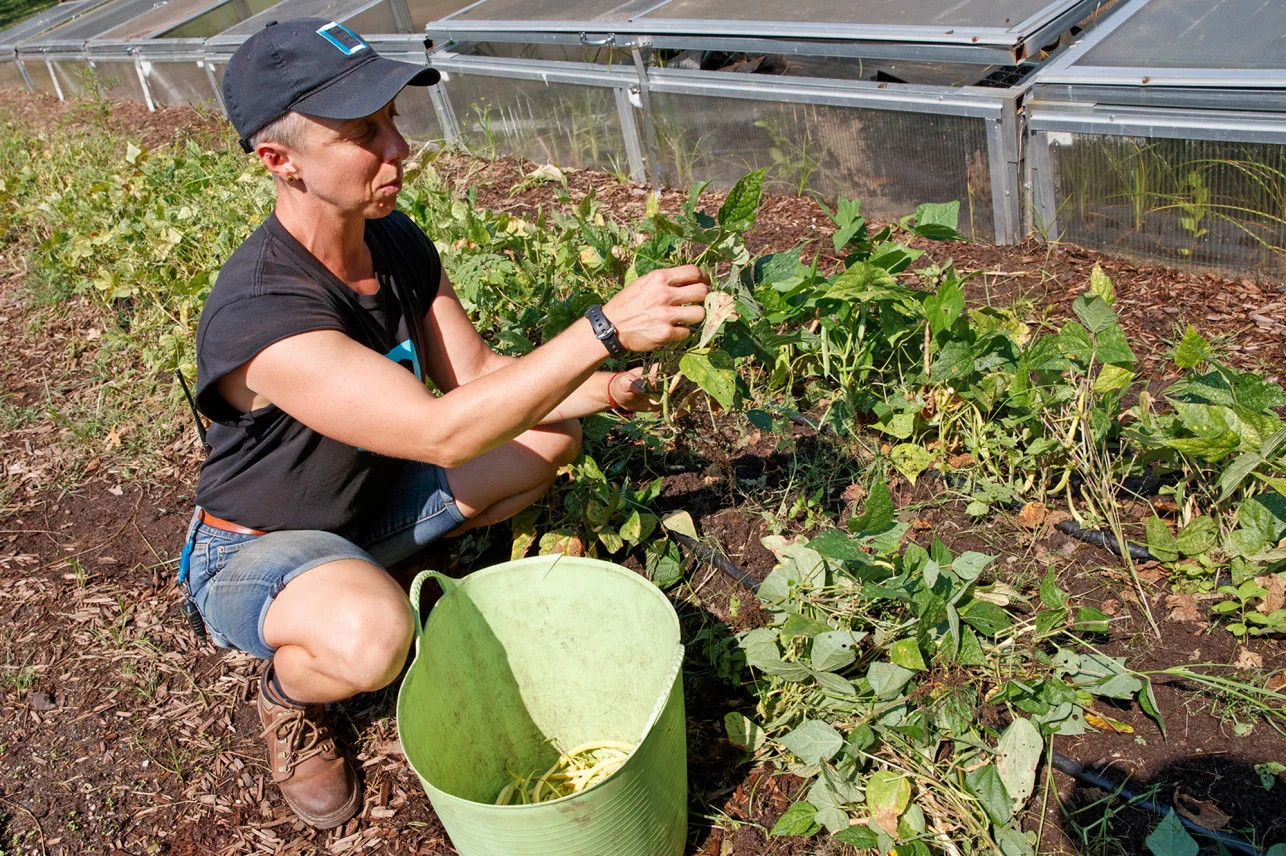
Tamara Beckwith/NY Post
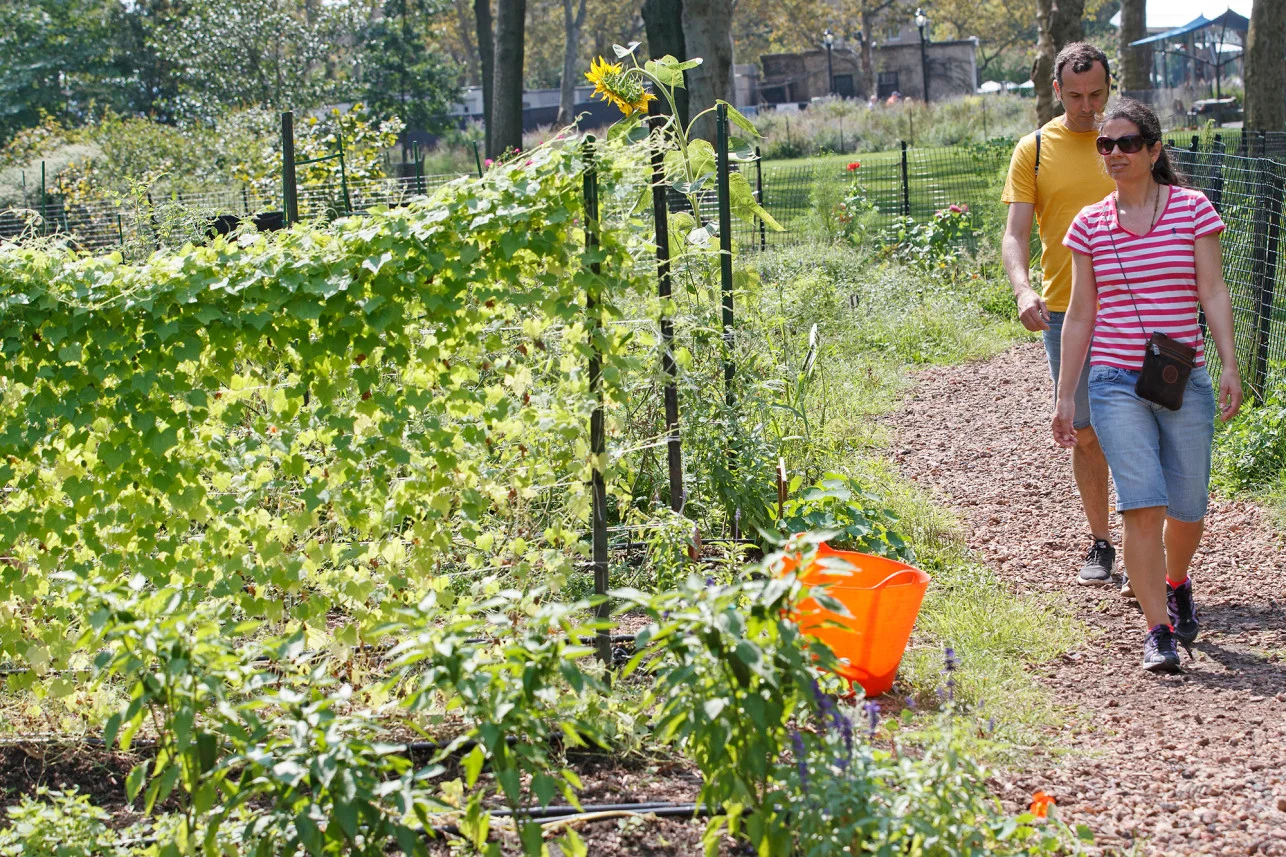
The farmers on this patch of parkland nestled in the southern tip of Manhattan have to deal with something even their most seasoned rural counterparts don’t encounter: shadows from skyscrapers. The hidden little garden hosts about 40 rows of plant beds, sprouting tomatoes, peas, kale, radishes, carrots, herbs, sweet peppers and more. The farm opened in 2011 and is tended weekly by a team of volunteers, but its open gates welcome in lots of tourists on their way to catch the ferry to the Statue of Liberty.
Mary Beth Rogan started volunteering at the farm last year after moving from, appropriately, Garden City, LI, to Tribeca and realizing she missed her home garden. She’s retired and finds peace at the space, even when she’s just pulling weeds out of one of the vegetable beds as noisy tour buses roar by the park.
“I love being in the dirt,” she says. “There’s a sense of tranquility, of being connected to the earth, to the world.”
The site is also a teaching garden for city students; a few get their own patch of land to tend in the park. The veggies grown here are served to kids, and donated to local charities. State Street and Battery Place, open every day; check Web site for volunteer opportunities
Brooklyn Grange Sunset Park
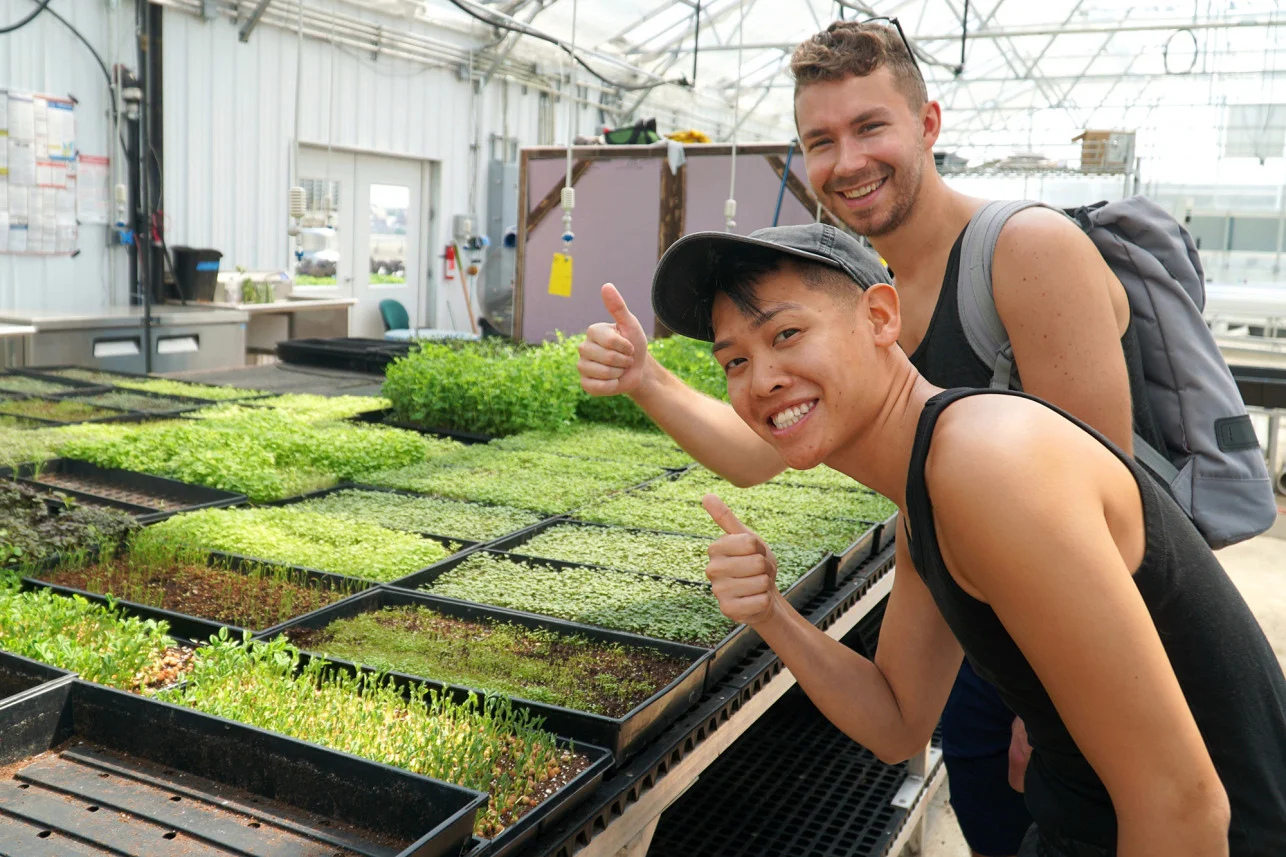
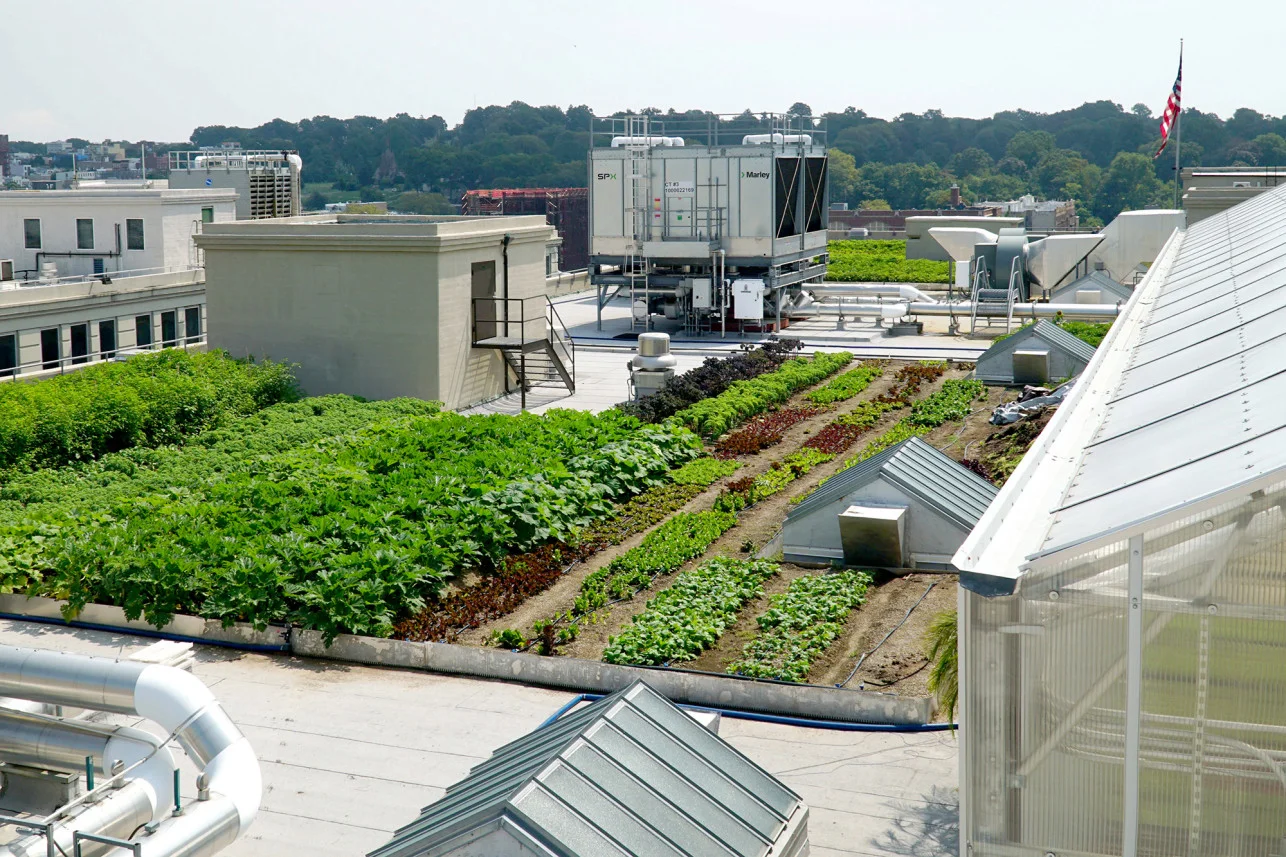
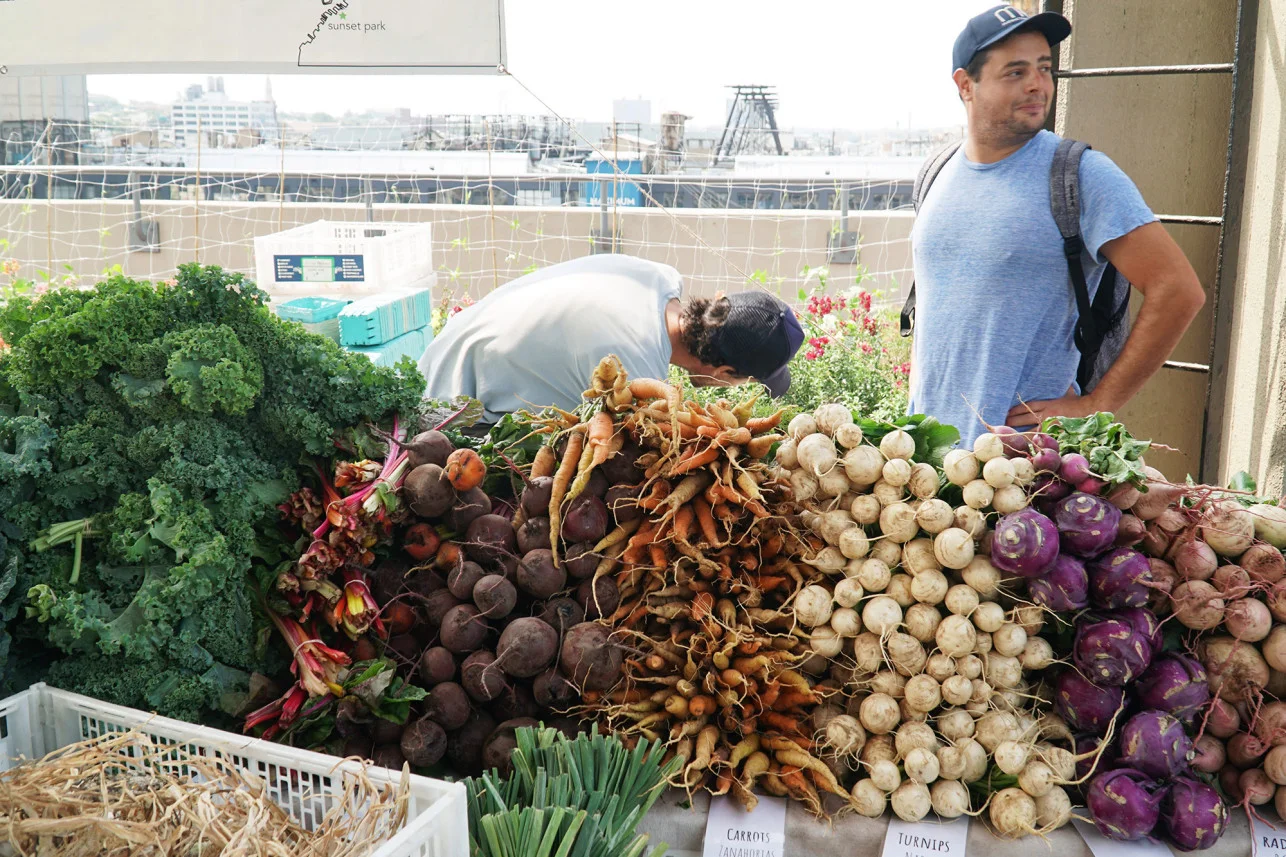
Colin Mixson
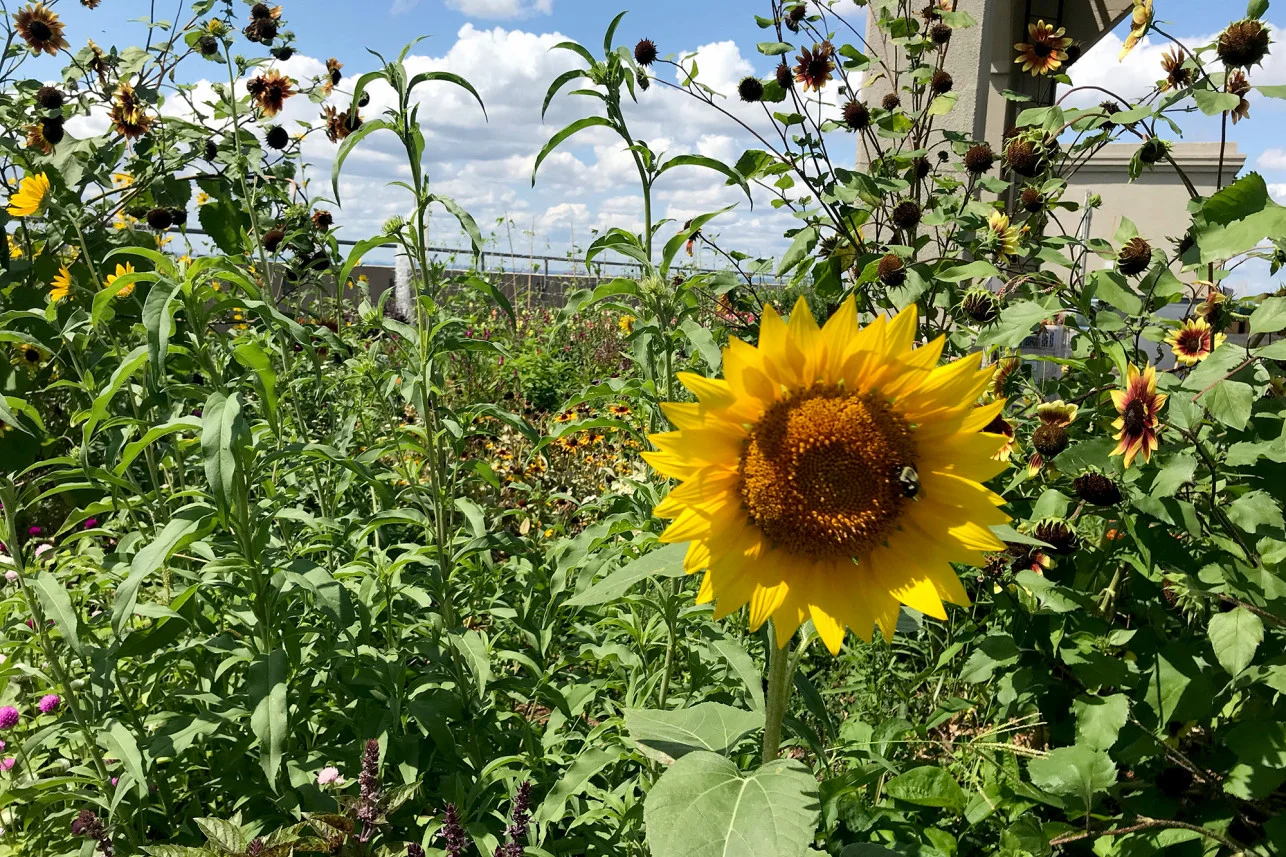
Brooklyn Grange has been leading the way in turning New York rooftops into lush farmlands over the past decade. Its newest outpost, which opened in Sunset Park last month, is now the largest rooftop farm in the city. The site is an oasis on top of a building that contains a Bed Bath & Beyond and other stores, with 140,000 square feet of tomatoes, peppers, kale and more, marked with colorful bursts of sunflowers and other flowers. The effect is so transformative it’s easy to forget you’re in NYC, until you look up and see crops perfectly framing the Statue of Liberty in the distance.
Bring your date: It’s a perfect mix of the urban and rural, especially John Epifanio, 44, who grew up in suburban Connecticut and says he occasionally hits a “tipping point” where he needs to escape the claustrophobic city. His girlfriend, Niki Roger, surprised him with a date to the farm on a recent sunny Sunday.
“Just having the backdrop of the city with that kind of contrast between agriculture and then the most defined urban background you could possibly see, I thought it was really stunning,” he tells The Post.
The new site uses 4 million pounds of soil; in total, Brooklyn Grange’s three farms yield 80,000 pounds of produce a year to sell to local restaurants and at farmers markets. At the weekly open houses on Sundays, you can take a guided tour of the space ($18) or visit for free and buy produce from the rooftop market. The new farm is expecting to host more events in the spring, but in the meantime, you can check out its other locations in Long Island City and at the Brooklyn Navy Yard, which host rooftop yoga, dinner parties, workshops and more.
What’s in season? The end-of-summer bounty at the market includes tomatoes, cucumbers, peppers, kale, eggplant and custom-made hot sauce. 850 Third Ave., Brooklyn; open to the public Sundays through the end of October, 11 a.m. to 4 p.m.
Queens County Farm Museum

Courtesy of Queens County Farm Museum
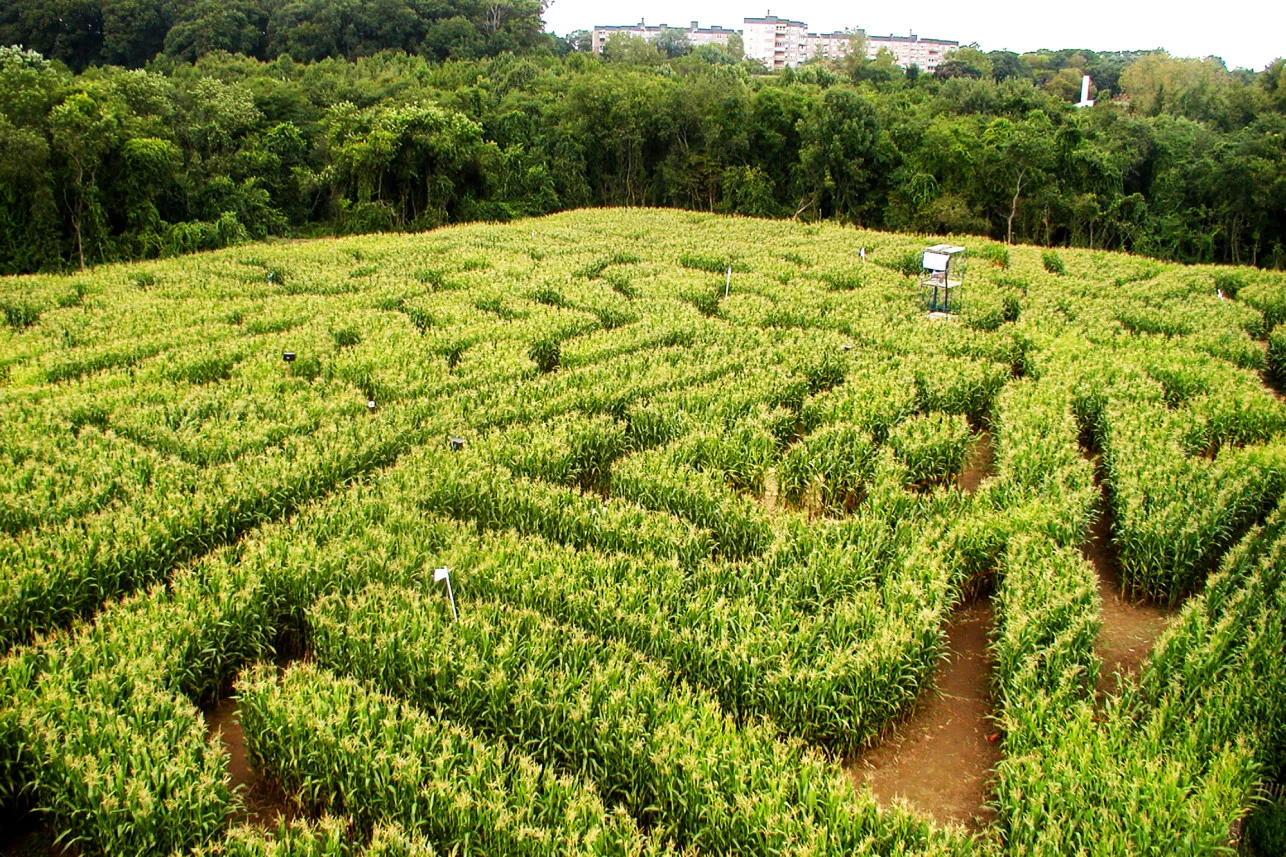
The Queens County Farm Museum’s famous Halloween-season corn maze is far more fun, and easier to solve, than the underground labyrinth of Penn Station. But the site also sits on the largest remaining tract of undisturbed farmland in the city, with 47 acres of farming history dating to the 17th century.
It’s a great spot for a family-friendly outing this fall, with the Queens County Fair and pumpkin picking kicking off later this month. But you can also tour the premises to see the farming, livestock and machinery up close, and enjoy the fruits of the land at its farmstand.
What’s in season? The fall harvest here includes kale, lettuce, sweet potatoes, watermelon, squash, radishes and more. And this year, the maze will be crafted in a familiar shape: the famed Unisphere from the World’s Fair site. 73-50 Little Neck Parkway, Queens; open daily, 10 a.m. to 5 p.m.
Randall’s Island Urban Farm
Matt Mead
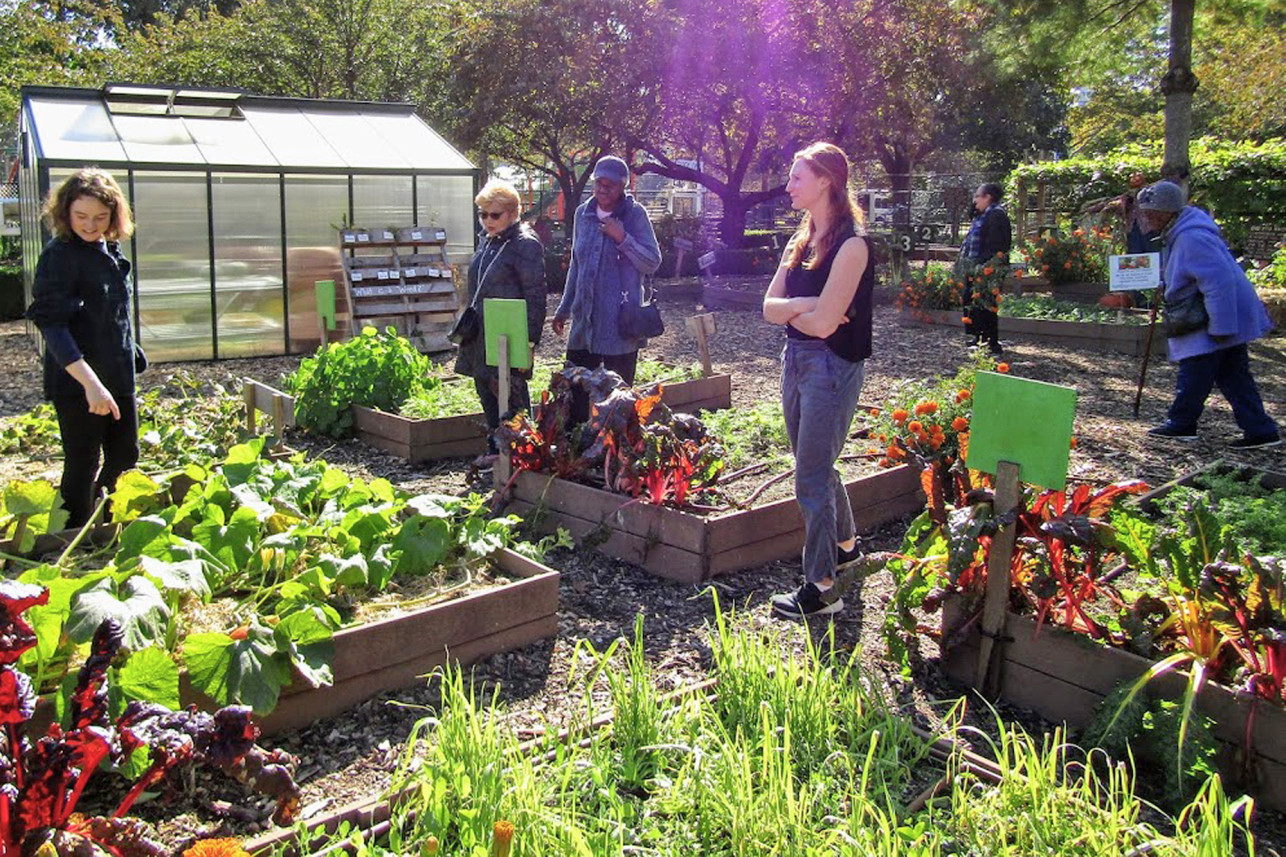
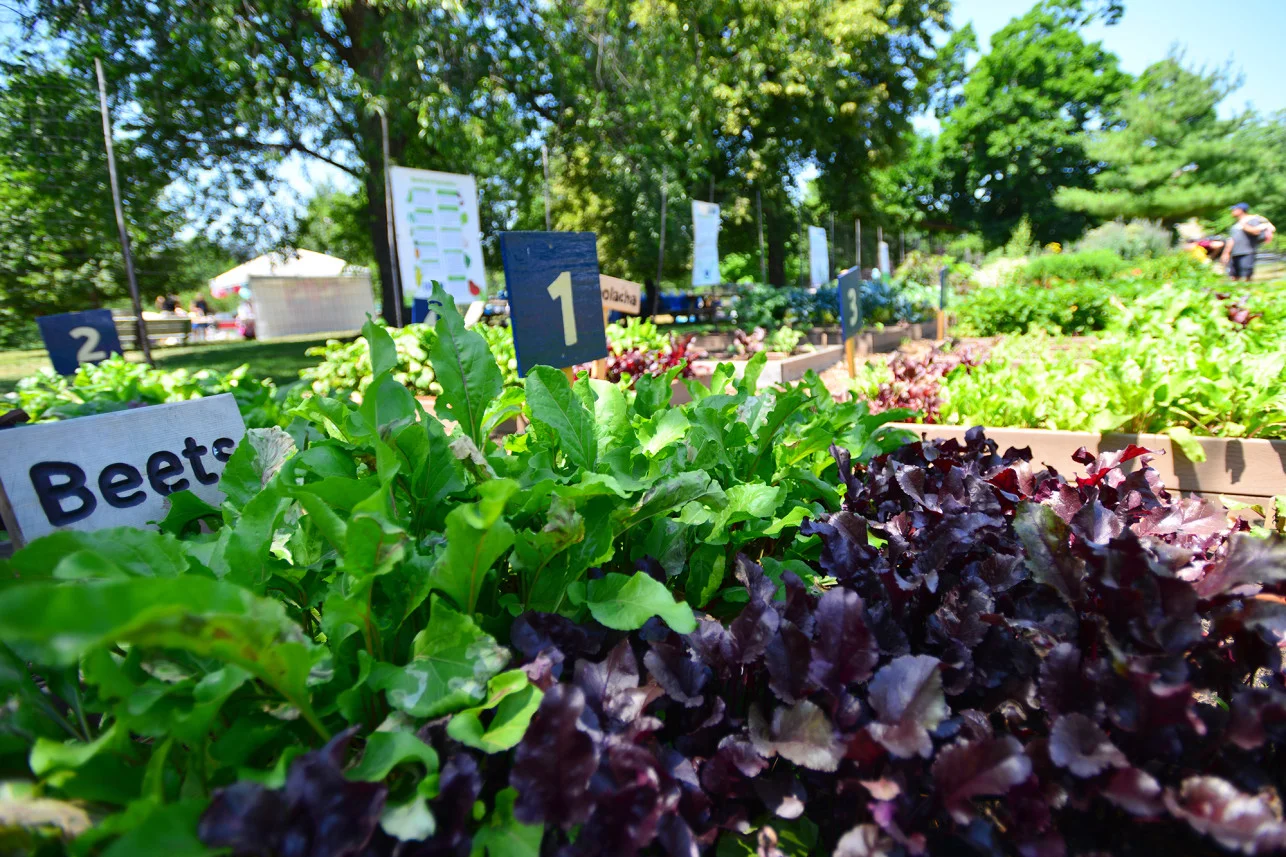
The farm on the island, sandwiched between East Harlem and Astoria, feels like a true oasis away from the city. It has 100 raised beds growing veggies and flowers. The farm also grows specialized items to get kids excited about farming, including a cucamelon: a tiny cucumber that looks like a little watermelon.
“Exposing young people and adults to this shows that it is possible to have this type of experience in New York,” farm manager Ciara Sidell says. “It opens people’s minds to what they could be doing in their own lives.”
Worth the trip: On Sunday, the park is hosting an urban farming bike tour, which will roll through the NYC Parks 5-Borough Green Roof, a 45,000-square-foot garden on the island, and the Randall’s Island Urban Farm itself. It’s free; just BYO bike. Wards Meadow Loop, Randall’s Island. Visit during the open house from 11 a.m. to 5 p.m. on Saturdays and Sundays, with “Art on the Farm” activities from 2 to 4 p.m., through mid-October
Hellgate Farm
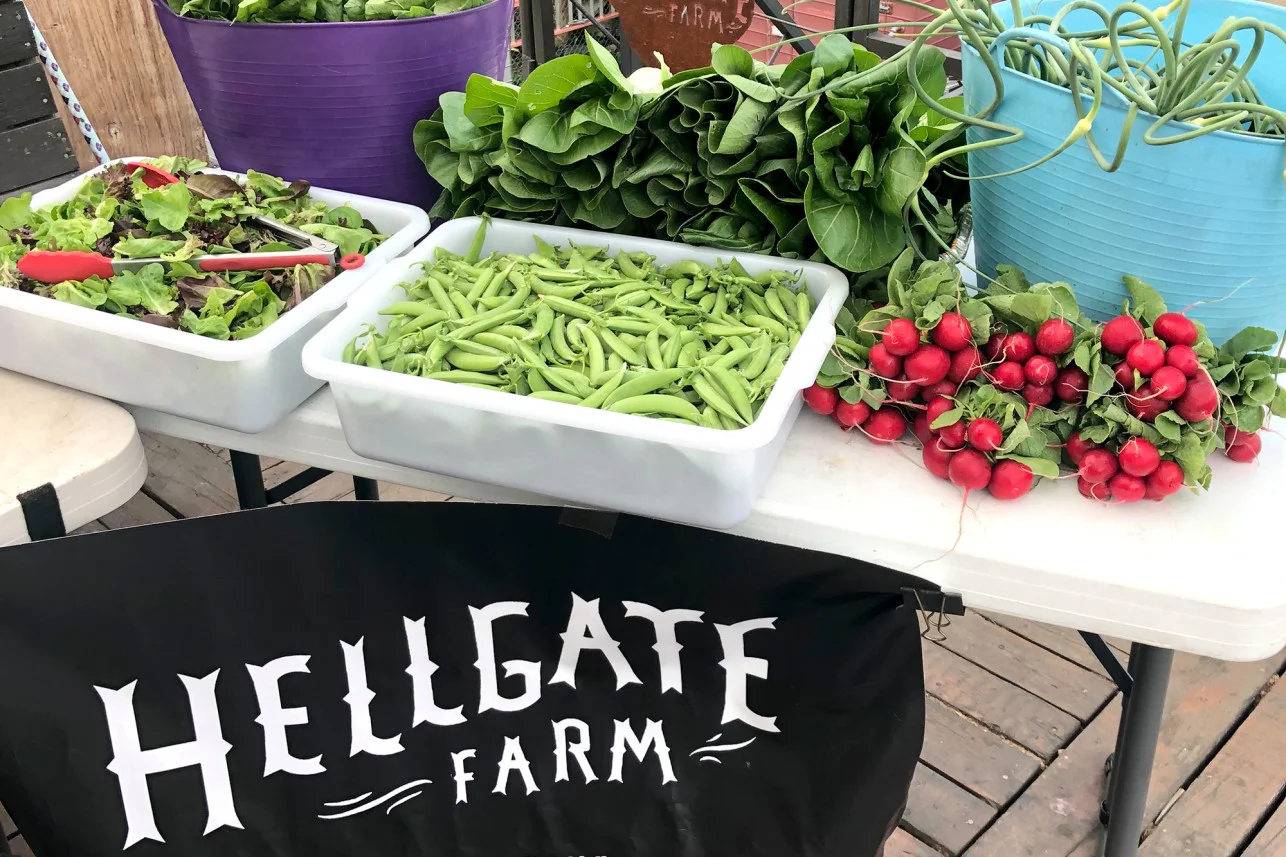
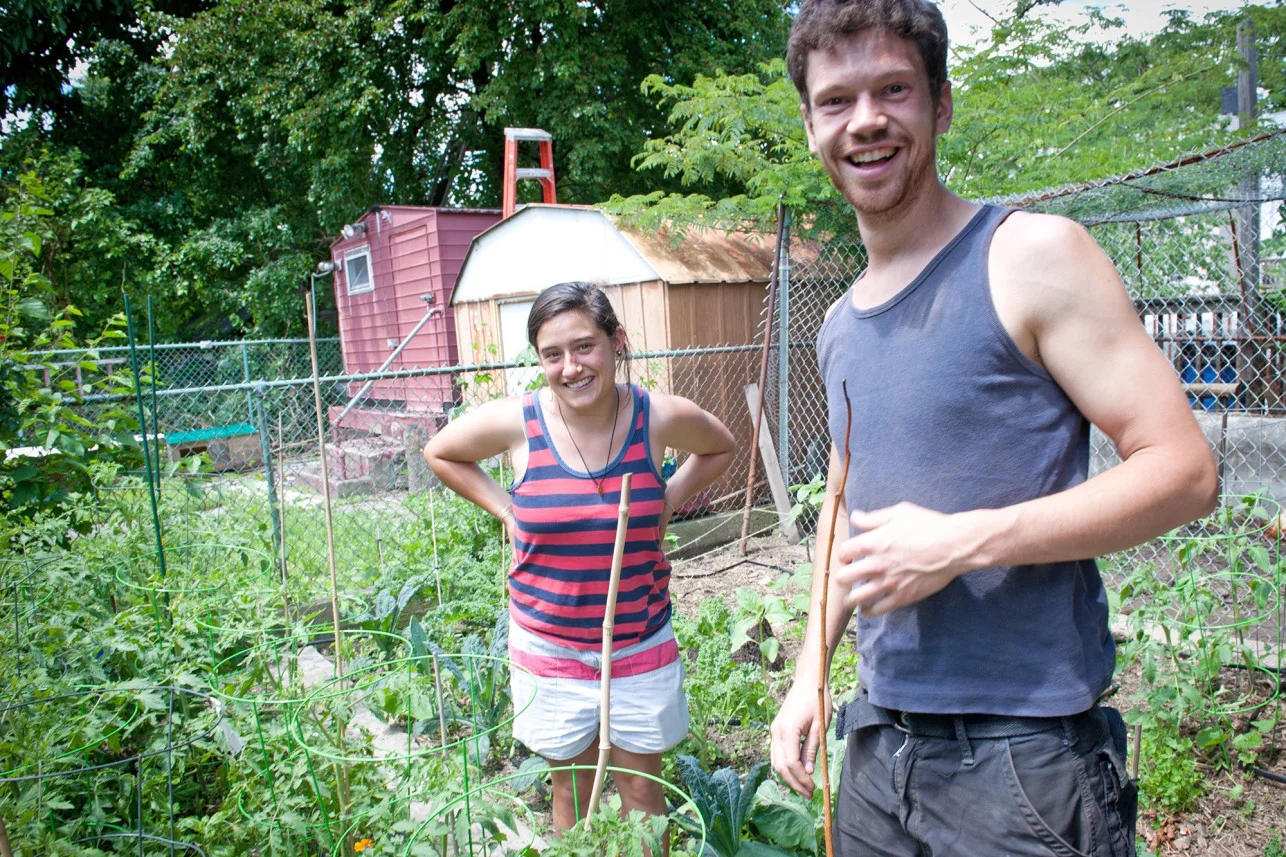
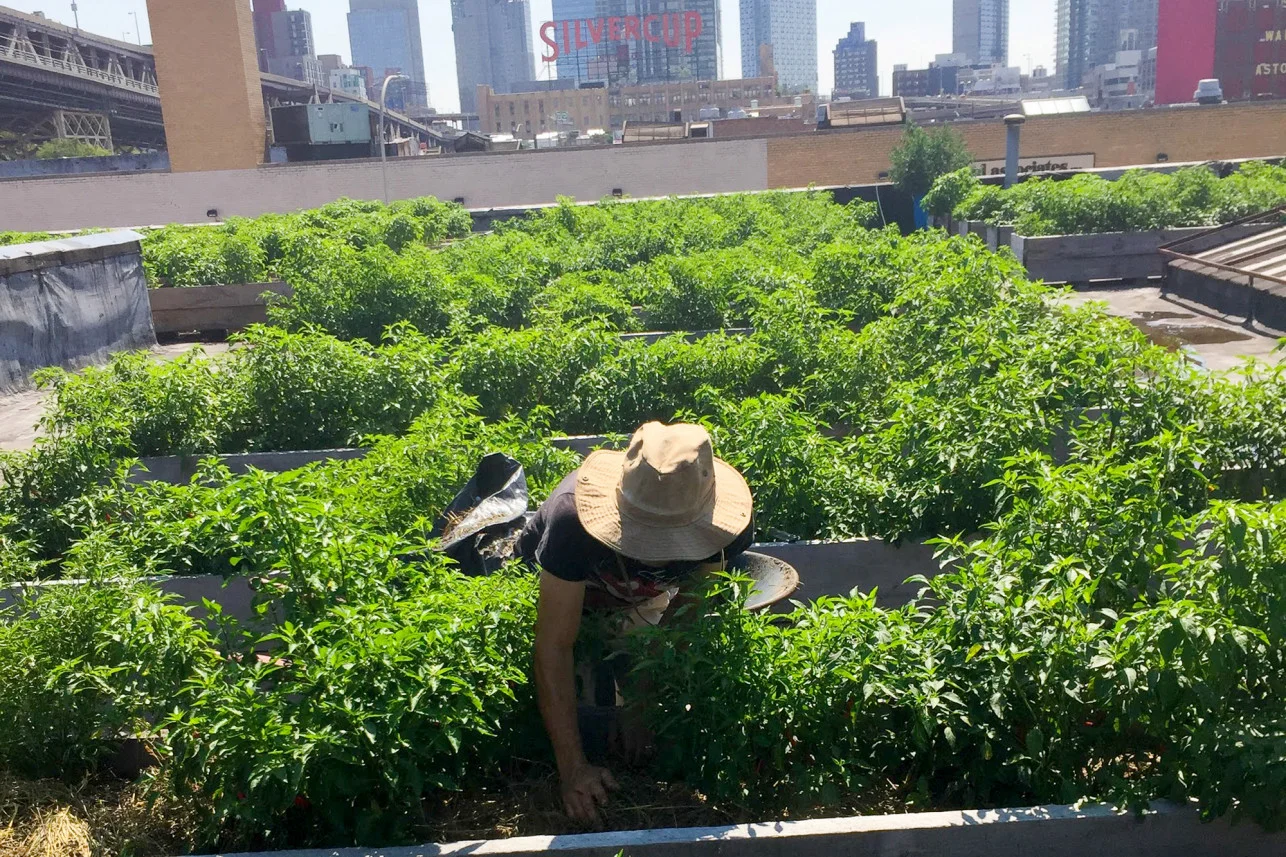
Rachel Mukon/Hellgate Farm
Hellgate may be the most badass name for a farm in the city, but it’s actually not one site, it’s a whole network of rooftop and residential gardens across Astoria and other parts of Queens. Founded in 2011, the project turns underutilized plots into environmentally friendly green spaces and productive gardens, selling produce at local markets and through a subscription service. Converting concrete to green space is something environmentalists say is key to capturing carbon dioxide in the city and absorbing rain, which helps keep the waterways clean.
Get your hands dirty: Hellgate Farm offers to teach you the ins and outs of rooftop farming through classes, an apprenticeship program and volunteer days. Check the Web site for more info before the growing season ends in October; various addresses in Queens
FILED UNDER FARMING , FARMS , NEW YORK CITY , OUTDOOR ACTIVITY

The Scottish Innovations Tackling The World’s Food Shortage
Invergowrie-based Intelligent Growth Solutions (IGS) has created Scotland’s first vertical farm, pictured here, and the company has recently harvested a £5.4 million cash boost from the Scottish Investment Bank, agri-food investor S2G and online venture capital firm AgFunder
Intelligent Growth Solutions' purpose-built facility is being constructed at the James Hutton Institute near Dundee.
SARAH DEVINE
19 September 2019
Scotland’s agriculture sector is changing rapidly, with rural businesses across the country driving forward groundbreaking innovations in attempts to address the myriad challenges of the land.
Globally, some 113 million people across 53 countries reportedly experienced food poverty last year, and it is expected that the world’s population will reach 9.8 billion by 2050, according to the UN.
However, inventive organizations across Scotland are devising new and creative ways to tackle the global food shortage.
Invergowrie-based Intelligent Growth Solutions (IGS) has created Scotland’s first vertical farm, pictured here, and the company has recently harvested a £5.4 million cash boost from the Scottish Investment Bank, agri-food investor S2G and online venture capital firm AgFunder.


The firm, which is based at the James Hutton Institute situated on the outskirts of Dundee, provides vertical farming technology to enable efficient food production through indoor crops around the world, having built its demonstration facility at Invergowrie last year.
It features stacked layers, LED lights and app-controlled air vents to create the perfect conditions for crops to thrive all year round.
The early-stage company states that its patented Internet of Things-enabled power and communications platform is able to reduce an organization’s energy usage by up to 50 percent and labor costs by up to 80 percent, in comparison to other indoor growing environments, and can produce yields of 225 percent compared to crops that have been grown under glass.
IGS experimented with colored LED lights, growing basil plants at the indoor facility in an impressive 20 days.
Its chief executive, David Farquhar, explains that such developments are urgently needed because at present an astonishing 30 percent of the world’s food is put to waste.
“Vertical farming allows experimentation to take place in order to impact the yield or cost of production, flavor, nutrients, appearance or a combination of those things,” he says.
“Producers want consistency, assurance of supply, and to know they are going to fill supermarket shelves or supply those Michelin-starred restaurants every day of the week. Those are things that farmers struggle with all the time.”
Farquhar adds: “If there is a forecast for bad weather and a supermarket decides to only take half of their delivery, what are they going to do with the rest of the produce?”
Using the vertical farm, a crop’s growth can be slowed down or sped up to prevent waste.
“People have been talking about vertical farms for several years, but we are now at the starting point. Over the next six months, we will get going with the first technology in the world that is capable of delivering this on an industrial scale.”
The firm, which was formed in 2013, plans to use this recent funding to create jobs in areas such as software development, engineering, robotics, and automation.
Investment into such areas is also needed across Scotland because dietary demand is changing, according to David Ross, chief executive of Edinburgh-based Agri-EPI Centre.
“Environmental sustainability is personal now for everyone and therefore there are challenges for primary producers to adapt to the needs of the consumer, the needs of society and the overall sustainability of the planet,” he says.

The World's Largest Rooftop Urban Farm Is Set To Open In Paris Next Year
The goal is to make this urban farm a globally-recognized model for responsible production, with nutrients used in organic farming and quality products grown in rhythm with nature's cycles, all in the heart of Paris
A joint Project Between Viparis
And Its Partners Agripolis, Cultures en Ville and Le Perchoir.
Paris, March 1st, 2019
In 2015, Viparis launched an extensive renovation project at the Paris Expo Porte de Versailles exhibition complex. This decade-long initiative will raise the complex to the highest international standards and make it a model of sustainable development, an integral part of Paris as much as a business centre. The initial phases have been completed; they include a new reception area, the redesign of the central walkway and the opening of the Paris Convention Centre, Europe's largest conference site.
During this transformation, events hosted there continue uninterrupted. Paris Expo Porte de Versailles welcomes trade fairs and conferences, but it is also rapidly becoming a haven for biodiversity, thanks to a 14,000 m2 urban farm on future Pavilion 6's roof. This will be the world's largest rooftop urban farm, offering a range of activities starting in spring 2020. To bring this exciting project to completion, Viparis teamed up with three partners, all of whom are experts in their fields.
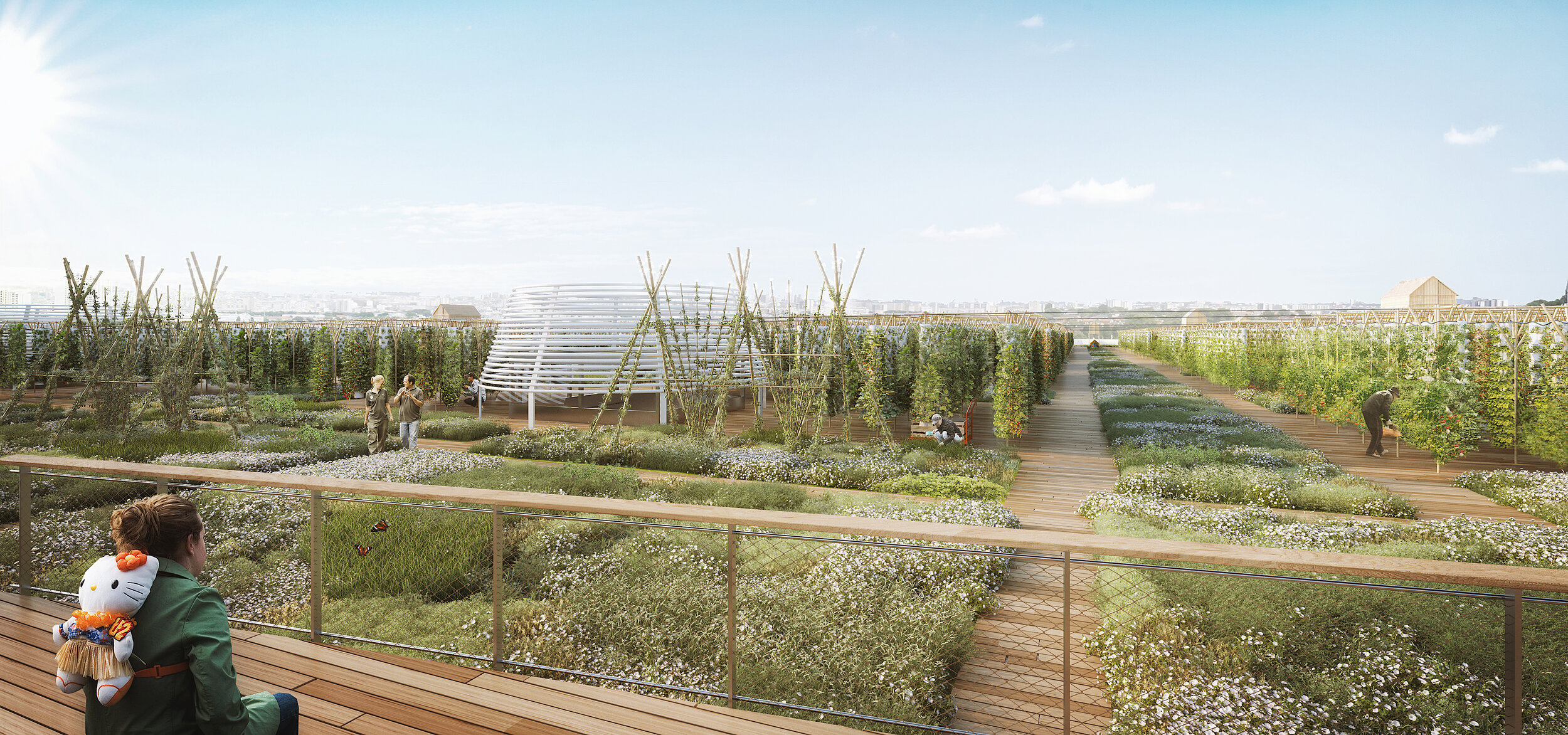

An urban farm in cooperation with Agripolis and Cultures en Ville
These two companies, specializing in urban agriculture, have teamed up to create a dedicated structure for the use of this exceptional space.
The goal is to make this urban farm a globally-recognized model for responsible production, with nutrients used in organic farming and quality products grown in rhythm with nature's cycles, all in the heart of Paris. More than twenty market gardens will produce over a thousand fruits and vegetables every day in season, from about thirty different varieties of plants.
Taking things to the next level, the farm will offer a range of services related to urban agriculture: educational tours, team-building workshops for companies, and vegetable plots leased by residents.
3D view of the urban farm on the rooftop of Pavilion 6 (Paris Expo Porte de Versailles)
© VALODE&PISTRE ARCHITECTES/ATLAV - AJN A restaurant and bar with a unique concept signed Le Perchoir
Le Perchoir, Paris's renowned chain of rooftop venues, will open a bar and restaurant on the panoramic terrace of Pavilion 6, with a menu that will include produce grown on-site. Le Perchoir's aim when developing its spaces is to spotlight urban heritage and encourage the greening of cities. Building on the success of its previous efforts, the company has now set its sights on western Paris.
--
"This project is in line with our goal of making the exhibition complex a part of Paris. We are transforming our venues with a view to sustainable development and maintaining biodiversity, which is reflected in our "Better Events Viparis 2030" strategy. Viparis is proud to contribute to the development of urban agriculture in Paris by making Paris Expo Porte de Versailles a flagship point of reference, and we are excited by the passionate commitment of our partners: Agripolis, Cultures en ville and Le Perchoir.
Pablo Nakhlé Cerruti, CEO, Viparis
"By installing working farms on the sites we operate, we are helping to foster environmental and economic resilience in tomorrow's cities. This is our guiding principle. To this end, the Paris Expo Porte de Versailles site will supply restaurants in the complex, primarily Le Perchoir, but also residents of southern Paris and neighbouring municipalities, either directly or through distribution, company canteens and hotels."
Pascal Hardy, Founder, Agripolis
"Today, large metropolitan areas are the focal point of a number of ecological issues. These include the loss of natural groundcover, pollution and rainwater management, but also societal issues such as the lack of connection between urban dwellers and their food supply. Cultures en Ville is keenly aware of these challenges, which is why, for the past four years, we have been providing innovative solutions that reconnect city dwellers with a healthier diet. The Paris Expo Porte de Versailles project is an ideal response, by offering local residents high- quality, locally-produced food and the opportunity to cultivate their own gardens. Working alongside our expert partners, we are proud to be building the world's largest rooftop urban farm!"
Clément Lebellé, Co-Founder, Cultures en Ville
"This project combines ecology, high-quality produce, the highlighting of the Parisian landscape, authentic experiences, cultural richness and human warmth. Le Perchoir shares these values, and is delighted to be part of this ambitious, trailblazing effort."
--
About Viparis
Viparis, a subsidiary of the Paris Ile-de-France Chamber of Commerce and Industry and Unibail-Rodamco-Westfield, is the European leader in conferences and trade events. Viparis manages nine event venues in the Greater Paris region. Each year, it welcomes ten million visitors (the general public, business visitors and spectators), and hosts 800 events in a diverse range of sectors at Paris Expo Porte de Versailles, Paris Le Bourget, Paris Nord Villepinte, Espace Champerret, the Palais des Congrès de Paris, the Palais des Congrès d'Issy, the Salles du Carrousel, the Espace Grande Arche and the Hôtel Salomon de Rothschild.
To learn more , visit Viparis.com, or follow us on Twitter and LinkedIn. About Agripolis
Christophe Talon, President, Le Perchoir
Agripolis is transforming food systems by installing and operating urban farms that use innovative techniques to generate high-quality, responsibly-produced vegetables and fruit. Our soil-free, aeroponic "vertical farms" require minimal installation. Fruit and vegetables can be grown without pesticides and harvested at maturity, optimising water use and with a very low carbon footprint. Agripolis' vision is a city in which flat roofs and abandoned surfaces are covered with these new growing systems that contribute directly to feeding urban residents, who now represent the bulk of the world's population.
About Cultures en Ville
Cultures en Ville specialises in urban agricultural development. Our core business is the creation of productive, playful and aesthetic vegetable ecosystems. Cultures en Ville is a partner of the AgroParisTech research institute and takes part in cutting-edge research into urban agriculture. With a customisable offer that includes the design, production and management of vegetable gardens, the company has already carried out more than thirty large-scale projects, including the urban agriculture demonstrator at La Maison de la RATP, a vegetable garden at one of La Poste's headquarters and another at the head office of Vinci Construction France in suburban Paris.
Agripolis and Cultures en Ville have each won several calls for projects, including the "Inventing the Greater Paris Metropolis" and "Les Parisculteurs" initiatives.
About Le Perchoir
Le Perchoir's mission is based on the desire to re-inhabit the rooftops of Paris and give Parisians the opportunity to reclaim unusual spaces.
Our first challenge was transforming a Parisian industrial building's 400 m2 terrace into a nighttime attraction.
Our rooftop bar quickly became a genuine crossroads for creative minds, a setting for collaborations and partnerships that generated a range of original projects - exhibitions, concerts, popup rooftop restaurants, outdoor film projections, and more.
To expand this nomadic undertaking, we turned to other venues - the Perchoir Marais, with its breathtaking view of Paris and its finest monuments, and the Pavillon Puebla located in the heart of the historic Buttes-Chaumont park. Our goal when developing and re-appropriating spaces is to spotlight urban heritage and encourage the greening of cities. The venues are Parisian, but act as gateways to other places and other spaces. This is reflected in our musical programming featuring gems from around the world selected by Karl Planck from Radiooooo.com, an eclectic Internet radio station.
MEDIA CONTACT - AGENCE GEN-G
Adrien De Casabianca
Tel.: +33 (0) 1 44 94 83 66
Cell: +33 (0)6 30 30 34 84 mailto:adrien.decasabianca@gen-g.com

These UMD Researchers Are Helping Farmers Grow Crops on Urban Roofs
John Lea-Cox, a plant science and landscape architecture professor at this university, and Andrew Ristvey, an affiliate faculty in the department, are working with the D.C.-based farming foundation Up Top Acres to grow crops on urban rooftops
September 6, 2019
The green roof at the top of the Physical Sciences Complex is just one among many around campus that serve as drainage and an ecosystem. (Joe Ryan/The Diamondback)
With the help of University of Maryland researchers, farms across Washington, D.C., are taking watermelons, cucumbers and cherry tomatoes to the next level: the roof.
John Lea-Cox, a plant science and landscape architecture professor at this university, and Andrew Ristvey, an affiliate faculty in the department, are working with the D.C.-based farming foundation Up Top Acres to grow crops on urban rooftops.
Kristof Grina, co-founder and farm director of Up Top Acres, said he initially connected with Lea-Cox and Ristvey a few years ago for help with research and data collection surrounding stormwater management and water retention on their rooftop farms.
Lea-Cox and his team monitor the rainfall, soil temperature and soil moisture on Up Top Acres’ rooftop farms, Grina said. Lea-Cox said he was impressed by the quality of the rooftop produce, which grows across eight farms in Maryland and D.C. The crops are delivered to restaurants downstairs or sold in a community-supported agriculture system.
“There’s like a little bit of Little Italy on the roof down in D.C.,” Lea-Cox said.
Relish Catering, a catering company in North Bethesda, started working with Up Top Acres about a year ago. The company operates about half a mile away from the rooftop farm at Pike and Rose.
The rooftop farm cuts transportation costs for the company, said chef Laura Calderone, since it’s both walkable and bikeable. When she needs ten pounds of pea shoots, for example, she can just load them in her backpack.
“They will literally pick it that morning, and it is going out to our clients that afternoon for the following day,” Calderone said. “Sometimes there are still bugs in it that are moving around, but that’s okay.”
Calderone said Relish Catering has incorporated local rooftop ingredients into salads, salsa verde and tarts, among other dishes.
“Their greens are sweeter and they are not as fibrous,” Calderone said. “You don’t have to manipulate it much. We can let it shine as it is.”
This university’s researchers collect data that gives the farm’s operators “better insight” into how the systems are functioning, Grina said. It lets them know how they’re doing with irrigation practices, and can spur ideas for design improvement.
Lea-Cox and his team also monitor nitrogen and phosphorus levels in the crops. An excess of these nutrients can runoff into local waterways and trigger excessive algae growth. When algae grows too quickly and too abundantly, oxygen levels decline, ultimately killing the fish.
La Betty, an American-style restaurant on K Street in D.C., featured wild rooftop-sourced bouquets on the tabletops. Owner and head of operations Tessa Velazquez said that the flowers last longer than alternatives.
“The story behind it is great,” Velazquez said. “To say that we’re featuring local farmed flowers makes us feel good, makes our customers excited … they’re beautiful and they’re colorful and you really just get that sense of how natural and fresh that they are.”
La Betty is located about two miles from Up Top Acres’ 55 M Street farm in the Capitol Riverfront neighborhood, which opened in 2016. Soon, Velazquez said, she hopes to feature produce from a rooftop farm on her menu.
“I love that they’re actually engaged with the community, as well as really trying to bring that fresh farm-to-table experience — which is a fuzzy term, but they’re really doing it,” Velazquez said. “They’re your neighbors. They’re down the street. They’re not two hours away in Pennsylvania, they are really here.”
How To Avoid Calcium Deficiency In Controlled Environment Food Crops
Tipburn and blossom end rot are symptoms of calcium (Ca) deficiency. Sometimes the first thought when a nutrient deficiency occurs is to add the nutrient that appears to be required to solve the issue
Tipburn and blossom end rot are symptoms of calcium (Ca) deficiency. Sometimes the first thought when a nutrient deficiency occurs is to add the nutrient that appears to be required to solve the issue. This isn’t always the best way to resolve the issue.
Calcium has a very important role in plant cell wall formation. If calcium cannot reach new cells in adequate time, cell wall formation cannot be completed. This can result in necrotic (dead) tissue in the leaves (tipburn) and fruit (blossom end rot) as consequence of cell death. This is why calcium uptake from roots to leaves is a very important process.
Calcium movement in plants
The main force moving calcium through plants is water. When plants transpire calcium moves. Calcium will only be present in plants when water is moving. Most cases of calcium deficiency in greenhouse crops is due to environmental conditions, not a nutrient deficiency directly related to the nutrient solution being applied.
Calcium deficiency triggers
There are several environmental conditions that can trigger calcium deficiency. The most common factors include:
Low relative humidity. When plants are exposed to low relative humidity levels, small pores in leaves called stomata close. Stomata are responsible for transpiration. Calcium movement depends entirely on stomata behavior. It is important to know optimum relative humidity levels for each crop and to keep the humidity levels as uniform and consistent as possible. The humidity in a greenhouse can be increased by running water through the evaporative cooling pads and/or by installing a fog system if necessary.
Lack of airflow over the crop. There needs to be air movement around the leaves to ensure continuous gas exchange. The airflow velocity around the plant leaves can be reduced as a result of the friction between the leaf surface and the moving air. This creates a boundary layer which is a layer of heavy air that can decrease gas exchange in plants. This reduction in gas exchange can impact calcium uptake by the plants.
This reduction in calcium uptake is common in greenhouse lettuce. Lettuce has a very tight leaf canopy. New leaves are usually exposed to a very dense boundary layer. Good airflow over the crop canopy is required to avoid tipburn. Installation of vertical fans is usually recommended to improve airflow in lettuce greenhouses. It is also important to maintain proper airflow in vertical farms. A 1 meter per second air velocity rate in each vertical layer is recommended for leafy greens.
High light intensity in vertical farms. With indoor farm production, there are many variables that need to be controlled to ensure good crop performance. Two variables that together can trigger tipburn are light intensity and the boundary layer. When plants are located close to the grow lights, the light intensity tends to increase and space for airflow decreases.
If plants are exposed to the same photoperiod during the entire production cycle, the total daily light integral (DLI) tends to increase with time. Recent research demonstrated that in indoor vertical farms when plants are exposed to a DLI that exceeds 17 moles of light per square meter per day (mol·m-2·d-1) for more than three days tipburn is triggered.
Excess humidity. Some crops including tomato show tipburn under high relative humidity environments. Transpiration from roots to leaves increases under high relative humidity levels. When the relative humidity is too high for tomato calcium uptake goes directly from the roots to the leaves bypassing the fruit. This is why sometimes blossom end rot (calcium deficiency in fruit) occurs in tomato fruit but no deficiency symptoms appear on the leaves.
Avoiding calcium deficiency
When calcium deficiency is seen in plants make sure to check that the fertigation system is operating properly. If the fertilizer stock solution is maintained in multiple tanks, check all reservoirs to ensure the same solution levels so that all nutrients are being delivered uniformly to all crops.
But remember to always monitor environmental conditions before adding calcium to any crop. Excess calcium can cause other nutrient deficiencies. If the decision is made to apply foliar calcium, then this treatment is required during the whole production cycle to avoid calcium deficiency. Foliar calcium applications to prevent calcium deficiency might be avoided if the production environment is properly controlled.
Fully Operational, Modern Hydroponic 45,000 sf Greenhouse For Sale In Pennsylvania
It is a fully operational automated hydroponic greenhouse with a glass roof, computer controls, sophisticated HVAC and irrigation systems, artificial lighting and cold storage
By urbanagnews
September 4, 2019
BrightFarms, leading grower of hydroponic salad greens and herbs, is set to open a 280,000 sf facility in central Pennsylvania later this year. At that point its existing Pennsylvania greenhouse in Bucks County will become surplus to requirements. It will be ready for occupancy by a new user late in the first quarter 2020.
It is a fully operational automated hydroponic greenhouse with a glass roof, computer controls, sophisticated HVAC and irrigation systems, artificial lighting and cold storage.
For more information, contact Sean O’Neill at soneill@brightfarms.com.
TAGS Business For sale Greenhouse

VIDEO: How One Boston Hospital Is Feeding Patients Through Its Rooftop Farm
Carrie Golden believes the only reason she’s diabetes free is that she has access to fresh, locally grown food. A few years after the Boston resident was diagnosed with prediabetes, she was referred to Boston Medical Center’s Preventative Food Pantry as someone who was food insecure. The food pantry is a free food resource for low-income patients
Boston Medical Center’s rooftop farm spans 2,658 square feet.
Photography Matthew Morris
Carrie Golden believes the only reason she’s diabetes free is that she has access to fresh, locally grown food.
A few years after the Boston resident was diagnosed with prediabetes, she was referred to Boston Medical Center’s Preventative Food Pantry as someone who was food insecure. The food pantry is a free food resource for low-income patients.
“You become diabetic because when you don’t have good food to eat, you eat whatever you can to survive,” Golden says. “Because of the healthy food I get from the pantry… I’ve learned how to eat.”
Three years ago, the hospital launched a rooftop farm to grow fresh produce for the pantry. The farm has produced 6,000 pounds of food a year, with 3,500 pounds slated for the pantry. The rest of its produce goes to the hospital’s cafeteria, patients, a teaching kitchen and an in-house portable farmers market.
The hospital joined a handful of medical facilities across the country that have started growing food on their roofs. The initiative is the first hospital-based farm in Massachusetts and the largest rooftop farm in Boston. The facility’s 2,658-square-foot garden houses more than 25 crops, organically grown in a milk crate system.
“Food is medicine. That’s why we’re doing what we’re doing,” says David Maffeo, the hospital’s senior director of support services. “Most urban environments are food deserts. It’s hard to get locally grown food and I think it’s something that we owe to our patients and our community.”
Lindsay Allen, a farmer who has been managing the rooftop oasis since its inception, says her farm’s produce is being used for preventative care as well as in reactive care. She says 72 percent of the hospital’s patients are considered underserved, and likely don’t have access to healthy, local organic food.
What people put in their bodies has a direct link to their health she says, adding that hospitals have a responsibility to give their patients better food.
“I generally feel that hospital food is pretty terrible and gross, which I always find ironic since that’s where we are sick and at our most vulnerable and we need to be nourished,” she says.
In addition to running the farm, Allen teaches a number of farming workshops to educate patients, employees and their families on how to grow their own food. The hospital’s teaching kitchen employs a number of food technicians and dieticians who offer their expertise to patients on how they can make meals with the local produce they’re given.
This is part of the medical center’s objective to not only give patients good food, but also provide them the tools to lead a healthy life.
Golden, who has used the pantry for the last three years, says the experience has changed the way she looks at food.
“I’ve gone many days with nothing to eat, so I know what that feels like when you get something like the food pantry that gives you what you need to stay healthy,” she says. “I appreciate all the people that put their heart into working in the garden. If only they knew how we really need them.”

The Earth Is Not For Sale
As an economist, I personally think it is time to stop trying to measure the consequences of soil erosion and the other things we are doing to the earth in terms of economics—in dollars and cents
John Ikerd
September 1, 2019
A 2007 article in the Environmental Economics Journal reported that U.S. farmers were losing an estimated $100 million in net farm income each year to soil erosion.[i] This might sound like lot of money until you consider there about 2 million farms in the US, which averages out to about $50 per farm. Even if we only count the 1 million or so “commercial farms,” the economic loss is only about $100 per farm. It’s pretty easy to see why farmers who are motivated primarily by economics aren’t willing to spend much of their own money to mitigate soil erosion.
However, a 1995 article in Science Magazine estimated the total on- and off-site costs of soil erosion and erosion prevention $44 billion per year. The economic costs of soil loss to society in general is far larger than the costs to farmers—about $22,000 per farm or $44,000 per commercial farm. If we add the on- and off-site costs of water and air pollution, we are talking about at least $50,000 per commercial farming operation for the economic costs of environmental degradation caused by current farming practices in the U.S.
However, we tend not to identify the off-farm costs of soil erosion or water and air pollution with their on-farm sources. So we have been willing to allow the economic interests of individual farmers to take priority over the environmental consequences for society in general. We seem to have a difficult time understanding social costs in terms of millions and billions of dollars but can easily understand why a farmer doesn’t want to spend a thousand dollars for erosion or pollution mitigation to save a hundred dollars in farm income.
As an economist, I personally think it is time to stop trying to measure the consequences of soil erosion and the other things we are doing to the earth in terms of economics—in dollars and cents. What right do we actually have to place an economic value on the earth? “The Earth does not belong to man; Man belongs to the Earth. This we know. All things are connected like the blood which unites one family. Whatever befalls the Earth befalls the sons of the Earth. Man did not weave the web of life, he is merely a strand in it. Whatever he does to the web, he does to himself.”[ii]
While this quote has been frequently attributed to a speech by the Suquamish Indian Chief, Seattle, it appears to be a liberal interpretation of a letter Seattle sent to President Franklin Pierce in 1854.[iii] Seattle actually wrote: “Every part of this earth is sacred to my people. Every hillside, every valley, every clearing and wood, is holy in the memory and experience of my people.”[iv] But more important, these sentiments of Chief Seattle regarding the sacred relationship between humans and the earth remains an integral aspect of Native American culture.
The Onondaga “Thanksgiving Pledge” begins, “We are thankful to our Mother Earth, for she gives us everything that we need for life. She supports our feet as we walk about up on her. It gives us joy that she still continues to care for us, just as she has from the beginning of time. To our Mother, we send thanksgiving, love, and respect.”[v]
The erosion of the earth’s soil, pollution of its air and water are not simply matters of imposing economic costs on others but show a fundamental lack of respect for our interconnectedness and utter dependence on the things of the earth. These things are desecrations of the earth. We all contribute to these desecrations when we buy foods or support public policies that support the current extractive and exploitative systems of farming and food production.
Thankfully, we know how to make better choices, we know how to farm better; we know how to take better care of the earth and how to create a better future for humanity. For the past 100 years, and particularly the past 50 years, farmers around the world have been developing new and better ways to farm. In the US these farms of the future have gone by names including permanent, biodynamic, organic, ecological, holistic, and sustainable. Globally, names like permaculture, natural farming, and agroecology have been more popular. More recent regenerative farming has been growing in popularity, which not only seeks to sustain the productivity of the land but also to restore the degradation of past centuries. Also, a large and growing global movement, called Food Sovereignty, is committed to creating local, community-based food system that reconnect people, with purpose and with place—with the earth.
In fact, all of the new sustainable farming systems are rooted in a commitment to restoring not only soil productivity but also to proclaiming a sense of integral connectedness with the earth and farming in harmony nature. I believe the vast majority of American farmers feel a similar sense of responsibility to be good stewards of the land or caretakers of the earth. I think most simply feel trapped in a system that forces them to focus on the economics of survival rather than the ethic of stewardship. If we create opportunities for farmers to survive economically as they transition from extractive and exploitative to a restorative and regenerative farming system, I believe many, if not most, farmers will do so—regardless of the benefit/cost ratios.
So what can we do to help create new and better systems of farming and food production for the future? We can make food choices that support the new farmers who are in the process of creating a new future for farming and food production, regardless of what happens to farm policies. We can also use the ongoing political campaigns to advocate policies that will facilitate a transition from an industrial agriculture to a regenerative, sustainable agriculture and to food sovereignty for economically oppressed rural communities.
And the reason we are here tonight, we can support organizations like the Sustainable Iowa Land Trust. SILT is helping farmers remove decisions concerning how their land is to be used from the economic pressures of markets and ensuring that it will be farmed sustainably by both current and future generations of farmers. You can support farm policies that allocate more public money to support SILT and sustainable land trusts. You can give your time, energy, and this evening, you can give whatever money you can afford to support the ongoing work of SILT.
Edward Hale, a Unitarian minister, is attributed with the quote: “I am only one, but I am one. I can't do everything, but I can do something. The something I ought to do, I can do. And by the grace of God, I will.”[vi] Hale also wrote, “Together—one of the most inspiring words in the English language. Coming together is a beginning; keeping together is progress; working together is success.” Together we can create better ways to farm, produce food, and meet our other needs while caring for the earth and creating a better future for humanity.
Together we can stop the desecration of Mother Earth and reverse the spiritual degeneration of humanity. We are still as dependent on the “gifts of Mother Earth” today as in the days of Chief Seattle—not only for our food but for our physical, emotional, and spiritual well-being. Our dependencies are just less direct and more complex. Our life is still a part of the life of the Earth. Our soul is still a part of the soul of the earth. “We can't do everything, but we can do something. The something we ought to do, we can do. And by the grace of God, together, we will do.”
John Ikerd
* Prepared for presentation at an annual fund-raiser of the Sustainable Iowa Land Trust in Fairfield, IA, June 19, 2019.
End Notes:
[i] Cited in the FAO Soils Portal, “Cost of Soil Erosion, http://www.fao.org/soils-portal/soil-degradation-restoration/cost-of-soil-erosion/en/
[ii] David Mikkelson, Chief Seattle Speech, Scopes, https://www.snopes.com/fact-check/chief-seattle/ .
[iii] Liberation Theology and Land Reform, “Seattle Real or Feighned,” http://www.landreform.org/seattle0.htm .
[iv] Liberation Theology and Land Reform, “We May Be Brothers After All,” Speech of Chief Seattle, January 9, 1855, http://www.landreform.org/seattle.htm .
[v] Robin Wall Kimmerer, Braiding Sweetgrass, (Minneapolis, MN: Milkweed Editions, 2013), p 108.
[vi] Attributed to Edward Everett Hale in: United States. President (1922). Addresses of the President of the U.S. and the Director of the Bureau of the Budget. p. 80

Hydroponic Farming Option For Veterans, Senator Told On Tour
U.S. Sen. John Boozman, R-Ark., toured a farm operation Monday that is largely immune to the weather, to pests and to trade wars. Vet Veggies provides fresh leafy green vegetables and herbs year-round to Northwest Arkansas restaurants and grocers by growing the plants indoors in climate-controlled conditions with artificial light
by Doug Thompson | August 27, 2019
U.S. Sen. John Boozman (R-Ark.) is shown in this file photo. - Photo by Sarah D. Wire
SPRINGDALE -- U.S. Sen. John Boozman, R-Ark., toured a farm operation Monday that is largely immune to the weather, to pests and to trade wars.
Vet Veggies provides fresh leafy green vegetables and herbs year-round to Northwest Arkansas restaurants and grocers by growing the plants indoors in climate-controlled conditions with artificial light.
Boozman, the son of a veteran, is a member of both the Senate Veterans' Affairs Committee and the Agriculture, Nutrition and Forestry Committee.
The Vet Veggies farm was the first stop on a tour of businesses Boozman said could provide opportunities for veterans.
Jerry Martin, founder of Vet Veggies and host for the tour, said a veteran or someone else could start a similar one with an initial investment as low as $350,000. Martin is a local businessman and veteran of the Vietnam War.
Although Vet Veggies is profitable, its real purpose is to refine techniques of hydroponic farming, he said. The idea is to come up with a business model that can spread nationwide.
"Veterans like to work outside and be their own boss," he told Boozman. "Also, to run this kind of business, you have to be involved with your community, with other people."
That would help returning veterans re-enter civilian life more successfully than many other options, Martin said.
"We're profitable now, but we could be a lot more profitable with more investment or a government grant or low-interest loan," he said. This capital would allow the business to improve the farming techniques quicker, he said.
A traditional farm requires hundreds of acres along with tractors and other farm equipment, Martin told the senator. Hydroponic farming by Vet Veggies' method can start with equipment in one 40-foot long conventional storage unit and as little as 1 acre of land. The units take up little space and can be stacked, he said.
No business enterprise is risk free, but hydroponic farming -- growing plants without soil by feeding them the needed nutrients mixed in with water -- has far fewer risks and variables, according to Martin.
Boozman noted during the tour 2018 and now 2019 have been bad years for the state's traditional farms. Rain in autumn last year ruined crops at harvest time statewide, he said.
"The weather's been absolutely terrible," he said.
As for the trade war underway in China, including tariffs, Boozman said there is no easy way out. The federal government has paid billions to farmers this year to offset lost trade opportunities for farmers.
"The Chinese government lies, cheats, steals and manipulates," he said. "This situation started years ago and won't end easily, but it is happening at a bad time for the farm sector. We should be supportive of our farmers as a country."
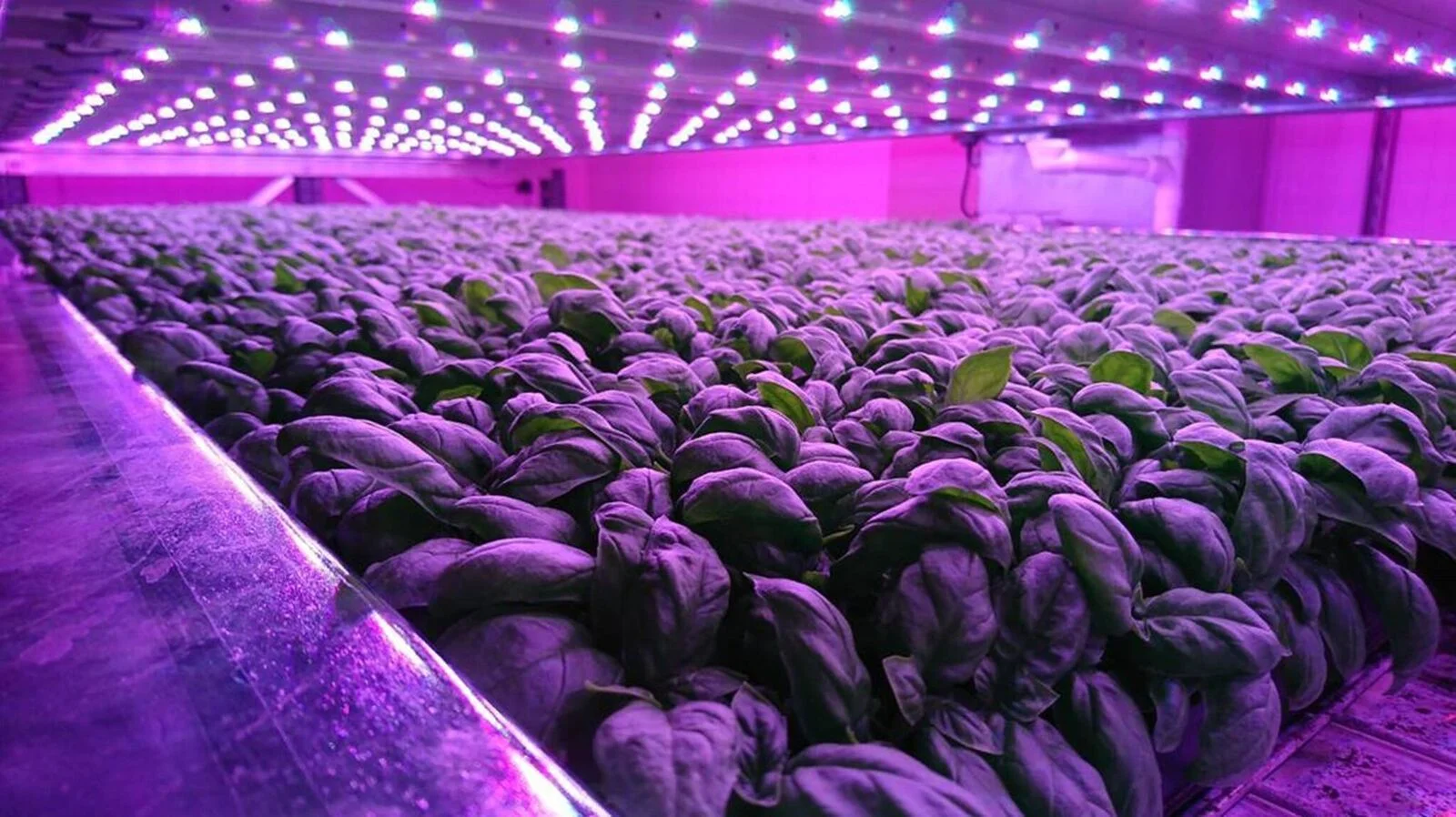
FOR SALE - Two - 2017 Custom Built - Hydroponic Grow Systems - Miami, Florida
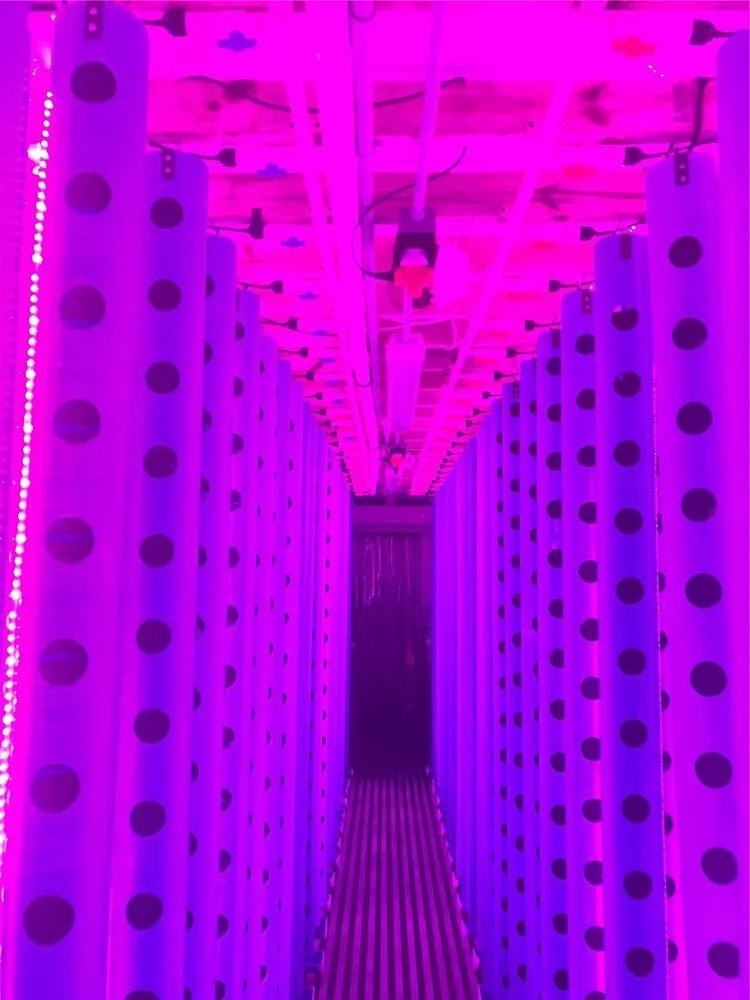
Two 40’ Insulated Container
Vertical Farming / Hydroponic Grow Systems
Two - 2017 Custom Built - Hydroponic Grow Systems - Can Be Sold individually.
Price: $45,000 each - Seller will finance with 20% down payment
Location: Miami, Florida

Electrical Work/Components
Plumbing Work/Components
HVAC Work/Components
2 x Air Conditioners (3.5 Tons)
Hydroponics Lights- 300 x 8’ Growing Tubes - 300 x Growing Medium/Sponges
Commercial Water Filtration System
Commercial Self Sustaining Sink
Stainless Steel Table
1 - Refrigerator
1 - Remote Switch via App
Stainless Steel Shelves x 10
55 Gallon Tank
Water Pump
Security Alarm (ADT)
Wireless Internet
Highlights:
Capacity to Grow +100K Plants
Self-Sustaining Water System
Hydroponic Light System - Proven Concept
Permitted by Dept. Agriculture
Permitted by Miami Dade County
Local Business Tax Receipt
Property Insurance Policy
General Liability Policy
Product Liability Policy
All information is from sources deemed reliable but is subject to errors, omissions, changes in price, prior sale or withdrawal without notice.
No representation is made as to the accuracy of any description.
All measurements, yields and square footages are approximate and all information should be confirmed by the customer.
Disclaimer of Warranty - The hydroponic farming greenhouse container is being sold “as is” and the Seller disclaims all warranties of quality, whether express or implied, including the warranties of merchantability and fitness for a particular purpose.

Why Maldives Needs To Declare A State of Climate Emergency - IMMEDIATELY (PT. I)
As an apocalyptic future approaches with alarming speed, rather than give rise to action, many seem to have settled for apathetic outlook
As Maldives gears up for Climate Strike on Sep 20, the UN Climate Summit on Sep 21 and COP25 in Dec, the time is ripe for the nation's leaders to acknowledge the urgent climate crisis and rise to action. Part I of a II part mini-series on the Climate Crisis.
Why Maldives needs to declare a state of climate emergency - IMMEDIATELY (PT. I). IMAGE: JAUNA NAFIZ / THE EDITION
Rae Munavvar
19 September 2019
According to the Intergovernmental Panel on Climate Change (IPCC), as of right now, 11 percent of the world’s population is vulnerable to droughts, floods, heatwaves, extreme weather events and sea-level rise caused by climate change. As the state of the Earth worsens, in as little as 2-3 decades, 100 percent of Maldivians stand to lose their livelihoods, heritage and homelands… presumably in that order.
Most people are aware that Maldives, presenting little in the way of world-wide carbon emissions and one of the least contributors to global warming and climate change on this shared planet - is fated to be first in line for the repercussions, along with a further 800 million vulnerable people.
As an apocalyptic future approaches with alarming speed, rather than give rise to action, many seem to have settled for apathetic outlook. Though no longer ignorant, urgent discourse and mitigation have taken a backseat to idle post sharing.
Perhaps this hurdle can be blamed on human psychology, for historically, discussions about a possible end of days have never gone down well. However, donning ‘eco slogan’ tees and hashtag fuelled rants, though immensely satisfying, is sufficient no longer. Beach cleanups, exporting plastic waste for recycling or stocking government offices with recyclable gear though fantastic, are only a start. There is a larger message that needs to be addressed and delivered to the masses.
By confronting the difficult truth of climate change and accepting the inevitable call to arms, this low-lying country not only succeeds in owning its reality - Maldives is presented with an opportunity to set an example for the world, leading the fight. To quote Bristol councillor Carla Denyer, the woman responsible for bringing the emergency movement to England, "It is the first step to radical action."
Sure, ‘Green Ambassadors’ from Maldives have done a remarkable job of voicing out these concerns to the global community - but this is more about the average Amina and Ali coming to terms with the fact that the threat of climate change is an issue they will most likely have to deal with in their lifetime, and providing everyone the best chance at survival.
Coming together and presenting a united front may be the only leverage the nation has in demanding that larger, more powerful nations of the world accept their share of responsibility and join islanders on the battlegrounds.
Sands of Time
At the time of the IPCC's Fifth Assessment Report, which provided the scientific input into the Paris Agreement, the goal was to maintain global temperatures below 2 degrees Celsius.
In 2018, IPCC shifted course and began advocating for temperatures to be kept below 1.5 degrees celsius, describing the difference as “a significantly lower risk of drought, floods, heatwaves and poverty” for hundreds of millions of people.
The document states, “without increased and urgent mitigation ambition in the coming years leading to a sharp decline in greenhouse gas emissions by 2030, global warming will surpass 1.5°C in the following decades, leading to irreversible loss of the most fragile ecosystems, and crisis after crisis for the most vulnerable people and societies.”
Terrifyingly, IPCC’s 1.5 Special Report further emphasizes that presently, humans have only a 67 percent chance of reducing global temperatures below the 2 degree Celsius limit.
Data recorded in 2016’s Second National Communication of Maldives (NCM) to the United Nations Framework Convention on Climate Change (UNFCCC) also supports IPCC’s claims, noting “future climate projections indicate that the extreme flooding events are likely to become more frequent in the future with changing climate”.
NCM then goes on to declare, “despite the fact challenges, Maldives is determined to adapt to the adverse impacts of climate change”. But how ready are we really?
Consider psychologist Abraham Maslow’s five levels of human needs, a theory most of us are familiar with to better comprehend the severity of today’s climate crisis, and the impact it has on the people of Maldives at the most basic levels.
1. Food
In the event of any extreme climate activity, let alone sea level rise, the country’s ability to both produce and store food will, without a doubt, be compromised. Similarly, as nearly 90 percent of the food consumed in the country is imported, any impact on food production in the source countries will also directly affect food security.
Food reserves in the capital city, as with the remaining 200 inhabited islands, are located in close proximity to the sea. As such, preparations for future storage needs are not in effect.
The race is on. For small island nations such as , winning the race against #ClimateChange is no longer a choice but a necessity for future existence. Time is running out and we need immediate #ClimateAction! #ClimateAction4Maldives @AkikoFujii1
On the subject of food production, environmentalists allege that agricultural centres like that of Thoddoo Island, are not pressured to farm sustainably and that simple measures such as utilizing rainwater for watering are not in place. Further, their unchecked profuse use of pesticides doesn’t just make the food dangerous to consume - it also contaminates groundwater and may leak into surrounding waters.
Fish and seafood are essential to the islanders’ diet. As such, changes in sea temperature and ocean acidity will affect fisheries. The issue of marine debris is also a concern, along with rising levels of untreated or improperly disposed sewage, which is the case for most islands. Though the expanding local tourism industry has encouraged cleanups, the wastewater situation has not benefited at all.
That’s not all. Microplastics have been discovered in the bodies of various species of fish and to account for dissolved toxins is nearly impossible. For a country that relishes concentrated fish products like ‘Rihaahukuru’ - this is far more than a footnote.
Aside from proper waste management and storage, adaptive measures for food could also include incentivizing other means of food production, for instance vertical farms, small-scale hydroponic farms and so forth. Harmful agricultural practices should be discouraged by taxes and bans.
Targeted awareness programs about the immediate impact of marine pollution could be conducted. A system where fishermen and boat crews could profit from fishing out waste from the ocean could be implemented.
2. Water
Certainly, water deserves to be ranked far higher than food as scientists estimate humans can go 3 weeks without food but less than 100 hours without water, that too in “average temperatures” and “without exposure to sunlight”, rendering the fact irrelevant to Maldives. However, the issue of water here is slightly murkier.
Most Maldivians have already noticed drastic changes to the usually predictable monsoon seasons. Sources from the MET Observatory confirmed that climate change has already begun to affect precipitation patterns in the Maldives.
According to NCM, overall decreasing trends in annual rainfall were observed over the 3 regions of Hanimaadhoo, Malé and Gan. The total number of rainfall days per year is also decreasing. Adding to the issue is that groundwater is hardly an option anymore; the freshwater lens used in our well water have become salinized and polluted in a majority of islands.
Another Male in creation? #ActOnClimate #ClimateStrikeMV #ClimateEmergency https://twitter.com/litmustimes/status/1174242550472945664 …
Replying to @AdamIshamMV and 10 others
Residents of Fuvahmulah need to question on the affects of their fresh water supply! Now all r supplied frm the island’s fresh water supply. All of which is flushed to the sea! This will deplete the island’s fresh water supply & affect the kilhis too.
See mariyam mohamed 's other Tweets
“Traditional rainfall patterns have changed over the last decade. If you’ve monitored precipitation or even asked elder locals to compare Hulhangu Moosun these days with the traditional Nakai Calendar, the difference is clear, “ revealed Sharafulla Thoha Hussain, technician at Maldives Climate Observatory based in Hanimaadhoo Island, Haa Alif Atoll.
Devoid of natural freshwater sources, the archipelago as a whole currently relies on desalination, a process that is heavily fossil fuel dependent. Even as resources deplete and prices rise, several alternatives are already on the market. Technology that allows for absorption of water from the atmosphere exists and there are forms of water extraction using clean energy that must be explored.
Furthermore, rather than abandoning traditional and more sustainable methods like the collection of rainwater, islands can be designed to capture heavy downpour. Instead of wasting water during showers and storms as happens now, this natural resource can and should be utilised.
3. Shelter
One of the most important factors to account for in this regard are rising global temperatures, after all, 17 of the 18 warmest years in the history of the planet took place after 2000. In the Maldives, NCM reveals temperatures are increasing in the capital city by approximately 0.3 °C per decade, although in this case the urbanization of the area bears most of the responsibility; however, the fact that the ‘replication of Male’ is a growing trend, makes it quite concerning.
Maldives, as vacation-goers often describe it, is a land of endless summers. But what was a blessing stands soon to become a curse - our asphalt and concrete homes will no longer be tolerable a few degrees later.
Cooling our homes uses up fossil fuels we will soon not be able to acquire. “One of the best championed answers is to examine ancestral resources and marry them with elements of modern tech to curate solutions with a smaller carbon footprint”, offered a Maldivian property developer.
Presently, 44% of all Maldivians and their homes, stand within 100m of the sea. Even for those settled further inland, nearly 80% of the nation is below 1.5 meters of mean sea level. In the event of a natural disaster people have nowhere to seek refuge.
To begin with, the building of high-standing homes, is a decent adaptive measure for low-lying islands as it would alleviate immediate threats of flooding. Presently, in most islands including the capital area, the majority of homes are based at ground level.
Finland’s answer was the introduction of floating villages six years ago and has had remarkable success. Equipped with energy-saving systems and technologies, prefabricated homes are designed to withstand extreme winds and wave conditions. Even if it means abandoning island ways of life, testing the far more resilient floating homes is something that must be considered.
Prior to that though, stands the protection of nature's own barricades - the mangroves. wetlands and coral reefs which together not only mitigate the effect of wave swells, tsunamis and storms, but also absorb 10 times more carbon from the atmosphere than tropical forests.
For example, another idea may be to test the Modular Artificial Reef Structure (MARS) introduced at Summer Island Resort, which was initially developed by Austrailian designers as a wave break, but in this case one that allows for water and sand movement thereby possibly preventing erosion, while also welcoming coral growth. There are many other promising projects to look into as well.
Environmental protection, public health & livelihoods are linked. Delayed action to protect the remaining parts of the mangrove , a clear violation of basic human rights, specially the rights of 400+ @DrHussainHassan @naeembe @hrw @hrcmv #SaveKulhudhuffushiKulhi
@AfaHusayn
4. Energy
Maldives has become extremely, unforgivably dependant on non renewable - as a single glance around the typical household or office building demonstrates.
As fuel prices climb, these lifestyles that have only just become accustomed to modern conveniences are set to become incredibly restricted, and fast. Heaters, coolers, inter-atoll travel, intra-atoll travel, cooking, learning - without energy normalcy in the island nation will need to be redefined, drastically. Soon even this article, may be far out of reach.
Renewable energy is the future; and in the long run, it will prove to be several times cheaper. In addition to halting the subsidization of fossil fuels and incentivizing clean energy, the government could commence initiatives tailored around projects for which the country has already served as a testing ground such as Swimsol’s Floating Solar Panels, Professor Tsumoru Shintake’s The Okinawa Institute of Science and Technology Graduate University Wave Energy Converter units (WEC-units), and more.
Frankly, few countries are better poised to enter a rapid fossil fuel phaseout or has more reason to actively seek out and begin testing, implementing and subsidizing clean energy alternatives, than Maldives.
5. Security
The issue of security is best described by Foreign Minister Abdulla Shahid at the United Nations Security Council meeting on the impacts of climate-related disasters on international peace and security, this January.
He asked, “While we are still busy trying to decide which forum of the United Nations must address which aspect of climate change, in our countries across the world; lakes are drying up depriving fresh water to tens of millions of people. Unseasonal droughts are leaving millions of people homeless. Hunger and displacement are leading to conflicts. And entire nations are sinking under water. What is a bigger security risk than this?”
Nevertheless the country is yet to see such statements translate into action at home. The same disruptive unsustainable development continues, antagonizing and destroying the fragile ecosystems.
Intensifying climate events pose serious threats to the Maldives, as demonstrated by the devastating loss caused by the 2004 Tsunami, where development was set back decades.
I want a military that proactively strives to build our resilience and well prepared to tackle the #ClimateCrisis please @MNDF_Official @NDMAmv @presidencymv @mvpeoplesmajlis https://twitter.com/koamasfurolhi/status/1174497830011977730 …
Replying to @koamasfurolhi
What do you think is more important for us? A military that waits in anticipation of a foreign attack or a military that actively tries to increase resilience of islands and are prepared to manage disasters all across the country?
See Aisha Niyaz's other Tweets
Although Tsunami and Weather warning protocols are in place, if citizens fail to understand the gravity of the current climate situation, appropriate response will not follow. Indeed mitigation measures concerning security begins with informing people of the ‘undiluted’ truth.
6. Relationships
There’s no telling, really, how our human connection will suffer in the coming years. First there is the loss of culture and heritage. Next, few countries have a population as dispersed as the Maldives; and when damage extends to travel and communication, relationships will face immense stress.
Internet, which itself carries a large carbon footprint, has nevertheless improved the lives of Maldivians in ways that are hard to describe. Having to ration power will mean that digital lives will be one of the very first compromises Maldivians may need to sacrifice in favour of the essentials; security, energy, water, and food.
Can any of us recall what life before the world-wide-web was really like? Is being disconnected in that fashion something we even want to remember?
For ‘digital generations’ at least, this might be one of the most compelling arguments as to why Maldives needs to spend money researching and implementing clean energy solutions.
Devastation In Progress
For most of the innovations mentioned in each category, wide-scale applications are yet to be seen. What the country’s leaders are waiting for, is just as much a mystery.
Marine experts state that rise in ocean temperatures to levels causing serious and widespread coral bleaching was first recorded in 1988, followed by 1998, 2010, 2012, 2016, 2017, 2018, 2019 - it doesn’t take a genius to understand the incidence is increasing and fast. The latter three may not have been mass bleaching events, but effects are significant.
The IPCC report expresses high confidence that if global temperatures can be stabilized at a maximum of 1.5 degrees celsius, 70 - 90 percent of coral reefs will deteriorate. If these temperatures exceed the 2 degrees celcius mark the report calculates with ‘Very High Confidence’ that 99 percent of reefs will die. Of course if that happens, the human race will follow shortly after.
Surveys conducted over the last two decades lead to clear deductions that at least 80 percent of coral reefs in the Maldives, are already severely damaged. The tourism industry works overtime to create a facade of perfect isles - despite existing legislation that prohibits excavation of sand, destruction of marine habitats and so on. The constant ‘beach nourishment’ that occurs in resorts, unjustifiable development of harbours, newly reclaimed resorts and airports, removal of ‘Heylhifah’ (vegetation buffer zone) by guesthouses, all serve to exacerbate an environment already slipping into deep decline.
Plz dont narrow minded ur thinking of having a resort is enough! Yes, We need jobs, Q healthy facilities, Q education, reliable transpt, proper waste mgmt and so on.Y not invest on food security!? @ali20waheed@YasirLathyf @JamsheedMohame6 @gafoor2656 @Mraee12 @FitteyZ @edzyadam https://twitter.com/MoTmv/status/1170663206261383169 …
Minister @ali20waheed meets with respective Parliament Members; @gafoor_moosa, @FitteyZ, @YasirLathyf, @JamsheedMohame6 and @Mraee12 to discuss potential islands for resort development in Haa Dhaalu Atoll.
Environment Impact Assessments are necessitated and therefore are carried out to ensure minimal harm occurs. However, for in instance, most consultants agree requirements like silt curtains and sediments screens are hardly ever used, and without enforcement by EPA and authorities, developers do get away with ‘oceanic’ murder. One of the most important steps that needs to be taken is to ensure that EIA’s are seen as more than a rubber stamp of approval for business owners to skirt around.
In terms of waste management, islands and atolls have moved to ‘take the matter into their own hands’, announcing everything from ‘banning single-use plastics’ to ‘recycling and composting’. Unfortunately the truth of the matter is, plastic is still being used momentarily and discarded, recycling and composting are only conducted in very small proportions. Across the archipelago, waste is still being burned and toxic emissions freely released into the atmosphere, including at the infamous Thilafushi garbage island where even a decade ago, up to 330 tons of rubbish was collected daily.
The technology to incinerate waste using clean energy with zero emissions does exist, and has been utilized by many including Indian inventor Shanavas Sainulabdeen. So does means of turning waste into energy, which is especially well carried out in Tokyo’s Shinagawa Incineration Plant which turns trash to ash in 30 minutes. However, foreign sources have confirmed that the government has, on occasion, deemed investing in such innovations as too costly.
Arguably, the depletion of the Maldives’ natural resources, and the permanent depreciation of its marketable value is a price the country cannot afford to pay.
Continue to Part II...
Why Maldives needs to declare a state of climate emergency - IMMEDIATELY (PT. II)
Freight Farm Gives University of Michigan Fresh Produce, Sustainability Data
The Freight Farm is a 320-square-foot recycled shipping container outfitted with 256 columns that can grow plants ranging from veggies to flowers. Automated humidity and temperature controls, a hydroponic system and hot pink LED lighting control the plants’ growing conditions
By Caroline Skiver
September 9, 2019 MDining
Sitting down to eat a salad you may think your greens traveled in a shipping container, but it might not occur to you they were grown in one. Yet this will soon be the case for people eating at MDining’s cafés and halls.
The Freight Farm is a 320-square-foot recycled shipping container outfitted with 256 columns that can grow plants ranging from veggies to flowers. Automated humidity and temperature controls, a hydroponic system and hot pink LED lighting control the plants’ growing conditions.
The farm sits on the U-M Campus Farm at the Matthaei Botanical Gardens. While a Freight Farm typically costs around $75,000, this one is being lent to U-M by LaGrasso Bros. Produce.
The Freight Farm is located at U-M’s Campus Farm at the Matthaei Botanical Gardens. (Photo by Aaron Brodkey, MDining)
While the greens produced there will be sold to MDining, the farm also serves a larger purpose as a research project conducted within the Center for Sustainable Systems.
“The project, funded as a catalyst grant by the Graham Sustainability Institute, initially sought to provide evidence-based decision support for institutional buyers (like MDining) who are faced with a barrage of options that may be seen as ‘sustainable,’” says Martin Heller, senior research specialist at CSS.
Yet the researchers had difficulty procuring data on existing Freight Farms, so they decided to generate their own. The energy needed to operate U-M’s Freight Farm — for lights, air conditioning and circulation pumps — will be monitored along with other inputs like water and nutrients. In August, East Carolina University began using the same data collection tool on its Freight Farm to provide more data.
A life-cycle assessment — or LCA — that considers the environmental impact of all stages of a product’s life cycle will be used to compare greens grown in the Freight Farm with those produced by other methods, such as hoophouses at the Campus Farm or those shipped in from states like Arizona or California. The environmental impact of the Freight Farm structure will be factored in as well.
Greens grown close to home may seem like they’re the most sustainable, but Heller said that isn’t always the case.
“It’s easy to assume that the locally grown greens would fare better, but we know from experience with LCAs of food products that, relative to the inputs required for production, transportation may not be a dominant driver of environmental indicators such as energy use and greenhouse gas emissions,” he said.
While the results aren’t in on the environmental impact of the Freight Farm, it offers a unique way to grow produce in small spaces.
Jocelyn Marchyok, a master’s degree student working as an MDining sustainability intern who manages the Freight Farm, holds plant seedlings that will be moved to the vertical columns of the farm’s growing area. (Photo by Aaron Brodkey, MDining)
Jocelyn Marchyok, a recent U-M graduate now pursuing her master’s degree at the School for Environment and Sustainability, is working as an MDining sustainability intern to manage the Freight Farm.
Marchyok is filling up one-quarter of the Freight Farm at a time, allowing her to grow around 3,200 heads of lettuce in two months. As seedlings, batches of plants will rest in trays for two weeks before they’re transferred to the vertical columns.
From a sustainability standpoint, one way the farm is unique is in its limited water usage.
“This is a completely hydroponic system, so in terms of water, we’re going to be using a lot less,” Marchyok said.
“The tank by the columns has 135 gallons and the one with the seedlings uses about 35 gallons of water. The water is continuously recycled through so there’s not really any input of water unless I’m cleaning it out, which should be every two or three weeks.”
Marchyok is interested to see the energy usage, as the LED lights are on about 18 hours a day. The lights generate heat, which in turn requires an air conditioning system and dehumidifier. In the winter, a heater may be needed. The LEDs are supposed to be enough to heat the farm, but Marchyok isn’t convinced this will hold true with Michigan winters.
The end goal of the project is to determine the associated energy use per kilogram of salad greens produced and delivered to MDining. While the duration of the project is uncertain, Heller would like to get data from all four seasons to capture seasonal variation.
In the meantime, people eating with MDining can know that their greens are not only coming from less than five miles away, but are contributing to research as well.
Tags: Campus Farm Center for Sustainable Systems Freight Farm Matthaei Botanical Gardens MDining

Meet The Farm-Based Neighborhoods Changing The Face of Master-Planned Communities
Forget the pristine landscaping, five-star golf courses and resort-style amenities that master-planned communities have become known for. Thanks to a handful of developers and their more sustainable approach to planning, a new vision of the American neighborhood has emerged—and it’s called the “agrihood.”
September 12, 2019
Aly J. Yale Senior Contributor Real Estate
I cover mortgage, housing and real estate.
Farmers at the Willowsford community farm in Aldie, Virginia, harvest fall greens for the neighborhoods CSA program and public farm stand. PHOTO BY DEBORAH DRAMBY
Forget the pristine landscaping, five-star golf courses and resort-style amenities that master-planned communities have become known for. Thanks to a handful of developers and their more sustainable approach to planning, a new vision of the American neighborhood has emerged—and it’s called the “agrihood.”
Rather than lap pools and community centers, these neighborhoods boast organic farms, herb gardens and edible nature trails. They have weekend farmer’s markets, cooking classes and employ full-time farm directors and artists-in-residence. Some even have camps and children’s programs to help foster healthy, sustainable living in the next generation.
According to the Urban Land Institute, “Agrihoods offer proven financial, health, and environmental benefits—to the stakeholders involved in their implementation, to surrounding communities and to the planet.”
One of the foremost examples of this trend? That’d be Serenbe. The Georgia agrihood offers residents a 25-acre organic farm, regular farmer’s markets and an annual plant sale. Blueberry bushes are planted along all the community’s crosswalks for “seasonal snacking,” according to the neighborhood’s VP of Marketing Monica Olsen.
The neighborhood also conserves water via landscaping and uses naturally treated wastewater for irrigation.
The Serenbe community outside of Atlanta boasts edible landscaping throughout its trails. Blueberry bushes line this bridge that leads to the neighborhood farm. PHOTO BY ALI HARPER PHOTOGRAPHY
There’s also Willowsford, a Virginia community boasting a public farm stand and weekly produce subscriptions, and Arden, an agrihood located in Palm Beach County, Fla.
Arden is home to a five-acre farm, run by a pair of full-time farm directors. Residents can take their pick of fruits, vegetables and herbs all grown right in the neighborhood. There’s also a general store and plenty of opportunities to help out around the farm.
Brenda Helman and her husband were the 15th buyers to secure their spot in the Arden community.
“It provides a lifestyle that seems to have been left behind in bygone times,” Helman said. “The homes have front porches, you know your neighbors here, and there are children always playing in the fresh outdoors. This community brings hometown values, fresh-grown vegetables and neighbors knowing neighbors back to us.”
Arden, an agrihood in Palm Beach County, Florida boasts a five-acre community garden and two full-time farm directors. COURTESY OF FREEHOLD COMMUNITIES
There’s currently an agrihood in at least 27 of the country’s 50 states, but a report from the Urban Land Institute says the trend is growing.
It’s no wonder why, either. The communities don’t just benefit those who live there. According to ULI, there are big benefits for developers, too.
“By including a working farm as a central project feature, developers can unlock special advantages, ranging from reduced amenity costs, increased project marketability and faster sales for residential properties to opportunities for enhanced community social ties and access to land for current and would-be farmers,” ULI reported.
There’s a price premium, too. According to Brad Leibov, homes in the agrihood he helped develop in Grayslake, Illinois, are going for 30% more than homes in comparable neighborhoods.
Throw in that agrihoods are also typically clustered, with homes located on densely concentrated, smaller lots, and developers can often make more with less in these communities. In Serenbe, for example, founder Steven Nygren was able to use clustering to add 20% more residential units than traditional planning would allow.
Still, profitability isn’t the only thing to be gained from this new practice. Developers also have the chance to make a difference—both on the world and those who inhabit it.
As ULI explains, “By building agrihoods, real estate decision-makers—including developers, investors, owners and property managers—can leverage a focus on food production in development to create value, promote equitable economic development, enhance environmental sustainability and improve public health.”
I'm a freelance writer and journalist from Houston, covering real estate, mortgage and finance topics. See my current work in Forbes, The Mortgage Reports, The Balance, Bankrate and The Simple Dollar. Past gigs: The Dallas Morning News, NBC, Radio Disney and PBS.