

Welcome to iGrow News, Your Source for the World of Indoor Vertical Farming

Improving The Profitability And Economic Sustainability of Vertical Farms
“According to our research, most vertical farms are focused on lighting as a means of improving yield and growth speed,” says Rob Agterberg, Partner at Back of the Yard Algae Sciences (BYAS)
“According to our research, most vertical farms are focused on lighting as a means of improving yield and growth speed,” says Rob Agterberg, Partner at Back of the Yard Algae Sciences (BYAS).
“However, not enough vertical farms are looking at innovative ways of growing faster and better. Through our research, we’ve discovered that certain algal proteins improve the photosynthetic process and this results in a biostimulant effect and also improves taste, aroma, shelf life and nutrient value in vertically farmed crops such as lettuce."
The biostimulant research
Algae biostimulant
“At BYAS we’re creating ingredients such as alternative proteins, food colorants, made from microalgae. We have a patented, unique, zero-waste production process that enables us to extract food ingredients and alternative proteins from microalgae,” says Marc Peter Geytenbeek, Partner at BYAS. The company has been researching its biostimulant for vertical farming the past 2 years and recently published a scientific article outlining a number of breakthrough results. Currently, the biostimulant is being tested by vertical farming companies, including across the world.
Saving time and money
Rob states that about two-thirds of vertical farms are struggling to be economically viable, due to their high capital expenditures. He says: “Our research has shown that lettuce growth increases after adding the biostimulant. This increase results in up to 20% shorter growth cycles, saving on lighting and therefore energy and labor costs. We think that our biostimulant can be a huge boost to make vertical farms more economically sustainable.”
Sustainable works
“Surprisingly, the biostimulant can be made from algae grown on agriculture waste streams,” says Rob. The biostimulant is organic and GRAS (generally recognized as safe). What is particularly interesting to vertical farming is the fact that the biostimulant is an extract, so there is no need to administer a live bacteria or fungus into a hydroponic system. BYAS is committed to the circular economy - sustainable re-use of resources. This can be found in the production processes that are zero-waste and use very little energy.
For more information:
Back of the Yard Algae Sciences
Marc Geytenbeek, Partner
marc.geytenbeek@algaesciences.com
www.algaesciences.com
Rob Agterberg, Partner
rob.agterberg@algaesciences.com
www.algaesciences.com
Publication date: Wed 6 Jan 2021
Author: Rebekka Boekhout
© VerticalFarmDaily.com

JPFA Offering Online Training Course On Plant Factories
The Japan Plant Factory Association is starting a new online English-language training course on Plant Factories with Artificial Lighting (PFAL) in February and is receiving applications now
English Training Course on Artificial Lighting In February
The Japan Plant Factory Association is starting a new online English-language training course on Plant Factories with Artificial Lighting (PFAL) in February and is receiving applications now.
The JPFA 2021 online training course on PFALs scheduled for February 18 – March 11 comprises introductory classes and special content designed for participants to acquire practical knowledge and expertise. The learning event follows its first online English-language training course that was offered last year.
Click here to view the course brochure.
All interested parties in plant factories or vertical farms can seize this opportunity as the course is not only available for JPFA members but also for non-JPFA members. The JPFA is a nonprofit organization committed to advancing controlled-environment agriculture.
The lecturers include Toyoki Kozai, honorary president of the JPFA and former president and professor emeritus of Chiba University, who is known as the father of plant factories. Introductory classes will cover such topics as current PFALs and forthcoming technologies as well as environmental effects on plants. Special content will allow participants to learn practical methods.
The course will also provide participants with a virtual tour to a commercial, large-scale PFAL and exhibitions by companies in the PFAL and related businesses. Although participants cannot get together as in on-site courses, the course’s platform allows them to enjoy interacting with other attendees and representatives of exhibitors. Also, a live question-and-answer session is planned for participants to deepen their understanding.
“Thank you so much for the opportunity to look deeper into this ‘industry,’ which is likely to reshape our future soon,” a Romanian participant of the 2020 course said.
Because the course is online, it may be easier to attend it than an on-site one, especially for those who live outside Japan.
Click here to apply for the course.
Vertical Farms Bear Fruit
Engineering perishable crops for use in indoor farms promises to expand the adoption of this high-yielding, efficient means of food production
Cathryn A. O’Sullivan, C. Lynne McIntyre, Ian B. Dry,
Susan M. Hani, Zvi Hochman & Graham D. Bonnett
Nature Biotechnology volume 38, pages160–162(2020) Cite this article
Engineering perishable crops for use in indoor farms promises to expand the adoption of this high-yielding, efficient means of food production.
Climate-controlled farms, including vertical indoor farms and greenhouses, have the potential to improve food security for the growing number of city dwellers worldwide. However, only leafy greens and herbs are grown commercially in most indoor farms1. If indoor farming is to realize its potential to increase fruit and vegetable production globally, the diversity of crops that can be grown indoors must increase. In this issue, Kwon et al.2 showcases the application of genetic technologies to modify both plant architecture and flowering times in tomatoes and groundcherries. This is an important example of how to expand the diversity of crops that can be grown in vertical farms.
Urban farming includes conventional soil-based outdoor smallholder farms, rooftop farms, greenhouses, and indoor, light-emitting diode (LED)-lit vertical farms. Urban agriculture accounts for 5–10% of global production of legumes, tubers, and vegetables, and is, therefore, an important source of income for producers and of food for their consumers3. Urban farms occupy less land than traditional farms, partly because of the higher cost of urban land compared with rural land. Recently, investment in sophisticated climate-controlled farms has increased. The most advanced of these are indoor, vertical, soil-less systems that have hydroponics or aeroponics culture setups with temperature and humidity controls, LED grow lights, automated nutrient dosing, pH controls, and CO2 enrichment.
Urban farms (indoor, greenhouses, or netted areas) in which the growing conditions are controlled can achieve substantially higher yields per unit area (kg/m2) than field farms while consuming orders of magnitude less water4. Stacking plants vertically indoors further increases the yield per unit area. Climate control can enable year-round harvests of high-quality, locally grown produce out of season. Crops grown indoors are not exposed to extremes of heat or cold, frosts, hail, drought, or flood. Fully enclosed farms physically exclude pests and diseases, resulting in a reduction in the use of fungicides and pesticides. Finally, growing perishable crops closer to consumers can shorten supply chains, reduce transportation and the associated economic and environmental costs of food miles, decrease storage times and provide consumers with products that have a longer shelf life.
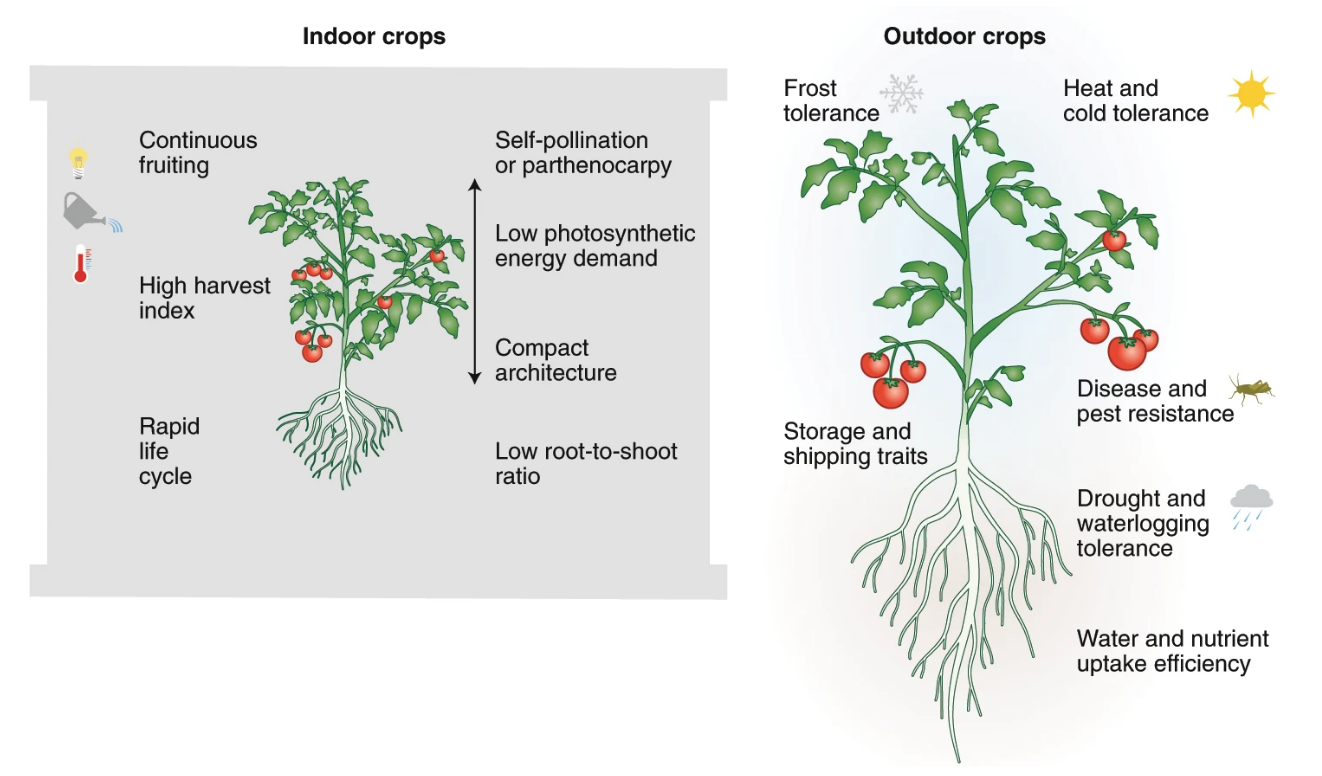
Leafy crops currently grown in vertical indoor farms are small in stature, have short times to harvest, have a high harvest index (all the aboveground biomass is harvested, unlike with fruits) and relatively low photosynthetic energy demand, and grow well in soil-less systems. These crops are also high in value per unit weight, which is a requirement for high-tech farms to be economically viable. Yet the value of leafy crops for food security is debatable. Most fruit and vegetable crops (including tubers and legumes) are not well suited to indoor, climate-controlled farms, and developing appropriate varieties will require optimization of several traits (Fig. 1). Indoor fruit crops need short life cycles, continuous flowering, low root-to-shoot ratio, increased performance under low photosynthetic energy input, and desirable consumer traits, including taste, color, texture, and specific nutrient contents.
In previous work, researchers have changed the architecture of grapevine by exploiting a naturally occurring mutation5 and of kiwifruit by applying gene editing6. In the present study, Kwon et al.2 engineered dwarf tomato and ground cherry plants by targeting a newly identified internode locus (SlER) and stacking this trait with mutations for compact growth habit and rapid flowering (SP5G) and for precocious flowering (SP). By editing three genes and using CRISPR–Cas9 for forward and reverse genetics, they rapidly altered a plant phenotype for indoor production.
The edited tomato varieties are well suited to indoor farming systems. Kwon et al.2 confirmed that the plants expressed the target traits of small stature, early yield, and rapid cycling both in traditional, soil-based field trials and in a commercial vertical farm under LED lights. They also found that, although the tomatoes produced were slightly smaller than for the wild type, each plant produced more fruit, and they had a similar sugar content (an important quality indicator) to the wild-type variety.
In this2 and previous5,6 reports on engineering dwarf crops, the plants exhibit continuous and/or precocious flowering, which greatly increases productivity and enables year-round production. Notably, different sets of genes were modified in tomato and groundcherry, grapevines, and kiwifruit to create the dwarf varieties. So, engineering indoor-farm-friendly plants of other species, such as pepper or cucumber, for example, may require different genetic changes. Even if there are several potential ways to engineer or breed dwarf, continuously flowering plants, the set of genes identified and targeted by researchers so far2,5,6 is likely to prove a useful starting point in a range of species.
For indoor farming to be broadly adopted, the capital and operating costs of climate-controlled farms must be reduced, or they will benefit only the wealthiest communities. These technologically advanced systems are capital intensive and out of the reach of most growers. The energy costs of crops grown in indoor farms far surpass those of field-grown crops7. The development of cheaper, more efficient LEDs was a crucial advance8, but other factors, such as linkage to renewable energy and waste heat reuse, are needed to further improve system economics. Urban farms are well placed to reduce waste by closing loops for water and nutrients, as well as energy, but more innovation is needed to make the recycling of urban waste into growing systems safe, efficient, and economical.
Agronomic research is required to assess how much climate control is needed to optimize crop management. In Australia, for example, greenhouses in peri-urban zones may be more appropriate than indoor farms in urban areas, because the climate is warm, with plenty of sunlight, and restrictions on available land are not extreme. In developing countries, research is needed to assess what capacity there is for smallholders in urban and peri-urban areas to benefit from intensifying production systems and what level of technology is appropriate. Advanced indoor farms are not likely to be feasible for many smallholders because of the associated costs, but there may be ways to use adapted crops in lower-tech, lower-cost systems, such as shaded structures with hydroponics, to increase yields and mitigate weather-related problems.
Although it is unlikely that indoor farms will provide all our staple dry goods (such as wheat and rice), they could increase the production of perishable fruits and vegetables, such as tomatoes, berries, capsicums, and spices. These horticultural products are a crucial source of vitamins, minerals, and fiber. Any plant that has high value and is eaten fresh could be grown indoors, but in many cases will be commercially viable only if genetic innovations such as those reported in Kwon et al.2 can be more broadly applied.
Fruits and vegetables that grow on bushes or vines (tomato, strawberry, raspberry, blueberry, cucumber, capsicum, grapes, kiwifruit) are likely to be most readily adapted for indoor farms, but high-value specialist crops (hops, vanilla, saffron, coffee) and medicinal or cosmetic crops (seaweed, echinacea) might be next.
One day, it is conceivable that even small trees (chocolate, mango, almonds) may be grown indoors. Importantly, the adaptation of a wide variety of plants for indoor cultivation could ensure that these crops can still be harvested in a future with an uncertain climate. Other products, such as medicinal cannabis, and insects and algae, which are used as alternative protein sources, are already being produced in indoor farms9.
Urban agriculture has existed for centuries, but the climate-controlled urban farming industry remains in its infancy. Interdisciplinary research in genetics, plant biology and physiology, agronomics, farming systems, engineering, and physics will be needed to improve the cost-effectiveness and productivity of modern urban farms. Broad-acre farmers and consumers have benefited from knowledge provided by agricultural researchers over centuries. Urban agriculture must receive similar support if it is to help feed growing urban populations in the face of increasing climate variability.
References
1. Benke, K. & Tomkins, B. Sustain. Sci. Pract. Policy 13, 13–26 (2017).
2. Kwon, C.-T. et al. Nat. Biotechnol. https://doi.org/10.1038/s41587-019-0361-2 (2019).
3. Clinton, N. et al. Earths Future 6, 40–60 (2018).
4. O’Sullivan, C. A., Bonnett, G. D., McIntyre, C. L., Hochman, Z. & Wasson, A. P. Agric. Syst. 174, 133–144 (2019).
5. Boss, P. K. & Thomas, M. R. Nature 416, 847–850 (2002).
6. Varkonyi-Gasic, E. et al. Plant Biotechnol. J. 17, 869–880 (2019).
7. Graamans, L., Baeza, E., van den Dobbelsteen, A., Tsafaras, I. & Stanghellini, C. Agric. Syst. 160, 31–43 (2018).
8. Kozai, T., Fujiwara, K. & Runkle, E. LED Lighting for Urban Agriculture. (Springer, Singapore, 2016).
9. Specht, K. et al. Sustainability 11, 4315 (2019).
Author information
Affiliations
CSIRO Agriculture and Food, Queensland Biosciences Precinct, St. Lucia, Queensland, Australia
Cathryn A. O’Sullivan, C. Lynne McIntyre, Ian B. Dry, Susan M. Hani, Zvi Hochman & Graham D. Bonnett
Corresponding author
Correspondence to Cathryn A. O’Sullivan.
Ethics declarations
Competing interests
The authors declare no competing interests.
Rights and permissions
About this article
Cite this article
O’Sullivan, C.A., McIntyre, C.L., Dry, I.B. et al. Vertical farms bear fruit. Nat Biotechnol 38, 160–162 (2020). https://doi.org/10.1038/s41587-019-0400-z
Published14 January 2020
Issue DateFebruary 2020
Share this article
Anyone you share the following link with will be able to read this content:
Get shareable link
Provided by the Springer Nature SharedIt content-sharing initiative
Subjects
Further reading
Food First: COVID-19 Outbreak and Cities Lockdown a Booster for a Wider Vision on Urban Agriculture
Giuseppe Pulighe
& Flavio Lupia
Sustainability (2020)
Water management beyond the fortressed COVID-19 world: considerations for the long-term
Katherine A. Daniell

Standardization To Build A Vertical Farming Industry or Building Customized Farms That Keep Cost High?
“Are we thinking about standardization so we can build a vertical farming industry or are we going to build a bunch of customized farms that keep costs unnecessarily high?
There are a lot of new ideas being trialed within the indoor farming space. “One of the hurdles I see is that it’s expected that there are standardized products available that will fit the new vertical farming systems being developed. Many farmers request that manufacturers develop custom components and equipment to meet the specifications of their system and their requirements, assuming that their systems will be the ones adopted by the industry and standardized,” says Chris Higgins, CEO of Hort Americas.”
According to Chris vertical farmers mostly don’t always take into account the required size and scale needed for custom made products. As an example, many of the new farming systems don’t fit the current substrate industry models. And that in itself is ok. Unfortunately, many of these farms aren’t large enough to afford the customizations needed to keep their produce profitable. That then creates additional work for these new farming businesses. Instead of being able to focus on growing, they’re trying to figure out the best way to manage a non-existent supply channel. “Growers keep designing new irrigation models and growing systems without thought of how they are going to source a substrate, consistently and cost-effectively.”
Chris Higgins
Chris says that there is a lot to learn from the Dutch greenhouse industry. Over the years they have built a great model that supports the commercial greenhouse industry really well. Namely, building a commercial vegetable greenhouse around a single crop, with the scale required to manage cost, labor, and the supply channel. “They are focused on reducing labor by using automation and getting as much efficiency out of the system and supply channel as possible. Dutch and other northern European farms grow several vegetable crops in greenhouses that are quite similar to each other. Here in the USA, the vertical farming industry is new. We are still finding ourselves. Defining our plan, and building learning to build out an industry that will support potential growth.”
“Are we thinking about standardization so we can build a vertical farming industry or are we going to build a bunch of customized farms that keep costs unnecessarily high? Factories are all about processes and standardization. Plant factories should be no different.” Chris wonders whether it’s really a problem to treat an indoor farm as a factory when building it. He states that substrates requirements are a simple yet good example of how there has not been much thought to standardization. But, how planning and simple changes could help farmers be more successful sooner.
A second hurdle Chris sees is a desire to become organic. “Building a new farm is challenging enough! Building a successful indoor hydroponic organic farm with new growers is even more challenging.” Indoor and vertical farmers are rightfully focused on food safety issues. Much of a successful food safety program is based on the ability to have tracking, tracing, consistencies and guarantees. This requires growers to need input products that can fit that model. Unfortunately truly organic products do not always fit that mold. Organics inputs can be hard to standardize as they are often not manufactured in a traditional way causing them to be influenced by outside variables in which only mother nature controls.
This can be seen within the peat moss substrate industry. “The vertical farming industry needs organic substrates to be delivered in a customized fashion, timely and in the highest of qualities. However, the peat moss industry has not necessarily evolved over time with this focus in mind. The industry has evolved to provide a very cost-competitive product to ‘large’ greenhouse growers. A smaller footprint farm that needs the highest of quality in a custom package may simply not have the volume needed to interest a supplier. However, many small farms using a similar product can work together to create the volume that will encourage the suppliers to change their strategies and put the energy and effort needed into new product development.”
So how can an industry be formed in such a competitive time where entrepreneurs are fighting for investor dollars? “Simple, focus on the business practices that truly make your new farming business unique. Then leverage the supporting horticulture industries and use what's available to you in a standardized package. This will allow you to grow quickly and focus on what makes you successful.”
For more information:
Hort Americas
Chris Higgins, CEO
chiggins@hortamericas.com
www.hortamericas.com
Publication date: Fri 8 Jan 2021
Author: Rebekka Boekhout
© VerticalFarmDaily.com

UNITED KINGDOM: Work Could Start Soon On Futuristic Derbyshire Food Hub
Planning application in for scheme, which would create 5,000 jobs
Planning Application In For Scheme, Which Would Create 5,000 Jobs
BY ZENA HAWLEY
7 JAN 2021
This is how the SmartParc campus would look (Image: Ashtonsmith)
When you subscribe we will use the information you provide to send you these newsletters. Sometimes they’ll include recommendations for other related newsletters or services we offer.
Food production could be in full swing by the end of the year at a giant new Derbyshire industrial site.
That's if a planning application submitted by SmartParc gets the go-ahead in the near future.
The company has applied to create a 155-acre, hi-tech food manufacturing campus on the former Celanese site at Spondon.
It will provide state-of-the-art manufacturing facilities, start-up incubation units, and a potential location for a food manufacturing technology centre of excellence.
The idea is to combine purpose-built food production units and a central distribution facility bringing food producers together on one campus. In the process, it is expected to create up to 5,000 direct jobs.
The company's ambition is to provide a sustainable blueprint for the industry. This will harness the latest developments such as vertical farming and smart technology to improve production and energy efficiency, reducing costs, and increasing competitive advantage for the site's tenants.
Vertical farming is a new development and is where crops are grown indoors in stacked layers, mitigating the vagaries of the weather and eliminating the need for pesticides.
This is an example of vertical farming (Image: SmartParc)
Jackie Wild, SmartParc chief executive, said: "We are delighted to take another step forward in our plans to put Derby at the heart of the UK’s future in sustainable, efficient food manufacturing.

Bowery Farming Expands With The Addition of A New Farm
“Adding our newest, most sophisticated, smart indoor farm in Bethlehem to our network is a critical next chapter in our growth,” said Founder and CEO Irving Fain
Jan. 6th, 2021
NEW BETHLEHEM, PA - If the new year has you thinking about all things bigger and better, you’re not alone. Bowery Farming announced its expansion with a new farm in Bethlehem, Pennsylvania, the company’s largest commercial farm yet.
Irving Fain, Founder and Chief Executive Officer, Bowery Farming“
Adding our newest, most sophisticated, smart indoor farm in Bethlehem to our network is a critical next chapter in our growth,” said Founder and CEO Irving Fain. “We’re proud to transform a former industrial site into productive, modern farmland, which will create year-round sustainable farming jobs for the community and expand access to a reliable source of traceable pesticide-free produce across the region.”
The farm, which is the most technologically advanced of Bowery’s farms, features industry-leading improvements like LED lighting that reduces energy consumption and a water transpiration system designed to recapture nearly all of the water from the plants, a press release revealed.
Bowery Farming announced its expansion with a new farm in Bethlehem, Pennsylvania, the company’s largest commercial farm yet
Bowery is working with the Commonwealth of Pennsylvania to transform the non-arable industrial site into useful, modern farmland. The grower is also partnering with the Pennsylvania Department of Community and Economic Development and Governor’s Action Team to bring the new farm to fruition. Because of its strategic location, the farm will bring local produce to the surrounding population of over 49 million consumers and provide year-round farming jobs.
Tom Wolf, Governor, Pennsylvania (Photo credit: National Governors Association)“
Pennsylvania welcomes Bowery Farming to our commonwealth’s rich and diverse agriculture industry and looks forward to supporting the company’s growth as it reimagines how farming can be more sustainable and impactful on our communities,” said Pennsylvania Governor Tom Wolf. “Bowery’s expansion will generate new opportunities by establishing this indoor vertical farm, and will create innovative farming practices, new jobs, and a chance to address food insecurity in the Bethlehem area.”
We at AndNowUKnow will keep our eye on the newswire as more and more growers continue to push for expansion in new markets.
Packaged Salads Value-Added Bowery Farming Expansion New Farm Farm Technology Water Transpiration System Lighting Sustainability New Jobs Facility Facilities Operation Growth Growing Expand Expanding Irving Fain Tom Wolf
COMPANIES IN THIS STORY
Bowery Farming
At Bowery, we're committed to growing the purest produce possible. To us, that means using zero pesticides and non-GMO...

Is A Rainwater Harvesting System Suitable For Hydroponic Lettuce Cultivation?
The aim of this study was to determine the suitability of a rainwater harvesting system to cover the water demand for indoor hydroponic lettuce cultivation located in Wrocław, Poland
The aim of this study was to determine the suitability of a rainwater harvesting system to cover the water demand for indoor hydroponic lettuce cultivation located in Wrocław, Poland.
The analysis was performed on the basis of the recorded rainfall in Wrocław in 2000–2019. The analyzed cultivation is located in a hall with an area of 300 m2, where the lettuce is grown vertically by the hydroponic method.
The calculations of the rainwater harvesting (RWH) system were carried out considering the selection of the tank capacity for the collected water. The operation of the water storage is simulated using a yield after spillage (YAS) algorithm.
It was evident that the proposed system might be an auxiliary system that relieves the water supply network or supports other water recovery systems (e.g., the water vapor condensation in a cross-flow heat exchanger operating as an element of the air conditioning system, proposed in Part 1 of this study).
The harvesting system for the selected vertical farming indoor hall covers an average of 35.9% of water needs and allows a saving of 146,510 L of water annually for the cultivation. An average water demand coverage increases up to 90.4%, which allows a saving of 340,300 L per year when the RWH system is combined with water recovery from exhaust air from the hall.
Click here to access the complete study.
4 Jan 2021

Abandoned Spaces And Automation: What To Expect For Indoor Farming in 2021
Controlled-environment agriculture — also simply known as indoor farming — had a big year both in terms of activity and investment dollars
Controlled-environment agriculture — also simply known as indoor farming — had a big year both in terms of activity and investment dollars. While once we might have questioned the sector’s economic viability and ability to actually feed a growing global population, a lot of those doubts have diminished and indoor ag in its many forms now has an important role in our future food system.
What that role is, however, will continue to evolve over time. Here are a few thoughts on how that will happen over the next 12 months.
More automation.
Automation isn’t new to controlled-environment agriculture, but its presence as a part of indoor farming operations has increased over the last several months and will continue to in the next year.
In the context of controlled-environment farming, automation can refer to any kind of technology that removes manual human labor from the growing process. In some cases that includes robots that plant and harvest greens or move trays of produce around the farm. More often, though, automation refers to software that can calculate the optimal environmental temperature for each plant, know when plants need to be fed and harvested, and handle many other calculations that would otherwise require a person to have horticultural and technological (hardware and software) expertise.
Moving into 2021, we’ll definitely see a few more robots buzzing around the indoor farm. But the bulk of automation will be about software.
More grocery store partnerships.
Many large-scale indoor farms started out selling their leafy green wares to restaurants and hotels. The pandemic, of course, put a hold on that in 2020, and controlled-environment agriculture operations had to look elsewhere for customers.
Enter the grocery store. From container farms at local markets to Kalera’s partnership with Publix stores across the U.S., more indoor farming companies are growing their greens either onsite at grocery stores or within throwing distance of them.
This could in turn help bring the cost of greens grown on high-tech farms down, since the shipping and distribution steps will be less resource intensive in many cases and nonexistent in others.
More underutilized space.
One of my favorite stories from 2020 was this one, about a company called Wilder Fields that turned an abandoned Target store in south Chicago into a massive indoor farm.
Many companies are constructing their own facilities from the ground up, while others stick to smaller scale container farms that are a bit more mobile. Finding existing space, such as an abandoned big box retailer, seems a logical middle ground, and one we’ll likely see more of as companies work to lower costs and keep their environmental footprint down.
Predictions pieces, of course, are always a bit of a crapshoot, and even if the above forecasts turn out to be true, they’ll be but a smattering of the activity that will happen for controlled-environment ag in 2021.
FILED UNDER: AG TECH BUSINESS OF FOOD DELIVERY & COMMERCE FEATURED FOODTECH

AppHarvest Hires Impossible Foods’ David Lee As President
Lee brings track record capitalizing on innovative disruption to meet consumer demand
Lee brings track record capitalizing on innovative disruption to meet consumer demand
MOREHEAD, Ky., Jan. 7, 2021 – AppHarvest, the leading AgTech company building some of the country’s largest indoor farms and combining conventional agriculture techniques with cutting-edge technology to grow affordable, nutritious fruits and vegetables at scale, has appointed David Lee president, reporting to Founder & CEO Jonathan Webb effective Jan. 25.
In this newly created role, Lee will develop strategy and engage in operations management, leading the sales, marketing and finance functions as AppHarvest continues to grow as a sustainable fresh foods company.
Lee will join AppHarvest from Impossible Foods where he has served as chief financial officer since December 2015. He is credited with significant growth accomplishments at Impossible Foods including securing more than $1.3 billion in funding to accelerate manufacturing, product development and distribution into key national grocery, restaurant, and hospitality venues; and to expand in international markets. Additionally, Lee served as chief operating officer of Impossible Foods from 2015 to 2019, during a period of significant transformation for the company. Lee has served on the board of
directors of AppHarvest since August of 2020 and will continue to serve in that role after the closing of the previously announced business combination of AppHarvest with Novus Capital Corporation (Nasdaq: NOVS).
“David Lee brings decades of experience across retail and consumer industries driving business transformation and optimizing organizational effectiveness from Del Monte to Zynga to Impossible Foods,” said AppHarvest Founder & CEO Jonathan Webb. “His skillset will help us build AppHarvest into an iconic brand and sustainable foods company that disrupts traditional agriculture to deliver responsibly grown American products with social impact,” Webb said.
“AppHarvest offers a unique solution to building a more resilient and responsible food system. I have seen firsthand that when given sustainable options, consumers will be the market force that helps address climate change and food supply issues, ensuring success of companies that are putting the planet first, and I am eager to invest my time in a mission-driven company with so much potential to grow.”
In January, AppHarvest expects to begin the first harvest from its flagship farm – a 60-acre facility growing tomatoes – in Morehead, Ky. The company has two additional facilities under construction – a similar 60-plus acre facility outside Richmond, Ky., and a 15-acre facility to grow leafy greens in Berea, Ky. AppHarvest also is planning for more facilities across Kentucky and Central Appalachia, with nine potential projects in the pipeline through 2025.
AppHarvest grows produce using 100 percent recycled rainwater and zero chemical pesticides. Its indoor farms are designed to use 90 percent less water with yields that are up to 30 times higher compared to traditional open-field agriculture on the same amount of land. Its location in Appalachia allows it to deliver a strong social impact by building a diversified economy in economically distressed areas of the country, while enabling its products to reach about 70 percent of the U.S. population within a single day’s drive. As a result, AppHarvest expects to deliver fresher fruits and vegetables, ripened on the vine for peak flavor and nutrition, and an 80 percent reduction in diesel consumption required for transportation as compared to produce shipped from Mexico and the Southwest of the U.S.
Lee holds an MBA from the University of Chicago and a BA from Harvard.
How is AppHarvest different from traditional agriculture companies?
- The company’s controlled environment agriculture facilities are designed to reduce water usage
by 90% due to unique circular irrigation systems connected with large-scale rainwater retention ponds. The system is designed to eliminate harmful agricultural runoff, which contributes to toxic algae blooms.
- Strong relationships with leading AgTech universities and companies in the Netherlands position AppHarvest as a leading applied technology agriculture company. The Netherlands has developed a significant high-tech greenhouse industry, becoming the world’s second-largest agricultural exporter despite having a land mass roughly equal in size to Eastern Kentucky. Earlier this year, AppHarvest led a landmark 17-organization agreement uniting Dutch and Kentucky governments, universities, and private companies, with all committing to building America's AgTech capital from within Appalachia.
- AppHarvest puts the planet and people first as a registered Benefit Corporation and has also been certified as a B Corp by an independent organization.
In just over two years, AppHarvest has attracted more than $150 million in investment into Central Appalachia and announced on September 29, 2020, its entry into a definitive agreement for a business combination with publicly-traded special purpose acquisition company Novus Capital Corporation (Nasdaq: NOVS). The combination, which is anticipated to close early in the first quarter of 2021, is expected to provide $475 million of gross proceeds to the company, including $375 million from a fully committed common stock PIPE at $10.00 per share anchored by existing and new investors – including Fidelity Management & Research Company LLC, Inclusive Capital, and Novus Capital Corporation. Upon closing of the transaction, the combined company will be named AppHarvest and is expected to remain listed on Nasdaq under the ticker symbol APPH.
AppHarvest’s investors include Revolution’s Rise of the Rest Seed Fund, Inclusive Capital Partners, Equilibrium, Narya Capital, Lupa Systems, Breyer Capital and Endeavor Catalyst. Endeavor selected AppHarvest Founder & CEO Jonathan Webb as an Endeavor Entrepreneur in 2019.
Board members include food icon Martha Stewart, Narya Capital Co-Founder and Partner JD Vance and impact investor Jeff Ubben.
About AppHarvest
AppHarvest is an applied technology company building some of the world’s largest indoor farms in Appalachia. The company combines conventional agricultural techniques with cutting-edge technology and is addressing key issues including improving access for all to nutritious food, farming more sustainably, building a home-grown food supply, and increasing investment in Appalachia. The company’s 60-acre Morehead, Ky. facility is among the largest indoor farms in the U.S.
For more information, visit AppHarvest.
Forward-Looking Statements
Certain statements included in this press release that are not historical facts are forward-looking statements for purposes of the safe harbor provisions under the United States Private Securities Litigation Reform Act of 1995. Forward-looking statements generally are accompanied by words such as “believe,” “may,” “will,” “estimate,” “continue,” “anticipate,” “intend,” “expect,” “should,” “would,” “plan,” “predict,” “potential,” “seem,” “seek,” “future,” “outlook,” and similar expressions that predict or indicate future events or trends or that are not statements of historical matters. All statements, other than statements of present or historical fact included in this press release, regarding Novus Capital’s proposed acquisition of AppHarvest, Novus Capital’s ability to consummate the transaction, the benefits of the transaction and the combined company’s future financial performance, as well as the combined company’s growth plans and strategy, future operations, estimated financial position, estimated revenues and losses, projected costs, prospects, plans and objectives of management are forward- looking statements. These statements are based on various assumptions, whether or not identified in this press release, and on the current expectations of AppHarvest’s management and are not predictions of actual performance. These forward-looking statements are provided for illustrative purposes only and are not intended to serve as, and must not be relied on as, a guarantee, an assurance, a prediction, or a definitive statement of fact or probability. Actual events and circumstances are difficult or impossible to predict and will differ from assumptions. Many actual events and circumstances are beyond the control of AppHarvest. These forward-looking statements are subject to a number of risks and uncertainties, including those discussed in Novus Capital’s registration statement on Form S-4, filed with the SEC on October 9, 2020 (the “Registration Statement”), under the heading “Risk Factors,” and other documents Novus Capital has filed, or will file, with the SEC. If any of these risks materialize or our assumptions prove incorrect, actual results could differ materially from the results implied by these forward-looking statements. In addition, forward-looking statements reflect AppHarvest’s expectations, plans, or forecasts of future events and views as of the date of this press release. AppHarvest anticipates that subsequent events and developments will cause its assessments to change. However, while
AppHarvest may elect to update these forward-looking statements at some point in the future, AppHarvest specifically disclaims any obligation to do so. These forward-looking statements should not be relied upon as representing AppHarvest’s assessments of any date subsequent to the date of this press release. Accordingly, undue reliance should not be placed upon the forward-looking statements.
Important Information for Investors and Stockholders
In connection with the proposed transaction, Novus Capital has filed the Registration Statement with the SEC, which includes a preliminary proxy statement to be distributed to holders of Novus Capital’s common stock in connection with Novus Capital’s solicitation of proxies for the vote by Novus Capital’s stockholders with respect to the proposed transaction and other matters as described in the Registration Statement, as well as the prospectus relating to the offer of securities to be issued to AppHarvest’s stockholders in connection with the proposed transaction. After the Registration Statement has been declared effective, Novus Capital will mail a definitive proxy statement, when available, to its stockholders. Investors and security holders and other interested parties are urged to read the proxy statement/prospectus, any amendments thereto and any other documents filed with the SEC carefully and in their entirety when they become available because they will contain important information about Novus Capital, AppHarvest and the proposed transaction. Investors and security holders may obtain free copies of the preliminary proxy statement/prospectus and definitive proxy statement/prospectus (when available) and other documents filed with the SEC by Novus Capital through the website maintained by the SEC at http://www.sec.gov, or by directing a request to: Novus Capital Corporation, 8556 Oakmont Lane, Indianapolis, IN 46260. The information contained on, or that may be accessed through, the websites referenced in this press release is not incorporated by reference into, and is not a part of, this press release.
Participants in the Solicitation
Novus Capital and its directors and officers may be deemed participants in the solicitation of proxies of Novus Capital’s shareholders in connection with the proposed business combination. Security holders may obtain more detailed information regarding the names, affiliations and interests of certain of Novus Capital’s executive officers and directors in the solicitation by reading the Registration Statement and other relevant materials filed with the SEC in connection with the business combination when they become available. Information concerning the interests of Novus Capital’s participants in the solicitation, which may, in some cases, be different than those of their stockholders generally, is set forth in the Registration Statement.

"The Push For Urban Farming Solutions Has Only Intensified"
Agritecture offers answers regarding urban farming solutions
With significant population growth and urbanization both underway and projected across the globe, the push for urban farming solutions has only intensified. The search for innovative solutions has generated many questions surrounding best agricultural practices and how to build a sustainable urban farm.
Agricultural consulting company Agritecture was developed to address exactly those questions. Agritecture was founded in 2011 when its CEO Henry Gordon-Smith began blogging about urban agriculture and subsequently received numerous inquiries from entrepreneurs looking to start urban farms. Within a few years, Agritecture began to officially offer consulting services and quickly built a portfolio.
Sustainable urban farming solutions
“With a mission to empower impact-driven organizations to develop sustainable urban farming solutions, Agritecture focuses on turning business ideas into practical realities,” says Agritecture’s media strategist, Briana Zagami. The breadth of services offered by Agritecture allows the company to meet the needs of entrepreneurs at various project stages.
Ask Agritecture is the company’s entry-level service through which entrepreneurs can schedule a 30-minute phone call with a consultant to discuss economic and technological aspects of the project and recommend future steps. The company also offers premium consulting services, which are “backed by several years of operational data and a team of experienced growers, agricultural engineers, sustainability managers, and marketing experts”, according to Briana. Furthermore, Agritecture uses its feasibility tools to help urban farmers and entrepreneurs obtain real-world financial estimates for a greenhouse or vertical farm project in any location.
Education
Agricultural education is another cornerstone of Agritecture’s mission, which the company achieves through its Commercial Urban Farming course, which presents best practices in six comprehensive lessons complete with short video modules and additional resources. Agritecture also provides free educational content in the form of its blog, podcast and videos.
The most recent addition to Agritecture’s service offerings is the Agritecture Designer, which was launched in April 2020 and is the world’s first digital platform for the planning of urban farms. According to Briana, “the goal was to take our years of experience as leading industry consultants and translate this into a digital platform to help expedite the planning stage and avoid common pitfalls.”
Future
In 2020, Agritecture’s digital audience is now comprised of 100,000 + users around the world. The team has consulted on over 120 projects spanning more than 26 companies. When asked how Agritecture has responded in light of the COVID-19 pandemic, Briana explained that “Agritecture reinvented itself in the wake of COVID-19 and offered insights from its learnings to other small businesses and advisory firms that are struggling to find new business. We launched several new online initiatives in April and May to better connect with our audience and saw a nearly 3x increase in inbound consulting requests.”
So how does Agritecture envision the development of urban agriculture? According to Briana, “urban agriculture will continue to grow around the world due to the innovative spirit of farmers and the rising demand for fresh, sustainably-grown products.” With the development of supportive policies and standards in key cities, Agritecture expects that urban agriculture will only continue to grow and push past its niche status.
For more information:
Agritecture
www.agritecture.com
Publication date: Wed 6 Jan 2021

Certhon's First Results of Indoor Strawberries Trial
Martin Veenstra, Indoor Farming specialist at Certhon: “This way of growing strawberries is unique because all grow parameters can be precisely controlled during the entire growth cycle
Martin Veenstra, Indoor Farming specialist at Certhon: “This way of growing strawberries is unique because all grow parameters can be precisely controlled during the entire growth cycle. From start to finish. This ensures optimum quality, yield, and fruit sizes, independent of the growing season. All grown without any pesticides and with a choice of both traditional as well as organic nutrients.”
The Certhon Innovation Centre consists of multiple indoor farms equipped with state of the art systems for LED lighting, climate control, CO2 dosing and irrigation systems which are all managed by Certhon's farm control system. In these farms, many crop trials are conducted for the indoor growing of a wide variety of plants, ranging from leafy greens to many vegetables and soft fruit. We would like to share exciting results of our trials with growing strawberries in our indoor farming system.
Results
Yields vary off course per strawberry variety, but at least a minimum of 26 up to 30 kg per m² per year with a consistent BRIX of 8 or higher is now available to every grower. Also, fruit sizes are much more consistent compared to open field or even greenhouse growing.
"At Certhon, we focus on the consistent and uniform top quality of the produce with an improved shelf life. In addition to optimizing the yield, we also put a strong emphasis on minimizing the power consumption for lighting and climate control. Also reducing water consumption is a strong focus point."
Martin: “We are continuously improving our trials and see even more potential in the very near future. Besides strawberries, we are also testing with tomatoes, lettuce, and raspberries.”
For more information:
Certhon
ABC Westland 555
P.O. Box 90
2685 ZH Poeldijk
The Netherlands
Tel: +31 174 22 50 80
Fax: +31 174 22 50 81
www.certhon.com
5 Jan 2021
Greenhouse Villages To Sprout In Metro Manila
The Agricultural Training Institute (ATI) recently partnered with four barangays in Caloocan and Quezon for the creation of greenhouse villages as part of the urban agriculture program of the government

Louise Maureen Simeon
12/22/2020
MANILA, Philippines — The Department of Agriculture will start establishing greenhouse villages in Metro Manila to help ensure a sustainable food supply in the country.
The Agricultural Training Institute (ATI) recently partnered with four barangays in Caloocan and Quezon for the creation of greenhouse villages as part of the urban agriculture program of the government.
Urban agriculture is one of the flagship programs of the Plant Plant Plant initiative of the DA to boost supply amid the pandemic.
Barangays 179 and 180 in Caloocan and barangays Payatas and Tandang Sora in Quezon City will serve as pilot areas for the project.
Under the partnership, ATI will provide funding assistance for the establishment of a greenhouse village per barangay.
This will feature one unit of high greenhouse with an administration office and storage area, one unit of seedling nursery with micro-sprinkler irrigation, and one unit of production area with drip kit irrigation system.
The agreement also calls for 10 sessions of training program from the construction phase until harvest time.
Through this, the DA and ATI aim to showcase doable technologies of protective farming systems.
The partnership also targets to increase the production of vegetables and to make these available in the barangay level throughout the year amid varying weather conditions.
DA’s urban agriculture program has been gaining positive feedback from more institutions as it continues to help stabilize food supply, foster social integration, and protect the environment through eco-friendly methods and innovative gardening methods.
It was launched in April as an immediate response to the food supply disruption due to the pandemic.

VIDEO: How 2 Hong Kong Pioneers’ Hi-Tech Robotic Arms Can Transform Traditional Industries And Research
Technology created at Jonathan Cheung’s Inovo Robotics performs repetitive tasks that can cultivate sustainable crops and process foods in automated kitchens
Technology created at Jonathan Cheung’s Inovo Robotics performs repetitive tasks that can cultivate sustainable crops and process foods in automated kitchens
Eric Wong has transformed lab experiments with Nikyang’s automated tools that allow researchers to carry out a more reliable and systematic analysis
7 January 2021
While robotic technology has been widely used by big manufacturing companies to increase productivity, the high cost of getting started means many smaller businesses have yet to take advantage of its huge potential.
However, Inovo Robotics, a Hong Kong-based technology start-up, is working to solve this problem.
Since it was founded in 2016, the robotics company has been developing solutions for small- and medium-sized enterprises to help them adapt to automation in their everyday business practices.
Jonathan Cheung, the co-founder of the start-up, says his goal is to “democratize robots” and develop tools for all businesses to help them improve efficiency and remain competitive.
By submitting, you consent to receiving marketing emails from SCMP. If you don't want these, tick here
“We found that there is such a big disconnect to the market for small businesses to be able to benefit from affordable and flexible robots,” he says.
“There are a lot of businesses that are struggling to get staff to do monotonous tasks, so what we’re developing is really a tool that enables them to take away repetitive work.”
Jonathan Cheung, the co-founder of Inovo Robotics, says high entry costs mean that many small businesses have yet to take full advantage of automation’s full potential.
Disrupting traditional industries
One of the applications of the robotic arms has seen them used around the clock to carry out repetitive tasks that help grow high-quality, pollution-free vegetables at a futuristic farm in Hong Kong’s Tai Po district.
The farm, operated by indoor farming company Farm66 since 2018, is located inside a 20,000-square-foot (1,860-square-metre) factory building.
The use of the robotic arms to automatically sow seeds and harvest plants helps the farm to produce up to 200 tonnes of organic fresh produce, including cherry tomatoes, cabbage and basil, which is sold online and delivered to the city’s supermarkets and restaurants.
“Robots really improve the efficiency and speed of the products that are being made,” Cheung says. “In this competitive world, there is always a desire to drive costs down.”
In the case of vertical farming, the technology means minimal space and manpower are needed for the farming process, offering a glimpse of how technology will be able to transform farming in future.
Besides the vertical farm, the technology has also been used in an automated kitchen, where it helps with food processing to ensure cooking consistency. Inovo Robotics is also teaming up with a programming company to develop a system for high-resolution 3D scanning.
Inovo Robotics’ technology is being used to cultivate fresh organic produce at Farm66’s futuristic indoor farm inside an industrial factory building in Hong Kong. Photo: Farm66
Popularising robots for everyday use
Before setting up his own venture, Cheung spent more than a decade working as an engineer, when he witnessed first-hand how robots can help businesses scale their operations.
In 2016, Cheung and a colleague co-founded Inovo Robotics to popularise the everyday use of robot technology by businesses.
Its launch product, Modular Arm, with an adjustable system of six fully rotatable joints, gives the robot the flexibility to reach different positions. The robot’s modularity also gives customers an easy mechanism to choose longer or shorter arms, depending on their configurations.
Cheung says while large manufacturing companies often require tools that can automate a repetitive task, smaller businesses look for collaborative robots that can work alongside staff to complete different jobs at the same time.
“Smaller businesses tend to have smaller batch sizes and tighter spaces,” he says. “That is where a collaborative robot really comes into its own.”
Jonathan Cheung says Inovo Robotics’ modular robot technology offers small businesses a variety of options thanks to its adjustable flexible joints and the choice of using shorter or longer arms.
Inovo Robotics currently has two offices at Hong Kong Science Park, a government-run start-up incubator, and London, in the United Kingdom, as it seeks to tap into both the Asia-Pacific and European markets.
Cheung says Hong Kong has proved an ideal location to scale up his business because of its proximity to hi-tech research and an abundance of talent.
“[We can] be close to our supply chain, which allows us to manage it closely and deliver the best product to our customers,” he says.
“At any point in Hong Kong, you are probably within 25km to five or 10 great universities,” he adds. “There is a wealth of talent to be able to tap into – there are only a few countries with that level of accessibility.”
Revolutionizing academic research
Another Hong Kong start-up, Nikyang, has also developed fully automated laboratory equipment to help academic researchers increase the reliability of data collected in experiments.
Today, its automation technology has been applied in many settings, such as research institutes and pharmaceutical and biotechnology companies.
The venture was founded by Hongkonger Eric Wong in 1999 with the initial goal of helping researchers in traditional Chinese medicine (TCM) to conduct analysis in a more systematic way.
“The basic dream of Nikyang was originally to pursue TCM research to gain a better understanding,” says Wong, who graduated with a master’s degree in biochemistry in Canada.
“I thought we needed a more standardized way of doing analysis in TCM to collect valid and precise information.”
Eric Wong, the founder of automation company Nikyang, says the use of robotic technology allows researchers to conduct more systematic analysis.
When he started his business journey by reaching out to laboratories in Hong Kong and mainland China, he realized that researchers wanted to use machines to help them follow the correct procedure as closely as possible while carrying out repetitive work.
However, many automated instruments available then lacked the ability to carry out different steps in lab research, he says, rendering them error-prone when applied in studies.
To solve the problem, Wong collaborated with Chemspeed, a Switzerland-based provider of lab equipment, in developing specific instruments for TCM research.
His team has integrated Chemspeed’s tools with robotic arms and wearables to increase collaboration between researchers and machines in conducting the analysis.
However, he realized the company would not be sustainable if it focused solely on serving the TCM industry, so he later diversified the business and began developing solutions for different settings.
In 2008, Nikyang began receiving orders from petrochemical companies in China, which gave Wong a lifeline to sustain his business and pursue his dream in TCM research.
The venture now places an emphasis on boosting effectiveness by providing an immerse lab experience.
Its SmartLab product, which is still under development, is set to integrate sensor technology, smart wearables, and cloud data management to help researchers work more efficiently with machines.
Nikyang’s SmartLab, which is still under development, will integrate sensor technology, smart wearables, and cloud data management so researchers can work more efficiently with machines. Photo: Nikyang
Nikyang has its headquarters at Hong Kong Science Park, where it carries out most of its research and development work. To tap into the China market, it has also opened branches in Beijing, Shanghai, and Guangzhou to sell its products.
Wong says Hong Kong has served as an ideal location to grow his company because of its connectivity with China and different parts of the world.
“Hong Kong is definitely unique in terms of being a super-connector between the East and the West,” he says.
The city’s world-class financial market and sound legal system have also helped start-ups in raising capital and developing ideas as they embark on their journey.
Pioneering spirit
Both Wong and Cheung believe it is important for aspiring innovators to be passionate about their business vision to help them overcome challenges when developing and selling the products.
Wong, who spent a decade before he found a way to make his business sustainable, says it was vital to remain dedicated because many innovators experience failures before they can get their businesses on track.
“You need to have passion and a big heart to accept failure, and [an] even bigger heart to think and take risks,” he says.
Eric Wong, who spent a decade before finding a way to make Nikyang sustainable, says aspiring innovators should be passionate about their business vision – and not focus only on profits.
Wong also advises young entrepreneurs not to look only at making profits if they want to make a difference in the world.
“Money is only a by-product,” he says, adding that many successful pioneers often have to make substantial investments before they are able to disrupt the industry.
Cheung agrees that innovators must feel empowered to turn ideas into reality.
“My advice is to really focus on the business model,” he says. “It’s a very, very difficult journey to go on, and it’s very, very rewarding as well. And it’s very important to make sure you stay true to what you believe in.
“Having an idea that you believe in wholeheartedly, that you are willing to give your time and commitment to, is a good validation that you are on the right track.”
Morning Studio is the commercial content team of the South China Morning Post (SCMP). It aims to engage readers through storytelling while enabling the brand behind the content to achieve its marketing objectives. The Morning Studio team consists of specialists in various areas such as journalism, multimedia graphics, video production, digital technology, and marketing.

SCOTLAND: Vertical Farming Research Gets Government Funding
EFFORTS to develop vertical farming technology are to get a share in £90million of UK Government funding allocated as part of its drive to get agriculture to 'net zero' carbon emissions by 2040
January 7, 2012
Political Affairs Editor
Light Science Technologies works with growers involved in vertical farming to provide solutions for controlled environment agriculture
EFFORTS to develop vertical farming technology are to get a share in £90million of UK Government funding allocated as part of its drive to get agriculture to 'net zero' carbon emissions by 2040.
Derby-based company Light Science Technologies is one of just 23 feasibility projects which will benefit from this cash pot from the UK’s innovation agency, Innovate UK, as part of its 'Transforming Food Production' challenge.
In partnership with Nottingham Trent University, LST will be leading the project to develop a growing sensor and transmission node for vertical farms over the next six months.
It is hoped that this ‘all in one’ indoor farm sensor will enable farms to monitor and control their environment by measuring key areas including light, water, air, temperature, humidity, oxygen, and soil to ensure optimal plant productivity and yield.
CEO of LST, Simon Deacon, said: “This is an especially important boost to our business. To be selected by Innovate UK is confirmation of the urgent need for more sustainable, productive, and cost-effective solutions in farming. Investment in UK technology and innovation in this sector is crucial in achieving a better approach to agricultural production and reducing emissions.”
Innovate UK executive chair Dr. Ian Campbell added: “There are many innovative projects in our latest feasibility competition showcasing ideas for improving productivity and cutting emissions that range across the whole agricultural sector, from arable to livestock, to sensor technology, and to new biopesticides. Our funding and support for these projects is ongoing.”

New Infographic From Ultimation Industries Shows
“How to Optimize Vertical Farming,” a new infographic created by Ultimation Industries LLC, highlights the benefits of vertical farming and ways to maximize the production of an indoor farming system. Ultimation has designed, manufactured, and installed conveyor systems for over 30 years and is a leader in vertical farming material handling
How To Optimize Vertical Farming
ROSEVILLE, Mich. (Jan. 6, 2021) – “How to Optimize Vertical Farming,” a new infographic created by Ultimation Industries LLC, highlights the benefits of vertical farming and ways to maximize the production of an indoor farming system. Ultimation has designed, manufactured, and installed conveyor systems for over 30 years and is a leader in vertical farming material handling.
Vertical farms can potentially achieve higher yields for the surface area dedicated to production by controlling the light, temperature, humidity, water, and nutrients the plants receive. They also reduce “food miles,” the distance food items travel from the point of production to the table and can reduce CO2 emission from transport while delivering fresher and better-tasting products.
As sustainable agricultural operations such as vertical and indoor farms become more prevalent, conveyor technology systems can be part of the solution. “Conveyors are essential to vertical farming because they can make use of all the available vertical space of a facility and can move plants through automated systems as they grow,” said Richard Canny, president, Ultimation Industries LLC. “How to optimize vertical farming is the challenge that the industry faces as it scales up.”
In addition to creating customized products for assembly operations, Ultimation offers food safe grade systems and material handling solutions for the vertical farming industry. The company has recently expanded into smaller, ‘quick ship’ products and systems that are sold through their website and in Amazon’s stores.
For more information about Ultimation Industries, visit https://www.ultimationinc.com.
About Ultimation:
Ultimation Industries, LLC is a woman-owned leader in the conveyor technology and automation industry. Founded in 1989, Ultimation designs manufactures, and installs machinery and equipment, automation devices, tire and wheel processing lines, and conveyor systems for customers throughout the Americas. The company offers a line of proprietary automation systems and is also a leading integrator of Jervis Webb Conveyor Systems. Ultimation’s e-commerce channel sells Ultimation, Interroll, Itoh Denki, Jervis Webb, and a wide range of other conveyor equipment. In 2020, Ultimation was recognized as one of Inc. 5000’s fastest-growing private companies in America. The company was a finalist for Amazon’s 2019 Woman-Owned Small Business of the Year and earned honors as one of “2019 Metro Detroit’s Best and Brightest Companies to Work For®.”
Visit https://www.ultimationinc.com/ for the latest product information and news about Ultimation.
###
For further information please contact:
Nancy Sarpolis
248-219-5651

Israel’s Vertical Field To Deploy Smart Vertical Farms In Ukraine
Vertical Field’s agreement with the Czech Republic-based Moderntrend SRO, one of the largest agricultural distributors in Ukraine, will see the Israeli company’s solutions set up at Varus, a local grocery chain with 95 stores across 25 cities nationwide

Vertical Field's farms are grown on 'green walls.' Garu Nalbandian
Israeli company Vertical Field, the developer of smart vertical growing solutions for fresh produce, announced a new agreement on Wednesday to deploy its vertical farms in Ukraine, starting with a pilot program with one of the country’s largest supermarket chain.
Vertical Field’s agreement with the Czech Republic-based Moderntrend SRO, one of the largest agricultural distributors in Ukraine, will see the Israeli company’s solutions set up at Varus, a local grocery chain with 95 stores across 25 cities nationwide.
Founded in 2006, the Ra’anana-based Vertical Field uses advanced IoT software, embedded sensors, and in-house monitors to ensure its indoor vertical farms, which grow fresh vegetables, greens, and other plants, are nurtured in controlled conditions regardless of geography, physical location, weather, and climate conditions. The company says its soil-based vertical growing systems make the most efficient use of spaces, both indoors and outdoors, for both agricultural and smart landscaping.
Vertical Field CEO Guy Elitzur said the company’s solutions are ideal for urban environments where land is scarce and access to fresh produce may be more limited. He also indicated that the COVID-19 pandemic has heightened the need for reduced contact and a more efficient supply chain.
“One of the realizations that have surfaced during the COVID-19 crisis is the need to develop solutions that allow urban residents access to healthy food, with minimal human handling and without depending on transportation and shipping from remote locations,” Elitzur said in a company statement. “We are delighted to be able to provide – and expand access to – healthy, and high-quality vegetables grown right outside the consumer’s door.”
Elitzur said the agreement with Moderntrend SRO will lead to partnerships with additional chains in the future.
Moderntrend SRO Director Bondar Denis said the pilot project introduces “innovative and proprietary technologies for vertical cultivation of products for the urban ecosystem by Vertical Field” and represented “a new level in the Ukrainian market.”
Last month, Vertical Field finalized a multi-million-dollar agreement with Israeli grocery chain Rami Levy to install vertical farms at dozens of the supermarket company’s branches across the country over the next five years.
By NoCamels Team January 06, 2021
SEE ALSO: Israeli Grocery Chain To Offer Fresh Produce Grown On-Site
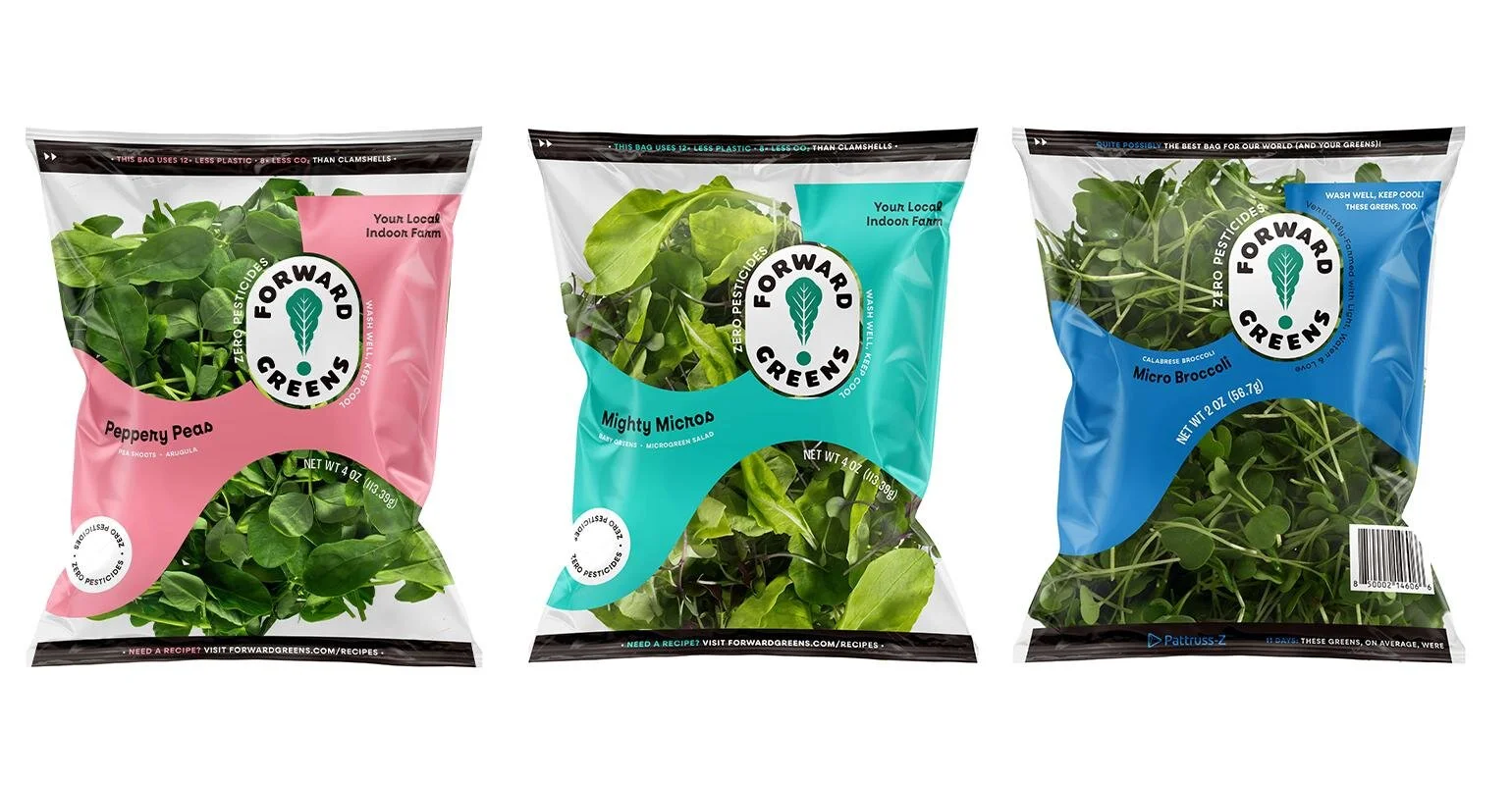
Grower To Flexible Packaging
Forward Greens' vertically farmed edible plants packaging was changed twice before finding the best metrics-based sustainable option, an OPP pillow pack
Forward Greens' vertically farmed edible plants packaging was changed twice before finding the best metrics-based sustainable option, an OPP pillow pack.
January 04, 2021
Sometimes the best of intentions doesn’t turn out as expected, which is why the phrase “if at first, you don’t succeed, try, try again” was crafted for those whose persistency pays off.
Taking that to heart was Forward Greens, an indoor “vertical farm” brand in Vancouver, WA, that went from PET clamshell packaging to tetrahedral-shaped oriented polypropylene bags to OPP pillow-pack bags. The final iteration was part of a major rebrand this year that centered on using the most sustainable packaging. Ken Kaneko, the company’s founder, and CEO provides answers regarding the packaging and decision-making process.
How did your sustainable journey begin?
Kaneko: Forward Greens’ process for developing a sustainable packaging solution for our greens started with researching waste stream management with local municipalities to understand how we could integrate with the existing infrastructure. Along with the Oregon Department of Environmental Quality and Portland Metro, we ran a Life Cycle Assessment (LCA) to understand the impact of production, logistics, and disposal for available packaging options. From this, we learned that material mass was the largest driver in carbon emissions and that most plastics, even compostable ones, are not accepted by the municipalities. After synthesizing all the information, we concluded that flexible plastic packaging demonstrated the lowest material mass and thus the lowest carbon emissions.
Forward Greens
It would be helpful to know more about your products and customers.
Kaneko: Forward Greens currently has 9 products across baby greens and microgreens, all delivered from farm to market within 48 hours of harvest. We’re unique in that it takes about 19 days from seed to market shelf for our baby greens and about 9 days from seed to market shelf for our microgreens.
Our target customer is anyone who is interested in locally grown, healthy greens — to use for salads, as ingredients, or toppings. We hope we attract those who are especially conscious of their impact on the environment, knowing that with our products, customers are not extraneously stressing the planet. That of course includes our packaging, but also in how we grow the plants themselves. Our sustainable indoor farming practices use 95% less water and 99% less land than outdoor agriculture. We skip the use of herbicides, pesticides and fungicides, and use only non-GMO seeds.
Why was the polymer choice made?
Kaneko: When we rebranded to Forward Greens this summer, we shifted from PET clamshell packaging to OPP flexible packaging to better reflect our mission. The OPP film uses 92% less plastic than traditional clamshells, 12 times less plastic, and produces eight times fewer carbon dioxide emissions compared to, for example, a recycled polypropylene tub.
Forward Greens
Comment on the tetrahedral design (seen above).
Kaneko: Forward Greens initially decided to adopt a tetrahedral shape for our packaging to help the product stand out, but also for two primary logistical reasons. First, the tetrahedral shape allows for more volumetric space for the greens with the same amount of plastic material. Second, the tetrahedral shape uniquely helps our greens stay safe and avoid getting crushed throughout the distribution process from farm customer’s plates.
Why didn’t that work and what was behind the change to the pillow pack?
Kaneko: There are a few reasons why Forward Greens decided to switch from the tetrahedral shape to the pillow pack. The primary reason is that retailers merchandise based on existing shelving units, which are often paid for by incumbent or slotted brands. Trying something new in that environment is very difficult, both for new brands and the retailers. Even though Forward Greens did receive initial buy-in from our retailers and staff, when it came time for the new packaging to rollout, it was more complicated to accommodate the new shape on the shelf than expected, so we adopted the pillow pack to streamline that process for everyone involved.
Forward Greens
Also, we used to be known as West Village Farms, but changed our brand to Forward Greens this summer to better reflect our dedication to sustainable practices and our hope to move the entire industry forward. The packaging change from our clamshells to the tetrahedral packaging shape was part of that brand launch. The most-recent package change from the tetrahedral shape to the pillow pack uses the same look that debuted this summer, but in the pillow-pack shape.
As an indoor farm, Forward Greens is constantly trying to improve yields and reduce production costs. Our recent switch from the tetrahedral packaging design to the pillow pack shape increased our content volume and net weight by 33%.
Talk about the timeframe for these changes.
Kaneko: The process for developing both our new packaging and rebrand as Forward Greens from West Village Farms was a huge undertaking. We began the initial planning and development for the new brand in late 2019. The new packaging and brand officially launched the summer of 2020 in the midst of the pandemic.
Switching from the tetrahedral shape to the pillow pack took about four months.
Can you credit the other companies involved?
Kaneko: We worked with Grady Britton, a Portland, OR-based marketing agency, to develop our new brand and packaging design. We wanted the new look to bring to life what we stand for, so the packaging reflects a love of community, food, and the planet while sparking joy. The new-look is vibrantly colorful, and part of that is because bagged greens is a crowded market. The new brand design stretches accepted notions of produce packaging design while ensuring the product still looks appetizing. The bag also offers a windowed look inside so customers can see how fresh the greens are.
What feedback have you received?
Kaneko: Forward Greens’ customers and retailers appreciated the effort and unique look of the new packaging shape. We may have just been a little bit ahead of the curve for the greens industry with the tetrahedral packaging shape.
What lessons did you learn in the past months?
Kaneko: Brands need to be selective about trying new things at retailer sites. There is a certain speed at which retailers move and it’s very different from the speed at which a company, like Forward Greens, moves. Regardless of the change back to the original pillow pack packaging shape, our fundamental goal is that our packaging has one of the lowest environmental impacts available, all while helping retailers merchandise our greens to the customers who want to buy our products.
TAGS: SUSTAINABLE PRACTICES SUSTAINABILITY EXTRUSION: FILM & SHEET

Iron Ox Announces Next Robotic Farm In Lockhart, TX
Iron Ox has purchased nearly 25 acres of land and plans to build a new, state-of-the-art facility on the property
November 6, 2020
LOCKHART, TX, — Iron Ox, a leader in robotics and AI-enabled farming with a mission to solve food insecurity, and the City of Lockhart, Texas today announced that Iron Ox will expand their operations to the city with plans to break ground on a new facility this December, bringing new tax revenue and jobs to Lockhart.
Since 2015, Iron Ox has developed hybrid robotic greenhouses that support a range of produce offerings. To bring those produce offerings to new communities, the company identified Texas as the next state in their national expansion plan with its favorable business environment and rich history of agriculture.
“We’re proud to make Lockhart our next farm outside of California,” said Brandon Alexander, Iron Ox CEO & Co-founder. “Lockhart’s city government, as well as their planning and development staff, worked diligently with us throughout this process and made us feel right at home. In addition, the city's central location within the Texas triangle and short drive from Austin, allows for strong distribution lanes of same-day grown and harvested products throughout the entire state of Texas, making the city the ideal choice for our robotic greenhouse growing platform”.
Iron Ox has purchased nearly 25 acres of land and plans to build a new, state-of-the-art facility on the property. This new facility will house the company’s natural light greenhouses, processing operations and AI-enabled robots to bring fresh, clean and healthy food to new customers and communities throughout Texas.
“The addition of Iron Ox to the Lockhart business community represents synergy between our city’s storied history in agriculture and our growing technology sector,” said Lockhart Mayor Lew White. “The food and beverage processing industry is one of four business sectors Lockhart has targeted in its 5-year economic growth plan because our city’s unique advantages align perfectly with the needs of companies like Iron Ox.”
Mike Kamerlander, Director, Economic Development, represented the Lockhart Economic Development Corporation (CEcD) on this project.
“As Lockhart continues to grow, Iron Ox and companies like it are essential to our economic vitality and future. We thank them for their investment and commitment to Lockhart.”
About Iron Ox
Iron Ox launched the world’s first autonomous farm in October 2018, leveraging advancements in plant science, machine learning, and robotics. The Iron Ox team develops AI-enabled, autonomous technology that enables fresher, more consistent produce to be grown and distributed globally. The company’s goal is to service thousands of communities with the freshest and healthiest products, while establishing global reach and impact on food security.
For more information, visit www.ironox.com.
About Lockhart Economic Development Corporation
The Lockhart Economic Development Corporation, a department within the City of Lockhart, is designed to provide a range of business and economic development assistance. To learn more about opportunities in Lockhart, visit www.lockhartedc.com.
Contact Info:
Taylor Aldredge
570-534-4754

Signify Adds Artechno To Its Philips Horticulture LED Partner Network To Lower Bar For Future Vertical Farmers
“Partnering with Signify is a logical choice for us,” said Art van Rijn, Owner of Artechno
January 4th, 2021
Signify Chooses Artechno As its New Philips
Horti LED Partner For The Unique Modular
Turnkey Vertical Farming Solutions That it Provides
· Lowers bar for growers and entrepreneurs to start a new vertical farm
· Helps to automate the production process for diverse crops from seed to harvest
Eindhoven, Netherlands – Signify (Euronext: LIGHT), the world leader in lighting, has signed a partnership agreement with Artechno, global provider of scalable Automated Vertical Farming systems, to make it easier for growers and entrepreneurs to start a state-of-the-art vertical farm using Philips GreenPower LED lighting. Artechno, headquartered in De Lier, the Netherlands, is an engineering company that develops and realizes unique automated cultivation systems based on hydroponic substrates for clients across the globe.
“Partnering with Signify is a logical choice for us,” said Art van Rijn, Owner of Artechno. “We’re a winning combination as we offer our customers the highest efficiency and highest reliability, while Signify provides energy-efficient lighting solutions that perform 24/7, 365 days a year. Together this will help our customers to grow tasty, high-quality produce year-round.”
Artechno has channeled 100+ years of combined experience in horticulture into its flagship product, Automated Vertical Farming, or AVF+. It offers a fully automated solution for producing a variety of crops from seed to harvest. Artechno has automated all processes to ensure low labor costs and consistent crop production. AVF+ is a modular system that can be customized to the needs of the crop, available space, or desired production volume. Growers and entrepreneurs can start with a few key components and scale up their automation and operation as they grow.
“We’re proud to expand our partnership network with the knowledge and expertise of Artechno,” said Udo van Slooten, Business Leader Horticulture at Signify. “They share our values of innovation, quality and reliability. This partnership will help us lower the barriers for growers and entrepreneurs who are considering a vertical farm by enabling us to offer Philips GreenPower lighting within fully modular and automated systems for every aspect of their operations.”
Signify continues to expand its horticulture partner network, further demonstrating its commitment to lead the horticulture industry as the innovative LED lighting systems provider for the indoor farming industry.
--- END ---
For further information, please contact:
Global Marcom Manager Horticulture at Signify
Daniela Damoiseaux
Tel: +31 6 31 65 29 69
E-mail: daniela.damoiseaux@signify.com
About Signify
Signify (Euronext: LIGHT) is the world leader in lighting for professionals and consumers and lighting for the Internet of Things. Our Philips products, Interact connected lighting systems and data-enabled services, deliver business value, and transform life in homes, buildings, and public spaces. With 2019 sales of EUR 6.2 billion, we have approximately 37,000 employees and are present in over 70 countries. We unlock the extraordinary potential of light for brighter lives and a better world. We achieved carbon neutrality in 2020, have been in the Dow Jones Sustainability World Index since our IPO for four consecutive years, and were named Industry Leader in 2017, 2018 and 2019. News from Signify is located at the Newsroom, Twitter, LinkedIn and Instagram. Information for investors can be found on the Investor Relations page.

Indoor Ag Fintech Startup Contain Raises Investment Round, Adds Industry Veteran To Team
We have plans to introduce new ways to support the burgeoning indoor agriculture industry in 2021, and this funding round will allow us to do just that.”— Nicola Kerslake, Founder, Contain Inc
NEWS PROVIDED BY Newbean Capital
January 04, 2021
Image from Contain Inc
A Techstars graduate, Contain Inc works with industry vendors and more than 20 lenders to facilitate access to capital for North American indoor growers.
We have plans to introduce new ways to support the burgeoning indoor agriculture industry in 2021, and this funding round will allow us to do just that.”— Nicola Kerslake, Founder, Contain Inc
Image from Rooted Global
RENO, NV, UNITED STATES, January 4, 2021 /EINPresswire.com/ -- Contain Inc, a fintech platform dedicated to indoor agriculture, today announced that it has closed a round of funding from investors in the US and Europe. They represent investments from indoor agriculture, food and beverage, entertainment, and financial industries. The funds will enable further technology development as well as new initiatives that support indoor agriculture. The industry has become ever more relevant in the time of COVID as consumers and produce buyers alike recognize the benefits of local secure produce supply.
Image from Contain Inc
A Techstars graduate, Contain Inc works with industry vendors and a pool of more than 20 lenders to facilitate access to capital for North American indoor growers of all sizes. In 2020, Contain collaborated with Singapore family office ID Capital to introduce a microlearning platform, Rooted Global, that enables corporate employees to grow a little of their own food at home. Its clients include tech and food majors, such as Danone and Dole. Nicola Kerslake, founder of Contain Inc, added: “We have plans to introduce new ways to support the burgeoning indoor agriculture industry in 2021, and this funding round will allow us to do just that.”
In addition, Chris Alonzo, President, and CEO of Pietro Mushrooms, will join Contain Inc to provide consulting services to future leasing clients. Chris brings a wealth of experience in planning, constructing and managing indoor farms across two continents. He is a third-generation mushroom farmer in Kennett Township, PA, an area that supplies half of the US’s mushroom supply. Nicola Kerslake said: “we’re frequently approached by indoor farmers planning large new projects and are delighted to be able to offer the services of such an experienced grower to those looking to bolster their plans before seeking financing.” Chris Alonzo added: “I’m excited to bring my expertise to Contain Inc’s fast-growing team and to engage with a startup that has long supported indoor farmers”.
The Company will also be expanding its team in business development, marketing and product development over the coming weeks, and encourages those seeking roles in this exciting space to visit its website at contain.ag for more details.
About Contain, Inc.
Contain Inc is a US-based fintech platform dedicated to indoor agriculture, growing crops in warehouses, greenhouses, and container farms. The Company works with leading equipment vendors and with an expanding pool of lenders to aid indoor growers in finding funding for their farms. It is also home to microlearning platform Rooted Global, which works with majors such as Danone and Dole to enable employees to grow a little of their own food at home. The Company graduated from the 2019 Techstars Farm to Fork program, backed by Cargill and Ecolab.
More information: https://contain.ag, https://rooted.global
Nicola Kerslake
Contain Inc.
+1 7756237116
email us here
Visit us on social media:
Twitter
LinkedIn