


Welcome to iGrow News, Your Source for the World of Indoor Vertical Farming

UK: Vertical Farm Construction Accelerated To Help Feed Bristol During COVID-19 Crisis
LettUs Grow, an indoor farming technology provider, is fast-tracking the building of two vertical farm modules in the city of Bristol to help feed vulnerable communities during the COVID-19 outbreak
LettUs Grow, an indoor farming technology provider, is fast-tracking the building of two vertical farm modules in the city of Bristol to help feed vulnerable communities during the COVID-19 outbreak. The company is teaming up with the food redistribution charity FareShare South West to ensure the produce gets to those who need it most.
LettUs Grow expects the first of the new aeroponic farm modules to be ready to start producing fresh produce from mid-April, with the first harvests ready to be delivered to FareShare just ten days after the farm’s commissioning. A second, larger module will be following in June.
Because most of the farm’s operations are automated, they can be run with only one person on site at any given time to allow social distancing of key workers and minimizing strain on an already stretched farm labor force. The food is also produced in a high care environment with few people coming into contact with it. Once up and running, the farms will be able to provide a consistent, predictable and climate-resilient food supply to the local community all year round.
The coronavirus outbreak has shone a spotlight on the fragility of the UK’s just-in-time food supply chain. The UK only produces 50% of the food it consumes, which leaves it vulnerable to shocks in the global supply chain. The closures and lockdowns enforced due to the pandemic, have created logistical bottlenecks that ripple across these lengthy chains.
Jack Farmer, co-founder and Chief Scientific Officer of LettUs Grow said: “When we founded LettUs Grow, we wanted to enable anyone, anywhere in the world, to grow fresh produce near its point of consumption. That mission has hardly ever felt as urgent as it does today. We knew we had to get involved and help in any way we could.
“Because our farm modules can be deployed anywhere with an electricity and water supply, they are uniquely positioned to increase regions’ food supply chain resilience by diversifying local food production.”
The FareShare group provides close to 1 million meals a week to frontline charities and community groups working with vulnerable people, such as those experiencing homelessness, mental health issues, domestic violence, loneliness and families who require free school meals. As the Coronavirus situation develops, Fareshare has seen demand for their service rising, particularly in the event of closures of schools, workplaces, and public spaces and people self-isolating.
Phoebe Ruxton, Fundraising Manager at FareShare South West said: “We are absolutely determined not only to stay open but to level up our organization as far as we possibly can to stop the very worst happening.
“While supermarkets seem empty, there are thousands of tonnes of surplus food in the system. There is no other organization in the region with the capacity to redistribute this food, and FareShare South West is well placed to deliver it straight to those most in need.”
You can help FareShare South West get food to people in need during this crisis by making a financial donation here: faresharesouthwest.org.uk/coronavirus-emergency-fund/. If you’re outside the South West, you can donate here fareshare.org.uk/help-us/.
For more information:
LettUs Grow
lettusgrow.com
Publication date: Thu 9 Apr 2020

Marcel Koolen, Codema; "Food Safety, Automation And Reliability Are More Critical Than Ever"
“In this changing market, it is crucial that we provide the investor and what we call the 'corporate horticulturist' with the right information, knowledge and the proper perspective
Since 2017, Marcel Koolen has been at the head of Codema as CEO. He took over from founder Maarten de Jager, who meticulously merged various horticultural specialists into the Netherlands' leading supplier of horticultural solutions. It is his task to realize the international ambitions and at the same time, realize his own vision.
Market for horticultural solutions is changing
“We come from a world in which our customers, experienced growers who took over the company from their parents, know all about the technology. They exactly know what they need. These people choose the best solution for each individual aspect of their operation, for example, a logistics system from Hawe or a water solution from B-E De Lier. These critical cultivation systems can now be found under one roof: at Codema. This fits in well with the changing market. An increasing part of the market requires a conversation partner who comes up with a total solution.”
In recent years, horticulture has been a popular destination for the money of investors who want to invest on a large scale in, for example, medicinal cannabis, food production, and vertical farming. Floriculture and traditional growers also continue to develop and grow. Partly due to size, technical innovation must ensure higher efficiency or yield.
Conversation partner from the start
“In this changing market, it is crucial that we provide the investor and what we call the 'corporate horticulturist' with the right information, knowledge and the proper perspective. After which, we arrive at the delivery of critical cultivation systems. In the first place, this means that, from the beginning of their trajectory, we are a full conversation partner for these organizations. Our organization is now geared up for this.
Secondly, this requires an international presence. We are always building projects in America, Europe and the Asia-Pacific region with a particular emphasis on China. This goes beyond a simple sales organization, our "license to operate" depends on our ability to provide after-sales service and maintenance."
Due to these developments and continuing growth, the organization of Codema has grown strongly. "From the Netherlands, we serve and supply all over the world and on location we work as much as possible with local workers. Many beliefs converge in the latter; cost control from the customer and the influence of Nordian Capital. For example, on sustainability." However, Koolen's personal motives also make their mark:
“That does not mean that I make many difficult considerations or want to impose these on my customers. By applying new technological developments and continuing to work on both design and engineering, we already are more economical with raw materials.
Of course, it starts by considering if we can make better decisions in everything we think about and everything we do. Think about choosing green energy, solar panels, limiting flight movements, a hybrid fleet, and so on. Good business decisions that are simply better for our planet. It is no coincidence that this is also essential for our investor, Nordian Capital. Nordian’s entire investment portfolio compensates for all of its emissions through certified contracts with Land Life Company. This foundation is committed to the reforestation of around 2 billion hectares of land around the world.’’
A shared vision for the future
Originally, Marcel Koolen was an Electrical Engineer. However, he soon discovered that a wider field of vision suits him better. That theme had been a common thread in his entire career. Paired with his passion for what he calls ‘public interest’. With every step, his playing field grew larger.
‘The first time that it actually connected was with an electrical family business. There I quickly built up a department whose turnover was equal to that of the parent company and was allowed to slim it down a few years later. I have been able to face these kinds of challenges at an increasingly higher level. First at VolkerRail, during the privatization of the railways, and then at Spitzke and ABB.
When I started at Codema, significant changes were to come and therefore was an excellent fit. However, the main reason for my choice is our shared vision for the future. When I worked on the mobility of the Netherlands at VolkerRail, I noticed that serving the ‘public interest’ motivates me enormously. And at Codema we go further: we help feed the world. A good and efficient food production not only ensures that everyone has food but also makes it a lot less harmful to the environment. That is a challenge, which I would like to put my efforts into.’
Future and strategy Codema: food production
The herb cultivation market has boomed in recent years, and the legalization of the cultivation of medicinal cannabis has created a large capital inflow, which also benefited Codema. Codema realized critical cultivation systems in the largest, most advanced cannabis greenhouses in the world. These are greenhouses in which food safety and reliability, as well as automation, are more critical than ever. Codema also works in the floriculture with large cultivation organizations to apply the latest technology in areas such as software, water, lighting, and logistics. This provides knowledge and experience that Codema can directly apply to food cultivation.
“Investing in food production is a good business decision. The world population is growing, and with it, the demand for food. There are many challenges in this area that require a technical solution and where Codema can make the difference. That makes it a good investment for both investors and Codema. Since we are now active in the three major time zones, we reduce the risk of economic volatility further. That makes us future-proof.”
Cooperation in the chain
“That does not mean that Codema can do that alone. We work together with greenhouse builders and engineering -and consultancy firms, such as scientific researchers, educational institutions and market researchers. Partly because of this, Codema is able to present the final solution to the customer. This means that we go further than ever in our services. That is also what the market demands.”
When asked whether he is satisfied if, in Codema 2024 anchored her international position as a food production specialist, Koolen replies:
“We should always keep growing, but that doesn't mean it's always about financial growth. This could, for instance, be growth in the impact you have on the world. Or growth in knowledge and skills, the development of new technologies. We need to keep moving and ensure that Codema can continue to offer its customers the best proposition in the future.”
For more information:
Codema Systems Group
Oosteindsepad 8
2661 EP Bergschenhoek
The Netherlands
+31105212755
info@codemasystemsgroup.com
www.codemasystemsgroup.com
Publication date: Wed 8 Apr 2020

SINGAPORE: Coronavirus Prompts Urban Farming Interest
Millions of people across the globe have been confined to their houses because of the coronavirus (Covid-19) pandemic and some have turned to urban farming to source their fresh produce, the start of a possible trend

BY LIAM O’CALLAGH
8th April 2020, Hong Kong
With movement in many countries restricted, some consumers are turning to urban farming for their fresh produce

Millions of people across the globe have been confined to their houses because of the coronavirus (Covid-19) pandemic and some have turned to urban farming to source their fresh produce, the start of a possible trend.
According to a report from Reuters, more urban residents are resorting to growing their own fruits and vegetables as panic buying has left supermarket shelves empty.
Landscape architect Kotchakorn Voraakhom designed Asia’s largest urban rooftop farm in Bangkok, she told Reuters the current situation has the potential to drive an urban farming trend.
“More people are thinking about where their food comes from, how easily it can be disrupted, and how to reduce disruptions,” said Voraakhom.
“People, planners, and governments should all be rethinking about how land is used in cities. Urban farming can improve food security and nutrition, reduce climate change impacts, and lower stress.”
Singapore is one country that has already signaled its interest in urban farming. It imports more than 90 percent of its food but in 2019 the government set a goal to produce 30 percent of its food needs by 2030, a plan that will embrace techniques such as urban farming.
On 6 April, Singapore lawmaker Ang Wei Neng urged the country to consider its food supply, “it would be wise for us to think of how to invest in homegrown food”.
Speaking to Reuters, Allan Lim, chief executive of ComCrop, said the coronavirus had amplified the fragility of the supply chain.
“It has definitely sparked more interest in local produce. Urban farms can be a shock absorber during disruptions such as this,” Lim said.
Millions of people across the globe have been confined to their houses because of the coronavirus (Covid-19) pandemic and some have turned to urban farming to source their fresh produce, the start of a possible trend.
According to a report from Reuters, more urban residents are resorting to growing their own fruits and vegetables as panic buying has left supermarket shelves empty.
Landscape architect Kotchakorn Voraakhom designed Asia’s largest urban rooftop farm in Bangkok, she told Reuters the current situation has the potential to drive an urban farming trend.
“More people are thinking about where their food comes from, how easily it can be disrupted, and how to reduce disruptions,” said Voraakhom.
“People, planners, and governments should all be rethinking about how land is used in cities. Urban farming can improve food security and nutrition, reduce climate change impacts, and lower stress.”
Singapore is one country that has already signaled its interest in urban farming. It imports more than 90 percent of its food but in 2019 the government set a goal to produce 30 percent of its food needs by 2030, a plan that will embrace techniques such as urban farming.
On 6 April, Singapore lawmaker Ang Wei Neng urged the country to consider its food supply, “it would be wise for us to think of how to invest in homegrown food”.
Speaking to Reuters, Allan Lim, chief executive of ComCrop, said the coronavirus had amplified the fragility of the supply chain.
“It has definitely sparked more interest in local produce. Urban farms can be a shock absorber during disruptions such as this,” Lim said.

Small Business Administration COVID-19 Resources & Information
The SBA is responding to small business owners impacted by the Coronavirus with several different forms of assistance
By urbanagnews
April 3, 2020
By Marlow Schindler, U.S. Small Business Administration
The SBA is responding to small business owners impacted by the Coronavirus with several different forms of assistance.
Last week the CARES Act was signed by President Trump. The Paycheck Protection Program (PPP) outlined in this stimulus package is not yet available. Lenders may begin processing loan applications as soon as April 3, 2020.
The SBA provides low-interest disaster loans directly to help businesses and homeowners recover from declared disasters. For this disaster, Economic Injury Disaster Loans are currently available throughout the state of California. You can get access to the online application and information about the SBA disaster loans here. The online application is now open.
Anyone who has already applied for EIDL should have received an email from SBA this week providing instructions on how to apply for the up to $10,000 EIDL advance. Advance may be available even if your EIDL application was declined or is still pending, and will be forgiven.
If you wish to apply for the Advance on your EIDL, please visit www.SBA.gov/Disaster as soon as possible to fill out a new, streamlined application. In order to qualify for the Advance, you need to submit this new application even if you previously submitted an EIDL application. Applying for the Advance will not impact the status or slow your existing application.
If you have questions about this application or problems providing the required information, please contact our Customer Service Center at 1-800-659-2955 or (TTY: 1-800-877-8339) DisasterCustomerService@sba.gov.
You may always reach out to your local Small Business Development Center, Women’s Business Center, Veteran’s Business Outreach Center or SCORE chapter to get paired with an advisor who can help you during this difficult time.
Also, we encourage you to subscribe to our national email updates via www.SBA.gov/Updates and follow the SBA on Twitter at @SBAgov for the latest news on available SBA resources and services.
Best regards,
Marlow Schindler
Assistant District Director for Lender Relations & Public Information Officer
San Francisco District Office
U.S. Small Business Administration(415) 519-0030
marlow.schindler@sba.gov
Check regularly at SBA’s page for Coronavirus Small Business Guidance
Here Are The ‘Dirty Dozen’ Fruit And Vegetables Laced With Legal Pesticides — Even Organics Have Traces
Nearly 70% of the fresh produce sold in the U.S. contains residues of legal though potentially harmful chemical pesticides even in small amounts, and a popular snack for children is another big offender
March 25, 2020
By Rachel Koning Beals
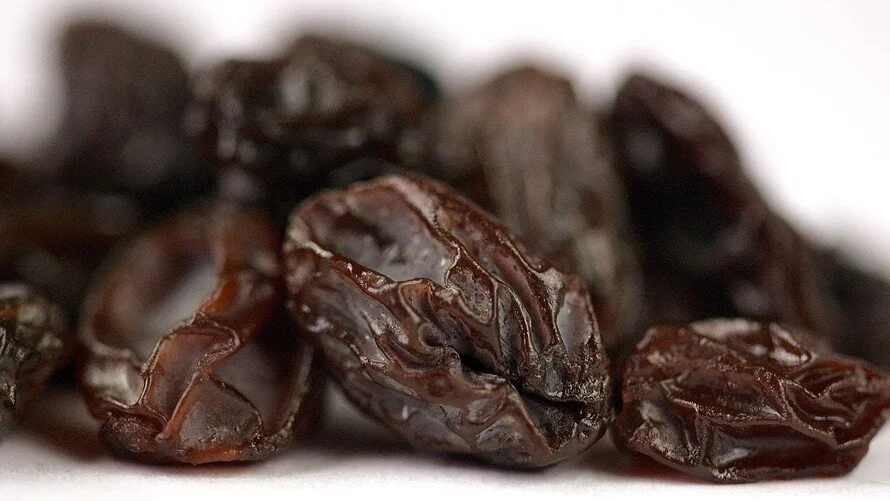
Raisins are surprise offenders this year with neurotoxic insecticide chlorpyrifos, which some research has shown can harm the nervous system in children
Nearly 70% of the fresh produce sold in the U.S. contains residues of legal though potentially harmful chemical pesticides even in small amounts, and a popular snack for children is another big offender.
Among the top choices to limit exposure to pesticides? Avocados, asparagus, and honeydew melon.
The analysis comes from the Environmental Working Group. Each year since 2004 it has ranked its Dirty Dozen and Clean Fifteen lists and combines them as a shopper’s guide for consumers. The “dirtiest” of all is not a fresh fruit or vegetable, but a dried one — raisins. Raisins weren’t ranked on the fresh lists but their surprising results caught the attention of EWG.
Toxicologists and other researchers at EWG compare the pesticide contamination of 47 popular conventional — meaning not farmed organically — fruits and vegetables. The review is based on the results of tests by the USDA and the Food and Drug Administration of more than 43,000 samples of produce.
Environmental Working Group
Most pesticide residues the agency finds fall within government-mandated restrictions, but advocacy groups such as EWG argue “legal does not mean safe.” Before conducting its tests, USDA washes, scrubs, and peels fruits and vegetables as consumers would.
Thomas Galligan, Ph.D., a toxicologist with EWG said researchers continue to study why raisins contained higher traces of pesticides than the grapes they’re dried from, though grapes ranked on the list this year. Read more of his analysis.
Children under the age of 15 eat a total of about 208 million pounds of raisins each year, or about half of the raisins consumed in the U.S., according to Zion Market Research. The average American consumed about 1.25 pounds of raisins in 2017, the latest year for which the USDA has information. Zion’s industry analysis shows that slightly less than two-thirds of raisins are consumed as ingredients in other foods, with the rest eaten as a stand-alone snack.
“Infants, babies and young children are exquisitely vulnerable to even low levels of pesticide exposure, so it’s important parents and caregivers take steps to safeguard children from these chemicals while also providing them diets rich in healthy fruits and vegetables,” said Dr. Philip Landrigan, a pediatrician and epidemiologist who’s director of the Program in Global Public Health and the Common Good in the Schiller Institute for Integrated Science and Society at Boston College.
“For many Americans, choosing an all-organic diet is not possible, so [pesticide guides] can help give consumers the tools to provide their families with a mix of both conventional and organic fruits and veggies without the pesticide punch,” he said.
Environmental Working Group
Producers generally use pesticides to improve crop yield, which can hold down retail prices, which is particularly important to low-income consumers. The findings also show that even produce labeled organic can show traces of pesticide.
The EWG group highlighted two chemicals in particular. One is neurotoxic insecticide chlorpyrifos, which some research has shown can harm the brain and nervous system in children at even low levels. The chemcial was detected on 5%, or 34 out of 670 samples, of conventional raisins, and 6%, or five out of 86, of organic raisin samples.
California, where the majority of the U.S. raisin supply is produced, recently banned all uses of chlorpyrifos because of the risks it poses to both children and farmworkers. That regulatory change was not carried through to the federal level, however.
The second chemical of note is neonicotinoids, which the USDA’s tests detected on almost one-fifth of fruits and vegetables. Neonics are the fastest-growing class of insecticides, “despite a decade of research making it clear that they are highly toxic to honeybees and other pollinator species,” EWG researchers said. Some studies on human health also suggest that exposure to neonics may be harmful to the developing fetus and children, they said.
Residues of at least one of three neonicotinoid pesticides banned in the European Union — imidacloprid, clothianidin, and thiamethoxam — were found on more than half the U.S. samples of potatoes, spinach and lettuce tested. At least one of these neonics was also found on more than one-fourth of the samples of U.S. cherries, watermelon, and strawberries.
The Alliance for Food and Farming, which represents both organic and conventional farmers of fruits and vegetables, argues that these annual lists overstate the amount of pesticide detection on food.
“To accurately assess consumer risks from pesticides, one needs to consider three major factors – 1) the amount of residue on the foods, 2) the amount of food consumed, and 3) the toxicity of the pesticides,” said Dr. Carl Winter, professor emeritus in toxicology at the University of California, Davis.
AFF points to an analysis and a calculator from toxicologists with the University of California’s Personal Chemical Exposure Program, which found a child could eat hundreds to thousands of servings of a fruit or vegetable in a day and still not have any health effects from residues.
Experts at EWG and the AFF stressed that maintaining fruits and vegetables in daily diets is the most important goal. Sometimes budget and availability limit shopping for organic produce.
“Although we believe consumers should be concerned about pesticide residues on the food they eat, the health benefits of a diet rich in fruits and vegetables outweigh the risks of pesticide exposure,” said Alexis Temkin, PhD, a toxicologist with EWG. “With the Shopper’s Guide, consumers don’t have to choose between pesticides and a healthy diet.”
EWG added specific guidance to its report as consumers respond to the coronavirus pandemic.
It is important to know that there is no evidence people can be exposed to the coronavirus through food, experts say. The spread pattern is quite different from foodborne pathogens like Salmonella and E.coli. That is why, even though the risks of COVID-19 are serious, consumers should continue eating plenty of healthy fruits and vegetables while in quarantine at home, the group said.
Lead photo:
Children under the age of 15 eat a total of about 208 million pounds of raisins each year or about half of the raisins consumed in the U.S. Getty Images

Professional Chefs Bring Out The Best of Madar Farms' Microgreens At Emirates Salon Culinaire
As part of the Expo Culinaire event, in collaboration with Emirates Culinary Guild, the chefs put their creative, gastronomic and artistic skills to the test in front of a judging panel
Abu Dhabi, 16 March 2020: Hundreds of professional chefs from the UAE and abroad prepared dishes using a variety of microgreens grown by Madar Farms at this year’s Emirates Salon Culinaire competition in Sharjah.
As part of the Expo Culinaire event, in collaboration with Emirates Culinary Guild, the chefs put their creative, gastronomic and artistic skills to the test in front of a judging panel.
Among the ingredients used were different ranges of microgreens that were grown in the UAE by AgTech company Madar Farms. Their local fresh produce included pea shoots, arugula, tendril peas, daikon radish, and amaranth.
Abdulaziz AlMulla, co-founder and CEO of Madar Farms, said: “As a partner, we are delighted to have been involved in this year’s Emirates Salon Culinaire. For any chef, fresh ingredients are key for preparing any type of dishes. With Madar Farms using cutting-edge farming techniques and advanced methods to grow quality produce every day, our supply of microgreens for the competition meant they were not only full of flavour but were grown here in the UAE.”
Chef Uwe Micheel, President of the Guild and Director of Kitchens Radisson Blu Hotel, Dubai Deira Creek, said: “We were privileged to have Madar Farms as one of our new partners for this year’s event. Madar Farms was our sole supplier for the microgreens and the freshness and quality of the products were very well received by the competing chefs.”

"With Our Concept, Everyone Can Be A City Farmer"
As Sweden is not on a lock-down yet, the virus is nevertheless having a great impact on jobs and the country’s economy
As Sweden is not on a lock-down yet, the virus is nevertheless having a great impact on jobs and the country’s economy. Crisis packages for jobs and transition are now being presented by the government. So far SweGreen has not noticed a great impact on business despite the COVID-19, rather the opposite. The absolute major part of SweGreen produce, based in Stockholm, is the distribution of their ‘Stadsbondens’ branded leafy greens and herbs to supermarkets. A particular increase in sales is visible, even though the company doesn’t do anything extra in-store to meet customers, besides deliveries.
Free greens
“We have some restaurants on our client list, and we see that they are suffering a lot now. We are actually delivering to them according to the agreement, but for free. We have chosen to not charge our restaurant partners anything during this crisis, just to show our compassion and goodwill,” Andreas Dahlin, CEO of SweGreen says.
The SweGreen salad mix
Stadsbondens
Stadsbondens, which means ‘The City Farmers’ in Swedish, is the leafy greens brand, that SweGreen uses for marketing their produce to supermarkets. As for now, the produce is sold at around ten supermarkets, located in Stockholm. SweGreen has recently set up service together with an online distributor which enables them to sell their fresh produce online and home-delivery of the greens. Dahlin notes: “It gives us the possibility to reach more people. Next to that customers don’t have to get out of the house, and our brand lovers can order the fresh produce no matter where they are located in Stockholm.”
Farming as a Service
SweGreen has developed its own farming service, which is a closed environment and automated in-store solution that gives customers within grocery and restaurants the possibility to be their own providers of fresh, nutritional, locally-produced greens harvested directly off the shelf.
A vertical basil wall
“Farming as a Service, as we like to call it, is the service we offer. We provide a whole system, containing both software and hardware, such as monitoring and steering. So basically with our concept, everyone can be a City Farmer as it automates the whole growing process”, Andreas Dahlin says. In Stockholm, the SweGreen city farm has been fully developed for automation. “We control everything that goes in and comes out. With a fully closed system, we also can digitally control every unit or crop that we provide to our client. One of the most important keys for Urban Farming is absolutely being able to get valid data from growing processes and having the ability to convert the data to value-shaping intelligence. We focus a lot on this now. In this way, we can improve the systems constantly together with our clients.”
A vertical fresh produce wall
Future aspect“
Our objective now is to further develop the Farming Service. Our customers really appreciate this service model and I think the circumstances right now prove the importance of factors such as sustainability, resilience and hyper-local production for the food industry."
Andreas Dahlin, CEO at SweGreen
"We have just closed our second seeding round with investors and we are planning on expanding internationally. Not only with the focus on supermarkets, because we also get a lot of interest from restaurants too. Restaurants and chefs are early adopters when it comes to the sustainable production of food”, Dahlin adds.
For more information:
SweGreenAndreas Dahlin, CEO, and partner
andreas.dahlin@swegreen.se
www.swegreen.com
Publication date: Fri 3 Apr 2020
Author: Rebekka Boekhout
© HortiDaily.com

A Journey Through The World Supply Chain With IFCO Systems
Founded in 1992, IFCO was the first pioneer to reintroduce a reusable packaging system for the entire fresh product supply chain, from producer to retailer
Founded in 1992, IFCO was the first pioneer to reintroduce a reusable packaging system for the entire fresh product supply chain, from producer to retailer. They are now the clear market leader in the world, with operations in more than 50 countries across five continents and subsidiaries in 30 countries. Their services are used by 320 of the world’s largest retail companies and over 14,000 growers and food producers. How did they grow from niche service providers to global supply chain leaders? I sat down with CEO Wolfgang Orgeldinger at FruitLogistica in Berlin to find out.
It starts with a pool of 314 million plastic containers
These containers account for 1.7 billion roundtrips per year, from one end of the supply chain to the other and back. The system is simple: first, a newly cleaned and sanitized container is sent to a grower or packer; the product is then packed and shipped to a distribution center, where it is distributed to retail outlets; the product is then sold and the container is returned to a service center where it is cleaned. Round trip complete.
The prime products are fresh fruit and vegetables, but IFCO also transports significant volumes of meat, eggs, seafood, and bread. Most containers stay in a regional pool: for example, containers will complete roundtrips for transporting cabbage in Germany, oranges in Spain, or leafed salad in Holland. But they are also used for southern hemisphere imports, bringing kiwis from New Zealand, grapes and apples from South America, and oranges from Argentina. If you ever wondered where your bananas came from, there is a good chance they came from Central America in an IFCO container.
Regional pools are flexible and scalable: you could have a specific pool for continents like North America and Europe, or scale down to a country level for Japan, Argentina, or Chile; or you could hyper-localize the pool down to a city level, for integration with vertical farms in an urban food system. To give an example, Mr. Orgeldinger cited the city of Sao Paolo, where 90% of fresh produce is grown within 100km of the city center. IFCO’s pool of containers in this region only moves within that circumference.
The operation of these pools is much more sustainable than transporting fresh products with single-use packaging.
To begin with, the containers are designed to be sturdy: each container is used for up to 120 round trips before it reaches the end of its life cycle. Small damage is repaired at servicing centers; if the container is beyond repair, the material is ground down and turned into new packaging. IFCO is the only company directly recycling its own crates to make new ones; this is possible because their crates are made out of one material and can be ground directly into the production process. This cradle to cradle system helps IFCO reduce CO2 emissions by 60%, consume 80% less energy and use up to 80% less water in its operations when compared to using single-use packaging.
But why use plastic at all? The answer is to reduce food waste. When you transport fresh products, you have to account for humidity and plastic is the best material to reduce this problem. With IFCO’s containers, the damage and spoil rates of fresh products is 90% less compared to a single-use container. A further innovation in the IFCO system is that it is totally modular: they design containers in two footprint specifications: 60X40 cm and 30X40 cm. Each footprint stacks perfectly to maximize space and reduce the likelihood of a fall. Finally, each container includes a ventilation system that extends the lifespan of the food in transit and on the shelf.
Given all the advantages of their product versus single-use packaging, it’s no wonder that customers are flocking to IFCO’s sustainable solution. ‘Customers come because the system reduces costs,’ says Mr. Orgeldinger. If you look at the cost-saving across the entire supply chain, from field to retail store, and account for all packaging related costs, all handling costs, and product damage, IFCO can save up to 27% of the total cost. Given the growing momentum of environmental concerns among consumers and suppliers, IFCO is well primed to lead the supply chain into the future. Let’s take a look at how else IFCO is innovating to help growers, producers and businesses save money and save the environment: it starts with technology.
Innovation in packaging: Apps, AI, and integration with vertical farms.
You might wonder how much technology can be packed into a plastic box. But it’s more about the technology that surrounds the box itself. Remember that pool of 314 million plastic containers? They are tagged and the new generation is readable by your smartphone. IFCO is developing a new app that enables smartphone users to identify and count all containers on a pallet. The new technology will first be rolled out in service centers and trialed in order to improve the AI algorithm. They will then provide this service to customers, enabling all participants in a given pool to act more efficiently.
Another new app enables customers to do all transactions with IFCO via their smartphone. This is an industry first, enabling growers who rely on mobile technology to participate in the supply chain more efficiently. Other technical innovations that were mentioned by Mr. Orgeldinger included integrating IFD and GPS-based systems and blockchain solutions into their producer to retailer model. But I was most interested to find out about how IFCO could integrate with innovations in other fields, like the transition of fresh food production to hyper-local vertical farms.
Vertical farms offer IFCO containers a shorter roundtrip journey
Mr. Orgeldinger told me that vertical farming is the most interesting solution for feeding the growing population who live in large urban areas. Modular, reusable plastic containers are perfect for transporting fresh produce across short distances and there is significant scope for integrating IFCO’s packaging with the shorter supply chains that are enabled by vertical farming. This is scaling down from continent to country to city, creating a whole new set of container pools for IFCO to fill. Both IFCO and the vertical farms they choose to work with will play a significant role in the sustainability of urban areas going forward. We will be watching this space closely.
Find out more about IFCO at https://www.ifco.com/
KYLE BALDOCK
View All Posts

COVID-19 Roundtable: Indoor Ag Perspectives On Coronavirus
One of indoor ag’s greatest strengths is its diversity. Under one roof — hopefully, with a rooftop garden — it unites agriculture, tech, business, tradition, and innovation in a way few other industries can match
One of indoor ag’s greatest strengths is its diversity. Under one roof — hopefully, with a rooftop garden — it unites agriculture, tech, business, tradition, and innovation in a way few other industries can match. This diversity means that when it comes to confronting something like coronavirus, people may experience the crisis in different ways. And it means a world of different people bringing their unique experiences to the monumental task of keeping people fed while the rest of the world is shut down.
With that in mind, we reached out to our friends across the industry for a (socially-distanced, email) roundtable on what they’re seeing now, and what it means for the industry.
Supply and Demand Are Changing
As shelter in place orders go out across the country, shuttering bars and restaurants, Americans are returning to eating at home, and that’s changing how they buy.
“Supply chains are disrupted and most indicators say that it will take three to four weeks to adjust to the current coronavirus situation. There is a big shift away from restaurants and toward retail food purchases and direct to consumer options. Direct-to-consumer quickly went from something grocery stores and restaurants wanted to figure out to an urgent need given the number of people that cannot or do not want to venture out of their house.
“Local produce and products from vertical farms can fit nicely into this new model. They provide local and fresh options that can fill in current supply chain gaps. Consumers tend to increase purchases of local, organic, and natural products when there is a human health or food safety concern. This spike will likely happen here. The only factor pulling it down is that these products tend to be more expensive and many people are very worried about their jobs. Over 3 million people filed for unemployment this week and that number is expected to rise dramatically in the coming weeks.” — Michelle Klieger, Strategerm Consulting
Automation Is Imperative
Whether you harvest insects, like Ÿnsect, or make agtech solutions, like Autogrow, it’s clear that this moment underscores what we’ve known for a long time: automation is one of the keys to the next generation of indoor ag.
“We have a robotized manufacturing process, where we require very, very few workers. They are wearing a full suit, so they are secure, and have a mask, like a diver. The risks of contamination are very low.” — Alain Revah, Ÿnsect
“We recently launched our new environmental sensor network, Folium, and we’re super excited to present this state-of-the-art solution to commercial growers. Launching a new product just before a global pandemic hit, who could plan for that? We are responding to this by changing channels we utilize to connect with our customer base, including more marketing and video conferencing based meetings.”
“In the current climate it’s pretty evident that if you have advanced automation systems and new smart applications to run your farm, e.g. remotely accessible environmental and crop information along with farm management tools, it gives you the freedom to make sure you are aware of what’s happening with your crops and manage them, without having to always be physically on-site. And it minimizes commercial risk. You can’t do without a grower or manager (yet) but you can certainly use solutions that can help — especially during isolation situations, reducing risk to a minimum.” — Darryn Keiller, CEO, Autogrow
Protect Your People
Our product is great food, but great food comes from great, hard-working people, and their health is always key. That means shaking up business, and how we connect with each other on an emotional level, too.
“We restricted international travel earlier in March, we could see that coming. International travel and now domestic have effectively been suspended. Cancellation of trade shows has been the biggest impact, they are how the whole industry operates in terms of customer engagement.” — Keiller
“We are dealing with anxiety and the fear of the unknown with all of the employees. We are all human and struggle with not knowing details and being out of control. So lots of communication, discussions (which are slightly more awkward as we all practice social distancing). Trying to understand all of the new rules and options for employees as we continue to process the changes that are happening on a day to day basis.” — Paul Brentlinger, President, CropKing
A Silver Lining?
There is no doubt that coronavirus is awful in just about every way, but somewhere in there is small but powerful silver lining: it’s making people think seriously about where their food comes from, and what it takes to keep stores and markets full.
As Brentlinger puts, it, “I think it shows us how prepared we need to be for any situation, and how essential we are to the world.”
Amen to that!
Learn more about Contain and funding your indoor ag business at our website, and subscribe to Inside The Box, our weekly newsletter.
Agriculture Food Supply Chain Indoor Agriculture Vertical Farming
WRITTEN BY
Nicola Kerslake
We’re Contain Inc. We use data to improve access to capital for indoor growers, those farming in warehouses, containers & greenhouses. Contain.ag


Unfazed By Covid-19, Infarm Arrives In Japan And In Canada
While centralized facilities have generally dominated the vertical farming venture capital domain, distributed and decentralized business models are gaining pace, according to AgFunder’s 2019 industry report. One in particular—Germany’s Infarm—nabbed $100 million last year to deploy its connected growing cabinets in supermarkets

March 26, 2020

Photo credit: Infarm
Strictly speaking, vertical farming has been with us since the dawn of agriculture; it would be interesting to see wheat growing any way other than vertically. But the term, despite its ambiguity, is now recognized shorthand for vertically stacked farming, where layers of crops are grown on top of each other, and where conditions like light, temperature, water or nutrients are artificially controlled indoors to allow for year-round growing.
There are two predominant visions of vertical farming: centralized and distributed. Proponents of centralized systems argue that large-scale production—and financial viability—depends on ever-bigger and higher farms. These farms, or plant factories as they are sometimes called, are proliferating, aided by huge sums of capital. Plenty scooped up a whopping $200 million in Series B funding back in 2017. US-based AeroFarms raised $100 million in late-stage funding in 2019, for example, while Fifth Season secured $50 million last year.
While centralized facilities have generally dominated the vertical farming venture capital domain, distributed and decentralized business models are gaining pace, according to AgFunder’s 2019 industry report. One in particular—Germany’s Infarm—nabbed $100 million last year to deploy its connected growing cabinets in supermarkets.
AFN has been keeping tabs on Infarm as a high-profile case study of the distributed vertical farming model. The company’s footprint already includes more than 600 cabinets in many European and US cities. During the first quarter of 2020, Infarm has been busy making progress on its global expansion strategy as well. In February, for instance, East Japan Railway Company (JR East) partnered with Infarm to deliver fresh produce grown and harvested in retail stores starting in summer 2020 (pending circumstances around the Covid-19 pandemic, of course). The partnership is Infarm’s first in Asia.
Infarm has also inked an agreement with national food distributor Muroo, which will support a phased roll-out of the Berlin-based company’s farms across Japan in 2021. Infarm has launched a new affiliate, Infarm Japan, to support its expansion in the country.
Similar plans are also afoot in Canada, where Infarm will soon launch its first fresh produce harvests at Safeway stores in Vancouver, with eventual expansion to Calgary, Edmonton, Halifax, Toronto, Victoria, and Winnipeg.
Roll-out timelines in both countries could yet be disrupted, as both Canada and Japan grapple with the Covid-19 outbreak. City lockdowns, movement restriction, and global logistics disruption may bolster the case for distributed urban growing models like Infarm’s, however.
“Urban farming by Infarm has the potential to drastically change the common practice of logistics,” Shunichiro Yamashita, the CEO of Muroo, wrote to AFN. “For produce to be consumed in large cities, such as Tokyo, we must rely on supplies from the suburbs and distant locations. By eliminating the distance between the customer and the place of origin, customers will be able to acquire fresher produce with peace of mind and safety.”
AFN caught up with Emmanuel Evita, global communications director at Infarm, (virtually, of course) to learn more about the company’s expansion strategy and the impact from Covid-19.
AFN: So how is Infarm progressing in light of the Covid-19 outbreak? How has that affected expansion, sales, and day to day operations?
Emmanuel Evita: We’re finding that the demand from many of our partners and consumers for fresh produce is increasing. In the past few weeks, for example, we were able to increase deliveries to stores with higher demand across our markets. With our hubs located in cities, as close as possible to many of the supermarkets and restaurants we serve, we’re able to keep growing and stay responsive to the needs of our partners throughout this period, whether we are growing fresh in-store or from our hub.
What did you have to adjust in your expansion strategy when thinking about Japan?
Overall, we are showing our capacity to build an operation quite quickly—from a single farming unit to hundreds of farms in supermarkets and distribution centers in cities around the world.
Japan is a nation of advanced robotics. Which synergies have you identified here with your own vertical farming offering?
There are a lot of synergies. IoT technology and Machine Learning are core to our farms, and it’s exciting to strengthen the relationship between technology and sustainable food in Japan.
In the popular imagination, Canada is a land of sweeping prairies, a place of vast outdoor agricultural production. Where would vertical farming be needed in this context?
We believe vertical farming is needed in diverse countries and cities all around the world. Modern agricultural production places an incredible burden on our environment. Not only are these processes responsible for 17% of total global CO2 emissions, but they sap plants of 45% of vital nutrients by the time they arrive in the supermarket. As climate change, soil degradation and the loss of natural ecosystems threaten to worsen these effects, we want to find another way.
Our mission is to help cities become self-sufficient in their food production while significantly improving the safety, quality, and environmental footprint of our food. We want to practice a form of agriculture that is resilient, sustainable and beneficial to our planet. And, we want to make fresh, pure, tasty and nutritious produce available to everyone.
By choosing Canada and Japan, you’re expanding simultaneously into two very different time zones, let alone cultures. How do you plan to handle and react to your growing data in real-time?
Japan and Canada mark our eighth and ninth countries, respectively, and we have more than 600 farms in stores and distribution centers around the world. Our machine learning and IoT technologies make it possible to collect huge amounts of data from our farms around the world in real-time.
With a decentralized strategy, keeping up unified growing conditions becomes difficult. How do you prevent infections at your vertical farms?
Infarm controls the farms remotely using sensors and a centralized, cloud-based platform that adjusts and improves itself continuously, so each plant grows better than the one before – providing plant seedlings with an ideal combination of light spectrums, temperature, pH, and nutrients for optimal growth. From the cloud at our Berlin headquarters, we’re able to gather up-to-the-minute information about how our plants are growing and how they respond to different growth environments on a minute scale. We can make many of the needed adjustments remotely. Our growers also offer support for the farms on-site as needed.
Infarm is the first hydroponic farming company to receive the Global G.A.P certification for the standard of quality and agricultural best practices and follow these best practices to maintain healthy plants for sale and consumption.
Is 2020 the year of hydroponics or aeroponics?
We specialize in hydroponic farms and that’s what we’re passionate about. But the Infarm approach is only one way to tackle the urgent agricultural and ecological challenges of our time.
What has been the biggest hurdle to driving down the price of indoor-grown fresh produce
Retailers set the price for the produce we provide in-store. The price does not tend to be significantly higher than their other produce offerings.
What is the ideal size of a vertical farm?
It depends on the environment. Our modular farms are easily scalable and rapidly deployable and can transform any space and fulfill any market demand, whether it’s a single unit in a restaurant or thousands of farming units chained together in a distribution center.
What can you grow? What’s been the hardest thing to grow? What’s been the craziest?
We have more than 65 herbs, micro-greens, and leafy greens as part of our catalog—from Italian Basil to Crystal Lettuce, to more special varieties like Peruvian Mint or Wasabi Rucola.
Are you collaborating with crop breeders to improve traits for indoor growing, boosting yields, taste and nutritional profiles? Can you mention any joint projects and what you have learned?
Yes, we are working with a range of responsible partners. However, we are more focused on optimized growing conditions and growing recipes than genetics at the moment as we see a huge untapped potential in improving yield, quality and consistency with that alone.
Where do you think AI will prove most useful in vertical farms by 2021?
AI can help collect and analyze data at a granularity that is remarkable for the agricultural industry. This data can be used to better plan and anticipate the growth patterns, yields and response of produce to different environmental circumstances in a way that allows farming to be implemented in a more strategic, efficient and ultimately sustainable way than ever before. Over the next several years, the marriage of real-time data capture and farming will truly revolutionize the agricultural industry.
Where will you expand to next?
We will continue to expand our operations in markets that will host the megacities of the future.

Engineers Found A Way to Generate Electricity From Thin Air
If it can be scaled up, Air-gen technology could power everything from iPhones to car charging stations
Green energy, as far as we’ve implemented it, is at best a shade of greenish-brown — army, perhaps, or olive. Solar farms harness the sun’s renewable energy but require large swaths of land and rare Earth metals. Wind power has a minimal carbon footprint, but, like solar, gets stored in batteries made from lead and lithium. Nuclear power is appealingly low carbon, but the risk of another Chernobyl is hard to stomach. All of these options are a huge improvement over coal power, but there’s real pressure to find an energy source that’s truly scalable, cheap, and 100% green.
Last week, scientists from the University of Massachusetts Amherst rose to the challenge, presenting a low-cost device they call the Air-gen, which generates electricity from thin air — enough to theoretically power devices like cellphones and electric cars. And since it doesn’t require harsh chemicals to produce, “the whole process,” corresponding author and assistant electrical engineer professor Jun Yao tells OneZero via email, is “green.”
Improbable as it sounds, the device’s technology is based on a natural phenomena: electricity-generating threads of proteins, called nanowires, that emanate out of a tiny bacteria called Geobacter sulfurreducens (a plush toy version of the bacteria looks like a Cheeto with tentacles). In the paper they published in the journal Nature last week, Yao and his co-authors describe their key discovery: Moisture suspended naturally in the air is the “driving force” behind the electricity-generating ability of the nanowires.
Think back to high school physics. Electricity is basically the flow of electrons, the negatively charged particles that circle atoms, from an area of high charge to an area of low charge. Water can be a good source of these charged electrons if it can be broken up into its building blocks, hydrogen, and oxygen.
The team theorizes that when a tangle of the nanowires is pressed into a mesh-like film, water from the air collects only at the top of it and breaks up into two Hs and an O, freeing up the water’s electrons. This gives the top of the film a greater charge than the bottom, setting up the perfect conditions for electrons to flow. When the researchers sandwiched one of these films between two gold electrodes to create a circuit, the tiny device produced a voltage of 0.5 volts across a film just seven micrometers thick. (A charged car battery, for comparison, measures at about 12.6 volts.)
“The whole process is green.”
Essentially, the Air-gen can generate a flow of electrons without much input, thanks to the impressive biology of Geobacter’s nanowires. Co-author and distinguished microbiology professor Derek Lovely, who has dedicated more than 30 years of study to the electric microbe, compares the wires to individual human hairs — a thread made up of different proteins, only 20,000 times thinner than what you’d pluck out of your scalp.
Before we can slap patches of these nanowire films onto an iPhone or Fitbit, their production will need to be scaled up so that multiple patches can work in tandem to generate enough electricity to power modern devices. Figuring out how to mass-produce the nanowires, plus devising a “clever engineering strategy” to put them together in a compact way, says Yao, will be key.
They’ve already started tackling the former problem by attempting to cut Geobacter bacteria itself out of the picture. “It is not easy to make large quantities of wires with Geobacter,” explains Lovley. Some bacteria are easier to grow en masse than others. Because it grows so quickly, E. coli has become scientists’ go-to for genetic engineering. Lovley’s team engineered a strain of E. coli that produces Geobacter’s nanowires, so now they have a ready supply.
“Now that we have solved the microbiological bottleneck, the engineers can begin designing larger Air-gen devices,” he says.
There’s still the question of whether the technology is as miraculously green as it seems to be. Yao maintains that production of the nanowires is completely harmless to the environment — and cheap to boot — because “we simply feed renewable feedstocks into the bacteria without harsh/toxic chemical involved.” The cost, according to an estimate from Lovley, would be 100-fold lower than that needed to make semiconductor-grade silicon, which is used for solar cells.
From the nanowires to the way they’re produced to the energy generated, says Yao, “All are green.” When the green label is placed on technology, he points out, it often “only means that the energy production part is green, and can still generate e-waste.”
Lovley says that there isn’t any existing technology that resembles Air-gen, as far as he’s aware. There doesn’t appear to be a patent on the Air-gen at the time of this article’s publication, but the research was funded by a seed fund through UMass-Amherst’s Office of Technology Commercialization and Ventures. The team appears set to scale up quickly.
The way Yao sees it, powering a large device with the Air-gen is only a matter of adding up many tiny generators. It’s analogous to using “thousands of battery cells” to “drive a Tesla car,” even though each individual battery cell only has limited energy. They can potentially power small-scale wearables, medium-scale electric tools, or even a remote station, as long as they can scale quickly. And they seem confident that they can.
In a cheeky tweet last week, he sent a “final response” to reviewers of their Nature paper: a gif of Gene Wilder in Young Frankenstein, mouthing his iconic line “It could work!”
“Now that we can make more wires, addressing this question should be relatively straight forward,” Lovley says.
OneZero
The undercurrents of the future. A Medium publication about tech and science.
Engineering Electricity Energy Science And Medicine Power
Lead Image: UMass Amherst/Yao and Lovley Labs
WRITTEN BY
Yasmin Tayag
Senior editor at OneZero at Medium. Previously at Inverse. Covering all science that’s shaping the future.
OneZero
The undercurrents of the future. A Medium publication about tech and science.

SoftBank-Backed Farming Startup Plenty Is In Talks to Raise Cash
Indoor farming startup Plenty Inc. is in talks to raise $100 million or more in a fresh round of funding, according to people familiar with the matter
(Bloomberg) -- Indoor farming startup Plenty Inc. is in talks to raise $100 million or more in a fresh round of funding, according to people familiar with the matter.
SoftBank’s Vision Fund is in discussions to lead a new fundraising round for Plenty at or below the $1 billion valuation that was ascribed to it in its most recent round, said the people, who requested anonymity because the matter is private. They cautioned that no agreement has been reached, and that one may not be finalized.
“Plenty does not comment on financing proposals and has not committed to any new financing rounds,” a spokeswoman for the South San Francisco-based company said in an emailed statement. “We are not in need of new equity financing, and evaluate any proposals opportunistically,” she added.
A representative for the Vision Fund didn’t immediately respond to a request for comment.
Plenty has raised about $400 million in capital over the past four years, according to PitchBook. In addition to the $100 billion Vision Fund, other backers include Data Collective, DCM, and funds that invest on behalf of Amazon Chief Executive Officer Jeff Bezos and former Google CEO Eric Schmidt.
The startup aims to be more efficient than traditional farms, yielding more produce in a given space, while requiring less water.
Last fall, Plenty said it intended to expand beyond the Bay Area and had identified Compton, Los Angeles, as the location for its next farm, with building slated to begin in late 2020.
SoftBank is seeking $10 billion so its Vision Fund portfolio companies can support portfolio companies battered by the coronavirus pandemic, Bloomberg News reported earlier this month.
Some of the Vision Fund’s companies have laid off employees this month including co-working giant WeWork and residential real estate brokerage Compass.
For more articles like this, please visit us at bloomberg.com
Subscribe now to stay ahead with the most trusted business news source.
©2020 Bloomberg L.P.

Corona-Update: 'US & Europe Already In Recession'
In the US, potatoes are a hot item across the nation. Unfortunately, in other news, the US & Europe already seem to be in recession
In the US, potatoes are a hot item across the nation. Unfortunately, in other news, the US & Europe already seem to be in recession. On a lighter note, UK farming leaders have stated that surplus food supplies caused by the closure of major restaurant chains like McDonald’s will now be redirected the consumers. There is also a general directive about what New Zealand growers need to know in the current environment, as well as news on markets and initiatives in India.
Potatoes flying off US retail shelves
All over the US, potatoes are suddenly a hot item across the nation and there are reports of goods flying off grocery store shelves. “It’s been really remarkable how fast … potatoes have been flying off the shelves,” said Blair Richardson, president, and CEO of Potatoes USA, the nation’s potato marketing organization. “Potatoes are being purchased as soon as they come into stores in many areas.”
“You can hardly find retailers with potatoes on the shelves” in some places, Idaho Potato Commission CEO Frank Muir told postregister.com.
The sale of potatoes through foodservice channels has dropped significantly as many restaurants and schools have shut down because of the coronavirus outbreak, Muir said.
But retail sales have jumped significantly and the IPC has sent out a communication to retailers, foodservice customers and shippers trying to facilitate a quick shift of spuds from foodservice to retail channels.
A farmer from Hammett said he’s heard that “retail can’t keep up with the demand for potatoes right now.” He said the industry, with the help of the commission, is undertaking a major effort to move potato cartons from food service to retail.
Even though spuds are a hot item right now, industry leaders said there is no shortage of potatoes in this country, nor will there be next year.
US & Europe already in recession
The closure of retail chains, offices, and workplaces is freezing economic activity, tipping the US into recession. The US and global economies are already falling into recession, with forecasts being revised on the fly as the coronavirus disease 2019 (COVID-19) spreads around the world, putting an end to a 10-year US economic expansion, according to IHS Markit Chief Economist Nariman Behravesh.
“There’s no question we’re in a recession,” Behravesh said Thursday during the JOC webcast, TPM20: What We Missed — The Economic, Trade, and Container Shipping Outlook. “The only question is how deep.” As of Thursday, IHS Markit, parent company of JOC.com, forecast the US economy would contract 0.2 percent in 2020, “but that will very soon get revised down to at least -1 percent,” perhaps by the end of the week, Behravash told the more than 1,100 logistics executives who attended the webcast.
The direct cause of the recession is the spreading coronavirus, or more precisely the precautions taken against the coronavirus, he said. “So far, it looks like the only way to stop it (COVID-19) is by freezing economic activity, and that plunges the economy into recession,” Behravesh said. “The virus itself isn’t killing the economy, but the response to it is sending us into recession.”
UK farm supplies diverted to retailers after McDonald’s closes
Farming leaders said the “huge surplus” of food supplies caused by the closure of major restaurant chains like McDonald’s will now be redirected to shops where consumers can buy it.
Concerns over the spread of coronavirus have forced the fast-food giant to temporarily close all of its 1,270 restaurants – which source £600m of ingredients each year from 23,000 British and Irish farmers, including many in East Anglia.
But the region’s agricultural leaders are confident that supplies of beef, potatoes, and pork – originally destined to become takeaway fries and burgers – will be quickly diverted to retailers via their “incredibly flexible and nimble” supply chains.
Andrew Blenkiron, estate director of the Euston Estate near Thetford, is also vice-chairman of the Red Tractor assurance scheme and vice chairman of the Suffolk branch of the National Farmers’ Union (NFU). “Everyone is so integrated in this supply chain that they have the ability to easily redirect product from one customer to another,” he said. “The people who process and pack for McDonald’s will also process and pack for supermarkets as well. So instead of minced beef for fast food burgers, it could be prime cuts for the supermarkets.”
Neil Shand, a director at the National Beef Association (NBA), said: “From the NBA’s perspective, we are living in a country that is now on lockdown. We are less than 70pc self-sufficient in beef and we have surplus created by some organizations, such as McDonald’s, not operating in their normal way.
“Any meat produced by farmers that is not going to be used for trade-in McDonald’s will be redirected in the food chain to make sure everybody is catered for and used to keep the country fed.”
South Africa reserves R1.2 billion aid package On March 24th, Ms. Thoko Didiza, South Africa’s Minister of Agriculture, Land Reform and Rural Development sent out a message to the Agriculture and Food Sector of South Africa. Full statement here.
“As you may be aware, that last night the President announced measures to deal with the COVID-19 pandemic, which include a 21-day lockdown. Several businesses will be affected, but the agriculture and food supply sector is one of the essential systems for livelihood and therefore will remain operational.
Our food supply system will remain functional during this period. Agricultural production in all its forms will remain uncompromised. This includes all services including provision of veterinary and advisory services. Live auctions of livestock and sale of other agricultural commodities will continue but under the strict conditions, a prescribed by the President. Exports and imports of critical agriculture commodities and the logistical measures will continue during this lockdown period to ensure global and national food security."
“The Department has set aside a package of R1.2 billion to address effects of the corona virus and ensure sustainable food production post the pandemic. The Department soon will make the details of this package together with the application channels available. The Department has also presented R100 million to the Land Bank to assist farmers under distress. Together with the industry, we are working on a sector operational procedures that would ensure adherence to the measures announced by the President this includes the provision of sanitation to employees within the sector especially farmworkers.”
“To wholesalers and retailers, we urge you not to engage in price gouging, at such a crucial time for the country. You have an important role to play in the supply of food, and the fight against COVID-19. We ask that you continue to serve the nation and help ensure food security at this critical juncture.“
California Citrus Mutual wants letters for essential workers
As part of the state effort to control the Covid-19 (coronavirus) pandemic, California Governor Gavin Newsom announced a state-wide stay-at-home order that went into effect last Friday, March 20. The order does not apply to workers in essential businesses, which includes agriculture.
In some parts of the state, the order is being aggressively enforced by local law enforcement. Reports are circulating that some employees have been stopped on their way to and from work and asked to return home.
California Citrus Mutual (CCM) recommends all members provide their employees with a letter stating that they are an employee of an essential business. All employees should keep the letter with them while traveling to and from work.
The letter should be on company letterhead and signed by a company manager. CCM recommends the following wording: “According to the Department of Homeland Security’s Guidance On The Essential Critical Infrastructure Workforce, dated March 19, 2020, food and agriculture are deemed a critical infrastructure that must be maintained during the COVID-19 crisis. (Company Name) is an agricultural business that is critical to the food supply chain, and (Employee Name) is an essential employee of the business.”
COVID-19 shuts down Miami farmers markets
At this point in time, keeping fresh produce in the house is tough when online delivery is limited and Miami’s farmer’s markets are mostly shut down. But the Urban Oasis Project has found a way to keep bringing veggies to the people during the coronavirus pandemic.
The non-profit, which operates several of Miami’s farmer’s markets including the ones at Legion Park, Tropical Park, and Surfside Market, is upping its game with delivery service and pop-up pick-up sites around town. In states like California and New York, farmers’ markets have so far been deemed “essential businesses” and allowed to stay open in the wake of coronavirus measures. That’s simply not the case in Miami, where the cancellation of temporary event permits has shut down the markets.
Coronavirus: What New Zealand growers need to know
More information has been provided on how those working in the agriculture sector will operate during the COVID-19 lockdown restrictions. Primary industries and those who supply them have been deemed an essential service, however, will need to follow strict rules to stop the spread of the virus.
Agriculture Minister Damien O'Connor says the Ministry for Primary Industries (MPI) has been working closely with food producers and other government agencies to ensure safe operations.
"The primary sector from the biggest companies, co-operatives, large orchards, right down to the smallest farms must keep high standards in workplaces for their own safety and others' wellbeing," he says.
MPI has set up a registration system for those businesses which intend to continue to operate during the lockdown.
Nagpur markets deserted, prices of fruit & vegetables rising
With the entire state concerned by the recent curfew, most of the markets in the city had a deserted look on Tuesday. "The markets are not the same anymore in the light of social distancing advisory to prevent the spread of the coronavirus. Sales have drastically dropped due to virtually no footfall," said one retailer.
The sale of fruits and vegetables has drastically dropped even in local vegetable markets like Khamla, Gokulpeth, and Itwari as a result of the low footfall. Many shopkeepers sold vegetables at discounted rates fearing that these would rot and turn into waste. To maintain social distancing at local markets, the Nagpur Municipal Corporation has used chalks and demarcated lines outside every unit in almost all markets.
Even orders at food chains, especially kitchen restaurants, have dropped drastically. The owner of a kitchen restaurant from Sadar, requesting anonymity, said that online food orders have dropped since Monday. Prashant Sahare, a professional and a bachelor staying in an apartment in KT Nagar, said that he continues to get food online since his firm has asked him to work from home.
India: AMC will sell vegetables door-to-door
Beginning tomorrow, the Ahmedabad Municipal Corporation is sending e-rickshaws full of fresh goods to people’s doorsteps. The AMC wants to do away with hordes gathering at vegetable markets and ensure maximum compliance to the government's lockdown orders.
The Smart City and Urban Community Development departments will work together to implement the same. Deputy Municipal Commissioner Nitin Sanghwan said, "We are yet to fix the timings. We are in the process of preparing a road map and decide on which areas to cover first and how to go about it."
In all, there will be 10 e-rickshaws that will cover all the areas under seven zones."Women's self-help groups will be in charge of providing a steady supply of vegetables. The purpose is to avoid large congregations and keep people safe in their homes. There won't be issues pertaining to hygiene; said Mukesh Gadhvi, Deputy Municipal Commissioner. In keeping with the lockdown orders, only a few vegetable shops in the city are open and that too only for limited duration. Besides, citizens have been complaining about hikes in retail prices of potato, lemon, carrot, and cabbages. However, the prices have not been affected, largely.
Indian Supreme Court receives appeal to three-month export ban
The Supreme Court was requested to redirect the ban on export of vegetable and fruits for three months, so that the people could get fruits and vegetables at affordable prices. Advocate Zulfiqar Ahmed Bhutta filed a petition in the Supreme Court under Article 184(3) of the Constitution making federation through secretary Establishment Division as respondent.
He called on the court to direct the federal and the provincial governments to formulate export policy by which hike in prices of food and vegetable be stopped. The petitioner submitted that due to the rapid spread of coronavirus across the globe, everyone was terrified about his/her survival and several countries had imposed mandatory lockdown recommending around 1.7 billion people to stay at home.
Philippines: Vegetable deliveries hampered at checkpoints
Despite the Department of Agriculture’s (DA) assurance that Metro Manila will continue to have a stable food supply despite the crisis, the price of goods —particularly of vegetables— have continued to surge during the past days.
Since September 2019, The Murang Gulay Shop has been sourcing vegetables from farmers primarily from the provinces of Benguet and Pangasinan. However, the declaration of the Luzon-wide enhanced community quarantine as a result of the COVID-19 pandemic has disrupted the transport of produce to Metro Manila, giving other traders an opportunity to jack up their prices.
Cargo trucks from Benguet are held up at several checkpoints and reach Metro Manila only days later. Meanwhile, vegetable farmers from Pangasinan and neighboring areas are not able to transport their harvest because tricycles have been banned from traveling in some areas, even if they’re ferrying foodstuff.
Turkey: Fines to be imposed on those with exorbitant prices
Turkey’s Competition Authority has stated that “Nowadays, the global COVID-19 epidemic is experienced in the food market of our country, especially in the fresh fruit and vegetable market. It is observed that exorbitant price increases were made with an opportunistic approach.”
The Competition Authority, which is empowered to protect consumer welfare and prevent actions and transactions that disrupt effective competition conditions, closely monitors the price increases and all actors contributing to this increase.
In this context, the heaviest administrative fines determined by the Competition Law will be imposed on individuals and institutions (all kinds of actors such as producers, intermediaries, carriers, end sellers) engaged in anti-competitive actions in the food market, especially fresh fruits and vegetables.
Vietnamese agro exports to US & EU badly affected
With Vietnam’s main agro-forestry-fishery export markets after China such as the US and Europe being hit by the new coronavirus, Vietnamese exporters are suffering.
Nguyen Dinh Tung, Chairman, and CEO of Vina T&T Group, which exports fresh fruits to several demanding markets, said fruit exports by air to the US and EU were down 70-80 percent since many airlines had stopped flights. "Shipments by sea are relatively stable but customs clearance in importing countries is expected to be prolonged because workers and officials are absent from work due to the pandemic, which could affect the quality of the goods. Therefore, at least in the next one month, vegetable and fruit exports to these markets will drop sharply."
After that, the export situation would depend entirely on how the countries control the pandemic, he said. His company now exports only three items, coconut, longan, and durian, because they last long, and temporary stops exporting other fruits.
Kazakhstan restricts agricultural goods export Kazakhstan has introduced restrictions on export of agricultural goods for the period of emergency state in the country, Trend reports with reference to Kazakhstan’s Ministry of Healthcare.
The list of products that were prohibited from export includes buckwheat, sugar, potatoes, carrots, onions and white cabbage. The corresponding decree of Kazakhstan’s Agriculture Ministry said that the prohibition on the export of these goods from Kazakhstan to third countries is valid from March 20 till April 15, 2020
On March 15, 2020, Kazakhstan’s President Kassym Jomart Tokayev signed a decree introducing an emergency state in Kazakhstan due to coronavirus outbreak, which will last till April 15, 2020.
The first two cases of coronavirus infection were detected in Kazakhstan among those who arrived in Almaty city from Germany on March 13, 2020. The latest data said that the overall number of coronavirus cases in Kazakhstan is 68 people.
Russia bans potatoes from Kazakhstan
The order to ban the export of certain goods from the territory of Kazakhstan was enacted in accordance with the presidential decree "On Further Measures to Stabilize the Economy." The Ministry of Agriculture of the country called food products that are forbidden to be exported to third countries until April 15, Tengrinews.kz reports.
The list includes buckwheat, white sugar, potatoes, carrots, onions, and white cabbage.
Publication date: Wed 25 Mar 2020
"A Few Weeks Ago, We Couldn't Have Imagined This Situation"
Due to the COVID-19 outbreak, the Dutch restaurants and cafes had to shut down two weeks ago
Due to the COVID-19 outbreak, the Dutch restaurants and cafes had to shut down two weeks ago.
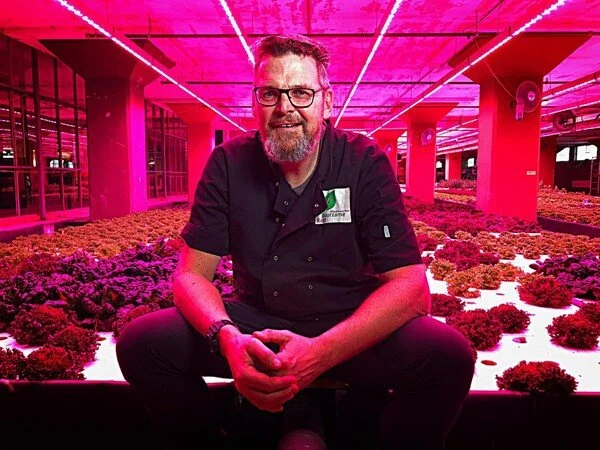
Although food can still be picked up or delivered, it has proven to be a burden for many food suppliers and requires innovative thinking. The Duurzame Kost City Farm is located in a unique location, on an industrial heritage in Eindhoven, the Netherlands and is the largest circular indoor farm in Western Europe. It grows leafy greens, strawberries, and trout using an aquaponic growing system. The aquaponic farm produces 20,000 kg lettuce per year on a surface of 400m2.
Innovative thinking
Some distributors have created a local mini-market to supply all produce available and in this case, to sell their products. A client of Duurzame Kost, restaurant Phood, based in Eindhoven as well, has come up with a food Farm Box. Jos Hakkennes, owner of Duurzame Kost says: “Together with their other suppliers, cooks are making recipes where we get to deliver the ingredients needed. The Farm Box can be ordered at the Food restaurant and will be delivered at your home address, but there’s also a pickup point. Last week the first boxes have been delivered out and about Eindhoven. Another initiative is a ‘mini market’ located in Maarheze, which is about 10 km to the south of Eindhoven. The market serves as a fresh collection point for customers, which includes the fresh lettuce of Duurzame Kost.
Local supportHakkennes mentions, “Last week we had a big supply of fresh lettuce that could not yet be used for the mini market and the Farm Box concept. Therefore, we promoted the pick-up of our fresh produce on social networks at a fair price in order to prevent it from being thrown away. We received great support from the locals. A few weeks ago, we couldn't have imagined this situation. Nevertheless, it’s great to see creative ideas coming up and that’s really a good thing.”
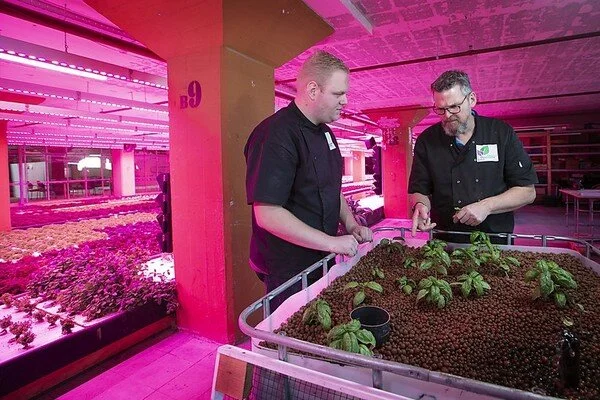
Jos and an employee checking on the basil
Product innovation
Also, Duurzame Kost itself is looking to new products. "We are currently working on the possibilities within aquaponics around saltwater growing, such as sea vegetables. We see a big demand in these products from the restaurants we supply to. So there’s definitely a market for it, looking at the sales."
Strawberries, leafy greens and trout
The main product of Duurzame Kost is lettuce, but they also supply 4kg of kale year-round to a local restaurant and grow strawberries as a seasonal activity to provide to local restaurants. As the plants are put up in February, it's going to be a while before they start bearing fruit. “These strawberries take a bit more time to grow than normally, as we offer mixed fresh produce. In the first one and a half years, we have done a lot of research into crops and specific varieties that can grow next to each other.”
A freshly harvested salad with trout
“Our fruits are not very big but they taste great. As the strawberries are a seasonal side product we love providing them to our local restaurants”, Hakkennes adds. And starting next week they are also kicking off the delivery of their fresh trout straight to customers - being grown in the water used for the cultivation of the plants. "The trout is sold per 300 grams for a price of €3.95 ($4.33) each. What is being produced is directly delivered to the customers after the harvest. Because we can.”
Daycare
Duurzame Kost also serves as a care farm as we take in people with diverse disabilities and social backgrounds on a daily basis. We have around 12 people that come to our indoor farm, but the visiting days are dispersed over the week as it varies weekly. The social workplace is not canceled as it serves as a daycare for these people. “The hygiene measures are stricter than ever so we take this into account when we let people in”, Hakkennes mentions.
Lead photo: Jos Hakkennes, owner of Duurzame Kost

For more information:
Duurzame Kost
Jos Hakkennes, founder
jos@duurzamekost.nl
www.duurzamekost.nl
Publication date: Mon 30 Mar 2020
Author: Rebekka Boekhout
© HortiDaily.com

Corona-Update: French Supermarkets Heed The Call For 'Economic Patriotism'
Several weeks into this unfortunate COVID-19 situation, new developments still arise. There are the French supermarkets, heeding the call for what Le Maire termed "economic patriotism". In Germany, in places, the vegetable crops are under threat as there are no workers. Meanwhile, fruit and vegetable demand in Europe is booming.
In Canada, the pandemic also impacts economic activity and in Florida, the agricultural industry witnesses a drop in demand. In the Philippines, traders are going online to sell their mangoes, and the same might happen in India as their seems to be no demand for the Ulavapadu mangoes. This, and much more, in today's update.
France hopes people will 'buy French' as single market erodes
French Finance Minister Bruno Le Maire issued a rallying cry to the nation’s supermarkets on 24 March: ‘Stock French products.’
Supermarkets in France have heeded the call for what Le Maire termed "economic patriotism".
French supermarket chain Carrefour has already moved to source 95% of its fruits and vegetables from within France. The supermarket industry’s trade body, La Féderation du Commerce et de la Distribution, told French business daily Les Echos that once fresh foreign produce runs out on French supermarket shelves, it won’t be replaced.
“Delegating our food supply […] to others is madness. We have to take back control,” French President Emmanuel Macron said in a speech just two weeks before Le Maire announced the economic measures.
But for a continent that has built an intricate agro-food market connected by cross-border supply chains, France’s plea to focus inwards for its food supply is a cause for concern for Brussels.
Also, with Covid-19 keeping foreign seasonal laborers away and time running out before fruit and vegetables rot, there has been an appeal to French people who are not currently working to help harvest crops and sow seeds. However, it has had mixed results.
A platform launched in mid-march called “Des bras pour ton assiette” has yielded around 150,000 applications so far but about 200,000 will be needed until the end of the harvest season in September, according to the FNSEA, the main agricultural sector union. The greatest need is in the South of France.
German vegetable crop threatened as virus shuts out workers
Currently, Germany’s fruit and vegetable harvest is under threat from the travel bans that are preventing Eastern Europeans from working on German farms, the BOGK association of German fruit and vegetable processors said on Monday.
Neighbouring Poland, the source of many of Germany’s seasonal workers and an important transit country for such workers from other Eastern European countries, has restricted foreigners from entering its territory in an effort to curb the spread of the coronavirus.
“The bans, which are preventing foreign seasonal workers entering the country, are endangering sowing, planting and harvesting,” the BOGK association said. “What is not harvested cannot be processed ... supplies for the population would no longer be secure from summer 2020.”
Germany itself has introduced temporary border controls on its frontiers with Austria, Switzerland, France, Luxembourg, and Denmark.
Fruit and vegetable demand in Europe is booming
The demand in Europe for fruit and vegetables has seen a large increase in recent weeks, which is being attributed to the measures and restrictions in relation to Covid-19. The European Commissioner for Agriculture and Rural Development, Janusz Wojciechowski, outlined the increased demand at a meeting of the EU’s agriculture ministers last week.
“The consumption of fresh fruit and vegetables in the EU has been booming in recent weeks. Spain, Italy and the Netherlands report 40% increases, and Germany up to 100%. Demand is expected to stay strong during the containment period,” the commissioner explained.
However, some EU fruit exports have slowed down, particularly those destined for China. Citrus fruits from Spain have been most affected by this. Exports of these fruits from the country usually peak in March, April, and May. There appears to be limited opportunities to redirect these exports to other markets, the commissioner explained.
Statistics Canada expects COVID-19 to impact inflation
Statistics Canada expects the Corona-virus to impact inflation, already pointing downwards, as the pandemic impacts economic activity. Citing declining demand for travel and oil among other factors, the agency expects a notable impact on consumer prices for various goods in the foreseeable future.
“Because of these factors, as well as supply chain disruptions for consumer goods, temporary closures of some stores and service providers, the recent lowering of interest rates and the recent slowing of economic activity, the price effects of the outbreak could be more deeply felt in subsequent months,” it reads in an analysis of inflation figures released Friday.
Accounting for seasonal factors, inflation across Canada rose by 0.1 percent in February 2020, matching the increase in January 2020.
Florida’s agro-industry witnesses drop in demand
Those that are working in the US agricultural industry, especially those in Florida, are still feeling the impacts. The agricultural industry is the second biggest contributor to Florida's economy behind tourism. Small scale farmers across the state are seeing the biggest impacts from the pandemic.
John Hoblick, president of Florida Farm Bureau: "Smaller producers are usually a niche type producer that supply the restaurants or supply farmers markets and those because of the social aspects that we have to deal with you know have been shut down."
Another major concern comes in the form of labor. Farms who use the H2A program have seen a delay in those workers getting to our area.
Brittany Lee, a local blueberry farmer: "Our farm uses H2A contracted workers from Mexico and they have not arrived yet, which is a little stressful, but the association, Florida Farm Bureau, and Florida Fruit and Vegetable all have been working together with the US Department of Ag to expedite those worker visas for ag commodities. Last week and this week the demand is lower than the same weeks that correlate to 2019… and that’s concerning."
Moreover, the visa confusion in Mexico is keeping out agriculture workers. While it is watermelon season in Florida. But as the top U.S. watermelon-producing state prepares for harvest, many of the workers needed to collect the crop are stuck in Mexico, unable to secure visas.
Restricted visa services, quickly evolving regulations and increased border controls risk wider labor shortages in the United States produce industry that may leave grocery stores scrambling for fruits and vegetables as spring and summer harvests spread across the United States.
Washington farm industry faces logistics problems
As Spokane-area farmers have begun spring planting, apple growers set a new sales record during the panic buying as the region continues to adjust to a pandemic that has disrupted most daily lives.
But while items from flour to eggs have been flying off supermarket shelves, including a wild run on apples, that hasn’t immediately helped farmers in Washington, several industry experts said. The higher demand at grocery stores hasn’t covered the market drop for milk, beef and produce that had been sold to restaurants.
“So far, agriculture is doing better than equities,” said Randy Fortenbery, an agriculture economist at Washington State University. “But the risk is not so much what happens to prices, it’s more what happens to logistics. If we have problems getting product to port and vessels out to sea, that’s where we’ll see some potential problems.”
Guimaras, Philippines: Online selling to dispose of mangoes
The mango season in the Philippines’ island province of Guimaras finds growers denied their usual markets this year because COVID-19 has restricted tourist movements and canceled fiestas and trade fairs.
“(Mango farmers) asked for our help because they have a rich supply of mangoes but they find it difficult to sell due to the community quarantine imposed in other provinces,” Lenny S. Gonzaga, an economist at the Provincial Economic Development Office (PEDO), said last week.
Earlier this month, the provincial government banned the entry of tourists and non-essential persons following the COVID-19 outbreak. Iloilo City, the main gateway to the province, has also been placed under enhanced community quarantine to limit the movement of people.
“It has really had a huge impact on our farmers. Before the crisis, Guimaras mangoes were easy to sell and farmers had sure buyers. Now, many of their transactions were cancelled due to the travel restrictions,” Ms. Gonzaga said.
India: No demand for famed Ulavapadu mangoes in Prakasam
Mango growers in the Prakasam district are worried as the country-wide lockdown to prevent the spread of novel coronavirus coincided with the marketing of the king of fruits.
The output this year has been quite encouraging as there was good precipitation, ending five years of consecutive droughts. Flowering also occurred at the right time in December/January promising a yield of about five tonnes per acre.
But the outbreak of the dreaded disease has put paid to their hopes of reaping the benefits. Upcountry buyers, who used to make a beeline for the orchards in and around the ‘mango village’ of Ulavapadu in the district, have not turned up yet to confirm orders, a group of farmers from the village stated.
The best quality mangoes are normally moved to cities such as Chennai, Mumbai, Hyderabad, Bengaluru and from there to the US, Europe and West Asian countries.
Turkish citizens complain about high garlic prices
Turkish citizens who shop at the public market in Kirikkale can only buy 3 or 5 pieces while complaining about the high prices of garlic. A market tradesman who suggested that the reason for the increase in garlic prices was flooding, “Garlic is expensive because of the flooding. Because we don't have garlic in place, we are buying it for 40 liras, we sell it for 50 liras. There is no garlic anywhere in Kastamonu at the moment.
Kerala pineapple growers seek help as lockdown hits harvest
The initiative by the Indian federal government to help tomato farmers in Madhya Pradesh market their harvested stock has prompted Kerala’s pineapple growers to seek similar help from the authorities.
According to growers, around 5,000 tonnes of pineapple is ready for harvest across 45,000 acres in various parts of Kerala. However, the lockdown has adversely affected the harvest, leading to the decaying of the fruit. Around 1,000 tonnes have already rotten and the government should take urgent measures to resolve the crisis, said Baby John, president of Pineapple Growers Association Keralam.
The harvested fruit, he said, can be made available directly to the retail market in the State, which is facing a shortage of fruits and vegetables due to the disruption in cargo movement. Also, the government could consider including pineapple in the food kit being distributed to people affected by the lockdown, he added.
Union calls on the UK government to support the ferry industry
P&O Ferries is temporarily standing down 1,100 staff members in response to the coronavirus pandemic. The operator announced its decision yesterday and said it would be suspending its passenger services between Dover and Calais and focusing all its efforts on bringing in freight to the UK.
Chief executive Janette Bell said due to the pandemic, P&O Ferries was having to respond with new measures to keep the business operational and to keep freight moving.
She said: "With respect to the UK, we bring in about 15% of all the goods the country currently urgently needs. The biggest part of which is food, including fresh fruit and vegetables from southern Europe and North Africa, as well as vital medicines and medical equipment. P&O Ferries is also handling important, but hazardous goods, such as detergents and cleaning products.”
Fruit and veg group Total Produce warns about profits
Total Produce, the fruit and vegetable producer chaired by Carl McCann, has become the latest listed business to delay its planned shareholder meeting as it warned that full-year earnings, though expected to be “satisfactory” were now likely to be lower than in 2019.
In a Covid-19 update, the company said the spread of the coronavirus pandemic was having an increasingly significant impact on the global economy in the three weeks since it published its full-year results. At that time, Mr McCann had said the outbreak was not expected to have any material impact on Total Produce’s business, though he conceded it was too early to form a “definitive view.” However, the company said on Friday that its supply chains were functioning “adequately” and remained open in all its markets.
How the coronavirus crisis is affecting food supplies
Like other parts of the global economy, food supply chains have been disrupted by the coronavirus pandemic and empty supermarket shelves have become a symbol of the crisis.
An in-depth article about the way panic buying in some countries has led to some grocery staples like pasta and flour being sold out in supermarkets in recent weeks. Retailers say they are able to replenish most products while bakery and pasta firms in Europe and North America have cranked up production.
Food firms say panic purchases are subsiding once households have stocked up and as they adjust to lockdown routines. However, shoppers may have to get used to less varied or more local food offerings. Logistical snags from closed borders to reduced workforces are putting strain on usual supply routes, particularly for fresh produce.
The United Nations’ Food and Agriculture Organisation has warned that any rush by importers to buy staples could fuel global food inflation, despite ample reserves of staple crops. Swings in commodity markets are not necessarily passed on in prices of grocery goods, as food firms typically buy raw materials in advance. Some poorer countries also have subsidized food programs that ensure price stability.
Prices of fruit and veg in Argentina went up considerably
Since the implementation of the quarantine due to the coronavirus crisis last week, the prices of the basic Argentinian food basket saw some significant increases, especially those of basic products such as meat, fruit, and vegetables.
The increases occurred precisely in the items where demand was more concentrated and where the measurement of prices is more difficult since purchases are made in local shops, where controls are usually more lax.
Juan Ignacio Paolicchi, an economist with the consulting firm Eco Go, explains that “this is an atypical month in which there was a change in relative prices. “The consumption basket changed as demand fell in some segments that are not essential,” he says.
The Federal Administration of Public Revenues (AFIP) and the Ministry of Domestic Trade reported the results of the controls in different shops. “There were 1,605 price control and supply operations in shops during the first nine days of compulsory social isolation, in which violations of up to 100% of the audits carried out in one day were recorded”.
Davao City to buy vegetables off Filipino farmers
The Davao City government will buy the produce of vegetable farmers to help them cope up with the loss of income due to the community quarantine imposed amid the coronavirus disease 2019 (COVID-19) outbreak, Mayor Sara Duterte said Monday. She has stated that the vegetables from the affected farmers will be distributed to the residents for free. Duterte noted that several farmers have already complained that their livelihood had been affected by the COVID-19 pandemic.
The demand for vegetables from restaurants has significantly declined after the city was placed under community quarantine on March 15, she said, citing their complaints. “The city agriculturist will buy the vegetables from the farmers since they have an issue with demand. Most restaurants only retained their take-out and food delivery services. In effect, there are fewer customers, and so they only buy fewer vegetables from the farmers,” Duterte explained.
Meanwhile, other sources point to a possible food shortage looms in parts of the Philippines. Faced with a looming food crisis, as the financial assistance promised by the Philippine government has yet to reach them, people in various parts of Luzon are left to their own devices to stave off hunger. A local government plans to distribute repacked vegetable seeds to help households grow "survival gardens".
Cambodian banana exports booming despite pandemic
Cambodia exported 72,182 tonnes of fresh yellow bananas to international markets during the first three month of this year, a Ministry of Agriculture, Forestry and Fisheries report said. Most of the bananas were exported to China, with the rest being shipped to Vietnam and Japan. Cambodia’s yellow banana exports to China have increased rapidly since the first shipment of bananas was sent in mid-2019.
Last year, Cambodia exported a total of 157,812 tonnes of yellow bananas and on average, it exports an average of more than 795 tonnes of bananas per day, the report said. Hun Lak, the director of Longmate Agriculture Co Ltd, which invests in 1,000ha of banana plantations in Kampot province, told The Post on Monday that China is the biggest market for his company.
India: Mother Dairy supplies 250 tonnes of fruits & vegetables
Mother Dairy on Monday supplied around 250 tonnes of fruits and vegetables to its retail stores ‘Safal’ across Delhi-NCR to meet local demand amid the nationwide lockdown, a senior company official said. Last week, the company had double its supply of fruits and vegetables in the Delhi-NCR at over 300 tonnes per day, as customers began panic-buying of household essentials after the announcement of the 21-day nationwide lockdown.
“We have supplied around 250 tonnes of fruits and vegetables today (Monday). The supply has come down from over 300 tonnes last week as panic-buying has stopped but still, it is more than normal,” PTI quoted Sood as saying.
Now that local vendors have the permission to sell fruits and vegetables in colonies, the demand at Safal stores has normalized. Due to the sufficient amount of supply of all vegetables in the local markets the prices of veggies like potatoes, tomatoes, and cauliflowers, too have come down.
Live streaming boosts Chinese farm produce sales
When Hangzhou Women’s Federation visited Dayang Town in Jiande County in late February, officials found that around 900 tons of mandarin oranges were difficult to sell because of the novel coronavirus outbreak. To help local farmers with their produce, the federation launched online sales on Taobao Live, a popular streaming platform. So far, the federation has held six sales promotions, resulting in online sales of 865 tons of Dayang’s mandarin oranges.
Produce from Tonglu, Jiande, Chun’an and Lin’an counties and Fuyang District have also been featured with sales worth 4 million yuan (US$ 563,500) in just nine days. The federation has established a department to direct live stream projects, inviting industry insiders and Internet celebrities to train women farmers.
“We hope more Internet celebrities will join the federation’s live stream activities. That is our responsibility to give a boost to public service projects, especially those related to women and children,” said Zhang Dayi, who has 11.72 million followers on social media.
Fruit exporters urge Thai growers to maintain sanitary standards
“Despite the Covid-19 crisis having a large negative impact on the economy, exports of fresh fruit from Thailand are still operational as demand from China continues, fruit exporters have urged Thai growers to ensure higher sanitary standards to protect the industry from the effects of the pandemic.” This from the president of Thai Fresh Fruit Traders and Exporters Association, Paiboon Wongchotesathit.
To safeguard the export market, Paiboon urged exporters to apply high sanitary standards to ensure that the shipments are not tainted with the Covid-19 virus, especially fruit like durian, longan, and mangosteen which are the main fruits that Thailand imports. He also asks exporters to make sure that workers wear face masks and to supply hand gel for food pickers and packers so their hands are frequently cleansed.
“If the workers are infected and transmit the virus to customers through droplets on products, the whole export industry will be ruined. Fruit exports, especially durian, will be able to achieve growth this year because Chinese consumers are likely to cut back on travel and focus on import and export.”
Mettupalayam auction halted; 80 tons of garlic with no takers
The Mettupalayam auction of garlic has come to a halt amid the Indian lockdown. Traders and farmers find it difficult to arrive for auction, and the regular procedures don’t hold, said garlic traders association president N.S.V. Arumukham.
Under usual circumstances, the garlic procured on Thursday, Friday, and Saturday would be stored separately. On Sunday, auctions are then held at six centers and garlic will be exported to other places. On an average 320 tons of garlic is auctioned where 200 farmers and around 350 traders attend.
At last Sunday's auction, 200 tons of garlic were sold. The remaining 80 tons have piled up with no takers.
Empty shelves incite some Brits to grow their own vegetables
Supermarket store shelves stripped of essentials and rationing of food delivery slots have brought the sustainability of UK supplies into question. Countries worldwide announcing nationwide lockdowns and workers falling ill or being forced to self-isolate have raised questions about where Britain’s produce comes from and who gets it to the supermarkets.
Over half of the UK’s food is produced by suppliers within the country, helping to lessen the impact of any potential disruption to shipping from overseas. Even so, the country is still reliant on the EU for over a quarter of its imports.
Some Britons are taking matters into their own hands. Sales of fruit and vegetable seeds have skyrocketed as people locked down in their own homes look for a productive way to fill their time and gardens, according to the Royal Horticultural Society.
Countries might start hoarding food, threatening global trade
It’s not just grocery shoppers who are hoarding pantry staples. Some governments are moving to secure domestic food supplies during the coronavirus pandemic. Kazakhstan, one of the world’s biggest shippers of wheat flour, banned exports of that product along with others, including carrots, sugar and potatoes. Vietnam temporarily suspended new rice export contracts. Serbia has stopped the flow of its sunflower oil and other goods, while Russia is leaving the door open to shipment bans and said it’s assessing the situation weekly.
To be perfectly clear, there have been just a handful of moves and no sure signs that much more is on the horizon. Still, what’s been happening has raised a question: Is this the start of a wave of food nationalism that will further disrupt supply chains and trade flows?
Korea’s Gangwon potatoes more popular than ever
Since securing a box of face masks during the coronavirus outbreak has become an impossible feat these days, some people have settled instead for a box of potatoes. To be exact, 10 kilograms (22 pounds) of potatoes for just 5,000 won ($4.10). The race to buy potatoes from Gangwon began with an idea thought up at the Gangwon Provincial Office in early March.
Governor Choi Moon-soon hosted a meeting at the office early in the month and told his staff about how many potato farmers in Gangwon no longer had retail partners due to school cafeterias remaining closed and local restaurants faring poorly in the midst of the coronavirus outbreak. According to the provincial government, there were as many 11,000 tons of potatoes harvested in October and November of 2019 that needed to be sold by April, when the next batch of potatoes needed to be planted.
In order to meet the heightened demand from consumers, the provincial government eventually secured 8,000 to 10,000 boxes a day. They still sold out within minutes.
Road Haulage and Freight Lobby gets official recognition for logistics workers
Official confirmation of the importance of logistics in this stressful time was given today in a letter from the Department for Transport clarifying that the essential roles played by road haulage drivers and others in the freight supply chain will not be interfered by officialdom who may otherwise misinterpret government guidelines about travel and work.
The letter, outlining that all travel related to the operation of logistics or necessary travel by logistics workers to places of work such as distribution centers is considered ‘essential travel’ in the context of current restrictions, was delivered to the Road Haulage Association (RHA) and the Freight Transport Association (FTA), both of whom have been closely involved in lobbying and advising the government on the specialties of their respective members.
Possible advantages of COVID 19 for the industry
Companies linked to agriculture, as providers of technology, services, training or knowledge, will see their demand redoubled by the entry of new actors to the undertakings of agricultural projects.
The world is in the midst of a systemic crisis. However, this is not an impediment to reflect and evaluate in a primary way the possible scenarios that can be created in the near future according to the behavior of society and the development of the pandemic.
At first glance, there is a consensus that the production, transport, distribution, and supply of agricultural food is a strategic and vital element for human survival, and, detaching from this, fresh and healthy foods are those that are privileged for consumption.
Companies linked to agriculture, as providers of technology, services, training or knowledge, will also see their demand redoubled by the entry of these new actors to the undertakings of agricultural projects.
WVDA works with local impacted producers and farmers
The West Virginia Department of Agriculture (WVDA) is working with local producers and farmers impacted by COVID-19 by facilitating communication between producers and potential buyers. Business development and marketing staff have received calls from multiple producers are who experiencing a surplus of food or other burdens due to the pandemic. To assist these affected businesses, the Department will provide an on-going directory to those who are interested in being connected with a local, West Virginia farmer and their availability of food.
“We are early in the growing season but many of our West Virginia farmers have lost potential buyers with the shutdown of business such as restaurants. That does not mean there is a lack of need within the food supply but an indication that many businesses have opted to close their businesses to help reduce the spread of the virus. Our hope is to connect those with food to those who need it,” said Commissioner of Agriculture Kent Leonhardt.
Publication date: Tue 31 Mar 2020

Freight Farms Expands Leadership Team with New CEO and Head of Engineering as Business Scales to Meet Growing Global Interest in Decentralized Food Production
Freight Farms, the global innovation leader of containerized vertical farming with the world’s largest network of IoT-connected farms, announces today that it has hired veteran consumer brand executive Rick Vanzura as CEO who will also join the company’s Board of Directors, while cofounder Brad McNamara will remain as Freight Farms’ President
Freight Farms Produce March 27, 2020
BOSTON — Freight Farms, the global innovation leader of containerized vertical farming with the world’s largest network of IoT-connected farms, announces today that it has hired veteran consumer brand executive Rick Vanzura as CEO who will also join the company’s Board of Directors, while cofounder Brad McNamara will remain as Freight Farms’ President. The company also welcomes automation and robotics specialist Jake Felser as Head of Engineering.
The need to simplify supply chains and ensure reliable access to healthy, traceable food at a local level has become more crucial for communities worldwide. Expansion of Freight Farms’ team follows a year of strong momentum for the company as forward-thinking organizations, particularly at the institutional level, recognize the benefits of a secure, distributed, and transparent food supply. As the company scales for growing demand at speed, expansion of Freight Farms’ leadership is positioned to quicken new extensions of its technology platform and deepen market reach.
“What excites me about Freight Farms is the ability to join a passionate, mission-driven business that is already perfectly positioned to address the growing critical need for sustainable, hyper-local food production,” says Vanzura. “Freight Farms has an incredible technology platform as the originator of container farming, as well as a global footprint driving numerous sources of value. Beyond providing a meaningful solution across industries, Freight Farms’ innovation addresses issues like urban land scarcity, traceability and the need for hyper-local solutions with speed to market. The current environment demonstrates more than ever the value of Freight Farms’ offerings.”
Vanzura has driven value for companies from start-up to Fortune 5 across technology, restaurant, retail, and entertainment sectors. With a focus on leveraging innovation and developing new market channels, he led strategy for Panera, General Motors Information Services and GameStop, and as the original CEO of Wahlburgers, he built the company from a single unit into one of America’s fastest-growing restaurant brands. Vanzura’s 20 years in President and C-level roles include a decade in food service working with markets central to Freight Farms’ business. He also brings significant international experience to his role, having run Borders Group’s nearly $1 billion International business.
“As cofounders, Jon Friedman and I have taken Freight Farms from an idea to help decentralize the food system to being the leader in containerized vertical farming that’s truly putting the power of hyper-local food production into people’s hands,” said McNamara. “Rick has amplified growth across interconnected industries, and his international experience lends itself to our ongoing global expansion. His personal alignment with Freight Farms’ mission was crucial for us as well—he’s a welcomed addition to the team as we scale.”
“The potential is extraordinary,” Vanzura added, “I’m excited to be working with Brad, Jon and the team on the spectacular opportunities ahead, all while doing our part to help build a better, more sustainable food system for all.”
Jake Felser, former VP of Engineering for eatsa (now Brightloom), has also joined the Freight Farms team as Head of Engineering. With teams across hardware and software, Felser led robotics R&D and the development of eatsa’s shelf-style pickup system from conception to deployment across the company’s network of partners. Prior to eatsa, Felser was Senior Engineer and Product Manager at Cooper Perkins and has worked in hydraulics, refrigeration, structural optimization, design for development, and agriculture for companies including Blue Origin, Promethean Power Systems, and AGCO. With a passion for sustainable development, Felser is focused on automation, IoT, and machine learning-based integrations for Freight Farms growing technology portfolio.
Company growth, including ten new roles across all departments in Q1, also follows Freight Farms’ recent launch of the Greenery. Nearly 100 have been adopted by customers in 9 countries to date, bringing Freight Farms’ global footprint to more than 300 container farms around the world. The innovation also spurred interest from Sodexo in a strategic national partnership to grow food onsite at educational and corporate campuses nationwide and new investment from Ospraie Ag Science.
About Freight Farms
Founded in 2010, Freight Farms debuted the first vertical hydroponic farm built inside an intermodal shipping container—the Leafy Green Machine—with the mission of democratizing and decentralizing the local production of fresh, healthy food. Now with the Greenery and integral IoT data platform, farmhand®, its technology empowers people anywhere in the world to grow more than 500 varieties of pesticide and herbicide-free produce, from leafy greens and herbs to root vegetables and vine crops, with 99.8% less water—onsite, year-round. Freight Farms’ network of IoT-connected container farms is the largest in the world, with more than 300 operating in 25 countries and 44 U.S. states. Customers range from small business farmers to the corporate, hospitality, retail, education, and nonprofit sectors.
To learn more, please visit freightfarms.com,

Betting The Farm: Soil-Free, Indoor Farming Might Be The Future of Healthy, Local food
Unlike companies like Amazon and FedEx that have recently brought the industry back to the grounds of the old Bethlehem Steel Plant with their distribution warehouses in Sparrows Point, Gotham Greens arrived and built a farm. An indoor, soil-free, tech-forward, 100,000-square-foot one
Lisa Elaine Held - April 2020
On a 30-degree day in January, heads of butterhead, red oak, and Tropicana green-leaf lettuce are soaking up the sun in a balmy 75-degree greenhouse so close to 695, it’s visible to drivers approaching the Francis Scott Key Bridge. “It’s pretty dreamy in here,” says Nicole Baum, director of partnerships at Gotham Greens, as a blue divider lifts and the aroma of fresh pesto welcomes us into the “basil room.”
Unlike companies like Amazon and FedEx that have recently brought the industry back to the grounds of the old Bethlehem Steel Plant with their distribution warehouses in Sparrows Point, Gotham Greens arrived and built a farm. An indoor, soil-free, tech-forward, 100,000-square-foot one.
Started on a Brooklyn rooftop in 2011, the New York City-based company is one of a hearty group of businesses now growing vegetables indoors in Baltimore year-round, turning the city into what could be, given its proximity to so many markets, a Mid-Atlantic hydroponic produce hub.
From small-scale, DIY endeavors to massive, state-of-the-art operations like Gotham Greens, these businesses say they’re increasing access to healthy, local produce while eliminating the greenhouse gas emissions, nutrient losses, and food safety concerns inherent in shipping, say, California romaine across the country to the East Coast. They also see their controlled-environment agriculture as important to food security in the era of climate change.
How they will affect the region’s food system, however, is still uncertain.
“I used to be a hacker for the Feds,” says Larry Hountz from inside his brick rowhouse off Patterson Park, where he sits on a leopard-print stool, offers guests velvet slippers, and talks about the farm he operates in his spare bedroom upstairs.
Those computer skills helped him build City-Hydro in 2013, where he now grows dozens of varieties of microgreens out of his own home. A traumatic brain injury suffered in a car accident had made focusing at a computer difficult, and urban farming seemed like it could provide opportunities for both healing and business. When he looked into indoor hydroponic systems fit for city living, though, he didn’t like what he found. “It was a lot of non-food-safe plastics and fertilizers and just things that didn’t make sense to me,” he says.
Hydroponic farming is generally done indoors. It involves placing plants in trays or towers, with the roots dropping directly into water instead of soil. Liquid nutrients are added to the water, LEDs are used for lighting, and the environment is climate-controlled for ideal growing conditions.
Hountz and his wife, Zhanna, bought their own materials, including grow lights, green plastic trays, and wire racks. Then they researched and tested designs until they landed on an efficient way to produce their seedlings, which require little space and grow to maturity quickly. He decided to sell directly to local chefs, who love microgreens for their concentrated flavor and delicate appearance. In their 10-by-15-foot room, the trays are stacked vertically, with water the only input, no pesticides, and energy-efficient lights above each.
In January, micro leeks for Cinghiale were sprouting out of coconut husk pads below micro peas headed to The Pendry and Foraged. But the farm has been significantly scaled back since its most productive days. After news coverage thrust their surprisingly simple, yet effective, system into the spotlight, the couple shifted the bulk of their business to selling the system they invented to other eager growers. “This week alone, I think we sold 60,” Hountz says, showing off a tower of boxes behind the kitchen filled with supplies that needed to be unpacked and assembled for customers. “We import a million coconut pads a year.”
They also offer free training and post YouTube videos for individuals who want to build their own farms instead of buying them, and as people from across the country visit the house to learn and report back with success stories, Hountz sees little need for what he considers big, corporate growers. “The only way we’re going to feed people [around the world] is with small, individually owned farms,” he says. “This works, and we have the people out there to prove it.”
While some hail hydroponics as an exciting new farming frontier, others are worried about the implications of growing without soil, like on the nutritional value of the vegetables produced. In the hydroponic production of full-size produce, however, growers feed their plant’s tailored fertilizers, which can lead to higher levels of some nutrients compared to soil-based farming.
Research also shows nutrient levels in all vegetables degrade over time, and produce sold in East Coast grocery stores is typically shipped long distances, especially during winter. Because hydroponic growers can harvest year-round in any locale, they are technically able to get fresher greens to consumers more quickly.
But skeptics like farmer Dave Chapman, executive director of the Real Organic Project, say soil is a complex ecosystem, home to fungi and microorganisms that interact with plant roots in ways not yet fully understood. “We are not smart enough to get the nutrient balance exactly correct,” he says. “The more we learn, the more we realize we don’t know.”
How these farms will affect the local food system is still uncertain
Then there’s the environmental impact. Hydroponic systems vary considerably, so it can be hard to make comparisons. Local distribution, no matter the farming method, can reduce greenhouse gas emissions related to transportation. Hydroponic farms generally use significantly less water and require less space, and therefore land, to produce more food. They do, however, require some energy use for systems such as lighting and climate control. Traditional outdoor farms, of course, work off natural light, but they often pollute the environment via man-made fertilizers and pesticides used to control variables and inefficiencies inherent in nature.
Organic outdoor farmers, however, have long confronted these challenges without chemicals, in ways that benefit the environment. “Organic farming is based on healthy soil,” Chapman says, back to its earliest roots, which in turn, farmers and experts say, leads to healthy plants. “The slogan is ‘feed the soil, not the plant.’”
Recently, he and other farmers have been at odds with corporate hydroponic growers who lobbied for their crops to be eligible for USDA organic certification simply based on the absence of added chemicals. Operations like Gotham Greens avoid that debate altogether: Instead of calling their produce organic, they simply state that they do not use pesticides.
In the end, some see ultra-automated, large hydroponic farms as threatening to those that are small and family-run. Others view them as an exciting way to replace the sprayed greens from far-flung places that sit on supermarket shelves.
Somewhere in the middle is Jon Shaw, a local farmer whose name comes up in most conversations surrounding hydroponic produce in Baltimore, which may be surprising to those who know him as the organic guru behind Karma Farm in Monkton.
While Shaw and his son, Nat, fully believe that soil’s magic leads to the incredible sweetness of their winter carrots, they also see hydroponic growing as complementary to their outdoor organic production. “It became clear to us that the winter was our weakness,” says Nat, who runs the farm’s hydroponic operations. “It seemed like this perfect marriage to combine hydroponics with the outdoor farm to have local, seasonal food all year.”
Like Hountz, Nat is a tech-savvy tinkerer who built proprietary systems for Karma Farm after discovering the made-to-order versions didn’t quite work as advertised. In his basement farm, where he was growing multiple basil varieties in January, he’s like a scientist showing off the gadgets in his lab, complete with timers, pumps, fans, dehumidifiers, and beneficial insects released to deal with harmful pests.
He also tends to two hydroponic farms inside shipping containers. One sits next to a Karma barn and is filled with specialty herbs like borage and cilantro, growing in vertical towers. The other is on the grounds of Sandlot, chef Spike Gjerde’s outdoor beach bar at Harbor Point, and it’s equipped to produce trays of leafy greens, which can be eaten at many restaurants, including Woodberry Kitchen.
For the Shaws, perfecting the shipping containers was a long process. Many growers find these systems difficult to master due to design flaws and the sensitive calibration of technology. So far, greens, herbs, and microgreens are the only vegetables that hydroponic farmers see as efficient enough to grow to make a profit. “It took us about two and a half years to figure out what we could grow and what will sell consistently,” Jon says.
In West Baltimore, a new, 3,000-square-foot hydroponic greenhouse that’s under construction is all about training farmers. Public charter school Green Street Academy specializes in workforce development for “green careers” and is already home to an orchard, chicken coop, fish farm, pollinator meadow, and hoop house for vegetables.
But one challenge to educating young people in agriculture has long been the school year, which is out of sync with the growing season, says JJ Reidy, CEO, and co-founder of Urban Pastoral, a local sustainable development company that’s helping Green Street build agricultural infrastructure. A greenhouse that continues to operate through the winter will give students the chance to participate in every part of the growing process.
“We should be able to do 25,000 pounds of leafy greens a year,” says Reidy, who plans to purchase them for Molina and Stem, his restaurants inside R. House in Remington. He also points out that the recent growth of hydroponic farming in Baltimore means that there will likely be more internship and job opportunities available for kids. “Indoor agriculture is a burgeoning field,” he says.
“We should be able to do 25,000 pounds of leafy greens a year.”
Across from T.J. Maxx and Petco in Nottingham, a looming gray building looks like a warehouse for storing boxes, but a worker wearing a hard hat and orange vest opens an unmarked metal door and points inside. “It’s the future of farming,” he says with a grin.
One thing is for sure: it’s futuristic farming. Started in New York City in 2015 with a mission to reduce some of the environmental impacts of agriculture, Bowery, another indoor farm setting up shop in Baltimore, now grows greens and herbs—purple bok choy, baby kale, wasabi arugula—at two farms in New Jersey.
During a winter visit, the Baltimore operation was barely up and running, but it was already clear that when founder-CEO Irving Fain says, “We stack our crops vertically from the floor to the ceiling,” he is not speaking metaphorically. The design, kept tightly under wraps, involves a dizzying grid of levels, stairways, and robotic parts moving around on their own. Fain declined to share the size of the farm or how much it cost to build, but Bowery has raised about $175 million total to date. He, too, chose the Baltimore County location for its access to markets and transportation.
“In this surrounding area, there are about 25 million people that we could serve with this farm,” he says, noting that Nottingham used to be an agricultural area. “This fulfills the mission we talk about—getting fresh food efficiently and sustainably to our population.”
Fain envisions a scalable model that would allow him to build Bowery farms that distribute locally in cities all over the world, and he emphasizes the importance of the sophisticated operating system that involves sensors, cameras, and algorithms that are constantly tracking and adjusting the plants and their environment.
“It’s like our central nervous system,” he says. “We’re collecting millions of data points in real time, and that data impacts how our crops are growing.” The company also digitally tracks each plant from seed to shelf, which reduces the possibility of an untraceable food safety scare.
While the scale and sophistication may inspire awe, the light human touch needed to operate the whole thing is apparent as well. When it’s fully up and running this spring, Bowery’s farm will create about 80 local jobs.
Gotham Greens’ farm will also employ about 60 people locally. But inside, it has less of a space-age feel, primarily because the company uses the sun instead of LEDs as its main source of light, and thus, plant energy. The space is vast, with leafy greens snuggled up to each other in rows as far as the eye can see, but it looks more like a turned-up version of a typical greenhouse. The technology used to irrigate, deliver nutrients, and move rows from seed to harvest is barely visible.
Since its launch in 2009, Gotham expanded within New York and also built farms in Chicago and Providence, Rhode Island. The Baltimore farm is the seventh, coming in around $11 million to build, and an eighth will be up and running soon in Denver. With each new location, the scale has grown, from the original 15,000 square feet to this newest iteration, which is six times the size with more advanced systems in terms of sensors, data, climate control, and automation.
CEO and co-founder Viraj Puri says the company was especially interested in Sparrows Point because urban revitalization is a part of the company’s larger goals. “We’re not single-handedly changing neighborhoods and cities,” he says. “But we are helping to raise the profile of some of these areas, to attract other businesses, and be a catalyst for additional urban renewal.”
Produce from Bowery and Gotham Greens will be sold throughout Maryland and surrounding states at various grocery stores, such as Whole Foods for the latter, and both will also court chefs throughout the region. As for small, local farms, Jon Shaw isn’t worried. “We have a relationship with restaurants. . . they want to be catered to, they want specialized [products],” he says. “And I think there’s a really strong inclination from chefs that buy locally to buy from soil-based farms.”
Plus, Fain says, “When you look at the demand for local food right now, it far, far outpaces the supply.”
HEALTH & WELLNESSTRAVEL & OUTDOORSSCIENCE & TECHNOLOGY HYDROPONIC FARMING INDOOR FARMING URBAN PASTORAL GOTHAM GREENS CITY HYDRO

Vertical Farming: How Plant Factories Stack Up Against Field Agriculture
With the world's population expected to reach nine billion by 2050, estimations project that food production must increase by 70 percent to keep up with worldwide demand. This means farmers will be required to grow more foodstuff in the next 35 to 40 years than the last 10,000 years combined
March 31, 2020
By Jeff Jurgens, AEM Director of Product Stewardship
With the world's population expected to reach nine billion by 2050, estimations project that food production must increase by 70 percent to keep up with worldwide demand. This means farmers will be required to grow more foodstuff in the next 35 to 40 years than the last 10,000 years combined. There is presently not enough farmable terrain to meet this constraint, and due to the negative environmental impacts of global deforestation (including desertification and flooding), clearing more forest for cultivation is not a sustainable option. Vertical farming, with its potential benefits, may play a major role in addressing the growing food demand while minimizing environmental impact.
VERTICAL FARMING DEFINED
Controlled Environment Agriculture (CEA), commonly known as vertical farming, is a growing system designed to weather- and climate-proof the production of food crops. CEA grows crops indoors in stacked, or standing, layers using growing systems such as hydroponics, aeroponics or aquaponics, all of which use a method of nutritious liquid delivery with minimal soil. CEA uses enclosed growing practices, controlling the environment’s temperature, illumination, gases and humidity with the goal of maximizing crop output in limited space.
CEA has become an attractive alternative to traditional farming in areas where arable land is inaccessible or scarce, including metropolitan areas where citizens wish to bring food production nearer to home. Rather than growing crops on a single level, such as in the ground or a greenhouse, CEA produces crops in vertically stacked layers, which can frequently be incorporated into other constructions like high-rise buildings, intermodal (shipping/Conex) containers or repurposed industrial space.
ENVIRONMENTAL CONCERNS
NASA reports that the majority of the world's freshwater supplies are draining faster than they are being replenished with freshwater demand set to increase by 55 percent by 2050. Currently, agriculture is responsible for 92 percent of the global freshwater usage, creating a challenge for even developed countries such as the United States, China and Australia.
A 2017 report found that more than 75 percent of Earth’s land areas have suffered from erosion and water degradation. The continual plowing of fields, combined with heavy use of fertilizers, has degraded soils across the world with erosion occurring at a rate 100 times greater than soil formation. This results in 33 percent of the world’s adequate or high-quality food-producing land being lost at a rate that far outstrips the pace of natural processes to replace diminished soil.
Collectively, this means arable land is decreasing, and poor soil health is contributing to less healthy agriculture, while water demands continue to rise.
COMMON GROUND
Approximately 1.3 billion tons of food destined for human consumption gets lost or wasted each year globally, discarded anywhere along the supply chain, from farmland to supermarkets, restaurants and home consumers. But crops for human consumption only accounts for 55 percent of all crops grown. Nine percent are used for biofuel and 36 percent used as livestock feed. Feed crops, such as hay and soy, are land and water-intensive to grow and the animals that consume them require high levels of water to thrive. Additionally, many types of livestock occupy the grazing land, which constitutes 70 percent of all agricultural land, which is not arable.
BENEFITS OF VERTICAL FARMING
Some of the obvious benefits of vertical farming for is year-round crop production for both human and livestock consumption, consistent quality, and predictable output. CEA holds other environmental benefits, requiring less fertilizer being applied to plants, reducing water usage up to 95 percent and, through weather-proofing, eliminating the need for chemical pesticides. CEA technology allows for faster growth cycles and quicker harvests, meaning more food can be grown every year, in a much smaller space than on a conventional farm. One of the highest-yielding farms grows over 350 times more food per square yard than a conventional farm.
In urban settings vertical farms utilize a farm-to-table order-based system, drastically cutting down on food waste, packaging and the fuel consumption used to transport food—known as food miles—as well. However, the carbon savings are relatively minor even with these novel approaches as at least 80 percent of the emissions for agriculture happens on the farm—not in the processing, not in the transportation. Urban gardening and vertical systems have many benefits, but it doesn’t presently have the scale that’s needed to meet human food demand or reduce environmental impact on a massive scale.
CHALLENGES OF VERTICAL FARMING
Economics is a major obstacle for the broad implementation of CEA practices. Plant factories are currently not the solution to feeding the world's increasing population as competition with crops grown in traditional systems will not be economically viable in the coming years. Plants – not just growers – will need to adapt to CEA growing conditions. Meaning, new crop genetics will need to be designed specifically for vertical farm production that addresses five traits of interest: easy and uniform fruiting; rapid biomass and multi-harvest capable crops; photoinduced quality; auto-harvest friendly traits; and dwarf plants with yield efficiency. It remains to be seen if created, the genetically modified plants would be attractive to an end consumer given the movement of non-GMO products.
CEA approaches require huge capital to launch, as they're high-risk businesses given the cost of production can be quite high per pound of product. Vertical farms are more feasible because of LEDs, but they are still energy-intensive. Proponents of vertical farms often say that they can offset the enormous sums of electricity they use, by powering them with renewable energy —, especially solar panels — to make the whole thing carbon neutral. But just stop and think about this for a second. These indoor “farms” would use solar panels to harvest naturally occurring sunlight, and convert it into electricity so that they can power…artificial sunlight? In other words, they’re trying to use the sun to replace the sun. With current technology, it makes no sense to grow food staples, such as wheat, indoors. A Cornell professor calculated that if you grew wheat indoors, just the electricity cost per loaf of bread made from that wheat would be $11.
Even if a vertical farm boom were to ensue, the output would only be a small percentage of the vegetables and fruits grown on traditional farms and none of the wheat, corn, soy, or rice, at least not in the foreseeable future. Nor will vertical farms raise livestock or grow oil palms, which are mainly what people are clearing hardwood forests to make room for.
THE FUTURE OF FIELD AGRICULTURE
The contribution of vertical farms to overall food production and environmental concerns is to be determined. The greatest potential impact is the implementation of technology in agriculture, partly due to new possibilities with data analysis. Vertical farms have a multitude of sensors measuring many parameters (from, temperature, to nutrient levels). The plants are analyzed with cameras and sensors, which monitor plant health in real-time. As a result, vertical farms are hiring data engineers and sensor specialists as a significant percentage of their workforce. Artificial Intelligence already plays a key role in many vertical farm operations. As sensors continue to get cheaper and more capable, the opportunities for field farms increases considerably.
Farmers will solve agricultural problems — like developing new methods for drip irrigation, better grazing systems that lock up soil carbon, and ways of recycling on-farm nutrients. Organic farming and high-precision agriculture are doing promising things, like the use of artificial intelligence for detecting disease, sensor-activated irrigation systems, and GPS-controlled self-driving tractors.
From the plummeting cost of robotics to the new frontiers of bioinformatics, the future landscape of farming may well look very different, indeed. While this isn't going to happen immediately, growth in the sector will accelerate as technological improvements drive down investment and operational costs.
THE BOTTOM LINE
While civilization wouldn't be where it is today without agriculture, it's a big factor in a number of society's greatest challenges. If farming practices continue unabated, the likely outcome is having to cut down more remaining forests for acreage, destroying even more land and freshwater habitats in the process. Current projections make a global water crisis almost certain.
In light of these challenges, AEM members are looking at every way to reduce the negative impact of current agricultural methods and existing equipment technology. Manufacturers are becoming technology balanced and interdisciplinary, utilizing designers, engineers, horticulturalists, and sustainability managers. AEM members can provide service from concept development to feasibility studies to education and workshops.
IoT devices are guiding precision farming to increase yields. Advanced machine communication is allowing the implementation to control the tractor for optimum efficiency. And manufacturers are developing many alternative power sources, such as advanced battery technology, cable-powered machines, and tractors powered by methane gas. Some concept machines are small enough to fit between rows, using lasers to destroy pests one by one. That is precision farming. If constraints are the catalyst for innovation, then AEM and its member companies are already rising to meet the challenge.
Subscribe to our AEM newsletters for more perspectives from AEM staff.
Vertical Field Changes The Kosher Produce Consumption
Today, Vertical Field announces its Star-K certification so that any company or community in cities around the world can benefit from growing and supplying its own fresh kosher greens locally and easily
Vertical Field Meets Star-K Kosher Certification
Vertical Field's customers can now benefit
from Star-K kosher certified greens
NEWS PROVIDED BY Vertical Field
TEL AVIV, Israel, April 1, 2020, / PRNewswire
Today, Vertical Field announces its Star-K certification so that any company or community in cities around the world can benefit from growing and supplying its own fresh kosher greens locally and easily. Star-K recognizes that Vertical Field's pesticide-free, soil-based urban farming operations lend themselves to producing naturally kosher products, in its highest level.
In fact, the greens are grown indoors in Vertical's Field's Urban farm, entirely free from exposure to insects, and since green agricultural produce is a naturally occurring plant that comes from the earth, they're almost fail-safe kosher after washing.
Vertical Field offers a never-been-done-before approach for supermarkets, restaurants, institutions, and hotels to take complete ownership of the supply chain by growing their own vertical living walls of delicious, naturally kosher greens — at the same time removing transportation expenses, reducing inventory costs, and ensuring year-round food supply regardless of climate or weather conditions.
CEO of Vertical Field Guy Elitzur said, "What Vertical Field offers together with the global kosher organization Star-K is the opportunity for anyone to enjoy kosher produce grown onsite at the local supermarket, restaurant, university, or company. You cannot get fresher greens if you pick it right off the wall once it's ready for harvesting. With Star-K's support and collaboration, Vertical Field is changing the way people think about kosher greens and vegetables."
President of Star-K Dr. Avrom Pollak said, "Vertical Field's revolutionary agro-technology offers the kosher consuming community a healthy, organic, pesticide-free solution for agricultural produce, ensuring peace of mind and promising quality. We are thrilled to be a part of this innovative new food supply initiative that makes kosher-eating communities' lives easy and healthy."
Vertical Field is committed to scaling the urban farm concept as well as exploring collaborations in agro-tech.
About Vertical Field
Vertical Field develops vertical indoor farming and landscaping solutions for urban environments and smart cities. The company was established in 2006, motivated to restore nature in the urban lifestyle. Vertical Field specializes in indoor and outdoor vertical plant growth solutions that improve well-being and environmental conditions in cities.
Additional Resources
Website: www.verticalfield.com
Media Contact: Natalie Ben Shaul
natalieb@verticalfield.com
SOURCE Vertical Field
https://www.verticalfield.com
Related Links
Also from this source
Vertical Field to Participate in the Smart City Expo World...
Vertical Field Recognized With NGBS Green Certification for...

Farming Plenty Is In The Discussion Of Lifting $100M From Softbank Vision Fund
With the new funding, Plenty is aiming to become more efficient compared with traditional farms, and have to produce more plants in a given space with less water. Moreover, the total funding of Plenty has reached $400 million

by StartupWorld Staff
Plenty, a San Francisco-based indoor farming startup, is in the course of negotiation to lift $100 million or more in fresh funding from a Japanese-based multinational conglomerate Softbank Vision Fund. Besides, DCM, Amazon CEO Jeff Bezos and former Google CEO Eric Schmidt, and Data Collective also participated in the funding round.
With the new funding, Plenty is aiming to become more efficient compared with traditional farms, and have to produce more plants in a given space with less water. Moreover, the total funding of Plenty has reached $400 million.
In 2014, Jack Oslan, Matt Barnard, Nate Mazonson and Nate Storey founded Plenty which brings local people and communities together for planting fresh, tasty fruits and vegetables by using less amount of water, less than 1% of the land, and without using chemical pesticides and fertilizers. Besides, all the fruits and vegetables are GMO-free.
Plenty has four key features such as Next Level Freshness, Taste You Can Trust, Nature Meets Nurture and Available Year Round. In Next Level Freshness, Plenty produce fresh and flavorful fruits and vegetables. In Taste you Can Trust, it cultivates crops without using any pesticides or fertilizers. In Nature Meets Nurture, it’s plants are 100% nurtured in an indoor environment. In the Available Year Round, it grows plants indoors and the flavorful crops are always available in the season. Moreover, it also helps plants to live their best lives.
As per reports, Plenty is planning to extend over the Bay Area. Moreover, the next farm place is in Los Angeles and the operation is going to start in the second half of 2020.
This month, SoftBank is trying to get $10 billion funds. So, its Vision Fund portfolio companies can back some of the portfolio companies affected due to the COVID-19.
Some of the Vision Fund’s companies including residential real estate brokerage Compass and the co-working giant WeWork have fired their employees this month.
About Author
StartupWorld Staff
StartupWorld is the destination to learn about new and upcoming startups making waves on the web. Being an entrepreneur is as much hard work as it is fun. No one knows it better than you do. Share your story, send it in and let us showcase it to the world.