


Welcome to iGrow News, Your Source for the World of Indoor Vertical Farming
HYVE To Exhibit At MISSION TOMORROW - On Display Will Be Indoor Farming For The Future
Indoor farming is in its infancy but holds great promise for the future. HYVE is positioned to be a leader in the industry and its systems promise to not only alter the way the world grows fresh crops and feeds people using smaller geographic footprints but also serves as systems that create jobs
HYVE Indoor Vertical Farming Systems is pleased to be an exhibitor at MISSION TOMORROW on October 23rd and 24th at the Richmond Raceway in Richmond, Virginia. MISSION TOMORROW brings together nearly 150 businesses and organizations from across Central Virginia and the Greater Richmond, Virginia Area to introduce an estimated 12,000 7th grade students to the opportunities for education and employment in the future.
Sponsored by many fine companies including Dominion Energy, Altria, Kings Dominion, Facebook, CarMax, and gsk Pharmaceuticals, among others. According to its site MISSION TOMORROW says, “This fun event is designed to introduce the next generation of the local workforce to a variety of career opportunities available in the region through interactive engagement with the exhibitors.”
Indoor farming is in its infancy but holds great promise for the future. HYVE is positioned to be a leader in the industry and its systems promise to not only alter the way the world grows fresh crops and feeds people using smaller geographic footprints but also serves as systems that create jobs.
According to Alia Clements, Program Manager for HYVE: “Vertical farming is a positive influencer and disrupter when it comes to providing fresh, healthy food and other crops for a growing population. Our systems are an example and precursor for an industry trend that will supplement traditional farming in meeting the world’s food needs. We are very interested in participating and educating people at MISSION TOMORROW because many students or even the general public have no idea just how dynamic and positive vertical farming can be for future generations.”
She adds: “We have targeted education as a market for our smaller indoor farming hydroponic systems known as LF-ONE or “Little Farm” because it teaches many of the
STEM elements needed in classrooms with a very positive hands-on approach. We’ll be showing and actual LF-ONE unit at MISSION TOMORROW along with a video on our large- scale complete hydroponic systems for commercial growers.”
Ken Bryant, Director of Marketing for HYVE says “Vertical farming holds tremendous promise for commercial farming both today and especially in the future. Twenty years from now it is likely to be very common to see crops grown indoors year-round in spaces that take much less real estate, deliver excellent return-on-investment for the growers,
and provide consumers with a healthy choice for fresh food. Add-in that our systems eliminate the need for harmful pesticides and herbicides and create an environment where crops can be grown year-round with great predictability and you can see why this is a very exciting industry. We believe HYVE is positioned to be a leader in this field because we differentiate ourselves from others with our complete system that provides all the elements needed for indoor vertical farming. Students now in the 7th grade can be leaders in this industry and at the forefront of doing something very special, that will influence generations to come as we build a better world together. MISSION TOMORROW is one platform to help educate those students on how they can be change agents.
HYVE systems are 100% hydroponic, use LED grow lighting, and thus use fewer natural resources and reduce carbon footprint. By growing indoors many of the elements of nature that plague traditional crop harvest can be mitigated. With vertical indoor farming, factors such as floods, droughts, and things of that nature are not factored in the food supply chain.
HYVE head grower Paul Edmondson is very excited about the future of indoor farming and all that the method offers. He says “For many years I have grown crops and have been subject to many uncontrollable forces of nature. Predictability, quality of crops, cost evaluation - all these have been things that are out of control many times for traditional farmers and their conventional methods. Indoor contained environment agriculture will not supplant traditional methods but will give farmers a great advantage moving forward to help them achieve a real measure of controlled, predictable growth. I have personally grown more than 60 varieties of plants in our labs using our systems and am confident that HYVE indoor farming systems will be something exciting for the industry and world of growing.”
MISSION TOMORROW counts among its collaborators the Richmond Chamber of Commerce and more information on the event can be found at https://www.chamberrva.com/programs/mission-tomorrow/.
Information on HYVE systems can be found at www.growhyve.com.
Paris Is Turning Abundant Car Parks Into Underground Farms
Falling ownership in car sales in Paris has increased the space of abandoned car parks in the city. This venture has taken a green turn as the city is transforming old car parks to grow mushrooms or even salad
Falling ownership in car sales in Paris has increased the space of abandoned car parks in the city. This venture has taken a green turn as the city is transforming old car parks to grow mushrooms or even salad.
Paris had built too many underground car parks in the 1960s and 70s, when the city tried to keep with the mushrooming housing blocks, building underground parking for residents hence became inevitable.
Sources allege, beneath Paris there are millions of square meters of car park. Figures however allege, a steady decline in car ownership in Paris, a trend which city authorities are keen to encourage. The drop in the number of car owners is also attributed to the new, convenient cab and bike services to move around the city.
As a result, some of the car parks find themselves surplus to the requirements. The city is hence calling for new ideas which can transform Paris’s underground to reveal its full potential. A number of competitions have taken place with this focus.
Urban farmers - Cycloponics were selected as one of the winners for rejuvenating three car parks in Paris. One of their projects was the redundant La Chapelle, a no-go area used by drug dealers and prostitutes. The space now is however blooming. The group made the space conducive for cultivating main crop: oyster, shiitake and white button mushrooms. They also grow chicory, a northern French delicacy that grows in the dark.
The produced harvest is sold through nearby organic grocery stores, which also means urban food is grown and consumed within a short distance. This method also reduces the pollution that comes along with the transportation.
In France there are a lot of regulations around operating a business underground not least for security reasons. Other businesses have been rejected for applications. Permits for such kind of farming have however been possible.
The city’s car parks are as a result experiencing a green makeover.
Posted in Environment, NewsTagged Paris, underground farms

CubicFarm® Systems Corp. Announces The Appointment of Vice President, Investor Relations and Corporate Communications
Ms. Lim has more than 10 years’ experience in investor relations and corporate communications for public and private mineral resource and technology companies, providing support in areas such as corporate financing, media relations, public relations, branding, regulatory compliance and event management
Vancouver, BC – (AccessWire – October 18, 2019) – CubicFarm® Systems Corp. (TSXV: CUB) (“CubicFarms” or the “Company”) announces that it has appointed Kimberly Lim as Vice President, Investor Relations and Corporate Communications. Her responsibilities will include the execution of comprehensive investor relations and corporate communications strategies and assisting the Company with its objective of growing and diversifying its shareholder base.
Dave Dinesen, CEO of CubicFarms commented: "We are delighted to have Kimberly join our team. She brings an exceptional background and perspective to this dual role, and we look forward to her contributions in helping to inform our stakeholders about all the great work underway at CubicFarms.”
Ms. Lim has more than 10 years’ experience in investor relations and corporate communications for public and private mineral resource and technology companies, providing support in areas such as corporate financing, media relations, public relations, branding, regulatory compliance and event management. Ms. Lim holds a Bachelor of Arts in Psychology and Economics from the University of British Columbia.
Ms. Lim is eligible to purchase the Company’s stock options pursuant to its stock option plan. The appointment remains subject to regulatory approval.
Neither the TSX Venture Exchange nor it’s Regulation Services Provider (as that term is defined in the policies of the TSX Venture Exchange) accepts responsibility for the adequacy or accuracy of this release.
Singapore Airlines Introduces A New “Farm-To-Plane” Food Range In Business Class
At the beginning of this month, Singapore Airlines began partnering with AeroFarms to have a fresh produce supply for its business class meals out of Newark Liberty International. Don’t let the name fool you – the company name has nothing to do with aviation
by Chris Loh
October 13, 2019
At the beginning of this month, Singapore Airlines began partnering with AeroFarms to have a fresh produce supply for its business class meals out of Newark Liberty International. Don’t let the name fool you – the company name has nothing to do with aviation. Rather, it’s because the ‘farm’ uses aeroponic technology. At its facilities, food is grown in vertically stacked layers just miles from Newark’s airport. This will allow Singapore Airlines to deliver a high-quality dining experience with incredibly fresh ingredients.
The produce will be served only to business class passengers flying to Singapore from Newark. Photo: Singapore Airlines
The farm to plane concept
“We wanted to be more sustainable and reduce our carbon footprint by using hyper-local produce, and we wanted the in-flight food to taste as vibrant as possible,” he says. “We’re always trying to innovate when it comes to on-board dining so AeroFarms was a great fit.” -Antony McNeil, Food and beverage director for Singapore Airlines.
This farm-to-plane concept has been in development internally at Singapore Airlines for nearly two years. This adoption has two aims: enhanced passenger experience and a lower carbon footprint.
Exclusive to passengers with a business class ticket from Newark to Singapore, guests will enjoy extremely fresh produce that is grown just a few miles from the airport.
“The produce will make its way into the dishes within hours and up to no more than a few days of being harvested and delivered to our kitchens,” says James Boyd, spokesperson for Singapore Airlines.
According to CNN, Singapore Airlines says that the airline aims to introduce AeroFarms’ produce to premium economy class riders eventually.
The flight between Newark and Singapore takes place on an Airbus A350ULR. Photo: Finnair
The produce available
CNN also reports that the farm-fresh collaboration between Singapore and AeroFarms will have a focus on dark leafy varietals. This includes leafy greens such as baby arugula, kale, mustard greens and bok choy; vegetables that are rich in vitamins and nutrients and known for their crisp, clean taste. Come December, the salad will include AeroFarms Baby Pak Choi, zucchini ribbons and Japanese pumpkin or sweet potatoes.
The airline, for the most part, sources the majority of its produce for the daily Newark-Singapore route from more distant sources such as California and Mexico.
The route and flight
The Newark to Singapore route is widely known as the world’s longest flight for which Singapore Airlines uses an Airbus A350-900ULR. The quirky aspect of this service is that it only flies business and premium economy class passengers. This flight covers a distance of approximately 15,350 km in about 18 and 1/2 hours.
The flight from Singapore to Newark travels roughly through the North Pole. Image: GCMap
Conclusion
Singapore Airlines’ will be eager to partner with more farms in its other major US markets according to their spokesperson. This could be either vertical or traditional farms. CNN speculates that destinations like San Francisco, Los Angeles, and Seattle could be next.

Illumitex Launches NeoPAR-XO LED for Vertical Farming With 1820 PPF Output And FarmVision AI
Illumitex, a leader in LED Grow Lights and Digital Ag, announces NeoPARTM XO, a major upgrade to their grow proven NeoPAR LED lighting system designed for vertical agricultural systems.
Illumitex upgrades it’s popular grow-proven NeoPAR LED lighting system for vertical-farming to record performance levels and adds FarmVisionAITM to see every plant, from anywhere, at anytime
[Austin, Texas, Oct. 7, 2019] Illumitex, a leader in LED Grow Lights and Digital Ag, announces NeoPARTM XO, a major upgrade to their grow proven NeoPAR LED lighting system designed for vertical agricultural systems. The new NeoPAR XO is a major leap forward in lighting performance and brings the benefits of Illumitex’s horticulturist-curated artificial-intelligent machine-learning FarmVisionAI to the difficult task of vertical farming.
NeoPAR XO takes Illumitex’s proven LED platform to the highest output commercially available at 1820 mol/sec with an efficiency of 2.6 mol/J. The system comes available with a wide range of features, highlighted below, that enable easy, worry-free vertical farming at the largest, densest scales. The high efficiency and low maintenance deliver the dream of profitable and sustainable urban farming ecosystems.
The new NeoPAR XO LED platform goes a step further in performance and capabilities with a native FarmVisionAI integration option. FarmVisionAI gives farmers “peace of mind” with integrated cameras and cloud-based AI that allows them to see any plant, at any level, from anywhere, at any time. FarmWatchTM is the visualization platform allowing you to see every plant on your farm at scale. Digital ScoutTM is the artificial intelligence that is trained to detect nutrition deficiencies, canopy density, and flower counts. “FarmVisionAI for vertical growing is absolutely essential in managing the added complexity of vertical systems,” says Dennis Riling VP of Business Development at Illumitex. “Our
DigitalScout can detect biotic and/or abiotic anomalies early in the grow cycle to prevent loss and help improve quality.”
To learn more come see Illumitex at the Canadian greenhouse conference on October 9 & 10 in Niagara Falls ON, Canada. If you can’t make the show look us up at www.illumitex.ca to learn more about LED lighting for horticulture and digital transformation of agriculture.
About Illumitex, Inc.: Illumitex is breaking the boundaries of traditional lighting by combining LED light fixtures with hi-res cameras and cloud-based horticulturist-curated artificial intelligence to deliver radically new value to growers and farmers. With more than a decade of experience in both LED lighting and horticultural science, an absolute dedication to quality and performance, and knowledgeable support for the success of every customer, grow and crop – Illumitex, Inc. is the optimum partner for your greenhouse, vertical farm or any indoor grow initiative.
###

Can Supermarkets Contribute To Local Cultivation?
The world’s current food system is under pressure. Global population numbers keep rising significantly, and a large portion of these people already live in, and will increasingly live in cities. So, ever further away from where food is grown.
Retailers Bring Herb And Vegetable Production Closer To The Public
The world’s current food system is under pressure. Global population numbers keep rising significantly, and a large portion of these people already live in, and will increasingly live in cities. So, ever further away from where food is grown. At the same time, it is expected that the amount of available agricultural land will decrease, due to climate change and urbanization. Is vertical farming – multi-layered cultivation, with no sunlight, in urban areas - for example, in or close to a supermarket a possible solution?
Jumbo cultivates herbs in its Foodmarkt in Veghel, the Netherlands
A knowledge café about multi-layered cultivation was recently held. Here, AgriFoodTech Platform – a partnership of, among others, the Dutch Food Industry Federation and the Dutch Agricultural and Horticultural Organization - established that this type of cultivation offers opportunities to gain additional knowledge and innovating specific foods production in certain geographic contexts. This method is not, however, considered to be the one and only solution. “There is still a long way to go before it can be broadly implemented,” reports AgriFoodTech Platform on its website.
Wageningen University & Research (WUR) is also doing research on this subject and they too, see opportunities. “By growing crops in layers in a controlled environment, guarantees can be given about quantities, as well the quality, of these crops. This can happen every day of the year, regardless of the weather or climate changes.” WUR thinks vertical farming can bring about a revolution in the production of fresh vegetables.
Freight Farms’ cultivation system in a container that the Swedish supermarket, ICA, uses to cultivate vegetables on site
Savings
There are huge benefits to this, Infarm states on their website. Infarm is a German company that supplies ‘instore farms’ (modular ecosystems). These are placed in supermarkets, restaurants, and distribution centers. For example, in a 2m² mini-greenhouse in a supermarket, the same amount of vegetables can be grown as would be produced on a 400m² plot of agricultural land. In addition, no pesticides are used, 75% less fertilizer is needed, and a 95% reduction in water can be realized. The distance to the consumers is especially important to Infarm. “We believe our current food system’s biggest failure is that is is too far removed from the people it is trying to feed.”
InFarm recently installed a mini-greenhouse in two Edeka supermarkets in Münster, Germany. The regional aspect is important for Edeka. “It is just about impossible to get more local than this,” says Uwe Marx, Branch Manager in Münster’s Loddenheide suburb.
Carrefour saves food miles by cultivating fruit and vegetables on the roof of their Villiers-en-Bière branch in France
Food Miles
Food grown in or near the supermarket is, of course, also fresh. This aspect is one of the reasons, ICA – a supermarket chain in Sweden - joined forces with Freight Farms in Högskolan to grow vegetables such as butter lettuce, spinach, and herbs in a container on the supermarket’s grounds. Freight Farms – which is based in the United States - says this system offers enough room to eventually cultivate as many vegetables as would normally grow on 8.093m² of agricultural land.
The distance from ‘farm’ to the store has also been shortened to a mere 30m. ICA emphasizes the benefits of local cultivation in a press release. “Freight Farms’ technology is especially useful here in Sweden, where the short cultivation season limits the availability of products, and we are becoming more and more dependent on imported fruits and vegetables,” writes an ICA spokesperson.
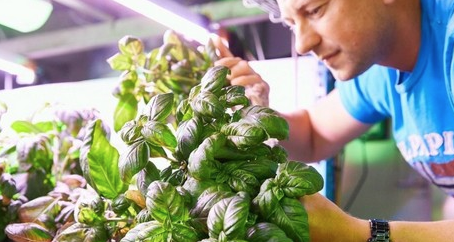
Colruyt grows basil in a multi-layered system and sells the herb in its Bio Planet stores
High cost
On the other hand, multi-layered cultivation is expensive. WUR admits that, at present, it is also still not energy efficient at all. However, researchers are hard at work trying to grow products in a greenhouse, using less power. “You need much less water and CO2 than in a traditional greenhouse. This is, however, not the case when it comes to the power needed to cool and humidify the interior climate. The high internal heat shedding and the lack of natural ventilation ensure a great need for cooling and, therefore, a lot of residual heat is produced.” Not all crops are suited to vertical farming either. AgriFoodTech Platform says leafy vegetables and herbs do well inside, but that it is more difficult to cultivate plants such as wheat and potatoes in a vertical farm.
Local and overseas supermarkets are fully invested in this subject and are developing activities to grow their own herbs and vegetables on site. Most retailers indicate that freshness and reducing products’ environmental impact are crucial aspects for wanting to start cultivating their own herbs and leafy vegetables. However, customer experience plays a role too. For example, the Dutch supermarket chain, Jumbo, says on its website that it has started growing basil in its Foodmarkt in Veghel to, among other things, improve customers’ food experience.
An increasing number of retailers are beginning to grow their own vegetables. Here are some examples:
Publication date: Thu, 03 Oct 2019
Author: Martine van der Wekken
© FreshPlaza.com
Saving Land With Vertical Farming Food Production
The Innovation Hub for Controlled-Environment Agriculture (IHCEA) at the James Hutton Institute is a collaboration between government agri-tech centre Crop Health and Protection (CHAP), and Liberty Produce, a London-based farming technology company with expertise in horticultural lighting and fertigation systems
By Rohese Devereux Taylor @hellorohese Senior Digital Reporter | October 11, 2019
A new research centre for vertical farming technologies that aims to enable Scottish farmers to transition to sustainable growing techniques opens in Dundee next week.
The Innovation Hub for Controlled-Environment Agriculture (IHCEA) at the James Hutton Institute is a collaboration between government agri-tech centre Crop Health and Protection (CHAP), and Liberty Produce, a London-based farming technology company with expertise in horticultural lighting and fertigation systems.
The centre has been purpose built for research and development and will help the industry to understand and tackle barriers to the adoption of hydroponic production systems.
The aim of the centre, which houses Liberty Produce's Future Farming Hub, is to drive innovations that reduce operational costs and improve the yields from controlled-environment farms, providing benefits to growers, food processors and consumers, as well as help farmers meet food requirements and limit further damage to the environment.
Director of Liberty Produce, Zeina Chapman said: "What we do is develop technology with a focus on trying to reduce the operational costs and the capital costs of running these systems, as well as improving the yield.
"The biggest challenge growers have at the moment is that vertical farming is really only on the cusp of commercial viability and that's because the cost of the capital expenditure required to build these systems is enormous, the operational costs are still very high, they're still quite labour intensive."
Because of this, most producers can only grow high-value crops such as microgreens, which can be sold for up to £40 per kilogram, and herbs.
But Liberty Produce, founded in 2018, wants to change that by developing new technologies with a focus on reducing costs these systems can be adopted globally.
Vertical farming grows produce in layers indoors in sometimes soil-less systems aided by LED lights either by hydroponics, where roots are continuously in moisture in the growing medium, or aeroponics, where the produce is misted and doesn't rely on a growing medium.
They are seen as a sustainable alternative to cultivating land not currently used for food, can withstand variable and increasingly extreme weather, eliminate the use of agrichemicals and reduce water use.
Liberty Produce will lead a £1.3 million project with eleven partners to accelerate the development of the UK vertical farming sector.
Using the funds, awarded by Innovate UK, the farming hub will support the creation of an integrated technology system focused on reducing operational costs by 25 percent, improving crop yield by 30 percent and reducing necessary grower intervention through improved decision support and automation in lighting, nutrient and environmental control technologies.
Some of the innovations that will be carried out at the centre will include designing high-efficiency LED lighting systems; test growing regimes, lighting applications and nutrient mixes in a variety of crops.
Vertical farming crops will complement traditional arable farming but Ms Chapman believes that more produce will be grown via the method as technologies advance and natural resources struggle to cater to growing populations.
She said: "I think they will become more mainstream for crops that are currently grown in fields or in glass houses. I think we'll start to see a more broadening of the crop types growing in these systems."
Growers are looking to produce baby leaves commonly found in salad bags with the vertical farming method, moving away from polytunnels and indoor track systems. But utilising the vertical method for wheat, barley and potatoes has a way to go yet.
Ms. Chapman said: "I think we'll start to see a patchwork of new growing systems coming in to help support and take over some of the more traditional growing systems."
Vertical crops are grown in a controlled environment with light levels, temperature, carbon dioxide, and applied nutrients all closely monitored and as an indoor crop, no pesticides are required.
Ms. Chapman said: "Improved technology in this sector will increase the adoption of these sustainable food growing systems, reduce the environmental impact of crop production, improve food security and create opportunities for the growth and export of UK agricultural technologies.”

VIDEO: Vertical Microgreens Farmer Interviews Nick Greens
Hello everyone! Visiting Vertical Farm On The West Side Of Chicago And Getting Interviewed By Shanquell The Grower
Hello everyone! Visiting Vertical Farm On The West Side Of Chicago And Getting Interviewed By Shanquell The Grower.

Indoor AgTech Landscape: 1,000+ Companies Innovating Inside
AgFunderNews created an image keeping track of the indoor growing landscape featuring 1000+ companies that take part in the industry, from greenhouse growers to suppliers of environmental controls
AgFunderNews created an image keeping track of the indoor growing landscape featuring 1000+ companies that take part in the industry, from greenhouse growers to suppliers of environmental controls.
The first thing to note is that they include greenhouses in the discussion as an indoor growing approach. At times, the conversation seems to be just limited to growing in buildings or containers with artificial lights, what we call “Sunless” or others broadly refer to as indoor, vertical, or urban farming.
Secondly, while there has been a great deal of activity around cannabis and alternative proteins such as insects, for the purpose of this landscape AgFunderNews kept to traditional food crop production.
The map focuses on the technology used in that production, from seeding to immediate post-harvest activities. We segment the landscape into the specific categories of component technologies, different types of growing systems and growers.
Read the full article, including the image of the landscape, at AFN (Louisa Burwood Taylor)
Innovation Hub For Controlled Environment Agriculture Launched In Dundee
CHAP partnered with Liberty Produce to develop and build the IHCEA facility with funding from Innovate UK. The facility is a series of self-contained units housing state-of-the-art equipment with a modular structure designed to create a flexible environment for research and development
10th October 2019
London, UK
Agri-tech centre Crop Health and Protection (CHAP) and farming technology company Liberty Produce have launched the Innovation Hub for Controlled Environment Agriculture (IHCEA) at the James Hutton Institute’s site in Invergowrie near Dundee.
CHAP partnered with Liberty Produce to develop and build the IHCEA facility with funding from Innovate UK. The facility is a series of self-contained units housing state-of-the-art equipment with a modular structure designed to create a flexible environment for research and development. With integrated cutting-edge LED lighting systems and patented nutrient delivery technologies, this unique research facility will enable collaboration between industry, academia, and government to effectively tackle the barriers to widespread adoption of vertical farming. Its purpose is to accelerate the development of sustainable food production year-round through resource-efficient, fully-controlled systems.
The IHCEA is a key part of Liberty Produce’s Future Farming Hub, which will offer a wide range of services, including research and development and CEA training programmes within a commercial demonstrator system, as well as industry and academic collaboration opportunities.
The James Hutton Institute has welcomed the location of CHAP’s IHCEA and Liberty Produce’s Future Farming Hub in Invergowrie, in the context of the Institute’s drive for the establishment of Open Science campuses at its sites and this has been facilitated by the creation of the Advanced Plant Growth Centre at Invergowrie as part of the Tay Cities Deal.
Fraser Black, CHAP Chief Executive, said: “We are excited to be partnering with Liberty Produce and the James Hutton Institute to establish the Innovation Hub for Controlled Environment Agriculture (IHCEA), in Invergowrie. This is a prime example of CHAP’s mission to harness game changing ideas from our creative and innovative partners to solve the problems industry is facing today and tomorrow. This is a progressive step in our ambition is enable the United Kingdom to become a global leader in CEA and augment the production of healthy food in a sustainable way.”
Zeina Chapman, Liberty Produce Co-Founder and Director, added: “Vertical farming is not yet sustainable; this partnership which has established the IHCEA and Future Farming Hub at the James Hutton Institute marks an advancement of our collective journey towards creating truly sustainable vertical farming technologies. The greater vision of Liberty Produce remains driving innovation that will enable us to meet our global crop requirements without harming the planet.”
Professor Colin Campbell, Hutton Chief Executive, commented: “This collaboration with Liberty Produce and CHAP marks the next step in the growth of the Institute's Open Science Campus initiative and brings new innovative companies to work closely with world-leading science. This has been facilitated by Tay Cities Deal announcement to create an Advanced Plant Growth centre at Invergowrie and our other new investments there and builds on our track record of engaging with industry, research partners and the public.”
UK Government Minister Colin Clark said: “I am pleased to see the opening of this new Innovation Hub at the James Hutton Institute. We know that technological innovation is the future of sustainable agriculture and Scotland is home to world-leading resources and expertise in this field. The UK Government recognises the importance of this work and remains committed to funding research and development through our modern Industrial Strategy.”
It is hoped that the synergy between CHAP, Liberty Produce and the James Hutton Institute will provide a better understanding of total controlled environment technologies, drive innovation and accelerate the growth of the vertical farming sector in the UK.
**Ends**
About CHAP
Crop Health and Protection (CHAP), funded by Innovate UK, is one of four UK Agri-Tech Centres. CHAP’s vision is for the UK to be a global leader in the development of applied agri-technologies, to help secure our future by nourishing a growing population sustainably while delivering economic, environmental and health benefits to society.
CHAP acts as a unique, independent nexus between UK government, researchers and industry, building innovation networks to identify and accelerate the development of cutting-edge solutions to drive incremental, transformative and disruptive changes in sustainable crop productivity and to establish controlled environment agriculture (CEA) as a core competency.
www.chap-solutions.co.uk/
For further information contact:
Darren Hassall
Darren.hassall@chap-solutions.co.uk
+44 (0)1904 462062
About Liberty Produce:
Liberty Produce is a farming technology company, enabling the growth of local produce year-round, using a fully-controlled, industry-leading, indoor vertical farming system. With expertise in lighting and nutrient delivery technology, Liberty develops and builds systems that reduce operational costs and improve yields of crops grown in controlled-environment farms. Their vision is to drive innovations that will enable the UK to meet our crop requirements over the next century, without harming the planet. Liberty Produce established the Future Farming Hub to enhance UK technology development and commercialization in the Controlled Environment Agriculture (CEA) sector. www.liberty-produce.com
For further information contact:
Benita Rajania
+44 20 3290 8801
About the James Hutton Institute
The James Hutton Institute is a world-leading scientific organization encompassing a distinctive range of integrated strengths in land, crop, waters, environmental and socio-economic science. It undertakes research for customers including the Scottish and UK governments, the EU and other organizations worldwide. The ongoing collaboration between the James Hutton Institute and Scottish-based vertical farm technology business Intelligent Growth Solutions Ltd resulted in the opening of Scotland’s first vertical farm at the Hutton Invergowrie campus in August 2018, and continues to be a major strength in developing the Advanced Plant Growth Centre initiative, which has been backed by a £27m transformational investment from the Tay Cities Deal. www.hutton.ac.uk
More information from Bernardo Rodriguez-Salcedo, Media Manager, James Hutton Institute, Email Bernardo.RodriguezSalcedo@hutton.ac.uk, Tel: +44 (0)1224 395089 (direct line), +44 (0)344 928 5428 (switchboard) or +44 (0)7791 193918 (mobile).
AeroFarms Announces Retail Launch of Microgreens with Amazing Flavor to Disrupt Leafy Greens Category
AeroFarmsⓇ, leader for indoor vertical farming and locally-grown produce has just introduced a new line of microgreens under their proprietary retail brand Dream GreensⓇ to further expand their mission of nourishing communities with safe, fresh, nutrient-dense, and delicious food that offers Peak Flavor AlwaysⓇ
Newark, NJ; October 14, 2019 -- AeroFarmsⓇ, leader for indoor vertical farming and locally-grown produce has just introduced a new line of microgreens under their proprietary retail brand Dream GreensⓇ to further expand their mission of nourishing communities with safe, fresh, nutrient-dense, and delicious food that offers Peak Flavor AlwaysⓇ.
Dream Greens now has two exciting, flavorful varieties of microgreens -
Micro Super Mix and Micro Spicy Mix, now available at all Whole Foods Market locations in the Northeast as well as online via FreshDirect. This retail debut builds upon the success of AeroFarms microgreens food service program that launched last year.
All Dream Greens microgreens are safely grown indoors in AeroFarms’ state of the art indoor vertical farms in located in New Jersey. Dream Greens are completely pesticide free, and they are ready-to-eat without any need to wash, providing a major benefit to consumers looking for safety and convenience.
Microgreens are the perfect addition to Dream Greens leading packaged baby leafy greens line, and strongly aligns with all the major grocery trends for produce, including local, flavor forward, sustainability, health & wellness, and visual appeal. In addition to being a flavorful & attractive garnish, a big handful of Dream Greens microgreens makes for an elevated salad base, side dish, & center-of-the-plate ingredient. Harvested after a few short days, Dream Greens microgreens provide more nutrient density than their mature green counterparts, so incorporating microgreens is a powerful way to provide a potent boost of vitamins, minerals & phytonutrients.
“We have had tremendous demand and interest in our microgreens, and we are thrilled to be launching at Retail our beautiful, pristine micro mixes that we think will disrupt the leafy greens category with the ultimate in nutrient density and peak favor,” says Marc Oshima, Co-Founder & Chief Marketing Officer at AeroFarms.
For more information, contact Marc Oshima, Co-Founder & CMO at Press@AeroFarms.com.Visit us at www.AeroFarms.com and www.DreamGreens.com
Dream Greens Micro Super Mix
Our micro super mix is a tiny & mighty blend of powerhouse greens including hearty red cabbage, sweet kale & juicy pac choi.
Dream Greens Micro Spicy Mix
Our micro spicy mix is a tiny & zesty medley with the perfect dash of heat, including red mustard greens, peppery arugula & juicy pac choi
About AeroFarms and Dream Greens
AeroFarms is on a mission to grow the best plants possible for the betterment of humanity. A global, mission-driven company, AeroFarms is a Certified B Corporation and proud to be named one of the World’s Most Innovative Companies by Fast Company. AeroFarms’ patented, award winning aeroponic technology provides the perfect conditions for healthy plants to thrive, taking indoor vertical farming to a new level of precision and productivity with minimal environmental impact and virtually zero risk. Through its retail brand Dream Greens, you can enjoy locally grown, pesticide-free produce that bursts with flavor and nutrition, all year round.
AeroFarms facilities meet USDA/FDA regulatory requirements and holds certifications in Good Agricultural Practices (GAP) and Good Manufacturing Practices (GMP), Non-GMO Project Verified, & OU Kosher.
SOURCE: AeroFarms
Relevant Links: www.AeroFarms.com; www.DreamGreens.com

UK Food Technology Company, Vertical Future, Completes Its £4m Seed Round To Accelerate Growth Plans In London
Vertical Future, a London-based food technology company, announced the completion of its Seed Round, raising £4m of equity finance, with further investment expected in the coming months. The company uses technology to produce high-quality, ethical food (primarily baby leaf vegetables and herbs), in controlled environments
Funds will be used to build additional ethical plant factories in London Fields and Mayfair, expanding from its existing site in Deptford
The move will also see improvements in technology, primarily in automation, data, and nutrition
Earthworm, lead investor, and High-Net-Worth-Investor-base invest in high-yield food production for urban environments
The company’s long-term objective is better urban health
Today (7th October 2019), Vertical Future, a London-based food technology company, announced the completion of its Seed Round, raising £4m of equity finance, with further investment expected in the coming months. The company uses technology to produce high-quality, ethical food (primarily baby leaf vegetables and herbs), in controlled environments. They also develop efficient and sustainable methods of food production and supply systems, with a long-term commitment to improving health and reducing CO2 emissions in cities.
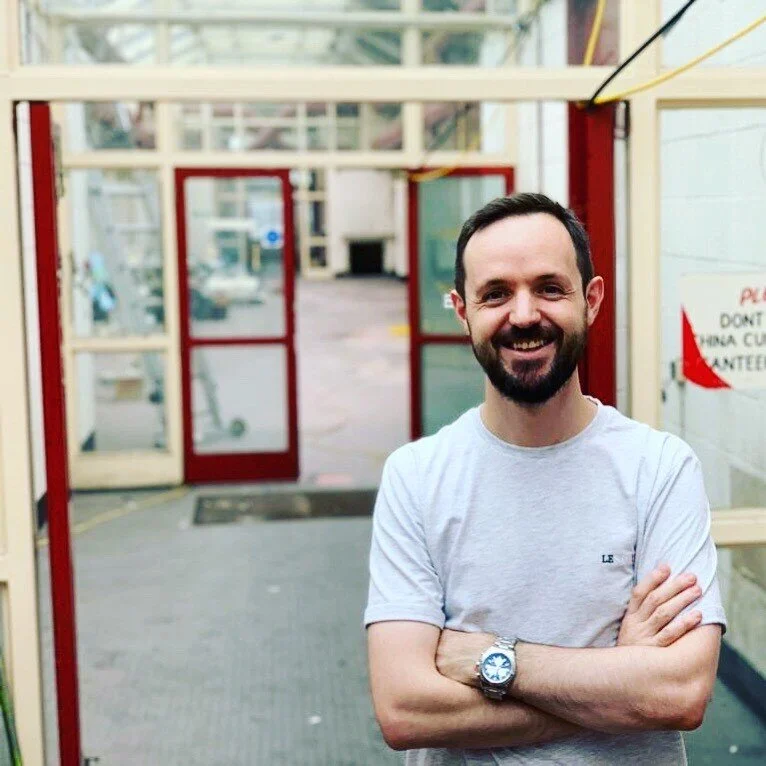
“Following several years of hard work, today’s raise validates our growth strategy and strong position in the London market, furthering our mission to improve the food and health of urban inhabitants, starting in London,” said Jamie Burrows, Founder, and CEO of Vertical Future.
The capital raised will be used to support the first phase of Vertical Future’s long-term, ambitious growth strategy. The company will see a 25x increase in crop production capacity across its London operations, aided by the development of two new ethical plant factories” in London Fields and Mayfair, as well as further developing its existing site in Deptford. Despite significantly more automation, this heightened production is expected to lead to 30 or more permanent local jobs, with more specialist roles focusing on the development of in-house growing tech, robotics, and process management.
The investment round was led by Earthworm – a fast-growing impact investor with a portfolio across food, energy, and waste – and supported by corporate finance adviser, Acceleris Capital. Also supporting the raise was Amberley Advisory and Gateley.
Ben Prior, CEO of Earthworm said: “Vertical farming offers huge potential in solving one of the biggest issues of our time – how to feed a growing population sustainably. We are really impressed with Jamie’s vision and work ethic, and the team at Vertical Future has a very special business poised for growth.”
Lord Nigel Crisp, Former Head of the NHS and Non-Executive Board Member at Vertical Future, added: “This is our first major move in this sector, enabling us to direct our work more towards health, in addition to purely producing food, in future years. Sustainable food will be one of society’s biggest health challenges and we aim to be at the forefront of the effort for better, long-lasting, tangible solutions”
Vertical Future’s ability to produce significantly more food will target a 10x increase in its Business-2-Business (B2B) restaurant, home cooks, and food brand customers – sold under the “MiniCrops” consumer brand. Current customers include Tom’s Kitchen, Mindful Chef, Chop’d, Kaleido, Sartoria, Lahpet, and Quaglino’s, to name a few.
Simon Thorn, CEO of Acceleris said: “We are delighted to complete this transaction with Jamie and the team at Vertical Future. We believe that we have secured an excellent investment partner in Earthworm and we look forward to supporting the company’s growth over the coming years. The team has attracted an impressive customer base so far and we see plenty of areas for growth.”
About Vertical Future
Vertical Future is a privately-owned technology company focused on improving health in cities through developing a better, more efficient food production and supply system.
About the Founder
Jamie Burrows previously worked as a consultant specializing in healthcare and life sciences strategy. Before founding Vertical Future in 2016, he worked at numerous top-tier consulting firms including EY and Deloitte, and also undertook a secondment to the Office for Life Sciences at the Department of Health. Educated to Ph.D. level in Economics, Jamie believes that much of the Vertical Future business directly relates to the central theme of health economics - resource scarcity.
About Earthworm
Earthworm is an environmental fund manager which only backs projects that will have a positive social or environmental impact.
We work closely with industry professionals from food, energy and waste to source, develop and nurture start-up and scale-up businesses with significant commercial potential. Although it is vital for the companies within the Earthworm community to make a return for our investors, it is equally important that they are ethically driven and they contribute to the circular economy. Members of the Earthworm community share expertise and best practice to support each other and achieve the best return for investors.
Earthworm now manages over £100m of investor capital. 10% of Earthworm profits go to charitable causes and 10% is invested directly in the environmental technologies of tomorrow.
About Acceleris Capital
Acceleris Capital are an FCA regulated corporate finance boutique that focus on advising early-stage technology SMEs.
Since incorporation in 2000, Acceleris have advised and managed fundraisings for over 50 UK businesses and raised over £120m, with a track record including start-up to IPO, trade sale and private equity exits.
Acceleris primarily source external funding directly from their network of High Net Worth investors and major UK investment institutions.
For more information and interviews, please contact:
Jess@ha-lo.co
+44 7789102402

US - Massachusetts: Hydroponic Farm Grows At Framingham High School
Via a mobile app, staff can monitor the crops, adjust the pink ultraviolet light, and prompt a light rain without setting foot inside the farm. A webcam even snaps a photo every three minutes, so they can see changes as they happen. If any crop’s reading falls outside of the target range, the app will send a notification

By Zane Razzaq
Daily News staff
October 11, 2019
Via a mobile app, staff can monitor the crops, adjust the pink ultraviolet light, and prompt a light rain without setting foot inside the farm. A webcam even snaps a photo every three minutes, so they can see changes as they happen. If any crop’s reading falls outside of the target range, the app will send a notification.
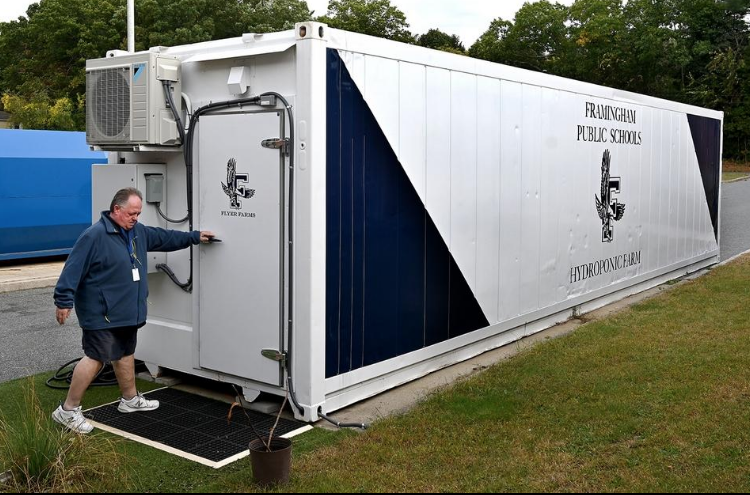
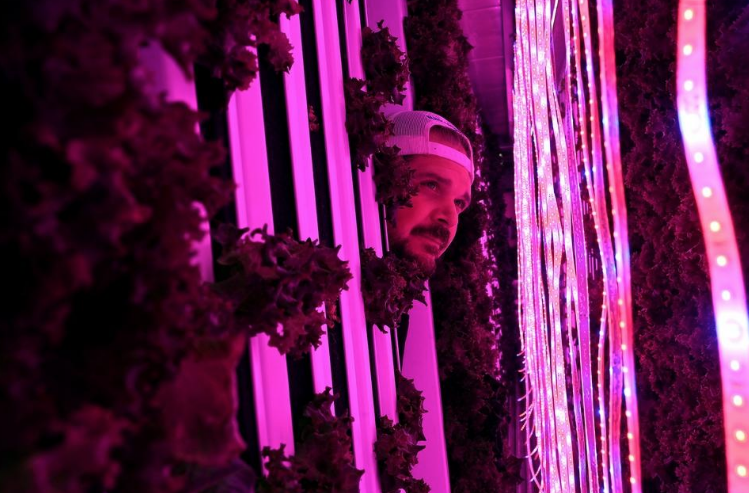
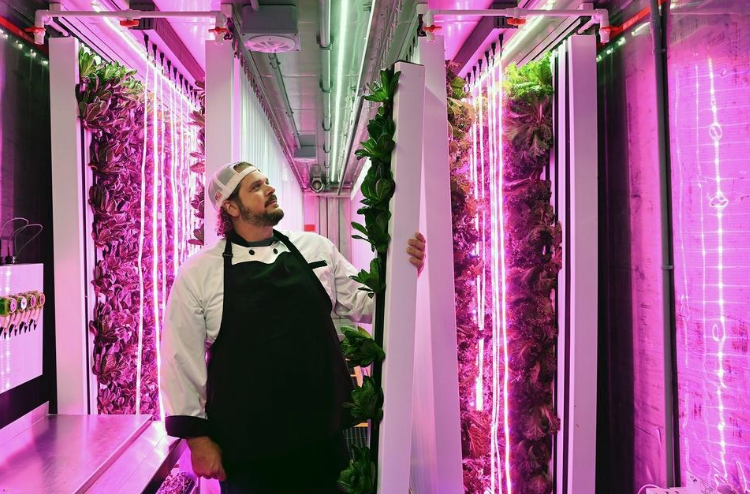
FRAMINGHAM – In an old shipping container behind the high school, towers of lettuce enjoy springtime.
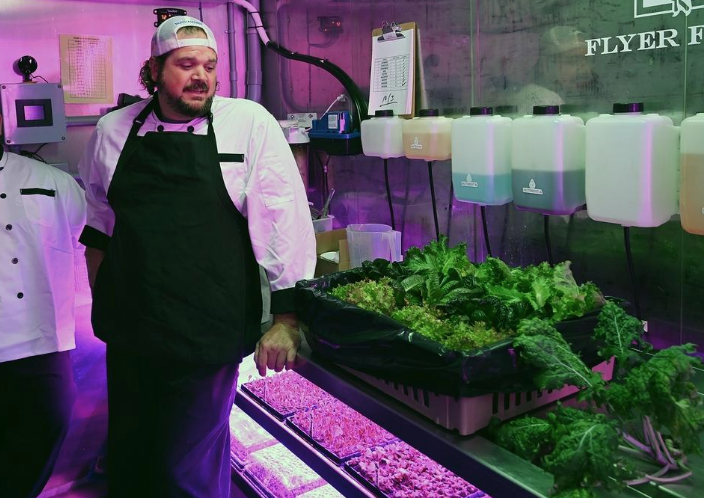
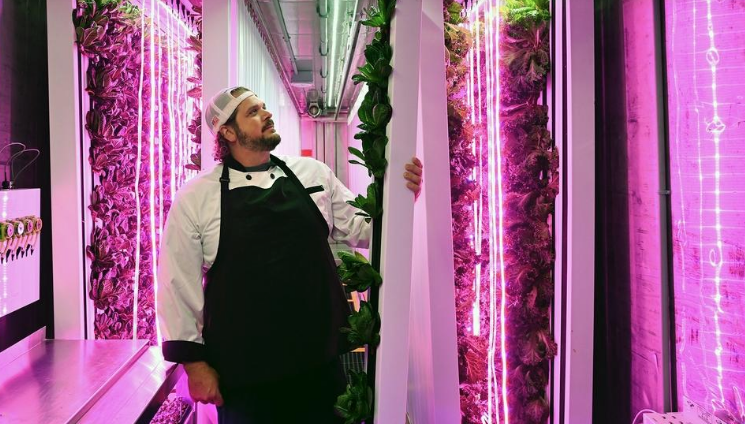
Walls of kale and other greens stretch down an aisle the length of the trailer, fed by ropes of LED lights that mimic sunlight. A wall-mounted keyboard that serves as the 320-square-foot hydroponic farm’s brain keeps the temperature at a steady 70 degrees. Every hour, a fan clicks on to distribute a spurt of carbon dioxide for a minute, helping the plants grow.
Later in the day, members of the Food Service Department will pluck leafy greens such as red romaine or wasabi arugula from about 35 grow towers. Then, produce is packed in crates and distributed to city schools to feed thousands of students.
“They might never see lettuce like this in their lifetime,” said Brendan Ryan, the foodservice department administrator for Framingham schools, holding up a particularly delicate lettuce. “You would be hard-pressed to buy this lettuce on the open market because it’s so hard to maintain.”
This will be the department’s first full year using the $104,000 product, which was first installed in April. It can grow the equivalent of two acres worth of vegetables inside without soil year-round.
Purchased from Boston-based Freight Farms with money from the department, it’s an example of the urban farming trend that the schools are now embracing. The indoor farm uses the technology of hydroponics: a technique where plants are grown with a nutrient solution and the same water recirculates repeatedly. Soil is not used.
For Ryan and his staff, it’s the latest “marketing tool” to promote the department, which previously started an outdoor garden to grow sunflowers, potatoes, corn and more.
“We’re trying to be as cutting-edge as we can and make sure that we’re serving these kids the best freshest product possible,” said Ryan. “This is one way for parents to see we’re making the lettuce right outside.”
Via a mobile app, staff can monitor the crops, adjust the pink ultraviolet light, and prompt a light rain without setting foot inside the farm. A webcam even snaps a photo every three minutes, so they can see changes as they happen. If any crop’s reading falls outside of the target range, the app will send a notification.
Containers of nutrient-infused water – chock-full of minerals found in healthy soil such as nitrogen, potassium, phosphorous – pump through tubes to the crops growing in polymer mesh.
Getting the hang of the technology posed some learning curves, said Raquel Vazquez, director of foodservice operations. For example, it takes more than an hour to calibrate the water tank filters to make sure every nutrient is properly dispensed into seedlings.
“If we don’t, then it improperly imbalanced and then our crops won’t yield as well,” said Vazquez.
The inside of the freight container also needs to be kept extremely clean to avoid problems like algae growth.
Ryan likened the “new endeavor” to going from “being a butcher to a brain surgeon.”
A head of lettuce that would normally take 14 to 16 weeks to grow in a field takes about eight weeks inside the trailer, 365 days a year. Another advantage: Crops are not exposed to any contaminants and are “beyond 100% organic,” said Ryan.
And it produces lettuce and other vegetables that would be too expensive for the district to buy from vendors, like the delicate lettuce that outside vendors would likely not risk shipping.
“They’re not going to be taking packed very well, they don’t take the exposure to extreme temperatures very well,” said Ryan, of the fine leaves. “You pack these in a shipping truck, stacked 30, 40 cases high – they flatten. Here, this crate goes right to the school.”
Vazquez said it also poses a learning opportunity for students, saying some have already toured the unit. Eventually, the biology department hopes to incorporate it into the curriculum.
“While our staff serves pizza on Fridays, they’re really teaching them about what hydroponic greens are, where this came from, all the way down to kindergarten. They’re starting to eat it and try it and taste it,” said Vazquez.
Ryan and Vasquez hope the high-tech aspect of the farm will get teens interested in farming as a career.
“A lot of kids think of agriculture as some lone farmer covered in mud in the middle of a field with a tractor. And it’s not anymore,” said Ryan.
Zane Razzaq writes about education. Reach her at 508-626-3919 or zrazzaq@wickedlocal.com. Follow her on Twitter @zanerazz.

Farmshelf CEO Counts On Manufacturing Scale To Become Big Hydroponic Feeder
And already Farmshelf has experienced the backing of another manufacturer based an ocean away and in an entirely different industry: Mini, the BMW-owned car brand, took Farmshelf under its wings as part of its Urban-X startup-incubator program and then invested in the company, along with angel investors including a handful of Fortune 500 CEOs and celebrity chefs
By Dale Buss
October 2, 2019

These days, Farmshelf basically is only helping grow basil in the back rooms of some of America’s best restaurants. But Founder and CEO Andrew Shearer is pursuing a vision of using manufacturing scale to bring down the cost of his hydroponic horticultural systems to transform his Brooklyn-based startup into a primary engine of the global food system.
And already Farmshelf has experienced the backing of another manufacturer based an ocean away and in an entirely different industry: Mini, the BMW-owned car brand, took Farmshelf under its wings as part of its Urban-X startup-incubator program and then invested in the company, along with angel investors including a handful of Fortune 500 CEOs and celebrity chefs.
Farmshelf sells internet-connected hydroponic systems that come complete with everything needed to grow herbs and vegetables indoors. For $8,250 apiece, customers can purchase Farmshelf’s bookshelf-sized units – there are more than 75 in the market already – and grow food in a “cost-effective, sustainable and easy way,” as Shearer tells Chief Executive.
The systems come with plant pods, nutrients, and the Farmshelf operating system. “You get the pods in the mail and put them into the system, plug it into the wall and add water once a week,” Shearer explains.
So far, restaurateurs and other low-volume customers mainly are growing herbs and leafy greens on Farmshelf. “Herbs is the largest focus because it is the most valuable crop, and it drives a bigger impact on dishes from a flavor and freshness perspective,” Shearer says.
But Shearer’s ambitions are carrying him far beyond. Actually, Farmshelf’s system already can grow about 50 crops, also including strawberries, peppers, tomatoes, radishes and “microgreens,” he says. “We can also grow potatoes and carrots and other things, but we’re focusing on highly nutritious foods that don’t transport well. That makes the most sense. It’s not a zero-sum game; we need to feed a growing population.”
And in that regard, he’s thinking much bigger for Farmshelf as a future food-supply solution. So far, for instance, Farmshelf has been a business-to-business proposition, but Shearer wants “to enable consumers to grow their own food where they are.”
“Today, we’re shipping food 1,500 miles to get to the end-user,” He says. “And urban agriculture struggles with logistics problems. In megacities, the last mile is the biggest problem, with highly perishable goods that don’t transport well. So our solution is internet-connected hydroponic farms that provide plants exactly what they need when they need it.”
Prototyped systems will boost Farmshelf yields by at least half, Shearer predicts, while scaling manufacturing will bring the cost of the system down drastically. “That’s how we can create a solution that will work in Abu Dhabi, Los Angeles, New York or Antarctica,” he says. “It’s not just urban agriculture but distributed agriculture.”
Dale Buss is a long-time contributor to Chief Executive, Forbes, The Wall Street Journal and other business publications. He lives in Michigan.

Freight Farms Welcomes Sam White As New Chief Innovation Officer
Freight Farms has expanded its executive team as it looks to expand globally. The company has appointed Sam White as Chief Innovation Officer. White was the co-founder of Boston-based Greentown Labs and Promethean Power
Freight Farms has expanded its executive team as it looks to expand globally. The company has appointed Sam White as Chief Innovation Officer. White was the co-founder of Boston-based Greentown Labs and Promethean Power.
In addition to his continued involvement with both organizations, White will now be collaborating with Freight Farms to guide corporate partnerships and strategic investment – his first major initiative upon moving back to Boston from India working with Promethean Power.
“Sam has a deep understanding of how sustainable technologies can scale to create meaningful and monetary impact for entire industries,” said Jon Friedman, Freight Farms COO. “His experience with modernizing a distributed farming system across India will contribute to our collective goal of enabling impactful, sustainable farming across the globe.”
According to the company, the move is an extension of White’s past focus on driving change in sustainable agriculture for Promethean Power, where today more than 50,000 farmers in India access its cold-storage technology.
“Freight Farms is truly making a global impact on sustainable farming, and supporting the team and its remarkable technology in the AgTech space felt like a natural next step for me. They’ve laid the groundwork to massively scale worldwide, and I’m excited to join the team in support of its momentum,” said Sam White, Freight Farms Chief Innovation Officer.
“Sam was able to instantly internalize Freight Farms’ mission, and we’re confident in his ability to recognize like-minded partners and creative opportunities to add value as we continue to grow,” said Brad McNamara, Freight Farms CEO. “It’s rare to find someone with experience scaling businesses across hardware, material science and infrastructure in multiple markets globally, and we’re happy to have him on the team.”
For more information:
www.freightfarms.com
Publication date: Mon, 07 Oct 2019

Scottish Start-Up Looking To Build Dozens of Vertical Farms Across UK
A Scots start-up plans to build dozens of indoor vertical farms across the UK. Edinburgh-based Shockingly Fresh is currently developing five sites countrywide to introduce low cost naturally-lit vertical farms using special hydroponic towers to grow multiple crop cycles of leafy veg such as salads and herbs
A Scots start-up plans to build dozens of indoor vertical farms across the UK. Edinburgh-based Shockingly Fresh is currently developing five sites countrywide to introduce low cost naturally-lit vertical farms using special hydroponic towers to grow multiple crop cycles of leafy veg such as salads and herbs.
They believe the increased yields from their farms will help British growers boost crop production and reduce the UK’s reliance on costly off-season imports from the EU. Plus the enclosed environment will mean less pesticides and cleaner crops, they say.
They’ve already secured rights to one site in Scotland and four in England – covering a total of 50 hectares – with their site in Worcestershire awaiting full planning consent.
Now they’ve launched an investor seed round to kick start their expansion to more than 40 sites countrywide over the next five years.
Shockingly Fresh has teamed up with technology providers Saturn Bioponics and specialist salad growers ValeFresco to roll out their plans.
Pak choi, lettuce, herbs
Over the last three years, ValeFresco and Birmingham-based Saturn have grown vertical crops of pak choi, lettuce, and herbs for a range of customers – with positive results.
“With pak choi we saw a three to four-fold increase in yields per crop cycle, with a third more cycle per year, giving an overall five-fold increase in annual yield,” says Saturn Bioponics founder and CEO Alex Fisher.
“The crops are cleaner, the season is longer, there is less disease and pest risk and they are easy to harvest.
“Consumers are well-accustomed to strawberries grown under cover and this is a natural next step,” Fisher adds.
Natural light
Unlike the majority of vertical farms, which use fully enclosed systems with heating and artificial light, Shockingly Fresh is promoting Saturn’s lower input, naturally lit approach which they say achieves most of the results at a fraction of the cost.
“We selected Saturn’s technology because their set-up requires far less up-front capital than a fully-enclosed vertical farm, yet delivers most of the benefits which are already driving the high demand for hydroponically-produced crops” says Garth Bryans, COO at Shockingly Fresh.
“This makes it much easier to get projects off the ground.
“A fully enclosed farm can achieve a higher annual yield, but when you add in additional lighting and heating costs as well as the high capex, their typical costs per kg are higher than a naturally lit set up can achieve,” Bryans continues.
“We have identified a significant market – particularly around the early and late season ‘shoulder months’ – which is currently filled by imported crops from Europe. We believe our sites will enable British growers to compete on a level field,” Bryans says.
50 hectares across four sites
Shockingly Fresh has already submitted a planning application for a 1.2ha site at Offenham in Worcestershire and has land agreed under heads of terms for a further 50 hectares across four sites countrywide.
They are now actively seeking more sites in the UK – to be funded by new investors – and are also advancing with a major project in Oman.
“Our funding round will enable us to secure and develop more than 40 sites in the UK – and we are keen to speak to brownfield site owners as well as traditional agricultural land holders,” Bryans says.
“The hydroponics market is set for significant expansion in the years ahead, so there is plenty of room for a number of players to grow.
“With our system we can significantly extend the shoulder months and offset the need for early and late season imports – plus we can bring in heating to extend the season further if the market is there,” Bryans concludes.
For more information:
Shockingly Fresh
www.shockinglyfresh.com
Saturn Bioponics
www.saturnbioponics.com
Publication date: Tue, 08 Oct 2019

Adapter To Fool-Proof Irrigation In Vertical Farming System
Aponix’ Vertical Barrel systems have been on the market for a while now, and since their conception, they have offered an alternative to rack systems as a way of making use of three-dimensional growing spaces. Aponix is releasing some new additions to make the system even more easy to use
Marco Tidona from Aponix talks about new accessories for the Aponix vertical barrels
Aponix’ Vertical Barrel systems have been on the market for a while now, and since their conception, they have offered an alternative to rack systems as a way of making use of three-dimensional growing spaces. Aponix is releasing some new additions to make the system even more easy to use. A new adapter to simplify irrigation with the Barrel, and a new larger and soil-based XL Vertical Barrel. Marco Tidona with Aponix: “We wanted to come with a solution that would make irrigation foolproof, so we built an adapter.”
Water Adapter
Irrigation in the cylinders requires a different approach than growers are used to. “To irrigate with the barrel all you have to do is put liquid on the inside surface at the highest point, gravity will pull it down and the wing system inside will make sure is an even spread,” says Marco. “We have been testing with different kinds of irrigation methods. One simple method is to just attach an inverted sprinkler, but these additions and sprinklers needed to be used with caution, but some users didn’t. Most of the users had irrigation cycles that lasted for too long and so there was too much liquid and they drowned their plants.”
In order to come up with a solution “We wanted to come with a solution that would make irrigation foolproof, so we built an adapter. The adapter can be integrated with all Netafim spraying mechanisms. It allows us to fix the drip stop to the lid of the barrel, and then the grower can define the flowrate using the Netafim equipment.”
Lego pieces
The Vertical Barrel system is a cylindrical alternative to the typical vertical farming solution of racks. “The Barrel is constructed of individual pieces, each ring consists of 6 pieces that click into each other like Lego pieces,” says Marco, emphasizing the ease of use of the system. “The rings can be stacked on top of each other to create the barrel, this way you can define the height of the barrel yourself. We have several different pieces that are suited for different types of produce so you can configure for different types of plants to optimize the cultivation area. The cultivation area is the outside of the cylinders, and with the variable height and the possibility to chain multiple of these units, the idea is to have an alternative for a rack system in vertical farming.”
So what are the benefits of growing with the cylindrical surface of the Barrel? “When you build racks, you cannot use natural sunlight,” says Marco. “On top of that you also get microclimate issues – plus when you go very high you need these scissor lifts or climbing equipment. The Barrel is an alternative that allows you to grow vertically in a greenhouse and use natural light.”
Though the system is already quite complete, a lot of additions are being planned in order to get it technologically up to par with other vertical farming solutions. “We are also expanding the system to have plant trellis holders left and right of the grow spaces,” says Marco. “Also we are working on ways to manage the microclimate, there will be an area where you can attach an airhole next to the grow spaces which can finetune the humidity and could also fertigate CO2. These things are necessary to compete with all the high-tech solutions that are already out there.”
Credibility
It can be quite difficult to get your foot in the door with a new product in the horticultural industry. “It took a lot of time to get slight credibility,” says Marco. “I remember the first year I was presenting this new technique at GreenTech, people thought it was just a gadget for your living room – they didn’t take it seriously. They didn’t see it as serious growing equipment, because it wasn’t what they knew – it wasn’t gutters and tables. So I am now trying to get this credibility by integrating and getting a lot of help from Gakon.”
According to Marco, Gakon are a very important partner for Aponix. “Gakon are helping me to add all these gadgets and functions that they know from the standard equipment they are using for large scale production. We are collecting ideas from them for the practical side, and we are translating them for vertical barrels. Gakon have been a major help for getting taken seriously. They have their partner companies, with whom they discuss our products. One such partner company is Hortilux, for lighting. With the help of Gakon, Hortilux are creating lighting plans for use with our barrels.”
The future
Marco believes that there is still a lot of future potential for the Vertical Barrels, and these new accessories are a step forward. “All the processes that are normally part of larger commercial operations are missing,” he says. “This product has the potential, but I need to find strategic partners who actually have the experience in the market and want to have a future alternative to racks. More and more big players in the industry are understanding the value of my product and inviting me to talk to them.”
Marco continues: “I had an interesting conversation with a company from the UK. They are building this robot that you can put over your raised beds and it functions like an agricultural printer: it irrigates, plants seeds, it takes care of your plants, and it’s fully automatic. This company is thinking about putting one of these robots, but with a circular arm, on top of my barrels. So it’s not using a flat surface like you have in a raised bed, but the round surface coming from the top and circling around. The future is looking exciting, but I am still looking for more people that believe in my product and want to support it in ways that I alone cannot.”
For more information:
Marco Tidona
Aponix
Publication date: Tue, 08 Oct 2019
Author: Brian de Lint
© HortiDaily.com

Video: A Look Inside The Vertical Farming Industry In Paris
Paris is not a place where you'd expect to find rows of neatly planted fruit and vegetables, but urban farming is flourishing in the French capital. The Down to Earth team takes a closer look in this video
Paris is not a place where you'd expect to find rows of neatly planted fruit and vegetables, but urban farming is flourishing in the French capital. The Down to Earth team takes a closer look in this video.
Publication date: Tue, 08 Oct 2019

The Inside Scoop On How Growers Can Up Their Funding Odds
Funding is a constant headache for many getting started, or even just keeping on, in the indoor ag world. We chatted with Contain’s VP of Business Development, Doug Harding, to get the inside story on what lenders are looking for, and the best ways to up your odds of getting funded
Image courtesy of CropKing
Funding is a constant headache for many getting started, or even just keeping on, in the indoor ag world. We chatted with Contain’s VP of Business Development, Doug Harding, to get the inside story on what lenders are looking for, and the best ways to up your odds of getting funded.
What main things are funders looking for?
Startups are going to be construed as riskier by any lender. They really don’t have a track record. In some cases, they don’t have the experience.
They have to have a thoughtful business plan. They’ve got to figure to commit some capital. We have a lot of people that come in and think that they can do it with no commitment on their own and hope that it works. Really, if you think that through, all the risk then lies with the lender, and that’s probably not going to work.
Image courtesy of Doug Harding
How much capital should growers expect to put in upfront?
It really depends on the size of the deal. Focusing on startups, 20%. In some cases more.
If they have more it can help get them more favorable terms on financing. If the lender requires an absolute minimum of 20%, and the customer has a pretty well thought-out business plan, is dealing with a reputable vendor, and maybe even has an offtake agreement, where they know they’re already going to sell their product, and maybe they’re going to come up with 40% down, they’re going to get a better offer.
It could be a longer-term. It could be because of that additional down they can help shorten their term, and that’s what a customer should always try to do. When you’re borrowing money for the first time for a startup business, keep the term as short as possible. You’ve got to afford the payment, but you’ve also got to assume your cost of capital after you prove yourself can be dramatically lower than when you first start out.
What are some other ways to bump up your funding odds?
Be reasonable with your size. When you’re first starting out, make sure, even though you think you have everything thought out in your business plan, start off smaller. We have some first-time growers that want to start off with a $5 million project with limited capital and no experience, and it’s just not going to work. Even if we could get that funding, why would you want to gamble that much before you really know what you’re doing? So start off small, get a feel for it, make sure that it’s something you have passion, ability, and time for.
What’s a common misconception that lenders have about indoor ag, compared to something like financing cars or houses?
A common misconception would be that even some of the experienced lenders in the industry really still are very uncertain on what the equipment’s worth. When that happens, they’re going to tend to be more conservative. They’re going to focus much more on the grower, and it may manifest in the form of insisting on more money down, just trying to dot their i’s and cross their t’s.
How can growers get around that reluctance?
It’s somewhat static. What they can do is stick to their business plan. If they’re successful in obtaining their funding, I’d tell them to work hard, and prove themselves, and show a track record and help prove the industry right.
We all know that everything about this industry makes sense. You can spend a whole lot less money. You can hedge your bets with climate conditions. You can grow year-round. There’s a growing need for food, as our population will increase for the next 30 years. Prove yourself. There’s not much they can do upfront other than making sure that they have things well thought out.
What are some common funding mistakes first-time growers make?
I think sometimes growers place too much emphasis on some of the initial conversations they have as far as where they can sell their product. It’s a long road to actually start growing and have the quality of product and still have that relationship intact, so I think one common mistake is that although it’s very prudent for potential growers to have a source of where they’re going to sell their product, it shouldn’t be the basis of their decision to start growing.
My advice is to not put all your eggs in one basket. If you get that kind of response, go talk to five others, and figure on not having just one source to sell your product to. Things could change.
What do the next five years in funding indoor agriculture look like?
That’s a real positive thing in the industry. Lenders are in business to generate a profit. In the next five years, as more and more lenders jump in—and it’s always a slower process at the beginning—other lenders are going to see the opportunity. People are going to understand what things are worth that they don’t know now, and it’s just going to be an evolution as it always is in a new industry.
That’s one of the really optimistic things about where Contain has positioned itself. We’re at the forefront of that. There’s only an upside ahead. Lenders are always looking for an opportunity, and there’s a giant opportunity in indoor ag.
Any final pieces of advice?
No one likes applying for financing. It can be a very frustrating process. If you’re trying to do it through traditional sources, it can almost lead to insanity. I mean, most people just don’t have the patience for it. It leaves you second-guessing your decisions.
We think that we can help dramatically speed up that process and take that frustration out for many customers by being aligned with the right lenders. Customers still need to be patient, but they need to understand that working with the right company can make their life a whole lot easier.
This conversation transcript has been lightly edited for length and clarity.
Learn more about Contain and funding your indoor ag business at our website, and subscribe to Inside The Box, our weekly newsletter.
WRITTEN BY
Nicola Kerslake
We’re Contain Inc. We use data to improve access to capital for indoor growers, those farming in warehouses, containers & greenhouses. https://www.contain.ag/
CubicFarm(R) Systems Corp Is Pleased To Announce Our Largest Sale of A Commercial-Scale System In the US
CubicFarms is pleased to announce the sale of its second commercial-scale farm in the US, in the State of Montana. The system's plan includes 18 CubicFarms patented growing machines, 2 patented germination machines, along with Cubic's proprietary supporting irrigation system. At approximately $3 million USD, this represents the second-largest sale to date
Tuesday, October 8, 2019
VANCOUVER, BC / ACCESSWIRE / October 8, 2019 / CubicFarm® Systems Corp. (TSXV:CUB) ("CubicFarms" or the "Company") announces that on October 7, 2019, the Company finalized an agreement for the sale of a large scale commercial CubicFarm system in Montana, USA and received the initial deposit from the customer.
CubicFarms is pleased to announce the sale of its second commercial-scale farm in the US, in the State of Montana. The system's plan includes 18 CubicFarms patented growing machines, 2 patented germination machines, along with Cubic's proprietary supporting irrigation system. At approximately $3 million USD, this represents the second-largest sale to date.* The customer’s purpose-built facility is designed and constructed to accommodate the possibility of doubling future production quickly and efficiently.
"We are very excited to be installing a large CubicFarm System in Montana," said Dave Dinesen, CEO of CubicFarm Systems Corp. "The location of this installation is quite strategic and will allow our customers to access several markets and leverage logistic resources to further enhance their commercial-scale growing operation. As our customer is already in the farming and produce space, they will be able to expand and diversify quickly and leverage their current infrastructure. CubicFarms will also be installing its latest generation of machine, which provides greater capacity and flexibility to grow more varieties and increase yield".
*The largest system sale to date was Calgary, Alberta for 23 growing machines, announced on July 11, 2019.
Neither the TSX Venture Exchange nor it’s Regulation Services Provider (as that term is defined in the policies of the TSX Venture Exchange) accepts responsibility for the adequacy or accuracy of this release.
About CubicFarm® Systems Corp.
CubicFarm® Systems Corp. is an Ag-Tech and Vertical Farming company that utilizes patented technology to cultivate high-quality produce. The Company believes that it can provide a benefit to the world by significantly reducing the physical footprint of farming, shipping costs, and associated greenhouse gasses, while significantly decreasing the use of freshwater and eliminating the need for harmful pesticides.
Founded in 2015, the Company's mission is to provide farmers around the world with an efficient growing system capable of producing predictable yields with superior taste. Using its unique, undulating growing system, the Company addresses the main challenges within the indoor farming industry by significantly reducing the need for physical labour, by reducing energy, and by maximizing yield per cubic foot. The Company has sold and installed systems in Canada and the US and is currently negotiating with a global pipeline of prospective customers. It also operates one wholly-owned facility in Pitt Meadows BC and sells its produce in British Columbia to retail customers under the brand name Thriiv Local Garden™ and to wholesale customers as well.
CubicFarm® Systems Corp's. patented growing system provides customers with a turnkey, commercial scale, hydroponic, automated vertical farm growing systems that can grow predictably and sustainably for 12 months of the year virtually anywhere on earth. CubicFarm® enables its customers to grow locally and to provide their markets with produce that is consistent in colour, size, taste, nutrition and allows for a longer shelf life. CubicFarms is focused on providing its technology to farmers to grow safe, sustainable, secure, fresh produce, nutraceutical ingredients, and animal feed. Further support and value is provided to our clients through our patent-pending germination technology and proprietary auto harvesting and processing methods.
CubicFarm® Systems Corp.
For further information contact:
Ross Rayment, VP - Corporate Development
ross@cubicfarms.com work: 1-403-616-0312
Cautionary Notice Concerning Forward-Looking Statements
This news release includes certain "forward-looking statements" under applicable Canadian securities legislation. Forward-looking statements include, but are not limited to, anticipated sale of this CubicFarm system to this customer. Forward-looking statements are necessarily based upon a number of estimates, and assumptions (including the receipt of regulatory approvals) that, while considered reasonable, are subject to known and unknown risks, uncertainties and other factors which may cause the actual results and future events to differ materially from those expressed or implied by such forward-looking statements. There can be no assurance that the sale of this CubicFarm system will be completed as currently planned or at all. Accordingly, readers should not place undue reliance on forward-looking statements. The Company disclaims any intention or obligation to update or revise any forward-looking statements, whether as a result of new information, future events or otherwise, except as required by law.
SOURCE: CubicFarm® Systems Corp.