


Welcome to iGrow News, Your Source for the World of Indoor Vertical Farming
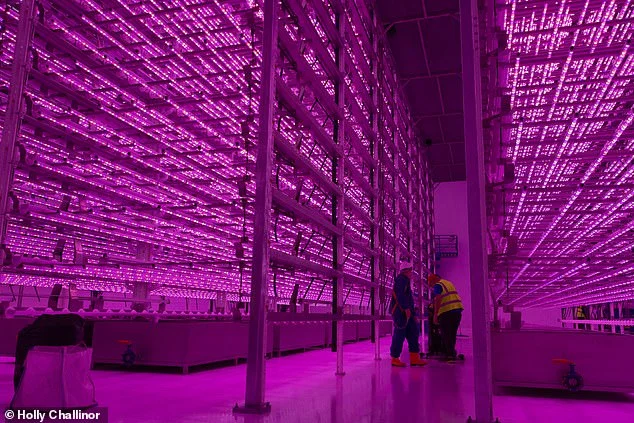
US: Utah - World’s First Commercial, Indoor Strawberry Farm Coming To Murray
It could be the world’s first private, commercial, vertical, indoor strawberry farm, and the Murray City Council approved it during their June 18 meeting. In a first for an urban Utah city, the City Council amended the Murray City Municipal Code to allow for indoor, vertical farming
August 29, 2019 ● By Shaun Delliskave
By Shaun Delliskave s.delliskave@mycityjournals.com
It could be the world’s first private, commercial, vertical, indoor strawberry farm, and the Murray City Council approved it during their June 18 meeting. In a first for an urban Utah city, the City Council amended the Murray City Municipal Code to allow for indoor, vertical farming.
This clears the way for Chihan Kim, a businessman whose holdings include a Sandy coffee shop, to develop what would be Utah’s first large-scale commercial, indoor, hydroponic farm in a vacant warehouse building located at 158 E. 4500 South.
“(I) will collect all the material to build the facility and…grow vegetables and some fruits, like strawberries, that will benefit from the omittance of herbicides,” Kim told the Murray City Planning Commission on May 2.
Vertical farming has become a buzzword in agriculture. The process includes producing food in vertically stacked layers, such as in a skyscraper, unused warehouse, or stacked shipping containers, with controlled-environment agriculture technology, where all environmental factors can be controlled. Such facilities utilize artificial light control, environmental control (humidity, temperature and gases) and fertigation. Some vertical farms use techniques similar to greenhouses, where natural sunlight can be augmented with artificial lighting and metal reflectors.
One of the most successful vertical farming operations is in Jackson, Wyoming. There, Vertical Harvest produces 100,000 pounds of vegetables a year on a plot 30 feet high by 150 feet long. Their 1/10th-of-an-acre site grows an annual amount of produce equivalent to 10 acres of traditional farmland. However, other ventures have failed.
Vertical farms are expensive to set up and take a long time to expand. Technology is changing at such a rapid pace that a newly opened competitor in the field could offer produce at a lower rate than an established producer. Still, indoor farming is appealing as a sustainable solution to growing food with little need for pesticides, water and land.
Before the code change, “Indoor Farming” was not listed as an allowable use in any zone in Murray City. For Kim to move forward with his zoning request, he needed to go through the extreme measure of having Murray change its code to allow for such a business.
This won’t be the first vertical, indoor farm in Utah, as an 11,000-square-foot facility sits on farmland in Charleston. Strong Vertical Garden supplies produce from that building to Smith’s grocery stores and microgreens to several chefs and restaurants in Utah.
The building that Kim intends to transform into an indoor farm is the former Electrical Wholesale Supply building. That building will allow Kim’s company, City Farm, to have 40,609 square feet for operations. LED lighting will be the primary source of light for the plants.
Murray City planning staff noted in their recommendation to the City Council that the indoor farm, “…will create the best opportunities to adaptively re-use and potentially revitalize older buildings and vacant spaces… (and) have the potential to place year-round access to fresh food closest to populations with limited transportation options, creating a positive impact on public health.”
“The main crops that we are considering at this moment are strawberries,” Kim said. Strawberries, he said, are one of the most contaminated fruits because of outdoor pesticides. This process will save them from harmful chemicals that get trapped in their seeds and pores and don’t all wash out with water.
“The farm operations will be maximum automation. Pollination—I am going to use drones. Drones will produce wind that will promote pollination. The farm will be open to the public with large windows. Strawberries will be supplied to grocery stores, but we will also make strawberry smoothies and food like that,” Kim said.
Councilwoman Diane Turner stated, “I think it is a great idea. I am really pleased you are doing this in Murray.”
Lead photo: An example of vertical farming shows stacks of crops growing in an indoor building. (Photo courtesy Murray City)
Ontario Greenhouse Growers Look At Cutting-Edge Advances
“As a vertically integrated grower, we’re using all the latest technologies available to us to grow the best possible vegetables,” said Chris Veillon, chief marketing officer for Pure Hothouse Foods Inc. in Leamington, ON
In an effort to contend with labor shortages, pests, food safety, and other challenges, Ontario’s greenhouse growers are tapping into a number of innovations.
“As a vertically integrated grower, we’re using all the latest technologies available to us to grow the best possible vegetables,” said Chris Veillon, chief marketing officer for Pure Hothouse Foods Inc. BB #:170379 in Leamington, ON.
Some growers use high-pressure sodium lights to supplement natural sunlight.
Pure Hothouse Foods installed the lights in a few facilities, and Carl Mastronardi, president and CEO of Del Fresco Produce Ltd. BB #:194101 in Kingsville, ON, said this the type of light used in Del Fresco’s strawberry greenhouses.
Automation is another increasingly common theme.
“Automation to offset the growing shortage of general farm labor is constantly added where it makes good financial sense,” said Ray Wowryk, director of business development with Nature Fresh Farms Sales Inc. BB #:274537 in Leamington, ON, adding that many growers are using upgraded artificial intelligence (AI) and other technologies to assist in crop management.
Some growers are also exploring indoor vertical farming, including Del Fresco.
“Our vertical farming is a very unique system—it doesn’t work like others where you’re growing in a warehouse on shelves,” Mastronardi said.
Called the LivingCube, he said it’s a very efficient growing method “where the plants actually get bathed by the light in the container. We’re going to grow microgreens and lettuce this way.”
The system produces living lettuce, basil, and microgreens all year, featuring 12 mechanized growing, germination, and irrigation machines, each built inside a proprietary insulated, 40-foot, stainless-steel growing chamber. The growing machines are individually climate controlled to optimize the environment and create a complete standalone growing system and independent growing facility.
Next, is packaging, and recent years have seen an uptick in demand for sustainability.
“Consumers are requesting more sustainable packaging,” Wowryk said.
In response, Nature Fresh has been working with retail partners to provide more eco-friendly options.
“Recently, we introduced a compostable tray for our mini cucumbers. Response has been very positive from our retail community, and customers have expressed gratitude through our social channels welcoming the change.”
Pure Hothouse Foods is also striving to reduce its carbon footprint with packaging alternatives.
“We’re transitioning our snacking tomato line to packaging that uses lidding film, which can reduce up to 25 percent of the plastic,” Veillon said. “The use of alternative bases such as palm fiber or sugarcane are emerging solutions that can be recyclable, biodegradable, or even compostable.”
Tagged greenhouse, ontario
Bowery Farming Hires Execs From Starbucks And Walmart
In a move to broaden consumer awareness and increase retail distribution, Bowery Farming has made two key executive hires for the company’s marketing and sales operations.
Wednesday, Aug. 28th, 2019
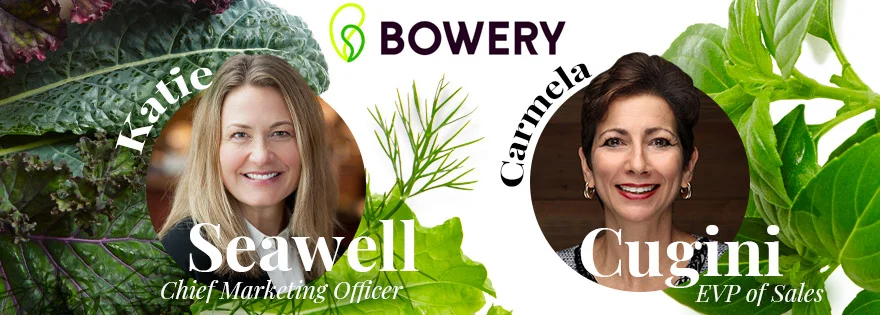
NEW YORK CITY, NY - In a move to broaden consumer awareness and increase retail distribution, Bowery Farming has made two key executive hires for the company’s marketing and sales operations. The company appointed Katie Seawell (formerly of Starbucks Coffee Company) and Carmela Cugini(formerly of Walmart) as the company’s Chief Marketing Officer and EVP of Sales, respectively.
Irving Fain, CEO and Co-Founder, Bowery Farming
“We are thrilled to have Carmela and Katie join the Bowery team,” Irving Fain, CEO and Co-Founder, stated in the press release. “We are committed to building a smart and passionate team that is dedicated to our mission of growing food for a better future. Katie and Carmela will be tasked with sharing our mission—and the work we are doing to revolutionize agriculture—to retail partners and consumers, ultimately bringing Bowery’s safe, fresh, and delicious locally-grown produce to more homes."
Bowery Farming appointed Katie Seawell (formerly of Starbucks Coffee Company) and Carmela Cugini (formerly of Walmart) as the company’s Chief Marketing Officer and EVP of Sales, respectively
Both Seawell and Cugini come to Bowery with vast experience in the food retail industry and are set to play a vital role in expanding the company’s operations and supporting Bowery’s mission of growing safe, fresh produce for a better future as the company plans to expand its network of farms to new markets over the coming months.
Katie Seawell, Chief Marketing Officer, Bowery Farming
“I was immediately drawn to Bowery’s approach to re-thinking the agricultural system and offering sustainable, fresh produce that meets the needs of our growing population,” Seawell commented. “I look forward to helping grow the Bowery brand, uncovering ways to connect directly with customers who believe in our mission.
Seawell led a variety of leadership roles at Starbucks, where she spent over a decade within the marketing and product organization field including driving brand campaigns, developing go-to-market strategies, product innovation, and most recently as SVP of Siren Retail Operations. Her new role with Bowery as the Chief Marketing Officer will include leading the marketing team, spearheading initiatives to build the company’s brand, consumer outreach in both existing and new markets, and partnering with the agriculture science team pertaining to innovation strategy to provide insights on consumer produce trends.
Carmela Cugini, EVP of Sales, Bowery Farming
“I’m excited to join Bowery at a pivotal moment for the company’s growth,” stated Cugini. “Now more than ever, consumers are demanding more transparency on where their produce comes from and how it was grown. For retailers, Bowery provides that insight and accountability. I look forward to working with our partners—existing and new—to ensure Bowery’s produce is top of mind for consumers looking for fresh, delicious produce.”
Cugini’s experience stems from her vast experience with e-commerce retail, consumer packaged goods, financial planning, and sales. Prior to her role as Vice President and General Manager of Walmart’s US e-commerce and Jet.com for three years, Cugini spent over 13 years at PepsiCo and four years at Merrill Lynch. Her strong background in sales management, key account sales, revenue management strategy, and marketing and brand development made her a key choice as Bowery’s new EVP of Sales. Cugini’s new duties with Bowery will include growing its network of retail partners and distribution channels while educating grocers on the benefits of indoor-grown, pesticide-free produce.
Congratulations to both Seawell and Cugini on their next adventure!
Packaged Salads Value-Added Bowery Farming Executive New Hires New Hires Starbucks Walmart Sales Marketing Sustainable Fresh Produce Katie Seawell Carmela Cugini Irving Fain

Growing Up: Inside Infarm’s Plans To Feed The World
It is projected that by 2050 two-thirds of humanity – or 6.5 billion people – will be living in urban spaces. The challenge will be building and managing urban spaces to sustain such a massive population. In theory, industrial agricultural produces enough food to feed the world as a whole, but the current model is unsustainable
September 3, 2019
Infarm founders Osnat Michaelli and Erez and Guy Galonska
Editor’s note: This is the first installment of a series focusing on social impact startups. Stay tuned for more.
It is projected that by 2050 two-thirds of humanity – or 6.5 billion people – will be living in urban spaces. The challenge will be building and managing urban spaces to sustain such a massive population. In theory, industrial agricultural produces enough food to feed the world as a whole, but the current model is unsustainable.
Large-scale agriculture has led to deforestation on a mass scale – as we are currently seeing in the Amazon – along with soil degradation, water waste, and plant diseases that require the use of pesticides (and are constantly mutating). Moreover, due to energy use and lengthy transportation routes, the CO2 footprint of food currently represents 17% of total global emissions. Climate change will, in turn, have an increasing impact on agriculture – with changes in rainfall, rising temperatures, an increase in pests, and extreme events such as heatwaves, droughts, storms, and floods affecting our ability to provide food for a growing global population.
These challenges have been the driving force behind the global agtech movement. For two straight years, agtech startups have received $2 billion in funding and 2019 is set to be another banner year for agtech.
Leading the pack in Europe is Berlin-based agtech startup Infarm, which recently closed an €88 million Series B investment led by Atomico.
From concept to reality
Founded in 2013 by Osnat Michaelli and brothers Erez and Guy Galonska, Infarm pioneered putting ‘indoor vertical farms’ in city locations such as supermarkets, shopping malls, restaurants, schools, hospitals and similar spaces where the produce can directly reach the end customer.
“My two co-founders and I came together around the idea that being close to the land and particularly its produce is vital to our health and creativity as a society. And from the beginning we began to explore – through travel, growing and experimentation – ways to bring natural vitality of the local farm into the city and the freshness and flavour back into our lives,” explained Infarm CEO and co-founder Erez Galonska.
“We also realised that our current food system’s biggest deficiency is that it is too far removed from the people it is trying to feed. At infarm, rather than asking ourselves how to fix these deficiencies in the current supply chain, we looked to redefining the entire chain from start to finish; Instead of building large-scale farms outside of the city, optimising on a specific yield, and then distributing the produce, we decided it would be more effective to distribute the farms themselves throughout the city.
“In 2013 we converted a 1955 Airstream trailer into our first vertical farm in one of Berlin’s most well-known urban farm spaces, ‘Prinzessinengarten’. This trailer became a hub for our early experimentation, where visitors could harvest herbs and microgreens and we could welcome a vibrant community of urban planners, designers, food activists, bio-dynamic farmers, architects, chefs, biologists, and hackers to explore the diverse challenges behind making urban farming a reality. This research station and lab would form the beginnings of what we today call Infarm.”
Today, ‘infarms’ can be stacked to fit any space and size, and are designed to easily plug into the city’s existing infrastructure. Infarm controls the farms remotely using sensors and a centralised, cloud-based platform that adjusts and improves itself continuously, so each plant grows better than the one before – providing plant seedlings with an ideal combination of light spectrums, temperature, pH, and nutrients for optimal growth.
The concept was further refined with inputs from biologists and cooks. The startup’s farms use no pesticides, 95% less water than traditional farms, and reduce transportation by 90%. Infarm’s largest module can grow up to 680,000 plants each year on only 25 square metres, making it 420x more efficient than soil-based agriculture.
In 2016, Infarm received a grant of €2 million from Horizon 2020, Europe’s biggest research and innovation programme. The grant was awarded on the basis of Infarm providing sustainable agriculture using hydroponics, proprietary lighting algorithms combined with indoor vertical farming, along with its patented modular ‘growth trays’ to create an incredibly efficient growing environment. The same year Infarm partnered with Metro Group, one of Europe’s biggest wholesalers, and in 2017, the startup received an early VC investment of €4 million.
2018 was a banner year for Infarm – both in terms of increased presence and funding. It secured a partnership with supermarket chains EDEKA and REWE in addition to partnering with several restaurants including Tim Raue and Good Bank. It also raised a Series A funding round of €20 million led by Balderton Capital. By mid-2018, Infarm was present in more than 50 customer-facing locations and launched its first Infarm in France via Metro Nanterre in November 2018.
Infarm has been rapidly growing and scaling since, and with its impressive €88 million round. Today, Infarm has over 200 in-store farms, over 150 farms in distribution centres and harvests more than 150,000 plants every month. In addition to its early partners Metro and Edeka, Infarm has partnered with major food retailers including Migros, Casino, Intermarche, Auchan, Selgros, and Amazon Fresh in Germany, Switzerland, and France.
Infarm’s team has grown from 40 people in 2016, to 150 in 2018, and the startup now employs over 250 people in several locations across Germany, as well as in Denmark, France, Switzerland, UK, and the US.
Today the total market for fruit and vegetables is €2.2 trillion worldwide, with an average of 10 kilos of salad per year, per person. This market is expected to grow to €5 trillion by 2030 as people’s diets are shifting to healthier and fresher food.
With this growing market size, Infarm sees a great opportunity for expansion while filling a societal need. The startup is planning to land in the UK this month, and is setting its sights on foreign markets; the startup is already in advanced discussions with retailers in the US and Japan. Its ultimate vision is to feed the 10 billion people living in urban centers by 2050.
Agriculture-as-a-Service
What makes Infarm attractive to supermarkets and other similar establishments is its ‘Agriculture-as-a-Service’ business model. The modular ‘farms’ themselves remain the property of Infarm, which receives income per harvested plant. Infarm coordinates with retailers and takes care of the farm including installation, cultivation, harvesting, and maintenance. Its farm unit becomes part of the retailer’s vegetable department. Aside from the regular visits by a service personnel to plant new plants, the farms are controlled remotely. This modular, data-driven and distributed approach — a combination of big data, IoT, and cloud analytics — sets Infarm apart from competitors.
From a price point, Infarm is attractive for supermarkets, which get a better product at the same price. In addition, the plants, especially herbs, are harvested fresh; preserving color, smell, flavour, and nutrients.
Sustainable cities with responsible production
Before there was agtech and its cousin foodtech, it was all under one banner: agrifood tech. This vertical is now split in two: upstream or agtech is closer to the farmer, while downstream is foodtech, closer to the consumer. Infarm sits perfectly at the intersection, innovating in farming while at the same time drastically reducing or even eliminating the farm to market supply chain and bringing its produce directly to consumers. In effect, Infarm addresses two United Nations sustainable development goals: impacting both building sustainable cities (SDG #11) and communities and responsible production (SDG #12).
Infarm is redesigning the entire food supply chain from start to finish by distributing the ‘farms’; farming directly where people live and eat. It claims to be 400x more efficient than traditional agriculture.
The impact of its instore farms is best illustrated by the following numbers:
2 square metres of instore farms is equivalent to 400 square metres of traditional farmland
Only 0.5% space usage for each instore farm
95% less water than traditional agriculture
90% less transportation
75% less fertilizers, 0 pesticides
150,000+ plants per month harvested
The future of farming
Infarm’s goal for the future is to gain an even deeper understanding of the optimal conditions for plants, and for supermarkets to source all their needs for herbs from Infarm alone. With its data collected from sensors that measure and control plant growth, Infarm possess a unique plant database and may well be on track to achieving this goal.
Although experts agree that feeding a rapidly burgeoning urban population cannot be solved by vertical urban farming alone, Infarm and similar agtech startups are hailed as trailblazers. They form part of the solution, while appealing to people who care about what they eat and where it comes from.
The signs are clear that in the near future, Infarm and similar companies will become the norm and not a novelty.
Maricel Sanchez has over 10 years of experience in various fields including trading, supply chain management, logistics and manufacturing. As well as helping startups to raise funds, she is an award-winning public speaker and the current President of Toastmasters Nice, a bilingual club that promotes public speaking and leadership.

Crop One Grows Food Hydroponically With Unique Formulas For Each Plant
Crop One is a vertical farming holding company for two subsidiaries – FreshBox Farms, Millis, Mass., and a joint venture with Emirates Flight Catering, Dubai South, United Emirates
Crop One is hardware agnostic but develops its own proprietary software and data analytics platform that governs its growing process as well as it farms.
Hydroponic Technology and Data Analytics in Vertical Farming
Dave Vosberg, CFO & SVP Strategy | Crop One
07/30/19 Indoor & Vertical Farming
Tell us about Crop One and your role with the company.
Crop One is a vertical farming holding company for two subsidiaries – FreshBox Farms, Millis, Mass., and a joint venture with Emirates Flight Catering, Dubai South, United Emirates. Crop One has been in commercial production longer than any other major vertical farmer in the U.S. It produces the highest crop yield per square foot, at 25% of the capital cost, of any vertical farm, due to its unique combination of proprietary technology platform and best-in-class plant science. For more information about Crop One and vertical farming follow the link to CropOneHoldings.com. Crop One’s mission is to solve the world’s food problems one crop at a time. The first crop we are successful with is leafy greens, but soon we will be growing fruits, proteins, some cereals and many specialty crops. My role with the company is as CFO and SVP Strategy, helping to provide the vision for corporate financial success.
Please tell us what advantages and benefits Crop One provides?
Crop One Holdings is transforming the ag tech industry, using advanced hydroponic technology and proprietary data analytics to provide pure, safe and consistent produce year round. Crop One’s differentiated technology stack and growing process make it the most advanced company in the vertical farming space. The company delivers industry-leading environmental benefits with technology that is centered around lowering costs and increasing yields. Additionally, the company is also actively experimenting with growing new crop types and cultivars, and has partnered with leading seed and research companies to develop seeds specifically bred for the controlled indoor environment.
Since sustainably feeding a growing population is a paramount interest globally, what type of international interest do you have for your farms?
Crop One Holdings, the world’s leading vertical farm operator through its FreshBox Farms brand and Emirates Flight Catering (EKFC), announced a $40 million joint venture the build the world’s largest vertical farm in Dubai, United Arab Emirates. The 130,000 square foot controlled environment facility will produce three US tons (6,000 pounds) of high quality, herbicide and pesticide-free leafy greens, harvested daily, using 99 percent less water than outdoor fields. Its location will enable quick delivery of fresh products within hours of harvest, maintaining the food’s nutritional value and reducing carbon emissions associated with transportation.
How big of an issue is distribution?
Distribution is the key issue. Crops are now grown far from the point of consumption often times traveling weeks before reaching supermarkets and are vulnerable to disruptions related to climate, pathogens, and chemical intervention. Addressing these challenges will require a combination of plant science, AI, agtech, software analytics, environmental sustainability and operations management to address. Crop One’s differentiated technology stack and grow process makes it the most scalable company in the vertical farming space, delivering industry-leading environmental and economic benefits.
What role have Sensors and LEDs played?
Vertical farming that can control the environment in which it grows can be liberated from climate and geography enabled by the advent of cheap LED lighting and cheap sensors. Both have allowed us to improve economics of leafy greens and will continue to allow us to permanently change the infrastructure of agriculture, one crop at a time.
What are the innovative aspects or the technological advances that make Crop One unique?
Crop One grows food hydroponically with unique formulas for each plant. Crop One is hardware agnostic but develops its own proprietary software and data analytics platform that governs its growing process as well as it farms. Crop One is technology enabled and plant science forward - it has a strong plant science team led by Dr. Deane Falcone, enabling the company to manage its cost and increase yields. The company’s plants are supported by more than 250M+ data points for maximum growth and give the exact, correct amount of water, light, and nutrients, all grown without the use of soil. The final products (leafy greens) are fresher, safer and cleaner.
What are the biggest hurdles currently facing Vertical Farming and its expansion?
To date, the biggest hurdle facing Vertical Farming has been operators who can demonstrate consistent operational and financial success in order to attract debt financing. This is an asset-heavy industry, and without debt or third-party project capital, the business is un-scalable. Crop One has consistently proven its operations and financial performance being the only vertical farm that has consistently delivered product every week for the past four years, and at positive gross margins the past two and a half years. As such, Crop One is now on a growth trajectory to significantly expand production.
Where do you see Vertical Farming and Crop One 5 years down the road?
5-10 years from now, Vertical Farming will supply roughly 50% of the value of the leafy greens market. It will also have made inroads into fruits, proteins, cereals and specialty crops. Similar to data centers, we are at the beginning of this industry and vertical farms will soon become as plentiful. Crop One will be a leader in this space, but this is a multi-winner market. Crop One will be distinguished by its leadership in plant science, technology and business model innovation.
About David Vosburg, CFO & SVP Strategy
Dave has spent his life's work founding, growing and scaling technology businesses. Crop One Holdings, trading as FreshBox Farms, is his fifth successful startup he has lead at the CXO level. As CFO and SVP Strategy for Crop One, Dave leads the finance and strategy of the company.
Dave is passionate about businesses which use technology to disrupt markets while creating significant social value. Previously, Dave was CFO of Southern Africa's largest money transfer company, outside of South Africa, CEO of Zambia's leading HR consulting and outsourcing company and CCO of an Ed-Tech startup which translated the entire Zambian primary curriculum into 5,000 flash-animated lessons.
Mr. Vosburg also served as the past President of the American Chamber of Commerce in Zambia and holds a BA from the University of Notre Dame and an MBA from Yale University."
The content & opinions in this article are the author’s and do not necessarily represent the views of AgriTechTomorrow

EDEN-ISS: Substantial Vegetable Harvest In Antarctica
“In just nine and a half months, we produced a total of 268 kilograms of food on just 12.5 square meters, including 67 kilograms of cucumbers, 117 kilograms of lettuce and 50 kilograms of tomatoes.”
EDEN-ISS ©Hanno Müller, AWI
Posted by Almut Otto | Aug 24, 2019 | Tags: Antarctic Neumayer III Station, Antarctica, DLR, greenhouses
No, luckily the climate in Antarctica is still inhospitable. And this is precisely why the German Aerospace Center (DLR) set up the EDEN-ISS greenhouse there in 2018. This is because food production of the future and future space missions are being researched in the immediate vicinity of the German Antarctic Neumayer III Station. In the meantime, the winter crew from the Alfred Wegener Institute (AWI), including DLR researcher Dr Paul Zabel, has spent a year surrounded by constant ice. The team presented the results on 23 August: There was an unexpectedly rich harvest. According to Zabel:
“In just nine and a half months, we produced a total of 268 kilograms of food on just 12.5 square meters, including 67 kilograms of cucumbers, 117 kilograms of lettuce and 50 kilograms of tomatoes.”
EDEN-ISS ©Hanno Müller, AWI
Before his trip, by the way, Zabel had been smart enough to look into artificial vegetable cultivation in Dutch greenhouses. Zabel adds:
“The taste of the fresh vegetables and their smell left a lasting impression on the winter crew and had a visibly positive effect on the team’s mood throughout the long period of isolation.
A correlation that is now also being researched from a psychological perspective.
Lower energy consumption than expected
Additionally, the scientists were surprised that they needed much less energy than they had initially expected. The average power consumption during the analog Antarctic mission was 0.8 kilowatts per square meter of cultivated area. It was consequently less than half as much as previously assumed for aerospace greenhouses, which were estimated at 2.1 kilowatts per square meter.
“This is an important aspect for a subsequent space venture and gives us confidence about the future of this idea”.
… says Project Manager Dr. Daniel Schubert from the DLR Institute of Space Systems. Aside from that, he stresses the potential and useful addition to space food that can be supplied by the earth:
“In one year in the Antarctic we have seen very clearly how enough food can be produced in a very small space in order to supplement the food of a crew of six by a third with freshly grown food.”
High workload should be reduced
Notwithstanding this, the researchers still see some potential for development. Because in order to save valuable astronaut time, the amount of work required for support and maintenance has to be significantly reduced in the future. Zabel needed an average of three to four hours a day in order to cultivate the plants:
” I spent about two thirds of my time operating and maintaining the greenhouse technology, another third on sowing, harvesting and maintenance. In the future, a space greenhouse needs to significantly reduce the amount of an astronaut’s valuable time.”
On top of that, the time required for experiments was about four to five hours per day. The aeroponic cultivation system, i.e. nutrient solution without soil, enabled the plants to flourish successfully. Some pumps caused problems in the intervening period and the biofilm in the nutrient tanks were unexpectedly high, yet these problems could be remedied.
New EDEN-ISS designed for the Falcon 9 rocket
Based on the results and experiences of the EDEN-ISS project, a new design concept for a space greenhouse has now been developed. This greenhouse is fairly compact in its design so that it can be launched aboard a Falcon 9 rocket. At the same time, it is expandable and large enough to provide sufficient food for the astronauts on the moon or on Mars. “The area used for cultivation is around 30 square meters, almost three times the size of the Antarctic greenhouse container. Using this system, around 90 kilograms of fresh food could be grown per month, which corresponds to half a kilogram of fresh vegetables per day and per astronaut if six astronauts are present,” Schubert explains.
The concept may also be combined with a biofilter system (C.R.O.P.). Its purpose is to produce a fertilizer solution for plant cultivation that is able to be utilized from biowaste and urine directly. This makes the greenhouse concept almost a fully bio-regenerative life support system for future habitats. Prof. Hansjörg Dittus, DLR Executive Board member responsible for space research and technology, elaborates further:
“The newly proposed concept for a space greenhouse is an invaluable foundation on which we intend to further expand our research work.”
EDEN-ISS is open to research teams worldwide
Following Paul Zabel’s return to Germany, the Antarctic greenhouse was initially in “sleep mode”. Previously, the DLR team had maintained all systems on site in January 2019 and completely overhauled the container. The Bremen researchers then woke the system up from its sleep at the beginning of May using a remote control system and powered it up again. A seed sown at an earlier stage began to flourish.
“This step served to test another space scenario. Because a provisional greenhouse is expected to arrive before the astronauts and ideally start its operation remotely.
… DLR researcher Schubert explains and he adds: “The test run was a complete success. Now the current AWI winter crew is continuing to operate the greenhouse with strong support from the Bremen Control Center, from where we monitor as much as we possibly can from a distance. The procedures developed last year are currently proving their worth in minimizing the crew’s workload and simplifying procedures as far as practicable”.
The greenhouse is also now available to various research groups worldwide who are interested in conducting plant cultivation experiments in the Antarctic.
“As one of the first new collaboration partners, the American space agency NASA has already sent us original NASA salad seeds, which are also cultivated on the International Space Station ISS and now thrive here in Antarctica,” Schubert adds.
Findings are interesting for global food production
The frozen continent of Antarctica is one of the most exciting research regions in the world. “It is primarily here that we gather data on global climate change and Antarctic biodiversity. However, the greenhouse is an excellent example of how we can conduct research at Neumayer Station III on other important questions for the future. After all, we have a lot in common with space travel when we travel to regions that are hostile to humans in order to gain new insights. At the same time, the permanent supply of fresh fruit and vegetables has a very positive side effect on our winter crew this year once again,” says Prof. Antje Boetius, Director of the Alfred Wegener Institute, who, during her stay at the station, was able to convince herself of the wonderful flavor of a juicy giant radish from the greenhouse. The cultivation of vegetables is consequently also interesting for future missions by the research icebreaker Polarstern.
Moreover, global food production is one of the central challenges facing society in the 21st century. An ever-increasing world population and the simultaneous upheavals caused by climate change call for new ways of cultivating crops even in climatically unfavorable regions. A self-contained greenhouse enables harvests that are independent of weather, sun and season, as well as lower water consumption and the elimination of pesticides and insecticides for deserts and regions with low temperatures, as well as for space missions to the moon and to Mars. In the EDEN-ISS project, such a model greenhouse for the future is undergoing long-term testing under extreme Antarctic conditions.
EDEN-ISS partners
EDEN-ISS is developed by DLR in cooperation with the Alfred Wegener Institute, Helmholtz Center for Polar and Marine Research (AWI) as part of a winter mission at the German Neumayer Station III in Antarctica. Numerous other international partners are working together as part of a research consortium under the leadership of DLR with the aim of ensuring that the Antarctic greenhouse functions properly. These include Wageningen University and Research (Netherlands), Airbus Defense and Space (Germany), LIQUIFER Systems Group (Austria), National Research Council (Italy), University of Guelph (Canada), Enginsoft (Italy), Thales Alenia Space Italia (Italy), AeroCosmo (Italy), Heliospectra (Sweden), Limerick Institute of Technology (Ireland), Telespazio (Italy) and the University of Florida (USA). The project is funded by the European Research Framework Program Horizon 2020 under project number 636501.
SUPPORT US!
Innovation Origins is an independent news platform, which has an unconventional revenue model. We are sponsored by companies that support our mission: spreading the story of innovation. Read more here.
On Innovation Origins you can always read articles for free. We want to keep it that way. Have you enjoyed this article so much that you want to contribute to independent journalism? Click here:
Share this article!
ABOUT THE AUTHOR
Almut Otto
Almut Otto is a writer and has over 30 years of know-how in the communications industry. She learned the trade of journalism from scratch in a daily newspaper and in a special interest magazine. After studying communication sciences in Munich, she worked as an international PR manager in the textile, shoe, outdoor and IT industries for a long time. For some years now, she has been concentrating more on her journalistic background. As a passionate outdoor and water sports enthusiast - her hobbies include windsurfing, kitesurfing, SUP boarding, sailing and snowboarding - she is particularly interested in keeping the oceans clean and shaping a sustainable future. In addition, she is always fascinated by the latest developments from the world's hardware and software laboratories.

Korean Agritech Startup To Export Smart Farm Solution To Middle East
South Korea’s agricultural technology startup n.thing said on July 8 it has started exporting an autonomous modular indoor farming solution Planty Cube to the United Arab Emirates
South Korea’s agricultural technology startup n.thing said on July 8 it has started exporting an autonomous modular indoor farming solution Planty Cube to the United Arab Emirates.
The autopilot farm system will allow farmers to grow greens in fully insulated indoor operations in areas with high aridity, the startup said.
The company said it is working with an undisclosed information technology partner in the Middle East.
According to the current plan, the company will grow and sell Romaine lettuce in Abu Dhabi with Planty Cube. Depending on the local market response, the type of greens will be diversified while the production volume of greens will rise, n.thing said.
Source: The Korea Herald (Son Ji-hyoung)

Planting The Seeds For Dramatic Changes In Agriculture
The UN’s Intergovernmental Panel on Climate Change (IPCC) recently released an important report titled “Climate Change and Land,” which chronicled the impact the agricultural industry is having on climate change
August 15, 2019
marsraw/Pixabay
The UN’s Intergovernmental Panel on Climate Change (IPCC) recently released an important report titled “Climate Change and Land,” which chronicled the impact the agricultural industry is having on climate change. Demonstrating the significance of that report, Alan Sano, a farmer in the San Joaquin Valley of California, wrote an op-ed in the New York Times titled, “Farmers Don’t Need to Read the Science. We Are Living It.”
But what is most interesting about the IPCC’s report is that they assume that traditional farming practices can be modified to address the crisis we face. Their recommendations are mostly focused on dealing with the fact that “global food production is now thought to be responsible for up to 37% of greenhouse gas emissions.” But there are other issues that make our traditional approach to farming unsustainable.
The global population will reach 9.7 billion by 2050.
Every hour, we lose 175 acres of farmland to real estate development.
A third of the planet’s land is severely degraded and fertile soil is being lost at the rate of 24bn tonnes a year.
Scientists say that the earth has lost a third of its arable land over the last 40 years.
A quarter of humanity faces a looming water crisis.
Agriculture accounts for about 70% of global water withdrawals.
Nitrate from agriculture is now the most common chemical contaminant in the world’s groundwater aquifers.
Those are just some of the reasons why those searching for a sustainable solution are exploring the alternative of hydroponics—specifically with something that has come to be known as “vertical farming.”
Rick LeBlanc identified the additional benefits of vertical farming, including the fact that it “allows us to produce more crops from the same square footage of growing area.” For example, “1 acre of an indoor area offers equivalent production to at least 4-6 acres of outdoor capacity,” while using 70-95 percent less water than traditional farming.
As Danny Danko explains, “hydroponic cultivation — the growing of plants without soil — is a science as ancient as the fabled Hanging Gardens of Babylon and as modern as a future NASA mission to Mars.” It has even played a role in feeding U.S. troops since World War II.
During World War II, American troops overseas grew vegetables hydroponicaly to ease the burden of transporting perishable food to barren islands in the Pacific Theater and the arid regions of the Middle East…
The military kept growing hydro long after WWII, as Lt. Col. Marcus E. Cooper, Quartermaster, 1st Cavalry Division reported during the Korean War, “While we were in Kumchon we began to receive our first shipments of fresh vegetables. These were airlifted from the hydroponic farms in Japan. We had a standing priority on fresh foods for the hospital, then for the front-line troops. These vegetables were a real morale-builder.”
LeBlanc points out that the biggest downside to vertical farming right now is financial feasibility, due to the high capital costs associated with start-up. But he notes that “the financial situation is changing, however, as the industry matures and technologies improve.” That is where the federal government could play a huge role, similar to what was accomplished with renewable energy by the stimulus package, as described by Michael Grunwald.
Obama promised that he would double renewable power generation during his first term, and he did. In 2008, people had the sense that renewable energy was a tiny industry in the United States. What they forget is it was a tiny dead industry — because these wind and solar projects were essentially financed through tax credits, which required people with tax liability, and everybody had lost money, so nobody needed [the tax credits]. By changing those to a cash grant, it instantly unlocked this industry.
Any so-called “Green New Deal” will need to provide seed money (pun intended) to explore dramatic changes to how we think about agriculture and farming. The potential we’ve already seen from hydroponics and vertical farming could lead us in that direction.
Spotlight On Urban, Vertical And Indoor Agriculture
Should food be grown in cities? If so, how? These questions have a long history, with the last few hundred years taking in the Garden City movement where towns were designed to include homes, industry and agriculture, the ‘Victory Gardens’ of the First and Second World Wars and, more recently, the food miles debate
By Helen Breewood, originally published by Food Climate Research Network
January 22, 2019
Should food be grown in cities? If so, how? These questions have a long history, with the last few hundred years taking in the Garden City movement where towns were designed to include homes, industry and agriculture, the ‘Victory Gardens’ of the First and Second World Wars and, more recently, the food miles debate.
Meanwhile, futuristic visions of the food system often feature city-centre skyscrapers full of fresh fruit and vegetables, carefully tended by a fleet of robots, with precise doses of fertiliser, water and exactly the right wavelengths of light administered by an intelligent computer – and perhaps open to city dwellers looking to unwind among some greenery or learn how their food is produced. Entrepreneurs Peter Diamandis and Steven Kotler, for example, paint a rosy picture in their book Abundance, in which they claim that just 150 thirty-storey farms could feed the whole city of New York.
But look closer, and the picture becomes less clear. Isn’t urban farming an old tradition, in the form of allotments or community gardens? Aren’t commercial greenhouses already highly automated? Is it really more efficient to build a huge structure and use artificial lights, instead of just transporting food from farmland using rapid modern supply chains? If high-tech skyscraper farms are really more efficient (in terms of resource use or environmental impacts per unit of output) than field-based farming, why limit them to urban areas where land is expensive?
This purpose of this blog post is to disentangle some of the many intertwined concepts here: urban, indoor and vertical farming. The diagram below is one attempt at showing how several different forms of food production can be classified as urban, indoor, vertical or a combination. I’ll outline some of the main factors and questions surrounding their implementation. This post does not aim to answer all the questions raised, nor make a judgement on which types of urban, vertical or indoor farming are ‘best’ or most sustainable. Its purpose rather is to stimulate ideas and discussion among FCRN members. Do give your thoughts and feedback via the FCRN Google Group.
This post focuses mostly on high-tech farming rather than, say, allotments. It also focuses on higher-income countries. However, urban farming is of great importance in the context of lower-income countries – see, for example, the paper Sustainable urban agriculture in developing countries. A review and the work of the RUAF Foundation, which is a “global partnership on sustainable urban Agriculture and Food Systems”. For more information on different aspects of urban, indoor and vertical farming, see the resources listat the end of this post.
Image: one possible way of classifying agriculture according to whether it is urban, indoor, vertical or a combination of these. An alternative visualisation of these categories could be a 3D graph with three axes: rural to urban, outdoor to indoor, and horizontal to vertical. In this latter option, individual items could be placed at the appropriate point along each axis, instead of being classified as strictly urban or rural (say).
Urban agriculture
Image: Fadi Hage, Greenhouses at Lufa Farms, the world’s first commercial rooftop greenhouses. Montreal neighborhood of Ahuntsic-Cartierville. Wikimedia Commons.
The location of agriculture can be defined on a spectrum from rural to urban, with urban or semi-urban encompassing a wide variety of situations such as windowsills, allotments, private gardens, public parks, multi-storey farms, industrial estates, rooftop gardens and even disused underground rail tunnels or ‘guerrilla gardens’ (areas of land that people cultivate without having formal legal rights to do so, such as unused building sites).
Proponents of urban agriculture claim that it has both environmental and social benefits.
On the environmental side, these include lower transport emissions, introducing green areas and biodiversity into cities, food waste reductions, greater efficiency of water use, and greater ease of using urban waste streams as a farming resource or linking with renewable energy production.
On the social side, listed benefits include fresher food, community cohesion, stress relief and mental health improvements, training and employment opportunities, and increased access to fresh fruits and vegetables. Matt Barnard, CEO of hydroponics startup Plenty argues that fruit and vegetables can be made cheaper by cutting out transport costs – and that therefore more people might be able to afford to buy them.
However, not all these benefits have a strong evidence base, not all apply to all types of urban agriculture, and there are also potential disadvantages to consider.
An example of a benefit that only applies to a specific form of urban agriculture is aesthetics. Anna Birgitte Milford, Research Scientist in the Division of Food Production and Society at NIBIO, is currently studying rooftop greenhouses in Bergen, Norway. She argues “A rooftop greenhouse can also, if done well, become an aesthetic landmark in any city, and this has a lot of social value.” However, commercial urban farms might not be open or visible to the public – and, as Milford points out, the aesthetic aims of a greenhouse may conflict with achieving optimal plant growing conditions. Mike Hamm, who is C.S. Mott Professor of Sustainable Agriculture at the Centre for Regional Food Systems, Michigan State University, adds that while one of the arguments used to promote some urban farms is that organic agriculture would be easier because pests can be excluded, this attribute would be absent in the case of open green spaces.
Similarly, while employment opportunities may be created by some types of urban farming, highly automated urban farms may not create many jobs. Nevertheless, social enterprises can be designed specifically to provide educational opportunities, access to green space or other social benefits (see for example the box below about Gorgie City Farm).
There could be trade-offs between emissions savings from transport reduction and the high energy or material use of some forms of urban agriculture (for more on the resources used by indoor agriculture, see below).
According to Milford, it is difficult for rooftop greenhouses to be economically viable because of the additional material cost required to safely construct rooftop greenhouses and because of the higher costs of urban compared to rural land. However, successful examples do exist: Lufa Farms, which operates commercial rooftop greenhouses in Québec, claims to be running a profitable business.
While Hanna Tuomisto, Associate Professor at the University of Helsinki, says that freshness is one possible advantage of urban agriculture (indeed, many urban agriculture companies focus on freshness as a selling point, including Plenty, Lufa Farms and Farm.One), freshness is only important for some types of crops, such as salad leaves and soft fruit. There will almost certainly be little advantage in growing less perishable crops, such as grains, in urban locations.
Image: GroCycle Urban Mushroom Farm, Grocycle press kit
According to Peter Wootton-Beard, Lecturer in Agri-Technology at Aberystwyth University, another advantage of urban farming is that it becomes easier to use so-called ‘co-located’ resources or waste streams as inputs for the farm, including “nutrient recycling technologies such as anaerobic digestion, insect production, micro algae production (both for protein) and the use of waste heat and CO2 from CHP [combined heat and power] plants or electricity generation.” Thinking along similar lines, Diamandis and Kotler have suggested that the energy to run artificially-lit urban farms could be extracted from sewage, a waste stream that is readily available in urban areas. Another enterprise taking advantage of urban resource streams is GroCycle, which uses waste coffee grounds from cafes as a substrate to grow mushrooms in a disused office building. It would be less practical to transport the coffee grounds to a rural area, because they go mouldy quickly.
Gorgie City Farm: An example of urban agriculture
Image: Kim Traynor, Gorgie City Farm, Geograph, Creative Commons Attribution-ShareAlike 2.0 Generic
Gorgie City Farm in Edinburgh, UK, is an urban farm designed to promote education, volunteering opportunities and social inclusion. It offers free entry to visitors along with educational tours and workshops. As well as selling fruit and vegetables to local shops and restaurants, the farm showcases traditional animal farming methods. The farm is a charity and accepts donations rather than being economically self-sustaining through food production.
Indoor agriculture
Image: NASA/GSFC/METI/ERSDAC/JAROS, and U.S./Japan ASTER Science Team, Surrounding the town of El Ejido, Almeria Province, southern Spain is a sea of greenhouses, stretching for tens of kilometres.
Indoor farming encompasses a range of food production methods such as cold frames, polytunnels, unheated greenhouses, heated greenhouses and so-called controlled environment agriculture (CEA), with tight control over many aspects of the growing environment (e.g. LED lighting with tuneable wavelengths to replace or supplement sunlight). What these methods have in common is a greater ability to control the growing environment than with outdoor production.
Some claimed advantages of indoor farming include better working conditions (e.g. less heat stress compared to working outdoors), greater control over pests and diseases, improved food safety, less vulnerability to extreme weather, the ability to produce all year long, lower emissions of pollutants such as excess nutrients and pesticides to the air, soil or waterways, and the ability to fine-tune crop flavours by adjusting growing conditions.
However, the energy and resource use of indoor farming can be high, depending on climate. For example, it takes so much energy to heat greenhouses in France that tomatoes grown in them have a higher carbon footprint than imported tomatoes grown in unheated greenhouses in Morocco, even after accounting for transport (Payen et al., 2015).
Speaking of relatively high-tech indoor systems, Mark Bomford, who is Director of the Yale Sustainable Food Programme, says “CEA comes at a higher energy cost per unit than field production for the same thing, which in most analyses means a higher environmental cost”, citing the thesis of Yoshihiko Wada, who in 1993 used real-world data to calculate the environmental impacts of tomato production in comparable hydroponic systems with conventional open-air farming. According to Bomford, Wada found that “sustaining the production of 1t tomatoes in a high-yield CEA system would actually require 15 times the ‘ecological footprint’ land for the same 1t of tomatoes in a low-yield field system [emphasis added]”. Bomford has advised several CEA startups, and mentions that these startups have generally viewed the high environmental impacts of CEA as a challenge to be overcome through greater efficiency.
Bomford does think that CEA has some advantages – namely, making working conditions safer and employment more seasonally stable – but suggests CEA may be best suited to single-storey sun-lit systems on relatively cheap rural land, and that multi-storey CEA farms on expensive urban land – i.e. the popular futuristic skyscraper farm vision – may be limited to a small market niche. Hamm agrees.
The relative ease of automation in indoor systems raises questions over control and ownership of technology and knowledge. For example, Infarm remotely controls all of its growing units (see box below). Although cofounder Erez Galonska says that the system will “re-empower the people to take ownership of their food”, might it actually mean that growers no longer develop expertise in recognising and responding to a plant’s needs? Plenty won’t share details of its hydroponics technology (source), but Liverpool’s Farm Urban, in contrast, gives out free instructions for building mini aquaculture kits.
Infarm: an example of indoor farming
Image: Infarm, First vertical farm to table restaurant opens its doors, Instagram
Berlin-based startup Infarm makes modular, automated farming systems that are designed to be used in locations close to consumers, such as supermarkets, restaurants, bars and schools. Infarm happens to be not just indoor but also vertical and – generally – urban.
The systems are remotely run by Infarm’s central control system to provide the right light spectrum, temperature, pH and nutrient levels for the crops. Retailers and others who hire the growing units won’t have to control the units themselves, other than to harvest the produce.
Infarm claims that one in-store farming unit is equivalent to 250 m2 of farmland (presumably in terms of production capacity) but uses 95% less water, 75% less fertiliser and no pesticide. It isn’t clear how Infarm’s carbon footprint or energy use compare to field-based farming.
There are also economic implications if the demand for manual labour decreases through automation. While it may benefit farmers in some circumstances – for instance, some UK farmers are concerned that there may be a labour shortage under the UK’s proposed post-Brexit immigration system – might automation also put people out of jobs or contribute to the concentration of wealth in the hands of those who own the technology?
Wootton-Beard says that indoor farming “means the possibility of near complete control over the environment, opening up the possibility to tailor the environment to alter flavour, nutritional profile and other characteristics of food plants.” However, such a tightly controlled growing environment may imply strict biosecurity and hygiene measures and a lack of public access – which would preclude some of the social benefits cited by promoters of urban and indoor farming. Wootton-Beard notes the discrepancy between public perceptions and what might realistically happen, saying people “have seen the concepts for urban skyscrapers and food production integrated with living accommodation, which whilst not impossible, is much less economically viable [than] a factory style production line approach.”
Another question is reliability: while Wootton-Beard points out that indoor farming is “agnostic of climate change, political instability, trade deals, and supply chain complexities”, might high-tech indoor systems instead be vulnerable to failure through mechanical breakdown, electronic faults, or malicious hacking of the control systems? Are these risks higher or lower than the risks of pests and extreme weather in outdoor systems?
Some indoor farming businesses say that fewer pollutants are released to the environment, compared to outdoor systems. For example, hydroponics startup Plenty says its system means “absolutely zero pesticides going into the soil, groundwater, and your food.” However, Bomford suggests that comparing controlled environment agriculture (CEA) to conventional farming is “not really fair” unless the same crops are being compared, saying “Advocates of CEA often miss their targets in their marketing material, pointing to the environmental abuses of agricultural sectors that will never be viable indoors (i.e. they might invoke the ‘dead zone’ in the gulf of Mexico, despite the fact that CEA tech will not change corn and soy practices, or invoke the subsidence of land in California due to groundwater removals, despite the fact that CEA tech will not change tree nut, cotton, or alfalfa growing practices) and then present a solution for a completely different sector – generally niche specialty crops.”
Vertical agriculture
Image: Farm. One press kit
Vertical farming can refer both to multi-level farms where the plants grow on stacked shelves of horizontal substrates, and to systems where the growth substrate itself is vertical, as in the Leafy Green Machine™, a ‘farm in a box’ where vertical strips of plants hang under artificial light in a converted shipping container (see the box below for more information). ‘Green walls’ of plants are also used for decoration, air purification, cooling of buildings or reducing stress, and less commonly for food production (e.g. the Edible Walls exhibit at Sydney’s Powerhouse Museum, curated by FCRN member Judith Friedlander). Vertical farming is highly compatible with growing techniques such as hydroponics, aquaponics and aeroponics, which don’t need soil.
One significant benefit of vertical farming is space-saving, relative to conventional ‘horizontal’ farming. This is particularly useful in urban areas, where land is more expensive than in rural areas. Vertical farming therefore offers the possibility of providing very fresh food by squeezing into urban locations near consumers – albeit perhaps at a premium, due to the energy use and high land costs. Perhaps vertical farming could compensate for some farmland lost to urbanisation. However, Tuomisto points out that some people are concerned “whether the plants from hydroponics have the same nutritional value [as] plants grown on soil.” For further discussion of this question, see this piece from the New York Times: Are Hydroponic Vegetables as Nutritious as Those Grown in Soil?
On the other hand, perhaps urban land would be better used to provide housing to reduce emissions from commuting – particularly since urban land is expensive compared to rural land. Furthermore, the space-savings benefits of vertical farming could also be applied in non-urban settings, such as growing food in cargo ships which would otherwise be empty on their return journey.
As Tuomisto tells me, vertical farming generally requires artificial lighting because otherwise the lower layers of plants would not receive enough sunlight. For this reason, vertical farming systems also tend to be indoor systems (although outdoor multi-level cropping systems could conceivably be classified as a form of vertical farming). Artificial lights, together with cooling systems to remove the heat they produce, require a lot of energy. Tuomisto says generating this energy sustainably may be a challenge, but adds that vertical farming systems may become more efficient in future through optimisation of lighting, cooling and fertiliser and water usage. However, Hamm suggests that gains in energy efficiency can’t beat using sunlight.
The cooling requirements of vertical farms are a contrast to horizontal heated greenhouses. In the latter, the relatively large ratio of surface area to volume means that a lot of light can get in, but that heat is lost rapidly (at least in a cold climate).
Perhaps there is an optimum shape of vertical greenhouse (maybe with only a few layers) where the heat produced by both natural and artificial lighting is approximately balanced by the greenhouse’s passive rate of heat loss. Such a greenhouse might need relatively little additional heating or cooling.
Tuomisto also cites high material costs as a disadvantage of vertical farming, raising questions as to whether vertical farming provides environmental benefits (see below for a discussion of the carbon footprint of one vertical farming system). We may have some answers soon, as Tuomisto is in the early stages of conducting a Life Cycle Assessment study of a four-layer hydroponic system in Finland. As well as considering the direct environmental impacts of novel farming systems, we should also consider interactions with the wider food system. For example, might land spared by vertical farming become available for carbon sequestration, e.g. through reforesting or BECCS?
Freight Farms: an example of vertical farming
Image: LED lights, Freight Farms Press Kit
The Leafy Green Machine™ (LGM) produced by Freight Farms is a vertical hydroponic growing system inside a shipping container. It has been used in urban areas such as Paris and Oslo and has also been placed on some conventional rural farms, where it adds the ability to grow herbs and salads all year round.
Freight Farms claims that its system, which has an area of around 30 m2, can produce as much food in one year as two acres of farmland (it isn’t clear whether this is measured by weight) and uses 90% less water use compared to conventional agriculture. The system costs $85,000 to buy and around $13,000 per year to run (including electricity, water and growing supplies), according to Freight Farms.
Freight Farms gives some illustrative figures for inputs and outputs, although these vary according to the outside climate: per week, 875 kWh of electricity, 160 litres of water, 15-20 hours of labour and $75 worth of nutrients can produce (for example) 52 kg of butterhead lettuce or 23 kg of spinach.
Freight Farms doesn’t give the carbon footprint of growing food with the LGM. However, if as a very rough estimate we take a carbon intensity of 414 g CO2 eq. per kWh of electricity (the UK’s electricity mix on 3 January 2019, according to Electricity Map), then the electricity to run the Leafy Green Machine™ for a week would cause emissions of roughly 362 kg CO2 eq. That’s around 7 kg CO2 eq. per kg of lettuce, or nearly 16 kg CO2 eq. per kg of spinach – only accounting for electricity, not fertiliser, water or construction of the LGM.
How does that compare to conventional production? According to Clune et al., who reviewed the carbon footprints of food production across the world, typical carbon footprints are 3.70 kg CO2 per kg of lettuce (based on heated greenhouse production) and only 0.54 kg CO2 eq. per kg of spinach. That means food produced in the LGM has a carbon footprint at least 2 to 30 times higher than for conventional production, not accounting for transport.
Does reduced transport compensate for the increased carbon footprint of growing food in an LGM? It seems unlikely: transporting food across several thousand kilometres might only produce around 0.7 kg CO2 eq. per kg of lettuce, according to Mike Hamm.
Of course, if the LGM were to be used with lower-carbon electricity, the carbon footprint of the food produced would fall. In France, for instance, where the large contribution of nuclear power means the electricity mix produces only 74 g CO2 eq. per kWh (3 January 2019, Electricity Map), the LGM carbon footprints would fall to (as a minimum) 1.2 kg CO2 eq. per kg of lettuce and 2.8 kg CO2 per kg of spinach – which, for spinach, is still much higher than conventional production.
The LGM may have some advantages, but climate impact is not necessarily one of them.
In conclusion
There is a great deal of enthusiasm for new forms of farming. Milford even tells me “I have probably never been met with more enthusiasm when searching for stakeholders to a project.” However, perceptions are not always realistic. Wootton-Beard says “I have found that people tend to be orientated towards the utopian visions for indoor farming, and imagine it to be some sort of science fiction strangeness”, while Bomford claims “Public perception of CEA often seems a fantastical construction.”
Urban, indoor and vertical farming encompass a wide variety of systems, each of which have different benefits and drawbacks. Perhaps many of the systems considered here do have some role to play in our future food system, with each type being suited to serving different environmental, social or economic goals.
Acknowledgements
Many thanks to our interviewees and to other FCRN members who have helped to produce this blog post by pointing out useful resources, including Anna Birgitte Milford, Hanna Tuomisto, Peter Wootton-Beard, Mark Bomford, Mike Hamm, Judith Friedlander, Annie Leymarie, Steve Gillman and Angelika von Heimendahl.
Tags: building resilient food and farming systems, urban agriculture, vertical farms
Indoor Farming New Buzz Across Globe
Urban farming is taking over from conventional farming at many across the globe. A BBC report states that ten shipping containers dominate a corner of the Brooklyn parking area, each full of climate control tech, growing herbs that are distributed to local stores on bicycles
Representative image. Courtesy: MarketWatch
Urban farming is taking over from conventional farming at many across the globe.
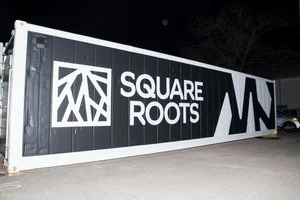
A BBC report states that ten shipping containers dominate a corner of the Brooklyn parking area, each full of climate control tech, growing herbs that are distributed to local stores on bicycles.
The containers are owned by Square Roots, part of America’s fast-expanding vertical farming industry, a sector run by many tech entrepreneurs who believe food production is ripe for disruption.
The world’s best basil reputedly comes from Genoa, Italy. Square Roots grows Genovese seeds in a container that recreates the city’s daylight hours, humidity, Co2 levels – and all fed hydroponically in nutrient-rich water, the report added.
An artificial intelligence expert, Peggs founded Square Roots with investor Kimball Musk (Elon’s brother) two years ago.
They’ve signed a deal with one of America’s big distribution companies, Gordon Food Service, to locate herb-growing containers at some its 200 warehouses.
The report quoted him as saying that the deal represents everything about indoor farming’s potential – locally grown, quick-to-market, fresh produce that can be harvested year-round and is free of pesticides and harsh weather.
Jeffery Landau, director of business development at Agritecture Consulting estimates the global value of the vertical farming market will rise to about $ 6.4 bn by 2023, from $ 403 m in 2013, with almost half that attributed to growth in the US.
Plenty, another major US player, raised funds from Softbank chief executive Masayoshi Son and former Google head Eric Schmidt.
The company has ambitions to build hundreds of vertical farms in China. In the UK, food delivery and robotics company Ocado is investing in indoor farming.
In neighbouring New Jersey, however, Bowery Farming, takes a different approach. The five-year-old company runs industrial-sized farms.
Outside one huge, grey windowless warehouse a heat haze shimmers off the concrete.
It’s a sharp contrast to the chilly interior where an aroma of fresh farm produce hits you immediately, the report added.

UK Tech Pioneer Conjures New Future For Farming Out of Thin Air
Change is in the air for agriculture and indoor farms developer LettUs Grow is breaking new ground with a system that produces more plants more quickly by growing their roots only in a nutrient-rich mis
Change is in the air for agriculture and indoor farms developer LettUs Grow is breaking new ground with a system that produces more plants more quickly by growing their roots only in a nutrient-rich mist. A pioneer within the field known as aeroponics, this air-based method uses 95 percent less water than conventional farming.
By MAISHA FROST
August 12, 2019
LettUs Grow Director Aims to ‘Inspire’ Food Production Generation
It can also involve lower carbon emissions compared to other soil-free systems such as hydroponics where plants are dipped enriched water. LettUs’s patent-pending technology introduces more simplicity and consistency to aeroponics while maintaining yields, explains managing director Charlie Guy. “We have developed a very efficient way of growing plants, from leafy vegetables to soft fruits, in completely controlled environments.
“Our aeroponic systems are easier to use than others on the market where water is pushed through nozzles to create an aerosol that can get clogged.
“Ours just needs a wipe down and is modular so can work with operations of all sizes, from a single layer to an entire controlled environment farm unit.
“Ostara, our software management can automate, control and collect data from the operation. That integrated licensed approach makes aeroponics accessible to anyone enabling farmers around the world to benefit from this game-changing technology.”
The clock is ticking and on LettUs’s side – by 2050 it is estimated the world must increase food production by 70 per cent to feed more than nine billion people.
Managing director Charlie Guy (Image: Jack Wiseall)
The Bristol-based firm was founded in 2015 by Guy, and fellow graduates of the city’s university Ben Crowther and Jack Farmer.
Their mission to tackle food waste and supply chain inefficiency “has always been to reduce the environmental impact of fresh produce by allowing anyone to grow food near its point of consumption,” says Guy.
“The past decade has been defined by the environmental crisis, but now food can be grown in the most unstable of climates. Any building can be converted and millions of transport miles saved.”
Two big tech changes paved the way for LettUs: cheaper, more efficient LED lighting and cloud computing enabling the harvesting of big data.
The company’s technology can match lighting to roots to optimise growth and precise delivery of the nutrients tailored to plant variety and stage of life.
The plants don't need as much water (Image: Picasa)
Systems are assembled in Bristol and pay back for growers estimated to be under five years. Overseas interest from the Middle East, Europe, Africa and US is accelerating.
More than £1million of funding, both in grants from government-backed Innovate UK and private investment, has gone into LettUs which sees potential further applications for its technology contributing to the likes of reforestation programmes.
The Royal Academy of Engineering Enterprise Hub, geared to maximise the potential of next-generation entrepreneurs, also played a crucial role in helping LettUs commercialise its innovation.
Crowther took its SME Leaders Programme, a grant-aided, coaching and mentoring support scheme for early stage engineering and technology firms with high growth potential and “that has been invaluable in accelerating our development”, says Guy.
After starting with laboratory projects such as research into plant-based proteins and pharmaceuticals, LettUs’s sales are increasing to growers and the business has plans to raise more investment this year.
The team, now 15, “is very plant-focused but diverse,” says Guy. “Not just engineers but ex-farmers and plant scientists. All our kit is made by growers for growers.”
LettUs Grow is breaking new ground with a system that produces more plants (Image: Jack Wiseal Photography)
Fifty Percent of Consumers Would Buy 'Vertical Agriculture' Products
Rising populations and worsening weather conditions due to climate change make it difficult to produce enough healthy and fresh food. A contribution to solving this problem could be provided by so-called vertical agriculture
Georg-August-University Göttingen observes:
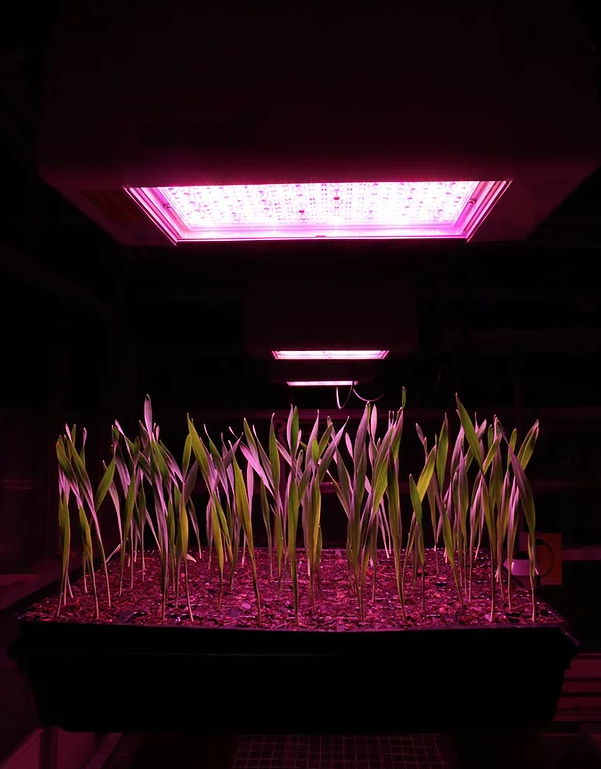
Rising populations and worsening weather conditions due to climate change make it difficult to produce enough healthy and fresh food. A contribution to solving this problem could be provided by so-called vertical agriculture. Here, the vegetables and fruits are grown on floors one above the other. This system requires neither direct sunlight nor farmland, as the plants grow in nutrient solutions under artificial light or daylight. A team of scientists from the University of Göttingen has investigated the acceptance of vertical cultivation systems. The results have been published in the journal Sustainability.
Researchers from the Department of Marketing for Food and Agricultural Products surveyed around 500 consumers from Germany on various vertical farming systems. The rating was for a refrigerator-sized appliance for home use, a medium-sized greenhouse in supermarkets, and a vertical farm that can be built into former industrial buildings. For 81 percent of consumers, environmental friendliness is an important issue.
Only seven percent had already heard of vertical agriculture. Interestingly enough, half of the participants would buy fresh products from vertical farming systems. It also shows that the larger the system, the higher the likelihood that it will be considered sustainable. The small systems for household use were rated worse overall.
Focus on sustainability
"Our results show that the development of vertical farming systems should focus in particular on sustainability. Only systems that are truly environmentally friendly will convince consumers," says Kristin Jürkenbeck, PhD student and lead author of the study. "The topic of sustainability is becoming increasingly important for consumers in all areas of life, as illustrated by the public discussions. This must not be ignored by the big companies," says Prof. Dr. med. Achim Spiller, Head of the Marketing Group for Food and Agricultural Products.
Publication date: 8/12/2019

International Indoor & Controlled Environment Agriculture Set For September Summit In Durban, South Africa
The 2019 edition will tackle the agricultural concerns many countries have about weather and pests problems, food security, climate change and environmental preservation challenges. Commercialization of vertical farming and urban agriculture is catching on in Asia, Europe, USA, Russia, and now Africa
The 2019 edition will tackle the agricultural concerns many countries have about weather and pests problems, food security, climate change and environmental preservation challenges. Commercialization of vertical farming and urban agriculture is catching on in Asia, Europe, USA, Russia, and now Africa. Many private companies are interested in growing crops in hydroponic, aquaponic and aeroponic systems in warehouses, greenhouses, containers and skyscrapers.
In addition, this year’s Summit will also address the burgeoning interest in the production of medicinal plants in vertical farms following the new rulings on cannabis production for medicinal use.
To View The Urban Ag Brochure, Please Click Here
CLICK HERE FOR REGISTRATION
Dube AgriZone will be hosting a field visit for participants. Dube AgriZone is Africa's first integrated perishables supply chain and the most technologically-advanced future farming platform on the continent.
International participants will also want to take advantage of the City Tour sponsored by the Summit's Destination Partners - the Durban Convention Bureau - which will showcase some of Durban's memorable experiences and attractions.
Conference Organiser Magenta Global's CEO, Maggie Tan commented: “This is an important knowledge-sharing and networking platform for the indoor agriculture industry. Since the previous Summit in Johannesburg last year, we have seen promising developments in Africa of indoor urban agriculture initiatives. Innovating how we produce food to feed the growing urban centres is crucial to food security and sustainability. Much needs to be done to transform the agriculture sector”.
Contact us below for more Summit information and follow / like the event's Facebook page (https://www.facebook.com/events/384938988754324/)
and Twitter channel (https://twitter.com/josemaglobal).
Media Contact:
Mr Jose Carpio
International Marketing Manager DID: +65 6846 2366
Email: jose@magenta-global.com.sg
About Magenta Global – Owner & Organizer
Magenta Global Pte Ltd is a premier independent business media company that provides pragmatic and relevant information to government & business executives and professionals worldwide. The organization provides the opportunity to share thought-provoking insights, exchange ideas on the latest industry trends and technological developments with thought leaders and business peers. With a strong focus in emerging economies especially in Africa, Middle East & Central Asia, Magenta Global works in partnership with both the public and private sectors. www.magenta-global.com.sg.
Singapore, 26 August 2019 - Urban Agri World 2019 Summit, the third edition of the conference series highlighting progressive farming developments for the indoor agriculture industry, will be held next month on 17-18 September 2019 at the Durban International Convention Centre (Durban ICC), South Africa.
This is the region's leading urban agriculture event focused on hydroponics, aeroponics and aquaponics techniques in farming. It will bring together agriculture officers, growers, investors, produce buyers, academics, policy makers, technology and system integrators, and CEA business owners. The Summit will feature practical sessions on the hottest topics, exhibits, lunch table discussions and unlimited networking opportunities, connecting services and solution providers.
Delivering the Summit Keynote Address will be MEC Bongiwe Sithole-Moloi of the Department of Agriculture and Rural Development, Province of KwaZulu-Natal, South Africa.
Some of the exciting presentations and their expert speakers include: "Vertical Farms & PFAL (Plant Factories with Artificial Lighting)" by Graeme Smith, Managing Director, Graeme Smith Consulting (Australia); "Future Technologies Driving Indoor Urban Agriculture" by Maartin Vandecruys, Founder & Managing Director, Urban Crop Solutions (Belgium); and "Marrying Proven Western Technologies with Localised Business Models to Create Pioneering Indoor
Farming Businesses" by Michelle Adelman, Managing Director, Accite Holdings (Botswana).
International experts from Australia, Belgium, Botswana, Canada, Kenya, Lesotho, Nigeria, the USA, South Africa amongst others, will be sharing their project experiences and best practices.

US, OHIO: Great Lakes Ag Tech Summit - September 23, 2019
Join Urban Ag News, Hort Americas and Current, powered by GE, for the inaugural Great Lakes Ag Tech Summit on September 23. The summit will be held at at the historic Nela Park campus in Cleveland, Ohio

By urbanagnews
August 14, 2019
Join Urban Ag News, Hort Americas and Current, powered by GE, for the inaugural Great Lakes Ag Tech Summit on September 23. The summit will be held at at the historic Nela Park campus in Cleveland, Ohio.
The one-day event features keynote presentations and panel discussions from leading researchers and innovative growers in the Great Lakes region. Attendees will be able to connect with growers, scientists, researchers and entrepreneurs as we shape the future of food and move controlled environment agriculture forward.
Keynotes
Optimizing Plant Production Under a Controlled Environment – Research and Education Programs at the Ohio State University
Dr. Chieri Kubota – The Ohio State University
Dr. Kubota’s research mission is to serve in the development of science and technology in the area of controlled environment agriculture (CEA). Her projects are in an interdisciplinary area that encompasses plant physiology and horticultural engineering to enhance understanding and efficiency of CEA plant production systems such as greenhouses, warehouses (vertical farms), and growth chambers.
Are Consumers and Growers Putting Dollars in the Local Food Industry? Insights on Technologies and Preferences
Dr. Ariana Torres – Purdue University
Dr. Torres’ background combines field experience in agriculture with theoretical and applied research on agricultural economics. She has worked on projects looking at the impact of marketing choices on technology adoption for fruit and vegetable growers; the economic implications of social capital on entrepreneurship; and the role of community support on the resilience of small business after disasters.
Dr. Torres uses economic analysis to support the economic viability of the horticulture industry. Her research focuses on the intersection between the horticulture industry and marketing decisions. Her goal is to conduct innovative outreach and applied research in specialty crops marketing, with the end of promoting economic sustainability for horticultural businesses.
Dr. Torres is currently working on a project evaluating the market, economics, and potential barriers to produce export-quality dried apricots from smallholders of southern Tajikistan. She is also working on evaluating the adoption of a solar dehydrator for selected dried specialty crops in Indiana and Georgia. Lastly, she is collecting foundational data and establishing long-term pricing reports for Indiana farmers markets.
Vertical Farm Production of Young Plants, From Hemp to Tomatoes
John Jackson – Sustainable Indoor Growing Systems, Inc.
John is the CEO of Sustainable Indoor Growing Systems, Inc. (SIGS) born from an USDA funded industry-academic partnership with Grafted Growers, the University of Arizona, and North Carolina State University. John is an award-winning entrepreneur and University of Arizona alum with an MBA from the Eller College of Management. John has successfully launched investor and grant funded businesses and operated tech based companies to early stage revenue. Born in Compton, California, John continues his grandfather’s legacy as a sharecropper of tomatoes in rural Texas.
SIGS gives plants what they need to express the features that the market wants.
Sustainable Indoor Growing Systems, Inc. (SIGS) is a clean agricultural technology company that uses controlled environment agriculture to induce young generic plants to express enhanced physiological traits customers want – while increasing the economics of propagation. This is made possible by scientific discovery and development of unique growing recipes which are learned and enabled only by the SIGS multi-layered growing platform and architecture.
Click Here to Register Now! Seats Are Limited!
Location
1975 Noble Rd. Cleveland, OH 44112
Date & Time
Monday, September 23, 2019
9 am to 4pm
Registration
Early bird admission price is $30 if registration occurs before Sept. 16.
Regular admission: $50
Hotel
Hyatt Legacy Village
24665 Cedar Rd
Lyndhurst, OH 44124
The rate is $129 for the night of 9/22/19.
• Call the toll-free number at 1-888-492-8847 for Hyatt Place Reservations and ask for the “Great Lakes Ag Tech Summit” or code G-GLGT
• OR use this link https://www.hyatt.com/en-US/hotel/ohio/hyatt-place-cleveland-lyndhurst-legacy-village/clezl?corp_id=G-GLGT
Click Here to Register Now!
About Urban Ag News
The mission of Urban Ag News is to be the leading science communicator for the commercial hydroponics, greenhouse vegetable, vertical farming and urban agriculture industries. Urban Ag News educates readers and provide an understanding of the industry’s latest technologies and luminaries.
About Current, powered by GE
Current, powered by GE, offers cutting-edge innovations in horticultural lighting. We’ve spent years perfecting our lighting technology and working with growers, systems integrators and plant scientists to establish the specific needs of the horticulture industry. The result? LED grow systems that maximize the potential of greenhouses and indoor farms by enabling efficient growth at an industrial scale.
TAGS Ariana Torres Chieri Kubota Conference GE Lighting Greenhouse Greenhouse Technology Hort Americas Indoor Ag Technology LED Grow Lights Ohio State University
Can Vertical Farming Feed The World And Change The Agriculture Industry?
Can Vertical Farming Feed The World And Change The Agriculture Industry?
Year after year, cities expand and pristine natural habitats are turned into farms and pastures to support the world’s growing population. But despite our encroachment into the environment, we still struggle to feed everyone. Vertical farms could offer a solution by producing higher crop yields year-round in less space than conventional agriculture.

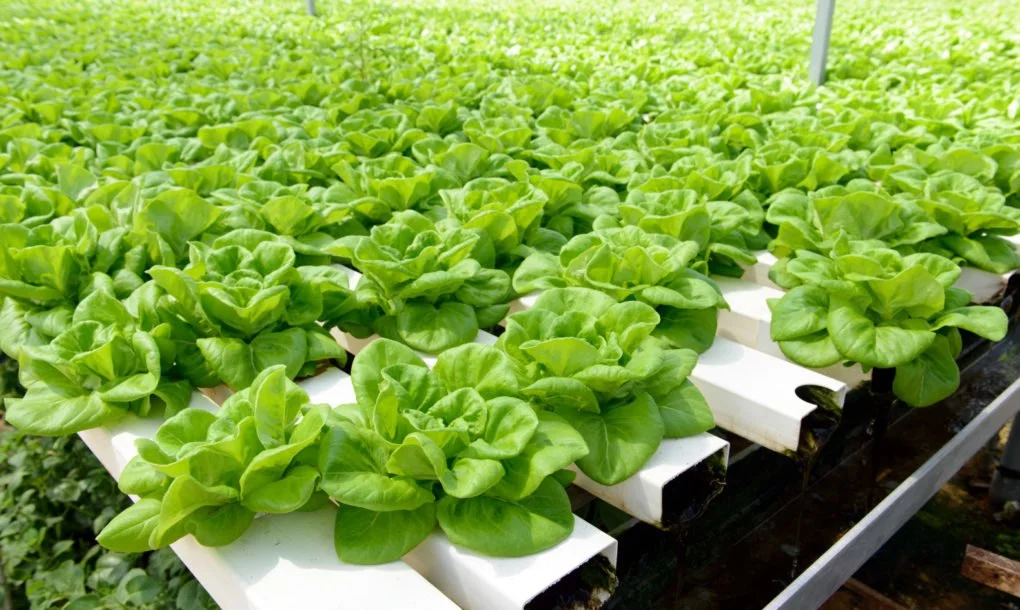
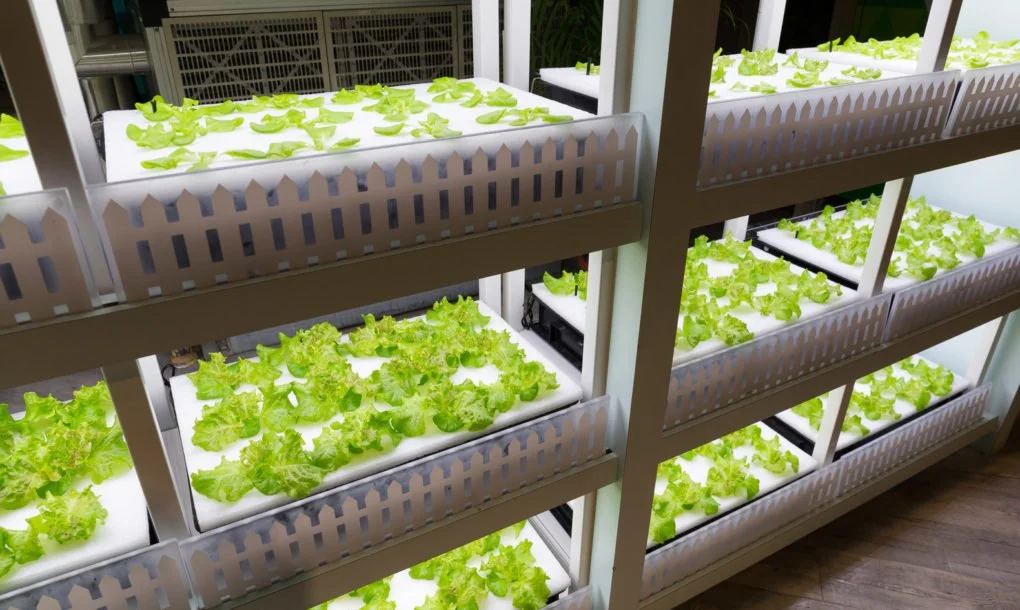
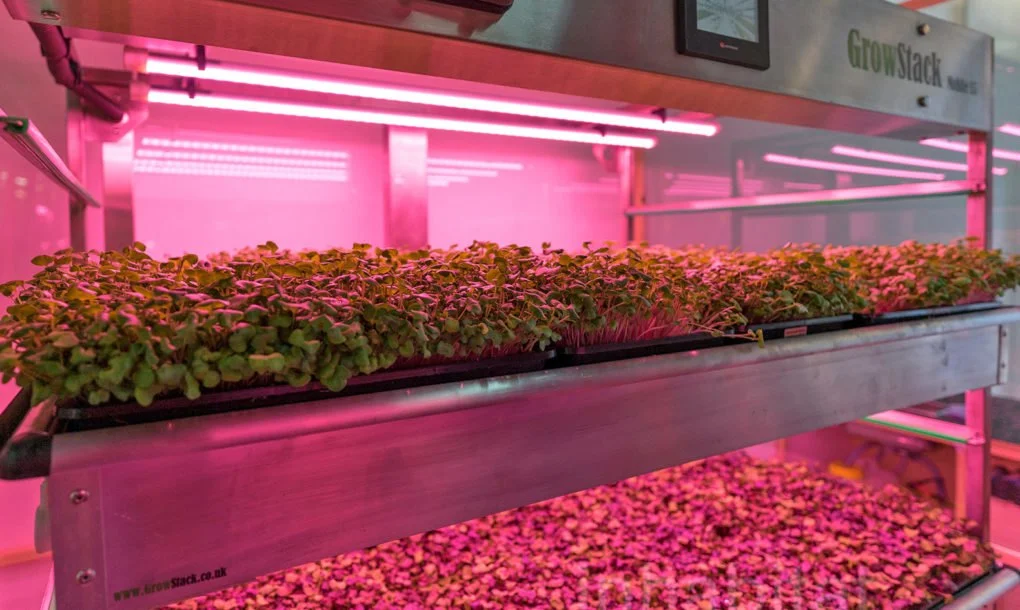
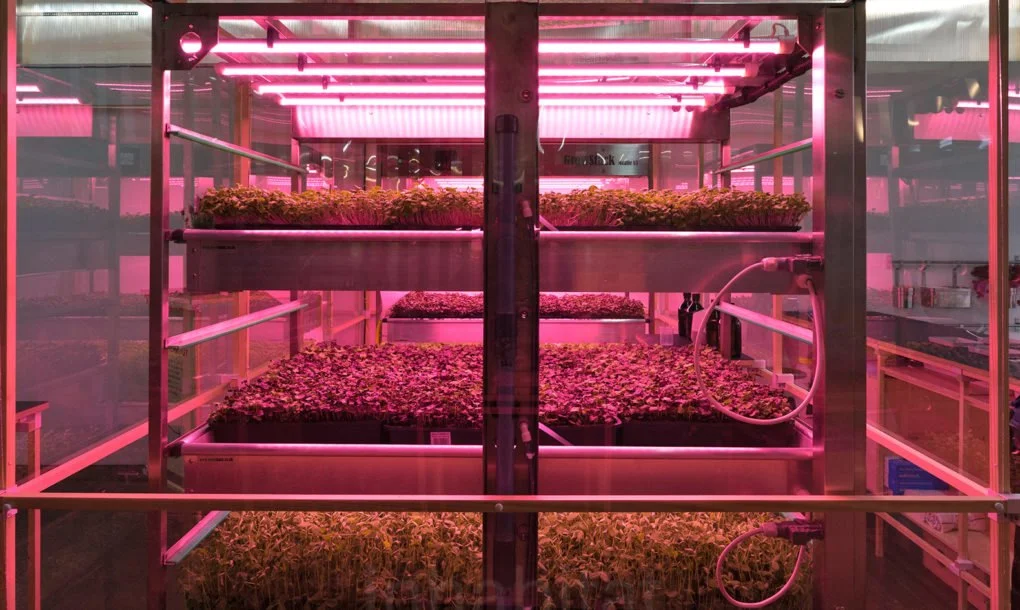
What Is Vertical Farming?
With land for crops and pastures growing scarce — plus the threat of pesticides and herbicides taking a toll on our health and the environment — people are exploring new ways to grow food, such as urban agriculture. In general, this is the process of growing food within city limits – whether on rooftops, in backyards or on balconies. The goal is to provide families with fresh, healthy food that isn’t laced with chemicals — and when you grow your own crops, you can control these elements.
Vertical farming is a type of urban agriculture – but vertical farms are often constructed indoors in extremely controlled environments. Crops are grown on shelves that extend upward instead of outward, and the environment is carefully monitored, so crops grow year-round.
In addition to growing crops, some vertical farmers have developed ways to grow fish in a self-sustaining system. Water from the plants is recycled into fish tanks, and the waste from the fish becomes fertilizer for the plants. Then, both the plants and fish can be harvested for food.
The benefits of vertical farming
The benefits of vertical farming are numerous. Farmers can control the crops’ environment in vertical farms, so the plants aren’t subjected to nasty weather conditions or droughts. Humidity, nutrients and water are administered to growing plants to achieve optimum growing conditions. Because of the controlled environment, crops can be harvested more than once a year, resulting in higher yields than traditional farming.
Related: The GCC’s first commercial vertical farm launches in Dubai
Vertical farms are more sustainable than conventional farms because they use less water (which is often recycled through the system), they take up less space and they use less fossil fuels because they don’t rely on heavy machinery such as tractors and harvesters.
Technology helps vertical farmers get the best output from the farm. Tailored lamps help plants get more light exposure, which encourages them to grow faster than crops that rely on the sun. Vertical farms also provide greater protection from insects, thus decreasing the need for harmful chemical products.
Downsides to vertical farming
While vertical farms can help with local hunger issues and sustainability, there are some barriers that may keep them from gaining worldwide traction. The cost of setting up a vertical farm can be prohibitive. Conservative estimates put the initial start-up cost at around $110,000, but there are estimates upward of millions of dollars.
Finding an abandoned warehouse or building in an urban setting for a reasonable price might be difficult. Since vertical farms rely on electricity for growing lamps and strict environmental controls, the location has to have reliable power — not just any old abandoned building will do. Vertical farms also depend heavily on technology, which can be costly. Keeping the lights on and the environmental controls running will impact energy use — and your budget.
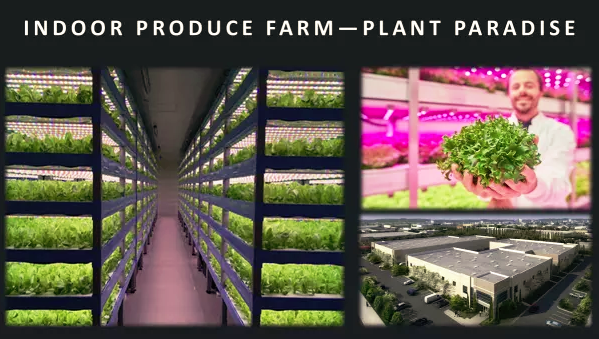
Not every crop that is grown traditionally can be raised successfully in a vertical farm. Leafy greens and herbs do the best in an indoor environment, while staple crops like wheat and potatoes are difficult to grow indoors, as are some fruits and vegetables. The crops that can be harvested from a vertical garden are limited.
Growing food to feed the hungry is a noble gesture, but it also has to be profitable, especially when the initial cost to set up a vertical farm is so high. If there isn’t a market in your area, it’s a waste of time to grow large amounts of food that you won’t be able to sell.
The Verdict
Despite the downsides, the positives are plentiful. In addition to embracing sustainability and helping combat hunger, vertical farms can also encourage support for local economies. These farms can create jobs, turn a profit and provide a healthy source of food for locals.
As technology continues to advance, new approaches will improve the efficiency and productivity of vertical farms. If nothing else, the idea sparks the conversation about changing the agricultural industry and gives us a place to start for finding better, more sustainable ways to grow food.
Images via Depositphotos, Aqua Mechanical and Mike Chino for Inhabitat
under Agriculture, Features, Innovation, Sustainable Food, Urban Farming

US: How LED Lights Help Grow The Microgreens In Philadelphia
Adam Green was pursuing a career in filmmaking when he realized his real passion was raising the finest microgreens for the world’s top chefs. Now, the 25-year-old directs AGreen Farms, an indoor hydroponic farm in Philadelphia that specializes in selling garnishes to restaurants and hospitality establishments
Adam Green was pursuing a career in filmmaking when he realized his real passion was raising the finest microgreens for the world’s top chefs. Now, the 25-year-old directs AGreen Farms, an indoor hydroponic farm in Philadelphia that specializes in selling garnishes to restaurants and hospitality establishments. Of course, it’s not easy to make a mint while growing mint in the city, and that’s why Green is investing in LED horticulture lighting from Current, powered by GE, to produce herbs and edible flowers that make culinary pros go wild.
Seeds of Inspiration
At Drexel University, Green dabbled in business, cinema and screenwriting before finding that his true calling was not behind a camera but in a kitchen, sharing locally grown food with those who can appreciate the finer points of pea shoots.
“I realized the thing that made me happiest was food―eating the highest-quality food, stopping at farmers markets, making connections with the farmers―it was really exciting to me,” he says. “Growing my own food and knowing where it came from attracted me to agriculture, and I felt I could put a sound business case behind it.”
Green soon found himself in New York City, working as a sales intern for Farm.One. The technology-powered urban vertical farm grows a diversity of special crops for local chefs and gave Green the confidence he needed to step out on his own.
“My job was to find customers and sell them the best products,” he recalls. “I developed a rapport with chefs, and it was incredible to see the emotional impact when you bring them an excellent product they can’t get elsewhere. It’s about more than garnishing a plate; these ingredients are what make a great pesto or add layers of flavor to a dish. That’s when I knew I wanted to bring the same experience to chefs in Philadelphia.”
Sprouting Upward
Green launched AGreen Farms in 2018 in a mixed-use building in Philadelphia’s Germantown neighborhood. The 5,000-square-foot operation includes 3,500 square feet of grow space dedicated to microgreens and edible flowers of all kinds, many of them rare to the region. Helping Green get his indoor farm off the ground was Hort Americas, a leading horticulture supply company. As the operation came together, the conversation turned to lighting arrangements that could allow the fledgling farm to flourish.
“Hort Americas and specifically our rep Kyle Barnett were just very passionate about what we were doing and helped us source all the equipment we needed,” says Green. “Not only selling us the right products but educating us on making the best decisions is what Kyle and his team brought to the table, and that made it easy for us to work with them.”
After hearing Green’s goals for the farm, Barnett created unique light plans for the operation and found that the Arize™ Lynk light was the perfect fit. The system provides different light spectrums to promote all stages of plant growth. Importantly, Current’s varied light recipes offer the ideal spectrum for the unique needs of AGreen’s crops.
“Most of our farm is growing microgreens under pink light that helps them thrive, and then we have flowers that respond well to a reproductive purple light,” Green says. “We are currently in the middle of testing our first round of crops, and I will definitely say that the lighting is my last concern right now. I recently delivered some product to a very discerning chef, and he looked at the clamshells and said, ‘These are beautiful.’ Our opinion is that LED was the right answer, absolutely.”
More than 1,400 Arize Lynk LED lamps were installed at AGreen Farms to cultivate everything from Swiss chard to celosia to cilantro. As Green explains, microgreens demand more care than most crops to produce consistently amazing results.
“When you’re growing garnishes, it’s all about the taste, texture and aesthetics to produce the high-quality products that these incredible chefs deserve. The lights have a positive impact on making things crunch more or turn a darker green, for instance, and that’s what you need to walk into a kitchen with confidence and show someone something they haven’t seen before.”
Sage Advice
Bill Green, a self-admitted serial entrepreneur, is Adam’s father and author of the book All In. In it, he offers practical advice for cracking the code of success in the business world, including to approach every challenge with genuine enthusiasm.
“Adam enjoys talking to chefs, and sales is clearly his sweet spot,” says Bill Green, who brings 40 years of executive counsel and guidance to AGreen Farms. “I thought the plan he set forth really made sense, because he’s not trying to build a giant to compete against the biggest names―he knows his niche and what certain chefs are looking for, and his passion to customize that experience is what will shape his business.”
For Adam Green, perfect pentas blooms are a mark he will never stop aiming for, but with help from Current and Hort Americas, this young grower has already hit the mark with LED lighting for his budding operation. Beyond vibrant, leafy crops, AGreen Farms will also benefit from the significant energy savings LED can deliver compared to conventional light sources. It all adds up to a tasty finishing touch at the finest restaurants in Philadelphia.
“Giving chefs the best tools in their arsenal is what we’re all about,” he says. “Based on our first year in business, I don’t expect a shortage of customers anytime soon.”
For more information:
Current by GE
Publication date: 8/6/2019

The Future of Food: Why Farming Is Moving Indoors
A car park opposite the infamous New York City housing estate where rapper Jay-Z grew up seems an unlikely place for an agricultural revolution. Ten shipping containers dominate a corner of the Brooklyn parking area, each full of climate control tech, growing herbs that are distributed to local stores on bicycles. This is urban farming at its most literal
By Russell Hotten BBC News, New York
August 22, 2019
Tobias Peggs says the fledgling industry is still developing the right business models. SQUARE ROOTS
A car park opposite the infamous New York City housing estate where rapper Jay-Z grew up seems an unlikely place for an agricultural revolution.
Ten shipping containers dominate a corner of the Brooklyn parking area, each full of climate control tech, growing herbs that are distributed to local stores on bicycles. This is urban farming at its most literal.
The containers are owned by Square Roots, part of America's fast-expanding vertical farming industry, a sector run by many tech entrepreneurs who believe food production is ripe for disruption.
The world's best basil reputedly comes from Genoa, Italy. Square Roots grows Genovese seeds in a container that recreates the city's daylight hours, humidity, Co2 levels - and all fed hydroponically in nutrient-rich water.
"Rather than ship food across the world, we ship the climate data and feed it into our operating system," says co-founder Tobias Peggs.
High costs
An artificial intelligence expert, Mr Peggs founded Square Roots with investor Kimball Musk (Elon's brother) two years ago. They've signed a deal with one of America's big distribution companies, Gordon Food Service, to locate herb-growing containers at some its 200 warehouses.
He says the deal represents everything about indoor farming's potential: locally grown, quick-to-market, fresh produce that can be harvested year-round and is free of pesticides and harsh weather.
Bowery is set to open its third industrial-sized indoor farm. BOWERY FARMING
"Indoor farming can answer many of the questions being asked by today's consumers about the provenance, sustainability and health of the food they eat," he says.
Jeffery Landau, director of business development at Agritecture Consulting estimates the global value of the vertical farming market will rise to about $6.4bn by 2023, from $403m in 2013, with almost half that attributed to growth in the US.
Despite the sector's high costs and limited food range, the potential is not lost on investors. Recently, AeroFarms, a producer of lettuce and other leafy greens, raised $100m, including from Ingka Group, Ikea's parent company. Bowery Farming raised $90m in a funding round backed by Google Ventures and Uber boss Dara Khosrowshahi.
Plenty, another major US player, raised funds from Softbank chief executive Masayoshi Son and former Google head Eric Schmidt. The company has ambitions to build hundreds of vertical farms in China. In the UK, food delivery and robotics company Ocado is investing in indoor farming.
But there have also been failures. "Vertical farms are a highly intensive capital expenditure," says Mr Landau. "Your lighting system will be one of your highest capital costs." And then there's ventilation, air conditioning, irrigation and harvesting. "Make a mistake and you will have one costly upgrade on the horizon," he adds.
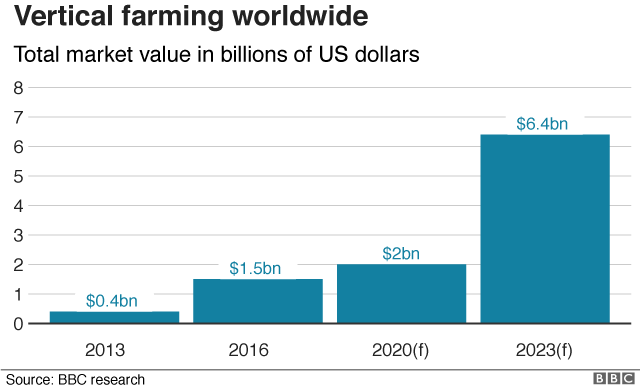
Mr Peggs chose a modular system based around shipping containers because he says it is quickly scalable according to demand. "We can put a herb farm in new city for less than $500,000 and be growing within two months. We just press the 'basil button' - or mint, or tarragon - and the box configures itself to grow in optimum climate conditions."
In neighbouring New Jersey, however, Bowery Farming, takes a different approach. The five-year-old company runs industrial-sized farms. Outside one huge, grey windowless warehouse a heat haze shimmers off the concrete. It's a sharp contrast to the chilly interior where an aroma of fresh farm produce hits you immediately.
Robots
Produce is grown on trays stacked ceiling-high to maximise acreage. Everything from the automatic seeding machine to harvesting is run by Bowery's proprietary operating system (OS) which controls light, adjusts water nutrients and takes camera images of each plant to monitor its health.
"The OS is our central nervous system. There are millions of data points," says founder Irving Fain. "The artificial intelligence is constantly learning and predicting how to produce the best quality product."
Irving Fain hopes to soon start producing radishes and turnips commercially. Michael BACA Image
Running the farm manually would be difficult, he says. Staff operate things from computer screens and iPads. In the cavernous farm room itself, the only sound is robots moving the shelves.
Growing food indoors has been around for decades, but the industry got a kick-start from advances in the performance of lower cost LED lighting. Combine that with robotics, innovations and AI, and you have an industry that Mr Fain says is both viable and scalable.
"The big question was, how can we grow in large volumes at a consistently high quality? Suddenly, the economics changed," he says. "We can grow 365 days a year - a major departure from thousands of years of agriculture. Unlike outdoor farming, our yield is virtually 100% guaranteed."
Vertical farmers talk with a zeal you'd expect of entrepreneurs with tech world backgrounds. With population growth and climate change putting pressure on food production, they think they may have answers.
Square Roots' herbs are delivered to customers by bike. SQUARE ROOTS
But this highlights one of the industry's limitations. You can't feed the world on leafy greens. That said, for Mr Fain, if Bowery only ever grew lettuce or kale, "it's still a win". But his ambitions are greater. Bowery is growing radishes and turnips that he expects to come to market with two years.
Square Roots hopes to soon start commercial production of beetroots and strawberries, and is experimenting with so-called heirloom produce from rare and long-forgotten seeds.
Carbon footprint
Mr Peggs says: "It makes sense to grow perishable produce in the same neighbourhood as the consumer - stuff that doesn't travel well. A lot of produce - tomatoes, strawberries - are grown for travel, not for taste. It doesn't make sense to vertically farm food with a long shelf life."
But different produce presents different challenges, says Mr Landau. Where plants are concerned, not all light is created equal. Fruiting and flowering crops such as tomatoes, strawberries and peppers have different needs.
QR codes on the food packaging can tell customers the history of the produce. SQUARE ROOTS
"Lights for these types of crops will generally be more expensive, require more electricity, and produce more heat, meaning additional cooling," says Mr Landau. "Harvesting these crops can be a significant operational cost."
But it is being done. In the US, Oishii vertically farms the much-prized Japanese Omakase strawberry year-round. And Farm One produces more than 200 products, including 34 edible flowers. Plenty is experimenting with watermelons. As technology costs fall and R&D intensifies, the crop variety will expand.
That may also ease criticism of the industry's carbon footprint. In the artificial light versus sunlight debate, the latter often has the upper hand. But, then, indoor farmers point to the transportation costs and waste in traditional agriculture.
For the moment, Mr Landau says, the carbon footprint concerns are valid, although he expects indoor farms to increasingly draw on renewable energy.
"And when you look at markets located in extreme climate environments or island nations where they import a majority of food, indoor farming could be a viable option," he says.
Mr Peggs stresses that industry is still young are trying to work out the right business models and direction. The entrepreneurs don't agree on everything, though they certainly agree on this: vertical farming has the potential to transform global food production as we know it.

CIT Gap Funds Invests In On-Demand Farming
The Center for Innovative Technology (CIT) announced that its CIT GAP Funds has made an undisclosed investment in Babylon Micro-Farms, a provider of on-demand indoor farming services
August 20, 2019
By Lynda Kiernan
The Center for Innovative Technology (CIT) announced that its CIT GAP Funds has made an undisclosed investment in Babylon Micro-Farms, a provider of on-demand indoor farming services.
Founded in 1985, CIT focuses on the seed funding and early commercialization of innovation, and provides support to tech entrepreneurs growing new companies that will foster economic growth and create jobs throughout the state of Virginia. CIT GAP Funds is a venture capital vehicle through which to make seed stage equity investments in these technologies.
The latest venture to join the CIT GAP Funds portfolio is Charlottesville, Virginia-based Babylon Micro-Farms. Founded in 2017 by a pair of students at the University of Virginia, Babylon Micro-Farms enables small growers and businesses to gain greater control of their supply of fresh organic produce by making indoor farming more accessible through a range of scalable indoor farming modules.
“The idea for Babylon Micro-Farms was born in a social entrepreneurship class at UVA, when a professor asked my co-founder Graham and I to develop a high impact, low cost product that could help refugees. I quickly discovered and became interested in hydroponics, a way to grow plants without soil, use less water, and grow crops faster,” said Alexander Olesen, co-founder and CEO, Babylon Micro-Farms.
Sales of organic fresh produce increased by 8.6 percent in 2018 to reach $5.6 billion, according to the Organic Produce Network, and increasingly, vertical and indoor farming are stepping in to meet this demand. In just the U.S., the vertical farming market is expected to reach a value of $3 billion by 2024, and on a global scale, the market is forecast to see a CAGR of 24 percent to reach a value of $6.4 billion by 2023.
A relatively new category in agricultural production and agtech, the production of food utilizing highly controlled, closed, and modular hydroponic systems has seen startups evolve on multiple continents and is beginning to gain investor attention.
Boston-based Freight Farms, Paris-based Agricool, and Canada’s TruLeaf are a select few raising capital to bring modular, containerized farming to urban areas that often lack affordable, organic, fresh produce because of long and expensive supply lines.
Babylon’s modular indoor farms are powered by a patented IoT platform that remotely controls each farm’s custom tailored ecosystem, depending on each customer’s needs. The startup’s easy-to-use application guides farmers through each step: when to plant, watering and harvesting schedules, and includes live data and farm health alerts. This system allows for the growth of produce twice as fast as traditional farming, while requiring 90 percent less water, and no pesticides or chemicals.
“The mission to offer more accessible, affordable produce to a wider range of communities across the U.S. is one that CIT is excited to stand behind. Responses from existing Babylon Micro-Farms users, including a UVA dining hall, The Boar’s Head’s Resort, Corner Juice and others have been very positive and showcase the wide use cases for this solution,” said Thomas Weithman, managing director of CIT GAP Funds, and president and CIO of MACH37.
“Being able to grow any kind of produce year round within our communities, such as for local food service industries, education and assisted living, or community farms to name a few, is a game changer for the state of sustainable urban agriculture,” continued Weithman. “CIT is very confident in Babylon’s future success, and we look forward to being part of their journey.”
Supplies are delivered to Babylon customers ready-to-grow, and Babylon provides 24/7 farming support, drastically reducing the upfront costs associated with indoor farming, while also providing the expertise needed for successful harvests.
“Our mission is to develop technology that will inspire a new generation of urban farmers to grow their own fresh, affordable, sustainable produce at the push of a button,” said Olesen. “We are grateful for the support of CIT GAP funds at this stage of our development.”
– Lynda Kiernan is Editor with GAI Media and daily contributor to GAI News. If you would like to submit a contribution for consideration, please contact Ms. Kiernan at lkiernan@globalaginvesting.com.

Welcome To The 4th Annual NYC AgTech Week, Organized By The Members And Partner Organizations of The NYC Ag Collective
The NYC Ag Collective - a consortium of 15+ commercial urban farms, tech companies, and non-profits - is pleased to announce the 4th annual NYC AgTech Week, the only AgTech conference on the East Coast run by the leaders of the industry themselves
The NYC Ag Collective - a consortium of 15+ commercial urban farms, tech companies, and non-profits - is pleased to announce the 4th annual NYC AgTech Week, the only AgTech conference on the East Coast run by the leaders of the industry themselves.
This six-day conference features exclusive farm tours, panels, workshops, and networking events focused on the fast growing and innovative AgTech sector, and promises unprecedented access to industry founders, investors, startups, and thought leaders.
About this Event
The NYC Ag Collective - a consortium of 15+ commercial urban farms, tech companies, and non-profits - is pleased to announce the 4th annual NYC AgTech Week, the only AgTech conference on the East Coast run by the leaders of the industry themselves.
For The Readers of iGrow News there is a 10% discount code
"NYCAGVIP10"
This six-day conference features exclusive farm tours, panels,workshops, and networking events focused on the fast growing and innovative AgTech sector, and promises unprecedented access to industry founders, investors, startups, and thought leaders.
FEATURED SPEAKERS
Alexander Olesen | Co-Founder & CEO, Bablyon Micro-Farms
Alina Zolotareva | Marketing Director, AeroFarms
Andrew Carter | Co-Founder & CEO, Smallhold
Christine Rico | Board Co-Chair, Slow Money NYC
Dermot O'Regan | Co-Founder & Managing Director, Grow Bristol
Henry Gordon-Smith | Founder & Managing Director, Agritecture
Jenny Osman | Senior Project Manager, NYC Economic Development Corporation
Jonas Günther | Co-Founder & CEO, We Are The New Farmers
Louisa Burwood-Taylor | Head of Media & Research, AgFunder
Montique Willis | Head of Software, GrowComputer
Rachel Klepner | Director of Farming and Operations, Edenworks
Rob Laing | Founder & CEO, Farm.One
Tessa Price | Labs Manager, WeWork Food Labs
Tinia Pina | Founder & CEO, Re-Nuble
Tobias Peggs | Co-Founder & CEO, Square Roots
...plus many more
CONFERENCE SCHEDULE
SATURDAY 9/21
5-8pm: Welcome Happy Hour [All Access Pass Holders Only]
Start the Conference with an intimate happy hour to network with fellow attendees, conference speakers and industry representatives. Sample drinks and bites made from hyper local produce and get to know your hosts at the NYC Ag Collective.
SUNDAY 9/22
8:30-11:30 am: Manhattan Urban Farm Tours (limited availability)
Contrary to what it may seem, the steel beams and girders of Manhattan are home to small but thriving pockets or urban agriculture. Choose one of three tours to see a unique perspective on farming in the city.
Option 1: Farm One
Option 2: East Village community gardens
Option 3: Governors Island
3-5 pm: Deepening Skills to Successfully Manage an Urban Farm: A Workshop with Cornell | @ Prime Produce
Join a special workshop led by Cornell on urban farm management to learn about new research in farm management skills related to the controlled environment agriculture industry. Then, enjoy one-on-one conversation and mentorship with urban farm managers.
*This event will be free of charge for all farm managers!* A separate registration form will be linked to from here before the end of August.
6-9 pm: Restaurant Partner Night
Discounts to restaurants committed to local & sustainable sourcing, including: Lighthouse (Williamsburg, Brooklyn), Maison Yaki (Prospect Heights, Brooklyn), Bunker Vietnamese (Bowery, Manhattan)
MONDAY 9/23
8:30-10:30 am: North Brooklyn Urban Agriculture Tour
Gain a wide perspective for the various forms of urban agriculture on this walking tour of farming-related sites in Williamsburg & Bushwick.
3-5pm: Show Me The (non-VC) Money: Alternative Capital Sources for Urban Agriculture
AgTech founders and funders discuss the various resources within the funding landscape for AgTech ventures.
6:30-8:30 pm: Chef x Farmer Mixer + Grazing Table | @ Project Farmhouse
Enjoy an evening connecting with New York's urban and local farmers, chefs and entrepreneurs while partaking in drinks and eats made from a diverse range of hyper-local produce. Sponsored by Urban Farm Academy. Partner farms and distributors will include the likes of Farm.One, Smallhold, Brooklyn Grange, Local Roots NYC.
> You can also purchase tickets to this event separately.
TUESDAY 9/24
8:30-10:30 am: Alternative Urban Farming Products: Algae, Insects, Mushrooms, Fish, Plant Proteins
Urban and indoor farming can support many different agricultural products. Leaders in aquaculture, aquaponics, fungiculture, and alternative proteins will discuss the obstacles and opportunities in meeting the growing demand for sustainable seafood, produce and plant-based proteins.
3:00-5:30pm: Brooklyn Navy Yard Corridor Innovation Tour
In and around what was once the hub of Brooklyn's maritime operations and industrial past are some of the most innovative and fast-growing Urban Ag companies in New York. You'll tour hydroponic container farms at Square Roots, plus visit the largest soil rooftop farm in the world at Brooklyn Grange.
6:30-8:30 pm: AgTech x UrbanTech Mixer
Networking event bridging the AgTech and UrbanTech innovation worlds, co-organized with NYC EDC and CIV:LAB’s The Grid. As cities become “smarter” through new technology in mobility, co-working/co-living, clean energy, and more, this event seeks to bring local food & agriculture into the conversation.
> You can also purchase tickets to this event separately.
For The Readers of iGrow News there is a 10% discount code
"NYCAGVIP10"
WEDNESDAY 9/25
8:30-10:30 am: The Future of Green Urban Development: Opportunity Zones, Green Roofs, & Creative Mixed Use Projects
Hear from industry experts in real estate, urban agriculture policy, green energy, and city planning on the new policies, pathways, and opportunities currently under development and available to various Urban Ag stakeholders to promote the scaling of this movement.
3-5 pm: Food Safety & Transparent Sourcing Enabled by Controlled Environment Agriculture
Discussion on CEA's ability to mitigate and prevent common food safety hazards inherent in traditional agriculture through rigorous testing and safety control. Will the rise of controlled forms of agriculture contribute to a more secure and resilient food system in the face of increasing environmental shifts?
6-8 pm: Make It In Brooklyn: Future of Farming Pitch Competition
Hear some of the most innovative and rising startups in the AgTech industry pitch their company to a room of industry leaders, mentors, investors, and entrepreneurs. Refreshments and networking will follow. Co-hosted with Downtown Brooklyn Partnership. Sponsored by OCP North America.
Applications to pitch are now open through August 30th! Five startups will be selected and informed by Sept 4th. Apply here.
THURSDAY 9/26
8:30-10:30 am: Global View: Opportunities & Challenges Accelerating AgTech around the World | @ Company (Grand Central Tech)
The AgTech industry is expanding on a global scale - but unique challenges exist in each region of the world. AgTech founders and experts will weigh in on the factors influencing the global market for sustainable food production as well as discuss the projected growth path of the AgTech industry around the world.
2-4 pm: AgTech as Consumer Education | @ WeWork Food Labs
Marketers, Founders and Industry Leaders discuss the role that marketing and consumer education play in creating, developing and retaining market demand for AgTech products.
6-8 pm: Vineyard in the City: Networking Finale | @ Rooftop Reds
Our final event! Enjoy a glass of wine overlooking the NYC skyline, made from grapes grown on the Rooftop Reds urban vineyard. Share takeaways from the week with your fellow conference-goers (and by this point, BFFs).
You can also purchase tickets to this event separately.
PARTNER EVENTS
The Ag Collective is also promoting a select number of partner events that coincide with NYC AgTech Week. Those include:
Climate Week NYC (Sept 23-29). More information can be found here.
Women in AgTech Roundtable with Amy Wu (Sept 21). More information can be found here.
--Events, speakers and locations subject to change. Some farm tours require registration post ticket purchase, on a first come first served basis--
Tags: United States Events New York Events Things To Do In New York, NYNew York Conferences New York Business Conferences
US: Chicago - Vertical Farming Brings High-Tech Approach To Metropolitan Agriculture
"We're doing for farming what Henry Ford did for the automobile," said entrepreneur Jake Counne
A Local Entrepreneur Has A High-Tech Take
On Agriculture That Could Change What Ends Up On Our Plates
By Meghan Kluth
Thursday, August 15, 2019 CHICAGO (WLS)
You could call it farming for the future.
A local entrepreneur has a high-tech take on agriculture that could change what ends up on our plates.
"We're doing for farming what Henry Ford did for the automobile," said entrepreneur Jake Counne.
Counne has found a way to grow produce locally, even when it's below 50 outside. He said the answer is using cameras, software and a conveyor belt in what's called a vertical farm.
"I came across vertical farming and I was just enamored with the ability to exponentially out produce the natural ability of that land," said Counne, who is the founder and CEO of Backyard Fresh Farms.
Six types of lettuce are stacked on a four level tower under the glow of purple LED lights in his Back of the Yards facility.
The farm produces three tons of greens in one year's time, which is what a farmer could do with Soldier Field but in just four parking spaces.
Counne's vertical farm reduces costs of energy, labor, and his produce has proven to last weeks.
"We've already beat the cost of a field farmed equivalent products," Counne said.
An automatic lift collects trays of ready plants and brings them to an assembly line of workers for harvest. It has reduced labor by 80% compared to the first vertical farms of its kind.
"We are quite literally building an assembly line of greens," Counne said.
Counne has nine patents pending that are helping him create the perfect environment for a plant every day of its life.
"The software here is looking to try to figure out what the optimal amount of light. It's also looking for early signs of stress in the new growth," said Counne.
Some of the cities high end restaurants are already using Counne's produce and when put to the taste test, it's clear this is not your average lettuce.
Counne's plan is to expand and open 100,000 square foot facilities near every major metropolitan area around the country