Welcome to iGrow News, Your Source for the World of Indoor Vertical Farming

Why Vertical Farming Won’t Grow Without More Data
January 3, 2019
Image courtesy of Princeton University
Vertical farming got a lot of attention at the very end of 2018, from Bowery’s $90 million funding round to news of major corporations starting their own farms.
But amid all those numbers and names, one vital piece of information was (and is) missing: We don’t actually know how well the vertical farming market as a whole is doing — if it’s on track to reach its projected $13 billion marketshare by 2024, and if the concept is even as promising a food source as the headlines would have you believe.
That’s where universities come in to play — Princeton University, to be exact. The Princeton Vertical Farming Project (PVFP) researches what the most optimal growing conditions are for indoor farming and how to produce the best crop yield while using the fewest amount of resources (e.g., water, electricity). Led by Paul P.G. Gauthier, an associate research scholar in plant physiology and environmental plant metabolism, PVFP also wants to provide a model for other initiatives and companies by releasing data on their experiments about what works in vertical farming, and what doesn’t.
“I just wanted to study and provide data,” Gauthier said in a phone interview. “Yes, we’re putting [farms] indoors. We never talk about where the waste water is going, how we get the water. Is it really worth it?”
If you’re a startup operating under the pressure of turning a profit, that’s a scary question. However, Gauthier and his PVFP team are free of that burden, so they can afford to ask questions and conduct more experiments: whether that’s trying to grow wheat or questioning the very value of, say, hydroponics, the current darling of the vertical farming startup scene. “It seems that hydroponic would be more efficient, but that’s never really been proven that that’s true,” says Gauthier. The industry as a whole tends to claim things that aren’t, he says, necessarily backed up by data.
The answer, as he sees it, is open-source vertical farming. That is, turning current data about vertical farming into a framework other projects and startups can use to guide their own efforts in the space. Gauthier would like to see PVFP provide an open-source model for vertical farming so the industry can start to answer some of those tough questions and gain a better understanding of the future.
Tied to that ideal is also the need for data to tell us about the not-so-successful stories. For every AeroFarms out there, there are others who go under for various reasons: operational costs, failure to break even, etc. We know very little, for example, about why Chicago-based startup FarmedHere shuttered in 2017. But the answer could help other vertical farming companies operate more successfully.
Gauthier agrees: “A lot of the small companies have something to tell, and we should hear their story.”
He’s quick to point out, though, that even with more robust data to learn from, vertical farming shouldn’t be treated as a savior come to end world hunger. “There’s really a lot of possibility and a lot of strategy, but it’s important to put everything into a context,” he says. Right now, leafy greens and cannabis are the most successful crops grown in vertical farms; neither make for a meal by themselves, particularly when you look at them in the context of food-insecure populations who need higher-calorie food as fuel.
That said, Gauthier does believe there’s a place in our agricultural future for vertical farming. “It will save us space,” he explains. “And eventually in the future, some of the space we’re using for [traditional] agriculture we can restore to forestry and improve biodiversity.” And initiatives like PVFP can also help train a new generation of labor to understand the science and process behind caring for plants, especially in this indoor context.
Right now, PVFP is working towards realizing that open-source model mentioned above, though no data is currently available publicly as of yet. Currently, the project fuels student theses at Princeton, and the greens produced by their experiments are making their way around campus eating establishments, most notably at the Terrance F. Club, one of Princeton’s dining clubs. PVFP would like to eventually supply all of the school’s dining outposts with vertically farmed greens.
There remains a lot of debate around the merits of vertical farming. I could write a 95-page opus on the complexities of the space, and how it’s neither a worrying distraction nor the robot-manned future of indoor agriculture, and instead lies somewhere in between those two extremes. But I don’t have to: research initiatives like PVFP — not to mention a growing number of others, including University of Arizona and Cornell University — are already delving deep into those complexities as they harness data that gets to the heart of vertical farming’s real value.

Urban Underground Farming
BY STAFF REPORTS ON DECEMBER 30, 2018 WORLD NEWS
SEATTLE — According to the U.N., the world population is more than seven billion and is expected to reach more than nine billion by 2050. With a vast majority of the population migrating to urban areas, cities are forced to expand. This puts a strain on rural land space and food production; urban underground farming is being seen as the solution.
Steven Dring, a co-founder of Growing Underground believes poor topsoil management and the percentage of freshwater used in industrial agriculture are compounding matters.
Dring feels that unless farmers start replenishing the soil’s nutrients, the lifespan of the world’s topsoil is only 80 to 120 years. Urban underground farming — a solution to the aforementioned problems — utilizes existing underground structures and hydroponics to yield large crops using minimal water.
Hydroponics and Urban Underground Farming
Hydroponic technology uses porous material in place of soil as well as low-energy LEDs instead of natural light. Plants can even sit in nutrient-rich waterbeds where the water is captured and recycled.
LEDs mimic photosynthesis, a process by which plants convert light of certain wavelengths into chemical energy that is stored for future use. The LED light’s low heat creates an ideal temperature for growth in the absence of sunlight.
Additionally, growing beds are stacked vertically to maximize the space of underground farms.
Underground Farming Around the World
Worldwide, growers are cultivating food beneath the soil. Underground farms already exist in England, France and Bolivia. Sweden and Wales have undergound farms that are in development.
England
A World War II air-raid shelter 100 feet below the streets of London was transformed into an urban underground farm by Growing Underground’s Steven Dring and his business partner Richard Ballard.
The farm provides two and a half acres of space for plant growth. Its depth regulates ambient temperature and its filters free the air of pests while hydroponics ensure the growth of crops.
This business model is more cost-effective than the U.K.’s traditional greenhouse farming. The only consistent expense is for the LEDs. Greenhouse farmers use two heat sources: natural light and LEDs due to short summers. They also use importation to keep a steady supply.
Dring believes his company is not replacing traditional farming and instead it’s just complementing it.
France
In Paris, the startup, Cycloponics, uses a once abandoned parking garage measuring 37,700-square-feet to grow crops. It is located beneath an affordable housing complex.
They use hydroponic farming to harvest microgreens and bricks of composted manure to grow mushrooms.
Cycloponics produces four and a half pounds of greens each month and even harvests chicory, which requires no natural light. The team produces 660 pounds of the crop each month via urban underground farming.
Sweden
Plantagon CityFarm is building an underground farm in an old newspaper archive underneath an office tower in Stockholm.
The company will not only grow food in vertical towers under LEDs but also heat the building. Instead of capturing the light’s heat and venting it out of the room, it will be sent into a heat storage system to heat offices.
It also plans to sell its food locally, which will eliminate shipping costs and pesticide use as well as reduce fossil fuel emissions.
The company’s innovative approach to urban underground farming is attracting Singapore and Malaysia; both of the countries have a shortage of farmable land.
Wales
Abandoned coal mines across Wales are being scouted as new sites for underground farms in the U.K. The country’s coal industry went down in the 1980s, leaving mine shafts and tunnels unoccupied. These coal mines are now being revived via urban underground farming.
The project is seen as a cost-effective way of supplying largescale crops for the growing global population. Advocates say these farms can yield up to ten times more food than regular farms.
Coal mine farms can grow plants in nutrient-rich water or suspend them in midair and mist them with water and nutrients. LEDs or fiber-optic technology can tunnel sunlight deep into the ground — both inexpensive methods — while the carbon-capture technology can take advantage of natural carbon dioxide.
If coal mines are to become underground farms, there will be technical, legal and financial hurdles to overcome before beginning construction. This project can generate income and minimize remediation costs. In fact, many hill farmers in Wales are living paycheck to paycheck, so the income from underground farming can benefit them greatly.
Bolivia
The idea of urban underground farming can be applied to an arid environment like Bolivia’s Andean Plateau. This area contends with frequent drought, frost, high winds and increasing temperatures.
Bolivian underground farms are known as Walipinis. Only their roofs are visible for they blend into the plateau’s arid landscape. Internally, bricks absorb the sun’s heat and act as conductors to create warm and humid conditions all through the year. These farms protect crops from nature’s elements and ensure food security for farmers’ families.
Walipinis help farmer and llama breeder, Gabriel Condo Apaza, improve his family’s diet and save money as they no longer have to purchase food from markets. Businessman, Michael Gemio, refurbished abandoned Walipinis and turned them into an eco-farm. He hires local families to develop the Walipini technology.
Walipinis require only a small amount of water to operate. Despite droughts and high temperatures, the existing small streams are able to supply the required amount of water.
Conclusion
Due to rapid urbanization, global cities face problems such as unemployment, an inability to meet growing food demands, poor health and pollution. Urban underground farming is the solution to these problems. As long as cities implement appropriate policies, underground farms can operate at an optimal level.
– Julianne Russo
Photo: Pixabay

Osram Presents New Near-Infrared LED for Smart Farming Application
Oslon Black SFH 4736 near-infrared LED (NIRED) helps farmers harvest at the right time.
12/12/18, 10:38 AM | Indoor & Vertical Farming, Monitoring & Growing
Osram, a leader in the optoelectronic industry, today announced its new Oslon Black SFH 4736 near-infrared LED (NIRED). When installed in a smartphone or tablet, the NIRED offers a simple way for farmers to scan fruit, vegetable or grain crops, generating reliable information about the sugar, water and fat content. One of the most important decisions for farmers and vineyard owners is picking the right time to harvest. This not only ensures that the produce has the best possible taste, but also saves precious time and money during the processing and shipment stages.
Determining ripeness is made possible by near-infrared spectroscopy. This process involves scanning the content of various types of fruit, vegetables and grains - and takes only a few seconds. For example, a farmer would select a random ear of wheat, scan it with a smartphone, and just a few seconds later read the results on the display.
The NIRED irradiates the sample with a defined spectrum of light. Depending on its precise composition, the sample will reflect only a certain proportion of that light. The spectrometer then processes the information and integrates it into the smartphone or tablet. The reflected light can be considered a kind of "photometric fingerprint." These measurements indicate the existence and quantity of certain nutrients, allowing farmers to take samples and easily monitor the progress of their crops in real time so they can plan the ideal time for harvest.
"By focusing on making progress for farmers, the new Oslon Black SFH 4736 near-infrared LED takes farming technology to the next frontier," said Karl Leahy, Director of Emitters, Lasers and Sensors at Osram Opto Semiconductors. "Our unique NIRED allows farmers to optimize their crop yield, as well as enhance harvest efficiency while keeping costs down."
In late 2016, Osram Opto Semiconductors unveiled the SFH 4735 as the worlds first broadband emitter of its kind. The previous model is being used in various applications including in SCiO, one of the first near-infrared micro-spectrometers for the consumer market from Consumer Physics. The SFH 4736, which achieves almost twice the output thanks to its newly integrated lens, is also suitable for use in the professional sector and can provide valuable assistance to farmers.
ABOUT OSRAM
OSRAM, based in Munich, is a leading global high-tech company with a history dating back more than 110 years. Primarily focused on semiconductor-based technologies, our products are used in highly diverse applications ranging from virtual reality to autonomous driving and from smartphones to smart and connected lighting solutions in buildings and cities. OSRAM uses the endless possibilities of light to improve the quality of life for individuals and communities. OSRAMs innovations enable people all over the world not only to see better, but also to communicate, travel, work and live better. OSRAM has approximately 27,400 employees worldwide as of end of fiscal 2018 (September 30) and generated revenue of more than €4.1 billion. The company is listed on the stock exchanges in Frankfurt and Munich (ISIN: DE000LED4000; WKN: LED 400; trading symbol: OSR). Additional information can be found at www.osram.com.

Indoor Farm Will Tap Solar Microgrid To Keep Plants Growing Year-Round
The Bowery Farming facility, inside a converted warehouse in Kearny, New Jersey.
WRITTEN BY Bill Opalka | January 4, 2019
PHOTO BY Bowery Farming
Bowery Farming’s New Jersey factory will include energy storage, solar panels, and on-site gas generation.
A solar-powered microgrid will soon help an urban agriculture startup grow vegetable greens inside a converted New Jersey warehouse.
Bowery Farming’s Kearny, New Jersey, facility will grow lettuce, kale and up to 100 varieties of plants, all indoors in a carefully controlled climate backed up by batteries, solar panels, on-site gas generators and technology that allows it to operate independently from the electric grid in the event of an outage or other disruptions.
“It’s really a manufacturing center with a high cost of energy in a very controlled environment,” said Don Wingate, vice president for utility and microgrid solutions with Schneider Electric, a Chicago-based company providing much of the infrastructure, controls and software for the high-tech food factory.
The microgrid will be built, owned and operated by Scale Microgrid Solutions, whose CEO Ryan Goodman said the platform is similar to what is offered in its standardized product, but it’s a first for this type of use.
“I believe no one has ever done microgrids in the indoor agricultural space like we’re doing here,” Goodman said. “There are some differences, but primarily they’re related to the load profile and how we’re using the assets.”
Microgrids are becoming increasingly popular to support uninterrupted operation of critical infrastructure like emergency and public safety buildings, hospitals, and sites that need a guaranteed power supply like data centers. In an agricultural setting, especially in the Northeast with hot summers and colder winters with shorter days, a stable, climate-controlled environment is required for plants that thrive in moderate temperatures.
The farm will run on grid power for part of its needs. Solar will provide about 15 percent of the energy required. The natural gas generator and batteries will provide the rest.
“Our assets can do a bunch of things, but in this case our natural gas product and the battery help primarily to manage peak loads,” Goodman said.
‘I believe no one has ever done microgrids in the indoor agricultural space like we’re doing here.’
The load profile is advantageous, as solar energy production peaks as overall grid demand rises and energy costs increase. Power stored in the on-site batteries could then be released to lower demand from the grid.
Goodman said the system will use the three assets in an optimal way, based on the load profile and the value proposition presented by opportunities for peak shaving and demand response.
“Generically, a solution like this would provide a 20 or 30 percent savings in energy consumption from the normal cost structure of a similar facility,” Goodman said.
Technically, the Scale system is capable of dispatching power back to the grid, but there are no plans to do that now.
The system includes Schneider Electric’s lithium-ion battery energy storage system interconnected in a behind-the-meter configuration.
“This new industry of indoor agriculture is really meaningful to society and us being able to partner in a project like this, to make repeatable solutions to make energy use much more efficient and more affordable, makes this much more exciting,” Wingate said. Schneider says it has a stable of more than 300 microgrid projects in the U.S.
Schneider Electric’s EcoStruxure Microgrid Advisor is a cloud-connected, demand-side energy management software platform that will be integrated to optimize the system’s performance. Its top layer includes cloud-connected demand side energy software that looks at current electric rate tariffs as part of its process to optimize energy use and make informed suggestions to the system. That advanced microgrid solution operates seamlessly and faster than any human being could to intervene.
The infrastructure can be built to scale and added to as necessary, Wingate said.
“As microgrids have become more cost-efficient and simpler, it’s more affordable to phase in additional pieces without having to re-engineer the entire system from the beginning,” he added.
Bowery said the indoor farm will be in production all year in a hydroponic system that uses 95 percent less water than plants grown by traditional methods out of doors. It claims crop cycles are twice as fast as traditional farming and its land footprint is 100 times less than outdoor agriculture.
The company hopes to expand to other metropolitan regions so crops can be delivered promptly to its markets. Bowery would not say how many new farms it plans or their locations.
“We’re looking forward to continuing to provide consumers with access to local, high-quality produce and drive a more sustainable future,” said Brian Donato, senior vice president for operations at Bowery Farming.
Commissioning of the Bowery microgrid project is scheduled for the first quarter of 2019.
Microgrids explained
The market for microgrids is slowly but surely expanding, and the technology is generating a lot of buzz. But how exactly do microgrids work?
ABOUT BILL OPALKA
Bill Opalka is a freelance journalist based outside Albany, New York. He has written about energy for newspapers, magazines and other publications for more than 20 years.
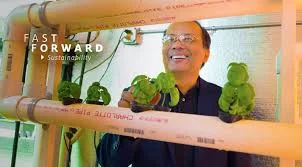
A TEDx Talk By Dr. Joel L. Cuello – Artificial Intelligence Does Food
By urbanagnews 2018
Dr. Joel L. Cuello, Professor of Biosystems Engineering at the University of Arizona brings us a TEDx talk on artificial intelligence as it can relate to food production for the growing global population.
Our planet sorely needs the help of artificial intelligence to achieve the increase in food production that our growing population demands in the face of scarce resources.
Vertical farming is already applying artificial intelligence and is sustainable with renewable energy.

Meet The Farmers Of The Future: Robots
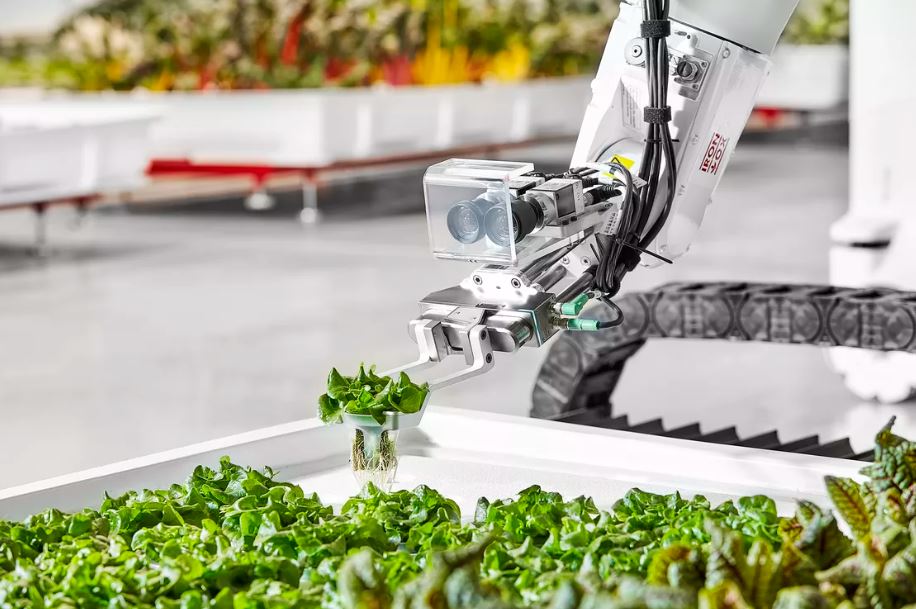
A robotic arm lifts plants being grown at Iron Ox. Iron Ox has been talking to San Francisco Bay area restaurants interested in buying its leafy vegetables and expects to begin selling to supermarkets next year. (AP photo)
By: The Associated Press 2018
Iron Ox CEO Brandon Alexander looks out at his robotic indoor farm in San Carlos, California. Alexander builds robot farmers that roll through a suburban warehouse, tending to rows of vegetables. (AP photo)
SAN CARLOS, Calif. (AP) — Brandon Alexander would like to introduce you to Angus, the farmer of the future. He’s heavyset, weighing in at nearly 1,000 pounds, not to mention a bit slow. But he’s strong enough to hoist 800-pound pallets of maturing vegetables and can move them from place to place on his own.
Sure, Angus is a robot. But don’t hold that against him, even if he looks more like a large tanning bed than C-3PO.
To Alexander, Angus and other robots are key to a new wave of local agriculture that aims to raise lettuce, basil and other produce in metropolitan areas while conserving water and sidestepping the high costs of human labor. It’s a big challenge, and some earlier efforts have flopped. Even Google’s “moonshot” laboratory, known as X, couldn’t figure out how to make the economics work.
After raising $6 million and tinkering with autonomous robots for two years, Alexander’s startup Iron Ox says it’s ready to start delivering crops of its robotically grown vegetables to people’s salad bowls. “And they are going to be the best salads you ever tasted,” says the 33-year-old Alexander, a one-time Oklahoma farmboy turned Google engineer turned startup CEO.
Iron Ox planted its first robot farm in an 8,000-square-foot warehouse in San Carlos, California, a suburb located 25 miles south of San Francisco. Although no deals have been struck yet, Alexander says Iron Ox has been talking to San Francisco Bay area restaurants interested in buying its leafy vegetables and expects to begin selling to supermarkets next year.
The San Carlos warehouse is only a proving ground for Iron Ox’s long-term goals. It plans to set up robot farms in greenhouses that will rely mostly on natural sunlight instead of high-powered indoor lighting that sucks up expensive electricity. Initially, though, the company will sell its produce at a loss in order to remain competitive.
During the next few years, Iron Ox wants to open robot farms near metropolitan areas across the U.S. to serve up fresher produce to restaurants and supermarkets. Most of the vegetables and fruit consumed in the U.S. is grown in California, Arizona, Mexico and other nations. That means many people in U.S. cities are eating lettuce that’s nearly a week old by the time it’s delivered.
There are bigger stakes as well. The world’s population is expected to swell to 10 billion by 2050 from about 7.5 billion now, making it important to find ways to feed more people without further environmental impact, according to a report from the World Resources Institute.
Iron Ox, Alexander reasons, can be part of the solution if its system can make the leap from its small, laboratory-like setting to much larger greenhouses.
The startup relies on a hydroponic system that conserves water and automation in place of humans who seem increasingly less interested in U.S. farming jobs that pay an average of $13.32 per hour, according to the U.S. Department of Agriculture. Nearly half of U.S. farmworkers planting and picking crops aren’t in the U.S. legally, based on a survey by the U.S. Department of Labor.
The heavy lifting on Iron Ox’s indoor farm is done by Angus, which rolls about the indoor farm on omnidirectional wheels. Its main job is to shuttle maturing produce to another, as-yet unnamed robot, which transfers plants from smaller growing pods to larger ones, using a mechanical arm whose joints are lubricated with “food-safe” grease.
It’s a tedious process to gently pick up each of the roughly 250 plants on each pallet and transfer them to their bigger pods, but the robot doesn’t seem to mind the work. Iron Ox still relies on people to clip its vegetables when they are ready for harvest, but Alexander says it is working on another robot that will eventually handle that job too.
Alexander formerly worked on robotics at Google X, but worked on drones, not indoor farms. While there, he met Jon Binney, Iron Ox’s co-founder and chief technology offer. The two men became friends and began to brainstorm about ways they might be able to use their engineering skills for the greater good.
“If we can feed people using robots, what could be more impactful than that?” Alexander says.

AVF Introduces Peter Lane As Interim Vice Chair
I don’t think there is a farmer’s son on the planet that hasn’t thought: there must be an easier way to make a living. I was no different- that is why, approximately 55 years ago, at the age of 10, I designed my first farm-engineering solution. And ever since leaving school in 1969, I have been in the electrical and controls industry in one form or another for 48 years.
by Peter Lane
I have worked as an engineer, site or project manager in near every industry since then from pharmaceutical and petrochem plants, to every form of power generation from nuclear to wind. I have worked on every kind of water treatment from sewage to ultra pure, on car plants and semiconductor plants, material handling, conveyors and sortation devices, to food and beverage plants in countries from as far apart as Azerbaijan and the USA, and most countries in between.
From all my experience over the years, I can safely say there is none more complex or fascinating as the controlled environment agriculture industry. In the mid-1980s I designed what is now a typical rack-and-shelf system and I went to Wageningen to learn what I could about growing tomatoes. Sadly, in those days before the LED light, it simply wasn’t economically viable. In 2014, I once again looked at the viability of what we now call vertical farming and immediately realised that there are so many solution variations- there is no one size fits all.
What works in a developed country would not work in the developing world and vice-versa, so I produced various blueprints that could be used as a template for a site-specific design. These included designs that worked where technology and resources were limited but had abundant sun and low-cost labour; and high-tech systems that would be suitable for areas where funding was more readably available but where labour and energy costs were seriously damaging the economic viability of any production facility.
Blueprinting innovation in Controlled Environment Agriculture
After failing to get all the funding for a project in Canada, I came back to the UK and I have now set up a new company called CEA Research and Development. We now have a new office in Coventry and the role of the company is to build, test and evaluate various prototypes suitable for the industry. We are currently working on several projects including the building and evaluation of a DC bus system with a direct DC supply for the LED lighting and all the other equipment for a working plant.
A secondary role of the company is to set up a training facility in Wales suitable for hands on training technicians and future technicians and operators of high density vertical growing facilities that tackle the issues of visibility, accessibility and maintainability that has caused so many problems in the industry so far. The year long course will cover all aspects of designing, building and operating a CEA growing facility, including project management training.
I am looking forward to shaping the industry future as part of AVF
As of the 16th of December, this year I was honoured at the AVF Annual General Meeting to be nominated and elected as the new Vice Chairman of the AVF. My engineering experience, and the plant and growing expertise of my co-vice chairperson, I hope will be beneficial to all the AVF members in helping guide them in their ambitions to design, build and operate profitable and successful businesses. The AVF is currently going through changes and evolving to better serve its members, to promote the industry, and to become a centre of information and support for its members and the industry at large. 2019 looks to be the start of a new and exciting era for the AVF and the industry.
For more information:
Association for Vertical Farming
Marschnerstrasse,
81245 Munich,
Germany
info@vertical-farming.net
80 Acres Farms Secures Significant Financing Round Led By Virgo Investment Group To Accelerate Indoor Vertical Farming Growth
NEWS PROVIDED BY 80 Acres Farms
January 15, 2019
Cincinnati, Ohio
80 Acres Farms, a leader in the rapidly growing indoor vertical farming industry, announced it has received a significant investment from Virgo Investment Group, a San Francisco Bay Area based private equity firm that invests in companies transforming and disrupting high-potential industries. Terms of the financing were not disclosed.
80 Acres Farms provides customers with a wide variety of locally grown, just-picked leafy greens, microgreens, and vine crops, including the world's only tomatoes and cucumbers grown completely indoors using just LED lighting. The company has developed its own artificial intelligence-powered growing system, sophisticated data monitoring, and automation technologies to deliver high quality and nutritious products at an affordable price. By locating its indoor farms close to customers, 80 Acres Farms is able to eliminate the costs, time and environmental impact of cross-country transportation, providing customers with a fresher, longer lasting product while drastically reducing food waste. 80 Acres distributes to major national grocers, local retailers, restaurants, and food service companies from its facilities in Ohio, Arkansas, North Carolina and Alabama.
"Virgo Investment Group joins our existing notable and experienced food industry investors in supporting the Company to rapidly commercialize the indoor vertical farming technology we have developed over the past three years," said Mike Zelkind, co-founder and chief executive officer of 80 Acres Farms. "We are optimizing every aspect of our production processes and driving down costs, which is crucial to scaling an indoor farming business like ours."
"We are excited to partner with highly experienced food industry leaders Mike Zelkind and Tisha Livingston to bring great tasting, freshly picked produce to local markets year round," said Eli Aheto, partner of Virgo Investment Group. "80 Acres Farms has created a unique and automated growing process and has built great relationships with its retail customers. We want to help accelerate the company's growth in this multi-billion-dollar market. The 80 Acres investment is an expression of Virgo's longstanding focus on investing in energy efficiency opportunities driven by reduced equipment costs. Virgo has completed investments in utility-scale wind, community solar, electric vehicle charging and now an LED lighting driven business."
The Virgo investment will enable 80 Acres Farms to complete the previously announced facility in Hamilton, Ohio, which will be the first fully automated indoor farm in North America. The first phase of the Hamilton project under construction is expected to be operational in early 2019. It will be automated from seeding to growing to harvesting for the highest quality and food safety standards. The Hamilton facility will feature handling robotics, artificial intelligence, data analytics, and around-the-clock monitoring sensors and control systems to optimize every aspect of growing produce indoors. The facility will allow 80 Acres Farms to begin to service the substantial and growing demand for fresh, locally grown produce year-round from both retailers and restaurants.
"Over the past three years we have provided our customers with fresh, flavorful and nutritious produce grown locally in our facilities with no pesticides and highly efficient usage of water and nutrients," Zelkind said. "We are rapidly increasing yields for our produce, while advancing each generation of our grow zone designs to lower capital costs, production costs and reduce the use of natural resources. Our facilities represent the realization of the next generation of farming. Our vision is to prove that indoor farming can be fully-automated, commercially scalable, higher-yielding, and profitable.''
About 80 Acres Farms
80 Acres Farms is an indoor farming pioneer providing customers with flavorful, and nutritious locally grown fruits and vegetables at affordable prices. Utilizing state of the art proprietary technologies, including modular grow zones, customized LED lighting, precisely-tuned climate controls, and an artificial intelligence powered growing system, the Company is able to offer customers a wide variety of pesticide free produce with a longer at home shelf life that exceeds the highest standards in food safety. 80 Acres has demonstrated early success distributing major national retailers and food service distributors. Based in Cincinnati, Ohio, the company was founded in 2015 by veteran food industry executives Mike Zelkind and Tisha Livingston who are supported by a deep team and a board of directors representing executive and leadership experience at leading food, healthcare, and other companies. For more information, please visit www.80acresfarms.com.
About Virgo Investment Group
Founded in 2009, Virgo is a thematic investor with the mission of building meaningful businesses. Virgo partners with Founder-led or Family-owned businesses where both existing owners and management have a material equity stake in the business. Virgo targets companies undergoing industry or company-specific change, which are executing on an identified inflection point in value. The Firm has invested over $1.1 billion, completing 52 investments to date.
Virgo has flexible capital that allows the Firm to provide differentiated solutions to current asset owners and existing shareholders. Virgo is an actively engaged investor. We don't just buy value; we work to create value. The Firm's Spica Alpha Unit drives value-add initiatives post-investment via a focus on human capital transformation, business process enhancement and technology implementation. We find our meaning at Virgo in creating and in reviving the soul of companies. It always starts with and ends with the soul. For more information, please visit www.virgo-llc.com.
SOURCE 80 Acres Farms
Related Links
‘Our World Is Entering A Fourth Agricultural Revolution’, Says UK Environment Secretary
Embracing a fourth agricultural revolution post-Brexit could help the UK to alleviate poverty and scarcity, replenish its stores of natural capital, and secure investment to tackle waste, pollution and emissions, he said.
(Image: Getty/JIRAROJ PRADITCHAROENKUL)
By Flora Southey
04-Jan-2019
RELATED TAGS: Brexit, Agriculture, gene editing
UK environment secretary Michael Gove has urged industry to embrace the potential of a fourth agricultural revolution: “We can guarantee a future for the UK as a major, global food producer.”
Industry is on the verge of a food production revolution, UK secretary of state for environment, food and rural affairs, Michael Gove, told delegates at the Oxford Farming Conference yesterday (January 3).
And according to Gove, the timing couldn’t be better for the UK farming industry: “In 2016 and 2017, more than half of the UK’s farms earned less than £20,000, and a fifth made no profit at all.”
Embracing a fourth agricultural revolution post-Brexit could help the UK to alleviate poverty and scarcity, replenish its stores of natural capital, and secure investment to tackle waste, pollution and emissions, he said.
The UK’s withdrawal from the European Union (EU) will help local farmers and food producers “escape from the bureaucratic straitjacket” of the Union’s Common Agricultural Policy (CAP) and access technologies the EU is “turning its back on”, he continued.
So just what does a fourth agricultural revolution entail?
Technological advances
In the next agricultural revolution, technological developments, such as artificial intelligence, the analysis of big data, drone development, machine learning, and robotics will allow us to improve productivity on traditionally farmed land, Gove told delegates.
“Not least by reducing the need for labour, minimalizing the imprint of vehicles on soil, applying inputs overall more precisely, adjusting cultivation techniques ore sensitively, and therefore using far fewer natural resource – whether carbon, nitrogen, or water – in order to maximise growth.”
The secretary also flagged data analytics, which together with advancements in sensor technologies, can monitor the health of livestock and develop optimal environmental conditions for animals.
The can help to “get their nutrition right, safeguard their welfare, and improve both dairy and meat production,” he added.
Gene editing
In June last year, the European Court of Justice (ECJ) ruled that crops obtained by mutagenesis – a technique that genetically alters the material of a plant – are to be classified as GMOs.
Gene edited plant and crop varieties, modified using methods known as new plant breeding techniques (NPBTs), for example, can help plant and crop varieties produce higher yields.
CRISPR-Cas editing technology has received significant attention in the agricultural sector, for its ability to help scientists make cuts at specific locations in a plant genome that introduce precise changes to facilitate crop breeding.
As a result of leaving the EU and its strict policies controlling the use of genetically modified crops and animals, the UK could open up to opportunities in gene editing, Gove suggested.
“The ability of giving Mother Nature a helping hand by driving the process of evolution at higher speed should allow us to develop plant varieties and crops which are more resistance to disease and pests and less reliant on chemical protection and chemical fertiliser.”
Farming advances
In a future that comprises vertical farming and innovative manufacturing techniques for alternative proteins, industry can minimise the land used for food production, said Gove.
“With vegetables growing in temperature-, moisture- and nutrition-controlled indoor environments, we can guarantee improvements in yield while at the same time limiting environmental externalities.”
Departure from the EU also presents an opportunity for hydroponic and vertical farm producers to attain organic status. Under current EU law, organic farming is ‘based on the soil’, which disqualifies these soil free systems from organic certification.
In addition, the fourth revolution may see animal products, from gelatine and egg whites, to milk and even meat, made in labs, Gove continued.
Challenges
Such technological advancements come with their own set of challenges, Gove explained, highlighting the significant capital required to invest in precision technology, robotics, and data analytics.
Gene editing also poses important ethical questions, and the energy required to maintain vertical farming systems can be costly and carbon-intensive, he told delegates, adding that despite these challenges, “No change is not an option.”
“Reform is vital to modernise the sector and to capitalise on technological advances.”
Copyright - Unless otherwise stated all contents of this web site are © 2019 - William Reed Business Media Ltd - All Rights Reserved - Full details for the use of materials on this site can be found in the Terms & Conditions
RELATED TOPICS: Organics, GM food, Brexit, Alternative proteins, Sustainability, Policy, Fruit, vegetable, nut ingredients

Local Grown Salads Launches Indoor Vertical Farms In Opportunity Zones
Local Grown Salads launches Indoor Vertical Farms in Opportunity Zones in Washington DC, Baltimore, and Nashville. Farms produce organic Ready-To-Eat Salads.
BALTIMORE, MD, UNITED STATES, January 10, 2019 /EINPresswire.com/ --
Local Grown Salads is opening Indoor Vertical Farms in Opportunity Zones located in Baltimore, Washington DC, and Nashville.
Local Grown Salads will be providing Ready-To-Eat salads, Ready-To-Use Herbs and vegetables that are GMO Free, Organic, Herbicide & Insecticide free, and certified insect free.

Wonderfully Fresh - Harvested and delivered on the same day.
Massive Selection - 25 different salads.
No prep needed - these are ready-to-eat.
No Food Safety concerns - FSMA & SFQ Quality Code level.
Good For The Environment - Reduced Carbon Footprint, No nasty runoff. No killing the bees.
Local Grown Salads is looking to provide LGS First Account status to a small set of restaurants, caterers, or food delivery companies prior to the official launch.
The LGS First Accounts will have special pricing, guaranteed availability, first access to product, and other advantages.
LGS First Accounts are select food service companies that will use Local Grown Salads' Ready-To-Eat Salads to provide extra-ordinary products to consumers.
LGS First Accounts will be located within 2 hours of one our locations and sell at least 5,000 high quality meals a week.
Local Grown Salads has limited the volume available and will be selective about who will receive this market advantage.
About Local Grown Salads Patent Pending Indoor Vertical Farming technology:
• Grows fresh produce year-round in a controlled environment with the highest standards of food quality and food safety
• Creates product that is organic, pesticide free, herbicide free, and GMO free
• Decreases transportation costs, thereby reducing the carbon footprint
• Helps to address the problem of food deserts
• Allows indoor farming that helps save the planet’s arable land
About Local Grown Salads and Opportunity Zones:
Opportunity Zones are a tax incentive established by Congress in the Tax Cuts and Jobs Act of 2017. 8,700 Opportunity Zones have been designated. The Opportunity Zones are low-income and food desserts. Local Grown Salads is expecting to create 20 jobs in its farms and provide fresh healthy food at wholesale prices to the community.
The Local Grown Salads farms can re-purpose older (heritage) buildings which are not challenged for other uses.
Zale Tabakman
Local Grown Salads
+1 416-738-2090
email us here
Visit us on social media:
LinkedIn

Trump Jr. Invested in a Hydroponic Lettuce Company Whose Chair Was Seeking Trump Administration Funds — “Trump, Inc.” Podcast Extra
The president’s eldest son last year became the most prominent shareholder in an indoor-lettuce farm while the company’s co-chairman, a friend of Donald Trump Jr.’s and presidential fundraiser, sought federal support for his other business interests.
by Jake Pearson and Peter Elkind
December 4, 2018 THE TRUMP ADMINISTRATION
The 45th President and His Administration
Exploring the Mysteries of the President’s Businesses
Find “Trump, Inc.” wherever you get your podcasts.
Donald Trump Jr., the president’s eldest son, took a stake last year in a startup whose co-chairman is a major Trump campaign fundraiser who has sought financial support from the federal government for his other business interests, according to records obtained by ProPublica.
The fundraiser, Texas money manager Gentry Beach, and Trump Jr. attended college together, are godfather to one of each other’s sons and have collaborated on investments — and on the Trump presidential campaign. Since Trump’s election, Beach has attempted to obtain federal assistance for projects in Asia, the Caribbean and South America, and he has met or corresponded with top officials in the National Security Council, Interior Department and Overseas Private Investment Corporation.
Beach and others at the startup, Eden Green Technology, have touted their connections to the first family to impress partners, suppliers and others, according to five current and former business associates. Richard Venn, an early backer of Eden Green, recalls the company’s founder mentioning “interest from the Trump family.” Another associate said Beach bragged about his ties to the Trumps in a business meeting.
The investment is one of just a handful of known business ventures pursued by Trump Jr. since his father moved into the White House almost two years ago. In addition to being a top campaign surrogate and public booster, Trump Jr. serves as an executive vice president of his father’s company and one of just two trustees of the trust holding the president’s assets.
Ethics experts have consistently criticized these arrangements, arguing that they invite those seeking to influence the government to do so by attempting to enrich the president or his family members with favorable business opportunities.
Trump Jr. invested in the startup, a company that grows organic lettuce in a hydroponic greenhouse, last year, records show. Those records don’t state how much money — if any — Trump paid for his 7,500 shares. But the shares would have been worth about $650,000 at the end of last year, based on a formula used by another shareholder in a recent court filing. Neither Trump Jr. nor the company have disclosed his investment publicly. Trump Jr. obtained the stake through a limited liability company called MSMDF Agriculture LLC, which was set up by a Trump Organization employee last fall.
The key ethical question, said Virginia Canter, chief ethics lawyer at the nonprofit Citizens for Responsibility and Ethics in Washington, is whether Beach’s involvement with Eden Green, and Trump Jr.’s investment in it, are based on the business merits — or on the possibility of cashing in on connections to power. “Why is Trump Jr. being given this opportunity?” she asked. “It definitely has the appearance of trying to gain access by any means to curry favor with the administration.”
The willingness of Eden Green to invoke the Trump name in its business dealings raises further ethical concerns, experts said, particularly if potential customers understand that they are giving contracts to a startup whose success could enrich the president’s son.
Neither Trump Jr. nor his spokesman responded to messages seeking comment on his relationship with Beach and investment in Eden Green. A White House spokeswoman didn’t respond to emailed questions. Alan Garten, the Trump Organization’s top lawyer, said in a statement that Trump Jr.’s investment is a personal one. The entity through which it was made “is not owned or controlled by, or affiliated in any way with, The Trump Organization,” Garten said.
Last fall, Eden Green concluded a deal with Walmart. Today, the giant retailer sells the company’s lettuce, kale and other greens at about 100 stores in the Dallas-Fort Worth region. (Eden Green’s sole facility is a 44,023-square-foot greenhouse outside Fort Worth, where it grows the greens in 18-foot vertical tubes.)
Walmart interacts with government regulators on an array of matters — everything from labor practices and land use to securities filings — but there is no indication that Walmart is aware of Trump Jr.’s connection to Eden Green. (Separately, Walmart contributed $150,000 to Trump’s inaugural committee. Beach was a finance vice chair of that committee, but a Beach spokesman says he has never met with Walmart executives.)
Molly Blakeman, a Walmart spokeswoman, declined to comment on Eden Green or its investors. “We don’t talk about our relationships with our suppliers,” said Blakeman, who added that Walmart has “supported inaugural activities” in the past.
Get More Trump, Inc.
Stay up to date with email updates from WNYC and ProPublica about their ongoing investigations.
Andrew Kolvet, a spokesman for Beach and the other Eden Green executives, said it’s “categorically false” that the Trump name was invoked by Eden Green officials. Kolvet cited a corporate policy that forbids discussing investors “with any current or potential client.” He also said Trump Jr. isn’t involved with company operations and bought into Eden Green during “U.S. friends and family fundraising efforts.”
A recent lawsuit asserts that Eden Green is in financial trouble. In October, the company’s largest shareholder, an entity controlled by a wealthy oil and gas family from Midland, Texas, filed suit in state court in Dallas, alleging “gross project mismanagement.” The suit accused Beach and six executives, all of them board members, of paying themselves extravagant salaries (allegedly $250,000 to $300,000 per year) and putting the company “on the precipice of failure.” A financial consultant hired to examine the company’s books asserted that Eden Green executives spent more than $19.4 million in the first nine months of 2018 — a daunting sum for a company that reported having raised a total of $22 million as of June — while generating $9,000 in revenues.
In late November, less than a month after the suit was filed, it was settled on confidential terms. Kolvet disputed the compensation figures asserted in the litigation, saying that the company’s pay is “in accordance with industry standards.” He maintained that Eden Green’s prospects are good. As with many startups, he said, “things don’t go in a straight line.” Kolvet asserted that the company has plenty of operating cash.
Trump Jr., now 40, and Beach, now 43, met at the University of Pennsylvania two decades ago. Both are the sons of wealthy businessmen, one in real estate, one in oil and gas. Beach’s father has since been laid low: Last month he was sentenced to four months in federal detention, plus two years of supervised release, for bankruptcy fraud.
Beach was a groomsman at Trump Jr.’s wedding (Trump Jr. and his wife recently separated). Beach and Trump Jr. like to hunt and once considered buying a hunting preserve in Mexico together. According to a 2010 deposition testimony by Trump Jr., they talked business during lunches at Rothmann’s steakhouse in New York.
Both have struggled in business at times. In 2009, Trump Jr. and others (including one person who pleaded guilty to an unrelated criminal fraud charge in 2010) formed a company that would sell concrete panels for home constructions out of a warehouse in North Charleston, South Carolina. The business quickly became mired in lawsuits seeking payment for unpaid bills. Trump Jr. made the situation more precarious by personally guaranteeing a $3.7 million loan for the project. Days before the note was due, the Trump Organization purchased the debt, eventually taking over the warehouse and selling it all back to Trump Jr.’s original business partner, according to press accounts.
For his part, Beach’s career path has also included some travails. He spent a year or so at Enron and then moved into finance. Beach worked for a hedge fund and remains locked in litigation with it more than a decade later. (He claims he wasn’t paid his full compensation; the fund claims he was “responsible for the destruction of millions of dollars of investor capital.”) Beach now runs a “family office focused on private equity investments” out of a Dallas office that Eden Green uses as its corporate address.
Trump Jr. has at least twice before invested with Beach in deals that didn’t pan out. Trump Jr. put $200,000 in a dry Texas oil well managed by Beach’s father, according to testimony by Trump Jr. He also lost an unknown sum in a failed African mining company affiliated with Beach’s uncle.
But Trump Jr. stuck with his friend. The Associated Press reported this year that the two formed a company last October to pursue technology investments.
Then there was Eden Green. By the time Trump invested last fall, the company had already run into problems. It first launched in 2013 in South Africa with an ambitious mission: to feed the world through a highly efficient indoor farming system deploying patented technology intended to yield 10 to 12 harvests a year, compared with two or three for conventional agriculture.
Butter lettuce and other leafy greens at a Eden Green vertical farm on June 27, 2018, in Cleburne, Texas. (Brandon Wade/AP Images for Eden Green)
There’s a market for vegetables grown in controlled greenhouse environments as big retailers increasingly push for cleaner, more reliable and locally grown alternatives. But the challenges are significant. Energy costs run high, and there are myriad difficulties associated with scaling up to an industrial-size system.
That’s what happened in Eden Green’s first iteration, according to a half dozen early backers and associates. The produce may have been sustainable — but the business model wasn’t. The CEO of its European unit wrote in an October 2017 email obtained by ProPublica that the company had “been bleeding money and resources for almost 2 years now.” In the fall of 2017, Eden Green’s founders cemented a deal to hand over majority control to a group of U.S. investors led by Beach, current and former business associates said.
This was the company Trump Jr. bought into. He used an innocuous-sounding limited liability company, called MSMDF Agriculture LLC, to make the investment. ProPublica discovered MSMDF after the Trump Organization listed it in New York City filings among dozens of other entities it controlled. (Because the Trump Organization has contracts with the city to run the Wollman skating rink in Central Park and a golf course in the Bronx, the city requires the company to file disclosures.) The Trump Organization told ProPublica that MSMDF is not in fact owned by the Trump Organization but was included in the disclosure form because it’s controlled by Trump Jr., who was described in the form as MSMDF’s president, secretary and treasurer.
MSMDF was formed by a Trump Organization employee in September 2017 in Delaware, according to incorporation papers. Eden Green Holdings UK, Ltd., an affiliate of the Texas-based company, then listed MSMDF among its roughly two dozen shareholders in a 2018 report filed with British regulators.
The Trump Jr.-Beach connection has been most visible in the political arena. Last year, for example, Trump Jr. publicly thanked Beach and their mutual friend Tommy Hicks Jr., another wealthy investor from Dallas, for their fundraising during the 2016 campaign. “We couldn’t have done it without you guys,” Trump Jr. said of his buddies to a crowd of Republican donors in March 2017. “It was just absolutely incredible.”
In the foreword to a recent book, Trump Jr. reiterated the message, writing that a “rag tag army” — Trump Jr., Beach, Hicks and Charlie Kirk, the firebrand chief of the pro-Trump organization, Turning Point USA — barnstormed the country in 2016, raising “over 150 million dollars in ninety days.”
Watch Donald Trump Jr. Thank Gentry Beach, Tommy Hicks Jr. for Trump Campaign Fundraising
Trump Jr. mentioned Beach and Hicks Jr. at a dinner hosted by the Dallas County Republicans in March 2017 and invested in Beach’s company Eden Green through an LLC created months after President Trump’s inauguration.
Since Trump’s election, Beach has met with top administration figures on multiple occasions. For example, according to the AP, he lobbied National Security Council officials to relax sanctions against Venezuela to create opportunities for U.S. companies. He attended a private lunch with Republican donors and Interior secretary Ryan Zinke.
Beach has denied leveraging his ties to the first family. Last month, Beach told a TV interviewer in Croatia, where he said he was exploring a “truly spectacular” $100 million real estate development, “I don’t need anything from the government, thankfully, except normal police protection in my hometown.”
But newly obtained emails show that Beach wanted government backing for his private business interests at the same time he was running Eden Green. In October 2017, Beach pitched Ray Washburne, who heads the Overseas Private Investment Corporation, a government agency that offers loans and guarantees to American companies looking to expand into emerging markets, according to emails obtained under the Freedom of Information Act. (Before joining OPIC, Washburne was a Dallas investor and a top fundraiser for Trump. He and Beach move in the same circles and have friends in common.)
“The Dominican Republic could really use some US investment and support,” Beach wrote in one email to Washburne, describing his various projects there, which included “a power plant upgrade to an existing tin mine” as well as liquid natural gas infrastructure. He invited OPIC officials to travel with him to the Dominican Republic “If permitted, we would be happy to handle all transportation from DC to DR and back,” he wrote in a follow-up note. (Such a trip never occurred, according to an OPIC spokesperson.)
A month later, the emails show, Beach also lobbied on another project, arranging a call with his business partner and one of Washburne’s top deputies regarding an “India Oppty,” which appeared to involve an energy fund. Separately, Beach also introduced Washburne to the head of oil giant Exxon Mobil’s Africa operations, with whom Beach said he had gone shooting at Blenheim Palace in England, where the Churchill family resided for three centuries. And Beach connected another Washburne aide with a South African mining executive who Beach described as “one of my partners.”
OPIC spokeswoman Amanda Burke said Beach has not submitted any formal applications for agency funding. “OPIC routinely meets with a variety of businesses and stakeholders,” she said, adding that formal applications trigger background and credit checks and “go through several levels of agency vetting and approval.”
Asked whether having a Trump connection would disqualify a person from receiving OPIC support, Burke emailed that “in general, an individual’s personal or legal business interests would not disqualify them from applying. However, certain relationships may cause board members or other decision makers of OPIC to be conflicted out of the decision-making process on potential projects.”

Future Farm: Crops Grown With LED Lighting Might Lead To New Markets
The plan is to see if the cost of using electricity to power the new frontier of “indoor agriculture” is feasible compared to traditional agriculture.
By Powergrams - 2018
Alabama Power engineer Blair Farley and Cheryl McFarland, Commercial and Industrial Marketing Support manager, inside the hydroponic container where they're testing the feasibility of indoor agriculture. (Joseph De Sciose/Powergrams)
Alabama Power’s penchant for pushing the innovation envelope can be seen in a refurbished Freight Farms shipping container outside the Technology Applications Center at the General Services Complex in Calera.
Employees are growing lettuce and other vegetables, herbs and edible flowers in an insulated container retrofitted with LED lighting and climate-control equipment. The plan is to see if the cost of using electricity to power the new frontier of “indoor agriculture” is feasible compared to traditional agriculture.
Alabama Power engineer Blair Farley steps out of the indoor agriculture unit in Calera where the company is test-growing lettuce, carrots, basil, dill, arugula and radishes. (Joseph De Sciose/Powergrams)
Indoor agriculture could be a game-changer for farmers, stores, restaurants, consumers and Alabama Power, in part because:
Crops could be grown in a controlled environment year-round with nutrients in circulated water without soil and few or no pesticides.
Crops could be grown in urban settings and areas classified as food deserts (locations where fresh food is not easily accessible).
Transportation costs could be drastically reduced or eliminated, as food could be grown near consumers and stores.
Indoor farming can produce 12 more lettuce harvests a year, and uses up to 90 percent less water, than a traditional outdoor farm.
Energy-efficient LED lighting and other components can be programmed for off-peak hours to take advantage of cheaper electric rates.
With electricity needed to operate the lighting and climate control systems, indoor farming could usher in a new stream of opportunities for the company.
From an economic development standpoint, vacant warehouses or buildings, including those with existing utilities, could be repurposed for controlled-environment agriculture, providing jobs for Alabamians.
Other advantages include growing during drought or excessive rainfall; producing fruits and vegetables not native to a geographic area; and uninterrupted growing seasons.
Engineer Blair Farley and Cheryl McFarland, Commercial and Industrial Marketing Support manager for Alabama Power, walk alongside the modified shipping container where the company is testing the feasibility of indoor agriculture. (Joseph De Sciose/Powergrams)
There is a viable market in Alabama, with $67 million spent on lettuce annually for households and about 70 percent of people buying organic products.
“Indoor agriculture can be a great addition to the already thriving agriculture industry in our state,” said Cheryl McFarland, Commercial and Industrial Marketing Support manager.
But there are challenges. Like any new, fast-growing concept, scarce data is available to determine long-term pros and cons. High startup costs and unavailable labor could be viewed as making it a financial risk. Vague or unfavorable city laws could be a barrier to an indoor agriculture operation.
Cheryl McFarland and Blair Farley monitor the towers where they’re growing vegetables inside a refurbished shipping container. (Joseph De Sciose/Powergrams)
Exploring the container farm concept at Alabama Power originated from an increasing interest in indoor agriculture and the need to fully understand the benefits of using electricity to enhance the process.
Alabama Power employees installed a 40-foot hydroponic container in January 2017 and began producing lettuce one month later. The container has a seed germination table and 256 vertical towers holding up to 17 small heads of lettuce each. Food production at the GSC is not limited to lettuce and includes basil, arugula, carrots, dill and radishes.
Because of automation, the APC container is fairly self-sufficient. However, one to two employees with other work responsibilities spend a little of their time each week planting, harvesting and performing routine maintenance in the container.
“Interest in indoor agriculture or controlled-environment agriculture is growing either in completely enclosed settings, such as our container, augmented greenhouses or empty buildings, like a vacant mall or Walmart,” McFarland said. “It’s a great way to provide access to fresh foods and jobs in rural communities and urban settings, particularly in areas of food deserts.”
Alabama Power’s next move on the chessboard that is indoor agriculture is to assess produce production and water and electricity usage, then compare findings with similar projects within Southern Company.
“We feel the interest in indoor agriculture is continuing to grow as consumers demand more fresh, local and healthy food options in stores and restaurants,” McFarland said. “Alabama Power has always tried to find ways to improve the way of life for our customers, and indoor agriculture is another avenue we are exploring.”
Food Security Issues Drive Wealthy But Civic Conscious Singaporeans To Become Farmers Abroad
Besides applying the vertical model to urban agriculture — experimenting with rooftop gardens and vertical farms in order to feed its many residents — farmers (both the wealthy and the not-so-moneyed) have ventured abroad to try their agricultural luck so that they can help ease up their country’s need for adequate food supply
December 29, 2018
To alleviate Singapore’s potential of becoming a nation of “starving” citizens, a number of well-meaning and audacious Singaporean farmers have endeavored to go overseas and establish farms so that they may be able to send food products back home.
Globally, Singapore ranks 4th as most food-secure nation on the Global Food Security Index. This catalog considers the affordability, availability, quality and safety of food supply. While Singapore has limited land capacity to produce its own food, it has designed a resilient food supply system which enabled it to reach a state of good food security. However, recent reports reveal that there exists food insecurity in several segments of its society and highlights how the expensive cars and bright lights of the cosmopolitan city-state very well concealed this relevant issue.
Currently, only 7% of Singapore’s food is grown locally. Every day, the country imports most of its fresh vegetables and fruits from neighboring countries like Malaysia, Thailand and the Philippines, as well as from more distant trading partners like Australia, New Zealand, Israel and Chile.
Besides applying the vertical model to urban agriculture — experimenting with rooftop gardens and vertical farms in order to feed its many residents — farmers (both the wealthy and the not-so-moneyed) have ventured abroad to try their agricultural luck so that they can help ease up their country’s need for adequate food supply.
When Apollo Aquaculture Group chief executive officer Eric Ng realized that his fish farm lease in Lim Chu Kang would expire in 2019, the 44-year-old began scouting for other options which include going overseas.
“Land is very limited here, and the cost of setting up a farm in Singapore is very high. But Brunei has vast land and abundance of sea water,” he said.
Today, he owns a parcel of land in Brunei that can generate 5,000 tons of trout, groupers, snappers and sea bass when operating at full capacity. In comparison, he only can produce about 110 tons of fish annually from his farms in Singapore.
Another daring farmer is former civil servant Lai Poon Piau, who recalled how he had to settle for plain prata after the roti prata stall near VivoCity ran out of eggs a few years back, due to the global food crisis which saw prices of food go sky-high. It was then that he realized how vulnerable Singapore was, in terms of food security.
Seeking to reconnect with his farming roots, Mr. Lai eventually acquired 80ha of land in Kampot, Cambodia in 2010 and started farming peppercorns three years later.
From the 50 tons of pepper he produces annually, only 100 kg is being exported to specialty stores and restaurants in Singapore. But he is gradually trying to build up his distribution channels for export. “I would like to sell all of it to Singapore if I can…Eventually, the idea is to use Singapore as a hub to export (my pepper) to other parts of Asia as well,” he said.
Ng and Lai Poon are just two of the handful of Singaporean farmers who have started farming on foreign soil, a concept that many experts think could help Singapore reinforce its food resilience despite its burgeoning population and its limited land resources.
Conventional Problems, Unconventional Solutions: Birth of Triton Foodworks
03 January, 2019 By: Sheetal Dhamecha
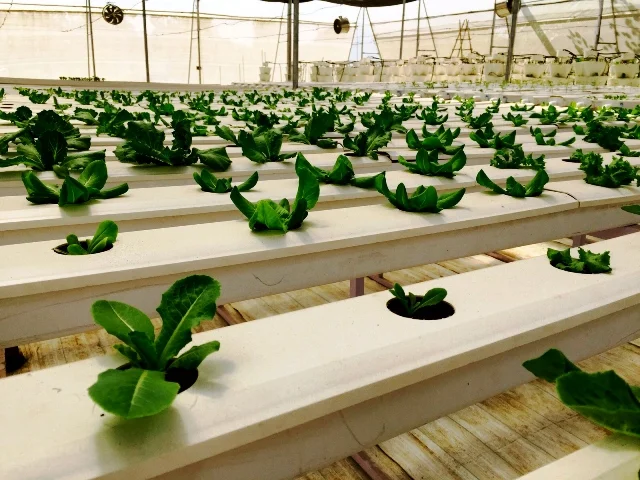
The conventional problems associated with agriculture can be solved through unconventional means, the belief was turned into reality by the young entrepreneurs in Delhi. Deepak Kukreja, Dhruv Khanna, Ullas Samrat, and Devanshu Shivnani, the friends who wanted to do something that was economical and ecological gave birth to Triton Foodworks.
What an idea! But how this idea?
Back in 2014, Ullas was keen on developing a farm in Mohali as a defense mechanism for his mother diagnosed with Interstitial Lung Disease. The doctors however advised that the life on farmhouse shall cause more harm than good due to dust and various issues linked to farming. He was then determined to find ways to make a clean farm for his mother. Dhruv, then based in Singapore did a lot of field research there and the two of them zeroed in on Hydroponics. They later collaborated with Deepak and Deevanshu to look after tech and finances.
Started as an experiment in the urban landscape, Triton Foodworks works on clean, accountable and reliable farming methods. The founders define a new generation of farmers, farmers who live in apartments, hang out in bars, and are social media addicts but also care deeply for the environment.
Say Hello to Hydroponics and Aeroponics
Hydroponics is the science of growing plants without soil. Nutrients are supplied to the plant through the water. In the present scenario of depleting water resources, hydroponics has an advantage over traditional farming. It consumes around 90 per cent less water, in turn, prevents topsoil erosion, requires no pesticides, and provides a better yield. Along with hydroponics, Triton uses aeroponics, a method of growing plants without a growing medium. The roots are suspended in air and nutrients are given through fine mist.
Both techniques are win-win methods, sustainable and profitable methods of food production.
Triton Foodworks now operates around 150,000 ft. of greenhouses in India and has managed to produce more than 700 tonnes of vegetables and fruits on their hydroponic farms. Be it bell peppers or strawberries, tomatoes or mint, they offer it right.
Related Links:

Take A Look At America’s First Robotic Farm
December 30, 2018
America’s first robotic farm claims to use less energy than other modern forms of farming. The hydroponics system uses 90% less water than traditional farming and this is while producing 30 times more crops/ac.
The farm, which is just 8,000ft² in size, is said to take a human-led, robotics first approach. This, it says, allows plants to be grown at their best from seed to harvest.
By using the hydroponics system, the farm provides the same products all year round; which are not affected by seasonality.
What is hydroponics?
Instead of soil, plants are grown using a mineral nutrient solution and misting methods. LED lights are often used as the light source.
However, hydroponic farms require a lot of labour, such as transferring individual plants at different growth stages.
To see the robots in action, take a look at the video below.
Quality Produce
Iron Ox – the company behind the robotic farm – states on its website that: “Quality shouldn’t be a luxury or compromise.”
The company claims that it is “using robotics and intelligence to grow better food for less. In a way that uses less; less of what we can’t get back or can’t afford to waste.”
The farm plans to provide a secure food supply and access to premium produce for everyone.
According to reports, the farm plans to grow 26,000 heads of lettuce, greens and herbs. Restaurants will be the first port of call for the produce, which is set to hit the market soon.

Space Tech That Feeds High-End Diners In Toronto Could Help Canada's North
Lush, leafy greens could be locally grown with innovative vertical farming system
James Dunne · CBC News · Dec 25, 2018
A look inside We the Roots vertical farm in Toronto. Wired with LED lights, the hydroponic facility can grow up to 20,000 leafy green plants at a time. (Yan Jun Li/CBC)494 comments
Technology being used to stock high-end Toronto restaurants with designer leafy greens could provide Northern Canadians with locally grown produce.
That's the view of academic experts and entrepreneurs involved with a high-tech vertical garden housed in an east-end Toronto warehouse.
"We're going to grow food using light recipes to make economic food, to make food cost-effective" says Amin Jadavji, "and I think that's the North story".
Jadavji is CEO of We the Roots, a company he co-founded in 2017 with six others, including celebrity chef Guy Rubino.
Recently, the federal government increased funding for shipping food to Northern Canada and expanded the Nutrition North program. That move comes as advances in hydroponics and LED lighting coming from research to grow food in space are expanding the prospects for northern farming.
Amin Jadavji, CEO of We the Roots, says vertical farms can produce cost-effective food, including in Canada's North. (James Dunne/CBC)
The vertical farm of We the Roots is a commercial test of the new tech. The most traditional farm-like thing about it is the pickup truck parked outside.
The structure inside a former factory is roughly 14 metres long by three metres wide and four metres tall. It houses from 15,000 to 20,000 plants at a time. "We're growing wild Italian arugula, mizuna, which is a Japanese mustard green, Tuscan kale, basil," Jadavji says, "and a little bit of cilantro."
See how hydroponic technology grows vegetables:
The operation is hydroponic and almost entirely automated. Water in the system carries nutrients and is recycled.
Plants are nested in trays and stacked seven layers high, each one under strips of LED bulbs. The bulbs provide a tailored light combination (cool white, green, deep red, ultraviolet, far red), created to bring out specific qualities in the plants, changing their size, texture and even taste.
Then there's the nutrition factor. "We can increase things like calcium and phosphorus and various vitamins by as much as 50 per cent just by changing light recipes," says Jadavji.
Young plants nestle inside the We the Roots vertical farm. The system features custom LED lighting from a company called Intravision. ( Yan Jun Li/CBC)
The system at We the Roots is the first commercial use of a concept developed by the University of Guelph in collaboration with a Norwegian company called Intravision, says Jadavji.
The university's Space and Advanced Life Support Agriculture program, which focuses on trying to grow plants in hostile environments like space, began using Intravision's LED lights in research. That developed into a stacked system that both light and water flow through.
Though this technology was created to help feed astronauts of the future, the first customers are already enjoying lunch and dinner at five upscale Toronto restaurants, including Parcheggio.
In the hierarchy everything clicks into place with this product, which is awesome.— Andrew Piccinin, Parcheggio executive chef
Parcheggio's executive chef Andrew Piccinin dropped romaine lettuce from his salad menu after California's E. coli problem. With greens from We the Roots, he doesn't worry about E. coli because hydroponics aren't vulnerable to the same contamination.
Besides safety, he loves that the greens are flavourful, local, and environmentally friendly. "In the hierarchy everything clicks into place with this product, which is awesome."
Chef Andrew Piccinin of Parcheggio displays his 'Nonna's Salad,' an old family recipe made with arugula grown in a new high-tech vertical farm. (James Dunne/CBC)
Vertical farming is part of a recent explosion in urban agriculture, a broad agriculture practice that dates back to ancient Egypt.
According to the United Nations, urban agriculture doubled from the early 1990s to 2005. Now, the UN Food and Agriculture Organization says 800 million people in cities are growing fruits and veggies or raising animals, accounting for 15 to 20 per cent of the world's food.
Vertical farming operations are a leading part of the trend.
Analysts suggest the vertical farm market will shoot up to $13 billion US a year by 2024, from just under 1.8 billion US in 2017.
Though vertical farming has seen some high-profile failures in Vancouver and Chicago, entrepreneurs and investors see fresh opportunity.
Aerofarms' massive vertical farm in New Jersey is not hydroponic, but aeroponic. It uses less water by spraying plants with mist instead of soaking the roots. (Aerofarms)
CBC News reported on a massive investment in the sector in 2016. Inside Aerofarms' large 6,500-square-metre facility in New Jersey aeroponics are used, spraying plants with mist instead of submerging them in water. The farm has the capacity to produce two million pounds of food a year.
In Canada, McCain Foods invested in a Nova Scotia vertical farm company called TruLeaf in the spring of 2018.
We the Roots plans to expand its Toronto operations next year. Jadavji is also opening two new farms, one about 135 kilometres from Toronto and one in New Jersey, each of them 1,850 square-metre facilities to produce 1.3 million pounds of greens per year.
Going big isn't the only way to get into vertical farming though.
Tiny turnkey vertical farms built inside shipping containers can be seen in cities such as Victoria, Calgary and Dartmouth, N.S.
Plants are densely packed into vertical towers inside the Very Local Greens container farm on the waterfront in Dartmouth, N.S. (Emma Smith/CBC)
Container operators can grow from 3,000 to 5,000 plants and sell at farmers' markets and to restaurants and caterers. Prices for container farms range from just over $50,000 to more than $200,000.
American container farm makers have clever names like Freight Farms and Crop Box, and Canadians are doing the same with brands such as Growcer and Modular Farms, which sells new custom containers.
While many vertical farms are in large cities, Ottawa-based Growcer has six of its high-tech containers in Alaska and three in Northern Canada, with systems in Kugluktuk, Nunavut, Kuujjuaq, Que., and Churchill, Man. Another system is going to Manitoba and one to Yellowknife as well.
Growcer's vertical farm in Churchill, Man., is made from a repurposed shipping container. The operator supplies stores, restaurants and individual or families with a weekly subscription. (Carley Basler)
Its units are insulated to function in temperatures as cold as –52 C. Growcer CEO Corey Ellis says the company began in 2015 deeply concerned about improving the supply of fresh food in the North.
It was the high food prices in the North that also gave the company a buffer period to improve its technology. The company was able to win Northern customers as it was working to lower operating costs.
"It was a great testing ground because you know with a $7 head of lettuce that's on the shelf before we show up," says Ellis, "we knew that if we could even do a $3 head we would be doing well." Ellis says Growcer's systems have advanced so much some units can match wholesale prices of greens from California.
It galls me, quite frankly, to think this Canadian technology will find its first expression in a large scale pilot in the deserts of Kuwait.— Mike Dixon, University of Guelph
Experts believe it's time to try large scale vertical gardens in the North.
University of Guelph professor Mike Dixon is frustrated technology from the school's space agriculture program isn't being used to help address Northern food security.
University of Guelph Prof. Mike Dixon believes large vertical gardens can help provide food security in Canada's North. But he says, 'It galls me, quite frankly, to think this Canadian technology will find its first expression in a large-scale pilot in the deserts of Kuwait.' (Joe Fiorino/CBC)
We The Roots wants to try the system Dixon helped create in the North, but it will be tested in extreme heat before severe cold. Why? Because Kuwait is willing to invest in it.
"It galls me, quite frankly," says Dixon, "to think this Canadian technology will find its first expression in a large-scale pilot in the deserts of Kuwait."
ABOUT THE AUTHOR
James Dunne
Producer, CBC News Business
James Dunne researches, produces and writes stories for the business unit at CBC News. He has a decade of experience in business programming including on the shows Venture and Fortune Hunters. An award winning video journalist, he's also worked on special projects and as the late lineup editor for the World at Six on CBC Radio 1.
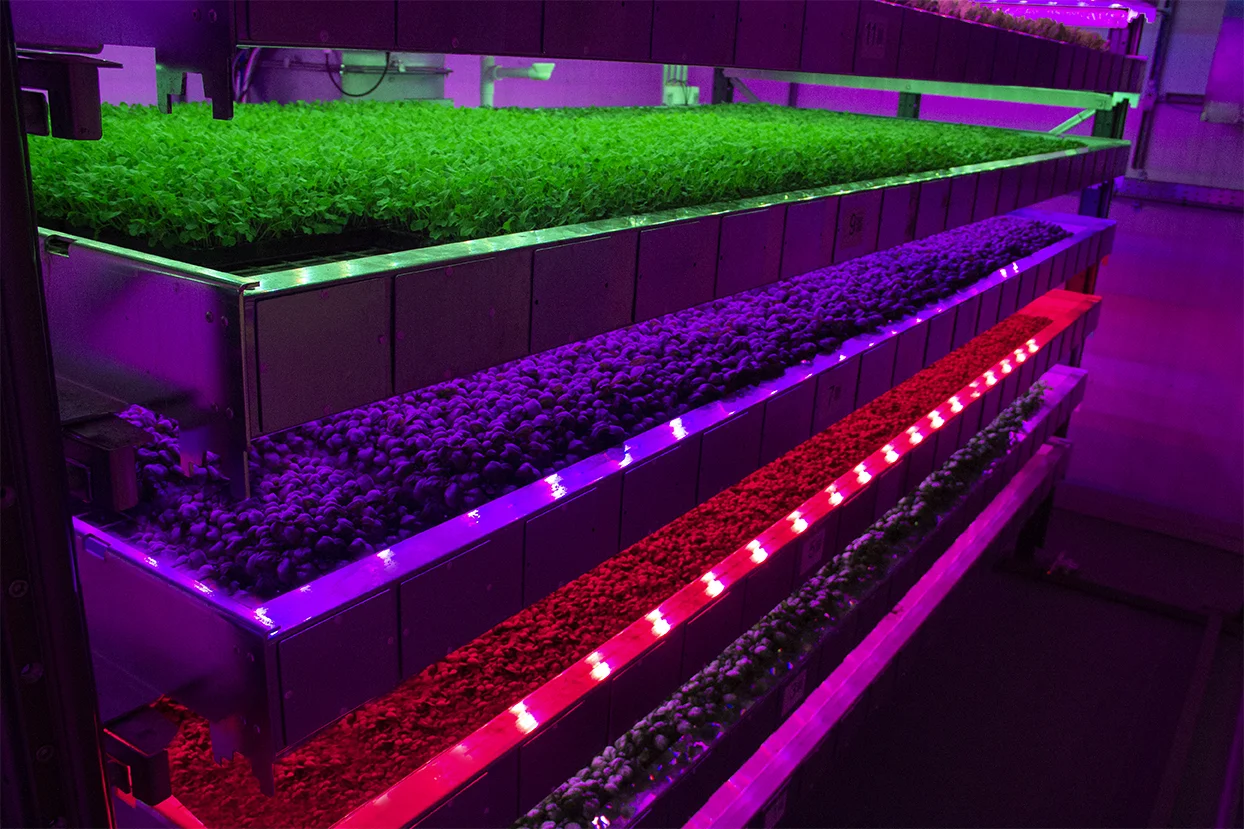
11 Indoor Farming Companies Taking Agriculture Indoors
“Vertical farming,” “low-impact farming,” and “urban farming,” are just some of the ways to describe the move towards indoor farming using smaller footprints than traditional farming
In our last article on precision agriculture, we talked about how global poverty is plummeting and there are fewer starving Africans that we need to feel guilty about every time we chuck out the leftover quiche because it gets too rubbery when zapped in the microwave. Now that we’ve sorted out all those poor people living in that far away country called Africa, we can move on to solving problems that hit a bit closer to home.
We’re talking of course about the whole “farm to table” trend where everyone wants to know that the baby spinach they’re nibbling on was grown by farmer Dick who lives two blocks away, a stern but likable old man, who tenderly nurtured the growing leaves every day in worn denim overalls while his golden retriever named Maggie frolicked alongside a small herd of free-range cows grazing in an idyllic pasture nearby. Story has now become an important part of the foodie experience, and being able to say that you grew something yourself means a lot to consumers. Which of course means you can then charge them more.
“Vertical farming,” “low-impact farming,” and “urban farming,” are just some of the ways to describe the move towards indoor farming using smaller footprints than traditional farming. The folks over at Finistere Ventures put together an awesome market map which listed out 10 startups working on indoor farming (to which we added one extra). If your amazing indoor farming startup isn’t on this list, drop us a note in the comments section below and the thousands of lovely readers that grace our site every day will still get to know about your venture. Please note that the main focus of this article is on indoor farming platforms that operate on a commercial scale.
Indoor Farming Platforms

Founded in 2014, San Francisco startup Plenty has taken in $226 million in funding so far to develop plant sciences for crops to flourish in a pesticide- and GMO-free environment. While the website contains all sorts of whimsical banter with little about what’s actually being done with this massive chunk of money that was raised, an article by Forbes last summer talks about how they’re poaching talent from Tesla to “create high-yield vertical farms that use a fraction of the energy and water needed for field-grown crops.” The numbers thrown around sound impressive. A 250,000 square foot space that equates to 5 acres because plants are being grown sideways on walls up to 20 feet high with only 1% of the water required to grow compared to traditional farming.
An indoor farming operation at Plenty – Source: Plenty
It’s all about using the latest technologies, which is why they made our list of 9 AgTech Startups Using AI to Grow Smarter. So did this next startup.
Founded in 2015, New Yawk startup Bowery Farming has taken in $141 millionin funding so far for their high-tech approach to indoor farming that uses robotics, LED lighting, and data analytics to grow leafy greens indoors using 95% less water and with 100X more yield on the same footprint of land that traditional farming requires. Again, it’s all about using technology, and Bowery Farming claiming to have the most technologically sophisticated indoor farming operation in the world. They’ve been selling produce for a few years now, and are now looking to start producing at scale.
Artisanal salads from Bowery – Source: Bowery
In addition to being featured in local restaurants, products like the ones seen above are being sold in Whole Foods at prices that are “comparable to most of the retailer’s other greens.” That’s according to an article by Fast Company that goes on to talk about how the system is automated such that “humans barely need to interact with the growing plants.” It also mentions our next company which is located nearby in New Joisey.
Founded in 2004, New Jersey startup AeroFarms has taken in $138 million in funding so far to develop an aeroponic growing system that can grow produce with neither soil or sun, in any location. We’re only a third of the way through this list of companies, and already the talking points seem to be getting redundant. They use 95% less water, the flavor is better, 390 times more land efficient, 30 crops a season, yada, yada, yada. A few things stood out though, like how they use cloth instead of water to grow plants in, and that every crop generates 130,000 data points. And also, this picture shows quite an impressive grow operation:
One massive indoor farming operation – Source: AeroFarms
If the market for designer salad gets too crowded, maybe they can throw one of those together up north in Canada and start a high-tech cannabis growing operation, eh. Speaking of crowded markets, here’s another startup in the same locale trying to build the next romaine empire.
Founded in 2011, New York-based startup BrightFarms has taken in $113 million in funding so far to “pioneer the future of local, low-impact farming.” They build, own, and operate greenhouse farms that create permanent green-collar jobs and deliver fresh, great-tasting produce to homes across the country. Sensing the fact that the local salad market might be getting a bit crowded, they’ve opened up greenhouses in three other States besides New York. The produce is grown locally, picked at the height of freshness, and delivered to supermarkets within 24 hours. Consequently, the world becomes a better place as a result:
The usual banter about how much better indoor farming is – Source: BrightFarms
We’re not sure there is too much more we can add here, so lettuce move on.
Founded in 2009, Brooklyn startup Gotham Greens has taken in around $30 millionin funding so far to design, build, and operate commercial-scale, technologically-advanced, urban greenhouse facilities located in New York City and Chicago. Their flagship greenhouse, built in 2011, was the first ever commercial-scale greenhouse facility of its kind built in the United States. Measuring over 15,000 square feet, it produces over 100,000 pounds of fresh leafy greens annually.
Lettuce growing on the rooftops – Source: Gotham Greens
For as much salad as they say they grow in those cities, spend some time there and you’ll hardly be convinced that salad constitutes a meaningful portion of anyone’s diet.
Founded in 2015, San Carlos, California startup Iron Ox has taken in $6.1 million in funding so far to develop robotic farms that will churn out better produce, everywhere. We decided to include them on this list when we saw that they’ve been featured in all kinds of media publications with headlines like “the first farm in America run entirely by robots.” Turns out, it’s not fully autonomous but they have certainly taken the use of robotics pretty seriously. That’s according to an article by The Verge which talks about a 1,000-pound robot porter, named Angus, that moves pallets of plants around, and another contraption that moves single plants around using a robotic arm:
Indoor farming + robotics = Iron Ox – Source: Iron Ox
With any of these indoor farming operations we’ve talked about so far, there is some element of automation. The question is, how much cost savings can be realized by removing humans from the equation entirely? These are some serious questions to think about, but maybe not as serious as our next startup.
Founded in 2012, Berlin startup Infarm has taken in $34.1 million in funding so far to develop farming tech for grocery stores, restaurants, and local distribution centers. It’s another take on vertical farming, but since it’s run by zee Germans, they’ve managed to make it even more efficient – by squeezing all the fun out of it.
One serious grow operation – Source: Infarm
According to an article by political commentary site Tech Crunch a few years ago, Infarm was the first company in the world to put vertical farming in a supermarket with Metro Group – one of the biggest wholesalers in Europe – and has since seen a big demand from other supermarkets that want to do the same thing. Nothing says fresh like letting customers pick the produce themselves.
Founded in 2015, Paris startup Agricool has taken in $41.4 million in funding so far to grow and produce fruits and vegetables inside shipping containers. Their focus on the moment is strawberries, that’s according to an article by Tech Crunch which talks about how you can already buy their strawberries in a couple of shops in Gay Paree. The company plans to use the $28 million in funding they raised last month to launch 100 containers in Paris and Dubai by 2021. When you get to Dubai lads, try not to be too intimated by what our next startup is building there.
Last but not least, we have Crop One. Founded in 2012, this Silicon Valley startup has taken in $18.3 million in funding so far to develop a market-leading technology platform for indoor growing. They grow in modular boxes and claim to be the largest operator and developer of vertical farms in the world. Their superior technology – they say – allows them to achieve 20% to 60% higher yields per square foot than anyone else in the industry, and at a cost basis that’s 25% that of any other vertical grower. These are some mind-blowing numbers, and it’s all found in the below video which says at the end of this year, their combined output will exceed six tons per day:
One interesting area they’re looking at is growing in remote locations, like offshore oil platforms or extreme environments like Antarctica. They’ve partnered with Emirates Flight Catering to launch a $40 million joint venture to build the world’s largest vertical farming facility in Dubai.
Picks and Shovels for Indoor Farming
Founded in 2005, Austin, Texas startup Illumitex has taken in $83.8 million in funding so far to build beautiful LED lights for industry and architecture as well as groundbreaking LED grow lights for horticulture lighting applications. Think of them as a picks-and-shovels play for indoor farming. “Lighting, very often, is the single most expensive and critical part of a successful Controlled Agriculture Environment (CEA),” says the company which needs to compete with some pretty solid players out there, like the ones we discussed in our past article on Investing in LED Lighting Stocks.
Founded in 2008, Albuquerque, New Mexico startup Growstone has taken in $1.2 million in funding so far to develop a patented manufacturing process that takes waste glass from the landfill and recycles it into customizable products ranging from substrates for advanced hydroponic growing systems to soil amendments to improve soil structure and texture. The process involves crushing the glass bottles into an extremely soft powder, so soft, it feels like flour. That powder is then transformed into various products like this one:
Source: Growstone
The production facilities are located at landfills so it’s even more green.
Conclusion
It seems like some MBA put together a financial model for an indoor farming operation that looked too good to be true, shared it with every venture capitalist out there, and then everyone started throwing money at pretty much the same idea. It’s basically about using technology to grow stuff you can sell at a premium in local supermarkets and restaurants while saving money on things like transportation costs, pesticides, tractors, and humans. It must be really lucrative because these eleven startups have collectively raised more than $900 million so far. The indoor farming market seems a bit crowded though, so we’ll check back in a few years’ time and see which startups are still growing and which startups have died on the vine.
Are you paying too much in transaction fees to your broker? Check out a brokerage firm called Zacks Trade that's offering $1 trades on U.S. stocks and options until 2019. After that, you'll pay just $3 a trade or a penny a share, whichever is greater. It's one of the cheapest brokers out there and you can also trade stocks on 91 foreign stock exchanges. Click here to trade US stocks and options for as low as $1 per order until July 4, 2019.
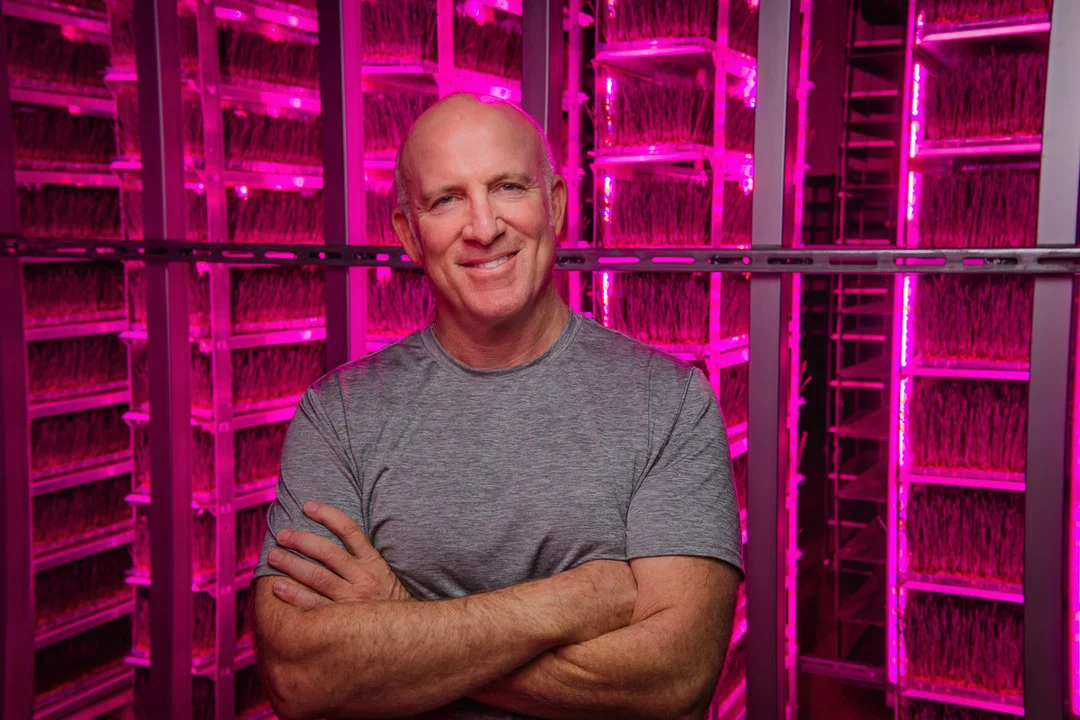
Indoor Vertical Farming 2019: What I've "Really" Learned..
This July marks five challenging years since I made the bold decision to pursue a career in indoor vertical farming; the growing of plants indoors using only LED lights and liquid nutrients – no sun, no soil.
Published on January 3, 2019
Jim Pantaleo
Senior Advisor - Indoor VerticalFarming
This July marks five challenging years since I made the bold decision to pursue a career in indoor vertical farming; the growing of plants indoors using only LED lights and liquid nutrients – no sun, no soil. My work, focused solely on growing plants in large scale for human consumption, has somewhat morphed into pursuing the fascinating and much-needed application of PMPs or plant-made pharmaceuticals. PMPs, simply stated, are the result of isolating key proteins in plants and extracting those proteins for use in antibiotics and vaccines…again, simply stated.
Did you know a plant produces proteins which fight hemophilia and rheumatoid arthritis? It’s true and profound. Just ask Dr. Barry Holtz of iBio CDMO in Texas. I could go on and on about PMPs, but what I really want to convey are some of the lessons my indoor vertical farming ‘journey’ has imparted. The hope is my experience may in some way inspire, or provide a cautionary tale, for those who have been seeking a career change, or better, a life change.
Since the summer of 2014, the road I’ve traveled has been bumpy, sometimes smooth and always winding…barreling head first towards the unknown…and the known. What is unknown is where I will be and who I will work with in 2019. You see, I’ve recently resigned my position as Vice President at one of the nation’s largest, privately-held indoor vertical farms for food production leaving me at the moment, sans employment.
What is known is my steadfast and dogged resolve to never, ever give up on this nascent industry and the people I’ve encountered along the way…not the noble and generous horticultural professionals and not the charlatans or whack-jobs either.
It was in 2015 when I wrote “Indoor Vertical Farming 2015: What I’ve Learned.” I was amazed at how many people actually read it. I reviewed my previous ‘year of immersion’ into indoor vertical farming and the people, start-ups and organizations I came to know. People like Marc Oshima, who along with David Rosenberg, the founders of AeroFarms, or the dear and generous-of-spirit industry colleague Brian Lanes of the Dutch R&D concern, PlantLab, or a true ally in Philips (Signify) City Farming representative, Blake Lange.
It was that summer of ’15 when I secured three pro-bono gigs with indoor vertical farms located in various parts of the world. Remotely from my home in California, I wrote business plans; researched cannabis in Colorado; assisted with marketing and generally ingratiated myself to the CEOs of these upstart operations. I also began to write. Over the next year I produced a dozen articles, blogs and interviews for Urban Ag News, the online resource for all-things controlled environment agriculture (CEA). I thank Urban Ag News founder Chris Higgins for not only this opportunity but also to work like a dog for a week in his company’s (Hort Americas) Dallas warehouse and experimental greenhouse.
I wrote and blogged about indoor farms and the ecosystem that surrounded them…like Priva and others. I interviewed industry leaders like American Hydroponics’ founder, Michael Christian, who turned me on to the sandbox argument of whether produce could be considered organic if it’s not grown in soil. “Jim, a nitrogen atom is a nitrogen atom!” he emphatically explained.
I wrote about hospitals who feed their patients high fat, high sodium, nutrition-less food and I shed a light on those forward-thinking hospitals who ‘grew their own’ in an effort to heal with food. I wrote about why LED’s can emit a pink hue. “Don’t call them pink!” was the public chastisement I once received from UC Davis horticulture professor and CEA leader, Dr. Heiner Lieth.
I also organized an amazing networking event with Urban Ag News in Salinas, California where eight member companies from the Japan Plant Factory Association shared their work (bravely presenting in English!) with a gathering of American agriculture companies and professionals. Included in this event was my personal CEA hero, Dr. Toyoki Kozai, a rock star in Japan and widely known as “The Father of the Japan Plant Factory.”
It was in the fall of 2015 when I secured my first paying gig at the now-shuttered indoor vertical farm, Urban Produce, ironically located in my hometown of Irvine, California, a former bucolic agricultural strong-hold now an over-built Orange County suburb. Over the next three years I would go from assisting Urban Produce with business development and marketing to working on ‘the farm’ growing tons (literally) weekly of USDA-certified organic wheat grass and micro greens. One of the hardest (physical) jobs I’ve ever had. In fact, I lost over 50 pounds in six months! Eventually, I was asked by Urban Produce’s investors to take over the operation as General Manager in the fall of 2017.
The many leadership lessons learned since 2015 not only from my role as General Manager but eventually as a C-Level Vice President of one of our nation’s largest privately-funded indoor farms were harsh and sobering. Meaning, just because you get the title and the “corner office” (I literally had a corner office) does not mean those whom you lead will accept your leadership. In fact, subversive behavior and a constant watchful eye over my every move were omnipresent. It’s true, when you reach the top, you should expect to be knocked down.
And let me provide a dose of reality when it comes to these large and well-funded indoor farms; they are not perfect, technologically-speaking, by any stretch of the imagination. The technical and facility challenges around water and water cleanliness along with air conditioning, energy and heat were again, omnipresent. If you have ever seen a large warehouse flooded with thousands of gallons of water because a grower forgot to turn off a hose for example…or a chiller did not chill…or a dehumidifier did not dehumidify…then welcome to the world of indoor vertical farming!
The copious amounts of money spent, precious operational time lost (along with actual crop loss…defined as catastrophic crop loss) and the hard labor extended to address these facility challenges were beyond anything I could ever have imagined. Over time and as I built credibility, I had the opportunity to speak publicly about this embryonic industry thanks to the likes of Indoor Ag Con’s founder, Nicola Kerslake, or the administrators at the University of California and the University of Nevada or Andy LaVigne, President of the American Seed Trade Association. I owe them and others a great debt of gratitude for their belief that I could be some sort of industry thought leader. Gratitude also to David Proenza who tapped me as the Master of Ceremonies for the second International Congress on Controlled Environment Agriculture held in steamy Panama in May of 2017.
From these speaking experiences I learned there was a true need not only to understand indoor vertical farming but to understand how the many peripheral industries could become involved, from academia and technology to packaging, to those breeding seeds meant only for controlled environments.
Fast-forward to 2018 and the aforementioned VP gig at one of the nation’s largest, privately-funded indoor farms. It was in this role where I came to know the world of PMPs along with how our government is becoming engaged with indoor vertical farming. In June of this past year, I traveled to Washington D.C. on the invitation of Dr. Sarah Federman of the Office of the Chief Scientist for the USDA for a gathering of industry folk. All the “Bigs” where there including Plenty, AeroFarms and Dr. Dickson Despommier, who played a key role in sparking the discussion around indoor farming with his 2010 book “The Vertical Farm.” A few months later I found myself back in D.C. for a gathering put together by Dr. John Reich of the Foundation for Food and Agriculture Research(FFAR). The three-day meeting was a starting-point and nexus in the public/private funding needs for credible research in indoor farming.
During this past year I have had the good fortune to meet and work with a number of universities including the team at the University of Arizona’s Controlled Environment Agriculture Center (CEAC) led by Director Dr. Murat Kacira and past Director, Dr. Gene Giacomelli. Cornell University’s College of Agriculture and Life Science Dr. Neil Matson and the previously mentioned Dr. Lieth of UC Davis along with Dean of Horticulture at the University of Nevada’s Dr. William Payne have all enriched my experience.
One of my last efforts during 2018 was working with the seed breeding team at Bayer/Seminis. It should be no secret that the fledgling indoor farming industry requires a different kind of seed than those sown in outdoor environments – and companies like Bayer know it. I presented research and data (compiled by a diligent R&D team) which shared trials of growing seed specifically meant for indoor environments. The experience was an important and valuable one, and my appreciation goes to Team Bayer for their vision and partnership.
What I would like to convey to the reader is if you want to make a change in your career and your life, I say do it! But do it for the right reasons. I have aggressively pursued this “business” because I wanted to make my children proud of me. I wanted to help the planet and I wanted to do something that would make a difference to human kind. I did not care, nor do I care now, about making money. Do something you love and you’ll never work a day in your life as the saying goes, but be prepared for a journey and to work very, very hard. My journey continues and I welcome you to reach out to connect with me…even if you don’t know me. That’s what I did and it is one of the key reasons I have made it this far.
Very special thanks to those not mentioned above but who have been integral to my career thus far: Herbert Kliegerman Founder of iGrow News, Glenn Behrman Founder at GreenTech Agro LLC., Michael Yates, Dominic Chen and Erika Summers of Sananbio U.S., Dr. Paul Zankowski of the USDA’s Office of the Chief Scientist, Dr. Sarah Taber, Henry Aykroyd Founder of Intelligent Growth Solutions, A.G. Karamura Founding Member of Orange County Produce and Former Secretary of Agriculture for the State of California, Val Dodd Former Managing Member of Urban Produce LLC., Brad Wahlgren of Bayer, Dr. Nadia Sabeh aka “Dr. Greenhouse”, Dr. Leo Marcelis of Wageningen UR, Dr. Sheila Bhattacharya, Glen Zimmermann of Sunrise Produce, Jan Westra of Priva, Adam Porsborg, Dr. Andy Moreno, Dr. Karl Kolb, David Armstrong President/CEO of Sakata America, Victor M. Hernandez of the USDA, Robert Colangelo Founding Farmer/CEO at GreenSense Farms, Jeff Randall of Get Fresh Sales, Dr. Gary Stutte Founder of SyNRGE LLC., Robert Puro Founder of SeedStock, Will Kain CEO/Co-Founder of Pantheon Energy, Dan Albert Founder/GM at Farmbox Greens.
‘Farming 4.0’: In Space-Starved Hong Kong, The Future of Agriculture May Be In High-Rise Buildings, And Hi-Tech
An old factory building in Tai Po is using ‘vertical farming’ to turn a 10,000 sq ft space into one the size of a football field.
By replacing shovels and hoes with computers and drones, the operation only needs four farmers
21 December 2018
A hi-tech vegetable farm in Hong Kong’s Tai Po district is thriving inside a converted factory building, and produces four tonnes of lettuce, wild rocket, endive and cabbage for salads each month.
HONG KONG NEWS
At Farm66, workers in their 20s and 30s tend to neat rows of racks, each 30cm tall and 10 tiers high, filled with potted greens lit by low-energy light-emitting diode (LED) lamps and connected to fish tanks on the floor.
Instead of shovels and hoes, they work with computers and drones.
“We farm with technology, not ploughs,” said the vertical farm’s co-founder, Gordon Tam Chi-ho, who is in his 30s. “This is farming 4.0.”
The 20,000 sq ft space is air conditioned and fitted with sensors which check the temperature, humidity and height of the vegetables to make sure the environment is kept stable for the growth of greens.
Once a day, a drone flies over the racks to inspect the vegetables. If some are too short, a technician in a control room will adjust the racks remotely to move the plants closer to the LED lamps.
The plants are watered automatically using the fish tanks. Carp reared in the tanks produce the waste that becomes organic fertiliser for the vegetables.
Farm66 offers a glimpse of the future of farming by harnessing technology and using less space than traditional farming, long regarded a sunset industry in Hong Kong.
Primary industries, mainly comprising farming, fishing, mining and quarrying, accounted for HK$502 million (US$64 million) last year, a tiny fraction of the city’s total gross domestic product of HK$2.65 trillion.
But Tam, who is optimistic about the prospects for aqua-farming, said: “Hong Kong is a service-based city, but we still need healthy food. This is a viable business in Hong Kong because of demand for healthy produce and the growing awareness of food safety.”
Tam had been troubled by allergies to metals and pesticides in vegetables when he and his two partners – Billy Lam Chi-yeung and Terry Chau Tak-hung – founded Farm66 in 2013.
They started in an old industrial building in Chai Wan before moving in June this year to premises 10 times larger at Tai Po Industrial Estate. The current property is part of the Hong Kong Science and Technology Parks Corporation’s revitalised precision manufacturing centre.
Setting up the vertical farming project cost more than HK$10 million, Tam said, with investment coming from an undisclosed angel fund.
The farm currently uses about half of its available space. When fully operational, output is expected to rise to about 16 tonnes a month, or 200 tonnes a year.
As the vegetables are grown in a tightly controlled ecosystem, they grow faster than outdoors, do not need pesticides and are ready to eat upon harvesting.
Tam, who trained as an architect in the United States and studied sustainable urban development in Hong Kong, said innovation had made farming more viable and less labour intensive.
Vertical farming using tiered racks means 10,000 sq ft of space can expand to become an area the size of a football field.
“We apply computer science and technology to the growing process, and that’s why we have only four people handling operations,” he said.
The future of farming: Japan goes vertical and moves indoors
Technology also allows the company to overcome the lack of sunlight indoors. The farm uses different types of LED lamps of varying wavelengths – for example, red LED light to help the plants grow taller and blue to encourage thicker, bigger leaves.
“Our biggest enemies are bacteria and insects – that’s why the growing areas are restricted areas and we keep track constantly of the data collected by our sensors,” Tam said.
Funding and space remain challenges too. “Raising angel funds and finding a sizeable space in Hong Kong are not easy,” he said. Rent accounted for 40 per cent of costs, labour 30 per cent, research and development 10 per cent and the rest went on utility bills.
To make the business more financially viable, he decided not to grow mass market greens such as choi sum or bak choi, which sell for about HK$12 for two catties (1.2kg).
Instead, the farm grows higher-priced salad greens which it packages in boxes sold for between HK$25 per 30 grams to about HK$68 for 120 grams.
Its vegetables, which are on sale at City’super, will soon also be available in other supermarkets and about 10 vending machines to be set up in residential clubhouses and office buildings.

Gulf Region, UAE: $1.2bn GCC Vertical Farming Boom Seen By 2021
New research says a growing importance is being given to vertical farming across the Gulf region
The UAE is leading the vertical farming change and has upcoming projects facilitated by the government as well as private players to help increase food security in the region.
A growing importance is being given to vertical farming across the GCC and is generating interest and increased investments from regional and overseas players, according to a new report.
Orbis Research said the region's vertical farming market is expected to reach $1.21 billion by 2021 at a compound average growth rate (CAGR) of 26.4 percent from only $380 million in 2016.
It said the UAE is leading this change and has upcoming projects facilitated by the government as well as private players to help increase food security in the region.
These include the UAE Ministry of Climate Change and Environment allotting space for 12 vertical farms to be built by Shalimar Biotech Industries, and the world’s largest vertical farm for Emirates Airlines by Crop One Holdings Inc.
With around 90 percent of food being imported in the UAE, territorial problems of water scarcity and small percentages of arable land, vertical farming is becoming increasingly vital to ensure food security within the region, the report added.
Mariam Al Mehiri, Minister of Future Food Security, also plans to create a "Food Valley" or a technology hub, dedicated to the development of food and farming automation.
The report comes ahead of AgraME 2019, a platform for the latest technology to be showcased to the regional agribusiness market.
Henry Gordon-Smith, founder and managing director of Agritecture who will be speaking at AgraME 2019, said: “The potential is certainly there to transform what has historically been a relatively small traditional farming industry into perhaps the most technologically advanced agriculture industry in the world.
"This means economic development, increased production of nutritious local produce, and lowered food costs, all with minimal water consumption and increased resilience to climate change and foreign markets.”
Samantha Bleasby, exhibition director of AgraME added that the show, which takes place in Dubai from March 5-7, is attracting key players in the industry such as Certhon, Agrotonomy, Veggitech, Wuxi, iGrowths Technology Co Ltd, Ozorganic Urban Farming and Van der Hoeven.
For all the latest tech news from the UAE and Gulf countries, follow us on Twitter and Linkedin, like us on Facebook and subscribe to our YouTube page, which is updated daily.