

Welcome to iGrow News, Your Source for the World of Indoor Vertical Farming

Urban Home For High Tech Horticulture In Australia
A feasibility study will be conducted to identify the opportunities and challenges for high technology horticulture in urban Australia
RMCG has kicked off 2021 with a new project for the Australian horticulture industry, which aims to assess the potential of emerging production technology and its application in the urban landscape.
Vertical farms, aquaponics, floating farms – these are just some of the many possibilities of high technology horticulture in urban areas across the globe. But are they feasible for Australian growers?
RMCG is excited to lead a consortium in partnership with the University of Technology Sydney (UTS) and global urban agriculture consultancy ugritecture to answer that very question. The six-month project, funded by Hort Innovation, will assess the potential of emerging production technology and its application in the Australian urban landscape, which will also cover regional areas and hubs.
High technology horticulture and emerging production technology can benefit Australian growers and industry by developing food production and delivery systems that have the potential to optimize yield, quality and supply. Examples of this technology include vertical farm systems, hydroponics, aquaponics, nearly fully automated production as well as rooftop, underground and floating farms.
Project approach
A feasibility study will be conducted to identify the opportunities and challenges for high technology horticulture in urban Australia. It will identify a range of high technology systems and assess their applicability to urban Australia by considering: regulation and planning, farm input and waste, supply chain logistics, and social, environmental, and economic aspects.
The project will include a high-level literature review and modeling of the social and environmental impacts. The economics of high technology systems for urban horticulture will also be analyzed.
The study is being guided by an industry-led reference group including growers and emerging commercial leaders engaged in urban high technology horticulture in Brisbane and Sydney, members of local city councils, and subject-matter experts in protected cropping.
The outcomes of the study will identify future priorities for research, development and extension activities and investment into Australian high technology horticulture in urban areas.
For more information:
RMCG
www.rmcg.com.au
28 Jan 2021

Tips On How To Set Up Large Hydroponics Farms
The need for large-scale hydroponics farms will increase as urban areas get more populated each year

The need for large-scale hydroponics farms will increase as urban areas get more populated each year. Hydroponics is an innovative farming method that will solve present and future issues surrounding urban areas. Operators of large-scale hydroponics farms can sell their goods to local restaurants, businesses, and individuals so people can get their food in the same city rather than from rural farming areas. This article is going to cover the basics of how to set up a large-scale hydroponics farm.
Step 1: Flesh Out Your Business Idea
Great, you want to start a hydroponics farm. But you’ll need to plan out your business venture to ensure it is set up for success! Configure the costs associated with starting a hydroponics farm, the ongoing costs. Who’s going to be your target market? Are you trying to sell to individuals, grocery stores, or local restaurants? How are you planning to sell your products? In bulk? What is the name of your business? Does it align with your company’s values and beliefs?

Step 2: Choose a Location
When it comes to a large-scale hydroponics farm, you’ll need to decide where you want to set up shop. Since the future of farming is appealing to major cities, you may want to set up your business nearby or inside a major city. The location of your business also depends on your target audiences.
Step 3: Decide What Crops You Want to Grow
Choosing the crops you want to grow is one of the most critical factors for your hydroponics farm. Check to see if there are other hydroponics farms in the area, and if so, what are they selling? See if you can offer a product that’s not only easy to grow but also will have demand amongst your audiences. Are you planning on growing one single crop to cut costs, or do you want to grow a variety of crops to appeal to various target markets?
Step 4: Pick a Hydroponics Growing System
Look at the space you’re planning to have your hydroponics farm in and determine what kind of system will work best depending on the location and the crop. If you’re growing crops like lettuce or spinach, then an NFT setup will suffice because these crops grow fast and short, which allows for easy pickings. Larger crops such as tomatoes or fruits will benefit from vertical hydroponics growing systems. Compare the prices for various hydroponics growing systems depending on the materials, crops, location, and setup.
Step 5: Lighting
Now you’ll want to determine the light source to use to grow your plants. Lighting can lead to expensive costs, especially when powering large-scale hydroponics farms. From LEDs to HID lamps to HPS bulbs, lighting is an important factor in hydroponics farming. Each lighting source has its pros and cons, and you’ll need to study each one to determine which option best suits your needs.
Hydroponics farms are the key to the future of farming. To learn more about hydroponics and farming, subscribe to the Nick Greens YouTube channel and join our microgreens group on Facebook. We look forward to helping you reach your goals!
#hydroponicsfarm #hydroponicsfarming #hydroponicsgrowing #hydroponicfarm #hydroponicfarming

AppHarvest, A Pioneering Developer And Operator of Sustainable, Large-Scale Controlled Environment Indoor Farms, Becomes A Public AgTech Company
“Today marks an important milestone for AppHarvest and for American agriculture as we drive the next chapter of our growth as a public company,” said Jonathan Webb, Founder and Chief Executive Officer of AppHarvest
February 01, 2021
AppHarvest and Novus Capital Complete Business Combination
AppHarvest to Begin Trading on Nasdaq as “APPH” on February 1, 2021
Company Reaffirms Full-Year 2021 Guidance
MOREHEAD, Ky., Feb. 01, 2021 (GLOBE NEWSWIRE) -- AppHarvest (“the Company”), a leading AgTech company and Certified B Corp building and operating some of the country’s largest high-tech indoor farms to sustainably grow affordable, nutritious, chemical pesticide-free non-GMO fruits and vegetables at scale using 90 percent less water than traditional open-field agriculture and 100 percent recycled rainwater, and Novus Capital Corp. (Nasdaq: NOVS) (“Novus Capital”), a publicly-traded special purpose acquisition company, announced today that they have completed their previously announced business combination and related charter amendments.
The resulting company is named AppHarvest, Inc. and its common stock and warrants will commence trading on Nasdaq under the new ticker symbols “APPH” and “APPHW,” respectively, on Monday, February 1, 2021. AppHarvest has qualified to list on the Nasdaq Global Select Market, which is the highest of three tiers based on certain financial, liquidity, and corporate governance requirements that the company met. The combined company will be led by Jonathan Webb, AppHarvest’s Founder & Chief Executive Officer.
The Boards of Directors of AppHarvest and Novus Capital unanimously approved the transaction, and the transaction was also approved at a special meeting of Novus Capital shareholders on January 29, 2021.
Preparing AppHarvest tomatoes for shipping (Photo provided)
Company Overview
AppHarvest, committed to ESG principles and social impact, is redefining and transforming American agriculture by developing modern, large-scale and efficient indoor farms in Central Appalachia, a water-rich region strategically located within a day’s drive of approximately 70% of the U.S. population. AppHarvest has strong relationships with the leading agricultural and construction firms and universities in the Netherlands, the world’s leader in high-tech controlled environment indoor farms.
The Netherlands, despite a land mass similar in size to Eastern Kentucky, is the world’s second-largest agricultural exporter behind only the United States due to its extensive network of controlled environment agriculture facilities. These relationships allow the Company to leverage the most recent proven technologies in an effort to sustainably increase crop yields, improve access to nutritious, non-GMO food, build a consistent and safe U.S.-grown food supply for national grocers, and increase investment and employment in Appalachia. The Company operates a 60-acre controlled environment agriculture facility in Morehead, Kentucky — one of the largest high-tech greenhouses in the world — and has an active development pipeline for up to 12 large-scale indoor controlled-environment farm projects through 2025.
AppHarvest has achieved several key commercial milestones since announcing the business combination on September 29, 2020:
January 19, 2021: Announced first-ever harvest of Beefsteak tomatoes from its 60-acre Morehead, Kentucky, flagship indoor farm, and began shipping to select national grocery retailers. The Morehead facility alone is expected to produce about 45 million pounds of tomatoes annually.
October 26, 2020: Announced the start of construction on a third high-tech controlled environment agriculture facility in Central Appalachia and expansion into growing leafy greens. Located in Berea, Kentucky, the farm, when complete, will be 15 acres.
October 20, 2020: Announced the start of construction on a second high-tech controlled environment agriculture facility in Madison County, Kentucky. The farm, when complete, will exceed 60 acres and will double AppHarvest's existing growing space in Central Appalachia.
“Today marks an important milestone for AppHarvest and for American agriculture as we drive the next chapter of our growth as a public company,” said Jonathan Webb, Founder and Chief Executive Officer of AppHarvest, “The capital we raised in this transaction will further advance our mission of transforming agriculture by developing large-scale sustainable food production in the heart of Central Appalachia. We currently import nearly half of all fresh vine crops sold in the U.S. To create a more resilient food system, we must farm more efficiently and closer to where the food is needed.”
David Lee joined AppHarvest as president on Jan. 25, having previously served in the CFO and COO roles at Impossible Foods and bringing decades of experience across retail and consumer industries driving business transformation and optimizing organizational effectiveness from Del Monte to Zynga to Impossible Foods. He will focus on accelerating infrastructure buildout, strengthening marketing and establishing effective product development processes as AppHarvest works to build an iconic brand that disrupts traditional agriculture.
“In a marketplace where consumers are more knowledgeable and conscientious than ever about the food they buy, we have a tremendous opportunity at AppHarvest to build a trustworthy sustainable foods brand that people care about,” said AppHarvest President David Lee. “Customers are craving better quality food options—and ones they can feel better about because the company is socially conscious and environmentally responsible. With our first harvest already underway and produce shipping to major grocery outlets, we reiterate our full-year 2021 guidance.”
Supported by early sales from its first harvest, AppHarvest reaffirms guidance on full-year 2021 net revenue of $21 million and Adjusted EBITDA of ($41) million provided during its Analyst Day presentation on December 15, 2020. Note, Adjusted EBITDA excludes stock-based compensation and other non-cash items.
“Jonathan Webb and his talented team at AppHarvest have established a unique platform for rapid growth and value creation that will be further strengthened by this transaction and entrance into the public markets,” said Bob Laikin, Chairman of Novus Capital. “We look forward to seeing the team capitalize on the attractive opportunities that lie ahead given the heightened investor focus on ESG initiatives and the secular shift to plant-based foods, as AppHarvest continues to redefine American agriculture.”
Transaction Overview
As a result of this transaction, AppHarvest has received approximately $475 million of gross proceeds, including $375 million from the fully committed common stock PIPE anchored by existing and new investors – including Fidelity Management & Research Company, LLC, Inclusive Capital and Novus Capital. The transaction provides AppHarvest over $435 million of unrestricted cash, which will primarily be used to fund operations, including building additional high-tech controlled environment indoor farms, support growth and for other general corporate purposes.
A more detailed description of the transaction terms will be included in a current report on Form 8-K to be filed by AppHarvest, Inc. with the U.S. Securities and Exchange Commission (“SEC”), as well as Novus Capital’s previous filings with the SEC. Once AppHarvest’s common stock and warrants commence trading on Nasdaq under the new ticker symbols “APPH” and “APPHW,” the Novus Capital units (“NOVSU”) will cease trading on Nasdaq.
Cowen served as sole placement agent and capital markets advisor, and Blank Rome LLP served as legal advisor to Novus Capital. Cowen served as financial advisor and Cooley LLP served as legal advisor to AppHarvest.
About AppHarvest
AppHarvest, a public benefit corporation and Certified B Corp, is an applied technology company building some of the world’s largest indoor farms in Appalachia. The Company combines conventional agricultural techniques with cutting-edge technology and is addressing key issues including improving access for all to nutritious food, farming more sustainably, building a home-grown food supply, and increasing investment in Appalachia. The Company’s 60-acre Morehead, Kentucky facility is among the largest indoor farms in the U.S. For more information, visit https://www.appharvest.com/.
Non-GAAP Financial Measures
The financial information and data contained this press release is unaudited and does not conform to Regulation S-X. Accordingly, such information and data may not be included in, may be adjusted in, or may be presented differently in, any proxy statement/prospectus or registration statement or other report or document to be filed or furnished by the Company with the SEC. Some of the financial information and data contained in this press release, such as EBITDA or Adjusted EBITDA, has not been prepared in accordance with United States generally accepted accounting principles (“GAAP”). The Company believes these non-GAAP measures of financial results provide useful information to management and investors regarding certain financial and business trends relating to the Company’s financial condition and results of operations. The Company’s management uses these non-GAAP measures for trend analyses and for budgeting and planning purposes. A reconciliation for the Company’s 2021E non-GAAP financial measures to the most directly comparable GAAP financial measures is not included, because, without unreasonable effort, the Company is unable to predict with reasonable certainty the amount or timing of non-GAAP adjustments that are used to calculate these non-GAAP financial measures.
The Company believes that the use of these non-GAAP financial measures provides an additional tool for investors to use in evaluating projected operating results and trends. Other similar companies may present different non-GAAP measures or calculate similar non-GAAP measures differently. Management does not consider these non-GAAP measures in isolation or as an alternative to financial measures determined in accordance with GAAP. The principal limitation of these non-GAAP financial measures is that they exclude significant expenses that are required by to be presented in the Company’s GAAP financial statements. In addition, they are subject to inherent limitations as they reflect the exercise of judgment by management about which expenses are excluded in determining these non-GAAP financial measures. You should review the Company’s audited financial statements prepared in accordance with GAAP, which will be included in a combined registration statement and proxy statement to be filed with the SEC.
Forward-Looking Statements
Certain statements included in this press release that are not historical facts are forward-looking statements for purposes of the safe harbor provisions under the United States Private Securities Litigation Reform Act of 1995. Forward-looking statements generally are accompanied by words such as “believe,” “may,” “will,” “estimate,” “continue,” “anticipate,” “intend,” “expect,” “should,” “would,” “plan,” “predict,” “potential,” “seem,” “seek,” “future,” “outlook,” and similar expressions that predict or indicate future events or trends or that are not statements of historical matters. All statements, other than statements of present or historical fact included in this press release, regarding the business combination, AppHarvest’s expected use of proceeds from the business combination and PIPE, the benefits of the transaction and AppHarvest’s future financial performance, as well as AppHarvest’s growth plans and strategy, ability to capitalize on commercial opportunities, future operations, estimated financial position, estimated adjusted EBITDA, revenues and losses, projected costs, prospects, plans and objectives of management are forward-looking statements. These statements are based on various assumptions, whether or not identified in this press release, and on the current expectations of AppHarvest’s management and are not predictions of actual performance. These forward-looking statements are provided for illustrative purposes only and are not intended to serve as, and must not be relied on as, a guarantee, an assurance, a prediction, or a definitive statement of fact or probability. Actual events and circumstances are difficult or impossible to predict and will differ from assumptions. Many actual events and circumstances are beyond the control of AppHarvest. These forward-looking statements are subject to a number of risks and uncertainties, including those discussed in the final prospectus/proxy statement filed with the SEC by Novus Capital on January 11, 2021, under the heading “Risk Factors,” and other documents Novus Capital has filed, or that AppHarvest will file, with the SEC. If any of these risks materialize or our assumptions prove incorrect, actual results could differ materially from the results implied by these forward-looking statements. In addition, forward-looking statements reflect AppHarvest’s expectations, plans, or forecasts of future events and views as of the date of this press release. AppHarvest anticipates that subsequent events and developments will cause its assessments to change. However, while AppHarvest may elect to update these forward-looking statements at some point in the future, AppHarvest specifically disclaims any obligation to do so. These forward-looking statements should not be relied upon as representing AppHarvest’s assessments of any date subsequent to the date of this press release. Accordingly, undue reliance should not be placed upon the forward-looking statements.
Investor Contacts
Chris Mandeville and John Mills
AppHarvestIR@icrinc.com
USA: Living Greens Farm’s Salads To Sell In 80 Cub Stores In Midwest
Starting December 2020, LGF’s ready-to-eat bagged salad products (Caesar Salad Kit, Southwest Salad Kit, Harvest Salad Kit, Chopped Romaine, and Chopped Butter Lettuce) will be carried in 80 high-volume CUB Foods stores in Minnesota and Illinois. CUB is known for its focus on food quality and commitment to offering the best produce, period
January 27, 2021
FARIBAULT, Minn., Jan. 26, 2021 (GLOBE NEWSWIRE) — via InvestorWire – Living Greens Farm (LGF), the largest vertical, indoor aeroponic farm in the U.S. that provides year-round fresh salads, salad kits, microgreens, and herbs, announced the addition of significant new retail distribution of its products in the upper Midwest.
Starting December 2020, LGF’s ready-to-eat bagged salad products (Caesar Salad Kit, Southwest Salad Kit, Harvest Salad Kit, Chopped Romaine, and Chopped Butter Lettuce) will be carried in 80 high-volume CUB Foods stores in Minnesota and Illinois. CUB is known for its focus on food quality and commitment to offering the best produce, period.
CUB will receive LGF’s products from UNFI BB #:158953, which distributes food products to thousands of stores nationwide. UNFI’s Hopkins, Minn., distribution center makes LGF products available to the CUB stores along with 100+ additional independent retail stores within their service area. This represents a significant amount of growth in the distribution of LGF products in 2021, continuing an impressive expansion trend for the company. LGF boasted a record sales year in 2020 with 190 new stores serviced and revenues more than doubling 2019’s figures.
LGF’s proprietary vertical indoor farming method yields the highest quality and freshest produce available. This is because there are no pesticides or chemicals used in the growing process. And because LGF’s growing, cleaning, and bagging process significantly reduces handling and time to the retail shelf, consumers enjoy the freshest product on the market. These benefits continue to attract new users and new retail distribution and could possibly lead to even more from UNFI.
For more information on why Living Greens Farm products are the cleanest, freshest, and healthiest farm salads and greens available, go to www.livinggreensfarm.com.
ABOUT LIVING GREENS FARM
Headquartered in Minnesota, Living Greens Farm is the world’s largest vertical plane aeroponic farm. Living Greens Farm produce requires 95% less water and 99% less land to grow year-round and all products are grown without pesticides or GMOs. Living Greens Farm has a full product line that includes salads, microgreens and herbs available throughout the Midwest. For more information, please visit http://www.livinggreensfarm.com.
Contact:
Jarrod Holland
910.431.3322
jarrod@fireworksbydesign.com
Tagged greenhouse, salads

Developing And Improving Productivity In Vertical Farms
Growing food in our increasingly variable climate is a challenge. Growing crops in a controlled environment provides an alternative approach to conventional farming which is free from the pressures created by extremes and variations in our weather, isolated from pests and allows crop growth at a wider range of latitudes
27-01-2021 | Agritech Tomorrow
Growing food in our increasingly variable climate is a challenge. Growing crops in a controlled environment provides an alternative approach to conventional farming which is free from the pressures created by extremes and variations in our weather, isolated from pests and allows crop growth at a wider range of latitudes.
Vertical farming is a relatively recent development with the first commercial vertical farm being reported as developed in 2012 in Singapore. Grand View Research estimated that the value of the vertical farming market would reach almost US$10 billion by 2025.
Developing indoor vertical farms requires a good understanding of all the requirements each crop plant will need for optimal growth and development. As a relatively new technology, research can have a big impact on how successful these enterprises will be in the longer term with expertise in plant physiology supporting improvements to these systems.
Dr. Antony Dodd’s research into the plant circadian clock had found that optimizing growing conditions to match the clock resulted in plants that contained more chlorophyll, allowing them to convert more of the available light into biomass and grow faster. Experimentally, productivity could be doubled by matching the circadian rhythm to the photoperiod in the growing environment. The capacity to control conditions precisely within a vertical farm means that the environment can be fine-tuned to the requirements of the crop to maximize yield.
In 2019 Dr. Antony Dodd was awarded a Royal Society Short Industry Fellowship to support the development of a collaboration with LettUs Grow. The collaborative team combines expertise in biological science with engineering, with Dr. Dodd’s research group providing expertise on optimal circadian rhythms, light quality, and plant physiology to inform developments in light provision for crop plants in vertical farming systems.
The team, from LettUs Grow, University of Bristol, and the John Innes Centre, have worked together on several projects since the fellowship was first awarded. This has not only enabled them to develop strategies to better analyze the performance of plants within vertical farms, but also to identify the areas of research which would accelerate the development of aeroponics for precision agriculture. And so together they have developed a Roadmap for aeroponics development.
The impacts so far have been:
Awarded a Royal Society Industry Fellowship supported the development of a team to develop improvements to aeroponics technology through the incorporation of circadian biology and plant physiology
· Development of a roadmap to inform on what future research is required to accelerate sustainable growth in vertical farming using aeroponics, reducing operational costs whilst maximizing productivity
· BBSRC funding has supported two studentship schemes to help LettUs Grow improve their processes to optimize lighting regimes for crop growth
Jack Farmer, Chief Scientific Officer and co-founder of LettUs Grow said: “Vertical farming is an emerging industry with a lot to offer that, alongside both greenhouse and organic agricultural practices, offers a potential pathway towards continuing to meet the worlds demand for nutritious produce without degrading large tracts of agricultural land. In many ways, each of these attempt to move forward from the chemically-driven intensive agricultural practices of the recent decades towards a system that factors-in environmental externalities.
However, if we want to manifest the environmental benefits vertical farming has to offer, we need to maximize productivity and efficiency for growers. We know it is important as a technology provider to collaborate with the best plant scientists to get the most out of our systems – elegant engineering will only take you so far. Internal collaboration between growers, engineers, and scientists is foundational to what we do here, and it’s been a real pleasure to expand that collaboration to include the talented staff at the John Innes Centre.”
LettUs Grow are now developing systems to allow growth of crops which are more technically challenging such as strawberries and tree whips through their award-winning aeroponic system, which is already being used to produce leafy green crops such as salads and herbs.
There are numerous benefits to be gained from growing crops in vertical farms. We are better able to keep out pests and disease reducing the requirement for pesticides, we can maintain an optimum environment for efficient plant growth which speeds up time to harvest and enables more accurate scheduling of crops thereby reducing food waste. Vertical farms can be located close to urban conurbations reducing food miles and year-round production means that we can become less reliant on imports, guaranteeing local food supply chains which in turn can stabilize prices as well as product consistency.
The next steps for further impact from this research will involve tackling the knowledge gaps identified in the roadmap and implementing changes to identify key growing formulae for specific crops which will allow vertical farming businesses to become more productive. This in turn will enable the potential benefits of vertical farming to be fully realized.
Source and Photo Courtesy of Agritech Tomorrow
Boost Operational Efficiencies With Lighting Control System
Signify has expanded its GrowWise Control System, allowing for higher levels of automation and reducing manual labor and operational costs
"Signify’s expanded GrowWise Control System helps growers boost operational efficiencies. This allows for full dimming for Philips toplighting compact in greenhouses. Besides, it enables growers to plan and automate light recipes one year ahead and to control the grow lighting through their climate computer or greenhouse management system. This will result in lower manual labor costs and improved operational efficiency," the company announces.
Signify has expanded its GrowWise Control System, allowing for higher levels of automation and reducing manual labor and operational costs. This can be achieved by automating the lighting planning for their crop’s full growth cycle, up to one year ahead. The software tool brings dynamic lighting to greenhouses and vertical farms and fits seamlessly with modern climate computers and greenhouse management systems. This enables growers to automatically adjust light levels to maintain consistent levels on cloudy days, save energy on sunny days and simulate sunrise and sunset throughout the day or season.
Growers, like the Italian vertical farm, Planet Farms, and the Belgium greenhouse, De Glastuin, are already using the expanded system providing additional value within their growing facility.
“Using the GrowWise Control System is ideal for us,” says Luca Travaglini, co-founder of Planet Farms. “We want to automate as many aspects of our operations as possible to become more cost efficient. Now we can easily create custom light recipes and set them to run year-round to provide the right light recipe with the right light intensity at the right time throughout the crop’s growth cycle. By automating our full light strategy during the growth cycle, for the whole year, we can run our operations very efficiently and keep our manual labor costs low. That makes it easier for us to maintain consistent quality as we scale up our production.”
The demand for the GrowWise Control System is increasing for greenhouse applications as well. “The lighting can be used much more efficient, since it gives us the flexibility to reduce light levels at any moment we need to,” says Wouter de Bruyn, owner at De Glastuin. Lettuce grower De Glastuin is using the GrowWise Control System to control the Philips GreenPower LED toplighting compact grow lights via its climate control system. “The climate computer is equipped with a daylight sensor that sends actual light measurements to the GrowWise Control System so we can adapt our light levels automatically to ensure an even light level throughout the day and season. This results in a continuous high-quality crop. In case the electricity is the limiting factor, we are still able to use the LEDs evenly for the whole greenhouse in a lesser intensity.”
“Dynamic lighting in a greenhouse is the next step in improving the cost-efficiency and quality for the cultivation process,” says Udo van Slooten, Business leader Horticulture LED solutions at Signify. “It allows growers to effortlessly maintain a consistent level of light throughout the day to produce the best possible crops. The system compensates for cloudy weather and creates a more controlled growing environment for your crop.”

VIDEO: Indoor Ag Science Cafe Discusses Marketing Vertical Farm Food To Consumers
This presentation given by Dr. Bridget Behe discussed marketing indoor farm produce
‘Considerations for Marketing Vertical Farm Food Products to Consumers’ by Dr. Bridget Behe (Michigan State University)
The Café presentations are available from the YouTube channel.
This presentation given by Dr. Bridget Behe discussed marketing indoor farm produce. Dr. Behe emphasizes that marketing is the communication of the value with consumers and “Why” to sell or buy is the important focus to connect producers and consumers. Dr. Behe also shared her latest research on consumer perceptions on price vs value, and COVID-19 pandemic related ‘shopping anxiety’. Indoor Ag Science Café is an outreach program of a project OptimIA, funded by the USDA SCRI grant program (http://www.scri-optimia.org). The café forums are designed to serve as a precompetitive communication platform among scientists and indoor farming professionals.
Contact Chieri Kubota at the Ohio State University (Kubota.10@osu.edu) to be a Café member to participate.

Could Controlled Environment Agriculture Change The Face Of American Farming?
One of the projects AppHarvest was involved with was retrofitting a 40-foot shipping container into a hydroponic production system that operates with a 5-gallon closed-loop irrigation system and LED lights for students to grow food
Exclusives From Urban Ag News
January 25, 2021
David Kuack, UrbanAgNews
Ramel Bradley thinks so. The community director at AppHarvest is talking to students and communities across the country about the benefits of locally-grown food and the agtech used to produce it.
[Photo above: Ramel with students and faculty from Breathitt High School in Jackson, Ky. on Jan. 15 at the opening of the school’s new container farm funded by AppHarvest and the U.S. Department of Agriculture.]
Growing up in Brooklyn, N.Y., Ramel “Smooth” Bradley aspired to become a professional basketball player like some of the kids that came before him. NBA Hall of Famers Michael Jordan and Bernhard King were two of his role models.
“These great legends inspired my love for the game of basketball,” Bradley said. “As I got older my talents began to increase and I became one of the top prospects in the city. I attended Manhattan Park West High School in New York City and then transferred to the Pendleton School at IMG Academy in Bradenton, Fla., where I was a member of the first basketball team in school history.”
Ramel Bradley, community director at AppHarvest, said the company has created a platform which has enabled him to become a Black farmer and community and youth leader.
At IMG Bradley was recruited by multiple college coaches including those from the University of Kentucky.
“What brought me to Kentucky was my love for the game of basketball,” he said. “While at UK, I became the starting point guard, captain, and fan favorite of the Wildcats. I earned my degree and then played professional basketball in multiple countries including Croatia, France, Turkey, and Israel.”
More important than basketball
In 2016 while visiting his family in New York, Bradley discovered his grandmother was having some health issues.
“I decided to stop playing the game I love for something that I love much more–my family and my community,” he said. “When I was 10-years old and falling in love with the game of basketball, my grandmother started a mission in Clinton Hill, Brooklyn, focused solely on feeding the hungry. She started the mission in her kitchen out of the need to feed people who were hungry to provide them with some hope and encouragement.”
“I studied in the College of Agriculture, Food and Environment at the University of Kentucky because of the seed that was planted in me by my family. My interest in agriculture came from the leadership that my grandmother and family displayed in serving the community. I could see the difference on people’s faces when they were fed a meal and they received encouraging words regardless of their circumstances or where they came from.”
AppHarvest has opened a 60-acre state-of-the-art greenhouse facility in eastern Kentucky to produce tomatoes. A second tomato facility is under construction with plans to open a third greenhouse operation for producing leafy greens. Photos courtesy of AppHarvest.
Healthy food is a solution
When Bradley stopped playing basketball he became involved again with his grandmother’s mission.
“We restarted the neighborhood pantry and I started to learn a lot more about the community in regards to food deserts, preventable diseases and the number of Americans dying from these diseases,” he said. “My grandmother is blind now and going to dialysis three times a week. It is one of the most devastating things for her to go through and for my family and I to have to witness. I also have friends and family who suffer from obesity. I never realized the level of access I was provided as a professional athlete to not only training and conditioning and living a healthy lifestyle, but also having access to healthy, nutritious food.
“When I came back home and got to see firsthand that family, friends and community members were suffering from preventable diseases, I made the decision to dedicate my life to feeding the people in my community. Healthy food is a solution to a lot of problems.”
While Bradley believes having access to food can have a major impact on improving the lives of Americans, it is the type of food that is even more important.
“One of the things that drives me is the health and nutritional well-being of our urban community members–the longevity of life,” he said. “A lot of the food that we are exposed to in our communities is processed and it’s just not good for us. If we can get people to eat healthier food, how many lives do we prolong and how many family members can lead happier lives?”
The CDC reported that only one in 10 Americans consumes enough fruits and vegetables. Cost has been cited as a possible barrier to higher fruit and vegetable consumption, especially for low-income households.
“There are a lot of people who are hungry in the world and need to receive food,” Bradley said. “The COVID-19 pandemic has amplified the food insecurity issue. If we’re not growing our own food, who is growing our food? Much of the produce consumed in America is imported. The U.S. imported more than 60% of fresh tomatoes in 2019, according to the U.S. Department of Agriculture.
“If the borders are closed where is that food going to come from? It is crucial that we grow our own food, which will help increase food security, whether it is controlled environment agriculture or open-field agriculture. We’re going to need a lot more food production and we’re going to need a lot more local food production.
Bradley said family and friends recently celebrated his grandmother’s mission by supporting New York City’s largest assistance organizations by giving out 1 million food boxes during the COVID-19 pandemic.
From AppHarvest’s tomato greenhouse in Morehead, Ky., the company can reach about 70 percent of the U.S. population in a one-day drive.
“Every week we feed families in the community in cooperation with a number of community organizations, including Change Food, Food Bank NY, City Harvest, and the Campaign for Hunger,” he said. “All of these organizations have really stepped up in Brooklyn and N.Y. City to deliver nutritious food to community members.”
Reaching out to local communities
In 2016 after retiring from professional basketball, Bradley received a phone call from his good friend and University of Kentucky classmate Jonathan Webb.
“We had a real-life conversation about the lack of economic mobility in our communities, me in Brooklyn and Jonathan in Pikeville, Ky.,” Bradley said. “He knew that I was feeding community members trying to help them overcome preventable diseases. Jonathan told me about his vision of growing vegetables using controlled environment agriculture and being able to feed 70 percent of the Eastern seaboard through a central location in eastern Kentucky in Appalachia.
“That was the birth of our partnership and what brought me back to Kentucky, for us to start AppHarvest. We recently opened the doors to a 60-acre state-of-the-art greenhouse facility in Morehead, Ky.”
Bradley, who is community director at AppHarvest, works with both company employees as well as doing community outreach.
“Since I’ve trained extensively in controlled environment agriculture facilities, I’m able to provide a knowledge transfer to those coming into our company learning about this new industry and providing encouragement to our employees,” he said. That is what I do from an internal standpoint.
“Externally, I go out and share the AppHarvest story with students and community groups around the state and across the country to get them excited about agtech programs. When I joined Jonathan’s vision of making Appalachia an agtech hub one of the first things I did was to create an agtech program that we implemented in eastern Kentucky.”
One of the projects AppHarvest was involved with was retrofitting a 40-foot shipping container into a hydroponic production system that operates with a 5-gallon closed-loop irrigation system and LED lights for students to grow food.
One of AppHarvest’s outreach projects was retrofitting a 40-foot shipping container into a hydroponic production system that allows students to grow food.
“I helped develop the curriculum which teaches the students about plant science, the local food system, the food supply chain, how to build their own local food system and entrepreneurship,” Bradley said. “We have engaged hundreds of students from elementary to high school showing them a new way to grow food.
“We recently partnered with the Save the Children organization where we made over 1,600 grow kits for students to take home and learn about hydroponic growing. The students grow their own lettuce and we provide them with recipes that they can use to cook with their parents while they’re home during the pandemic.”
AppHarvest is also partnering with five universities in Kentucky. The goal is to work closely with them to develop programming and research and development with their students.
“What we are doing at AppHarvest is not being taught at most universities or high schools,” Bradley said. “We have been working with the governor of Kentucky who has put together an agtech task force which I am a part of. We want to continue developing partnerships with universities as well as community organizations throughout the state.
“We have broken ground on a second tomato greenhouse facility and a third facility for the production of leafy greens. We are very adamant about redefining agriculture and making the biggest impact we can possibly make.”
Inspiring future ag leaders
Through Bradley’s role as one of the founding members of AppHarvest, he has transitioned from professional athlete to becoming a Black farmer and community and youth leader.
“It is only right that I use this platform and use this responsibility to provide more access and more opportunity to future Black ag leaders,” he said. “Less than 2 percent of American farmers are African-Americans. By doing the work I’m doing I can hopefully inspire folks that look like me to take advantage of the new opportunities in this growing community.”
Bradley has been talking with leading youth agricultural organizations, including 4-H, FFA and Jr. MANRRS, to implement multicultural programs to develop future ag industry leaders.
“I’m also looking to work closely with historically black colleges and universities (HBCU),” he said. “I’ll start in Kentucky and then hopefully be able to provide access and opportunity to students at HBCU schools throughout the nation. That is another way we can make the ag community more diverse.
“Barriers are being broken by the work that I’m doing. I’m looking to inspire the people who I would like to see get involved in this industry. I am the modern farmer and this is how their future could look.”
Ramel Bradley, AppHarvest
For more: AppHarvest, info@appharvest.com; https://www.appharvest.com.
This article is property of Urban Ag News and was written by David Kuack, a freelance technical writer in Fort Worth, Texas.

VIDEO: Which Type of Hydroponic System Is Better?
I am fairly sure that my standard answer of, “it all depends” annoys most of the people I am speaking to. From suppliers to growers and from researchers to hobbyists there is always a desire to know and understand which system is the best
January 21, 2021, | Chris Higgins
Hint: They are all just irrigation systems.
One of the questions that I get most frequently is, “Which hydroponic system is the best?”
I am fairly sure that my standard answer of, “it all depends” annoys most of the people I am speaking to. From suppliers to growers and from researchers to hobbyists there is always a desire to know and understand which system is the best.
So why do I answer, “it all depends”?
Whether we are talking about nutrient film technique (NFT), deep water culture (DWC), drip irrigation systems, aeroponics systems, ebb and flow systems, or any other system we should agree that these are all just variations of irrigation systems.
Buffer capacity means security. Buffer capacity means you can leave for a day without fear of losing the crop.
Next let’s talk about the systems suppliers and their sales representatives. Suppliers of hydroponic systems will all tell you why theirs is better, but the conversation should really revolve around what factors cause their systems to fail. Every system has a weakness. Your crop, your budget, your facility and your geographic location will likely quickly highlight these weaknesses.
A large variety of hydroponic systems all at once – Big Tex Urban Farms
So, how do you determine what system is best for you?
Here are the things you should know, think about and research thoroughly before you invest.
What crop are you going to grow? If you are planning to grow tomatoes, it’s very unlikely that you will want to invest in a nft system or a dwc system. The needs of your crop will help direct you into the right direction. Likewise, a closed loop drip irrigation system is unlikely to be the answer for lettuce production.
Know your budget. Your budget will play a major role in this decision making process. Do not only think about the upfront costs of the system. Make sure to include the operational and labor costs associated with running the system 7 days a week 365 days per year.
Know your environment. Each crop type will respond to these 9 environmental variables (see diagram below) in different ways. As a grower your ability to manage these variables will be a primary indicator of your ability to achieve your target yields. The irrigation systems primary function is to help you control the 4 variables surrounding the root zone (see diagram below and focus on root zone temp, nutrients, water and oxygen.) Your geographic location and crop will determine which of these variables are most important.
Truly understand the design. In the recent Urban Ag News article, “Important Tips For Designing A Hydroponic Production Facility” I discussed the importance of buffer capacity. Buffer capacity in your irrigation system plays some very important roles. First, it will help you manage your nutrients. Second, it will help your crop deal with variations in temperature. Third and most importantly, it will be a primary indicator of how much time you can spend away from your farm.
Figure out your maintenance and spare parts plan. Irrigation systems break. Irrigation systems get clogged. Irrigation systems need to be serviced and fixed. Make sure you understand everything from how to access the most vulnerable and weak parts of the system to how long it will take you to get replacement parts and what parts you should plan to carry in case of an emergency. Think about redundancy!
Labor is KEY! Consider every aspect of labor. From the education requirements of running the labor, to the amount of labor needed to operate and maintain the system to the importance of labor needed on the system on a regular basis.
Budget • Scale • Access
Which brings me back to where we started. Which hydroponic system is the best? It truly all depends. All we know for sure is that if a supplier tells you, “you can grow every crop in our system”, be concerned. It might be true, but I can almost guarantee you that you cannot grow every crop profitably in their system. If a supplier struggles to help you clearly understand and answer the questions posed in this article, look for a new supplier. There are plenty that will.
Finally, focus on building a professional network with experience in the commercial hydroponics industries. Ask lots of questions and understand the full benefits and limitations of any system you choose.
Final hint: Aquaponics growers use one of these systems as well

Hydroponic Indoor Farm Plans To Be Among First Tenants In Downtown Piqua's Zolo Building
It was strategically placed in front of the Zollinger's building, a 40,000-square-foot former grocery warehouse planned as a mixed-use development with 16 loft-style residential units, a roof deck, community market/kitchen incubator and co-working space.

Fifth Season Farm, founded by a local brother-sister duo, has launched a hydroponic indoor farm inside a shipping container along Main Street in downtown Piqua.
By John Bush – Senior Reporter, Dayton Business Journal
A unique farming business has set up shop in downtown Piqua, and if all goes to plan the concept will be among the first tenants in an historic building being redeveloped in the city core.
Fifth Season Farm, founded by brother-sister duo Britt Decker and Laura Jackson, launched a hydroponic indoor farm inside a shipping container along Main Street. It was strategically placed in front of the Zollinger's building, a 40,000-square-foot former grocery warehouse planned as a mixed-use development with 16 loft-style residential units, a roof deck, community market/kitchen incubator and co-working space.
While the farm has been operating there for months, the long-term intention is to occupy space inside the the century-old building, which will be renamed the "Zolo." Chris Schmiesing, Piqua's community and economic development director, said the community market concept fits well with Fifth Season's business, and would be a welcome addition to the building.
"Part of the Zolo concept is the community market space, where local growers and producers can come and put their product on the shelves and begin to grow their business," Schmiesing said. "We're really excited to have Fifth Season Farm in there because we think it really represents the kind of innovative, entrepreneurial activity we want to see more of."
Unlike some traditional farms, Fifth Season does not use pesticides or herbicides, and utilizes non-GMO seeds. Powerful LEDs create a specific light recipe for each plant, allowing control over size and shape. There is no dirt, meaning the crops are free of bugs. The hydroponic system uses 90% less water by recycling the nutrient rich infused water in a loop system. Since it is weather controlled, temperature, relative humidity and CO2 levels remain constant all year.
"It is a complete, self-contained unit," Decker said. "The products also have a much longer shelf life because they are harvested to order."
Fifth Season currently grows about half-a-dozen varieties of lettuce, as well as specialty greens such as Swiss chard and kale. Decker said they are also growing small root vegetables such as radishes.
Currently, Fifth Season offers delivery through its website. Orders can be delivered up to five miles from its farm location, where customers can also come to pick up their products. Fifth Season produce can also be found on the Miami County Locally Grown Virtual Market. Decker said they are in discussions with local grocery stores, restaurants and gyms to carry their product as well.
When their space in the Zolo building is ready, Decker said they plan to open a marketplace and pickup location inside. He added the entire reason they placed the farm in that location was to be ready for when the redevelopment project is complete.
In June 2020, the Piqua Planning Commission unanimously approved a zoning change that allows for residential use within the building. The rezoning was a big administrative hurdle the project needed to cross, but the project still needs to be fully financed. The project missed out on the latest round of Ohio Historic Preservation Tax Credits, though Schmiesing said additional funding sources are being finalized.
Gamble Associates, a Massachusetts-based urban design and planning firm, is taking the lead on the Zolo project. Gamble Associates Principal David Gamble previously said the interior build-out will take between nine and 10 months to complete once it gets started.
Assuming everything aligns, Gamble said this project will create a "critical mass" that could have ripple effects throughout the city of Piqua.
"Piqua, in my mind, has reached an inflection point," he said in July 2020. "While there may not be a lot of transformation to date, there's been a lot of good planning and the city has very good leadership. Piqua is due for that next phase of growth. We like working here, and we're excited about this opportunity and what it can do for the city."

American Indian Architect Leads Aeroponics Farm Plan For Iron Range To Meda Finals
Pieratos, who is now 62, and three other Chippewa women are co-owners of Harvest Nation, which is leading a promising effort to build an indoor aeroponics farm that would serve hundreds of customers with fresh produce year-round from the reservation, near Tower and Lake Vermilion
JANUARY 24, 2021
“The recruiting sergeant looked at me like, ‘What is this Indian woman doing?’ I scored so highly on the entrance test that he showed me a lot of jobs.” Denise Pieratos, an MIT-trained architect and founder of Harvest Nation, started by four women who are members of the Bois Forte Band of Chippewa in northeastern Minnesota.
Denise Pieratos, who grew up on the Bois Forte Chippewa reservation in northeastern Minnesota, started her career after Tower-Soudan High School as an iron miner.
Recession cost Pieratos her job in 1982 at the former U.S. Steel mine near Virginia. She enlisted in the Army for the G.I. Bill in order to finance the college education that always had seemed a distant dream.
"The recruiting sergeant looked at me like, 'What is this Indian woman doing?' " Pieratos recalled. "I scored so highly on the entrance test that he showed me a lot of jobs."
Pieratos became a Russian-language specialist in Army intelligence and rose to sergeant. And that wasn't the last time Pieratos surprised those who underestimated her.
She was a double-major honors student at the University of Minnesota in the early 1990s, in fine art and graphics design.
Her mentor during an internship at Walt Disney Co. recommended architecture school. Pieratos won a scholarship to MIT in Boston. She earned a master's degree in 1998.
That led to a 12-year design career at architecture firms in Minneapolis and in New York City.
Pieratos, then a divorced mother of two, moved back to the reservation from New York in 2010 to care for her father, who was dying of heart disease and diabetes.
Pieratos attributed that to bad diet.
Pieratos, who is now 62, and three other Chippewa women are co-owners of Harvest Nation, which is leading a promising effort to build an indoor aeroponics farm that would serve hundreds of customers with fresh produce year-round from the reservation, near Tower and Lake Vermilion.
These entrepreneurs also were seeded in 2019 with a $35,000 feasibility grant by Blandin Foundation.
CEO Tuleah Palmer, president of Grand Rapids-based Blandin, praised Pieratos and noted that less than 5% of such investment lands in rural Minnesota and less than 1% with tribes.
"As I admire the work Ms. Pieratos has advanced, her ingenuity and determination, I wonder how many more people like her are out in Minnesota's small towns and villages without access to capital,'' Palmer said.
"Scarcity is a dangerous narrative; it is long overdue that that changes."
Harvest Nation, a semifinalist in the 2019 Minnesota Cup entrepreneur sweepstakes, has been working with a business-development mentor and is one of the 13 finalists this week in the third-annual Meda Million Dollar Challenge for minority-led firms.
The national competition, the largest such entrepreneurs-of-color competition in America, has resulted in $3 million invested in 12 minority businesses since 2019.
Other finalists have attracted post-competition growth capital.
"We're like 'Shark Tank' without the teeth," quipped Meda CEO Alfredo Martel. "2020 has been a tough year for most and to see these exciting companies persist is inspiring. We are excited to see the results of their hard work."
Dani Pieratos, 32, Denise's daughter and the sales and marketing director for Harvest Nation, said the four founders are encouraged by hundreds of reservation, commercial-and-residential Iron Rangers who have expressed interest in becoming fresh-produce customers.
"Our traditional, native-food economy was wrecked and we started eating all those mass-produced processed foods," said Dani Pieratos, who also works full time in food distribution for the Arrowhead Economic Opportunity Agency.
"Investing in healthy bodies and minds is the best 'asset-management' strategy for any community."
Pieratos said Harvest Nation is talking to the Minnesota Department of Natural Resources about siting a demonstration project of around $1 million, of a full-sized production farm inside the old Lake Vermilion-Soudan iron mine that would cost up to $4 million. The mine is managed as a state park by the DNR. The temperature is a near-constant 55 degrees.
Harvest members would pay about $50 per week for a big box of fresh vegetables weekly.
Aeroponics may be best demonstrated in Minnesota by "Living Greens" of Faribault. The company has raised millions of dollars to build a 7,000-square foot building in the middle of farm country. It combines technology, agriculture and science to produce tons of year-round fresh salads, microgreens and herbs on 60,000 square feet of space, mostly elevated.
Aeroponics, a growing trend, uses misting and "dosing" systems to grow year-round crops that need 98% less land and 95% less water than traditional farming with no herbicides or pesticides.
The Harvest Nation founders want to generate green economic growth and better health on the range, to supplant some of what must be trucked in most of the year.
They also are seeking investors for their long-odds aeroponics farm.
Minneapolis-based Meda, a nonprofit adviser, and financier, was founded in 1971 by business leaders to foster minority-business expansion. It has grown in recent years to serve businesses with total revenue of $1 billion and 6,000 employees.
More information is at meda.net and harvestn.ationinc.com

PODCAST: Season 2 Episode 21 - Chief Science Officer (CSO) of AeroFarms, Ed Harwood
In this episode, Harry and Ed share a discussion on the difference between hydroponics and aeroponics, the merits and disadvantages of both, and Ed’s never-ending quest to change the world for the better through education, technology, and science
Join Harry Duran, host of Vertical Farming Podcast, as he welcomes to the show Chief Science Officer (CSO) of AeroFarms, Ed Harwood. It is the mission of AeroFarms to grow the best plants possible for the betterment of humanity. With over forty years of agricultural and engineering experience, Ed founded GreatVeggies before transitioning to AeroFarms.
In this episode, Harry and Ed share a discussion on the difference between hydroponics and aeroponics, the merits and disadvantages of both, and Ed’s never-ending quest to change the world for the better through education, technology, and science.
VERTICAL FARMING PODCAST
Listen & Subscribe

Cultivatd Launches As A New Vertical Farming Technology Brokerage
Co-founded by two former executives at ZipGrow Inc, Cultivatd will represent over 30 different vertical farming and greenhouse growing technologies to better help people select which tools and tech are best suited for their project needs
JANUARY 1st, 2021: Cultivatd Inc, a startup based in Canada, is announcing it has begun operations and launched an indoor farming technology brokerage.
Co-founded by two former executives at ZipGrow Inc, Cultivatd will represent over 30 different vertical farming and greenhouse growing technologies to better help people select which tools and tech are best suited for their project needs.
“We were seeing a lot of people come to us in the past, asking for solutions that required more than one technology, so we decided to launch Cultivatd to fill that gap in the marketplace,” says Eric Bergeron, a serial entrepreneur who is now on his fourth AgTech startup. “We use our expertise as growers, manufacturers, and consultants to make recommendations on the proper setup and agtech solutions.”
Added co-founder Eric Levesque, the former VP of Business Development at ZipGrow, “We work with manufacturers and technology providers to help sell their products to customers that are best suited to their needs. Our brokerage services are free to the end-user as we work on behalf of our partners”.
At current, Cultivatd works with several known AgTech partners including long-time industry companies such as ZipGrow, Cubic Farms, Moleaer, AutoGrow, Ceres Greenhouses, Nelson & Pade Aquaponics, Modular Farms Australia, Growfilm, Iluminar, Hydrogreen, and Intravision Group as well as new technology providers such as GroStack, AmplifiedAg, GROV, Canobi Technologies, Auto Greenhouse, Just Vertical, Grobo and ATOM Controllers,.
Cultivated is also announcing two new service offerings;
Farming As A Service and Cultivatd Consultants.
Farming As A Service (FAAS) is a program where Cultivatd will send a farm manager to operate your indoor farm, removing the difficulties in getting a farm up-and-running and eliminating the barrier-to-entry for most new farmers. The service is contract-based and meant to get your farm to full operational efficiency with an experienced grower by your side. Once the team is trained and using the SOPs put in place, the farmer will move on or remain on as a consultant.
The Cultivatd Consultants service will be a brokerage of experienced master growers looking to share knowledge with indoor farm operators. Cultivatd currently has 6 consultants with expertise in cannabis, vertical farming, greenhouse production, operations, and sales & marketing for vertical farming. “We are always looking to expand our network of consultants as demand for this service is already outweighing our ability to connect experts to projects in need of support..” added Levesque.
“We continue to add new partnerships every day and want to work with the world’s best agtech technology solutions so we can offer our clients a true, unbiased, assessment of the right solution to solve their need”. added Bergeron.
Visit cultivatd.com for more details and to see the growing list of partnerships.
FOR MORE INFORMATION
Eric Levesque
Managing Partner, Cultivatd Inc.
+1 (613) 360-5195

Vertical Farming Takes Root In Taiwan
Taiwan is uniquely placed to benefit from the application of information technology to agriculture, enabling it to help provide food for an expanding global population.
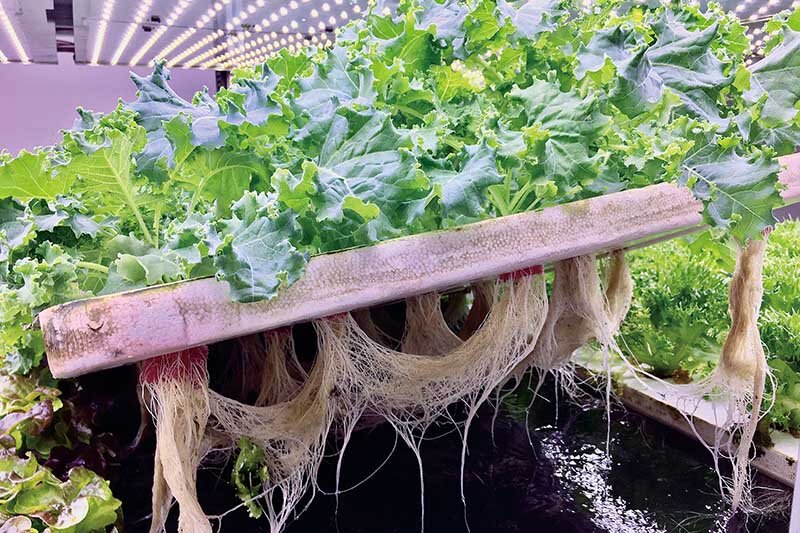
Exposed root system for hydroponically grown plants at YesHealth's iFarm in Taoyuan. Photo: Jules Quartly
After becoming a world leader in semiconductors and other electronic products, Taiwan is now looking to smart agriculture as its next vine to climb. The island aims to supply much of the world’s fruit and vegetables within the next 30 years.
This might seem rather unlikely until you consider that the future of farming is not land and labor but factories and robots. Furthermore, Taiwan already possesses in abundance the tools that tomorrow’s smart farmers will use, including solar and advanced light technology, chemicals, gene editing, drones, smart sensors, software, algorithms, data mining, and big data.
Many of these technologies are being put to use in a glittering new 14-story vertical farm at Copenhagen Markets in Denmark’s capital. The first phase of construction of the 7,000-square-meter facility finished in early December. It is one of Europe’s biggest and most efficient vertical farms and was built using a blueprint of patented technologies from Taiwan’s YesHealth Group.
The result of a partnership between YesHealth and Danish agritech startup Nordic Harvest, the farm looks like a fancy warehouse from the outside. The interior is fitted with rows upon rows and columns upon columns of trays containing leafy greens, growing under an intense battery of more than 20,000 smart LED lights. The plants are tended by engineers in lab coats and guided by software that processes over 5,000 individual data points to optimize plant health.

Rows of fresh produce grown under batteries of LED lights at iFarm. Photo: Jules Quartly
The LEDs provide variable spectrum light for 100 different kinds of plants, nanobubble hydroponics oxygenate the roots and inhibit bacterial growth, and liquid microbial fertilizers derived from oyster shells, brown sugar, and soy milk provide essential nutrients for plants and soil. Even the music played to the plants is science-infused, with classical or light jazz music ranging between 115 and 250 Hertz seeming to work best.
Production at the new vertical farm is set to begin in the new year and will scale up to around 3,000 kilograms of leafy vegetables per day by the end of 2021, equating to approximately 1,000 tons of greens annually. Crucially, unlike most farms, these figures are close to guaranteed since production is not at the mercy of climate, the weather, pests and disease, pesticide residue, nitrate levels, or hundreds of other variables that affect traditional farming.
According to Jesper Hansen, YesHealth Group’s Chief Communications Officer, the partnership with Nordic Harvest has been a productive one so far. It took just five months to install the farm and all the produce is pre-sold to ensure the operation is profitable by Q3 of 2021.
“This collaboration is just the start of a long-term journey together,” Hansen said in an email from Denmark. He notes that the two partners plan to expand to other Scandinavian countries over the next several years.
Hansen credits Taiwan for its efficient development of the technology and know-how to reproduce vertical farms all over the world and calls the Danish development “a crucial milestone in our international expansion.” He adds that the company is eyeing new partners in Europe, Asia, and the MENA (the Middle East and North Africa) region.
YesHealth is the brainchild of serial tech entrepreneur Winston Tsai, who started an LCD screen company at age 21. His “eureka moment” came after being diagnosed with liver cancer and partly linking his illness to pollution in foods. After recovering, he made it his mission to produce affordable, pesticide-free produce by harnessing the power of technology.
He founded YesHealth Agri-Biotechnology Co. Ltd. in 2011 and six years later established YesHealth iFarm in Taoyuan’s Luzhu District. The iFarm cultivates an ever-expanding range of leafy vegetables and herbs in a 2,500-square-meter warehouse factory. It produces 1,500 kilograms of leafy greens per day, a yield which the company says is 100 times more efficient than a traditional farm using the same space and requires only 10% as much water. In addition, YesHealth has a farm in China’s Shenzhen, which harvests up to 2,500 kilograms per day.

A tour of iFarm is well worth a visit and introduces the wide variety of plants grown there. Photo: Jules Quartly
YesHealth’s products are sold to major retailers both in Taiwan and abroad, including restaurants, hotels, and airports. Its stated aim is to supply a total of 7,000 kilograms of leafy greens per day worldwide in 2021.
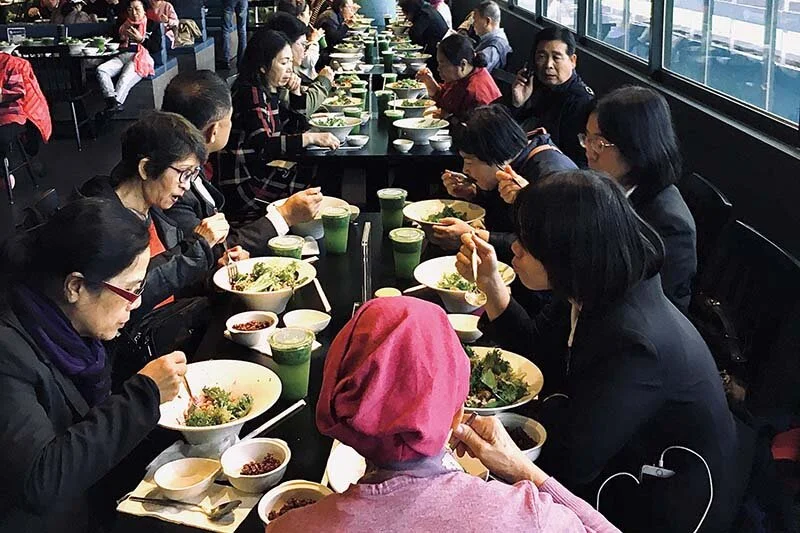
Diners enjoy a meal at iFarm’s restaurant, which overlooks the vertical farm. Photo: Jules Quartly
Having sampled the produce at the iFarm, I can confirm the arugula grown there is as tasty as any I have tried, while the lettuce and leguminous alfalfa is a perfectly clean, green, and crunchy eating experience – the result, I was informed, of an optimal growing environment and harvesting at exactly the right time.

A plate of salad featuring leafy greens grown at the iFarm site. Photo: Jules Quartly
In a sense, it’s back to the future for Taiwan, which had a largely agricultural economy up until the 1950s. Agriculture was one of the pillars supporting the nation’s economic miracle after World War II. With the help of mechanization and productivity gains, agricultural production at that time contributed around a third of Taiwan’s GDP.
In more recent times it has accounted for just 1.8-1.9% of GDP. That greatly reduced figure, which includes animal husbandry, fishing, and forestry, is not due to a decline in agricultural output per se, so much as the growth in manufacturing and the emergence of a pervasive service sector.
Taiwan has a wide range of rich, often volcanic soils that are exceptionally fertile, along with a subtropical climate that provides plentiful sun and rain. It is known as the “Fruit Kingdom” because of the quality of its fruit, with dozens of varieties ranging from bananas and papayas to wax apples and guavas. More than 100 kinds of vegetables grow all year round.
On the other hand, Taiwan’s mainly mountainous geography means just 25% of the land is suitable for farming. Meanwhile, climate change is affecting agricultural production by increasing summer temperatures and making rainfall more unpredictable. At the same time, considerable soil erosion, acidification, contamination by chemicals and heavy metals, and strong pesticide use have diminished soil quality over the last 50 years.
Furthermore, the proportion of Taiwanese involved in farming has rapidly declined, from 37% of the population in the early 1970s to the current 15% or less, according to the Yearbook of the Republic of China. Not only is the farming population declining, but it’s also ageing as well.
Those factors may not pose as much of an issue, however, since the old model of agriculture is being disrupted so dramatically that even economies of scale are being upended. Given the large size and advanced technology of the U.S., it may come as no surprise that it is the world’s biggest exporter of food as measured by value. Second on the list, however, is the Netherlands, which has just 0.045% the area of the U.S.
According to a National Geographic report in September 2017, the Netherlands’ achievement can be attributed to the work coming out of Wageningen University & Research, 80 kilometres from Amsterdam in the heart of Food Valley – the world’s agricultural equivalent of Silicon Valley in California. The university strives to come up with ways to increase yields and sustainability, and then to disseminate that knowledge.
New generation
With its strong background in information technology, Taiwan is in a good position to follow that example. The island manufactures everything required for what is known as precision agriculture, a farming management concept that uses IT to collect data from multiple sources as a means of increasing crop yields and boosting profitability. Taiwan is thus the ideal place for putting together prototypes relatively quickly and cheaply.
YesHealth, for example, makes its own LED lights through a local contractor rather than relying on a major manufacturer like Philips, which means it’s nimbler in terms of bringing focused, new tech to the market – and reaping the dividends. According to the company’s Program Manager, Dennis Jan, Taoyuan’s iFarm has the sixth generation LED lighting, while new iterations that are increasingly productive and energy-efficient are being rolled out on an almost annual basis.
The Council of Agriculture (COA) recognized some time ago the need for a precision approach to farming. In 2016, it developed the “Smart Agriculture 4.0 Program,” which was passed by the legislature a year later.
COA realized that the nation’s “calorie-based food self-sufficiency rate is relatively low” and that “shortages in food supplies and escalations in food prices” will inevitably occur as the world’s population expands from 7.5 billion to an expected 10.5 billion by 2050.
The Food and Agriculture Organization of the United Nations says that in order to meet the needs of all these additional people, about 70% more food needs to be produced. Gains achieved in improving crop yields have plateaued and are unlikely to rise again without a complete transformation of the agricultural landscape through the introduction of city farms, vertical farming, and the application of information technology.
In a written response to Taiwan Business TOPICS, COA commented: “With the rapid development of sensing technology, smart machinery devices, IoT, and big data analysis, smart agriculture has been growing in various fields.
“For example, it can monitor and control the production environment automatically to keep animals and crops in the best condition,” COA said. “It can predict harvesting dates and yields through data analysis and make adjustments to maintain a balance of production and marketing, and it can use smart automated machinery in agricultural operation to significantly reduce the labor burden.” Such uses, says the Council, “make agriculture more competitive.”
Fruitful results
Besides fruit orchards, other sectors that COA has included within Agriculture 4.0 include seedlings, mushrooms, rice, aquaculture, poultry, livestock, and offshore fisheries.
COA cites Taiwan Lettuce Village as an enterprise that has benefited from precision farming. The company halved fertilizer use but improved harvest efficiency 1.5 times by introducing a fertilization recommendation system, a harvesting date and yield prediction system, synchronous fertilizing technology, and transplanter and harvester technology.
According to COA the application of precision farming increased yield prediction accuracy by 5% and prevented 350 metric tons of overstocking. In addition, plant disease and pest control were improved through the use of a cloud-based system and machine learning algorithm. “The results were very fruitful,” COA concluded.
Agriculture 4.0 doesn’t just apply to the growing of produce; it also looks at the storage, transport, and export of goods. As an example, COA points to a relatively new fruit hybrid that was originally developed in Israel in the late 1960s. The atemoya – or pineapple sugar apple (鳳梨釋迦), as it is known in Taiwan – is a heart-shaped fruit with green, scaly skin. A cross between wax apples and the cherimoya (often referred to as Buddha’s head fruit locally), it has become synonymous with Taiwan and export success, much like the kiwi fruit and New Zealand.
Previously, 90% of the country’s atemoya exports went to China because it is so close. Later, the Taitung District Agricultural Research and Extension Station introduced a frozen whole-fruit technique that enables 95% of thawed fruit to have a “consistent ripening texture and dramatically improved the raw material quality.”
The technique involves a quick freeze to -40° Celsius, which inhibits bacteria, allowing the whole fruit to be transported at a fairly standard -18°C. After thawing, it can meet the rigorous food safety standards of Japan and South Korea.
Traditional farmers may harbor concerns about agriculture becoming a primarily manufacturing process, taking place under artificial light. However, Kevin Lin, Head of Business Development at YesHealth, insists that what the company is doing is still agriculture.
“This is nature; we are just optimizing it,” he says. “Sustainability is at the forefront of what we do, and our focus now is on ensuring the energy costs of vertical farming – such as heating and lights – are lowered and the source is sustainable.”
In this way, Lin says, Taiwan can produce cheap, healthy, and environmentally friendly food that can help feed the world, even as the global population approaches the staggering 10.5 billion mark.

* New Deadlines * Center of Excellence Announces: Indoor Farming "Best in Class" Awards!
Companies that score the highest in each category will be nominated for an “Indoor Ag Center Best in Class Award” (TM)
Center of Excellence Announces
Indoor Farming
"Best in Class" Awards!
Who Can Enter
Indoor Vertical Farms
Plant Factories
Greenhouses
Grow System Solution Manufacturers
Lighting Companies
How to Enter
Go to: https://indooragcenter.org/awards/
New Deadlines for Submissions:
Manufacturers: Feb 1, 2021
Growers: Feb 15, 2021
There Is No Fee To Enter
Companies that score the highest
in each category
will be nominated for an
“Indoor Ag Center Best in Class Award” (TM).
Learn More
Our vision is to accelerate the growth of the indoor farming industry. We believe we can do that by recognizing excellence. Consequently, we have embarked upon an ambitious program to collect bench-marking data on indoor farm operations and equipment used to run vertical farms and greenhouses. Each year we will review the data and publicly recognize key stakeholders for their excellence in several categories.

GROW Impact Accelerator Invites Applications From Startups Fostering Food Sustainability
This is a unique opportunity for startups operating in new frontiers of foodtech and agtech to supercharge their growth by tapping into a global network with GROW as their gateway to Asia and the world
January 19, 2021
GROW is based in Singapore, at the heart of Asia Pacific. Image credit: lena_serditova / iStock
GROW, the impact venture builder backed by AgFunder, is now accepting applications for its 2021 Impact Accelerator program. This is a unique opportunity for startups operating in new frontiers of foodtech and agtech to supercharge their growth by tapping into a global network with GROW as their gateway to Asia and the world.
This program marks the GROW Impact Accelerator’s second cohort, backed by AgFunder’s GROW Impact Fund. It will include bespoke coaching, mentor support, expert sessions, peer learning, and access to AgFunder’s unrivaled industry network to help businesses scale aggressively into new markets around the world. Successful applicants will receive US$200,000 in cash and in-kind investment on founder-friendly terms.
Agrifood is the sector where impact investors expect to increase their allocation the most over the next five years, according to the Global Impact Investing Network’s 2020 investor survey. Startups participating in the GROW Impact Accelerator will be given the tools to implement ESG principles and to track how their technology solutions help bring positive impact to people, place, and planet. We deliver a complete program that will provide access to experts, partners, potential customers, and impact-focused investors.
Last year, GROW ran its Singapore Food Bowl program, focused on accelerating early-stage startups that can contribute to local food security. Find out more here
Established to advance sustainability in the agrifood system through its support of extraordinary founders, GROW has designed the GROW Impact Accelerator program to propel not just commercial growth for participating startups, but personal growth for the entrepreneurs behind them. As venture capital investors we are in pursuit of profit, but GROW will also imbue in its alumni an ethos of doing well by doing good; one that will remain with them long after the program has finished.
The GROW Impact Accelerator is based in Singapore but will be conducted as a fully virtual program until international travel resumes. Applicants should have an MVP, be well on the way to establishing product-market fit, and should be operating in at least one market. Our interests stretch end-to-end across the agrifood value chain with a focus on technologies that allow for scalability while delivering on impact creation.
Invest with Impact. Click here.
Areas of particular interest for our 2021 intake include (but are not limited to):
Biotech and digitalization to advance sustainable agriculture;
Circular economies (eg, sustainable materials and closed-loop production systems);
Climate-smart agriculture and aquaculture (technologies for carbon emissions reduction, regenerative agriculture, water use);
Alternative proteins, innovative foods, and novel ingredients;
Food waste valorization;
Supply chain rationalization;
Technologies to support smallholder farmers (eg, robotics, decision support, chemical reduction, financial inclusion).
To encourage as diverse and representative a cohort as possible, GROW is especially interested in receiving applications from teams with at least one female founder.
You can find more detailed information and apply here.
Applications close on 28 February at 23:59 GMT+8.

“Agriculture Doesn’t Lack For Data – It Needs Better Organisation of Data to Feed 10 Billion”
"At Sensei Ag, we believe that indoor agriculture can transform the way we capture data about edible plants, help transform land and water usage at least tenfold through better use of that data, and be part of the critical new infrastructure of post-pandemic economies
As we look ahead to 2021, the challenge of overcoming Covid-19 still stands before us. The primary focus is on rolling out vaccines, but as worries about new variants come to the fore, we really do need to act at warp speed to get shots in arms and take additional measures if necessary.
To look at some of the challenges we face and some of the solutions we have in place, we asked a number of the world’s leading thinkers what their “moonshots” would be, and what grand visions for society we should pursue today.
Sonia Lo says: "Data is collected in the millions of data points every second around the world, in food and agriculture systems. In lesser developed economies, informational offers abound, to help even the smallest small-hold farmer. However, this is not relevant or helpful in the absence of the attendant ecosystem infrastructure of financing; robust, weather-resistant, and inexpensive physical facilities in which to farm; and real-time feedback for the farmers about their critical inputs. The world today is capable of imaging and analyzing every edible plant on the planet and yet there isn’t an international data infrastructure to be able to do that."
"At Sensei Ag, we believe that indoor agriculture can transform the way we capture data about edible plants, help transform land and water usage at least tenfold through better use of that data, and be part of the critical new infrastructure of post-pandemic economies. Organizing data across countries and providing unified data sets across climates and crops not only helps individual farmers but also enables a new generation of “agricultural fintech” which helps those farmers with much needed, but now, well-informed capital. Our vision is to enable the building of a multitude of indoor farm types – to stabilize food supply around the world but also t

2020 Shone A New Light On The Need For Container Farming
For us here at Freight Farms, the COVID-19 pandemic became a pivotal moment
Even A Pandemic Couldn’t Stop Us!
When the COVID-19 pandemic came to a head in March, we all felt a deep sense of trepidation. At the time, the future looked beyond bleak. We were all at the forefront of a completely new experience and it was up to us to figure out how to stay safe and continue to thrive in the ‘new normal’ world. For us here at Freight Farms, the COVID-19 pandemic became a pivotal moment. Would people still care about their source of food in the midst of a health crisis? Would individuals be looking to shift careers and lifestyles during such uncertainty?
The answer came right away: yes. The pandemic shone a spotlight on the key flaws within our food system and the need for a workplace revolution. We saw a tremendous growth of interest from people looking to make a positive and needed impact on their communities. We reflect on the year with immense gratitude for our community of farmers that continue to help us address pressing issues of sustainability and food security–we can’t wait to see all we can accomplish together in 2021!

Coimbatore’s Hydroponic Farm Delivers Fresh Greens Within Three Hours of Harvest
I grab a leaf of peppermint from a bed of mint leaves and taste the intense freshness.
Sustainable farming and fresh, zero-carbon food are the philosophy behind the city’s first urban hydroponic farm, located inside an industrial building campus. To know more, MetroPlus makes a visit
I grab a leaf of peppermint from a bed of mint leaves and taste the intense freshness. Next, I look at thyme and smell the powerful aroma. A little away, purple basil with a beautiful, coppery glow beckon. I crush a lemon balm leaf and take in the uplifting, mild scent.
I am at Parna Farms, Coimbatore’s first urban hydroponic farm, located right in the heart of the city at an industrial building campus. Spread across 3,000 square feet, it grows 2,520 plants.

Akhila Vijayaraghavan | Photo Credit: S Siva Saravanan
“Our fresh lemon balm leaves impart a subtle flavour and fragrance, making it especially nice for custards, jam and jellies, cakes and tea,” says Akhila Vijayaraghavan, owner of the farm. “The purple basil is used for colour in salads. Except maybe amaranthus and palak (spinach), you can eat all the greens we grow here raw,” says Akhila pointing to varieties of lettuce, basil, bok choy, and kale.
Asian water spinach (kang kong), red gongura, mustard leaves and methi (fenugreek) are some of the new additions. “We also grow dill leaves, which are used as a garnish for fish and meat dishes and pasta. Fresh peppermint extracts are used in baking. We constantly try new crops based on demand, after rounds of trial-and-error.”

Peppermint grown at the hydrophonic Farm | Photo Credit: S Siva Saravanan
A graduate of Molecular Biology from the University of Glasgow, Akhila ran her own environmental consultancy for over 10 years before turning an urban farmer. “I worked with a lot of companies, from pharmaceuticals to FMCG, and learnt that the supply of quality end-product is a difficult task. Agriculture has always been one of my passions; I was interested in food crops. A herb can be used in cooking, to extract oil, extract nutrients in dry form, and maybe in alternative medicine, perfumery… the possibilities are exciting,” adds Akhila.
She researched hydroponic methodology and educated herself on farming before diving into it. “Anyone can do it, it is not rocket science,” she says.
“Hydroponics combines both sustainability and technology. In indoor hydroponic cultivation, the control on nutrient supply ensures more quality products, for example, improved oil content in herbs, as well as better crop yield. A hydroponic mint has more methanol content than a soil-grown one. The system also uses 80% less water than conventional agriculture. The water is upcycled for reuse.”
At Parna Farms, greens are grown using the nutrient film technique (NFT), where a thin ‘film’ of nutrient-rich water with macronutrients like nitrogen, potassium, phosphorous and calcium nitrate, and micronutrients like manganese and zinc nourish the roots of the plants.

Seedlings at the nursery at the hydroponic farm | Photo Credit: S Siva Saravanan
The farm has a germination area that uses coco peat to sprout plants and a nursery where net cups (small planters) are filled with clay pebbles. There is also the growing system, which involves metal stands and PVC pipes attached to a covered nutrient tank that pumps water to the plants. “We incubate the net cups in a plastic tray for a couple of weeks. Once the plant grows roots, it is transferred to the main system with higher nutrients in the water. This is where it is fully grown and harvested,” explains Akhila.
Hydroponic agriculture, she says, has existed for over 3,000 years, with the Hanging Gardens of Babylon being one of the often-quoted examples of this technique. “It is one of the more accessible forms of modern agriculture, tackling the dual problems of water scarcity and shortage of farmland. It reduces soil-borne pests and diseases.”
Akhila says the objective is to ensure that customers get fresh, pesticide-free produce within three hours of harvest. “Though a palak bunch from here costs ₹130, they are willing to pay the premium to enjoy good health,” says Akhila, adding, “You are what you eat. In hydroponics farming, every day is a learning curve.”
Follow @parnafarms on Instagram to know more

Combining Hydroponic And Aeroponic In Vertical Farming
Growers are finding new ways to drive the efficiency up and the cost down, and one of these solutions is vertical farming.
Generally speaking, horticulture operations can be quite expensive to operate; yet, growers can rely on hundreds of years of knowledge to improve the efficiency, so that those costs go down. At the same time, indoor farming cannot rely on such knowledge, and it is not uncommon to see cultivation facilities with huge bills at the end of the month. As the industry matures, growers are finding new ways to drive the efficiency up and the cost down, and one of these solutions is vertical farming.

LED technology
Nowadays, LED technology has made a huge leap forward, and Alvis Ma, the CEO of GrowSpec claims they are the industry standard. “Growers generally make the switch from HPS to LED for three reasons: increased yield, improved cannabinoid, and terpene content, and energy efficiency,” he explains. Thus, LEDs allow for vertical cultivation, which has a host of benefits, especially when it comes to space optimization.
“The VetriAero Planter system uses a mobile planting rack that reduces the ‘required’ indoor grow space area and extends the plant cultivation space by multiple tiers, maximizing growth space, increasing the yield and thus the profit,” Alvis Ma points out. “And if a grower wants to use one rack only initially, other tiers can be added later on: the helves can be connected to one another so that growers can modify the VetriAero Planter system length according to the size of the room.”

A very peculiar feature of this system is the integration of both aeroponic and hydroponic methods. “Instead of growing in soil, the roots are suspended in mid-air and surrounded by oxygen,” he adds. “The plant roots get misted directly with a nutrient-dense solution that gets sprayed to the roots every 3-5 minutes. At the same time, the remaining liquid at the bottom of our container ensures that, in the event of an emergency, there is still enough nutrient-dense liquid to sustain your plants for up to 48 hours.”
“Commercial indoor cultivation operations can be very expensive,” says Alvis Ma with GrowSpec. “And if you look at the cost of the real estate, added on top of substantial
power bills and staffing requirements, it becomes critical to find a way to increase profit and reduce overhead costs.” Exactly to respond to such a demand, GrowSpec has developed the VertiAero Planter system, a new vertical growing system. “One of the primary reasons why vertical farming is so attractive for growers is the improved performance of current LEDs,” Alvis Ma continues. “This is something that could not happen back in the day, as HPS has been the go-to lights for decades, and they produce a lot of heat; generally speaking, the plants have to be placed a couple of feet away from light to stay safe and healthy.”
Controlling the environment
Indoor growing, especially vertical growing, requires a particularly efficient airflow system to guarantee healthy growth for the plants. This has direct consequences on the growing environment. “Maintaining optimum temperature, humidity, and air circulation is challenging for all cannabis operations,” Alvis Ma remarks. “But in vertical growing, there is even more variability in macro and micro environmental conditions, because more plants make control more difficult.
That’s why the GrowSpec VertiAero’s multi-layer airflow solution improves the airflow rate in the micro-environment of the plant canopy by maintaining consistent plant canopy temperature and humidity, reducing the cultivation potential of harmful pathogens, and increasing the rate of photosynthesis by evenly distributing CO2 over the plant canopy. The system utilizes various sensors to detect crucial data points such as moisture change, for instance.”
Although such a system might sound complicated to use, user-friendliness and easiness of use are very well implemented. “The VertiAero Planter system integrates intelligent control and touchscreen control system so that your business can save up exponentially on overhead costs,” Alvis Ma points out. “At our core, we operate according to the highest standard, combining this with technology that respects our planet.”
For more information:
GrowSpec
Yuxin Industry Zone, Shishan Town, Nanhai, Foshan, Guangdong, China
+86-15914220731