


Welcome to iGrow News, Your Source for the World of Indoor Vertical Farming

USA: GEORGIA - Fresh Vegetables From UNG's Garden Feed Lumpkin County Students
A portion of the summer produce was frozen for future use, which helped the school's finances this academic year. Knight-Brown explained the school nutrition program's budget has suffered because of the COVID-19 pandemic
September 16, 2020 by J.K. Devine
Dr. David Patterson, associate professor of biology at UNG, and Julie Knight-Brown, school nutrition director at Lumpkin County Schools, harvested vegetables from the gardens at the Vickery House on UNG's Dahlonega Campus. The fresh radishes, tomatoes, onions, and an assortment of herbs from UNG's gardens were delivered to Lumpkin County Schools and were integrated into school lunches.
As school nutrition director at Lumpkin County Schools, Julie Knight- Brown learned some surprising news about elementary school children.
"The little kids love radishes," Knight-Brown said. "One of the parents thanked the café manager at Long Branch Elementary for introducing her children to radishes. She said, 'They loved them.'"
Fresh radishes, tomatoes, onions, and an assortment of herbs were a few items the University of North Georgia (UNG) supplied the school system this summer and into the fall. The vegetables and herbs were grown and harvested from the gardens at the Vickery House and Appalachian Studies Center on UNG's Dahlonega Campus. The fresh produce was delivered to Lumpkin County Schools and has been integrated into school lunches.
"We started in July and harvested on a weekly basis," said Dr. David Patterson4, associate professor of biology who spearheaded the project.
Knight-Brown said some of the produce such as cherry tomatoes and radishes have been a "featured" vegetable at a school or offered as a side dish in the cafeteria. Other items such as onions were incorporated into other meals while herbs were used for their flavor.
A portion of the summer produce was frozen for future use, which helped the school's finances this academic year. Knight-Brown explained the school nutrition program's budget has suffered because of the COVID-19 pandemic. She said the donations from UNG's gardens happened at an optimal time.
"All school nutrition programs are facing the same financial dilemma," Knight-Brown said. "We will happily take any donated fresh produce."
Lumpkin County Schools is not the only beneficiary of the Hometown Harvest program. UNG students in need of service-learning hours can get their hands dirty in the gardens. Patterson said between five and 10 students helped harvest the produce this summer.
Two more students, Amelia Arthur and Zach Pilgrim, have been involved in a precision agriculture research project funded by UNG's Center for Undergraduate Research and Creative Activities6 (CURCA). The primary objective was to test the impact of a precision agriculture system in small-scale gardens as a means for increasing food production for students in need.
"They took the garden from seed to production," Patterson said. "They also collected the data, which we are analyzing now."
In the meantime, the gardens have been turned to produce fall vegetables for Lumpkin County Schools. Leafy greens and broccoli seeds have been sown. The only missing element this fall is more volunteers.
Fresh produce from the gardens at the Vickery House and Appalachian Studies Center on UNG's Dahlonega Campus were delivered to Lumpkin County Schools and integrated into school lunches.
"The gardens at the Vickery House have always been viewed as an heirloom garden," Patterson said. "But now we have determined how to integrate consistent food production with seed-saving techniques. Now we need more UNG and community involvement."
He said some volunteer opportunities could be as simple as watering the garden or turning over the compost. Pulling weeds may take a little more effort and knowledge, Patterson said.
"Some students may have trouble knowing the difference between an onion stem and a weed, but we are there to help," he said.
To help with the Hometown Harvest, contact:
Patterson at david.patterson@ung.edu or
Knight-Brown at julie.knightbrown@lumpkinschools.com.
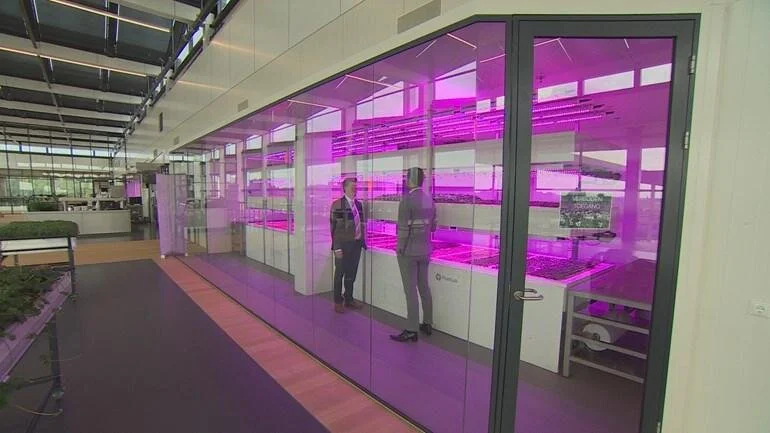
Abu Dhabi To Be Home of World’s Largest Indoor Farm
Project will be developed in three phases and is expected to produce 10,000 tonnes of fresh produce per year
September 27, 2020
Project Will Be Developed in Three Phases And is Expected to
Produce 10,000 Tonnes of Fresh Produce Per Year
The largest indoor farm in the world is set to take shape in the desert of Abu Dhabi, following a joint venture (JV) deal between GrowGroup IFS from the Netherlands and RainMakers Capital Investment from Abu Dhabi.
The project is expected to cost $177m and is planned in different phases over the course of three years. Phase 1 will be operational before Expo 2020 Dubai in October 2021, so GreenFactory Emirates can show the world its innovations, the statement said.
The GreenFactory Emirates is expected to produce 10,000 tonnes of fresh produce per year, on a plot of 17.5 hectares and a cultivation area of 160,000 sqm. The company says it will develop innovative indoor farming with the world’s most advanced indoor growing system from the Netherlands. It is a combination of vertical and flat farming and solves the normal cultivation restrictions due to extreme climates in regions like the UAE.
The facility is expected to involve numerous agro-technological companies in its construction as best of breed for each component will be sourced through top-tier Dutch companies. It is now possible to cultivate high-quality vegetables 100% pesticide-free, all year round and anywhere on the planet, the statement noted.
“The private sector plays a vital role in the transition towards more sustainable food systems. Private sector organizations have entrepreneurial traits that drive innovation. They possess the qualities necessary to disrupt existing non-sustainable agricultural systems,” said Mariam Hareb Almheiri, Minister of State for Food Security.
She added, “The UAE is applying concerted efforts to improve its domestic production of food, with agricultural technology – ‘AgTech’ – having a hugely important role to play. In fact, key targets of the government’s National Food Security strategy launched in November 2018 are to generate a 30% yield improvement from technology-enabled production and for the UAE to become a world-leading hub in innovation-driven food security by 2051. Indoor farms such as GreenFactory Emirates are instrumental in helping us reach these goals.”
The JV also plans to build other indoor farms in other regions of the world, where extreme climates are a challenge to normal cultivation, the statement explained.
RELATED ITEMS: ABU DHABI, AGRICULTURE, FARMINGN, FEATUREDNEWS, GROWGROUP IFS, JOINT VENTURE (JV)
Worldwide Horti Lighting Industry To 2030
The worldwide population is expected to increase to 8.5 billion by 2030, from 7.7 billion in 2019, as per the United Nations Department of Economic and Social Affairs (UN-DESA). Additionally, the disposable income of people is also rising, and the two factors are together resulting in a growing demand for food products
21-09-2020 | Cision PR Newswire
DUBLIN- The "Horticulture Lighting Market Research Report: By Type, Technology, Cultivation, Application - Global Industry Analysis and Growth Forecast to 2030" report has been added to ResearchAndMarkets.com's offering.
The worldwide population is expected to increase to 8.5 billion by 2030, from 7.7 billion in 2019, as per the United Nations Department of Economic and Social Affairs (UN-DESA). Additionally, the disposable income of people is also rising, and the two factors are together resulting in a growing demand for food products.
To increase the yield, by making the best use of the available land, several countries are developing indoor farming techniques. Thus, with the population boom, the revenue generated in the global horticulture lighting market is expected to rise from $3.2 billion in 2019 to $20.3 billion by 2030, at a CAGR of 18.1% during 2020-2030 (forecast period).
Light-Emitting Diode (LED) to Dominate Market during Forecast Period
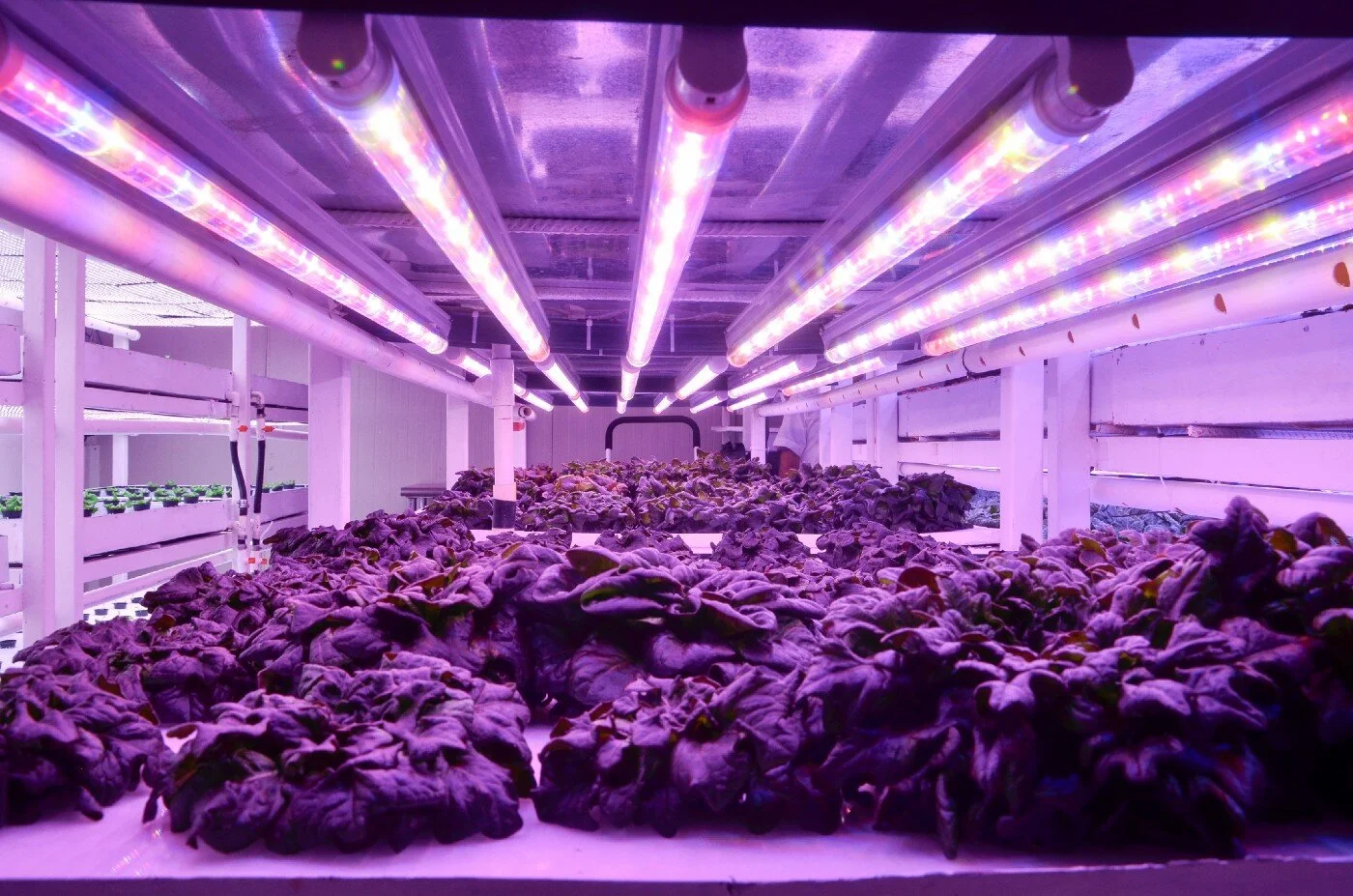
Till 2030, LED would continue holding the largest revenue share in the horticulture lighting market, as this technology is quite cost-effective and lets farmers control the light intensity to suit different plants and crops. These factors are resulting in a high adoption of LED lights in greenhouse and indoor agricultural processes.
During the forecast period, the flowers bifurcation is expected to witness significant horticulture lighting market growth, as the demand for flower buds and cut flowers for decorative purposes is surging. From 2017, the exports of such products rose by 2.5%, to garner $6.6 billion in revenue in 2018, as per Trade Map. Currently, Europe's flower exports account for the highest revenue, followed by Latin America (LATAM), Asia-Pacific (APAC), Middle East and Africa (MEA), and North America.
In 2019, top lighting dominated the horticulture lighting market, as this type of lighting is vastly used for vertical farming, wherein the lights are placed close to the plants. Similarly, in indoor farming, the lamps and bulbs are suspended for the ceiling, because it creates optimum conditions for the growth of plants.
In the coming years, the fastest growth in the horticulture lighting market is projected to be experienced by the indoor/vertical farming division. The rapid increase in population and urbanization rate is leading to the shrinking of cultivable land, which is forcing the agrarian community to adopt indoor farming methods. Additionally, farmers are being offered financial support, to install vertical farms, by companies such as Toshiba Corporation and Panasonic Corporation.
Europe was the largest horticulture lighting market during the historical period (2014-2019). This is because it is the largest exporter as well as producer of fruits, flowers, and vegetables around the world. During the forecast period, the highest CAGR, of 21.1%, would be experienced in Asia-Pacific, owing to its increasing disposable income and population. Further, as a result, the reducing arable area, numerous countries in the region are looking at modern farming techniques, such as indoor horticulture, greenhouse, and vertical farming.
Market Players Strongly Pursuing Client Wins to Better their Position
In the recent years, several players in the horticulture lighting market have successfully pursued client wins to increase their sales and strengthen their position in the industry. For instance, a Canadian licensed producer of recreational and medicinal marijuana selected LumiGrow Inc. as its LED lighting partner in May 2019, for its six-acre cannabis greenhouse expansion project.
Similarly, in October 2019, Heliospectra AB received a $7.46 million (SEK 72 million) order for its MITRA LED lights from Nectar Farms in Victoria, Australia. The lights will be installed at a tomato-based glasshouse at Nectar Farms.
The competition in the global horticulture lighting market is primarily among Cree Inc., Samsung Electronics Co. Ltd., Lumileds Holding B.V., EPISTAR Corporation, Everlight Electronics Co. Ltd., Osram Licht AG, Broadcom Inc., Signify N.V., Illumitex Inc., Hubbell Incorporated, Hortilux Schrder B.V., LumiGrow Inc., General Electric Company, and Heliospectra AB, as they are the largest companies in the domain.
Click here for more information.
Media Contact:
Research and Markets
Laura Wood, Senior Manager
press@researchandmarkets.com
For E.S.T Office Hours Call +1-917-300-0470
For U.S./CAN Toll-Free Call +1-800-526-8630
For GMT Office Hours Call +353-1-416-8900
U.S. Fax: 646-607-1907
Fax (outside U.S.): +353-1-481-1716
SOURCE Research and Markets

Meet The Urban Greenhouse Developers of The Future
Create a liveable and healthy environment for urban dwellers, ensuring that a city can feed itself sustainably. That's the premise of the Urban Greenhouse Challenge, the second edition of which ended in August with the announcement of the winners
Urban Greenhouse Challenge'2 participants share experiences
Create a liveable and healthy environment for urban dwellers, ensuring that a city can feed itself sustainably. That's the premise of the Urban Greenhouse Challenge, the second edition of which ended in August with the announcement of the winners. We spoke with the three winners, Team Bagua, Team KAS and TeAMSpirit about their journey through the challenge of designing an urban greenhouse in Dongguan, China.
Chinese symbolism
Gabriel Malaquin and Olivia Manzart are two of the members of Team Bagua, which took first place in the challenge. "We wanted to value China’s agricultural history and culture. We need to reinvent agriculture to have a lower environmental impact and Dao inspired us to take the strengths of traditional agriculture and merge with innovation and technology. Dao represents the importance of flow and flexibility and we think this is key to finding local solutions to urban farming", they describe the inspiration behind their concept.
"What else than a popular Chinese symbol to represent what we want to be one of the next wonders of Dongguan? When we think of any Chinese symbol, we think of Bagua. The symbol is an important precept of Taoism. Composed of 8 different earthly and godly elements to showcase duality, and represents the importance of flow and flexibility.
"When we learnt more about the symbol and what it meant, we found it incredibly close to what we wanted to create. From our desire to both use technology and traditional techniques, to the need to create circularity of energy and wastes. We created our project following what the symbol meant, hence the name Bagua."
Team Bagua concept art
Third-place winners TeAMSpirit also took inspiration from Chinese mythology, although in their case the design came before the symbolism. Their Turtle design surely catches the eye, but they didn't come up with a turtle at first, explains team member Annie Berendsen. "Initially, we started off with the different functions we had in mind: public space, crop production and research. This came with an open ground floor, a big dome and a cubical. After the first design phase, we decided to 3D-print our building. When we began exhibiting our model, we repeatedly received comments that it resembled a turtle. The team really didn’t know what to think of this at first, but luckily our two Chinese members explained its symbology within Chinese mythology, and we realized just how relevant the turtle was to our concept. They explained that it represents wisdom, longevity and a long life, which perfectly encapsulated what we strived for with our resilient greenhouse. So that’s how the turtle found us!"
TeAMSpirit
Circularity
An important factor in Team Bagua's design was circularity. "Fertilizer inputs and leachates are key environmental issues in current agriculture and our solution was to produce all nutrient requirements of the crops onsite", Gabriel and Olivia explain. "Through using local agricultural and household organic waste we transform it into high quality substrate and nutrient solution using a biodigester. Our greenhouse design maximizes the use of sunlight to grow crops to reduce the need for nonrenewable energy to run LED lighting. Using new solar shade panels and a biodigester, Bagua can produce a significant proportion of the energy needs of the building."
Team Bagua concept art
From the architectural side, they proposed the use of materials that met a specific criteria that helped guarantee circularity in the building. "For example, we wanted the materials to be locally produced. The materials also had to be lightweight and highly resistant in order to minimize the amount of material and to reduce the foundation needed to support the building."
Architectural challenges
Speaking of architecture, combining food production with a community center of sorts comes with a number of challenges. For Team Bagua, the main challenge was to design a project that combined efficiently the production of quality food with spaces for social interaction and learning. "In addition, using local resources and materials, and making it a low environmental impact building was also a large challenge", Gabriel and Olivia say. "Having Dongguan (China) as the location of the project, we needed to work in a geographical and cultural environment very different from where most of the team are from. In addition we were a very diverse group of people, which reinforced our main concept: Bagua, the Taoist philosophy of adapting. With the project we sought not only to adapt to the neighborhoods and local areas, but also to adjust to their different activities and needs. For this reason we proposed a flexible building with multi-purpose areas that could evolve over time or adapt to the new use that the city requires."
Team KAS, runners-up in the challenge, put emphasis on two main things in their design: uniqueness and profitability. "Of course, sustainability and circularity are considered and incorporated as the bases, but we really wanted to create something feasible and realistic. The given space for the indoor food production system was limited; therefore, it was a natural choice for us to incorporate indoor farming production systems such as hydroponics and aeroponics", Kyungchun Kim tells us on behalf of the team. In the beginning, they were considering other choices such as herbs, medicinal plants, and microgreens. "However, according to our calculation, these choices weren’t even enough to break-even our initial investment in a span of 10 years." So, after a series of meetings, they finally came up with alternative options, which were high-value crops such as ginseng and dragon fruit.
Team KAS
Because the challenge site was separated into two big areas, which were the construction site and the basic farmland, the total area of the challenge was big with about 30,000 m2, but the majority was the basic farmland, which they were only allowed to build any construction in less than 5% of the land. "The basic farmland was a huge opportunity to miss out on if we didn’t cultivate anything on it", Kyungchun says. "Therefore, in order to maximize the total profit (by cultivating on the basic farmland), we lowered the building height (in order to prevent the sunlight blockage by the building) and implemented the cross cultivation system to ensure a yearlong production. We also invented a foldable greenhouse that can be deployed anywhere in the basic farmland, to protect our crops from the harsh environment of the Dongguan area."

For TeAMSpirit, one of the most pressing challenges was also attempting to merge all the different activities and ideas that the team came up with. "Being such an interdisciplinary team, all of us had exciting ideas on what the building should be, ranging from innovative aquaponic systems to sustainable building materials and circularity systems. The synthesis of all these ideas into a functional concept was challenging but proved itself extremely rewarding by the end of the competition."
Coaches help close the gap
During the Challenge, the teams had to solve a range of important challenges to ensure they were meeting environmental, social and economic sustainability of the project. Fortunately, they got some help from the coaches. "We are a team of 10 students. Even with the best intentions in the world, we would not have been able to answer the key objectives and criteria of the Challenge without the help of the coaches", Gabriel and Olivia tell us. "We were able to talk to people that have been working in the industry for decades, and that confronted the same concern as us during their careers. Incorporating all aspects in the greenhouse was complex, but was made easier with the support of professionals. The coaches were able to steer us in the right direction or provide constructive feedback on new technologies and ideas. For example, coaches made sure our ideas were not premature concepts and were backed up by evidence, which helped a lot with being confident and trusting our ideas."
Kyungchun agrees: "It truly was an amazing experience working with all the coaches. Meetings with them were constant eye-opening moments, and they really helped us to think from a practical perspective. We were also feeling relieved after the meetings, as we got our what-ifs validated by the experts and coaches, which became a huge motivation to power through the 'un-tacted' COVID-19 era."
A view of Team KAS' project. The building was developed based on the Lingnan style, and it merges the surrounding landscape and the indoor food production in an attractive way.
Thomas (Zhuzi Ye), another member of Team KAS, adds that "thanks to the powerful social network of WUR, the experts who established contact with us and provided us with advice are all veterans in this industry. They gave very specific and constructive feedback on our proposal. In the meeting with our coaches, they answered our questions generously. Their professional attitude and perspective of thinking made me realize that there is still a gap between what I learned in the 'ivory tower' and the industry's needs. In addition, their enthusiasm for helping us makes us have high hope for this industry."
A look inside 'The Turtle' of TeAMSpirit
TeAMSpirit also received a lot of guidance and feedback from the various coaches and experts, as team member Tearlach Barden also says. "Firstly, our team’s coach Alexander Laarman was able to connect us with relevant experts in the myriad of academic fields that were required for the competition. The advice received from the experts allowed us to address the interdisciplinarity of the competition and helped us compartmentalize within our sub teams. For instance, within the plant production sub team, we were able to collaborate with Parus and create an optimized lighting scheme that fit our multi-seasonal greenhouse."
Engaging the community
As the first prize winners, Gabriel and Olivia share that they are super excited about the prospect that Bagua urban greenhouse will be built in the Marina Center Agriculture Park (CAP project), Dongguan, China. They are currently waiting to hear more specific details about the next steps.
When that time comes, The Bagua will not only be a food production plant. It has been designed as a landmark for social integration and diversity, which, Olivia and Gabriel expect, will also entice investors to jump onboard the project.
The Bagua urban greenhouse
The project will work with schools to get children and young people to understand where their food comes from and be a part of the Great Food Transformation. "We want people to be enthusiastic about new agricultural solutions, by teaching them important and meaningful skills, and to improve the image of farmers in China, considered lower-class", they explain. This way, Team Bagua aims to bridge the gap between the richer and poorer population in Dongguan.
Through the Bagua game app, they also aim to get the next generation excited about agriculture. The app engages people to understand the challenges farmers face, while being interactive and fun. And through the Bagua Prospective Producers Program, the next generation will be inspired to get involved in agriculture.
Bagua will also have a variety of programs that the local community can get involved in, whether it's cooking classes, a community garden, exercise classes or eating at the 0km restaurant. By bringing food waste to the Bagua or volunteering, consumers are rewarded with points, which they can then use to buy produce in the vegetable and fruit shop - another way to reduce food insecurity and help those most disadvantaged living in Dongguan.
Inside view of Team Bagua's greenhouse
Team KAS also tried to engage the local community in their project, Kyungchun explains: "For instance, we created a membership app, where our members can actively participate in our production system, monitor what we do, and even vote for what we should grow. We also have onsite attractions, where locals can experience cuisines made with our own produce, visit the food production system, and learn more about the new and future farming in our education program."
TeAMspirit went for a reward system not unlike Team Bagua's. Tearlach: "Our ‘Living lab’ connects stakeholders, researchers and the local community together. This collaboration was also done through our ‘Turtle Eggs Currency’: a currency system that encourages the people of Dongguan to provide green waste to the building that can be transformed into biogas and energy. The ‘turtle eggs’ that the people receive from this can be used to receive discounts in other local sustainable businesses."
The future of food production
The project designs for the site in Dongguan could be considered a blueprint for the future of food production. "We need to change the way we do agriculture to have a lower environmental burden", according to Olivia and Gabriel. "Climate change poses significant challenges for the future of growing food and feeding a growing urban population. Food production must change to be more circular, maximising local resources, closing nutrient loops, and minimising external inputs. Through circular economy, we believe it is possible to create a more localised food production system that is profitable, has a low environmental impact and improves livelihoods. Urban farming will not replace field production, but it plays an important role in feeding growing cities more sustainably. We see urban farming and field food production working together to change practices to reduce soil erosion, improve water management, reduce phosphorus and nitrogen water pollution and ultimately reduce the environmental burden of agriculture."
COVID-19 also highlighted the need for local, affordable food production, Olivia and Gabriel argue. That's why they tried to make the greenhouse as closed as possible, so pests would not enter. "We can grow food without pesticides; people are concerned with quality and food safety. With a semi-closed greenhouse we can produce the highest quality, safest food for less money, to make it available not only to richer populations. We didn't just want to make healthy safe food, but make it affordable."
Kyungchun agrees, saying that the future of food production is at risk. "Western countries, such as the Netherlands are very progressive in investing in the future of food production, however, not many countries in the world are. They lack knowledge, skills, resources, and infrastructure. Innovation is very important, but implementation is as important. Therefore, it is critical for our generation to go out to the world and think about the ways to feed the world. This challenge was a stepping stone for me to think of that question in a practical manner, and I am happy to learn through this project that there are many like me."
Thomas adds that there is still a lot of room for future improvement in the food production system. "The market’s demand for the quantity and quality of food is constantly increasing. But the bottleneck of the current industry of food production has been touched for a while. How to adapt the information technologies such as big data, AI, and IOT in food production, and the optimize the energy consumption of food production (such as artificial lighting) would be a foreseeable breakthrough in the near future."
Team KAS concept art
Tearlach also sees the future of food production moving away from centralised corporate supply chains and back into local communities. "While this statement may have seemed outlandish just a few months ago, I hope, and believe, that the recent effects of the COVID-19 pandemic have revealed just how vital a system such as this is today", he says. "Rather than transport our farmed food across vast areas of land, releasing millions of tonnes of carbon dioxide as we do it, perhaps we could introduce small-scale dispersed areas of land dedicated to innovative farming. These could potentially be greenhouses that incorporated reliable agricultural technologies such as vertical farms and aquaponic systems that would maximise the output of food to the communities in the surrounding area. Ideally, these closed systems would help us begin to move away from intense factory farming and closer to an approach that better mimics a natural and balanced ecosystem."
Another view of TeAMSpirit's project
Branching out in the industry
Ultimately, the end of the Urban Greenhouse Challenge'2 is just the beginning for many of the participants. "The project has made us excited about the future opportunities within urban agriculture. Many of us are interested in working for companies that push agriculture to the next level", Olivia shares. She is starting her own farm and is excited to implement key concepts from Bagua into a passive solar greenhouse to grow microgreens.
"We believe that one of the keys to a sustainable and healthy future is to focus on food security and availability in urban areas. We are passionate about this and a few team members would love to be part of such projects in the near future. Please contact team Bagua if you have a project that addresses this and we can provide resumes."
Team Bagua's design incorporates the map of China in the grounds surrounding the building as a community garden
Kyungchun and his team are also working on further developing a few of the ideas from their project. "We really see the value of our creations and we know we can contribute in the future of farming. For me, I am currently working on creating new teams for two different projects. I absolutely loved the energy and the creativity that flew out of this project, and, most importantly, I learned a lot. Hopefully, I can be on another HortiDaily interview, with a different project."
The members of TeaAMSpirit are also eager to branch out in the industry, as Tearlach tells us. "We are currently contemplating our future steps and discussing how the framework of our concept may potentially be applied elsewhere. For instance, the outside space of our building was a space dedicated to low cost reliable farming practices that could be applied more universally than the costly innovative technologies that were a focus in our indoor production. Consequently, it is a personal goal of mine to expand on this idea, and potentially come up with a global framework that encapsulates the reliability of traditional farming with innovative low-cost practices. This could be particularly impactful in impoverished communities if such a framework utilised the knowledge of locals to native plant species as well as provided education on how to implement this knowledge through new technologies."
For more information:
Team Bagua
Gabriel Malaquin
malaquin.gab@gmail.com
Olivia Manzart
oliviamanzart@gmail.com
Team KAS
Kyungchun Kim
kyungchun.kim@wur.nl
TeAMSpirit
Tearlach Barden
tearlachbarden37@gmail.com
www.instagram.com/teamspirit_ug
Publication date: Tue 22 Sep 2020
Author: Jan Jacob Mekes
© HortiDaily.com

Basil Production In Horizontal or Vertical Aquaponic Systems
The main objective of this work was to compare basil production between horizontal and vertical decoupled aquaponic systems and assess the utilization of supplemental lighting in a greenhouse environment
Source: ECB
Aquaponic facilities allow the joint production of fish and plants in a reduced space. This hydroponic technique, combined with vertical farming, is not well studied. The main objective of a recent work was to compare basil production between horizontal and vertical decoupled aquaponic systems and assess the utilization of supplemental lighting in a greenhouse environment.
Six independent vertical racks were arranged with hydroponic trays at three heights. Three racks were affixed with LED lighting on the lowest levels and three with supplemental lighting on the intermediate level. Immediately adjacent to the vertical systems, two independent horizontal systems containing three trays were constructed to compare basil production.
After 35 days of growth post transplanting, the total production per tray and weight, height, number of leaves, and nodes of 20 selected plants per tray were determined. Records of the intensity of illumination photosynthetic photon flux density (PPFD)) were recorded at dawn (8:00), noon (12:00), and dusk (18:00) at randomly predetermined positions associated with the 20 selected plants per tray.
The total basil production in the experiment was 58.79 kg, with an average production per unit area of 2.43 and 0.94 kg m−2 for vertical and horizontal systems, respectively. Productivity per unit area in the vertical systems was 160% greater than in horizontal systems. A significant effect of lighting, the height of the tray, and plant position inside the tray was found on plant growth parameters.
Optimization of light source distribution and tray orientation can enhance the productive performance in vertical aquaponic systems. Electricity cost associated with supplemental lighting per kg of production increment was 21.84 and 12.25 $ kg−1 for the bottom and intermediate levels of the vertical system, respectively, the latter being economically the most profitable.
Agronomy 2020, 10(9), 1414; https://doi.org/10.3390/agronomy10091414
by Víctor M. Fernández-Cabanás 1,*,Luis Pérez-Urrestarazu 2,Alexes Juárez 3,Nathan T. Kaufman 3 andJackson A. Gross 3
1 Urban Greening and Biosystems Engineering Research Group, Departamento de Ciencias Agroforestales, Universidad de Sevilla, ETSIA, Ctra, Utrera km.1, 41013 Seville, Spain
2 Urban Greening and Biosystems Engineering Research Group, Area of Agro-Forestry Engineering, Universidad de Sevilla, ETSIA, Ctra, Utrera km.1, 41013 Seville, Spain
3 Department of Animal Sciences, University of California, Davis, Davis, CA 95616, USA
Author to whom correspondence should be addressed.
Received: 29 July 2020 / Revised: 10 September 2020 / Accepted: 14 September 2020 / Published: 17 September 2020
(This article belongs to the Section Horticultural and Floricultural Crops)
View Full-Text Download PDF Browse Figures Cite This Paper
Keywords: decoupled aquaponics; vertical farming; hydroponics; basil; artificial lighting
Source: MDPI.

Nicola Kerslake Elaborates On Frequent Struggles of Indoor Farmers Looking For Funding
Contain is a Fintech platform for indoor agriculture. Founded on the observation that 75% of indoor growers are looking for funding and that many won’t receive it from traditional agriculture banks and traditional business banks
Investors perception: “Cute Millennials With A Container Farm”
Contain is a Fintech platform for indoor agriculture. Founded on the observation that 75% of indoor growers are looking for funding and that many won’t receive it from traditional agriculture banks and traditional business banks. “The question for us is: ‘how do we help indoor farmers find the best funding options?’ We have an automated leasing platform where indoor farmers can come in and begin their application. Our algorithms match them to a pool of, currently, 18 lenders. This ranges from small two-person shops to some of the largest banks in the world”, Nicola Kerslake, Founder, and CEO of Contain says.
The company aims to work with anyone on the indoor farming side and want farmers to understand their odds. “We are aiming to build long term relationships with growers so we can maintain that relationship. We’re always by the client’s side during the whole process.”
Nicola Kerslake (Source: Larta Institute)
A 60-pages business plan
Most investors live in a rule-based world so they have to fulfill a series of criteria in order to sign a lease. A lot of indoor farmers don’t look like what they’ve seen before. On the other side, the company sees a lot of people who are not accustomed to dealing with commercial lenders. They don’t understand the criteria.
“We’re trying to help farmers become familiar with, what position they need to be in before they sign a lease. We have a calculator on our website that figures out the odds of getting a lease through us. Next to that, there’s a medium blog that walks through the criteria. A common thing we see is that farmers think they don’t need much deposit, which is not true within commercial leasing. You typically need at least 20% down. Another thing we see is that farmers approach it as an equity investment. Lenders are mostly not interested in a 60-page business plan. Their rules are around different things. Such as knowing that there’s enough equity so the farm will make it through the scale-up period and opening period.”
Attract lenders’ attention
Kerslake continues: “We encourage new growers to start small, which is a lot more interesting for a lender. Rather than a grower aiming to build a five-million-dollar greenhouse with no track record of farming. Coming back to the 60-page business plan, it’s too complicated for a lender to get a business plan. Many growers haven’t grown before. Prove to lenders that you can have a reliable product shipping. Later on, you can enhance your business with solar, retail, and various other features.”
Preferences and financing needs
At this point, Contain has been in touch with around 400 growers in the region. The company learned a fair amount about their financing needs and preferences. The relationship between the grower and the lender is defined through algorithms. That definitely helped with lenders. Kerslake adds: “The other piece we learned through pattern recognition is, what it takes to get a lender comfortable with the industry. Part of in the way leases are priced, depends on the novelty of the industry. Particularly, with regards to equipment and farmers on the lenders’ part. More established equipment and farmers typically get offered better rates.”
“We are very upfront with lenders on what the industry is and isn’t, as a part of the educating piece. Indoor ag has become much more interesting to lenders recently since COVID-19. There’s not much discussion in the media about funding outside venture capital investing and private equity investing. There are a lot of farms on the flip side that establishes new farms quickly using all manner of other funding sources, from lending to grants. Many indoor farmers will never engage with VC’s, but we see people spending lots of time and energy chasing investors. Which for many of them is not the optimal route”, Kerslake affirms.
Connecting farmers and lenders
The company works closely with container farmers through to greenhouse majors, LED suppliers, and any kind of capital equipment that would be used on a farm. “We help to educate the lenders around the breadth and scale of indoor ag. The challenge that most of them have is the perception of the industry. They think of two cute millennials with a container farm. Which is obviously not always the case, particularly in the commercial industry.”
“On the other hand, there’s the big indoor farm’s investors see in their conference rooms and small farms they see in their communities, but for them, there’s nothing in between. We always say we focus on the 99% that are never going to get near to a VC fund. The fact that there’s not the depth of media coverage within the industry, is a real issue when it comes to financing. Investors are coming away with ”Softbank already owns the industry”. But that’s not the case”, Kerslake notes.
For more information:
Contain Inc.
Nicola Kerslake, Founder and CEO
nicola@contain.ag
www.contain.ag
Publication date: Mon 21 Sep 2020
Author: Rebekka Boekhout
© HortiDaily.com

How We Can Rethink Agriculture So It’s More Local
While we can still produce enough food to feed the world today, we are running out of time
SEP 21, 2020
Climate Week is a reminder of how susceptible global agriculture systems are to climate change risks. More than 800 million people went to bed hungry every night even before COVID-19 disrupted the global food supply chain, which put an additional 130 million at risk of food insecurity.
This unprecedented crisis comes as industrial agriculture already struggles to feed a growing global population under threats of declining resources and an increasingly inhospitable environment.
While we can still produce enough food to feed the world today, we are running out of time. Many experts believe that conventional farming techniques are becoming unsustainable because of the vast amounts of land, water, and energy required, as well as additional crop failures that will occur with the warming climate. To achieve sustainable food security, we must fundamentally disrupt the traditional forms of agriculture. We must pivot towards more cost-effective food production that is closer to home, more sustainable than factory farming, and less land-intensive.
Building more local capacity for agriculture
With a global population projected to exceed eight billion in 2023 and 10 billion by 2056, we can ill afford the inefficiencies and incremental gains of today’s industrial agriculture. Feeding 10 billion people will require an additional 109 million arable hectares, a landmass larger than Brazil. Given that 80 percent of arable land is already in use, the world faces even more acute food shortages if we can’t figure out how to grow more with less and get it where’s it’s most acutely needed.
The first step is to decentralize food production and distribute it more locally. When the 2017 famine in South Sudan took hold, it wasn’t because there wasn’t enough food to feed the five million people; it was because disruptions to the food supply prevented its distribution. Similarly, when food supply disruptions caused harrowing shortages on American supermarket shelves in the early months of the pandemic, we all witnessed how quickly panic and hoarding set in.
Urban agriculture is one way to build more local capacity. Building in cities, even on rooftops, can improve local food security and nutrition in food deserts where underserved communities suffer from access to fresh produce. Studies show that urban agriculture can meet 15 to 20 percent of global food demand today.
The next step is to bring food production indoors, when and where it makes sense. Technological innovation has helped bring food closer to local communities, enabling food to be grown more in places once thought impossible. However, we need to rethink our approach to indoor growing systems.
Today’s most advanced greenhouses and indoor vertical farms have significant shortcomings. Vertical farms, for instance, require massive amounts of energy due to the need for climate control systems and artificial lighting. Some argue that energy and environmental costs of vertical farms are offset by the reduced “food miles” of transporting food from afar. But as climate and environmental scientist, Dr. Jonathan Fole points out this argument turns out to be a red herring. Local food typically uses about the same energy per pound to transport as food grown away due to volume and method of transport.
And both indoor vertical farms and greenhouses suffer from a lack of the sun’s full light spectrum, compromising the robustness of indoor plant growth as well as the quality of the food.
The need for precise controls
Instead, a new model of agriculture is emerging that is nimbler than large scale commercial farming, safer than outdoor farms, greener than greenhouses, more natural than vertical farms, and more efficient than almost any other growing technique in terms of water consumption, power usage, and CO2 production. It’s essentially a hybrid approach of all three growing modalities – outdoors, greenhouses, and indoor farms. This “fourth way” of agriculture integrates and continually refines entirely new approaches to crops, operations, facilities, systems, and the growing environment (COFSE). The model was developed to produce far higher yields per acre than outdoor farms, superior yields to greenhouses, and up to 20 percent better yields than comparably sized indoor farming systems.
The new model has two key principles: first, bring the full sun indoors and, secondly, create and control an indoor ecosystem precisely tuned for each kind of crop.
Plants grow most robustly and flavorfully in full natural sunlight. While it may seem counter-intuitive to some, even the clearest of glass greenhouses inhibit the full light spectrum of the sun. But new cladding materials have emerged recently that enable the near-full-transmission of the sun’s RV and light spectrum.
Unlike plastic or glass, these new transparent membranes can help crops achieve their full genetic (and flavor) potential. Natural light also warms the microclimate when necessary, dramatically reducing heating energy requirements. And at times when the sun isn’t cooperating, advances in supplemental grow lighting can extend the plants’ photoperiod – even beyond natural daylight hours – to maximize crop growth and quality, and reduce time to harvest by up to 50 percent or better.
Greenhouses and vertical farms are also compromised by outdoor and human-introduced contamination. The new model relies on creating a tightly-sealed, cleanroom-like microclimate that keeps pests, pesticides, and other pollutants outside.
Thanks to artificial intelligence (AI), the Internet of Things, and similar advances, growers can create highly automated growing systems that reduce human intervention and its associated costs. Finely-tuned convective air circulation systems enable the microclimate to remain sealed and protective. Natural temperature regulation using sunlight and organic foam-based clouds can significantly reduce air-conditioning electricity requirements. And highly automated hydration, fertilization, and lighting are all continuously optimized by machine learning.
This new model, which has been designed over more than three years of research and development, is set to be put into large scale practice when the first of three new grow facilities completes construction on a 41-acre site in Coachella, Calif. Construction is set to commence within the next year. This unique approach, which included contributions from lighting experts who had previously worked at NASA sending plants into space, was developed to significantly affect local food security in an environmentally friendly way.
It applies the best aspects of current growing methods – outdoors, greenhouse, and indoors – and, where possible, replaces their shortcomings with superior technology and processes, creating an overall improved approach. Yet as a result of the facility design and automated growing system, it is designed to and expected to consume up to 90 percent less energy than traditional indoor grow operations while producing up to 10 to 20 percent better yields than other comparably sized farming systems.
The world we live in now gives us the intelligence and technologies we need to change the outdated legacy of how farming is done today into tomorrow’s way of producing food, creating a robust, delicious, and nutritious food chain on a global level. Using these technologies, we can decentralize production, reducing our reliance on global supply chains, and move high-density growing systems closer to communities to ensure food security for all.
Image credit: Devi Puspita Amartha Yahya/Unsplash
INGO MUELLER is the CEO of AgriFORCE Growing Systems Inc.
Future Looks Bright For Indian Hydroponics Market
Hydroponics is a method of growing plants in a water-based, nutrient-rich solution without soil, where the root system is supported using an inert medium such as perlite, rock wool, clay pellets, peat moss or vermiculite
10 September 2020
Darsh Lathia and Yamini Vivek
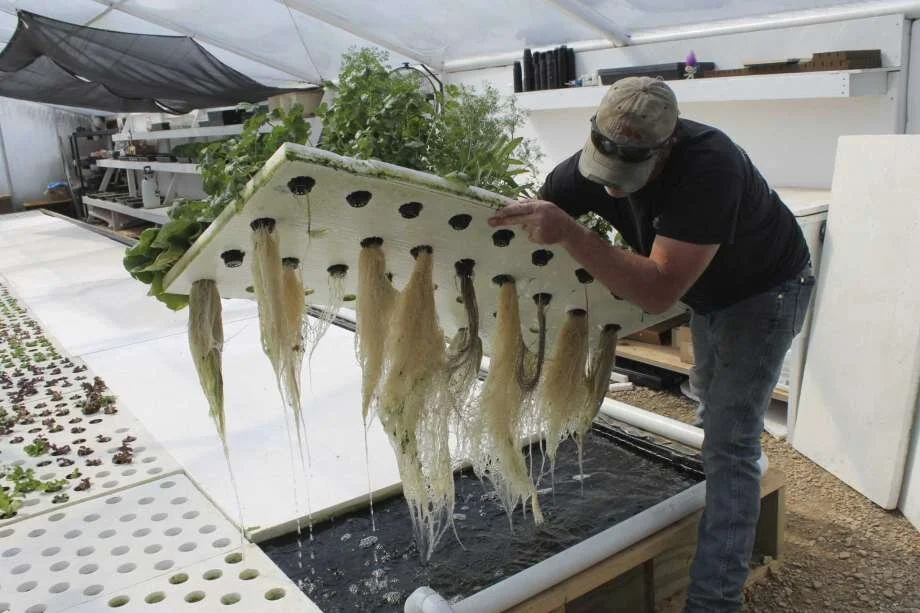
Hydroponics is a method of growing plants in a water-based, nutrient-rich solution without soil, where the root system is supported using an inert medium such as perlite, rock wool, clay pellets, peat moss or vermiculite.
The roots are suspended in a purified water system enriched with nutrients, thereby reducing the chances of pest and insect attack. This technique caters to a host of challenges, such as water and arable land shortage, global warming, and overuse of harmful pesticides and fertilizers.
Although hydroponic systems depend on water and water-based solutions, they use only about 1/20th of the amount of water used in traditional farming. Based on Frost & Sullivan’s analysis, productivity was found to increase by 3-10 times the conventional output in the same amount of space as conventional farming. The technology allows the decrease in time between harvest and consumption, leading to higher retention of nutritional value for the end-product. Many crops can be produced twice as fast in a well-managed hydroponics system.
Hydroponics on the Rise in India
Hydroponics is at a nascent stage in India, with the majority of farms being operated as startups. However, large corporates are entering this business, which will increase their acceptance at the commercial level. Based on our research, there are over 40 commercially active hydroponic farms in India and a couple of new farms are underway. With produce being perishable, the majority of farms cater to the nearby metro cities and companies try to set up farms close to demand centres for ease of logistics.
The large farms are concentrated in southern and western India. According to our analysis, Southern India accounts for the highest share, with cities like Hyderabad, Bangalore, and Chennai having a large number of farms and many new small and medium farms being established.
Farms are forming near the Mumbai-Pune belt and other western regions of Maharashtra, such as Nasik and Kolhapur. Competition is currently not intense as the technology is in a very nascent stage and the awareness level is low, even amongst chefs and food enthusiasts. However, it is expected that the popularity of hydroponics will increase, and the competition will intensify correspondingly.
Our research revealed that Hydroponic farms in India are largely used to grow leafy greens like lettuces and herbs like Italian basils and vegetables like cherry tomatoes, cucumbers, and red and yellow bell peppers. In terms of volume and value, large greens like cherry tomatoes, bell peppers, and cucumbers, account for the major share of the hydroponic output, which is followed by leafy greens like various lettuces, arugula, and pakchoi.
The Green Conundrum Facing Farmers
Our research reveals that hydroponic farming is largely a B2B business model with HoReCa (Hotel, Restaurant, Cafe) and organised retail accounting for a 90%-95% share, and remaining by the unorganised sector. Organised retail is the primary mode of selling supply products in the retail market. The unorganised sector is almost negligible and the penetration of e-commerce is minimal. The organised retail outlet offers decent volume off-take and better margins compared to HoReCa.
With the unorganised retail market being price-sensitive, conventional farm output has a stranglehold due to its pricing. Transportation is done primarily through transport vans delivering the produce to adjoining city centres, typically about 100-200 km from the farm. Only farms supplying long distances (over 500 km) use reefer trucks.
Commercial hydroponic farms typically have a land area of 10,000 sq. ft. to 50,000 sq. ft. Usage of the grow bag technique accounts for 70%, whereas NFT (Nutrient Film Technique) and others account for the rest. As per Frost & Sullivan’s analysis, the cost of setting up a grow bag/trough system for growing large greens is almost half compared to setting up an NFT system for growing leafy greens and, hence, large greens are the preferred product category. Although leafy greens go through six to seven crop cycles and large greens take one to two crop cycles in a year, the output per plant for large greens in terms of volume is up to 20 times that of leafy greens. Also, in terms of value, large greens fetch about 25%-30% more value per kg compared to leafy greens.
Farm utilities include equipment for setting up the farm, plant seeds, minerals/nutrients and water, organic pest control solutions, packaging, and so on. Greenhouses, NFT channels, grow bags, net pots, fogger and auto dossers are some of the major farm equipment used. Plant seeds and nutrients account for the largest component of the operational expenses, some of which are imported from Europe and America.
HoReCa and Healthy Lifestyles Set to Boost Hydroponics
HoReCa is considered to be the largest customer segment for hydroponics as it has a bulk requirement, and farm owners trying to offload their volume prefer to cater to the HoReCa segment.
Hydroponics also ensure a smooth supply, despite weather conditions and monsoon seasons, when supply is usually interrupted for traditional vegetable suppliers. Within HoReCa, high-end cafes and restaurants not only have a decent off-take but also offer better margins as this sub-segment prefers high-quality vegetables and is open to paying a premium. With health-conscious customers requesting vegan, Keto diet, and so on, the menu is revised constantly to cater to the demand of the customers, and there will be increased growth of detox juices and salads. The entry of more salad outlets is leading to the growth of exotic vegetables, thereby creating opportunities for hydroponically grown vegetables. Since 2017, salad consumption has increased by 25%-30% and this trend is expected to continue in the coming five years.
With an improved lifestyle, high disposable income, and growing awareness, there is an increasing demand for healthy menus like low-carb and organic, where customers are requesting more leafy vegetables that are organically grown. Not only Tier 1 cities, but Tier 2 and Tier 3 cities also are expected to follow a similar disrupting trend in the coming years.
Over the past few years, the share of expenditure on health and wellness has increased among the young working class. According to the Federation of Indian Chambers of Commerce & Industry, the foodservice industry is expected to reach ?5,52,000 crore by 2022, growing at a CAGR of 10%. Of this, the health-conscious segment is expected to cater to over 1 crore people in the top six Indian cities by 2022, registering a growth rate of 12%.
Organised retailers and specialty grocery stores, especially in major cities, have higher-volume off-takes and also offer comparatively better margins for hydroponic growers. This is because the consumers visiting these stores are willing to pay a premium for high-quality produce. However, prices offered at unorganised retailers are too low for the hydroponic farmers to break even. Direct-to-customer offers a higher margin compared to HoReCa or retail; however, it also requires additional effort in acquiring customers, creating awareness, offering innovative packaging, and so on.
Hydroponics Headed in the Right Direction
Hydroponics holds advantages over traditional farming. However, organically grown products have already become popular among young consumers. HoReCa and organised retail still prefer organically certified products over hydroponics.
Conventionally grown products are available at a much cheaper rate compared to hydroponically grown produce as well. The presence of hydroponic players in India was limited until 2015; however, with the growing popularity of the technology and year-round supply, which conventional farms cannot offer, it has gained attention in recent years. New players are expected to enter the market in the coming years and revolutionise urban farming in the country.
The authors are consultant and consulting analyst, chemicals, materials & nutrition practice, Frost & Sullivan. They can be reached at Srihari.Daivanayagam@frost.com)

Lettuce Linked To 40 E. Coli Outbreaks In A Decade – Most Related To Romaine
Of outbreaks linked to a specific leafy green — rather than a mix — 54% were linked to romaine. Spinach and iceberg lettuce were each linked to 17% of the outbreaks, and cabbage, green leaf, and kale were each linked to 4%
Romaine Lettuce's Growing Popularity,
However, Doesn't Explain Its Link To Numerous Outbreaks.
Sept. 16, 2020, / Source: NBC News
By Sara G. Miller
Leafy greens are a common culprit of foodborne illnesses, with the produce linked to 40 outbreaks of a serious strain of E. coli from 2009 to 2018, a report published Wednesday in the journal Emerging Infectious Diseases finds.
Among those outbreaks, one lettuce, in particular, bore the brunt of the blame: romaine. (Recall 2018, a year rocked by two massive romaine-linked E. coli outbreaks?)
Of outbreaks linked to a specific leafy green — rather than a mix — 54% were linked to romaine. Spinach and iceberg lettuce were each linked to 17% of the outbreaks, and cabbage, green leaf and kale were each linked to 4%.
To View the Above Video, Please Click Here
It's not entirely clear why romaine was the most common culprit in the outbreaks. The researchers noted, for example, that more iceberg lettuce was harvested and sold each year from 2009 to 2017 than romaine.
Romaine did grow in popularity during the decade analyzed, the researchers wrote: By the end of the study period, more money was spent on romaine lettuce than on iceberg. But this alone doesn't explain why romaine was responsible for so many outbreaks.
Another possible explanation, the researchers posited, is the lettuce's shape, which could provide an entry point for pathogens: "Romaine is tall with loosely clumped leaves, open at the top; iceberg is smaller with compact leaves."
Other outbreaks were linked to mixed greens, including three romaine and iceberg mixes, a butter lettuce and radicchio mix, and a spinach and spring mix.
The report focused on outbreaks of a type of E. coli called Shiga toxin-producing E. coli, or STEC. The name refers to a toxin produced by the bacteria that makes people sick. Symptoms can include diarrhea and vomiting, according to the Centers for Disease Control and Prevention. Most people recover on their own within 5 to 7 days, though some may need medical care.
Related NEWS
Food-poisoning outbreak that is in 6 states is likely from ground beef
The decade of outbreaks, which occurred in the United States, Canada or both countries, accounted for 1,212 illnesses, 420 hospitalizations and eight deaths, according to the report. A total of 77 cases of hemolytic uremic syndrome, a kidney problem that requires hospitalization, were also attributed to the outbreaks.
Shiga toxin-producing E. coli are linked to about 265,000 illnesses each year in the U.S., according to the report. One type of STEC in particular, STEC O157, tends to cause more severe illness. The most common source of this infection is ground beef, followed by leafy greens. Indeed, STEC O157 was responsible for 32 of the outbreaks described in the report.
Though leafy greens are grown year-round in the U.S., more outbreaks began in October and April than any other month of the year. It's unclear why this seasonality in outbreaks occurred, the study authors wrote.
There are several reasons why leafy greens are particularly susceptible to E. coli contamination, starting with how the crops are cultivated, Benjamin Chapman, a professor and food safety specialist at North Carolina State University, said.
"The vast majority of lettuce production is outside and requires a lot of water," Chapman, who wasn't involved with the report, said in an email. And in the U.S., it's mostly grown in areas where animals — a source of E. coli — are also raised. E. coli contamination can come from sources such as irrigation water, animals, and handling.
"We know from earlier outbreaks that a little bit of contamination in the field can lead to cross-contamination," he said.
Once that contamination has made it onto the plant, it's "very difficult to remove," Chapman said. Produce is triple-washed in processing plants, and in the home, a person may be able to rinse off "90 to 99% of what's there, but that may not be enough depending on how much" contamination there is, he added.
And because lettuce is almost always eaten raw or undercooked, "any contamination that makes it to the plate ends up in the gut," he said.
Avoiding outbreaks entirely is, unfortunately, a supply chain issue, he said.
This story was originally published on NBC News.

Leaf Raises $2m Seed Round To Expand API Offering For Agrifoodtech Startups
Los Angeles-based startup Leaf came out of stealth earlier this year with an API designed to make it easier for anyone to transfer data between hundreds of agriculture data sources through its one simple integration
September 22, 2020
Tech permeates pretty much everything we do today, though most of us only experience the user-facing side of it. And while every app or program is hoping to tackle some major pain point or another, there are countless digital nuts and bolts that have to be put in place in order to help that software run smoothly behind the scenes.
By now, nearly every major industry has digital infrastructure solutions in the form of application programming interfaces (APIs) to help developers build interoperable software and apps.
Farming is no exception.
Los Angeles-based startup Leaf came out of stealth earlier this year with an API designed to make it easier for anyone to transfer data between hundreds of agriculture data sources through its one simple integration.
Today, it announced a $2 million seed round led by Cultivian Sandbox Ventures, with participation from SP Ventures and existing investor Radicle Growth.
Invest with Impact. Click here.

Photo credit: Chris Lawton / Unsplash
The funding process was relatively smooth sailing for the startup despite Covid-19, according to CEO Bailey Stockdale. Helping the deal along was the immediate understanding among the investor syndicate about Leaf’s technology and the problems it hoped to solve.
“We sat down and they understood everything we said about APIs, food, and agriculture,” Stockdale told AFN.
“We’ve really focused on keeping industry-specific investors for this round, especially as we continue to grow and partnerships are so important to us. We have a development office in Brazil so it was also nice to bring SP Ventures into the round as well.”
Leaf plans to use the new funding to grow its team and to make the developer experience using its API as frictionless as possible. To do this it’ll bring in people with tech backgrounds in other industries – like recently appointed head of product Brandon Mensing, formerly of enterprise search company Elastic and data analysts Sumo Logic. He wrote about his journey in a blog post shortly after joining Leaf.
Making the switch from the mainstream tech sector to agrifoodtech was an easy decision for Mensing.
“I became cynical in some ways. There are all these brilliant people working on making ad targeting just a little bit better, but there are not enough people working on making food better,” he wrote.
“That’s what led me to really fall in love with the hypothesis [of Leaf]. It’s developer-focused and it’s trying to enable developers to bring about that change to make our food system better.”
When AFN spoke with Leaf in February this year about its launch, Stockdale said its biggest challenge would be obtaining buy-in from as many tech and service providers as possible. If only a handful of companies signed on to let Leaf access their APIs, then it would hardly have enough traction to go the distance.
Fortunately, buy-in has not been a problem.
Since launching, Leaf’s API has been used to build and expand a wide range of agrifoodtech platforms, including farm management software, lending, and financing products, agronomic recommenders, food traceability apps, equipment maintenance forecasters, and marketplaces for land, inputs, and carbon credits, among others.
As demand has increased rapidly, so have the number of customers and potential avenues it can explore. Having too many opportunities is a champagne problem for any startup, but it also presents unique challenges.
“Obviously, we stay very focused on building products that work for everyone. We have to say no a lot to specific requests of existing functions, of looking into other industries too early, like indoor ag data,” Stockdale said.
“We say, ‘maybe in a couple of years.’ We have a lot of work to do outside first.”
When it comes down to it, however, Leaf’s medium is farm data. Applying it to other canvases isn’t necessarily as difficult as one may think. Stockdale offered machine operations data as an example: Whether a user is a lending operation wanting to track management on the farm, or an outcome-based pricing function that wants to validate on-farm activity, the back-end processes may not be so different.
Leaf’s primary challenge moving forward is overcoming the technical difficulties that come with developing APIs. It’s part of the reason the startup is so motivated to recruit the right people with deep expertise; it’s also why it is yet to see serious competition, according to Stockdale.
“There have been so many attempts at solving this problem and it is such a large problem. Most of these attempts have taken a business-level approach to solving it like big partnerships,” he said.
“There are plenty of standards for each type of data. At the end of the day, everyone has their own flavor for how they implement those standards. The groups get very political and no one is really taking a developer-first, product-centric approach. That’s how we are doing it.”hoto credit: Chris Lawton / Unsplash
What Does A Vertical Farm Taste Like?
“By giving plants exactly what they want, we can make them taste how they should.”
iStock / LouisHiemstra
Indoor farming companies—like Kimbal Musk’s Square Roots—claim their methods can replicate any climate on earth, resulting in better-tasting produce. That story may be more marketing than science.
It may have been cold and gray in New York, but inside a shipping container in Brooklyn, it was as warm as a summer day in Italy—the ideal climate for growing Genovese sweet basil.
That’s what Kimbal Musk, co-founder of the indoor farming company Square Roots, told me when we met after an event at the Food and Finance High School in Manhattan last December. Though he’d just appeared onstage with the musician Questlove, I wasn’t there to ask him about Questlove’s new cookbook, to which Musk—a chef and restaurateur—had contributed a recipe. I was there to learn about his company’s line of bespoke, hand-harvested herbs, which are grown inside shipping containers in Brooklyn (and at a second “farm campus” in Grand Rapids, Michigan).
Specifically, I wanted to know about flavor. Square Roots claims to “recreate ideal growing climates from around the world” for its basil, mint, and chives to thrive in. According to Musk, these intensively managed indoor environments can be fine-tuned to recreate, and even improve upon, the best-tasting herbs planet Earth has ever had to offer.
The interview took place in a classroom. Wearing a brown suede jacket, black and white sneakers, and his signature straw cowboy hat, Musk—the brother of billionaire entrepreneur and Tesla founder Elon Musk—looked the part of a future-of-food emissary.
The interior of a shipping container basil farm operated by Square Roots, a Brooklyn-based indoor farming company growing hand-harvested herbs. | Square Roots
“We can replicate any climate in the world,” he said. “We actually replicate Genoa, Italy, for growing our basil. And it’s not any part of the year—it’s the month of June, in 1997.”
According to Musk, June 1997 was a banner season for Genovese basil. Why settle for good growing conditions when you can have the best there ever was?
“That was the perfect year,” Musk continued. “That’s how precise you can get it to. And you can get the humidity and oxygen levels, carbon dioxide levels to, you know, within half a percent.”
“By giving plants exactly what they want, we can make them taste how they should.”
As indoor farms have proliferated in recent years, so have claims like these. The promise of these facilities—which are part of a larger category of food production called controlled-environment agriculture—is being able to create the optimal growing conditions for plants throughout their life cycle by manipulating the temperature, humidity, carbon dioxide level, nutrient mixes, and light spectrum and intensity. This is in contrast to conventional crops, which are still subject to the vagaries of weather, good, bad, or disastrous. Inside Square Roots’ growing containers, nothing is left up to chance.
“It’s just amazing what we can do,” Musk elaborated in a follow-up phone interview in January. “You can actually design the lights to, say, I’d like the leaf of this to be a little bit bigger, or a little smaller, or I’d like the softness of the leaf to be a little softer or a little crispier, or I’d like the oils to increase or I’d like the oils to decrease, depending on what you need.”
Square Roots is far from the only indoor farming company making total environmental control a part of their marketing pitch. The CEO of Bowery Farming told CNBC that his company can grow kale with a softer leaf or a more peppery arugula. The chief executive of 80 Acres Farms told The Washington Post he can grow two types of basil from the same seed—a sweeter herb for the grocery store and a stronger version for chefs—simply by tweaking environmental factors. Fresh Impact Farms’ business model—before the pandemic, at least—was growing customizable herb and flower garnishes for restaurants. The company’s website features an indicative tagline: “Harnessing the power of technology to invigorate the emotion of flavor.”
Left, a Square Roots employee harvests Genovese basil. The company’s co-founder, Kimbal Musk, has claimed that Square Roots replicates the climate of Genoa, Italy, in June 1997, for growing its basil.
Square Roots
These claims about the links between climate and taste may sound fantastical, but science backs them up—to a point. Changing light color, intensity, and duration has been shown to influence plant growth and development, as well as shape, size, and color. Different light recipes can even increase the volatile compounds that determine how plants smell and taste.
Still, fact-checking specific claims—for instance, whether Square Roots’ basil tastes anything like basil grown in Genoa in June 1997, or even whether the growing conditions really approximate Genoa in 1997—is difficult, if not impossible. Indoor farming companies keep their cards close, reluctant to let any bit of intellectual property slip out, or to open themselves up to outside scrutiny. Some companies won’t even allow press on-site or share photos of their farms with the media in order to protect their intellectual property. And then there’s the fact that many of the wildest claims revolve around flavor or taste, which is still not fully understood by sensory scientists. It’s hard to know where the science ends and marketing begins.
That hasn’t stopped money from flooding the indoor farming space. Newark, New Jersey-based Aerofarms, which claims it’s setting “a new culinary standard” with greens grown in peak-season conditions all year round, has raised $238 million. Plenty, a San Francisco-based startup which claims its greens have “unparalleled flavor,” has raised $401 million, and counts Jeff Bezos and Google co-founder Eric Schmidt among its backers, puts it simply: “By giving plants exactly what they want,” the company writes on its website, “we can make them taste how they should.”
The implication is always that a more flavorful future is on the horizon. But is it?
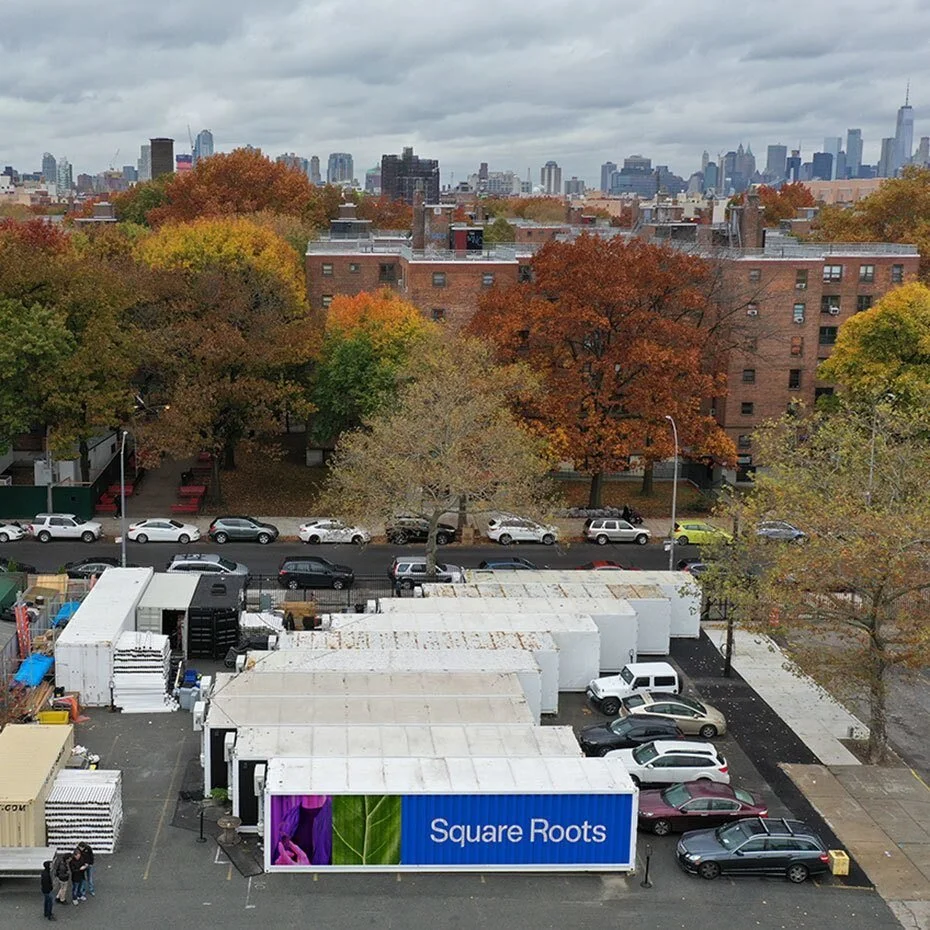
An aerial view of Square Roots’ Brooklyn operation: ten shipping containers in the parking lot of the Pfizer building | Square Roots
The shipping container is parked along with nine others in the lot next to the Pfizer building, a former chemical plant in Brooklyn where Square Roots is headquartered. When I visited on a brisk January afternoon, Paul Berry, Square Roots’ head of engineering, gave me a brief tour of one of the company’s shipping container farms, which it calls “climate farms” for their ability to fine-tune the environment enclosed within. He opened a door to the basil container and we peered through a protective veil of glass.
Dark green herbs covered the walls, sprouting from vertical planters. The basil on one side was lush and full, almost ready for harvest, while the rest needed more time. A center divider housed a bank of lights, but they were dark; Berry said night and day are reversed in the containers so that farmers don’t have to work under a harsh glare. He explained that a mixture of water and fertilizer periodically drips down through the planter towers and soaks the basil roots in their soilless growing medium—simulating rain, or something like it. While we stood there talking, a smaller set of lights flickered on over a tray of seedlings in the back, in the plant nursery. Indoor farms mostly use light from the red and blue spectrums, which promote photosynthesis, so the light had a bright pink hue.
Square Roots controls every condition within that shipping container: the temperature, humidity, carbon dioxide levels, nutrient mix, and light spectrum and intensity. While greenhouses rely primarily on sunlight, sometimes supplemented with growing lights, indoor farms are lit entirely by artificial lighting. This kind of agriculture has largely been made possible—and financially viable—by the increased efficiency and plummeting cost of light-emitting diodes (LEDs) over the past decade.
In imitating Genoa, Square Roots is trading on what wine producers call “terroir,” or what the American wine writer Matt Kramer has called its “somewhereness.”
Although recreating sunlight with electricity comes with significant financial—and environmental—costs for indoor farms, it does open a number of possibilities. Square Roots can grow summer crops like basil year-round, and by simulating peak-season conditions has managed to greatly decrease growing times: Berry said the complete lifecycle of Square Roots’ basil is a mere 30 days from seed to harvest, which is very fast. For comparison, grown outside, basil can take up to 30 days just to germinate, or sprout.
But is it really like 1997 Genoa on the other side of the glass?
Not exactly. Musk’s cofounder, Tobias Peggs, later told me that Genoa is really more of a “baseline.” He said Square Roots will talk to chefs or look online to see where in the world the best basil is grown, and when in the last few decades the herb was “really, really fantastic.” Then they’ll look at the climate data from that season—at the temperature, the time the sun rose and set—and try to replicate that environment inside the containers.
“But that’s just the start, right, because from there you then improve,” said Peggs. So while Square Roots may have started with Genoa, it has since iterated on what nature and history provided.
Those iterations turned out to be modest. During my visit, Berry said that they were growing basil at two different temperatures, one significantly hotter than the other, to see what happened—amounting to a basic A/B test. Musk had described these efforts in more dramatic terms, suggesting that each container added to the company’s research and development capacity.
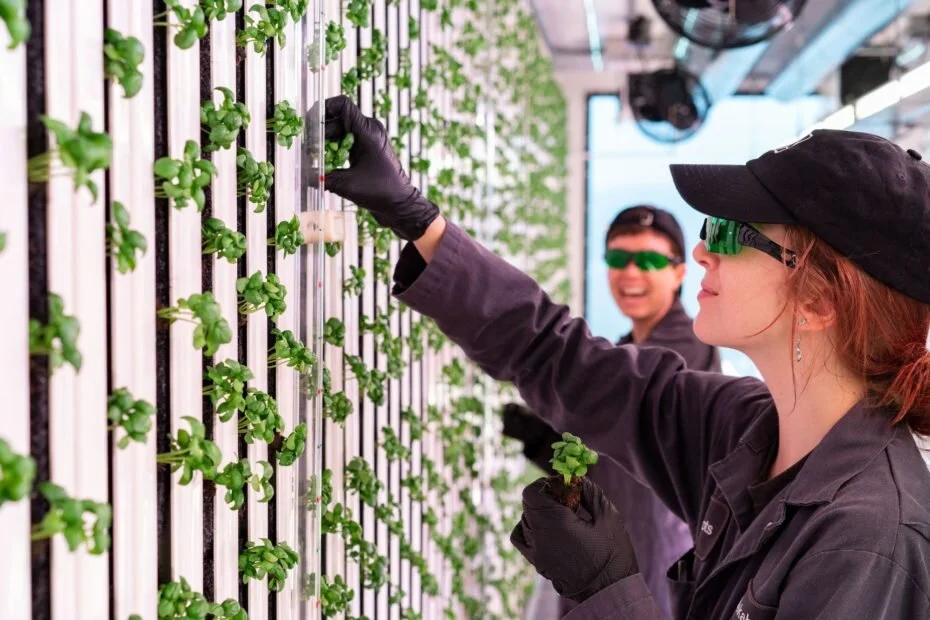
The complete lifecycle of Square Roots’ basil is a mere 30 days from seed to harvest. For comparison, conventional basil, grown outside, can take up to 30 days just to germinate. Square Roots
“In Brooklyn, we have 10 farms, which really means we have 10 experiments going on at any one time, at least,” he said.
Even if Square Roots could conduct ten experiments at once, scientists say there are limits to that approach. Just like conventional fruit and vegetable breeders, indoor farmers may find that changes that improve taste have a negative impact on yield or shelf-life, or that making plants grow faster lowers nutrient levels. In other words, promoting one desirable parameter may have unintended consequences for another key trait.
“Maybe a certain light source or certain light recipe could increase the pepperiness or the bitterness or whatever they’re looking for,” Erik Runkle, a professor in the Department of Horticulture at Michigan State University and project director of OptimIA (Optimizing Indoor Agriculture), a Department of Agriculture-supported Specialty Crop Research Initiative, told me in a phone interview. “It’s just whether or not other things that change at the same time would still be desirable. So you can steer it, of course, but only to an extent. You can’t, you know, you can’t turn a banana into an apple.”
Harry Klee, a horticulturalist at the University of Florida who studies why fruits and vegetables taste the way they do, said it even more plainly: “If someone is telling you it’s all about light, they’re probably on drugs.”
—
In imitating Genoa, Musk and Peggs are trading on what wine producers call “terroir,” or what the American wine writer Matt Kramer has called its “somewhereness.” They not alone in this: The vertically farmed strawberry company Oishii, for instance, seeks to recreate “the ideal natural ecosystem of Japan’s most distinguished strawberry-producing regions.”
Terroir is often assumed to be the earth itself—the soil in which the grapevines grow—but there are other factors too, from altitude to humidity to airflow, some of which could possibly be quantified and replicated indoors. (Flavors that are derived from soil are probably off the table; virtually all indoor farms use a soilless growing medium.)
Whether terroir is even “real” or not is a passionate and ongoing debate among winemakers. But indoor farming companies want to have it both ways: To assert that there are superior regions and climates for growing specific produce, and also that those conditions can be replicated in a box. It’s one thing to suggest that the Italian coast imparts certain qualities to basil. But then shouldn’t the inside of a sealed shipping container taste like something too? Can an herb’s “somewhereness” be convincingly faked? Or will it yield instead a kind of “anywhereness”?
Can an herb’s “somewhereness” be convincingly faked?
Then there’s the question of empirically evaluating taste, or flavor. Who is in charge of determining if and when one of Square Roots’ experiments results in better-tasting basil?
“This is a classic issue with sensory science,” said Beverly Tepper, a sensory scientist at Rutgers University. “You have somebody in the organization who makes a decision about whether something is good or bad and whether it should be packaged and shipped without actually having, I would call it evidence-based information about what exactly does it taste like.”
Evidence-based information could include evaluation by a panel of experts “trained to recognize different aromas, flavors, textures, taste in a specific food product,” Tepper explained, or consumer tasting panels.
One of the few companies to be conducting such experiments in a rigorous, semi-public way is AeroFarms. In 2017, AeroFarms and Rutgers received a $1 million grant from the Foundation for Food and Agriculture Research to study the flavor and nutritional content of baby leafy greens.
Tepper, one of the researchers working with AeroFarms, said one class of nutritional elements they’re looking at are glucosinolates, a compound that has a bitter and astringent taste. If someone doesn’t like kale or broccoli, glucosinolates might be to blame.
“They’re health-promoting compounds, which is good, but if you drive them too high people won’t want to eat them,” said Tepper. “So what we’re trying to do is to find that sweet spot where you can drive the chemistry to a certain level and get the highest nutritional value while also making these plants very acceptable to people.”
Tepper and her fellow researchers at Rutgers are taking samples of baby leafy greens from AeroFarms and giving them to an expert panel trained to identify different aromas, flavors, and textures. At the same time, her colleague James Simon in the plant biology department is analyzing the chemistry of the greens to track nutrient changes. One of Tepper’s graduate students also secured a separate grant to convene consumer panels and measure consumer acceptance of the greens. The researchers will then track how different growing conditions change both the flavor and the nutritional content.
Even so, Tepper and the other researchers can only do so much.
“You can’t modify too many variables with too many treatments, because it becomes impossible, particularly when you’re doing sensory experiments.”
“You can’t modify too many variables with too many treatments, because it becomes impossible, particularly when you’re doing sensory experiments,” Tepper explained. “There’s only so many things people can taste at one time.”
Tepper signed a confidentiality agreement with AeroFarms, so she couldn’t go into detail about the experiment design, but she did say that “we had long discussions about balancing how many samples the panel can taste, how many variables…to modify at one time.”
For example: If Rutgers and AeroFarms are looking at light treatments and how different light recipes increase or decrease the presence of glucosinolates, it is difficult to also look at the role of temperature or different fertilizer mixes or carbon dioxide levels. For every variable tested, the group will need to have control, otherwise, it will be impossible to say whether any resulting changes in the plant are due to one variable or the other, or the two in concert.
Because there are countless variables to manipulate, these experiments can grow in complexity quickly, spawning endless permutations that take time and cost money. And that’s when a company has the benefit of a university research team and a giant research grant, which most do not. Of course, as Tepper points out, “you can do one set of experiments that focuses on one aspect and then come back and do another set of experiments that focus on a different aspect,” but the process remains arduous.
“Whether the average consumer is going to be able to differentiate, ‘oh, that arugula tastes extra special,’ I really don’t know.”
Do indoor farming companies really have the capacity to tweak light recipes and other growing conditions, then rigorously track how those tweaks manifest in the plant? In other words, do they really have the ability to grow finely-tuned, better tasting produce? Is it a science, an art, or just artifice?
While it might be relatively easy to see if herbs grow faster or slower, or bigger or smaller, greener or redder—subtle changes in flavor are much trickier to track, and not just for indoor farms.
“Whether the average consumer is going to be able to differentiate, ‘oh, that arugula tastes extra special,’ I really don’t know,” said Runkle.
And again, while AeroFarms and Rutgers will eventually publish some of their research in this area, most companies do all this work (or not) behind closed doors. We may always need to take their word for it.
“I hear about companies, indoor farming companies doing tasting studies,” Runkle said. “But the data is usually not shared or made available.”
“A lot of greenhouses, warehouses, vertical farming folks, it’s very kind of in the black box,” said Jon Friedman, the chief operating officer of the container farm company, Freight Farms, which supplied Square Roots with its first 10 containers. “And then you look and you’re like, it’s just lettuce, you’ve just grown lettuce, and you won’t tell anybody how you’re growing lettuce? Cool.”
Oishii, an indoor farming company, recreates the “ideal natural ecosystems of Japan’s most distinguished strawberry-producing regions” to make its berries, which cost $50 a box. Oishii
On a muggy July afternoon at the tail end of a heatwave, I took the subway from Brooklyn to Manhattan to pick up a $50 box of strawberries at Farra, a restaurant in TriBeCa. They’d been grown indoors in New Jersey by Oishii, the fruit company I mentioned earlier that models its farms on Japan’s strawberry-growing regions. (Oishii is a Japanese word that translates roughly to “delicious” or “tasty.”)
While the vast majority of indoor farms in the U.S. produce leafy greens or herbs, which are easy and fast to grow, tomatoes and strawberries have been bandied about as possible—and lucrative—future offerings. Musk said he thinks strawberries could be “the one that will blow people’s minds,” and his cofounder, Peggs, said he had researched strawberry production on a trip to Japan earlier this year.
Until I brought it up in conversation, neither Musk nor Peggs seemed aware that Oishii got there first—and have been selling vertically-farmed strawberries to restaurants since 2018.
The company says it is the only vertical farm growing strawberries on a commercial scale in the United States. John Reed, the company’s director of strategy and finance, said it is aiming to be the country’s largest strawberry producer within 10 years.
I wanted to taste the future of fruit.
Oishii sells boxes of eight larger or 11 smaller berries; I opted for the box of 11, so each berry cost a little over $4.50. They come nestled in individual cups, kind of like an egg carton, but suspended in plastic hammocks. They were a paler orangey-pink-red than I expected, with deep pockmarks but no seeds. They come chilled and should be stored chilled, but Oishii recommends bringing them to room temperature to fully enjoy their flavor and aroma (which was so potent I could smell it through my mask while riding the subway back home). While at Farra I also picked up a bottle of sparkling wine to go with the berries—not a true Champagne, but one made with grapes from an adjacent region; the bottle cost half as much as the fruit.
My tasting notes from that night were as follows: “Very sweet, like strawberry but more so, the essence of strawberry, strawberry-infused with strawberry, distilled strawberry.” But what was even more notable than the sweet taste was the texture, which was very soft, with a melt-in-your-mouth quality. My boyfriend described them as “light, smooth, and fluffy.” They were certainly superior to the commercial organic strawberries we later bought at the grocery store, but it was impossible to do a side-by-side comparison with the berries we might get in our CSA or at the greenmarket because the strawberry season had ended weeks ago.
Like Square Roots with its Genovese basil, Oishii says its indoor farms replicate the ideal environment for strawberries.
“I can’t go into the details, but the facilities are—you know, everything is tailored to the plants.”
“By recreating the ideal natural ecosystem of Japan’s most distinguished strawberry-producing regions in a controlled indoor environment, Oishii is able to consistently grow the world’s best strawberries year-round and pesticide-free,” the company claims on its website. “Oishii’s groundbreaking approach to vertical farming enables bees—nature’s pollinators—to thrive, ensuring optimal strawberry quality.” (Yes! Bees—and other indoor farms, including Square Roots, also introduce beneficial insects like ladybugs to help manage pests.)
In a video call, Reed declined to elaborate any more about Oishii’s farms or its growing conditions. “We manage our facilities in a dynamic way,” he said. “I can’t go into the details, but the facilities are—you know, everything is tailored to the plants.” Reed also said he could not divulge the specific variety of strawberry, which Oishii markets as the Omakase berry, after the chef-led dining experience. Omakase translates roughly to “I leave it to the chef,” Oishii’s co-founder told NPR. As with the dining experience, we have to trust the grower.
According to the company’s website, it is “a unique Japanese variety characterized by its beautiful aroma and exceptional sweetness. It was developed through years of breeding the best Japanese strawberry cultivars, resulting in its signature seedless appearance and creamy texture.”
Little is known about the genetics of Oishii’s berries—though the company calls its strains the Omakase Berry. (Omakase is a Japanese word that means “I’ll leave it to the chef.” ). Oishii
Oishii has taken a very different approach to marketing than other indoor farming companies. Instead of making the technology a centerpiece, it downplays the fact that the strawberries are grown indoors. Reed said the company does not share pictures or videos of the farms in order to protect its intellectual property. Instead of LED-bright, futuristic farming images, the company’s Instagram page is filled with sumptuous food photography, mostly—though not entirely—of strawberries, as well as other aspirational lifestyle content. It’s refreshing, in a way, that Oishii doesn’t celebrate the technology more than the unknown variety of fruit, because genetics remain the primary driver of flavor and texture.
But it’s also a reminder of an uneasy contradiction. At the same time vertical farming companies invoke a traditional growing heritage and the specificity of place, they tightly control the narrative about their own breeding practices and growing technologies. Since one can’t visit—or even see pictures of—the farms where Oishii’s berries are grown, and since once can’t know anything about the genetics it’s actually using, it serves the company to emphasize something else: time-honored agricultural practices honed in a different time and place. Maybe it’s a way to humanize the cold, technologized reality of indoor farming. Or maybe the stories are a way to compensate for a different anxiety: That these products are a kind of tabula rasa, blank-slate foods that could be from anywhere, or be anything to anyone.
—
Before light recipes and controlled environment agriculture, there was plant breeding, or the science of emphasizing desired traits through crossbreeding or hybridization—think Gregor Mendel and his peas. To ignore the role of breeding and focus singularly on light recipes or even the controlled environment more generally is to miss at least half the equation.
“In plant breeding, there’s two things we’re trying to work with,” explained Michael Mazourek, a vegetable breeder at Cornell University, in a phone call earlier this year. “It’s a genotype by environment interaction, and that really drives everything. There’s all the genetics of a species or forms within the species—cultivars or breeds. And then there’s everything in the environment—the fertilizer, the light, the growing season, rainfall or water supply. So it’s that interaction that’s going to determine a lot.”
The role of breeding, which is how farmers and scientists have historically developed fruits and vegetables with specific characteristics, is often downplayed by indoor farming companies. That, or they only mention the negative outcomes of breeding, like flavorless tomatoes that can travel long distances and still be red and firm—if watery and mealy—after weeks in transit and on the shelf. But plant breeding isn’t always as bad as all that.
Indoor farming companies typically emphasize their complex, climate-controlled growing conditions. But a plant’s genetics probably have more influence on flavor.
In his work at the University of Florida, Harry Klee studies how sugars, acids, and up to 20 different volatile compounds interact in tomatoes and other fruits and vegetables to produce what we perceive as flavor. For example, the volatile hexanal is characterized by a green and grassy odor; 1-nitro-2-phenylethane is musty and earthy; phenylacetaldehyde has a floral/alcohol scent; 2-phenylethanol is nutty and fruity; and methyl salicylate smells like wintergreen. Videos about Klee’s work show giant test tubes filled with jewel-toned tomato chunks ready to be analyzed using gas chromatography. Klee’s goal is to identify the primary genes that govern these volatile compounds and therefore the “flavor” of heirloom varieties and to use that information to help build (breed) a better-tasting commercial tomato.
I asked Klee to what extent light recipes can change the way fruits and vegetables taste, and how much control indoor farmers really have.
“While I’m sure light will have an effect on flavor, I don’t believe that anyone has really quantified it,” Klee wrote in an email. “Lots of growth factors do influence flavor. Salt, fertilizer, amount of sunlight, water . . . I don’t think anyone has systematically set out to define the variables.”
The author purchased Oishii’s boxed strawberries in New York City. Each Omakase Berry cost a little over $4.50. Jessica McKenzie
Echoing Tepper, he said, “You have to appreciate that, to get useful data on flavor, one really needs to do this in a thorough way with consumer panels and these are expensive. It’s just a really complicated problem.”
In the end, the variety of seeds probably matters more than any light source or growing condition. “If you were going to take just some utilitarian tomato breed and [used] all your magic and hydroponics and all the tools available,” Mazourek said, “you’re never going to have, like, an exquisitely delicious tomato.”
But tweaking flavors and other characteristics in indoor farms can be susceptible to the same pitfalls as plant breeding. As in the Rutgers and AeroFarms experiment, making leafy greens healthier might also make them too bitter. A change that makes a plant sweeter could also reduce its shelf life, or lower its nutritional value. Improvements in taste could negatively impact yield and vice versa. Who’s to say that an indoor farming company will always prioritize flavor over other more profitable characteristics, like yield, or faster growth?
Even if consumers get looped into the process, who’s to say that they know what’s best for them?
“If you just leave a consumer panel to their own devices,” Mazourek said, they’ll typically choose whatever is sweetest.
—
In spite of the limitations and challenges outlined above, interest in indoor farming’s potential remains sky-high, especially with those invested in space exploration. The National Aeronautics and Space Administration, for example, has funded research into indoor farming for years. “On the way to Mars, we’re going to take as many seeds as we can, but we can’t take all seeds,” Trent Smith, who leads the Veggie project at the Kennedy Space Center, said in a phone call earlier this year. “So if you can take a plant and then if you give it different light algorithms, you can change the nutritional composition of that plant, or you can change the taste of that plant, then you can kind of fine-tune it for the crews’ preferences, or for the crew’s medical needs.”
One of the projects NASA has funded is a study of self-sustaining crop production by Freight Farms and Clemson University, which would come in handy in space, or in harsh climates that are unsuitable for agriculture.
“I don’t think we’ve seen the limits yet, we’ve just scratched the surface,” said Freight Farms’ Friedman. “There’s a lot of room to grow, pun intended.”
The NASA-funded study is a reminder that the rise of controlled environment agriculture over the past few years has been against the backdrop of climate change, which is often explicitly or implicitly evoked as a raison d’être for indoor farms.
Maybe the fantasy of perfectly-controlled climate farms is so compelling is because the actual climate—the one we live in—is anything but.
As Musk told me: “You can adjust [the light] spectrum by the minute, you can change the heat, you can create a climate that is perfectly controlled.” If perfectly-controlled climate is the commodity indoor farms are selling, maybe the reason it’s so compelling is because the actual climate—the one we live in—is anything but.
It’s not enough that in an apocalyptic future, humankind will have indoor farming to fall back on. In the techno-utopian vision of indoor farming companies, their strawberries and basil will good as the best—almost no matter what befalls the earth. In this future, consumers don’t have to lose or sacrifice anything when climate change wreaks havoc on agriculture. If it’s too hot for strawberries to grow in Japan, that’s okay, because we can grow them inside in New Jersey, yours for just $50 a box. Even if you had to cancel your summer vacation to Italy because of a global pandemic—now increasingly likely due to climate change—you can still make pesto with basil grown in a “climate farm” inspired by Genoa.
It doesn’t matter, in this telling, if the science behind these flavor claims is still emerging. It doesn’t matter if we know little about what growing methods were used. It doesn’t even matter if, in the course of “improving” upon the conditions of 1997-era Genoa to grow better, faster basil, the indoor farm loses whatever tenuous connection it had to the “somewhereness” of the Italian countryside.
Genoa makes for a better story.
Jessica McKenzie is a freelance journalist in Brooklyn, NY. Previously, she was the managing editor of the civic technology news site Civicist and interned at The Nation magazine.
Also tagged
agritech, climate, indoor farms, science, vertical farming Jessica McKenzie
Ikea Just Shared Its Garden Sphere Design For Free
Blueprints for IKEA’s Garden Sphere are available for free download, distribution, and reuse. The product design allows any users to feed an entire street, block, or even neighborhood, depending on population
IKEA's Idea Lab Space 10 Created A Sustainable, Spherical Garden For
Urban Environments Called
The Growroom With Open-Source Blueprint And Instructions.

May 12, 2020
Blueprints for IKEA’s Garden Sphere are available for free download, distribution, and reuse. The product design allows any users to feed an entire street, block, or even neighborhood, depending on population.
The Growroom gardening sphere design makes it easy to grow fresh produce in dense urban areas. The multi-tiered, spherical design mimic some forms of verticle gardening by maximizing airspace. The structure’s designers, architects Sine Lindholm and Mads-Ulrik Husumtoin, are part of Space 10—IKEA’s innovative idea lab.
The entire Growroom frame can be constructed with just a few supplies: plywood, screws, a hammer, and access to a local fab lab. Experts suggest small workshops offering digital fabrication are increasingly commonplace. “This means most people — in theory — could produce almost anything themselves,” the company press release read.
Community-grown food minimizes the distance traveled and other contributing factors in food production’s carbon footprint. Many people do not have ready access to fresh produce and outdoor space. The Growroom can help facilitate shared access to both.
“Local food represents a serious alternative to the global food model. It reduces food miles and our pressure on the environment and educates our children about where food actually comes from,” Space 10 noted on its website. “The challenge is that traditional farming takes up a lot of space — and space is a scarce resource in our urban environments.”
The Growroom could increase access to fresh produce in urban areas. | Image/bellinghammakers
IKEA And Sustainability
IKEA emphasizes sustainability in several other areas of its business. In its 2018 sustainability report, IKEA estimated its climate footprint to be 26.9 million tons of carbon dioxide equivalent. Following this, the home furnishings retail giant announced plans to invest over $220 million in efforts to become “climate positive.”
IKEA has also banned all single-use plastic from its cafes to minimize waste and preserve the environment. Instead, the company now uses alternatives such as wooden cutlery and paper straws. The retailer says it sources all materials from sustainable suppliers.
STAFF WRITER | BRISTOL, UNITED KINGDOM | CONTACTABLE VIA: LIAM@LIVEKINDLY.COM
Liam writes about environmental and social sustainability and the protection of animals. He has a BA Hons in English Literature and Film and also writes for Sustainable Business Magazine. Liam is interested in intersectional politics and DIY music.
Lead photo: IKEA is making its garden sphere design free to access.
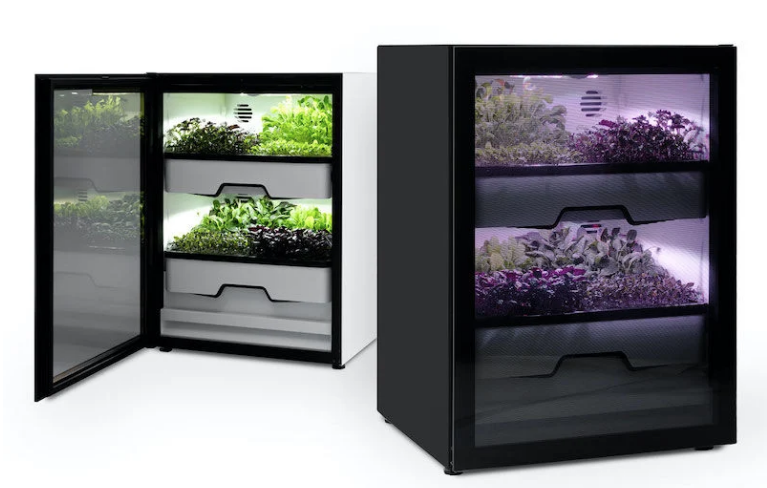
Miele And Agrilution Bring Vertical Farming Tech To Europe's Kitchens
Miele has branched out beyond its usual home appliances lines with a venture into home growing technology
Miele Publicized An Unusual Product At Smart Home Show IFA:
The Plantcube, A Vertical Growing System
By Emma Rowley, White Goods & Appliances Editor
08 Sep 2020
Miele has branched out beyond its usual home appliances lines with a venture into home growing technology.
The appliances company has gone into business with Agrilution, which makes an indoor gardening system geared towards people with no outside space, or those who want a high-tech, low fuss way to grow their own kitchen herbs and salad.
Its product is basically a way for people to engage in small-scale vertical farming: an optimized growing cabinet. You can grow everything you need for a green smoothie; or all the greens you’d need for a salad; microgreens such broccoli cress; or all of your culinary herbs. It’s a self-contained system that doesn’t require soil.
The business venture was publicized at the smart home show IFA. The move makes sense, not only as a complement to Miele’s existing kitchen appliances but also as a sign of the company’s ability to seek out new products likely to interest consumers.
The Plantcube is a product that delivers on a lot of topical concerns
Freshly grown vegetables are likely to be more vitamin-rich and have a lower carbon footprint than their shop-bought counterparts. And there’s no need for pesticides when growing them. Plus, there’s the fact that, during the pandemic, gardening became the focus of renewed interest for many people – which is all very well if you have a garden. For the rest of us, home growing tech is an attractive idea.
Agrilution’s product has three parts: the app, seed mats, and the Plantcube itself (the growing cabinet). When you buy seeds, they’re already integrated into the growing mat. Place the seed mats into the cabinet, fill the water reservoir, and follow the directions on the app.
Its product is basically a way for people to engage in small-scale vertical farming: an optimized growing cabinet. You can grow everything you need for a green smoothie; or all the greens you’d need for a salad; microgreens such broccoli cress; or all of your culinary herbs. It’s a self-contained system that doesn’t require soil.
The business venture was publicized at the smart home show IFA. The move makes sense, not only as a complement to Miele’s existing kitchen appliances but also as a sign of the company’s ability to seek out new products likely to interest consumers.
The Plantcube is a product that delivers on a lot of topical concerns
Freshly grown vegetables are likely to be more vitamin-rich and have a lower carbon footprint than their shop-bought counterparts. And there’s no need for pesticides when growing them. Plus, there’s the fact that, during the pandemic, gardening became the focus of renewed interest for many people – which is all very well if you have a garden. For the rest of us, home growing tech is an attractive idea.
Agrilution’s product has three parts: the app, seed mats, and the Plantcube itself (the growing cabinet). When you buy seeds, they’re already integrated into the growing mat. Place the seed mats into the cabinet, fill the water reservoir, and follow the directions on the app.
It's simple, attractive, and likely to appeal to tech-lovers and health-conscious consumers. But there’s a catch: the price. The Plantcube costs €2,904, which will constitute a fairly high salad budget for most of us.
It’s also only available in Germany, Austria, Belgium, Luxembourg, and the Netherlands at this stage. It’ll be rolling out more widely in the future. But if you’ve got the budget and you live in central Europe, you can buy it straight from Agrilution’s website. You can choose between a black and a white model, and can also buy a wide variety of seeds.
If you like the idea but not the price tag, an Aerogarden could be what you’re looking for. I had one of these for years and it was brilliant for growing culinary plants. It's more versatile than the Plantcube, as you can also choose from a wider variety of plants – including tomatoes.
The Aerogarden Sprout costs £69.95 from Amazon in the UK, with free delivery. You can buy it in black or white and it has space to grow three plants. It comes with a gourmet seed kit to kick off with: basil, parsley, and dill.
Tags: Smart Home Appliances
Note: We may earn a commission when you buy through links on our site, at no extra cost to you. This doesn't affect our editorial independence. Learn more
White Goods & Appliances Editor
Emma writes about home tech, white goods & appliances. She’s particularly interested in environmentally-conscious brands, as well as appliances that save people time, money and improve their lives.

“The Future of Agriculture”: Goochland Tech Students Get New Vertical Farms While Demand Grows At Area Food Banks
"Meredith Thomas said this kind of farming is more environmentally sustainable — it uses no soil, no pesticides and roughly 90 percent less water. She added this kind of farming is more environmentally sustainable — it uses no soil, no pesticides and roughly 90 percent less water. The nutrients and PH are controlled by sensors that check the water every single morning, and add nutrients, or PH balancing solution, or even water,” Thomas said."
GOOCHLAND COUNTY, Va. (WRIC) — Farm to table has a whole new meaning.
“It’s literally grown, sometimes even harvested and consumed in the same room,” said Meredith Thomas with Babylon Micro-Farms.
Vertical Farming is one of the fastest growing trends in food production. Some call it the future of agriculture. Now, students at Goochland Tech will get the chance to learn all about it while their local community reaps the benefits.
In a new partnership between GoochlandCares and Goochland Tech, two new vertical farms have been installed at the high school. According to Babylon Micro-farms, the Charlottesville company who made the farms and installed them in early August, “a single micro-farm takes up only 15 square feet but has the productive capacity around 2,000 square feet.”
The farms are active year-round and all aspects of farming are controlled by a cell phone app.
“It’s a hydroponic farm designed to take the green thumb out of growing,” Thomas said.
She added this kind of farming is more environmentally sustainable — it uses no soil, no pesticides and roughly 90 percent less water.
“The nutrients and PH are controlled by sensors that check the water every single morning, and add nutrients, or PH balancing solution, or even water,” Thomas said.
Students will be taught about vertical farming while also supplying food to the pantry at GoochlandCares, which distributes food to neighbors in need.
“The pantry will receive both nutritious, locally grown fresh produce year-round and dishes prepared by the students with the harvests from the farms,” said Janet Matthews with Babylon Micro-Farms.
8News has witnessed long lines outside of food banks in our area for months. In Chesterfield on Friday, cars filled two lanes for over half a mile leading up to the Chesterfield Food Bank. That kind of backup has been seen on Ironbridge Road every weekend for the past several months.
Before COVID-19 spread around the world, the Chesterfield Food Bank was helping anywhere from 8,000 to 12,000 people a month. Now, they say nearly 30,000 people utilize the food bank’s distribution programs each month — with 200 to 400 volunteers offering their help every week.
Chesterfield Food Bank averaging a million meals per month during the pandemic, triples in donations
“The recent COVID-19 pandemic has shown us the weak links in our country’s food distribution system, affecting everyone especially those who are most vulnerable. We hope that this partnership will be a model for many other food pantries to have a reliable in-house resource to provide fresh food,” said Sally Graham, Executive Director of Goochland Cares.
On Wednesday, the food pantry’s manager, Terri Ebright, said her team is “ecstatic” about the food that will be coming in. She said the demand for food has also grown at her pantry during the pandemic. “Our clients are relying on us even more.”
Goochland Tech Culinary Arts instructor David Booth said the new farms are a big deal for students.
“Right now I’ve got five different lettuces in there that I know half my students have never seen or tasted before,” he said. “It’s one of those things you don’t even really have to design a lesson plan around,”
“I just see it as a boundless opportunity. I really do,” Booth said.
You can learn more about how vertical farming works here.
By Alex Thorson
Posted: Sep 16, 2020 / 09:01 PM EDT - Updated: Sep 16, 2020 / 09:19 PM EDT


New Office Aims to Help Grow Food in Small Spaces
The new office is aimed at helping improve access to healthy foods in urban areas
NAFB | 09-19-20
(Washington, D.C.) -- As part of the 2018 Farm Bill, the Natural Resources Conservation Service has led interagency collaboration to establish the Office of Urban Agriculture and Innovative Production.
Louis Aspey is the interim director of the office and talks about why it was formed.
“Because food insecurity is an everyday reality across the United States, unfortunately. USDA’s Economic Research Service estimates that over 23 million people live in communities lacking food access, with about 16 million of those being children that are food insecure, so it’s a significant problem. It’s especially true when you focus on the urban areas and typically caused by economic challenges that limit attracting retail grocery stores, which reduces or eliminates food shopping options, which results in a term you may be familiar with, which is food desert.”
The new office is aimed at helping improve access to healthy foods in urban areas.
“The Office of Urban Ag supports innovative production methods that respond to these needs and the interest to grow food in small spaces, efforts that seek to help communities increase the production of healthy foods that can have a range of dietary diversity, and urban farms will help contribute to the local food supply chain by connecting growers, schools, and communities to help address food insecurity and overall help meet the increasing demand for locally grown food.”
Aspey is also the Deputy Chief for Management and Strategy for the NRCS, and he talks about how the Office of Urban Agriculture will work to meet its goals in the future.
“Our work involves a public process, and I want to highlight the word public, and we really seek to increase support from stakeholders and focus on a locally-led process. Those of you that are familiar with NRCS recognize that’s one of our foundational principles of the agency; locally-led. We think that is especially true in the option to move forward under the urban agriculture banner.”
The Office of Urban Agriculture and Innovative Production recently gave out $4.1 million in grants and cooperative agreements to help support projects being done by people ranging from urban farmers to community gardeners. USDA Undersecretary for Farm Production and Conservation Bill Northey adds,” I look forward to seeing the innovations in urban, indoor, and other emerging agricultural practices that result from these grants, including community composting and food waste reduction.”
Thank you for reading kmaland.com
At KMA, we attempt to be accurate in our reporting. If you see a typo or mistake in a story, please contact us by emailing kmaradio@kmaland.com.

US Farming Is Tasteless, Toxic And Cruel
and its monstrous practices have no place here: Radio 4’s veteran food presenter Sheila Dillon decries ministers’ dangerous plans
By SHEILA DILLON FOR THE DAILY MAIL
19 September 2020
And its monstrous practices have no place here: Radio 4’s veteran food presenter Sheila Dillon decries ministers’ dangerous plans
British farming and food production are a remarkable success story. In recent years, this sector has been at the forefront of a revolution that’s transformed the quality of our food — and acted as a guardian of our countryside.
Through the vision and dedication of our farmers, Britain is increasingly a global leader in animal welfare, environmental protection, and high standards of produce. Now all these achievements are at mortal risk. As we prepare to leave the European Union at the end of this year, our impressive agricultural system could soon be wrecked by ruthless competition and a flood of cheap imports.
The most serious threat comes from the U.S., whose vast and unwieldy farming industry is far less regulated than ours.
In the name of efficiency, it has built a highly mechanised, intensive, and shockingly cruel approach which keeps animals in conditions so appalling it’s hard for us in the UK to grasp. Meanwhile, an arsenal of chemicals that are banned here are also deployed on these poor creatures.
It is not the sort of produce that should be allowed to swamp our own. When Brexit supporters spoke of ‘taking back control’, they did not envisage the destruction of British farming caused by mass-produced goods soaked in chlorine and cruelty.
In an attempt to prevent this grim eventuality, a last-ditch battle is under way at Westminster aiming to establish essential safeguards in post-Brexit Britain.
As the Agriculture Bill — which sets out a new domestic, post-Brexit alternative to the EU’s Common Agricultural Policy — makes its way through Parliament, MPs in the Commons and peers in the Lords have tried to impose amendments to keep Britain’s high standards of animal husbandry and environmental care. So far the Government has rejected all such proposals. Desperate to reach a trade deal, ministers seem unwilling to block the hugely influential U.S. food and agriculture lobby from gaining access to our market.
Their argument is that, in the brave new world of deregulation, consumers will enjoy more choice and, crucially, will have access to ‘cheap’ food. But cheapness will come at a huge cost to our health, our countryside, our rural economy, and our animals.
The reality is that choice will be restricted — because British farmers and producers will find it impossible to compete. From the supermarkets to takeaways, this ugly juggernaut of American food will sweep all before it.
The Agriculture Bill is about to go to the final stage of its passage through Parliament. There is one last chance for legislators to stop a free-for-all from which our agriculture would emerge the loser.
As someone who has covered the food industry for 20 years presenting The Food Programme on BBC Radio 4, I am deeply alarmed at the prospect of the advances British food has made in recent decades going into reverse.
Before COVID, British food was flourishing as never before. I think of the surge in high-quality bakeries, of our farmhouse cheeses beating rivals across the world — we produce more than France.
Even McDonald’s UK now uses free-range eggs and organic milk and recently won an RSPCA award for its animal welfare standards. I need hardly say it’s not how McDonald’s operates in the U.S.
It’s all part of Britain’s deep and enduring compassion for animals. We have 25 million free-range hens here, more than any other country — and more free-range pigs than anywhere in Europe.
In frequent talks with farmers, I have been struck by how they see themselves, not just as producers, but as custodians of the land, a vital role they fill with imaginativeness in an age of mounting concern about climate change.
The U.S. farming model is completely different. Its aim is not to work with nature but to dominate it. Industrialised and chemicalised, the entire system is a monument to the denial of biology.
I am not in any way anti-American — I’ve lived across that wonderful country in Indiana, California, Massachusetts, and New York. I’m married to an American: my son and his family live in Pennsylvania.
It’s precisely because I visit regularly, and have seen at first hand the harshness of U.S. food production, that I feel so strongly.
The ‘chlorinated chicken’ has rightly become a symbol of U.S. farming at its worst, but few ask why poultry has to be washed in chlorine before it can be sold. It is because the birds are kept in such over-crowded squalor and so pumped with chemicals during their brief, unfortunate lives.
The same applies throughout American industry. Even the British Government’s farming Secretary George Eustice has admitted U.S. animal welfare law is ‘woefully deficient’. Pigs are reared in grotesquely inhumane battery farms. More than 60 million are treated with the antibiotic Carbadox, which promotes growth and is rightly banned in the UK.
Similarly, U.S. cattle are fed steroid hormones to speed growth by 20 percent — the use of such chemicals has been illegal in Britain and the EU since 1989. And as the cattle are kept in vast confined feeding pens, they need regular antibiotics.
Incredibly, some staff processing carcasses at huge meatpacking plants wear nappies because they are not allowed time off to go to the lavatory. In arable production, pesticides are used on a scale far beyond anything in Britain. In recent decades, the U.S. has banned or controlled just 11 chemicals in food, cosmetics, and cleaning products — the EU has banned 1,300.
Polar opposites: Cows in a British field, and in beef pens in Texas
In U.S. farming there’s almost no effort to mitigate climate change yet here the National Farmers’ Union is committed to achieving zero carbon production by 2040. What will happen to that commitment if cheap U.S. food floods in?
The U.S. genetically modified crops to be resistant to Roundup weedkiller — but after weeds grew resistant to Roundup and flourished, one U.S. farmer told me proudly crops were now engineered to be resistant to the infamous Agent Orange, a defoliant used by the U.S. military to kill vegetation in the Vietnam War.
Environmental devastation and health problems — including disabilities to as many as a million people — were caused in Vietnam by Agent Orange. Is this a road we want to go down in Britain?
The so-called cheapness of American produce is a delusion. These farming methods carry a heavy price in quality and health. A battery chicken is tasteless compared to an organic one, just as factory-farmed salmon has nothing of the flavour of wild.
Cheap, low-quality foods have brought with them disturbing health problems including obesity, diabetes, and heart disease.
The coronavirus crisis proved the need for resilient supply lines. But that cannot be achieved if we ruin our own domestic agricultural system and become reliant on imported food.
In World War II, when the survival of the nation was imperilled, the Government attached huge importance to domestic food output, reflected in the propaganda campaign ‘Dig for Victory’ and the Women’s Land Army. We need that collective spirit today.
It would be stupidity beyond measure to obliterate our farming industry for a short-term, unbalanced trade deal with the U.S.
A trade deal without agricultural safeguards would be a calamity for British farming and our prosperity. One in eight jobs in Britain is in food supply, while food exports brought in £9.6 billion to the economy. All that will be lost if cut-throat competition prevails.
And a vital part of our heritage will also be lost. From the robust imagery of John Bull as a yeoman squire to William Blake’s Jerusalem, with its evocation of our ‘green and pleasant land’, the countryside has always held a central place in our national soul. It must not be sacrificed on the altar of illusory cheapness or trans-Atlantic subservience.
Lead photo: It’s all part of Britain’s deep and enduring compassion for animals. We have 25 million free-range hens here, more than any other country — and more free-range pigs than anywhere in Europe
Sheila Dillon presents BBC Radio 4’s The Food Programme.

Berlin-Based Infarm Raises €144 Million During Pandemic To Grow Largest Urban Vertical Farming Network In The World
Founded in Berlin in 2013 by Osnat Michaeli and the brothers Erez and Guy Galonska, Infarm is dedicated to creating a future where local super fresh produce is available for everyone
September 17, 2020
Today German startup Infarm, one of the world’s fastest-growing urban farming networks, has announced an approx. €144 million investment raised in the first close of a Series C funding round expected to reach around €169 million. Led by LGT Lightstone, the first round included participation by investors Hanaco, Bonnier, Haniel, and Latitude and was supported by existing Infarm investors Atomico, TriplePoint Capital, Mons Capital, and Astanor Ventures.
Founded in Berlin in 2013 by Osnat Michaeli and the brothers Erez and Guy Galonska, Infarm is dedicated to creating a future where local super fresh produce is available for everyone. The farms are placed in various locations in the city, like supermarkets, restaurants, and distribution centers, so that vegetables grow and are harvested close to the moment of purchase or consumption.
These controlled, growing environments are connected to a central cloud-based farm-brain which gathers more than 50,000 data points through a plant’s lifetime, allowing the platform to learn, adapt and improve itself constantly so that every plant grows better than the one before. This modular, data-driven, and distributed approach — a combination of big data, IoT, and cloud analytics, in addition to rapid growth at a global scale — sets Infarm apart from any other urban farming solution.
With a mix of equity and debt financing, the scaleup’s fresh capital infusion brings Infarm’s total funding to date to more than €254 million, underscoring consumer and retailer appetite for Infarm’s innovative approach to fresh, sustainable and local food production in the wake of this year’s pandemic. By 2025, Infarm’s farming network is expected to reach more than 5,000,000 square feet to become the largest distributed farming network in the world as it builds towards helping cities become self-sufficient in their food production.
The investment will be used to deepen the regional and local reach of Infarm’s global farming network and complete the development of Infarm’s new generation of vertical cloud-connected farms, capable of generating the crop-equivalent of acres of farmland and amplifying the diversity of produce currently available through vertical farming. An integration of advanced engineering, software and farming technology, these farms will save labor, land, water, energy, and food-miles while contributing to a more sustainable food system.
Erez Galonska, Co-founder and CEO of Infarm said: “The coronavirus pandemic has put a global spotlight on the urgent agricultural and ecological challenges of our time. At Infarm, we believe there’s a better, healthier way to feed our cities: increasing access to fresh, pure, sustainable produce, grown as close as possible to people. As we scale to 5,000,000 sq ft in farming facilities across Europe, North American and Asia by 2025, this investment will help us make a truly global impact through our network, preserving the thousands of acres of land, millions of liters of water, and ultimately change the way people grow, eat and think about food.”
In the past 12 months alone, Infarm has formed new partnerships with the world’s largest retailers, including Albert Heijn (Netherlands), Aldi Süd (Germany), COOP/Irma (Denmark), Empire Company Ltd (Sobeys, Safeway, Thrifty Foods – Canada), Kinokuniya (Japan), Kroger (United States), Marks & Spencer (United Kingdom) and Selfridges (United Kingdom), driving market expansion beyond Germany, France, Luxembourg and Switzerland to the United Kingdom, the United States, Canada, Denmark, the Netherlands, and Japan.
With operations across 10 countries and 30 cities worldwide, Infarm harvests 500,000+ plants monthly and growing while using 99.5% less space than soil-based agriculture, 95% less water, 90% less transport and zero chemical pesticides. Today, 90% of electricity use throughout the Infarm network is from renewable energy and the company has set a target to reach zero emission food production next year.
Dharmash Mistry, Partner of LGT Lightstone said: “We are excited to partner with the Infarm team to accelerate their urban vertical farm vision, ultimately creating a more sustainable food system for a growing population. Fresher, tastier & healthier food using 95% less land & water, no pesticides and 90% less transport. With over $1 billion of customer demand, partnerships with 17 of the top 50 global grocers, Infarm is set to revolutionize the market behind a unique ‘demand led’ modular business model. We look forward to working with Erez, Guy & Osnat to create a better, healthier & tastier future.”
Pasha Romanovski, Co-founding Partner of Hanaco Ventures said: “We are big believers in vertical farming as we see the traditional industry going through (much needed) rapid disruption these days. We were deeply impressed by Infarm’s founders and management, with their ability to move fast and execute. What is extremely appealing about Infarm is their innovative and modular approach, using cutting edge technology that unlocks added value throughout the supply chain, benefiting both the retailers and end-customers. We see a massive demand in the market for sustainable, environment-friendly, and healthy food – and Infarm has just the right team in place to make this happen.”

WEBINAR - Food Safety in CEA Systems - September 24, 2020 - 2:00 PM EDT
Data will be presented on space-grown leafy green vegetables, as well as from a study with market produce and ground-grown produce to compare
Date: September 24, 2020
Time: 2 p.m. - 3 p.m. EDT
Presented by: Gioia Massa (NASA) and Marni Karlin (CEA Food Safety Coalition)
Click here to register
Dr. Gioia Massa, plant scientist at NASA will highlight some of the unique aspects of space crop production and the microbial food safety considerations of space-grown produce. Data will be presented on space-grown leafy green vegetables, as well as from a study with market produce and ground-grown produce to compare. NASA's preliminary Hazard Analysis Critical Control Points (HACCP) Plan will be highlighted and future goals will be discussed.
Dr. Marni Karlin, executive director of the CEA Food Safety Coalition will provide a brief introduction to the unique opportunities and challenges for CEA leafy greens producers, vis-à-vis food safety. Dr. Karlin will identify the areas where a risk assessment may indicate increased controls needed to ensure food safety; as well as the areas where CEA processes enhance the ability to ensure food safety.

Vertical Farming World Congress Kicks Off With Remote Site Visits
Aerofarms in the United States, Intelligent Growth Solutions (IGS) in the United Kingdom, Root AI (United States), Uns Farms from the United Arab Emirates, and YesHealth Group in Taiwan all opened their doors to virtual visitors, by means of videos showcasing what their operations are all about
Under normal circumstances, participants in the Vertical Farming World Congress, organized by Zenith Global, would have been able to visit some vertical farming sites, see the lights, sample some produce, talk to the farm managers. With the global pandemic still raging, however, the organizers decided to take the event online. As part of that move into the virtual domain, participants were able to 'visit' some vertical farms from the comfort of their own home.
Aerofarms in the United States, Intelligent Growth Solutions (IGS) in the United Kingdom, Root AI (United States), Uns Farms from the United Arab Emirates, and YesHealth Group in Taiwan all opened their doors to virtual visitors, by means of videos showcasing what their operations are all about.
The presentation program was then kicked off by Richard Hall, Chairman of Zenith Global, who introduced the first speaker: Ellis Janssen, Global Director City Farming at Signify. The Dutch lighting supplier has put increasing attention on developing products for vertical and indoor farming in recent years. According to Ellis, while lighting is crucial to photosynthesis, it's only part of the puzzle: "It's a combination of factors that makes a vertical farm successful or not - the sum of all elements should add up to more."
Ellis Janssen
Educating vertical farmers
Next up, Wythe Marschall introduced the FarmTech Society (FTS). As Education Committee Chair, he focuses on education and workforce development, pointing out that there are lots of opportunities there in the industry.
Wythe Marschall
"In the US, there are not that many places to go for training, unlike in Northern Europe or Japan for instance," Wythe noted. "We look to work with educational institutions and members, and based on what industry members want, we offer courses with industry credentials, skills that are vetted by the academic institutions and industry." To this end, a CEA training and education consortium has been formed by the FTS.
Vertical circularity
The mic was then passed to Stephan Wullschleger and John Macdonald of Porohita Projects, who tuned in from Switzerland and New Zealand respectively. As Stephan explains, 'Porohita' stands for 'circular' in the Maori language, so it's no surprise that the company is all about circularity in indoor agriculture.
John Macdonald
The duo met in the Middle East, where John was working on a bottled water project. Recently he also spent some time in the UAE and Saudi Arabia working on controlled-environment agriculture projects, before moving into vertical farming. "Most importantly, this project was water positive for most of the year, that made it really very exciting", he says about the latter project.
Saving energy
In the Q&A session, the discussion moved back to lighting. "It's very important that you look at the efficacy of the lighting module", Ellis explained. "In the end, some light is for free, so we need a proper business case for a vertical farm to make it economically feasible.
At Signify, they've been working on improving the efficiency of lighting modules, but as Ellis points out, the other part is also crucial: the yield of your farm. "That yield is influenced by the light spectrum. What you gain in kilograms in yield in your farm, has a direct impact on your price - not only the cost price but also the sales price.
"So it's a combination of having the right spectrum and the right module. Do not only look at capital expenditure but look at the total light plan."
John agrees that it's important to take into account energy as a critical factor and a really big cost. "Water positivity is interesting and emotionally nice to achieve, but it's not going to be your biggest cost, so energy is the one to work on."
The Vertical Farming World Congress continues until the 24th of September. HortiDaily will be posting summaries of several of the sessions in the near future, so keep an eye out for those updates!

Publication date: Wed 23 Sep 2020

GreenFactory Emirates: The Largest Indoor Farm In The World To Be Developed In Abu Dhabi
GreenFactory Emirates will develop an innovative indoor farming with the world's most advanced indoor growing system from The Netherlands
Barendrecht (The Netherlands) and Abu Dhabi (UAE)
September 22, 2020
A joint venture between GrowGroup IFS from Barendrecht (The Netherlands) and RainMakers Capital Investment LLC from Abu Dhabi (UAE) will build the largest indoor farm in the world in the desert of Abu Dhabi. The GreenFactory Emirates will produce 10,000 tons of fresh produce per year on a plot of 17.5 hectares and a cultivation area of 160,000 square meters.
GreenFactory Emirates will develop an innovative indoor farming with the world's most advanced indoor growing system from The Netherlands. It is a combination of vertical and flat farming and solves the normal cultivation restrictions due to extreme climates in regions as the UAE. The facility will involve numerous leading agro-technological companies in its construction as best of breed for each component will be sourced through top-tier Dutch companies. It is now possible to cultivate high-quality vegetables 100% pesticide-free, all year round and anywhere on the planet: “Quality of Holland – Local Grown.” From seeding, harvesting, processing to "ready to eat" products will take place under one roof.
The joint venture also plans to build other indoor farms in other regions of the world where extreme climates are a challenge to normal cultivation.
Water, Co2, and waste
The GreenFactory will be saving 95% of water consumption as opposed to standard methods of cultivation as well as reducing its Co2 footprint up to 40%. By growing fresh produce locally, GreenFactory Emirates will also contribute to reducing waste in various other areas. Its contribution to slowly reducing reliance on fresh foods imports will in turn reduce waste of produce occurring during the transport process while reducing logistical traffic.
Research and development
GreenFactory Emirates will include a built-in research and development component that will help ramp up the production beyond the 56 current varieties of lettuces, leafy greens, herbs, and kale. It will also optimize its production by collecting real-time data to inform future global expansion of indoor farming. With confirmed partnerships with GAAS Wageningen and Delphy in The Netherlands, GreenFactory will benefit from live feedback provided by some of the best students and Academia in the field.
Food security
Food security is high on the UAE’s agenda. The country aims to be number 1 on the Global Food Security Index by 2051. In 2019, the UAE ranked on the 21st place on the Index, jumping an impressive 10 places from number 31 in 2018. Boosting local production and creating an enabling environment for agri-tech is a top priority for the government. The UAE strives to become a knowledge hub with regards to food production in heat, high humidity, and high salinity soil. The private sector (supermarket chains and the hospitality industry) has also set ambitious targets for itself in order to sell more local produce.
Partnership
The partnership between GrowGroup and rainMKRS is initiated and a result of an introduction made by the Embassy of the Kingdom of The Netherlands in the United Arab Emirates and the Monarch Group which has played an instrumental role in seeking opportunities and nurturing relationships.
Expo 2020 Dubai
The total project amounting to 650M AED (150M EURO) is planned in different phases in 3 years. Phase 1 will be operational before Expo 2020 Dubai in October 2021, so GreenFactory Emirates can show the world its innovations. A kick-off for more similar projects and innovations worldwide.
GrowGroup IFS
GrowGroup IFS (Innovative Farming Solutions), founded by CEO John Breedveld in Barendrecht in The Netherlands, is specialized in developing indoor farming based on the most advanced Dutch innovative farming solutions, especially in regions where normal cultivation is restricted by extreme climate and or limited space.
rainMKRS Capital Investment LLC
With offices in Abu Dhabi (UAE) and Montreal (Canada), rainMKRS is an entrepreneurial catalyst co-founded by a group of Emirati and Canadian entrepreneurs. Led by Mohamed Jouan Al-Dhaheri, Sultan Al-Nassour, Sebastien Leblond, and Jonathan Mérineau Gosselin, rainMKRS brings together the world’s most impactful companies and projects in the food and agriculture sector and UAE’s economic, educational, and investment stakeholders. rainMKRS’ objective is to help bridge the gap between these stakeholders in order to accelerate the progress on critical and strategic components in support of the UAE desire to achieve food security.
GreenFactory Emirates is its first of many initiatives in the field.