

Welcome to iGrow News, Your Source for the World of Indoor Vertical Farming

Wasabi Japonica Grown Under GE LED Grow Lights
Contact Hort Americas if you are looking to learn more about using the Current LED grow lights to produce crops grown in tissue culture and micropropagation facilities

The “Hardest to Grow” Plant in the World
The Opportunity
Wasabi Japonica is widely accredited as the “hardest to grow” plant in the world. The plants are native to Japan and require a very specific set of environmental conditions to successfully produce healthy plants.
Wasabi is most commonly associated with Japanese food, where it is used as a unique spice and as a condiment on sushi, but many are now learning of its secondary metabolites that possess distinct health benefits including significant anti-cancer and antimicrobial properties. Unfortunately, few growers outside of Japan have successfully grown Wasabi Japonica commercially. This has led not only to a high global demand for fresh grown product, but also to an increasing amount of interest from commercial growers trying to tap into a market that now pays an estimated $325/£250 per kilo of rhizome.
The Possibilities and the Challenges
Successful field cultivation is difficult because of the specific parameters required for growth over a relatively long harvest period of up to 2 years. Wasabi is also highly susceptible to pests and disease. Although resistant strains are available in Asia, the West is restricted to two main varieties: Mazuma and Daruma. Vegetative propagation can be successful for F1 generations, but thereafter, endogenous fungal infection leads to poor yields and major crop loss. Therefore, it is important to grow from clean stock produced under controlled environmental conditions.
A small startup in Scotland called The Functional Plant Company is currently working with LED grow lights from GE Current, a Daintree company to grow wasabi. The Functional Plant Company is using a variety of hydroponic and micropropagation techniques to produce plantlets from tissue culture through to acclimation and eventually full maturity. They are proving that light intensity and spectrum are equally important factors in establishing new cuticle and stomatal development. Their aim to prove this can become more efficient and faster by using GE LED battens as compared to natural daylight.
Finding Success with LED Grow Lights
Trials show the plants have established good root production using the Arize Lynk LED Grow Lights at 60umols/m2/s, although they noted the leaf canopy growth is slower and darker than when using TLEDs at equal intensity. The Functional Plant Company added that interesting results also arose when trying other spectrums of the Arize LED grow lights. They have noted a darker callus at higher light levels with high percentage of red light, while lower intensity prevents leaf burn and dehydration during early acclimation.
They concluded by noting that the Arize LED grow lights are very energy efficient, generating little heat—which is perfect for Wasabi as even a small temperature increase can cause wilt and plant loss.
Contact Hort Americas if you are looking to learn more about using the Current LED grow lights to produce crops grown in tissue culture and micropropagation facilities.

US: Lynchburg, Virginia - Lynchburg Hospital Offers Unique Experience With Home-Grown Lettuce
Centra in Lynchburg is offering fresh lettuce that’s grown in the building at its salad bar. Centra partnered with a Charlottesville company to grow four different kinds of lettuce, including romaine. Nutrition service officials said they can control the plant’s environment and receive alerts on their phone if something is wrong
Lettuce takes two to four weeks to grow before served to patients, families
LYNCHBURG, Va. – Feedback has been good for one hospital that’s taking dining to another level.
Centra in Lynchburg is offering fresh lettuce that’s grown in the building at its salad bar.
Centra partnered with a Charlottesville company to grow four different kinds of lettuce, including romaine.
Nutrition service officials said they can control the plant’s environment and receive alerts on their phone if something is wrong.
“We have chefs who serve things. We want the food to be nutritious. We want the food to be good tasting. So, things like this are innovative. We are the first ones to have this in the U.S. This does not exist in any other hospital,” Timothy Schoonmaker, executive chef of Centra Nutrition Services, said.
Schoonmaker said it takes about two to four weeks for the lettuce to be ready and served to patients and families.

ABOUT THE AUTHOR:
Magdala Louissaint
Magdala Louissaint is an award-winning journalist who joined WSLS 10 in July 2017 as the Lynchburg bureau reporter.

A First International Project For Inno-3B
Using Inno-3B Technology, Madar Farms plans to triple its current production of microgreens. Inno-3B’s vertical farming towers enable high yields while producing plants at low cost and with little energy, in a limited space
Saint-Pacôme, Quebec, Canada, January 14, 2020
This document is to announce that Inno-3B, a company specializing in the development of automated vertical farming technology, has recently entered into an agreement for the design, construction, and delivery of an automated production tower with a major customer in Dubai ̧ in the United Arab Emirates. The delivery is scheduled for the summer of 2020.
Using Inno-3B Technology, Madar Farms plans to triple its current production of microgreens. Inno-3B’s vertical farming towers enable high yields while producing plants at low cost and with little energy, in a limited space. Madar Farms also plans to produce tomatoes exclusively under LED lighting in this same facility, which will be located halfway between Dubai and Abu Dhabi, a world-first according to the company.
"We are very proud and enthusiastic to export our know-how from here to the international market. This agreement marks the deployment of our sales efforts on a global scale," says Martin Brault, President, and co-founder of the Canadian company.
About Inno-3B:
Inno-3B is a young innovative company based in Saint-Pacôme, Québec, Canada. The company designs and manufactures vertical farming towers with controlled environment for growing high-density plants. The technology developed aims to offer sustainable solutions to global food production issues while reducing greenhouse gas emissions related to agriculture.
About Madar Farms:
Madar Farms is a company that uses advanced methods to grow high-quality fresh produce, with a mission to help solve the food and water security problems in the region.
Madar Farms aims to provide a holistic approach to sustainability by supporting sustainability education in schools through learning content, resources, and practical experiences, working with governments to inform policy, ensuring that the crop is sustainable and always provides an excellent product, developing future solutions for food sustainability.
Headquartered in Dubai and with a research and development center in Abu Dhabi, Madar Farms also operates Sustainable Futures, a program for schools to give the next generation the awareness, knowledge, skills, and behaviors needed to create a sustainable future for us all.

Women in Agribusiness Europe Agenda is Now Available
Our 2020 agenda is now available Here's a sample of the valuable industry content being featured
Our 2020 agenda is now available
Here's a sample of the valuable industry content being featured:
Farming 4.0 - Ushering in the Age of Digital Agriculture
How Farming Can Help Mitigate Climate Change
Agricultural Trade After Brexit
Reducing Food Waste
Check out the full agenda for more details.
Join us in Paris on March 9-10, 2020
Register now to get the best rate before prices increase.
Limited seating available!
Visit our website for more details
Thank you to our sponsors

An Urban Farm Is In The Works For Milwaukee's Near West Side
Planet2Plate's plans include a building at 817 N. 27th St. and a lot at 2734 W. Wells St. that will be used for growing, processing and serving the produce grown on-site
Sarah Hauer Milwaukee Journal Sentinel
Dec 30, 2019
Building at 817 N. 27th Street in Milwaukee, site of proposed urban farm.
Michael Sears / Milwaukee Journal Sentinel
An urban farm is in the works for Milwaukee's near west side.
Planet2Plate Inc. has filed applications to develop a building and lot off Wells Street west of downtown into an urban farming site. The Brooklyn-based company that designs edible learning spaces and hands-on education programming is planning to launch its first project in Milwaukee.
Planet2Plate's plans include a building at 817 N. 27th St. and a lot at 2734 W. Wells St. that will be used for growing, processing and serving the produce grown on-site.
At 817 N. 27th St., Planet2Plate applied to use the first and second floors as a commercial farming enterprise with food processing, a sit-down restaurant, a retail area, an assembly hall and space for personal instruction. Planet2Plate plans to use the lot at 2734 W. Wells St. to grow plants with plans to build a new greenhouse.
Building at 817 N. 27th Street in Milwaukee, site of proposed urban farm.
Michael Sears / Milwaukee Journal Sentinel
The building on 27th Street is owned by Cecelia Building LLC, which is led by Rick Wiegand, the owner of the Ambassador Hotel. He said earlier this year he was considering plans to redevelop buildings at 801-813 and 817-831 N. 27th St.
Planet2Plate says that it revitalizes existing urban spaces with green infrastructure for hands-on learning opportunities. It said in December 2018 that it was looking for a space in Milwaukee to develop its new project.
Sarah Hauer can be reached at shauer@journalsentinel.com or on Instagram @HauerSarah and Twitter @SarahHauer. Subscribe to her weekly newsletter Be MKE at jsonline.com/bemke.

HVAC For Indoor Farms - Dr. GreenHouse - West Coast Winter Workshop - February 20-21, 2020
Whether you’re growing in a greenhouse, a warehouse or a container, climate management is key to your success
For More Information: www.DoctorGreenhouse.com/workshop

Shape The Future of CEA Energy Policy at IAES Conference – Special Discount For Growers
Are you an owner, operator, or employee of an indoor farm? IAES Conference is offering a special reduced registration of only $100 for growers and cultivators
SAN DIEGO, CA, January 15, 2020–As California policymakers develop codes for Controlled Environment Agriculture (CEA), Resource Innovation Institute (RII) will convene the inaugural Indoor Agriculture Energy Solutions (IAES) Conference, connecting policymakers, utility program managers, equipment manufacturers, and suppliers, researchers, manufacturers, cultivators, and investors to shape the future of energy policies and utility programs for CEA.
The IAES Conference will be held at the San Diego La Jolla Marriott, February 24-26, 2020.
Are you an owner, operator, or employee of an indoor farm? IAES Conference is offering a special reduced registration of only $100 for growers and cultivators.
To receive your discount code, please contact
Stephen Baboi at sbaboi@drintl.com
or on LinkedIn and ask about the “IAES Grower Discount.”
Expanding on RII’s mission to advance resource efficiency in the rapidly expanding indoor agriculture sector, this first-of-its-kind event arrives at a critical moment in time for controlled environment agriculture. Cannabis legalization is accelerating across North America, and the urban and vertical farming sector is scaling rapidly for crops of all kinds.
Urban areas and food deserts are looking at indoor farming as a way to access locally grown produce. As a result, the carbon and energy implications of indoor controlled environments are becoming more impactful. Drawing from the experiences of early models, this conference will explore energy solutions for indoor agriculture without focusing on any one crop.
Conference attendees will access educational sessions presented by experts in the field, connect with policymakers and other industry leaders, and discuss cutting-edge policies and technologies. IAES will elevate innovative solutions related to energy access, efficiency and sustainability and shape the future of indoor agriculture.
Keynote speakers include Kay Doyle from the Massachusetts Cannabis Control Commission, Dr. Mark Lefsrud from McGill University’s Biomass Production Laboratory, and Dr. Nadia Sabeh a.k.a “Dr. Greenhouse.”
“We have the opportunity to take the lessons learned from initial government, utility and non-profit responses addressing the energy and carbon impacts of regulated cannabis and apply them to the broader world of controlled environment agriculture,” said Derek Smith, Executive Director of RII. “These learnings will inform controlled environment agriculture broadly. This is precisely why we are hosting the Indoor Agriculture Energy Solutions conference. And we look forward to convening top stakeholders to join the dialogue.”
Visit www.iaesconference.com to review the program and speaker bios, inquire about sponsorship, and register for the conference. To stay up-to-date on conference news, follow us on LinkedIn and Facebook.
About Resource Innovation Institute
Resource Innovation Institute (RII) is a non-profit organization whose mission is to advance resource efficiency to create a better cannabis future. Founded in 2016 in Portland, Ore., USA, RII’s Board of Directors includes the American Council for an Energy-Efficient Economy (ACEEE), a former Energy Policy Advisor to two Oregon governors, a former board member of the US Green Building Council and leading cannabis industry players.
The organization has unique expertise in data, policy, and education related to cannabis energy use. Its Cannabis PowerScore benchmarking survey is backed by the world’s largest dataset on cannabis energy use. RII’s Technical Advisory Council is the leading multi-disciplinary body assessing the environmental impacts and best practices associated with cultivation resource issues. In 2018, RII advised the Commonwealth of Massachusetts on the establishment of the world’s first cannabis energy regulations, and it is now advising other governments.
RII’s Efficient Yields cultivation workshops are the only grower-led, non-commercial venues for the exchange of resource-efficient cultivation best practices. RII is funded by utilities, foundations, governments, and the cannabis supply chain.
Visit our website at ResourceInnovation.org.

Is It Safe To Eat Romaine Lettuce From Salinas Again? CDC Says E. coli Scare “Appears To Be Over”
The Centers for Disease Control and Prevention said in an updated food safety report that it is “no longer advising that people avoid romaine lettuce from the Salinas Valley growing region in California.”
By Kelly Tyko, USA TodayJan 15, 2020
After nearly three months, the romaine lettuce outbreak “appears to be over,” federal health officials announced Wednesday.
The Centers for Disease Control and Prevention said in an updated food safety report that it is “no longer advising that people avoid romaine lettuce from the Salinas Valley growing region in California.”
Since Nov. 22, the CDC and the Food and Drug Administration have told consumers to avoid the lettuce from California as they investigated multistate E. coli outbreaks.
A total of 167 people from 27 states were infected with the outbreak strain of E. coli O157:H7, the CDC said Wednesday.
A total of 85 hospitalizations were reported, and 15 people developed hemolytic uremic syndrome, a type of kidney failure. No deaths were reported, the CDC said.
The ages of those who fell ill ranged from infancy to 89 years old, with a median age of 27. Several people in Canada also may have been affected.
The CDC was able to interview 113 people who fell ill, with 83 percent of them saying they’d eaten romaine lettuce, much higher than a survey of healthy adults.
Frank Yiannas, FDA deputy commissioner for food policy and response, said in a statement that the investigation is ongoing and they are “doing everything possible to find the source or sources of contamination.”
“The investigation into how this contamination occurred is important, so romaine growers can implement measures that will prevent future contamination and illnesses,” Yiannas said.
This outbreak was caused by the same strain of “Shiga toxin-producing” E. coli that caused outbreaks linked to leafy greens in 2017 and to romaine lettuce in 2018, the CDC said. The Shiga toxin can cause severe stomach cramps, diarrhea that is often bloody and vomiting. Severe dehydration can result.
Contributing: Joe Szydlowski, Salinas Californian
Wageningen Researches Efficiency of Vertical Farming
Researchers of Wageningen University & Research are looking at how vertical farming can be more efficient
14 Jan 2020
Researchers of Wageningen University & Research are looking at how vertical farming can be more efficient.
“In a high-rise building – on a surface area about the size of a soccer field – you can grow enough vegetables for 100,000 people who each eat 250 grams of vegetables a day. You have complete control over the production process, so you are not dependent on the weather, the temperature, the daylight and the season. This makes vertical farming possible everywhere – also in infertile areas, in the desert or on Mars”, says Leo Marcelis, professor of Horticulture, in his blog on the website of Wageningen University & Research.
Vertical farming 1 of the solutions to the global food issue
“Vertical farming will not solve food shortages. It does not lend itself to rice and cereal production, but it is good for healthy, fresh vegetables, packed with fiber and vitamin C, and grown without contamination by pesticides or harmful microorganisms. That makes vertical farming one of the solutions to the global food issue”, says Marcelis.
Vertical farming takes place in buildings – the crops are grown on top of each other in several layers. - Photo: AFP
2 to 4 litres of water to grow a kilo of tomatoes
Vertically grown vegetables can make do with much less water. “We can recycle all the water and recover most of the water that the plants evaporate. As a result, we only need 2 to 4 litres of water to grow a kilo of tomatoes, whereas we use 17 litres of water in a Dutch greenhouse and in theory at least 60 litres for soil cultivation in for example southern Europe, and in practice often 200 litres,” says Marcelis.
In the closed cultivation system, nutrients such as nitrates and phosphates are also retained, while outside cultivation they end up in the soil, groundwater and surface water.
Pesticides a thing of the past
The use of pesticides is also a thing of the past, the professor emphasises. “By ensuring high hygiene levels, we can prevent insects and diseases from entering the building with employees, materials, seeds or air.”
Marcelis says the fact that the vegetables are not sprayed is good for our health, the environment and the preservation of plant and animal species. Moreover, thanks to local production, no shipping over long distances is required, which means that the CO2 footprint for transport is a lot smaller.
LED light healthy for plants?
The vegetables are grown on multiple floors of a high-rise building without daylight using special LED lamps, which often emit purple or bright pink light. Is LED light healthy for plants? “If we adjust the amount, colour and duration of the light, the amount of water and the temperature and composition of the air very precisely, we can give the crops much more nutritional value. I am absolutely convinced of that; there is already evidence that these factors influence nutritional value. In addition, we can also improve taste and shelf life.”
High energy consumption
Even though LED lamps are economical, a quarter of the costs goes to energy consumption says Marcelis in his blog. “If you can make substantial savings on this, the investment will become more affordable,” he says. Together with colleagues, he is studying options for reducing energy consumption. “We want to ensure that the light is used more efficiently by the plant. If we can optimize the temperature, humidity, the concentration of carbon dioxide and availability of water and fertilizers and can determine the optimum intensity and color of the light for every moment of the day, we can produce much more per unit of light,” says Marcelis. He also wants to improve the efficiency of climate control technologies.
Improve the crops
Current crops have been bred for outdoor cultivation and greenhouse cultivation. “We can also breed crops for these indoor circumstances, but that is a long-term task. Plant breeding projects easily take ten years.” And finally, the buildings can also be made more energy-efficient, for example by using the heat generated by the light for the heating of houses and offices.”
5 million euros for research into vertical farming
The Netherlands Organization for Scientific Research (NWO) has awarded 5 million euros to Wageningen research into vertical farming. “Our greenhouse horticulture sector is leading and has a lot of technology and knowledge that the Netherlands exports worldwide, also in the field of vertical farming. That is why it is important that we stay ahead,” says professor Marcelis.
Greenhouse cultivation is very efficient in the Netherlands and therefore much cheaper than vertical farming. In many places in the world, however, it is too cold in the winter or too hot in the summer to keep growing vegetables all year round. And sometimes there is simply not enough land available, for example in the city-state of Singapore. Singapore, but also the US, countries from the Middle East and Japan, are interested in vertical farming, according to the professor. “In Japan, food safety has become very important since the Fukushima nuclear disaster, and vertical farming is very safe,” explains Marcelis.

US: Boston, Freight Farms Goes To School
Farming is a club activity for the school’s high school students, who can go in during their free time
On local campuses, the repurposed shipping containers aren’t just used for growing food, they’re helping teach valuable lessons about science, social justice, and the humanities
By Andrea Pyenson Globe correspondent,
January 14, 2020
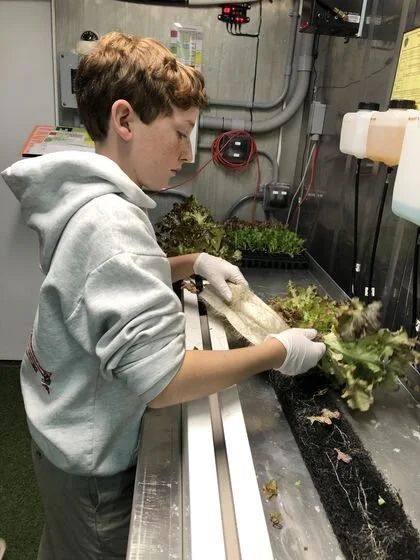
A student harvests lettuce at Rivers School in Weston.
STEPHEN PORTER FOR THE BOSTON GLOBE (CUSTOM CREDIT)
Inside the big white shipping container parked behind a classroom building on the campus of the Rivers School in Weston, it smells like a verdant field on a warm spring day, with a degree of humidity that is completely at odds with the cold, dry air outside.
A variety of lettuces, herbs, and a smattering of other vegetables grow on vertical towers in adjustable rows. The sixth-grade students who maintain the school’s Freight Farm cycle through in groups of four to reap the bounty of work they started at the beginning of the 2019-2020 academic year. The first harvest day was in late October.“
They all love to come in here,” says Emily Poland, who teaches eighth-grade science and is the farm director at this independent school for grades 6 through 12. The Freight Farm and related projects are built into the sixth-grade curriculum, incorporating humanities, social justice, and science, among other subjects. Students spend time there once a week planting, cleaning, and harvesting. Farming is a club activity for the school’s high school students, who can go in during their free time.
The Freight Farms container at the Rivers School.
STEPHEN PORTER FOR THE BOSTON GLOBE (CUSTOM CREDIT)
Based in Boston, Freight Farms manufactures technologically advanced hydroponic farming systems. In 320-square-foot, climate-controlled shipping containers, users can grow up to 13,000 plants at a time, vertically, without soil. The company was founded in 2010 by Brad McNamara and Jon Friedman. Several area schools, among them Rivers, Boston Latin School, and Worcester State University, are using the farms to grow food for their own communities, for their neighbors, and as educational tools.
For Poland, managing the farm was a natural extension of her teaching. “I like to create a curriculum. I care about food. I like to be outside,” she says. One of the sixth-graders’ annual activities, which combines academics with community service, is cooking a meal for the Natick Open Door at St. Paul’s Episcopal Church. These are hosted every week and attended primarily by seniors. Poland explains that planning the meal incorporates math skills because the students have to scale recipes to feed up to 45 people. And naturally, they use their own greens in the salads.
The students run a farmers market in the spring. And this year they are maintaining a (very micro) CSA, which one parent won in an auction. The school’s chef, Michael Clancy, also gets involved, using the students’ produce in the dining room, and helping them cook with what they grow — so far this year they have made pesto and herb vinaigrette. “Their pride is really amazing,” he says.
Boston Latin, a public exam school for grades seven through 12, acquired its farm in 2013 after students in the Youth Climate Action Network won the $75,000 prize in the Global Green Schools Makeover Competition. Farming is a student-run after-school activity here, under the guidance of eighth-grade history and civics teacher Cate Arnold, whose evident affection for her students appears to be reciprocal.
Though roughly 70 students have signed up as student farmers, there is a smaller core group that farms regularly, with an even smaller leadership team that is trained by Freight Farms. At the beginning of each academic year, the leaders meet to plan what they will grow, who will work to train new students, and organize schedules. They keep track of chores on a whiteboard in the farm.
Addy Krom, a junior, notes of the farm, “You can come in, it’s a whole different environment. All the stress from school [goes] away.” Adds sophomore Azalea Thompson, “This makes locally grown food more accessible to the city.” The students give the food they grow to faculty members, bring some home, and are working to create a CSA. With Arnold’s help, they are also trying to reestablish a more consistent connection to a food pantry in Jamaica Plain, where a former Boston Latin parent, recently deceased, used to deliver their greens.
At Worcester State, Mark Murphy, associate director of dining services, oversees the Freight Farm, which sits outside of Sheehan Hall, the school’s newest dormitory and site of its main cafeteria. Rich Perna, former director of dining, made the decision to purchase the farm five years ago, says Murphy, “to bring hyperlocal produce to the campus.
”Murphy has been responsible for the farm for the last two years. An employee of Chartwells, which has the contract for all of the school’s food services, he grows almost all of the greens for the cafeteria, as well as for alumni catering events, and the salad bar in the food court in the building next door. “I’m learning from trial and error,” he says.
At full capacity, Murphy explains, the farm produces about two acres’ worth of crops. He is constantly looking for different varieties of lettuce that will appeal to the students and is currently “trying to figure out a gourmet mix.” In addition to three varieties of lettuce, he grows kale, rainbow Swiss chard, parsley, and basil. He coordinates with the cafeteria’s cooks, telling them what he is growing so they can plan menus to incorporate the farm’s production.
Though WSU students are not currently working in the farm Murphy says he promotes the fact that most of the greens in the cafeteria are grown right outside the door. And, he says, “We’re trying to get the word out to get students involved.”
Through a partnership with the Worcester Public Schools and its program that helps young adults with differences transition from school to the workforce, Murphy has three part-time helpers/trainees. Once a week three students, who have completed high school with a certificate, come (often with a job coach from the program) to seed, plant, harvest, and clean. Murphy is in the process of hiring one of the students, who has aged out of the program. She “has a lot of passion for the farm,” he says.“I never thought we’d be growing food inside a container,” Murphy says. “I think it may become a necessity someday.”
Andrea Pyenson can be reached at apyenson@gmail.com.

The Humble Veggie Patch Just Went Hi-Tech
Growing vegetables and herbs is set to get a whole lot easier with big tech companies creating indoor 'vertical farms'
Forget battling insects and having to remember to water your veggie patch, growing herbs and vegetables at home is set to become hi-tech with new indoor farms.
by Tanya French
9th Jan 2020
Growing vegetables and herbs is set to get a whole lot easier with big tech companies creating indoor 'vertical farms'.
Samsung and LG have both spruiked their answer to the humble vegetable patch - creating indoor gardening appliances that enable people to have their own veggie garden, even if they don't have a backyard.
Samsung's Chef Garden technology integrates with its next-generation Family Hub refrigerator and automatically regulates light wavelengths to enable users to grow and enjoy fresh, pesticide-free fruit and vegetables all year round.
Samsung's vertical farm.
"There is a growing interest in healthy food," said Samsung LED technology centre's Chohui Kim.
"Horticulture LED is playing a key role in vertical farming and indoor crop cultivation, and we are looking to expand its applications in various fields."
The indoor farm integrates with the Family Hub fridge.
While Samsung's offering can easily fit into an existing kitchen, LG's version needs to be in-built into new or renovated kitchens.
The LG vertical farm consists of 24 pods which all have seeds and fertiliser in-built.
The machine recognises the amount of light and water it requires for optimum growth.
The farm - which takes 4-6 weeks to grow - will produce enough leafy vegetables to feed a family of four.

LG’s vertical farm solution. Photo: Tanya French
There's no word yet on when the technology will be available in Australia or what it will cost but an LG spokeswoman said it was 'very high end and part of a bigger kitchen solution'.
Maryland Helps Grow Urban Rooftop Farms
Farm-to-table, the movement which looks to illuminate and shorten the distance between the two, is all well and good. But what if you're city-dweller living miles from the nearest farm?
John Tolley, January 10, 2020
Farm-to-table, the movement which looks to illuminate and shorten the distance between the two, is all well and good. But what if you're city-dweller living miles from the nearest farm?
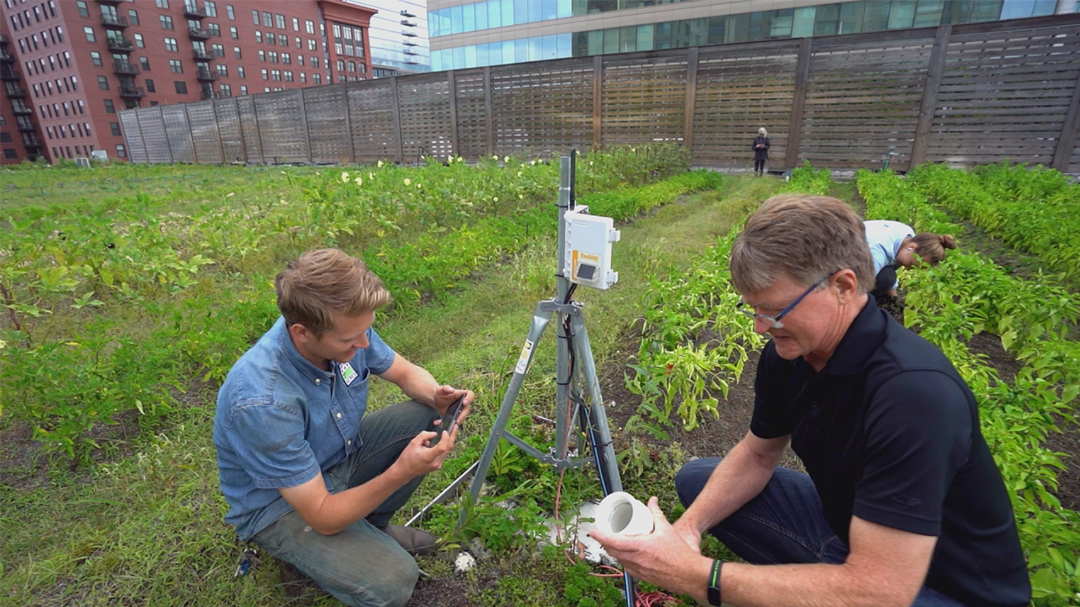
Enter the University of Maryland, who is working to make urban rooftop farming as ubiquitous as the corner Starbucks. The concept is no more difficult to understand than the name. People in cities cultivate their own fruits, vegetables, herbs and flowers on these untapped open spaces.
"The interesting thing about cities is they're fragile," notes John Lea-Cox, a professor in the Departments of Plant Science and Landscape Architecture at Maryland. "By fragile I mean that urban people are really dependent upon transport to get food into cities. That's why this kind of urban food production, whether it be at grade or on a rooftop, is really important."
From the deceptively simple idea of urban rooftop farming sprouts a plethora of potential benefits for cities and surrounding communities alike.
FRESH FOOD
As alluded to before, due to transport costs and limitations of space, most cities find themselves plagued with food deserts. These are areas where unprocessed, fresh foods are difficult to obtain and grocery stores are difficult to access.
Partnering with Up Top Acres, Maryland is countering this trend, helping the group refine and improve their practices, one rooftop at a time. Kristof Grina, co-owner of Up Top Acres, says that the difference between local and shipped-in produce is night and day.
"It comes to the miles that are attached to the vegetables they are eating," says Grina. "We're not even measuring it in miles. We're measuring it in flights of stairs or floors in a building. That has an impact on the freshness of the food, which correlates to the nutrient density."
A HELPING HAND
The partnership between Maryland and Up Top Acres began when the urban farmers found themselves out of their element in terms of data collection. They launched a program to gauge the performance of Up Top Acres' systems, but quickly saw the potential for more.
Lea-Cox, alongside Andrew Ristvey, extension specialist at Maryland's Wye Research and Education Center, helped Up Top Acres develop soil media blends and a nutrient management program for the unique environment.
"For the last ten or fifteen years, I've been involved in sensor-driven irrigation and nutrient management," says Lea-Cox. "What that does is it actually provides the tools for Kristof to monitor his practices in real-time. What we are doing is we're providing sensors that will actually sense not only the soil, the soil moisture, but also the atmosphere. So, what we do is we connect the dots. Connect the dots, provide that information to Kristof, so that he can get on with his day, he can understand what's happening in the soil and make better decisions."
WEATHERING STORMS
Another especially salient benefit for the state of Maryland, which hugs the Chesapeake Bay, is the role urban rooftop farms can play in mitigating the detrimental effects of stormwater.
Modern cities, covered in a skin of concrete, asphalt and other impermeable materials, displace natural areas of soil and vegetation. Without these elements to capture the rain, it careens out of the area and into local waterways. As it does, that rain carries pollutants and nutrients, negatively impacting the entire ecosystem.
Ristvey explains that urban rooftop farms can help hold back the wash. "A green roof system, if it's working and functioning properly, is retaining stormwater and preventing that initial slug of stormwater from getting into the waterways."
BACK TO NATURE
On a more philosophical level, Lea-Cox says that urban rooftop farms of any scale afford city dwellers a connection to the natural world. Beyond the nutritional and environmental benefits of the farm plots, he surmises that people yearn to get their fingernails a little dirty.
"Of course, an urban area is a really exciting place to live," says Lea-Cox. "But I think what a lot of us miss is that connection to the earth. That's what's so great about working for a land-grant university, is that we are connecting people back to the earth."
JOHN TOLLEY
John Tolley is a BTN.com contributor covering stories of inspiration, impact and innovation - on and off the field - in the areas of science, philanthropy and the arts.
Lead Photo: BTN LiveBIG

The Final Event of The Erasmus+ 'Aqu@teach' Project Which Will Take Place At The University of Greenwich On Saturday 28 March.
In light of climate change, Brexit, and concerns over the carbon footprint of the food supply chain, aquaponics, and other controlled environment farming technologies could play a key role in the future of food production, but only if there is an appropriately trained workforce
Aqu@teach is the first aquaponics curriculum to be developed
specifically for university-level students.
The curriculum, which covers the basics of aquaponics with a focus on transferable and entrepreneurial skills, can be taught either using blended learning or as an e-learning course and will be freely available on the project website from 1 April. Given the multidisciplinary nature of aquaponics, the curriculum can be taught as an optional module in a wide variety of different degree courses, including agriculture, agronomy, horticulture, aquaculture, landscape architecture, and ecological engineering.
In light of climate change, Brexit, and concerns over the carbon footprint of the food supply chain, aquaponics, and other controlled environment farming technologies could play a key role in the future of food production, but only if there is an appropriately trained workforce.
At the event on 28 March, we will explain how the curriculum was put together, and participants will be able to explore the online modules. There will also be an opportunity to visit our green roofs and aquaponics greenhouse.
Please see our Eventbrite site for further information
about the event and to register for a free ticket:
https://www.eventbrite.co.uk/e/aquteach-tickets-87961111051

Vertical Farming Startup Expands Through New Retail Deals With Whole Foods, Safeway
A South San Francisco farming startup is quickly growing its retail roots after landing new distribution deals with two of the area's largest grocers
Vertical farming startup Plenty is ramping up its retail distribution through two new deals with Whole Foods Market and Safeway.
South San Francisco, CA
By Katie Burke – Staff Reporter, San Francisco Business Times
A South San Francisco farming startup is quickly growing its retail roots after landing new distribution deals with two of the area's largest grocers.
Vertical agriculture company Plenty will soon stock the produce shelves at a handful of Whole Foods Market and Safeway locations across the Bay Area to mark the beginning of what the startup is hoping will be a widespread push into new retailers and restaurants. Plenty's vegetables first began selling in retail outlets last year and are now available through Good Eggs, Berkeley Bowl, Bi-Rite Market and the robotic burger restaurant, Creator.
Plenty grows its produce hydroponically, meaning it feeds the plant without having it rooted in soil. By cutting water consumption, shortening the supply chain and shrinking the amount of space needed to grow produce, Plenty will be able to deliver more produce at a faster rate, Plenty CEO Matt Barnard previously told the San Francisco Business Times.
Matt Barnard, CEO and CoFounder, Plenty Inc.
Since it was founded in 2013, Plenty has raised more than $400 million, $175 million of which was raised as part of a Series C round the company closed last June. The round pushed the company's valuation to its current $1.05 billion.
The latest infusion of capital has helped fund the company's expansion to Los Angeles, where it's in the process of opening a new 95,000-square-foot farm in Compton. The new facility is expected to begin supplying produce like bok choy, mizuna, fennel, and kale to retail partners by the end of this year.
The company's South San Francisco farm, which launched last summer, is on track to hit full capacity before the end of the year. At that point, it will be able to supply more than 100 grocery partners throughout the Bay Area. Plenty also operates a test farm in Wyoming, where it experiments with different seeds and varietals.
Plenty is ultimately aiming to have as many as 500 vertical farms stationed in highly populated, urban areas around the world.
"We are able to deliver a product that’s both better than and at a price that is less than anything that’s in the market," Barnard previously said. "You are going to see us on more and more shelves. You going to be able to find us, have us delivered to your home. We want our product in more people’s hands and mouths."
Europe Can Be At The Heart of Tech With Purpose
“Some say China has all the data, and the US has all the money. But in Europe, we have purpose.”
09 Jan 2020
Tom Wehmeier Partner and Head of Research, Atomico
This article is part of the World Economic Forum Annual Meeting
• Venture-backed, purpose-driven companies represented 12% of all capital invested in Europe in 2019.
• Talent and consumers are both demanding start-ups display social commitment.
• Only 1 in 5 start-up founders actually measure environmental and social impact.
“Some say China has all the data, and the US has all the money. But in Europe, we have purpose.”
Thus observed EU commissioner for competition Margrethe Vestager when she outlined her priorities for the next five years in October.
Her words could not be timelier. This year, the number of purpose-driven European founders who have pitched to us at Atomico has been overwhelming. Tech leaders have the most powerful tech toolkit in history available to them, and European companies are stepping up to help solve some of the world's most pressing challenges such as the climate crisis and healthcare.
We quantified this trend in our annual State of European Tech report, released in November. With Dealroom, we created a framework to assess venture-backed European tech companies based on their alignment with the United Nations Sustainable Development Goals (SDGs). The analysis focused on a subset of seven of the 17 SDGs. Only companies where the purpose-driven impact was considered core to the business model were included in the final dataset and analysis.
In total, the analysis identified 528 unique venture-backed, purpose-driven tech companies. They raised a total of $4.4 billion in capital investment in 2019, up from less than $1 billion in 2015. That $4.4 billion represents 12% of the total capital in Europe invested in 2019. It also represents the third largest “industry” in European tech by capital invested, behind fintech and enterprise SaaS.
These companies span Europe and include Infarm in Germany, which is building advanced vertical farms, telemedicine firm Kry in Sweden, and insect farming start-up Ÿnsect from France.
From an investor's point of view, it is obvious that the world’s biggest challenges also represent some of the world’s biggest markets and opportunities. But the rise of purpose-driven tech in Europe is also a response to the changing priorities of talent and consumers in Europe.
More debate and visibility over the impact and unintended consequences of digital technology on our society have made talent think more about working for companies that align with their values. Kate Hilyard, COO at Healx in the UK who we partnered with this year, expressed this trend very well in the report.
“At Healx, we believe every rare disease patient deserves a treatment. It's this belief that drives us to achieve our mission of taking 100 new treatments towards the clinic by 2025. Having such a clear mission also helps with recruiting and retaining the best and brightest talent. For the team here, there's no bigger motivator than knowing you're applying your skills to improving the lives of patients, their careers and their families. This is especially the case for the many team members who count either themselves or a relative amongst the 400 million people worldwide living with a rare disease.”
Then there are consumers who also want to support companies that align with their values and beliefs. According to a survey of 30,000 global consumers by Accenture Strategy, 62% of consumers want companies to “take a stand on current and broadly relevant issues like sustainability, transparency or fair employment practices”.
It also makes sense that European tech start-ups are differentiating themselves on purpose, as compared to their US or Asian peers. Many western European countries are leaders on sustainability from energy to transportation. According to RobecoSAM and Robeco’s Country Sustainability Ranking, a comprehensive framework for analyzing countries’ ESG performance based on governance, societal and environmental considerations, seven of the top 10 countries are in Europe.
Despite this rise in purpose-driven companies, only one in five founders told us in our State of European Tech survey that they are already measuring their firm’s environmental or social impact – something potentially important for all tech companies regardless of their business model. Given that the majority of founders say they are considering measuring this, and only 14% say they don’t think it’s important, measurement seems to be one way that investors could support all founders to consider the impact of their business on society.
In the early 20th century, technologies from electrification, to the washing machine to the jet engine improved the day-to-day lives of millions and opened up new frontiers for humanity. Technology drove economic growth and boosted prosperity, but it also left deep scars on the environment and failed to solve big problems such as global food security.
Though we are only two decades into this century, the work of purpose-driven European founders suggests that the legacy of technology in the 21st century might have a more beneficial and transformational impact on our society, one in which purpose and profit are mutually reinforcing.
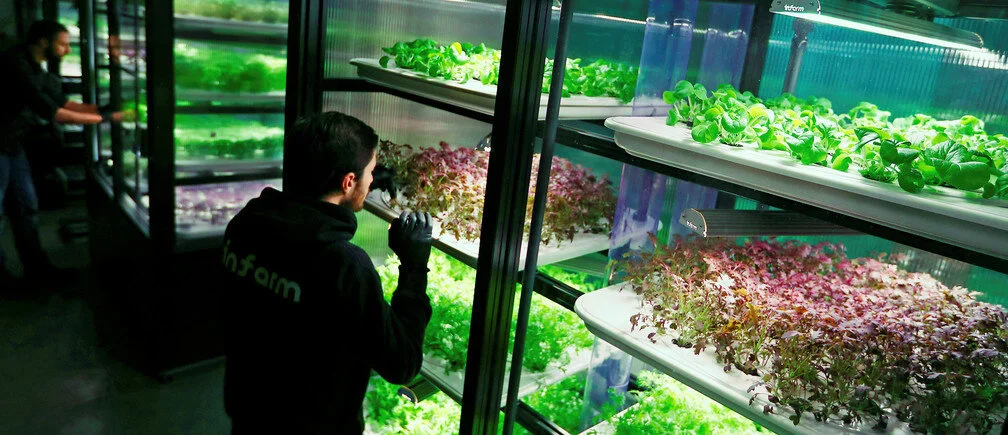
Lead Photo: An employee of the urban farming start-up Infarm checks an indoor growing system.
Image: REUTERS/Hannibal Hanschke

US: Massachusetts - Alum Introduces Brookline To New Farming Techniques
Levine's startup Town to Table utilizes several different hydroponic technologies such as those made by Freight Farms, which allows plants to be grown in winter. Each 40-foot container can produce the equivalent of an acre of conventionally grown crops
GRAPHIC BY NICK CLONEY
Nick Cloney, News Managing Editor
January 14, 2020
Levine's startup Town to Table utilizes several different hydroponic technologies such as those made by Freight Farms, which allows plants to be grown in water. Each 40-foot container can produce the equivalent of an acre of conventionally grown crops.
Massachusetts isn’t exactly known for its farming capabilities. Between its varied terrain, harsh winters, and short growing seasons, many obstacles stand in the way of the state producing much agriculturally. But Jack Levine ‘16 is working to change that.
Levine felt that his experience in high school lacked real-world relevance. Now, his work to introduce innovative and sustainable agricultural techniques to the Brookline community through his startup Town to Table allows him to offer real-world experience to students at the high school.
Starting after Thanksgiving, Town to Table plans to take on up to 10 high school students as interns for the second semester. Student volunteers in the program would gain hands-on experience working in Town to Table’s hydroponic Freight Farm, a shipping crate modified to grow crops in a water-based medium, as opposed to a planting bed made of dirt.
Social Studies teacher and Food Justice Club adviser Roger Grande explained how the key feature of hydroponics – the delivery of nutrients through the water – is beneficial for the growing process.
“The key thing is that no matter how nutrients are being delivered to the plant, as long as they’re getting there, the plant is going to grow. If they are being delivered via water, then it cuts down on the lack of mobility and lack of flexibility that you have to deal with when everything is buried in dirt,” Grande said.
Levine said that the cross-country transportation that most vegetables in Massachusetts undergo reduces their quality, a problem solved by localized agriculture.
“In Massachusetts, 98 percent of our leafy greens come from California or Arizona, so pretty much every time I eat a salad, I think of it being jet-lagged, like how you feel when you get off that plane in California,” Levine said. “We’re offering districts farm-to-plate food. Within 24 hours of when we harvest it, students will be eating it.”
Grande said that one of Levine’s goals is to give students an opportunity to gain hands-on experience in an environment unlike any they have encountered before.
“I think he would also like to see this programming be integrated to the Brookline public school system, and for kids to have really interesting opportunities related to learning by doing. That’s authentic learning – it’s not just learning about something, it’s learning by doing that thing,” Grande said.
Levine said he was often a difficult student to teach during his time at the high school due to his lack of engagement with traditional high school subjects.
“Funny enough, I met with Brittany Stevens recently to talk about introducing this program to some of her classes. She asked me if I remember how I used to say every single day, ‘we have to fix the school,’” Levine said. “‘School doesn’t work’ was kind of one of my things since it especially didn’t work for me. I was off the walls. I was a pain in the butt for teachers, I was crazy.”
English teacher Elon Fischer, who taught Levine’s English for Entrepreneurs class during his senior year, said that he showcased an interest in business and charting his own path while still in high school.
“He was a goofball, but he was also very interested in entrepreneurship. By the time he was a senior, he was kind of fed up with school, and was looking to do something a bit more interesting than what BHS offered,” Fischer said. “Jack felt like school was just a big game and he wasn’t very interested in playing it. Great sense of humor, really a smart kid, but he was looking for something different to do.”
Grande said he was impressed with Levine’s vision to expand his business and involve food justice.
Levine said that the goal of any partnership would be to provide students with hands-on experiences that are relevant to their future career paths.
“That’s what we want, to take this and show other students that something like this can capture their attention in a classroom. You know, there’s no right or wrong answer when you’re growing a plant. It’s just a process and it’s a process in which you’re constantly learning. To us, that’s what we should be preparing students to do,” Levine said.
Grande explained that one of the biggest benefits of Town to Table’s services is the autonomy and decision-making power that sustainable, localized agriculture offers.
“At its core, it’s about empowerment: it’s about having more control over our health, our nutrition, and our values. It’s about seeing your place in the world and taking back some of your power from people who are making choices for you,” Grande said. “People should be more focused on being thoughtful about the choices they’re making, or the choices that are being made for them. There are many powerful forces that try to shape those things and steer us into buying what they’re marketing.”
Fischer said that Levine is a great role model for how students can take things they’re passionate about and transform them into careers.
“This is just a great example of what kids can do when they find something that they care about. And I think that the more that we as a school can make these opportunities available to kids, and work hard to spark their interests in things that aren’t directly academic, the better,” Fischer said.

Discover The NKBA Award-Winner: The Natufia Kitchen Garden At KBIS
Come and learn how to create a healthy, happy and sustainable life with Natufia Kitchen Garden

NATUFIA AT KBIS
Natufia is excited to showcase the NKBA award-winning
Natufia Kitchen Garden at KBIS, North America's premier trade show dedicated to kitchen design & innovation.
We would love for you to visit us in BOOTH SL1625 at the South Hall.
Enjoy a FREE Expo Pass as our guest with promo code EXIV844585.
Come and learn how to create a healthy, happy and sustainable life with Natufia Kitchen Garden.
Schedule an Appointment
Our mailing address:
Värvi 5, Unit C 216, 10621 Tallinn, Estonia
(702) 686 4196 ⎮ info@natufia.com
ALASKA: Indoor Produce Sprouts In Anchorage
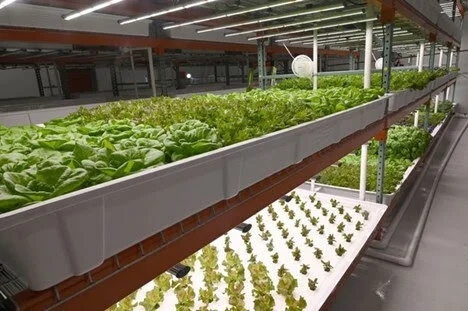
Anchorage Greens is an expansion of Juneau Greens, a similar business in the state’s capital, said Trevor Kirchhoff, who co-owns the businesses with John Krapek. In the back of Anchorage Greens’ warehouse, a vivid green garden grows in a hydroponic system. Racks of plants sit in nutrient-filled water under LED lights
Author: Alex DeMarban
Anchorage Greens: This new indoor farm at 1207 E. 73rd Ave. in South Anchorage is building a devoted clientele eager for tasty lettuce, herbs, and other greens, especially in winter when grocery stores can run low on quality produce.“
This is amazing produce," said customer John Schoen, buying a tub of butter lettuce and other leafy veggies on Friday. “Nothing at the grocery stores comes anywhere near this.”
“Our family doesn’t drive much," said Meghan Holton, another customer grabbing an order. "But we drive here every week to get fresh greens because it tastes like summer.”
Anchorage Greens is an expansion of Juneau Greens, a similar business in the state’s capital, said Trevor Kirchhoff, who co-owns the businesses with John Krapek.In the back of Anchorage Greens’ warehouse, a vivid green garden grows in a hydroponic system.
Racks of plants sit in nutrient-filled water under LED lights.
The first plants were harvested in November. Customers can subscribe to the Greens Bag program, a weekly rotating menu of lettuces and herbs including basil, cilantro, and red-veined sorrel. Kirchhoff said customers can also buy items individually.
The store features hard-to-find veggies such as purple-leafed basil, a colorful take on the herb.
Anchorage Greens has done no advertising, Kirchhoff said. Clients are learning about it through word of mouth.
Business owner Trevor Kirchhoff closes the cooler door at Anchorage Greens, Jan. 3, 2020. (Anne Raup / ADN)
Lead Photo: Plants grow at Anchorage Greens, Jan. 3, 2020. (Anne Raup / ADN)

Texas A&M Undergraduate Initiates Urban Farm On Campus
Urban farming comes in many forms, and now one of those, vertical farming, is helping feed students at Texas A&M University
Vertical farm project helps provide fresh vegetables to students while advancing agriculture
JANUARY 1, 2020
Urban farming comes in many forms, and now one of those, vertical farming, is helping feed students at Texas A&M University.
The project is part of an experiential learning initiative, which is a required part of the curriculum for undergraduates in Texas A&M’s Department of Soil and Crop Sciences.
The department offers internships and study abroad opportunities to help students meet this requirement. Broch Saxton, one of the department’s December graduates, created his own internship as a student leader and greenhouse project director with Texas A&M’s Urban Farm United, or TUFU.
Seedlings are planted in the towers where they will remain until they reach maturity and are harvested. (Texas A&M AgriLife photo by Beth Ann Luedeker)
Campus farming
Seedlings are planted in the towers where they will remain until they reach maturity and are harvested. (Texas A&M AgriLife photo by Beth Ann Luedeker)
TUFU is an urban farm that utilizes tower gardens or vertical towers that produce high-value/specialty crops in a space-conscious technique via hydroponic growing methods.
The project, started by Saxton, is in a greenhouse on the Texas A&M campus. It currently includes 24 towers in which a variety of produce is grown, with plenty of room to expand.
The urban farm project began as a collaboration between Saxton and Lisette Templin, an instructional assistant professor from Texas A&M’s Department of Health and Kinesiology.
“I have dreamed of running greenhouses in this form,” Saxton said. “Using the knowledge obtained from my degree, I want to help people have better access to greater food, all while ingraining hydroponic farming into the university. My experience in this process has been completely driven by networking and passion. This is what I want a career in.”
Saxton earned his bachelor’s degree in plant and environmental soil science Dec. 13.
“Hydroponics has huge potential to benefit many people,” he said. “When I approached the Texas A&M Office of Sustainability with my idea of a vertical farm project, they suggested I partner with Ms. Templin, who had approached them with a similar idea.”
Templin has a tower garden on her patio, which feeds her family of four.
Feeding students
Templin and Saxton envisioned a project that could potentially feed Aggie students and staff on campus. They submitted an abstract to the Aggie Green Fund. In January 2019 received a $60,000 grant and permission to use space in a greenhouse owned by the Department of Plant Pathology and Microbiology.
Using grant funds, they purchased towers and a closed-loop watering system that provides nutrition to the plants. They also bought 800 seedlings from an urban farm in Austin to use for their initial crop. They will be self-sufficient and seed their own plants for future endeavors.
Seedlings are planted in the towers where they will remain until they reach maturity and are harvested. (Texas A&M AgriLife photo by Beth Ann Luedeker)
Seedlings are planted in the towers where they will remain until they reach maturity and are harvested. (Texas A&M AgriLife photo by Beth Ann Luedeker)
The first crop included four different types of lettuce, kale, snap peas, snow peas, herbs, chard, bok choy, tatsoi, and celery. They plan to expand the project to include peppers in the next round.
The team manages each tower individually to ensure the pH of the water is appropriate for the stage of growth and nutritional requirements are met.
Educational aspect
Since it is an internship and Saxton received college credit for his time with TUFU, he needed an adviser in the department. He reached out to Jacqueline Aitkenhead-Peterson, Ph.D., associate professor of urban nutrient and water management.
“I had taken courses under Dr. Peterson and was impressed by her value as a teacher and her approach to education,” Saxton said. “She has the mentality of mentorship and guidance that I was looking for.”
Aitkenhead-Peterson said she was happy to serve as Saxton’s adviser for the project.
“The fact that this project was not research-based was very unusual to me,” she said. “However, this project is about feeding people and educating them on the possibilities of feeding themselves, which I deem to be a very important exercise.”
Providing food
The produce harvest by TUFU was distributed by the 12th Can Food Pantry, a student-run program on the Texas A&M campus, which serves all students, faculty, and staff in need of assistance.
TUFU looks forward to continuing to support the 12th Can and hopes to expand to support student dining.
-30-

Brick Street Farms To Construct Cultivation Hub, Increase Production In St. Pete
Backed by proprietary technology developed by Brad and Shannon, Brick Street Farms is now able to produce the equivalent of 2-3 acres of agriculture per shipping container
OWNERS OF BRICK STREET FARMS, BRAD DOYLE AND SHANNON O’MALLEY
For some reason, I can never keep plants alive. Maybe I don’t water them enough. Or perhaps I water them too much! Could it be the amount of light I expose them to? You know what, it’s probably due to my cats eating the leaves off every plant I’ve ever owned. Either way, I’ve never been able to provide the perfect environment for green life to thrive. And back in 2015, Shannon O’Malley and Brad Doyle were having similar troubles. But for them, the problem was the Florida heat.
Luckily, the couple found a solution to their woes. When they took their plants inside and put lights on them, the plants flourished. Brad and Shannon didn’t know it yet, but this revelation would end up being the seed that would sprout into an agricultural movement in Downtown St. Pete. After extensive research, the duo realized they could use their backgrounds in computer engineering and IT skills to build indoor hydroponic farms.
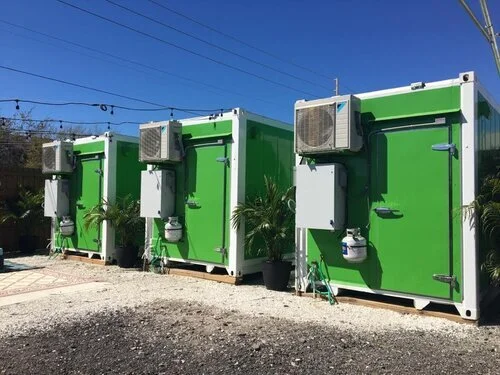
HUMBLE BEGINNINGS: BRICK STREET FARMS FIRST THREE CONTAINER FARMS
And so in January 2016, the duo purchased an overrun junkyard at 2001 2nd Avenue South in the Warehouse Arts District for $125,000 to house their new venture — Brick Street Farms. After months of environmental inspections, permitting and zoning obstacles, and electrical and plumbing issues, Brick Street Farms kicked off their first grow cycle inside three 320 square-foot shipping containers in October 2016.
Backed by proprietary technology developed by Brad and Shannon, Brick Street Farms is now able to produce the equivalent of 2-3 acres of agriculture per shipping container. The farm cultivates a variety of leafy greens including heads of bibb, butterhead and romaine lettuce, kale, basil, and rainbow chard.
Best of all, the growing process uses no dirt, no pesticides and much less water than traditional farming. Needless to say, their concept caught the attention of many local residents, and restaurants, such as the Vinoy, Oak & Ola, Oxford Exchange, and Pacific Counter.
For the past three years, Brick Street Farms has been feverishly trying to keep up with production. “When we started, we really just thought we’d be a wholesale production facility to grow and sell to restaurants, and maybe grocery stores,” says O’Malley. "But the level of interest and inquiries we get from everyone from chefs to elementary schools, we realized we couldn’t be closed off to the public.”
INSIDE ONE OF BRICK STREET’S HYDROPONIC SHIPPING CONTAINER FARMS
This year will be Brick Street Farm’s biggest yet. After bringing on a few investment partners in late 2019, the hydroponic farm will begin construction on a community-focused grow facility and will also dramatically ramp up production to satisfy demand from a new Publix partnership.
The current farm, located at 2001 2nd Avenue South, will be transformed into the Brick Street Cultivation Hub, which will include an expanded market, more container farms, a commissary kitchen, a beautiful courtyard, and pop-up event space.
RENDERING OF THE BRICK STREET CULTIVATION HUB AT 2001 2ND AVENUE SOUTH IN THE WAREHOUSE ARTS DISTRICT OF ST. PETERSBURG
Right now there are four container farms on site, but once the Cultivation Hub is complete, there will be a total of ten, stacked two high. Not only will Brick Street continue to grow lettuces, kales, and herbs, but they’ll be expanding into other products, such as tomatoes and strawberries.
“People always laugh at us, but one product we can grow exceptionally well in the containers is strawberries,” says O’Malley. “We haven’t sold them because we live in the strawberry capital of the world, but ours are phenomenal so we are going to give them a try and see if people want them.”
The largest addition to the property will be a new 6,500 square foot mixed-use building. The first floor will contain a 1,800 square foot farm-to-table market featuring greens grown on-site, as well as items from other local farms, like dairy, fruits, and vegetables, which cannot be grown in Brick Street’s shipping containers.
Additionally, the market will carry sustainable products from other local businesses, such as baked goods, health and beauty items, apothecary products, grab-and-go meals, beer and wine, and much more. Well-known local companies like St Pete Ferments, Nightshift Wax Company, Mother Kombucha, and Sunny Culture will also be available at the market.
A coffee concept will be located in the center of the Cultivation Hub. “It’ll be a full-time community space serving coffee, beer and wine,” says O’Malley. “Customers can relax in the beautifully landscaped courtyard, connect to the wifi and just hang out.” Two local coffee companies are currently in negotiations to lease the space.
An existing 416 square foot building will be converted into a commissary kitchen. This will be the new home of Brick Street Canning Company, helmed by Illene Sofranko, founder of The Urban Canning Company, which recently closed up shop. “We will be revising all of her core products and introducing an all-new line of products as well,” says O’Malley.
When Sofranko isn’t using the space, it’ll be rented out to local food makers. A few local restaurants will be hosting pop-up events at Brick Street, including Greenstock, Pete’s General, and Top Chef alum Jeffrey Jew, whose new St. Pete restaurant, Lingr on 6th St, opens this Spring.
“The Cultivation Hub will be dog-friendly and kid-friendly,” says O’Malley. “It’s just going to be a multi-functional property centered on food.” Construction begins in February and is tentatively scheduled to open in November.
If the Cultivation Hub wasn’t exciting enough, Brick Street Farms has also leased a warehouse on 22nd Avenue South that will serve as a manufacturing facility as well as house all farming operations while the Cultivation Hub is under construction.
BRICK STREET FARMS RECENTLY STARTING SELLING AT A PUBLIX SUPERMARKET IN LAKELAND, FL. AS PRODUCTION INCREASES, BRICK STREET PRODUCE WILL BE AVAILABLE IN ST. PETE & TAMPA
Brick Street Farms recently started selling their greens at a Publix Supermarket in Lakeland, the grocery chain’s test market. Feedback has been stellar and Publix is interested in expanding the partnership. “We have been selling 12 times their projected volume,” says O’Malley. “As our production grows, we will begin expanding to more cities.” Brick Street Farms is slated to hit St. Pete Publix stores in early March followed by Tampa and Central Florida thereafter.
With interest from Publix and a growing list of wholesale partners, the 22nd Avenue South warehouse will serve as a farming container assembly line. “It’ll be like a car plant,” says O’Malley. “We have an entire construction crew ready to begin building the farm containers.”
The goal is to build 60 containers in 2020 and an additional 100 in 2021. So if Brick Street’s goal is met, they’ll be operating around 170 container farms or the equivalent of 340 to 510 acres of agriculture by the end of 2021.
BRICK STREET FARMS RED LEAF LETTUCE
So, where will all of these container farms live? Everywhere! One of the core tenants of Brick Street Farms is to decentralize farming. In other words, the Tampa market will be served by Brick Street farm containers in Tampa, and Orlando produce will come from farm containers in Orlando.
“We have been overwhelmed by the response from the community, both from individual households as well as our restaurant accounts,” says O’Malley.
At St. Pete Rising, we couldn’t be more excited for Shannon O’Malley, Brad Doyle and the future of Brick Street Farms, a true homegrown local business. Be sure to follow them on Facebook and Instagram to stay up to date on well their produce will hit St. Pete shelves and for the debut of the Brick Street Cultivation Hub at 2001 2nd Avenue South.