


Welcome to iGrow News, Your Source for the World of Indoor Vertical Farming

CANADA: Bringing Fresh Greens To Albertans And Making Hydroponics More Accessible
While the vertical farming industry typically prides itself on high levels of automation, Vertical Roots is taking a different approach that doesn’t rely on technology and automation
Mike and Becky Newhook first took an interest in local agriculture nearly 20 years ago, during a visit to the Philippines where most of the people they met were farmers. When they visited the region 18 years later, those same people were still farming.
One thing led to another, and the couple began working with the locals over Skype to set up two aquaponic farms and begin producing 20,000 heads of lettuce, which isn’t otherwise produced in the region. While those aquaponic farms are locally owned and operated, Mike and Becky continued in their pursuit of local food systems back home in Tofield, Alberta. That is how, at the beginning of the pandemic, Vertical Roots Canada was established.
Vertical Roots is a hydroponic farm founded in 2020 by Mike and Becky Newhook as well as their partners Brent and Evelyn Harley. While the farm began in the Newhook’s garage, it has expanded to Brent and Evelyn’s property in Beaver County, Alberta. It currently runs out of a 600 sq-ft building, although only 386 sq-ft is currently used for production. At this point, the major challenges to production are limited amperage and the limited access to potable water, requiring that water be trucked in. Vertical Roots hopes to expand to 1,500-2,000 sq-ft with all operations occurring under the same roof, from plant propagation to growing, testing, and harvesting.
While the vertical farming industry typically prides itself on high levels of automation, Vertical Roots is taking a different approach that doesn’t rely on technology and automation. The farm focuses on hands-on growing and relatively small-scale production. But according to Mike, that hasn’t hurt their business in the slightest as the company is expanding within a year of its establishment.
“We’re not about producing in warehouses and supplying major companies. People seemed to say that if you aren’t producing 20,000 heads of lettuce, then you’ll be left behind. But that hasn’t been the case at all,” says Mike. Vertical Roots sells its greens through subscriptions, to the Mayfair Royal Golf Club, and to local restaurants. The interest in local food has never been higher, according to the Newhooks, as consumers have flocked to the farm and maxed out the supply.
“When people are ordering from larger suppliers, the quality is lower. They are paying the same price or lower for a product that they can only use half of. We’ve learned that people are willing to pay more for a head of lettuce if it means that they can use all of it rather than only a portion of it,” says Becky.
Throughout the Newhooks experience, they’ve found the hydroponics community to occasionally be difficult to collaborate with, as the industry tends to keep its cards close and not share its experiences. They also struggled with having consultants make technical recommendations that didn’t ultimately make sense for their business. According to Mike, this lackluster knowledge sharing in vertical farming is part of why many vertical farms have failed.
As such, Vertical Roots is committed to being a transparent company that welcomes people and questions. The company has also developed a prototype system which it plans to commercialize by autumn 2021, which will be complemented by educational resources and consulting also provided by the farm. Vertical Roots already has 3-4 growers pursuing them to build a farm once the systems are available for sale.
“Our product is where we want it to be; we just need to keep repeating it. We want to master all four seasons before beginning to sell. While you are growing indoors, the season does impact climate control inside the farm,” explains Mike. In the future, Vertical Roots hopes to explore opportunities in northern Canada, as the rates of food insecurity and food prices are exorbitant throughout the region.
For more information:
Vertical Roots Canada
info@verticalroots.ca
www.verticalroots.ca
Publication date: Fri 19 Mar 2021
Author: Rebekka Boekhout
© VerticalFarmDaily.com
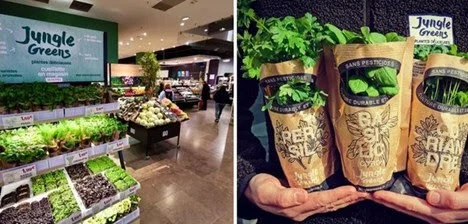
FRANCE: Jungle Says It’s Cracked How To Make Vertical Farms Profitable
“No matter how good your product is, if the price is higher than the alternative, then you’re dead.”
“No Matter How Good Your Product Is,
If The Price Is Higher Than The Alternative,
Then You’re Dead.”
BY FREYA PRATTY
22 MARCH 2021
Jungle, a French vertical farming company that says it can produce ten to 30 times more food than traditional greenhouses, has raised €42m in new funding.
The company also says its focus on large-scale farms will help it overcome one of the biggest challenges facing vertical farming: how to make a profit.
Jungle’s new funding, €7m of which is in equity and €35m of which is debt financing, comes from Founders Future, a French investment firm focused on impact startups. Jungle is the firm’s first investment.
The company’s funding comes as the wider industry continues to grow fast. It was worth $2.2bn in 2018 but is expected to reach $12.8bn by 2026. Investor appetite is clearly there: vertical farming giant Infarm raised $170m at the end of last year.
Jungle is building a 5,500m2 farm 80km from Paris, where crops will grow on stacked platforms. The site is already partly operational and the company has secured contracts with French supermarkets Monoprix and Intermarche.
At present, it’s growing a mixture of aromatic herbs, greens and, unlike other vertical farms, flowers. It’ll be fully operational by the end of 2021.
Less pesticides, more local and a greater yield
Gilles Dreyfus, cofounder of Jungle.
“We don’t claim to be instigating a revolution, we are part of an equation that wants to be a solution,” explains Gilles Dreyfus, who cofounded Jungle in 2015.
For Dreyfus, vertical farming has several advantages. Crops can be grown close to cities, where the majority of consumers are, thereby reducing the environmental costs of transit.
Plants can also be grown on more frequent cycles than on traditional farms because they’re not seasonally dependent, and they’re also grown without using pesticides.
“Our most popular product, Green Basil, gives 14 harvests a year in the vertical farm, compared to 3 or 4 in the South of France, where the crop grows best outdoors.”
National food sovereignty
Being able to grow crops out of season means vertical farming can help countries achieve better food sovereignty, Dreyfus says.
“We have to go further and further from the country to get crops when they’re out of season,” he says. “Brexit import taxes on food have shown the complicated situations this can lead to.”
“If the price is higher, you’re dead”
Despite the benefits, vertical farming has often struggled with how to make a profit. “Having a viable financial model and an efficient farm is the main hurdle for vertical farming,” Dreyfus says.
“No matter how good your product is, if the price is higher than the alternative, then you’re dead.”
The company believes that bigger farms is the answer.
German company Infarm, which is aiming at profitability by 2023, places microunits into supermarkets. Jungle, which is aiming at profitability in 18 months time, will focus on large-scale production facilities that then supply a whole area.
“Price depends on scale and we’re not aiming for small-scale farms, we’re aiming for less farms but a lot bigger. If you activate the economies of scale you can get a very reasonable product,” he says.
The company’s aiming to sell food at 5% more than the cost of conventional alternatives, but at 20% less than organic foods grown on farms.
For Valentine Baudouin, partner at Founders Future which has invested in Jungle, the focus on large-scale farms is the key to profitability, and what makes Jungle stand out.
“They’ve answered the economic question of vertical farming, which is very important because you have many similar enterprises that haven’t done so.”
Jungle’s vertical farm warehouse.
Beyond salad?
A criticism often leveled at the vertical farming industry is whether it can grow beyond just salad leaves and herbs.
Unlike other farms, Jungle also grows flowers for the perfume industry, but Dreyfus says the other crops its working on, including cherry tomatoes and mushrooms, won’t be in supermarkets until 2023.
“You can grow virtually anything you want, except truffles — which is a real shame actually,” says Dreyfus. “But the question shouldn’t be, can we grow it, it should be, do we have the financial model to make it work?”
Jungle’s currently got a team of 25 people based in France, but will use the new funding to double its workforce by 2022. It also plans to open two new large-scale farms in France, including one in the south that’ll be twice as big as its first site.
Freya Pratty is Sifted’s news reporter. She tweets from @FPratty

This Vertical Farming System Was Designed To Build Up Community And Accommodate The Urban Lifestyle!
Urban farming takes different shapes in different cities. Some cities can accommodate thriving backyard gardens for produce, some take to hydroponics for growing plants, and then some might keep their gardens on rooftops
03/19/2021
Following interviews with local residents, Andersson set out to create a farming system that works for the city’s green-thumb community.
Urban farming takes different shapes in different cities. Some cities can accommodate thriving backyard gardens for produce, some take to hydroponics for growing plants, and then some might keep their gardens on rooftops. In Malmö, small-scale farming initiatives are growing in size and Jacob Alm Andersson has designed his own vertical farming system called Nivå, directly inspired by his community and the local narratives of Malmö’s urban farmers.
Through interviews, Andersson learned that most farmers in Malmö began farming after feeling inspired by their neighbors, who also grew their own produce. Noticing the cyclical nature of community farming, Andersson set out to create a more focused space where that cyclical inspiration could flourish and where younger generations could learn about city farming along with the importance of sustainability.
Speaking more to this, Andersson notes, “People need to feel able and motivated to grow food. A communal solution where neighbors can share ideas, inspire and help one another is one way to introduce spaces that will create long-lasting motivation to grow food.”
Since most cities have limited space available, Andersson had to get creative in designing his small-scale urban farming system in Malmö. He found that for an urban farm to be successful in Malmö, the design had to be adaptable and operable on a vertical plane– it all came down to the build of Nivå.
Inspired by the local architecture of Malmö, Andersson constructed each system by stacking steel beams together to create shelves and then reinforced those with wooden beams, providing plenty of stability. Deciding against the use of screws, Nivå’s deep, heat-treated pine planters latch onto the steel beams using a hook and latch method. Ultimately, Nivå’s final form is a type of urban farming workstation, even including a center workbench ideal for activities like chopping produce or pruning crops.
Taking inspiration from community gardens and the local residents’ needs, Andersson found communal inspiration in Malmö.
Backyard and patio gardens are popular options for those living in cities who’d still like to have their very own gardening space.
Lead photo: Designer: Jacob Alm Andersson.
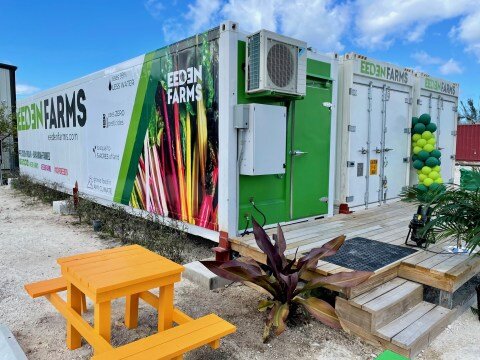
Eeden Farms Sees Phenomenal Market Response To Pioneering Concept
Lincoln Deal II, the founder of Eeden Farms, said: “The response has been phenomenal. Most days, we are combing growing and facilitating tours because the interest level is so high among restaurants and hotels

An Eeden Farms worker plants seeds for a sustainable future. (PHOTO: EEDEN FARMS)
NASSAU, BAHAMAS — A tech-enabled containerized farming company has seen a “phenomenal” response to its offering, according to its founder, who told Eyewitness News “the demand is definitely there”.
Lincoln Deal II, the founder of Eeden Farms, said: “The response has been phenomenal. Most days, we are combing growing and facilitating tours because the interest level is so high among restaurants and hotels.
Lincoln Deal II.
“A lot of the restaurants and hotels are enamored by how fresh the produce is, that they can get it farm-to-table and it’s Bahamian. The demand is definitely there.”
Eeden Farms, located in the BRON Business Centre, Airport Industrial Park, officially launched back in February.
The company currently utilizes three repurposed shipping containers equivalent to 15 acres of farmland and offers fresh organic produce year-round. Its farm system was created by Boston-based Freight Farms, the world’s leading manufacturer of container farm technology.
Deal defended the containerized farming concept, noting that Eeden Farms is the first company to have Freight Farm’s newest model of containerized farms.
“The technology that we are utilizing has never been used here before,” said Deal.
“We are the pioneers of this technology here in The Bahamas despite what misinformation may put out there. We were the first to receive this model from Freight Farms and they own the patent on this particular technology.”
Caroline Katsiroubas, director of marketing and community relations at Freight Farms, told Eyewitness News: “Eeden Farms represents the first entry of our technology into that region and that market. It began in 2020 but the journey didn’t start there. We have been working with him (Deal) for quite a few years, having first met at a conference in 2016.
“We’re in 32 countries right now. In terms of who our client base is, we have a very diverse kind of network of people who are interested in operating the system and it has infinite applications.”
Tags Always a headline ahead, Bahamas news, ewnews, ewnews.com, Eyewitness News, Eyewitness News Online, Nassau Bahamas, www.ewnews.com
About Natario McKenzie
View all posts by Natario McKenzie →
Lead photo: Eeden Farms. (BIS PHOTO/KRISTAAN INGRAHAM)

VIDEO: Inside A Shipping Container Vertical Farm
New farming models are cropping up around the world, including in Sydney, where Sprout Stack is transforming old shipping containers into commercial vertical farms
March 17, 2021
New farming models are cropping up around the world, including in Sydney, where Sprout Stack is transforming old shipping containers into commercial vertical farms.
With lighting in the containers designed to optimize plant growth, and sensors measuring temperature, humidity, and carbon dioxide, the approach is more productive than traditional farming — and uses 95 percent less water.
Take a look inside Sprout Stack’s vertical farms.

Technology Is Key To Feeding The World - Celebrating National Ag Day On March 23: We've Come A Long Way From Plows To Agbots
High-Tech Farm Trends: A Glossary
March 18, 2021
By: Steve Foster
Extension Educator Pershing County, University of Nevada, Reno Extension
High-Tech Farm Trends: A Glossary
Over the years, I have listened to many speakers predict what the future of agriculture will look like. One of the biggest challenges for agriculture is to feed 9.6 billion people by 2050. To do so, food production must increase 70% by 2050.
One way to address these issues and increase the quality and quantity of agricultural production is to use sensing technology to make farms more intelligent and connected through so-called "precision agriculture," also known as “smart farming.”
I came across an article the other day, Five High-Tech Farming Trends, by JoAnn Alumbaugh, that shares British author and Labour Party politician Anthony Crosland’s most cited sentence: “What one generation sees as a luxury, the next sees as a necessity." History has shown this to be true – just look at the use of cell phones, televisions, hand-held devices, and computers. Then look at how living conditions and diets have changed as societies have become more affluent.
Below are technologies related to agricultural and natural manufacturing under four key areas of accelerating change, many of which are already in use today: sensors, food, automation, and engineering.
Sensors
Air & soil sensors: Enable a real-time understanding of current farm, forest or body of water conditions.
Equipment telematics: Allow mechanical devices, such as tractors, to warn mechanics that a failure is likely to occur soon.
Livestock biometrics: Collars with GPS, radio frequency identification systems (RFIDs), and biometrics identify and relay vital information about livestock in real-time. Also, farmers and ranchers are using virtual fencing to control the movement of livestock, similar to invisible fences for pets.
Crop sensors: Instead of prescribing field fertilization before application, high-resolution crop sensors inform application equipment of correct amounts needed. Drones or optical sensors, such as infrared light, identify crop health across the field.
Food
Genetically designed food: The creation of entirely new strains of food animals and plants to better address biological and physiological needs. A departure from genetically modified food, genetically designed food is engineered from the ground up.
In vitro meat: Also known as cultured meat, in vitro meat is muscle tissue grown in a lab and therefore never part of a live animal. These products have already entered the market, including the plant-based hamburgers sold by Burger King.
Automation
Agricultural robots: Also known as “agbots,” these are used to automate agricultural processes, including harvesting, fruit picking, plowing, soil maintenance, weeding, planting, and irrigation, among others.
Precision agriculture: Farming management based on observing and responding to intra-field variations. With satellite imagery and advanced sensors, farmers can optimize returns on crop resources, such as irrigation and fertilizer, while preserving natural resources at ever-larger scales. Further understanding of crop variability, geo-located weather data, and precise sensors should allow improved automated decision-making and complementary planting techniques.
Robotic farm swarms: The combination of dozens or hundreds of agbots with thousands of microscopic sensors that would monitor, predict, cultivate and extract crops from the land with practically no human intervention. Small-scale implementations are already on the horizon.
Variable-rate swath control: Building on existing geo-location technologies such as GPS, future swath control could save on seeds, minerals, fertilizer, and herbicides by reducing overlapping resources. By pre-computing the shape of the field where the resources are to be used, and by understanding the relative productivity of different areas of the field, tractors or “Agbots” can procedurally apply resources at variable rates throughout the field.
Engineering
Closed ecological systems: Ecosystems that do not rely on matter exchange outside the system. Such closed ecosystems would theoretically transform waste products into oxygen, food, and water to support life-forms inhabiting the system. Such systems already exist in small scales, but existing technological limitations prevent them from scaling.
Synthetic biology: Programming biology using standardized parts in the same way computers are programmed using standard libraries today. Includes the broad redefinition and expansion of biotechnology, with the ultimate goals of being able to design, build and remediate engineered biological systems that process information, manipulate chemicals, fabricate materials and structures, produce energy, provide food, and maintain and enhance human health and our environment.
Vertical farming: A natural extension of urban agriculture, vertical farms would cultivate plant or animal life within dedicated or mixed-use skyscrapers in urban settings. Using techniques similar to glass houses, vertical farms could augment natural light using energy-efficient lighting. The advantages are numerous, including year-round crop production, protection from the weather, support for urban food autonomy, and reduced transport costs.
The information revolution ties global and local producers and consumers together in ways not possible just a decade ago. As the speed and capacity of computers continue to increase, the ability to gather and use the information on all aspects of production agriculture will explode. Some of these technological advances have already been developed and are just waiting to become financially viable before they transition from a luxury to a necessity.
Sources:
“15 Emerging Agriculture Technologies That Will Change The World,” Michell Zappa, Policy Horizons Canada.
“Five High-Tech Farming Trends,” JoAnn Alumbaugh.
By: Steve Foster
Extension Educator Pershing County, University of Nevada, Reno Extension

US: SOUTH CAROLINA - Indoor Farm Provides Fresh Lettuce To Charleston County Schools
Vertical Roots’ goal is to revolutionize the way communities grow, distribute and consume food
Indoor Farm Provides Fresh Lettuce
To Charleston County Schools
03-16-21
Vertical Roots, a hydroponic farm in Charleston, looks different compared to a traditional farm. Inside the upcycled shipping containers, individual heads of bright green and red lettuce line the walls as they complete the growing process without touching the outdoors.
Vertical Roots’ goal is to revolutionize the way communities grow, distribute and consume food.
“All the founders of the company have always been very inspired and motivated by feeding the community healthy, nutritious food,” said Jessica Diaz, the sales manager at Vertical Roots.
Students at Chicora Elementary School taste-tested Vertical Roots lettuce. PROVIDED
The school system is no exception to the organization’s mission. At the end of February, Vertical Roots began providing all of Charleston County schools with fresh lettuce from the farm.
“They’ve never been in the position where they could have a local lettuce provider,” said Diaz. “You have to be able to provide that product year-round for it to be an option for the farm-to-school program.”
In order to provide food to the schools, a farm has to meet the requirements of the Fresh Fruits and Vegetables Order Receipt System Catalog from the Department of Agriculture, which includes sufficient quantity and ability to produce a consistent supply.
Since Vertical Roots’ lettuce is grown indoors in a controlled environment, the lettuce is not impacted by environmental factors, like flooding, droughts or even seasonal changes. This means the lettuce can be produced year-round with each container growing 3,400 heads of lettuce per harvest.
Vertical Roots’ two farms in Charleston and Columbia produced approximately 3 million pounds of lettuce in 2020.
Diaz said it’s taken several years to scale up to the capacity that the farm is currently at; Vertical Roots began in 2016 and currently, it’s the largest hydroponic container farm in the country. The farm provides lettuce to over 1,200 retail locations across 11 states in the Southeast.
Vertical Roots farmers checking on the lettuce in one of the storage containers. PROVIDE
Vertical Roots initially connected with the CCSD in January 2020 during its Harvest of the Month program. Each month, CCSD’s Nutrition Services, in partnership with the Green Heart Project, provides students with nutrition education with a focus on locally grown produce.
“Based on the success of that program, we started having conversations about what would it look like to service the school district in a more meaningful way,” Diaz said.
Each school district is allocated a specific amount of money from the government that goes towards fresh fruits and vegetables based on the number of students and school sizes, according to Kerrie Hollifield, a registered dietitian with the CCSD Office of Nutrition.
She said it’s up to the district on how the funds are spent and CCSD is committed to providing fresh, local produce to students and staff so partnering with Vertical Roots became a natural fit.
The current lettuce options at the schools are the Green Butter lettuce and a cut spring mix. Each day, the schools offer an entrée salad that includes Vertical Roots lettuce, grilled chicken and fresh vegetables including tomatoes, cucumbers, and carrots. There is also a side salad option. Occasionally, the schools will offer other options like a lettuce wrap sandwich.
Hollifield said all of the lettuce in Charleston County schools is from Vertical Roots, which means over 50,000 students from 84 schools have a fresh lettuce option. “It’s been awesome to see the kids get excited about salads,” she said.
Since the initiative began, Emily Trogdon, the public relations specialist for Vertical Roots, said the farm has received positive feedback from teachers and parents who are excited that fresh, local lettuce is now available at the schools.
“Children, in general, are always geared towards sweets and candies, salty snacks, but to see them genuinely enjoying the vegetable is just a testament to the product quality itself and to the amazing work that the nutrition program has been doing in the schools,” said Trogdon.
Typically, lettuce that is consumed on a food service or retail level is grown in California or Arizona, so most lettuce travels 2,000 miles before reaching a restaurant or grocery store.
Vertical Roots’ goal is to close the “farm-to-table gap” by providing lettuce with close to zero food miles.
The lettuce growing in an indoor, controlled environment. PROVIDED
Charleston County schools have not had a local lettuce option until the partnership with Vertical Roots because lettuce cannot be grown year-round in South Carolina on a traditional, outdoor farm.
In addition to being grown locally, Vertical Roots’ lettuce is not treated with chemicals or pesticides. Trogdon said she likes to tell people the produce is 100 percent lettuce.
“The produce is incredibly clean and safe to consume,” Trogdon said. “That’s a barrier that the school system doesn’t have to jump over with our produce.”
Vertical Roots controls the entire environment as the lettuce matures from propagation to harvest. The temperature, humidity, amount of light, and water are optimized in order to provide the safest and most productive growing environment.
Vertical Roots’ system speeds up the harvest time to 35 days, versus the 45 to 60 days for traditionally grown lettuce.
The organization is committed to sustainability, specifically with water and land conservation. Indoor farming uses up to 95 percent less water compared to traditional farming due to the ability to recycle and re-filter water throughout the system.
The company is also socially sustainable when it comes to providing fair wages for employees.
While part of Vertical Roots’ mission is to revolutionize the produce industry, Diaz said their goal is not to eliminate traditional farming. She said there are many heritage crops in South Carolina that could not be grown in an indoor system, so the organization fully supports the local farming industry.
When it comes to buying locally, Diaz said ultimately it benefits the county and state. “When you’re buying from a local farm, you’re employing local people who spend that money in the local economy,” Diaz said.
Lead Photo: The lettuce growing in a controlled upcycled shipping container. PROVIDED
Are Vertical Farms Still A Thing?
Treehugger has been following this subject and has been dishing up stories on vertical farms ever since Gordon Graff first showed his Skyfarm in Toronto's Entertainment district, ready to serve tomatoes to throw at actors in the theaters and olives for the martini bars
March 19, 2021
Vertical farms are back in the news, with Sean Williams writing in Wired that vertical farms nailed tiny salads. Now they need to feed the world.
Treehugger has been following this subject and has been dishing up stories on vertical farms ever since Gordon Graff first showed his Skyfarm in Toronto's Entertainment district, ready to serve tomatoes to throw at actors in the theaters and olives for the martini bars. They were the toast of the internet after Dickson Despommier wrote his book "The Vertical Farm" – I was not convinced and wrote in my now archived review in 2010:
"Ultimately the idea only makes sense if you think of farming as a no-holds battle to the death and when you think of soil as nothing more than a mechanism to hold a plant up. Sami has written that 'there are more organisms in one teaspoon of soil than there have ever been humans on this planet.' Others are trying to build biodynamic, organic, regenerative, or ecological farming communities, where food is grown naturally and is actually good for the soil instead of destroying it. It is a much more attractive and probably better tasting future of food."
Subsequently, I was honored to be an external examiner at Gordon Graff's defense of his Master’s thesis at the University of Waterloo, where he demonstrated that vertical farms could actually work, but pretty much in an industrial barn, where he cornered the lettuce market. And that is kind of where we are today, with Aerofarms in a Newark warehouse and vertical farms operating in repurposed factories around the world, mostly growing what critics call "garnishes for the rich."
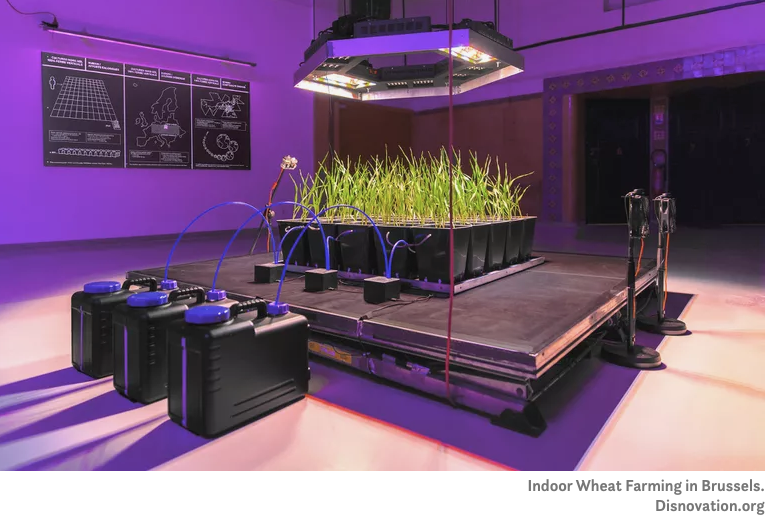
Our go-to critic of all things techno-futurist is Kris De Decker of Low-tech Magazine, who notes that garnishes for the rich don't include carbohydrates or proteins, and writes that "to feed a city, it takes grains, legumes, root crops, and oil crops." He recently had a look at vertical or indoor farming after seeing an art exhibit in Brussels called The Farm, which examined the inputs required to grow a square meter of wheat. The artists write:
"This 1 square meter experiment makes manifest the vast technical infrastructure and energy flows required to grow a staple food such as wheat in an artificial environment. In today’s economy it is profitable to artificially produce agricultural products with high water content such as leafy greens and tomatoes. However, from a systemic understanding, this apparent profitability and efficiency of the current system relies on the availability of cheap fossil energy, unaccounted-for resource extraction and pollution all over the globe, incurred in subordinate processes from mining and electronics manufacture, to international freight."
De Decker reports that it took 2,577 kWh of power and 394 liters of water to grow this little bit of wheat, and that didn't include the embodied energy from making all the equipment needed. Ultimately a loaf of bread made from this wheat would cost 345 euros ($410).
Among the purported virtues of vertical farms is that they can use specifically tuned LED lights, a controlled atmosphere, and that they take up a lot less space because the plants are stacked vertically. However, if you wanted to run them on renewable energy such as solar power, "then the savings are canceled out by the land required to install the solar panels." De Decker concludes the article:
"The problem with agriculture is not that it happens in the countryside. The problem is that it relies heavily on fossil fuels. The vertical farm is not the solution since it replaces, once again, the free and renewable energy from the sun with expensive technology that is dependent on fossil fuels (LED lamps + computers + concrete buildings + solar panels)."
Except that's not really the conclusion, it is just the start of pages and pages of comments on the article from the techno-futurist crowd, attacking De Decker for a "hit piece" and pointing out that there is nuclear power. The discussion gets picked up on Y Combinator Hacker News where they say "fusion energy is going to account for a rapidly increasing share of energy production by the end of this decade," so why not? Poor Kris De Decker responds by saying "I had no idea that vertical farms were such an emotional topic" (Treehugger could have warned him) and clarifies that "this article (and this artwork) criticizes the idea that vertical farming could supply a substantial share of a city's food supply."
Much has changed in the years since we started covering vertical farms, including the improvement of LEDs, the understanding of which spectra of light they should be tuned to, and of course, the rise in global temperatures, increasing climate weirdness, and worries about increasing deforestation for agricultural land. But as we recently noted, just cutting out red meat would cut agricultural land use in half, or that we could grow all the food we need in our yards.

Ultimately, I do not believe that the prospects for hydroponic vertical farms under artificial light (versus rooftop farms under glass or vertical greenhouses) have changed much. If anything, they have gotten worse, because not a single analysis I have seen has ever included the embodied carbon or upfront carbon emissions from actually making the aluminum and steel and lighting equipment that they are built from. We live in a world where we are using sunlight to grow our building materials to get rid of steel and aluminum; surely we can use it to grow our food.
In his recent book, "Animal, Vegetable, Junk" Mark Bittman complains about modern farming practices and their reliance on fertilizers. He writes:
"Methods of treating the soil became predictably and tragically oversimplified, as it was incorrectly determined that plants didn't need healthy soil and all that it contained – literally hundreds of elements and compounds and trillions of microbes. According to reductionist analysis, soil and plants quite simply needed nitrogen, potassium, and phosphorus."
Now the reductionists even want to replace the soil and sunlight. Perhaps instead, we should listen to Bittman.
Dr. Jonathan Foley had much to say about this a few years ago in No, Vertical Farms Won't Feed the World.
Lead photo: Indoor Wheat Farming in Brussels. Disnovation.org

UNITED KINGDOM: Sheffield Underground Farm Is 'Green And Sustainable'
Luke Ellis, from Sheffield, grows his produce at Kelham Island using organic soil and food created from waste products and without natural light
03-18-21
A Former Builder Has Transformed Unused Cellar Space
Into An Underground Farm To Produce
Fresh Herbs And Vegetables
Luke Ellis, from Sheffield, grows his produce at Kelham Island using organic soil and food created from waste products and without natural light.
He said it might sound like science fiction, but the unusual farming method has the potential to address food shortages and climate change.
The business already sells produce to restaurants and direct to customers.
Mr. Ellis first became interested in hydroponics technology six years ago but felt it was not as sustainable as it could be with most companies using high-tech, state-of-the-art equipment with a high start-up cost.
To address that he decided to create a bioponic farm, an organic form of hydroponics.
"Bioponic vertical farming may sound like something straight out of the world of science fiction, but it is a sector which holds a lot of potential for growth," he said.
The produce is grown in soil created from waste food, paper, used coffee, and ash
COPYRIGHT LUKE ELLIS
The plants are fed with an organic food packed with nutrients | COPYRIGHT LUKE ELLIS
The company uses waste materials, such as paper, card and food scraps, to create its own soil and the run-off from those systems is not wasted either.
"We make our own plant food, which means we don't ever pour anything away," said Mr Ellis.
The plants are grown under electric lights which, he added, offer advantages.
"Artificial light can be better than natural light because we can control the flavour of the food and control the growth rate."

Electric lighting helps control the growth rate of the plants. COPYRIGHT LUKE ELLIS
The produce is sold to both restaurants and individual customers. COPYRIGHT LUKE ELLIS
Mr. Ellis said he hoped the business, which opened in December 2020, would inspire others to help build a "greener, more sustainable society".
"It's super fast to grow, we use recyclable materials, it's 100% organic and it's very efficient," he added.
Follow BBC Yorkshire on Facebook, Twitter and Instagram. Send your story ideas to yorkslincs.news@bbc.co.uk or send video here.
Lead photo: Luke Ellis supplies residents and restaurants with herbs and greens. COPYRIGHT LUKE ELLIS

Judge Rules In Favor of U.S. Department of Agriculture’s Certification of Organic Hydroponic Producers
The decision is a major victory for producers and consumers working together to make organics more accessible and the supply more resilient
SAN DIEGO, CALIFORNIA March 19, 2021 – The Coalition for Sustainable Organics (CSO) is ecstatic with the ruling issued today by the U.S. District Court in San Francisco that affirms the legality of U.S. Department of Agriculture certification of organic hydroponic operations. Lee Frankel, executive director of the CSO, stated, “Our membership believes that everyone deserves organic.
The decision is a major victory for producers and consumers working together to make organics more accessible and the supply more resilient. The COVID-19 pandemic has further increased demand for fresh organic vegetables and fruits as consumers look to healthy foods to bolster their immune systems and protect their family’s health.
The court preserves historically important supplies of berries, tomatoes, cucumbers, peppers, mushrooms, leafy greens, herbs, sprouts and microgreens that are frequently grown using containers or other hydroponic organic systems. In addition, the lawsuit threatened the nursery industry that provides many of the seedlings used by organic growers planting both in open fields as well as greenhouses.”
The court in its written opinion stated that “USDA’s ongoing certification of hydroponic systems that comply with all applicable regulations is firmly planted in OFPA.”
Frankel was pleased that the court ruling clearly affirmed the legitimacy of hydroponic and container production systems under the Organic Foods Production Act that established the USDA National Organic Program. In addition, the ruling also confirmed that USDA was fully within its rights to reject the petition to ban the certification of operations and correctly followed procedures in its handling of the petition.
“We look forward to the organic industry coming together in the wake of this court decision to help strengthen the organic community, continue to enhance the cycling and recycling of natural resources and promote ecological balance,” continued Frankel. “We are eternally grateful to the teams at USDA and the Department of Justice in effectively defending the work of the National Organic Program.”
FOR MORE INFORMATION:
Lee Frankel, Executive Director
info@coalitionforsustainableorganics.org
619-587-4341

VIDEO: Utah Company To Launch All-In-One Universal Climate Control Utility System To Agribusiness
Water scarcity and land degradation is a global problem with additional difficulties in utility costs and climate control for growing food and sustaining strong and sufficient agricultural commerce. However, a new company, Selu.earth, is providing a universal solution

BY JENNIFER WEAVER, KUTV SATURDAY
MARCH 20TH 2021
SALT LAKE CITY (KUTV) — Water scarcity and land degradation is a global problem with additional difficulties in utility costs and climate control for growing food and sustaining strong and sufficient agricultural commerce. However, a new company, Selu.earth, is providing a universal solution.
According to a press release, Selu is an innovative company that created patent-pending technologies to reclaim atmospheric humidity, produce renewable energy, and use CO2 to fertilize agriculture environments to regulate temperature and humidity. The result is an all-in-one climate-control utility system to enhance plant growing conditions.
“Selu Oasis” provides agribusiness customers with the ability to grow and harvest food in many more areas than previously available or viable. By vastly increasing the locations and amount of land available for growers, the Selu Oasis system allows agribusiness providers to reduce overhead costs while achieving maximum potential growth yields.
To that end, the company is seeking and intends to launch five pilot programs to support greenhouses, agriculture infrastructure suppliers, and vertical farms in the United States.

Jake Hammock, Cofounder and CEO (Photo: Selu)
Jake Hammock, Selu’s founder and CEO, said in a prepared statement:
By providing universal climate control conditions from one solution, our customers will be able to better realize lower utility costs and higher crop yields. Now is the time for producers to have a lower universal utility access solution to grow closer to consumers without the hassle of multiple climate controlling devices saturating energy costs.
By adapting and using the Selu Oasis technology, our customers will not only receive substantial utility savings but will also replenish the environment through our carbon-neutral solution.

Utah company to launch all-in-one universal climate control utility system to agribusiness (Photo: Selu){p}{/p}

Selu’s technology addresses seven of the United Nations’ Sustainability Development Goals:
Zero hunger,
Clean water and sanitation,
Affordable and clean energy,
Decent work and economic growth,
Industry innovation and infrastructure,
Sustainable cities, and
Life on land.
In all, Selu’s goal is to strengthen and enhance nature to liberate all life, while empowering agribusiness with immense commercial value, a press release stated.
Lead photo: Utah company develops technology that provides water & renewable energy for agribusinesses (Photo: Selu)

Polygreens Podcast Episode: 18 Jamey Agathen - Grow Strong Industries
Grow Strong Industries’ mission is to help humanity thrive by enabling all people to grow indoors effortlessly.
Since they founded in 2002, Grow Strong Industries has grown by leaps and bounds
Grow Strong Industries’ mission is to help humanity thrive by enabling all people to grow indoors effortlessly.
Since they founded in 2002, Grow Strong Industries has grown by leaps and bounds.
From offering a single product, now offer multiple products - including grow tents, LED lighting, hydroponics systems, and nutrients - all suitable for indoor growing. Starting from three lifelong friends in their garage, they now have an army of employees and an office to call their own.
Latest Episode

LONDON: New Vertical Farm Offers Eco-Friendly Greens Picked And Delivered Within 24 Hours
London’s first delivery service for vertically-farmed, eco-friendly greens has launched from its base in the Docklands. Vertical farming is a fast-growing trend, with the global market size that was valued at $2.23 billion in 2018, projected to reach $12.77 billion by 2026

Lettuces growing vertically at Crate to Plate, a new farm in London's docklands | CRATE TO PLATE
London’s first delivery service for vertically-farmed, eco-friendly greens has launched from its base in the Docklands. Vertical farming is a fast-growing trend, with the global market size that was valued at $2.23 billion in 2018, projected to reach $12.77 billion by 2026. Crate to Plate is a clever new vertical farming venture founded by Sebastien Sainsbury who is a firm advocate of the concept of "15-minute cities" where everyone has access to fresh produce within a 15-minute walk of home. Crate to Plate offers consumers a wide range of super fresh organic lettuces, leafy greens and herbs, all picked within 24 hours, available by home delivery or at select greengrocers throughout London.
Recycled shipping containers house Crate to Plate, a vertical farm in London | ALISTAIR CARMAN
The eco-friendly farm is located in a parking lot owned by international property company Lendlease on the Isle of Dogs (Canary Wharf) inside three recycled shipping containers kitted out with LED lighting and an automated nutrient delivery system. Each 40-foot container achieves the same production as over an acre of farmland, with the site projecting to produce around six tonnes of greens each year. Not only does the urban farm use far less land but the pesticide-free produce is grown using hydroponic technology that uses 96% less water than traditional farming.
Crate to Plate, a new vertical farming initiative |. CRATE TO PLATE
Scientists and farmers at Crate to Plate carefully control the environment inside the shipping containers. Meticulously monitored vertical farming ensures that greens can be grown locally in urban environments, all year round, using minimal water, allowing produce to be delivered to consumers within 24 hours of harvest, with zero carbon footprint in transporting from farm to customer. As a result, the produce is as fresh as possible and has the highest possible nutrient value, completely free of pesticides and toxic chemicals. Lettuce, rocket, kale, pak choi, herbs, microgreens and more are harvested and delivered twice a week. The difference in taste between Crate to Plate’s greens and those you can buy from a supermarket is astonishing and delicious. And dynamite options like wasabi rocket and basil Genovese are already proving to be customer favorites.

Basil growing vertically at Crate to Plate | JOANNE SHURVELL
Produce from Crate to Plate is available in select greengrocers like Artichoke in North London and direct to consumers via their website. A £15 mixed box includes three types of lettuce, three bags of greens, and three herbs. Crate to Plate also sells to restaurants and have recently become Chef Ollie Dabbous's exclusive distributor of greens for his Michelin-starred Mayfair restaurant Hide. Crate to Plate has an ambitious UK expansion plan. A second site will open near Elephant and Castle this month, followed by other London sites and farms in other cities (Manchester, Birmingham, etc). And further ahead will be expansion to the United States.

Seedlings before they are transferred to the walls of the farm | CRATE TO PLATE
Crate to Plate’s new site in Elephant Park is part of a £2.5 billion regeneration project headed by the local council and Lendlease. One of the key aims of the development is to create a local, community-oriented ecosystem, with businesses from the area supplying residents and other retailers in the nearby community. Crate to Plate slots nicely into this concept, aiming to sell direct to local residents and to the new food businesses that are opening. Crate to Plate’s next London site is already in the works: the International Quarter London development near the 2012 Olympic Park in Stratford, east London.
With the global covid-19 pandemic fueling home deliveries and such a high-quality product on offer, it’s no surprise that Crate to Plate’s greens have sold-out every week since launching. Founder Sebastien Sainsbury says he wants “everyone to be able to get fresh leafy greens no more than a mile away from where they live.” It appears he’s off to a good start at achieving that goal and it will be fascinating to follow the progress of this sustainable new business.
Crate to Plate London home delivery boxes range from £6 to £28 depending on the selection and quantity, with no delivery charge on orders of £20 or more.

I've been writing on travel, food, fashion and culture for the past decade or so for a variety of publications. I co-founded PayneShurvell, a contemporary art gallery in London which is now an art consultancy in London and Suffolk. My photographer partner Paul Allen supplies photos for my features that often include a music or art event and our travels have taken us to under the radar music and art festivals in France, Italy, Portugal and Spain. I am the co-author of the Citysketch series of books that includes London, Paris and New York, published by Race Point and I'm the author of Fantastic Forgeries: Paint Like Van Gogh. Follow our adventures on Twitter at @jshurvell and on Instagram at @joshurvell and @andfotography

Hydroponics Startup Babylon Micro-Farms Raises $3m Seed Capital For US Expansion
Babylon will use the capital to fund its nationwide expansion. It offers a cloud-based, plug-and-play hydroponics system for indoor farming operations
March 18, 2021
US indoor agriculture startup Babylon Micro-Farms has closed a $3 million seed round led by previous investors including the Center for Innovative Technology (CIT).
New investors to take part in the fundraising included Hull Street Capital, VentureSouth, and CAV Angels – the University of Virginia‘s alumni angel investor group.
Babylon will use the capital to fund its nationwide expansion. It offers a cloud-based, plug-and-play hydroponics system for indoor farming operations.
The Richmond, Virginia-based startup claims that its 15 square-foot miniature farm can grow as much produce as 2,000 square-feet of outdoor cropland.
In January 2020, Babylon raised its initial seed investment of $2.3 million led by CIT’s early-stage investment group CIT GAP Funds and startup incubator Plug and Play Ventures.
Invest with Impact. Click here.
“2021 is on track to be a year of accelerating growth and major market penetration through national distribution as we continue to focus on deploying our indoor farming service,” Babylon CEO Alexander Olesen said in a statement.
“We’re enabling businesses and communities to grow their own fresh produce and demonstrating the benefits of our fleet of remotely managed vertical farms.”
Indoor farming startups have been bagging fundings left, right, and center of late. Babylon Micro-Farms is just one of the latest outfits to capture investors’ attention, along with the likes of New York’s Oishii, Germany’s Infarm, and recently SPACced Kentuckian player AppHarvest.
What makes Babylon unique — in its own estimation — is its “remotely managed,” easy-to-use growing platform. The technology could give aspiring or existing indoor growers a quick way to get into the game instead of building a new growing system from scratch, or having to learn the ropes through old-school, analog means, the startup suggests.
Babylon Micro-Farms’ machinery can squeeze into relatively smaller spaces compared to many other indoor ag solutions on the market. This may give users a foothold over larger operations by allowing them to enter the fray more quickly while bigger players are still shopping for real estate.
Through a two-year lease contract, Babylon users can dabble in the indoor farming craze without having to commit to a more long-term operation. This can also give flexibility when it comes to testing new markets.
“The Covid-19 pandemic highlighted a national food-supply system issue, putting the spotlight on a critical need for more locally-grown produce options. Babylon Micro-Farms has found their focus, and it is a reflection of their leadership team’s commitment to building a category-defining customer experience while making a positive impact,” Alex Euler, investment director at CIT GAP Funds, said in a statement.
“During a time when many people are experiencing isolation, being able to watch your own garden grow can improve one’s quality of life. The company’s innovative approach to developing a technology system that enables its own staff to remotely control the light, water, and nutrients for its farming systems is absolutely making them a leader in this space.

March Indoor Ag Science Cafe - March 30th Tuesday 11 AM Eastern US Time
This month's Café Will Introduce A Funding Opportunity For Small Businesses‘ R&D
This month's Café Will Introduce A Funding Opportunity
For Small Businesses‘ R&D.
Please sign up, thank you!
"USDA SBIR Grants Program Overview"
Dr. Steven Thomson & Melinda Coffman
USDA NIFA
SBIR = Small Business Innovation Research
Please sign up so that you will receive Zoom link info.
Indoor Ag Science Cafe is an open discussion forum, planned and organized by OptimIA project team supported by USDA SCRI grants.
Sign up here

VIDEO: Farming In A Shipping Container
Transforming Unused Spaces Into Vertical Farms
Transforming Unused Spaces Into Vertical Farms

This New Greenhouse Is Expected To Break New Ground
The 1.5-acre facility will rely on 99% sunlight and recycled water of up to 7,500 gallons a month and produce about 500 tons of leafy greens per year
The 1.5-acre facility will rely on 99% sunlight and recycled water of up to 7,500 gallons a
month and produce about 500 tons of leafy greens per year.
Outlook Web Bureau
March 20, 2021
Vertical farming is fast gaining popularity since growers obtain increased yield in a smaller area of land. In India, many farms in and near urban areas have since taken to this practice of growing crops in vertically stacked layers.
Another benefit is that under a controlled environment plant growth is set to optimize. Soilless farming techniques also add to the advantages.
Vertical farming can be done inside buildings, shipping containers, and even tunnels. That involves artificial lighting.
Now, a new 1.5-acre vertical farming greenhouse, situated in an opportunity zone in Cleburne, Texas, will reportedly produce approximately 500 tons of leafy greens per year for its local offtake partners.
Eden Green Technology, a next-generation vertical farming company, announced this week that it has broken ground on the new facility, next to its R&D greenhouse in the Dallas-Ft Worth Metroplex. Existing investment partners are investing $12 million into Eden Green Technology as part of the development deal.
The company's plans include partnering with firms and organisations not only in Texas, but also in other domestic and international locations.
The facility will rely on 99% sunlight, rather than 100% LED lighting, and recycled water of up to 7,500 gallons a month. Combined with annual water consumption equal to only two households, the facility will produce 11 to 13 harvests per year, compared to 1-2 harvests yielded by traditional farming methods.
Eden Green Technology claimed that this facility will use 99% less land, and 98% less water, than an equivalent yield on a soil-based farm.
In This Article: AgricultureAgri OutlookOutlook KrishiTechnology

Leo Marcelis At Al Jazeera On Vertical Farming
Vertical farming has the potential to meet this demand: by cultivating in multilayer systems that literally go up into the air, sustainable, efficient, and fully controlled cultivation can be carried out in cities without taking up too much space
18-03-2021 | Wageningen University & Research
Source and Photo Courtesy of Wageningen University & Research
QATAR- The world population and the number of people living in cities are growing. At the same time, the demand for healthy, fresh and locally produced food is increasing. Vertical farming has the potential to meet this demand: by cultivating in multilayer systems that literally go up into the air, sustainable, efficient, and fully controlled cultivation can be carried out in cities without taking up too much space. Professor Leo Marcelis explains to Al Jazeera the potential of vertical farming and the hurdles that still need to be taken.
Watch the interview: Leo Marcelis at Al Jazeera on vertical farming

CANADA: Vertical Urban Farm 'Ortaliza' Opens Kingsville Storefront
A Kingsville farm is celebrating its grand opening Friday, but it’s not your typical, sprawling set-up. Ortaliza is what’s called an urban vertical farm, growing microgreens right in the store — so you can watch your crop before it lands on your plate
An urban farm has popped up in a Kingsville storefront where fresh microgreens are grown. CTV Windsor's Rich Garton with details.
WINDSOR, ONT. -- A Kingsville farm is celebrating its grand opening Friday, but it’s not your typical, sprawling set-up.
Ortaliza is what’s called an urban vertical farm, growing microgreens right in the store — so you can watch your crop before it lands on your plate.
The new venture is the brainchild of Carina Biacchi and Alvaro Fernandes, who moved from Brazil to Canada five years ago, bringing with them a passion for entrepreneurship and farming.
“We’ve been dreaming and researching not only dreaming but panning about this idea for years, doing research, traveling,” says Biacchi, who is the founder and CEO of the company.
On Friday, Mar. 19, that dream becomes reality — with the launch of Ortaliza, which is Spanish for vegetable garden.
“We fell in love with microgreens because they are such an easy way to eat healthy food,” Biacchi says. “They’re convenient, packed with nutrients, and you can use them, not only in a salad but sometimes you want to enjoy yourself a little bit.”
The vertical urban farm has a main street location in Kingsville — where the fresh microgreens are grown right behind the sore counter.
“People are hearing about vertical farming, but they can’t see it. They are not being there. So we wanted to allow them to come and see what it is,” says Biacchi. “It is still a farm, yes, we’re more tech, more modern, but we wanted to give that feeling to people.”
Vertical Urban Farming — takes traditional farming techniques — but creates density in space.
Ortaliza’s store is only 850 square feet, but rows of stacked shelves utilize six times the space.
“For vertical farming, the sky’s the limit, literally, you can grow as tall as you want,” says Alvaro Fernandes, the company’s chief operating officer.
Much like a greenhouse, Fernandes says growing conditions are optimal — regardless of what’s happening outside.
“I fell in love with indoor agriculture because we have full control of what we do. We can control the lights, the wind, humidity, temperature, everything,” he says.
According to WE-Tech Alliance, which is assisting the business in the start-up process — urban vertical farming provides food security and sustainability, adding significant value to the food system.
Each shelf of microgreens at Ortaliza can feed 20 families, according to Fernandes.
The new business owners also believe the most important aspect of their operation is freshness — so they will only deliver and cater to people in Windsor-Essex.
“We want to be close to our consumers, we want to sell directly to our consumers, we are as urban as we can be,” says Biacchi.
Hand-watered and lit up 14 hours a day, the 25 varieties of micro-greens take 10 days to grow in Canadian Pete-moss and are harvested daily for in-store purchases and deliveries.
The couple hopes this Kingsville store is their first of many across the country but Fernandes promises they will stay true to the business model of by local, for local.
“We don’t want to lose our identity, our proximity to customers.”
You can learn more about the new store here.

Chinese Agriculture Platform Pinduoduo Unveils Plans To Become The World’s Biggest Grocer
Chen Lei, the Chairman and CEO of Pinduoduo, is banking on the continued blurring of boundaries between the online and offline worlds to open up new opportunities
Pinduoduo is one of the fastest-growing consumer internet companies in China, achieving close to 800 million active buyers in just six years. It is also the country’s biggest agriculture platform, handling some $42 billion of agriculture orders in 2020. It has now set sights on becoming the world’s biggest grocer.
Chen Lei, the Chairman and CEO of Pinduoduo, is banking on the continued blurring of boundaries between the online and offline worlds to open up new opportunities. So confident is Chen that the mobile internet will transform the way people interact and behave, that when Pinduoduo started in 2015 the team built a mobile-only technology platform.
His judgement has proven right so far. The surge in online grocery shopping is one recent example. In China, shopping for groceries at traditional wet markets is an entrenched habit. Households would do their shopping daily, buying just what they need for the day or next couple of days. That changed with Covid-19 as shopping in crowded markets became a potential health hazard.
The lockdowns and subsequent changes to daily routine have pushed more consumers in China to order groceries through mobile apps. Some analysts estimate the online grocery market could be worth more than $120 billion by 2023.
To cater to this new demand for fast and affordable groceries, Pinduoduo introduced Duo Duo Grocery, a next-day service that offers a curated list of produce and groceries from local farms and suppliers to consumers in the same region. Consumers place their orders through the Pinduoduo mobile app before 11 pm and pick up their orders after 4 pm the next day at collection points located near their homes. The whole process shortens the time for produce to reach from farm to table from a few days to less than 24 hours.
“We saw six years ago that mobile is the only way to go. Therefore, we are the only major consumer internet company in the world that is mobile only. The mobile internet fundamentally transforms the way humans interact with each other,” said Chen, who was the chief architect of Pinduoduo’s mobile platform. “This mobile revolution is now tearing down the walls between the physical and digital worlds. Being a mobile-only product in this new age, we are well-placed to benefit from the opportunities thrown up by each behavioral change.”
“One such change sweeping the world is agriculture and grocery. Pinduoduo started with agricultural products, with the vision of offering consumers the “Costco + Disney” experience of more savings and more fun,” he said. “We are now the largest agriculture platform in China and we hope that Pinduoduo can one day become the largest grocer in the world.”
To achieve the goal of becoming the world’s largest grocer, Pinduoduo is investing in building an agriculture-focused logistics infrastructure that it sees as a stumbling block to meeting two key and contradictory consumer demands: speed and cost. In other words, consumers want both speedy delivery but also low prices. Most e-commerce platforms, including Amazon, charge extra for expedited shipping.
An additional problem is that the current express delivery logistics system in China is designed by and large to handle sturdy manufactured goods, which can withstand rougher handling and days on the road, often under harsh weather conditions. Fresh produce fares much worse under such treatment and spoilage rates are much higher, especially during the summer months.
Pinduoduo sees the solution as an agriculture-focused logistics infrastructure that is suited to handling fragile perishables. Another important part of the equation is shortening the time from farm to table, which is achieved by Pinduoduo’s proprietary technology in predicting and matching local supply with consumer demand. The more accurately Pinduoduo can pinpoint what is available in terms of supply, and match it with nearby demand, the less time the produce spends reaching the customer, resulting in less spoilage and deterioration in quality.
There’s an added advantage in this model for farmers who produce leafy greens and other fragile farm goods. Local-to-local commerce has the potential to put these farmers closer to consumers, giving them an added option to selling solely to wholesale buyers like supermarkets. By removing the inefficiencies from the supply chain, farmers stand to gain more for their toil, while consumers save on their grocery bills.
Publication date: Wed 17 Mar 2021