


Welcome to iGrow News, Your Source for the World of Indoor Vertical Farming

USA VIRGINIA: Regional Board Approves Agreement For AeroFarms To Receive $200,000 Grant
The company plans to build the largest indoor growing facility to date in Cane Creek Centre, a joint industrial park owned by Danville and Pittsylvania County via the Danville-Pittsylvania Regional Industrial Facility Authority
January 11, 2021
AeroFarms, the company that announced in December 2019 it would bring 92 jobs to the region and invest $42 million over three years, will get a $200,000 state grant if it meets up to a performance agreement approved Monday by the Danville-Pittsylvania Regional Industrial Facility Authority.
The RIFA board unanimously passed a resolution during its meeting Monday to sign a performance agreement with the company for a $200,000 grant from the Virginia Department of Agriculture and Consumer Services.
Matt Rowe
"They have all intention of moving forward with the project in the near future," said Pittsylvania County Economic Director Matt Rowe. "I think you will see some activity out there soon."
The company plans to build the largest indoor growing facility to date in Cane Creek Centre, a joint industrial park owned by Danville and Pittsylvania County via the Danville-Pittsylvania Regional Industrial Facility Authority.
AeroFarms specializes in chemical-free vertical farming and announced in December 2019 that it plans to bring 92 jobs and invest about $42 million in the Dan River Region over three years.
The company must meet the jobs and investment goals before it gets the $200,000 from the state’s Agriculture and Forestry Industries Development Fund, Rowe said during an interview with the Danville Register & Bee Monday afternoon.
"It's guaranteeing to them that if they do those things, they'll get the money," Rowe said. "The company signed the agreement two weeks ago."
The agreement is among the company, Danville, Pittsylvania County, RIFA, and the state.
The Newark, New Jersey-based company's process involves growing such crops as leafy green vegetables in stacks at a rate said to be 390 times more productive than field-grown plants. It uses no soil, sunlight or chemicals and takes place indoors, where the environment is brought to the crops.
AeroFarms co-founder and CEO David Rosenberg points to an illustration of what the company’s vertical farming process looks like at the Institute for Advanced Learning and Research in December 2019. The company announced then that it was bringing 92 jobs and $42 million in investment to Cane Creek Centre. File photo
Vertical growing uses LED lighting and aeroponic mist on leafy greens in stacks that can reach as high as 40 feet. It mists the greens’ roots with nutrients, water, and oxygen, using 95% less water than field farming and 40% less than hydroponics, according to the company’s website.
The Virginia Economic Development Partnership worked with the Virginia Department of Agriculture and Consumer Services, Pittsylvania County, Danville, and the Southern Virginia Regional Alliance to secure the project for Virginia.
Incentives for the company include $190,000 in grant money from the Virginia Tobacco Commission, $200,000 from the Governor’s Commonwealth Opportunity Fund, and the $200,000 that's part of the agreement approved by RIFA.
No money will go to the company until it meets its obligations, Rowe said.
Rowe said he was not sure when construction would start on the 150,000-square foot building for AeroFarms.
"Given the COVID situation, I don't want to go on the record for a specific time," Rowe said.
Lead photo: Alina Zolotareva, marketing director and product champion at AeroFarms, offers some of the company’s leafy greens for sampling at the Institute for Advanced Learning and Research in December 2019. The company announced then that it was bringing 92 jobs and $42 million in investment to the Dan River Region. File photo
Tags Grant Aerofarms Rifa Agreement Matt Rowe Economics Agriculture Commerce
Finance Industry Danville And Pittsylvania County Money Danville

AVF Presents Advisory Board For 2021
The Advisory Board will support and advise AVF Board of Directors in all strategic developments, oversee the implementation of annual objectives and create a valuable ecosystem for the members to advance the Vertical Farming industry globally
AVF is honored to introduce our Advisory Board members for the year 2021, they are experts in their own fields and represent different sections of the indoor farming industry and academia.
The Advisory Board will support and advise AVF Board of Directors in all strategic developments, oversee the implementation of annual objectives and create a valuable ecosystem for the members to advance the Vertical Farming industry globally. AVF’s board and staff are pleased to have the support of this esteemed group going forward.
Ali Ahmadian is the CEO of Heliospectra and the chair of AVF’s Advisory Board for 2021.
Ali combines his passion for people and technology with 20 years of international business leadership experience to his position at the helm of Heliospectra.
Ali is globally recognized for his successful track record of developing new business and delivering profitable growth in a multitude of geographies. He has lived and worked in five different countries on three different continents over the course of his career. Highly skilled in integrating cultural and commercial experiences, he excels in establishing partnerships with different stakeholders and driving diverse teams to peak performance. Prior to joining Heliospectra, Ali was Vice President of Tetra Pak in Asia Pacific and served as a member of Tetra Pak’s global executive team.
Luis Trujillo is an Area Sales Manager at Hoogendoorn Growth Management.
He has more than 25 years of experience in markets with a strong focus on innovation and technology. He is currently with Hoogendoorn America.
Jasper den Besten is a professor at HAS University of Applied Sciences in the Netherlands.
He is researching new cultivation systems, with a focus on cultivation without daylight. Since 2009, HAS University has been involved in very applied LED-lit climate cell research.
Hemant Julka is the Co-founder and COO at Veggitech in the UAE, a professional with over 3 decades of experience in business and technology.
He is a social entrepreneur with a vision to make a positive impact in transforming communities at the grass-root level. The Agro-Tech startup company, VeggiTech, is disrupting the Agriculture industry with protected Hydroponics and grow light-based Hydroponics.
Max Loesel is the CEO of Agrilution and one of the Co-founders of the AVF.
He is a young entrepreneur and has been engaging with activists for sustainable living to preserve our planet for years. He has pioneered a fully automated Vertical Farming home system with Agrilution.
For more information:
Association for Vertical Farming
info@vertical-farming.net
www.vertical-farming.net
Publication date: Wed 6 Jan 2021
Nature Fresh Farms Hires New General Manager For Their Mexico Greenhouse
Nature Fresh Farms has expanded operations into Mexico to be close to growing partners and augment their existing North American supply chain. Central Mexico’s favorable climate reinforces their ability to provide fresh produce 365 days of the year
Leamington, ON (January 11, 2021) – Nature Fresh Farms welcomes Robert Van Der Geest as General Manager to their Mexico team.
Nature Fresh Farms has financially invested in the operation of a 15-acre greenhouse with an additional 15 acres under construction, located in Central Mexico. Robert Van Der Geest has been brought on to lead their greenhouse operations and take on the role as General Manager of Nature Fresh Farms Mexico.
Nature Fresh Farms has expanded operations into Mexico to be close to growing partners and augment their existing North American supply chain. Central Mexico’s favorable climate reinforces their ability to provide fresh produce 365 days of the year. By having full control over the operations in Mexico, Nature Fresh Farms can ensure the level of quality and flavor their customers expect.
Originally from Holland, Robert first began his agricultural career in the cut flower industry. For five years Robert ran a cut flower project in Mexico and following his return to Holland he shifted to produce greenhouse growing, then in 2016, he moved back to Mexico to continue the management of greenhouses in the region. Robert is excited to join the Nature Fresh Farms Mexico team and will be playing a key role in meeting the company’s growth goals as well as building on their commitment to providing fresh and consistent produce to their customers throughout the year.
“One of the first things I’ve noticed about this company is the real team environment, which is a fantastic achievement for a company this large,” shared Robert. “I’m looking forward to working with a team that is so innovative and constantly pursuing growth.”
Robert will be responsible for the initial set up of the facility and will take care of personnel and operational management to ensure the facility runs smoothly while helping to integrate the greenhouse with the rest of Nature Fresh Farms operations. He is thrilled about the new opportunities arising in Mexico and looks forward to acquiring more knowledge and applying it to growing.
“We welcome the addition of Robert to the Nature Fresh Farms teams,” announced Vice President, John Ketler. “With our new facilities in Mexico, we needed someone with an extensive understanding of the industry and familiarity of the region and Robert is a great fit.”
Nature Fresh Farms is thrilled with the growth and direction of the company along with the steady expansion of their team. As the business continues to grow, the company is excited to offer new opportunities for professional development.
About Nature Fresh Farms -
-30-
Continuously expanding, Nature Fresh Farms has become one of the largest independent, vertically integrated greenhouse vegetable farms in North America. As a year-round grower with farms in Leamington, ON, Delta, OH, and Mexico, Nature Fresh Farms prides itself on consistently delivering exceptional flavor and quality to key retailers throughout North America, while continuing to innovate and introduce more viable and sustainable growing and packaging solutions.
SOURCE: Nature Fresh Farms | info@naturefresh.ca T: 519 326 1111 | www.naturefresh.ca

Bottom of Fresh Herbs Bag Becomes Growing Pot
Bottom of Fresh Herbs Bag Becomes Growing Pot
Danish Company Launches New Package Solution
Danish-based growing company Grow Up FARM is launching a new product, named Eat-Grow-Repeat: Small pea plants that grow in hemp in a bag. Refrigerated and bagged, the pea sprouts keep fresh for a week. "Rip off the upper section of the bag, and the bottom of the bag is now the pot," they explain. "Place the bottom of the bag with pea plants on your windowsill and care for it with light, water, and a little love. The growth will continue, and after a few days you can cut completely fresh pea sprouts for your salad bowl."
"Usually, bean sprouts are packed in a tray and then flow wrapped, so the consumer would have to repack any sprouts that may be leftover. But now this is history," they explain.
The corner stone of the Greenow family business was laid back in 1966, when the first generation pioneered the professional cultivation of bean sprouts. It turned into a success and still is - who does not regularly add the crisp and healthy bean sprouts to the shopping cart? Sales of organic bean sprouts are growing steadily, and this has led Greenow to seek a more efficient packaging solution, also since their pea sprouts dependance Grow Up FARM is growing as well.
Fresh produce
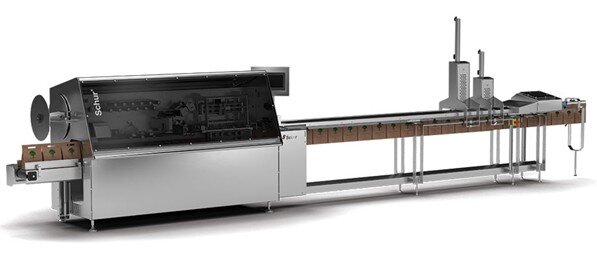
Initially, the Schur®Star Packaging Machine they use for this new packaging was only planned for packing bean sprouts fully automatically into reclosable bags. "Often, one does not eat all the sprouts at once; but in a reclosable bag, the sprouts do not desiccate in the refrigerator, but will retain their crispness for up to eight days. Hereby, the consumer can make his contribution to reducing problematic food waste, which is today an issue in both the retail outlet and the home," they say.
Capacity for new project
With its large capacity, the Schur®Star Packaging Machine has given Greenow & Grow Up FARM the opportunity to realize the Eat-Grow-Repeat project. The pea plants are initially grown in an entirely new, vertical greenhouse – on five floors, in a 100% controlled climate, with recirculated water, under artificial light and completely without soil. And to match the 100% compostable contents, the bag is produced of PE, a single-layer material that does not require separation to be processed in a recycling system.
Convenient packing
”Bean sprouts are our core product, for which we chose the Schur®Star Concept,” says Lasse Vilmar, CEO and third generation in the company. ”But because of the versatility of the packaging machine and its high capacity, we decided to speed up the new Eat-Grow-Repeat project. When starting up a new project, flexibility is of the utmost importance, as you must be able to quickly adapt to market reactions”.
Lasse Vilmar continues: ”Now we can change from a fully automatic to a manual packing process in a few minutes – e.g. if we want to pack meal salads with different elements. Also in terms of bag constructions we are not at all limited to the two bag types that we started up with. We are excited about the new flexibility and the many options, and we feel convinced that the market will welcome our novelties: Healthy and tasty produce in convenient packaging.”
With its rectangular fill opening in the entire width of the bag, the Schur®Star Packaging Machine is ideal for filling of light and unevenly shaped products, such as a portion of bean sprouts or small pea plants. With more than 500 companies around the world, the concept packs all types of products – including a broad range of fresh produce, into a comprehensive range of bag constructions.
For more information:
Schur Star Systems GmbH
Tel:+49 (0) 461 99 750
Email: sfg@schur.com
www.schur.com/en/
11 Jan 2021

How COVID-19 Has Impacted Indoor Farming
Yahoo Finance’s Zack Guzman and Akiko Fujita discuss the indoor farming outlook and the plant-based fresh food categories with Viraj Puri, Gotham Greens Co-Founder, and CEO
January 11, 2021
Yahoo Finance’s Zack Guzman and Akiko Fujita discuss indoor farming outlook and the plant-based fresh food categories with Viraj Puri, Gotham Greens Co-Founder, and CEO.
To View The Video, Please Click Here.
ZACK GUZMAN: Welcome back to Yahoo Finance LIVE. Of course, 2020 was an interesting year for a lot of startups out there, particularly when it comes to being able to raise capital, as that quickly dried up when the pandemic first hit. But following that, a lot of companies were able to raise new capital to take on some pretty important goals here.
We're going to focus on two, one tied to the reopening of the economy as we continue to-- I don't want to say suffer through online events here, but one Zoom competitor, as well as our next guest here, focused on indoor farming-- a very interesting startup that is trying to challenge some traditional ways of doing things in farming. That would be Gotham Greens, which recently raised $87 million in new investment capital, and we're joined here by the co-founder and CEO of Gotham Greens. Viraj Puri joins us now.
And Viraj, I mean, we've talked about indoor farming for a few years here in the way that it's gained momentum to take on traditional agriculture in perhaps being a way that's more sustainable over the long term. But how have you seen maybe new capital getting put to work here recently as it catches on?
VIRAJ PURI: Absolutely. Well, I think to start with, this pandemic has really underscored the value proposition of more resilient supply chains. And indoor farming can really provide that because one can really farm anywhere, regardless of climate or availability of arable land, et cetera. So in our country, up to 50% of fresh produce is imported, and the balance majority comes from places like California and Arizona on the West Coast, which requires that fresh produce has to travel great distances to reach consumers throughout the country.
Conversely, indoor farming allows one to really grow anywhere, regardless of the climate, regardless of the soil conditions or land, et cetera. So I think when supply chains were really challenged early on this year with the pandemic, it has really revealed some of the benefits of indoor farming. And then, on top of that, sustainability is more of a topic that more consumers and companies care about.
And then on the third, sort of, point is food safety. We've seen more and more incidences of food safety and food safety recalls associated with that over the past decade or so, and indoor farming provides a compelling solution to reduce some of those risks. So as a result, we've seen a lot more capital rush into the space over the last 24 months.
AKIKO FUJITA: When you talk about the reliance that we saw exposed early on, in terms of where the food comes from, in particular states like California or Florida, how do you see the distribution shifting as a result? Indoor farming, of course, inherently means you can farm in any different region here. How have you seen that shift, the distribution channel shift as a result of that?
VIRAJ PURI: Yeah, similar to other sectors, we're seeing more last mile distribution centers, and we're seeing more just-in-time fulfillment, right? So with indoor farming, one can do that. The traditional supply chain is obviously dealing-- it's quite complex. A lot of middlemen, a lot of different actors along the way, and you're dealing with a highly perishable product when it comes to agricultural commodities-- many fresh agricultural commodities, particularly the ones that we grow and sell in market, including lettuce, leafy greens, herbs, things like that.
So this decentralized supply chain allows us to deliver much quicker to retailers. They don't have to place their purchase orders so far out in advance. And then it also allows us to fill those voids on the store shelves, depending on demand and supply with shoppers. So it really also reduces waste, which is a real ill that faces the food supply chain. Almost 50% of fresh produce in our country is thrown away between farm to fork, and we believe that indoor farming systems can really help create that equilibrium between demand and supply, which helps reduce that waste.
AKIKO FUJITA: Viraj, how have you seen your customer base shift? Is it-- is it restaurants that are getting in, that are expanding your base? Is it grocery stores?
VIRAJ PURI: Primarily grocery stores. I think pre-pandemic, it was really both. We did lose some food service business, restaurant business, at the onset of the pandemic, but that was more than made up for by increase in retail sales. Our revenue doubled in 2020, compared to the previous year, and a lot of that is a result of just the supermarkets wanting suppliers that can be more nimble with the supply chain.
And then increasingly, consumers are spending their dollars behind brands that speak to many of their values around ESG, around food safety, around supporting local economies. So those have been some of the factors that have really led to our doubling of our growth this last year, and we're very optimistic about the years ahead, for both our company and the broader indoor farming industry.
ZACK GUZMAN: Yeah, in the broader space discussion, too-- I mean, I know you guys have greenhouses across five states-- New York, Rhode Island, Maryland, Colorado, Illinois-- but when you think about the push here for more sustainability coming from the incoming administration, how much of that really throws fuels on the fire in terms of growth right now in expectations that there could be more friendly policy around indoor farming? Was that the impetus here to raise new capital, and if so, where do you look to put that to work in the short term?
VIRAJ PURI: I think there was a variety of factors that led to raising this capital, but primarily, it's less about the incoming administration and really more about capturing this opportunity in the marketplace to capture share from incumbents that are facing a lot of headwinds, whether it's climate issues, water issues out west, labor issues due to, sort of, you know, the reliance on migrant farmworkers to harvest and package and process product, along with food safety.
So we had actually put an expansion-- a pretty aggressive expansion plan into place prior to the pandemic, but post-pandemic, we're accelerating that change and using this capital to expand our network of greenhouse facilities across the country. As you pointed out, we currently operate-- we have manufacturing facilities in five states, and we service about 40 states. And our vision in the next few years is to really cover much of the country to truly become a national supply chain solution and consumer brand for consumers around the country.
ZACK GUZMAN: Yeah, it was interesting when you first saw indoor farming kind of taking hold here in the country and always interesting to see how fresh this stuff is in the store when I come across Gotham Greens. But Viraj Puri, I appreciate you coming on here. Co-founder and CEO at Gotham Greens. Thanks again.

Fifth Season Named The "Official Greens" of The Pittsburgh Penguins
In addition to feeding our players, this partnership represents another way the Penguins are cultivating strong ties with our local Pittsburgh community
Hyper-local, nutritious, and ultra-fresh produce from Pittsburgh-based vertical farming pioneer will fuel the team throughout the 2020-21 season
NEWS PROVIDED BY
PITTSBURGH, Jan. 12, 2021
The Pittsburgh Penguins have announced that Fifth Season, a vertical and robotic farming pioneer headquartered in Pittsburgh, will be the team's official greens provider for the 2020-21 season. The team chef, Chef Geoff Straub, will use Fifth Season's greens in the team's pre-game meals throughout the season.
"Proper nutrition is critical to peak performance, and having access to the freshest, highest-quality and most nutritious produce available will help position our team for success throughout the entire season," said Mario Lemieux, NHL Hall of Famer, Fifth Season partner and co-owner of the Pittsburgh Penguins. "In addition to feeding our players, this partnership represents another way the Penguins are cultivating strong ties with our local Pittsburgh community. Fifth Season's farm in Braddock not only provides delicious, fresh greens, but is helping to revitalize an area of our city forgotten by other businesses."
By delivering its produce within hours of packaging, Fifth Season is setting a new standard for fresh produce. All Fifth Season produce is grown locally and without pesticides, and has an average shelf life of weeks, not days.
Fifth Season salads come in a variety of pre-packaged sizes and are available across Pittsburgh at select Giant Eagle locations and can also be delivered directly to customers' doors. Currently, direct-to-consumer greens and salad subscriptions are available in the Pittsburgh-area at a 10% discount. Local residents and businesses can order Fifth Season salads and greens at www.fifthseasonfresh.com.
"The Penguins are a beloved part of the Pittsburgh community and are at the cutting edge of brand partnerships. We are thrilled to be fueling their pursuit of this year's Stanley Cup," said Austin Webb, co-founder and CEO of Fifth Season.
All produce is grown at Fifth Season's vertical farm located in Braddock, adjacent to the oldest still-operating steel mill in the country. The company has Carnegie Mellon roots and is committed to Pittsburgh by supporting local organizations including 412 Food Rescue and For Good PGH.
ABOUT FIFTH SEASON
Fifth Season is delivering an entirely new category of hyper-local, fresh food with their ready-to-eat salads and sustainable leafy greens grown inside their proprietary vertical farms with proprietary robotics and AI. Fifth Season's newest vertical farm in Braddock, Pa., a historic steel town on the edge of Pittsburgh, features a 25,000-sq.-ft. grow room with twice the growing capacity of traditional vertical farms. It is set to grow more than 500,000 lbs. of produce in its first full year of operation.
The company's fresh, tender lettuces, spinach, "Bridge City" and "Three Rivers" blends, and herbs each receive individualized attention as sensors monitor every condition — humidity, pH, light, nutrient mix — and adjust to each plant's needs. Fifth Season can even determine the perfect nourishment to give varietals their own buttery or crispy, soft, sharp, or tangy flavor and texture. For more information on Fifth Season, its technology and produce, visit www.fifthseasonfresh.com.
The Farm of The Future Could Be Hiding Inside This Shipping Container
It's called The Cube and could bring farming to urban environments
It's Called The Cube And Could Bring Farming To Urban Environments
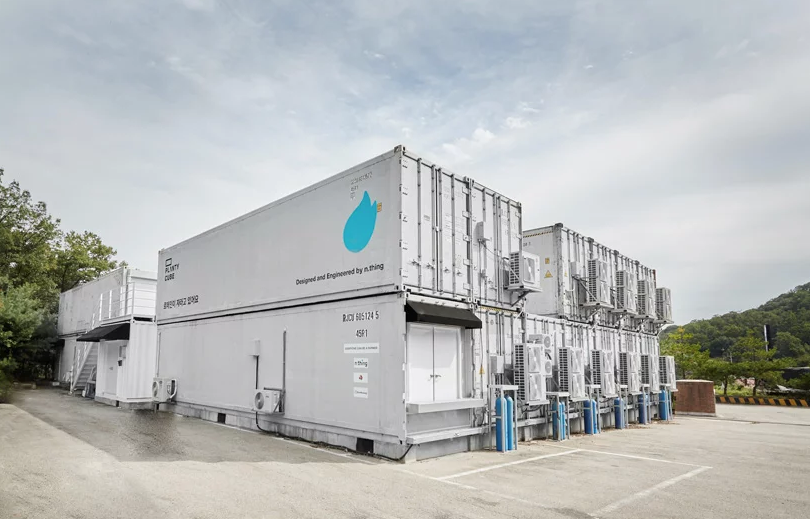
The Cube's crops are powered by LED lights. N.Thing
As we head into 2021 facing a number of dire existential threats -- pandemics and climate change to name a few -- one of humanity's encroaching issues is population rise.
How on earth (literally) are we going to feed all these people?
Traditional farming methods could be problematic in the long term. It's not just an issue of space but a problem of sustainability. We're currently damaging our environment with current farming techniques -- and eradicating existing species and their habitats to the point where many are calling it the sixth extinction event.
In short, we have some problems to solve. Part of the solution could be found inside this 40-foot refrigerated shipping container.
They call it The Cube: A modular smart farm, designed to be built in urban spaces in pretty much any configuration you like.
The containers can be stacked vertically or horizontally, with potentially dozens or even hundreds of Cubes fitting together to make one giant farming system, capable of cultivating and growing tonnes of produce. The hope is to bring sustainable, efficient, year-round farming to spaces that can't traditionally support agriculture.
"The human populations are growing quite fast," explains Seungsoo Han, the COO at N.thing, "and we need to come up with some kind of very efficient solution that can actually support that fast-growing population, also at the same time, we shouldn't actually damage the environment that that population lives in."
At the heart of the Cube, the farm is an automated operating system known as Cube OS. The system takes in data from sensors inside each farm, measuring readings like humidity, ph levels in the water, temperature, carbon dioxide -- everything that's needed to grow a healthy plant. And each of these variables can be tweaked and optimized, depending on the plants you're growing.
N.Thing has already partnered with Korea's largest supermarket chain to supply greens and, last year, it rolled out a farm in the United Arab Emirates, where summer temperatures regularly climb over 100. Next, N.Thing plans to expand into other territories like Singapore and Qatar.

Sustainable Food Leads £6m Research Project To Transform The UK food System
Food security and sustainability are among the greatest challenges facing the world today, and traditional approaches of intensifying food production are coming under criticism for not looking at the whole picture of how we produce, and supply food to the nation
By India Education Diary Bureau Admin
January 10, 2021
A new £6m research project titled Healthy soil, healthy food, healthy people (H3) seeks to transform the UK food system from the ground up via an integrated programme of interdisciplinary research.
Social and natural scientists from the Institute for Sustainable Food at the University of Sheffield will collaborate on a whole-system approach to emphasise the links between production and consumption and identify practical paths towards food system transformation.
Food security and sustainability are among the greatest challenges facing the world today, and traditional approaches of intensifying food production are coming under criticism for not looking at the whole picture of how we produce, and supply food to the nation.
The Covid-19 pandemic also shone a light on the fragility of the UK’s food systems resilience and how its reliance on foreign imports during a global crisis meant people in the UK experienced empty shelves, and shortages of basic staples such as flour and pasta.
The H3 consortium – which draws on the combined strength of researchers from the University of Sheffield, University of Leeds, University of Bristol, University of Cambridge and City, University of London as well as a wide range of stakeholders from government, business and civil society – will focus its research on horticulture, hydroponics and hybrid farms, and on the health benefits of biofortification and increased fibre consumption.
This is an exciting, once-in-a-lifetime, opportunity to use cutting-edge research to have a genuinely transformative effect on the health and sustainability of the UK food system.
“We are delighted that the Institute for Sustainable Food will be leading one of the four consortia to be funded by the UK Research and Innovation’s Transforming the UK Food System for Healthy People and a Healthy Environment programme.
Professor Peter Jackson
Co-director of the Institute for Sustainable Food at the University of Sheffield
The project will identify practical paths towards food system interventions: on farm, in food manufacturing and retail, and improve dietary health and environmental sustainability of the agri-food industry in the UK.
This will include finding ways to increase the production of health-promoting vegetables while reducing reliance on harmful agricultural inputs and imported food by integrating hydroponic production systems within conventional soil-based farms. The project will also look at how improving the microbiomes of growing mediums has the potential to increase nutrients in our food systems and reduce our reliance on pesticides.
We are absolutely delighted by this award and excited to apply the food systems-level thinking we’ve developed at the Institute for Sustainable Food to the real world.
“Backed up by our world-leading research, this work has huge transformational potential to improve the sustainability, the quality, and the equity of our agri-food system here in the UK. Working closely with our external partners will add a real world perspective to shape how our initiatives are applied.
“In terms of fighting the climate crisis, this kind of transformational research is sorely needed. We are delighted that the Institute for Sustainable Food will be leading the way in developing and applying that research.”

Biological Innovation Is Key To The Economic & Environmental Sustainability of CEA
As the global population rapidly urbanizes, we need to move our agricultural production to within urban and peri-urban areas
January 6, 2021
Editor’s note: Leonard Lerer is founder and CEO at Back of the Yards Algae Sciences (BYAS), a Chicago, US-based biotech company developing sustainable novel ingredients derived from algae.
BYAS is a graduate of the GROW Impact Accelerator, which is affiliated with AFN’s parent company AgFunder.
As the global population rapidly urbanizes, we need to move our agricultural production to within urban and peri-urban areas. The environmental and social costs of large-scale, industrial farming are huge, and include the fallout from widespread pesticide and chemical use, the depletion of land resources, and the progressive depopulation of rural areas.
In regions where land is at a premium or climatic conditions are not favorable for outdoor farming, the only alternative is the controlled environment agriculture (CEA) ‘plant factory’ – whether an indoor, vertical, or greenhouse-based facility.
The advantage of CEA is clear: safer, standardized, pesticide-free produce with short delivery ‘circuits’ that are less polluting.
Invest with Impact. Click here.
The flipside is that the jury is still out as to whether indoor or vertically farmed produce can be considered especially sustainable given lighting energy costs in particular. If these energy input costs could be reduced, then the door opens to using vertical farming as a production system for food staples such as wheat, corn, and soy.
The current energy use reduction effort in CEA is largely focused on improving lighting technology with the goal of greater energy efficiency and ‘tuning’ light frequencies to the photosynthetic needs of plants. But perhaps there are other approaches to support the transition of indoor and vertical farming into an incontrovertible part of the urban food chain?
Recently published research from BYAS offers the exciting prospect of moving vertical farming past the economic and environmental sustainability barrier. This is the opportunity to transform indoor and vertical farming from simply a source of leafy greens, vegetables, and small fruits into a real, long-term pillar of urban food security.
At the heart of this promising approach is the application of an algae-based biostimulant to significantly reduce growing time, thereby saving energy and increasing profitability. After more than two years of intensive research, BYAS has developed a proprietary microalgae extract that shortens the time between planting and harvesting in leafy greens and vegetables. This phycocyanin-rich spirulina extract (PRSE) is part of the BYAS portfolio of alternative proteins, including food colorants and plant-based meat ingredients.
Published research shows that PRSE is effective as a biostimulant in hydroponics, improving growth, yield, and quality of lettuce while cutting maturation time by six days (about 21%.) PRSE-treated lettuce showed a 12.5% increase in yield, a 22% increase in photosynthetic efficiency, a mean increase of 2.6 cm in leaf length and 2.2cm in basal stem diameter. In a shelf-life test, wilting was seen two to three days after it was observed in control groups. The treated groups were a brighter green (specifically 17% brighter and 75% greener) and better tasting. They had firmer texture, stronger aroma, and more intense flavor than the untreated group, according to an independent certification agency.
Using high-performance liquid chromatography analysis, the BYAS team also examined nutrient content showing that PRSE-treated lettuce had 30% more of the flavonoid, quercetin.
Natural biostimulants offer vertical farmers a new avenue for reducing energy inputs, while the improvement in product quality will assist in improving profitability by ensuring better selling prices. The most exciting aspect of developing natural biostimulants specifically for vertical farming is the possibility to extend the indoor farming sector into row crops as food staples, ensuring not only better and more secure food supplies for urban populations, but also protecting the planet.
agfunder, algae, asia, Europe, Frankly Speaking, grow, microalgae, United States, vertical farming

USDA Seeks Members For New Urban/Indoor Ag Committee
The dozen members of the board will advise the agriculture secretary on issues relating to urban/indoor/vertical farms and identify barriers to establishing them
by Chris Koger
January 7, 2021
(Courtesy AeroFarms )
The U.S. Department of Agriculture is seeking members for a new advisory committee for urban agriculture.
The dozen members of the board will advise the agriculture secretary on issues relating to urban/indoor/vertical farms and identify barriers to establishing them.
“This group will underscore USDA’s commitment to all segments of agriculture and has the potential to support innovative ways to increase local food production in urban environments,” Bill Northey, USDA’s undersecretary for farm production and conservation, said in a news release.
The members will represent:
Four growers, two from an urban area/cluster and two who use innovative technology;
Two people from a university or extension program;
One person from a nonprofit organization, which may be a public health, environmental or community organization;
One person from of business and economic development, such as chamber of commerce, city government or planning organization;
One person with supply chain experience, such as a good aggregator, wholesaler, food hub, or a background in a direct-to-consumer program;
One person from a financing entity; and
Two people with experience in urban, indoor or other emerging agriculture production practices, as determined by the USDA.
Nominations are due by March 5, and should include a cover letter, resume and a background form.
Send them to Ronald Harris, Designated Federal Officer, Director of Outreach and Partnerships, Natural Resources Conservation Service (NRCS), Department of Agriculture, 1400 Independence Avenue, S.W., Room 6006-S, Washington, D.C. 20250, or mail them to Ronald.Harris@USDA.gov.
The NRCS oversees the Office of Urban Agriculture and Innovative Production, which was established by the 2018 farm bill.
PODCAST: Season 2 Episode 19 - Nate Storey - Co-Founder & Chief Science Officer of Plenty
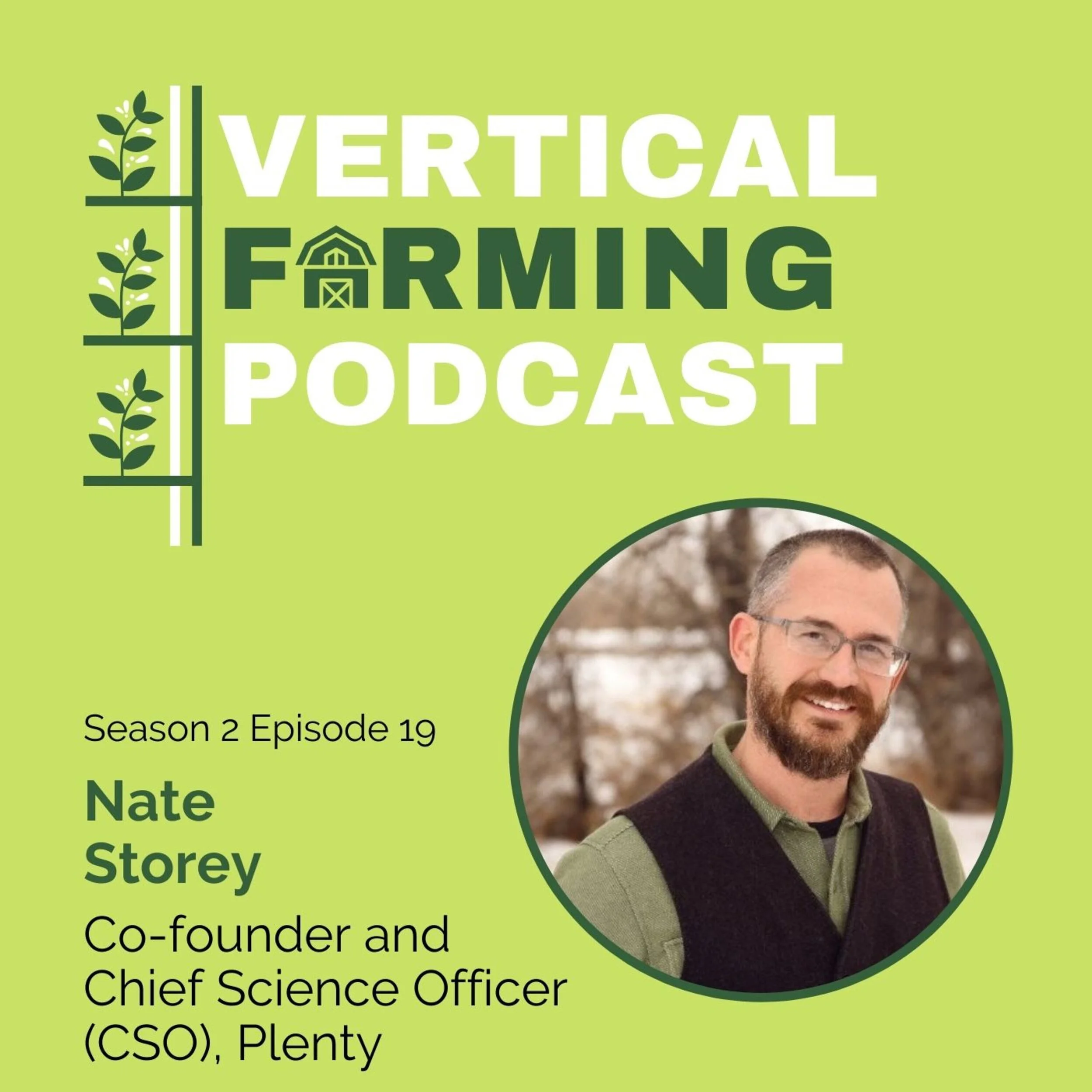
Join Harry Duran, host of Vertical Farming Podcast, as he welcomes to the show co-founder and Chief Science Officer (CSO) of Plenty, Nate Storey
Join Harry Duran, host of Vertical Farming Podcast, as he welcomes to the show co-founder and Chief Science Officer (CSO) of Plenty, Nate Storey. Plenty is on a mission to bring fresh, local produce to communities everywhere in a way that’s better for the environment.
In this episode, Harry and Nate discuss Plenty’s local field-scale indoor farms, the importance of having supportive infrastructure for vertical farming, and the work Nate is doing at Plenty to promote social responsibility and better food for all.
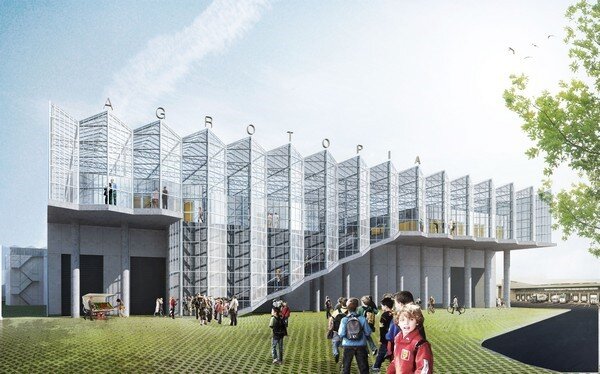
Rooftop Greenhouse Agrotopia Is Taking Shape
Little by little, the roof greenhouse on the crate shed of the REO Auction in Roeselare is taking shape. Compared to the very first visible work, there is already a real greenhouse on the roof, as greenhouse builder Deforche Construct shared recently
Little by little, the roof greenhouse on the crate shed of the REO Auction in Roeselare is taking shape. Compared to the very first visible work, there is already a real greenhouse on the roof, as greenhouse builder Deforche Construct shared recently.
After the Christmas break, the construction team went back to work. The project is scheduled for June 2021, but the official opening is due August this year. After that, the greenhouse will be ready for the 'Festival of the Future' which will be held in Roeselare in September, they shared in a LinkedIn update.
Stijn Cappon (Deforche Construct), Francis Vancraeynest (Deforche Construct), Johan Vermeulen (Maïs Automatisering), and Jago van Bergen (Van Bergen Kolpa Architects) at the laying of the first pile for the project in July 2019. Deforche is constructing the greenhouse, whilst Maïs Automatisering will take care of the technical completion of the greenhouse. Van Bergen Kolpa Architecten has designed the jagged façade and the twelve-meter high greenhouse as a landmark.
Vegetable garden
The REO Auction is located in the heart of West Flanders. "The vegetable garden of Western Europe", the initiators say. The rooftop greenhouse offers space for both leafy and fruiting vegetables. In co-creation projects, suppliers, knowledge institutes, governments, growers, and technology companies are included in crop research. The first processes have already been set up, such as cultivation on water with densely sown crops and vertical farming.
All greenhouse departments will be equipped with LED artificial lighting and a specific climate control system that relies even more on all the knowledge of plant physiology. The greenhouse will be 8000 square meters and will be 8.4 meters separate from the first floor, on the roof of the crate shed.
Vertical cloths are used as shields between the departments, preventing light from radiating into the environment. This is particularly relevant when growing vertically. The rooftop greenhouse does not have its own heating installation: heat is provided by the municipal waste incinerator MIROM and by auction REO.
Festival of the Future
As was recently announced, the Province of West Flanders has chosen the rooftop greenhouse as the location for the 'Festival of the Future'. Three editions will take place between 2021 and 2025. The first edition is planned from 23 September to 3 October 2021.
A document with 'eye-catchers' from the multi-annual budget of the province reads: "At the foot of the rooftop greenhouse there will be built a universe of experience. During two weekends, the general public will be able to discover the agriculture, biodiversity, and food of the future in an exciting journey through an export space. Besides, an attractive and widely accessible evening program will be prepared.
During the week, schools will also be involved, through original workshops. Workshops on computational learning for primary and secondary education, for instance, will be organized. The students will here learn to build a 'Mini-Agrotopia'".
According to the province, the project is characterized by an 'intensive co-creation course of the Province of West Flanders, Inagro, TUA West, POM West Flanders, PTI and the education expertise cell of the Province of West Flanders'. The West Flemish colleges VIVES and HOWEST also 'actively contribute' to the development of the Festival.
Some history
Dominiek Keersebilck of the REO Auction told more about Agrotopia in an interview that appeared earlier in Primeur. The arrival of the rooftop greenhouse is a new step in the history of the auction, he says.
REO Veiling was founded on 20 July 1942 by 27 professional horticulturists from "Roeselare and surroundings" (REO). Due to WW II they had to wait until November 21, 1944, for the first auction day. The story of the REO Auction started in a small shed of a potato trader in the center of Roeselare. After that, the auction moved five times to cope with the increasing supply of horticultural products from West Flanders.
In 1978, REO auction introduced block sales. Also, 1983 was an important year because in that year a simultaneous sale was organized with the Centrale voor Glasgroenten in Sint-Katelijne-Waver for the first time. In 1987 the board of directors decided to build a new and larger auction complex at the current address at the Oostnieuwkerksesteenweg. The new complex was taken into use on 1 April 1991 and officially inaugurated on 24 May.
Rooftop greenhouse
The old auction buildings on the Diksmuidsesteenweg made way for the current packaging department, and a new crate shed was built on the adjoining Vuylsteke site, which was put into use at the end of 2015. A rooftop greenhouse is currently being built on the roof of this packaging shed.
Agrotopia
According to commercial director Dominiek Keersebilck, a lot has changed in recent years. "The REO Auction has seen an increase in turnover and the volume of product sold in recent years. Whereas we have achieved record sales in recent years, this will probably not happen this year due to the corona crisis. This in no way means that there will be no further development on our site. At the moment there is indeed the development of the rooftop greenhouse called "Agrotopia".
The rooftop greenhouse is meant for research and with this technical knowledge, we want to anchor horticulture, here in West Flanders. Also, space can be made for other forms of horticulture, such as vertical farming and urban crop. The rooftop greenhouse allows research into vertical horticulture along a wall of 12 meters high and in the meantime, other innovative cultivation possibilities, such as the cultivation of leafy crops in containers, are also under consideration.”
This article originates from our Dutch magain Primeur - www.agfprimeur.nl.
For more information:
REO Veiling
www.reo-veiling.be
info@reo.be
Publication date: Thu 7 Jan 2021

Joint UAE-Israel Food And Water Security Conference Announced
The first-ever UAE-Israel food security summit will take place later this month, bringing together Israeli food and water security companies and investors from the UAE
Could Israel’s success story of “making the desert bloom” boost food security in the UAE?
BY GULF BUSINESS STAFF
JANUARY 6, 2021

The first-ever UAE-Israel food security summit will take place later this month, bringing together Israeli food and water security companies and investors from the UAE.
GoforUAE-Israel Food Security Investment Conference will have experts from both countries explore strategic partnerships and capital market opportunities. This event aims to improve the productivity of desert environments in the Middle East and worldwide.
To be held on January 18, the online conference will address pertinent issues in agriculture and food security such as precision agriculture, desert farming, development of resilient species, advanced storage solutions, and more.
“Our mission for this event is to introduce emerging technologies that can facilitate the UAE access to food security solutions in the long term”, said Edouard Cukierman, chairman of Cukierman Investment House and Managing Partner at Catalyst Funds.
“Since its founding in 1948, Israel has never stopped inventing agricultural technologies that greatly improve farming everywhere, especially in arid areas. Israel gladly shares its experience, innovations and achievements in this field with the rest of the world. With Similar weather, conditions and water scarcity to the UAE, and 60 percent of Israel’s land covered by the Negev desert, Israel and the UAE can jointly make an impact on desert farming to enable quality, available food in the Middle East and worldwide,” he added.
Read: Israeli tech companies make debut at Gitex 2020
Hundreds of investors from the UAE have already registered for the conference to explore some of Israel’s most promising and innovative solutions for food and water security and agtech, the organizers said.
Participating Israel firms include Saturas, a pioneer of in-tree water intelligence systems based on water monitoring from within the plant. Saturas can then offer tailored irrigation based on the crop’s real-time water needs, resulting in efficient water use.
Also taking part is Ramat Negev Research & Development, an R&D center that develops agro-technical methods suitable for desert conditions. Ramat Negev R&D has recently established a new ag-tech innovation center jointly with Arieli Capital to boost Negev agriculture through co-developing with emerging startups.
Register Here

2020’s Indoor Farm Venture Capital Bonanza
"The industry raised US$565mm in 2020. This figure excludes several notable rounds where the amounts raised were not publicly disclosed," says Nicola Kerslake, CEO of Contain
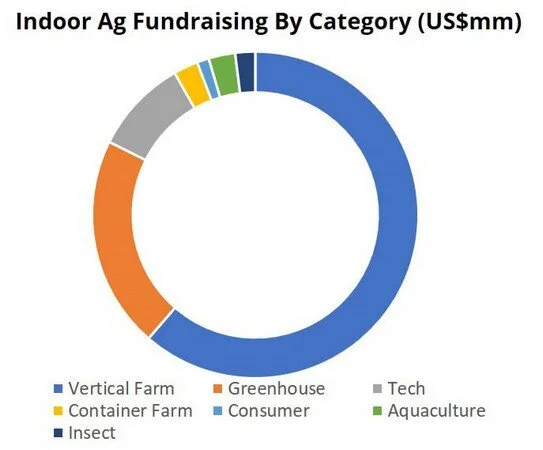
In the face of a dismal year, indoor agriculture saw record fundraising from venture capital and other private investors in 2020. "The industry raised US$565mm in 2020. This figure excludes several notable rounds where the amounts raised were not publicly disclosed," says Nicola Kerslake, CEO of Contain.
"New Jersey-based vertical farmer AeroFarms was one of four recipients of funding from the Abu Dhabi Investment Office for its Dubai farm. Late in the year, automated vertical farmer 80 Acres raised a round from British bank Barclays. Elsewhere, at-home kit provider Back to the Roots added a prominent Saudi sustainable ag supporter to its existing investor list for an October 2020 round. Even without these rounds, 2020’s total was up nearly 50% on 2019 and represents a record for the industry, besting 2017’s US$391mm," states Nicola.
Credits: Contain
According to Nicola, vertical and greenhouse farms again represented the bulk of funding, thanks to large rounds from majors such as Bright Farms (US$100mm), Gotham Greens (US$87mm), InFarm (US$170mm), and Plenty Ag (US$140mm). Outside of this, a notable trend was that industry suppliers are now beginning to interest investors. For instance, greenhouse computer vision tech provider iUNU raised a $7mm round led by frequent agriculture investors S2G Ventures and Ceres Partners. Contain Inc, the fintech platform that I lead, has itself been a part of this trend, raising a funding round from the US and European investors at the tail end of 2020.
"This resurgence can be traced to several factors. Most important is the lure of all manner of sustainable agriculture in a world where everyone seemed to become food-obsessed during lockdowns. Increasing industry participation from large produce buyers has also played a part, as they’re seen as an indication of the industry’s viability by venture capital investors," Nicola adds.
In addition, venture capital funds are typically thematic investors, and COVID rendered several of these themes obsolete and encouraged venture capitalists to pivot to new ones. "For example, some parts of the ultra-hot sharing economy theme that spawned companies like Uber suddenly look less alluring when consumers are loath to share space. Meanwhile, themes around health and wellness became far more attractive, benefiting adjacent industries such as indoor agriculture," Nicola affirms.
Credits: Contain
"Going forward, venture capital funds still have plenty of dry powder for investment, after a healthy fundraising environment for them in 2020", says Nicola. Industry researcher PitchBook says that funds raised by venture capital firms rose by nearly a quarter over 2019 levels.[1] The year’s strong IPO (stock market listing) market helped, with tech favourites like AirBNB and DoorDash going public. Indoor agriculture remains a minority sport for investors, 2020’s record haul represents less than that raised in the year by stock trading app Robinhood alone. Nicola adds: "Given this, it’s perfectly possible that we may see another record-breaking year for indoor agriculture in 2021."
For more information:
Contain
nicola@contain.ag
www.contain.ag
5 Jan 2021
Author: ebekka Boekhout
© VRerticalFarmDaily.com

Tips To Reduce Vertical Farm Costs
Light Science Technologies offers a bespoke solution that helps growers to achieve maximum yield while saving costs and energy
There are a number of key variables to consider when setting up your own vertical farm that calls for considerable financial clout. Light Science Technologies offers a bespoke solution that helps growers to achieve maximum yield while saving costs and energy.
The rising AgriTech start-up offers the first of two features offering tips to help you to reap optimum results and high returns.
Tip 1: Location, location, location
While you don’t need as much land as traditional growing, finding the right location for your vertical farm is crucial. The wrong location can prove a costly mistake, so do your homework before committing. Do you have the right local infrastructure in place to get your product to your buyer as efficiently as possible? Can you source enough electricity? How much does water cost in this county compared to the next one over?
Tip 2: Minimize energy costs
However, energy-efficient your operation is, you’re still going to use a huge amount of electricity every year. The most cost-effective solution might be to create your own renewable energy. That isn’t possible for all sites, but even micro-generation could help to bring your OPEX down.
Tip 3: Engage the experts
Let’s be frank: vertical farming is no small subject. Start building relationships as early as possible with people who know everything on it, from lighting and data to botany.
Tip 4: Balance OpEx and CapEx costs
Think big picture in terms of cost. Spending more initially could reap rewards later on. For instance, heavier investment in technology in order to automate seeding, feeding, watering and harvesting will require a greater initial outlay, but a far smaller workforce; labour costs can easily account for over 50% of a vertical farm’s OpEx.
According to CambridgeHOK, a small vertical farm with minimal automation costs around £1,000 per square metre to set up. A large farm with full automation will cost in the region of £3,000 per square metre. You’ll also need to factor in OPEX differences to the growing system you choose (hydroponic, aeroponic, and/or aquaponic).
Tip 5: Don’t cut corners
Buy wisely. Avoid gambling on cheaper products, such as mass-produced imported lighting. Ensure major costs come with decent guarantees and support in place should anything go wrong.
Cutting corners now could cause repercussions later down the line, and not just in maintenance and replacement costs. Cheaper options could spell inflexibility, killing your vertical farm’s true potential.
6. Choose your crops carefully
There are pros and cons to different types of crops. Quick-growing plants tend to be cheaper to grow, resulting in an abundance of product. However, some slower-growing crops, such as medicinal cannabis, can earn you far more per plant. Some crops require less energy. Others take up less space so you can pack more in. Fastidious research and number crunching will help you to choose the best option for your own vertical farm.
Tip 7: Know your audience
Assuming there’s a market for what you’re growing is where you could fall short. Many vertical farmers focus on fast-growing salad crops. In an optimized environment, you could end up producing 30 tonnes of salad a day. But can you guarantee sales of lettuce through the depths of winter? Potentially, this could either mean considerable wastage or letting part of your vertical farm sit idle for weeks on end, which will mean diminishing returns.
Sound planning and organization from the start is essential and will enable you to factor in a different crop switch every few months with flexible lighting systems if required.
For more information:
Light Science Tech
Claire Brown, PR Consultant
claire.brown@lightsciencetech.com
www.lightsciencetech.com
Publication date: Fri 8 Jan 2021
Polygreens Podcast Episode: 008 -CO2 GRO
CO2 from a gas tank and water from the facility source are plugged into the Aqueous CO2 Infusion System, which comes as an in-situ system or can be integrated into booms
CO2 from a gas tank and water from the facility source are plugged into the Aqueous CO2 Infusion System, which comes as an in-situ system or can be integrated into booms. The CO2 completely dissolves in the water creating a saturated aqueous CO2 solution.
The aqueous CO2 solution is targeted directly on to the plant's leaves by misting micro droplets that create an aqueous CO2 film on leaf's surface. This film isolates the leaf surface from the atmosphere and creates a diffusion gradient that favors the transport of CO2 into the leaf and other gasses out of the leaf.
The carbon is used by the plant for photosynthesis to grow and the oxygen is given off to the atmosphere.
Listen
Nick Greens
The Nick Greens Grow Team has participated in many changes since they started developing indoor controlled agricultural environments in 2010. Our goal is to expand the vertical farming industry by helping ag-entrepreneurs manage their businesses better, avoid common mistakes, and improve crop yields based on what we have observed and developed over the past decade.
YouTube

Year-Round Under-Glass Herb Cultivation In The Heart of Berlin
ECF Farmsystems uses innovative LED lighting solutions from Fluence for today’s herb cultivation in the heart of Berlin
Urban Farming Using LEDs From Fluence by OSRAM
ECF Farmsystems uses innovative LED lighting solutions from Fluence for today’s herb cultivation in the heart of Berlin. An innovative urban farm, ECF Farm Berlin (ECF Farmsystems) uses techniques for greenhouse and vertical cultivation of basil. The farm also uses aquaponics to naturally fertilize the crops, the produce of which then goes to Rewe, Germany's second-largest supermarket chain.
Less space and more production is the name of the game at ECF Farmsystems: comprehensive lighting solutions, from growing to greenhouse culture, enable the year-round production of uniform, aromatic basil plants.
Modern agriculture thanks to LED lighting / Image: Osram
Urban cultivation from seed to finished product
On-site propagation on VertiCCs, a racking system for vertical cultivation developed by ECF Farmsystems, increases production by 35% with the same footprint and optimized supply chain from seed to finished product.
The system also ensures consistent, uniform products. This is because ECF Farmsystems completely controls the entire growing cycle with less pest infestation and more accurate yield forecasting. In addition, the VYPR lighting systems offer higher-quality light spectra compared to conventional lamp systems. In addition, thanks to VYPR solutions, greenhouse growing is no longer seasonal, as efficient crop lighting provides uniform plants with consistent productivity, regardless of local weather.
With Fluence's RAZR Series, ECF Farmsystems achieves more effective operations and a 35% increase in production without the need for new construction or remodeling. By expanding vertical growing in the plant nursery, which eliminates the need to invest in additional growing space/facilities, ECF Farmsystems saves important emission costs. Propagation on VertiCCs systems with RAZR exposure allows ECF Farmsystems to control the entire growth cycle, better manage pests, and now calculate yields more accurately.
The new RAZR module will be available in January 2021.
For more information:
fluence.science/webinars
https://en.ecf-farm.de/
https://www.osram.com/os/applications/horticulture-lighting/index.jsp
Publication date: Thu 7 Jan 2021

“There Is Abundant Liquidity But A Lack of Solid Business Cases”
“I come across many vertical farming concepts. There are some very interesting developments going on in the market. Especially for investors, because vertical farming is future-focused”
“I come across many vertical farming concepts. There are some very interesting developments going on in the market. Especially for investors, because vertical farming is future-focused,” says Jobbe Jorna, Founder and Managing Partner at Upstream Capital. The Amsterdam-based organization advisory boutique is specialized in helping companies realize their full potential with performance improvement and corporate finance.
“Multiple investors are looking into (inter)national vertical farming projects. There’s abundant liquidity but a lack of solid business cases.” According to Jobbe, as a result of the pandemic investors are becoming increasingly critical, also in the Netherlands. They take more time for a thorough analysis, walking through the entire process teaming up closely with stakeholders. In the end, this is only beneficial for farmers because it contributes to the design, build, finance, maintain, and operate a solid foundation to build a successful farm upon.
Jobbe Jorna
Sharp review of business cases
Jobbe says that there are three common mistakes that he comes across frequently when reviewing business cases. Firstly, farmers need to develop a strategic competitive advantage with sufficient upside potential. The business case has to be scalable. Secondly, the value proposition has to be validated, tested, and ready-to-market. “Don’t put too much R&D into it, Bear in mind, an idea does not immediately make a working concept. Let alone a winning go-to-market proposition that can be achieved,” Jobbe adds.
“Investors want to see a rock-solid value proposition with upside potential and a powerful management team with strategic business partners, backing up the company. Most investors don’t go onboard if there isn’t a worthy team with a strong and proven track record.” Finally, farmers should look outside the box as in horizontal integration within the value chain, long-term off-take contracts. In the past, we successfully realized sustainable energy projects in greenhouses driven by long-term contracts at a middle price. In this way, we can secure the business case against crop price fluctuations. As a result, the business case attracts more interest from potential financiers, in the wide range of business angels and investors to banks.”
Key takeaways
Cultivation is your core, says Jobbe, then start with the end in mind. Who is the end customer, what are the current needs, and what are tomorrow’s needs? Rethink the value chain and develop your own eco-system of strategic partners. Farmers need to their homework. Start in time, as it’s more challenging than people think. You need to have a rock-solid business plan in place prior to approach potential investors.
Jobbe says that when a business plan is solid enough, farmers should put together a game plan before going out and start to approach potential investors. “If that’s done too early, your process, time and wallet for that matter will take a sufficient hit. When growers are in a negotiation phase with investors, they should follow a structured approach. Keep your options open, your eye on the ball as the negotiation window is a moving target and always respect your walk-away point. Especially now, during the pandemic, growers should not be seduced by an unfair proposal.”
For more information:
Upstream Capital
Jobbe Jorna, Founder and managing partner
+316 1518 4909
jobbe.jorna@upstreamcapital.nl
www.upstreamcapital.nl
Publication date: Thu 7 Jan 2021
Author: Rebekka Boekhout
© VerticalFarmDaily.com

Agri-Tech Startup Granted £566,000 To Develop Growth Chambers
Driven by the need to reduce the environmental impact of agriculture, and to improve the nutritional quality and availability of fresh produce, the vertical farming market is a very exciting place to be for an agri-tech startup-like Grobotic Systems
Innovate UK, the UK’s innovation agency has just awarded Grobotic Systems and their consortium partners a grant worth £566,000 to fund the development of their cutting-edge growth chamber and to support the UK Government’s Industrial Strategy to transform food production.
Agri-tech startup Grobotic Systems believes the best way to deliver this promise is with their latest invention, a new class of plant growth chamber loaded with high-tech sensors and plugged into the internet. This state-of-the-art growth chamber will help vertical farmers identify the best way to grow plants to produce the most nutritious and environmentally-friendly food possible.
Managing director, Dr. Moschopoulos says “Through collaborating with industry leaders in photonics, controlled environment agriculture, and plant physiology, this funding enables Grobotic Systems to recruit additional staff, accelerate product development, and access the rapidly growing global vertical farming market with our innovative growth chamber technologies.”
“Driven by the need to reduce the environmental impact of agriculture, and to improve the nutritional quality and availability of fresh produce, the vertical farming market is a very exciting place to be for an agri-tech startup-like Grobotic Systems. Our novel technologies will help farmers grow healthier food more efficiently - that is better for the environment, better for the farmer, and better for the consumer.”
This project builds on the patent-pending growth chamber technology developed by Grobotic Systems over the past year. Grobotic Systems will lead this project in collaboration with partners from the Fraunhofer Centre for Applied Photonics, Stockbridge Technology Centre, and the University of Sheffield.
Founded in 2018 by Dr Alexis Moschopoulos, a plant geneticist, and Richard Banks, an electronics engineer, Grobotic Systems is a Yorkshire-based startup engaged in the design and manufacture of innovative plant growth chambers for plant science research.
For more information:
Grobotic Systems
Alexis Moschopoulos, managing director
alexis@groboticsystems.com
www.groboticsystems.com
Publication date: Fri 8 Jan 2021

RSVP - Indoor Ag Science Cafe January 12th 11:00 AM Eastern Time
"Considerations For Marketing Vertical Farm Food Products To Consumers"
January Indoor Ag Science Cafe
January 12th Tuesday 11:00 AM Eastern
Please Sign Up, Thank You!
"Considerations For Marketing Vertical Farm Food
Products To Consumers"
Dr. Bridget Behe
Michigan State University
Please sign up so that you will receive Zoom link info.
Indoor Ag Science Cafe is an open discussion forum, planned and organized by OptimIA project team supported by USDA SCRI grants.