

Welcome to iGrow News, Your Source for the World of Indoor Vertical Farming

INDIA: Gurgaon Based Startup Nutrient Co Integrates Hydroponics With Yogic Farming Techniques
Gurgaon based startup Nutrient Co, founded by Arpit Jain, harnesses and uses the power of human mind and delivers pesticide-free greens and herbs that are UV sterilized and ozone washed at its state of the art, hydroponic farm, within 2 to 8 hours of its harvest
Gurgaon based startup Nutrient Co, founded by Arpit Jain, harnesses and uses the power of human mind and delivers pesticide-free greens and herbs that are UV sterilized and ozone washed at its state of the art, hydroponic farm, within 2 to 8 hours of its harvest.
After having lost his father and two of his close family members, Gurgaon based entrepreneur says he researched extensively about the growing number of cancer patients in India and factors owing to such an increase and he wasn’t shocked to find our lifestyle, stress, and degraded quality of food we consume as the primary reasons.


Recalling his search for pesticide-free food, he says, “The quality of vegetables and fruits in the capital is so bad, despite India being the largest agro-based economy of the world. The vegetables & fruits from local vendors/ sabziwalas and mandis come through long supply chains. With them, there was always a concern about hygiene, freshness of the produce, and its quality. I even researched and tried some online vendors of imported herbs like basil and parsley, but to my disappointment, they were waxed and chemically treated for longer shelf life.”
Not long after, he began researching about Urban farming technologies, which enables one to trace where their food is coming as opposed to the prevalent mandi model. This is when he opted out of his family-run business and started his own hydroponic farm, which not only consumes 90% lesser water than traditional farming, uses no chemical weed or pest control products, but also decreases the time between harvest and consumption, thereby, increasing the nutritional value of the end product.
What intrigued him, even more, was getting connected with premier spirituality preaching institutes and learning and experiencing how powerful our thoughts are and deeper elements of metaphysics.
The startup dedicated a year to field research to understand the supply chain of traditionally produced crops, use of pesticides, the role of cold storage units, mandi operations, artificially controlled demand & supply, amongst other factors, which made Arpit’s decision to startup even firmer.
Alongside, Arpit was intensively studying and practicing meditative techniques, metaphysics, how our thoughts create vibrations. What influenced his decision to integrate hydroponics and yogic agriculture most was a study conducted by Japanese Businessman Masaru Emoto on how human consciousness can affect the molecular structure of water, later published in his book in 2004.
The entrepreneur says he is personally convinced of the benefits of yogic farming and knows from first-hand experience that when the farm is treated with certain meditative techniques and intentions and not just for profit when it is given those pure yogic vibrations, it flourishes in more ways than one. “I personally experienced the qualitative benefits of the produce from yogic agriculture, providing greater stability of mood, a more positive outlook, a decrease in depression, and improved relationships. And what can explain any of this better than the saying: Jaisa ann waisa mann (What you eat is what you become)”.
The method that start-up follows begins with a process of “seed empowerment” with meditation and positive intention of growth, purity, and strength to the seeds during germination. When the seeds are finally planted, different methods of meditation are used. Physical evidence has been observed by the startup that crops grown from empowered seeds have greater root germination and stronger growth.
Bootstrapped so far, the startup started delivering in September 2020.
The entrepreneur says he is happy with the response they got since inception, managing to get around 50 monthly subscriptions in their first month along with one time sales and almost doubling this number in the following month. This has also ensured that none of their produce goes to waste.
Arpit says he has also managed to enroll half a dozen B2B clients in his bouquet of clients and was surprisingly happy to see the demand for his produce with restaurants and cloud kitchens, who despite of the price difference between hydroponic produce and mandi crops owing to quality weigh quality, taste, and freshness as more important factors for their business than economic benefits.
Slowly and steadily, it aims is to make a qualitative difference in Indian households because “Your health is our priority”.
For more information: Arpit Jain (Founder) Nutrient Co, India contact@nutrientco.in

AppHarvest And Save The Children Team Up To Provide East Kentucky Kids Hands-On Education in Growing Food, Eating Healthy
Through the Grow Green Eat Green project, AppHarvest is working with Save the Children to create and provide indoor hydroponic grow kits to more than 1,600 children and their families in six Eastern Kentucky counties
1,600 Children Receive Hydroponic Grow Kits
As Part of Grow Green Eat Green Project
NOVEMBER 24, 2020 — BEREA, Ky. — Save the Children today announced a new partnership with AgTech leader AppHarvest to help educate children across Eastern Kentucky on how to grow their own nutritious food and the importance of healthy eating. Through the Grow Green Eat Green project, AppHarvest is working with Save the Children to create and provide indoor hydroponic grow kits to more than 1,600 children and their families in six Eastern Kentucky counties.
Participating children – who live in some of the state’s most impoverished counties, including Floyd, Harlan, Knott, Leslie, Owsley, and Perry – are receiving everything they need to help start their own indoor gardens, such as seeds, growing nutrients, and supplies, pots and instructions to help them get growing. They can also receive live instruction via video conference on how to grow their own food from AppHarvest’s farming experts, as well as learn the benefits of hydroponic farming.
“During a time when COVID-19 is having significant, detrimental impacts on children across Eastern Kentucky — including the alarming increase of child hunger across our region — Save the Children is proud to partner with AppHarvest to educate children and families about ways to help end this vicious cycle of food insecurity in the future,” said Alissa Taylor, Save the Children’s Kentucky State Director.
“AppHarvest was founded as a benefit corporation and is also a certified B Corp because we believe companies should be in the business of doing good,” said Amy Samples, Director of Community Outreach and People Programs. “We’re building America’s AgTech capital from within Appalachia and know that education is core to achieving that.”
Virtual instruction for the children will take place with their teachers in the coming days.
Committed to combatting child hunger across Kentucky and rural America, Save the Children has helped prepare and deliver more than 9 million meals as part of its coronavirus response efforts since March. In rural Kentucky alone, Save the Children staff have helped distribute more than 2.5 million nutritious meals to children in some of the state’s most impoverished communities since COVID-19 impacted the region this spring.
Prior to starting operations at its 2.76-million-square-foot indoor farm in Morehead, Ky., AppHarvest invested more than $150,000 in starting a high-tech container farm educational program. The program retrofits shipping containers with high-tech farming equipment to teach students to grow healthy leafy greens. The program started at Shelby Valley High School in Pike County in 2018 and has since expanded to Rowan County with additional units planned.
###
AppHarvest is an applied technology company building some of the world’s largest indoor farms in Appalachia. The Company combines conventional agricultural techniques with cutting-edge technology and is addressing key issues including improving access for all to nutritious food, farming more sustainably, building a home-grown food supply, and increasing investment in Appalachia. The Company’s 60-acre Morehead, KY facility is among the largest indoor farms in the U.S. For more information, visit https://www.appharvest.com/.
Forward-Looking Statements
Certain statements included in this press release that are not historical facts are forward-looking statements for purposes of the safe harbor provisions under the United States Private Securities Litigation Reform Act of 1995. Forward-looking statements generally are accompanied by words such as “believe,” “may,” “will,” “estimate,” “continue,” “anticipate,” “intend,” “expect,” “should,” “would,” “plan,” “predict,” “potential,” “seem,” “seek,” “future,” “outlook,” and similar expressions that predict or indicate future events or trends or that are not statements of historical matters. All statements, other than statements of present or historical fact included in this press release, regarding Novus Capital’s proposed acquisition of AppHarvest, Novus Capital’s ability to consummate the transaction, the benefits of the transaction and the combined company’s future financial performance, as well as the combined company’s growth plans and strategy, future operations, timing of first crop harvest, estimated financial position, estimated revenues and losses, timing of expected revenues, projected costs, prospects, plans and objectives of management are forward-looking statements. These statements are based on various assumptions, whether or not identified in this press release, and on the current expectations of AppHarvest’s management and are not predictions of actual performance. These forward-looking statements are provided for illustrative purposes only and are not intended to serve as, and must not be relied on as, a guarantee, an assurance, a prediction, or a definitive statement of fact or probability. Actual events and circumstances are difficult or impossible to predict and will differ from assumptions. Many actual events and circumstances are beyond the control of AppHarvest. These forward-looking statements are subject to a number of risks and uncertainties, including those discussed in Novus Capital’s registration statement on Form S-4, filed with the SEC on October 9, 2020 and as amended to date (the “Registration Statement”), under the heading “Risk Factors,” and other documents Novus Capital has filed, or will file, with the SEC. If any of these risks materialize or our assumptions prove incorrect, actual results could differ materially from the results implied by these forward-looking statements. In addition, forward-looking statements reflect AppHarvest’s expectations, plans, or forecasts of future events and views as of the date of this press release. AppHarvest anticipates that subsequent events and developments will cause its assessments to change. However, while AppHarvest may elect to update these forward-looking statements at some point in the future, AppHarvest specifically disclaims any obligation to do so. These forward-looking statements should not be relied upon as representing AppHarvest’s assessments of any date subsequent to the date of this press release. Accordingly, undue reliance should not be placed upon the forward-looking statements.
Save the Children believes every child deserves a future. Since our founding 100 years ago, we’ve changed the lives of more than 1 billion children. In the United States and around the world, we give children a healthy start in life, the opportunity to learn, and protection from harm. We do whatever it takes for children – every day and in times of crisis – transforming their lives and the future we share.
Follow us on Facebook, Instagram, Twitter, and YouTube.
Important Information for Investors and Stockholders
In connection with the proposed transaction, Novus Capital has filed the Registration Statement with the SEC, which includes a preliminary proxy statement to be distributed to holders of Novus Capital’s common stock in connection with Novus Capital’s solicitation of proxies for the vote by Novus Capital’s stockholders with respect to the proposed transaction and other matters as described in the Registration Statement, as well as the prospectus relating to the offer of securities to be issued to AppHarvest’s stockholders in connection with the proposed transaction. After the Registration Statement has been declared effective, Novus Capital will mail a definitive proxy statement, when available, to its stockholders. Investors and security holders and other interested parties are urged to read the proxy statement/prospectus, any amendments thereto and any other documents filed with the SEC carefully and in their entirety when they become available because they will contain important information about Novus Capital, AppHarvest and the proposed transaction. Investors and security holders may obtain free copies of the preliminary proxy statement/prospectus and definitive proxy statement/prospectus (when available) and other documents filed with the SEC by Novus Capital through the website maintained by the SEC at http://www.sec.gov, or by directing a request to: Novus Capital Corporation, 8556 Oakmont Lane, Indianapolis, IN 46260. The information contained on, or that may be accessed through, the websites referenced in this press release is not incorporated by reference into, and is not a part of, this press release.
Participants in the Solicitation
Novus Capital and its directors and officers may be deemed participants in the solicitation of proxies of Novus Capital’s shareholders in connection with the proposed business combination. Security holders may obtain more detailed information regarding the names, affiliations and interests of certain of Novus Capital’s executive officers and directors in the solicitation by reading the Registration Statement and other relevant materials filed with the SEC in connection with the business combination when they become available. Information concerning the interests of Novus Capital’s participants in the solicitation, which may, in some cases, be different than those of their stockholders generally, is set forth in the Registration Statement.
Swedish Agtech Startup Urban Oasis Raises €1M Funding To Build Its First MegaFarm
Swedish agtech startup Urban Oasis claims to build the food production platform for the 21st century
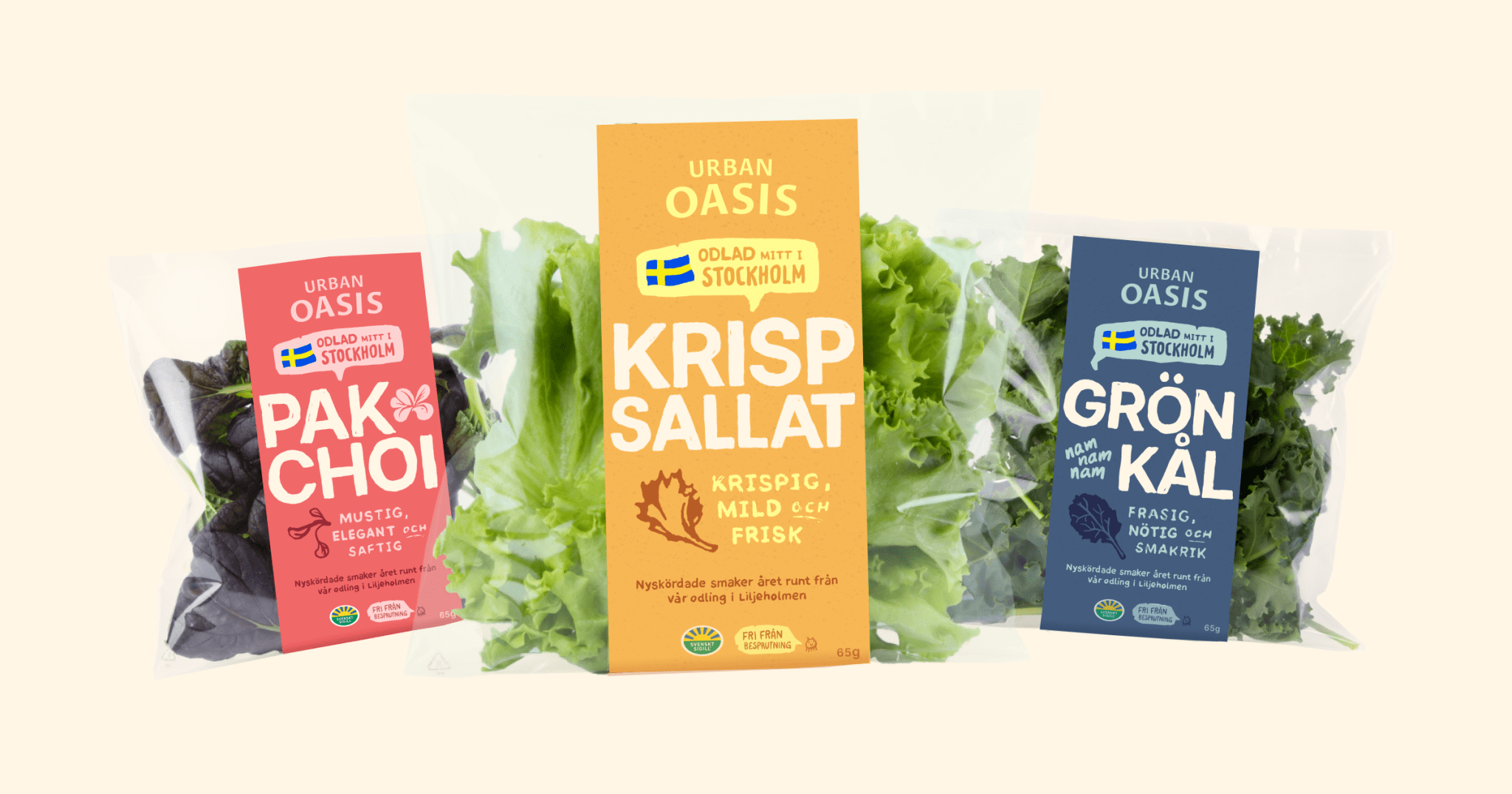
Swedish agtech startup Urban Oasis claims to build the food production platform for the 21st century. The company started as a pilot project in 2017 with the mission to provide the city of Stockholm with affordable and sustainably-grown food products through indoor vertical farming technology. Currently, Urban Oasis’ leafy greens such as Kale, PakChoi, and Lettuce can be found at major Swedish retailers including ICA, COOP, and online grocer MatHem.
Funding to build MegaFarm
In a recent development, Urban Oasis pocketed 10.5M SEK (nearly €1M) funding from both existing and new investors. The company plans to use the funding to build its first MegaFarm and expand its production capacity by 15-20 times. The construction work for this facility has already started and is expected to be operational by the end of 2020.
The MegaFarm will be powered by GreenOS, which is an automation software developed in-house. MegaFarm One will demonstrate the capability to optimally grow a large variety of crops in a single controlled production facility.
The investors in the company include Family Offices Pelarhuset and Anteeo, along with Yobi Partners Ltd, led by Toni Nijm and Charly Nijm.
Indoor vertical farming tech!
Urban Oasis was founded by Albert Payaró Llisterri and Lasse Kopiez in Stockholm Since its inception, the Swedish agtech startup has successfully scaled production at the pilot facility underneath an apartment complex in central Stockholm. Previously, this space was home to the Swedish Wine and Spirits Corporation’s storage and production facility. Now, it is owned by a Swedish real estate company GreenGroup, which is also an Urban Oasis partner.
“We are rethinking the way food is produced and consumed. Today Sweden imports more than 25 BSEK (€2.4B) worth of greens and vegetables from abroad. Growing produce where people live not only decreases transportation and climate impact, it also increases the freshness, taste and nutrition of the greens and vegetables. By leveraging the latest technology, we are building the food production platform for the 21st century,” says CEO and co-founder Albert Payaró Llisterri.
Main image picture credits: Urban Oasis
in (Crowd)funding, News, Startups

CEO of Red Lobster Joins Kalera Board of Directors
Kalera also welcomes Chris Logan, Investment Director of Canica International AG. The addition of these members coincides with Kalera’s rapid expansion into several new markets including recent announcements of locations in Atlanta, Houston, and Denver to open in 2021
ORLANDO, Fla., Nov. 20, 2020 (GLOBE NEWSWIRE) -- Kalera (OSE ticker KAL-ME, Bloomberg: KSLLF), one of the fastest-growing vertical farming companies in the world, today announced the appointment of two new members to its Board of Directors. Kim Lopdrup, the CEO of Red Lobster, brings decades of expertise from the restaurant industry and a history of successful global expansion. Kalera also welcomes Chris Logan, Investment Director of Canica International AG. The addition of these members coincides with Kalera’s rapid expansion into several new markets including recent announcements of locations in Atlanta, Houston, and Denver to open in 2021.
“We couldn’t be more thrilled to have Kim, a proven titan in the food and restaurant industry, join our Board,” said Daniel Malechuk, Kalera CEO. “His knowledge and expertise span from securing the highest quality, traceable food for his vast network of restaurants to leading companies through global expansion, skills which are invaluable to Kalera at this time. Chris has also made an impact within his industry and I am confident he will bring key financial insight as we grow rapidly and internationally.”
New board member Kim Lopdrup has been the Chief Executive Officer of Red Lobster, the world’s largest seafood restaurant chain company, since 2014. Under his leadership, Red Lobster has greatly improved its food and service, and today all of Red Lobster’s seafood is traceable, sustainable, and responsibly sourced. Before joining Red Lobster, Kim was the Chief Operating Officer, North America, for Burger King Corporation. He led the company’s 8,500 North American restaurants to record guest satisfaction scores in both company-owned and franchised restaurants, contributing to a turn-around of declining same-store sales.
“Kalera is an extraordinarily innovative company with disruptive technology and an unbeatable product that will allow them to grow very quickly and successfully,” said Kim Lopdrup, new Kalera board member and CEO of Red Lobster. “I am very passionate about food quality, safety, nutrition, and sustainability, and Kalera’s passion and commitment to all of these things is particularly impressive. I also have a lot of experience expanding brands internationally, and it is clear to me that Kalera has tremendous global potential.”
Kim serves on the boards of Wawa, Inc. (since 2006); Red Lobster (since 2014); and Bob Evans Restaurants (since 2017). He previously served on the boards of Rubio’s Restaurants (both before and after its IPO), 31 Ice Cream (a Japanese public company), and Hiram Walker & Sons, Ltd. (a Canadian company). He also served on the board of Boys & Girls Clubs of Central Florida for 12 years, being named Board Member of the Year in 2011 and receiving National Service to Youth awards in 2010 and 2015. He is currently co-chair of Project Opioid. Orlando Business Journal named Kim a “CEO of the Year” in 2016. He holds an MBA with Distinction in Business from Harvard Business School. In 1984, Kim won the Uhlmann Prize for best agribusiness research at Harvard Business School.
Also joining the board is Chris Logan, Investment Director of Canica International AG. His career prior to Canica includes four years as an accountant at Deloitte and six years at Goldman Sachs in London where he was responsible for European infrastructure research and was a three-time ranked analyst in the Greenwich and II surveys. He was also a founding partner of investment bank Liberum Capital in London, and Head of Research for Swiss-based hedge fund B1 Capital. His 20 years of capital markets experience includes corporate valuation, mergers & acquisitions, financing solutions, and investment management. Mr. Logan is a Chartered Accountant (ACA) and holds a B. A (Hons) in Economics from the University of Nottingham.

Indoor Ag-Con Co-Locating With NGA Show in 2021 - The Event Will Be Held In Las Vegas At The Caesars Forum Convention Center
By co-locating with Indoor Ag-Con, we bring our attendees a new resource to meet consumer demand for transparent food sourcing, delivering just-picked produce year-round and, for those on the cutting edge, access to in-store growing operational resources
November 26, 2020
Posted by Chris Manning
The NGA Show, a trade show and conference for independent grocers, and Indoor Ag-Con, a agriculture conference, and trade show for the indoor and vertical farming industry, announced that they will co-locate in 2021 for the first time. The combined event will be held May 16-18, 2021, at the new Caesars Forum Convention Center in Las Vegas.
“The NGA Show, entering its 38th year, has established itself as the world’s premier educational and supplier resource serving the independent grocer community,” said Courtney Muller, chief corporate development and strategy officer with Clarion Events North America. “By co-locating with Indoor Ag-Con, we bring our attendees a new resource to meet consumer demand for transparent food sourcing, delivering just-picked produce year-round and, for those on the cutting edge, access to in-store growing operational resources. Ultimately, that means additional value for all of our customers and the industries overall.”
Indoor Ag-Con, launched in 2013, provides exhibitors and attendees with the latest technology and business strategies for growing crops in indoor systems, using hydroponic, aeroponic, and aquaponics techniques, bringing together growers, investors, chefs, produce buyers, academics, policymakers, industry suppliers and advocates.
“Indoor farming is an important segment that’s been on the rise for several years,” said Brian Sullivan, co-owner of Indoor Ag-Con. “The great energy and audience The NGA Show has cultivated will be key to our combined success as we work together to better serve our industries. We look forward to welcoming The NGA Show visitors and exhibitors, and we can’t wait for a successful show.”
“This is an exciting opportunity and what’s bound to be a successful industry-first event that delivers much more value to our members, customers, partners, and the markets we serve,” added Greg Ferrara, president, and CEO of the National Grocers Association.
The NGA Show and Indoor Ag-Con visitors will have access to all exhibits, and discounts will be available for cross-over educational event attendance.
For more information, click here.
Health protocols for the event can be found here.
Tags: Retail Grocery Ag-tech Events Technology Blockchain Technology
Produce events Indoor farming events
Inside AgTech Startup Evergreens Farms' Scalable Vertical Farms
Unlike typical hydroponic farming, Evergreens has a unique irrigation system that allows plants to grow in dense environments, which speeds up their growth cycle. The plants are grown in stacks, either next to each other or vertically atop one another
By Emma Campbell
November 25, 2020
Sometimes, the grass is greener on the other side.
Just ask Evergreens Farms, an agribusiness that’s bringing innovation to the farming industry. With patented vertical farming technology, the startup has invented a way to increase crop production year-round, while reducing costs, waste, and lengthy supply chains.
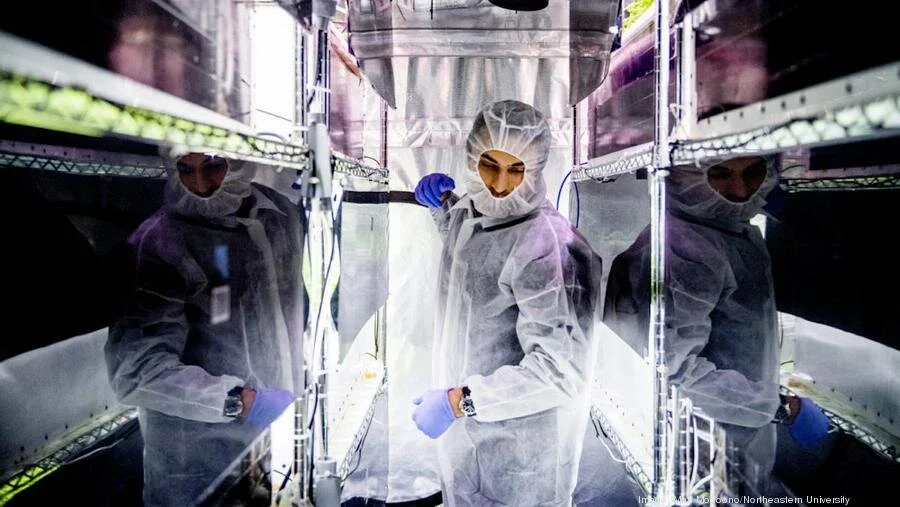
Unlike typical hydroponic farming, Evergreens has a unique irrigation system that allows plants to grow in dense environments, which speeds up their growth cycle. The plants are grown in stacks, either next to each other or vertically atop one another.
“We can grow 300 to 400 times the amount of product at the same square foot as compared to a field farm,” said founder and CEO Ahmad Zameli. “That's because we stack everything up and because the cycles are a lot faster than field farming.”
The company, which grows everything indoors, currently has four products: baby arugula, baby kale, an arugula-and-cress mix, and a brassica mix. The ability to grow produce indoors also allows for an increase in crop production, since the plants aren’t dependent on the seasons. Instead, the produce is grown year-round.
Zameli, who studied industrial engineering at Northeastern University, founded Evergreens in 2017. He originally planned to set the company up in the Middle East; Zameli is Lebanese and grew up in Saudi Arabia.
“My dream was to take indoor farming and bring it to the Middle East, specifically to Saudi Arabia—take it home because 90 percent, if not 100 percent, of all of our fresh food in Saudi Arabia is flown in from outside the country,” Zameli said. “The supply chain is really, really crazy. There's a lot of waste in the product, and the carbon footprint is massive.”
He initially wanted to buy indoor farming technology and grow food locally through a network of farms across the region. However, the farming technology that existed couldn’t operate at a large enough scale to turn a profit.
“If you really want to break into the larger food space, you need to be able to meet cost—cost of production to compete at wholesale, and not just in a niche distribution channel,” Zameli said. “Our mission is to create a piece of technology that's profitable to operate at a large scale and able to distribute food in wholesale markets.”
The company will now be focused on New England. Evergreens’ business model has also evolved. Rather than exclusively building and owning farms, Zameli and his team decided that to be able to scale effectively, they would need to partner with growers.
Zameli partnered with Northeastern University three years ago and has since built three farms on the school’s innovation campus in Burlington, Massachusetts. Evergreens is currently building its fourth farm off of the Burlington campus. This new farm will be the company’s first commercial, revenue-generating farm.
“Our farms are going to be gradually larger, they're all going to be in New England, and they're all going to be serving the New England region,” Zameli said. “The portfolio of crops that they're going to grow is going to change, it's going to expand over time... And the point of building those three is to kind of prove our technology and prove our marketability...Once we get to that point, we will then switch over our model and begin to franchise, where we will partner with growers and investors who are interested in operating technology like this.”
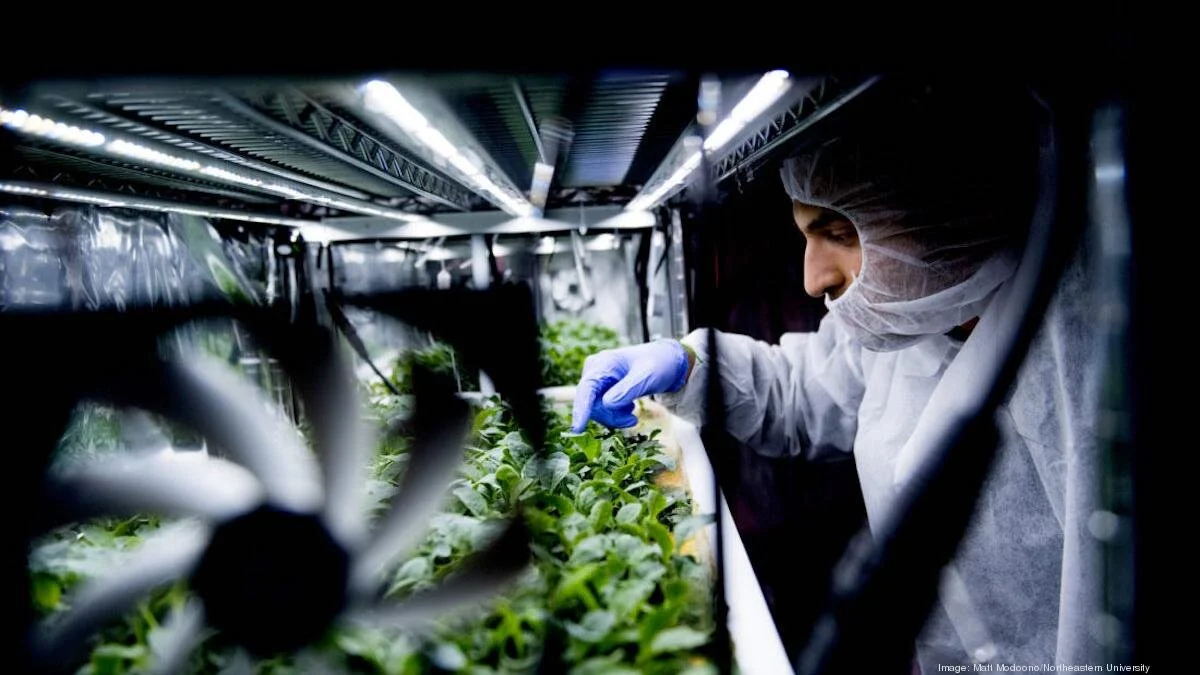
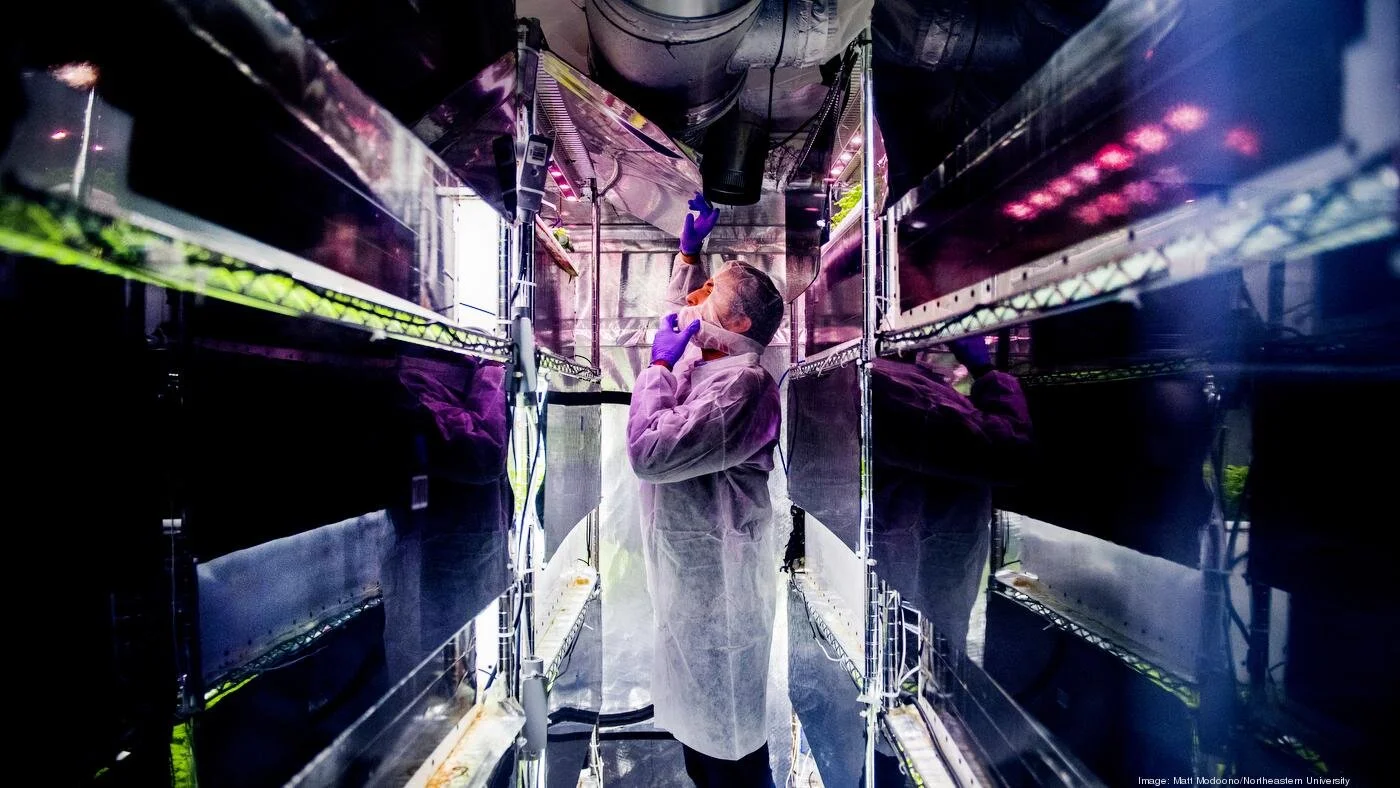
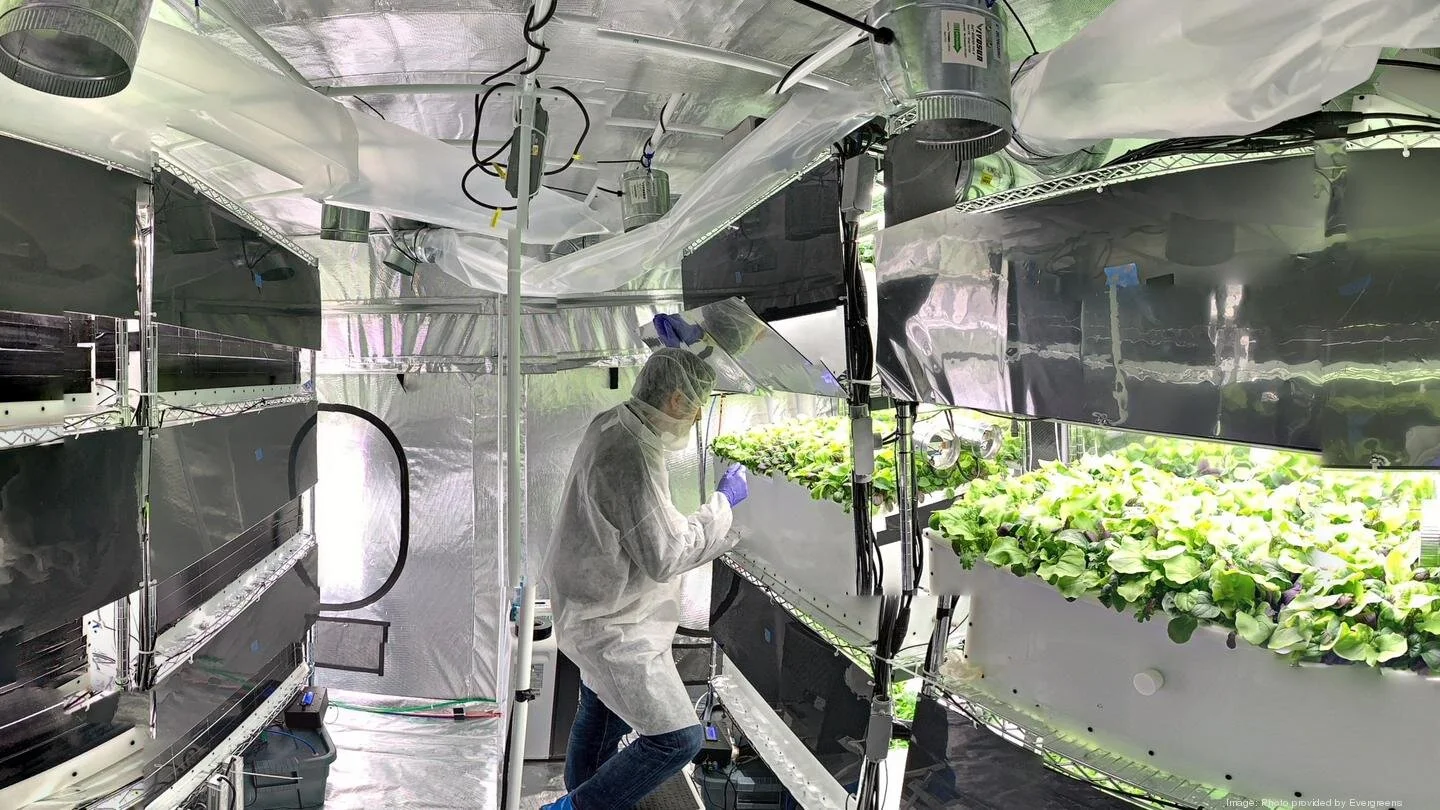
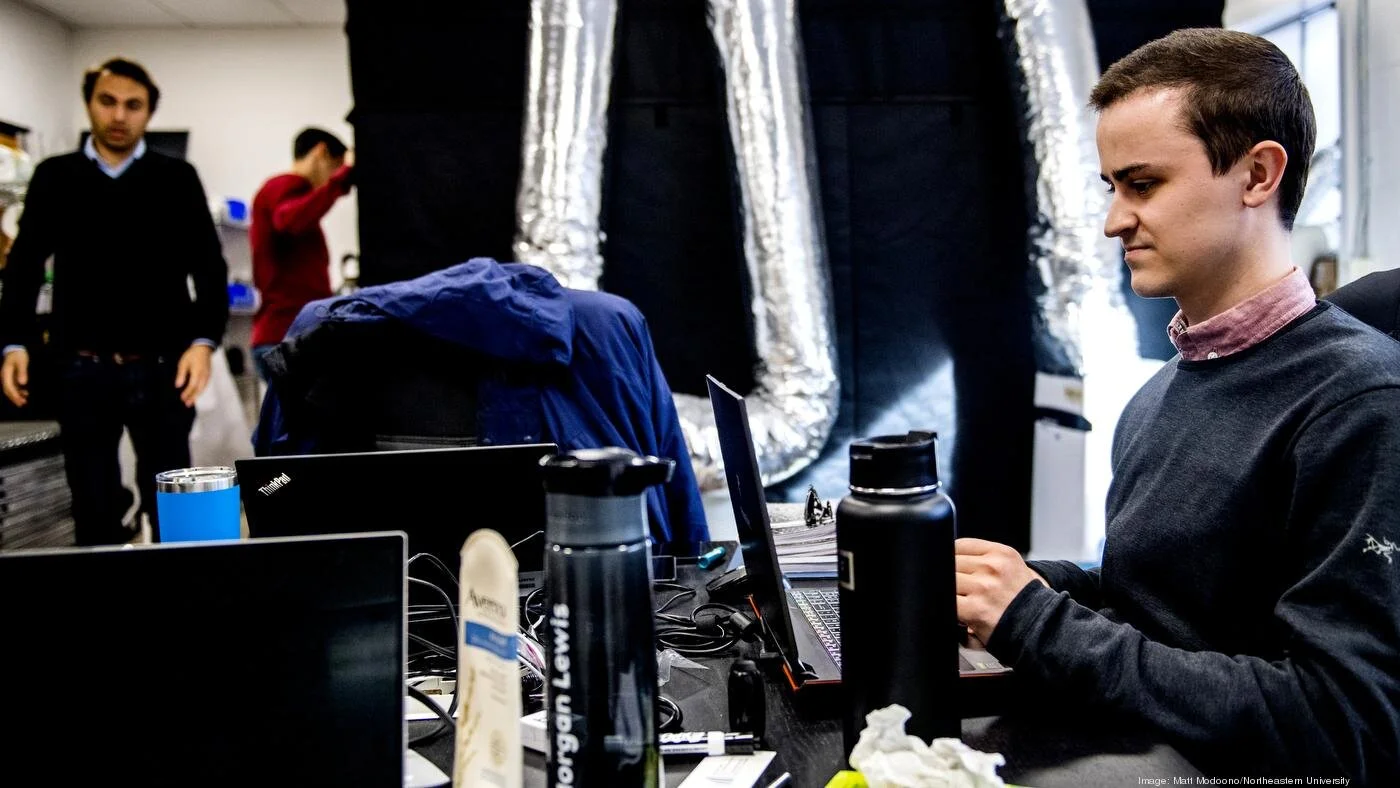
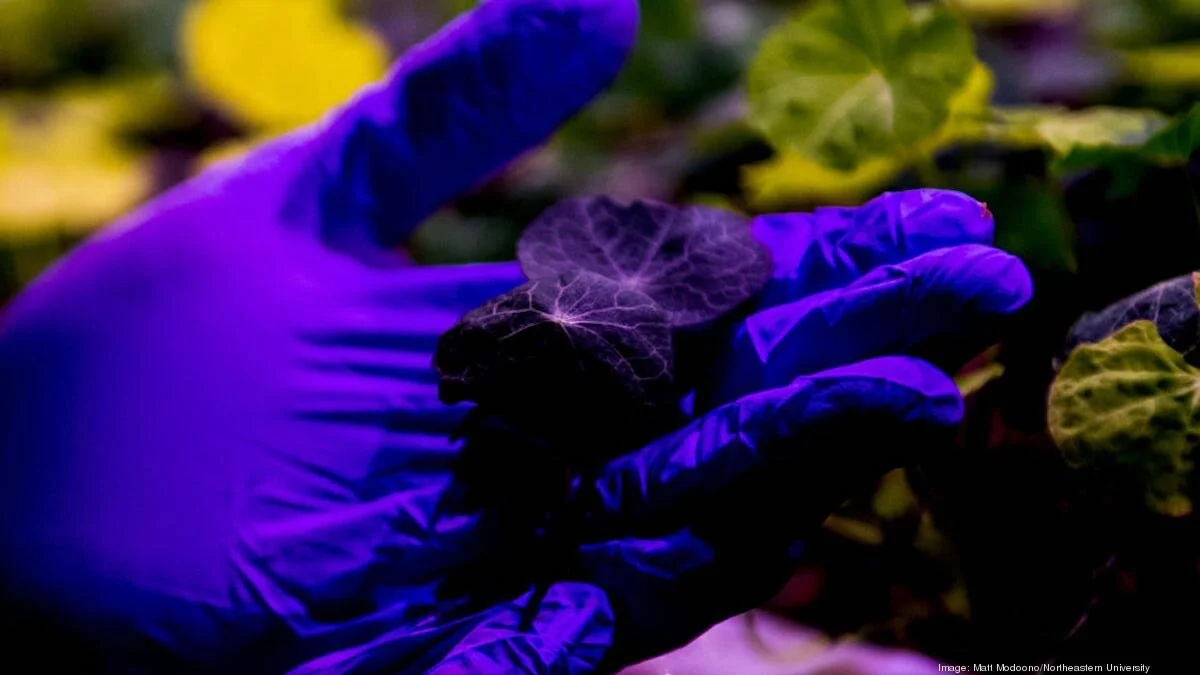
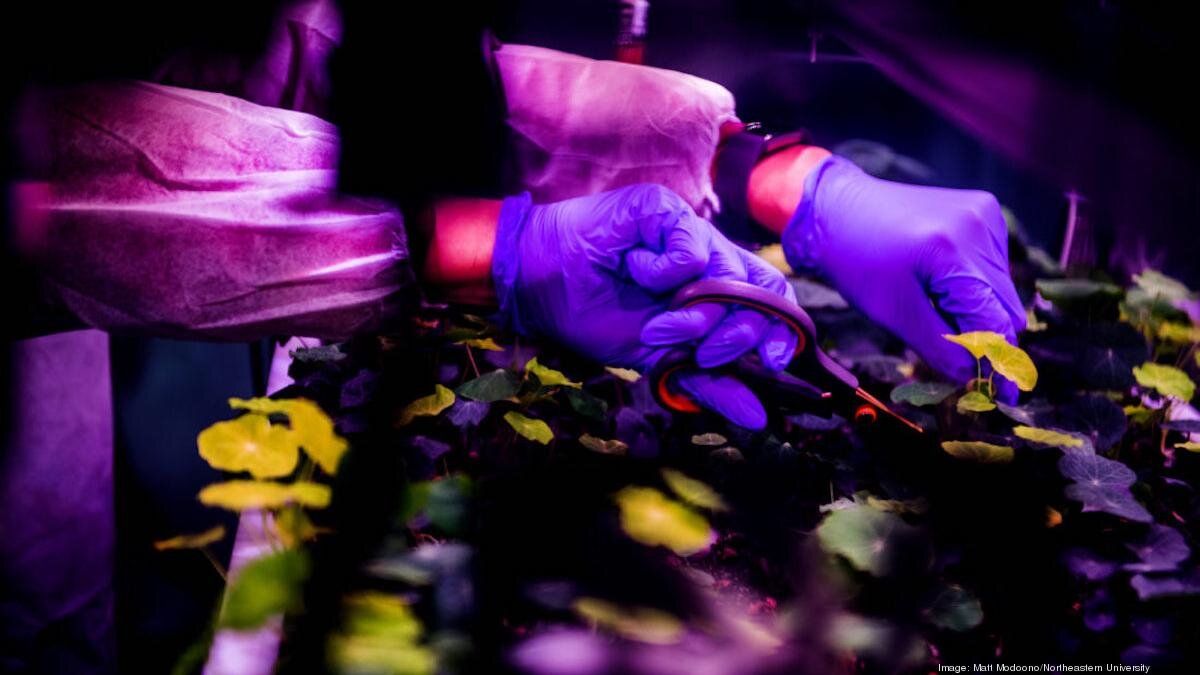
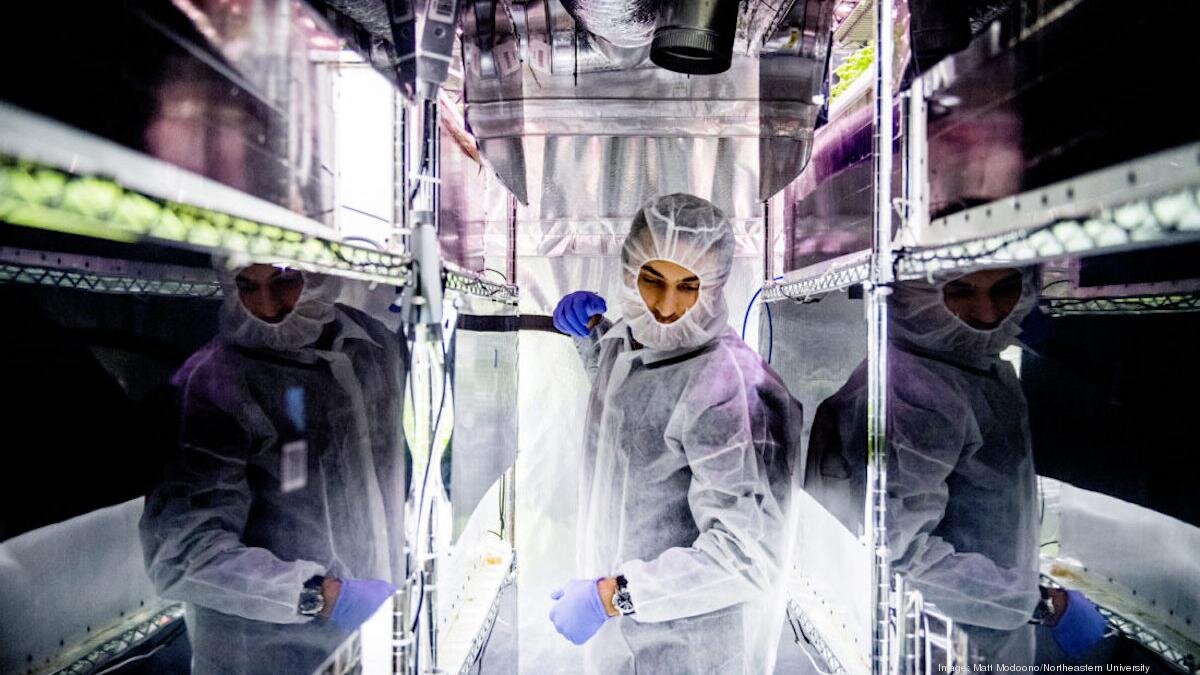

During the past three years, Evergreens Farm’s technology has reduced costs, waste and lengthy supply chains. With the company’s patented technology and unique irrigation method, the company has been able to grow plants in a production line method, thereby saving money on a key growing component—light.
“We're not lighting unused space, essentially ever,” Zameli said. “All of the light that we're giving the plants is being used by plants. It's not being absorbed by sunlight materials elsewhere.”
Evergreens also reduces two types of waste: water and food. First, the company never washes its produce, because the plants are not treated with pesticides, herbicides or fungicides. Evergreens also recaptures and reuses water, including atmospheric humidity, which reduces the farms’ water use by up to 99 percent.
For Evergreens, reducing food waste goes hand in hand with reducing lengthy supply chains. Typically, in conventional farming, when produce is transported by trucks, it can take approximately five to eight days before it reaches the grocery store. The produce changes hands as many as five times before it reaches its final destination, each time increasing the chance of introducing foodborne illnesses, degrading the flavor, and decreasing the shelf life, Zameli said.
According to Zameli, about half of all food harvested is thrown away before it reaches its final destination, a “shrink factor” that contributes immensely to food waste in agricultural supply chains.
“By being close to where the stuff is consumed, by being close to all of the grocery stores, we can deliver directly to them right after we harvest,” Zameli said. “Within hours of us putting the stuff into boxes, we ship it directly to the store, and it's on the shelf within 24 hours. Consumers can pick it up, and it's freshly harvested. It lasts two weeks longer in your fridge.”
Evergreens won the Ahold Delhaize Supply Chain Innovation Pitch Award earlier this year. It was also part of MassChallenge Boston’s 2020 cohort. The startup has raised $750,000 in pre-seed funding.
Evergreens Farms is one of BostInno’s 2020 Inno on Fire. Celebrate Evergreens and the other winners at our virtual awards ceremony on Dec. 3. Register here.
Lead photo: Zameli at work on Northeastern's Innovation Campus in Burlington, Massachusetts.
Matt Modoono/Northeastern University
Emma Campbell is a contributing writer for BostInno.
Global G.A.P. World Consultation Tour Focus Controlled Environment Agriculture Partnership With UKUAT And The Farm Tech Society
November 26, 2020
Register for free today! https://globalgapsolutions.org/wct/
Virtual Design Discussion for the Revised
GLOBALG.A.P. Standard Version 6 to be launched in 2022
7th December 2020, 17:00 CET, 16:00 GMT
The GLOBALG.A.P. World Consultation Tour goes into its second round! Join the upcoming virtual meeting in cooperation with the Farm Tech Society and UK Urban AgriTech (UKUAT).
We aim to deliver an impactful standard in line with producers’ practices. The unique challenges presented by vertical farming or produce grown in controlled environments will be addressed to ensure an appropriate user experience.
Participants will meet the expert working group behind the standard revision and will have the opportunity to join the ongoing discussion and process.
Details:
7th December - 1700 CET
Please register here
High-tech monitoring and control systems in commercial controlled environment agriculture farms and their supply chains enable the opportunity to capture automated measurements, support assessment and analyze a wide range of variables including water to energy to inputs, reducing costs and adding value for individual farms and across the industry. The ultimate goal of the partnership is the development and implementation of an impactful standard and certification process.
About FTS:
The Farm Tech Society (FTS) is an international non-profit industry association that unites and supports the Controlled Environment Agriculture (CEA) industry, seeking to strengthen the sector through the development and implementation of resilient and future proof methods and technologies for indoor growing.
The FarmTech Society is enlisted in the EU Transparency Register with #469686733585-87
About UKUAT:
UK Urban AgriTech (UKUAT) brings together the UK’s key players in modern agricultural technologies, in a cross-industry group devoted to promoting urban agtech as a solution for food and environmental crises.
About GLOBALG.A.P.:
GLOBALG.A.P. is a leading global certification program whose mission is to bring farmers and retailers together to produce and market safe food, to protect scarce resources, and to build a sustainable future.
cheers
Tom ZoellnerCo-Founder FarmTech Society ASBL Secretary-General

Resetting The Food System From Farm to Fork
Resetting the future of food is possible and with this aim, we will present in an international debate- concrete solutions to rethink our food systems from farm to fork
Barilla Foundation and Food Tank invite you to attend the online event “Resetting the Food System from Farm to Fork: Setting the Stage for the 2021 UN Food Systems Summit” to be held on December 1st, from 2.00 PM CET.
Resetting the future of food is possible and with this aim, we will present in an international debate- concrete solutions to rethink our food systems from farm to fork.
The event will begin by highlighting the critical role of farmers in feeding the world and managing natural resources, food business in progressing towards the 2030 Agenda, and chefs in re-designing food experiences.
Here are details of the first three conversations of the day, which will feature, among others, the likes of Edie Mukiibi, Vice President, Slow Food International; Massimo Bottura, Chef and Owner, Osteria Francescana; Jeffrey Sachs, Professor and Director of the Center for Sustainable Development, Columbia University; Director, U.N. Sustainable Development Solutions Network; Elly Schlein, Vice President, Emilia Romagna Region.
REGISTER FOR FREE NOW
The world needs urgent action on agriculture and food systems.
Let's make the future grow!
2030 is the deadline to achieve all 17 Sustainable Development Goals (SDGs). The next decade is a chance to remake our future. Through the “Decade of Action”, we all have a part to play in the transition towards sustainable economic, social, and environmental development—with sustainable food systems at its heart.
In a rapidly changing world, food systems face substantial challenges, including the COVID-19 pandemic acting as a multiplier of food and nutrition insecurity. Globally, two billion people are malnourished. More than 700 million adults are obese while at least 820 million suffer from hunger—a statistic that will no doubt increase as a result of the pandemic. And some one-third of the global harvest is lost or waste. Biodiversity is declining, water and land are increasingly degraded, climate change is posing adverse impacts on agricultural production and livelihoods.
We must act now to address the impending global food emergency and avoid the worst impacts of the pandemic while seizing upon the opportunity of resetting food systems. Over the next 20 years, food systems will need to nourish 10 billion people while also protecting precious natural resources for future generations. The spread of COVID-19 has demonstrated the fragility of global food systems, but it also offers opportunities to transform the way we produce, distribute, and consume food.
Join the conversation
Distinguished speakers
Leading experts, world-renowned chefs, and international journalists will convene for this unique virtual event.
Lively discussions
Panels will cover diverse themes including the role of food as medicine, the new food economy, and the EU’s Farm to Fork strategy.
Trends spotlights
The latest food and agricultural technologies will be discussed, as well as how chefs are re-designing food experiences.
Concrete change
The event will generate recommendations that will help set the stage for the 2021 United Nations Food Systems Summit.
SPEAKERS

Greenhouse And Vertical Farming In New Jersey
Vertical and indoor farming ventures are versatile in the ways they can operate in the community by bringing fresh healthy foods, sustainable practices, and new opportunities for education and employment
New Jersey has a long agricultural history dating back to pre-colonial times, which is how it acquired its name as the “Garden State.” Traditional cultivation methods of NJ’s fertile land have earned New Jersey its spot as a top producer of several horticultural crops. New Jersey‘s cultivation of over 720,000 acres is thus seen as a vital part of a multi-billion-dollar industry totaling over $115 billion (2019). However, in recent years, the high cost of land and urban encroachment of farmlands has become a serious concern for the state. New Jersey has experienced the highest decline of farmland and rural open land in the United States.
Limited available farmland has pushed some producers into urban and peri-urban areas. Others have been enticed with investments and tax incentives to move operations to urban areas across the Garden State. Companies like AeroFarms, Bowery, and others have established themselves in New Jersey’s cities and are benefitting consumers with local fresh foods, offering employment opportunities, and championing urban development initiatives and partnerships.
In New Jersey, not only are we seeing an interesting mix of businesses large and small as part of a growing industry but also non-profits benefitting the populations they serve. Vertical and indoor farming ventures are versatile in the ways they can operate in the community by bringing fresh healthy foods, sustainable practices, and new opportunities for education and employment. We look forward to seeing how indoor farming continues to add to the rich history of agriculture in the state of New Jersey.
Read more about the New Jersey market on Indooragcenter.org
Tue 24 Nov 2020

CDC Updates E. coli Outbreak Numbers
There are now 39 cases in the E. coli O157:H7 outbreak, according to a CDC notice on Nov. 23. The previous number of ill people was 16, according to the CDC. Cases have been reported in 18 states; there have been no deaths
By CHRIS KOGER November 25, 2020
The Centers for Disease Control and Prevention has added 16 more people to an E. coli outbreak investigation of unknown origin.
There are now 39 cases in the E. coli O157:H7 outbreak, according to a CDC notice on Nov. 23. The previous number of ill people was 16, according to the CDC. Cases have been reported in 18 states; there have been no deaths.
The CDC and Food and Drug Administration are not advising people to avoid any particular food at this time.
“State and local public health officials are interviewing ill people to determine what they ate and other exposures in the week before they got sick,” according to the CDC’s Nov. 23 update. “Of the 22 ill people interviewed to date, all reported eating a variety of leafy greens, like spinach (16), romaine lettuce (15), iceberg lettuce (12), and mixed bag lettuce (8). No single type or brand of leafy greens or other food item has been identified as the source of this outbreak. CDC is not advising people to avoid any particular food at this time.

“Experimentation, Learning By Doing And Listening To Others Is Key For Any Entrepreneur”: Interview With Infarm’s Co-Founder Osnat Michaeli
Osnat Michaeli is co-founder and CMO of the fast-growing German agritech scaleup, Infarm. Since 2013, the Berlin-based startup has grown to be one of the world’s fastest-growing urban farming networks
November 20, 2020
Where did the food on your plate come from? Was it from a neighboring EU region, or perhaps a vertical urban farm around the corner in your city?
Osnat Michaeli is co-founder and CMO of the fast-growing German agritech scaleup, Infarm. Since 2013, the Berlin-based startup has grown to be one of the world’s fastest-growing urban farming networks. In September 2020, Infarm announced a €144 million investment, raised in the first close of a Series C funding round, which is expected to reach around €169 million. Right now they’ve grown to a team of 400+ employees, an impressive feat in 7 years.
This scaleup has covered a lot of ground and has garnered new interest since the pandemic set in and we collectively started thinking more about our food systems. So let’s jump into the interview, to get her insights on scaling a fast-growing team, the future of foodtech, and advice for fellow founders.
Hello Osnat, thank you for being with us today. Could you please give us a short overview about how you became an entrepreneur as well as why you founded Infarm?
Just under a decade ago, my two co-founders (Erez and Guy Galonska) and I started Infarm with a mission: to help cities become self-sufficient in their food production while improving the safety, quality, and environmental footprint of our food. We had just moved to Berlin, bought a 1955 Airstream trailer, outfitted it with DIY growing shelves, and started experimenting with indoor farming. Soon we began to build modular, vertical farming units that could be installed in any urban environment, including supermarkets, restaurants, distribution centers, and other urban spaces, as close as possible to where food is consumed.
Infarm is based in Berlin. What is your opinion on the environment for creating a tech company there?
We owe a great debt to the Berlin community who received us and welcomed our vision to challenge the status quo in how we transport, plant and harvest our produce in cities.
Moreover, the growth of Europe’s most dynamic tech hubs – London, Berlin, Amsterdam, Stockholm, Helsinki, Dublin, and others along with the accompanying inflow of investment is driving a steady reorientation of talent, not only from Europe but from countries outside of Europe – including my native Israel – to help meet demand. Our business, which requires highly trained individuals in plant biology and plant science also benefits from the pool of Master’s and Ph.D. candidates so plentiful in European markets, including here in Berlin.
Infarm has announced recently closing a €144 million Series C funding round. What are your future plans with such capital?
We believe Infarm has the potential for mass expansion across the world. We have big ambitions, aiming to reach more than 5,000,000 square feet of growing facilities by 2025, and in doing so becoming the largest distributed farming network in the world.
This news comes amidst growing concerns about a second COVID-19 wave. What steps have you taken to safeguard your operations and teams?
What we found was that our farming model was quite resilient, allowing us to respond quickly to the needs of our clients, many of whom themselves were also moving quickly to establish procedures for producer and customer interaction within their retail spaces. We were able to alternate easily to direct delivery of fresh produce from our local hubs where needed if direct store access to our employees or our farms was limited. Across our global network, each of our farms is connected to the cloud, allowing us to monitor plant performance, growing environment, and make adjustments remotely. We developed a system to guide local teams through farm installation remotely when our installation teams were unable to travel, further minimizing any potential impact from the changing pandemic environment to our operations.
In our offices, as our work environment increasingly became more remote, we began to use office space more creatively, dedicating more space in our Berlin headquarters for example, to areas like marketing, packaging, and product design, while establishing a greater number of remote workstations so employees who needed to work on-site could easily do so. We also looked for and found more opportunities to communicate across our teams, not only in terms of regular updates relating to the changing environment, but through groups where we checked in on one another, shared playlists and successful lunchtime dishes, and participated in virtual get-togethers to maintain a sense of community.
Over the years, Infarm has grown to more than 600 employees. What tips would you give to someone who wants to build a solid team?
When starting out, it’s important to find the right partners who inspire you, partners whom you trust and you enjoy working with. My co-founders and I elevate one another. We each have a different area of focus and expertise, whether that be branding, operations or technology. We create more together than anything we could possibly produce apart. This is also true for the investors, mentors and employees you bring along. Today, we’ve grown our workforce to hundreds of employees and have brought together people from all kinds of backgrounds and disciplines—data scientists, designers, engineers, scientists and more— as inclusivity and diversity in talent is key.
In your opinion, how is the vertical farming ecosystem doing now compared to when you started?
Back when we first started out, vertical farming was intriguing as a concept for many, but we couldn’t have imagined that a few years later we would be partnering with some of the largest retailers in the world. Our assumptions at the time were that retailers and their customers would be attracted to the taste and freshness of produce that grew right in front of them in the produce section, in our farms. What we didn’t anticipate was how much and how quickly the demand for a sustainable, transparent, and modular approach to farming would grow as we, as society, begin to feel the impact of climate change and supply chain fragility upon our lives, our choices and our food. Of course, we also did not anticipate a global pandemic, which has underscored the urgency of building a new food system that can democratize access to high quality, amazing tasting food, while helping our planet regenerate and heal. The past few months have confirmed the flexibility and resilience of our farming model, and that our mission is more relevant than ever.
What is it like to build a company from the ground up with Erez and Guy?
It’s great to be able to work with someone you trust, and we’re all very lucky to have found one another to build this together.
What is your advice to young entrepreneurs looking to kick off their own agtech company?
Passion for what you’re doing is the best foundation. Being an entrepreneur is an ongoing learning process that involves lots of research, trial, and error. You have to love it and keep learning new things because the need to be open to learning and exploring just accelerates over the years as you grow. Experimentation, learning by doing, and listening to others is key for any entrepreneur. We learned so much by experimenting with the hydroponic systems we built ourselves. We also gained powerful insights from being active in the food and innovation community by hosting interactive installations, making food, conducting workshops, joining debates, and meeting with many inspiring urban planners, designers, food activists, bio-dynamic farmers, architects, chefs, and hackers.
It’s vital to stay focused and enjoy the journey. All entrepreneurs know that there is always the possibility that they might have set-backs, but it’s not constructive to concentrate on that. Stay positive, focus on where you’re going, choose your partners well and the right people and opportunities will cross your path.

New Modular Scalable Indoor Vertical Farm Design
In addition to our 20,000 sq. ft. farm, we now offer a modular scalable farm system that can “start small and grow big” to meet increased demand
Green Sense Farms has been an early adopter and pioneer when it comes to indoor vertical farming. We built our first 20,000 sq. ft. indoor vertical farm in 2012 in Portage, IN. Controlled Environment Agriculture (CEA) has changed greatly since that first farm and so has our company. We started our journey focused on operating our indoor vegetable farm, selling lettuce, baby greens, herbs, and microgreens to grocery stores and produce companies in IN, IL, and MI. Since that time, we have leveraged our operating experience and evolved the company to provide contract research and farm design & build services on a global basis.
One of our recent innovations is the development of a modular scalable growing system using our proven grow technology. We found that our standard 20,000 sq. ft. farm can be cost-prohibitive in many parts of the world. We have also seen that many vertical farm companies “start big and grow small” making right-sizing a farm the key to being profitable.
In addition to our 20,000 sq. ft. farm, we now offer a modular scalable farm system that can “start small and grow big” to meet increased demand. After spending a year studying container farms to objectively understand their strengths and weakness, we came up with a better indoor grow design that includes:
• Touchless conveyance
• Improved IPM and automated sanitization
• Higher crop density and improved economics
• Can be operated with 2 employees plus a packing team
• Computer delivery of growing inputs and climate control with improved air circulation
• Can be housed in functionally obsolete industrial buildings with minimal tenant improvements.
Our modular scalable custom farms use shipping containers as a prefabricated low-cost structure to install the individual farm components. Components can be sold separately or as a system and include:
• Seeding line
• Germ / Nursery Room
• Grow Room
• Packing / Cooler
• Equipment Room, with CO2, fertigator, water treatment, water storage, and recirculation, HVAC, data collection, sensors, and automation controls.
It’s an honor and privileged to be part of CEA and watch it evolve from an idea into an industry. For more information on contract research or design and build services contact:
Robert Colangelo, Founding Farmer
VIDEO: CubicFarms Systems Corp. Announces $2.8 Million Sale of Commercial Scale Systems to Customer in Abbotsford, B.C.
The Company's commercial agreement with Aright for the sale of 16 CubicFarms machines includes 14 growing machines, two propagation machines, and an irrigation system, representing a total of approximately Cdn$2.8 million (including installation and shipping) in sales revenues to the Company
NEWS PROVIDED BY
Nov 23, 2020
The customer intends to evaluate the performance of the Company's technology in B.C. with the potential for international use in other countries where the customer operates
VANCOUVER, BC, Nov. 23, 2020,/CNW/ - CubicFarm® Systems Corp. (TSXV: CUB) ("CubicFarms" or the "Company"), a technology company developing and deploying technology to feed a changing world, announced today that its automated, controlled-environment growing system has been selected by Aright Greentech Canada Ltd. ("Aright"), a British Columbia-based agriculture investor-operator, to grow commercial quantities of fresh produce (the "Abbotsford agreement") for retail markets in the Abbotsford and Chilliwack regions in British Columbia, Canada.
Aright is an international company with interests in environmentally-focused companies in India and other countries, and this B.C. launch is a soft pilot for a potential future international roll-out.
Abbotsford Agreement
The Company's commercial agreement with Aright for the sale of 16 CubicFarms machines includes 14 growing machines, two propagation machines, and an irrigation system, representing a total of approximately Cdn$2.8 million (including installation and shipping) in sales revenues to the Company. The system is expected to be installed in Abbotsford by August 2021.
The Company has received a deposit from Aright with respect to the commercial agreement.
The Company's patented CubicFarms technology will enable Aright to grow high-quality foods, with predictable crop yields indoors, all year round.
Aright also plans to expand its systems after the successful completion of Phase 1 in Abbotsford.
CubicFarms CEO Dave Dinesen commented: "We believe the Abbotsford agreement with Aright helps to further validate the commercial upside of our technology. We are equally excited that Aright, through its parent company, has agreed to develop the Abbotsford site to serve the local market, and commence learning for potentially significant expansion into India. We are looking forward to a seamless collaboration between our teams to successfully grow high-quality, great-tasting, local produce here at home, and potentially in India."
Tanya Mehta, Founder & CEO of Aright, commented: "We are a family of impact operators and investors who aim to have a net positive impact on people, the community and the environment. As next-generation growers, we are driven to be a key player in innovation of AgTech that can feed the rising population through technologically advanced farms that can adapt and operate with consistent results. Planting and harvesting existing croplands on technologically advanced farms that consistently deliver food production without requiring new land is at the heart of this plan to work with CubicFarms. After thoroughly evaluating all available indoor growing options, we determined that it is in the best interests of Aright and our stakeholders to work with CubicFarms, which we predict will be beneficial to launch our BC operations, and to foster further innovations both in B.C. and internationally."
Potential Commercial Opportunities in India
CubicFarms and Aright India will launch a pilot project at Aright's Abbotsford location to assess CubicFarms machine production capabilities for a number of crop types.
After the evaluation is complete, it could culminate in a significant roll-out of the technology in the upcoming years. The potential India commercial opportunity will enable development and commercialization of the CubicFarms' technology, and align to Aright's focus on achieving wide-scale environmental efficiencies for urban areas.
The pilot and the potential commercial agreement with Aright India are not related to the signed commercial Abbotsford agreement, and performance of those units, between the Company and Aright.
Neither the TSX Venture Exchange nor its Regulation Services Provider (as that term is defined in the policies of the TSX Venture Exchange) accepts responsibility for the adequacy or accuracy of this release.
About CubicFarm® Systems Corp.
CubicFarm Systems Corp. ("CubicFarms") is a technology company developing and deploying technology to feed a changing world. Its proprietary technologies enable growers around the world to produce high quality, predictable crop yields. CubicFarms has two distinct technologies that address two distinct markets. The first technology is its CubicFarms™ system, which contains patented technology for growing leafy greens and other crops indoors, all year round. Using its unique, undulating-path growing system, the Company addresses the main challenges within the indoor farming industry by significantly reducing the need for physical labour and energy, and maximizing yield per cubic foot. CubicFarms leverages its patented technology by operating its own R&D facility in Pitt Meadows, British Columbia, selling the system to growers, licensing its technology, and providing vertical farming expertise to its customers.
The second technology is CubicFarms' HydroGreen system for growing nutritious livestock feed. This system utilizes a unique process to sprout grains, such as barley and wheat, in a controlled environment with minimal use of land, labour, and water. The HydroGreen system is fully automated and performs all growing functions including seeding, watering, lighting, harvesting, and re-seeding – all with the push of a button – to deliver nutritious livestock feed without the typical investment in fertilizer, chemicals, fuel, field equipment, and transportation. The HydroGreen system not only provides superior nutritious feed to benefit the animal but also enables significant environmental benefits to the farm.
For more information, please visit www.cubicfarms.com
Cautionary Statement on Forward-looking Information
Certain statements in this release constitute "forward-looking statements" or "forward-looking information" within the meaning of applicable securities laws, including, without limitation, statements with respect to CubicFarms' expected revenue recognition, and the completion of the sale and installation of the system by the customer. Such statements involve known and unknown risks, uncertainties, and other factors which may cause the actual results, performance, or achievements of CubicFarm Systems Corp., or industry results, to be materially different from any future results, performance, or achievements expressed or implied by such forward-looking statements or information including the Company obtaining the approval of the Offering from the TSX Venture Exchange. Such statements can be identified by the use of words such as "may", "would", "could", "will", "intend", "expect", "believe", "plan", "anticipate", "estimate", "scheduled", "forecast", "predict", and other similar terminology, or state that certain actions, events, or results "may", "could", "would", "might", or "will" be taken, occur, or be achieved.
These statements reflect the Company's current expectations regarding future events, performance, and results and speak only as of the date of this news release. Consequently, there can be no assurances that such statements will prove to be accurate and actual results and future events could differ materially from those anticipated in such statements. Except as required by securities disclosure laws and regulations applicable to the Company, the Company undertakes no obligation to update these forward-looking statements if the Company's expectations regarding future events, performance, or results change.
SOURCE CubicFarm Systems Corp.
For further information: Investor Information Contact: Adam Peeler, adam.peeler@cubicfarms.com
Phone: +1-416-427-1235, www.cubicfarms.com
AUSTRALIA: Roto-Gro Raises $1.53 Million To Launch Perishable Food And Vertical Farming Divisions
November 24, 2020
Roto-Gro aims to expand its presence in the vertical farming space across North America.
Agricultural technology specialist Roto-Gro International (ASX: RGI) is set to roll-out its perishable food and vertical farming divisions backed by a $1.53 million capital raising.
The Melbourne-based company this morning announced it has received firm commitments from a range of professional and sophisticated domestic investors for the placement of approximately 38 million shares at $0.04 to raise the funds.
Each share issue will have attaching options on a 2:3 basis exercisable at $0.05 and expiring at the end of 2023 (subject to shareholder approval).
Settlement of the shares is expected by month-end and Roto-Gro expects a general meeting of shareholders to approve the issue of options in the new year.
Peak Asset Management acted as lead manager to the placement and will work closely with the company to drive shareholder value.
Roto-Gro non-executive chairman Michael Carli said the raising is an “important step forward as [we] welcome a number of new shareholders to our register”.
Proceeds will be used to drive the roll-out of Roto-Gro’s perishable food division and expand its presence in the vertical farming space across North America.
Growing concept
Vertical farming is the practice of growing crops in vertically-stacked layers, often incorporating controlled-environment agriculture which aims to optimize plant growth.
An increased crop yield, the smaller unit area of land required and the ability to grow a larger variety of crops at once have seen the vertical farming concept take off in popularity.
Innovations in technology have been able to provide growers with year-round sustainability, operational efficiencies, and competitive costs of production when compared to conventional farming.
Market research shows the global vertical farming market was valued at $2.23 billion in 2018 and is projected to reach $12.77 billion by 2026, growing at a compound annual growth rate of 24.6% from 2019 to 2026.
Europe’s vertical farming market currently accounts for over one-third of current global vertical farming production.
Garden systems
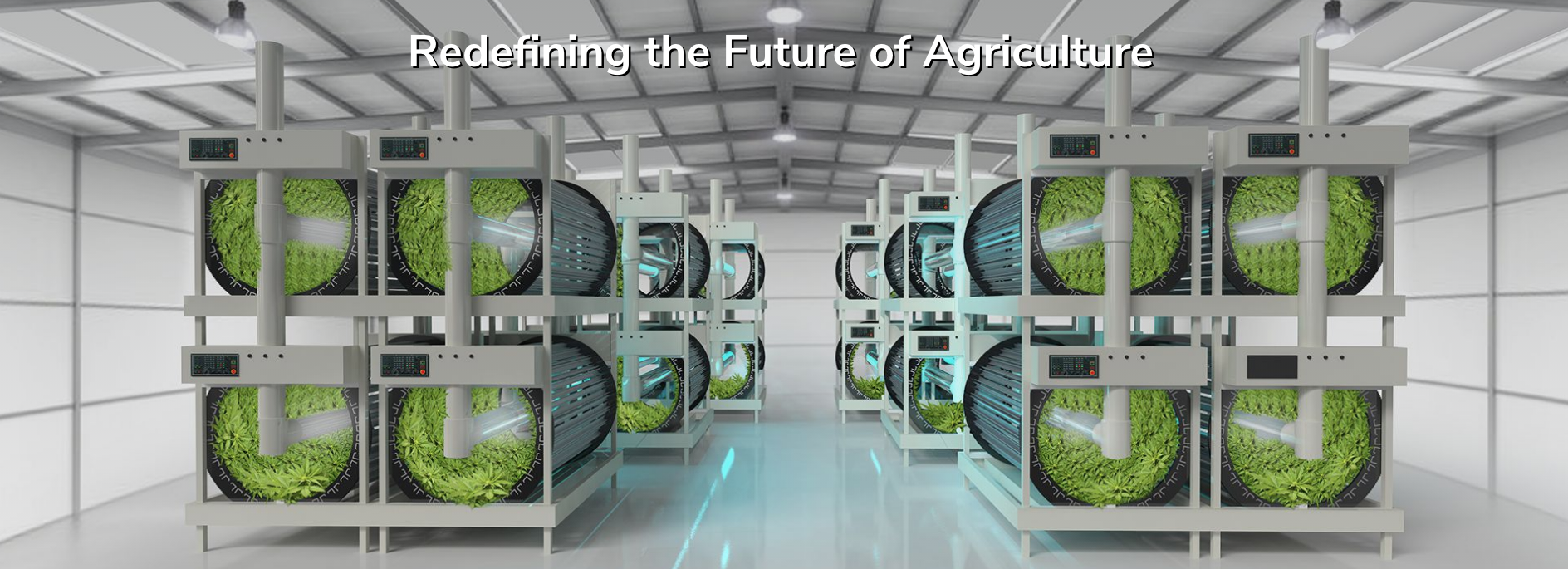
Roto-Gro’s rotational garden systems are at the core of the company’s technology and lead the charge in sustainable urban indoor vertical farming.
The technology has undergone constant innovation and optimization since 2003 to become a patented, commercial-scale cultivation system designed for the consistent production of high-quality crops.
The company claims the use of its garden systems can optimize space (stackable up to three-high) and significantly increase crop yield and quality while lowering operational costs.

The NGA Show And Indoor AG-Con To Co-Locate Events In May 2021
The NGA Show, the leading trade show and conference for independent grocers, and Indoor Ag-Con, the premier agriculture conference, and trade show for the indoor and vertical farming industry, announced today that they will co-locate in 2021 for the first time. The combined event will be held May 16-18, 2021, at the new Caesars Forum Convention Center in Las Vegas
Las Vegas Events Will Provide Retailers With Access To
Indoor Farming Resources
The NGA Show, the leading trade show and conference for independent grocers, and Indoor Ag-Con, the premier agriculture conference, and trade show for the indoor and vertical farming industry, announced today that they will co-locate in 2021 for the first time. The combined event will be held May 16-18, 2021, at the new Caesars Forum Convention Center in Las Vegas.
“The NGA Show, entering its 38th year, has established itself as the world’s premier educational and supplier resource serving the independent grocer community,” said Courtney Muller, chief corporate development and strategy officer with Clarion Events North America. “By co-locating with Indoor Ag-Con, we bring our attendees a new resource to meet consumer demand for transparent food sourcing, delivering just-picked produce year-round and, for those on the cutting edge, access to in-store growing operational resources. Ultimately, that means additional value for all of our customers and the industries overall.”
Indoor Ag-Con, launched in 2013, provides exhibitors and attendees with the latest technology and business strategies for growing crops in indoor systems, using hydroponic, aeroponic, and aquaponics techniques, bringing together growers, investors, chefs, produce buyers, academics, policymakers, industry suppliers and advocates. “Indoor farming is an important segment that’s been on the rise for several years,” said Brian Sullivan, co-owner, Indoor Ag-Con. “The great energy and audience The NGA Show has cultivated will be key to our combined success as we work together to better serve our industries. We look forward to welcoming The NGA Show visitors and exhibitors, and we can’t wait for a successful show.”
“This is an exciting opportunity and what’s bound to be a successful industry-first event that delivers much more value to our members, customers, partners, and the markets we serve,” added Greg Ferrara, president, and CEO of the National Grocers Association.
The NGA Show and Indoor Ag-Con visitors will have access to all exhibits, and discounts will be available for cross-over educational event attendance.
For updated information on all of The NGA Show and Indoor Ag-Con events, and to stay connected and educated, visit the websites at www.thengashow.com and www.indoor.ag.
###
The NGA Show has been the place where independent grocers gather for more than 30 years, connecting supermarket retailers and wholesalers, food manufacturers and service providers from around the world to share innovative solutions and best practices that support and strengthen the independent supermarket channel. The NGA Show is produced and managed by Clarion Events as part of the Food & Beverage Group in partnership with the National Grocers Association (NGA). For more information and to register, visit www.theNGAshow.com.
Founded in 2013, Indoor Ag-Con has emerged as the premier trade event for vertical farming | indoor agriculture, the practice of growing crops in indoor systems, using hydroponic, aquaponic and aeroponic techniques. Its events are crop-agnostic and touch all sectors of the business, covering produce, legal cannabis |hemp, alternate protein, and non-food crops. In December 2018, three event industry professionals – Nancy Hallberg, Kris Sieradzki, and Brian Sullivan – acquired Indoor Ag-Con LLC, setting the stage for further expansion of the events globally. More information is at https://indoor.ag.
The National Grocers Association (NGA) is the national trade association representing the retail and wholesale grocers that comprise the independent sector of the food distribution industry. An independent retailer is a privately owned or controlled food retail company operating a variety of formats. The independent grocery sector is accountable for close to one percent of the nation's overall economy and is responsible for generating $131 billion in sales, 944,000 jobs, $30 billion in wages and $27 billion in taxes. NGA members include retail and wholesale grocers, state grocers’ associations, as well as manufacturers and service suppliers. For more information about NGA, visit www.nationalgrocers.org.
Clarion Events (www.US.ClarionEvents.com) produces 37 events across 13 sectors of both trade and consumer events. Clarion Events, which is the U.S. division of Clarion Events UK and backed by The Blackstone Group, has become one of the fastest-growing event companies in the U.S. with aggressive growth through both acquisition and launch. Clarion acquired PennWell in early 2018, bringing four Tradeshow 200 events into the U.S. portfolio and supercharging the already rapid growth. Clarion Events has offices in Trumbull, Conn.; Kennesaw, Ga.; Boca Raton, Fla.; Tacoma, Wash., and Fairlawn, N.J. www.US.ClarionEvents.com.
Indoor Ag-Con, 950 Scales Road, Building #200, Suwanee, GA 30024, United States
Founded in 2013, Indoor Ag-Con has emerged as the premier trade event for vertical farming | indoor agriculture, the practice of growing crops in indoor systems, using hydroponic, aquaponic and aeroponic techniques. Its events are crop-agnostic and touch all sectors of the business, covering produce, legal cannabis |hemp, alternate protein, and non-food crops. In December 2018, three event industry professionals – Nancy Hallberg, Kris Sieradzki, and Brian Sullivan – acquired Indoor Ag-Con LLC, setting the stage for further expansion of the events globally. More information is at https://indoor.ag.
The National Grocers Association (NGA) is the national trade association representing the retail and wholesale grocers that comprise the independent sector of the food distribution industry. An independent retailer is a privately owned or controlled food retail company operating a variety of formats. The independent grocery sector is accountable for close to one percent of the nation's overall economy and is responsible for generating $131 billion in sales, 944,000 jobs, $30 billion in wages and $27 billion in taxes. NGA members include retail and wholesale grocers, state grocers’ associations, as well as manufacturers and service suppliers. For more information about NGA, visit www.nationalgrocers.org.
Clarion Events (www.US.ClarionEvents.com) produces 37 events across 13 sectors of both trade and consumer events. Clarion Events, which is the U.S. division of Clarion Events UK and backed by The Blackstone Group, has become one of the fastest-growing event companies in the U.S. with aggressive growth through both acquisition and launch. Clarion acquired PennWell in early 2018, bringing four Tradeshow 200 events into the U.S. portfolio and supercharging the already rapid growth. Clarion Events has offices in Trumbull, Conn.; Kennesaw, Ga.; Boca Raton, Fla.; Tacoma, Wash., and Fairlawn, N.J. www.US.ClarionEvents.com.
Indoor Ag-Con, 950 Scales Road, Building #200, Suwanee, GA 30024, United States

Organic Germination Mats
The HollandBioMat is a lightweight bio-based germination mat that absorbs water in a perfect balance with air and retains it for healthy root development

VIDEOS: The Technologies Helping Move Agriculture Indoors
As more agriculture moves indoors, Israeli technologies are moving in with them to optimize lighting, watering, temperature, and other factors for an efficient and effective operation. Greenhouses and urban farm factories are expensive to set up but pay off in higher yield, quality, and market value, growing all through the seasons.
Greenhouses and urban farm factories are expensive to set up but pay off in higher yield, quality, and market value, growing all through the seasons.
A pick-yourself strawberry farm in China built inside an Azrom greenhouse. Photo courtesy of Azrom
Grain crops will always need large fields. But tomatoes, leafy greens, peppers, and strawberries are some of the many fruits and veggies that thrive indoors under precisely controlled conditions.
Though it costs more to raise produce in greenhouses or urban “farm factories,” the payoff is higher yield, quality, and market value. The plants can grow year-round with less fertilizer and pesticide.
As more agriculture moves indoors, Israeli technologies are moving in with them to optimize lighting, watering, temperature, and other factors for an efficient and effective operation.
Sarai Kemp, vice president of deal flow at Trendlines AgriFood. Photo: courtesy
“There is a growing trend for traditional greenhouse farming and indoor hydroponic and vertical farming for certain types of crops,” says Sarai Kemp, vice president of deal flow at Trendlines AgriFood based in Israel with branches in China and Singapore.
Kemp tells ISRAEL21c that most greenhouse-grown tomatoes go straight to consumers while most field-grown tomatoes go into items like ketchup.
“Growing indoors helps you produce more in a better environment than in open fields,” she says. “Farmers invest in technology for greenhouses because they can control the growing environment and sell the produce at a higher value.”
Kemp says a lot of indoor farming technology originated in Israel. “We have the experience, capability, and technology to provide monitoring solutions.”
Europe is the main market for Israeli indoor farming technology, and Kemp notes that a new market has opened closer to home.
“The United Arab Emirates is very interested in indoor farming because of the desert conditions that make it difficult to grow in open fields there.”
Let’s look at a few Israeli solutions for indoor farming.
Greenhouse experts
This 5.5-acre medical cannabis greenhouse complex in Greece is covered with f-CLEAN, a durable polymer offering exceptional light transmission and energy savings. Photo courtesy of Azrom
One of the oldest market leaders in the greenhouse farming business is Azrom, a family company that has specialized in designing, building, and installing fully customized greenhouse systems since 1979.
“That’s all we do,” says Zviki Porat, Azrom’s international marketing manager. “We started exporting in 1979 to Greece and since then we have done about 1,500 projects in more than 70 countries.”
In the old days, technology meant simple drip irrigation. Today, Azrom partners with Israeli research institutes and ag-tech companies to stay a step ahead of the greenhouse technologies curve.
“Now it’s a whole package of high-tech systems that lead to much higher yields and monitor processes better, including weather and topography, planning, designing, engineering, and remote controls,” says Porat.
Also in the early days, greenhouse crops were raised in the ground. Today, most farmers opt for hydroponics – growing in soil-free mediums.
“There are 10 kinds of platforms to choose from in hydroponics, so it’s much more complicated today to plan and price a greenhouse system,” says Porat.
Four kinds of crops growing under one greenhouse roof in Belarus. Photo courtesy of Azrom
“And every year more crops are being grown in greenhouses because land is in short supply. The main crops are vegetables, strawberries, ornamental flowers, and medical cannabis. But you can even grow watermelon, pineapple, and mango indoors where they stay warm and are exposed to fewer pests.”
In addition to Asia and Europe, Azrom has projects planned in Louisiana (US) and Dubai (UAE).
“Greenhouse growing requires a high investment. But you pollute less because you don’t spray as much, and you can collect and reuse water and even fertilizer,” Porat says. “So we have a lot to contribute to desert agriculture.”
Hydroponic greenhouse factories
A British-Israeli venture formed from a merger of two established companies about eight years ago, Growponics designs and builds automated hydroponic greenhouse factories in urban settings.
“You can grow vegetables all year round in greenhouses in many places, like in California’s Salinas Valley. But that is not where the population is,” says founder Lior Hessel.
Hessel says shipping costs today account for more than 80% of the landed cost of vegetables – that is, the total expense to get a product to its destination.
“Local greenhouse farming is expensive, but it pays off compared to shipping costs,” Hessel tells ISRAEL21c. “In the last 10 years, a new trend is local production with a lower landed price and lower carbon footprint.”
Still, for a massive greenhouse factory to be profitable, its steep capital and operating expenses must be offset by maximizing yield per square meter, Hessel explains.
“In Growponics we do this by using automation. The plants move on conveyers. We eliminate aisles, which normally take up 15 to 20% of greenhouse space; and we adjust the spacing between plants in different parts of the growth cycle. That alone can increase yield by more than 40% on top of the savings from eliminating aisles. It’s a gamechanger when you put them together.”
With funding in part from the Israel Innovation Authority, Growponics invests heavily in R&D in cooperation with institutes in Israel, the UK, and continental Europe.
One innovation is a data collection robot that supplements the data collection done by sensors in the greenhouses. Another is organic fertilizer produced via atmospheric nitrogen fixation, which uses bacteria to make nitrogen in the air available to plants. This technology won Growponics the European Union’s Seal of Excellence and €2.5 million in funding to implement it in Europe.
Growponics has three sites in Israel, accounting for more than 70% of domestic hydroponics.
“In Europe, we registered a new company in Greece to do more than $4 million in projects,” says Hessel, “and we are going to the UAE as part of an Israeli business delegation before the end of the year.”
Three years ago, Growponics established a two-acre greenhouse factory in Connecticut that sells its produce to New England supermarket chains. Further US expansion is planned with local partners as owner-operators to handle marketing and distribution.
Lighting and growing system
“Indoor growing demands scientific knowledge of what each plant needs and when,” says Daniel Levin, founder of Tel Aviv-headquartered Growor, whose indoor agriculture system can reduce overall costs up to 40 percent (up to 70% electricity saving alone) while increasing yield by about 30%.
The business started five years ago with a light-bulb idea, literally.
Pharma-grade cannabis thriving under Growor’s lighting system. Photo: courtesy
The smart LED light, which can manipulate outcomes such as tomato color and juiciness, was developed by Levin’s business partner Michael Naich, now CEO of Growor and its companion R&D company Group 1607 (so named because both their birthdays are on July 16).
But lighting alone wasn’t enough. Indoor farmers must control and monitor a variety of inputs such as water, nutrients, temperature, and humidity.
“Because we had so much data from our lighting system, we were able to develop a full dynamic protocol for any kind of indoor growing,” says Levin. “The protocols adapt to help each plant feel it is in the best conditions at any time and location.”
Energy-efficient LED lighting retains a starring role in the Growor system, which includes sensors, AI software, and a mobile app to manage cultivation remotely.
“We adjust the rest of the parameters to the light parameters because only light can manipulate the plant’s behavior drastically. More or less water, or more or less fertilizer, won’t change a tomato’s color.”
Growor has pilot projects in Israel, North America, Europe, and Asia for growing flowers, tomatoes, cucumbers, and pharma-grade cannabis. The latter crop, says Levin, is raised in clean rooms and must be reliably stable and consistent because “there’s no room for surprises.”
Robotic indoor harvesting
The higher yield in indoor agriculture requires more farmhands, and that’s a problem.
“One of most the urgent issues today is a labor shortage because most activities are done manually,” says MetoMotion CEO Adi Nir.
MetoMotion is developing a robotic system that automates labor-intensive greenhouse tasks and simultaneously gathers actionable data to improve yield and quality.
MetoMotion’s GRoW robot picks tomatoes and performs other labor-intensive tasks in greenhouses. Photo: courtesy
This portfolio company of The Trendlines Group has been testing its unique GRoW robotic tomato harvester in Israel and in The Netherlands in partnership with Bayer Crop Science.
“Since March we haven’t been able to travel from our offices in Yokne’am,” says Nir. “Our team there works with the robot and the software is operated mainly from here. This reduces the amount of staff needed at the greenhouse.
“You always need people too, but the robots work autonomously and from the office, you can see yield and yield forecast and other actionable data collected and transmitted to the cloud.”
The first commercial GRoW units will be shipped to a few farmers in Europe for evaluation in the next eight months.
“We are currently focused on tomatoes, but the platform can be adapted to different vegetables,” says Nir. GRoW also can be adapted to perform pruning, pollination, and de-leafing.
Wall to fork
As ISRAEL21c previously reported, “green walls” can provide insulation, air purification, and aesthetic landscaping to the interior or exterior of buildings.
They can also produce salad greens, mushrooms, and strawberries in an urban space-saving way.
However, vertical farming is still quite limited because to be profitable “you have to either grow more or save on costs of labor or resources such as electricity,” Sarai Kemp from Trendlines tells ISRAEL21c.
Among several Israeli vertical farming startups working to make this model viable are Verticanna and Vertical Field.
Verticanna, in the seed investment stage with two medical cannabis pilots running in Israel, aims to revolutionize vertical hydroponic growing systems for crops including, uniquely, citrus fruit.
Vertical Field of Ra’anana makes the Vertical Farm, a modular, moveable soil-based platform that can grow 200 types of organic, pesticide-free crops and requires no special training to operate.
The Vertical Farm can grow hundreds of types of crops indoors or outdoors at a supermarket, restaurant or another retail outlet. Photo courtesy of Vertical Field
Vertical Farm can be placed in a 20-foot or 40-foot standalone container equipped with advanced sensors that monitor, irrigate, and fertilize crops throughout every growth stage.
Vertical Farms are up and running at some Israeli supermarkets and at Farmers & Chefs restaurant in Poughkeepsie, NY, and at Evergreen Kosher Market in Monsey, NY. Expansion across other US cities is planned.
“We offer an easy-to-use real alternative to traditional agriculture,” CEO Guy Elitzur said. “Our urban farms give new meaning to the term ‘farm-to-table,’ because one can pick their own pesticide-free greens and herbs at supermarkets, restaurants, or other retail sites.”
The Israeli startup was cited by Silicon Review as one of “50 Innovative Companies to Watch in 2019” and named by World Smart City in 2019 as “Best Startup.”
Abigail Klein Leichman is a writer and associate editor at ISRAEL21c. Prior to moving to Israel in 2007, she was a specialty writer and copy editor at a major daily newspaper in New Jersey and has freelanced for a variety of newspapers and periodicals since 1984.
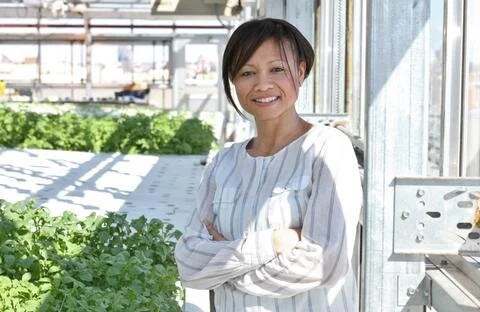
Food Waste To Indoor Farming Input: Re-Nuble Raises $1.1m Seed Funding
New York-based Re-Nuble is adopting yet another strategy: turning food waste into a way to grow more food. The company’s technology ‘upcycles’ organic compounds from unrecoverable vegetable food waste, generating water-soluble, organic, hydroponic nutrients for soilless farms
November 23, 2020
Startups are taking a diversity of approaches to tackle the issue of food waste. Phood is using hardware and software to measure and address waste in restaurant kitchens, while Clean Crop is targeting post-harvest wastage. Ambrosia turned leftovers into a household cleaning product while Full Harvest connects food producers with buyers to sell what would otherwise go to waste.
New York-based Re-Nuble is adopting yet another strategy: turning food waste into a way to grow more food. The company’s technology ‘upcycles’ organic compounds from unrecoverable vegetable food waste, generating water-soluble, organic, hydroponic nutrients for soilless farms.
“We haven’t seen anyone applying this to indoor or controlled environment ag,” Tinia Pina, Re-Nuble founder, and CEO, told AFN.
Pina’s inspiration for the business came from her stint working as a teacher in 2012, when she noticed a serious lack of healthy food options for her students. In her view, this affected their productivity – which had downstream implications for their future success. She saw an opportunity to wrap her interest in tamping down food waste into the venture, too.
Re-Nuble recently closed a $1.1 million seed round led by Global Sustainable Future. She1K, SOSV, SVG Ventures, WOCstar, and others participated in the round as well.
The fundraising process involved some education, Pina explained. Investors at first considered Re-Nuble’s need for a constant supply of food waste as a risk – but the former teacher taught them that there’s certainly no shortage.
“The other thing we had to really educate investors on was how food waste is handled differently region to region,” she said. “Agricultural economies are going to have different regulations. Here in New York, by 2022 a lot of the industrial and commercial food scraps or food waste generators have to divert to an organic recycler within 20 miles.”
Pina said she met with prospective investors all over the US, but ended up having most success raising from investors on the East Coast.
“[That’s] because I think the sophistication of seeing the potential with agtech, especially in the NYC metropolitan area, helped us. And, to be quite honest, I think the diversity of seeing a woman of color in agriculture. That is an anomaly in some states based on what I have experienced.”
The new funds will be used for typical seed-stage tasks like hiring, R&D, manufacturing, and general acceleration. Pina estimates the product market pipeline is worth at least $2 million.
Thanks to a lot of upfront diligence, Re-Nuble is confident that it has reached product-market fit and that securing customers won’t be too much of a challenge. The startup spent seven years studying different food waste characterizations and their biochemical reactions when applied under different environmental controls for a group of specialty crop varietals.
“We’ve been really drilling down and making sure the product works consistently in each type of farm, which is very different,” Pina said. “Some use deep water culture systems, some vertical farming systems are using tray racking systems and ebb and flow. Others are nutrient film techniques. We really wanted to spend the time to make sure that it is consistent in all farm types.”
In addition to its core nutrients product, Re-Nuble has also developed what it calls its ‘On-Site Food Waste Recovery System.’ This captures residual product waste — such as plant matter like vines, leaf cuttings, and perishable produce — as well as a farm’s wastewater for conversion into sterilized biostimulants and potable water. These byproducts are then reused for reduced water and agricultural input consumption.
The startup has faced some serious Covid-related challenges, according to Pina. It had a $500,000 loan rescinded that caused the team to completely redesign its manufacturing process, while also trying to work with manufacturing equipment under a cash-strapped budget.
“We’ve overcome that and we are now on pace to continue working with the farms that we’ve been doing case studies with, which we will release Q1 of next year,” she said. “That will definitely lead to growth and allow us to accelerate more farms getting access to our product.”
Revisiting "The Vertical Farm" - Dickson Despommier’s Book
The concept he discusses is fairly simple. If we used hydroponic and aeroponic systems to grow fresh produce, indoors, in large cities, we could curb our environmental impact by letting our current farms return to their natural state
20-11-2020 | Linkedin
Listen to the 21st Talks podcast on Spotify
In 2010, author and emeritus professor of microbiology and public health, Dickson Despommier released his book, “The Vertical Farm: Feeding the World in the 21st Century.” The concept he discusses is fairly simple. If we used hydroponic and aeroponic systems to grow fresh produce, indoors, in large cities, we could curb our environmental impact by letting our current farms return to their natural state. Being its 10th anniversary, I wanted to revisit the book and look at it in a new context.
The Problem
By 2050, it’s estimated that there will be two billion more human beings than there are today. To feed that many people, we’ll need a landmass the size of South America to account for the food production. Unfortunately for everyone, they don’t make new continents anymore, and if the lack of land isn’t enough to worry about, year by year, the planet is losing arable land due to the changing climate, intensifying weather conditions, air quality, and more.
Modern farming is also not without its issues. A large percentage of fresh produce never reaches your plate, whether that be due to harsh weather, unforeseen pests, or other factors. In some cases, transportation can be the problem, as most fresh options travel 1200 to 1500 miles to reach their final destination.
Insecticides, fungicides, and pesticides are commonly used to kill off threats to growing produce, but water runoff with these chemicals often end up contaminating rivers, ponds, lakes, and streams. This damages natural wildlife habitats and has adverse effects on human beings.
Despommier’s Solution?
Farm upwards in buildings and skyscrapers. Avoid the use of pesticides and other chemical agents that damage the environment. Without the potential of chemicals and weather effects, you can grow produce in a controlled, ideal environment--year-round--at a rate that today’s farms simply can’t match.
When you’re producing food at this accelerated rate, there is no need to transport it 1200 to 1500 miles, which means fresher, tastier options arrive at the customers’ homes. You can also cut out the CO2 that would get pumped into the atmosphere if the food were to be transported long distances.
Because hydroponics and aeroponics are closed-loop systems, we could conceivably use 70-95% less water to produce the same amount of food as is currently produced. Despommier also talks about using vertical farms to eliminate food waste that attracts vermin and millions of gallons of contaminated water that pollutes large cities every day.
An interesting omission from Despommier’s vision is the use of aquaponics. While it’s a closed-loop system like the aforementioned, aquaponic farmers cultivate fresh-water fish to provide nutrients to their plants. In a matter of months, a farmer who has produced tons of fresh, leafy greens, could also provide local restaurants or residents with high-quality fish.
What happens to old farms and farmers?
If we were able to successfully transition to growing products from vertical or urban farms, there would be little need for farms as we know them. We would have the opportunity to reforest hundreds of thousands of acres and combat a large percentage of harmful CO2 and chemical agents. That said, I’m not keen on essentially firing two million Americans whose main source of income is farming, but neither is Despommier. The author suggests a government-provided financial incentive for farmers who actively work to curb CO2 by reforesting their land. That this might cause frustrations for some, but that’s a discussion for another day.
Vertical farms could also give rise to hundreds of thousands of new jobs--many for those displaced farmers--from the managers who will keep the facilities running to the techs who will make sure no pest or pathogen breaches a micrometer of produce. You could also bet that the vertical farming industry would give rise to job opportunities in related industries and fields.
Why this is important.
It’s not lost on me that in the coming decades, as I reach my parents’ age, the quality of my life might be severely different from theirs. My children and their children will inherit a world with rising temperatures, intensifying weather patterns (like 2020’s hurricane season), environmental refugees, and--oh yes--the two billion more people that I mentioned above. The opportunity to innovate in the farming industry is, well, 10 years ago when this book came out. We’re making strides, but mainstreaming vertical farming would require a tectonic-like shift in our mindsets and priorities or at least a billionaire champion (looking at you, Bezos, Musk, Gates) to kick things off.
Not to alarm, but with every passing day, the climate crisis becomes direr, and while it’s easy to let your mind drift to the negative, I believe Despommier’s vision is that of hope and innovation. We have all the tools we need to make the shift. We just have to do it.
But there’s one more reason I think that this book is more important now than it was at the time of its release. The passage in the book that stuck out to me most is this:
“All life on the Earth is linked either directly or indirectly to each other in mutually dependent life-renewing cycles. It is the foundation upon which that science is built. Without our interference, life would go on in an equitable manner, with all forms living within a given eco-zone sharing their part of the energy budget provided to them each day by the sun.”
This quote needs to be seen with 2020 vision. At the time I’m writing this, there are more than 242,000 Covid deaths in the United States and 1.28 million worldwide. Some scientists suggest that Climate Change has played a role in the spread of Covid-19. Others suggest that the agony and anguish of Covid-19 pale in comparison to the devastation the Climate Change will inflict on us in the future.
As the quote suggests, everything is connected. When you've tampered with one thing (like the environment), you've tampered with everything. We are the planet’s stewards. I don’t blame anyone specifically for Covid-19, but perhaps if we take larger steps to tackle the climate crisis, it will help us prepare for the next pandemic, either directly or indirectly.
The Greater Impact
Despommier leaves no stone unturned. He discusses vertical farming's local, national, and global impacts on our health, habits, and societies. He explains that, with trial and error, vertical farming can produce any crop you can imagine, and he provides technological and architectural blueprints necessary for success. He provides a broad overview of the benefits, many of which I've mentioned, but in much greater detail. Honestly, if someone has the money and ambition to start a vertical farm, conceptually, he's done most of the heavy lifting for them.
He also gives you the sense that with vertical farming, the quality of life could improve for everyone, and makes a case for allowing financially or food-insecure countries to rely on foreign providers. Naturally, there would be major pushback from those opposed to globalization, but Despommier's position is to advocate for environmental equity and sharing resources. In some cases, vertical farming could become a significant tool in avoiding major world conflicts.
Final Thoughts
I’m no farmer. I'm certainly not a scientist. I’m just a guy concerned about the days ahead. Ten years ago I heard about an exciting, inspiring concept and wanted to revisit it. That said, I won't presume that a hypothetical shift toward vertical farming wouldn't be met with significant challenges and resistance--many for legitimate reasons.
Finally, I don’t know if New York City, Hong Kong, Dubai, Mexico City, or Shanghai will ever have sprawling districts with skyscrapers that produce millions of pounds of fresh, healthy food each day. It’s simply a hopeful future and in terms of solving tomorrow’s problems, I think vertical farms are an excellent place to start.
When it comes to vertical farming, urban farming, and modern farming techniques, here are just a few companies that are ahead of the game:
Published by Jonathan Haile, MA
Source and Photo Courtesy of Linkedin

Lettuce Losses Could Cause Shortage Across U.S.
Lettuce growers in central California experienced unseasonably high temperatures and crop disease that caused severe losses to iceberg and romaine varieties
Crop Losses Lead To Supply Chain Disruptions, Beyond COVID-19
NOVEMBER 13, 2020
Lettuce crop losses in California could affect availability and prices at Texas grocery stores and restaurants and highlights the fragility of the nation’s food supply chain, said Texas A&M AgriLife Extension Service experts.
Twelve cultivars of bibb, loose-leaf, and romaine lettuce being grown hydroponically using the nutrient film technique. Most lettuce in Texas is grown in greenhouses like these. (Texas A&M AgriLife photo)
Lettuce growers in central California experienced unseasonably high temperatures and crop disease that caused severe losses to iceberg and romaine varieties.
David Anderson, AgriLife Extension economist, Bryan-College Station, said the shortage is another instance of the nation’s food supply chain being disrupted.
Anderson said lettuce is one product in a long list of perishable food items that are produced to serve a “just-in-time inventory” for retail grocers, restaurants and ultimately consumers.
“Consumers have dealt with shortages related to COVID-19 disruptions most recently, but it looks like this is weather- and disease-related losses that resulted in supply issues,” he said. “We grow accustomed to seeing lettuce at the grocery store year-round, but a lot of folks don’t know we rely on producers all around the country and beyond to serve that year-round availability.”
Lettuce is a cool-season crop and performs best at 60-65 degrees. The crop requires temperatures stay consistently below 80 degrees, accompanied by cool night temperatures.
Anderson said Texas and the rest of the U.S. rely on growers in specific microclimates domestically, but also in Canada, Mexico and other parts of the world, to produce certain products like lettuce and spinach to meet year-round demand. The heatwave in California accompanied by leaf spot disrupted the harvest that growers’ in Salinas provide to meet demand now.
“In a couple of weeks it’ll be another areas turn to meet that demand, and so on, but it just shows how delicate the system can be if there is an issue in the supply chain,” he said.
Fresh produce takes time and timing
Juan Anciso, Ph.D., AgriLife Extension horticulturist, Weslaco, said Texas producers grow very little lettuce aside from niche-market growers who supply restaurants, specialty grocers and directly to consumers. But the region is part of the national supply chain for cool season produce.
Growers in the Rio Grande Valley, for instance produce thousands of acres of cool-season produce – mostly onions, leafy greens like spinach and kale, and carrots.
The planting window is critical for those cool season crops because of the time they take to mature, he said.
Onions take 160-170 days from seed to harvest. Cabbage takes 90-110 days, and carrots take 90-plus days for fresh market and 150-180 days for fields destined for processing.
“California is the breadbasket of America when it comes to many varieties of produce, including various kinds of lettuce,” he said. “The growing season moves north and south as seasonal temperatures dictate the crop, planting time and harvest.”
Anciso said these crops are also very dependent on timing because they are only marketable for a week or two once harvested.
“These are all extremely perishable foods,” he said. “They are grown, harvested and go directly to the stores, so timing the logistics of that is critical to supplying demand. We expect to see a head of lettuce when we go into a grocery store and take the process for granted until it’s not there.”
-30-
Adam Russell