

Welcome to iGrow News, Your Source for the World of Indoor Vertical Farming

Publix Grows Hydroponic Produce At Greenwise Store
Publix has partnered with local hydroponics firm Brick Street Farms to grow, pack and harvest hydroponic lettuce in a container farm located outside its Lakeland, Florida Greenwise Market store
Krishna Thakker@krishna_thakker
Aug. 3, 2020
Dive Brief:
Publix has partnered with local hydroponics firm Brick Street Farms to grow, pack and harvest hydroponic lettuce in a container farm located outside its Lakeland, Florida Greenwise Market store.
The 40-foot container farm will grow an equivalent of 2.5 to 3 acres of lettuce and can operate 365 days a year in any weather conditions, Brick Street Farms told Grocery Dive in an emailed announcement. It substitutes soil for mineral-rich water, which means no pesticides are needed. The container farm uses 90% less water than a traditional farm and produces 720 heads of lettuce each week.
Customers can watch the produce grow through a window on the side of the container and purchase heads of lettuce inside the store.
Explore how the current landscape is impacting coffee manufacturers and how organic and fair trade can help ensure long-term success of the industry.
Dive Insight:
Publix has recently stepped up its partnerships in alternative agriculture. Earlier this year, the company began hosting Vertical Roots' interactive mobile hydroponic farm in the parking lots of its grocery stores and Greenwise locations. In March, Publix began selling microgreens from Kalera, a hydroponic farm on top of a Marriott hotel that lost all its business due to coronavirus, at 165 stores.
Hydroponic farming has been plagued by inefficiencies and high costs in the past, but improvements in technology are helping suppliers better meet retailers' demands for pricing and scale. On-site farms also add a bit of theater that can draw curious shoppers to stores.
Publix isn’t the only food retailer exploring this field. Kroger last year installed mini hydroponic farms in a handful of Seattle stores in partnership with Infarm, a start-up based in Germany. Around the same time, Gordon Food Service and indoor farming startup Square Roots opened their first co-located hydroponics farm on Gordon’s headquarters in Wyoming, Michigan. H-E-B and Whole Foods have also experimented with hydroponics in and around their stores.
Having a hydroponic farm at the store removes the need for transportation and storage of lettuce before it hits shelves, according to Brick Street Farms. It also allows Publix to sell the produce in-season all year round, providing some supply stability.
Although omnichannel business is booming for grocers like Publix right now, many are looking for ways to drive traffic to their stores, where they can make the most money per order. Grow farms and other safe, eye-catching attractions could be one way to accomplish this.
Follow Krishna Thakker on Twitter
Lead Photo: Permission granted by Publix
Filed Under: Fresh food Natural/organic
Farming In The Desert: Are Vertical Farms The Solution To Saving Water?
When I told people I was going to grow tomatoes in the desert, they thought I was crazy," Sky Kurtz, founder of Pure Harvest Smart Farms, told DW
Jul. 23, 2020
By Isabelle Gerretsen"
When I told people I was going to grow tomatoes in the desert, they thought I was crazy," Sky Kurtz, founder of Pure Harvest Smart Farms, told DW.
With just an average 12 days of rain a year, less than 1% arable land, a desert location, and an 80% import rate for food, the United Arab Emirates (UAE) seems an unfavorable place to set up a farm.
Kurtz is one of several entrepreneurs using high-tech farming techniques to boost crop production in the Emirates. Pure Harvest built the first climate-controlled greenhouse in Abu Dhabi in 2017.
Prompted by arid conditions and a desire for greater food security, the country is investing millions in technologies — such as vertical farming — that could make it an unlikely agricultural pioneer.
Vertical farms can grow a rich variety of different crops by stacking them in layers under LED lighting in climate-controlled greenhouses and watering them with mist or drip systems. The process is tailored to each crop's specific needs, resulting in high-yield, year-round harvests."
It takes 30 to 40 days to grow leafy greens out in the field. We can grow that same crop in 10 to 12 days," says Marc Oshima, co-founder of Aerofarms. The company received funding from the Abu Dhabi Investment Office to build the capital's largest indoor vertical farm, with 800 different crops, by 2021.
Water Scarcity and Fossil-Fuel Reliance
The technology uses minimal land and up to 95% less water than conventional agriculture.
The hydroponics system places the plants' roots directly into a water-based and nutrient-rich solution instead of soil. This "closed-loop" system captures and recirculates all the water, rather than allowing it to drain away — useful for a country like the UAE suffering from extremely high water stress.
Globally, agriculture accounts for 70% of freshwater withdrawals, and UAE is extracting groundwater faster than it can be replenished, according to the International Center for Biosaline Agriculture (ICBA)."
Water is very expensive over in the UAE, but energy is cheap as it is subsidized," says Jan Westra, a strategic business developer at Priva, a company providing technology to vertical farms.
The artificially controlled environment is energy-intensive because the air conditioning and LED lights need a constant source of electricity.
This bringing forth of life in the desert could come at a high environmental cost. Most of that energy comes from carbon-emitting fossil fuels, even as the Middle Eastern country feel the effects of climate change.
By 2050 Abu Dhabi's average temperature is predicted to increase by around 2.5°C (36.5 F) in a business-as-usual scenario. Over the next 70 years, patterns of rainfall are also expected to change.
Integrating Renewable Energy
Although Pure Harvest is building a solar-powered farm in neighboring Saudi Arabia, its UAE operations get electricity from the carbon-intensive national grid.
Investing more in renewables "is a goal of ours," Kurtz told DW. He said the company has not set a clean energy target but is working on various green power projects, including a plan to integrate solar power generated in UAE into its operations.
However, Willem van der Schans, a researcher specializing in short supply chains at Wageningen University in the Netherlands, says sustainability and clean energy should be "inherent in the technology and included in plans when starting a vertical farm."
He argues that many vertical farming companies are not sustainable in terms of energy as they still view clean power as an optional "add-on."
Ismahane Elouafi, director-general of the government-funded ICBA in Abu Dhabi, acknowledges that vertical farming has some way to go before achieving "real sustainability," but she believes the innovations are "promising."
Improved battery storage, increasingly efficient LED lights, and cheaper solar panels will help, she adds.
Local Solutions
By 2050, the UAE government wants to generate almost half its energy from renewable sources.
Fred Ruijgt, a vertical farming specialist at Priva, argues that it's important to factor transport and refrigeration into the energy equation. Vertical farming uses more energy to grow crops than traditional agriculture, but because crops are grown locally, they do not have to be transported by air, sea, or truck over long distances."
The energy-saving is difficult to calculate exactly, but the advantages of locally grown crops are huge," he says, adding that those grown in vertical farms not only use less water and pesticides but that they also have a longer shelf life due to minimal transportation time.
Food Security and Coronavirus
In 2018, the UAE set out its vision to become a hub for high-tech local food production.
Companies and investors have flocked to the region, attracted by the 0% corporate tax rate, low labor costs, and cheap energy. With their help, the UAE aims to reduce its reliance on imports and make its food system more resilient to shocks like climate change and pandemics.
Oshima from Aerofarms says the coronavirus pandemic has brought "greater appreciation of how fragile the supply chain is and raised questions about food safety and security."
When the UAE went into lockdown in April, imported supplies of perishable goods like vegetables fell and business boomed for local suppliers.
ICBA's Elouafi said they have helped keep the UAE well-stocked during the pandemic."With the help of local food production and adequate imports, there has been absolutely no shortage of food in the UAE," Elouafi told DW.
Climate change, however, poses an altogether more complex threat to the country in the long-term. Given climate change's likely impact on food production, she says vertical farming has shown it is "an economically viable proposition even with harsh climatic conditions."
Reposted with permission from Deutsche Welle.
RELATED ARTICLES FROM ECOWATCH
Vertical Farms: The Future of Agriculture? -
EcoWatch ›Inside the Nation's Largest Organic Vertical Farm - EcoWatch ›
5 Ways Vertical Farms Are Changing the Way We Grow Food ...
RELATED CONTENT AROUND THE WEB
Investing In Vertical Farming: Five Take-Aways ›
This company wants to build a giant indoor farm next to every major ... ›
TAGS: farming farmers water food food security agriculture renewable energy

Local Company Providing Fresh Produce, Tools to Grow It All Year Long
Since opening its doors last July, Cold Acre Food Systems has been perfecting its indoor hydroponic growing systems for greens and herbs that can be harvested continually throughout the year.
August 6, 2020
The Yukon isn’t the place in the world most suited to year-round farming, given its long winters and short, unpredictable summers, but one local company is trying to change that.
Since opening its doors last July, Cold Acre Food Systems has been perfecting its indoor hydroponic growing systems for greens and herbs that can be harvested continually throughout the year.“
Hydroponics is a very old growing system and can be done in different methods,” said Carl Burgess, Cold Acre Food Systems CEO. “It’s essentially nutrient water delivered to roots to grow plants.”
The benefit of it in food production for a community sense is that there is less soil management because there is no soil management and in that way it can stabilize production year-round,” Burgess added.
The company does the majority of its farming in two shipping container-style growing facilities located on Titanium Way in the Marwell industrial area.“
Right now we are operating 6,000 planting spaces,” Burgess said. “One of those (containers) is basically equivalent to an acre of a market garden,” and “one container can give, at minimum, a weekly supply of greens to about 100 to 200 people.”
Denise Gordon, Cold Acre Food Systems lead grower, holds trays of microgreens in front of their growing unit in Whitehorse on July 26, 2020. (Crystal Schick/Yukon News)
Environmentally, the system uses 10 to 20 percent less water than the traditional method of growing, Burgess said. The carbon footprint is also greatly reduced since produce only has to travel a couple of blocks to its destination compared to being shipped on trucks, food waste is almost nonexistent because of the high reliability of growing indoors, the company uses compostable packaging, and there are no storage facilities.“
We harvest and go,” Burgess said. “It’s usually within two hours of harvesting that the produce is in the grocery stores or dropped off at someone’s home.”
What began as some test lettuce crops have turned into a diverse selection of leafy greens, like bok choy, arugula, kale, mizuna, and rainbow chard, as well as several different types of microgreens, which are similar to sprouts in appearance, and basil. The company is also experimenting with growing edible flowers and mushrooms.
Cold Acre Food Systems currently sells the vegetables it grows to several grocery stores in Whitehorse, restaurants, and cafes, and through a subscription box.“
The last year of business has been lots of fun,” Burgess said. “We went from being a very small food producer to a medium-sized food producer (in the Yukon).”
But selling the vegetables it grows isn’t the end game for this company. Building, selling, and installing growing systems is also part of Cold Acre’s business model. The company can build custom growing facilities for just about any client, from smaller at-home units to the larger commercial shipping container-style units.
Right now there are two large units that will soon be providing fresh produce to Yukon communities. The first, in partnership with the University of Calgary, is at the Kluane Lake Research Station near Silver City. Once it is up and running it will provide food to the Haines Junction and Burwash Landing areas. The second, currently still in Whitehorse, is owned by Na-Cho Nyäk Dun Development Corporation (NNDDC) and will be ready to feed people in the Mayo area this spring.
Leafy greens grow under neon lights in a shipping container style facility in Whitehorse on July 26, 2020. (Crystal Schick/Yukon News)“
We are currently fabricating a small-scale unit for demonstration/growing inside the Mayo Foods Store as part of the NNDDC project,” said Burgess.
The objective of Cold Acre Food Systems is to reduce food scarcity in the North and to enable everyone access to fresh produce year-round. “Success will be twofold,” said Burgess. “Our goal is to activate indoor growing. So success will look like a handful of growing facilities around that we either deployed or helped deploy. And success for us looks like a large growing facility that’s displacing a number of food products that right now are coming up the road and doing that cost effectively for consumers.”
Contact Crystal Schick at crystal.schick@yukon-news.com

Martha Stewart, J.D. Vance And Impossible Foods’ David Lee Join Board of AgTech Leader AppHarvest
Company adds executives from The Carlyle Group, Impossible Foods and raises new round from sustainability-focused investors such as Jeffrey Ubben and James Murdoch as COVID-19 heightens need for more resilient domestic supply chains
The company adds executives from The Carlyle Group, Impossible Foods and raises new round from sustainability-focused investors such as Jeffrey Ubben and James Murdoch as COVID-19 heightens need for more resilient domestic supply chains
AUGUST 6, 2020 – MOREHEAD, KENTUCKY – AppHarvest announced today that food entrepreneur and icon Martha Stewart, Impossible Foods Chief Financial Officer David Lee, and best-selling author and investor J.D. Vance, have joined the company’s Board of Directors as it prepares to open one of the world’s largest indoor farms this fall in Morehead, KY. Starting with non-GMO tomatoes, AppHarvest’s farms will provide freshly grown American fruits and vegetables for national grocers, meeting the enormous and growing demand for locally grown produce amidst the supply chain challenges created by the current COVID-19 pandemic.
“The future of food will be, has to be, growing nutrient-rich and delicious produce closer to where we eat,” Stewart said. “That means food that tastes better and food that we feel better about consuming. AppHarvest is driving us towards that future and working from within Appalachia to elevate the region.”
Added Vance, “The last few months have taught us that our food system is a little more precarious than we realized. AppHarvest will change that, and it will do so by building a sustainable, durable business in Appalachia, and investing in the people who call it home.”
Added Lee, “AppHarvest’s innovative approach to agriculture has the potential to dramatically change the way we get our produce and the impact our food has on the natural environment. I’m excited to join their mission as they enter this next phase of growth.”
Anna Mason, Partner at Revolution’s Rise of the Rest Seed Fund, the fund led by AOL Co-founder Steve Case to back companies outside of Silicon Valley, will also join the Board. “AppHarvest’s rapid expansion and job creation is exactly what Rise of the Rest envisioned with its focus on helping companies in Middle America grow,” Mason said.
Inspired by the belief that the technology already exists today to grow dramatically more food, with far fewer resources, AppHarvest’s indoor farms reduce the need for acreage, use no harmful pesticides, lessen fuel used in shipping, and are the first of their size that will rely entirely on recycled rainwater for all water needs. AppHarvest’s closed-loop water system eliminates agricultural runoff common in open-field agriculture. This is critical as the U.S. ramps up efforts to secure food systems that can withstand health and climate disruptions.
“It’s time for agriculture in America to change,” said AppHarvest Founder & CEO Jonathan Webb. “The pandemic has demonstrated the need to establish more resilient food systems, and our work is on the forefront of that effort. Eastern Kentucky, with its central U.S. location, provides the perfect place to build AppHarvest’s indoor farms while also providing much-needed jobs to a ready workforce.”
AppHarvest’s 2.76-million-square-foot controlled environment agriculture facility has already created 100 construction jobs and will create more than 300 full-time permanent jobs for residents of Eastern Kentucky, where 44 percent more residents are unemployed than the national average.
With its vision to create America’s AgTech capital in Appalachia, AppHarvest has been recognized for its focus on social good. The company has been certified by the independent non-profit B Lab as a
B Corporation, passing a rigorous audit of its sustainability practices.
AppHarvest is also announcing the hires of Marcella Butler as the company’s first Chief People Officer, Jackie Roberts as its first Chief Sustainability Officer, and Geof Rochester as its first Chief Marketing Officer. Butler joins AppHarvest after serving as Impossible Foods' first Chief People Officer, where she led the tripling of employees to more than 650 individuals. Prior to joining Impossible Foods, she worked at Google, first in People Operations, followed by Corporate Development, where she led global acquisition due diligence and integration activities. Roberts joins AppHarvest from The Carlyle Group, where her roles included Chief Sustainability Officer. Prior to The Carlyle Group, she served in several senior roles at the Environmental Defense Fund. Rochester, who has decades of experience in marketing and corporate social responsibility, previously served as Managing Director and Chief Marketing Officer of The Nature Conservancy with prior work at WWE, Showtime, Comcast, and Procter & Gamble.
AppHarvest’s Board and staff additions come as the company closes its $28 million Series C funding round. Combined with the company’s prior funding rounds, including project financing, AppHarvest has attracted more than $150 million in investment in just over two years.
Narya, the new venture capital firm co-founded by Vance and Colin Greenspon as well as backed by leading entrepreneur and venture capitalist Peter Thiel, led the investment round with participation from existing investors ValueAct Capital’s Spring Fund, Revolution’s Rise of the Rest Seed Fund, and Equilibrium, which has provided nearly $100 million in project financing to date.
New investors include Lupa Systems, the private investment firm founded last year by James Murdoch (who along with the ValueAct Spring Fund and Equilibrium, are leading the way for venture’s expansion into sustainability-focused investments); Breyer Capital, founded by early Facebook investor Jim Breyer; food and agriculture fund S2G Ventures (Seed 2 Growth); Black Capital, led by NBA legend Kevin Johnson; and Endeavor Catalyst, the co-investment vehicle through which Endeavor invests into companies founded by its entrepreneurs. Endeavor selected Webb as an Endeavor Entrepreneur in 2019.
“AppHarvest is poised to be a leader of the modern agricultural transformation, and we’re enthused to be a part of its upcoming launch and growth phases both in the U.S. and internationally,” said Frederic Michel, Partner at Lupa Systems. “The team is developing a compelling model that can respond rapidly to the needs for efficiency, sustainability, quality, and resiliency in the food sector today.”
The Series C funding round will allow the company to continue to recruit top-tier talent from around the globe as it prepares to build additional farms throughout Central Appalachia.
About AppHarvest
AppHarvest is building some of the world’s largest indoor farms, combining conventional agricultural techniques with today’s technology to grow non-GMO, chemical-free fruits and vegetables to be sold to the top 25 U.S. grocers. The company has developed a unique system to reduce water usage by 90% compared to typical farms, as a 10-acre, on-site rainwater retention pond pairs with sophisticated circular irrigation systems. The system also eliminates agricultural runoff entirely. By locating within Appalachia, AppHarvest benefits from being less than a day’s drive to 70% of the U.S. population. That lowers diesel use in transportation costs by 80%, allowing the company's fresher produce to compete against low-cost foreign imports.
Future of Food Is Fresh And Green For Manitoulin First Nation
Launched in 2015, The Growcer adheres to other models of container farming that start with a shipping container and add hydroponic growing equipment and LED lights to create a self-contained, closely monitored system that allows for growing year-round
Sheshegwaning First Nation Takes High-Tech Step
Toward Food Security
Jul 22, 2020
By: Lindsay Kelly
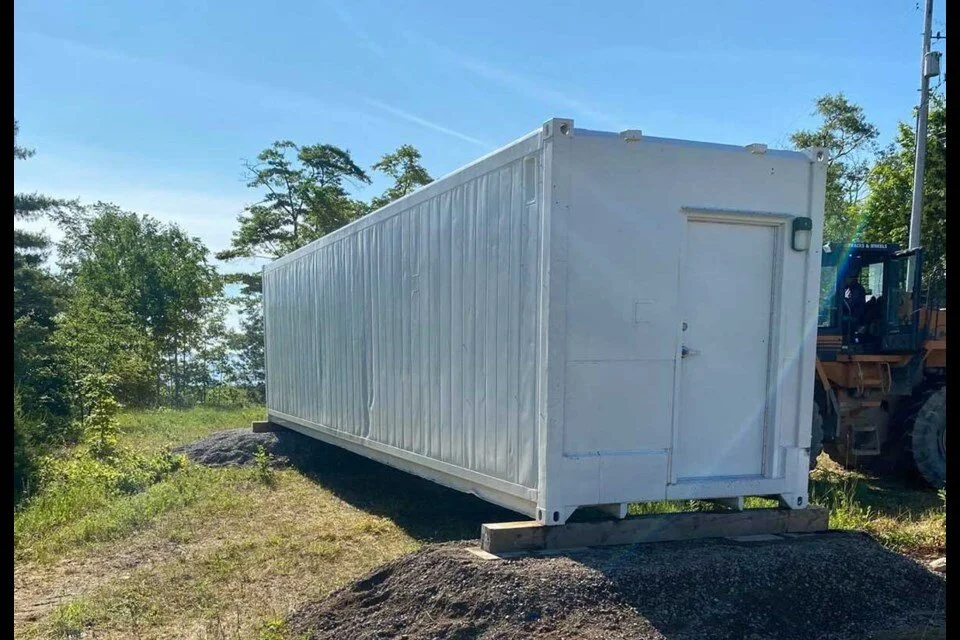
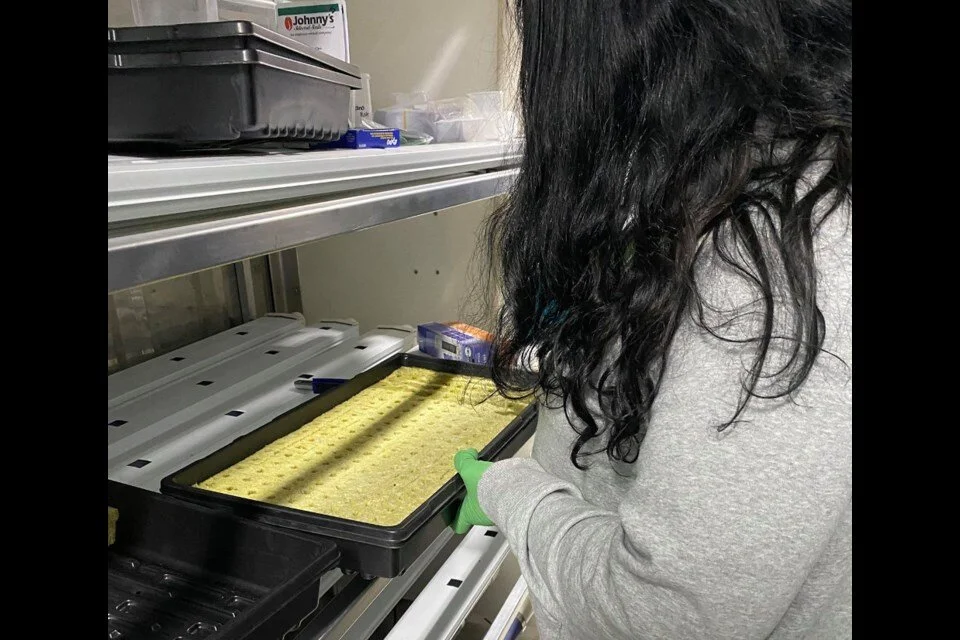
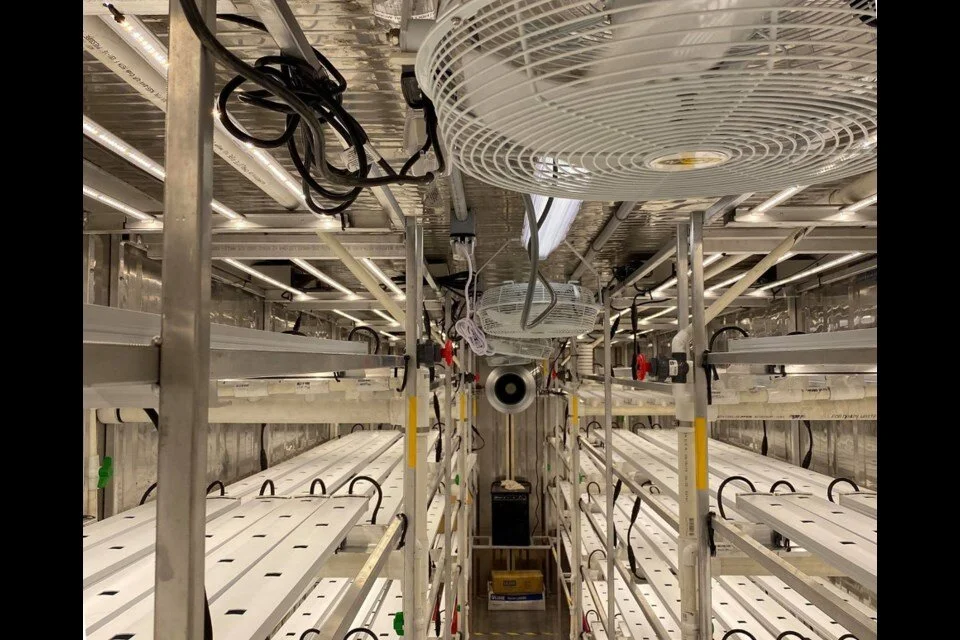
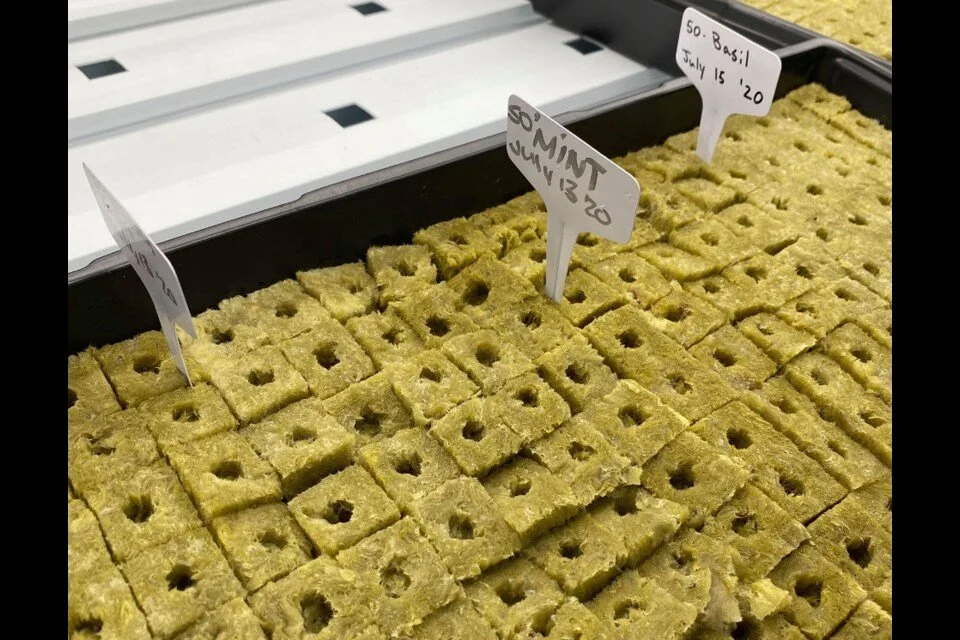
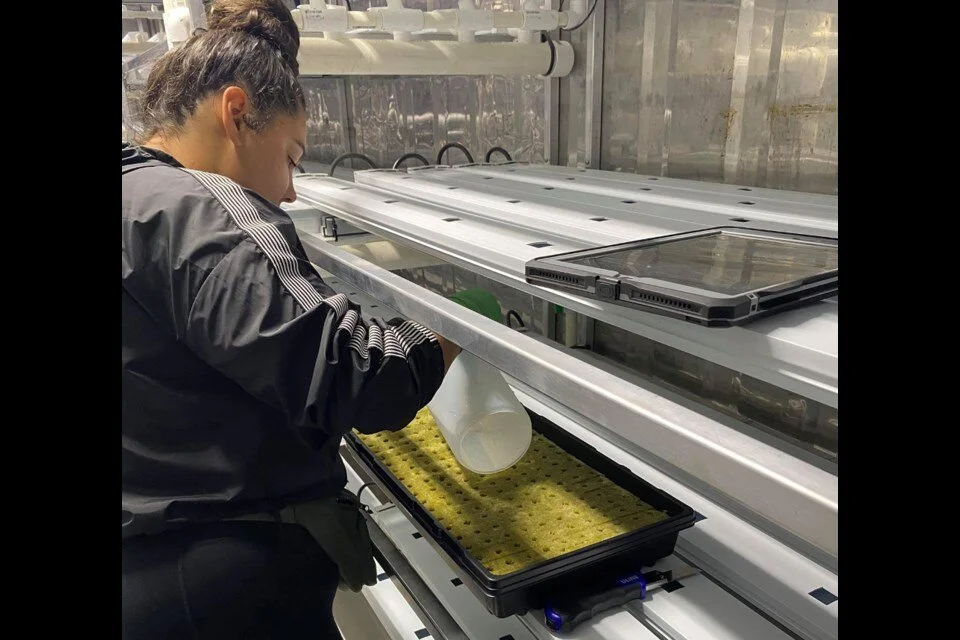
Last February, April Folz was attending a conference in Québec with a team from Sheshegwaning First Nation when a tradeshow display caught her eye.
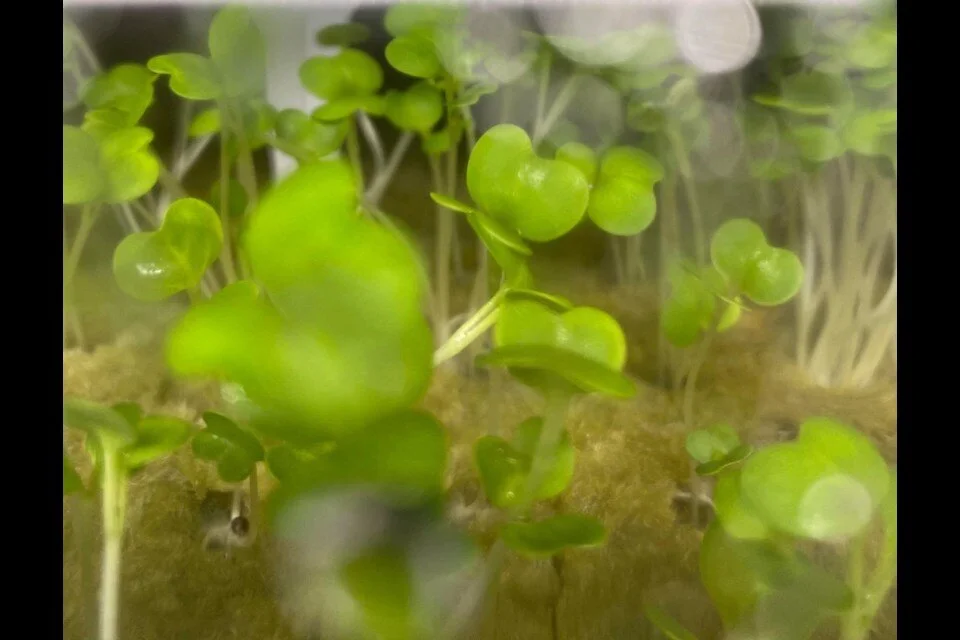
It was unusual to see shoots of fresh, edible greens in amongst the displays, especially at that time of year, but there they were, at an exhibit for The Growcer, an Ottawa-based company that develops hydroponic container farms.“
It was winter, and it was snowing,” recalled Folz, Sheshegwaning’s economic development director. “It was so neat that it was growing in the middle of winter – there were snowstorms.”
The community’s interest in the farming system was piqued but wasn’t given any serious consideration until a few weeks later, Folz recalled.
When COVID-19 arrived in Northern Ontario in March, members of the outlying community, which is situated on the far west end of Manitoulin Island, began to worry about food chains being interrupted and how they would continue to enjoy a supply of fresh produce when the nearest grocery store is about 45 minutes away in Gore Bay.
Fears were further exacerbated with talk of closing off access to the swing bridge at Little Current, which, during the winter months, provides the sole route on and off the island that’s situated in the upper end of Georgian Bay in Lake Huron.“
This pandemic happened and people were complaining that they couldn't get anything at the grocery store, and they couldn't get any of the fresh produce in at the store here (in Sheshegwaning),” Folz said.“We were having a hard time supplying that for our people.”
The community of 118 quickly made a decision to take the plunge into container farming, taking out a loan to purchase their very own Growcer farm, and the unit arrived in the community on June 22.
Launched in 2015, The Growcer adheres to other models of container farming that start with a shipping container and add hydroponic growing equipment and LED lights to create a self-contained, closely monitored system that allows for growing year-round.
Seeds are nurtured with a tailored combination of nutrients, water, and lighting, and crops are ready to be harvested after about four to six weeks. With a staggered planting system in place, crops are always growing.If something goes wrong – the temperature gets too high, for example – the sophisticated monitoring system will alert staff through their phones so they can visit the farm and adjust accordingly.“
Growcer also has access to our system,” Folz said. “So they get alarms as well, and they can regulate it from Ottawa.”
The company provides full training and ongoing support as part of the purchase agreement.
There are even some job opportunities for those enterprising community members with an interest in agriculture. Folz is currently hiring for a full-time systems manager, who will be responsible for planting and harvesting, cleaning, and calibrating the Growcer system, as well as two part-timers, who will help with monitoring the crops.
Growcer farms are now successfully producing fresh greens every week in communities as far-flung as Kugluktuk, Nunavut, and Churchill, Man.
Conditions in Sheshegwaning aren’t nearly as harsh or rugged as in those more remote regions, but the arrival of their own container farm has generated buzz amongst the many avid salad-eaters in the community.
For $10 a week, residents who want a take of the harvest sign up for a subscription box, which guarantees them five heads of greens of their choice delivered to their door. A portion of the harvest will also go to local business Mkwa Catering for use in their dishes.
The first seeds were planted during the week of July 20, and Folz expects to reap the harvest in mid-August. Products will be marketed under the Odawa Freshwater brand.
She’s calculated that if they sell out weekly, the community will break even on its loan for the project.
So far, the community has planted Monte Carlo romaine lettuce, red Russian lettuce, Tuscan kale, wildfire lettuce, and win-win choi, along with basil, parsley, and mint.“
People want spinach, so they’re going to send us some spinach seeds and get that going,” Folz noted.
Folz said 450 heads of greens will be harvested weekly, while the herbs can be cut back each week and will self-replenish until they reach the end of their lifecycle, which she estimates will be some time in October.
An ongoing experiment with different lighting and growing conditions aims to see if there's any success with strawberries.
Known in many Indigenous cultures as the “heart berry,” strawberries are celebrated as a marker of spring, help promote health and well-being, and signify friendship and reconciliation.“
Strawberries are very important for Native culture for ceremonies, and it would be fantastic to get them fresh year-round if we could do that,” Folz said.“
This (container) is specific for greens, and it will probably stay that way. Maybe down the road, we’ll get one for strawberries.”
PHOTOS:
1 / 6 Crops being grown by Sheshegwaning First Nation in its new container farm include kale, lettuce, parsley, mint, and basil. (Supplied photo)
2 / 6 Sheshegwaning First Nation took delivery of its Growcer container farm on June 22. Its first crops will be ready in mid-August. (Supplied photo)
3 / 6 Container farms use a customized combination of water, nutrients, and lighting to get the maximum yields per crop. (Supplied photo)
4 / 6 Ottawa-based The Growcer uses a shipping container, outfitted with LED lights and a hydroponic growing system, as the base for its container farms, which allow year-round growing. (Supplied photo)
5 / 6 Seeds are put into a growing medium to get started. Crops are ready in four to six weeks. (Supplied photo)
6 / 6 Sheshegwaning's Growcer container farm will create jobs for three community members, who will plant seeds, harvest crops, and clean, calibrate, and monitor the system. (Supplied photo)

Plantlab Uses €20 Million Investment To Open New Vertical Farms In The Netherlands, The U.S. And The Bahamas
"On a surface area the size of only two football fields, it is now possible to produce enough crops to feed a city of 100,000 residents with 200 g of vegetables each on a daily basis"
25 July 2020
Dutch scale-up PlantLab has raised a first external investment of € 20 million from De Hoge Dennen Capital. The company has developed a globally patented technology for ‘vertical farming’, an efficient method for growing vegetables and fruits. It will use the injection of capital to open indoor production sites in various countries, including the Netherlands, the US, and the Bahamas.
Over the last 10 years, PlantLab has succeeded in developing innovative and revolutionary technology for efficient urban farming, which is already being applied in a commercial production site in Amsterdam. The new technology enables growing vegetables on a large scale very close to the consumer, without using any chemical crop protection agents. On a surface area the size of only two football fields, it is now possible to produce enough crops to feed a city of 100,000 residents with 200 g of vegetables each on a daily basis, the company claims.
“This injection of capital will enable us to open up additional production sites and further perfect our technology”, explains Plantlab CEO Michiel Peters. “The increasing population of the planet and the climate crisis are posing new and enormous challenges to the production of food for the world’s population. We have no choice but to grow our food more sustainably and efficiently, and that demands innovative and revolutionary solutions.”
PlantLab’s production sites can be set up anywhere in the world, even on barren land or urban areas. Due to optimized temperature, moisture, and light control, the crops grow to their full potential, while water use is reduced by as much as 95%, Peters says. Light is provided by specially developed LEDs that provide the specific wavelength needed by the plant for photosynthesis.
New CEO, new CFO
De Hoge Dennen is part of the investment company founded by the De Rijcke family, the former owners of Kruidvat. The company has made previous investments in the online supermarket Picnic, the salad producer De Menken Keuken, and the electric bicycle brand QWIC. CFO Jelle Roodbeen says he wants to help PlantLab make a real difference on a global level. “It will make healthy and delicious vegetables affordable and accessible to everyone, in an environmentally friendly and sustainable fashion.”
In addition to the injection of capital by De Hoge Dennen, Frank Roerink and Michiel Peters are joining the scale-up company as its new CFO and CEO, to strengthen the management team. PlantLab has its vertical farming R&D center in Den Bosch and a commercial production site in Amsterdam. PlantLab employs over 60 people.
PlantLab
PlantLab specializes in technology for innovative urban farming and aims to supply the planet with a sustainable source of food for the future. The company was founded in 2010 in Den Bosch with the goal of revolutionizing the production of food for our planet. Over the last 10 years, the company has already invested € 50 million in the development of technology. The goal is to grow healthy, day fresh vegetables close to the consumer anywhere in the world without the use of chemical crop agents, while at the same time reducing water consumption to an absolute minimum.
More on Plantlab at Brabant Brandbox
Lead Photo: © Plantlab

Are Automated Indoor Growing Facilities The Future For Fresh Produce?
Can growing veg in urban units scale up to meet demand, or is vertical farming a cottage industry focussed on leafy greens? Interest in Controlled Environment Agriculture is increasing internationally. Agri-TechE bring together Controlled Environment Agriculture technologists, producers and investors to discuss the current landscape and promising developments
CEA-Lite is an online debate on precisely that question,
taking place on 10th Sept.
Agri-TechE bring together Controlled Environment Agriculture technologists, producers and investors to discuss the current landscape and promising developments
Can growing veg in urban units scale up to meet demand, or is vertical farming a cottage industry focussed on leafy greens? Interest in Controlled Environment Agriculture is increasing internationally. In the UK autonomous growing systems have attracted funding from the Government’s Transforming Food Production program and tens of millions are being invested in a new training and demonstration facility; but the industry still has many challenges.
Agri-TechE is hosting an event “CEA-lite”, which is discussing the drivers for innovation and investment with leading entrepreneurs, producers, and investors on 10th September 2020.
Are new business models emerging?
Dr Belinda Clarke, Director of Agri-TechE says new models of food production are gaining traction. “Year-round intensive cropping of high-value crops becomes economically viable if the technology can scale. The Transforming Food Production call focussed on big, inspirational projects and this will help de-risk the technology, particularly around automating the monitoring and harvesting, which are so problematic for open field production.”
Jock Richardson of Growpura agrees: “A lot of operators have some great technology but to grow bigger means a linear (or worse) growth in costs. Scale-up is vital but there are operational challenges of how we grow plants at scale and at low cost.”
Could scaled-up vertical farms create economic value in vacant retail units?
“I have seen repurposing of buildings for CEA but location remains vitally important”, says Investor Kiryon Skippen of Capital Agri International, “landlords of these buildings need to be realistic in their rent demands and preferably have a real interest in the vertical farming business and work with it, taking the longer term view.”
Jock has seen uplift in interest in localised crop production, but as their system requires cleanroom conditions, refitting an older building could be too costly. “We’ve been talking to major retailers and its clear there is real interest in the use of hydroponics (growing in water) to fulfil the demand for fresh produce but of course it has to be at a competitive cost and offer a reliable supply,” he says.
The company will announce funding for a large training and demonstration facility in the coming days, which may provide over 200 jobs and internships in the South East Midlands area. “A vibrant hydroponics industry is essential in the UK. On the licensing front there has been interest from a number of countries particularly in the UAE and Asia and also for non-food products which we are progressing keenly,” Jock continues.
Can the industry look beyond leafy greens?
This international interest is a trend David Farquar, of Intelligent Growth Solutions, has also seen. He says; “Interest from NW Europe, the Middle East, and SE Asia is increasing the diversity of the food grown under secure conditions to reflect local diets and cuisine; encouraging the CEA industry to look beyond leafy greens and salads. For example, we have seen more demand for roots and fruits over recent months and interest in re-localizing as much of the food supply chain as possible.”
Phytoponics has recently raised £0.5M to develop its next-generation deep-water culture modules that offer a sustainable more profitable alternative to hydroponics substrates, such as rock wool and coir, and the company has started a series of strawberry trials with Total Produce. CEO Andy Jones, says the funding environment is challenging but that investment is there for companies with the right solutions.
He continues: “For growers, costs remain the big issue and one of the biggest is labor. New approaches need to give growers an economic advantage by reducing those costs.”
Are we swapping a labor shortage for a skills shortage?
However Max McGavillray of Redfox Executive says Brexit, and then COVID-19, has resulted in a marked increase in protected cropping roles as the UK adapts to a new normal: “We’re seeing individuals with plenty of cash establishing vertical farms but with very little experience in agriculture and foods, so there’s a real need for those with growth expertise in controlled environment agriculture.”
CEA Lite is an online event being held
on 10th September 2020 15:00 – 17:00.
Register your interest at bit.ly/ATEeEvents
About Agri-TechE – www.agri-tech-e.co.uk
Agri-TechE is a business-focused membership organization that is supporting the growth of a vibrant agri-tech cluster of innovative farmers, food producers and processors, scientists, technologists, and entrepreneurs.
Agri-TechE brings together organizations and individuals that share a passion for improving the productivity, profitability, and sustainability of agriculture. It aims to help turn challenges into business opportunities and facilitate mutually beneficial collaboration.
Photos:
1 – Credit: Growpura / Caption: Growpura is set to create a hydroponic farm, training and demonstration facility in Bedford, UK
2 – Credit: IGS / Caption: IGS has seen more demand for root vegetables and fruits in recent months as vertically farmed crops diversify
3 – Credit: IGS / Caption: Phytoponics has recently won funding and is undertaking commercial trials of its deep-water hydroponics modules
Bejing National Agricultural Science And Technology Innovation Park To Be Expanded
AgriGarden International is a Chinese provider of services covering the entire industry chain of horticulture
AgriGarden International: To Build a Platform of Innovation For global horticultural Industry
The Covid-19 pandemic that has been ongoing for months has affected China's horticulture industry to varying degrees, and many projects under construction had to be suspended. AgriGarden International is a Chinese provider of services covering the entire industry chain of horticulture. Liu, Manager of International Cooperation, said, “Since the outbreak of Covid-19 at the end of January this year, the construction of all of our ongoing projects has been forced to stop. Currently, projects in other provinces and cities have been able to resume, but due to the second wave of cases occurred in Beijing in mid-June, the construction of National Agricultural Science and Technology Innovation Park here had to be once again put on hold and is awaiting approval for the resumption of work.”
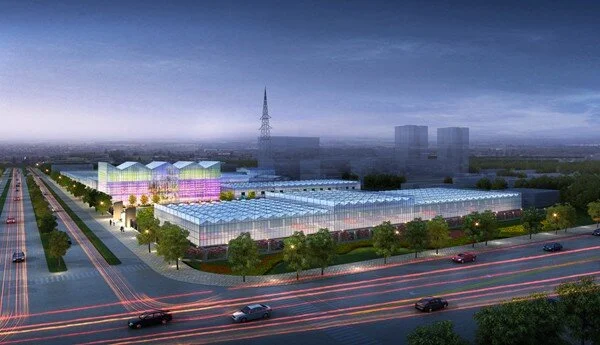
National Agricultural Science and Technology Innovation Park
Liu, Manager of the company’s marketing department, said, “The National Agricultural Science and Technology Innovation Park and the International Facility Horticulture Innovation Center that is to be expanded will serve as an exchange platform for the horticulture industry. By working with internationally renowned horticultural research institutions and companies, they will showcase the latest results of horticultural scientific research, and new technologies and equipment for facility horticulture to visitors at home and abroad, and promote exchanges, cooperation, and joint innovation among enterprises. The Innovation Park will also function as an investor and incubator. Since the establishment of the park, it has received nearly 40 heads of state and leading politicians.
Interior of the National Agricultural Science and Technology Innovation Park
About the Innovation Center
When talking about the International Facility Horticulture Innovation Center, Liu said, “AgriGarden International is an agricultural high-tech enterprise affiliated with the Chinese Academy of Agricultural Sciences. It is a benchmark enterprise for transforming scientific and technological achievements via in-depth integration of production, education, and research handpicked by the Ministry of Agriculture and Rural Affairs. We often receive domestic and foreign leaders with investment intentions. In the future, our Innovation Center can provide office space for domestic and foreign horticultural technology companies, and more importantly, provide a communication platform for these companies and help them open the Chinese market and bring more potential customers. We also hope to facilitate joint innovation of the horticulture industry in this center to create more innovative products for the Chinese market.”
In recent years, more and more companies have transitioned from traditional agriculture to facility horticulture, which shows the huge potential of the Chinese market. However, foreign companies have to face a series of challenges such as the lack of customers and ignorance of local policies, even though they have advanced technologies and concepts. The Innovation Center will provide these companies with localized information and help them expand the Chinese market.
International Facility Horticulture Innovation Center
AgriGarden International
AgriGarden International is an agricultural high-tech enterprise affiliated with the Chinese Academy of Agricultural Sciences. It is a benchmark enterprise for transforming scientific and technological achievements via in-depth integration of production, education, and research handpicked by the Ministry of Agriculture and Rural Affairs. “We welcome companies in the industry that are interested in joining the International Facility Horticulture Innovation Center (Alliance) to contact us." Manager Liu said.
Lead photo: The core part of the National Agricultural Science and Technology Innovation Park
For more information:
Contact: JING (Laurie) LIU
Company: AgriGarden International BD
Tel.: 00491791229249
Email: laurie.liu@agri-garden.com
Publication date: Thu 23 Jul 2020
© HortiDaily.com

CANADA: Space-Age Tech Will Take Farming To New Heights in Welland
Intravision Group has shone a light on everything from cannabis to planet simulators, spanning across Kuwait, McMaster University, and the European Space Agency. Now, through Intravision Greens Niagara, its tech is taking veggies to new heights in Welland
Vertical Farming Facility Aims to Produce 1-Million Pounds of Produce


Intravision Group has shone a light on everything from cannabis to planet simulators, spanning across Kuwait, McMaster University, and the European Space Agency. Now, through Intravision Greens Niagara, its tech is taking veggies to new heights in Welland.
Starting in Norway, Intravision made its progression across the pond to the University of Guelph's Controlled Environment Systems Research Facility. In collaboration with the university, they honed in on how isolated plants in a hyper-controlled environment responded to everything from lighting spectrum, to airflow movements.
While the technology applies to plants grown in space, the fundamentals behind it aren’t rocket science.
Modern farming has drastically evolved to give farmers more control over their crops, but outside in the field, nature still has the upper hand.
Move the entire growing process inside into a controlled environment, and suddenly you have control over everything. For Intravision Greens, it’s a bit like getting to play God.
"It's a low-tech approach to a high-tech challenge," says Nic Keast, a senior project manager with Intravision. "You're growing plants, plants grow themselves, let's give them the right conditions and let them do their thing."
Non-GMO, certified and sterile seeds are planted in-house. Every stage of the plant’s growth, from germination to harvesting, is dialed in; from what spectrum of light the plant gets, to the temperature and amount of air circulated over a plant, to the spacing in a tray.
By the time produce makes its way out the door, there’s a traceable log of its entire journey.
Plants start off on the lower level of a vertical farming system and as they mature, they’re moved up higher. It’s a constant cycle of maturing plants moving up, replaced by seeds below.
Intravision Greens Niagara’s Neville D’Souza, one of the operation’s executive directors, said without insects to worry about, there won’t be pesticides or herbicides used; leafy greens like basil and arugula, are sent out the door ready-to-eat; and the facility will use significantly less land and water than a conventional farm.
Inside the 20,000 square-foot facility, one-acre of leaf cover will be grown, producing around 1-million pounds of plants, according to D’Souza.
Undeniably, there’s a lot of work and money going into only one acre, but Keast stresses it’s all about getting the most out of a bit of space.
The Welland facility, now being built, is based off of a pilot plant in Toronto where the concept was tested on a small scale.
For their produce to compete with commercial-scale productions, they’ll eventually have to scale, says Keast. There’s the potential for an additional two acres — by knocking down a few walls, they can replicate their current setup.
D’Souza says they aren’t trying to compete with local farms though. Their interest lies in the GTA market, where he says most produce is imported.
"What we are going to produce here, represents just two to give percent of what is imported, so that is what we are looking at, and the farmers are growing for three or four months, this is growing the other nine months when stuff is imported ... this is import substitution, and so it compliments what the farmer is growing and not treading on his toes," D'Souza said.
This past Friday, some of Intravision’s 2,340 lighting units were being installed above roller racks that will eventually hold plant trays. Keast and D’Souza point out that robotics, framing, the water system, harvesting equipment, and a future conveyor system are all locally sourced.
D’Souza claims that an operation like theirs will be the first in the world, and believes as the technology becomes more viable, there will be more vertical farms to compliment traditional ones.
It’s still early stages, and D’Souza admits it’s an ambitious goal, but he hopes for the operation to be up and running by the fourth quarter of this year, and sees an expansion within 24 months.
Photo Credits:
A vertical farming system is seen at an upcoming Intravision Greens Niagara facility in Welland on July 17, 2020.
A vertical farming system is seen at the “We the Roots” pilot plant in Toronto, in this undated photo provided by Intravision Light Systems. - Photo provided: Intravision Light
A vertical farming system is seen at an upcoming Intravision Greens Niagara facility in Welland on July 17, 2020. - Jordan Snobelen/Torstar

US: WISCONSIN - City of Ripon Receives $190,000 State Grant To Support Redevelopment of a Vacant Grocery Store
Ripon is home to one of the largest vertical farms in the state since Ernessi Farms moved its operation to Wisconsin in 2015
WEDC Investment to Help Fund Renovation
of a Vacant Building Into An Urban Vertical Farm
By Wisconsin Economic Development Corporation
July 22, 2020
RIPON, WI. JULY 22, 2020 – The City of Ripon is receiving a $190,000 state grant to help in the renovation of a vacant former grocery store into an indoor urban vertical farm produce operation with the potential for retail operations and a future rooftop garden.
The Community Development Investment (CDI) Grant from the Wisconsin Economic Development Corporation (WEDC) will support the expansion of Ernessi Farms’ urban vertical farm produce operation using the vacant space.“
A vibrant blend of businesses is vital to a community’s overall economic success, and the urban vertical farm redevelopment will serve as a catalyst for future development and investment in the Ripon community,” said Missy Hughes, secretary, and CEO of WEDC. “
I congratulate the community for working together on this important project that will serve as a foundation for future economic growth and for the collective good of the local economy.”
Ripon is home to one of the largest vertical farms in the state since Ernessi Farms moved its operation to Wisconsin in 2015. Vertical farming is revolutionizing the agricultural industry by using innovative technology to provide fresh and local produce to urban and rural areas that would otherwise have to transport large quantities of fresh produce over long distances.“
Ernessi Farms has been an excellent member of the Ripon community for many years now,” said Ripon Mayor Theodore Grant. “I am pleased to see them expanding. This new location should be a great fit for Ernessi Farms, and I am intrigued to see the future rooftop garden.” With this expansion, Ernessi Farms is expected to more than double their output of produce in the first phase, with room to expand into new products and markets in the future. This will make Ernessi Farms the largest indoor vertical farm in the state of Wisconsin.“
This WEDC grant will help the City of Ripon redevelop the old grocery store on the corner of Fond du Lac Street and Blackburn Street,” said state Sen. Luther Olsen. “The grant will provide an opportunity for a new and innovative business to become a part of the Ripon community.”
“This is a wonderful opportunity for Ernessi Farms to double their production and create new jobs in the community, as well as aid in the revitalization of downtown Ripon and Fond du Lac County,” said state Rep. Joan Ballweg. “This business is already successful, and this grant will allow for their natural growth in a developing, non-traditional area of agriculture.”
“We are honored to have been selected for this grant. Located in the heart of our downtown, this redevelopment project will create a significant benefit to Ripon’s downtown revitalization efforts and the entire community,” said Lori Rich, city administrator, and treasurer for the City of Ripon. “The project will not only improve the assessed value of the former property but more importantly will add new employment opportunities, particularly for our community’s disabled workforce. WEDC continues to be a strong partner in redevelopment efforts in Ripon, inspiring continued investment in the amenities that Ripon is proud of.”
The expansion of Ernessi Farms has the potential to make a significant impact on the community, county, and region. The project will promote Ripon’s ongoing downtown area revitalization and economic development within the community and beyond. Additionally, vertical farming often utilizes space in vacant buildings that may otherwise become problem areas for communities.“
We’re incredibly excited to move forward with our expansion in historic downtown Ripon. Once complete, we’ll be able to offer our fresh, locally grown produce year-round to an expanded delivery area covering the whole state,” said Bryan Ernst, owner of Ernessi Farms.“
Envision Greater Fond du Lac, Fond du Lac County’s economic development organization, is proud to have supported the City of Ripon’s application and its subsequent approval of a CDI Grant for a Downtown Ripon Development project,” said Jim Cleveland, vice president of economic development for Envision Greater Fond du Lac. “Ernessi Farms started as an entrepreneurial venture for the owner and has since grown into a thriving business in northeast Wisconsin. By receiving this grant, the City of Ripon will be able to support a homegrown business, as they embark on an exciting expansion that will create new jobs and investment in the city.”
Ernessi Farms sells products to local and regional grocery stores and restaurants and utilizes services from several local businesses.
WEDC’s CDI Grant Program supports community development and redevelopment efforts, primarily in downtown areas. The matching grants are awarded based on the ability of applicants to demonstrate the economic impact of the proposed project, including public and private partnership development, financial need, and use of sustainable downtown development practices.
Since the program’s inception in 2013, WEDC has awarded more than $30 million in CDI Grants to over 100 communities for projects expected to generate more than $500 million in capital investments statewide.
Mentioned in This Press Release
People: Bryan Ernst, Jim Cleveland, Joan Ballweg, Lori Rich, Luther Olsen, Missy Hughes, Theodore Grant
Government: Wisconsin Economic Development Corporation
Vertical Farming in LatAm: AgroUrbana Closes $1m Seed Funding
Access to vertical farming technologies is deepening and widening across the world, bringing down the costs and hassle of locally producing anything from Singaporean strawberries to Arctic tomatoes
July 2, 2020
Access to vertical farming technologies is deepening and widening across the world, bringing down the costs and hassle of locally producing anything from Singaporean strawberries to Arctic tomatoes.
In Latin America, however, indoor vertical farms are still largely written off on a continent thought of in terms of its abundant fertile soil and plentiful sunlight. Why pay for artificial light or indoor automation when the sun is free, and labor and land are cheap?
That said, there are early signs of a Latin American vertical farming awakening in Chile, where AgroUrbana has just closed a $1 million seed round, bringing its total capital raised to $1.5 million. The startup has created South America’s first vertical farm, according to the Association for Vertical Farming.
Leading the round by contributing 33% of the cash was the CLIN Private Investment Fund administered by Chile Global Ventures, the VC arm of Fundación Chile, a public-private initiative for innovation and sustainability in the country. Support financing also came from CORFO, Chile’s economic development agency, and private investors like company builder and VC Engie Factory, the country’s largest telecommunications company Entel, and sustainability investor Zoma Capital.
In an interview with AFN, AgroUrbana founders Cristián Sjögren and Pablo Bunster described how the funds would be put to work at their 3,000 square feet pilot facility in the suburbs of Santiago, where testing is ongoing on layered, renewable energy-powered stacks of hydroponically grown, LED-lit leafy greens and fruits. AgroUrbana’s first big offtake deal has just been inked with a major Chilean grocery retailer, they said.
A pre-planned switch from restaurant to retail
“It’s been run, run, run,” Bunster recalls, describing the political turmoil in Chile that brought curfews and shuttered restaurants months before Covid-19 locked down the country. That earlier disruption, he adds, actually had its upsides, as it got them thinking more about e-commerce and direct-to-consumer sales — so when the team’s restaurant deals dried up during the Covid-19 pandemic, the switch to retail was already scoped out.
As to scaling up further, Sjögren envisions an eventual 30,000 square foot facility to be bankrolled by Series A funding they plan to work towards later this year. The design and output would depend on the results of their pilot trials.
This size of farm sets the team somewhere in the middle of the two dominant visions of vertical farming: centralized versus distributed. Proponents of centralized systems argue that large-scale production — and financial viability — depend on ever-bigger and higher farms. These farms — or plant factories as they are sometimes called — are proliferating, aided by huge sums of capital. Plenty scooped up a whopping $200 million in Series B funding back in 2017. AeroFarms raised $100 million in late-stage funding in 2019 while Fifth Season secured $50 million last year.
Although centralized facilities have generally dominated in terms of raising capital, distributed and decentralized business models are gaining pace according to AgFunder’s 2019 industry report. One in particular, Germany’s Infarm, nabbed $100 million last year to deploy its connected growing cabinets in supermarkets.
The theatricality of these cabinets harmoniously glowing in office buildings or hospitals in a post-coronavirus world also holds sway in the popular and corporate imagination of 2020. Companies like Square Mile Farms recently crowdfunding over $300,000 on the promise of re-kitting office spaces like Microsoft’s London premises with fresh produce. In New York, Farmshelf has its own grow cabinets deployed in WeWork FoodLabs.
Learning from cash-heavy first movers
Mention of relative giants like Plenty or InFarm could be daunting for newer entrants such as Square Mile Farms or AgroUrbana and their hitherto modest sums raised. But there is perhaps an advantage in starting late, so long as the team learns from the costly mistakes and hubris of earlier endeavours. Here, both Bunster and Sjögren see parallels with the renewable energy industry — where they worked previously — and see the arrival of cheaper, more sustainable energy and capital in Chile as crucial to making vertical farming competitive.
AgroUrbana is exploring three options for solar going forward: either establish a power purchase agreement, in which they buy renewable energy from an existing plant; finance a power plant which will sell energy to them later; or build their own solar farm. But they acknowledge that the larger the facility, the less feasible it is to have solar on-site.
The pair describe how some Chilean outdoor farming is already lean and competitive, yet much of it has been geared towards high-value crops like avocados – and that stuff is primed for export. For the urbanizing local market, they see gaps for hyper-local fresh produce, where the competition would actually be with low-tech smallholder farmers with less traceable supply chains. In the context of Covid-19 and an ensuing consumer embrace of e-commerce options, better nutrition, less water use, and fewer pesticides, the pair reckon there is much to gain from providing produce that is consistently fresh, 365 days a year.
Any chance of the world’s first vertically-farmed avocados any time soon? Unlikely, replies Bunster. As for gene editing, where South American jurisdictions are known to have more lax regulations than their North American counterparts, Bunster says the plan was to work with what nature already provides, while giving “the conditions of spring every day of the year.”

'Wall Farm" Allows Shoppers To Pick Their Own Produce in Store
"We are gratified to be the first kosher supermarket in the country to introduce the Vertical farm," said Malki Levine of Evergreen
'Wall farm' allows shoppers to pick their own produce in store
A new vertical field urban farm system at New York-based Evergreen Market makes tasty, healthy, sustainable, and pesticide-free produce available to consumers 365 days a year.
Jul 27, 2020
The world of freshly harvested greens and herbs is looking up—literally—in Monsey, New York. Evergreen Kosher Market is debuting a revolutionary 20-foot-high geoponic (soil-based) wall farm that lets customers choose clean, fresh-picked produce and see exactly where it comes from.
The pesticide-free lettuce, kale, arugula, basil, and cilantro from Evergreen's on-site farm are sold at in individual pots, making the "buying local" experience more convenient than ever. Pesticide-free and grown in soil that is never exposed to bugs, all products are Star-K Kosher Certified for purity.
"We are gratified to be the first kosher supermarket in the country to introduce the Vertical farm," said Malki Levine of Evergreen. "Our customers are very much looking forward to buying fresh produce that is grown in our own backyard rather than being transported on long hauls from farms across the country. They will also appreciate the significantly reduced level of infestation, a major concern of kosher consumers."
Shoppers can visit the vertical farm when they visit the store. The system features a controlled, sterile environment with soil beds containing a proprietary mix of minerals and nutrients. Advanced sensors constantly monitor, irrigate, and fertilize the crops throughout every growth stage.
Evergreen's wall farm is the latest installation from Vertical Field, an Israeli ag-tech company that produces innovative vertical agricultural solutions that help the environment, improve human health conditions, and make fresh produce available all year round.
Geoponic (soil-based) vertical farming yields a new crop every few days, ensuring that fresh greens and herbs will always be in season in Monsey. The sustainable and eco-friendly method produces cleaner, healthier, tastier veggies than those shipped from miles away. And reduced soil-to-plate time means a longer shelf life and fewer hands involved—a welcome benefit in the age of COVID-19. "We are extremely excited about the partnership with Evergreen," said Guy Elitzur, CEO of Vertical Field.
They are precisely the type of supermarket that has the right customer base and will successfully integrate the latest technological advances in geoponic farming."
Source: Evergreen Kosher Market
MarketTAGS: RETAILER AND DISTRIBUTOR
Space To Grow, or Grow In Space – How Vertical Farms Could Be Ready To Take-Off
Vertical farms with their soil-free, computer-controlled environments may sound like sci-fi, but there is a growing environmental and economic case for them, according to new research laying out radical ways of putting food on our plates
JOHN INNES CENTRE
14 JULY 2020
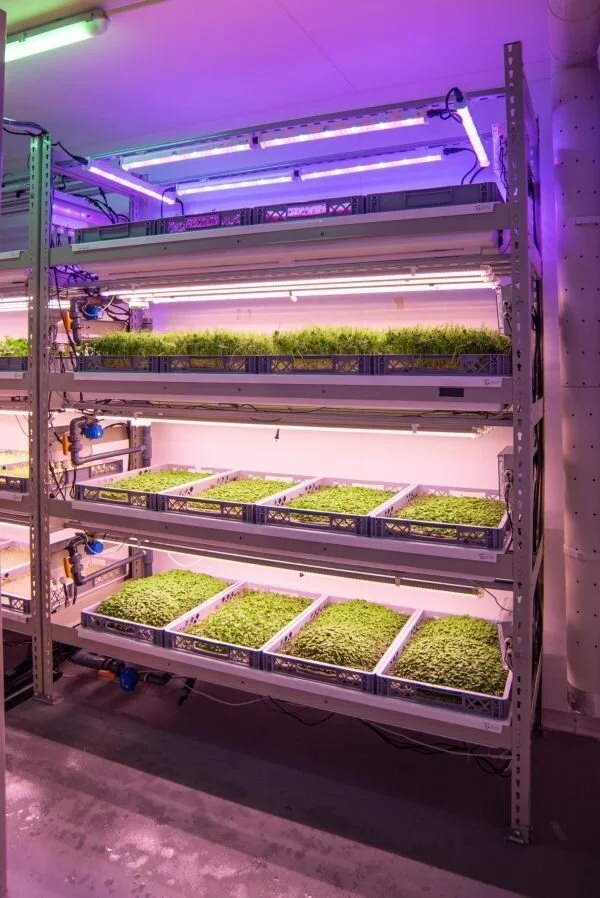
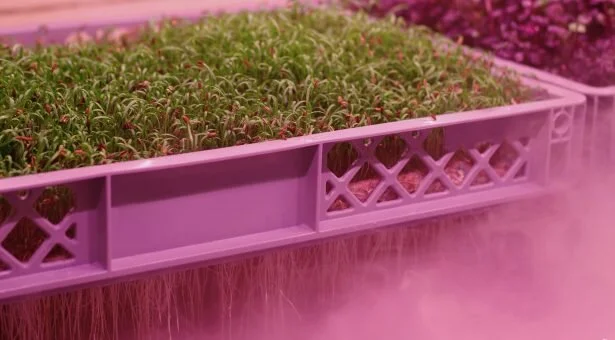
Image: Vertical Farming -- economic and environmental benefits. (Credit: LettUs Grow)
Vertical farms with their soil-free, computer-controlled environments may sound like sci-fi, but there is a growing environmental and economic case for them, according to new research laying out radical ways of putting food on our plates.
Vertical farms with their soil-free, computer-controlled environments may sound like sci-fi, but there is a growing environmental and economic case for them, according to new research laying out radical ways of putting food on our plates.
The interdisciplinary study combining biology and engineering sets down steps towards accelerating the growth of this branch of precision agriculture, including the use of aeroponics which uses nutrient-enriched aerosols in place of soil.
Carried out by the John Innes Centre, the University of Bristol, and the aeroponic technology provider LettUs Grow, the study identifies future research areas needed to accelerate the sustainable growth of vertical farming using aeroponic systems.
Dr Antony Dodd, a Group Leader at the John Innes Centre and senior author of the study, says: “By bringing fundamental biological insights into the context of the physics of growing plants in an aerosol, we can help the vertical farming business become more productive more quickly while producing healthier food with less environmental impact.”
Read more at John Innes Centre
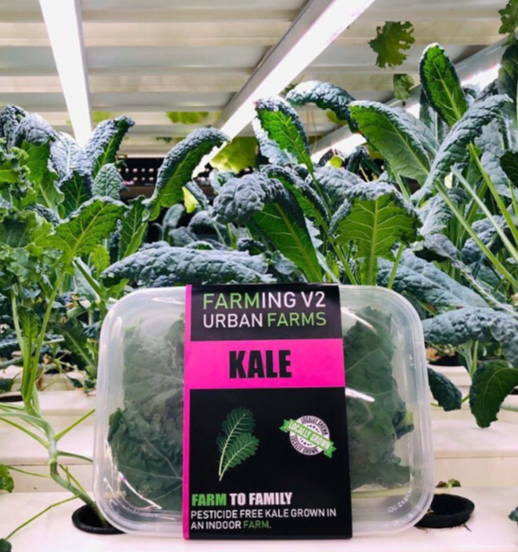
Farming V2 - The New Age of Farming
Hydroponics is a method of agriculture that uses a mineral-rich solvent in lieu of soil. This method uses far less water and allows plants to grow at a much greater speed.

Rags to riches stories fascinate us. We cheer incessantly for entrepreneurs who have beaten the odds, often giving them the stature of a renewed and risen phoenix. Rightly so, the transition from an aspiring entrepreneur to an established one is a challenging peregrination towards a hazy destination.
Amongst the plethora of value-generating activities a business undertakes to stay alive; maintaining cash flow, building a commendable product, keeping costs low, remaining wary of major societal and technological paradigms, the most fundamental challenge for early-stage companies is knowing that the customer exists and convincing the customer you exist. Neglecting the balance between these two essential conditions of success leads many companies towards an early demise.
The fear of failure silently triggers a deep contemplation amongst aspiring entrepreneurs, yet the hope that proclivity will eventually yield success keeps many committed towards their cause.

Kalera Opens Texas’ Largest Vertical Farming Facility in Houston
Houston farm will be the company's newest and largest yet, joins farms in Orlando and Atlanta
Houston farm will be the company's newest and largest yet, joins farms in Orlando and Atlanta
July 13, 2020 | Source: Kalera
The new Houston facility, which will be the largest vertical farming facility in Texas, is the next step in Kalera’s rapid domestic and international expansion plan to bring consumers fresh leafy greens right where they are.
ORLANDO, Fla., July 13, 2020 (GLOBE NEWSWIRE) -- Today, technology-driven vertical farming company Kalera announced that it will open a new state-of-the-art growing facility in Houston, Texas in the spring of 2021. The new Houston facility — which will be the largest vertical farming facility in Texas — is the next step in Kalera’s rapid domestic and international expansion plan to bring consumers fresh leafy greens right where they are. By placing its farms directly in the communities that they serve, Kalera is able to supply national retailers and foodservice distributors without a long haul across the country, guaranteeing that its leafy greens are fresher longer, and much safer than field-grown lettuce.
The new facility is being announced a mere two months after Kalera announced it will be opening a new facility in Atlanta in early 2021—an announcement that took place less than two months after it opened its second Orlando, Florida farm. While Kalera’s Atlanta farm is slated to be the highest production volume vertical farm in the Southeast, the new Houston facility will be even larger and will generate dozens of new jobs for the local Houston community. Kalera’s Houston farm’s lettuce will be available at retailers and foodservice distributors, as well as through the hospitality and travel industry.
Retailers, distributors, and food services facilities interested in carrying Kalera’s lettuce can connect with the sales team at orders@kalera.com.
Kalera is able to quickly open its newest growing facility in Houston as a result of a streamlined design and construction process, further illustrating its ability to rapidly scale and expand its vertical farms. As Kalera accelerates its growth over the next few years, it will continue to open additional facilities, expanding production capacity throughout the US and internationally.
“In light of the global pandemic and seemingly endless food safety recalls, today, more than ever, consumers are demanding food that is local and that they can trust. Kalera is leading the way in the indoor-farming AgTech revolution and we are proud, especially in today’s environment, to bring the safest, purest, freshest, most nutritious, sustainable, non-GMO, pesticide-free lettuce to cities across the country as we continue our rapid expansion plan across America and prepare to open our largest facility to date,” said Daniel Malechuk, CEO of Kalera.
“Houston presents Kalera with a wonderful market for our produce, as it allows us to not only supply one of the largest cities in America, but also service cities throughout the region including Dallas-Fort Worth, Austin, San Antonio, and New Orleans. Since we can easily supply produce within hours of harvest from this location to surrounding cities, Kalera can ensure the highest quality and freshness by delivering product to customers within hours of harvest, rather than days or weeks.”
The company utilizes cleanroom technology and processes to eliminate the use of chemicals and remove exposure to pathogens. With indoor facilities situated right where the demand is, Kalera is able to supply an abundance of produce locally, eliminating the need to travel long distances when shipping perishable products. Kalera's plants grow while consuming 95% less water compared to field farming.
In addition to its R&D center, Kalera opened its first commercial vertical farm, the HyCube growing center, on the premises of the Orlando World Center Marriott to bring fresh, local produce to the hotel’s visitors and customers. In March this year, it announced the opening of its second facility in Orlando, and in April, announced that it will open an Atlanta facility in early 2021. The Houston facility is the fourth farm in Kalera’s portfolio, and will soon be joined by more in the United States and around the world. Kalera also made headlines after pivoting their business strategy amidst the COVID-19 crisis, shifting from a foodservice-focus to land their produce in the aisles of Publix. During this time, Kalera also organized giveaways for the Orlando community, giving away tens of thousands of heads of lettuce to provide access to fresh, local, produce to residents.
About Kalera
Kalera is a technology-driven vertical farming company with unique growing methods combining optimized nutrients and light recipes, precise environmental controls, and cleanroom standards to produce safe, highly nutritious, pesticide-free, non-GMO vegetables with consistently high quality and longer shelf life year-round. The company’s high-yield, automated, data-driven hydroponic production facilities have been designed for rapid rollout with industry-leading payback times to grow vegetables faster, cleaner, at a lower cost, and with less environmental impact.

How Vertical Farms Could Be Ready To Take-Off
A new interdisciplinary study combining biology and engineering sets down steps towards accelerating the growth of vertical farming, including the use of aeroponics which uses nutrient-enriched aerosols in place of soil, reports Science Daily
24 Jul 2020
Study identifies future research areas needed to accelerate growth of vertical farming using aeroponics.
A new interdisciplinary study combining biology and engineering sets down steps towards accelerating the growth of vertical farming, including the use of aeroponics which uses nutrient-enriched aerosols in place of soil, reports Science Daily.
Accelerate sustainable growth of vertical farming
The study was carried out by the John Innes Centre, the University of Bristol, and the aeroponic technology provider LettUs Grow. It identifies future research areas needed to accelerate the sustainable growth of vertical farming using aeroponic systems.
Dr. Antony Dodd, a group leader at the John Innes Centre and senior author of the study, says: “By bringing fundamental biological insights into the context of the physics of growing plants in an aerosol, we can help the vertical farming business become more productive more quickly while producing healthier food with less environmental impact.”
Vertical farming is a type of indoor agriculture where crops are cultivated in stacked systems with water, lighting, and nutrient sources carefully controlled.
Seven areas of future research
The study, which appears in the journal New Phytologist and is called Getting to the Roots of Aeroponic Indoor Farming, lays out seven steps – strategic areas of future research needed to underpin increased productivity and sustainability of aeroponic vertical farms.
These seek to understand:
Why aeroponic cultivation can be more productive than hydroponic or soil cultivation.
The relationship between aeroponic cultivation and 24-hour circadian rhythms of plants.
Root development of a range of crops in aeroponic conditions.
The relationship between aerosol droplet size and deposition and plant performance.
How we can establish frameworks for comparing vertical farming technologies for a range of crops.
How aeroponic methods affect microbial interactions with plant roots.
The nature of recycling of root exudates (fluids secreted by the roots of plants) within the nutrient solutions of closed aeroponic systems.
The report argues that a driver of technological innovation in vertical farms is minimizing operation costs whilst maximizing productivity – and that investment in fundamental biological research has a significant role.
Genetically tune crops to grow in vertical farms
John Innes Centre researchers have bred a line of broccoli adapted to grow indoors for a major supermarket and one of the aims of research will be to test how we can genetically tune more crops to grow in the controlled space of vertical farms.
Bethany Eldridge, a researcher at the University of Bristol studying root-environment interactions and first author of the study adds: “Given that 80% of agricultural land worldwide is reported to have moderate or severe erosion, the ability to grow crops in a soilless system with minimal fertilizers and pesticides is advantageous because it provides an opportunity to grow crops in areas facing soil erosion or other environmental issues such as algal blooms in local water bodies that may have been driven by traditional, soil-based, agriculture.”
Aeroponics is associated with very little water, automation, and high tech systems. But what is the current potential of aeroponics technology to grow food or cannabis crops economically?
Hugo Claver
Web editor for Future Farming
Lead Photo: - Photo: ThisIsEngineering
Farming In The Desert: Are Vertical Farms The Solution To Saving Water?
"When I told people I was going to grow tomatoes in the desert, they thought I was crazy," Sky Kurtz, founder of Pure Harvest Smart Farms, told DW
With high temperatures and water scarcity, the Emirates might seem an unlikely place for a farm. Yet, as coronavirus and climate change heightens the desire for food security, could vertical farms be the solution?
"When I told people I was going to grow tomatoes in the desert, they thought I was crazy," Sky Kurtz, founder of Pure Harvest Smart Farms, told DW.
With just an average 12 days of rain a year, less than 1% arable land, a desert location, and an 80% import rate for food, the United Arab Emirates (UAE) seems an unfavorable place to set up a farm.
Read more: World needs 7 planets to eat like a G20 nation, food report finds
Kurtz is one of several entrepreneurs using high-tech farming techniques to boost crop production in the Emirates. Pure Harvest built the first climate-controlled greenhouse in Abu Dhabi in 2017.
Prompted by arid conditions and a desire for greater food security, the country is investing millions in technologies — such as vertical farming — that could make it an unlikely agricultural pioneer.
Read more: Goodbye to fields: What food production may look like tomorrow
Sky Kurtz says people thought he was crazy when he said he would grow tomatoes in the desert
Vertical farms can grow a rich variety of different crops by stacking them in layers under LED lighting in climate-controlled greenhouses and watering them with mist or drip systems. The process is tailored to each crop's specific needs, resulting in high-yield, year-round harvests.
"It takes 30 to 40 days to grow leafy greens out in the field. We can grow that same crop in 10 to 12 days," says Marc Oshima, co-founder of Aerofarms. The company received funding from the Abu Dhabi Investment Office to build the capital's largest indoor vertical farm, with 800 different crops, by 2021.
With vertical farming, crops can flourish year-round, far from traditional regions of production
Water scarcity and fossil-fuel reliance
The technology uses minimal land and up to 95% less water than conventional agriculture.
The hydroponics system places the plants' roots directly into a water-based and nutrient-rich solution instead of soil. This "closed-loop" system captures and recirculates all the water, rather than allowing it to drain away — useful for a country like the UAE suffering from extremely high water stress.
Read more: Blue Gold: The dwindling resource of water
Globally, agriculture accounts for 70% of freshwater withdrawals, and UAE is extracting groundwater faster than it can be replenished, according to the International Center for Biosaline Agriculture (ICBA).
"Water is very expensive over in the UAE, but energy is cheap as it is subsidized," says Jan Westra, a strategic business developer at Priva, a company providing technology to vertical farms.
The artificially controlled environment is energy-intensive because the air conditioning and LED lights need a constant source of electricity.
This bringing forth of life in the desert could come at a high environmental cost. Most of that energy comes from carbon-emitting fossil fuels, even as the Middle Eastern country feel the effects of climate change.
By 2050 Abu Dhabi's average temperature is predicted to increase by around 2.5°C in a business-as-usual scenario. Over the next 70 years, patterns of rainfall are also expected to change.
Aerofarms has received funding from the Abu Dhabi Investment Office to build the capital's largest indoor vertical farm, with 800 different crops, by 2021
Integrating renewable energy
Although Pure Harvest is building a solar-powered farm in neighboring Saudi Arabia, its UAE operations get electricity from the carbon-intensive national grid.
Investing more in renewables "is a goal of ours," Kurtz told DW. He said the company has not set a clean energy target but is working on various green power projects, including a plan to integrate solar power generated in UAE into its operations.
However, Willem van der Schans, a researcher specializing in short supply chains at Wageningen University in the Netherlands, says sustainability and clean energy should be "inherent in the technology and included in plans when starting a vertical farm."
He argues that many vertical farming companies are not sustainable in terms of energy as they still view clean power as an optional "add-on."
Read more: Innovative clean water technologies
Ismahane Elouafi, director-general of the government-funded ICBA in Abu Dhabi, acknowledges that vertical farming has some way to go before achieving "real sustainability," but she believes the innovations are "promising."
Improved battery storage, increasingly efficient LED lights and cheaper solar panels will help, she adds.
Local solutions
By 2050, the UAE government wants to generate almost half its energy from renewable sources.
Fred Ruijgt, a vertical farming specialist at Priva, argues that it's important to factor transport and refrigeration into the energy equation. Vertical farming uses more energy to grow crops than traditional agriculture, but because crops are grown locally, they do not have to be transported by air, sea or truck over long distances.
Vertical farming installations come in all shapes and sizes, meaning food can grow where land and water are scarce
"The energy-saving is difficult to calculate exactly, but the advantages of locally grown crops are huge," he says, adding that those grown in vertical farms not only use less water and pesticides but that they also have a longer shelf life due to minimal transportation time.
Read more: Dubai: Can the city of black gold go green?
Food security and coronavirus
In 2018, the UAE set out its vision to become a hub for high-tech local food production.
Companies and investors have flocked to the region, attracted by the 0% corporate tax rate, low labor costs, and cheap energy. With their help, UAE aims to reduce its reliance on imports and make its food system more resilient to shocks like climate change and pandemics.
Oshima from Aerofarms says the coronavirus pandemic has brought "greater appreciation of how fragile the supply chain is and raised questions about food safety and security."
When the UAE went into lockdown in April, imported supplies of perishable goods like vegetables fell and business boomed for local suppliers.
ICBA's Elouafi said they have helped keep the UAE well-stocked during the pandemic.
"With the help of local food production and adequate imports, there has been absolutely no shortage of food in the UAE," Elouafi told DW.
Climate change, however, poses an altogether more complex threat to the country in the long-term. Given climate change's likely impact on food production, she says vertical farming has shown it is "an economically viable proposition even with harsh climatic conditions."

Is The Future of Farming Indoors?
The global population is predicted to reach 9.7 billion by 2050, and to feed everyone, it’s estimated that global food production will need to increase by up to 70% in the next 30 years
July 14, 2020
Brian Kateman Contributor
I write about sustainable and ethical technology and consumer trends.
The global population is predicted to reach 9.7 billion by 2050 and to feed everyone, it’s estimated that global food production will need to increase by up to 70% in the next 30 years.
There are many challenges to overcome before fears of a worldwide food shortage can be allayed, including rising temperatures and more frequent droughts caused by global warming. These obstacles are making traditional farming methods increasingly inefficient and unpredictable.
Traditional farming has also been hit hard by the COVID-19 pandemic. According to the FAO, border closures, quarantines and disruptions to supply chains are limiting some people's access to food, especially in countries hit hard by the virus or already affected by high levels of food insecurity.
There’s an emerging consensus that the agriculture industry needs to adapt to use less water and chemicals, make crops less vulnerable to changes in the climate, and produce more reliable yields. Part of the answer may lie in the emerging start-ups growing produce in indoor environments, where growing conditions can be better managed.
The indoor farming technology market was valued at $23.75 billion in 2016, and is projected to reach $40.25 billion by 2022. Yields are typically much higher than traditional farming methods. Crops from indoor farming are grown in three dimensions, rather than two – and can be grown all year round, independent of external weather conditions.
Square Roots next-generation farmers growing basil. CRAIG VANDER LENDE
One of Square Roots’ indoor farms, for example, produces the same amount of food as a two- or three-acre farm annually, just from 340 square feet. This yield is achieved by growing plants at 90 degrees, and by using artificial intelligence (AI) to ensure the environment is optimal for each specific plant, including the day and night temperatures and amount of CO2 needed.
“Our indoor farms are living biosystems, constantly adapting to maintain optimal climates for growing specific crops. We’re then able to understand how changes in the climate can impact yield taste and texture,” says Tobias Peggs, Square Roots’ chief executive.
Not only could indoor farming help adapt to a warming planet, but it has the potential to help slow down climate change by being more sustainable – using less water and producing fewer emissions. While estimates vary widely, according to the United States Environmental Protection Agency, agriculture accounted for 10% of all greenhouse gas emissions in 2018; it is also highly dependent on, and a pollutant of, water.
Square Roots’ pop-up farms are built in shipping containers in cities, often in parking lots. They serve local communities, which means reduced emissions compared to traditional agriculture, which often involves transporting food much further. For example, it has 10 farms in Brooklyn that serve 100 retail stores all within five miles of the farm.
At the Plenty headquarters in South San Francisco, leafy greens use up one percent of the land and five percent of the water compared to traditional outdoor farms, says Matt Barnard, the start-up’s Chief Executive Officer, and Co-Founder.
AeroFarms’ indoor farm in New Jersey grows greens including baby kale, baby arugula, and baby watercress using 95% less water than conventional agriculture on just one percent of the land required. The crops grow under LED light with no pesticides and a fraction of the fertilizer used on traditional farms.
AeroFarms environmentally-controlled indoor farms can grow all year round independent of climate and ... [+] AEROFARMS
Marketing director Alina Zolotareva says being able to produce have ready-to-eat produce that doesn’t require rinsing helps to reduce water usage.
“This is a transformational innovation for agriculture at large,” she says, “as access to fresh water for growing food is one of the most pressing challenges of our time.”
As well as fewer miles and less water, indoor farming doesn’t require pesticides. This is better for the environment and human health as it eliminates the risk of water contamination due to run-off, and is in line with increasing consumer demand for non-GMO produce.
Plenty eliminates the need for pesticides with LED lights, which are synced with the crop’s growth, Barnard says, to provide the ideal spectrums and exposure and minimize energy usage.
“Our sensor system ensures each plant gets exactly the amount of purified water it needs, and any excess water is recycled through a closed-loop irrigation system resulting in greatly reduced water consumption and zero waste,” he says.
Nanobubbles super-saturates the water with oxygen, making the plant roots healthier. This promotes ... [+]
MOLEAER
Other farms are using nanobubble technology, such as Moleaer, which has allowed more than 100 indoor farms to connect their irrigation systems to generators that provide oxygen via sub-micron gas-containing cavities to the plant’s roots to provide chemical-free water. These nanobubbles result in healthier roots, more resilient plants, and increasing crop yields, says Nick Dyner, CEO of Moleaer.
“Our oxygen transfer efficiency provides the most cost-effective solution to elevate oxygen levels in the water, which in turn promotes beneficial bacteria and root development,” he says.
The company is also working on a new NASA-approved space farming research project, exploring how astronauts on the International Space Station can grow their own food in microgravity using nanobubble technology.
There are concerns that it’s an expensive investment, but Dyner says Moleaer has various systems so it’s accessible to all sizes of indoor farms, high- and low-tech. Some products do, however, require growers to connect an external source of oxygen, which must come from a gas supply company or an onsite oxygen generator, which Moleaer provides.
“In many cases, traditional farmers may have more to gain by using our technology, since the capital investment is significantly less than the most advanced growing technologies available today, which are often out of a typical farmer’s budget,” Dyner says.
“Nanobubble technology is a cost-effective, chemical-free, and scalable solution that allows growers to increase crop yields and shorten cultivation time - which will be much needed to feed our growing population in the future.”
Peggs says Square Roots is also focused on ensuring its technology makes farming an accessible career path for young people who live in urban areas.
“If you’re a new young farmer at Square Roots, our app will guide you through what to do; what’s growing, what state is in it, what do we need to do today based on where things are in the growth cycle. Through our app and our training program we’re able to bring new people into our team, even folks with zero horticulture experience, and get them ready to go in about six weeks.”
Indoor farming is putting the youth back in agriculture. PLENTY
But despite being an emerging option for youth in the city, Barnard predicts most will remain traditional farmers.
“The world still needs the field and will need the field forever. We support the field by growing in addition to the field. Over time, [indoor] farming systems will become more accessible and affordable. Both field and indoor farming will be necessary to support global food demand.”
Viraj Puri, Co-Founder, and CEO of Gotham Greens, a pioneer in urban indoor agriculture that operates over 500,000 square feet greenhouses in 5 U.S. states, echoes this sentiment: “Growing produce indoors certainly has an increasing role to play in the future of sustainable food production. While indoor farming may not represent the future of all fresh produce production, for certain types of crops such as tomatoes, cucumbers, leafy greens, and herbs, it will become more prevalent. Customers are increasingly recognizing the reliability, consistency, and high quality of greenhouse-grown produce that’s grown in close proximity to large population centers using fewer natural resources. Other agricultural commodities like grains or fruits or root vegetables, however, can’t yet be produced.”
However, Dyner predicts that, eventually, the majority of agriculture will move to indoors, in vertical farms— the practice of growing crops in vertically stacked layers—in urban areas.
“These settings enable traditional farming to shift to controlled growing conditions, using new technology and automation, and reducing the risk of exposure to harsh climate conditions,” he says.
Plenty's goal is to build vertical farms in urban hubs and distribute each farm’s harvest locally ... [+]
PLENTY
Start-ups like Square Roots, Plenty, and AeroFarms currently practice vertical farming, which is a form of indoor farming that relies on artificial lighting such as LEDs instead of drawing on natural sunlight.
Other indoor farming companies like Gotham Greens grow produce in high-tech glass-clad greenhouses that primarily rely on natural sunlight for plant photosynthesis. According to Puri: “vertical farming is a more nascent technology within the indoor farming sector and the costs of running a vertical farm with artificial lighting and air conditioning is currently not as cost-effective as relying on natural sunlight in greenhouses.”
Gotham Greens takes a different approach, relying on natural sunlight rather than the artificial ... [+]
GOTHAM GREENS AND JULIE MCMAHON
“Greenhouse indoor farming technology has been in operation globally for 20 to 30 years and is proven to be commercially viable. That being said, the costs around artificial lighting and other vertical farming technologies have been coming down significantly in the past few years,” he adds.
Nonetheless, indoor farm technology start-ups, broadly speaking, don’t see themselves as disruptive, but as being on the same side of traditional farms, for the wider cause.
“The common enemy is the industrial food system, shipping food from one part of the world to the other, rather than locally produced food,” Peggs says.
Indoor farms don’t work in competition with each other, either; they work collaboratively by forming a network that shares data. For example, AeroFarms is collecting data on a research project with the non-profit Foundation for Food & Agriculture Research to understand the sensory and nutritional characteristics of leafy greens for the benefit of the entire agriculture industry.
However traditional and AI-based indoor farming work together in the future, there’s little doubt that indoor farming is helping to meet the needs of a growing global population and support traditional farming, which is both at the mercy of and exacerbating a warming planet. Only one method will find itself in space – but there’s space for them both.

I am co-founder and president of the Reducetarian Foundation, a nonprofit organization dedicated to reducing consumption of animal products.
Lead Photo: The world’s current agricultural practices are unsustainable, and indoor farming may offer solutions ... [+] PLENTY

Larry Ellison's Indoor Greenhouse Farm In Hawaii Undergoes Business Changes
The initial farm on Lanai island was separated from Sensei, formerly Sensei Retreats, and Sensei Lanai, a wellness resort operated by hotel management firm Four Seasons
April 12, 2011: Lanai, Hawaii. The long red dirt road of Munrow Trail. (Image: Jenna Szerlag/Design Pics via ZUMA Wire)
HONOLULU - The owner of a hydroponic greenhouse operation in Hawaii has announced changes to the farm operation in Lanai, including a new leader and severance from resort operations.
Owner Larry Ellison and partner David Agus said earlier this week that Sensei Farms has been rebranded as Sensei Ag as part of the change, the Honolulu Star-Advertiser reported.
Sensei Ag began producing vegetables earlier this year on Lanai and is currently supplying hotels, retailers, and chefs on the island. The operation aims to produce more than a million pounds of food annually for distribution beyond Lanai using 90% less water than traditional farming, company officials said.
The initial farm on Lanai island was separated from Sensei, formerly Sensei Retreats, and Sensei Lanai, a wellness resort operated by hotel management firm Four Seasons.
The farm and the resort were previously part of Sensei Holdings, Inc.
Sonia Lo was also named CEO of Sensei Ag, officials said. Lo has more than 30 years of experience in finance and most recently was CEO of Crop One Holdings, a California-based indoor farm operator.
“We are incredibly well-positioned with Larry and David’s guidance, knowledge, and networks to become the leader in our space,” Lo said. “There has never been a better time to rebuild our global food and agriculture supply chains.”
Ellison, the co-founder of Oracle Corp., was ranked by Forbes as the fifth-richest person in the world, with a net worth of $73 billion. He bought 98% of Lanai in 2012, the Star-Advertiser reported.
His partner Agus is a doctor and renowned cancer specialist.

Vertical Farm Opens First of 20 Planned Facilities
The 10,000 square-foot facility contains 6,500 square feet for production. It grows more than 20 cultivars, including leafy greens such as Romaine, arugula, kale, bok choy, and baby spinach, plus more than a dozen herbs, including basil, cilantro, and parsley
June 23, 2020
By Greenhouse Canada
Source: Local Leaf Farms
New Canadian agtech company Local Leaf Farms opened the doors to its new Barrie facility yesterday – the first of 20 planned to open by the end of 2025.
The 10,000 square-foot facility contains 6,500 square feet for production. It grows more than 20 cultivars, including leafy greens such as Romaine, arugula, kale, bok choy, and baby spinach, plus more than a dozen herbs, including basil, cilantro, and parsley.
Local Leaf Farms says they grow local produce that’s fresh, sustainable and fully traceable – addressing concerns by Canadian consumers.
The demand for local
According to an IPSOS study, 68 percent of Canadians say the COVID-19 pandemic has made food safety more important to them, and 47 percent say locally produced food is a top factor driving their purchase decisions. Nearly all Canadians (96 percent) prefer to buy produce grown in Canada, whether in their local community (21 percent), their province (41 percent), or elsewhere in the country (34 percent).
“Canadian consumers are demanding greater transparency about the food they eat. And that demand has never been more urgent,” said Steve Jones, President, and CEO of Local Leaf Farms. “As we begin to consider a post-COVID reality, we need to have real discussions about the stability – and overall future – of food production in this country. Local Leaf is bringing leading-edge technology to the food sector to produce the fresh, safe, and sustainable produce that Canadians are asking for.”
According to Local Leaf, the average package of leafy greens travels 3,000 km before it lands in a shopper’s cart at a Canadian grocery store. The journey can reportedly take up to two weeks, causing produce to lose up to 70 percent of its nutritional value and impacting taste, texture, and flavour.
To reduce the impact, all of Local Leaf Farms’ produce can be found at local grocery stores just hours after it is harvested, not only because of the facilities’ proximity but because it can be delivered directly without passing through distribution centres.
Automated and traceable
Local Leaf also offers a fully traceable food source, with instant access to information about the food from seed to shelf. The company’s proprietary technology and mobile app allow retailers and consumers to know exactly where their produce comes from, including detailed information on how it was grown, when and by whom. With automated technology, Local Leaf is able to employ an entirely local workforce, eliminating the need to rely on migrant labour – a workforce that has faced severe challenges in the face of COVID-19.
Connecting with consumers
“In addition to our year-round production in our vertical farm, our Barrie, Ontario location has converted its 20,000 square foot backyard to an outdoor community garden. This allows identified residents to grow their own food and learn from our agronomist and team in a collaborative environment,” says Local Leaf Farms.
Local Leaf’s facility is also open to the public once every month, allowing local residents to more closely connect with their food.
Eliminating plastic from packaging
In the results of the IPSOS study, more than two in three Canadians (68 percent) say that eliminating plastic from their food packaging is important, and half (51 percent) say they would prefer their leafy greens and herb packages be made of a non-plastic, compostable, plant-based material. In contrast, 21 percent would prefer produce to come packaged in recycled plastic, sometimes referred to as recycled PET.
“That’s why we’re excited to have sourced packaging that is made of non-plastic, compostable, plant-based material for all Local Leaf products,” says the team.
Plans for expansion
Local Leaf’s Barrie location services grocery stores, food service providers, and home meal kit providers within 50km of the farm. All of the produce, which is sold under the My Local Leaf brand, is pesticide- and herbicide-free, non-GMO, and packaged in 100 percent plastic-free compostable packaging. The company is on track to open its next location in Kingston in the coming months – and has a scale goal to launch 20 locations across the country by the end of 2025.
With files from Local Leaf Farms