


Welcome to iGrow News, Your Source for the World of Indoor Vertical Farming
UAE: Growing Salads In Dubai
With the world in Lockdown Local warehouse farms can come into their own and show their value, by growing staple salads and not just Microgreens


Uns is the largest operational farm in the UAE and was designed with the intention of providing fresh high-quality produce to the masses of the UAE.
Here at Uns Farms, we took a different approach to the typical ‘concept’ warehouse vertical hydroponic farm, as we believed that these types of projects need to be large in order to make a real impact and actually address food security. To do this, we took the bold step and built a large-scale vertical farm inside a warehouse complex. Uns farm has some 2,000 ebb n flow benches that have 2.88m2 growing area each. This makes Uns one of the largest warehouse growers with over 5,700 m2 of growing space available now.
A global crisis like the COVID19 virus has really highlighted the importance of local produce and the stability it can provide.
Uns Farms being a large operation, has always meant that we grew products for all segments of the market. So, from the start, we had three main product lines or divisions.
Gourmet for the HORCEA industry, Premium for the mass supermarket industry then our specialty lines for all markets. The HORCEA industry has been impacted in a big way, however, there is still a market given the home delivery of food from the Restaurants. Our premium baby leaf market has seen an increase in market share due to the supermarket sales increasing, so people although not eating out still have access to our produce through our distribution in local supermarkets.
Uns is focused on growing the best quality mixture of leaves which we pack as baby leaf’s in a range of six mixes. These are grown for quality, taste & texture. Our micro herbs have always been grown to order so by doing this the slowing down of the market our damage has been limited. Distributors take care of the sales in both the HORECA and retail, while we take care of the growing. Therefore, we are diversified and not too dependent on anyone's market segment.
Customers can reach us for our products through some large chain supermarkets and we are exploring online platforms, but we are constantly battling to expand our reach through as many mediums as possible.
We also have a steady flow of sales directly from the farm and people are welcome to purchase our products directly from the farm as well.
So as one door has closed in hospitality, we have other doors of opportunity and are always looking for the next one. Innovation is not just growing, but sales and distribution are key.
One benefit of indoor warehouse growing is we have more food security, However, we are based in Dubai so now as the summer is arriving we are seeing ‘Normal’ greenhouse farms slowing production down due to the heat and humidity. Here at Uns Farms we are actually increasing production and expanding. Our quality increases due to us being able to control the conditions that we grow in. So we aim to continue to provide our fresh salad and expand our range as indoor growing allows us to be relatively safe from outside elements.
Our products are salad mixes and we have designed them to cater to multinational tastes and cuisines to fit the diverse community of the UAE.
Uns farms were built as a large-scale commercial facility, with the intention of supplying high-grade consumer-based salad products. We were built with the vision to address the masses and to help the UAE fight its dependence on imports and build food security. Given that this farm is the largest in the country,
we only aim to grow larger and cement the UAE as an agricultural powerhouse in the region.

Colruyt Grows Basil In Self-Developed Vertical Farm
The basil plants are grown in a sustainable way but are not organic. The problem is that they are not grown in the open air, nor on biological substrate, which is why they do not receive an organic certificate
On Tuesday, March 3rd, Colruyt Group introduced home-grown basil from a vertical farm. The fresh basil from the private label Boni Selection can be purchased from today in all 31 stores of Bio-Planet. Bio-Planet will also market-fresh coriander within months.
Fabrice Gabbato
According to Fabrice Gobbato, director of Bio-Planet and Okay; sustainability is in Colruyt's DNA and they were looking for a way to make the range more sustainable. "The system is sustainable and local. We do not use plant protection products and the product travels a distance up to five times less. The plants also need less space, water, and nutrients, which means that the footprint of this product is very small."
No organic label
"Although growing basil is quite difficult, we have opted for basil because there is a lot of demand for it," says Fabrice. "The basil plants are grown in a sustainable way but are not organic. The problem is that they are not grown in the open air, nor on biological substrate, which is why they do not receive an organic certificate.
The price that consumers pay for the fresh basil in the Bio-Planet stores is € 1.89, the normal market price."



Capacity: 250,000 plants
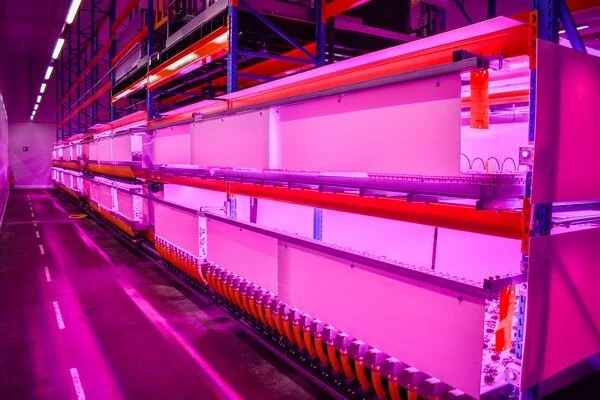
In the Colruyt distribution center, near the head office in the Netherlands, the retailer grows basil plants under violet light. "We have developed the entire installation, from ventilation to lamps, in collaboration with KU Leuven and UGent. We opted for our own installation because we mainly wanted to focus on energy efficiency, "says Wannes Voorend, R&D coordinator of Colruyt Group. "We are currently growing the plants on two layers of 450 square meters, with a capacity of 250,000 plants."
High technology
In the vertical farm, it is moist and the temperature is 30 ° C. "We use state-of-the-art technology whereby the plants receive a different mix of light, water, and air every day. This makes the plants stronger so that they can be kept longer. The right mix of red and blue light ensures that the plants contain more aroma and grow twice as fast, the R&D coordinator continues. We recycle all the water that the plants do not absorb or that evaporates. All the energy used by the vertical farm is green."
Future plans
Colruyt is in charge of the entire cultivation process, from growing the seeds to packaging the mature plants. "We started this project about three years ago in a small aquarium with lamps and currently we can supply 31 stores. In the future we want to grow at more levels and also supply the other chains, but this is a step in the right direction. Currently, all operations in the vertical farm are still done manually. We intend to automate the entire process, but that is the future, "says Wannes.
"We Are All In This Together And We Will Make It"
Vertical farming has been hit by the virus as many farms deliver their fresh produce to the hospitality service
vertical farms are battling the new market situation due to COVID-19
The COVID-19 has a huge impact on many industries due to the measurements taken in regards of labor and food safety. Also the vertical farming has been hit by the virus as many farms deliver their fresh produce to the hospitality service. Now most restaurants are closed they have to come up with solutions for their produce. We reached out to vertical farms worldwide to see what measurements they have taken to battle the COVID-19.
What to do with the produce?
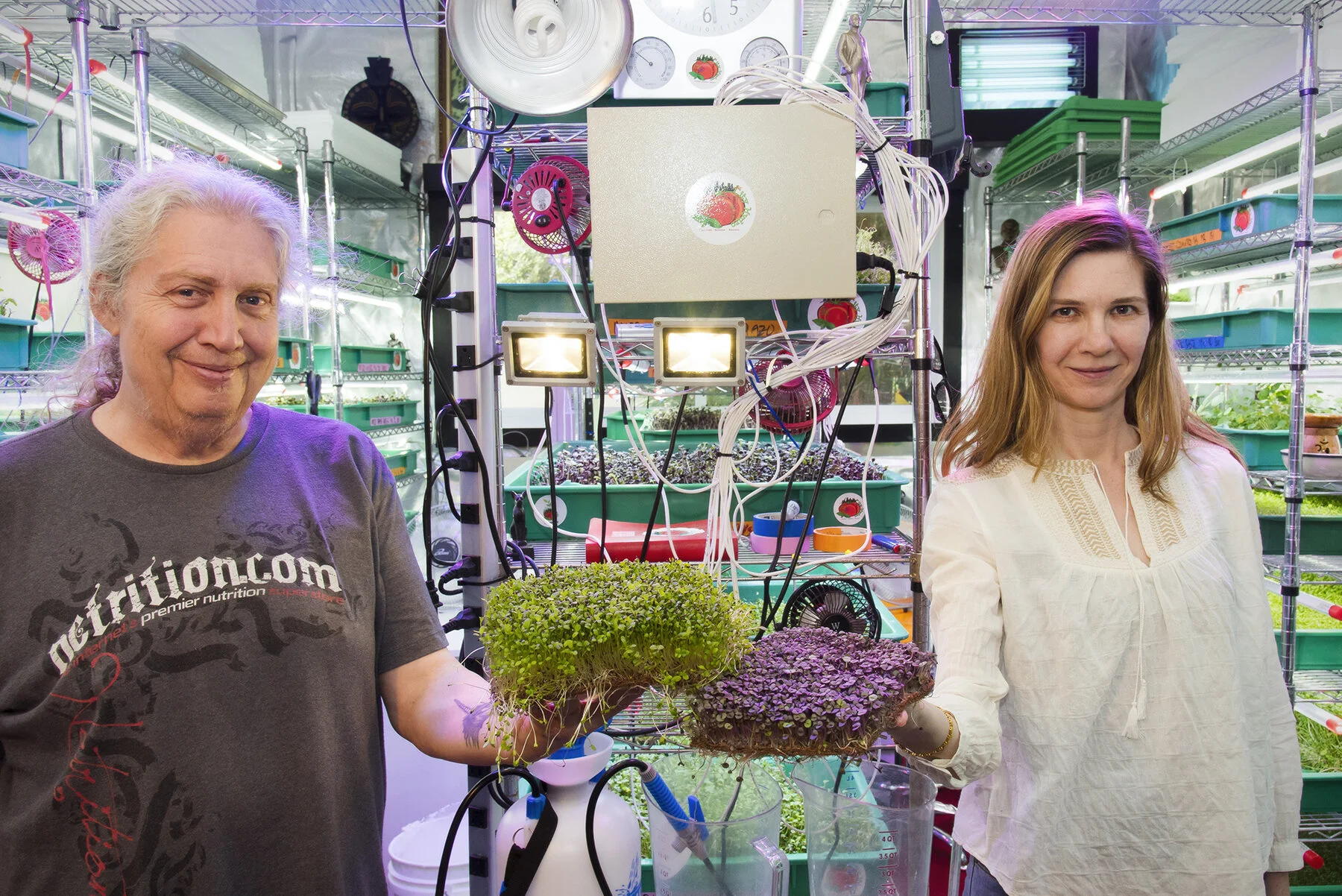
"Many have seen complete closers resulting in no orders, so they are targeting home delivery and CSA (Community Supported Agriculture). Such as Facebook posts in neighborhood groups e.g., letting their neighbors know they have fresh, living microgreens for sale", says Larry Hountz with City Hydro Systems, growing microgreens in Baltimore City. "This will more than likely continue after we get back to open restaurants and folks eating out being a new revenue stream for them."
Larry and Zhanna Hountz with City Hydro Farm showing their fresh produce
Tossing outAlso Ard van de Kreeke with Growx in Amsterdam, Netherlands, says the orders have shut down completely. "The growing period of most of these products is 4 or 5 weeks, so if I have to deliver in 4 weeks I have to sow the cresses now. I can’t just stop producing. For the next three weeks, we will have to toss everything that comes out of our greenhouse, out. Now we try to harvest everything and have our customers make oils and things like that. We just try to give everything away and make people happy with the products."
An employee harvesting fresh lettuce at Growx
Direct selling to customers
In Taiwan, the team with YesHealth Taiwan is building a salad brand to influence consumers to eat salad more often. "The percentage of selling directly to the consumer is around 35% now", says Stella Tsai with YesHealth Taiwan. “YesHealth in Taiwan has three main selling channels. The first is wholesale, the second is direct to the end-consumer, and the third is to hotels and restaurants. Out of these, the two first are the most important. The COVID-19 has caused a 30% decrease towards hotels and restaurants because of the lack of customers in horeca. But sales towards wholesale and the end-consumers through our online shop have increased by more than 40% at the same time. That is because people want to buy vegetables and cook at home”, Tsai mentions.
Grahame Dunling with Uns Farms, a large-scale vertical farm inside a warehouse complex, located in the United Arab Emirates. “As our distributors handle sales in both horeca and retail, while we take care of the growing. Therefore, we are diversified and not too dependent on anyone's market segment, as our distributors.”
Jesper Hansen director at YesHealth Group checking the produce
Other outlets possible?
As most of the restaurants are closed most of the options seem to be out of reach. Tsai comments, “With many restaurants closed, we had to consider alternatives. Luckily, we already process some of our harvests into supplement products. For instance, we have made our green kale into probiotic powder, which is good for stomach health”.
"The support I have seen locally to the hospitality industry has been amazing folks ordering delivery or take away, GoFundMe pages, etc. We are all in this together and we will make it", Hountz adds.
What to do now?
Dunling continues, "We were built with the vision to address the masses, and to help the UAE fight its dependence on imports and build food security. All we can do now is continue to provide our fresh salads, as indoor growing allows us to be relatively safe from outside elements".
The vertical farm of Uns City Farm
Hydro City Farm still has plenty of supplies but there are slight concerns as their Chinese light manufacturer is still closed. “They are on lockdown, one person is allowed to leave the house every 3-4 days for food and other items, as it has been like this since December. Unless this is a seasonal virus and the warm temperatures kill it off we are going to be in this boat for a while", Hountz remarks.
For more information:
City Hydro Systems
Larry Hountz, Owner
larry@city-hydro.com
www.city-hydro.com
Growx Amsterdam
Ard van de Kreeke, Owner
www.growx.co
Uns FarmsMehlam Murtaza, Owner
Grahame Dunling, CEO
grahame@unsfarms.com
www.unsfarms.com
YesHealth Taiwan
Jesper Hansen, International Business Development Director
jesperhansen@yeshealth.com.tw
www.yeshealth.com.tw
Publication date: Fri 20 Mar 2020
Author: rebekka@boekhout.nl
© HortiDaily.com

Shipping Firms Warn of Risk To Food Supplies
Britain’s food imports could be cut off without more long-term support for shipping companies and fast-track coronavirus testing for maritime staff, the Government has been told
Sailings Could Be Cut As Ferry Companies Face A Cash Crisis That Will Force Layoffs
By Lizzy Burden and Alan Tovey, INDUSTRY EDITOR
21 March 2020
Britain’s food imports could be cut off without more long-term support for shipping companies and fast-track coronavirus testing for maritime staff, the Government has been told.
Half of Britain’s food is imported and there has been a spike in supplies from Europe as shoppers panic buy.
Boats carrying trucks packed with food keep shelves stocked but sailings could be cut as ferry companies face losses because of a collapse in passengers which makes running services that also carry freight viable.
The UK Chamber of Shipping, whose members include operators such as Brittany Ferries, P&O and Stena, said some sailings are “ghost ships”.
Bob Sanguinetti, chief executive of the industry group, said: “State support on wages to avoid layoffs is helpful but we’re facing a long-term issue. We don’t know how long it will be sustainable to run services which are losing money but are vital to supply the food and materials the country needs.”...
To continue reading

4 Ways To Avoid Picking Up Germs At The Grocery Store
Believe it or not, your local food mart may be germier than a public restroom. That's right — from bacteria to viruses, grocery stores can expose you to a plethora of potential pathogens

By Jaime Osnato
March 17, 2020, Medically Reviewed by Jennifer Logan, MD, MPH
Believe it or not, your local food mart may be germier than a public restroom. That's right — from bacteria to viruses, grocery stores can expose you to a plethora of potential pathogens.
Your local supermarket may be a hotbed of germs, but shopping smart can help prevent you from getting sick.
Credit: miljko/E+/GettyImages
Whether you're trying to avoid the common cold or stay safe from the novel coronavirus, taking these four precautions can help protect your health on your next food run.
1. Be Careful With Carts
At the grocery store, the first thing you touch — the shopping cart — may be the most perilous when it comes to picking up pathogens.
A study conducted in Spain found that 41 percent of shopping cart handles and 50 percent of cart baskets (where children usually sit) were contaminated by enterobacteria (which are associated with intestinal diseases) while coliforms (which often originate from feces) were lurking on almost 26 percent of handles and 46 percent of baskets, per December 2018 research published in the Journal of Applied Animal Research.
Similar results were found in American grocery stores. A December 2012 study in Food Protection Trends detected coliforms — including E. coli — on 72 percent of shopping carts. Researchers noted that this finding indicated far greater bacterial levels than those discovered in public restrooms. Eww.
According to the authors' hypothesis, these bacteria may have stemmed from contact with raw foods (think: meat), bird poop (while the carts were stored in parking lots), consumers' dirty hands and leaky diapers.
Not only is this super gross, but exposure to these bacteria can cause infections. To avoid this gaggle of germs altogether, consider using your own portable cart for grocery shopping. But if that's not possible, you can still take a few precautions to lower your risk.
"Wipe down the shopping cart handle (and the child seat) with disinfectant before you use it while also minimizing hand-to-face contact as you move through the store," suggests Jason Kindrachuk, PhD, a virologist at the University of Manitoba in Canada. And at the end of your trip, wash your hands with soap for at least 20 seconds or clean them with a good alcohol-based sanitizer.
Related Reading
4 Ways to Avoid Picking Up Germs at a Restaurant
2. Skip the Self-Checkout
Self-checkout may be super convenient, but it's also a surefire way to make contact with meddling microbes, University of Arizona microbiologist Charles Gerba, PhD, tells LIVESTRONG.com.
Just imagine all the grimy hands that have touched the screen throughout the day. This germy picture grows even grislier if you consider that most people don't follow the Centers for Disease Control and Prevention (CDC) guidelines for proper hand-washing practices (ICYMI, the CDC recommends scrubbing with soap and water for 20 seconds).
"Wash [your hands] with soap and water as soon as you have the chance. Hand sanitizers and wipes carry a convenience factor, but their effectiveness can be hindered depending on how dirty or oily your hands are."
Indeed, an April 2013 study published in the Journal of Environmental Health found that only a measly 5 percent of bathroom users washed their hands long enough to effectively kill germs that can cause disease. And it gets worse: A whopping 33 percent skipped the soap and 10 percent didn't even bother washing their dirty mitts at all.
Needless to say, this hideous hand hygiene can transform your self-checkout kiosk into a breeding ground for germs. But if you're in a pinch and must use it, always apply an alcohol-based hand sanitizer afterward, Gerba says, adding that sanitizers with at least 60 to 70 percent alcohol work best against viruses.
"That said, make sure to wash with soap and water as soon as you have the chance. Hand sanitizers and wipes carry a convenience factor, but their effectiveness can be hindered depending on how dirty or oily your hands are," Kindrachuk adds.
Tip
In addition to reducing hand-to-face touching, be mindful of how often you're touching your smartphone while out and about. And don't forget to sanitize your device, too — here's when and how to do that.
Opt for packaged cheeses over slices from the deli counter.
Credit: ShotShare/iStock/GettyImages
3. Ditch the Deli Counter
You might have heard that eating processed lunch meats can increase your cancer risk, but you might not know that cold cuts can make you sick in other ways, too.
A November 2014 study published in the Journal of Food Protection found that almost 10 percent of samples from 30 delis — including swabs from surfaces like meat slicers and counters where food is prepared — tested positive for the bacteria Listeria monocytogenes.
If ingested, these bacteria can cause diarrhea or an upset stomach in healthy people but may result in more serious systemic infections in the elderly, children, pregnant women and individuals with weakened immune systems.
For this reason, the CDC recommends those who are at higher risk avoid eating foods like lunch meats, cold cuts and other deli meats (unless cooked to an internal temperature of 165°F).
If you're devoted to the deli counter, the CDC says you can take the following steps to help prevent Listeria infection:
Be careful not to let juice from lunch meat spill onto other foods, utensils, and food preparation surfaces.
Wash your hands after prepping deli-sliced meats and cheeses.
Once opened, don't store packages of deli-sliced meat any longer than three to five days in the fridge.
4. Say no to the Salad Bar and Free Samples
There's nothing like walking through grocery store aisles to make your belly grumble. On an empty stomach, you may be tempted to reach for those free cheese samples or make a quick stop at the salad bar. But that's not the best idea when you're avoiding germs.
Even though the U.S. Food and Drug Administration publishes a Food Code, or guide health authorities can use to ensure places that serve food like grocery stores are following proper safety rules and protocol, your local salad bar still may not be safe from contamination.
Case in point: An August 2016 study published in the Journal of Food: Microbiology, Safety & Hygiene found that E. coli can be easily transferred to a person's hands while using salad tongs.
The same goes for those yummy-looking free finger foods. They may look appetizing to the naked eye, but what about under a microscope? You just don't know if anyone with unclean hands has touched them, i.e., if they're crawling with critters that could potentially make you sick.
Moral of the story: Save the salads and snack bites for your home kitchen where you can ensure they're prepared in a sanitary way.
Concerned About COVID-19?
Read more stories to help you navigate the novel coronavirus pandemic:

India’s Answer To Vertical Farming Raises $5.5m Series A
India’s fresh produce industry has severe shortcomings. Bottom line: Not enough of it gets produced; nor can its consumers rely on its consistency or freshness

February 13, 2020
India’s fresh produce industry has severe shortcomings. Bottom line: Not enough of it gets produced; nor can its consumers rely on its consistency or freshness. For the producers themselves, getting their tomatoes or lettuce to market at a fair and timely price is fraught with financially hazardous uncertainty.
Does this all herald an opening for vertical farming in India’s vast urban and peri-urban areas? Not quite, says Omnivore’s managing director Mark Kahn, speaking to AFN by phone to disclose his firm’s latest investment deal: “Vertical farming is not especially relevant in India,” he said. “Land is plentiful and the cost of energy is very high.”
$5.5m for ‘India’s Plenty’
Nevertheless, he said, there is still a large and growing demand for more nutritious produce that has not been doused in chemicals and has been grown in a place not far from where it is consumed. There is also an urgent and substantial need for more climate resilience, Kahn noted. So India’s venture capital equivalent to North American indoor farms like Plenty, Bowery or Brightfarms, he concluded, is a company that galvanizes and coordinates the tens of thousands of already existing greenhouses dotted on the outskirts of India’s major cities.
That resulted in Kahn’s team at Omnivore jointly leading a $5.5 million in Series A into Clover — a greenhouse agritech platform, which partners with farmers across India with the aim of marketing premium quality, branded, greenhouse-grown fresh produce via B2B and B2C channels. Clover “is partnering with the asset owners that are largely disorganized right now. Then aggregating the high-quality produce,” said Kahn. Most of the greenhouse owners are smallholders with about an acre to work with — “not enough to make a brand,” he added. In his due diligence process, Kahn and his fellow investors saw how this platform boosted the yields, the quality, and the profit margins of fresh produce at participating greenhouses. “We visited all the farmers they were working with,” he said. “The farmers we spoke to were all making much more money. There’s a stickiness to the platform.” Consumers, meanwhile, seemed happy with the added reliability of the quality on offer.
Two towering existing investors
Fellow leaders of this round were two towering existing investors: Mayfield and Accel. Both had invested in Clover’s seed round back in December 2018 while the company was still in stealth mode in Bangalore, having been co-founded by Avinash BR, Gururaj Rao, Arvind Murali, and Santhosh Narasipura
“Clover is transforming the perishables supply chain to better serve the new-age Indian consumer who values high quality produce,” underscored Prashanth Prakash, a partner at Accel, which recently closed its sixth India fund on $550 million.
It is the first time, despite years of investing on similar turf, that Omnivore and Accel have been side by side on an investment round; the same goes for the joint presence Omnivore and Mayfield in an investor lineup — Mayfield has been investing in India since 2006 and cumulatively manages $219 million on the subcontinent. In a statement, Vikram Godse, a managing partner at Mayfield, gave his view on what drew in this gigantic Silicon Valley VC firm: “Clover operates in the highly-fragmented but large agriculture market of India. By using cutting edge technology, systems, and processes, the Clover team, led by Avinash, is disrupting the agriculture value chain for fruits and vegetables. This not only brings about economic benefits to Clover’s B2B customers but also ensures significantly improved quality of produce is delivered to the end B2C consumer.”
Any insights on greenhouses in India? Let us know at richard@agfunder.com
Lorhill Farms Near New Hamburg is Spearheading Sustainable Agriculture With Vertical Vegetables
The year-round, hydroponic vegetables make up the popular Lorhill Greens Boxes. The fresh vegetable boxes can be purchased online and are delivered to customers’ doors to reduce the long-distance transportation impact
by Lisa Hagen for the Independent New Hamburg Independent
Tonia Streicher stands among Lorhill Farm’s vertically grown, hydroponic vegetables. The plants take up a fraction of the space of tradition row planting and use 90 percent less water. - Lisa Hagen
A surge in “eating local”, as well as a generation of farmers looking to produce food in a sustainable manner has given rise to farmers switching to methods that are better for the environment and their livestock. Lorhill Farms, just west of New Hamburg, is one of the vanguard spearheading sustainable agriculture.
Lorhill Farms was formerly a dairy farm, but as the fourth generation of the Wagler family took over the homestead, the business branched into several, environmentally conscious departments. Tyler and Maegan Wagler Scheerer look after the market gardens, landscape business, and poultry divisions; Dwayne and Tonia Streicher oversee indoor hydroponics and beef and pork production; and original owners Larry and Pat Wagler consult in all areas including a spiritual retreat on the farm.
At the forefront is the family’s hydroponic, vertical farming operation. Housed in their former milking building, the indoor garden, affectionally nicknamed the I-Farm, grows salad vegetables and herbs in a closed-loop environment.
“In a closed loop, we are able to control what comes in and out of the area,” explained Tonia Streicher. “Growing vegetables vertically takes up a fraction of the space of conventional, row farming and because we’re closed loop, we use 90 percent less water which we then recycle. The only energy spent is on lights and we are moving towards solar panels soon.”
Another aspect to a closed-loop is that no pesticides are required as few insects find their way into the sealed room. The few that do are caught in the old fashion way, on specialized, adhesive paper. As the plants are “no-till” they take no nutrients from the soil. Over tilling is known to strip the land. In contrast, the no-till system constantly adds to the soil’s health as old plants are composted.
The year-round, hydroponic vegetables make up the popular Lorhill Greens Boxes. The fresh vegetable boxes can be purchased online and are delivered to customers’ doors to reduce the long distance transportation impact. In the summer, market garden vegetables are added to the selection for the “choose what you want” boxes which, like all their packaging is compostable or recyclable. The outdoor vegetables are pesticide-free as beneficial insects are employed to ward off unwanted pests. Lorhill herbs will be available at the New Hamburg Sobeys in the near future
Lorhill beef, pork, poultry, and egg production also adopts all-natural processes. Livestock are treated responsibly and are pasture-raised with no hormones and no antibiotics.
“My kids name nearly all the animals,” said Streicher. “I want them to have a relationship and respect with them so the animals and kids feel safe. We give the livestock the best lives we can.”
This philosophy includes keeping cows and calves together until the young ones significantly mature.

Innovative Hamilton Company 80 Acres Farms Impresses Ohio Agriculture Leader
State Assistant Director of Agriculture Tim Derickson launched Ohio Agriculture Week on Monday in a surprising location: inside an industrial park building within Hamilton’s city limits, where he saw a future of farming
03-10-20
By Mike Rutledge, Staff Writer
HAMILTON — State Assistant Director of Agriculture Tim Derickson launched Ohio Agriculture Week on Monday in a surprising location: inside an industrial park building within Hamilton’s city limits, where he saw a future of farming.
At the 80 Acres Farms building, Derickson and others watched as a powerful orange-and-blue robotic arm lifted large trays of plants from inside climate-controlled containers into a bin on rollers as part of one of the world’s most high-tech agricultural operations, all located indoors.
“When I think of a farm, a building like this does not come to mind,” said Derickson, of Hanover Twp., whose family had a multiple-generation tradition of dairy farming.
READ MORE: Hamilton’s 80 Acres Farms expands size and influence with new facility, NYC exhibit
Derickson recalls when 17 families in Butler County in the 1980s owned dairy farms. Now the number is a small fraction of that, he said.
For many of the dairy farms, “It simply became a thing where it’s just not profitable, and you work an awful lot,” Derickson said.“It’s a gamble every year,” Derickson said. Among other things, “You’ve got to hope and pray for weather to cooperate.”
That isn’t the case inside several 80 Acres locations across the country, where tomatoes, strawberries, lettuce, grapes, and culinary herbs, among many other crops, can be grown even when there’s a foot of snow outside.
80 Acres is constructing a 70,000-square-foot building in Hamilton Enterprise Park, next to the existing research facility Derickson toured. That building will be able to produce between 1.5 million and 2 million pounds of crops a year — equal to production from 100 acres of farmland.
80 Acres CEO and co-founder Mike Zelkind said his crops taste better and are fresher than competitors. With strawberries the company grows elsewhere, “I bite into it, you guys would all smell it,” because it’s so juicy and full of flavor, he said.
One thing 80 Acres is not trying to do is compete with local farmers, Zelkind emphasized. It does not grow things that area farmers are raising during their growing seasons.
The company during 2019 decided to locate its headquarters in Hamilton, inside the city-government building.
Outdoors across Butler County, 41.5 percent of the county’s total land is used in farming — mainly as cropland, with some pastureland and woodland agricultural uses.
In 2017, the last time an agricultural census was taken, 123,916 acres in the county were dedicated to farming. That was down 12.8 percent from 142,128 in 1997, largely because of housing subdivisions and other developments making use of what was farmland, Kif Hurlbut of the U.S. Department of Agriculture’s Great Lakes Regional Office, and Derickson said.
By far, soybeans and corn are Butler County’s largest cash crops, earning $18.7 million and $16.5 million, respectively, in 2017. Behind them were hogs and pigs, at $6.1 million; and cattle and calves, at just under $6 million; nurseries and greenhouses, $2.9 million, and milk at $1 million.“Technology enables a completely different form of agriculture,” Zelkind told Derickson and others during a tour of one of two company growing operations in Hamilton.
They are pesticide-free operations where people like grower supervisor Tim Brodbeck, 22, control the amount of light, water and nutrients going to plants within various “grow zones” within shipping-container-sized boxes.
The company prides itself on environmentally friendly practices, such as recycling of water and the nutrients it contains.
Controlling all aspects of growing, the company can produce crops with “much higher quality, much better carbon footprint, much cleaner product — the nutritional value is unparalleled,” Zelkind said.

Hydroponic Growers Defend Their Use of Organic Label From Outside The Courtroom
A federal civil action brought by soil-using organic growers does not name any of the hydroponic growers they want to prevent from using USDA’s organic label
By Dan Flynn on March 11, 2020
A federal civil action brought by soil-using organic growers does not name any of the hydroponic growers they want to prevent from using USDA’s organic label.
But that does not mean hydroponic growers are going to remain silent as the litigation proceeds against Secretary of Agriculture Sonny Perdue and other USDA officials.
The lawsuit was filed on March 2 against USDA by the Center for Food Safety and several prominent organic growers. Hydroponic growers, represented by the Coalition for Sustainable Organics (CSO) said the CFS roll-out was misleading.
Current policy as determined by Secretary Perdue permits hydroponic growers to use the official USDA organic seal. Perdue gets advice on such issues from the National Organic Standards Board, an appointed body that meets twice a year.
Lee Frankel, the executive director of the CSO, said the press release and legal complaint “contains incorrect information regarding the final 2017 NOSB vote on whether to recommend making hydroponics, containers, and aquaponic systems as prohibited practices.”
Frankel said the NOSB voted in the majority to reject that proposal. “It is false to state that USDA ignored the NOSB proposal when in fact the NOSB vote indicated that the majority of NOSB supported the existing USDA policy,” he added.
The CFS-led Plaintiffs in the lawsuit charge that current policy permitting hydroponics to use the USDA certified organic seal violates the Organic Foods Production Act (OFPA). That’s because standards for implementing the act encourage organic growers to “foster soil health.”
Frankel says the CSO “is saddened by the latest attempts by the Center for Food Safety and their allies to limit fair competition and organic supplies in the market through legal action.”
“It is disappointing to see groups target pioneering organic farmers that use the most appropriate organic growing methods adapted to their site-specific conditions on their farms to meet the needs of consumers,” Frankel said.
Hydroponics has been called the “indoor agriculture evolution” by USDA, with the potential to offer a food safety advantage for growing lettuce and other leafy greens. Hydroponics grows plants in water using specific mineral nutrient solutions, not soils.
Frankel says his members are committed to the integrity of organic standards and the organic label. He says the groups behind the lawsuit failed to convince NOSB members that hydroponic and container production should be prohibited and there was significant industry debate by the organic community.
Frankel says the CFS “is seeking to eliminate public input to achieve their goals of restricting competition to drive up the price of organics for organic consumers to allow favored producers to increase their profit margins.”
While Perdue’s most recent decision favoring hydroponics occurred on June 6, 2019, the USDA policy is not new. “Growers using containers adhere to the USDA organic standards under the National Organic Program (NOP) and have been allowed to grow certified organic produce since the initiation of the nOP more than 25 years ago,” Frankel added.
Federal Magistrate Judge Laurel Beeler with U.S. District Court for Northern California is hearing the case.
Sylvia Wu, senior attorney for CFS, says “federal organic law unequivocally requires organic production to promote soil fertility.” And CFS Executive Director says “healthy soil is the foundation of organic farming.”
As for the soil-using organic growers who are Plaintiffs in the lawsuit, price competition from hydroponic growers is causing economic damages, according to their complaint.
(To sign up for a free subscription to Food Safety News, click here.)
Tags: Center for Food Safety (CFS), Coalition for Sustainable Organics (CSO), hydroponics, Lee Frankel, National Organic Standards Board
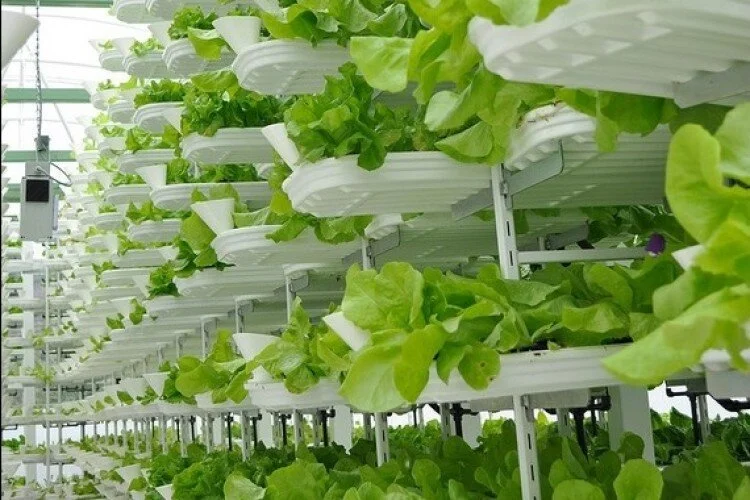
House-Builder Moves Into Indoor Farming
A Property Firm That Failed to Secure Funding For a Residential Development Has Decided to Turn its Attention to Farming – Or, More Specifically, Hydroponics
A Property Firm That Failed to Secure Funding For a Residential Development Has Decided to Turn its Attention to Farming – Or, More Specifically, Hydroponics
AIM-listed developer Trafalgar Property plans to diversify into hydroponic vertical farming and is looking for opportunities. It is in early-stage discussions with a potential hydroponics operator who could benefit from Trafalgar’s property expertise.
Hydroponics has existed since the 1950s. It is a form of controlled environment agriculture, where crops are grown undercover. It is a water-based growth system in which a nutrient solution is pumped around reservoirs in which plant roots grow directly. In vertical farming, crops are cultivated in vertically stacked levels in buildings, under artificial lights, without soil or natural sunlight. It requires less land and less water (since the water is all recycled) than traditional agriculture – and it is all organic as it needs no pesticides or fungicides.
It is battery farming for veg. And Trafalgar sees it as an opportunity.
Trafalgar New Homes is a regional residential property developer focused on Kent, Surrey, and Sussex, focusing on small sites of up to a dozen units – a scale that is too small for large developers, but too big for jobbing builders.
In March 2018 it acquired Trafalgar Retirement to develop assisted living and extra care schemes for the older residents. But difficulties obtaining finance led to the loss of its first development opportunity in that sector. This prompted the board to look around.
It has identified hydroponic food production, which requires significant property investment and expertise, as an area for investment. It is asking shareholders to stump up £2m to fund its new hydroponics venture.
Trafalgar cites a report that predicts the global vertical farming market will grow from $2.2bn in 2018 to $12.8bn by 2026. Other investors in hydroponics include Amazon's Jeff Bezos and Google's Eric Schmidt. Ocado entered the market in 2019 when it took a majority stake in Europe's largest vertical farm.
Got a story? Email news@theconstructionindex.co.uk

How Long Can The Novel Coronavirus Survive On Surfaces And In The Air?
A New Study Shows That SARS-CoV-2 Can Linger in The Air For Hours And On Some Materials For Days
March 19, 2020
AT A TIME when many people have taken to washing hands and sanitizing the objects they hold dear—frequently—a pesky question has loomed. How long does the SARS-CoV-2 virus stick around? A new paper in the New England Journal of Medicine, one of the first to examine the lifespan of the virus on common surfaces, offers some answers.
Like the common cold, Covid-19 spreads through virus-laden droplets of moisture released when an infected person coughs, sneezes or merely exhales. A team of researchers, including scientists from America’s National Institute of Allergy and Infectious Diseases, simulated how an infected individual might spread the virus in the air and on plastic, cardboard, stainless steel and copper. They then measured how long the virus remained infectious in those environments.
They found that SARS-CoV-2 stays more stable on plastic and steel than on cardboard or copper. Traces of the virus were detected on plastic and steel up to three days after contamination. SARS-CoV-2 survived on cardboard for up to one day. On copper, the most hostile surface tested, it lasted just four hours (see chart). In the air, the team found that the virus can stick around for at least three hours. In the air, as elsewhere, the virus’s ability to infect people diminished sharply over time. In the air, for instance, its estimated median half-life—the time it takes for half of the virus particles to become inactive—was just over an hour. And the levels of the virus that do remain in the air are not high enough to pose a risk to most people who are not in the immediate vicinity of an infected person.
These findings are likely to assuage some fears. Homebound consumers worried about contagion from cardboard delivery boxes may have less to worry about the next time Amazon rings (unless they are used to same-day delivery). At the same time, the findings will amplify concerns about airborne transmission, which some experts had not considered possible. The research may change the way medical workers interact with infected patients, who with close contact may transmit the virus onto protective gear.
Why the virus can survive longer on some surfaces rather than others still remains something of a mystery. Maybe it has to do with the consistency of the object playing host to the virus. Cardboard, of course, is much more porous than steel, plastic or copper. But the authors noted that there was more variation in their experiment for cardboard than for other surfaces, and the results should be interpreted with caution. No doubt consumers are used to treating their surroundings that way by now.

PODCAST: Honolulu's First Vertical Farm: MetroGrow Hawaii
They produce specialty crops, like herbs, corn shoots, butter lettuce, and an extra-salty ice plant, using hydroponics and aeroponics
We interview Kerry Kakazu, a plant scientist who started MetroGrow Hawaii.
They produce specialty crops, like herbs, corn shoots, butter lettuce, and an extra-salty ice plant, using hydroponics and aeroponics. Learn why chefs love their produce and what some of the challenges are when building a vertical farm in Hawaii.
LISTEN TO PODCAST
March 2020

InFarm’s High-Tech Vertical Farms Head to Canadian Grocery Stores
InFarm is bringing its in-store vertical farming systems to Empire supermarkets across Canada, according to a press release from Empire. The partnership will launch this coming spring and put InFarms’s high-tech farm pods in stores across that country, including at Empire subsidiaries Sobeys, Thrifty Foods, and Safeway Canada
InFarm is bringing its in-store vertical farming systems to Empire supermarkets across Canada, according to a press release from Empire. The partnership will launch this coming spring and put InFarms’s high-tech farm pods in stores across that country, including at Empire subsidiaries Sobeys, Thrifty Foods, and Safeway Canada.
Berlin-based InFarm, which raised $100 million in June of 2019, has struck multiple deals with grocery store chains around the world over the last several months, including Irma in Denmark, M&S in the UK, and Kroger stores in the U.S. The company is one of many startups developing vertical and/or indoor farming solutions meant to shorten the food supply chain by growing greens closer to food stores.
With InFarm, that means growing those leafy greens and herbs inside the produce section of stores. The company’s indoor farms come in the form of enclosed pods that use the hydroponic grow method, meaning plant roots are submerged in a nutrient-enriched water supply and no soil is involved. Cloud-based software controls the temperature, watering schedule, and light and humidity levels of the farms, adjusting those elements based on plant type.
There are two major benefits to this in-store approach to vertical farming. Zero pesticides are used in the grow process, and greens can be harvested onsite, reducing carbon emissions since food doesn’t have to be transported to the store from a distribution center.
Better-tasting greens is another one of InFarm’s claims. By precisely adjusting light, temperature, water levels, and other elements, vertical farmers can create ideal growing “recipes” for each plant type meant to bring out the optimal amount of flavor.
Many vertical farming companies make this claim, along with those about reduced water usage and carbon footprint. What the indoor ag industry needs next is more public data backing these claims up. With other companies — notably Square Roots and Freight Farms — striking deals of their own to get vertical farms closer to food stores, more hard numbers will be needed to show us when, where, and how these high-tech farms can be most useful in the overall food system.
InFarm will launch a range of herbs at two Safeway stores in Vancouver this spring, according to the press release, and Empire will also put farms in stores across seven Canadian cities.
Will We Be Saved by Vertical Farming?
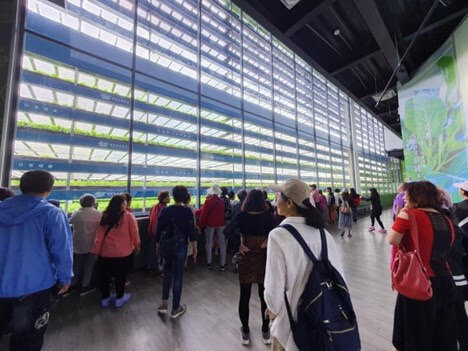
Vertical farming uses carefully controlled growth conditions to give yields far higher than normal agriculture. As the world goes into lockdown as a result of COVID-19, many are fearful about the reliability of food supplies in urban areas. Vertical farming may well be a solution – although not in the immediate short-term
Will We Be Saved by Vertical Farming?

March 20, 2020
Vertical farming uses carefully controlled growth conditions to give yields far higher than normal agriculture.
As the world goes into lockdown as a result of COVID-19, many are fearful about the reliability of food supplies in urban areas. Vertical farming may well be a solution – although not in the immediate short-term.
Vertical farming is the practice of growing plants indoors under fully controlled environmental conditions in many stacked layers, using artificial lighting instead of relying on the sun. By tuning the growing environment to the exact needs of the plant and using soil-free growing techniques, vertical farming can achieve yields hundreds of times higher than conventional agriculture, 365 days a year and without requiring pesticides.
Supporters of vertical farming claim it could revolutionize global food production, practically eliminating food miles by enabling crop growth right next to urban population centers, paving the way for the future of smart cities. At the moment, fruit and vegetables often travel thousands of miles to reach consumers, losing freshness and quality along the way and increasing the risk of contamination.
Investors are responding enthusiastically, with the sector raising over $1 billion in funding since 2015. High profile investments include New Jersey-based start-up AeroFarms raising $100 million in 2019 to expand its aeroponic growing facilities, and Californian start-up Plenty raising $200 million in 2017 in a funding round led by SoftBank Vision Fund, along with backers including Jeff Bezos and Alphabet chairman Eric Schmidt. Across the Pacific, the industry is already well-established – in Japan, there are over 200 vertical farms currently operating, with industry leader Spread Co. Ltd. producing 30,000 heads of lettuce every day in its highly automated Techno Farm Keihanna plant.
However, despite this optimistic picture, the industry is facing challenges. The sector is littered with bankruptcies as companies struggle with the power costs of maintaining a controlled environment 24/7 and the difficulties of coordinating the labor-intensive process of running a vertical farm. Nevertheless, companies remain optimistic, with advances in lighting and automation technology helping to shape the future of indoor growing.
A new report from market intelligence firm IDTechEx, “Vertical Farming: 2020-2030”, discusses the state of the vertical farming industry, the key technological enablers and the economics of the process compared with conventional agriculture, identifying the keys to success in this fledgling industry.
Based on interviews with key stakeholders and extensive analysis, the report evaluates the current markets and forecasts the future of the global vertical farming industry.
To find out more, visit www.IDTechEx.com/VertFarm

How An Unlikely Farmer Is Plotting The Future of Food
In a nondescript former root beer plant, tucked behind the Curtain & Bath Outlet off Main Street in Millis, Massachusetts, FreshBox Farms is growing the future of food
By: Dan Morrell; photographed by Scott Nobles
In a nondescript former root beer plant, tucked behind the Curtain & Bath Outlet off Main Street in Millis, Massachusetts, FreshBox Farms is growing the future of food.
The FreshBox facility bears no resemblance to our cultural renderings of a farm; not only is there no soil, but every attempt is made to contain the risk that such outside organic matter could introduce. Visitors are asked to dip the soles of their shoes into a shallow plastic water bath, so as to limit contamination by pathogens and insects. Entry into one of the facility’s 15 growing units—8' x 40' metal boxes resembling shipping containers—necessitates a white cap and a lab coat. The units feature a double-door protocol that requires the exterior door to be closed before a second internal door can be opened. In the far corner of the building, a larger-scale model of the growing unit features an entry foyer with a ventilation system that cycles the air every few seconds and a secondary system designed to blow out any pathogens or insects that might have snuck past earlier garrisons.
All of this security is in place to protect—sans pesticides—the racks of Styrofoam-like growing beds inside the units, which are filled with leafy greens and fed by precisely tuned LED lights. An intricate digital system measures the room’s temperature and the CO2 levels inside the units every 30 seconds, adjusting as necessary; another delivers computer-calculated nutrients and water through the plant beds. These precision systems allow the facility to use about 1 percent of the water required by traditional farming counterparts while producing the equivalent of a 400-acre farm in just 27,000 square feet of space. It’s as if nature has been stripped of its variability and cranked all the way up.
Which is exactly the kind of tech upgrade the world food system needs to be given our increasingly insecure ecosystem, says Sonia Lo (MBA 1994), CEO of Crop One Holdings, which owns and operates the FreshBox brand. Sitting in FreshBox’s makeshift conference room—a long table, chairs, and a monitor, surrounded by four very high stacks of the white foam growing racks—she lays out the challenge. Climate change and its progenies, drought and flooding, are threatening traditional agricultural systems. And even when those systems work, they still rely on carbon-intensive shipping supply chains that move food thousands of miles from where it is grown to the tables where it is consumed. The global population is rising, with the United Nations projecting it to swell to 9.7 billion from its current 7.7 billion by 2050. “We also have to solve the calorie deficiency that we’re going to confront by 2050 on this planet,” she says. “We have to produce 70 percent more calories than we produce today to feed that population.”
Addressing a problem with that kind of span requires scaling beyond the 8' x 40' units—and beyond Millis. “The modular unit that’s going into Dubai will be three times the size of this,” says Lo, motioning to the larger-scale model in the back left corner of the facility. In June 2018, Crop One won a bid to provide leafy greens to Emirates Airlines’ flight catering company, and it is in the midst of building a 130,000-square-foot facility in Dubai that they expect to produce three tons of greens a day. It’s an almost unfathomable amount of daily production, but Lo puts it in perspective. “A single fast-food restaurant chain uses 300 million pounds a year of leafy greens alone,” she says. “A one-ton-a-day farm produces 740,000 pounds a year. So even if we built a 50-ton-a-day farm, you’re still only producing 240 million pounds a year. You would serve one customer.”
That 50-ton-a-day mark is a real goal, says Lo, and the Dubai farm will be a big proof of concept. And while any company’s world-saving ambitions can resemble Silicon Valley–like hype, Lo stresses that there’s a path, and the first step was figuring out how to most effectively grow lettuce in climate-controlled shipping containers in this former root beer plant. “We’re doing this in a very logical, road-mapping way. We’re not trying to bend the laws of physics. We are trying to enhance control. We’re trying to grow 365 days a year. We’ve been growing every day since February of 2015, which is pretty remarkable for any farmer to be able to say. We have not stopped growing even one day, you know?”
“We’re not trying to bend the laws of physics. We are trying to enhance control. We’re trying to grow 365 days a year.”
Lo is an admittedly unlikely farmer. She grew up as the daughter of Korean diplomats, a life that provided her with a multitude of international addresses and seven languages. And while growing up in fully staffed ambassadorial residences and being transported in limousines with darkened windows and little flags on the hood seems strange in retrospect, the multicultural upbringing had an impact that Lo has only recently come to realize.
About six years ago, Lo met a neurologist who was fascinated by her early experience with languages. “I would love to study you because the way that your neural networks have been formed must be so different—because you were really substantively multilingual before you were seven,” the doctor told her. “The implications of that are problem-solving, so you’re probably going to be able to see two or three solutions around something in a way that other people don’t.” The other benefit, the neurologist noted, was creativity. While Lo never saw herself as a creative person, she did seem to have a knack for seeing overlooked connections between ideas and then visualizing and building maps to explain those correlations.
These cartography skills have proved vital to her career. In the late 1990s, Lo was working on innovation and ventures for a media company in London when she realized that the industry was due for disruption. In a meeting with the CEO, Lo drew him a network diagram of what the future infrastructure of TV distribution was going to look like. “It’s all going to be bits and bytes,” she told him. Lo would later help stitch together some 200 European internet cafés to build a digital media platform; when the entrepreneurial bug bit soon after, Lo built a Groupon-like platform that helped smaller companies get product discounts.
That startup, eZoka, was pulling in £1 million a month until outside investment was derailed by the attacks of September 11, 2001. She spent a year cleaning up the aftermath. Exhausted and bruised, she decided to step away from business, attending culinary school and becoming a private chef in London for two years. (Lo donated all her earnings to charity and coauthored a book during that time, Dining with Dictators, which was part political satire and part cookbook.)
Lo returned to business in 2004, starting Chalsys, an investment and advisory practice that helps large companies avoid the pitfalls of corporate venturing. And it was through this company that she met a German investor who would become an initial Chalsys coinvestor and, eventually, one of the firm’s partners. In 2012, Phil Strause (MBA 1967), a former boss from an early career stint at Deloitte, sent Lo a business plan for a vertical farming company. She forwarded it on to the German investor, whose family, it so happened, had major European agriculture holdings. “You know, this is really interesting,” he told Lo. “Because if the unit economics of this thing turns out to be even remotely true, it’s the future of food.”
Lo’s interest was piqued. She knew almost nothing about farming and had always just trusted that the Western world’s food supply was safe and reliable. But as she dug into the research, she began to realize how wasteful, unsafe, and unreliable it really was. Conventional agriculture was facing substantive infrastructure problems while the cost of the tech solutions to address these issues was declining rapidly. It was a recipe for revolution.
But what Crop One needed was one of Lo’s maps. After their initial investment in April of 2013, Lo describes the business as “failing to launch.” There was a leadership deficit and a business model that hadn’t accounted for returning investor capital—which included a significant investment from the Chalsys partner to whom she’d initially forwarded the business plan. “By the end of 2013, we reached the point where I confronted either writing it off and writing off my friend and benefactor’s money—or I was going to pull the nose up.”
Lo stepped in as CEO in July 2014. She built out the team, including hiring Chief Scientific Officer Deane Falcone, an expert plant biologist from the University of Massachusetts, to start defining the science side. “I was trying to figure out the technology road mapping for an industry that didn’t have a road map and, in fact, wasn’t an industry,” she says. But she also changed the mindset. “I was asking ‘Why is this an investable industry? Why is this a world-class company? How do we get it to be on the world stage?’ And that’s really the big fundamental shift.”
Lo focused on three factors for growing in her first few years at Crop One: lowering costs, enhancing yield, and segregating risk.
In her first 18 months, the company worked to reduce the cost of the growing units from $560,000 to $43,000. To boost production, they leaned heavily on Falcone’s expertise, allowing him time to test and tweak the inputs—temperature, CO2 levels, water, LED spectrums—to determine optimal growing conditions for the various greens. This focus on nailing the plant science, says Lo, was a differentiator, though one she didn’t immediately grasp. “I have enough experience in technology that I thought, ‘I totally see this hardware being commoditized.’ ” But she soon realized that it wasn’t the racks and tubs and trays that would separate them—anyone could buy those at their local hydroponics store. “But very few people can grow at the density and with the specificity that we can,” says Lo. The risk issue was addressed with what she refers to as the facility’s “triple defense system,” which includes the shoe bath, the growing units’ double-door protocol, and the lab coats. Better defenses mean decreased loss and, therefore, higher yields.
By the fall of 2015, FreshBox had six production units and was distributing its leafy greens to the local Roche Bros. supermarket chain, filling plastic clamshells with kale and spring mix on-site. Originally occupying only 24,000 square feet of the warehouse, it expanded to take over the facility’s entire 43,000 square feet. “What surprised us was the take-up and the demand, the kind of hunger for the product,” says Lo. More than 90 percent of the country’s leafy greens are produced in Arizona or California, according to the states' Leafy Green Marketing Agreement, and transportation to New England can take weeks; FreshBox being able to offer Massachusetts consumers a locally grown product not subject to the region’s cruel winters has proved to be a boon to the brand.
The addition of more modular units also allowed the company to grow different types of greens, enhancing R&D and commercial growth. This diversity came into play when they were bidding for the Emirates contract. Up against a very capable Japanese company that was already producing some 1,700 pounds a day, Crop One boasted 24 plant varieties to the Japanese company’s 4.
The Emirates farm is scheduled to have its first harvests this year, and plans for national expansion are now underway. Crop One will only be a minority owner in these new farms, says Lo, noting that the farming aspect of the business is very capital intensive. But they’ve pursued a project financing model rather than venture financing. “Project financiers are not starry-eyed venture capitalists,” she says. “They’re not romantic at all.” They want to see cash flow and mitigated risk, not hockey-stick returns. “We believe that in every technological disruption you have to have hand-in-hand capital model disruption and business model disruption because you don’t reinvent an industry unless all of those things coalesce. This is the wholesale replacement of agricultural infrastructure, right?”
“Gigafarms we’re defining at 50 tons a day. We hope to build our first gigafarm in the next five years, which is pretty ambitious.”
Deciding on future locations, Lo says, will come down to costs—energy and labor, chief among them—and existing local sources. Meaning, on the latter, can they grow anything there outdoors? “So in the Middle East, definitively not, right? You really have to bend the laws of physics to grow stuff there. Northern Europe—doesn’t grow very much, good prices, high labor, reasonable green energy, right?” The US Midwest has solid energy options and population density. There’s great hydroelectric power in New York, so the Northeast could work. The Southeast too. “When we look out across the United States, we would map against the major retailers’ distribution center network,” says Lo, meaning they’d build a farm at these centralized locations—23 of them to be exact. “We see a minimum of 23 megafarms.”
A megafarm? “Somewhere between 1 and 10 tons [of production] a day,” says Lo. “Gigafarms we’re defining at 50 tons a day. We hope to build our first gigafarm in the next five years, which is pretty ambitious. That’s our sort of moonshot goal.”
But she can see it pretty clearly. Twelve megafarms in Northern Europe, maybe one or two gigafarms. Russia would make sense. The Middle East is almost there.
Another ultimate goal, says Lo, is carbon neutral—vertical farms set up next to, say, a giant solar field or a wind farm. “We look at the industry, and it’s pretty clear you can’t put a sustainable label on yourself unless you solve the energy piece of it—and we don’t see our competitors doing that,” she says.
Crop One is also exploring decarbonization models, pairing with power companies to feed its CO2 to their plants. “We have people who are rocket scientists”—literally—“who are looking at this for us and doing the energy analysis. I touch base with them every couple of months just to say, ‘So tell me, if we were to approach power plants about being their carbon sink, who would we go to?’ They know who we would go to.”
Lo has the coordinates; she sees the path. “I think it is a tangible, known goal in which we have known steps.”
Vertical farming is still far from mainstream, but Lo notes its profile began to rise a few years ago, thanks to a marquee investment: In July 2017, Softbank’s Vision Fund led a $200 million funding round into Plenty, a San Francisco–based vertical farming startup. “That really moved the needle,” she says.
Don Goodwin, the founder and president of produce consulting firm Golden Sun Marketing—and a longtime attendee of the School’s Agribusiness Seminar—has closely tracked the industry’s ascent. He estimates that there’s some $2 billion invested in the space right now, with money flowing in from VCs, sustainable private equity funds, and billionaires like Eric Schmidt and Jeff Bezos, who also contributed to that July 2017 Plenty funding round.
“We look at the industry, and it’s pretty clear you can’t put a sustainable label on yourself unless you solve the energy piece of it.”
The recipients of those funds vary, says Goodwin. “There’s a number of reasons people come into the space. We have the small local operator who has a vision and a past, and wants to change the way people eat,” he notes. “And then we have these ‘big idea’ guys like Crop One.” Those businesses, he notes, are “trying to create a sustainable investment strategy, not only from traditional economic terms but also from societal terms.”
Which means that growing locally in a vertical farm allows FreshBox to compete on price and mission. Here’s how that works, Goodwin explains: “If [the lettuce] is grown in Massachusetts, I can put it on [a grocery store’s] dock at the same price or lower than if you grow it in California and truck it across the country. And so I get all that benefit of the freight. I get the shelf life that you’ve given up—the seven or eight days to get there by truck. And I get the whole sustainability message because of food miles.”
While she gets the business model and consumer appeal, Mary Shelman (MBA 1987), former director of HBS’s Agribusiness Program, is slightly wary of the world-saving aspirations of vertical farming. She’s heard entrepreneurs discuss how they can manipulate the LED lighting to create arugula with different flavor profiles, for example, even varying the spiciness. “But at the end of the day, how much does arugula really help if we have to feed nearly 10 billion people?”
Which isn’t to say that Shelman thinks there is no value in it. “I think we can learn things from their systems—because they have the ability to do controlled experiments—that we can then take outside or in more traditional, controlled-environment agriculture,” she says, “and use that in those systems that are lower capital cost.”
Chief among vertical farming’s costs is energy. “It’s the industry’s dirty little secret,” says Lo. So noticeable is indoor farming’s drain on a local grid, she notes, that law enforcement used to monitor spikes in electricity demand to find illegal marijuana growers.
The energy costs are improving, plus Crop One is constantly refining its design to increase efficiency, adds Deane Falcone. Scaling up will be a big help. He contrasts the climate system they use for the larger model in the corner of the facility to the individual systems on the independent units. “It’s like if you had a 10-bedroom house: Would you have 15 window air conditioners, or would you have a central air-conditioning system?”
Driving down costs is important because Lo ultimately wants this model to be cheap enough to be a solution for the developing world. “I do not want to be in a carbon-intensive industry; I want to be producing a nutritionally relevant meal, and I do not want to only be in the business of feeding rich people,” she says.
But if vertical farming is going to feed the world, it will also need to expand beyond lettuce and kale. Wheat and corn are unlikely, says Lo, but rice could eventually be a possibility. “Two-thirds of the world population’s staple diet includes rice,” she notes. But there’s perhaps an even greater opening here: Andrew D. Ive (MBA 1997), former managing director of the Food-X accelerator and founder of Big Idea Ventures, says that the meat-production model that much of the world still relies on is wildly inefficient at producing protein. “It basically takes nine calories of energy or input to get one calorie out,” says Ive. “Whereas if you’re producing a plant-based material, it’s closer to one-to-one. It also doesn’t require the same land use, it doesn’t require the same water use, et cetera. So leafy greens are great, but if you’re thinking about how to supply food for the 9 billion, then you’re really, really focusing more on other protein sources and other kinds of plant-based sources.”
This plant-based protein movement is fast becoming mainstream. Even the McDonald’s in the shopping center across Main Street from FreshBox Farms could be offering meatless burgers soon: The fast-food chain recently announced a trial partnership with Beyond Meat, whose products are made in part from yellow peas. So, yes, says Lo, getting to the point where her farms could grow yellow peas and soybeans—a crucial ingredient of the plant-based Impossible Whopper, Burger King’s early market entrant—would be ideal. The ongoing food revolution needs a parallel farming revolution to succeed.
Lo is on it. Crop One, she says, is researching these and other high-protein plants and investigating how her farms can produce products that can provide the world with necessary subsistence while also absorbing carbon dioxide at a higher rate.
“That will cause an explosion of take-up,” says Lo. “Because, again, we can’t continue on the trajectory that we’ve been on. We just can’t.”
Someone has to do something, even if that someone is a first-time farmer trying to build a global revolution in an old root beer plant in small-town New England.
Topics: Agribusiness-Plant-Based AgribusinessInnovation-Disruptive InnovationLeadership-Leading Change

INDIA: The Changing Face of Urban Food System: UrbanKissan
The majority of the World’s future population will live in urban areas in the near future as we witness a mass migration to the cities due to climate impact, related health hazards and associated risks. Feeding the planet ’s population will be one of humanity's greatest challenges by 2050
12 March 2020
The majority of the World’s future population will live in urban areas in the near future as we witness a mass migration to the cities due to climate impact, related health hazards and associated risks. Feeding the planet ’s population will be one of humanity's greatest challenges by 2050. Current food systems in cities are being challenged because they fail to provide permanent and reliable access to adequate safe, local, diversified, fair, healthy and nutrient-rich food to host over half the world’s population. The world at present produces more food than ever before, yet dietary diversity is declining and food insecurity is on the rise.
Food is an effective entry point to improve a city’s resilience. Currently, food production is responsible for almost 25% of global greenhouse gas emissions, and poorly managed fertilization exacerbates pollution of the air, ground, and water. We need to imagine an improved food production system grounded in better use of resources. This will involve moving to a circular economy, particularly in towns and cities. Faced with the acceleration of these tendencies and determined to bring about a reinvention of food policies, urban agriculture is emerging as one driver for this new-look approach. Cities need to explore various opportunities in developing sustainable food systems. Many interesting platforms are reworking on the need for Urban Agriculture and City Region Food Systems.
The Agriculture Industry becomes a complicated place with technologies and marketing tools and techniques that are launched almost on a daily basis. At this juncture how does one feel to step into a farm and purchase greens fresh in an Urban farm and buy it at costs lower than ever thought possible?
UrbanKisaan, the Vertical Farming Startup that puts quality first, has debuted its 3000 sqft new-age urban farm and retail store in Manikonda, Hyderabad. Here, customers can walk into the retail store, harvest fresh and clean products of their choice which are grown in the indoor farm which is on the other side of a glass wall. Urbankissan redefines the category ’Fresh
’!India’s First Urban Retail Farm and Store “Urbankissan” is now open in Hyderabad!
Walk-in, Pick your produce, Harvest on the spot and Walk out with the freshest cleanest produce there is. Grown locally and sustainably, we grow fresh produce that is beyond organic and like no other urban Kissan will change the shopper behavior where consumers are increasingly shifting their purchases to more experience-oriented retail locations in urban areas. Urban Kissan is inspiring a trend of having an indoor farm and a store in the same location and this will necessitate the immediate availability of Good Quality Vegetables within the vicinity of Urban areas for the urban consumers. This will also enable urban consumers in having the choice of vegetables at much lesser prices.
While Interacting with Vihari Kanikollu, CEO of Urban Kissan he eloquently explains the concept of Urbankisaan to be a full stack of plant science and food production technology — a sustainable, high-tech, high-efficiency, automated indoor vertical farm that can produce delicious, nutritious food at massive scale for lower costs than ever before thought possible. Urbankisaan brings together the unified design of a complete large-scale farm that maximizes the applications of energy, process control, and big data, along with with with advanced plant science to create maximum flavor, better shelf life, and ultra-clean food at incredible yields. By combining the latest plant science with these technologies, Urbankisaan farms are ideally optimized to produce yields of delicious, nutrient-rich food at a lower cost. ● 1.75 Acres produce grown in 2,000 Sq. Ft ● 30 days from seedling to harvest ● 365 harvests per year ● The shop and the farm are divided and the shop if of 500 sq ft and the farm of 2000 sq ft.
Urbankissan thereby plans to build a series of indoor vertical farms across India and will grow pesticide-free produce with 95 % less water and requiring less than 1% of the land needed for outdoor farms thereby saving 2,16,000 liters of water per farm per month. Vihari reiterates the Supply Chain’s approach to decentralize F&V production and distribution by being inside and close to the consumption centers (cities). By cutting down thousands of food miles, the produce is in consumers’ hands within hours of harvest, not days or weeks as is now. They harvest at the peak of taste and quality versus harvesting early for transportation. As and when the product gets finished in the shop they harvest more according to the need.UrbanKisaan has been recently funded by Ycombinator in Winter 2020 batch and has gone on to raise further.
Vertical Farming: The Advantages of Growing Up, Not Out
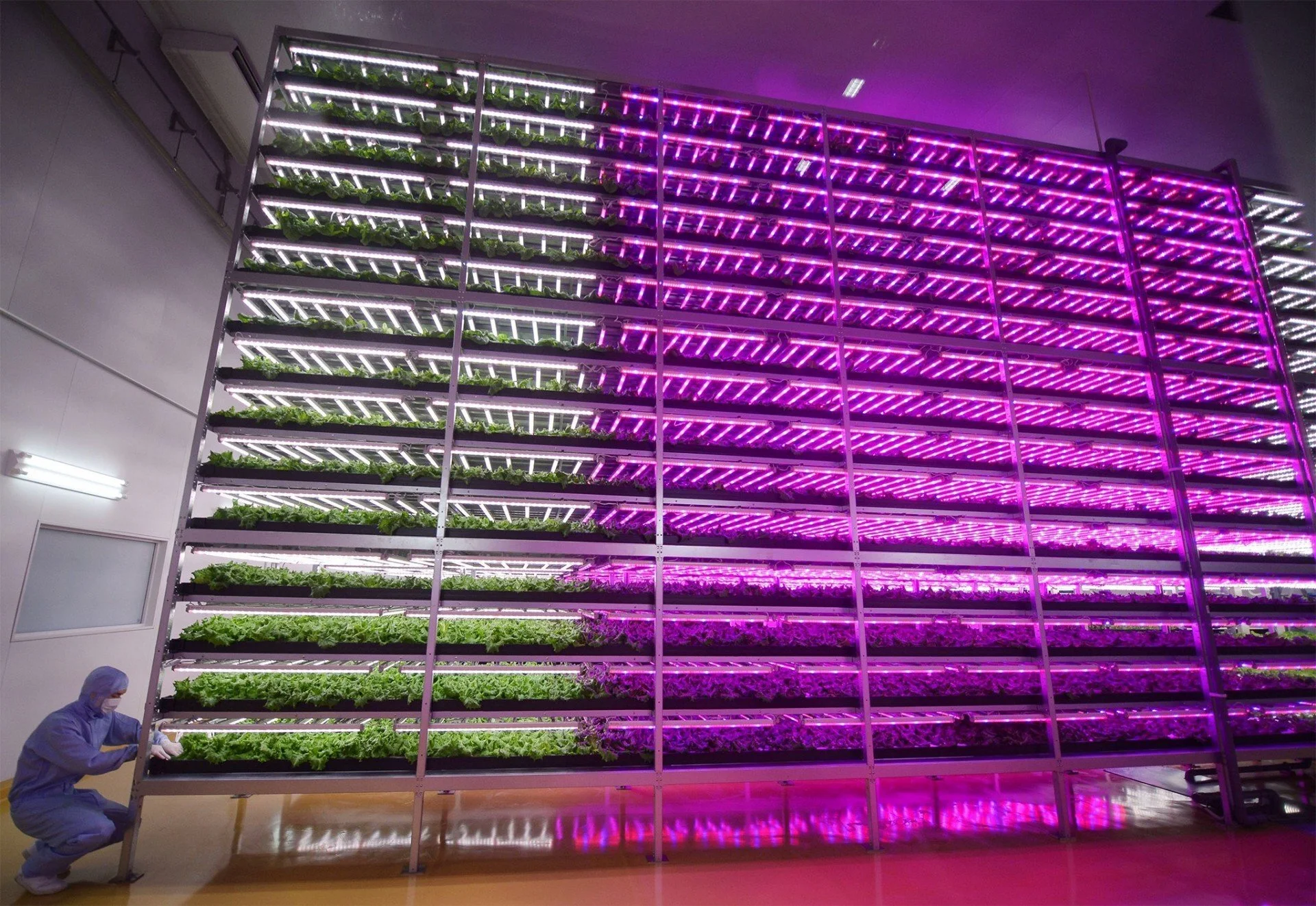
Vertical farming refers to growing crops in multiple vertical layers in controlled indoor environments, such as repurposed buildings, growth chambers and even shipping containers
We share this planet with more than 7 billion people, and the UN forecasts that by 2050 we will need to feed over 9.7 billion. If you’re like me, you’re wondering what we can do to scale farming to meet the needs of the future. That’s where vertical farming comes in, along with innovative technologies that make growing up, not out, a more viable option.
by Ali Ahmadian, CEO Heliospectra
Vertical farming refers to growing crops in multiple vertical layers in controlled indoor environments, such as repurposed buildings, growth chambers, and even shipping containers. While growing crops in the greenhouse have its own merits, depends on the crop and technology used vertical farming has advantages over single-layer crops grown in a field or greenhouse:
Vertical farming enables growers to optimize their costs per square meter and produce more within the same footprint. A vertical format could potentially produce a harvest that is 3- to 4-times larger (or more!) than a field the same size could produce.
Vertical farming is done in an automated, controlled environment, which eliminates many of the risks involved with traditional field farming. Variables such as seasonal weather and environmental issues are taken out of the mix to produce a thriving crop year-round – no matter what’s happening outdoors.
Crop yields are standardized in vertical farming, with every harvest cycle producing the same quantity, quality, flavor and appearance that customers expect.
Vertical farming enables growers to meet changing market demands, by easily introducing new crops or varieties based on consumer or retail preferences.
Due to its smaller footprint, vertical farming is a viable and environmentally sound solution for feeding cities. The UN predicts that close to 70% of the population will be living in urban areas by 2050. To reduce the carbon footprint of our food, we need to think of ways to bring food production closer to the dining table. A LCA is necessary to weigh in such decision making.
While we continue to build larger and larger cities to accommodate our growing population, arable farmlands will be pushed further out. Vertical farming can ensure our cities have plentiful locally grown food – food that has a predictable harvest, optimizes costs per square meter, looks beautiful, fresh and tastes delicious.
Source: LinkedIn
Publication date: Fri 6 Mar 2020
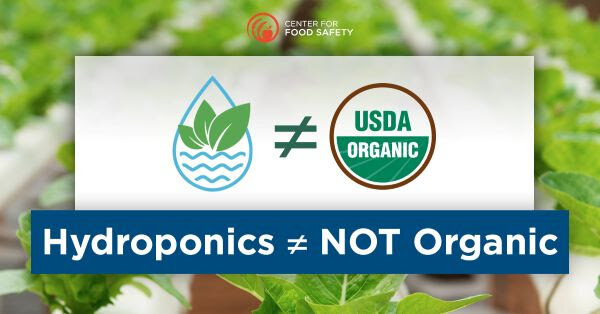
Lawsuit Demands USDA Stop Certifying Hydroponic Foods as 'Organic'
Hydroponics is a type of farming or gardening that uses water (rather than soil) as a growth medium for a variety of fruits, vegetables, herbs, and other plants—including cannabis. Hydroponic growth can be accomplished indoors with the addition of commercially available lighting, nutrients, and other materials
Dirt Farmers Want The Feds To Stack The Deck in Their Favor.
BAYLEN LINNEKIN | 3.14.2020
(Rodrigo Reyes Marin/ZUMA Press/Newscom)
Earlier this month, a group of organic farmers and advocates sued the U.S. Department of Agriculture (USDA) over the agency's certification of some hydroponic produce as "organic." The suit seeks to bar the USDA from awarding its organic seal to hydroponically raised foods.
Hydroponics is a type of farming or gardening that uses water (rather than soil) as a growth medium for a variety of fruits, vegetables, herbs, and other plants—including cannabis. Hydroponic growth can be accomplished indoors with the addition of commercially available lighting, nutrients, and other materials.
The suit was filed by the Center for Food Safety (CFS)—a "litigious" California-based nonprofit that boasts nearly a million members—along with a handful of organic farmers and the Maine Organic Farmers & Gardeners Association. CFS petitioned the USDA early last year, asking the agency to develop rules that would prohibit organic certification of hydroponic operations. The agency denied the petition in June.
The suit alleges that the USDA's actions fly in the face of the 1990 law that established the agency's authority over the labeling of organic foods. That argument hinges in large part on the language around fostering soil fertility in the 1990 law, the Organic Foods Production Act (OFPA), which gave rise to the USDA's certification program. Under the law, which refers to "soil" only a handful of times, farmers must have in place an "organic plan [which] shall contain provisions designed to foster soil fertility, primarily through the management of the organic content of the soil." A farmer raising crops she wishes to market under the USDA's organic seal must submit its organic plan to a certifying body such as Oregon Tilth.
That group, the nation's first organic certifying body, was established in the early 1970s. The word "tilth" refers to soil quality.
"Organic farmers and consumers believe that the Organic label means not just growing food in soil, but improving the fertility of that soil," says Andrew Kimbrell, executive director of the Center for Food Safety, in a release announcing the lawsuit. "USDA's loophole for corporate hydroponics to be sold under the Organic label guts the very essence of 'Organic.'"
According to the handful of farmers who are part of the lawsuit—and who grow a host of organic fruits and vegetables, many of them having done so for decades—they're facing stiff competition from (typically) larger hydroponic farmers, who incur lower costs to grow the same food and can, therefore, offer more value to consumers for the same products.
What exactly is "organic"? For regulatory purposes, the term refers as much to what doesn't go into producing a particular food as what does go into it. As I explained in a 2016 column, under USDA rules the term "organic" refers to foods that are produced 1) "without excluded methods;" 2) " using allowed substances;" and 3) under the oversight of a USDA-authorized organic certifying agent.
The hydroponic-organic fight dates back to at least 2010, according to Food Dive, a news website that has a helpful chronology on the fight.
As I detailed in 2016, the Cornucopia Institute, which promotes organic foods, had recently filed a complaint with the USDA over hydroponic organics.
TOP ARTICLES1/5After a State-Authorized Medical Marijuana Patient Had an EpilepticSeizure and Crashed Her Car, Police Arrested Her for Driving With 'Marijuana in Her System
"It's not hard to make the case that soil is as central to the concept of 'organic' as any other idea or thing," I wrote. "On the other hand, it's also not hard to make the case that soil isn't central to the concept of what is and isn't organic. While most of our food is grown in soil, only a small percentage of that food is 'organic' under USDA rules. In other words, whether or not food is grown in soil tells us little that's useful about whether that food is 'organic' or not."
When I last wrote about this issue, the Boston Globe editorial board had just weighed in on the debate over hydroponics and organics. Step off, the paper told the USDA.
"It would be better for the authorities to focus on ensuring the safety of food and the accuracy of label information about things like nutrition and allergens, while letting consumers figure out for themselves what organic means to them," write the Globe's editors.
That latter point is so important—and something USDA rules simply don't allow for. It's also just one of the many flaws inherent in the USDA's oversight of organic food. For example, I detail the arguments of several leading supporters of organic foods who are also leading critics of the USDA's organic labeling program in my book, Biting the Hands that Feed Us: How Fewer, Smarter Laws Would Make Our Food System More Sustainable
If CFS and its fellow plaintiffs lose, then the result will likely be more innovation, more competition, and lower costs for consumers. The USDA's organic seal has very little integrity to begin with. Allowing hydroponic crops to be certified as organic—while not as welcome as would be getting the USDA out of the organic-labeling business altogether—won't damage that integrity any further.
BAYLEN LINNEKIN is a food lawyer, scholar, and adjunct law professor, as well as the author of Biting the Hands that Feed Us: How Fewer, Smarter Laws Would Make Our Food System More Sustainable (Island Press 2016).
ORGANIC FOODDEPARTMENT OF AGRICULTUREREGULATIONFOOD LABELING

Is Vertical Farming The Future of Agriculture?
To address these issues of resource scarcity and loss, many scientists and innovators have been hard at work to come up with a solution
MARCH 14, 2020
To address these issues of resource scarcity and loss, many scientists and innovators have been hard at work to come up with a solution. A viable option that has come up is controlled environment agriculture, or weather or climate-proof farming, or vertical farming. This is increasingly being utilized in urban centers, arid zones, and some populous Asian countries.
This kind of farming is done in vertical rack systems as opposed to conventional farming. Oda has successfully experimented with this technology in arid zones and urban centers in Beijing.
His company has successfully used an abandoned shipment container to grow vegetables in the dry climate of Dubai.
Vertical farming is finding more acceptance commercially with innovations in efficiency and affordability, says Oda.
So how does this vertical farming work?
A lot of artificial elements are introduced to take the place of sunlight, water, etc. LEDs are used to provide energy in place of sunlight. Nutrients are pumped directly into the root zones of the vegetables, which are recyclable, for plant growth. Hydroponics and aeroponics systems are used for efficiency. Soil substitutes like polyurethane sponges, biodegradable peat moss, and even inorganic materials like perlite and clay pellets are used.
Racking systems can be16 to 14 stories high. A sophisticated automation and monitoring system is used to increase productivity, efficiency, and consistency of the food.
The benefits of indoor vertical farming are many. There is year-round production, which is of consistent quality, and one can be assured of a certain quantifiable output. It is great in terms of resource efficiency. Water, fertilizers and land use goes down by almost 99 percent in this type of farming. Moreover, as the system is weatherproof, the need for fertilizers is nil.
The produce can be made totally chemical-free. It gives 350 times more food per square meter than conventional farming. It will shorten the supply chain and maintain the nutritional content as the growth centers will be near urban and city centers. Also, such type of farming can be seamlessly integrated into the urban landscape with the utilization of underused civic structures, office corners, etc.
Considering the advantages, you may wonder why there is no widespread adoption of the method. The reason being it is a very energy-intensive program. Also, the variety of vegetables produced like this is limited. The cost of production is still very high for it to be widely adopted. For a better energy solution, higher efficient LED lights are being developed. Another option is to use laser lights for plant growth. Fiber optics cables to channelize sunlight to the facility in daylight hours is also another option.
Vertical farming may be the solution to an imminent water and food crisis that the world is facing. The biggest advantage is it will give equitable access to nutritional food to the most underprivileged, too once it becomes a common practice and is widely accepted. Still, a lot needs to be done before it becomes a shared reality.
Stuart Oda has floated his own vertical farming company called Alesca Life.
TAGS: AGRICULTURE, INDOOR VERTICAL FARMING, VERTICAL FARMING
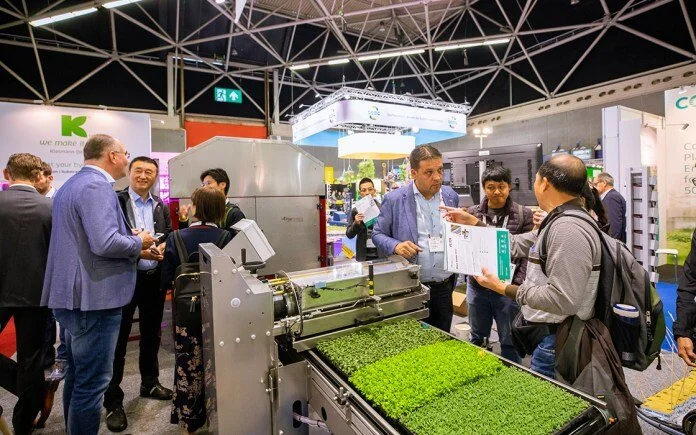
GreenTech Americas Program Focuses On 2 Main Themes
During GreenTech Americas fifty Mexican and international speakers will present various topics for ‘crop optimization in protected horticulture’ and ‘strategic themes focused on business and investment’
By urbanagnews
February 21, 2020
Press Release – During GreenTech Americas fifty Mexican and international speakers will present various topics for ‘crop optimization in protected horticulture’ and ‘strategic themes focused on business and investment’. The objective is to present trends, knowledge and new solutions to all levels of professionals in the horticultural industry of Latin America. The show and program will be held from March 24 to 26, 2020, at the Congress Center, Querétaro Mexico.
Program
Within the framework of this event, a program of conferences and panels is developed with 2 main themes 1: Crop optimization
and 2: Business and investment. A few of the many highlights are:
Saber Merismailli, CEO of Ecoation, talks about “How artificial intelligence can help us grow clean food. And how early detection of issues can increase the revenue in your greenhouse”;
Chris Higgins, Hort Americas, tells you all you want to know about vertical farms. “Do vertical farms build stronger plants? How will the vertical farming industry develop and how does it impact you?”;
Peter Hendriks, director of LetsGrow.com, gives an update about big data. “Big data is no longer a stranger. How can you implement it to your business?”;
“The world’s population is growing and with it the demand for raw materials. However, the supply of crucial raw materials is limited”. A delegate of The World Bank explains the importance of Circular Economy, trends and developments for a sustainable future;
Héctor Manuel Cotero, Dummen Orange, discusses the trends in high-quality flower production. “What are the latest technologies and trends in this industry?’.
Experts and panel leaders
To name a few of the experts who will participate:
Erik J. Plaisier, Agricultural Counsellor for Mexico and Cuba, Nature and Food Embassy of the Netherlands;
Aldo Mares, President of the National Association of Exporters of Berries, Aneberries;
Oscar Woltman de Vries, General Director of Hortinvest Mexico;
Ricardo Martínez, Director General de Asesores en Invernaderos;
Alfonso Torres, Director General, Koppert Mexico, Koppert Biological Systems;
Edison Torrado León, Founder of Naturavisión;
Mauricio Revah, CEO, United Farms;
Paul Arkesteijn, Product Manager & Consultant, Ludvig Svensson;
Remy Matt, Manager, Cultilene;
Rene Beerkens, Consultant, Hoogendoorn.
About GreenTech Americas
GreenTech Americas is a spin-off of GreenTech Amsterdam with the goal to meet the needs of regional growers, breeders, and suppliers. GreenTech Americas will enable a greater exchange of knowledge, experiences, and success stories of the horticultural industry from Mexico and its region. The show is organized by RAI Amsterdam and Tarsus México. Please find more information and to register at www.greentech.nl.
About GreenTech Amsterdam
GreenTech Amsterdam will be held Monday 8 – Wednesday 10 June 2020. The exhibition is a global meeting place for all horticultural technology professionals. GreenTech focuses on the early stages of the horticultural chain and the current issues growers face. All Dutch front runners, greenhouse builders and suppliers are present. Last year a total of 12,489 professionals from 114 countries visited GreenTech Amsterdam.