

Welcome to iGrow News, Your Source for the World of Indoor Vertical Farming
Second Chances Farm Launches In Wilmington With New Trainees And A Hemp License
Ajit George and his team had a lot to announce at the launch of social impact startup Second Chances Farm, where it celebrated the official opening of its 47,500-square-foot facility in Wilmington with a “ladybug dedication.”
The 47,500-square-foot facility in Riverside is bringing on 17 returning citizens to help run the indoor urban farm.
By Holly Quinn / STAFF
Ajit George speaks next to one of the hydroponic towers that will soon fill the warehouse space in Riverside. (Photo by Holly Quinn)
Ajit George and his team had a lot to announce at the launch of social impact startup Second Chances Farm, where it celebrated the official opening of its 47,500-square-foot facility in Wilmington with a “ladybug dedication.”
That’s like a ribbon-cutting, but instead of wielding oversized scissors, the governor, New Castle County executive, mayor and City Council president (among others) released tiny bags of live ladybugs into a floor-to-ceiling vertical “fields” of hydroponic lettuce and herbs.
The urban farm in Riverside will soon also be growing hemp, which is processed into CBD oil, after receiving approval for a license to grow it. (Hemp, a strain of cannabis that has an extremely low level of THC — the substance that gets you high — was made legal in all 50 states with the passage of the 2018 Federal Farm Bill.)
The farm will also offer a few free services to people who live in the neighborhood, including a Crossfit gym and wireless WhyFly service via a connection on the top of the building.
Seventeen returning citizens who have completed their sentences of incarceration have been selected as the first trainee cohort and will receive 16 weeks of paid training.
“We believe those nearest to the solution have also been affected nearest to the problem,” said Saad Soliman, executive director of Peace by Piece, the organization that assists with the reentry program at Second Chances Farm. “Borrowing from my own experience having served 15 years in prison and overcoming boundaries, overcoming barriers, overcoming obstacles, I believe in the leadership of every single man and woman that we’re bringing in here. Let’s humanize the components of who these men and women really are.”
In addition to Second Chances Farm launch, George is also celebrating the launch of his new book, “The Magic of the Red Carpet,” which follows his journey from the founding of TEDxDelaware to Second Chances Farm. All proceeds of the book will go to Peace by Piece.
Watch Soliman introduce the new team members here:

Vertical Farming, A Growing Industry?
Vertical farming is at root a simple concept – instead of spreading out, you spread up. Where previous agricultural innovations have tended to focus on intensity, vertical farming solves for density
MOIRA BENIGSON
6 APRIL 2018
Vertical farming is at root a simple concept – instead of spreading out, you spread up. Where previous agricultural innovations have tended to focus on intensity, vertical farming solves for density. And it needs to – while the number of malnourished people in the world has fallen from one in four in 1970 to one in ten today, the global population is set to reach nearly 10 billion by 2050.
Moreover, industrial development and urbanization mean that even as the human population grows ever larger, there is less arable land today than there was yesterday, and there will be less tomorrow than there is today. The earth has in fact lost 40% of its farmland since 1970.
There have so far in human history been three major agricultural revolutions. The first, around 12,500 years ago, was the shift from the hunter-gatherer lifestyle of our forebears to the sedentary, agrarian system that enabled mass societies to grow. The second, which began in Britain in the 18th century, gave the industrial revolution the workforce it needed to transform the world. The third, in the 1950s and 60s, saw the development of high-yield disease-resistant crop varieties that massively increased the world’s agricultural output and has been credited with saving more than a billion lives. Could vertical farming be the fourth?
Growing crops and plants in stacked layers indoors, vertical farming uses far less water than its conventional counterpart (some estimates put it at one-twentieth) and, theoretically, produces a radically greater yield. By using aeroponic (spraying the roots of plants with a nutrient-rich solution) or hydroponics (growing the plants in a shallow bath of water containing their nutrients) methods, vertical farming reduces the reliance on the soil. It is in short a way to maximize the productive capacity of every square foot while minimizing waste and ecological damage.
Investors have taken note of the method’s potential value. Plenty, a San Francisco-based vertical farming startup that aims to build a large-scale indoor vertical farm outside of every major city in the world last year secured the largest agro-tech investment in history, a $200m funding round involving Softbank, Jeff Bezos, and Eric Schmidt among others. In 2017 the company announced plans to build a 100,000-sq. ft. facility just south of Seattle.
But mass vertical farming may not be the most important change to be brought about by this technology in the near future. For that, we must look to Berlin, where a startup called InFarm is creating modular vertical farming units that can be scaled easily and effectively.
The idea is to have a farm in every store. Imagine going into your local supermarket and instead of aisle after aisle of carefully packaged herbs and fresh-ish vegetables that have travelled hundreds if not thousands of miles, there’s a vertical farm where you can pick your own. It doesn’t get much more ‘experiential retail’ than that.
It’s not just effective marketing or something pretty to look at – InFarm’s clever use of data and monitoring means that yields per square foot can be multiples higher than from conventional farming. Importantly, the proximity of the farm to the consumer allowed by InFarm’s modules means that a different set of incentives can govern the growing process – taste and flavour can be prioritised over shelf life and durability.
When a new plant is added to the system, the company’s team of data scientists and engineers write a new algorithm designed to ensure that the module is perfectly calibrated to every plant. Each of their units is, in essence, an individual ecosystem. A world in miniature that uses machine learning and data to mirror the perfect growing environment of a plant in its natural environment. All modules are monitored and operated using the cloud from a central control centre. As they call it, it’s ‘farming as a service’.
This model of vertical farming might also be the ultimate form of vertical integration, offering grocers the chance to simplify their supply chains, reduce cost and increase yield while at the same time bringing food to shelves that is fresher than ever before. InFarm has already signed deals to place its units in the stores of two of Germany’s largest retailers, Metro and EDEKA.
Not incidentally, InFarm’s system, and vertical farming in general, avoids the use of pesticides. A clear selling point as more and more consumers turn to products which tout their environmentally friendly credentials, minimal waste and chemical-free production processes.
“Rather than asking ourselves how to fix the deficiencies in the current supply chain, we wanted to redesign the entire chain from start to finish; Instead of building large -scale farms outside of the city, optimising on a specific yield, and then distributing the produce, we decided it would be more effective to distribute the farms themselves and farm directly where people live and eat,” Erez Galonska, co-founder & CEO of InFarm
Vertical farming businesses are also budding up in the direct-to-consumer market. Several, such as neoFarms, offer in-home farming modules with built-in ease-of-use technology. neoFarms’ model is about the size of a fridge and can handily fit into a kitchen. CityCrop has already brought a mini-unit to market.
Vertical farming still has a way to go yet. While the industry is predicted to be worth $5.8bn by 2022, that pales in comparison to the $300bn value of the indoor farming market in general, or the estimated $3.1trn global agricultural industry. For the vast majority of producers, distributors and retailers vertical farming will for the time being at least be an attractive addition, rather than a sufficient replacement, to the conventional supply chain.
In the developed world, we have largely been freed from the need to think about where our food has come from, how it was grown, and who grew it. But, perhaps counterintuitively, the increasing urbanisation of much of the world’s landmass may also involve the farmification of our cities. Urban spaces may be eating into our farmland, but farms have already started to eat into our urban space.
The grocers and retailers of the future may become our farmers as well. Combining the technologies of firms like InFarm with their own customer data they’ll be able to produce the food that customers want in the places they want it at a higher quality and with lower impact. Previously farm-to-table has been about bringing the table closer to the farm. Now it’s about putting the farm right next to the table.

Why Do Vertical Farms Fail In India? Stop Copying The West
In this series starting today, we will share with you a few insights (specific to Indian context) that we have gained over time. These insights are based on our understanding and the inferences we have drawn. These may not be directly applicable in your specific set of circumstances
During our journey in CityGreens, we have met many Consultants, Competitors, Collaborators, Govt. Dignitaries, Investors, Entrepreneurs, Aspirants, and so forth. These encounters have helped us develop deep insights into the industry. It will not be an understatement to say that the Vertical Farming industry in India is still in its infancy. The way this industry shapes up will depend upon a lot of factors, primarily being the establishment of a few successful commercial models at a scale that can help the fence-sitters to make an informed leap of faith.
In this series starting today, we will share with you a few insights (specific to Indian context) that we have gained over time. These insights are based on our understanding and the inferences we have drawn. These may not be directly applicable in your specific set of circumstances. However, we do hope that these will help you think more in-depth about the issues that you may face in your journey of Urban Growing.
The first insight that we will cover today is the one that we have observed most commonly and has the potential to inflict the maximum damage on the success potential of a farm.
Aping the West
Agriculture in India, per se, is way behind the western world, when it comes to using technological advancements. One such technology that was promoted and supported by various Governments and vehemently abused by some unscrupulous Farmers (to misuse the subsidy system and make undue financial gains) was that of Greenhouse.
The reason for failure – aping the west. If you consider polyhouse or greenhouse technologies, their roots are in Europe. The primary reason these were created was to protect the crops from cold weather. The climate/weather profile in India is very different. Blindly copying the technology to tropical parts of the country resulted in disastrous consequences in many states. (the technology does work well in the colder climatic regions of the country)
When it comes to Vertical Farming, one can observe a similar phenomenon is taking place. Most of the vertical farming aspirants we talked to had two things in common:
1. They wanted to use LEDs
2. They wanted to grow Lettuce
The reason? Because that is what they have seen everyone doing the world over. Let us evaluate both of these in the Indian context, one by one.
1. Use of LEDs:
Take a step back and look at the problem that LEDs solve, they help you grow indoors. And why do you want to grow indoors?
a. the land cost is too high.
b. The temperature outdoors is not conducive of growing (its either sub-freezing or too hot).
c. one wants to grow in multiple vertical layers (say 10 – 15 levels at least).
In the Indian context, the first two will not hold. What LEDs will result in, in such a scenario, will be a manifold increase in the Cap-Ex and the Op-Ex, thus pushing away the break-even period further, or increasing the input cost so much that the output product becomes uncompetitive in the market.
The third reason may still be the right reason for someone to set-up an LED-based farm in India. But it is cap-ex heavy and should be pursued if one is willing to wait for a long gestation period to break-even.
2. Growing Lettuce:
It is surprising that we rarely come across any Urban Farming aspirant who does not want to grow Lettuce. The questions we like to ask is, after all, how much lettuce can Indian’s consume? People in the west grow lettuce because they eat lettuce day in and day out (as a part of salads, or sandwiches which form their staple diet). Indian’s just don’t.
If one observes carefully, one will see that the palate preferences that get developed over time, do so based on the demographic dividends. In semi-arid and desert regions of western India, when our ancestors had to travel long distances they needed the food that can stay edible for long periods in the hot environment. And you see a lot of gram flour based snacks in those cuisines (think Gujarati / Rajasthani cuisines). Similarly, in the economically lesser developed eastern parts of the country, potato served as one of the cheapest sources of quick energy, and you can see that influence even today (think Bengali Chicken biryani) in most of the eastern cuisines. Similarly, when it comes to greens, Indian palate prefers the one that can be grown in tropical regions. Lettuce is definitely not the one.
Unless India transforms into a salad eating nation or lettuce becomes a part of mainstream Indian cuisines, (think lettuce paneer instead of Palak Paneer), the market for lettuce will remain limited. In such a scenario, if all the vertical farms start producing lettuce, it will flood the market and lead to price erosion.
In order to grow lettuce or other exotics not native to Indian weather, one needs to make a significant investment in temperature control infrastructure which makes the cost excessive. You can save on those investments and keep both your Cap-Ex as well as Op-Ex considerably lower if you grow the Indian greens like spinach. (You can still grow lettuce in the winter season and command market price). Having said that, In case, you do have an assured market for the supply of lettuce that comes out of your farm (through B2B rate contracts or otherwise), please go ahead and set-up a lettuce factory. But if you are doing it just based on the assumption that you will find the market later, better go small and test the hypothesis first.
This brings us to our second observation which we will cover in the next part of this series.
Till then,
Happy Growing!
Gaurav is an entrepreneur whose first Start-up was focused on providing services to patients suffering from Chronic Diseases. While researching about the causes of lifestyle diseases and the ways to reduce their incidence, he chanced upon the idea of growing healthy and nutritious food using advanced farming techniques.
He founded CityGreens with a mission to enable City Dwellers to access Safe, Healthy and Fresh food.
US: Alabama - Container Will Grow Food For Montgomery Restaurants
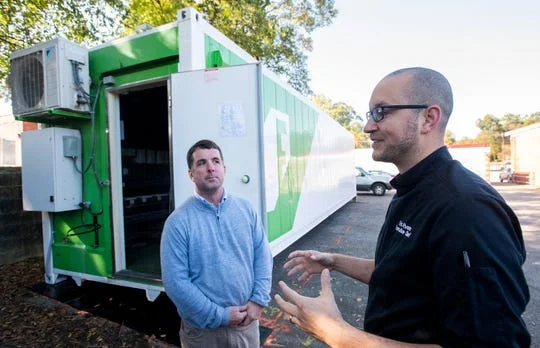
The future of Montgomery fine dining scene is growing inside a freight container in a parking lot off Decatur Street. Dropped into place by a crane earlier this week, the Freight Farm container is full of vertical hydroponics farming equipment and environmental controls
Brad Harper, Nov. 20, 2019
Vintage Year owner Jud Blount, left, and Executive Chef Eric Rivera show their new hydroponic container garden that is being set up to grow fresh vegetables for the Vintage Year restaurants in Montgomery, Ala., on Tuesday, November 19, 2019. (Photo: Mickey Welsh)
The future of Montgomery fine dining scene is growing inside a freight container in a parking lot off Decatur Street.
Dropped into place by a crane earlier this week, the Freight Farm container is full of vertical hydroponics farming equipment and environmental controls — everything you need to grow produce inside. Another crate is on the way and will be stacked on top of the current one.
“We’ll have two different climates, one primarily to (grow) our lettuce and some of our greens, and another climate that’ll be more conducive to growing all of our fresh herbs,” Vintage Year Executive Chef Eric Rivera said. “We should be able to come out and harvest that day for the produce we need that night.”
Everything can be controlled via a phone app.
Workers lower a Freight Farm container into place on South Decatur Street in Montgomery. (Photo: Contributed)
They’ll be up and running in a few weeks, with the first harvest around the end of the year. The team behind Cloverdale’s Vintage Year plans to use the crates as the source for food at its Cloverdale restaurant, the neighboring Vintage Café, and, eventually, at the Ravello Italian restaurant that’s now under construction downtown.
The production capacity in each crate is “huge,” Rivera said. A single crate can produce 700 heads of lettuce a week, for example. They plan to send some of the food to local farmers’ markets and sell more to other restaurants here.
Jud Blount, one of the people behind Vintage Hospitality, said he was sold on the idea after talking about the problems of outdoor gardening with Auburn University Horticulture Dean Desmond Layne. It was a way to work around issues like extreme weather and pests. “This is something where 365 days a year we’ll be growing,” Blount said.
Vintage Year owner Jud Blount, left, and Executive Chef Eric Rivera show their new hydroponic container garden that is being set up to grow fresh vegetables for the Vintage Year restaurants in Montgomery, Ala., on Tuesday, November 19, 2019. (Photo: Mickey Welsh)
Launching the container farming business, called MGM Greens, will give them the chance to work with interns and graduate students from the Auburn horticulture department. Those students, in turn, will have “an opportunity to use a full, functioning facility, which they don’t currently have,” Rivera said.
It also opens new menu options for Rivera. He said they’ll be able to grow herbs that are entirely new to Montgomery, and they can start growing something in the container just a few weeks before it pops up on the menu at one of the restaurants.
Vintage Hospitality announced this fall that they’re opening an upscale Italian eatery in the former City Federal Savings & Loan Building at 36 Commerce Street downtown. The 1925 structure is still being redesigned and restored. Plans call for marble floors, an event space, a ballroom, a courtyard, and a wine cellar.
That opening is still more than a year away.
Vintage Year's new hydroponic container garden that is being set up to grow fresh vegetables for the Vintage Year restaurants in Montgomery, Ala., on Tuesday, November 19, 2019. (Photo: Mickey Welsh)
Contact Montgomery Advertiser reporter Brad Harper at bharper1@gannett.com.
Workers Grow Food And Develop Skills At Arnold Center’s Plant Factory
Arnold Center President Craig Varterian, who began this hydroponic business, called Arnold Farms after growing plants in his basement, likens the facility to a ‘plant factory’.
CHERYL WADE | NOVEMBER 07, 2019
Agencies serving people with disabilities often have piecework projects with workers packaging materials in large quantities. Locally, the Arnold Center is in their second year of a new effort to grow plants in a process that combines recycled water and gravity.
Arnold Center President Craig Varterian, who began this hydroponic business, called Arnold Farms after growing plants in his basement, likens the facility to a ‘plant factory’.
Craig Varterian, Arnold Center President.
For several years before starting Arnold Farms, Varterian read plant journals, consulted experts and grew plants in his basement, often using simple equipment and bins to hold the soil and greens. By the time Arnold Farms launched in 2018, he had done enough background research to design the hydroponic system with help from a couple of other staff members.
“We brought in parts from all over the world – China, Korea,” Varterian says, noting the necessary LED bulbs give off very intense amounts of heat and light. “With some of the parts, you can’t buy in the U.S.”
Walk down the hall toward the large indoor growing area and one quickly breathes air with notes of basil, including a sweet variety that has a little whiff of licorice. There is Genovese, an Italian basil that’s excellent for pesto, and a spicy variety from Thailand that has red stems. Arnold Farms also grows varieties of lettuce and kale, plus edible flowers such as Mexican mint.
Multiple varieties and sizes of plants means the prospect for growth and a diversity of crops that Arnold Farms can produce.
The indoor farm has approximately 6,000 square feet of space and capacity for 26,000 plants. Varterian believes the farm is one of the most advanced, high-tech facilities in Michigan. Unlike many other plant farms with much higher startup costs, Arnold Farms was built for about $500,000, primarily from grants but also from private gifts in order to provide training in a specified field for workers.
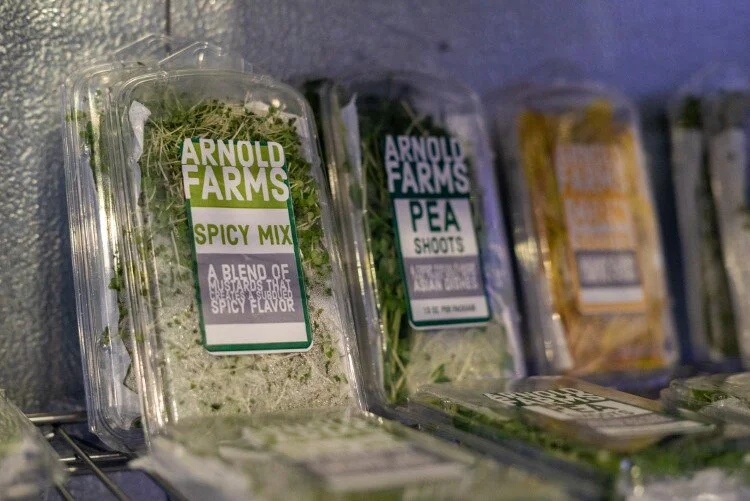
Arnold Farms also produces microgreen whicg grow just 10 to 12 days before being harvested. These plant varieties carry many more nutrients than full-grown plants, says Chandra Jewel, the intake coordinator at Arnold Center. Some of the more unusual products include amaranth, green and purple shiso – an Asian member of the mint family -- and a spicy green mix for salads. More common herbs grown include wasabi, cilantro and mint.
The indoor farm has approximately 6,000 square feet of space and capacity for 26,000 plants.
Jewel has found at least one use for the corn shoots the farms grows. She mixes the wispy, grass-like plants with taco seasoning, salsa and sour cream. “They are great to add to Mexican dishes, because they provide the corn taste,” she says.
Jewel remembers when the fledgling hydroponics business began in a room about 14 feet square, a brick-walled space that was a classroom. There were just a few trays for plants and a couple of employees. “Now we can do so much more.”
Varterian explains this experimentation with multiple varieties and sizes of plants has meant the prospect for growth and a diversity of crops that Arnold Farms can produce.
Arnold Farms also produces microgreen whicg grow just 10 to 12 days before being harvested
“We have a great opportunity to explore agricultural sustainability and we’ve got a great opportunity to create jobs for people with disabilities,” Varterian says.
Varterian didn’t get his start in the disability field. First, he owned a factory. Then, he was president of Reclaim Detroit, a blight remediation program that started with 77,000 abandoned houses. The program trained people to make furniture from the recycled wood of houses that had been torn down.
Workers wear protective suits at Arnold Farms.
“I’d been thinking of doing some version of hydroponic farms,” he says, contrasting his new profession with the old. “Life as we did it (working with demolished houses and used wood) was unsustainable.”
Varterian spent years working to employ people, but knew nothing about running a disability-related organization. Still, he says, he’s always been up to a challenge. Recycling practices, which had been a practice for decades, would provide the renewable resource of plants and possibilities for expansion.
“How many times in your life do you get the chance to take over an organization where you could do something meaningful and make something exciting happen?” he says.
Microgreens are harvested after 10-12 days.
Facilities that traditionally provided supported employment or ‘sheltered workshops’ as they are sometimes described are moving away from piecework for large companies and toward providing people with jobs that pay at least minimum wage and give them training that also prepares them to eventually work outside the facility.
As employment needs change, sometimes the amount and type of work changes for people whose work is confined to a rehabilitation facility, leading to a drop in the amount of work contracted. Varterian said 60 to 70 percent of Arnold Center workers are working at jobs outside the center, and that also means their employers are required to pay them minimum wage.
Racks of produce inside Arnold Farms.
Another 12 to 14 full- and part-time employees work at the indoor farm. They monitor the pumps, which dispense nutrients as they are needed. They transfer plants from germination to seedling stage and later to the area where plants grow to their desired size and are harvested.
Plants are then packed into bags or clam shell containers for delivery to stores and restaurants that will use them. Local restaurant customers include Midland Country Club, Gratzi, Pizza Baker and Whine. Stores include Jack’s Fruit and Meat Market and LaLonde’s Market as well as several Bay City businesses.
“Arnold Farms staffers have sold their products at the Midland Area Farmers Market but now have ceased for the season”, Varterian says.
12 to 14 full- and part-time employees work at the indoor farm.
Although he’s aware that individuals might want to buy produce throughout the year, this is a farm and it’s not set up for individual orders.
“We’re focused mainly on training rather than commercialization,” he says.
At some point, the farm might have its own market day apart from the Midland Area Farmers Market, when staff could sell the products.
Joe Allen, who used to work on the Arnold Center’s floor, says he loves his job at the farms. Not only does he harvest and plant, but he helps with accounting tasks.
“They gave me employment and a safe, secure environment,” he says. “I like working with something that grows, something that’s planted, something to watch. And we’re always learning.”
Arnold farms supplies many area restaurants and stores as well as the farmers market.
Robert Goulette has worked at the farm for 10 months. Although he can use just one hand due to his cerebral palsy, Goulette says his disability doesn’t hold him back and he does everything he can. Varterian calls him “one of our rock stars” because he works hard and fast.
Workers need to keep close eyes on the plants, transferring them as they grow and making sure trays and other equipment are washed. Plants are stacked in trays up to five or six levels high. Gravity takes water down through the stacks; then it’s pumped back up to begin the process again.
“I’d like to see people with disabilities as leaders around the country in this type of farming."
Arnold Farms uses no pesticides, and Varterian likes to call the facilities plants ‘purer than organic’. Plants are germinated in a something called a clean room, which requires workers to use gowns so germs don’t come into the facility on their clothes.
What’s Varterian’s dream for the future of Arnold Farms? He’d like to employ this kind of farming around the country, especially in ‘food deserts’ where food isn’t easily accessible.
“I’d like to see people with disabilities as leaders around the country in this type of farming,” he adds.

The Ultimate Farming Tool Is Data
The agricultural food production mechanisms and their tight dependency on nature have always left little room for operational agility. Now, thanks to Agritech, and more specifically, data, farmers can meet supply and demand efficiently, and reduce losses and uncertainty from plagues and bad weather
Data Is Shaking Up The Current Food Production Mechanisms
The agricultural food production mechanisms and their tight dependency on nature have always left little room for operational agility. Now, thanks to Agritech, and more specifically, data, farmers can meet supply and demand efficiently, and reduce losses and uncertainty from plagues and bad weather.
When we look at Agritech, there are broadly two ways in which startups are making farmers’ life easier: reengineering the products or optimizing the creation of the existing products. The first is more focused on R&D — what the Beyond Burger has been doing — and the latter is more focused on data processing and analytics.
By now, everyone is quite aware of the existence of food substitutes for meat and so on, thanks to the news coverage of the Beyond Burger lucrative IPO and its controversial nature — meatless meat, everyone! What people are not as aware of are data-intensive companies aiming at solving modern food supply problems in creative ways.
Farming is becoming data-intensive
Agritech software is allowing farmers to utilize data to boost their sales, predict the value of their crops before harvesting, and remove the uncertainty that plagues and lousy weather brings to plants; software puts the farmer in control. By gathering farming data, AI models allow farmers to understand the value and opportunities of their crops better.
Which are the companies that are empowering farmers all around? There’s a big chunk of them coming from Israel — a country characterized by their solvency when faced with agricultural adversities. One of the most notorious is Taranis, a four-year-old Tel Aviv based startup utilizing the data pulled from drones surveilling fields to predict and prevent crop diseases and pest losses. It can envision the health of the crops, detect insects and weeds early, growth problems, and many other actionable quandaries.
Also, coming from Israel, we got Prospera Technologies. The company pulls data from the farmer’s crops and also uses macroeconomic data pulled from the web. The software manipulates this data so that the farmer can visually track supply and demand balances, and in this way, plan ahead of the market. This solution enhances the sales team of farmer companies, with an outstanding 95% of accuracy. The company was founded in 2014 and has already raised a total of $22M after its recent Series B.
Guy Galonska, CTO and Co-Founder at Infarm (left) & Erez Galonska, CEO and Co-Founder at Infarm (right) — Picture originally posted at Freunde von Freunden
Startups are also tackling the adverse effects of transport of these short-lived products. Coming from Berlin, we got Infarm, an urban farming services company that develops farming tech in grocery stores, restaurants, and local distribution centers.
Infarm is developing smart farms in cities: vertical farms inside of supermarkets, restaurants, and so on, from where customers can get fresh vegetable produces. Each of these farms connects to the cloud allowing Infarms biologists, agronomists, and engineers to understand the growth and health of plants and use the data to continually adjust and improve the conditions under which the plants grow in real-time. The results are healthy and fresh grown plants that have removed the negative externalities of transport.
According to Infarm, given that 7 billion people will be living in urban centers by 2050, the ability to use the city landscape for vibrant, sustainable agriculture will be a fundamental step to ensuring sustainable cities and a sustainable future.
I spoke to the co-founders of Infarm, the Galonska brothers. Guy Galonska, CTO at Infarm, gave me his take on why data is a game-changer in the agricultural and food production space. “Data is providing an unbiased look into the inner workings of how crops grow, and it gives valuable insight into what can be done better.” As he puts it, infrastructure has been the leading enabler. “The combination of increased computing power & mobile connectivity have an immense potential to drive much-needed optimization across the entire supply chain.”
Software is now feeding the world.
— Guy Galonska, CTO & Co-Founder at Infarm
After raising a $100M Series B funding round this past June, led by Atomico, Infarm is now expanding globally, to bring smart and quality-efficient farming to a global scale. As Guy Galonska puts it, “Software is now feeding the world.”
What’s next
Some may argue that Agritech and Foodtech look more impressive on the food R&D-intensive side — it’s thrilling to envision new products that replace the traditional ones; it allows business processes to leap exponentially. Nevertheless, agricultural automatization and data analytics can have a positive impact by turning farming smart. Even though the advances may seem at first marginal, taking the uncertainty of climate change or plagues out of the equation and having a better knowledge of the state of their product is a big game-changer for farmers.

The Second Generation of Vertical Farming Is Approaching. Here’s Why It’s Important
Current market prices for 1 kg of leafy greens are around $33 for vertically-grown produce and $23 for organic produce. As vertical farms invest and employ higher levels of technology, they will be able to increase their competitive advantage by driving down costs and prices
November 4, 2019
Editor’s Note: Boaz Toledano is a business consultant specializing in vertical farming and other agtech markets. His website is: www.EconoMind.co. Here he writes about how vertical farming is progressing into its next stage. Disclosure: Toledano independently included mention of one of the AgFunder’s portfolio companies IGS (Intelligent Growth Solutions).
Vertical farming practitioners claim to be pioneering the third agricultural revolution.
Vertical farming is the practice of growing produce in vertical stacks using soil, hydroponics or aeroponics to deliver water and nutrients to the plants.
With seemingly higher-quality produce that is grown efficiently, locally and with a potentially lower environmental footprint, the industry appears to be a promising answer to the rising need for sustainable farming methods.
The market was valued at $2.3 billion in 2018 and investments grew significantly from $60 million in 2015 & 2016 to $414 million in 2017 & 2018. What’s less commonly known, however, are the challenges vertical farming companies face and the prospects of overcoming them in order to establish the viability of this industry.
Want to invest in the foodtech and agtech revolution?
Join Us! Sign up for our Asia fund here.
Not surprisingly, capital expenditure (CAPEX) is high. A smallscale, low-tech vertical farm employing 1st generation technology (more on this later) can cost around $280 thousand to start. However, when we consider the more complex operations, those that employ 2nd generation technologies, the setup costs may surpass $15 million.
In order to understand why these figures are so high, we must first understand the difference between the two generations of vertical farming technologies, and why the transition between the 1st and the 2nd is the most important process in this industry’s short history.
First-generation technology enables the basic functions of a vertical farm to occur without the constant intervention of human operators. Second-generation technology enables the growing process to not only be automated but also be continuously optimized to the requirements of the plants being grown. These two generations can be further divided into five levels, detailed below. Generally, the more a company has advanced down these levels, the better its competitive advantage.
When vertical farms were being established around the world about a decade ago, they employed 1st generation technology. These operations showed it was possible to grow food — and other plants — in vertical structures, thus enabling a more efficient use of land. On average, 2nd generation vertical farms yield 55 times more produce per unit of area compared with conventional farms. For the first time in modern history, food could be grown in cities, where it is eaten.
It has also become possible to remove problematic sections of our food supply chain, for instance, transportation and the pollution that goes with it, excessive packaging and preservatives. Also, we could finally reconnect to the source of (some) of our food, a privilege that was removed from our lives around the 17th century, when the Second Agricultural Revolution — also known as the British Agricultural Revolution — sparked the industrial revolution that led to mass urbanization.
Next, vertical farms had to prove their economic viability. Virtually the only way companies were able to become profitable is by using technology to cut down on the high operating expenses (OPEX), which mainly consist of lighting and labor (~30% of OPEX each).
Enter 2nd generation technology.
In a vertical farm, LEDs (light-emitting diodes), which provide light to the plants, are more efficient than other forms of artificial lighting that were used in the past (fluorescent and incandescent), resulting in lower operating costs. According to the International Energy Agency (IEA), LED lighting efficiency is expected to increase by an extra 70% by 2030. The pricepoint also continues to drop.
Labor expenses will be tackled by automation. Many startups and some capital-backed growers are developing technologies to help vertical farms reduce their dependence on human labor, with remarkable achievements. A noteworthy example is IGS (Intelligent Growth Solutions), which has developed an automated system that enables highly efficient production using modular structures. The company claims to have reduced labor by up to 80% and power by up to 50%. Its plan is to sell its technology to companies that want to improve the efficiency of their vertical farms’ operations.
Another example is Plenty, an industry leader and one of the best-funded vertical farming groups globally, which was able to improve the energetic efficiency of its newest facility, Tigris Farm, fivefold, compared with its previous facility. Though quite secretive, we now know that the company uses plant management automation to transfer its growing towers around the warehouse, as well as harvesting automation.
These are examples of the OPEX reduction trends the industry is seeing. Lighting improvements should reduce OPEX by 12%, and automation should cut OPEX by a further 20%+.
Since vertical farms have thus far introduced mediocre returns on investment (ROIs), these reductions in OPEX are crucial for the industry to prove itself to investors, governments, and companies considering entering the market. Although CAPEX will remain high compared with conventional and organic farming, the 30%+ expected reduction in OPEX makes a compelling case for vertical farming.
Current market prices for 1 kg of leafy greens are around $33 for vertically-grown produce and $23 for organic produce. As vertical farms invest and employ higher levels of technology, they will be able to increase their competitive advantage by driving down costs and prices. Eventually, I believe, they will be able to compete with organic producers, who last year operated in a $100 billion market.
Bowery CEO: Building Tech Is Expensive, Takes Time But Has Direct Impact On Economics of Vertical Farming
Bowery Farming, the New York-based vertical farming startup that counts Google, First Round Capital, and famous chef Tom Collichio as investors, has just raised an extra $50 million as an extension to its Series B. Temasek, Singapore’s state fund, led the extension with participation from Henry Kravis, the founder of private equity giant KKR
November 12, 2019
Bowery Farming, the New York-based vertical farming startup that counts Google, First Round Capital, and famous chef Tom Collichio as investors, has just raised an extra $50 million as an extension to its Series B. Temasek, Singapore’s state fund, led the extension with participation from Henry Kravis, the founder of private equity giant KKR.
Temasek invested in the first tranche of the Series B and was taking advantage of its seat at the table to preemptively invest more into the company on the back of Bowery’s growing commercial success, said CEO Irving Fain, adding that he wasn’t looking for more funding; the company has raised $172.5 million to date. “To their credit, they are phenomenal partners and this deal closed at a nice place from a valuation perspective for us. They have a very strong conviction about this space, both because of the macro trends but also after spending a lot of time looking at [vertical farming] before choosing to invest in us.”
The big piece of news coming with the funding announcement was the launch of Bowery’s third farm, a facility in Baltimore that is 3.5 times larger than its last in New Jersey. The farm is already operational and will be selling greens in the New Year, Fain told AFN.
Why Baltimore? From a population perspective, it can serve 26 million people within a 150-mile radius from its location, which is a transportation hub. And the company will be able to hire a workforce from within the community, which Fain says has always been important to them.
Fun fact: the exact location, White Marsh, used to have a farm many moons ago, so Fain likes the idea that Bowery is bringing the area back to its agricultural roots but in a modern way.
This round also coincides with a step-change in Bowery’s commercial activities, which Fain said have been less of a focus until now in favor of the company’s technology platform. As part of this, the company has hired Carmela Cugini as EVP of sales. Cugini comes from Walmart where she led its online grocery business after it acquired Jet.com, and also spent time leading sales divisions at Pepsi. “She’s been both a seller and a buyer at some point and that’s a unique set of skills to find,” said Fain.
Having said that, Bowery has still managed to expand its retail footprint to Whole Foods Markets, Ahold, Amazon Fresh, Jet, Westside Market, among others and recently significantly increased its deal with Whole Foods, Fain told AFN. Bowery’s greens will now appear in Whole Foods stores in all of Manhattan, Westchester, and Connecticut. Fain puts the growth in demand for Bowery produce down to two critical consumer trends that are gathering pace rapidly: the demand for local food and food grown with sustainable farming practices.
Tell us about the tech!
Meeting the growing demand for indoor-grown food has been a challenge for many in the vertical farming industry; the high costs associated with building new facilities and the struggles to find the right talent have been some of the key challenges in scaling this industry. For Bowery, building its internal technology platform has been key to its strategy of “thoughtful scaling,” said Fain.
“With each new farm we’ve opened, we’ve made meaningful improvements and steps forward in the technology, taking time to learn and understand what’s working well and what needs to improve,” he said.
Dubbed BoweryOS, the firm’s technology platform combines sensors, control systems, computer vision, robotics, and machine learning to optimize many of the processes around the farm, making the overall operation more efficient in terms of labor and costs. Not only can it do some of the tasks humans would have previously done such as monitoring and altering the environment or moving plants around the facility, but its machine learning and software platform can also guide workers on what to do and when such as identifying plants ready for harvest and harvesting.
“This means the workforce can look and resemble an Amazon fulfillment center; they don’t need to have grown a crop or have familiarity with farming,” said Fain. The company recently hired Caralyn Cooley as chief people officer, who was also previously with Jet.com, Amazon, and Pepsi. Cooley has deep experience working with an hourly workforce and the types of workers Bowery will be looking for in its farms in terms of experience and salary, said Fain.
Bowery wouldn’t disclose how much of the $170 million-odd raised has been spent on its technology platform — although we know it to be significant — but Fain said its a critical part of the company’s success.
“Building technology is hard, it’s expensive, and it takes time, but the tech you use in indoor ag has a direct and clear impact on the economics of the business you’re creating, the varieties you can grow, and the efficiencies you can generate and we realized this early on,” he said.
As Boaz Toledano recently wrote in a very popular AFN post, this type of second-generation indoor ag technology can enable vertical farms to yield 55 times more than first-generation vertical farms where tasks such as controlling lighting, heat and Co2 were automated to some extent but not optimized with data analysis.
Asked why they decided to build it in-house instead of deploying third-party technology that would have been cheaper, Fain said the ability to control and own the technology meant they could iterate on it and optimize at a very fast rate, unreliant on other vendors to make changes and updates. “The ability to create tech specifically for our system and ecosystem provides enormous efficiencies from farm to farm,” he said of the benefits of internal tech in scaling the company to multiple farms.
But Bowery emphasized that technology is still just one piece of the business; “scaling for Bowery is more than just evolving technology or rapidly opening new farms in new cities – it also means investing in agricultural science and R&D, and hiring top talent across the organization to support this continued growth. All of these factors (and more) ensure the brand can continue expanding their farm network and distribution footprint in 2020, and beyond,” the company said in a statement.
The agricultural science team, under Susan McIsaac, a plant biology Ph.D., is looking at optimizing and improving the varieties of vegetables the company grows today and researching new ones including new species across root vegetables, vine crops, and fruiting crops. Using BoweryOS data, it also suggests detailed tweaks to how to grow different crops and is looking at “how to push the boundaries in conjunction with the farm design team.” It’s not considering gene editing at this stage though, unlike some others in the space that recently created the Precision Indoor Plants (PIP) Consortium.
€5 Million For Dutch Vertical Farming Research
"The increasing world population needs to be fed, while more and more people live in cities, there is often too little water, and we want our vegetables to have more and more nutritional value”
Wageningen University & Research (WUR) is to receive more than €8 million from the Dutch Research Council (NWO) and participating bodies for two major research programs, one involving tower garden systems using LEDs and the other focusing on improvements in the welfare of pigs and chickens. A third project, with WUR as a partner, is about sustainable freshwater management in the Dutch delta.
The recipients of the so-called Perspectief round 2019 funding were announced during the annual ‘Teknowlogy’ event hosted by NWO’s Applied and Engineering Sciences domain.
Tower gardens using LEDs
Sky High, a research program led by Professor of Horticulture & Product Physiology Leo Marcelis, which aims to bring about a revolution in vertical farming, received a total grant of €5 million.
"The increasing world population needs to be fed, while more and more people live in cities, there is often too little water, and we want our vegetables to have more and more nutritional value. By growing plants in layers on top of each other and illuminating them with special LED lights, you can produce fresh vegetables all year round, anywhere in the world, and under all weather and climate conditions," says program leader Prof. Leo Marcelis.
Researchers working on the Sky High program will cooperate with lighting specialists, plant breeding companies, growers, horticultural technology companies, architects and food suppliers to make vertical agriculture systems cheaper and more energy-efficient. Another aim is to produce vegetables and herbs that taste better, have longer shelf lives and provide more nutritional value, while using the absolute minimum of water and fertilizers and no pesticides.
Other participants
Amsterdam Institute for Advanced Metropolitan Solutions (AMS), Bayer, Bosman Van Zaal, Certhon, Fresh Forward, Grodan, GrowX, HAS University of Applied Sciences, OneFarm, Own Greens, Priva, Signify (Philips Lighting), Solynta, TU Delft, Eindhoven University of Technology, Unilever, Leiden University, Utrecht University, University of Amsterdam, and Van Bergen Kolpa Architecten.
Source: Wageningen University & Research
Publication date: Tue 12 Nov 2019

From Bomb Shelter To farm: The Latest Food Revolution
When you think of growing anything ‘underground’, the first thing you may envisage is some kind of criminal activity. But, there’s a food innovation gaining traction around the world, specially in London, and while it might be coming from beneath the streets, it’s all above board
14 Nov 2019
Sponsored by KETTO
Food for thought
When you think of growing anything ‘underground’, the first thing you may envisage is some kind of criminal activity. But, there’s a food innovation gaining traction around the world, specially in London, and while it might be coming from beneath the streets, it’s all above board.
Here's what you need to know about the latest underground food revolution...
Growing Underground
The fully-working Growing Underground farm is located 33 metres beneath the busy streets of Clapham, in the abandoned tunnels of a former World War II air-raid shelter.
The urban farm covering 65,000 square feet lie 120 feet under Clapham High street and are home to 'Growing Underground', the UK’s first underground farm. The farms produce includes pea shoots, rocket, wasabi mustard, red basil and red amaranth, pink stem radish, garlic chives, fennel and coriander, and supply to restaurants across London.
Salad without soil?
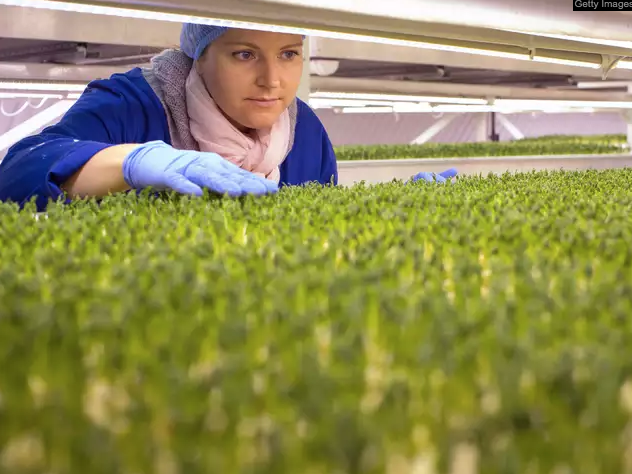
Urban farmers, Richard Ballard and Steven Dring are using the latest hydroponic systems and LED technology to grow fresh microgreens and salad leaves, in a stable, sustainable and pesticide-free environment.
A spigot supplies nutrients and water to the roots of the plants and artificial light and warmth is provided by LED lighting. The site is powered with renewable energy.
Instead of using soil, seeds are planted into mats made out of old carpet offcuts. Once the seeds germinate, they are put under lights to mimic sunlight.
Science behind the sprouts
So what is hydroponics? According to the Royal Horticultural Society, it is “the science of growing plants without using soil, by feeding them on mineral nutrient salts dissolved in water.”
Hydroponics does not use soil, instead, the root system is supported using an inert medium such as perlite, Rockwool, clay pellets, peat moss, or vermiculite.
Location, location, location
Its central London location is convenient to distribute the vegetables to hotels, restaurants and shops, reducing the food miles for businesses and consumers. The farm also boasts using 77% less water than conventional agricultural methods.
The system is completely unaffected by the weather and seasonal changes, which means they can be grown 356 days a year.
All photos: Getty Images
Bowery Expands Indoor Farming To Baltimore Area With An Eye Towards More Sustainable Production Globally
18-Nov-2019 By Elizabeth Crawford
Uncomfortable with the idea that agriculture is a necessary evil with the demand for food outweighing the negative environmental impact of traditional farming and ranching, the co-founder and CEO of Bowery is expanding his revolutionary approach to food production through indoor farms that use proprietary technology to improve sustainability and produce quality.
To Read The Entire Article, And View The Video, Please Click Here

Kimbal Musk’s Square Roots is On A Mission To Feed The World — And Eventually Astronauts On Mars
Elon Musk’s brother, Kimbal, is on a mission to feed the world and train the next generation of farmers. He co-founded Square Roots with CEO Tobias Peggs to grow non-GMO crops in reclaimed shipping containers, even in urban areas. The company is installing its container farms at Gordon Food Service facilities and other grocery stores across the U.S. Square Roots made CNBC’s 2019 Upstart 100 list, released Tuesday
NOV 12 2019
KEY POINTS
Elon Musk’s brother, Kimbal, is on a mission to feed the world and train the next generation of farmers.
He co-founded Square Roots with CEO Tobias Peggs to grow non-GMO crops in reclaimed shipping containers, even in urban areas.
The company is installing its container farms at Gordon Food Service facilities and other grocery stores across the U.S.
Square Roots made CNBC’s 2019 Upstart 100 list, released Tuesday.
Kimbal Musk meets with Square Root farmers at the company’s Brooklyn headquarters, home to farms housed in shipping containers.
Mary Stevens | CNBC
One-third of the world’s food supply is wasted, according to research from the UN Food and Agriculture Organization. Now a start-up called Square Roots, co-founded by Kimbal Musk (Elon Musk’s brother) and Tobias Peggs wants to reduce that waste by growing food as close as possible to the point of use.
Based in Brooklyn, New York, Square Roots has developed and installs “modules” — hydroponic farms in reclaimed shipping containers that can grow certain non-GMO vegetables around the clock and without pesticides. Today they are producing mint, basil, other herbs, and leafy greens. The company made CNBC’s 2019 Upstart 100 list, released Tuesday.
The modules, which employ software-controlled LED lighting and irrigation systems, can be set up in the parking lot of a grocery store or even inside a large warehouse or industrial building, enabling a food maker to access fresh ingredients locally for use in their dishes or packaged products.
According to CEO Peggs, raising at least some crops close to where they will be eaten helps reduce the food damage and spoilage that occurs during shipping from a point of harvest to a faraway destination.
Growing food in a tightly controlled microclimate also means those crops can have better flavor and yield than counterparts that are grown in traditional farms, said Peggs, who added that in the great but unpredictable outdoors, everything from changes in soil acidity to humidity can harm crops.
Square Roots CEO Tobias Peggs is redefining urban farming. | Square Roots
Those who buy Square Roots produce can scan a QR code on the packaging to read a “transparency timeline,” with details about their fresh food, like the identity of the farmers who grew it and when it was harvested and delivered to the store.
One day Square Roots aims for its technology to work off-world. Kimbal Musk, who is Square Roots’ executive chairman and also holds board seats at SpaceX and Tesla, said: “I’m focused on bringing real food to everyone (on Earth), but the farming technology we are building at Square Roots can and will be used on Mars.”
Peggs, who has a Ph.D. in artificial intelligence from Cardiff University, has a history of building businesses with Kimbal Musk. Peggs was the CEO of a social media analytics firm called OneRiot, which Musk co-founded. They sold it to Walmart in the fall of 2011.
Peggs and other OneRiot employees joined Walmart Labs and helped the retail giant roll out mobile apps and analytics in international markets. That was when Peggs became intrigued with the potential for software to help feed the world.
Square Roots faces significant competition in what’s known as indoor ag or sunless farming, including venture-backed competitors Bowery Farming, Plenty, Freight Farms, Gotham Greens and AeroFarms, among others. Their potential to reduce the environmental footprint of agriculture is yet to be determined.
Modern agriculture accounts for 24% of greenhouse gases and is the No. 1 source of pollution on the planet, according to environmental researcher Paul Hawken, the founder of Project Drawdown, a nonprofit that points to ways global warming can be reversed.
Hawken told CNBC, “Indoor ag may or might not pencil out with respect to sustainability when all the energy and inputs are totaled.” That’s because indoor farming requires more human-made energy but less transport and distribution energy.
Square Roots container farms can grow fresh mint and basil, year-round, in Brooklyn.
https://squarerootsgrow.com/
Moreover, crops from indoor farms might not match the nutrition of soil-grown crops, because the medium the plants are grown in is either hydroponic or assembled substrates. Hawken wrote:
“What makes plants superfoods and nutritious is stress, not ‘perfect’ temperature-controlled growing environments. Phytonutrients that are vital to human health do not develop to the same extent indoors. Sun, UV radiation, insects, dryness, competition, wind, and wide temperature variations ultimately make plants strong, delicious and nutritious.”
But it will bring locally grown, organic produce — part of a healthy diet — to markets that may not have much of it otherwise, he said.
Inspiring a new generation of farmers
Square Roots is aiming to work with partners that use renewable energy as much as possible to power their modular farms, said Peggs. One recent example is Square Roots’ partnership with Gordon Food Service in Grand Rapids, Michigan, which runs its business partly on wind power.
The company has agreed to roll out Square Roots modular farms across their network of hundreds of retail stores and food production and distribution facilities in the U.S. in the coming years.
“Rather than a plant factory, where you’d spend tens of millions to build an industrial-scale facility that could take two to three years, we pop up in a new city in a matter of weeks.
Tobias Peggs
SQUARE ROOTS CO-FOUNDER
Another objective of Square Roots is to inspire more people to become farmers. Wherever it installs its modules, crops are grown and systems are managed by employees who have enrolled in Square Roots’ Next-Gen Farmer Training Program. Throughout the year, the trainees get to learn about everything from plant science to computer science from Square Roots, while also earning a salary and health benefits — which aren’t always available from similar internships and apprenticeships.
Because Square Roots is supplying fresh-grown herbs to more than 70 stores in New York City, that means a significant number of its next-gen farmers are city dwellers who never expected to be working in agriculture.
Peggs said he’s betting on modular farms over other indoor agriculture approaches precisely because of their flexibility. “Rather than a plant factory, where you’d spend tens of millions to build an industrial-scale facility that could take two to three years, we pop up in a new city in a matter of weeks.”

An Analysis of Vertical Vegetable Farms
Until recently, vertical farms were an exception in the market, but now this high-tech agricultural sector is rapidly gaining ground in urban centers of Asia, North America, and Western Europe
"Huge Investments, Confident Markets, But Still Many Uncertainties"
Until recently, vertical farms were an exception in the market, but now this high-tech agricultural sector is rapidly gaining ground in urban centers of Asia, North America, and Western Europe. However, their economic viability and agronomic interest, compared to field crops or greenhouses, are far from established. Why, then, do some investors choose to follow this path of innovation? What, exactly, are the technical solutions required to produce in confined buildings, without natural sunlight? And, does this business model have future prospects?
The French Centre for Studies and Strategic Foresight, part of the Ministry of Agriculture and Food General Secretariat, published an analysis on the market.
Urban agriculture is now promoted as a vector of sustainable food, quality of life and community engagement. Most often, though, it consists of small-scale home and leisure activities: shared neighborhood gardens, potted crops on balconies or green
rooftops, etc. These “initiatives” are confined to a niche by the lack of land and the intermittence of citizen involvement. The artificial
environment of the city, with its soil and air pollution, building shadows, and impermeable pavement hinders any large-scale deployment of urban gardens. Thus, their contribution to the populations’ food supply seems doomed to remain marginal.
On the opposite side of the social and market spectrum is urban agriculture for industrial and production purposes, and more specifically on vertical farms. With advancements in LED lamps, robotics, and information technology, multi-level indoor production units with reduced footprints are being created, dedicated to the intensive cultivation of plants and vegetables, mostly salads.
Contrary to greenhouses, these high-tech farms do away with natural light and cut all dependance to their outside environment. This version of urban agriculture has strong ambitions: mass production of quality food products, at any time, under any climate, close to consumers, and without the use of pesticides, all at market prices.
Download the full analysis here
Publication date: Thu 7 Nov 2019
Singapore Agritech Startup Sustenir Now Serving Hong Kong With Locally Grown, Low Emissions Kale
Earlier this year, Singapore-based agri-tech company Sustenir made headlines with its lab-grown strawberries and arugula in its hydroponic facility. Now, the startup has just expanded into Hong Kong to start vertical farming in the city, producing two kinds of kale at their Tuen Mun facility
By Sally Ho November 12, 2019
Earlier this year, Singapore-based agri-tech company Sustenir made headlines with its lab-grown strawberries and arugula in its hydroponic facility. Now, the startup has just expanded into Hong Kong to start vertical farming in the city, producing two kinds of kale at their Tuen Mun facility. Sustenir’s vertical farming technology presents an alternative to the current food system operating in hot and humid climates like Hong Kong and Singapore. By growing non-native crops in lab-controlled settings, the startup hopes to alleviate dependence on foreign food imports, which generates additional carbon emissions, and food waste in the transportation process.
After its latest round of Series A funding, which attracted US$15.4 million in investment from venture capital firms including Grok Ventures and Tamesek Holdings, Sustenir has recently launched a new 30,000 square foot hydroponic farming facility in Tuen Mun, Hong Kong. The produce currently launched in the city include “Kinky Kale” and “Toscano Kale”. The company is also looking to bring in new offerings in the near future, including kale juice and pesto, both of which they sell in Singapore.
Commenting on the reasons behind their launch in Hong Kong, co-founder and CEO of Sustenir Benjamin Swan told Green Queen that “Hong Kong has similar constraints to space as Singapore and has a similar reliance on imported produce. Our mission has always been to be present in countries and communities with heavy reliance to imports, so we can produce locally and lessen carbon emissions from import transportation.”
The company, which was founded in Singapore in 2013, produces crops that are in local demand using laboratory-controlled vertical farming methods based on artificial intelligence and LED lighting, which helps photosynthesis in plants. Using this technology, the shelf-life of Sustenir’s farmed crops can be extended, which helps to reduce food wastage. In addition, by growing non-native crops in a local facility, the concept minimizes the carbon footprint involved in transporting foods, as well as wasted food that often results in the logistical process of importing fresh produce. This is particularly relevant for Hong Kong, where over 90% of the city’s food supplies are imported from abroad, and for the wider Asian region, which is responsible for over half of global waste.
To cater to Hong Kong tastes specifically in their first launch outside of Singapore, Swan said to Green Queen: “When we enter a country, we always make sure that we tailor our products to the tastes and wants of the people so we can truly give a product made in Hong Kong for Hong Kong.”
Now that their first international foray under their belt, Sustenir hopes to be able to first increase their product offerings in the facility, including growing other leafy greens like lettuce, spinach, arugula and basil, and to continue to launch more urban vertical farms across Asian cities.
Lead image courtesy of ST Photo/ Lim Sin Thai.

The Next Hot Tech Career? Farming
Back in 1870, almost half the U.S. workforce was employed in agriculture — today just two percent of Americans work on farms
Shutterstock
Back in 1870, almost half the U.S. workforce was employed in agriculture — today just two percent of Americans work on farms. Over the decades, some people were driven away by mechanization or lured to cities by the promise of better-paying jobs. More recently, trade wars, tariffs, volatile crop prices, and declining profit margins have increased risk for farmers — and then there’s the impact of climate change on crop yields, chronic labor shortages and increasing debt. Add to that the perception of farming as unsophisticated, undesirable work and it’s no wonder family farms, once the backbone of America, are now in crisis.
According to the 2017 USDA census, the average American farmer is 57 years old and with few young people entering the field, farming is in desperate need of new blood. There’s much more than centuries of tradition at stake. The UN estimates that the world population will reach 8.5 billion by 2030, and as high as 9.8 billion by 2050, requiring a 70 percent increase in global food production. With that many mouths to feed, farming may well be the most important job on the planet.
As the CEO of an AgTech company working to help farms transition to more sustainable practices, I’ve seen firsthand the effort and dedication farmers put into stewarding the land and feeding the world. I’ve also seen misperception about what farming is (and isn’t) hold the sector back from attracting younger generations and adopting technological innovations that can improve the lives and livelihoods of farmers.
It seems to me that what’s needed is a rebrand of sorts — a concerted effort to separate myth from fact and promote the potential farming holds for fulfilling impactful careers. So, how do we give agriculture an image makeover? I don’t have all the answers, but I do have a few ideas on where to start.
Farming is a Tech Industry — Let’s Treat it Like One
Twenty years ago, it wasn’t cool to work at a car company, but today companies like Tesla are attracting some of our best and brightest by reframing auto manufacturing as a sophisticated, futuristic field. Farming has the potential to do the same.
Agriculture might be perceived as old-fashioned and low-tech, but farmers have worked hand-in-hand with technology for generations — whether it’s large machines like tractors and combines or complex chemicals, fertilizers and pesticides. Right now the field is in the midst of profound change as advanced technologies including green chemistries, robotics, artificial intelligence, IoT, autonomous vehicles, machine learning, regenerative agriculture, and biomimetics transform how farms look and function. It might seem like the stuff of science fiction, but autonomous vehicles, indoor farming, and drone pollination are becoming more common throughout the sector.
Looking at, and more importantly, talking about farming as a part of the tech revolution has the potential to ignite the curiosity and imagination of the next generation. In fact, it’s already happening in many countries in Africa, where millennials are using apps and other inexpensive technologies to improve profits and elevate the image of farmers from peasants to professionals. North America would do well to follow suit with an updated image of farmers wielding smartphones rather than American Gothic-era pitchforks.
Create Better Economics — and Education — for Farmers
Advanced technologies may be poised to revolutionize farming, but the reality is they don’t come cheap — at least not yet. Most farmers don’t have the budget for a strawberry-picking robot much less the skillset to maintain or repair one. What’s needed is an industry-wide, gradual integration of affordable AgTech, accompanied by education and mentorship. Traditional farming co-ops could be revitalized to help bring farming into the digital age by pooling funds and sharing resources to offset the cost of emerging technologies — while still providing vital networks for knowledge sharing and a sense of community.
Meanwhile, farming knowledge, once passed down from generation to generation, needs to include people who weren’t necessarily raised on farms. Programs like Square Roots and New Entry are starting this wave with courses like plant science, indoor farming and business foundations that aim to teach next-generation farming skills to a new generation and lineage of farmers.
Right now farmers can test and iterate on a crop season maybe 50 times in their life. New tools will allow them to experiment and optimize much more rapidly. Startups like Prospera, Iron Ox, and Farmer’s Edge are utilizing sensors, analytics and machine learning to capture the interest of younger generations and improve predictability, precision, and profits. My own company is working to reduce reliance on synthetic chemical fertilizers and pesticides while increasing yields by gathering data on how inputs like crop protection products, nutrients and water can be used more effectively to naturally boost a plant’s resistance to pests, disease, and drought. By augmenting farmers’ intuition with informed cause and effect, we can use technology to take the guesswork out of farming and decrease risk.
Deepen Our Connection with Food
There’s something special about the gift of food. If someone takes the time to bake you a pie, it’s a gift from the heart. If someone bakes you a pie made with strawberries and rhubarb that they grew themselves? Now that’s a whole new level of love.
From food bloggers posting plates on Instagram to the explosion of TV shows exploring everything from street food to obscure ingredients, foodie culture has deepened our appreciation of good food. But there’s still a disconnect with how it’s grown, or more importantly, who grew it.
Fortunately, we’re headed in the right direction. The increasing popularity of plant-based products such as Beyond Meat and the skyrocketing demand for organic, natural and local produce has people asking what’s in their food. The next step is to connect the dots with how it’s grown.
Education of this sort needs to start at a young age, with school community garden projects and field trips to farms. The Clinton Foundation’s Students for Eco-Education and Agriculture program provides a hands-on agricultural literacy that helps kids understand the food journey – from farm to table – and teaches them about healthy eating, sustainable farming practices and the fragility of our ecosystem. Michelle Obama’s White House Kitchen Garden, meanwhile, sparked a nationwide conversation about nutrition and exposed a generation of kids to the joys of growing their own food. We need to build on that legacy.
Emphasize the Purpose of Farming
We’ve heard time and again that millennials want meaningful careers that help make the world a better place. Often that interest is funneled towards jobs in CleanTech, non-profits, the environment or the arts. But farming is an overlooked industry with incredible potential to help improve the world.
Farmers are stewards of the land, with huge potential to restore damaged ecosystems by employing sustainable and regenerative agricultural practices. As the world grapples with the effects of climate change, the next generation of farmers has a pivotal role to play in correcting the mistakes of the past. Companies like Ingleby Farms have tapped into this ethos by promoting their focus on long-term care of the land, green energy and biodiversity. They’re walking the talk, providing food with a conscience and farms with a future.
Somewhere along the line, we started to devalue farmers and take them for granted, but it’s hard to think of a career that’s more important for our collective survival. Feeding the planet isn’t simplistic or base, it’s multifaceted, complex and sophisticated. Farmers are the original experimenters, hackers, makers and problem-solvers; they’re biologists, chemists, engineers, entrepreneurs and inventors. Perhaps if we talked about them like that, young people would be inspired to continue their legacy, and proudly bring the field into the future.
This article was originally featured in Agfunder and LinkedIn.
— Published on November 4, 2019
Karn Manhas
CEO and Founder of Terramera, Karn Manhas is a leader in the AgTech industry, pioneering the application of revolutionary technologies that transform how we grow food and solve other world-scale challenges. A biotechnologist, entrepreneur and environmentalist, Karn’s mission is to reduce global synthetic chemical loads in agriculture by 80% while improving global farm productivity by 20% by 2030.
Karn was inspired to start Terramera after winning a friendly argument over whether pests like bed bugs could be controlled using non-toxic, natural ingredients. What started as curiosity-fueled research in the summer of 2009—exploring how a natural extract he’d read about, neem oil, could be used to control insects — evolved into a new area of science and the beginning of Terramera and their Actigate™ Targeted Performance technology. Today, Terramera is pairing its Actigate technology with AI, data science and machine learning, to allow natural alternatives to become more effective, reduce global synthetic chemical loads, and revolutionize agriculture in the process.
Karn is an accomplished public speaker who has appeared at TEDx Vancouver, Unreasonable, and Singularity University. He is also a former MLA in the B.C. Legislature in the riding of Port Coquitlam-Burke Mountain. Karn holds a Bachelor of Science in Biology from McGill University and a law degree from the University of British Columbia.

Produce Will Grow On Site At Kroger's QFC Stores.
The Kroger Co. is teaming with urban farming network Infarm to bring modular living produce farms to North America, which will result in offering produce picked so fresh that consumers will be able to see the roots
Kroger Launching Living Produce Farms This Month
11/19/2019
Produce will grow on-site at Kroger's QFC stores.
The Kroger Co. is teaming with urban farming network Infarm to bring modular living produce farms to North America, which will result in offering produce picked so fresh that consumers will be able to see the roots.
The partnership between Cincinnati-based Kroger and Berlin, Germany-based Infarm marks the first-of-its-kind in the United States, according to the two entities.
The living produce farms will launch this month at two of the 15 stores planned at QFC, a Kroger banner, at locations in Bellevue and Kirkland, Washington. Using hydroponic technology, the produce will grow on site at the participating QFC stores, removing the need for extended transportation and storage and producing a more eco-conscious product, according to Kroeger. The farms are designed to scale and will provide shoppers the freshest and most sustainable living produce options available.
"Kroger believes that everyone deserves to have access to fresh, affordable and delicious food, no matter who you are, how you shop or what you like to eat," said Suzy Monford, Kroger's group vice president of fresh. "Our partnership with Infarm allows us to innovate by combining ground-breaking in-store farming technology with our passion for fresh, local produce and ecological sourcing. Kroger is excited to be first to market and offer the best of the season."
"We want to make fresh, pure, tasty and nutritious produce available and affordable for everyone," said Erez Galonska, CEO and co-founder at Infarm. "Kroger's commitment to innovation, quality and flavor makes them the perfect partner with which to launch our business in the United States and for the first time in North America."
Bowery Farming's $50 Million Financing Tops Recent Funding News In New York
New York-based agriculture company Bowery Farming has secured $50 million in Series B funding, according to company database Crunchbase, topping the city’s recent funding headlines. The cash infusion was announced Nov. 6th
Photo: Paul Arps/Flickr
November 12, 2019
New York-based agriculture company Bowery Farming has secured $50 million in Series B funding, according to company database Crunchbase, topping the city’s recent funding headlines. The cash infusion was announced Nov. 6.
According to its Crunchbase profile, "Bowery is the modern farming company growing the purest produce imaginable. We are on a mission to grow food for a better future by revolutionizing agriculture. By combining the benefits of the best local farms with advances made possible by technology, our indoor farms create the ideal conditions to grow post-organic produce you can feel good about eating."
The four-year-old startup has raised three previous funding rounds, including a $90 million Series B round in 2018.
The round brings total funding raised by New York companies in food and beverage over the past month to $55 million. The local food and beverage industry has seen 65 funding rounds over the past year, securing a total of $786 million in venture funding.
In other local funding news, lending and point of sale company Octane Lending announced a $45 million Series C funding round on Nov. 4, led by Valar Ventures.
According to Crunchbase, "Octane Lending is a point of sale financing platform focused on niche consumer lending markets. They are currently focused on the recreational market (motorcycles, ATVs, UTVs, personal watercraft, boats, RVs and snowmobiles). Their web-based platform helps dealers save time by eliminating the need to re-key customer information and helps move more units by opening dealerships to more prime/subprime lending sources."
Founded in 2014, the company has raised 11 previous rounds, including a $50 million debt financing round earlier this year.
Meanwhile, cloud data services and recruiting company Papaya Global raised $45 million in Series A funding, announced on Nov. 5. The round's investors were led by Insight Partners.
From the company's Crunchbase profile: "Papaya Global is a global HRIS that transforms global payroll, payments, and workforce management. Papaya Global's automated platform helps companies hire, onboard, manage and pay people in more than 100 countries. The cloud-based solution is easy to use and scale ensures full compliance and provides industry-leading BI and analytics."
Papaya Global last raised $3 million in funding in 2018.
Also of note, innovation management company Eight Sleep raised $40 million in Series C funding, announced on Nov. 6 and led by Founders Fund.
From Crunchbase: "Eight Sleep is the first sleep fitness company. It leverages innovation, technology, and personal biometrics to restore individuals to their peak energy levels each morning. Backed by leading Silicon Valley investors including Khosla Ventures and Y Combinator, it was named by Fast Company in 2018 as one of the Most Innovative Companies in Consumer Electronics."
The company previously raised $14 million in Series B funding in 2018.
Rounding out the city's recent top local funding events, rental property company SquareFoot raised $16 million in Series B funding, announced on Nov. 6 and led by DRW Venture Capital.
From Crunchbase: "SquareFoot serves companies that are looking for their next office and care deeply about finding the right next home. Growing companies require flexible lease options, a stress-free process, and transparency throughout the leasing journey. SquareFoot provides a seamless experience supported by easy-to-use technology and a highly responsive team of real estate professionals working to match specific client needs with a strong knowledge of what the market has to offer at any given moment."
The company previously raised $7 million in Series A funding in 2018.

In A Seoul Subway Station, A Smart Farm Sprouts
The future could see farms without farmers – automated agriculture, boxed up and set to go anywhere, anytime
The farm of the future – in a Seoul metro station. Photo: Asia Times/Andrew Salmon
The future could see farms without farmers – automated agriculture, boxed up and set to go anywhere, anytime
By ANDREW SALMON
With agricultural sectors massively subsidized globally, with threats posed by pesticides and herbicides raising international concerns and with chemical-free organic farming a hugely risky undertaking, could the future see the sector move off the farm and into a box?
An underground, vertical smart farm established last month in – of all places – a Seoul subway station points to one possible solution.
In Sangdo, a subway station serving a southern Seoul residential neighborhood, Korea’s first “Metro Farm” – an urban, underground smart farm – opened on September 23. A second has just started operation and two more are under construction and will open by the end of the year.
The metro farms are a partnership between the sustainability- centric administration of Seoul Mayor Park Won-soon and commercial smart farm firm company Farm 8.
“Seoul was looking for a company that would grow, and which had the capability to operate a system,” said Kim Sung-un, a senior manager at Farm 8. “We had 10 years of history, so Seoul received applications and they chose us.”
Making Sangdo Station sustainable
The result in Sangdo is an impressively futuristic-looking space that would not look out of place on a spacecraft – which is, incidentally, one potential future application of smart farms.
Covering 394-square meters, it is divided into four separate zones. There is the main facility, a glassed-in, vertical farm, a smaller, self-contained smart farm in a shipping container, an education space for children and an outlet where produce is sold and consumed on-site.
Inside the air shower. Photo: Asia Times/Andrew Salmon
Sterilized outwear – lab hats, coats, and overboots – are donned before entering the vertical farm. After being wafted by an “air shower,” trays of herbs and lettuce, at various stages of cultivation and stacked floor-to-ceiling, can be seen in the pinkish, artificial light.
Eight vegetables are being cultivated in Sangdo, under LED lighting, in trays of hydroponics – composed of algae, water, and nutrients – that take the place of soil.
The smaller container farm displays Farm 8’s smart farm-in-a-box product. Here, the farm’s digital monitoring and control panels can be seen, close up, in addition to the growing produce.
“People in Korea are very concerned about fine-dust pollution,” said Kim who, together with a Seoul City official, recently showed foreign reporters around the farm. “We are not pulling in dirty air from outside or from the subway. We have a filtration system.”
Inside the container smart farm. Photo: Asia Times/Andrew Salmon
Thanks to this sealed, sterile environment, vertical farms have no need for widely-demonized herbicides or pesticides. Moreover, the vegetables grown boast slightly higher amounts of vitamins and minerals than regular vegetables, Kim said.
These messages are being promulgated to a small audience.
“These are not only farm facilities, these are places where children can see urban farming for education purposes,” Kim said. A classroom includes puzzles, stickers, workbooks that teach about balanced diets.
“At the end of the sessions, the children get the chance to harvest some vegetables, and we finish with a quiz,” Kim said. Signup is online.
Sangdo’s metro farm is a full nose-to-tail operation – its salad bar sells cartons of produce to eat on-site or to take home, together with juice drinks. While Seoul City may have partnered with Farm 8 for reasons of sustainability, the concept is not simply about being smart and doing good, Kim insisted.
“The most important thing is that the facilities must be able to make a profit without [government] support,” he said, although he admitted that Farm 8 benefits from generous government energy subsidies for farms. “That is what makes us competitive.”
The end product had the thumbs up from one customer dining at the café.
“I live in this area and this was my first time to see this kind of thing,” said Kim Ji-eun, 30, a teacher dining on a salad with bulgogi topping, a Korean beef dish that translates as “fire meat.”
Describing herself as “an avid veggie lover” she added: “I’d prefer more toppings, though.”
Alas, Farm 8 does not do cattle farming. But it offers plenty of other budding ideas.
Packaged salads on offer in Seoul’s first ‘Metro Farm.’ Photo: Asia Times/Andrew Salmon
Down on the smart farm
Unlike traditional farming work, with its requirement for spadework and heavy machinery, smart farming labor is light. With almost all processes – bar seeding and harvesting – fully automated or using robots, the main job is monitoring.
According to Kim, Seoul’s four metro farms require only three monitoring staff – and disabled people were hired for the job. “The good thing about smart farming is that we can include those who are socially excluded, and that is why Seoul City is so proactive,” Kim said. “And these systems are something women can work on, there is no hard labor.”
These characteristics make smart farms suitable for a generation that has turned away from traditional agriculture, Kim said, referencing the lack of young people entering the farming sector in heavily urbanized and industrialized South Korea.
The farms are also applicable in environments where traditional farming is not feasible – such as deserts and arctic climate zones. “There is a smart farm in the Korean base in Antarctica,” Kim said. “Theoretically, smart farms could operate on spacecraft, but we have not had the chance to try that.”
Sangdo Station’s vertical farm maximizes the use of space. Photo: Asia Times/Andrew Salmon
Farm 8
Farm 8 is headquartered in the port-industrial hub of Pyeongtaek on the Yellow Sea coast south of Seoul. The company, founded as an agribusiness in 2008, has seen approximately 20% growth per year, Kim said.
Under the “wellness” trend, which is prompting growth in areas such a premium mineral waters and organic vegetables, the salad market is on the rise – hence the firm’s main business is salad production and distribution.
In partnership with about 70 farms nationwide, Farm 8 grows about 50 vegetables, selling roughly 30 tons of packaged salads per day. Clients include Starbucks and GS25, a leading nationwide convenience store chain.
Salad is 80% of Farm 8’s business. Retailing and servicing smart farms is the other.
Inside the container smart farm. Photo: Asia Times/Andrew Salmon
Eat greens, get smart. Photo: Asia Times/Andrew Salmon
That breakdown offers the business two prongs: domestic produce supply and global hardware supply. While salad distribution is only feasible in the domestic market – due to the short sell-by dates of fresh vegetable products – the smart farm market is global, Kim said. Farm 8 is now selling its container farms to Japan as well as in South Korea.
“Our main focus is our LED light technology,” Kim said – appropriate, given South Korea’s strengths in that industry. “We own the technology. These are the best LED lights for plant growth,” he claimed.
Under the brand “Cultivate the Future,” Farm 8 operates the largest number of smart farms in South Korea. Customers who buy a smart farm unit from Farm 8 get a monthly service visit.
Units vary from refrigerator-sized vertical farms, suitable for in-home use, to 40-foot containers, which are more appropriate for restaurants, canteens or actual farms. The container farms retail at 150,000,000 won (US$129,000) – about half the price of a downtown Seoul apartment.
Still, Kim admits that smart farms are not suited to every kind of vegetable. “We can produce potatoes or tomatoes, but they are not cost effective,” Kim said.
However, they are ideal for lettuce – widely used in Korean cuisine as wraps for barbequed meat and fish – and herbs – widely used in Korean cuisine and medicine.
In these areas, Farm 8 boasts real competitiveness. “Compared to ordinary farmland, we are 40% more profitable as we are stacked in layers,” Kim said. “Our system uses less space and offers faster growth.”
Moreover, smart farms bridge a seasonal gap in Korea’s traditional farming calendar. “In Korea, in summer, it is too hot to cultivate greens, so prices fluctuate,” Kim said. External heat, however, does not impact temperature-controlled smart farms.
Another advantage is risk-management. “The agriculture sector is risky. Even if there is a lettuce problem in Europe, people stop eating lettuce here,” he said. Smart farms, however, are firewalled from both blights and fear of blights.
Farms of the future
Farm 8 is thinking outside the box when it comes to its future business lines.
In its next subway outlet – in central Seoul’s super-busy Euljiro Station – Farm 8 is planning a produce café complete with salad vending machines for on-the-go Seoulites.
It is also planning to install allotment-style smart farms in upmarket apartments, where families would be able to grow their own vegetables at a central, managed facility in the complex.
With Farm 8 being largely a B2B company with limited human resources, the plan, Kim said, would see the operation of the apartment complex farms outsourced to a rental company.
Looking to the broader future, the company is peering beyond salads and toward the cosmetic and medical sectors.
“They need special herbs and other ingredients for both cosmetics and drugs,” Kim said, noting the rising demand for pesticide-free herbal face packs. “We are researching this with both government and universities, and expect to see results in three years.”
Buds in a box: Checking out the station’s container smart farm. Photo: Asia Times/Andrew Salmon
Vertical Farming: On The Up
The cost of energy – financially and environmentally – remains the greatest challenge to scaling up vertical farming. Even using off-peak energy, and with ever more efficient LEDs coming on the market, the energy requirements are high
Ramona Andrews Author
24th April 2019
Standing 12 metres high and with 17 stacked levels of indoor growing space, lit with LEDs in a mixture of red, white and blues – is this really the future of farming?
Lincolnshire-based Jones Food Company’s (JFC) vertical farming system is capable of producing over 400 tonnes of baby leaf salad a year in about 5,000 square metres of indoor space. While there has been development in growing berries, tomatoes and other fruiting plants through these systems, the technology is not yet there to make these crops scalable and JFC is concentrating efforts on baby leaf and herbs. As co-founder Paul Challinor explains, the intention is to make the business commercial from the beginning “rather than having a trial shipping container to look at how it could develop”.
Other city hydroponic growers, such as New York’s Sky Vegetables, a rooftop farm in The Bronx and Growing Underground, a hydroponic farm located 33 metres below the streets of Clapham in London, see their role as an incredibly short supply chain for produce directly into the city.
But not everyone has the same end goal – Grow Bristol has built a vertical farm inside a shipping container on disused land, offering an opportunity for public engagement and connecting urban communities to food, rather than to provide high quantities of salad to the city.
The Jones Food Company grows over 400 tonnes of salad a year. Image Holly Challinor
The sky isn’t the limit
The cost of energy – financially and environmentally – remains the greatest challenge to scaling up vertical farming. Even using off-peak energy, and with ever more efficient LEDs coming on the market, the energy requirements are high.
Jaz Singh of Innovation Agri-Tech Group, behind an indoor farm in Bracknell, Berkshire, says: “It doesn’t really matter what time of day your energy is getting produced. It’s about how you cycle it. You can turn the evening into effectively daytime if you’re doing it in a fully closed environment.”
For Grow Bristol’s Oscar Davidson, the future of vertical farming must be in renewables, such as biogas or through anaerobic digestion, and ideally on-site generation. This is echoed by another hydroponics expert Kate Hofman, of GrowUp Urban Farms, who says: “From my point of view, the only purpose of doing this kind of farming is to be able to grow food more sustainably…you’ve got to use renewable energy and at the moment it’s too expensive to buy off the grid, so we’ve got to be co-located.”
GrowUp tested a pilot aquaponics urban farm (aquaponics combines raising fish with hydroponics, feeding the plants fish waste), but the system has not proved financially sustainable in its original East London location due to high land rental costs. For Hofman, in theory, the more production moved indoors, the more land can be freed up for other uses, less intensively farmed and even used for carbon sequestering.
Moving beyond salad
Described by Davidson as a “gateway crop to the technology”, salad greens are easy and quick growing (baby leaf salad takes four to five weeks to mature, microgreens just over two weeks), require minimal nutrients and provide multiple crops per season.
Oscar Davidson and Dermot O’Regan of Grow Bristol
But will we be seeing more than just baby leaf and herbs anytime soon? There has been researching into crops including sweet potatoes and broccoli, and Singh says he has had some success trialing strawberries. But this poses a greater financial risk with the longer growing time required, and the extra light hours needed.
It all comes back to considering the whole cycle of growing and supply, including energy use. Vertical farming is becoming ever more environmentally and economically sustainable, and if these startups continue to develop at the current rate, a lot more of the food in our fridge could be grown in the tower block down the road.
Is vertical farming organic?
Vertical farming often uses hydroponic growing systems that do not use soil
The Soil Association does not currently class hydroponic growing as organic – in the UK, plants classified as organic need to be grown in soil, whereas in the US, the United States Department of Agriculture (USDA) does not make this requirement.
That said, there are no pesticides involved in the growing at JFC and other hydroponic farms, and the no pesticide factor is often a major motivator for people choosing organic. Hofman says: “I would wonder that the organic movement’s reliance on soil was good for the time it was created, but there’s actually the opportunity to think a bit more broadly about how both systems might be able to coexist or work together.”
Davidson adds: “There are other things to consider, where has that been grown, what was the conditions of the workers who have grown that crop? So yes, we use a lot of energy to grow our crops with our lighting, but we don’t use big agricultural machinery that uses diesel, we don’t use petrol fertilizers, and we don’t use endless amounts of groundwater.”
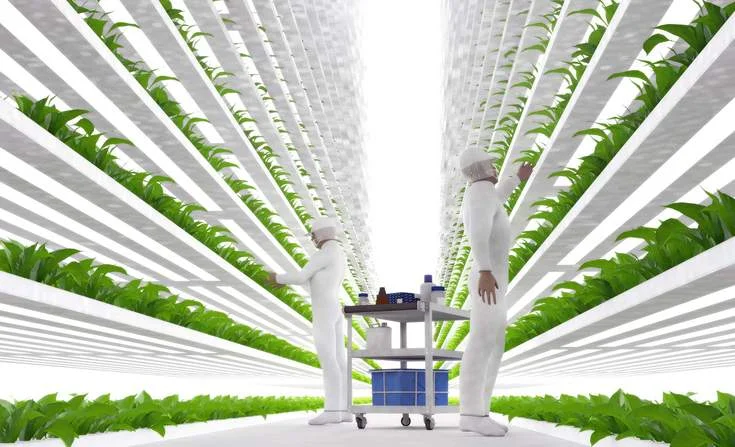
How Indoor Ag Is Growing A Resilient Food Revolution
We're at a pivotal moment in an important trend for sustainable food systems: the emergence of sustainably grown food in urban environments. As the growth and maturity of these operations continue, they could play a critical role in food security amid a changing climate as well as the continuing shift in global trade patterns

November 12, 2019
We're at a pivotal moment in an important trend for sustainable food systems: the emergence of sustainably grown food in urban environments. As the growth and maturity of these operations continue, they could play a critical role in food security amid a changing climate as well as the continuing shift in global trade patterns.
They also could be key in eliminating food deserts, neighborhoods that lack a supermarket selling produce, serviced only by convenience stores that stock nutrient-poor packaged foods and beverages.
A great deal of the technology that enables indoor growing was developed and honed over the past two decades by cannabis farmers, who learned how to grow plants at scale in confined (and usually hidden) spaces. They use controlled-environment agriculture, including hydroponics — growing plants without soil — a technology as ancient as the fabled Hanging Gardens of Babylon thought to be the first example of soilless gardening.
Today, such technologies are used on the International Space Station to study plant growth outside the Earth’s atmosphere and how best to supply food and oxygen for future colonization missions to Mars and beyond.
Growing leafy greens, specialty herbs, tomatoes and other produce indoors using hydroponics consumes up to 95 percent less water than growing them outdoors and uses fewer pesticides.
Even on Spaceship Earth, such technologies make a lot of sense. Growing leafy greens, specialty herbs, tomatoes and other produce indoors using hydroponics consumes up to 95 percent less water than growing them outdoors and uses fewer pesticides — sometimes none at all. Hydroponics has long been central to the Dutch and Japanese food systems, but the relatively cheap cost of land and water in the United States, combined with the costly energy intensity of lighting, made hydroponics too expensive for growing anything but high-value cash crops (such as cannabis).
That’s changing. Today, there is the new breed of indoor ag companies sprouting up all over, many using tricked-out shipping containers, LED lighting and a simple continuous-flow watering system. Environmental controls ensure that temperature, airflow, carbon dioxide, and humidity levels remain optimized.
In the East Ward neighborhood of Ironbound in Newark, New Jersey, for example, AeroFarms built the world’s largest vertical farm using aeroponics, in which racks of crops are grown indoors using neither soil nor water. Most of the seed money for the operation came from Goldman Sachs’s Urban Investment Group.
AeroFarms' 69,000-square-foot facility, in a former steel factory, can grow 2 million pounds of leafy greens annually, all without using a speck of dirt or a ray of sunlight. The company says the same seed that would take 30 to 45 days to grow in the field can grow in 12 to 16 days indoors, enabling up to 30 crop turns a year.
Rising tide
Operations such as AeroFarms are a perfect example of the need for a distributed network that can provide security and resilience in the face of societal shocks — in particular, extreme weather events.
Case in point: Most of the food that finds its way into New York City — cabbage from New York, oranges from California, blueberries from Chile, bell peppers from the Netherlands, beef from Australia, fish from Nova Scotia — passes through a single facility: the Hunts Point Food Distribution Center in the South Bronx. Opened in 1967, and home to 8,500 workers at 115 companies, it is the largest food market in the United States, feeding more than 23 million people throughout the region.
The million-square-foot facility is not just critically important, but also vulnerable. It sits on a peninsula with the East River on two sides and the Bronx River on the third and is subject to storm surge during high tides.
If Hurricane Sandy had hit 12 hours earlier, during high tide, the food supply for all five boroughs would have been disrupted.
In fact, if Hurricane Sandy had hit 12 hours earlier, during high tide, Hunts Point would have been flooded, the facility would have lost power and the food supply for all five boroughs would have been disrupted. As a result, AeroFarms offers an additional route to bring food into New York — food produced locally, indoors, year-round — enabling the region's food supply chain to be more adaptive to challenging circumstances.
It’s important to note that few of these operations rely on federal dollars or subsidies to grow their businesses. (As Haggerty notes, the 2018 U.S. Farm Bill allotted $10 million annually to develop an Office of Urban Agriculture and Innovative Production at the U.S. Agriculture Department, a pittance but a start. Among other things, it requires the ag secretary to conduct a census of urban, indoor and other emerging agricultural production sites). Indeed, when it comes to creating the new menu for how America grows and consumes food, Uncle Sam is largely absent from the table.
Instead, these companies were built by innovators and entrepreneurs chasing market opportunities, helped along by nonprofit and for-profit incubators, food aggregation and distribution centers catering to smaller operators, and local tax breaks for landowners who lend or lease their property to urban farmers.
And, of course, a healthy appetite for locally produced food that will only continue to grow.
For more on these topics, I invite you to follow me on Twitter, subscribe to my Monday morning newsletter, GreenBuzz, and listen to GreenBiz 350, my weekly podcast.
Topics: Food & Agriculture Climate Change Cities Risk & Resilience