


Welcome to iGrow News, Your Source for the World of Indoor Vertical Farming

Jeff Bezos-Backed Vertical Agriculture Startup Plenty ‘Hibernates’ Plans For Seattle Farm
The indoor agriculture startup backed by high-profile tech executives — including Amazon CEO Jeff Bezos — has canceled plans to open a major Seattle-area farm, GeekWire learned this week
By inventiva - November 15, 2019
Plenty Is Rethinking Its Growth Strategy
The indoor agriculture startup backed by high-profile tech executives — including Amazon CEO Jeff Bezos — has canceled plans to open a major Seattle-area farm, GeekWire learned this week. Plenty said it changed plans because the Kent, Wash., facility could no longer accommodate its next-generation vertical farm. The company is continuing to grow in its home state of California but has no plans in the immediate future to launch a farm in Washington.
“We decided that the best course of action would be to hibernate Seattle,” said Christina Ra, Plenty’s senior director of integrated marketing.
In the two years since announcing plans to build a 100,000 square-foot vertical farm in the Seattle region, Plenty developed Tigris, a new facility near its San Francisco headquarters. Tigris is too tall to fit in the Kent facility that Plenty leased in 2017, according to Ra.
“As a relatively lean company, we had to just make a decision about where we were going to put our focus and we felt like building Tigris, while also focusing on Seattle as a new and really important market, was something that we couldn’t do well,” Ra said.
Plenty grows its plants in tall towers inside a climate-controlled facility with LED lights. It does not use pesticides, herbicides, synthetic fertilizers, or GMOs. The system uses thousands of infrared cameras and sensors to collect data in the farms that is analyzed using machine learning to optimize growth.
The five-year-old startup promises its new Tigris farm can produce fruits and vegetables using less than 5 percent of the water and 1 percent of the land required in traditional agriculture.
It’s a prospect that has attracted some of the biggest names in tech. Backers of the company’s last fundraising round include SoftBank (via its Vision Fund); Alphabet Chairman Eric Schmidt (through Innovation Endeavors); Bezos (through Bezos Expeditions); DCM Ventures; Data Collective; Finistere Ventures; and Louis Bacon. Plenty has raised more than $200 million in venture funding.
Ra said Plenty ceased operations in Kent a year ago. Some employees were given the opportunity to relocate to San Francisco. Today, none of the employees who worked in Kent are still with Plenty. Ra said it is unlikely that Plenty will circle back to the Kent facility but the company still maintains its lease on the building.
Last month, Plenty announced plans to open a next-generation farm in Los Angeles. With the Seattle-area operation defunct, LA will be Plenty’s first expansion beyond its home markets in South San Francisco and Wyoming.
“Seattle’s still on our roadmap,” Ra said. “It’s a really important market for us. It was just a decision we had to make to prioritize and focus as a small company and the limited resources that we had.”
Indoor farming remains an untested industry with plenty of casualties.
Local Garden Vancouver, a similar crop-yielding greenhouse concept, declared bankruptcy a few years ago. Another startup called Aerofarms pledged to build 25 indoor farms over five years in 2015. To date, it has only built one farm outside its headquarters, according to Fast Company. Other startups in the space have struggled over the years.
Source: Geek Wire
Temasek Leads $50m Funding Round In US Indoor Farming Startup Bowery
“We are excited to share that Bowery’s third (and biggest) farm yet is launching in the DC-Baltimore area in early 2020. Along with this expansion, our team is elated to announce an additional $50 million in funding led by Temasek that will drive further innovation and scale across our organization,” it said on its Linkedin page
Southeast Asia India Greater China Rest of Asia World E-Commerce & Internet Economy Technology Real Estate and Infrastructure Financial Services Social Infrastructure Temasek leads $50m funding round in US indoor farming startup Bowery Farmers work at the Bowery Farming Inc.
indoor farm in Kearny, New Jersey. Photographer: David Williams/Bloomberg By Quynh Nguyen
November 7, 2019
Singapore state investor Temasek has led a $50-million Series B extension round for Bowery Farming Inc, a four-year-old startup that uses robotics to cultivate crops indoors.
“We are excited to share that Bowery’s third (and biggest) farm yet is launching in the DC-Baltimore area in early 2020. Along with this expansion, our team is elated to announce an additional $50 million in funding led by Temasek that will drive further innovation and scale across our organization,” it said on its Linkedin page.
Launched in 2015, Bowery is the modern farming company that uses robotics, LED lighting and data analytics to grow leafy greens indoors.
The company is currently operating two indoor farms in Kearny, New Jersey. Its new farm in Baltimore is around 3.5 times larger than the last, the company said.
The fresh funding brings the New York-based company’s total capital raised to $172.5 million. Last year, the indoor agriculture startup raised $90 million in Series B funding led by GV (formerly Google Ventures). Temasek, restaurateur David Barber’s Almanac Insights, and Uber CEO Dara Khosrowshahi joined the round.
Singapore-based investment firm Temasek last year participated in a $70-million Series B funding round in Pivot Bio, a US agriculture startup that combines machine learning and computational modeling to help microbes in providing plants with a daily supply of nitrogen, eliminating pollution in the process.
The round was led by Breakthrough Energy Ventures, a venture supported by billionaires.

Early History of Indoor Agriculture & Associated Technology Development
This month’s Indoor Ag Science Café was about the history and current technology status of indoor farming. The beginning seems to be in Syracuse, NY, where General Electric developed an indoor hydroponic farm funded by DoD in 1973
By urbanagnews
October 17, 2019
By Dr. Cary Mitchell (Purdue University)
This month’s Indoor Ag Science Café was about the history and current technology status of indoor farming. The beginning seems to be in Syracuse, NY, where General Electric developed an indoor hydroponic farm funded by DoD in 1973. Then there was a large commercial indoor farm for leafy greens in Dekalb, IL, owned by General Mills, which was closed in the 1990s. The longest survived may be the one in Japan (TS Farm by Kewpie Co.) where they use HID lamps and aeroponics since 1989. Most significant technological improvements are two ways – one in lighting and another in rack/shelving systems. Dr. Mitchell also introduced the contributions that NASA indoor farming studies made over the past 30+ years, as one of the contributors in the space.
Indoor Ag Science Café is supported by the USDA SCRI grant program and designed to create a precompetitive communication platform among scientists and indoor farming professionals. The Café presentations are available from YouTube channel. Contact Chieri Kubota at the Ohio State University (Kubota.10@osu.edu) to be a Café member to participate.

US - Indiana - Lafayette Resident Grows Produce Without Soil For Community
At Lafayette Produce farm on Wabash Avenue, 25 vertical, aeroponic towers produce basil, kale and other crops. Austin Kasso, Lafayette Produce owner, said he hopes to increase the farm to hundreds of towers as they become a year-round source of local, organic produce for Lafayette residents
BY LUCAS BLEYLE Staff Reporter
November 11, 2019
At Lafayette Produce farm on Wabash Avenue, 25 vertical, aeroponic towers produce basil, kale and other crops. Austin Kasso, Lafayette Produce owner, said he hopes to increase the farm to hundreds of towers as they become a year-round source of local, organic produce for Lafayette residents.
Lafayette Produce's vertical aeroponic system involves growing plants in towers, with the roots of the plants extending into the interior of soilless, cylindrical towers. Every 15 minutes, water mixed with an all-natural nutrient solution trickles down over the roots.
“With vertical aeroponics, we can grow 150 different fruits, vegetables, fruits, herbs and flowers,” Kasso said. “We can do a great variety of things that people ordinarily don't have access to around here. We could do five different kinds of basil and five different types of tomatoes.”
Because the water-nutrient mix is reused and trickled through multiple times, none of the water or nutrients are wasted like they might be in soil-based agriculture, Kasso said. The resulting produce is healthier because the plants are never subjected to nutrient deficiencies while they grow, he said.
“(Aeroponic towers) use 98% less water than traditional farming and they can grow 150 different crops in about 50% less time with about 30% greater yield on average,” Kasso said.
“Yields in soilless systems are typically higher and you can reduce the crop cycle time, especially with the leafy vegetables if it's your fruiting crops,” said Petrus Langenhoven, horticulture and hydroponic crop specialist for Purdue's horticulture and landscape architecture department.
Up until last year, Kasso had worked with community members and the organization Habitat for Humanity to fundraise and purchase his first 12 aeroponic towers. Since he began in 2013, Kasso has experimented with numerous crops including tomatoes, kale, basil and zucchini.
In 2018, Kasso was approached by his current business partner, Bob Corbin, to start an aeroponic farm for Corbin’s Corner Market, a store on Wabash Avenue selling local goods such as handmade candles, raw honey and West Lafayette BONZ BBQ sauce.
Kasso said Wabash Avenue used to be considered the “armpit of Lafayette.” Historically, it was the part of the city that had little development and lots of crime. Over the last few years, community planners have worked to bring new life to the area, inviting artists to adorn buildings with murals and expanding the local park.
“I was inspired to start it here because I realized there's a food insecurity problem in Indiana as well,” Kasso said. “It needs to be addressed and I believe local food and urban farming are the answer to that.”
Langenhoven said the closer farming is to cities, the better.
“Urban farming is great," Langenhoven said. "I think the closer we can get to the major city centers, the better it is for that supply chain."
He said there is a potential for urban farming to help meet the demand for fresh produce. Two controlled-environment farms — Green Sense Farms in Portage, Indiana, and Gotham Greens in Chicago — both successfully supply produce year-round to the Chicago area.
Local produce often sells at a premium because customers are drawn to its superior taste and freshness.
“I'm a big fan of (local farming), because I like fresh produce,” Langenhoven said. “I know what fresh produce tastes like because I grow this stuff and I eat what I grow, and everybody else in the department ... they're always like, ‘Wow, this is so different from what it tastes like in the store.’ And it's really because it was picked this morning or yesterday and I've waited until it was fully mature to actually pick it.”
Langenhoven said customers are often willing to pay a premium for local produce that helps make capital- and energy-intensive controlled cropping systems such as aeroponics more viable.
“First thing to note about aeroponics is that it's actually a very management-intensive system," Langenhoven said. "Anything can go wrong if you don't have backups. You (can) have total crop failure because the roots are hanging in the air.”
Any sort of power outage can devastate a crop if proper electricity backup systems aren’t in place. These backup systems and the other controls needed to have a functional production system makes aeroponics very expensive, Langhoven said.
Due to the productivity and efficiency of his system, Kasso said he is able to make up for the increased infrastructure and energy costs, especially when compared to produce shipped from California. His goal is to sell produce at an affordable cost.
“Instead of charging more for organic, local, it's going to be similar to what you'd find at Pay Less or Walmart,” Kasso said.
Lafayette Produce currently sells basil to two local restaurants, Bruno’s Pizza and Town & Gown Bistro.
Bowery Grows With New Facility In Maryland
By increasing efficiencies around R&D, computer vision and automation, Bowery will continue experimenting beyond leafy greens and herbs, and focus on crops that are very limited by seasonality and traditionally grown outdoors, from root vegetables (turnips, radishes, kohlrabi) to fruiting crops (peppers, cucumbers)
Bowery announced its new indoor farm in the Baltimore-DC area - the brand's first farm outside the tristate region - with distribution of leafy greens and herbs to local retailers starting early next year. This new farm is 3.5x larger than Bowery's last facility, and the urban density of the new farm's surrounding area of White Marsh, MD provides access to a population of 26 million people within a 150-mile radius.
New crops
By increasing efficiencies around R&D, computer vision and automation, Bowery will continue experimenting beyond leafy greens and herbs, and focus on crops that are very limited by seasonality and traditionally grown outdoors, from root vegetables (turnips, radishes, kohlrabi) to fruiting crops (peppers, cucumbers).
Expanded distribution
In addition to moving to the Baltimore/DC region, Bowery recently expanded distribution at Whole Foods in the tri-state area, growing from availability in 12 locations to 31. Bowery leafy greens and herbs are now available in retail locations on Long Island, Connecticut, West Chester and in all Manhattan locations. On the heels of this expansion news also comes Bowery’s announcement of $50M in a B+ funding round.
For more information:
Bowery Farming
contact@boweryfarming.com
boweryfarming.com
Publication date: Thu 7 Nov 2019

ACTION ALERT: Tell Congress To Support USDA Urban / Innovative Ag Office
By the end of this week (Friday, Nov 15) please call or email your two senators and one representative and ask them to Support the new USDA Office of Urban Agriculture and Innovative Production
(Bella Vita Farm, Brookeville, MD)
By the end of this week (Friday, Nov 15) please call or email your two senators and one representative and ask them to Support the new USDA Office of Urban Agriculture and Innovative Production.
In the next week or two, Congress will decide whether or not to fund the USDA’s new Office of Urban Agriculture and Innovative Production. The Office was created by the 2018 Farm Bill but still needs to be funded.
This new Office is intended to be the USDA’s central hub to handle aquaponics, hydroponics, vertical growing, and other new growing methods. It will coordinate matters for these growers and offer new research and funding opportunities. (See Summary)
INSTRUCTIONS:
1 – Identify your two federal senators and one federal representative.
2 – Find the phone number of their Washington, DC office on their website.
3 – Call each Office and ask to speak to the staff member that handles agriculture policy. [You may not get to speak to the staff, they may ask you to leave a message or give you an email address. Wherever you land, use the message below.]
4 – Tell them you’d like the Senator / Representative to Support the new USDA Office of Urban Agriculture and Innovative Production created by the 2018 Farm Bill. If you’re feeling chatty you can tell them what you do and why you think your work is important.
Thanks for supporting urban and innovative agriculture, future generations will thank you!
Brian Filipowich, Chairman
Aquaponics Association

iGrow - Op Ed / Opinion: by: Bruce Carman - Founder of Controlled Environmental Farming Inc.
I recently read an article in Fast Company entitled "This Google Ventures-backed indoor farming startup just opened its biggest farm yet" by Adele Peters a staff writer (11.06.19)
November 17, 2019
by: Bruce Carman
I recently read an article in Fast Company entitled "This Google Ventures-backed indoor farming startup just opened its biggest farm yet" by Adele Peters a staff writer (11.06.19).
In the article, Ms. Peters identifies a few of the larger indoor farming operations, Bowery, Plenty, to name a few and where these entities are today versus their projections from a couple of years ago. In most cases, these entities have fallen short of their own growth projections in terms of the number of facilities they predicted would be operational at this point in time.
As an owner/operator and the developer of Indoor Agriculture Technology for Urban Farming locations, I would like to share my vision of indoor agriculture. First, location, location, location, it is very important. Facilities should be placed geographically where the consumer is. Urban Farming, within its truest form, means that facilities will be placed in the downtown districts of a municipality, next to the opera house or the sports stadium. I realize this is disruptive to conventional operations but, doing so provides reduced transportation costs, fresher more nutritional product with less food waste, greater affordability, and sustainable economical development. Carbon footprint reduction is a huge winner within this concept.
Second, facilities need to offer product diversity. Leafy greens alone will not provide the necessary product variety for a successful Urban Farming entity. How often do you go to the store for just one item? The Urban Farm is no different, you don't go to just acquire leafy greens. When you go, you want to be able to purchase locally grown fruit, vegetables, herbs, shrimp and fish. In short, you would like to be able to purchase an entire meal and just not the core of the salad.
Third, Urban Farming entities should be closed-loop operationally. The ability to produce locally grown, organic products, is the true ideal model for Urban Farming facilities. Resources, like water, are conserved, reclaimed and re-used beneficially. Pollution is reduced or eliminated. Food safety, food security, and affordability are increased within the local community. The closed-loop system provides for protein-based food production, naturally, efficiently, while also providing product diversity. The economic model for the Urban Farm is enhanced and the community benefits.
Please don't misunderstand my thoughts. Developing cultivation technology is very important and necessary for the evolution of Urban Farming to get where it needs to be, quickly. Equally important, in my view, is food production that occurs outside the box. That provides for new locations, zoning regulations, structures, methods, systems, distribution models and product diversity outside of leafy greens. If we don't invest in those facets of food production too, we will not meet the challenges that are upon us now.
Controlled Environmental Farming Inc.
In This Finnish Farm, Strawberries Grow On Multiple Levels
Despite fall being in full bloom, the strawberry cultivation in Lappträsk, Finland is running full throttle. Robert Jordas believes it is interesting to try new cultivation methods
Robert Jordas Performs 'Secret' Experiment In His Greenhouse
Despite fall being in full bloom, the strawberry cultivation in Lappträsk, Finland is running full throttle. Robert Jordas believes it is interesting to try new cultivation methods.
One of the new methods is the vertical cultivation of strawberries: the strawberries grow on different levels. In the space, around 30 square meters in size, strawberry plants are hanging with flowers, unripe, and ripe fruit. Because of the colorful lighting, it reminds of a disco.
The high air humidity immediate fogs up your glasses, but the temperature is not tropical. it looks more like the Finnish Indian summer.
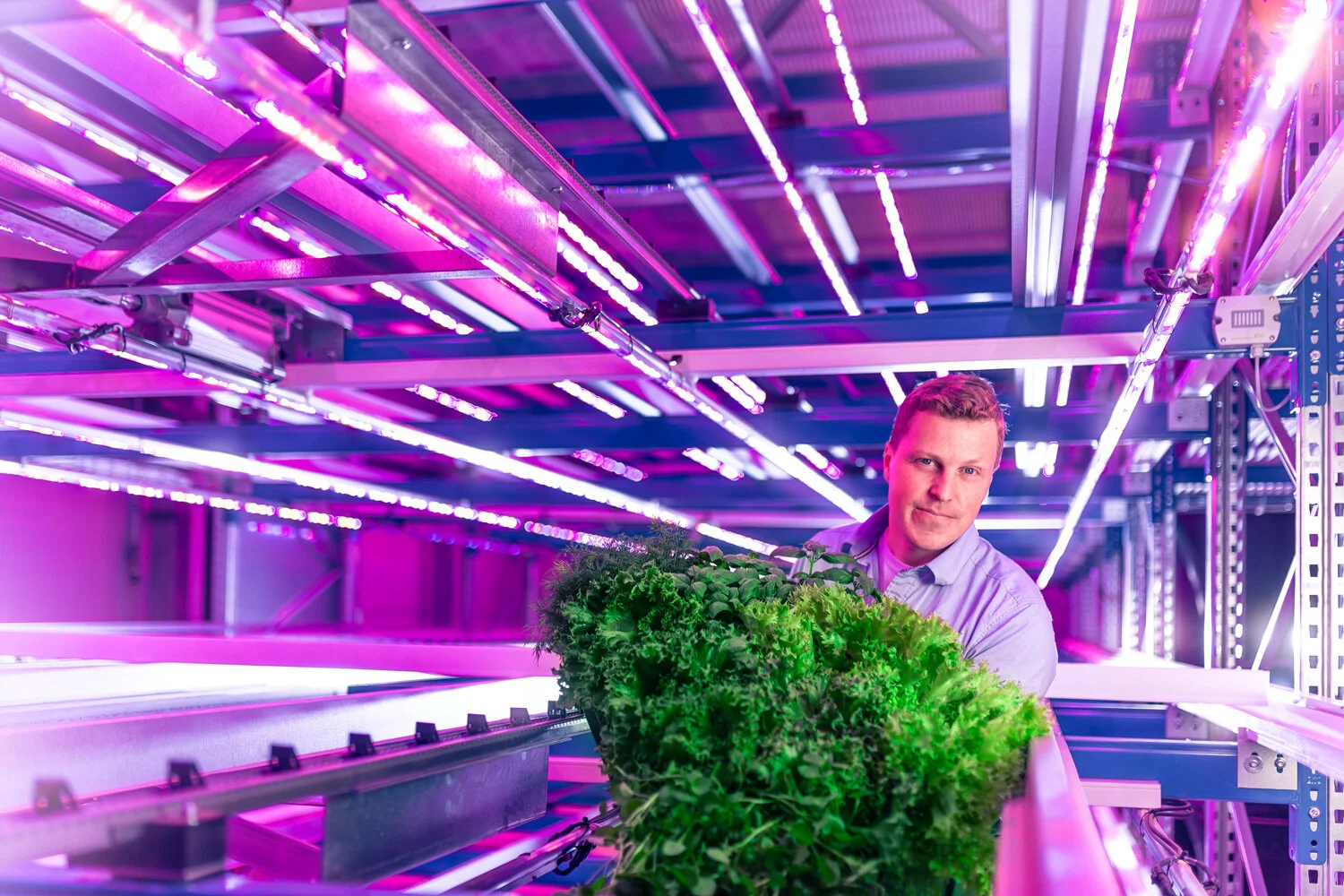
All plants are looking well, because every level has its own lighting. Jordas: "We want the plants to grow optimally and to keep the climate around the plant as optimal as can be."
Secrets, pink light, and the perfect cultivation circumstances
The optimal climate for a strawberry plant means the right light and the right heat and air humidity. The plant also requires CO2, nutrients, and water.
Jordas: "The interesting thing is that we, focused or the growth requirement, can control everything."
Much of the project is still secret. One of the secrets is LED lighting. The plants need a lot of light; LED lighting produces less heat than other lamps and can be placed closer to the plant so you can create more levels.
Jordas: "There are many advantages to growing on multiple levels: a larger harvest on a smaller surface, being able to control the spectrum of the lamps. We try to learn as much as possible and find the right cultivation method."
Robert Jordas wanted to grow strawberries because he likes them, but he is not completely satisfied with the taste his strawberries have at the moment.
Jordas: "We are going to test this cultivation method for a year. Continuous harvesting is possible, when one plant has flowers, the other has ripe fruits."
But is it environmentally friendly to grow strawberries in Finland in the middle of winter?
According to Jordas, that depends on how the electricity is generated. "If we use sustainable energy, it is better than importing vegetables and fruit from other countries. Also, strawberries are fresh products and it is important to consume them as soon as possible."
Source: Svenska
Publication date: Fri 8 Nov 2019
© HortiDaily.com
Vertical Farming, Micro-Algae, And Bio-Reactors — The New Frontier of Sustainable Food
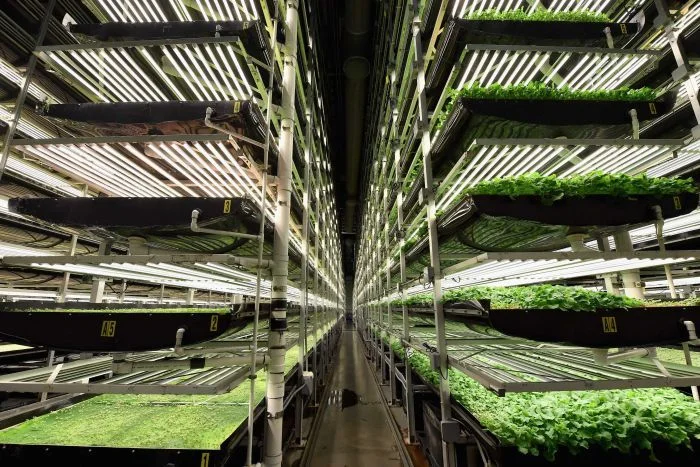
CEA represents a small but growing dimension of agriculture. It's attracting huge investment, particularly in the United States where venture capitalists see gains to be made in a high-tech process known as vertical farming. Vertical farms look like a cross between a factory and a laboratory. Plants are grown indoors on trays, often stacked up to 30 tiers high
RN By Antony Funnell for Future Tense
November 8, 2019
It's brunch time in the not-too-distant future. You're in your favourite cafe and you have a craving for pancakes.
You know they're delicious because you order them all the time: fluffy and light with a slightly carroty taste.
Hardly a health food, but at least they're easy on the environment — they're made with organic eggs and 100 percent locally-sourced bacteria.
The bioreactor that produces the flour is only a block away.
Like many people, you're worried about the size of your carbon footprint, so it's good to know that none of the main ingredients had to be shipped or flown in.
The coffee is good too — from a boutique plantation in an old converted office block just down the road.
It's expensive, but it's worth paying a little more to make sure the produce you eat and drink is grown right here in the city.
Your friend orders the pork and fennel sausages with a side salad — from the rooftop farm above the cafe.
Follow this story to get email or text alerts from ABC News when there is a future article following this storyline.
She often feels guilty about the amount of meat she consumes. But at least the pig she's eating was raised on micro-algae, not soybean. So, a small chunk of the Amazon is still standing because the trees in that area weren't cut down to make way for yet another enormous soya plantation.
Eating pancakes made from bacterial flour and animals raised on unicellular photosynthetic micro-organisms might seem a little out there, but these ideas are currently being explored by scientists as part of a new approach to farming called controlled environmental agriculture (CEA).
And CEA, some agricultural researchers argue, could be the best way of reducing the environmental destruction associated with modern farming, which is both land and resource-intensive.
Listen to the episode
Controlled Environmental Agriculture promises to be cleaner and greener. Future Tense examines the potential and the pitfalls.
The veggie patch goes high-tech
CEA represents a small but growing dimension of agriculture.
It's attracting huge investment, particularly in the United States where venture capitalists see gains to be made in a high-tech process known as vertical farming.
Vertical farms look like a cross between a factory and a laboratory.
Plants are grown indoors on trays, often stacked up to 30 tiers high.
Everything about the indoor environment is governed by sensors and automation, but the crucial ingredient is the artificial lighting.
"All the vertical farms operating today are using a type of lighting called LEDs, which stands for light-emitting diode," says Jeffrey Landau, the director of business development at Agritecture, an urban agriculture consultancy.
"Different types of crops prefer different types of lighting. So, your leafy greens, your vegetative crops prefer light towards the blue side of the spectrum.
"Whereas your fruiting and flowering crops, they will want something more along the red spectrum of lighting."
Each variety of plant has its own tailored lighting recipe, allowing them to photosynthesise for much longer periods of the day — up to 18 hours at a time.
In practical terms, that means more crop yields.
The major players, to date, have concentrated on producing perishable goods such as salad vegetables — crops that traditionally require large amounts of water.
But vertical farming expert Paul Gauthier believes even staples like potato and wheat could eventually be grown indoors.
"Everything is possible. I don't think there is anything in the vertical farm that we can't grow," he says.
"I was growing coffee trees inside a vertical farm.
"It's a question of which kind of design we have to make and what the economics are behind it."
Dr Gauthier, who now works for the New Jersey-based company Bowery Farming, admits both the capital and energy costs involved in vertical farming are "definitely huge".
But that needs to be put in context, he argues, because significant government subsidies have long been provided to traditional farming operations.
People in glass houses
Others aren't so convinced.
Viraj Puri sees the Silicon Valley-inspired approach adopted by companies like Bowery as unnecessarily high-tech.
"It has certainly attracted a tonne of investment, media attention, consumer interest, there's no doubt about it," he says.
"I still think the business models will require a path to profitability before it can start to attract more mainstream financing."
Mr. Puri, the CEO, and co-founder of Gotham Greens, operates five rooftop urban greenhouse facilities in New York and Chicago.
His approach to controlled environmental agriculture is to recast the classic Dutch greenhouse of an earlier age, but with 21st-century modifications.
"These are glass and steel structures controlled by computers that are able to monitor climate 365 days of the year, 24 hours a day, and make smart adjustments, data-driven adjustments, in order to maximise crop productivity, efficiency, reduce production losses," Mr. Puri says.
"They combine a lot of these advanced horticultural and engineering techniques that proponents of vertical farming espouse and promote."
And they also have the potential to achieve exponential crop yields.
"One can still get 50 times the productivity on certain types of crops. But one relies primarily on natural sunlight which is a free natural resource," Mr. Puri says.
Next year, Gotham Greens is due to open a 2,800-square-metre facility just outside Denver, Colorado, as part of a $70 million capital expansion plan.
"Some of these greenhouses are the size of dozens of football fields, so these aren't backyard hoop houses but rather very sophisticated climate-controlled buildings," Mr Puri says,
And they can get even bigger.
A French company is currently constructing a roof-top greenhouse in the centre of Paris that will cover some 14,000 square metres when completed.
Like Bowery Farms, Gotham Greens sells itself on growing pesticide-free crops, grown locally with very few transport miles.
"Urban farming is about bringing issues closer to large population centres," Mr Puri says.
"And telling the story of how agriculture is an enormous consumer of natural resources around the world and how this form of farming can play a significant role in a more sustainable future."
A revolution in the paddocks
A young farming couple find out how they can rehabilitate the natural environment while also producing healthier food.
The substitution game
For Cambridge University's Asaf Tzachor, the solution to environmental degradation lies not just in rethinking how we grow, but what we grow.
The future of food that he envisages is busy fermenting away in a bio-reactor in Iceland.
The facility is run by a company called Algaennovation, which has been experimenting with the development of a new kind of animal food supplement made from microalgae.
Dr. Tzachor estimates up to 85 percent of the soybean produced globally each year is used to feed farm animals.
Soya farming in South America is identified by environmental agencies as a major cause of deforestation.
So, the idea is to simply substitute the microalgae for soya.
"Microalgae are very interesting. They are marine organisms, which means that they don't need fresh water, unlike soybean," Dr. Tzachor says.
"And we don't have to cultivate them on terrestrial areas, so we can grow them within facilities, and these facilities can also be closed."
The savings on water alone would be significant, says Dr. Tzachor.
He says experiments at Algaennovation's facility have so far been able to achieve between 200 and 250 times more biomass per litre of water than soybean farming.
The next stage of development is demonstrating that microalgae production can be done on a mass scale.
A similar approach is being undertaken by researchers in Finland, but their focus is on producing a supplement for human food rather than stock feed.
Pasi Vainikka, from the company Solar Foods, says his company has used a bio-reactor to produce an edible flour made from fermented bacteria.
"We have a fermenter, but we don't use yeast. We use a specific microbe that doesn't eat sugar," he says.
"So instead of sugar we introduce carbon dioxide and hydrogen, and these the microbe uses for energy and carbon instead of sugars to grow.
"Then we take the liquid out of the fermenter when the microbes grow and multiply and you end up with a dry powder."
The flour, called Solein, has a 65 percent protein content, says Dr. Vainikka, and can be used as a substitute for wheat flour or soya in everything from bread to protein drinks.
"The organism has carotenoids. When you taste it raw it has a bit of an umami (savoury) taste," he says.
"When you add it to pancakes, for example, it tastes as if it would have egg, and also a bit of carrot taste."
"The production cost, according to our estimations, is around $US5 per kilogram."
But that cost, says Dr. Vainikka, could be expected to decrease as production begins to scale.
"We are about 10 times more environmentally friendly than plants and about 100 times better than animal-based proteins," he says.
"If we want to make a fundamentally more sustainable food system for the increasing population, we need to disconnect from agriculture, which usually means irrigation, use of pesticides and a lot of land use.
"So, when we disconnect from everything that has to do with these processes, the environmental benefits are huge."
Despite the promise offered by controlled environmental agriculture, Mr Puri cautions against seeing it as "panacea or a silver bullet" for the world's growing food demand issues.
"I think solutions are going to have to be varied and they have to be uniquely suited to their own geographical, economic, social and cultural contexts," he says.
"I think there's many different ways to farm sustainably and responsibly.
"Indoor farming techniques can certainly play a significant role for certain types of crops, high-value crops, crops that use a lot of water, crops that often have to be shipped in refrigerated trains, planes or trucks over great distances."
But the challenge is great. The United Nations estimates the world's population will increase to around 9.7 billion by 2050.
That's another 2 billion mouths to feed.

Contain Ready To Grow After Completing The Techstars Accelerator Program
Contain started from the ground up. It all began by talking to indoor farmers about their finance needs. Over the last 18 months, we met over 300 growers and developed a deep knowledge of what growers need when looking for finance
Nov 7, 2019
Contain started from the ground up. It all began by talking to indoor farmers about their finance needs. Over the last 18 months, we met over 300 growers and developed a deep knowledge of what growers need when looking for finance.
Once we had developed our expertise through first-hand knowledge and executing a number of leases, we recognized the need to grow what we learned from those conversations. It was time to take the next step as a start-up.
Here enters the Techstars accelerator program.
Last Spring, we pitched and were selected to participate in the Techstars’ Farm to Fork accelerator program, a program that provides ambitious tech startups with corporate mentorship and investment, backed by Cargill and Ecolab. Now, three months later, we’re ready to use the resources of the program to serve more clients, according to their needs. In other words, we’re growing (and we’re growing fast). We’re excited to share more about this exciting new stage in the company. Here’s what’s on the horizon for us.
We’re changing the way indoor farmers find financing.
The investment from Techstars gave us the opportunity to convert our knowledge into an automated leasing platform built for indoor growers. Our newly developed algorithms match indoor growers with the optimal lenders and provide growers with leasing options. And this platform isn’t just for farmers. It also includes specialized portals for equipment vendors and lenders.
We’re growing our mission.
The new platform sets the stage for rapid growth for Contain. It automates our process, and allow us to add hundreds of vendors and lenders to the platform. This in turn, will enable the success of thousands of growers. We’re already working hard to on board the numerous vendors and new lenders that now want to work with us.
Techstars’ Farm to Fork Demo Day
Our network is deeper than ever.
During our time in the accelerator, we developed valuable relationships with industry experts. We got to seek advice from leaders in the marketplace, financial services, and consumer packaged goods mega-corps. We worked with these mentors on everything from product development to marketing and fundraising strategies. As a Fintech company, we’re excited to work with the broader Techstars’ network in New York, Chicago and the Bay Area. We now have more relationships than ever to help us realize our vision.
The program has strengthened our team internally as well. The Contain team is a distributed one. Overall, this is a strength of the company; We see it as one of our advantages that we can accommodate our team members’ lives and still work with experienced and highly skilled folks. But that means that our headquarters is usually Slack, and we hang out with each other virtually most of the time. Being in one location for the summer gave us the opportunity to spend more time with one another in person and become more cohesive as a team.
But at the end of the day, it’s not just about the corporate connections or our team. It’s about the indoor farmers that inspire our work. Here is our CEO Nicola Kerslake, on what we learned while conducting interviews with some of the indoor growers we had worked with prior to the program.
“The greatest boost to the Contain team during the program was interviewing some of the indoor growers that we had worked with,” she said. Kerslake continues, “we realized that we had made a difference in the life of farmers and the communities that they support.”
For her, “It’s the best feeling to know that our hard work has a positive impact in the wider world.”
WRITTEN BY Nicola Kerslake
We’re Contain Inc. We use data to improve access to capital for indoor growers, those farming in warehouses, containers & greenhouses. https://www.contain.ag/
Hydroponic Farms To Reduce Food Imports
In a 40-foot container situated in a warehouse in Central Trinidad, lies an amazing freight farm with the capacity of producing over 1,200 heads of lettuce, chive, and even strawberries
November 5, 2019
Lead Engineer at Cube Root Farms, Hamlyn Holder stands in a 40-foot container which was converted into at hydroponic farm at Preysal Crown Trace, Freeport. by: Kristian De Silva
Radhica De Silva
Lead Engineer at Cube Root Farms Hamlyn Holder stands in a 40-foot container which was converted into a hydroponic farm at Preysal Crown Trace, Freeport. © KRISTIAN DE SILVA
In a 40-foot container situated in a warehouse in Central Trinidad, lies an amazing freight farm with the capacity of producing over 1,200 heads of lettuce, chive and even strawberries.
Developed by Cuberoot Farms, the farm comprises of a state-of-the-art hydroponic farming system retrofitted inside a freight container.
Engineered by local agri-scientists and engineers, the farm is geared at producing enough crops to reduce T&T’s staggering food import bill.
During an interview with Guardian Media, Cuberoot Farm’s lead engineer Hamlyn Holder said they were hoping to share their technology with interested persons.
“We will provide training and our aim is to set up this entire system for 20 farmers,” he explained.
Using a stacky system with a fully-automated nutrient flow, one section of the farm produces four varieties of lettuce and chive. The other portion has a drip to waste system using cocopeat where other types of leafy vegetables could be grown.
“Everything is constructed in house. We utilise grow lights and this provides optimal temperatures for optimal growth. We use energy-efficient units to keep down operational costs while keeping plant performance high,” Holder said.
He said Agri scientists Jessica Churarian, chief executive officer Andrew Bridgemohansingh and Agri scientist Nkosi Felix were instrumental in establishing the farm.
“The Dexion shelving came from Massy, even the automation we put together. We have Alexa integration, CCTV cameras and we used local resources to put it all together,” Holder said.
He explained that everything grown on the farm is totally organic.
“We are aiming at using zero pesticides. Our systems are built so pests are mitigated against from bacteria to aphids or fungus. This type of technology offers a controlled environment when it comes to disease,” he explained.
After two years of trials, Holder said they were happy to report that more than 100 varieties of different crops could be grown in the farm.
Saying this was T&T’s only indoor farm, Holder said using the climate-controlled environment the farm can imitate the ideal conditions for crops to generate bountiful yields.
“We have grown strawberries, cherry tomatoes. We did many trials and technology gives that consistency. It is limitless and definitely can be used to grow any leafy vegetables as well as some flowers,” he added. Anthuriums were seen growing in the farm along with parsley, kale, baby spinach and cilantro.
Holder said the Ministry of Agriculture was very supportive of the project and so was the Agricultural Development Bank.
“We want to show this technology to the show this new technology to Minister of Health and the Minister of Education so they can incorporate technology into agriculture and reduce health issues as well as the food import bill,” he added.
Kennedy Charran of Greengold T&T Limited said the farm was innovative and had great potential. He said interested persons will see a return in investment adding that once the farm is bought it could last for decades.
Tagged in:

CubicFarm Systems Announces Global Reseller Agreement With Groviv With Minimum Sales Threshold of 200 Machines
The new partnership significantly expands CubicFarms’ machine sales pipeline into strategic international markets
New partnership significantly expands CubicFarms’ machine sales pipeline into strategic international markets
Vancouver, BC – (AccessWire – November 6, 2019) – CubicFarm® Systems Corp. (TSXV: CUB) (“CubicFarms” or the “Company”) is pleased to announce that it has entered into a global Reseller Agreement (the “Agreement”) with Groviv, a leader in the science and technology of controlled-environment agriculture (CEA). Groviv, a division of Nu Skin Enterprises – a minority investor in CubicFarms – will lead global sales for CubicFarms and has appointed Joe Huston, its Vice President of Business Development to direct the effort. Mr. Huston has extensive retail sales and distribution experience, working with brands such as Walmart, Kroger and Costco.
The authorized Reseller Agreement, while global in nature, will be focused initially on the sales of vegetable-growing machines in key territories such as China, the Middle East, and other strategic areas. The Agreement complements CubicFarms’ own sales and marketing efforts for its machines. CubicFarms is also focused on growing machine sales in its other verticals – animal feed, hemp/cannabis, and nutraceutical ingredients – through its own sales pipeline or in partnership with other resellers.
In January 2019, CubicFarms signed a binding term sheet with Nu Skin to work together in the long term to market and sell CubicFarms systems in China. This Reseller Agreement expands upon CubicFarms’ relationship with Nu Skin to allow its Groviv division to act as an exclusive, authorized reseller globally, with the provision that Groviv fulfills a minimum semi-annual sales threshold of 60 and 140 CubicFarms growing machines by June 30, 2020 and December 31, 2020, respectively.
“The expansion of the China binding term sheet to this global Reseller Agreement is a testament to Nu Skin and Groviv’s confidence in CubicFarms’ patented technology. We are excited to work with Joe and his team to bring the best automated vertical farming technology to China, the Middle East and other strategic areas where population growth, water, soil and farmland challenges present a huge need for high-value leafy vegetables, herbs and other crops,” said Dave Dinesen, Chief Executive Officer of CubicFarms.
“Joe and the rest of the Groviv team have already established relationships with key growers, customers and partners worldwide, resulting in a significant sales pipeline. Joe’s leadership experience in building businesses and driving revenue, coupled with his deep experience operating in China, are an enormous boon to our partnership.”
Steve Lindsley, President of Groviv, stated: “We are excited to combine both our sales and marketing expertise with CubicFarms. Together we have the science, technology and experience to provide sustainable solutions that will grow safe, clean and nutritious fresh produce around the world.”
Neither the TSX Venture Exchange nor its Regulation Services Provider (as that term is defined in the policies of the TSX Venture Exchange) accepts responsibility for the adequacy or accuracy of this release.
About CubicFarm® Systems Corp.
CubicFarm® Systems Corp. (“CubicFarms”) is an ag-tech company commercializing large scale, vertical farming solutions for global industrial markets. Founded in 2015, the Company’s mission is to provide industries around the world with efficient growing systems capable of producing predictable crop yields. CubicFarms offers turnkey, commercial scale, hydroponic, automated vertical farm growing systems that can grow predictably and sustainably for 12 months of the year virtually anywhere on earth. CubicFarms enables its customers in the fresh produce, animal feed, nutraceutical, and hemp/cannabis industries to grow locally and to provide their markets with safe, sustainable, secure and fresh ingredients that are consistent in colour, size, taste, nutrition and allows for a longer shelf life. Further support and value is provided to customers through the Company’s patent-pending germination technology and proprietary auto harvesting and processing methods.
Using its unique, undulating growing system, the Company addresses the main challenges within the indoor farming industry by significantly reducing the need for physical labour and energy, and maximizing yield per cubic foot. The Company has sold and installed systems in Canada and the US, and is currently negotiating with a global pipeline of prospective customers. It also operates one wholly owned facility in Pitt Meadows, British Columbia, and sells its produce in the province to retail and wholesale customers under the brand name Thriiv Local Garden™.
Information contact
Kimberly Lim
kimberly@cubicfarms.com
Phone: +1-236-858-6491
www.cubicfarms.com
Cautionary statement on forward-looking information
Certain statements in this release constitute "forward-looking statements" or "forward-looking information" within the meaning of applicable securities laws, including, without limitation, statements with respect to Groviv, a division of Nu Skin Enterprises – a minority investor in CubicFarms – will lead global sales for CubicFarms; and the authorized Reseller Agreement, while global in nature, will be focused initially on the sales of vegetable-growing machines in key territories such as China, the Middle East and other strategic areas. Such statements involve known and unknown risks, uncertainties, and other factors which may cause the actual results, performance, or achievements of CubicFarm Systems Corp., or industry results, to be materially different from any future results, performance, or achievements expressed or implied by such forward-looking statements or information. Such statements can be identified by the use of words such as "may", "would", "could", "will", "intend", "expect", "believe", "plan", "anticipate", "estimate", "scheduled", "forecast", "predict", and other similar terminology, or state that certain actions, events, or results "may", "could", "would", "might", or "will" be taken, occur, or be achieved.
These statements reflect the company's current expectations regarding future events, performance, and results and speak only as of the date of this news release. Consequently, there can be no assurances that such statements will prove to be accurate and actual results and future events could differ materially from those anticipated in such statements. Except as required by securities disclosure laws and regulations applicable to the company, the company undertakes no obligation to update these forward-looking statements if the company's expectations regarding future events, performance, or results change.

UK: Vertical Farming Now Aiding Beer Brewing
For vertical farmers, the question of “what can we do with all of this excess heat from the LED lights?” is a reoccurring question. One firm in the Midlands decided to put their thinking caps on and come up with a solution when posed with that exact dilemma
For vertical farmers, the question of “what can we do with all of this excess heat from the LED lights?” is a reoccurring question. One firm in the Midlands decided to put their thinking caps on and come up with a solution when posed with that exact dilemma.
In a bid to take more eco-friendly steps, the firm Astwood Group, formed a business idea, making expert use of all of that wasted heat.
Enter Lab Culture, a microbrewery based in the Midlands, UK. An idea born from a team brainstorm at the pub (we recognize the irony), that boasts a range of beers brewed directly from their neighboring vertical farm, Vertivore.
Read the full article at Urban Ag News
Publication date: Fri 8 Nov 2019
The Vertical Farming Industry Is Growing Deeper Roots
The urban indoor vertical farm industry is at an important juncture. Automation is taking root, long-term contracts with creditworthy retail and foodservice distributors are in the works and vertical farms are preparing to scale up. Also, the industry is about to get its first trade group, the American Association for Urban and Vertical Farming
November 11, 2019
Plenty plans to build a global network of vertical farms, starting with the west coast of the United States.
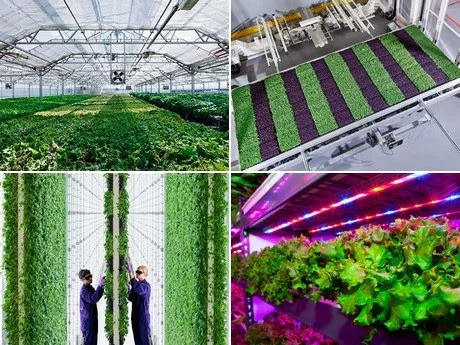
The urban indoor vertical farm industry is at an important juncture. Automation is taking root, long-term contracts with creditworthy retail and foodservice distributors are in the works and vertical farms are preparing to scale up. Also, the industry is about to get its first trade group, the American Association for Urban and Vertical Farming.
"The vertical farming industry in the U.S. is at a point where — if provided facilitation in terms of industry coordination, information exchange, innovation, education, training, funding, etc. — ... it can be enabled to reach critical mass," said Joel Cuello, a University of Arizona professor of biosystems engineering and vice chair of the Munich-based Association for Vertical Farming (AVF).
Just as important: a trade association can advocate for the industry and help it secure more funding.
In the 2018 U.S. Farm Bill, an annual allotment of $10 million was established to develop an office of urban agriculture and supporting projects, said Neil Mattson, controlled environment agriculture director and associate professor/greenhouse extension specialist at Cornell University. That’s a relatively small amount that includes everything from vertical farms to urban community gardens.
Whether industry-wide collaboration is needed or wanted at this stage is unclear. Sharing information could accelerate the industry’s development, but it also could dilute the value of a firm’s propriety research and development efforts.
Technology is important to reduce cost and to improve yields and quality, and therefore to provide a better return on investment.
The existence of New York City’s Agriculture Collective — which counts AeroFarms, Bowery Farming, Smallhold and Square Roots as members — illustrates that there are ways for the urban farming industry to share knowledge.
Having a city or regional dimension to collaborative efforts is key, especially when it comes to working in cities, said Henry Gordon-Smith, founder and managing director of Agritecture Consulting. For example, there is often a need for new zoning for indoor farming because it is not a permissible use of a building in an urban area, he added.
The new vertical farm trade association will be affiliated with the AVF, but the exact affiliation has not been negotiated yet.
A compelling story
Vertical farming does a very good job of tapping into customers’ interest in tasty, fresh and locally grown food. "Customers love it," said Chris Manca, Whole Foods Market’s local program coordinator for the Northeast region. "It connects with people who are passionate about local food and the environment."
Since 2014, Whole Foods has cultivated a high-tech Gotham Greens greenhouse farm on the rooftop of its Gowanus, Brooklyn, store. Leafy greens, microgreens and herbs grown in this rooftop greenhouse are sold in its store downstairs, in other nearby Whole Foods locations and at local restaurants. In addition, for the last year and a half, the Whole Foods location in Bridgewater, New Jersey, also has been selling mushrooms grown in an in-store vertical farm unit developed by the Brooklyn-based organic mushroom farming company, Smallhold. More recently, a second Smallhold in-store mushroom growing unit was added in a Whole Foods store in Brooklyn.
Gotham Greens
Gotham Greens operates a network of greenhouses across the Northeast, Mid-Atlantic, Midwest, New England, Mountain West and beyond.
The chief selling points of indoor vertical farm-grown fruits and vegetables are that they are pesticide- and herbicide-free, require only a little water and land to produce, offer flexible supply dynamics, have short grow cycles, offer year-round production and have easy product traceability, according to those interviewed for this article. Grocers or producer purveyors also might be able to claim greater price certainty and a longer shelf life.
"We look at [vertical farms] as a growing trend and a unique opportunity to partner with up and coming brands," Whole Foods’ Manca said.
But some farms need to get their prices in line with traditional produce, and it is becoming clear that vertical farms must start offering a wider variety of produce. Many are experimenting with growing berries and vine crops, such as tomatoes and cucumbers. To date, leafy greens, microgreens and herbs have been vertical farms’ cash crops because they offer more competitive pricing due to high yields and the fact that they require less energy to grow.
The growing appetite for indoor growing
Five Mediterranean climates — including California’s — supply all of the world’s fresh fruit and vegetables, and these climates are dealing with changing weather patterns. That is forcing more scrutiny of the vertical and indoor farming sectors.
"Today, the world can only grow enough fresh fruits and vegetables to feed two-thirds of the global population what is required for a healthy diet. That's with 7.5 billion people on Earth," said Christina Ra, senior director of integrated marketing at Plenty, the San Francisco-based indoor vertical farming company that in 2017 raised $200 million in Series B funding from Softbank, Amazon’s Jeff Bezos and Eric Schmidt, the former chairman of Alphabet.
Already, there is not enough, and the global population is expected to reach almost 10 billion in 2050, Ra pointed out.
Vertical farms alone cannot fill the gap, but new technologies and innovations, including more efficient LED lighting, robotics, machine vision and artificial intelligence, are making vertical farms more efficient and productive.
"Technology is important to reduce cost and to improve yields and quality, and therefore to provide a better return on investment," said Charlie Wang, president and CEO of Oasis Biotech, an Albuquerque-based company that owns vertical farms in Las Vegas, China and Albuquerque. It also develops and sells LED lights and hydroponic grow systems under SANANBIO brand.
During the last three years, LED lighting costs have dropped considerably amid a 20 percent improvement in energy efficiency. Looking ahead, over the next three years, similar advances in energy efficiency are expected, and developments in precision farming and automation are also expected to help the vertical farm industry eke out additional efficiency gains.
"We can do precision agriculture within a precise environment," said Grant Vandenbussche, senior business development strategist at Fifth Season, a fully automated indoor vertical farm company based in Pennsylvania. "This allows us to isolate variables to optimize for specific desired outcomes rapidly. We know how each factor is impacting things like plant growth, coloring, and flavor. … It's a true 'smart manufacturing' system."
Operating a fully-automated vertical farm can put a vertical farm's labor cost on par with field-grown produce, Cornell’s Mattson said.
We have been very forward [about how] energy requirements are a potential limiting factor for the industry.
According to Vandenbussche, automation helped Fifth Season reduce its labor from 40-60 percent of costs to 20 percent of costs. Fifth Season also said that the energy required from its automation processes is negligible within its system.
Indoor vertical farms’ energy needs for lighting and HVAC are considerable, however. For example, leafy greens grown in vertical farms in the Northeast currently have a carbon footprint that is two times higher than the carbon footprint for the same product grown in a field in California and then shipped 3,000 miles across the country, Mattson said.
There is also research and data that points to vertical farming being more energy-intensive than greenhouse-grown produce.
"We have been very forward [about how] energy requirements are a potential limiting factor for the industry," Vandenbussche said. "We're paying very close attention to our energy requirements as we launch our new farm, and we are implementing as many energy savings solutions as possible."
Sourcing all of a vertical farm’s energy needs from renewable sources through local utility providers can be challenging. Microgrids are an obvious alternative, but for some vertical farms, the initial capital cost is prohibitive.
For its farm, Fifth Season partnered with Scale Microgrid Solutions, a firm that provides turnkey microgrids, on a solar-microgrid solution. "[They have] a shared savings solution that allows you to capture the benefits of a microgrid without the upfront capital cost," Vandenbussche said.
Another workaround could involve geothermal energy, which can help control the air temperature. But for indoor vertical farms, the largest energy cost is electricity for lighting, which geothermal cannot address.
Plenty of paths
The indoor vertical farm industry has seen a lot of investment, but the business models are still sorting themselves out.
"There has been a big push on technology, but technology might not be the differentiating factor. The business models matter" said Ian Copeland, managing director at Ultra Capital, a San Francisco- and Philadelphia-based firm that focuses on small to midsize sustainable infrastructure projects in the agriculture, energy, waste and water sectors.
Investors want data-rich businesses that are responding to climate change, Gordon-Smith of Agritecture Consulting said. Consumers and retailers, meanwhile, want produce that they can trust will be clean and local, he added.
According to Whole Foods Market’s Manca, one big driver of the vertical farming trend is people wanting to know where their food comes from. "Especially for people in urban areas, I think that it’s really appealing to know that fresh produce is now being grown nearby and available at local stores at the peak of freshness," he said.
When it comes to vertical farming, venture capital is important, but project financing is critical, Oasis Biotech’s Wang said.
Project finance investors want to see long-term contracts with creditworthy counterparts; cost-competitive products and revenue predictability are also important.
Most vertical farms, including Plenty, initially have focused on leafy greens such as kale. Plenty
"Thanks to our modular platform — where we build farms inside refurbish shipping containers — we can quickly pop up in a new city with relatively little capital vs competitors,” said Tobias Peggs, co-founder, and CEO of Square Roots.
Earlier this month, Square Roots and Gordon Food Service (GFS), North America’s largest privately-owned foodservice distributor, forged a strategic partnership and opened its first co-located farm at GFS’ headquarters in Michigan.
"First, we want to refine and evaluate the proof of concept [at the co-located headquarters farm]. Assuming that we meet or exceed the projections going in, we hope to begin adding more locations next year," said Sean Walsh, GFS’s director of North America category management.
GFS trucks food to more than 100,000 restaurants, schools, hospitals/healthcare facilities, cruise ships and summer camp customers in the eastern half of the United States and Canada. GFS also runs a regional network of stores that service small businesses, caterers and walk-in consumers.
Other indoor farming companies are also in an expansionary mode. For example, Gotham Greens, which operates five high-tech greenhouse farms in New York City and Chicago, is opening new locations in Providence, Rhode Island; Chicago and Baltimore in the coming months. It says its retail presence will have grown to about 2,000 retail doors by the end of this year.
And in late October, Plenty, which concentrates on the West Coast, announced plans for a farm in the heart of Los Angeles. The new facility will create about 50 local jobs, ranging from growers to operations manager.

Violet Defense Group Raises $2 Million For Expansion of It's Germ-Killing And Ag Light Businesses
“This infusion of additional capital will enable us to take both companies to their next level of growth, including further build-out of our management team and the product inventory necessary to accelerate the rich pipeline of opportunities that are developing for our products,” added Terrance Berland, CEO of Violet Defense Group
ORLANDO, Fla. – November 5, 2019 - Violet Defense Group announced today that it has raised an additional $2 million in funding for its germ-killing business, Violet Defense and its agricultural lighting business, Violet Gro. This round of capital was led by Kirenaga Partners, an early-stage venture capital firm with offices in New York and Orlando, Florida.
“This infusion of additional capital will enable us to take both companies to their next level of growth, including further build-out of our management team and the product inventory necessary to accelerate the rich pipeline of opportunities that are developing for our products,” added Terrance Berland, CEO of Violet Defense Group.
Violet Defense introduced the first known pulsed Xenon UV disinfection system that could be installed in the ceiling and work automatically to kill up to 99.9% of key pathogens of concern in both healthcare and other commercial spaces, such as athletic facilities, office buildings, food production facilities, hotels, schools, and more. Violet Defense has established an exclusive partnership with Puro Lighting for commercialization of the Violet Defense technology throughout the United States and Canada. Puro Lighting is a Denver-based company dedicated to protecting people’s health and promoting wellness with specialized lighting technologies, which markets its products directly and also through an extensive network of medical and lighting agencies and distributors.
Violet Gro combines cutting-edge design with patented technology to produce LED grow lights that are highly energy-efficient and produce very little heat, thereby lending themselves to substantial cost savings of up to 70% when compared against traditional lighting solutions.
“We have a unique ability with our technology to solve critical issues in the indoor agriculture space from energy savings to improved conditions for growing healthy, vibrant plants,” said Kurt Kucera, President of Violet Gro.
A key commercialization opportunity for Violet Gro is its partnership with Hyperponic, which selected Violet Gro as its primary lighting supplier for its CropTower TM in June of this year. The Hyperponic CropTowerTM is a technologically advanced and fully integrated growing system that provides a complete computer-controlled environment and nutrition management system to facilitate increased quality and consistency, faster production, reduced space requirement and better yields at lower costs.
The Violet Gro team will be showcasing its latest technology, including its next-generation grow light, its UV light prototype and a version of the CropTowerTM at MJBizCon, the preeminent Marijuana Business Conference in Las Vegas, December 11-13, 2019.
###
About Violet Defense Group
Violet Defense Group is an advanced photonics company based in Celebration, Florida helping to leverage its patented technology for solutions that lead to a healthier world. As the parent company to Violet Defense, the germ-killing technology company, and Violet Gro, the agricultural lighting company, Violet Defense Group is committed to harnessing the power of the sun to bring its benefits to indoor environments.
About Violet Defense
Violet Defense uses UV disinfection to protect everyday spaces from harmful pathogens by killing up to 99.9% of bacteria and viruses, including E. coli, Salmonella, MRSA, C. diff., Norovirus, and C. auris. Violet Defense’s technology is the only known Pulsed Xenon solution that can be installed into a room full-time, creating a continuous way to address disinfection needs of all types of settings. For more information, visit www.violetdefense.com or follow us on Facebook (@violetdefense).
About Violet Gro
Violet Gro’s LED grow lights combine cutting-edge design with the patented technology to create cost-effective, long-term solutions to indoor growing, providing plants more light with less heat, leading to substantial energy savings. Violet Gro is uniquely capable of incorporating UV light into grow environments to protect against harmful mold, mildew, and pests, as well as drive increases in medical substances produced by plants. For more information, visit www.violetgro.com or follow us on Facebook (@violetgro) or Instagram (@violet_gro).
Media Contact for Violet Defense Group:
Jessica Jones, Vice President of Marketing
407.433.1104, x1002

Our Latest Webinar Recording Is Now Available!
The Saint Joseph’s College farm supplies the campus with fresh greens year-round and is the backbone for several campus sustainability, student employment, and hands-on education initiatives–including a one-of-a-kind certificate program at the school’s new Institute for Local Food Systems Innovation
On October 21st, we interviewed the farm operators and student farmers from Saint Joseph’s College in Maine. The Saint Joseph’s College farm supplies the campus with fresh greens year-round and is the backbone for several campus sustainability, student employment, and hands-on education initiatives–including a one-of-a-kind certificate program at the school’s new Institute for Local Food Systems Innovation.
Watch The Webinar To Learn More
Don’t have time for the full recording?
Check out our complete summary
on the Freight Farms blog (under 10 minute read!)
JUMP RIGHT IN!
00:00 - Introduction to Freight Farms
05:42 - Meet the speakers
07:18 - Introduction to Saint Joseph’s College
14:49 - Using the farm in the dining hall
20:26 - Student employment at the farm
30:00 - Adding the farm to the curriculum
43:32 - Farmers share some advice!
46:15 - Q&A with audience questions
This Google Ventures-Backed Indoor Farming Startup Just Opened Its Biggest Farm Yet
The Baltimore farm is 3.5 times as large as Bowery’s formerly largest farm—and is the latest attempt to make indoor farming work as a way to disrupt the agricultural system
11.06.19
The Baltimore farm is 3.5 times as large as Bowery’s formerly largest farm—and is the latest attempt to make indoor farming work as a way to disrupt the agricultural system.
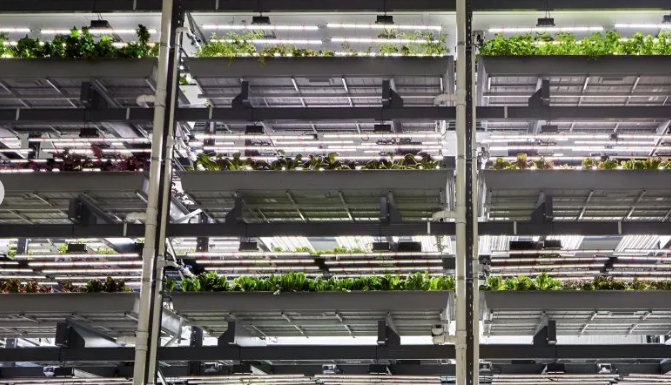
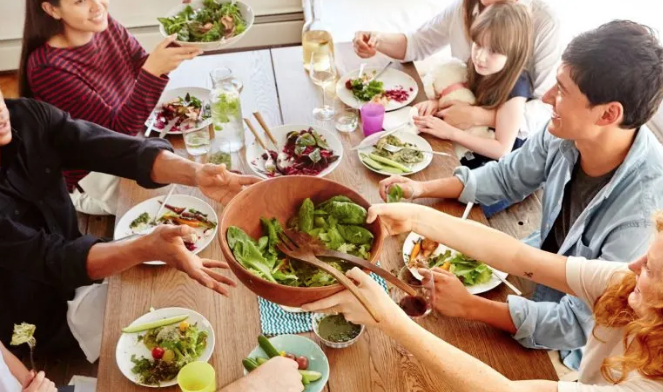
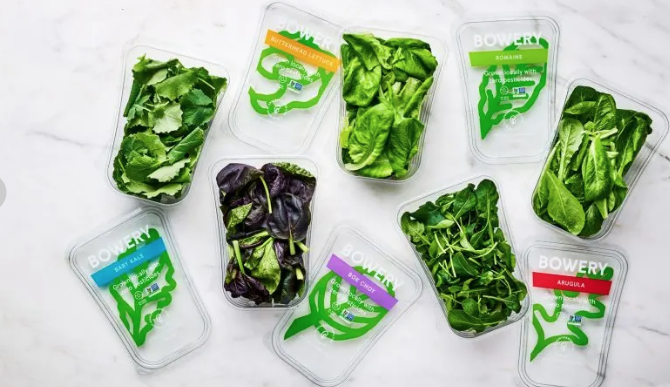
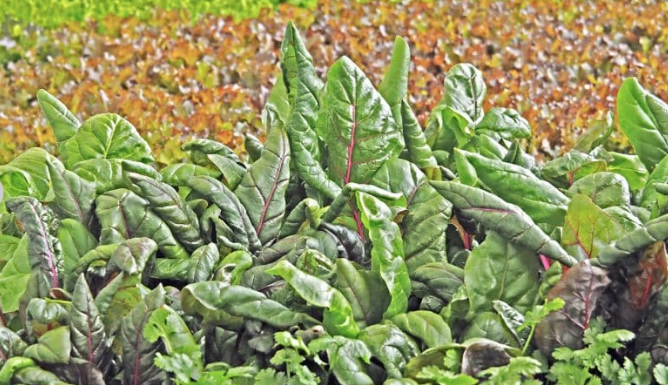
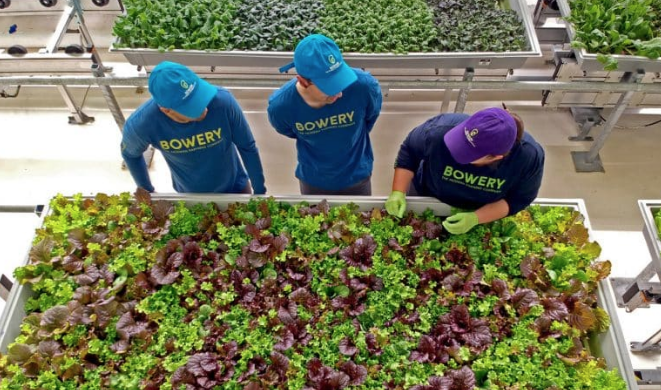
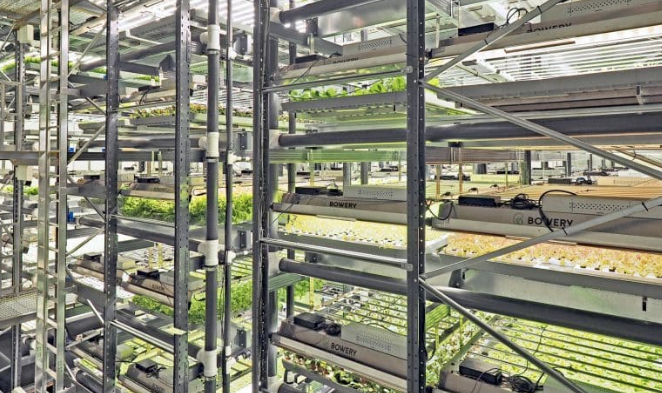
If you live in the U.S., the last time you ate a salad, the lettuce inside it almost certainly came from California or Arizona. But the geography of leafy greens is very slowly starting to change as the trend of indoor farming—growing greens in large warehouses using artificial light and automated technology—expands. The latest farm to open is in Baltimore. It’s the largest, so far, from the New York-based, tech-heavy startup Bowery.
[Photo: Bowery]
The company, which just announced that it raised another $50 million from investors, grows what it previously called “post-organic” produce in sprawling warehouses (it no longer uses the phrase, but the greens are grown without any pesticides). It’s one of a handful of startups trying to make a dent in some of the challenges of traditional agriculture. The industry isn’t moving as quickly as some predicted. Aerofarms, for example, said in 2015 that it hoped to build 25 farms over the next five years; so far, it has two large farms, an R&D farm and a small farm at a school. The same year, FarmedHere said that it planned to expand to 18 farms but went out of business two years later. Boston-based Fresh Box Farms said in 2017 that it planned to expand to 25 farms in five years but still has only one farm. Plenty, a Silicon Valley-based indoor farming startup that has raised $226 million, has one farm.
Bowery, which launched in 2015, opened its first farm in New Jersey in 2017, followed by another farm at the same location, roughly 30 times larger, in 2018. The new farm in Baltimore is around 3.5 times larger than the last (the company won’t disclose specific square footage). The company is ramping up operations in Baltimore this week and planting crops, with the first sales to begin at local retailers early next year. Like others, the startup also hasn’t moved quite as quickly as it has suggested—last year, it said that it planned to open multiple farms in new cities by the end of 2019, though the Baltimore farm will be the only one to open this year—but it offers evidence that the field is continuing to grow. Another large indoor farm, from Gotham Greens, will also open in Baltimore late this year inside a former steel mill. In Pittsburgh, a robot-run farm from another startup called Fifth Season is scaling up in an industrial neighborhood.
“We’ve been really measured and thoughtful at Bowery in the way that we’ve scaled and grown the business, and that’s not just the farms themselves but the development around our technology . . . I think that really is rooted in the recognition that the problem that we’re solving and the opportunity that we’re focusing on is a large one, and ultimately, we’re running a marathon, not a sprint,” says Bowery CEO Irving Fain.
If the business model can succeed, it could help farming become more sustainable. “When you look at the footprint of agriculture globally, it’s the largest consumer of resources in the world by a quite a wide margin,” says Fain. The majority of the world’s water is used for agriculture—often in places like California that struggle with frequent drought and where droughts will increase with climate change. Indoor growing systems can shrink water use by more than 95%.
Because the crops grow in a pristine environment, they also don’t require any pesticides, fungicides, or herbicides. (Growing inside a controlled environment also eliminates the risk of contaminated produce, such as an E. coli outbreak in conventionally grown lettuce in 2018 that made 210 people sick and left five people dead.) Bowery estimates that its system is 100 times more productive than a traditional farm on the same amount of land. And while indoor farming uses a significant amount of energy for climate control and lighting, the technology is becoming more efficient. “I think you’re going to see us really fulfill our energy needs with more and more renewable energy over time,” he says.
[Photo: Bowery]
Like others in the space, Bowery relies heavily on technology. The company uses a custom-built operating system to carefully monitor plants and automatically make changes to improve yield and quality. Cameras track plant growth. “That plant vision system is taking photos of our crops in real-time,” Fain says. “It runs those photos through deep learning algorithms that we’ve developed. It both analyzes and understands what’s happening with the crops today but also predicts what will happen to the crops in the future. And then all that data runs through other machine learning algorithms, which essentially say, these are the adjustments and tweaks and changes that we want to make to this crop.” The software also manages farmers, making it possible, he says, to hire people who have no previous experience in growing food.
As the company expands, it can use the data it has already collected to improve each new farm. “In essence, what we’re doing is we’re building this distributed network of farms, and every new farm comes online with the benefit of all the prior farms that have come before it,” says Fain. “And then that farm itself also is now contributing data into that network and strengthening the network itself. What that means is better produce, more efficiency, new taste and flavors, and new varieties, and all those things are sort of translating from the learning that we’re getting through the Bowery operating system and the systems themselves.”
All of this, he says, can happen at a cost-competitive with growing in the field. Right now, the company’s leafy greens sell through 100 retailers for around the same price as organically grown produce. Fain says that he expects the cost to eventually be at par with any produce. “When I started Bowery, one of the things that was really important to me was really ensuring that we could ultimately democratize access to high quality, fresh produce,” he says. “To get there, we had to be able to sell a product that was already competitive today . . . We’ve spent a lot of time really carefully and meticulously focusing on not only the way we run our farms but the systems inside of our farms, the automation, the technology and the software, and how that directly ties into the unit economics of the farms themselves. And so we can today be at or below field organic pricing with a very healthy economic model for our farms.”
ABOUT THE AUTHOR
Adele Peters is a staff writer at Fast Company who focuses on solutions to some of the world's largest problems, from climate change to homelessness. Previously, she worked with GOOD, BioLite, and the Sustainable Products and Solutions program at UC Berkeley, and contributed to the second edition of the bestselling book "Worldchanging: A User's Guide for the 21st Century."
[Photos: Bowery]

US (MA): MIT Halts Work On The Controversial Open Agriculture Initiative Food Project
MIT has closed down much of its Open Agriculture Initiative following allegations of academic dishonesty and improper dumping of wastewater, according to an article published in the NY Times
MIT has closed down much of its Open Agriculture Initiative following allegations of academic dishonesty and improper dumping of wastewater, according to an article published in the NY Times. Late last week, MIT’s vice president of research, Maria Zuber, closed down all offsite work on the project, though she has allowed researchers to continue doing some design and document work.
The project, often simply referred to as “OpenAg,” is known for its food computers — small, high-tech containers meant to grow plants in controlled environments and without any soil. OpenAg also operated larger farms it called “food servers” in shipping containers housed outside the MIT campus in Middleton, Massachusetts.
Project leader Caleb Harper also had a vision that owners of these food computers would be able to share data on the perfect combinations of light, water, nutrient, and temperature levels with one another, creating a kind of open-source framework for high-tech indoor farming. “As an open-source project, we believe the more Food Computers we all build, the more data we all have to play with, and the more we can radically alter the future of food,” states a page on the Open Ag site.
Read the full article at The Spoon (Jennifer Marston)

The Economics of Container Farming In Nauru
You might be excused for not knowing much about the country of Nauru. It’s a small island in the Pacific Ocean that’s only ten times larger than Microsoft’s campus in Redmond with one-fifth the people. The 11,000 citizens of Nauru occupy a footprint of about 8.1 square miles (21.98 sq. kilometers) out in the middle of absolutely nowhere where the waters are so deep they never have to worry about tsunamis
People from countries we refer to as frontier markets must roll their eyes when some people in America talk about how “oppressed” they are. The same people complaining about how bad it is in the States probably think Africa is a country when in fact it’s 54 countries. A lot of Africans actually are oppressed because about half of the continent’s countries are run by dictators. If you can go into your local store and buy some fresh lettuce at any hour of the day, 365 days a year, you’re not oppressed. Most people around the world don’t have access to a large selection of fresh vegetables or the means to purchase them. Take Nauru for instance.
You might be excused for not knowing much about the country of Nauru. It’s a small island in the Pacific Ocean that’s only ten times larger than Microsoft’s campus in Redmond with one-fifth the people. The 11,000 citizens of Nauru occupy a footprint of about 8.1 square miles (21.98 sq. kilometers) out in the middle of absolutely nowhere where the waters are so deep they never have to worry about tsunamis. About once a month, a ship will cruise into the harbor dropping off loads of food and supplies. Vegetables are all flown in by air. With its pleasant island breezes, Nauru is a hidden gem that happens to be the least visited place in the world. As a result of not having to deal with obnoxious tourists, the citizens are some of the kindest people you’ll ever meet. They’re also the world’s most portly. You would be too if you had to pay these prices for vegetables.
Produce prices in a Nauru supermarket in AUD – Credit: Nanalyze
We did the math for you on those numbers. If you want to buy a head of lettuce in Nauru, you can’t. They don’t have any right now. If they did, you would pay $3.29 a pound or $7.25 a kilo in greenbacks. That’s more than three times the retail price of lettuce in the United States which sits at around $1.09 a pound. In order to solve the obesity problem which commonly afflicts island nations like Nauru, we need to make healthy food more affordable. Maybe we can use something Nauru has a whole lot of already – shipping containers.
In a previous article, we wrote about the newly sprouted industry of “vertical farming.” Also called indoor farming, the eleven startups we looked at have collectively raised more than $900 million in venture capital so far. The appeal is in the delicious numbers. Indoor farming uses 95% less water and yields 400 times more output than the same land footprint when compared to traditional farming methods. That’s what it says on the tin, but the experts are skeptical when it comes to indoor farming using shipping containers like the one seen below.
The Greenery from Freight Farms – Credit: Freight Farms
Container Farming Economics
We’re not interested in the “farm to table” marketing spin being put on container farming, we’re solely interested in the economics. For that we can turn to Peter Tasgal, a man who used to work as an investment banker before he managed to turn his life around and became the CFO of a $100 million consumer packaged goods company. Today, he’s an agriculture consultant, and this past February he penned a piece on “What is the Future of Container Farming?” in which he talks about how it’s largely a niche business applicable to applications like “restaurants, traditional farmers seeking to maintain year-round customers, clean rooms, and areas of extreme climate.” This table pulled from his article compares various methods of farming:
Source: Agfunder News
Container farming has the “highest cost per delivered pound” with Mr. Tasgal stating that it’s “at best four times as expensive per pound to grow in a container farm and more likely over 10.0x as expensive as compared to traditional farming methods.” He proposed that either technology can be used to reduce the cost per pound (nothing on the horizon yet) or people can pay a price premium for “better quality produce.” Since the people of Nauru already pay a price premium, this isn’t exactly a showstopper.
Some Initial Concerns
We shipped one of our MBAs over to Nauru to visit with Mathew Batsiua, former Health Minister of Nauru, and someone who has spent the last 4 years of his life fighting his own version of an African dictatorship with the local government. He thinks that container farming might be able to provide the Nauruan people with an alternative to purchasing over-priced greens at the supermarket. Aside from being able to offer cheaper and fresher greens, container farming could be used as part of a school program to get the country’s youth eating healthier. An additional benefit would be creating some local jobs. If the initial implementation works out, Nauru could act as a model for other Pacific Island countries that all have a similar obesity problem for all the same reasons.
Some initial concerns he raised around container farming:
Support and training
Durability of the components in the unique climate of Nauru
Consumption of electricity
The need for solar integration
Availability of consumables required to operate the farm
In order to gauge the suitability of container farming for the country of Nauru, we’re turning to “the world’s leading manufacturer of container farming technology,” a startup called Freight Farms.
Freight Farms
Founded in 2013, aptly named startup Freight Farms hails out of Bahstun Massachusetts and has raised $11.4 million in funding so far to develop “high-volume crop production units made from upcycled shipping containers to support farming in any climate.” Their container farming solution can produce over 500 types of lettuces, herbs, leafy greens, and small root vegetables at a commercial scale. As of January 2019, their hydroponic container farms can be found in 38 U.S. states and 15 countries. Their latest growing platform, The Greenery, costs $104,000.
Credit: Freight Farms
It’s a significant price increase over their previous container solution, The Leafy Green Machine, which ran just $76,000. That’s because The Greenery has over 70% more growing space than the Leafy Green Machine.
If we’re going to deploy The Greenery on Nauru, we need to get it there first. Let’s say that’s an additional $8,000 in shipping costs. With an initial capital outlay of $112,000, we can begin to crunch some numbers. Firstly, let’s look at the operational requirements:
Credit: Freight Farms
Nothing too alarming here. Water is clearly in short supply for Nauru but 5 gallons a day is manageable. One gigabyte of data a month is affordable. We need to consider that electricity in this part of the world is more costly as well. Consumables like peat moss plugs, seeds, and nutrient solutions will all need to be imported by ship. Let’s do some back-of-the-napkin math and see how much time it might take to recoup our initial investment.
Container Farming Yields
According to an article by the University of Saskatchewan on hydroponic lettuce, “all it takes to grow one lettuce is 1 g of fertilizer, 1 L water, 1 seed, and 1 Jiffy-7 peat pellet, at a cost of as little as 10 cents per plant.” Now we have an estimated cost per head of lettuce. “With an average plant success rate of 95%, you can plan on harvesting about 940 plants a week,” says Freight Farms. They’re talking about harvesting lettuce at a 4-week maturity and we’re estimating the weight of each lettuce head to be 4 ounces based on an estimate given from Bright Agrotech in their article on How Much Can Container Farms Really Grow? That gives us 235 pounds of lettuce a week or 12,220 pounds of lettuce a year (just over 6 tons). If we sold that lettuce at $1.64 a pound – about half the price of lettuce on Nauru today – that gives us about $20,040 in revenues a year. For consumables, let’s assume ten cents per plant (48,880 plants = $4,888). For electricity, the company states that power consumption for a Greenery ranges from 150-165 kWh per day. Here’s an idea of electricity rates on Nauru in AUD.
Credit: Nauru Utilities Corporation
Unless we can convince the government to cut us a break, the math works out to $21,900 a year AUD which is $15,064 a year USD in electricity costs. Subtracting our costs ($15,064 + $4,888) from our revenues ($20,040) we get a meager profit of $88 and we haven’t even considered labor or the cost of support. Barring any serious errors in our assumptions, it doesn’t look like container farming would be very economically viable for the country of Nauru. Even with electricity subsidized at the lowest domestic rate, we’re still looking at 10 years before we can receive a return on our initial capital outlay and that’s without considering the time value of money.
Conclusion
Container farming shouldn’t just be about producing better tasting “farm to table” produce for over-priced restaurants to sell at a premium to well-off diners, it should do something better than that for mankind. Our back of the napkin calculations don’t quite add up. Sure, we might be able to negotiate down the price a bit, or the Government of Nauru might subsidize the operation, but as we’ve said before, subsidizing the world’s problems won’t scale. The operation needs to be self-sustaining, generate a profit, and provide an ROI in a reasonable amount of time. If you think your container farming startup can provide a solution to Nauru’s obesity problem, Mr. Batsiua would like to have a chat with you. Just drop us a line and we’ll put you in touch with him. Stay tuned for our next article on container farming where we look at all the players in this space in addition to Freight Farms.

CubicFarm Systems Announces Its First Operational Growing Machine For Hemp and Cannabis
The ZenCube project leverages CubicFarms' patented, undulating-path growing technology to allow hemp and cannabis growers to cultivate significant amounts of product in a smaller footprint by doing so in a completely climate-controlled environment
October 28, 2019
License Agreement with Zenabis to Expand Sales of CubicFarms Systems in New Vertical
VANCOUVER, BC / ACCESSWIRE / October 28, 2019,/ CubicFarm� Systems Corp. (TSXV:CUB) ("CubicFarms" or the "Company") is pleased to announce that ZenCube, its vertical-farming machine for growing hemp and cannabis, is fully operational at a showcase and R&D facility in Langley, Canada.
The ZenCube project leverages CubicFarms' patented, undulating-path growing technology to allow hemp and cannabis growers to cultivate significant amounts of product in a smaller footprint by doing so in a completely climate-controlled environment. The ZenCube helps to address challenges faced by traditional growing methods, by providing a solution that requires less space, labour, water and energy, and is expected to result in a more consistent, higher quality product for farmers and end-users alike.
CubicFarms has developed a pipeline of sales opportunities for its ZenCube-branded growing machines that is expected to be augmented by an exclusive License Agreement signed with Zenabis Ltd. ("Zenabis"), a subsidiary of Zenabis Global, a leading Canadian licensed cannabis cultivator of medical and recreational cannabis, and propagator and cultivator of floral and vegetable products. Under terms of the agreement, Zenabis shall fulfill a minimum sales threshold of 150 ZenCube machines by year 2024 to maintain its exclusive license to operate, sell and sublicense ZenCube machines globally.
The License Agreement supersedes the Joint Venture Agreement between CubicFarms and Zenabis, announced in a Bevo Agro press release dated October 9, 2018. Bevo Agro now is Zenabis Global.
CubicFarms and Zenabis are conducting ongoing R&D on crop growth and quality at the Zenabis-owned-and-licensed Langley facility.
Dave Dinesen, Chief Executive Officer of CubicFarms, commented: "CubicFarms is excited to bring online its first growing machine for the purposes of facilitating yet another vertical in the hemp and cannabis space, and to help farmers grow more produce reliably, 12 months a year, wherever they are on earth. CubicFarms has received numerous enquiries to utilize our technology in this space and we are thrilled to serve this market, in addition to our other verticals, namely fresh produce, animal feed and nutraceuticals."
Leo Benne, Chief Growing Officer of Zenabis, added: "The Zenabis and CubicFarms partnership on the ZenCube project is a culmination of our joint vision of bringing a robust and reliable solution to the global hemp and cannabis market, to ensure we meet consistency and quality in our crop yields."
Neither the TSX Venture Exchange nor its Regulation Services Provider (as that term is defined in the policies of the TSX Venture Exchange) accepts responsibility for the adequacy or accuracy of this release.
About CubicFarm� Systems Corp.
CubicFarm� Systems Corp. ("CubicFarms") is an ag-tech company commercializing large scale, vertical farming solutions for global industrial markets. Founded in 2015, the Company's mission is to provide industries around the world with efficient growing systems capable of producing predictable crop yields. CubicFarms offers turnkey, commercial scale, hydroponic, automated vertical farm growing systems that can grow predictably and sustainably for 12 months of the year virtually anywhere on earth. CubicFarms enables its customers in the fresh produce, animal feed, nutraceutical, and hemp/cannabis industries to grow locally and to provide their markets with safe, sustainable, secure and fresh ingredients that are consistent in colour, size, taste, nutrition and allows for a longer shelf life. Further support and value is provided to customers through the Company's patent-pending germination technology and proprietary auto harvesting and processing methods.
Using its unique, undulating growing system, the Company addresses the main challenges within the indoor farming industry by significantly reducing the need for physical labour and energy, and maximizing yield per cubic foot. The Company has sold and installed systems in Canada and the US, and is currently negotiating with a global pipeline of prospective customers. It also operates one wholly owned facility in Pitt Meadows, British Columbia, and sells its produce in the province to retail and wholesale customers under the brand name Thriiv Local Garden".
Information contact
Kimberly Lim
kimberly@cubicfarms.com
Phone: +1-236-858-6491
www.cubicfarms.com
Cautionary statement on forward-looking information
Certain statements in this release constitute "forward-looking statements" or "forward-looking information" within the meaning of applicable securities laws, including, without limitation, statements with respect to the ZenCube is expected to result in a more consistent, higher quality product for farmers and end-users alike; and CubicFarms' sales pipeline is expected to be augmented by the License Agreement. Such statements involve known and unknown risks, uncertainties, and other factors which may cause the actual results, performance, or achievements of CubicFarm Systems Corp., or industry results, to be materially different from any future results, performance, or achievements expressed or implied by such forward-looking statements or information. Such statements can be identified by the use of words such as "may", "would", "could", "will", "intend", "expect", "believe", "plan", "anticipate", "estimate", "scheduled", "forecast", "predict", and other similar terminology, or state that certain actions, events, or results "may", "could", "would", "might", or "will" be taken, occur, or be achieved.
These statements reflect the company's current expectations regarding future events, performance, and results and speak only as of the date of this news release. Consequently, there can be no assurances that such statements will prove to be accurate and actual results and future events could differ materially from those anticipated in such statements. Except as required by securities disclosure laws and regulations applicable to the company, the company undertakes no obligation to update these forward-looking statements if the company's expectations regarding future events, performance, or results change.
SOURCE: CubicFarm Systems Corp