


Welcome to iGrow News, Your Source for the World of Indoor Vertical Farming

Is Indoor Farming The Answer to Agri-Woes? 80 Acres Farms Thinks So
Entrepreneurs and 80 Acres Farms co-founders Tisha Livingston and Mike Zelkind started their indoor farming journey after extensive work with food executives and farmers alike, hearing their struggles to produce quality food
By Mark Payne
June 20, 2019
Entrepreneurs and 80 Acres Farms co-founders Tisha Livingston and Mike Zelkind started their indoor farming journey after extensive work with food executives and farmers alike, hearing their struggles to produce quality food.
“There is a much better way to farm today, a much more effective way,” Zelkind said.
As you may have guessed, the duo believes indoor farming is the answer, solving issues related to the health of crops and the freshness of delivered food.
A tomato row. Courtesy Photo 80 Acres Farms.
“Our whole business model is that we will grow and harvest and deliver within a day to the region we’re in,” said 80 Acres Vice President of Marketing Rebecca Haders.
It works like this: 80 Acres grows most of its food hydroponically indoors, with “100 percent traceability from seed to package.” The company also eschews pesticides and controls the lighting where certain types of food are grown; with this much control, they can adjust the richness of the flavor of the produce.
Once a vegetable or fruit is ready to be harvested, it is delivered directly to one of the handful of grocery stores they work within the region, such as Whole Foods, Dorothy Lane Market and Jungle Jim’s International Market.
Hamilton vine. Courtesy Photo 80 Acres Farms.
Eliminating food miles is another goal of Zelkind and Livingston, who explained that when produce is hauled from Mexico or Canada or California, it effects the quality of the item.
“The only way to do [get produce to its destination] before it turns to mush is to pick before it’s ripe,” Zelkind said, resulting in food that’s missing critical nutrients and taste elements.
80 Acres work is not only trying to benefit the fruit and vegetables it grows, but also the environment. In fact, its farms utilize 97 percent less water than others, as well as renewable energy, in its work.
Basil grows under pink lights. Courtesy Photo 80 Acres Farms.
These results have resonated with investors, with 80 Acres announcing in January that it had received a $40 million investment from California-based private equity firm Virgo. The team will use the funds to build two farms in Hamilton in an effort to grow their operations in the region, ultimately creating what will be the first fully automated farms in the country.
Courtesy Photo 80 Acres Farms.
Bowery Farming: Expanding Assortment Outside Lettuce and Leafy Greens
It is one of the favourite topics for critics of indoor farming: how will you feed the world with lettuce? The team with Bowery Farming doesn’t see it as its primarily goal to feed all of the world, but is expanding its produce assortment anyhow
"Just Because It's Possible To Grow A Crop Indoors
Doesn't Mean You Should Do it"
It is one of the favourite topics for critics of indoor farming: how will you feed the world with lettuce? The team with Bowery Farming doesn’t see it as its primarily goal to feed all of the world, but is expanding its produce assortment anyhow. Yesterday at the Indoor AgTech in New York, Bowery Farming Founder & CEO Irving Fain explained how the company is trying out new products like radishes, turnips and kohlrabi, all grown in their own controlled environment. “We’re still excited and see many more opportunities for the leafy greens and herbs market, but have aspirations outside this area as well.”
Irving Fain & Tom Colicchio at Indoor AgTech
Flavor
At the Indoor AgTech Innovation Summit, the role and future of indoor farming is discussed. While there are many challenges, in the talk with Irving Fain and Tom Colicchio, chef and founder of Crafted Hospitality, it became clear that there are new opportunities for indoor farms through partnerships. Tom explained how years ago he would have dismissed any food grown hydroponically, as he believed it not to be any good or tasteful at all - but had his view changed after learning about the flavors that can be achieved with indoor farming, based on the crop recipe.
Tom Colicchio and Bowery recently hosted an event with a group of chefs to try out the new vegetables grown by Bowery: radishes, turnips and kohlrabi. “The texture of the products is what shocked most,” Tom says, explaining how indoor grown products open up new opportunities for chefs. “You’re not just working with lettuce any more, you’re working with an ingredient of flavor that can play a role in your dish. What kind of flavor do you want and how do you use it? We’re having to train chefs on this.”
Scaling up
Bowery Farming opened up their first farm in 2017 in New York, and recently announced a $95 million Series B funding round last year, totaling $122.5M raised to-date. They developed their own software system, BoweryOS, and plans to use their capital to scale their operation in new cities, Irving explained. Also product differentiation is on the agenda, which Irving shared this week. “We expect to look back on this time, when it will seem obvious that indoor agriculture takes care of an enormous part of produce found in the grocery store. Right now, a lot of crops beyond leafy greens are grown outdoors, but the future is to look much more indoors when it comes to produce as another option.”
Economically viable model
High in flavor, grown in a responsible way and answering climate change are some of the arguments called out for this. That said, Irving emphasizes that the focus is still on having an economical model. “There are many crops that you can grow indoors that will not be economical. Pineapples for example - we will not be your source for that,” he laughs. “Well, maybe someday - but just that it is possible to grow a crop indoors doesn’t mean you should do it. In the end it is an economic business case.”
That’s also his answer to critics saying indoor farms grow only high-end products and leafy greens and need to make their business more broad to remain viable. “It’s easy to forget how innovation goes. Look back at the start of the companies that we take for granted nowadays. Following Amazon, cashier-less grocery stores are popping up all over the city right now, but in 1994 Amazon was just a place selling books on something called the internet. Journeys don’t unfold in a couple of years - and the same thing goes for our industry. We believe there are many more opportunities outside leafy greens and even though we are still excited and see many opportunities for herbs and leafy greens, we also have aspirations outside this area. We see many other crops - fruiting crops, vine crops - flourishing in our environment. We want to move there quickly but also want to move in the right way.”
For more information:
Bowery Farming
boweryfarming.com
contact@boweryfarming.com
Publication date: 6/21/2019
Author: Arlette Sijmonsma
© HortiDaily.com

The Steep Climb of Vertical Farms And Where Urban Ag Might Be Revolutionary
Square Roots is an urban farming accelerator — empowering 1,000’s of millennials to join the real food revolution. Our goal is to enable a whole new generation of real food entrepreneurs, ready to build thriving, responsible businesses. The opportunities in front of them will be endless
By Marc Brazeau | June 13th 2019
A few years back in an essay titled: “Why I’m empowering 1,000’s of millennials to become #realfood entrepreneurs through Vertical Farming”, Elon Musk’s younger brother Kimball announced that he was going to invest in urban farm incubators in multiple cities. While there is certainly room for vertical farms in urban food systems to supply hydroponic greens and herbs to upscale grocers and restaurants, Musk’s ambitions go far beyond that.
The Kitchen’s mission is to strengthen communities by bringing local, real food to everyone. With our commitment to local food sourcing, our restaurants have become major catalysts for local food economies — across Colorado, Chicago, and now Memphis — serving real food to over 1 million guests a year. Meanwhile, our non-profit The Kitchen Community has built 300 Learning Gardens across the country — inspiring 150,000 kids each day as we get them outdoors and teach them about real food.
But the impact of those initiatives are a drop in the ocean compared to what’s needed. By 2050, 9 billion people will live on our planet, and 70% of them will live in cities. These people need food. And the data is clear: they will want local, real food.
The industrial food system will not solve this problem (more Deep Fried Twinkies, anyone?). Instead, finding the right solution presents an extraordinary opportunity for new entrepreneurs. As I’ve said before, “Food is the new internet.” I know the next generation is excited to join the #realfood revolution, and shape the future.
That’s why I’m thrilled to introduce a new company in The Kitchen’s family: Square Roots.
Introducing Square Roots
Square Roots is an urban farming accelerator — empowering 1,000’s of millennials to join the real food revolution. Our goal is to enable a whole new generation of real food entrepreneurs, ready to build thriving, responsible businesses. The opportunities in front of them will be endless.
Square Roots creates campuses of climate-controlled, indoor, hydroponic vertical farms, right in the hearts of our biggest cities. On these campuses, we train young entrepreneurs to grow non-GMO, fresh, tasty, real food all year round, and sell locally. And we coach them to create forward-thinking companies that — like The Kitchen — strengthen communities by bringing local, real food to everyone.
The real and imagined impacts and potential of vertical farms had very much been on my mind. Just the week before, a friend on Facebook shared a story on the amazing ecological efficiencies of a new vertical farm and asked “Is this stuff real or is it just hype?”
The article asked “Considering it uses 95% less water than regular farms, could vertical farming be the future of agriculture?” and told the story of a vertical farm in Newark, NJ in an old laser tag facility. At AeroFarms in Newark, New Jersey, crops are stacked more than 30 feet high in a 30,000 square foot space that was formerly a laser tag arena. They use aeroponic technology, which involves misting the roots of the plants, using an astonishing 95% less water than more conventional farming methods. David Rosenberg, CEO of AeroFarms told Seeker, “Typically, in indoor growing, the roots sit in water, and one tries to oxygenate the water.
Our key inventor realized that if we mist nutrition to the root structure, then the roots have a better oxygenation.” AeroFarms doesn’t use any pesticides or herbicides either. The plants are grown in a reusable cloth made from recycled plastic, so no soil is needed to grow them. They also use a system of specialized LED lighting instead of natural sunlight, reducing their energy footprint even further. “A lot of people say ‘Sunless? Wait. Plants need sun.’ In fact the plants don’t need yellow spectrum. So we’re able to reduce our energy footprint by doing things like reducing certain types of spectrum,” Rosenberg said. IT’S ALWAYS SALAD GREENS I would say that it’s mostly hype, certainly not revolutionary.
These projects always center on salad greens and herbs, crops that sell at a premium, and deliver very few calories, but a lot of water. Crops require light, water and a growing medium – three things in abundance at low prices on rural farms in the form of sun, rain, and soil. The economics of paying for light and rain, plus the economics of real estate are such that these projects cannot pencil out for any crops other than high end greens and vegetables. There is a reason why so much of the innovation in hydroponic growing systems came out of marijuana production.
The ROI per square foot is far greater than for oats. The future of urban farming is in crickets and other insects, mushrooms and other fungi, algaes and yeasts, and in vitro meat. If you want to go beyond premium salad greens and herbs, you need to focus crops or herds that don’t require lots of space, water or sunlight. More importantly, if you really want to lower the impact of food production, urban farming needs be able to close nutrient cycles in dramatic ways. The exception might be in cities like Detroit, where a collapsing urban footprint changes the economics of the real estate.
As a city economy grows, agglomeration increases the productivity per square foot, driving up rents which leads to the necessity of greater productivity per square foot. If urban farming catches on, it requires more square feet, driving up rents, requiring greater productivity per square foot, driving up the required productivity per square foot driving up the price required to be charged per square foot of product. TLDR: this model cannot work for barley, oats, canola, cowpeas, black beans, soybeans, pinto beans or any other serious sources of calories or protein in an urban setting. The revolution is not going to be powered by expensive salad greens. Tamar Haspel helpfully chimed into that discussion to share an article she did for the Washington Post on the ledger of environmental challenges and benefit of vertical farming. In terms of growing lettuce greens she tallied the use of less land, less water, less fertilizer and less pesticides as four environmental benefits of vertical farming.
On the down side, she pointed out that one of the biggest trade off was foregoing solar power for electricity. However, unless the vertical farm is powered by nuclear or renewables or both there is one big sticking point: But before you shell out for the microgreens, there are a couple of disadvantages. The first is that you’ll have to shell out a lot, and the second gets at the heart of the inevitable trade-off between planet and people: the carbon footprint. If you farm the old-fashioned way, you take advantage of a reliable, eternal, gloriously free source of energy: the sun. Take your plants inside, and you have to provide that energy yourself. In the world of agriculture, there are opinions about every kind of system for growing every kind of crop, so it’s refreshing that the pivotal issue of vertical farming — energy use — boils down to something more reliable: math.
There’s no getting around the fact that plants need a certain minimum amount of light. In vertical farms, that light generally is provided efficiently, but, even so, replacing the sun is an energy-intensive business. Louis Albright, director of Cornell University’s Controlled Environment Agriculture program, has run the numbers: Each kilogram of indoor lettuce has a climate cost of four kilograms of carbon dioxide. And that’s just for the lighting. Indoor farms often need humidity control, ventilation, heating, cooling or all of the above. … Let’s compare that with field-grown lettuce. Climate cost varies according to conditions, but the estimates I found indicate that indoor lettuce production has a carbon footprint some 7 to 20 times greater than that of outdoor lettuce production. Indoor lettuce is a carbon Sasquatch.
She goes on to explain that with more efficient lighting systems and access to nuclear and renewable energy sources, vertically grown lettuce can close a big part of that gap, but it’s still a steep climb. Before moving on to the reasons why I’m enthusiastic about farming crickets and other insects, mushrooms and other fungi, algaes and yeasts in urban settings, I want to circle back to the economics of real estate that serves as the stake through the heart of mass scale vertical farming of traditional crops.
A LITTLE PERSPECTIVE ON SCALE
First let’s put some things in perspective about scale. One of the larger well known urban rooftop farm in New York City is 42,000 square feet. 42,000 square feet sounds like a lot of square feet. But retail and office space is measured in square feet.
Farms are measured in acres and 42,000 square feet is pretty much one acre. 0.964187 acres to be exact. New York state has 7 Million acres of farm land across 36,000 farms. That’s just the state of New York, which isn’t a particularly rural state. Urban real estate is denominated in square feet. Farms are denominated in acres. Field corn (not grown for ethanol) accounts for some for over 50 million acres of farm land. Wheat, another 50 million acres. That’s 100 million acres just in two major grains. But lets put that aside. Nobody thinks were are going to grow corn and wheat in urban vertical farms, I just think it’s important to start with a baseline of the scale of the footprint of where most of our calories come from. And if you think we should be getting less of our calories from corn and wheat – and I’d agree with you – just keep in mind that no other crops come close on calories per acre, so any shift away from corn and wheat is going to drive that 100 million number upwards.
Let’s look at the crops that make up the core calories of a healthy diet. Barley accounts for 3.2 million acres. Lentils, dried beans and peas 2.7 million acres. Rice – 2.6 million acres. Vegetables – 4.1 million acres and half of that is potatoes, sweet corn and tomatoes. Orchards and berries – 5.4 million. 18 million acres total or 756 Billion square feet.
Let’s grant these vertical farms the wildly ambitious ability to increase yield by a third and say that shifting 10% of production into vertical farms would be a substantial impact. That would require 50 Billion square feet of urban real estate. (This is what tomato harvest looks like at a consequential scale. 75% of tomatoes are used for processed products, salsa, sauces, soups, etc. If you really want to impact the food system you need to be thinking about production on this scale. That’s a lot of square feet of real estate in any city.)
ECONOMIES OF AGGLOMERATION
Now let’s back up to the point we made about real estate prices and productivity. As cities grow bigger and denser productivity rises. Similar firms cluster and generate a base of workers who circulate among them increasing knowledge and competence. Travel times are lower, so a delivery van can make more stops per hour in a city than in a suburb or rural community. With more customers in there base, firms can grow larger and take advantages of economies of scale.
This is what is called agglomeration in economics. Agglomeration makes for productive, vibrant cities, but it also drives up rents. Which further puts pressure on firms to increase the productivity out of each square foot of real estate that they own or lease. To increase productivity per square foot firms can either produce more units or charge more per unit. This is why expensive herbs and greens are the only products that currently make sense in vertical farms. Now imagine what it would mean to add demand for another 50 billion square feet of real estate to US cities. Scaling up the operations of vertical farms would COMPOUND the pressure to produce crops that they can sell at high prices.
While proponents often claim that as more vertical farms come on line, prices will come down, for most crops the economics of cities tell us that the opposite is true. So the economics of urban real estate are stacked against vertical farms except in places like Detroit where the urban footprint in shrinking and there is massive slack in the real estate market. But the economics for vertical farms are even steeper when we take comparative advantage into account.
COMPARATIVE ADVANTAGE
Comparative advantage is an economic concept that most people have heard of but very few understand and a vanishingly small number of people “get” on an intuitive level. That’s because it is one of the most counter-intuitive concepts in economics and I balk at the headache of even attempting to put it across when I think I’ve probably already made my case as to why I don’t expect vertical farms to catch on beyond expensive herbs and greens (and maybe some heirloom tomatoes and peppers). But it’s an important concept to understand in general and for the case I’d like to make for why I think the future of urban agriculture is in mushroom and cricket farming, black soldier flies, algaes and yeasts, and in vitro meat production.
The economist Paul Krugman once called comparative advantage “Ricardo’s Difficult Idea” in an essay in which he explains why a concept formalized in 1817 by the philospher and political economist David Ricardo remains so poorly understood, if not outright resisted, even by economic sophisticates. The idea of comparative advantage — with its implication that trade between two nations normally raises the real incomes of both — is, like evolution via natural selection, a concept that seems simple and compelling to those who understand it. Yet anyone who becomes involved in discussions of international trade beyond the narrow circle of academic economists quickly realizes that it must be, in some sense, a very difficult concept indeed.
I am not talking here about the problem of communicating the case for free trade to crudely anti-intellectual opponents, people who simply dislike the idea of ideas. The persistence of that sort of opposition, like the persistence of creationism, is a different sort of question, and requires a different sort of discussion. What I am concerned with here are the views of intellectuals, people who do value ideas, but somehow find this particular idea impossible to grasp.
My objective in this essay is to try to explain why intellectuals who are interested in economic issues so consistently balk at the concept of comparative advantage. Why do journalists who have a reputation as deep thinkers about world affairs begin squirming in their seats if you try to explain how trade can lead to mutually beneficial specialization? Why is it virtually impossible to get a discussion of comparative advantage, not only onto newspaper op-ed pages, but even into magazines that cheerfully publish long discussions of the work of Jacques Derrida? Why do policy wonks who will happily watch hundreds of hours of talking heads droning on about the global economy refuse to sit still for the ten minutes or so it takes to explain Ricardo?
Against that backdrop let me apply my meager talents to see if I can pound this into your thick skulls with any greater efficacy. Here goes.
Ricardo provided a simple two country model to show the math at work here. Consider two countries, England and Portugal, producing two identical products but at different rates of productivity.
WIKIPEDIA: In this illustration, England could commit 100 hours of labor to produce one unit of cloth, or produce 5/6ths units of wine. Meanwhile, in comparison, Portugal could commit 90 hours of labor to produce one unit of cloth, or produce 9/8ths units of wine. So, Portugal possesses an absolute advantage in producing cloth due to fewer labor hours, and England has a comparative advantage due to lower opportunity cost.
In the absence of trade, England requires 220 hours of work to both produce and consume one unit each of cloth and wine while Portugal requires 170 hours of work to produce and consume the same quantities.
England is more efficient at producing cloth than wine, and Portugal is more efficient at producing wine than cloth. So, if each country specializes in the good for which it has a comparative advantage, then the global production of both goods increases, for England can spend 220 labor hours to produce 2.2 units of cloth while Portugal can spend 170 hours to produce 2.125 units of wine. Moreover, if both countries specialize in the above manner and England trades a unit of its cloth for 5/6ths to 9/8ths units of Portugal’s wine, then both countries can consume at least a unit each of cloth and wine, with 0 to 0.2 units of cloth and 0 to 0.125 units of wine remaining in each respective country to be consumed or exported.
Consequently, both England and Portugal can consume more wine and cloth under free trade than in autarky.
To share an embarrassing story from my past, at the last union I worked for I had a boss who was a supremely talented union organizer and I was going through a personal rough patch and not firing on all cylinders, though I was still OK at my job. But he was constantly frustrated with me and just wanted to push me aside and do my job for me, because he could do my job better than I could. And he could – he was just much more talented at union organizing than I was, especially during that sad chapter of my life. But he didn’t because, not only was he much better at my job than I was, he was much, much better at HIS JOB than I was.
So it made more sense of him to concentrate on doing his job – supervising me and another ten organizers than to split his time doing his job and my job (and assigning me the minor parts of his job that he wouldn’t have time to do). In the neighborhood I grew up in, software engineers frequently paid thirteen year old kids to mow a lawn in an hour that they could mow in 45 minutes. But if they were going to put in one more hour of effort that week, it was better spent working as a highly paid software engineer, not out competing thirteen year old’s who mowed grass to buy grass.
So think of a simple economy composed of the city of Los Angeles and California’s Central Valley where both produce movies and tomatoes. Even if Los Angeles could produce tomatoes somewhat more efficiently than the Central Valley, the theory of comparative advantage tells us that they should still stick with movies and let Central Valley deal with tomatoes – they will both be better off. Likewise if we imagine an economy of New York City and Iowa, where they both produce business services and corn, even if NYC can do corn better than Iowa, they should stick with business services, where they are heavy weight champion. These are simple models and there are all sorts of situations and examples where comparative advantage doesn’t work in a clean, frictionless, straightforward way.
But any narrative which attempt to make the case that vertical farms are the next big thing in agriculture needs to deal with comparative advantage rather than sidestep, ignore or dismiss the issue. To beat this horse a bit closer to death, here is Krugman on trying to make a charitable interpretation of those who seem to be in denial about the power of comparative advantage: Surely, we have argued, the problem is one of different dialects or jargon, not sheer lack of comprehension. What these critics must be trying to do is draw attention to the ways in which comparative advantage may fail to work out in practice. After all, economists are familiar with a number of reasons why the gains from free trade may not work out quite as easily as in the simplest Ricardian model.
External economies may mean underinvestment in import-competing sectors; imperfect competition may lead to a strategic competition over industry rents; because of distortions in domestic labor markets, imports may reduce wages or cause unemployment; and so on. And even if national income rises as a result of trade, the distribution of income within a country may shift in a way that hurts large groups. In short, there are a number of sophisticated extensions to and qualifications of the model introduced in the first few chapters of the undergraduate textbook – typically covered later in the book. Which is to say that, standard economics is not ignorant of all the reasons you may come up with for trying to dismiss the implications of comparative advantages just because you can’t shake the idea that vertical farms are a neat idea and wouldn’t it be cool if cities were self-sufficient in food production.
We’ll look at some examples of where cities would have comparative advantage going forward in terms of local food production. I think these are areas where Kimball Musk’s 1000’s of millennials will ultimately find greater success. But first we need to look at the one big advantage an urban setting brings to agricultural production.
THE NUTRIENT CYCLE
When you grow a crop, the plant takes nutrients, most notably the old NPK – nitrogen, phosphorus and potassium out of the soil to feed and construct itself. When the crop is harvested a lot of those nutrients go with them and they need to be replaced in the soil. This creates a problem that is solved by planting nitrogen fixing legumes and adding fertilizers, either synthetic fertilizers or manures. But they have to come from somewhere – and that somewhere is generally somewhere not on the farm. Meanwhile, the nutrients have been shipped in our simple model economies from the Central Valley to Los Angeles and from Iowa to New York City.
The people eat the nutrients and then deposit the nutrients into the trash, compost bins or their toilet. This creates a waste management problem. Nitrogen management is a huge issue in agriculture, but the nutrient cycle problem that most keeps the deep thinkers up at night is phosphorus. It’s pretty easy and getting easier to pull nitrogen out of the air to fertilize crops. We have an effectively infinite supply of potassium. However, we are running out of phosphorus that we can mine. Eventually, and the sooner the better, we need to figure out how to close the nutrient loop that mostly ends when food reaches our cities. The modes of food production that close that loop will be the ones that make the greatest impact, both ecologically and economically. That’s why I think the future of urban agriculture will be in crickets and other insects, mushrooms and other fungi, algaes and yeasts, and in vitro meat.
CRICKETS:
Crickets grow to maturity in 3-4 weeks, so they do not take a lot of space to produce prodigous amounts of protein. Protein per acre is a threshold measure in food security.
Protein is ecologically expensive – carbs need carbon which is easily pulled from the air and converted into structure by photosynthesis – the nitrogen in the air is bound by very tight chemical bounds which require a lot of energy to break and put it to use. Lots of protein per square foot means cricket can pay urban rents in cities where heating costs are low (crickets like the temperature to stay above 25C). And the reason urban rents make sense is that cricket thrive on food waste. Current cricket production is geared to a higher end consumer product, which also makes paying the rent easier, but that requires a more uniform diet to achieve a more uniform tasting cricket. The big breakthrough from an environmental perspective and the ability to achieve impactful scale will be when cricket producers start selling affordable cricket feed to livestock and aquaculture producers.
That will allow cricket farms to be less fussy about what they feed the crickets and will create an economical way of cycling nutrients back to rural communities from cities that can complement the current practice of composting food waste and shipping the humus to farms from cities.
BLACK SOLDIER FLIES:
Even better at turning waste into usable protein is the black soldier fly larvae. The larvae can feed on human solid waste and drastically reduce the volume and weight, allowing it to be shipped as a fertile soil amendment while transforming the nutrients into protein which is ideal for livestock feed. Black soldier flies can also feeding food waste and reduce it to a soil amendment much faster than composting without producing the greenhouse gases that make composting environmentally problematic. One start up is taking the fruit and vegetable pulp waste from a local juicery and the day old bread from a bakery using the grubs to transform it into high quality animal feed.
Cities are full of these waste streams in dense supply chains. This kind of waste is currently mostly going to land fills where it creates greenhouse gases emissions.
MUSHROOMS:
Mushrooms are a vegetable crop that has one massive advantage over lettuces and hydroponic tomatoes and peppers in an indoor growing environment. Mushrooms don’t use photosynthesis and thus don’t require light to grow. This removes a major energy input in comparison. Another thing mushrooms have going for them is that they thrive in coffee grounds and our cities are producing massive amounts of spent coffee grounds that would be relatively easy to cordon off into new supply chains. After mushrooms are harvested, the mix of spent coffee grounds and mushroom roots makes a great soil amendment that can be marketed to suburban gardeners and peri-urban farms.
ALGAES AND YEASTS:
Algaes and yeasts are currently being used to produce previously expensive compounds and ingredients.
Sometimes developed by traditional breeding, sometimes via the techniques of synthetic biology, algaes and yeast have been used to produce replacements for palm oil which is environmentally disastrous by and large and for compounds like vanillin which we generally get from vanilla farms in environmentally fragile ecosystems. Algaes and yeasts are also used to produce pharmaceutical compounds. Currently sugars are used as the input for their growth and as the substrate they convert to more useful and valuable compounds, but current research and development is fairly quickly moving to make using a wider range of cellulosic biomass as a substrate more and more viable. Be one the look out for vegan milk, cheese and butter from this sector.
IN VITRO MEAT:
“Test tube meat” or vat grown meat is still a ways out in it developing an economically viable product, but it’s certainly coming.
I expect it to be used in sausage production before we get to a satisfying vat grown ribeye, but in vitro meat production fits our criteria for successful urban agriculture. You can produce a lot of valuable product in a relatively small space, without the need for light as an energy source and you can use urban waste streams as a valuable input. Now, I’m not saying that there aren’t going to be vertical farms that are successful in producing and selling high end lettuces, herbs, peppers and tomatoes. There will be. It will be a limited, upscale market, but that niche will work.
What I am saying is that those kinds of vertical farms will not ever achieve the kind of scale necessary to transform the food system in consequential ways. Nor do they do much to tackle the biggest challenges in the food system, which have to do with waste management and the nutrient cycle. The kinds of urban ag that will transform the food system and significantly reduce the environmental impacts of food production will be those that are not fighting against the economics of cities, but are leveraging the economics of cities. That means leveraging comparative advantage rather than trying to dismiss it.
Most of all, it means leveraging the dense supply chains and waste streams of valuable inputs that already exist in cities, rather than trying to replace the rain, sun, space, and soil that already exist on rural farms.
MORE ARTICLES
The Steep Climb Of Vertical Farms And Where Urban Ag Might Be Revolutionary
How I Learned To Stop Thinking For Myself And Get To The Right Answer (Part One)
ABOUT
Marc Brazeau edits the Food and Farm Discussion Lab. Twitter @eakcookwrite...

Future of Indoor Grown Food Discussed At Indoor AgTech
What role will indoor-grown food be playing in the future and how will the vertical farming industry develop? There’s a lot going on
What role will indoor-grown food be playing in the future and how will the vertical farming industry develop? There’s a lot going on: Investors find their way into the industry, growing facilities are scaling up and collaborations are being formed these days. On the other hand, companies go out of business, there’s talk about a bubble and the profitability and scalability of the sector is questioned regularly. At the Indoor AgTech event, that kicked off yesterday in New York, the future of the industry and its relationship with retail and consumers is discussed.
Walter Robb
The Indoor AgTech event unites over 300 companies interested in this industry and coming from various parts of the fresh produce chain - from technical suppliers and breeders to growers and retailers - showing there’s a lot of interest in the market. Panel discussions and talks are to help the industry find its way into a durable future.
That there’s opportunities for indoor growing is emphasized by many speakers at the event. Walter Robb for example, former CEO of Whole Foods, sees a disruption in the food value chain that he never saw before and believes there are opportunities for indoor farms as the retail industry is urged to innovate as well and the importance of produce is high. He says indoor agriculture operators have to respond to these opportunities as well: by moving to favorable products and telling their story to retailers and consumers for example, but also by closing the last mile data and connecting the consumer to the grower, sharing also nutritional and story aspects.
Sanjeev Krishnan, Tobias Peggs, Caleb Harper & Danielle Gould
Transparency
Providing transparency was a recurring theme in more discussions on the first day of the Indoor AgTech. While on the one hand operators like Tobias Peggs with vertical farming company Square Roots explain how they’ve integrated their complete value chain from seed to retail and how almost 4 per cent of their packages get scanned by the consumer, providing data about the product, these individual closed chains are also defined as one of the challenges for the industry.
“Many indoor farming companies state they are an R&D company, software supplier, distributor and building its own produce brands”, says Caleb Harper with the OpenAg Initiative, doubting whether these individual integrated chains will bring the trust that’s needed to upscale and further develop the industry. He pleads for companies specializing in one part of the value chain, optimizing and sharing information gathered, developing the industry and in that way bringing trust to both investors and consumers. “We are to learn from the mistakes made in the industry. Whether it’s the US, Japan or even the Netherlands, some problems are unique, but standards exist. The greenhouse industry scaled thanks to creating and sharing these standards.”
Today Martin Veenstra, Head of Global Strategy, Indoor Farming at Certhon will take part in the session From Pilot to Mainstream: Automation and Systems Design to Transform Horticulture.
Roel Janssen and Blake Lange with Signify show the recently launched Production Module and GrowWise Control System
Irving Fain & Tom Colicchio of Bowery Farming at Indoor AgTech
Driving the industry
Other topics discussed in the event include investing opportunities and what’s needed to get proper funding. Today more greenhouse operators are programmed and also more technical suppliers will share what they can bring to the industry. We will of course keep you updated and provide you with a photo report on Monday.
Publication date: 6/20/2019
Author: Arlette Sijmonsma
© HortiDaily.com

BREAKING NEWS: Autogrow Announces First Industry Collaboration With Ridder Group And NATIVE
The collaboration is made possible with the launch of Autogrow’s new farm management platform, FarmRoadTM, which was announced by CEO Darryn Keiller at the Indoor AgTech Summit in New York today
June 20, 2019 (NEW YORK): Global automation expert Autogrow has announced a collaboration with competitor Ridder Group and New York agriculture software firm NATIVE.
The collaboration is made possible with the launch of Autogrow’s new farm management platform, FarmRoadTM, which was announced by CEO Darryn Keiller at the Indoor AgTech Summit in New York today.
“FarmRoadTM was conceived to fulfil two broad purposes. A platform for autonomous farming and secondly as a way of bringing together all disparate technologies that farmers use into one unified management tool,” explains Mr. Keiller.
“To be truly unified you need to be open and work collaboratively across the industry with buy-in from existing major players. It’s a concept we advocated two years ago when we came out with the first open API (Application Programming Interface) and I’m pleased to be in a position to say the dream is now tangible.”
“We are ecstatic that Ridder has shown the foresight and faith in us, to support what we are doing and join us in showing the industry what is possible when true collaboration occurs.”
Both Autogrow and Ridder market automation solutions for Controlled Environment Agriculture (CEA) and both will be able to integrate with FarmRoadTM.
“The Ridder Group, developer of the HortiMaX greenhouse control systems for over 40 years, supports the initiative of Autogrow,” says Joep van den Bosch, Chief Innovation Officer, Ridder Group.
“Ridder believes strongly in a connected future where systems and data is shared for the benefit of optimizing the plants growing conditions and more efficient and sustainable greenhouse operations.”
“As an industry partner, Ridder will make it possible for growers to connect their Ridder climate control and irrigation systems to the FarmRoadTM platform.”
Alongside Ridder Group, Autogrow will also be collaborating with New York based Start-Up NATIVE.
“Equally as important as an established player showing vision, is new entrants to the industry who are also bringing innovation. What NATIVE are creating delivers a fundamental industry building block, which we will integrate with FarmRoadTM,” says Mr. Keiller.
The NATIVE platform connects farms with local buyers, maximizing the value of their harvests and helping both buyers and restaurants deliver on the promise and demand of locally sourced food.
“Our partnership with Autogrow will most benefit the growers and the farmers,” says Frank Pica, co-founder, NATIVE. “FarmRoadTM users can provide NATIVE with real-time data that verifies the quantity and quality of their harvests, and NATIVE will return the true market value of the products. NATIVE then provides an outlet for growers to bring their products to premium markets within their region.”
Autogrow will work closely with Ridder Group and NATIVE over the coming months during the pilot phase. The beginning of the journey in working collaboratively with producers and growers.
“The next iterations of FarmRoadTM include flower and fruiting identification through Machine Vision and AI to provide pollination rates and flower to fruit conversion performance. We will be extending the 3rd party integration to include finance, labor management, food security and more,” says Mr. Keiller.
More information can be found on www.farmroad.io
QUERIES
General queries: (e) info@farmroad.io
Media queries: Kylie Horomia, Autogrow Head of Communications (e) Kylie.horomia@autogrow.com
(w) www.farmroad.io
About Autogrow
Autogrow leverages the power of technology, data science and plant biology to provide indoor growers affordable, accessible and easy-to-use innovation – 24/7, anywhere in the world.
Our hardware, software and data solutions support growers and resellers in over 40 countries producing over 100 different crop types.
With over 25 years in business, we have a depth of experience and passionate, fun people creating original ideas and making them a reality for our growers.
About Ridder Group
Farmers and growers worldwide need to be able to adopt their own individual approach to efficient and sustainable controlled environment agriculture. This is the promise that Ridder, as an international family-owned company, fulfils by translating more than 65 years of Dutch agri-food expertise into adaptive technology and know-how that is tailored precisely to local needs and conditions.
At Ridder, the drive to innovate is in our DNA. We are also committed to finding the best possible solution. The balanced combination of these two characteristics has enabled Ridder to evolve into the experienced market leader in technical solutions for the horticulture, intensive livestock and crop storage sectors. Today, Ridder has customers in more than 100 countries, who receive support from international offices and a global partner network.
About NATIVE
NATIVE’s mission is to empower local growers by maximizing the value of their harvests and meet the rising demand for local, transparently sourced food. NATIVE integrates real-time technology throughout the agricultural supply chain to accelerate traceability, waste mitigation, and return on investment. For more information, please visit www.nativeag.io

LettUs Grow And Octopus Energy For Business Partner To Build a More Sustainable Vertical Farming Industry
LettUs Grow, the leading tech developer for vertical and indoor farming is partnering with Octopus Energy for Business, using its Vertical Power offering to bring down energy costs and reduce the environmental impact of controlled-environment farming

17TH JUNE 2019
LettUs Grow, the leading tech developer for vertical and indoor farming is partnering with Octopus Energy for Business, using its Vertical Power offering to bring down energy costs and reduce the environmental impact of controlled-environment farming.
LettUs Grow offers pioneering technology for efficient indoor, greenhouse and vertical farming in the UK – bringing to market this energy solution that other agri-tech businesses can use to operate more sustainably.
Octopus Energy for Business was established in 2018 to bring businesses a tech-enabled, 100% renewable energy proposition. Its Vertical Power tariffs track energy pricing in real-time, making it perfect for smart management of operations to reduce costs. LettUs Grow has modelled the savings for a ‘typical’ vertical farm on a Vertical Power tariff – seeing up to 12% cost reduction.
Zoisa Walton, Director of Octopus Energy for Business, says “The partnership between Octopus Energy for Business and LettUs Grow demonstrates the most advanced proposition for vertical farm energy provision currently offered in the UK.
“Here’s to supporting budding vertical farmers and laying the foundation for a greener future in the UK.”
Tech synergy
LettUs Grow’s proprietary software, Ostara, combines crop performance data with agile energy controls to efficiently automate lighting, heat and irrigation in vertical farms.
These ‘closed-loop’ controls are unique for the industry, sending feedback on the crop produced to adjust the energy input required; reducing errors, improving crop quality and making this future farming method even more efficient.
The system can be used in commercial-scale vertical farms, greenhouses or smaller urban farming projects and, when paired with Octopus Energy’s Vertical Power tariff, further reduces the cost of indoor growing.
LettUs Grow’s plant scientists are working with world-leading researchers and key technical partners to optimise these conditions with a focus on growing the tastiest, highest quality, most sustainable crops.
Charlie Guy, Co-founder and Managing Director of LettUs Grow says, “LettUs Grow’s products are designed with the future of energy in mind. Pairing the most energy-efficient crop growing systems with Octopus’ unique Vertical Power pricing will further optimise energy efficiency for our farmers.
“In the face of growing uncertainty for the UK farming industry, we are looking forward to offering this unique service to enable farmers to grow as efficiently as possible all-year-round in a predictable, climate resilient fashion.”
You may like:LettUs Grow secures £1m to build farms of the future

Down On The (Hi-Tech) Farm: Ocado Branches Out From Grocery Deliveries And Warehouses With A £17m Investment In 'Vertical Farming'
Ocado has bought a majority stake in vertical farming firm Jones Food Company
It has also entered into a JV to build new tech solutions for vertical farming
Shares in Ocado rose 4.6%, making it the biggest riser on the FTSE 100 today

By CAMILLA CANOCCHI FOR THISISMONEY.CO.UK
PUBLISHED: 10 June 2019
Ocado has taken another step away from food delivery and towards technology as it unveiled plans to expand into food production with two major investments in vertical farming.
The online grocer, which is focused on growing and diversifying its tech solutions arm, said it has splashed out £17million on a majority stake in Jones Food Company and a joint venture to build technology for vertical farming.
Vertical farming is when food is grown at indoor facilities in multi-level vertical stacks. It allows growers to fit a lot of produce into a small space and make it available all-year round.
Green shoots: Vertical farming is seen as an answer to providing food to urban populations
This method has become more popular in recent years as it is often seen as an answer to provide local, fresh food to a growing urban population.
It is also considered to be more sustainable, as it uses less water, less space and lower wastage than traditional agriculture methods.
Shares in Ocado were up 4.6 per cent to 1,165p towards the close, making it the biggest riser on the FTSE 100 today.
Jones Food Company, which is based in Scunthorpe, is Europe's largest operating farm producing leafy salads and herbs like dill, chives and basil.
The firm uses hydroponics, which means plants are grown in water or an inorganic fabricated substrate instead of soil as in traditional farming.
Ocado has also entered into a three-way joint venture called Infinite Acres with US based 80 Acre Farms and Netherlands-based Priva Holdings.
The collaboration is aimed at creating technology solutions for companies in the vertical farming industry.
Ocado boss Tim Steiner said: 'We believe that our investments today in vertical farming will allow us to address fundamental consumer concerns on freshness and sustainability and build on new technologies that will revolutionise the way customers access fresh produce.
'Our hope ultimately is to co-locate vertical farms within or next to our Customer Fulfilment Centres (CFCs) and Ocado Zoom's microfulfilment centres so that we can offer the very freshest and most sustainable produce that could be delivered to a customer's kitchen within an hour of it being picked'.
Less grocer, more tech: Ocado recently made a £4.75m investment in food robot firm Karakuri

The deal is Ocado's first move into food production, but follows its £4.75million investment in food robot firm Karakuri last month.
Jones Food Company boss James Lloyd-Jones said they were 'delighted' about the partnership with Ocado.
'We are certain that the combination of their world-leading logistics and automation systems coupled with our advanced growing technology will transform the way customers experience fresh produce - delivered fresh to their door a matter of hours from ordering,' he added.
Why does Ocado think vertical farming is ripe for the plucking?
By This is Money business and markets reporter Emily Hardy
Ocado Solutions: Ocado robots pack groceries in its warehouses

On a call with journalists on Monday, Ocado finance boss Duncan Tatton-Brown said that the move into vertical farming represented a chance for the delivery firm to ‘leverage its tech expertise’.
While staying close to the food and grocery sectors for now, it demonstrates how Ocado may put its warehouse robotics to use across a range of different industries in the future.
‘Our focus is delivering on Ocado Solutions, but this is an example of how we can use our know-how and put it to use across other areas. We think it works on many levels,’ Tatton-Brown said.
For shoppers, the finance boss said there were ‘many clear advantages’, including ‘fresher and tastier products all year round’.
‘We foresee a day when customers’ fresh produce is harvested just hours before they get it,’ he said.
He added that there were clear benefits for Ocado’s existing partners – which includes M&S, and Kroger in the US – as they may wish to try out this food production method and the Infinite Acres venture.
He also emphasised that this production method can be better for the environment, as it brings the crops closer to the end user therefore cutting down on shipping and flights.
At Jones Food Company, 100 per cent of the water used is recycled and its LED lights are powered by renewable energy.

Robots Are Already Farming Crops Inside This Silicon Valley Warehouse
Indoor farming company Plenty’s new, bigger operation wants to deliver fresh greens, any time of year. And its robot farm workers help it optimize growing conditions to make the most delicious produce
06.20.19
Indoor farming company Plenty’s new, bigger operation wants to deliver fresh greens, any time of year. And its robot farm workers help it optimize growing conditions to make the most delicious produce.


1/7 [Photo: Spencer Lowell/courtesy Plenty Farms]
Inside a cavernous warehouse in South San Francisco, 16-foot-tall walls of kale and other greens stretch down aisles twice the length of a bowling lane. Matt Barnard, CEO and cofounder of Plenty, the startup that designed and built the indoor farm, points to two types of mustard greens called mizuna and tatsoi. “This is one of the blends that we are working to position against junk food,” he says.
Barnard wants to change how the world eats by changing how food is grown. The new farm, which will begin selling produce to San Franciscans later this year, is the latest iteration of its indoor growing system, designed to grow food as efficiently as possible in any space, so cities anywhere can have access to locally grown vegetables—optimized for flavor—at any time of year. When I first visited the company’s headquarters in 2017, it used only a small amount of the space, a former electronics distribution center in an industrial neighborhood. A few months later, Softbank led a $200 million investment round in the startup. The new version of Plenty’s farm now sprawls over a much larger part of its headquarters, and the company plans to eventually replicate it near large cities globally.
[Photo: Spencer Lowell/courtesy Plenty Farms]
Each step in the process is now automated. In one corner of the massive warehouse, a bright yellow robot picks up a tower filled with kale that was growing, minutes earlier, in one of the aisles of greens next door. Gently turning the tower on its side, the robot sets it on a conveyor belt where a spinning wheel neatly trims the greens to harvest them. When the farm opens, this will be one of the last steps before produce is delivered to grocery stores or directly to consumers (the company already sells greens from its earlier, smaller farm through a local food delivery service called Good Eggs, along with some independent groceries). In another corner, robots pack trays with soil and seeds and deliver them to another room to germinate. Along another wall, four robots inside glass boxes carefully lift seedlings out of trays and plant them into the tall white growing towers. Back in the growing room, infrared cameras and sensors monitor the indoor climate, and software adjusts details like the precise “recipe” for light or water to create the best flavor in the plants.
“We essentially coax a different flavor profile out of the plants by giving them the right recipe,” says Barnard. Each day, the company runs harvested crops through its “sensory” department, evaluating factors like size and flavor and tweaking the growing environment as needed for the next crop. “We take those plants and analyze what’s in them, and then we work to give subsequent crops exactly the right recipe so that these things are lovable. And that’s critical. That’s how we get to 10-year-olds asking their mothers for our kale.”
[Photo: courtesy Plenty Farms]
Right now, only around 1 in 10 Americans eat as many fruits and vegetables each day as federal guidelines recommend. If it’s possible to buy local, freshly harvested produce in Minneapolis in February—rather than wilted greens that spent a week on a truck from Arizona or California—Plenty believes that people will be more likely to want to eat them. Because the company can control the growing environment, it says that it can achieve flavors that aren’t consistently possible in fields. It can also sell varieties of produce that are too delicate to survive current supply chains. Consumers don’t really want to buy iceberg lettuce, Barnard says. But it’s a huge crop because it can survive both difficult growing conditions on farms and then travel thousands of miles. With a local journey, Plenty can sell crops that don’t exist in typical supermarkets now. I tasted wasabi arugula, a spicy wild green that mimics the heat of the Japanese condiment.
The company wouldn’t comment on the cost of its system. But it says that it’s still possible to sell greens at the same cost as those grown on a traditional farm. One of the largest costs for indoor farms is energy use, especially from lighting; in the last year, Plenty cut energy consumption by 80% per kilogram of plants grown, and it expects to cut that further. Roughly a third of the value of vegetables sold in the eastern U.S., it says, comes from transportation from farms in places like California or Mexico. Indoor farms can also avoid the cost of days in distribution centers and other parts of those long supply chains. There’s also intrinsic value for consumers in the fact that greens grown in food safety-certified facilities can avoid the contamination that sometimes happens outdoors. In 2018, in three outbreaks, romaine lettuce grown on traditional farms caused 300 infections and hospitalized 128 people; six died. Water contamination from nearby livestock was the culprit. Plenty uses purified tap water inside a space so pristine that it doesn’t have to treat its greens for them to be safe to eat (“prewashed” greens from farms are often washed in bleach in an attempt to kill germs).
Indoor farming still hasn’t proven itself at scale. Aerofarms, another startup with a massive indoor farm at its headquarters in Newark, New Jersey, said in 2015 that it expected to build 25 farms over the next five years; to date, it has built one large farm in addition to its headquarters. FarmedHere, which said in 2015 that it planned to build 18 farms near major cities. Two years later, the company shut down. Bowery, a New York-based, Alphabet-backed startup that also uses robotics, has two farms so far, though it raised a $90 million round of investment in late 2018 and plans to expand. Plenty itself had planned to open a farm near Seattle by this point, but decided to focus on building its tech platform. Still, it can move quickly: The company completed the design for its new automated Bay Area farm last November, began construction in December, and was operational by March.
To begin with, like other companies in this space, Plenty is growing greens, because they are particularly economical to grow in this way. But at another location in Wyoming, where it tests new varieties of crops—700 over the last year—it is also perfecting the “recipes” to grow foods like strawberries and tomatoes. Indoor growing is unlikely to ever replace growing in fields, both because some crops are better suited for outdoor growing and because of the scale required. But as available space for farmland shrinks and the global population grows, indoor farming could help fill some of the gap. Plenty declined to share the exact size of its new farm or expected annual production, but depending on the crop, the company’s indoor growing system can produce between 150 and 350 times as much produce as the same crop in a field. It could also become more necessary in some areas as outdoor farms struggle with drought, heat waves, flooding, and other impacts from climate change. Indoor farms use a small fraction of the water required in places like California.
Barnard believes that the company can grow quickly. “I think people are going to be stunned at the speed with which a lot of what’s available in the fruit and vegetable aisle is from a Plenty farm or from an indoor farm,” he says.
ABOUT THE AUTHOR
Adele Peters is a staff writer at Fast Company who focuses on solutions to some of the world's largest problems, from climate change to homelessness. Previously, she worked with GOOD, BioLite, and the Sustainable Products and Solutions program at UC Berkeley.

USA, OHIO: Dilapidated Hamilton Building Transforms Into An Industry-Changing Grow Facility
Photo: Nick Graham
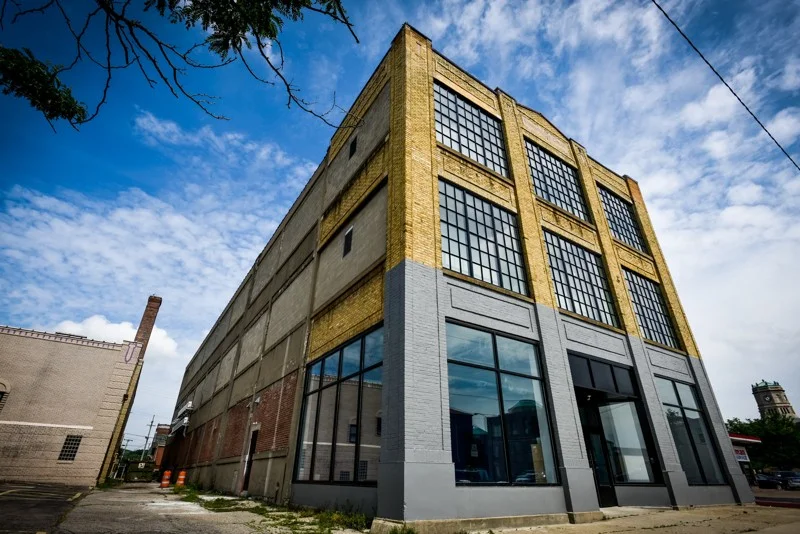
80 Acres Farms is now producing tomatoes in downtown Hamilton. They purchased the former Miami Motor Car Co. building on S. 2nd Street in February 2017 and have renovated it to create an indoor farm facility.
June 16, 2019
Eric Schwartzberg, Staff Writer
HAMILTON, OH
80 Acres is working to transform not only the way food gets grown and delivered, but also Hamilton itself.
The vertical farming business is now reaping the benefits of two years of work it put into a formerly dilapidated historic building at 319 South 2nd Street in the city’s downtown.
While its automated facility on Enterprise Drive, which started operations earlier this year, intends to grow leafy vegetables, herbs and strawberries, the downtown Hamilton location targets the growth of vine crops, including tomatoes, cucumbers and peppers.
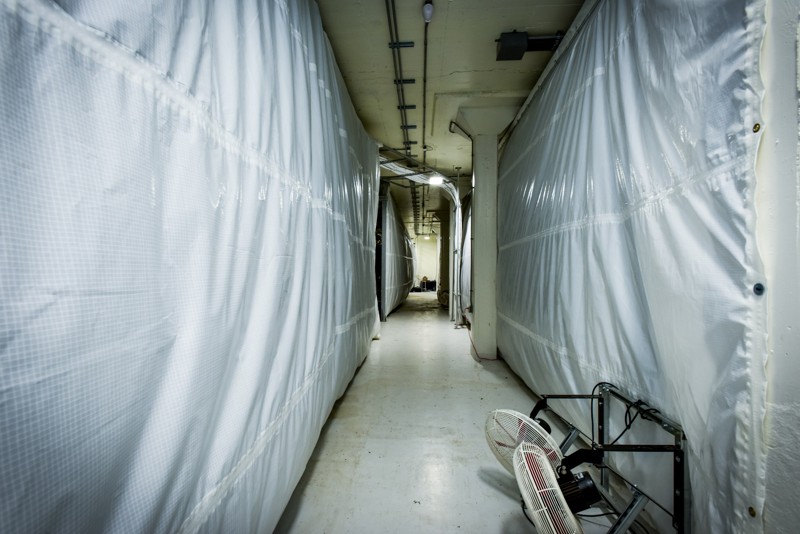
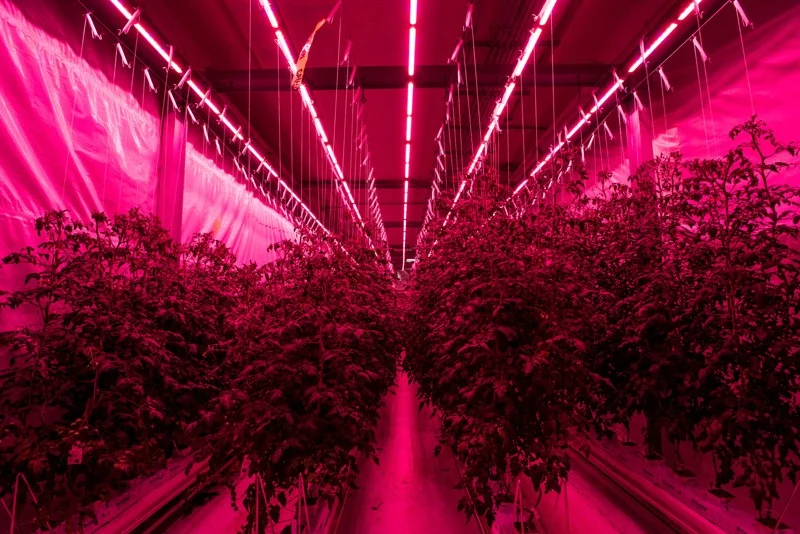
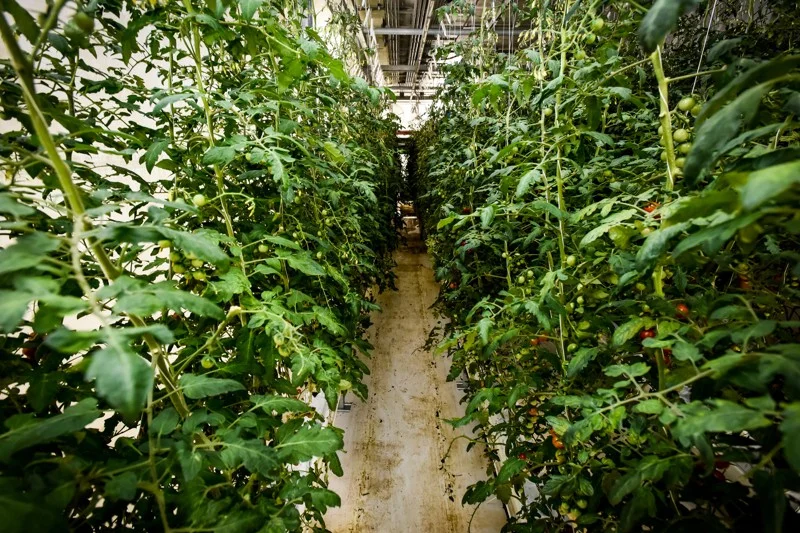
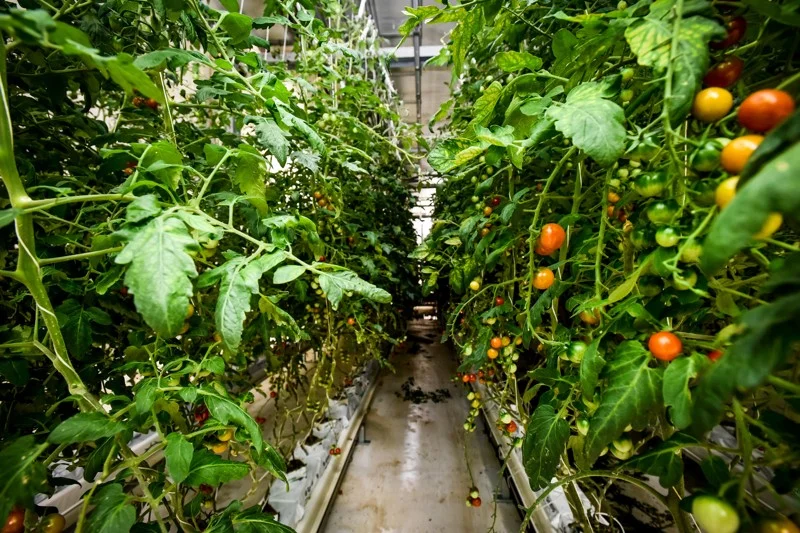
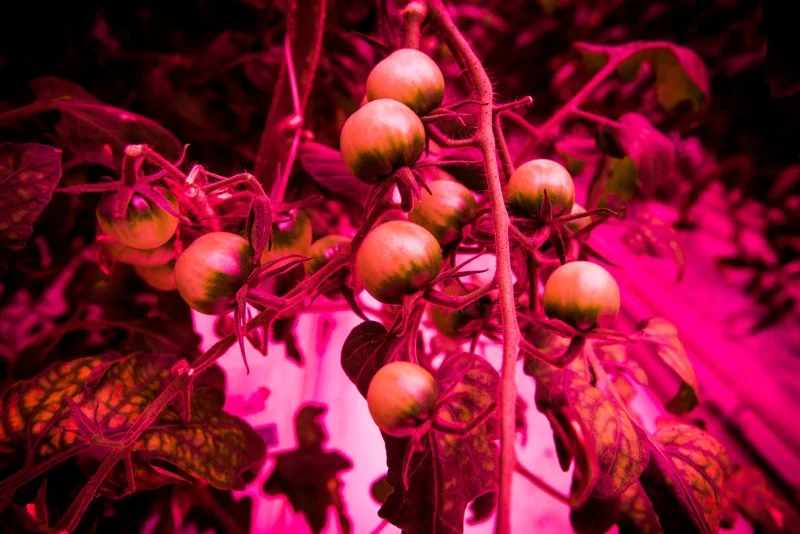
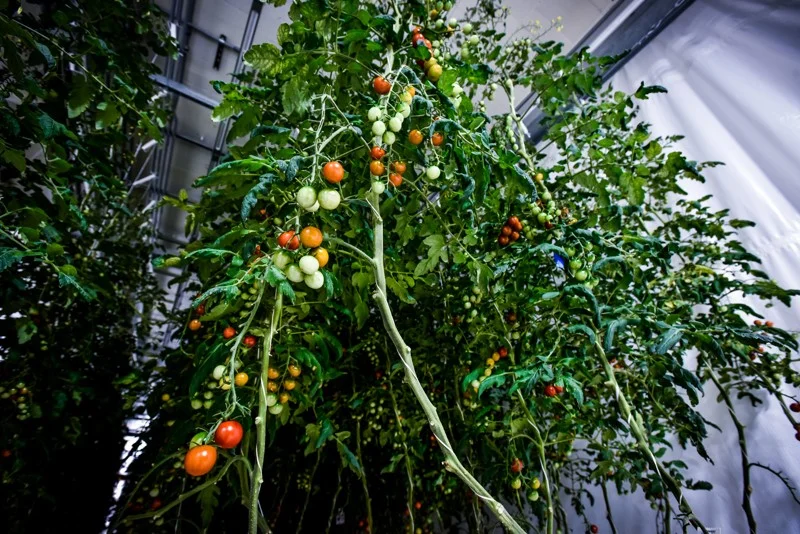
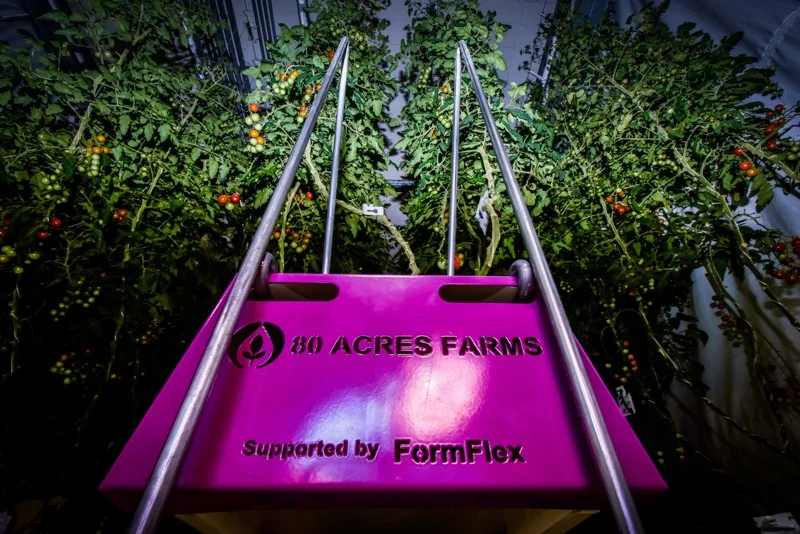
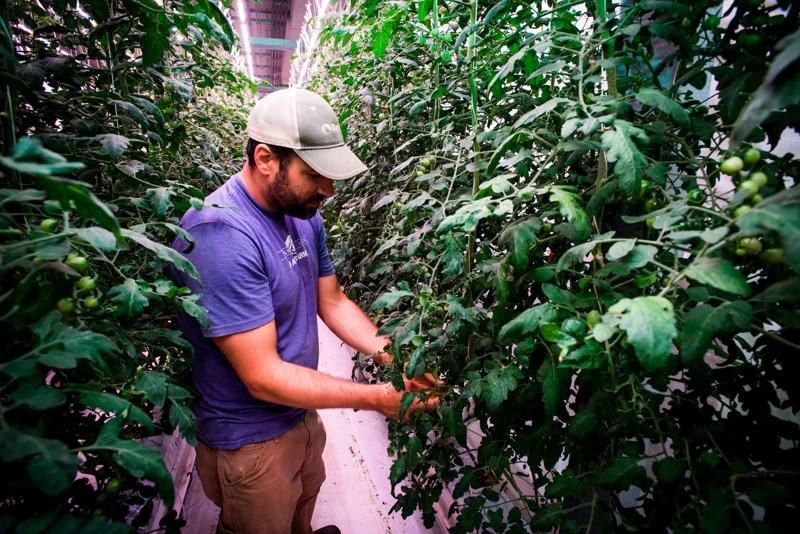
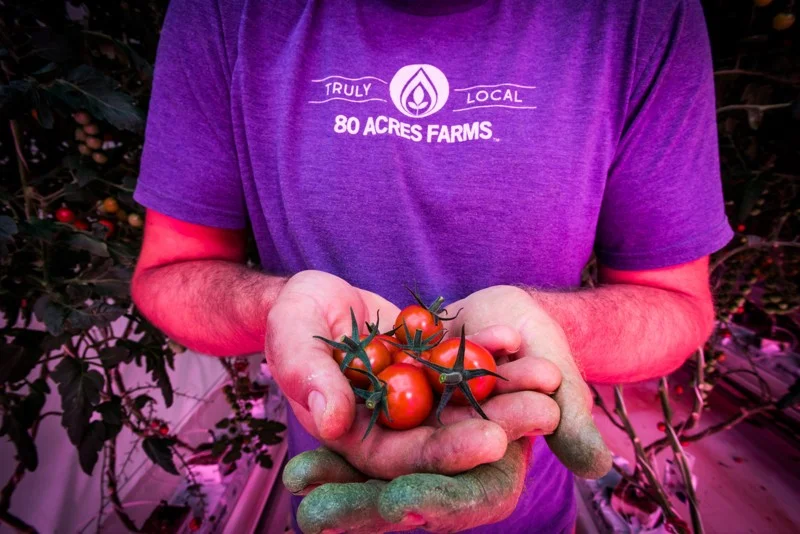
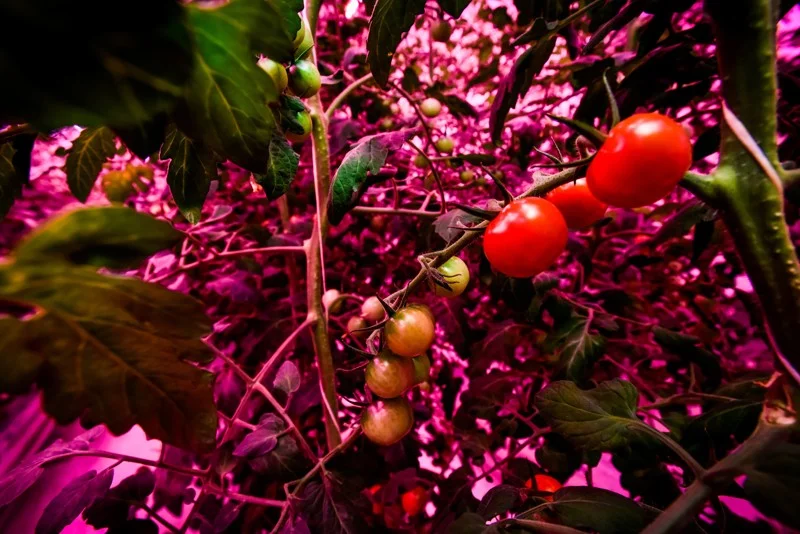
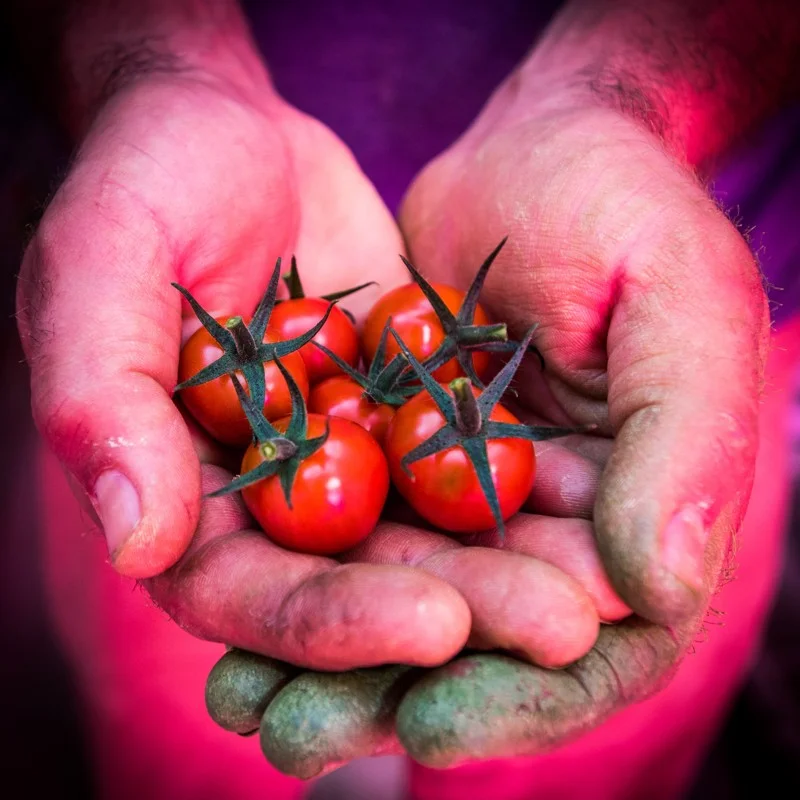

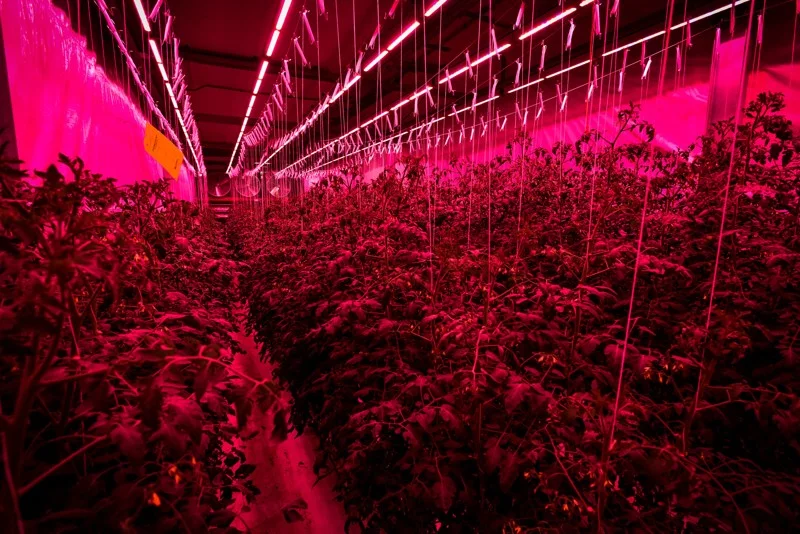
PHOTOS: Inside the huge Hamilton growing facility 80 Acres, the country’s first of its kind Nick Graham
80 Acres Farms harvested its first crop of tomatoes in recent weeks in a space designed to be far more productive that its 12,000-square-foot Cincinnati location, something that was proof of concept, but isn’t at the scale it needs to be to “make a dent” in demand, according to Rebecca Haders, 80 Acres Farms’ vice president of creative and marketing.
While the Cincinnati location has room for one “grow zone” for tomatoes, the downtown Hamilton location has room for 15 such areas. That, Haders said, means the ability to grow and harvest thousands of pounds of tomatoes each week.
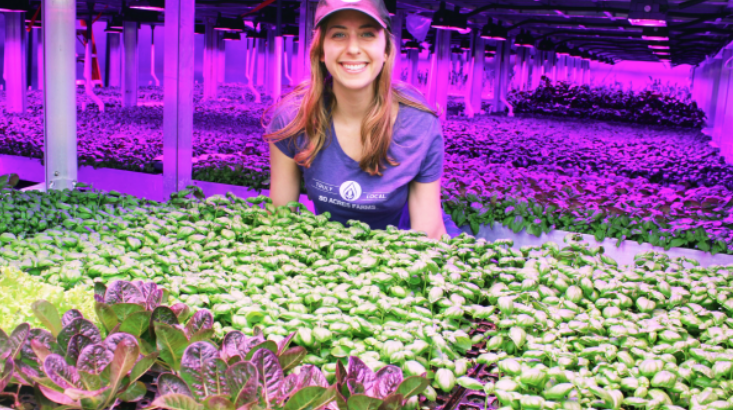
Head grower Robert Norris walks through rows of tomato plants at 80 Acres Farms that is now operating in downtown Hamilton. They purchased the former Miami Motor Car Co. building on S. 2nd Street in February 2017 and have renovated it to create an indoor farm facility. The special pink colored lighting is controlled by a timer for optimal growing conditions. NICK GRAHAM/STAFF
“This is really our foray into commercialization,” Haders said during an exclusive first-look tour around the facility provided to this news outlet. “We could service a larger retailer at this point.”
80 Acres Farms’ Cincinnati location sells to Jungle Jim’s International Market in Fairfield and Eastgate, Dorothy Lane Market’s three Dayton-area locations, Clifton Market in Cincinnati and Whole Foods Market locations in Cincinnati, Deerfield Twp. and Dayton. It also distributes to several restaurants, including Hamilton’s Coach House Tavern & Grille and Alexander’s Market & Deli, plus Loveland’s Tano Bistro, which is set to open a Hamilton location this summer.
With 80 Acres Farms now conducting the bulk of its operations in the city, a move of its headquarters there from the Cincinnati area is not far behind, Haders said. That relocation to Hamilton should occur by year’s end, she said.
“This is where the excitement is,” Haders said. “There’s been such a draw to come to Hamilton, and I think the leaders of the city have a great vision. They’re making it happen and creating a lot of excitement and getting the right people in to turn it around and we were excited to be a part of it.”
Haders said it also helps that 80 Acres Farms’ Hamilton employees enjoy working in Hamilton, where they can grab a coffee or lunch in its growing downtown.
“It’s such a great atmosphere and you can feel the energy,” she said.
80 Acres Farms is now producing tomatoes in downtown Hamilton. They purchased the former Miami Motor Car Co. building on S. 2nd Street in February 2017 and have renovated it to create an indoor farm facility.
Photo: Nick Graham
Transforming a historic building
Haders said when 80 Acres Farms co-founders Mike Zelkind and Tisha Livingston toured the building several years ago, “they fell in love with it,” leaving their respective corporate careers to start their brainchild.
Transforming the building, which was constructed in 1920 as the home of the Miami Motor Car Company, has taken two years.
“We wanted to really figure out what we needed from this building but it had a lot of work that needed to be done,” she said. “There were walls inside of walls inside of walls that we were tearing away.”
The building, which most recently served as a furniture store, also had to be sealed to make it a completely food-safe facility. Renovations also included deconstructing and cleaning the interior, redoing the plumbing and electrical and touching up much of its cosmetics.
80 Acres Farms also had the arduous task of having to clear three floors of furniture from the structure.
Tomatoes are being grown on the third floor, but not with the broad spectrum lighting contained in sunlight. Instead, there’s a red and blue lighting system that optimizes photosynthesis and allows the plants exactly what they need to produce the sugars that create phytochemicals and other beneficial plant compounds.
“That’s why you see that pink-purple light for indoor farming because you can grow under broad spectrum, but the plants don’t need all of those light spectrums,” she said.
The company continuously tests the water that is recycled through its irrigation system, relying on state-of-the-art sensors to identify what is or isn’t needed.
“We use a third-party lab to keep us on par on what’s in our water, so you know exactly the nutrient content,” she said. “There’s a lot of fluoride in Cincinnati water, so we have to take out that fluoride. Hamilton water is amazing.”
80 Acres Farms, which uses 97 percent less water than a traditional farm, also opted to locate the bulk of its operations in the city because of the hydroelectric power and the renewable energy it offers, Haders said.
“We always want to be a little bit more sustainable as we move forward,” she said.
While the second floor of the downtown location is expected to start growing vegetables in the near future, the first floor will be dedicated to packing, harvesting, cooling and germination.
A lighted letter sign will be placed in a prominent location on the north side of the building sometime later this year.
“It’ll look really great,” she said.
Head grower Robert Norris holds freshly plucked tomatoes at 80 Acres Farms that is now operating in downtown Hamilton. They purchased the former Miami Motor Car Co. building on S. 2nd Street in February 2017 and have renovated it to create an indoor farm facility. The special pink colored lighting is controlled by a timer for optimal growing conditions.
Photo: Nick Graham
A form of farming on the rise
Indoor farming, which includes hydroponics, aeroponics, aquaponics soil-based and hybrid, has gained significant popularity in recent years as its technology has become more defined. That, industry experts say, has allowed a large amount of fresh and green vegetable produced in city environments, with minimum space and less water utilization than typical techniques on conventional farms.
The global indoor farming technology market accounted for nearly $6.5 billion in 2017, according to a 2018 Zion Market Research report. That number is expected to reach nearly $15.3 billion globally by 2024, growing at an annual growth rate of around 13.2 percent through 2024.
Vertical farming is a form of controlled environment agriculture, or CEA, that consists of fully insulated indoor operations, producing crops of vegetables and other foods on multiple levels instead of on a single level, such as in a field or a greenhouse.
They rely solely using electrical lighting and are touted as a solution to many environmental issues in food production, partially because they are protected from the outside environment, and can be constructed in even the most extreme environments.
Chris Stout, the executive chef at Coach House Tavern & Grille, said using 80 Acres Farms products, which are harvested the day before they are served to customers, has made a tremendous difference for the Hamilton restaurant.
“The flavor of their products is just so much more intense than anything that I’ve gotten elsewhere,” Stout previously told this news outlet.
Thank you for reading the Journal-News and for supporting local journalism. Subscribers: log in for access to exclusive deals and newsletters.
Facts about 80 Acres Farms
• Agriculture start-up got its start nearly three years ago when food executives and co-founders Mike Zelkind and Tisha Livingston left their corporate careers to start their brainchild.
• its indoor, vertical farms use 97 percent less water, with no need for pesticides and no place for pests or GMOs
• produce grows three times faster, with yields 100 times larger, on a tenth of the land, 365 days a year
• 7512 Hamilton Enterprise Drive location in Hamilton is modular farm with state-of-the-art grow centers working to produce specialty greens, including leafy greens, culinary herbs and kale, plus strawberries.
• 319 S. Second St. location in downtown Hamilton aims to produce tomatoes, cucumbers and peppers.
SOURCE: 80 Acres Farms
Vertical Farm Planned For Warehouse In Northeast Wilmington This Fall
Alex Vuocolo June 18, 2019
Second Chances Farm, LLC has entered into a Letter of Intent to purchase a 50,000-square-foot warehouse at 3030 Bowers St. in Northeast Wilmington and plans to open its first vertical farm by this fall if everything falls into place.
Vertical farming is an industry that can work to supplement traditional agriculture by using a controlled environment to grow food locally while saving space and water, and reducing the carbon footprint of transporting food long distance.
The goal is to help state or federal inmates from Delaware obtain jobs – and futures as entrepreneurs – after they’re released, and to reduce the high rates of recidivism in a city where, on average, about 100 men and women are released from Delaware prisons every month to three Wilmington ZIP codes (19801, 19802, and 19805),” founder Ajit George told the Delaware Business Times in February.
George plans to raise $2.5 million to fund the purchase of the former Opportunity Center building that borders the Riverside neighborhood and set up the first 10,000-square-foot farm. The Opportunity Center, owned by ServiceSource Delaware, provided workshops for disabled people at the location before relocating earlier this year to New Castle
The first step is asking the Wilmington City Council to amend the zoning code to allow for “Indoor Commercial Horticultural Operations.” George says he is on an accelerated timetable and hopes to have approval by the end of July. The City Planning Commission is holding a public hearing tonight to get public comment and City Council will meet on the topic on Thursday and schedule an additional public hearing before voting on the measure.
But there are other hurdles to clear before George can open the doors.
Finalize the crop mix with the help of Jackson, WY-based Vertical Harvest Co-Founder Penny McBride.
Sign a definitive agreement with the property owner that will give George right of entry before the Oct. 31 closing date so that he can set up a prototype farm to show “investors, the media, and government officials” how they work and let them taste some lettuce grown in LED-lit hydroponic towers that do not require soil, pesticides, or even natural sunlight.”
Set up the $2.5 million Opportunity Fund, which allows investors in opportunity zones to defer capital gains.
Work with the Kingswood Community Center at 2300 Bowers St. and other community groups to hire 10-15 workers from the local neighborhood, depending on the mix of crops.
Close on the building purchase by Oct. 31 (“earlier if we raise the capital sooner,” says George) and set up the farm over the next 30 days, with an eye on distributing the first set of crops by Christmas 2019.
“The interesting thing about indoor farming in general is that it has many different business models,” said McBride, who is also the vice-chair of the international FarmTech Society. “It has
the capacity to not only feed people but train different workforce sectors. I’ve seen it work with immigrants and people with disabilities, but this is the first ex-offender population application for this sector.”
Opportunity Zones are census tracts designated by the governor and approved by the federal government for the purpose of economic development and investment in low-income areas. They were created as part of the Tax Cuts and Jobs Act of 2017. Delaware has 25 such opportunity zones, including six in Wilmington.
Approval of Resolution 8-19 would expand the definition of acceptable uses and “facilitate not only plant cultivation but related practices such as harvesting, transportation, packaging, distribution and marketing. These urban farming practices result in the creation of jobs and development of the workforce; increased local food production and supply; the creation of new markets for agricultural producers, consumers, and businesses; the revitalization of abandoned or underused properties and buildings; and community engagement,” according to the planning-meeting agenda.
“With the onset of innovative indoor horticultural production practices in nontraditional urban settings, such as indoor vertical farming and hydroponic farming, Wilmington’s Zoning Code is proposed to be updated to encourage and promote these practices within the City,” the proposal says.
“The mission of Second Chances Farms aligns with what we’re trying to accomplish here,” said Logan Herring, CEO of REACH Riverside, a community development corporation focused on revitalizing the neighborhood. He is also the CEO of Kingswood Community Center and The Warehouse, a “one-stop teen center” that will open next January on the site of the former Prestige Academy charter school. “ I anticipate working closely with them to make sure our residents are both employable and employed.
Ajit George, FarmTech Society, LLC, Logan Herring, REACH Riverside, Second Chances Farm

Intelligent Growth Solutions Attracts £5.4 million Series A Funding to Achieve Global Growth in Vertical Farming
Scottish agri-tech business to
deliver ground-breaking technology to burgeoning
indoor farming sector
Invergowrie, Scotland – 18 June 2019 - Intelligent Growth Solutions Ltd (IGS), the Scottish-based vertical farm technology business, announced today a £5.4 million Series A funding round led by US-based S2G Ventures, the world’s leading agri-foodtech investor.
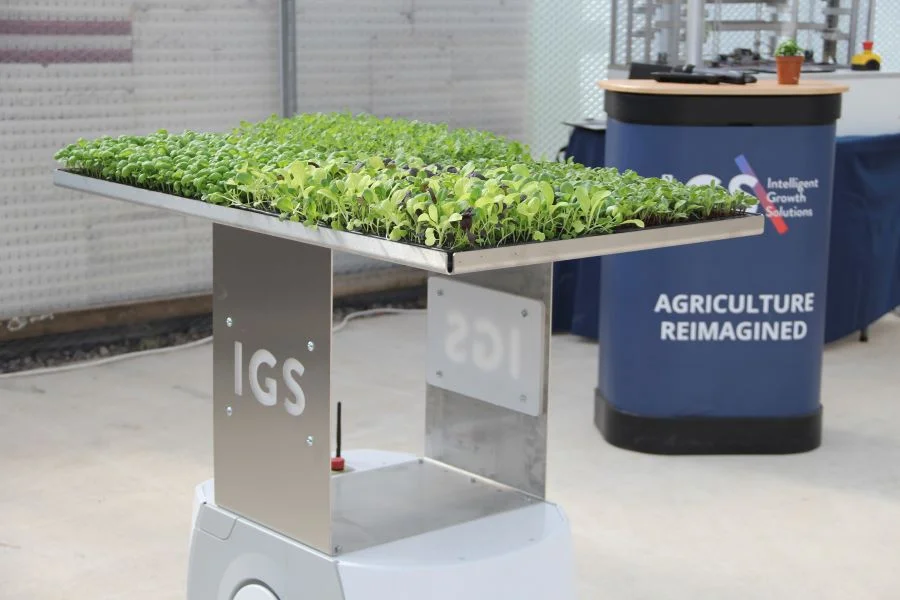
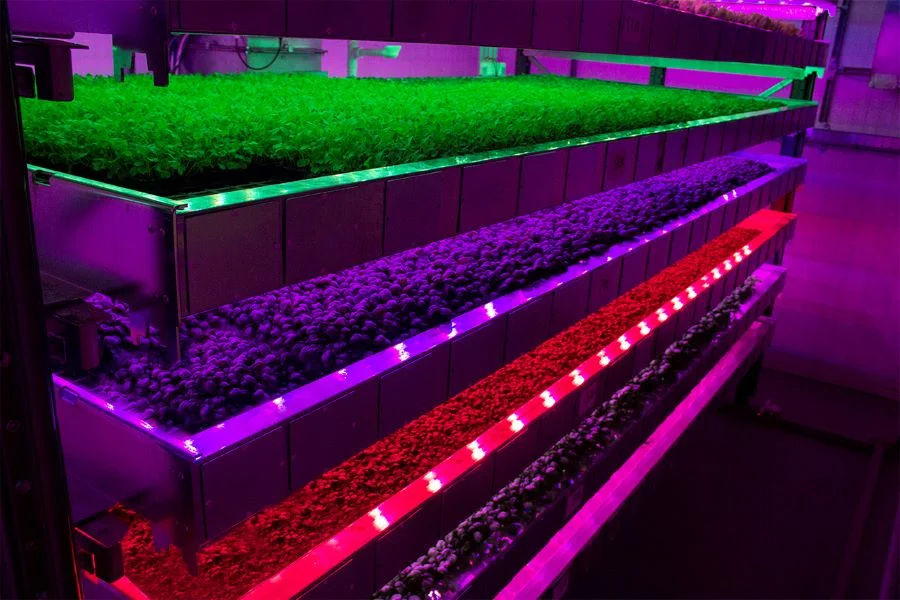
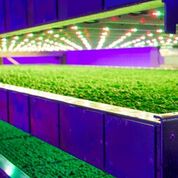
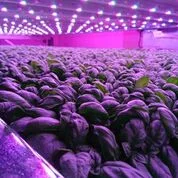



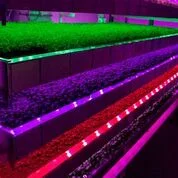

IGS supplies highly sophisticated plug-and-play vertical farming technology to indoor farms to enable the efficient production of food in any location around the world.
To demonstrate the unique technology stack it has developed, IGS opened its first vertical farming demonstration facility in August 2018. Since that announcement the company has received significant interest from around the world with orders mounting for its ground-breaking, patented technologies.
IGS’ unique technology has been designed specifically to address some of vertical farming’s biggest challenges, including the cost of power and labour, as well as the inability to produce consistently high-quality produce at scale. These economic and operational barriers to growth have inhibited the sector’s expansion to date. IGS has designed all its products to be highly pragmatic, flexible, modular and scalable in-line with market requirements.
The £5.4 million investment will allow IGS to create jobs in areas such as software development, engineering, robotics and automation. It will also help IGS to increase its product development, including continued innovation in AI, big data and the Internet of Things. IGS will also be building global marketing, sales and customer support teams in three continents.
This growth is pivotal for IGS to meet significant demand from growers, retailers and governments aiming to address food security issues through alternative methods of production and new business models in their regions. In 2019, IGS will be deploying indoor farming systems for clients in every major territory globally.
With global market growth in vertical farming predicted at 24 percent per annum over the next three years, the opportunities for IGS are substantial, with over 95 percent of its sales expected to be exported either directly or through regional channel partners.
The Series A funding round was led by S2G (Chicago), the most active agri-foodtech investor globally in 2018, with online venture capital firm AgFunder (San Francisco), the second most active and Scottish Investment Bank (SIB).
“Indoor agriculture production is at a tipping point. Grocery and food service firms have never been more interested in adopting this in their future supply chain. Cost and quality of product will be critical to scale this adoption. IGS’s revolutionary technology has proven itself to reduce power consumption, improve ventilation and hence reduce the capital and human costs to deliver fresh and differentiated products to consumers,” commented Sanjeev Krishnan, Managing Director of S2G Ventures. “We are excited IGS will help enable this emerging movement”.
“We see IGS as the perfect foray for AgFunder into the indoor agriculture arena,” said Michael Dean, founding partner at AgFunder. “As a developer of highly sophisticated energy and control system technologies for third-party indoor farms, IGS satisfies our bias for investing in enabling technologies rather than technology-enabled production with the inherent risks associated with building and operating a large asset.”
Kerry Sharp, Director of the Scottish Investment Bank, said: “We are delighted to support the continued development of IGS as it looks to take its technology to the global marketplace. The company has been account managed by Scottish Enterprise since 2014 and has received both financial and non-financial assistance covering innovation and R&D as well as supply chain management and international market entry. The company has made significant progress over the last 12 months and has assembled an impressive team with a clear focus on taking the IGS offering to an international market.”
IGS Chief Executive Officer David Farquhar said “We are thrilled to have the backing of the world’s leading agri-tech investors and the Scottish Investment Bank. We have recruited a world-class international management team, to be announced soon, to drive our plan forward with support from a board of senior international business people bringing industry expertise and best practice governance to the table.
“This industry is just at the starting line and we look forward to working with our customers, partners and colleagues at the James Hutton Institute to enable the highest quality produce to be grown at economically viable prices and help feed the burgeoning global population.”
The Scottish-led R&D team at IGS has developed, patented and productised a breakthrough, IoT-enabled power and communications platform consisting of patented electrical, electronic and mechanical technologies. All this is managed by a SaaS and data platform using AI to deliver economic and operational benefits to indoor growing environments across the globe. This technical solution enables the potential for reduction of energy usage by up to 50 per cent and labour costs by up to 80 per cent when compared with other indoor growing environments. It also can produce yields of 225 per cent compared to growing under glass.
Thorntons’ corporate and commercial team (led by Alistair Lang and with support from Victoria McLaren and wider team) acted for IGS throughout the Series A funding process.
A Shepherd and Wedderburn corporate team (led by Stephen Trombala with support from Christina Sinclair and Cath Macrae) acted for Chicago-based S2G Ventures - the lead investor in the first closing of the series A financing of Intelligent Growth Solutions Limited.
About IGS:
IGS was formed in 2013. Its purpose was to bring indoor horticulture to commercial reality by combining efficient internet-enabled smart lighting with automation and power management. The founders’ experience combined extensive knowledge of horticulture, industrial automation and big data.
IGS launched its first vertical demonstration facility in August 2018 and is now selling a revolutionary controlled-environment growth system. The location of IGS’ facility at the James Hutton Institute, a world leading crop research facility, was deliberately chosen to enhance collaboration opportunities for the benefit of customers. Scientists and researchers at the Institute are working with the team at IGS to better understand how growing indoors can impact different varieties of crop growth, as well as driving increased productivity.
For more information visit www.intelligentgrowthsolutions.com or connect with us on Twitter and LinkedIn.
About S2G Ventures:
S2G Ventures (Seed to Growth) is a multi-stage venture fund investing in food and agriculture. The fund’s mission is to catalyze innovation to meet consumer demands for healthy and sustainable food. S2G has identified sectors across the food system that are ripe for change, and is building a multi-stage portfolio including seed, venture and growth stage investments. Core areas of interest for S2G are agriculture, ingredients, infrastructure and logistics, IT and hardware, food safety and technology, retail and restaurants, and consumer brands. For more information about S2G, visit www.s2gventures.com or connect with us on Twitter and LinkedIn.
About AgFunder
AgFunder is an online Venture Capital Platform investing in the bold and exceptional entrepreneurs transforming our food and agriculture system. Our in-house technology enables us to invest globally and at scale, make better investment decisions, and support our portfolio companies. Through media and research, AgFunder has built a community of over 60,000 members and subscribers, giving us the largest and most powerful network in the industry.
Stay up-to-date with Food Tech and AgTech startup news, and other reports, by signing up to our newsletter here.
About Scottish Investment Bank:
The Scottish Investment Bank (SIB) is the investment arm of Scotland’s national economic development agency, Scottish Enterprise, operating Scotland-wide in partnership with Highlands and Islands Enterprise (HIE). SIB’s activities support Scotland’s SME funding market to ensure businesses with growth and export potential have adequate access to growth capital and loan funding.
SIB manages a suite of co-investment funds including the Scottish Co-investment Fund, the Scottish Venture Fund and the Energy Investment Fund on behalf of the Scottish Government. SIB is also an investor in Epidarex Capital’s Life Sciences Fund and is a participant in the Scottish-European Growth Co-Investment Programme with funding secured from the Scottish Government’s Scottish Growth Scheme alongside the European Investment Fund.
SIB also provides funding into LendingCrowd, Scotland’s marketplace lender providing loans to SMEs, and Maven's UK Regional Buy Out Fund (MBO) that offers financial support for management buyouts (MBOs) and helps existing management teams acquire their businesses from their owners so they can continue to flourish. SIB’s team of financial readiness specialists help companies to prepare for new investment and access appropriate finance.

Farming In The City
Liyana Hasnan
13 June 2019
This file photo shows an employee of urban farming start-up Aeromate checks on vegetables and aromatic herbs growing on the rooftop of a building owned by French public transport group RATP as part of a rooftop farming project in Paris on 24 August, 2017. (Benjamin Cremel / AFP Photo)
Urban farming could help provide a boost to the region’s food security and safety issues.The traditional farming system, though productive, has serious downsides which include food wastage, polluted ecosystems and significant greenhouse gas (GHG) emissions.
According to the United Nation’s (UN) Food and Agriculture Organization (FAO) and NASA, an additional 109 million hectares of new land will be needed to feed the world’s population by 2050. Presently, over 80 percent of arable lands suitable for crops are already in use. The total land used for agriculture in ASEAN currently stands at 30 percent, or 132,953 million hectares.
The current quality of land used for agriculture is being threatened by degradation due to over exploitation, pollution and the shortage of available water. Feeding an estimated 10 billion people in 2050 without further destroying the environment is a tall order indeed.
A tall order
Rapid urbanisation is causing an increase in urban poverty and urban food insecurity. Bringing food production into cities could be a responsible solution towards maintaining a sustainable system.
Urban farms focus more on providing city dwellers with food security and economic diversification. Governments could encourage the use of underutilised land for constructing small farm gardens for communities in the immediate area while increasing environmental awareness among them.
Another non-traditional farming method which takes advantage of urban spaces, especially tall buildings, is vertical farming. Usually found on rooftops or in abandoned buildings, vertical farming has a highly controlled environment with temperature, humidity, light and water levels being closely monitored at all times. It significantly reduces the need for toxic and costly pesticides.

Source: Various
According to the Association for Vertical Farming, by utilising aeroponics or aquaponics, a vertical farming system requires 70-95 percent less fresh water than traditional farming. It also uses less space when the rooftops of offices or supermarkets are utilised.
Traditional farming runs the risk of unpredictable weather which accounts for 50 percent of failed crops during harvest. Vertical farms on the other hand can have a yield of at least 90 percent every harvest. Experts estimate that a 30-story farm could feed 50,000 people for an entire year.
Traditional agriculture accounts for 15 percent of global GHG emissions from machinery and transportation. Because vertical farms are based in urban centres, the distance required for travel is far shorter.
A resilient, local economy can survive catastrophes that would otherwise doom a supply chain-independent system. Dickson D. Despommier, professor of Public Health in Environmental Health Science at Columbia University and author of the book, ‘The Vertical Farm: Feeding the World in the 21st Century.’ says that “the world would be a much better place if we had vertical farming.”
Sky high
Singapore is currently the front runner for vertical farming. Companies like Sky Greens and Comcrops are showing the ASEAN region the effectiveness of the system which has increased the island nation’s food production. There were more than 30 vertical farms in Singapore in 2018.
Singapore produces only 10 percent of its food, importing the rest due to the unavailability of land. With current issues of climate change, a growing population and pressing food security issues, Singapore does not want to depend on imports to feed its 5.6 million people. The government there has called for farmers to answer the call to “grow more with less,” with the hope of raising food production to 30 percent by 2030.
Sky Greens claims to be the first economically viable vertical farm in the world. Jack Ng, entrepreneur for Sky Greens says his products range from Chinese cabbages, bak choi, kai lan, and lettuce, to other leafy green vegetables. The company also guarantees freshness as produce hits the shelves a mere three hours after harvesting.
Although Sky Greens’ vegetables cost slightly more than those from traditional farms, the proximity to consumers reduces transportation costs as well as cuts down on storage and spoiling during transport. Sky Greens was able to get a positive return on investment after just five years in operation.
Comcrop’s Allan Lim believes high-tech urban farms are the way forward for cities. The company builds its farms on shopping mall roofs along Singapore’s Orchard Road, and uses vertical racks and hydroponics to grow leafy greens and herbs.
Regional initiative
Urban farming in Southeast Asia is still limited and scattered. Though it is not without its following.
The Philippines has new laws under the Urban Agriculture Act of 2013 which mandates the Department of Agriculture to promote the use of urban agriculture and vertical farming. Aimed to ensure food security and rejuvenate the ecosystem, these laws also mandate that abandoned government lots and buildings owned by national or local governments should be considered for growing crops.
In Malaysia there are movements such as CityFarm Malaysia which is an organisation whose objective is to inspire city farmers with the ability to grow locally for sustainable food production. Currently, Bangkok is developing rooftop farms and mixed-use skyscrapers with open-air farms.
Despommier has said cost continues to be the major drawback as “it requires a heavy investment and creativity to invent the methods and to create a social buy-in.” Vertical urban farming should not be seen as just a current trend but as a viable alternative to food production. Nor should it be seen as a threat to traditional farming.
Can vertical farming solve the global food security problem? The UN’s FAO certainly thinks so, and wants the trend to prosper and become sustainably embedded within public policy.
Related articles:
Food security a key issue for ASEAN
Your plate of rice is hurting the climate
Tags Urban farming Vertical farming, Agriculture Food tech Sky Greens Singapore Technology

UK: Alvechurch Tech Firm Launches 'Vertical Farm' To Produce High-Quality Greens
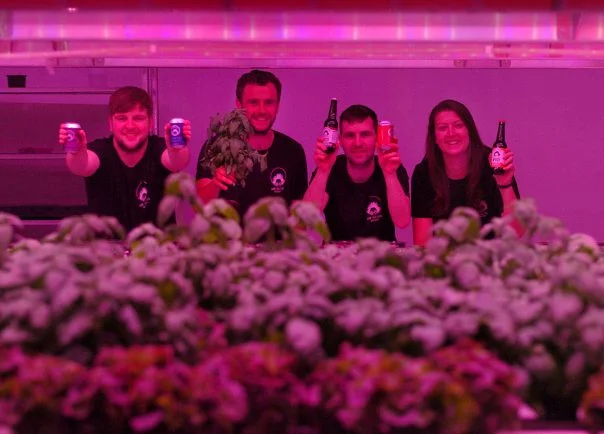
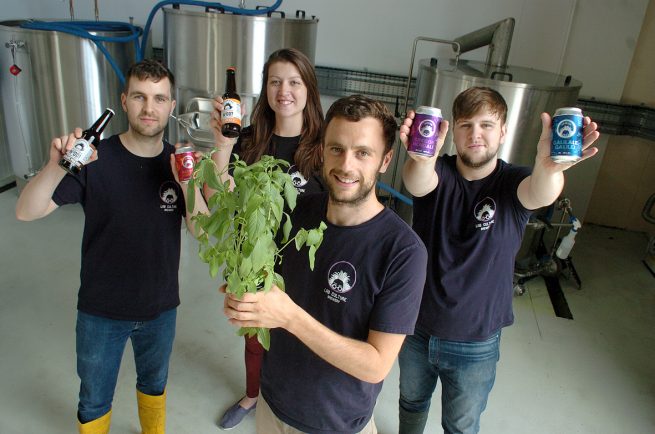
05-27-19
An Alvechurch tech firm has launched a new ‘vertical farm’ designed to produce high-quality, home-grown salads, herbs and greens.
Vertivore Farm, created by Astwood Group, and based at Moons Moat North Industrial Estate, is ideal for large or small-scale food producers who want to source the finest, local ingredients.
The farm itself consists of a climate-controlled chamber with a stream of LED lights to grow ‘beyond organic’ and nutritional produce, which is said to lead to ‘improved quality and taste’.
Michael Capwell, CEO of the Astwood Group and founder of Vertivore said: “Advances in technology have made foods available that were previously seasonal or regional, but with a devastating impact on the planet.
“In developing and launching the farm, we have successfully established an environmentally-friendly way of growing home-grown produce, without the use of damaging pesticides.”
Vertivore conserves natural resources, using 70% less water than soil-based farming and does so with fewer miles involved to travel from pallet to place.
“This could be vital as and when we feel the impact of Brexit,” said Michael.
With its pilot vertical farm successfully up and running, Astwood Group boasts ambitious plans for the Vertivore brand, with an aim to scale through the launch of new sites in strategic locations across the UK.
With produce grown and harvested 365 days a year, without the requirement for good weather, herbicides or pesticides, Vertivore has already received interest from a number of industry stakeholders.
For more information head to – www.vertivore.com
Photos:
1. Jack Gooch, Will Evans, Bert Roelants and Amber Capewell. Picture by Marcus Mingins 2119016MMR1 www.buyphotos247.com
2. Bert Roelants, Amber Capewell, Will Evans and Jack Gooch. Picture by Marcus Mingins 2119016MMR2 www.buyphotos247.com

Connecting Technology & Business To Create Healthier Urban Food Systems
Mission Statement
The Indoor AgTech Innovation Summit will focus on building and investing in more sustainable, profitable and healthy food systems and the role that vertical and indoor agriculture can have in serving the cities of tomorrow.
The Summit will share best practice from around the world and uncover breakthroughs in energy efficiency, AI, automation, lighting, environmental control and yield improvements are set to transform these systems in the future.
Bringing together a unique mix of operators, food producers, technology developers, plant scientists, food buyers, retailers, financiers, utility operators and city planners, the Summit will explore the innovation, business models and partnerships that are needed to scale this emerging industry.
Key Themes
Nutrition and Food Security in the City: The Role of Indoor Farming in the Future Food System
The Power of Restaurants & Retail in Creating Demand for Healthy, Fresh Produce
Streamlining Access to Capital and Partnerships for Growth
What Success is Asia Having in Taking Indoor Farming to an Industrial Scale?
Food Safety and Labelling: The Collective Benefits of Greater Standardization
From Pilot to Mainstream: A.I., Automation and Systems Design to Transform Horticulture
What will it take for Strawberries to be the Next Big Crop?
Capturing Market Value Through Better Breeding, Genetics and Lighting
Industrial Partnerships to Drive Efficiency and Economic Viability
https://indooragtechnyc.com/
Location
New York Marriott at the Brooklyn Bridge
333 Adams Street Brooklyn, New York 11201 USA
Registration
One Summit Pass: Indoor AgTech
Delegate Registration: $1695
Two Summit Pass: Indoor AgTech and Future Food-Tech
Delegate Registration: $2295
https://indooragtechnyc.com/register/
Focused on the role of vertical and indoor farming in local, regional and national food systems, and new opportunities for investment and collaboration - the summit will connect 300 international operators and food producers with technology entrepreneurs and food retailers, financiers and city planners.
We are delighted to share with you the full program for the Indoor AgTech Innovation Summit, taking place in New York on June 19-20.
Download now to discover who's speaking, session topics and how to join.
Focused on the role of vertical and indoor farming in local, regional and national food systems, and new opportunities for investment and collaboration - the summit will connect 300 international operators and food producers with technology entrepreneurs and food retailers, financiers and city planners.
Here's a snapshot of our exciting thought leaders:
Matt Roy, Senior Director, Produce, US FOODS
Sonia Lo, CEO, CROP ONE HOLDINGS
David Rosenberg, CEO & Co-Founder, AEROFARMS
Victor Verlage, Senior Director, Resilient Sourcing, WALMART
"The Indoor AgTech Innovation Summit was my one-stop-shop where business, science and technology converged in the most effective manner. The event was put together impressively well, enabling attendees to interact and build lasting relationships. It’s an A+ from me!"
CEO, ELO LIFE SYSTEMS
REGISTRATION IS NOW OPEN
We look forward to welcoming you to the summit this June.
With thanks to our Partners:
Who is Coming
Platinum Partner:
Gold Partners:
Silver Partners:
Marketing & Media Partners:
Co-located with:
Part of:
Hosted by:

"If You Wouldn’t Be Comfortable Drinking Your Processed Water, You Shouldn’t Be Comfortable Using It On Produce"
On May 22, the Canadian Food Inspection Agency added a Class 1 (high risk) recall for microgreens – due to listeria contamination – to its Food Recall Report.
"Food recalls are serious business", Jim Shubat with SanEco Tec says. "Producers face heavy financial consequences; consumers are exposed to potential health risks; consumers lose trust in products and companies; and litigation follows. It’s a devastating spiral."
Counting the costs
In 2018, there were 708 food recalls in the U.S. A survey by the Food Marketing Institute and the Grocery Manufacturers Association found that direct costs of a food recall can reach $100 million, with indirect costs growing exponentially in the event of health effects.
Along with direct costs comes, of course, the loss of trust. According to Harris Interactive’s survey, after a recall, 15% of consumers would never buy the product again and 21% would not buy any product by the same manufacturer.
"When the consequences are so grave you’d think the best way to keep money in the bank and consumers on your side is to avoid recalls", says Jim. Isn't that an oversimplification? "Perhaps", he states.
"Except that a major cause of food recalls relates to something as simple as water. Many recalls are due to microbiological contamination from water sources or through unsanitary handling along the supply chain."
'It stands to reason that by proactively taking care of your water – making it your first line of defense, you can reduce the risk of recalls."
Start with the source
Where is your water coming from? What could be influencing its quality?
"Farmers and growers especially have to be careful about the quality of their irrigation water. Source water, whether from a surface or well, can be contaminated by animal fecal matter or sewer overflows and run-offs, which greatly increases the risk of E. coli", says Jim.
"Checking your water a few times a year for E. coli isn’t enough to ensure that your water is safe. Frequent and repeated testing, or better yet, treating your water with a system that combines filtration and disinfection is the best way of preventing microbiological risk", says Jim.
Don’t leave it up to Lady Luck
In Ontario, it is required that “water used for washing and cooling of fresh, ready-to-eat fruit and vegetables must be of potable quality” as determined by the Ontario Drinking Water Quality Standards.
"If you wouldn’t be comfortable drinking your process water, then you shouldn’t be comfortable using it on produce", says Jim.
He explains how AVIVE systems, developed by SanEcoTec® Ltd, are engineered water solutions that combine disinfection, a multi-barrier approach and real-time water quality monitoring and process control for clean, safe and dependable water. AVIVE aims to provide water that is free of microbial contamination, like E. coli and listeria.
"Our Smart Water monitoring system, called SPI®, provides real-time monitoring and analysis, ensuring sanitizers are always at the optimal level", he continues. "This way you can keep eyes on your water with real-time water quality monitoring and process control."
Recently, SanEcoTec received a Letter of No Objection (LONO) from Health Canada for the use of its Clean5, Clean25 and Clean50 sanitizers in process water on fresh and minimally processed fruits and vegetables. The LONO is a standard form letter in response to a detailed scientific submission expressly stating that Health Canada sees no reason why the sanitizers should not be used. The line of sanitizers is also recommended by HACCPCanada.
Remember your process water
"Bacteria can enter produce through stem, leaf and root, and contaminated water can promote infection on the inside and the outside of fruit."
"Contamination can still happen along the supply chain due to poor hygiene standards among workers or cross contamination, but adopting sanitation measures for your irrigation and process water gives you a good head start."
For more information:
Joy Knowles
SanEcoTec
Joy.Knowles@SanEcoTec.com
T: +1.613.491.0525 x 2620
www.sanecotec.com
Publication date: 5/27/2019

We Are EXCITED To Introduce You To Our Newest Partner! Meet DANI!

A Non-Profit Organization that creates opportunities for adults with physical and/or cognitive challenges so that they can participate fully as valued members of the community and enjoy a meaningful and dignified quality of life! DANI offers vocational training and the partnership with Ripple Farms provides employment to adults with disabilities.
We Have Helped To Create Their Newest Opportunity! A Vertical Hydroponic Microgreen Farm! The Produce Is Now FOR SALE On 100km Foods!
Click the link to learn more about DANI! https://dani-toronto.com/
Our Micrgogreens Are Available Through 100Km Foods!!
Chefs, Restaurants, Caterers! You can now add Ripple Farms Microgreens to your 100KM Foods Order!
Pea Shoots, Radish, Fenugreek, and Kale are available!
Our Vertical Farming Bootcamp was a SUCCESS!
Thank you to all of our participants and supporters!
Interested in participating in future Bootcamps? Send an email to opasut@ripplefarms.ca to make sure you get Bootcamp updates!

GP Solutions Installs State-of-the-Art Growth Chamber at University of California, Riverside
Specially configured “GrowPod” will be used to expand knowledge into advanced agricultural methodologies
Corona, CA – May 14, 2019 – GP Solutions (OTC: GWPD), developer of GrowPod modular automated micro-farms, announced it has installed one of its state-of-the-art Growth Chambers at the University of California, Riverside. The growth chamber will be utilized for agricultural and horticultural research at the University.
Grow Pod Solutions developed the specialized system to meet the need for a large walk-in growing system that offers researchers a precision-controlled environment to conduct sophisticated research at laboratories and universities across the country.
Grow Pod Solutions offers one of the finest walk-in growth chambers available, and features a number of advanced technologies, including optimized photosynthesis, high level security, 24/7 remote control and video monitoring via a cloud-based platform, and precision environmental controls for temperature, humidity, and other vital factors.
The GrowPod system provides an optimum solution for research with a clean environment that is free of contaminants, pathogens, and pesticides.
The University of California, Riverside, College of Natural and Agricultural Sciences, is one of preeminent institutions of its kind in the world. Known for its cutting-edge research, the campus is at the forefront of ag-science and operates several prominent institutions, including The California Agriculture and Food Enterprise, The Citrus Research Center, The Center for Conversation Biology, and The Center for Integrative Biological Collections.
GP Solutions is proud to be a provider of technology and expertise to the University, and looks forward to becoming an integral partner in the ongoing development of advanced cultivation methodologies.
For more information, visit: www.growpodsolutions.com, or call (855) 247-8054.
ABOUT GP SOLUTIONS:
GP Solutions is at the forefront of clean agriculture. The company developed “GrowPods” – innovative indoor clean micro farms that provide optimum conditions for plant cultivation with total environmental control. GrowPods are modular and automated for ease of use and scalability.
Forward-Looking Statements
This release includes information considered “forward-looking” within securities laws. These statements represent Company’s current judgments, but are subject to uncertainties that could cause results to differ. Readers are cautioned to not place undue reliance on these statements, which reflect management’s opinions only as of the date of this release. Company is not obligated to revise statements in light of new information.
Connect:
Email: info@growpodsolutions.com
Website: www.growpodsolutions.com
Facebook: facebook.com/GrowPodTechnology
Twitter: @GrowPodSolution

How Cannabis Cultivation Has Advanced Farming Technologies
Those same technologies and practices are being brought to other agricultural products in a phenomenon called vertical farming
May 27, 2019
Canada’s newly legal cannabis industry might still be in its infancy but the legacy of illicit growers continues to contribute to greener agricultural practices across the globe.
The once covert operations—meant to keep cannabis cultivation under police radar—can be credited with creating innovative farming techniques that curb agricultural waste and save on natural resources like space and water.
See how cannabis has already helped in making the future a little greener.
Sustainable, environmentally-friendly farming practices may not have been the initial goal, but are among the unintended side effects of cannabis prohibition in this country.
Looking back to the 1970s when cannabis consumption was skyrocketing in Canada, supply simply could not keep up with demand and prices rose accordingly.
The problem was the supply chain. Most cannabis was brought into Canada by tourists, or people posing as them, returning from tropical nations like Jamaica, Mexico or the Bahamas. Law enforcement seized a big chunk of that illicit supply, causing numerous dry periods.
The solution to the problem was for cannabis enthusiasts to grow their own. That was easy for people living in California, but not so much for those in Nova Scotia.
Canadian cannabis consumers, however, persevered.
Growing indoors, they constantly improved their technology to include hydroponics, aeroponics, grow-lights and other devices to promote growth.
Sean Berrigan/Leafly
They selectively bred strains that were not just hardier, more bountiful, and increasingly potent, but used the same care that vintners take with fine wine to ensure traits they desired.
In just more than a generation, Canada went from having virtually no cannabis crop to becoming the No. 8 producer in the world, according to the UN, and a net exporter of what many consider among the world’s best varieties.
How Canada’s West Coast Became World Renowned for Cannabis Cultivation
And now, those same technologies and practices are being brought to other agricultural products in a phenomenon called vertical farming.
Essentially, the legacy concepts pioneered by cannabis growers have been adopted by people and companies growing other produce indoors with outstanding results. Although most of the biggest producers are in Japan, Taiwan and large American cities—where they can take up whole high-rises and warehouses—it’s quickly becoming big business in Canada too.
According to the Food and Agriculture Organization of the United Nations, as much as 20% of the world’s food supply is grown in urban situations. And Allied Market Research predicted in a White Paper that vertical farming will take in nearly six times as much revenue in 2023 as it did in 2016.
It makes perfect sense. More efficient land use, less water used, few if any pesticides, lower fertilizer use, year-round harvests, and availability where people live without refrigeration or trucking are all cost reducers and environment helpers. And because the process is cleaner than traditional farming, yields are huge and even taste can be improved.
Chemical-Free Cannabis: Canadian Growers Turn to Biological Pesticides
“When you do a side-by-side test of the flavour,” said Rob Wing, executive chef for the Eataly gourmet market chain, “the taste isn’t even comparable.”
Leafly spoke with Ricky (not his real name), a veteran Abbotsford grower who started with a single plant in 1985 and 20 years later, was cultivating dozens. “People talk about it like it’s a new idea,” he said. “But we’ve been doing it since forever.”
He explained that cannabis growing was forced inside as much by law enforcement as climate; but acknowledged that by being able to control the farm’s temperature, he could harvest year-round.
Growing Cannabis Indoors vs. Outdoors: 3 Key Differences
Of course, such covert indoor cultivation requires artificial light. “That’s when the cops started looking at everyone’s utility bills,” he told us. Residences that used an inordinate amount of electricity were flagged as potential grow-ops. So, growers like Ricky switched to more efficient LED lights, reducing their electricity use. Business began to boom, and Ricky made cannabis cultivation his full-time job.
To keep up with demand without moving to a bigger, more conspicuous location, he had to become more efficient—and that required serious technology. “I tried hydroponics, but didn’t like all the water usage,” he said. “So, I switched to aeroponics.” That not only increased his output, but allowed him to grow far more potent cannabis.
Sensing legalization over the horizon, Ricky sold his plants and equipment and went into real estate. “I might have made a mistake, though,” he said, after reading some articles about successful urban farmers and noting how similar they are to his old operation. “I just should have switched to tomatoes or something.”
Even now that cannabis cultivation has gone big-scale and corporate, the innovations aren’t stopping. Hamilton’s Green Relief has embarked on an entirely new way to grow cannabis. Called aquaponics, the cannabis plants are grown alongside tanks of tilapia. The fish produce waste that is processed into fertilizer and the plants filter and clean the water for the tilapia.
Introduction to Growing Cannabis With Aquaponics
“Hydroponic cultivators have to drain their tanks every couple of weeks and refill them, starting the process all over again,” said Allan Glanfield, Green Relief’s marketing director. “Ours is closed circuit, from plants to fish to plants again.” The yield, the company says, is ten times as high as traditional methods and requires 90% less water. He likens the process to how lily pads grow in a natural setting.
While Green Relief could turn the tilapia it raises into a revenue stream, Glanfield said that the company donates them to Second Harvest to help feed the needy in the Hamilton area.
Although Green Relief is the only large-scale aquaponics farm in North America, Glanfield said that he is aware of several others in the startup process, and not all for cannabis.
“We’ve worked out the kinks and have an effective system, so it’s no surprise to see others adopt it,” he said. “We don’t feel threatened by them, we just like being reminded that it’s a great idea.”
Green Relief founders Warren and Lyn Bravo are so dedicated to the cause that they are building a smaller version of their farm for their backyard to provide them with fresh vegetables and fish.
Farms are moving indoors not just because they are cleaner, more efficient, and offer better products, but also because of the profit incentive. And it’s not just cannabis.
In many vertical farms, according to a study conducted by Agrilyst, Cornell University, Urban Ag News, foodshed.io, the Association for Vertical Farming, and FarmersWeb, it was determined that similar profits can be made by growing flowers, greens, microgreens, and herbs. And you don’t have to go through an arduous, years-long process to get a license to grow flowers.
So, when your future self is enjoying a big fat salmon steak along with fine fruits and vegetables all grown a few blocks away and harvested fresh that day, raise a glass to the pioneering cannabis growers who made it all possible.
Jerry Langton is a political reporter and author who splits his time between Canada and NYC.
Lead photo: Green Relief

BREAKING NEWS: Indoor Farm Sprouts Up In Shanghai
Friday 14th June 2019, London
China-Based Horticulture Company Orisis Has Partnered With A New international Joint Venture to Build An Indoor Vertical Farm
Orisis has signed a contract with Infinite Acres – a joint venture involving three companies, Ocado, Priva Holding and 80 Acres Farms – to build what it says will be the first indoor vertical farm in the Shanghai region.
The farm is set to feature an internal, vertical design consisting of five layers with more than 1,600m2 of grow zone area. It will produce varieties of lettuce and leafy greens to supply food-service distributors, grocers, and consumers in the Shanghai area.
The farm will be located in Pinghu Zhejiang, a new agriculture economic development zone in China located about 100 kilometres southwest of Shanghai.
The Infinite Acres joint venture was announced earlier this week, and farm is the partnership’s first project.
Ocado, a UK-based online retailer, Priva Holding a Dutch horticulture technology company and US plant science firm 80 Acres Farm, each own one third equity in the venture.
Together the three companies aim to custom-design, build, install, and maintain automated indoor growing centres near large population centres.
"We are very pleased to be working with Infinite Acres on this project, which is part of a totally new and innovative horticulture development in the Shanghai region," said Yanwen Huang, chief executive officer of Orisis.
"Orisis is partnering with Infinite Acres to fulfil the rapidly growing requirement of chemical-free and high-quality crops in China. This project will demonstrate to China and the rest of the world the indoor food-growing possibilities in densely-populated urban locations."
Tisha Livingston, chief executive of Infinite Acres, said the company hoped this will be the first of many indoor vertical farms in China, which tackle the problem of a shortage of farmland.
"With its growing mega-cities and shortage of arable farmland, China like other nations, faces the challenges of providing healthy, fresh, just-picked produce to its people," Livingston said.
RELATED ARTICLE
US $100m funding boosts Infarm model

UK: Octopus Launches Two ‘Vertical Farming’ Tariffs
06/06/2019
Octopus Energy for Business has launched two new tariffs designed to grow the vertical farming industry.
Vertical farming is the practice of producing food and medicine in vertically stacked layers, vertically inclined surfaces and/or integrated in other structures.
According to Octopus the farming method can increase output x100 and reduce food mileage.
The company claims the Vertical Power tariffs “pave the way” for agritech businesses and control-environment farms to bring down energy costs and reduce their environmental impact.
The two new tariffs are:
Vertical Power Tri
This tariff avoids peak pricing between 4pm and 7pm. It delivers the “most efficient savings” when compared against adoption of technologies and changes to farming operations. It provides up to “8 per cent saving annually versus cheapest Economy 7 tariff”.
Vertical Power Agile
When combined with automation, this tariff allows a vertical farm to scale up or reduce energy usage depending on the cost of energy at half-hour granularity. Savings are dependent on site flexibility and crop type, but Octopus says models show this could unlock savings of up to 12 per cent.
Zoisa Walton, director of Octopus Energy for Business, said: “The global farming industry needs to innovate to support a growing population and a planet under threat.
“Octopus Energy for Business is determined to ensure that vertical farms are supported in the UK.
“The fact that energy costs account for up to 40 per cent of vertical farms’ overheads presented a problem – and we developed the Vertical Power tariff specifically to make the sector more efficient.
“Here’s to supporting budding vertical farmers and laying the foundation for a greener future in the UK.”
Meanwhile a National Drought Group (NDG) meeting convened on 4 June to review water resources ahead of summer, following a dry winter and spring which has affected river flows and groundwater levels.
Lower than average rainfall, continuing through April and May – particularly in the East of England – has seen some river flows decline to lower than normal for the time of year. In the south and east, rainfall has not replenished groundwater stores, with levels now declining. “While there is no threat to public water supply, these conditions are putting particular pressure on the environment and agriculture,” the group said.
Farmers in East Anglia, Lincolnshire and Northamptonshire have reported they are facing significant pressures with irrigation. Environment Agency monitoring has shown a decline in water available so there were discussions about how the water companies and the Environment Agency can help farmers during the growing season, particularly in the east of England.
Environment Agency chief executive, Sir James Bevan met with government departments, the Met Office, National Farmers Union (NFU) and water company CEOs to agree the action needed to support farmers and wildlife as well as conserve water supplies if the dry weather persists.
The NFU urged farmers to consider how they could be affected by running out of water and to make plans, where possible, to manage water shortages. The EA set out a number of steps it has taken to support farmers including:
Allowing farmers to flex abstraction licence conditions to take more water, wherever this can be done without damaging the environment, in order to safeguard food production and animal welfare. So far in 2019, the EA has approved 90 per cent of requests.
Extending the licence trading map from East Anglia to Lincolnshire, Northamptonshire, East Midlands and West Midlands, to help abstractors look for opportunities to access other abstractors’ unused water
Working with the NFU, CLA and AHDB to hold advice sessions for farmers since January 2019.
Sir James Bevan said: “Ahead of the summer months, the National Drought Group met to agree action to reduce the risk of drought measures and damage to the environment.
“Some rivers and groundwater supplies are below average so the Environment Agency is ready to respond to incidents over the summer and we are supporting farmers where possible by flexing water abstraction licences and with water trading. We welcome action the water companies are taking to ensure maintenance of supply over the coming months.”
Adam John Company strategy, Customers, Electricity retail, Energy retail, Gas retail, Strategy & management, Technology, News, Octopus Energy,Farmers, renewable energy