

Welcome to iGrow News, Your Source for the World of Indoor Vertical Farming

'Europe's Largest' Vertical Urban Farm Arises In Sweden
The Swedish initiative Grönska Stadsodling focuses on sustainable urban cultivation throughout the year using small surface areas. The crops are grown in a system with high/narrow cabinets that provide LED lighting and nutrients. The project began as a start-up by Petter Olsson, Robin Lee and Natalie de Brun Skantz. They are now opening their second growing location in Huddinge, near Stockholm. This will be one of the largest vertical urban farms in Europe.
Grönska grows and sells varieties of lettuce and cabbage. The new nursery farm in Huddinge has a capacity of 1.3 million plants per year. "We think that vertical cultivation is the future. At the moment, we import large amounts of food in Sweden and that's no longer desirable or feasible, considering the climate," says Natalie de Brun Skantz. Vertical cultivation requires less water and soil. Further, it allows farming in countries with a cold climate, throughout the year.
The company aims at expanding the number of products. For example, Grönska is already experimenting with strawberries, raspberries, peppers, cucumbers, tomatoes and edible flowers. In fiscal year 2017/18, which ended in April last year, Grönska had a turnover of 130,000 euros and an operating result of around 15,000 euros. By 2020, revenues are expected to reach 1.5 million euros. Grönska is a young company that has developed its own technology, instead of relying on external suppliers. This means that their operating costs remain relatively low.
In the future, Grönska wants to continue investing and expanding its activities to other cities in Sweden and even other countries. This could include the Netherlands, Japan and the US.
Source: www.breakit.se
Publication date : 2/5/2019

Franchise Farms: Champion or Disrupter of Grocery Stores?
Coauthor: Jonathan Hua
Over the past few years, we’ve seen e-commerce aggressively challenge brick and mortar stores across industries. Despite this market trend, the food and grocery industries still heavily rely on in-store experiences, led by big box chains such as Walmart, Target and Costco. This is attributed to the high perishability of produce, two-thirds of which are grown in California which requires an extensive supply chain and energy intensive refrigeration sections to constantly account for losses. In the United States and Canada, around 40 percent of wasted food is thrown out by consumers according to United Nations Food and Agriculture Organization.
But is it too far-fetched to imagine a world where next-gen farming solutions could one day replace brick and mortar grocery stores? As it turns out, with rising obesity rates, dwindling natural resources and a lackluster set of options for fresh produce, we may need to consider the efficacy of indoor agriculture solutions to help feed the world’s population sooner rather than later.
To put this concept into perspective, it makes sense to take look closer at one of the causes of the food production problem. Across mid-America, “small-box” retailers such as Dollar General have moved into communities deemed too small to be profitable by large retailers such as Walmart. This is only possible by carrying a limited stock of prepared foods; in fact, Dollar General is now feeding more people than grocery chains like Whole Foods! Dollar General has now become one of the fastest growing franchises in the United States, but has consequently caused these rural communities to see an increase in obesity, as few options for fresh produce remain.
To exacerbate this problem further, seasonal climates simply do not offer the consistent growing seasons needed to grow vegetables throughout the year due to long winters with harsh conditions. This situation may sound bleak, but we may already be well on our way to a viable long-term solution: indoor agriculture. This is a topic that hasn’t drawn as much attention as buzzwords such as “blockchain” or “automation”. However, the case can be made that indoor agriculture is, indeed, the most viable solution to the food production climate because of an ability to provide Controlled Environment Agriculture in a dynamic climate. According to Maximum Yield, indoor agriculture is a method of growing crops or plants, usually on a large scale, entirely indoors. The primary challenge of indoor farming is that many of these facilities require skilled engineers on staff to maintain these complex operations, and plant scientists to ensure the biological needs of the plants are met. Although the massive vertical farms of the world are cautious to not share information about their margins, it can only be assumed they are around 4–5% at best.
Without the agricultural, reduced energy rates, it is unlikely any of these facilities would be profitable at all with the exception of specialty crops. Many US companies have access to state-level agricultural energy pricing which can be as low as $.015 per KWH. Residential americans pay almost 90% higher rates or $0.12 per KWH. They are directly competing with farm gate pricing in order to maintain positive cash flow in a complex supply chain that must account for the margins of growers, processing/packaging facilities, and ultimately the retailers. The digital revolution has provided transparency by immediately tracking outbreaks of foodborne illnesses to the source. This will result in more costly outdoor growing operations, which will be required to be equipped with sensors to monitor environmental conditions and alert the growers when pathogen outbreaks occur. The implementation of sensors and computer controlled apparatuses is tantamount to a controlled environment farming operation.
Therefore, decentralized, indoor agriculture is the most viable solution to bring fresh produce to the masses! Perhaps the best opportunity for vertical agriculture would be a vertically integrated supply chain, as shown by the headlines made by SweetGreen recently.
The Fourth Industrial Revolution is defined by the combination of mechanical systems from the first industrial revolution, powered by electricity from the Second Industrial Revolution, given a rudimentary nervous system of digital sensors in the Third Industrial Revolution, and now a consolidation of complex tasks into a cohesive automation platform that historically required a dedicated team of experts. This is particularly advantageous for indoor agriculture companies that can now eliminate the largest risk factor of any growing operations, which is the human input itself.
The primary value proposition of indoor farming operations is clean produce that does not carry pesticide residues. Despite the benefits of eating clean food, these chemicals are very effective at killing pests. Indoor farmers are required to follow a disciplined pest management protocol with near clean room sanitation standards to prevent a single pest from breaching the operations. Robotics can now eliminate the exposure of the clean plants to the outside world and, more importantly, eliminate the knowledge of operating an indoor farm if coupled with a computer vision system to diagnose nutrient deficiencies or pH imbalances in real-time. Agriculture is now being democratized into a franchise business model.
This is happening now with computer vision companies such as IUNU offering a complete growing platform to provide constant monitoring of plant needs without an extensive background of indoor agriculture required. These machine learning algorithms will only become more efficient as they gather more data to refine the operational output. Another company, 80 Acres, has now secured funding to build what it claims to be the first fully autonomous, indoor farm. The future of agriculture will certainly be less human, and more like kiosk business models. Perhaps there will even be kiosk growing systems that emulate the Redbox business models which can be stationed at these Dollar General store locations or Sweet Green restaurants. History often repeats itself.
Source: Heliponix
Many species of produce will no longer be shipped in its final stage of growth, but instead as a zip file for food or a compostable seed pod like a keurig k cup from an automated production facility that contains all essential macro and micro nutrients with growing media for consistent yields. Our dependence on refrigeration at brick and mortar grocery stores will be greatly reduced by consuming produce directly from the source of a personal farm. They may even have the ability to learn from a user’s feedback to optimize the growing conditions to meet the their taste expectations. Keeping the plants alive until the moment of consumption will maximize the nutritional content and taste for the user which can only be assumed to increase fruit and vegetable consumption for residents across mid-America who were deemed too remote or sparsely populated to keep a constant supply of fresh produce on demand.
Generation Z and Alpha Farmers
The invention of the lightbulb made the need for oil (in the form of kerosene for lanterns) obsolete, but quickly met a new demand for gasoline in automobiles. The internet made paper mail obsolete through email, but revived the need for mail logistical services through e-commerce marketplaces more than ever. For all we know, people may re-adopt the agrarian lifestyles of our ancestors through these automated farming appliances at a consumer level in the new gig economy.
To engage the CoAuthors

'It's A Blizzard Outside And We're Growing Lettuce': Busby Area Farmers Grow Vertical
A unique farm has opened near Busby growing leafy greens in fabricated shipping containers
Travis McEwan · CBC News · Feb 02, 2019
Greens are expected to grow at Swiss Leaf Farms out of 14 different shipping containers. (Trevor Wilson/CBC)
An indoor farm near Busby, Alta. is harvesting leafy greens in the middle of winter using a system called vertical farming and fabricated shipping containers.
David and Alyssa Pfaeffli of Swiss Leaf Farms have been growing lettuce, microgreens, and herbs in a 9,500-square-foot warehouse for the past couple of months. The system they are using will allow them to grow year-round.
The growing machines are developed by a company in Langley, B.C. and an irrigation system waters each tray as it rotates past a water spout. A single row of growing lights sit on the top of the container.
A heating and cooling system ensures the plants grow at the right temperatures.
CBC News Edmonton | A Busby, Alberta farmer uses a vertical farming system to grow leafy produce all year round.
Within the warehouse, there are 14 growing machines that grow different varieties of leafy greens. Each container holds 4,000 heads of lettuce, with each head of lettuce taking a month to grow. The microgreens are harvested every six days.
The farm just had their first harvest last week and have delivered greens to grocery stores in Westlock, Barrhead and Edmonton.
"We can provide the same produce that's fresher, tastes better, it's healthier and there's zero pesticides. It's better for the planet," said David Pfaeffli. "You're not driving a diesel rig all over North America to deliver lettuce."
Alyssa and David Pfaeffli of Swiss Leaf Farms started the vertical farm a few months ago. Their 14 shipping containers have the capacity to grow 4,000 heads of lettuce per container. (Trevor Wilson/CBC)
The couple say they're able to grow a lot within a small space, as a traditional garden will take up a lot more land. Within their building, they can also control the temperatures with a heating and cooling system.
"This system allows us to do that here now, whereas before in Alberta where would you be able to do that? It's a blizzard outside and we're growing lettuce." said Alyssa Pfaeffli.
The cost of vertical farming
Financing the vertical farm was the biggest challenge for the couple, said David Pfaeffi. Without large farming equipment, he didn't have a lot of collateral if things dried up.
"Agricultural lending outfits weren't too eager to lend a large sum of money on equipment like this because they'd have a hard time recouping their costs. It's not a combine," David said.
The Pfaeffli's are excited about their new farming venture, but at the moment they're trying to not get too ahead of themselves.
"We want to grow not only plants but we want to grow the business. We want to keep adding on phases of growing machines. I'd like to see 50 acres of growing containers eventually," David Pfaeffi said.
Their greens are sold in grocery stores like Freson Bros. in Stony Plain. The Swiss Leaf Farms product fills a void of locally-produced lettuce in the winter months.Their latest order sold within 24 hours.
"We try to have an Alberta item everywhere. As soon as we get something like this, there are [consumers] willing to pick it up and try it," said Dan Pazder, Freson Bros. produce director.
Busby is approximately 71 kilometres northwest of Edmonton.
With files from Trevor Wilson

Innovative Veg Growing Firm Secures £1 Million To Build The Farms Of The Future
January 11, 2019
An innovative Bristol firm which has developed a range of aeroponic technology for indoor farms has announced it has secured £1 million in funding to build world-leading indoor growing facilities.
LettUs Grow was awarded a grant of £399,650 by the UK’s innovation agency, Innovate UK, to lead a £700,000 project – which will help increase food resilience and security in the face of climate change.
This is alongside a further €100,000 from the Green Challenge and several additional research grants.
As part of the project, LettUs Grow will work alongside ECH Engineering, industry leaders in controlled environment technology, and urban agriculture experts from Grow Bristol.
The grants came hot on the heels of the disruptive startup’s most recent investment round, where they raised £460,000 from ClearlySo, Bethnal Green Ventures, the University of Bristol Enterprise Fund II, managed by Parkwalk Advisors, and angel investors.
This funding has allowed the company to scale operations and drive forward product development to access a rapidly growing global market for efficient and sustainable farming technology.
By 2050, it’s expected that humanity will need to increase food production by 70% to feed over nine billion people. Existing methods of agriculture will not be enough to feed this burgeoning global population.
Alongside this, most ‘fresh’ produce is imported out of season, often travelling hundreds of miles to reach consumers and resulting in colossal waste throughout the supply chain.
LettUs Grow has designed a patent-pending aeroponic system that has shown growth rate increases of over 70% compared to existing solutions for leafy greens, salads and herb production.
What Is Aeroponic Growing?
Aeroponics is a way of growing plants without soil, where the roots are watered using a fine mist. Not only does this allow greater oxygenation of the roots, delivering better flavour and faster growth, but it uses up to 95% less water than traditional agriculture.
Charlie Guy, co-founder and managing director said: “This injection of private and public funding into the company enables us to accelerate our innovative products to market and build one of the most technically advanced facilities for indoor growing in the world.
The global agri-tech industry is very exciting right now, all stemming from the necessity to improve the economic and environmental sustainability of food production.
“We are fielding enquiries from all around the world from food producers and farmers who want to experience the benefits of our technology across a growing range of crops.”
Matias Wibowo, investment manager at ClearlySo: “Innovation is critical to ensuring long-term food security and sustainability.
“Our investors see the value, both in terms of financial and environmental returns from tackling this systemic global problem. That’s why they got involved in LettUs Grow.
“LettUs Grow provides the technological innovation piece to the vertical smart farming movement that is currently trending rapidly in the urban context.”

What We Can Learn From The Opportunity Zone Comment Letters
Comment Letters Give A Sense of How Developers Are Thinking About Using The Opportunity Zones.
By Erika Morphy | January 14, 2019
In October 2018, the Treasury Department and the IRS released highly anticipated regulatory guidance related to the Opportunity Zone program. The guidance answered a lot of questions and its generally favorable approach for real estate jump-started interest in the program.
But as Treasury admitted in the release there were still issues to be resolved and it promised another guidance. In the meantime, comment letters have been pouring in that, the writers hope, will have some influence on the final shape of the regulations.
If nothing else, the comment letters provide a guide as to what developers and other participants are thinking about the Opportunity Zones and how they might be used.
CREModels did an analysis on some of the letters and concluded that, “We are starting to see development-friendly trends emerge in the comment letters.”
“There are repeated requests for clarifications surrounding substantial improvement and original use. We also see a lot of requests for extensions beyond the 30/31 month timelines and flexibility around the asset and gross income tests,” it wrote.
Here are some excerpts from comment letters that may shed light on the future shape of the Opportunity Zone program.
National Multifamily Housing Council National Apartment Association
NMHC/NAA request that the Treasury Department and the Internal Revenue Service clarify in a specific example in the final regulations that land itself need not be improved to meet the original use requirement so long as development occurs on the land . We also request that the Treasury Department and Internal Revenue specifically state that the land may have been acquired prior to 2018 and still qualify as Opportunity Zone property so long as development on that land occurs after 2018 consistent with Opportunity Zone rules.
To incentivize additional multifamily rehabilitation projects and address our nation’s workforce housing shortage, we once again respectfully request that the Treasury Department and Internal Revenue Service allow a waiver to the “double the basis” rule if property has been vacant for a period exceeding one year.
While beyond the scope of final regulations, the multifamily industry also urges the Trump Administration to support statutory modifications to reduce the basis increase necessary to qualify a multifamily rehabilitation project for Opportunity Zone purposes.
NMHC/NAA request that the Treasury Department and Internal Revenue Service use final regulations to clarify that debt-financed returns of capital that do not exceed a partner’s basis in an Opportunity Fund are not treated as a sale or exchange.
Individuals may wish to exit one Opportunity Fund to invest in another. We recommend that the Treasury Department and Internal Revenue Service allow such reinvestments without negative consequence to the five-, seven-, and 10-year basis adjustment thresholds so long as proceeds from exiting a Qualified Opportunity Fund are reinvested in another Qualifying Opportunity Fund within 180 days.
NMHC/NAA are concerned that the proposed regulations do not address the ability of an Opportunity Fund to: (1) dispose of a qualifying multifamily asset and acquire or construct another qualifying asset; and (2) own multiple multifamily assets within a single Opportunity Fund. We recommend that the Treasury Department and Internal Revenue Service address the first issue by providing Opportunity Funds the ability to reinvest capital from a sale without adverse Opportunity Fund tax consequence to either the Fund or its investors. This could be done by treating proceeds from a sale as working capital eligible for the 30-month working capital rule. We also request that the Treasury Department and Internal Revenue Service allow for multiple properties to be held within a single Opportunity Fund and that Opportunity Funds be allowed to divide into two funds in the case that a property is sold and the Fund does not reinvest the resulting capital in a qualifying Opportunity Fund asset. In such case, investors would still be able to realize Opportunity Fund tax benefits with regard to assets remaining in the original Opportunity Fund.
Stroock & Stroock & Lavan LLP
It would be very helpful for the IRS to provide guidance that addresses the following questions:
When will a QOZ business be treated as engaged in the active conduct of the QOZ business? For example, if a startup is just spending money on R&D, is that active enough for these purposes?
What constitutes a “substantial portion” of the intangible property of the business? We would suggest that 40% is a substantial portion, based on the use of that percentage for the new markets tax credit. See Treas. Reg. §1.45D-1(d).
Is cash used for advertising, research and development or other purposes eligible for the working capital exception? We would suggest that cash used for expenses to create or buy intangible property be eligible for the same 31-month safe harbor that is provided for cash that is used by a QOZ business to acquire or construct tangible property pursuant to a written schedule.
Under what circumstances should a business be treated as being conducted (and intangible assets be considered to be used) in the zone? For example, should this determination be made solely based on the location of employees and/or tangible assets of the business? We believe those factors should be determinative. Should the location in which property is sold or services are provided be relevant? We believe they should not be, at least if the employee or tangible asset tests are met. Based on the use of 40% for purposes of the new markets tax credit, we would suggest that a business would be considered conducted in qualified opportunity zones if at least 40% of the tangible assets of the business are in one or more QOZs or at least 40% of the employees of the business are employed in QOZs.
Center for American Progress
The zone selection process has resulted in the creation of Opportunity Zones in many tracts that are relatively well off or already gentrifying….In these tracts, the forfeited tax revenue will simply provide windfalls to those who already invested there before the program began rather than to community residents. In fact, certain developers have already cashed in due to their property being in a tract that was designated as a zone.
The Small Business Investor Alliance
SBIA recommends a broader definition of “qualified opportunity zone business property” to include intangible property because the active conduct of certain QOZ businesses will, no doubt, involve intangible product.
Please consider expanding the “substantially all” test (70 percent/total tangible property) to include investments in both tangible and intangible property provided the intangible property relates back to the tangible property of a QOZB.
Treasury regulations should expressly permit QOF investments in entities defined as small businesses under the Small Business Investment Act of 1958 as amended….
Erika Morphy
Erika Morphy has been writing about commercial real estate at GlobeSt.com for more than ten years, covering the capital markets, the Mid-Atlantic region and national topics. She's a nerd so favorite examples of the former include accounting standards, Basel III and what Congress is brewing.
National Multifamily Development Midwest Northeast Southeast Southwest West
CNBC Transcript: Benjamin Swan, Co-Founder And CEO, Sustenir Agriculture
January 10. 2019
Below is the transcript of an interview with Sustenir Agriculture’s Co-founder and CEO Benjamin Swan. The interview will play out in CNBC’s latest episode of Managing Asia on 11 January 2019, 6.30PM SG/HK (in APAC) and 11.00PM BST time (in EMEA). If you choose to use anything, please attribute to CNBC and Christine Tan.
Christine Tan: Okay Ben, so you were working for Marina Bay Sands, Citibank, and UOB, what made you leave corporate life and do something crazy like vertical farming?
Benjamin Swan: It all started with an article on Facebook. I was on my way home from work and I read an article by Dickson Despommier on the future of farming and vertical farming very specifically. I was looking at a lot of the illustrations and thought to myself, you know, this space that is being used in these illustrations just wouldn’t work for Asia given our land scarcity, especially here in Singapore and even in Hong Kong. So I went home that night and jumped on archiCAD and actually rendered up pretty much what you see up the back of the facility today. I was inspired by that and then started learning about indoor farming. I went on to Professor You and Dr. Google, which is YouTube and Google, and actually learnt what is traditional farming and applied a hypothesis on how growing could happen inside of a building using those renderings. I came up with an excel sheet and came up with a hypothesis and took it for a very long test drive. I used that excel sheet to effectively solve problems of indoor farming.
Christine Tan: Why this passion on farming? Did you think you could really make a difference?
Benjamin Swan: I felt that everything I have done in my life kind of boiled down to this point. My construction days, working as a banker, all my skills that I had learnt, I felt that this was my opportunity to do something that would make a difference, an opportunity to fight the good fight. And why farming? Farming right now we know is a problem. We are reliant on techniques that have been used for centuries and whilst we are trying to bring in automation, and improving the ways we’re using machinery and so forth, the thing that we can’t improve is land usage. So vertical farming can solve that problem. Growing our kale indoors, we’re 127 times more efficient than traditional farms per square foot.
Christine Tan: You have no background in agriculture. Did you not think of the risk you were taking when you started the business?
Benjamin Swan: Absolutely, it was a calculated risk. So I did all of this whilst working full time. So I’d finish calls from New York when I was working for Citibank in the early hours of the morning, and I’d go underneath my business partner’s pool to go and take measurements of plants so I could understand, you know, all the inputs and outputs of the plant, the diminishing returns on those imports so I could optimize growing. And to be completely frank for the first six months of exploring this space, it just didn’t work. The numbers weren’t making sense especially on the capex. I mean this is a very capex heavy industry. It wasn’t until about six or seven months after starting to trial different lights, different techniques. When the cost for LEDs started to come down, then it started to make sense. So obviously I started pushing a bit harder.
Christine Tan: So your first project was to try to grow kale, a crop notoriously difficult to grow in a place like Singapore and is usually imported from overseas. Why kale?
Benjamin Swan: So kale is a superfood. It actually has three times the nutritional value of, say, lettuce. The importance of growing a superfood meant that we could go out more on the branding aspects and talk about the value of quality over quantity. So our consumers can start to think about the environmental impact of the produce they’re buying in-store. We do have to focus on products and get us a high margin in order to break even on the cost. We’re paying real estate here, electricity, a lot of manpower. So, we need to make sure that we can grow products that will break even.
Christine Tan: To increase the yield in vertical farming is all about squeezing and more growing racks to maximize the confined space you’re actually growing in?
Benjamin Swan: Absolutely we need to maximize not only the real estate, but then also the electricity that is being consumed. We haven’t reinvented the wheel here with indoor farming or vertical farming. We’ve simply optimized it.
Christine Tan: So, in June you launched your own vertically grown strawberries, the first fruit is locally produced here in Singapore. How did you make such a breakthrough?
Benjamin Swan: Just by trying. Just by thinking big and we know the Singaporeans love strawberries. All Singaporeans wait for the seasons of Japan and Korea. Why can’t Singaporeans have local strawberries all year long? And with indoor vertical farming, we can make that happen.
Christine Tan: So how long did it take for you to get it right?
Benjamin Swan: It actually took about three and a half, to four months.
Christine Tan: Really?
Benjamin Swan: Absolutely. In 54 square metres we’re doing about 400 kilos right now. We’ve just introduced bees into space to help with the pollination. Right now all our guys...
Christine Tan: You’re introducing bees into the space?
Benjamin Swan: Into the space to help us with the pollination. Pollination, to date, has been done by hand with a forensic brush. It’s very laborious and you’ll never get it as perfect as a bee can. So we’re expecting the yield will increase a further 40 to 50 percent just by bringing the bees into the space.
Christine Tan: Where do you get your bees from?
Benjamin Swan: Locally. We’re working with the local bee partner and he brings his bees in and then we rotate them so they have a healthy lifestyle of outdoors and indoors. And look, this has never been done before. All we can do is try.
Christine Tan: So now, you’re growing lettuce, arugula, basil, two types of kale, strawberries. What’s next? What else do you want to grow?
Benjamin Swan: The sky’s the limit, not just metaphorically, but physically. We can do anything in this space. We’ve literally grown every single leafy green, edible flower. Anything is possible with indoor farming. Obviously some products aren’t feasible to grow indoors, those that have a very long life cycle, so we need to choose products that have a shorter life cycle.
Christine Tan: You’re not the only vertical farm in Singapore, and you’re clearly not the first mover. Are you worried about competition in this space?
Benjamin Swan: Absolutely not. Absolutely not. Everyone needs to eat and we need to find more and innovative ways to produce food.
Christine Tan: In terms of margins that you want, doesn’t that affect how much you can sell your produce to? Given all the competition coming online?
Benjamin Swan: We’re not even scratching the surface on the demands required just for Singapore. So there is plenty of room for even other operators to come into this space and bring good quality local produce to Singaporeans.
Christine Tan: So when you look at the entire business model of vertical farming, there are high set-up costs where a lot of money is ploughed into equipment, into technology. How long did it take for you to break even, to become profitable?
Benjamin Swan: We actually just broke even (in 2018). So it took about three years of full commercial operations to get there. For us, we started off very heavily focused B2B and obviously we had a lot of volume, a lot of exposure in the market about our brand and what our brand could deliver. The end-state for us is always to push directly to the end consumers because the value propositions of our product factors is 100% clean, it’s traceable, it’s local. That affects the end consumer more than it does the wholesalers.
Christine Tan: Can you talk about your margins? What are they like?
Benjamin Swan: The margins are very profitable here. Obviously we’ve just broken even but that’s at 70 percent of our capacity within the facility. We’ve made some changes in the produce that we’re growing right now. We were growing cherry tomatoes, for example, but with the strawberries now becoming our hero product, we want to expand on that. So we decommissioned one of the rooms, which was a tomato room, to grow the strawberries. So in that transition, there’s a little bit of down time. And we’ve still been able to break even. The point is here that the infrastructure we have is completely agile. As our consumer demands change, we can change with them.
Christine Tan: So what your margins like? What are you targeting for?
Benjamin Swan: What we targeting for? Circa 40-45 percent EBITDA figures.
Christine Tan: So it’s been five years, can you talk about your revenue figures? How did you manage to do this year?
Benjamin Swan: In 2018, we’ve had year-on-year growth of about 83% which is very huge for a brick-and- mortar business.
Christine Tan: How many tons of vegetables or fruits do you sell every year? Do you try to sell every year?
Benjamin Swan: We sell, right now, per month we sell about almost five tons of produce into market. That’s both business and retail. So we are 80 percent, 83 percent into retail and the rest of it is into our wholesale partners.
Christine Tan: So both you and your business partner Martin, invested something like S$3 million into the venture. You are now in the process of building another vertical farm, a bigger one, in Hong Kong. So is your next phase of growth all about replicating and scaling up your business model overseas?
Benjamin Swan: Exactly. The way that the infrastructure has been designed is that it can be retrofitted into any existing footprint. That, on the construction perspective, makes us very sustainable.
Christine Tan: So what are your expansion plans? Which cities do you want to be in?
Benjamin Swan: Well. We’ve got to be focused on Asia-Pacific for now. But I want to be in every major city across the globe.
Christine Tan: And you have plans to further expand in Singapore? Is this ten thousand square feet facility enough for you here in the city?
Benjamin Swan: Well, we’ve got another 50,000 square feet that will start in Q1 (2019). So, 50,000 square feet in Hong Kong, our existing 10,000 here in Singapore, with another 50,000 coming next month.
Christine Tan: How exactly will you fund all this expansion? I understand you just completed your Series A funding.
Benjamin Swan: We have. We’ve just raised S$22 million to expand into Hong Kong and a further expansion into Singapore.
Christine Tan: Where will this money go into?
Benjamin Swan: Just purely into the deployment of capex for the expansion, some operational costs in building, the core competencies, to build brand, and to manage the space.
Christine Tan: Has it been easy finding investors for your vertical farming business?
Benjamin Swan: Given it’s a sunrise industry, a lot of investors I guess were a little bit hesitant about investing in the space. They want more proven cases in order to invest. I think the industry right now is very fragmented. You’ve got a lot of vendors and suppliers supplying all different parts of technology, a lot of them are untested right now. So I think a lot of investors are waiting for more of a steady state before they will invest big. And that’s why we have a lot of investment in smaller companies or startups right now to push and innovate and this space.
Christine Tan: Did it take a lot longer for you to complete a Series A funding as a result?
Benjamin Swan: Yeah. In total it took about seven months, a lot of road shows, a lot of snappy no’s. But we did manage to find a few investors who were very forward thinking.
Christine Tan: When you say investors that are forward thinking, are they key cornerstone investors? Anyone we know about?
Benjamin Swan: There are a few, but given that we’re kind of closing up the back end of the Series A, I can’t disclose exactly who.
Christine Tan: Any sovereign wealth fund investors?
Benjamin Swan: Potentially yes.
Christine Tan: Ben, now, as an urban farmer, how big a challenge was it for you to find this 10,000 square feet facility to set up your vertical farming business? Did you explore other areas to find the optimal growing environment?
Benjamin Swan: What actually happened was, we went out and spoke with the AVA about taking a space inside a building. That was very new for them. So the biggest challenge that we had was finding ways to rewrite the policies that would enable us to grow inside of this building. It’s more so the paradigm from traditional farming to indoor farming. And the way we assess it, needs to be very different. So it’s about setting up different policies and guidelines around how indoor farms are assessed, and how licenses are issued.
Christine Tan: Why not explore a rooftop garden? Where you can actually save on energy costs?
Benjamin Swan: In the future we could, but rooftop has its limitations. Obviously it will reduce your electricity consumption for the likes of the LEDs, but you’re limited to only growing local produce. That’s why growing bok choy and gai lan on rooftops is ideal. That’s one of the reasons why we don’t choose bok choy or gai lan inside of our environment. Not only is it not sustainable for other local farmers, to flood the market with a lot of those produce, but if we can grow the impossible, shouldn’t we?
Christine Tan: In a land scarce place like Singapore, obviously vertical farming has received a lot of support when it comes to food security. But there are some who argue that vertical farming requires a lot of energy use when it comes to climate control, when it comes to lighting. And that doesn’t really cut down on the production of greenhouse gasses. How would you respond? And is it a sustainable form of agriculture in your opinion?
Benjamin Swan: I believe today it is already. When you think about the logistics required getting the produce over to where it’s being consumed, there’s a lot of logistics right now with the centralized farming systems. What we’re really not talking about is, right now in Singapore alone, 33 percent of produce is wasted just through logistics, this is common knowledge. What we’re not talking about is the 15 percent that’s wasted through the retailers and then as well for the end consumers, there’s another 15 percent. This is very conservative, so 60 percent of produce is wasted just getting it to the end consumer. Not just farming and transportation, but also the amount of land required in order to produce the products to get to the end consumer. So that’s an extra 60 percent of farming land required to get that produce to the end consumer. So, how much carbon will be reduced from the ozone had it still been forest?
Christine Tan: So unlike traditional farming, you leverage a lot on technology and innovation. To what extent do you use AI, artificial intelligence, robotics to actually help you in your growing process?
Benjamin Swan: Right now, what we’ve done is everything that you see out the back is 100 percent designed by Sustenir. We are working in the space of AI and computer deep learning, as well as, robotics. We’re in the process of developing our own AI system called “SARA” which is Sustenir’s agricultural real-time assistant. That helps us not only to monitor the environment but to also, through its lifecycle, detect what the plants are doing. We’re integrating robotics as well and given the cost of robotics now, they’re coming down, it’s actually becoming a lot more feasible for us.
Christine Tan: Where do you see the future of vertical farming? What will it look like?
Benjamin Swan: Vertical farming is going to be a supplement to all farming systems. And it will really decentralize the food value chain as it’s seen today. Because we can grow as impossible crops locally, vertical farmers will be used to bring those products that can’t be grown into market so communities can have great temporal products all year round. And then we can work with outdoor farmers to help them integrate smart technology very bespoke to their footprints to help them optimize their farming.
Christine Tan: So you see vertical farming existing alongside traditional farming?
Benjamin Swan: Yes I do. What we’re doing here with indoor farms, is we’re creating clean data. It’s something that you can never do with outdoor farming. One day you’ll get temperature change, cloud cover. So with this environment we can find out the precise way to grow the product as optimally as possible. And then taking that data into outdoor farms, we can help outdoor farms optimize their farming footprint.
Christine Tan: You and your business partner Martin, are both in your thirties. Are you both what some people call the next generation of farmers?
Benjamin Swan: Absolutely. I guess we are.
Christine Tan: What drives you? What motivates you? What keeps you going?
Benjamin Swan: We are both very passionate about sustainability. In fact, when we first talked about starting a business together, we were looking at doing sustainable condominiums. This was just after the GFC and it’s a little bit harder to find funding for that. So it was then that I read the article on vertical farming and had that “Aha!” moment. And I call Marty up after I did the renderings, I was speaking earlier and I asked him, “Do you know about vertical farming?” He was like, “Kinda...” I was like “Stay tuned”. And it just kind of kicked off from there.
Christine Tan: How did both of you meet?
Benjamin Swan: We actually met in a pub when I moved to Singapore. I think about two months after I moved to Singapore and I think I was talking about my job in Marina Bay Sands and the initiatives I was doing towards using more sustainable products inside of the construction and so forth. And then we found a common ground that...
Christine Tan: You hit it off?
Benjamin Swan: We hit it off yeah.
Christine Tan: So at Sustenir, you’re the CEO while he remains the Managing Director. But both of you own half of the company. Who makes the decisions? Who calls the shots?
Benjamin Swan: As the CEO, it does all boil down to me. Obviously I’ve always used him as a very strong sounding board, as well as my board of directors.
Christine Tan: Building up your skills a farmer, is one thing, but really trying to get your cash flow in order is another. Did the entrepreneurial instincts come to you easily?
Benjamin Swan: They did. I surprised myself. I definitely surprised myself and never in my wildest dreams thought I’d be a farmer nor did I think I was going to be an entrepreneur and here we are today, and I’m on CNBC.
Christine Tan: What advice would you give other people on how to do a startup?
Benjamin Swan: No one ever told me that, that being an entrepreneur would be so difficult and what I did find was that having a good routine is something that really pushed me through those times where I really had to dig my heels in deep. And that routine of you know healthy lifestyle, going to the gym. Those are the things that really allow me to persevere and get things done.
Christine Tan: When do you get your best ideas?
Benjamin Swan: Actually, when I go to the gym in the morning. So every morning I do go to the gym, and I actually say it’s a part of my work day. It’s time that I use to get my body ready to get the blood pumping. But then also to think about how am going to plan out my day. The ideas come best when I’m actually at gym.
Christine Tan: You’re 38 years old, worked for MBS, Citibank and UOB, you co-founded Sustenir in 2013. How would you describe your leadership and your management style?
Benjamin Swan: I try to bring in people that are passionate, as passionate as I am about this business. I want them to take ownership on this space. I create an environment for all my leaders inside of this company, to craft the way they want to get their job done. I give them that freedom, I set the KPIs as what needs to be achieved but allow them to do it in the way that they want to do it, thereby giving them full ownership.
Christine Tan: Do you ever get mad? What frustrates you the most being an entrepreneur?
Benjamin Swan: Competency. Of course I get mad and if you met me as a younger man, you would probably think I was a little bit crazy. But I think becoming an entrepreneur and becoming a leader has humbled me in a way. And I need to think of myself as the foundation of this company, the rock that keeps everyone stable.
Christine Tan: You need to set a good example.
Benjamin Swan: I need to set a good example.
Christine Tan: You’re in charge of about 30 employees now. Has it been hard to attract talent to work for you? How does farming resonate with the younger generation of workers?
Benjamin Swan: It’s very difficult because when people think of farming they think they’re going to be out in the soil, in the sun. It’s not until we bring them into this environment that they actually go “wow, this is pretty cool”. We like to think of this as more of a tech company. We’re actually using technology to create great products.
Christine Tan: And finally, it’s been five years. You have this 10,000 square feet facility here in Singapore, building a bigger one here, as well as in Hong Kong. Where do you see the company in the next five years? What is your ultimate ambition for Sustenir?
Benjamin Swan: The ultimate ambition for Sustenir is to have one of our farms in every major city across the world. But what we want to do is - we want to have the excellence that we create within this environment and apply that into local farming around it, like a hub and spoke system. So we want to have ubiquity, no matter where you’re eating our produce you know that it’s local, you know that it’s sustainable, and you know it’s 100% clean.
Christine Tan: You just completed your Series A funding, any plans for public listing one day?
Benjamin Swan: One day potentially.
Christine Tan: What happens if somebody comes up to you and says, “Let me buy over Sustenir” What would you say?
Benjamin Swan: I’m not in this to make money. I’m in this to make a change.
Christine Tan: So you’d say no?
Benjamin Swan: If I can maintain control of the company, then I would definitely consider it.
ENDS
For more information:
Clarence Chen
Communications Manager APAC, CNBC International
D: +65 6326 1123
M: +65 9852 8630
E: clarence.chen@cnbc.com
About CNBC:
CNBC is the leading global broadcaster of live business and financial news and information, reporting directly from the major financial markets around the globe with regional headquarters Singapore, Abu Dhabi, London and New York. The TV channel is available in more than 410 million homes worldwide.
CNBC.com is the preeminent financial news source on the web, featuring an unprecedented amount of video, real-time market analysis, web-exclusive live video and analytical financial tools.
CNBC is a division of NBCUniversal. For more information, visit www.cnbc.com.
About Managing Asia:
Managing Asia is the Asia Pacific region’s ground-breaking interview programme featuring CEOs, entrepreneurs and other business leaders.

Solar Microgrid To Power Indoor Farm All Year Round
January 22nd, 2019 by Erika Clugston
So you want to buy local produce, but you also want strawberries in December? Soon you can have your cake – scratch that – vegetables, and eat them too. Up to 100 varieties of vegetables, including lettuce and kale, will soon be grown in an indoor warehouse in New Jersey, supported by a solar microgrid to keep plants growing all year round.
Photo by Jatuphon Buraphon, via Pexels
Bowery Farming’s facility will be be powered by batteries, solar panels, and on-site gas generators to enable it to operate independently from the electric grid. Scale Microgrid Solutions will build, own and operate the microgrid, and Schneider Electric will provide most of the infrastructure and software for the indoor farm.
Bowery is well acquainted with high-tech agriculture, making waves with its “post-organic” vertical farming which landed it $20 million in investment in 2017. In fact, its produce is grown in trays and requires no soil at all, using 95% less water than traditional farming due to a finely-tuned hydroponic system. Now, it is adding microgrids to its tech-repertoire.
One doesn’t normally associate microgrids with the realm of agriculture, and Scale Microgrid Solutions CEO Ryan Goodman thinks it might a first. “I believe no one has ever done microgrids in the indoor agricultural space like we’re doing here,” Goodman said, according to the Energy News Network. “There are some differences, but primarily they’re related to the load profile and how we’re using the assets.”
15% of the power will come from solar, while some of the power will still come from the grid, and the rest from the natural gas generator and batteries. So while New Jersey winters will bring cold winters, with short days lacking in sunlight, the indoor farm will be unaffected. Schneider Electric’s lithium-ion battery energy storage system will store solar energy that can be released to lower demand from the grid.
Schneider currently has more than 300 microgrid projects on the go in the US, and is using its EcoStruxure Microgrid Advisor software platform for cloud-connected, demand-side energy management. It’s integrated into the system to enable a look at current electric rate tariffs and optimization of energy usage – but does so faster than any human could.
This, combined with Bowery’s hydroponic system that uses 95% less water than is normally needed to grow plants, enables the creation of a super high-tech urban agriculture startup that will perhaps change the way we think about farming. Bowery Farming is set to begin the microgrid project this year, we can’t wait to see some tasty results.
Aerofarms Inks New COO To Help Expand Indoor Vertical Farm
Roger has a bachelor’s degree in industrial engineering from the New Jersey Institute of Technology and an MBA from the Lake Forest Graduate School.
By Emily Bader
Newark | January 17, 2019
Aerofarms
Roger Post has been named chief operating officer at Aerofarms in Newark.
AeroFarms, an indoor vertical farm based in Newark, announced it has named Roger Post as its new chief operating officer.
In this role, Post will oversee the company’s operations, food safety and quality assurance, engineering, farm construction, data systems, and research and development.
Post, who has more than 28 years of manufacturing and supply chain experience, most recently served as senior vice president of manufacturing operations and fulfillment at Danone Foods North America.
“AeroFarms continues to lead the way for commercial production for indoor vertical farming, and Roger Post, with a proven track-record, is a great addition to our team to ensure the highest levels of safe, high quality production all year round for our key global selling partners as we look to transform agriculture overall,” David Rosenberg, CEO of AeroFarms, said.
Roger has a bachelor’s degree in industrial engineering from the New Jersey Institute of Technology and an MBA from the Lake Forest Graduate School.
“I am excited to join AeroFarms on their mission to build sustainable farms globally to feed the world by leveraging my deep experience in large-scale food and supply chain, and I am looking forward to helping them create a positive culture where business can be a force for good,” Post said.

"Producing Within 5 Miles of The Customer Makes Us 'Hyper Local'"
First Vertical Farm in Putney opens for business
There's something else than Brexit news coming out of the UK this week. Yeeld, the vertical farm in Putney, is happy to announce that they have commenced the sustainable growing of fresh produce.
The start-up is the brainchild of ex-city trader Doug Barr who left his job as a commodities trader to tackle one very large problem. How will we efficiently feed the next 2 billion people who come onto the planet?
To do so, Doug designed and built a vertical growing system over the summer of 2018, with initial growing trials commencing in September. "The next stage was perfecting the cultivation. We struggled a little at first with climate control but finally managed to get the temperature, humidity and air flow just right to achieve a perfect controlled climate to grow our microgreens all year round", he explains.
Nowadays the 1000 square feet farms is lit by T5 OMNIPower strips by Mirror Lighting, which are run on 12 hours on 12 hours off cycle. "We have found this gives the best results for growing our microgreens. They are very efficient at 20 watts."
The microgreens are grown on a recycled wool medium that gives the plant roots something stable to ground themselves into. As a whole, the plants are grown in flooded water beds. The company is currently process of raising capital to expand to a 500 sq ft facility. As they expand in the coming months, they hope to increase their line of vegetables and eventually start to include fruits, namely strawberries.
Three microgreen mixes
Yeeld is currently harvesting their microgreens, something that has been talked about extensively as wel. "We decided after many deliberations to focus, at least initially, on three different microgreen mixes. Initially we planned to offer individual varieties but felt at this early stage it would be better to focus on three solid product offerings instead of doing a small amount of many varieties. We found very early on that each variety of microgreen has a whole host of different characteristics that either make them simple to grow or tricky."
Microgreens
Nowadays Yeeld is offering a range of microgreens to customers in London. “Microgreens are young, immature versions of every day vegetables that you would typically buy in the supermarkets. The main difference is we harvest them after 12 days”, says Doug. The reason they do this, according to Doug, is because at this early stage in their growth the nutrient content is extremely dense, some studies have shown up to 40 times the difference between mature vegetables and their micro versions.
Hyper local
Branding wise, the team felt they should really lean on the locality concept to get this across to their customer base. Location is key to the Yeeld team. "First off, before going any further we will no longer use the term “local”, normal farmers have overused that word, instead going forward we will use “hyper local” which refers solely to produce grown by Urban Vertical Farms like ours and any others out there", he explains. "Most of the produce that is marketed as local will still be a minimum of 50-100 miles away from where it is consumed, assuming we are talking about central London here. We will bring that down to sub 5 miles, so you see we really are “hyper local”."
"We named each of our three mixes after a few of our catchment areas in West and South West London: Richmond Radish Mix, Putney Pea Shoot Mix and Fulham Fresh Mix. - and these will no doubt evolve as we grow. We feel this will help to drive the image of fresh, hyper local produce that is harvested that morning, packaged and then delivered in under 90 minutes. Yeeld is Farm-To-Table 2.0."
For more information or trying the produce:
Yeeld
Unit 103
210 Upper Richmond Road
SW15 6NP
Putney, London
Website: www.yeeld.co.uk
Instagram: TheRealYeeld

Germany: Edeka Grows Some Products In Stores
Vertical farming is meant to make the climate-damaging part of agriculture a thing of the past. Fruits and vegetables could also be grown in the supermarket, manufacturers promised.
Customers can spot a large black box with Plexiglas windows stands in the middle of the vegetable department of the Oberhausener Edeka market. The box is a device allows the vertical farming. This is the “greenhouse of the future,” explains Kaufmann Pascal Gerdes. In fact, it is a digitally networked herbal farm in which plants should grow under optimal conditions.
Only a few weeks ago, the futuristic-looking farm was in the store of the Gerdes family. It comes from the Berlin start-up Inform, which is one of the major suppliers in the field of vertical farming. Inform also cooperates with other retailers. The farm is to be tested for one year in the Edeka market. If mint, Greek basil, mountain coriander prove worthwhile articles from a sales standpoint, the farm may remain.
Source: internationalsupermarketnews.com
Publication date : 1/21/2019

Florentaise Presents Its Vertical Farm On France 3
The company Florentaire recently invited the television channel France 3 in order to present its vertical farm.
The company Florentaire recently invited the television channel France 3 in order to present its vertical farm.
After the request for proposals won by the Parisculteurs, the company will install the facility at the Utopi’hall in Angers in March.
How UAE’s Food Security Agenda Will Impact Dubai
Minister reveals key initiatives of National Food Security Strategy
January 26, 2019 Sharmila Dhal, Chief Reporter
Mariam Al Muhairi, Minister of State for Food Security Image Credit: Ahmed Ramzan/Gulf News
Dubai: Soon, your visits to the supermarket will be a different experience. As you browse the shelves for your tomatoes, dates, leafy greens, meat or fish, you will find there will be far more options of premium local produce than currently available.
Reason: The UAE has launched its first-ever Food Basket which has identified 18 different food items (see infographic) whose large-scale local production in some cases is set to make prices more competitive. Not just that, many items will have an all-new ‘Emirates Sustainable Agriculture Label’, which means they are ‘Agriculture-tech’ or ‘Ag-Tech’ products complying to standards of sustainable production, water efficiency, without chemicals and in line with innovative technologies. Basically they will be “clean and traceable foods.”
Food consumption is growing at the rate of 12 per cent a year. Looking at climate change and global food demand, we need to ensure we have different plans in place to secure food for today and the future.
- Mariam Al Muhairi, Minister of State for Food Security
Making these revelations to Gulf News in an exclusive interview at her office, Minister of State for Food Security Mariam Al Muhairi said, “We are looking at a domestic production target of over 100,000 tons by 2021 in line with the National Food Security Strategy 2051 announced in November.”
100000
tons is the target set for domestic production of foods by 2021
She said, “We need to understand what’s in our food basket and say which of these foods makes sense to be grown in the UAE and still have a competitive price, compared to imports. We arrived at the basket based on consumption patterns, local production capacity and nutritional value of foods. The basket is dynamic and could change in a few years depending on these factors.”
Image Credit: ©Gulf News
Image Credit: ©Gulf News
Challenges
UAE’s food imports currently stand at 90 per cent. How will the new thrust on domestic production impact this figure? “It is difficult to put a number on where we want to head in terms of imports,” said Al Muhairi. “We need to factor the many challenges — less than five per cent of our land is arable and water is scarce. Our population is growing rapidly — it is expected to go up from nine million now to 11.5 million by 2025.
11.5 million is the estimated population of the UAE by 2025
A graduate of the Latifa School for Girls, the minister, who has a master’s degree in engineering from Germany, said, “Food consumption is growing at the rate of 12 per cent a year. Looking at climate change and global food demand, we need to ensure we have different plans in place to secure food for today and the future.
“We have to be in a position to absorb food shocks, secure the continuity of food supplies and also enhance the quality of food.”
12 is the percentage rate at which food consumption is growing in the UAE
Another challenge, she said, pertains to the consumption behaviour of the diverse mix of people (UAE is home to people of over 200 nationalities), their eating patterns, and the way we deal with food wastage and loss.
Community’ role
The government is not the only entity that will make the change happen. “Food security is not just the government’s responsibility,” she said. “Individuals, families and communities also have to play their part. When you choose your food, you are taking part in the food security outlook. If we make sure we educate our communities and give them the tools to do that, we could nudge them to go for more sustainable foods and make healthier choices. Also, the community is involved when we talk of consumption habits or reducing food loss and waste.”
Accessibility
Explaining the difference between food security and self-sufficiency, she said, “People tend to relate food security to self-sufficiency, which is not the case. Food security for the UAE means enabling all residents to have access to safe, nutritious, sufficient and affordable food to lead a healthy and active lifestyle at all times.”
90% UAE's current food imports
Taking the example of Singapore, she said, “Singapore is No. 1 in the Global Food Security Index even though it imports 90 per cent of its food. Why? Because it has managed to have access to food at all times.”
Supermarkets will soon have a lot more options of premium local produce than currently available. Many items will also have an all new ‘Emirates Sustainable Agriculture Label’Image Credit: Abdul Rahman/Gulf News
According to her, the UAE, which ranks 31 in the index, aims to make it within the top 10 by 2021 and to the first place by 2051. “To be able to do that, we need to diversify, with some food grown at home, some food grown by our companies abroad and some imported from different sources.”
With land and water being scarce in the UAE, she said local companies can invest abroad to boost supplies. “There are many possibilities they can explore across all continents. Recent investments have been made in Romania, Egypt, Sudan, Serbia, and Cambodia. Lately, Uganda has also allocated 2,500 hectares of land as an agricultural free zone dedicated to the UAE. The government’s role is to facilitate agribusiness to increase food trade of quality products.”
She said the UAE’s food security stems mainly from its economic and political stability. “We have the buying power but we need to be prepared for what lies in the future concerning the global food systems. At the same time we should work on the opportunities of becoming a world leading hub in innovation-driven food security by enhancing facilitation for agribusiness and increasing R&D and place more emphasis on sustainable and efficient ways of food production.”
New economic sector
The Office of Food Security has introduced 10 strategic initiatives as part of a “new economic sector” to encourage the adoption of new technologies in the agricultural sector. “We wanted to develop a new economic sector with food systems that are sustainable and don’t use water excessively. We had to first see what were the barriers.”
So a joint programme between the Future Food Security Office and the Government Accelerators was undertaken. It was attended by over 50 representatives of federal and local government authorities and the private sector.
“The idea of coming together was to see how best we could remove existing barriers companies faced in the sector and come up with solutions in 100 days. The result was the set of 10 initiatives.
“The first — an Emirates Sustainability Agriculture Label — tells the consumer that the product has been grown in a sustainable way, using innovative technologies, without chemicals or soil and in keeping with human and animal rights. This is the first national logo of its kind to be introduced anywhere in the world. Unlike earlier, when investors would require four-five different licences to set up a facility, the new economic sector provides a single unified licence, under which activities have been consolidated and updated, reducing costs by 60 per cent.
“It also offers a hassle-free framework for providing agriculture finance and an Ag-tech loan guarantee and supply chain financing. In other words, cash flows have been streamlined.
“Similarly, a new Ag-tech building code allows for hi-tech greenhouses or closed system fish farms to be built to required specifications while a food security data framework and platform (bayanat.ae) provides easy access to information.
“Investors can also benefit from a new standard for aquaculture in keeping with Good Aquaculture Practice, besides a local aquaculture atlas that shows places in the UAE that are suitable for fish farming and a dedicated fish feed facility.”
The minister said 70-80 per cent of the operational costs of fish farming derives from feed which is currently being imported. So it was important to build a sustainable fish feed facility locally.
What Ag-Tech means
Ag-Tech covers advanced agricultural methods that differ from traditional ways of farming. Among other things, it encourages the use of “controlled-environment agriculture” (CEA) that includes efficient technologies to manage inputs and maximise outputs, aquaculture or farming of fish and other marine life in controlled conditions, vertical farming where plants are grown indoor in vertically stacked layers using artificial light, regulated humidity, temperature and minimal pesticides, thus enabling large-scale production of vegetables in the absence of soil, sunlight and chemicals. It also covers drones to map farming areas and adoption of sensors that can help boost yields.
Hi-Tech Agriculture in the UAE
Badia Farms in Al Quoz, Dubai: Based in Al Quoz, the region’s first vertical farm employs hydroponics technology and uses 90 per cent less water than open field farming and recycles the water it uses. It produces a wide range of lettuces, microgreens and baby leaf herbs among other varieties.Image Credit: Ahmed Ramzan/Gulf News
Masdar City’s eco villa Bustani: A pilot project in Masdar City, this smart showcase has been designed to use 72 per cent less energy and 35 per cent less ater than a typical comparably sized villa in Abu Dhabi.Image Credit: Supplied
Al Dahra BayWa Greenhouse in Al Ain: The facility in Al Ain consumes 67 per cent less water than traditional greenhouses and the cooling technology employed is the first of its kind in the world. It has the capacity to produce 3,000 tons of tomatoes locally.Image Credit: WAM
The UAE can boast of several hi-tech projects:
Al Dahra BayWa Greenhouse in Al Ain
Pure Harvest, Al Ain
Fish Farm LLC, Dubai, Fujairah
Al Qouz-based Badia Farms
Masdar’s eco villas initiative — Bustani with Madar Farms
Upcoming indoor farm by Emirates Flight Catering and Crop One Holdings of the US
Dedicated fish feed facility for which a letter of intent has just been signed
The National Food Security Strategy:
The National Food Security Strategy 2051 was presented by Minister of State for Food Security Mariam Al Muhaiari in November 2018 during the UAE Government’s second Annual Meetings. The meetings were chaired by His Highness Shaikh Mohammad Bin Rashid Al Maktoum, Vice-President and Prime Minister of the UAE and Ruler of Dubai, and His Highness Shaikh Mohammad Bin Zayed Al Nahyan, Abu Dhabi Crown Prince and Deputy Supreme Commander of the UAE Armed Forces.
The food security strategy was among seven national strategies that outlined the early stages of implementing the UAE Centennial 2071 goals in vital sectors.
The strategy, which includes 38 short and long-term key initiatives, seeks to facilitate the global food trade, diversify food import sources and identify alternative supply schemes, covering three to five sources for each major food category.
The strategy aims to:
Make the UAE the world’s best in the Global Food Security Index by 2051 and among the top 10 countries by 2021.
Develop a comprehensive national system based on enabling sustainable food production through the use of modern technologies.
Enhance local production.
Develop international partnerships to diversify food sources.
Activate legislation and policies that contribute to improving nutrition.
Activate legislation and policies to reduce waste.
US: New Modular Indoor Agricultural System Grows Food In Clean, Pure Environment
Grow Pod Solutions announced that its new modular indoor agricultural systems can grow herbs and vegetables without contamination frequently associated with other farming methods.
The modular, stackable pods feature proprietary technology to monitor every detail of plant growth, including light intensity, nutrient delivery, and oxygen levels.
"We are leading the drive to provide consumers with 'Super Foods' that are clean and healthy," said George Natzic, President of Grow Pod Solutions. "Our exclusive high-grade clean agricultural system eliminates harmful pathogens, and grows food with farm-to-table freshness and 100% traceability."
'Know the grow'
GrowPod allows businesses, entrepreneurs, restaurateurs, grocery stores, schools, hotels, neighborhoods and organizations to grow fresh, clean food on-site that is free from disease, pesticides and dangerous chemicals. This allows consumers to "Know the Grow" and have confidence that their food is fresh, clean, and healthy.
The GrowPod agricultural system uses sterile water and purified air in a sealed and filtered environment, thus eliminating the sources of contamination. The company's patented bipolar air ionization reduces airborne pollutants by delivering charged oxygen molecules that neutralize chemical compounds and sterilize pathogens, mold and bacteria, to create the optimum environment for growing.
Grow Pod Solutions also announced that the company is shortening its name to GP Solutions in conjunction with its move from a privately held to a publicly traded company. GP Solutions is traded on the OTC markets under the ticker symbol: GWPD.
For more information:
GP Solutions
(855) 247-8054
info@growpodsolutions.com
www.growpodsolutions.com
Publication date : 1/4/2019

The Number One Reason Why Indoor Vertical Farming Makes Sense?
Contributed Content by: Robert Colangelo, Green Sense Farms Holding’s, Inc.
With a temperature of -23 F and a -53F windchill,
the Green Sense Farms team is still growing strong!
Davos 2019: The Man Who Thinks He Can Make Us Love Kale
By Katie Hope BBC News, Davos
23 January 2019 Davos
Matt Barnard says food can taste better grown indoors. Image copyright PLENTY
Matt Barnard's favourite memory of the recent Christmas holiday period was receiving a thank you letter from the 10-year-old daughter of a friend who'd been over for a meal. "I'm stunned you got me to like kale. I never knew I could like salad," she wrote.
The products had come directly from Mr Barnard's South San Francisco farm.
It's a nice anecdote. Of course, food you've grown yourself tends to be fresher and taste nicer than the same stuff from the supermarket.
But Mr Barnard's ambitions are a lot bigger than providing friends and their children with nice lunches. He is the chief executive of Plenty, a high-tech, agricultural start-up that he co-founded six years ago.
He may only have two farms currently, with a third due to open later this year, but they are test pads for a much more ambitious global expansion plan. "Plant science artificial intelligence training centres" is how he describes them.
Pole planting
The crops are grown upwards on vertical poles, enabling them to produce higher yields on much smaller areas of ground, and the farms are indoors, meaning the weather has no impact. LED lights provide the equivalent of sunshine.
The plants don't even need soil, instead they are fed by nutrient-rich water and there's no need for pesticides because there are no pests in this carefully controlled environment.
For Mr Barnard, farming is a return to the family business. He grew up on an orchard but says he never expected to work in the industry because he "didn't enjoy growing up without any control over my livelihood".
Plenty's farms grow leafy green plants including kale, sweet lettuces and salad leaves Image copyright PLENTY
On his farms it's now all about control.
The amount of water, ratio of minerals, humidity levels and different types and durations of LED light are all being varied and tested.
"By giving plants different versions of perfect environments, we have the ability to influence the way they taste," he says.
'Bowling balls'
The farms' small size means they can also be close to, or even within, big cities, dramatically reducing the distance produce needs to travel before it is eaten.
He believes that fresh produce "gets a bad rap" because most fruit and veg crops are chosen for their durability, rather than their flavour.
"Look at the iceberg lettuce. It's got no flavour and no nutrition, but it's the largest cash crop in the US because it's like a bowling ball making it resilient in the field and truck. That's what the supply chain dictates," he says.
Local farms like his are able to grow more delicate and varied types of produce because they don't need to be as robust.
"Working to produce food for people not trucks," is how Mr Barnard puts it.
High energy
He is optimistic that people will automatically choose to eat more veg if it tastes better.
Such farms could also be part of the solution to obesity and to feeding a growing global population when we're running out of space to grow crops economically, he believes.
As futuristic as it sounds, this kind of farming isn't new. There are similar companies elsewhere such as Jones Food Company in North Lincolnshire, Intelligent Growth Solutions in Scotland and the Growing Underground business in London. Internationally there are rivals such as Aerofarms in the US.
Plenty of such farms have also failed, with critics saying the high cost of the energy required to run them stops them being commercially viable.
Mr. Barnard says iceberg lettuce is easy to transport but lacks flavour. Image copyright GETTY IMAGES
Mr Barnard says it's an industry that is easy to enter with off-the-shelf systems, but argues that Plenty's use of machine learning and data is what makes it different.
He says external changes, including a sharp drop in the cost of LED lighting, has also helped make it viable, with the farms more reliant on light than heat.
Reconnecting
It's easy to be sceptical, but he's been backed by some serious investors, raising $200m (£154m) from some big names, including Japanese media giant SoftBank, Alphabet's Eric Schmidt and Amazon boss Jeff Bezos in 2017.
Prof Tim Benton, an expert in food systems from the University of Leeds, agrees there is a role for companies like Plenty, but says they are unlikely to replace conventional horticulture.
"On average, if you divide global agricultural land by the number of people on the planet, each person uses a football pitch of land to crop the food we eat. Even if vertical farming stacks space high, it would be difficult to replicate even a big chunk of this space within cities. So, whilst part of the solution, it is not THE solution," he says.
But like Mr Barnard, Prof Benton agrees vertical farming is one way to reconnect people with food, "converting it from a commodity that is plastic wrapped, cheap and 'waste-able', into something real, something local, something nurtured during production".
Mr. Barnard wants to "meaningfully change how people think about fresh produce"
Image copyright PLENTY
Plenty's farms currently grow leafy green plants including kale, sweet lettuces and salad leaves, which require less energy compared to more substantial crops such as potatoes.
The crops are distributed via online retailers, at special events and given to a small number of consumers to trial.
Shelf life
Mr Barnard says Plenty only sells its produce when it can do so at "median organic pricing or better".
Of course, that is still much higher than rival non-organic produce, but Mr Barnard denies that his farms are simply producing tasty food for the middle class.
Lab tests have shown the produce has a longer shelf life and he says that means people will waste less, which makes it more affordable.
"Our mission is pretty ambitious. We've shown that it is possible at large scale relative to efficiency. Now we have to go about the hard work of building a business."
That's why he's here at Davos to spread the word and secure further investment for his plan.
Mr Barnard expects the business to accelerate after 2020, with expansion "likely to be outside the US".
In the end, he will judge his success on whether he manages to "meaningfully change how people think about fresh produce" as something enjoyable to eat.
So has he persuaded his own children, aged 11 and 13, to take an interest in veg?
"More and more so. Both are eating more over time," he says.
Related Topics: Davos Food Agriculture

Masdar City's Steel Urban Allotments Could Help Solve Food Security Crisis
Vertical farms and eco-villas to be profiled at Abu Dhabi Sustainability Week could help UAE grow more of its own crops
Abu Dhabi’s Masdar City is piloting a project that could see urban communities growing their own food in an allotment, but with a very modern day twist.
A pilot future farming facility built from recycled shipping containers could solve the region’s food production crisis by allowing communities to grow produce, despite the harsh desert climate.
Masdar City, which was built to be one of the world's most sustainable communities, is collaborating with Madar Farms, who try to find sustainable solutions to the GCC's food security issues, to develop vertical farming inside shipping containers. They are equipped with hydroponic systems that can operate using minimal water.
“With the world’s population expected to exceed 9 billion by 2050, efficient and sustainable production and distribution of food is becoming increasingly important,” said Yousef Baselaib, executive director of Masdar City.
“This is particularly true for countries with arid climates and harsh environmental conditions like ours.”
Hydroponics systems allow tonnes of greens to be grown in small spaces. Antonie Robertson / The National
The 1.5 acre plots inside each 12-metre container have the capability to grow crops using less than 40 litres of water a day.
The crops are constantly monitored by the latest technology within a sealed environment, shortening the growing cycle.
Temperature and carbon dioxide levels can be regulated via a mobile phone app, with an automated nutrient delivery system to produce the best possible results.
“We have begun investing in technologies and partnerships focused on sustainable agriculture with the aim of commercialising farming techniques,” said Mr Baselaib.
“These systems can be applied to urban areas to encourage people in the UAE to eat home grown produce.”
Read more:
Abu Dhabi Sustainability Week to place spotlight on real environmental change, says minister
Smart cities look well set to power global economy
Neighbourhood Watch: Farming grows sense of community at Dubai's Sustainable City
Food security and sustainable farming will be one of the key focuses of Abu Dhabi Sustainability Week (ADSW), which begins on Saturday.
The technology and methods used by Madar Farms use approximately 95 per cent less water and land than conventional farming, making the company one of the most efficient and sustainable growers in the GCC.
The initiative joins other similar schemes such as one run by Agricool in Sustainable City in Dubai, where they are growing fresh strawberries for the local community in hydroponic grow room inside shipping containers.
Masdar City first engineered ideas of productive landscapes in 2008 to address food security issues.
Since then, community gardening plots have been developed to allow for plant research, agricultural education and to encourage people to grow their own food.
Masdar’s agricultural strategy hopes to encourage traditional farming methods and the growth of indigenous plants.
An eco-villa has been built in the eco-friendly city to show how green living could be used in the home on a wider scale.
Kyle Wagner, head of operations at Madar Farms, checks the growth of crops grown in a retrofitted shipping container. Antonie Robertson / The National
“The villa is an example of Masdar’s commitment to sustainability and is a pilot project conceived as a template for affordable, energy- and water-efficient residential villas,” said Mr Baselaib.
By this month, they also hope to have implemented home farming technologies and they will be showcasing the project at ADSW.
The eco-villa uses about 72 per cent less power and 35 per cent less water than a typical villa in Abu Dhabi, displacing an estimated 63 tonnes of carbon dioxide annually.
During ADSW, Masdar will also show other projects focused on vegetable and livestock farming, water harvesting and recycling, waste recycling and how to use energy for cooking.
Less than 1 per cent of the region is arable and permanent crop land, and more than 40 per cent of the UAE’s food is imported.
Importing that volume of food will cost more than US$100 billion (Dh367b) by 2030.
The crops are grown inside shipping containers. Antonie Robertson / The National)
More than 40 per cent of natural water sources have been lost in the past 20 years through overuse and despite water scarcity, 84 per cent of water is used for agriculture and irrigation, which contributes less than 1 per cent to GDP.
That has left conventional farming unsustainable in the UAE, forcing the development of alternative models.
Masdar has paired up with the UAE Office for Future Food Security to rubber stamp its commitment to addressing the most important environmental issues likely to impact the nation.
Other sustainable farming methods are being developed in a Central Park project, using vertical farming techniques, solar-powered greenhouses, a self-contained farmers’ market and edible maze.
“Tackling the challenge of food security is a priority for Masdar and one that we are addressing in a holistic manner by looking at solutions in energy, food and water,” said Mr Baselaib.
How A Facebook Post Drove A Banker To Launch A Multimillion-Dollar Vertical Farming Business
January 15 2019
Karen Gilchrist @_KARENGILCHRIST
Next time you feel guilty about idling away your commute on social media, remember that inspiration can come from all sources.
That was certainly the case for Benjamin Swan, whose subway scrolling sparked an idea that led him to quit his corporate job and embark on a multimillion-dollar business venture.
“It all started with an article on Facebook, ” Swan told CNBC’s Christine Tan in a recent episode of “Managing Asia.”
Benjamin Swan, co-founder and CEO of Sustenir | Sustenir
“I was on my way home from work and I read an article by (microbiology professor and author) Dickson Despommier on the future of farming and vertical farming very specifically,” said Swan, referring to the practice of growing crops in stacked layers, rather than horizontal fields.
“I was looking at a lot of the illustrations and thought to myself ... (this) just wouldn’t work for Asia.” So, that evening, the ex-engineer, who at the time was working for Citibank in Singapore, consulted “Professor You and Dr. Google” (YouTube and Google), and set about finding a solution.
’’I felt that everything I have done in my life kind of boiled down to this point ... I felt that this was my opportunity to do something that would make a difference.
Benjamin Swan
CO-FOUNDER AND CEO OF SUSTENIR
Six months — and many long nights of experimentation — later, Swan, along with co-founder Martin Lavoo, finalized the first working prototype for an indoor vertical farm that could replicate in Singapore the conditions required to grow non-native crops.
And with that, the first seeds of Sustenir were sown. Within 18 months, Swan and Lavoo had quit their day jobs to pursue the project full-time; and today, five years on, the pair have pumped millions of dollars of their own and investors’ money into vertical farms designed to make food production in Asia more sustainable and efficient.
Addressing global food challenges
It may seem like a dramatic move for a banker bored on his commute. Indeed, Swan, Sustenir’s CEO, said “never in (his) wildest dreams” did he think he’d go into farming, or even entrepreneurship. But, when he first stumbled across the idea in Despommier’s article, he said he saw it as his opportunity to “fight the good fight.”
“I felt that everything I have done in my life kind of boiled down to this point,” said Swan. “My construction days, working as a banker, all my skills that I had learnt, I felt that this was my opportunity to do something that would make a difference, an opportunity to fight the good fight.”
Kale growing in Sustenir’s Singapore-based vertical farm facility. | Sustenir
Globally, food production is becoming a hot button issue, with governments and corporations looking for innovative ways to make the process more suitable for today’s society and climate concerns. That challenge is especially felt in Asia — and Singapore and Hong Kong in particular — where rising populations and limited land availability put pressure on the agriculture sector.
Vertical farms can provide a solution to that by reducing the space needed for production and manipulating the indoor climate (with LED lights for example) so that exotic crops can be grown away from their natural environment, thereby moving production closer to consumers. In the case of Sustenir’s kale, Swan said it can make the process 127 times more efficient than traditional farms per square foot.
“Farming right now we know is a problem,” said Swan. “We are reliant on techniques that have been used for centuries and whilst we are trying to bring in automation, and improving the ways we’re using machinery and so forth, the thing that we can’t improve is land usage. So vertical farming can solve that problem.”
Making farming cool
Vertical farming companies, of which Sustenir is one of many across the globe, are not only trying to reinvent tired processes. They’re also attempting to reinvigorate a tired industry that has struggled to attract young, millennial workers, typically thought to prefer big cities and co-working spaces to provincial life.
Swan, who is now 38, said he hopes his business can help overhaul that mindset and attract more young people into agricultural careers.
“When people think of farming they think they’re going to be out in the soil, in the sun,” said Swan, who is now 38. “It’s not until we bring them into this environment that they actually go ‘wow, this is pretty cool.’”
We like to think of this as more of a tech company. We’re actually using technology to create great products.
Benjamin Swan
CO-FOUNDER AND CEO OF SUSTENIR
“We like to think of this as more of a tech company. We’re actually using technology to create great products,” he continued, referring to Sustenir’s use of artificial intelligence and its development of a real-time robotic assistant to monitor the farm’s environment.
Part of that, said Swan, is incorporating a youthful, forward-thinking mentality into his leadership style. As CEO, he builds a morning gym session into his work day routine, saying that’s when his “ideas come best,” and he encourages his 30 employees to enjoy similar autonomy.
“I create an environment for all my leaders inside of this company, to craft the way they want to get their job done,” said Swan. “I give them that freedom, I set the KPIs as what needs to be achieved but allow them to do it in the way that they want to do it, thereby giving them full ownership.”
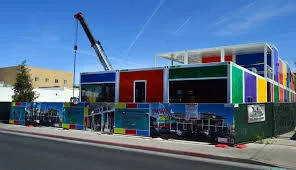
Nevada: Henderson-based Xtreme Cubes Sees Growing Industry
As indoor farming grows, which is what these would be used in, they’re environmentally sealed containers.

By Bailey Schulz / Las Vegas Review-Journal
January 5, 2019
Cannabis farms, military shelters and downtown Las Vegas’ Container Park all have one thing in common: They were built from interlocking blocks created by Xtreme Cubes.
The Henderson-based company builds modular street structures it describes as “giant, prefabricated Legos.” The blocks come in a range of sizes and can be interlocked and used for things like offices, residential buildings, retail buildings and remote work sites.
According to CEO and co-founder Brandon Main, the modular building industry has been growing rapidly, with a growing number of diverse sectors taking an interest.
This Q&A has been edited for length and clarity.
What’s it like working in Henderson?
We started the company in Las Vegas, Nevada, in 2008, but we quickly outgrew that factory. We landed on a property out here in Henderson in 2015. Moving out here, we have the space, we have the access to interstate, we have rail access, and Nevada is actually a very business-friendly state. There’s no income tax and a lot of opportunity with a tremendous workforce in the surrounding areas.
It’s a tough economy right now with low unemployment, but we can pull employees from neighboring states. Geographically, we’re in a good spot. Moving to Henderson allowed us to achieve our growth plans.
How has the modular building industry changed over the years?
The industry is growing rapidly. There’s a workforce shortage with such low unemployment. Contractors are struggling to find people to perform their work, and there’s a need for a high-quality product quicker.
The modular building industry has been around a long time. Even though there were other options, we took a cutting-edge approach to the process, and we said we’re going to design a steel building frame system that can carry all the load. Ours is a standalone application that is specifically aligned to customer needs.
What sort of industries use Xtreme Cubes?
Industrial was our starting sector, but over the years we got into commercial and retail and then residential. We built some cabin-style or condo apartment-style buildings. We’re getting into some hotels and then military or government-type buildings.
Some of the new sectors include military applications and hospitals. We’re going to be building some modular rehabilitation clinics and hospitals, or hospice care. We’re getting ready to release our first set of hotels, a multi-story apartment.
With the legalization of marijuana, medical cannabis is another new sector. As indoor farming grows, which is what these would be used in, they’re environmentally sealed containers. A lot of the problems with the cannabis industry is related to control of crops. No mold, pesticides, insects, anything that’s a potential infection to crops. We have a clean room where the operators can grow. If can be leafy greens, tomatoes, specialized herbs.
We as a manufacturer offer turnkey solutions to our customers. We design and build to exact requirements.
What’s the benefit of building with blocks as opposed to traditional construction methods?
Speed to market. With traditional construction methods, you’re burdened with the permitting process and delays with on-site inspections. We have the same building codes as traditional construction methods but in a factory environment. We have our own third-party inspector that comes to our factory. We marry them up together in sync and save all that time. We end up with a finished product in one-third of the time. We can run around the clock.
Contact Bailey Schulz at bschulz@reviewjournal.com or 702-383-0233. Follow @bailey_schulz on Twitter.

Future Farming Hub Is Creating A One-Stop-Shop Vertical Farming System For ‘Anyone’
January 15, 2019
The Vertical Farming Development Centre at Stockbridge Technology Centre (a Liberty Produce consortium member)
For a company less than one year old, Liberty Produce has already taken some big strides along its path to make vertical farming a more scalable, economically feasible reality. Specifically, the UK-based agtech company hopes to not just grow food, but also create an end-to-end, automated vertical farm system that, according to founder Zeina Chapman, “anybody” could use.
On vertical farming in the UK, Chapman notes there are “really great things happening . . . but they’re all siloed.” In other words, LED companies aren’t talking to those who make HVAC systems, and thus the development of these products happens independent of one another. As technologies by themselves, they work, but when put together in one environment, are they creating the most energy- and resource-efficient way to grow the best crop yield?
It’s a question Liberty will address with its new project, the Future Farming Hub. For the £1.3 million (~$1,652,000 USD) project, Liberty will lead a consortium of 11 different partners, each focusing on a different capability of the vertical farm. Chapman wouldn’t name specific names over the phone, but she did note there were partners in Taiwan, where vertical farming is a huge industry, a major LED company, as well as companies working on sensors, nutrient delivery (for the plants), and the growbeds themselves. For the latter, a partner will redesign growbeds to reduce the amount of bacterial growth that can sometimes hinder plant growth or damage plants. Sensor technology, meanwhile, would immediately tip the grower off to there being a bacterial problem in the growbed.
Underscore that word “immediately,” as that’s the other point Liberty and the Future Farming Hub are pushing. The project will also focus on a developing a system that gives growers real-time data about the farming operation
All of this rolls up under one goal focused on, according to a press release, reducing operational costs of vertical farms by 25 percent, increasing crop yield by 30 percent, and cutting down the amount of decisions growers themselves have to make when it comes to caring for plants.
“There’s lots we don’t know about growing plants in this artificial environment and we’re not giving them optimal conditions,” says Chapman. She cites lighting as one example: “With lighting, there isn’t an option to control it in a way that maximizes plant growth. So we might be putting plants under stress.”
Chapman also wants to make it easier for virtually anybody to operate a vertical farm. When I asked if that includes an open-source framework for growing, as others have suggested, she noted this project goes a step beyond open source. “If you decide you’re going to grow basil, you just press the button and the system will take care of that,” she said. In theory, at least, Liberty will have already developed the formula for growing optimal basil and programmed it into the system, effectively taking the guesswork out of growing.
Automated vertical farming is slowly gaining momentum around the globe, and other proprietary farm systems abound. Stateside, AeroFarms’ patented system can create light “recipes” to give each plant the exact spectrum and intensity it needs to grow. Bowery, too, uses a mix of hardware, analytics, and proprietary software to produce greens year-round. They also just got a $90 million shot of fresh investment. Over on the West Coast, Plenty more than doubled that figure last year, when Softbank invested $200 million in the company’s system.
But no one’s yet come out with a one-stop-shop system that you need neither an agricultural or engineering background to operate and which relies on real-time data to do the heavy lifting.
The project doesn’t kick off until April of 2019, which makes all of this somewhat abstract at the moment. But Chapman’s optimistic. “One of the greatest things we want to achieve is to pull together a system that’s fully integrated and get all these systems to talk to each other,” she says. “We hope it can reduce the costs, which is a huge barrier to entry and also increase yield. As we increase yield, more and more products become viable.”
Chapman and Liberty aim to have a full product ready for market at the end of the 27-month project, and along with it, a more accessible, scalable approach to vertical farming.

Watch: Canada's First Vertical Mushroom Farm
In just three years, the Grugers went from farming their first mushrooms in a converted shipping container to producing about 12,000 pounds of mushrooms per month in their Nisku facility.
Published on: January 2, 2019
Rachel Gruger is co-owner of Gruger Family Fungi in Nisku, Canada’s first vertical mushroom farm.
The Nisku operation is the only indoor vertical mushroom farm of its kind in Canada. It specializes in tree-loving mushrooms so you won’t see any regular grocery store portobello or button mushrooms growing here.
In just three years, the Grugers went from farming their first mushrooms in a converted shipping container to producing about 12,000 pounds of mushrooms per month in their Nisku facility. The farm grows 10 different kinds of mushroom. Some are to eat and some are medicinal varieties meant to heal.
With files from Lisa Johnson