

Welcome to iGrow News, Your Source for the World of Indoor Vertical Farming

VIDEOS: The Technologies Helping Move Agriculture Indoors
As more agriculture moves indoors, Israeli technologies are moving in with them to optimize lighting, watering, temperature, and other factors for an efficient and effective operation. Greenhouses and urban farm factories are expensive to set up but pay off in higher yield, quality, and market value, growing all through the seasons.
Greenhouses and urban farm factories are expensive to set up but pay off in higher yield, quality, and market value, growing all through the seasons.
A pick-yourself strawberry farm in China built inside an Azrom greenhouse. Photo courtesy of Azrom
Grain crops will always need large fields. But tomatoes, leafy greens, peppers, and strawberries are some of the many fruits and veggies that thrive indoors under precisely controlled conditions.
Though it costs more to raise produce in greenhouses or urban “farm factories,” the payoff is higher yield, quality, and market value. The plants can grow year-round with less fertilizer and pesticide.
As more agriculture moves indoors, Israeli technologies are moving in with them to optimize lighting, watering, temperature, and other factors for an efficient and effective operation.
Sarai Kemp, vice president of deal flow at Trendlines AgriFood. Photo: courtesy
“There is a growing trend for traditional greenhouse farming and indoor hydroponic and vertical farming for certain types of crops,” says Sarai Kemp, vice president of deal flow at Trendlines AgriFood based in Israel with branches in China and Singapore.
Kemp tells ISRAEL21c that most greenhouse-grown tomatoes go straight to consumers while most field-grown tomatoes go into items like ketchup.
“Growing indoors helps you produce more in a better environment than in open fields,” she says. “Farmers invest in technology for greenhouses because they can control the growing environment and sell the produce at a higher value.”
Kemp says a lot of indoor farming technology originated in Israel. “We have the experience, capability, and technology to provide monitoring solutions.”
Europe is the main market for Israeli indoor farming technology, and Kemp notes that a new market has opened closer to home.
“The United Arab Emirates is very interested in indoor farming because of the desert conditions that make it difficult to grow in open fields there.”
Let’s look at a few Israeli solutions for indoor farming.
Greenhouse experts
This 5.5-acre medical cannabis greenhouse complex in Greece is covered with f-CLEAN, a durable polymer offering exceptional light transmission and energy savings. Photo courtesy of Azrom
One of the oldest market leaders in the greenhouse farming business is Azrom, a family company that has specialized in designing, building, and installing fully customized greenhouse systems since 1979.
“That’s all we do,” says Zviki Porat, Azrom’s international marketing manager. “We started exporting in 1979 to Greece and since then we have done about 1,500 projects in more than 70 countries.”
In the old days, technology meant simple drip irrigation. Today, Azrom partners with Israeli research institutes and ag-tech companies to stay a step ahead of the greenhouse technologies curve.
“Now it’s a whole package of high-tech systems that lead to much higher yields and monitor processes better, including weather and topography, planning, designing, engineering, and remote controls,” says Porat.
Also in the early days, greenhouse crops were raised in the ground. Today, most farmers opt for hydroponics – growing in soil-free mediums.
“There are 10 kinds of platforms to choose from in hydroponics, so it’s much more complicated today to plan and price a greenhouse system,” says Porat.
Four kinds of crops growing under one greenhouse roof in Belarus. Photo courtesy of Azrom
“And every year more crops are being grown in greenhouses because land is in short supply. The main crops are vegetables, strawberries, ornamental flowers, and medical cannabis. But you can even grow watermelon, pineapple, and mango indoors where they stay warm and are exposed to fewer pests.”
In addition to Asia and Europe, Azrom has projects planned in Louisiana (US) and Dubai (UAE).
“Greenhouse growing requires a high investment. But you pollute less because you don’t spray as much, and you can collect and reuse water and even fertilizer,” Porat says. “So we have a lot to contribute to desert agriculture.”
Hydroponic greenhouse factories
A British-Israeli venture formed from a merger of two established companies about eight years ago, Growponics designs and builds automated hydroponic greenhouse factories in urban settings.
“You can grow vegetables all year round in greenhouses in many places, like in California’s Salinas Valley. But that is not where the population is,” says founder Lior Hessel.
Hessel says shipping costs today account for more than 80% of the landed cost of vegetables – that is, the total expense to get a product to its destination.
“Local greenhouse farming is expensive, but it pays off compared to shipping costs,” Hessel tells ISRAEL21c. “In the last 10 years, a new trend is local production with a lower landed price and lower carbon footprint.”
Still, for a massive greenhouse factory to be profitable, its steep capital and operating expenses must be offset by maximizing yield per square meter, Hessel explains.
“In Growponics we do this by using automation. The plants move on conveyers. We eliminate aisles, which normally take up 15 to 20% of greenhouse space; and we adjust the spacing between plants in different parts of the growth cycle. That alone can increase yield by more than 40% on top of the savings from eliminating aisles. It’s a gamechanger when you put them together.”
With funding in part from the Israel Innovation Authority, Growponics invests heavily in R&D in cooperation with institutes in Israel, the UK, and continental Europe.
One innovation is a data collection robot that supplements the data collection done by sensors in the greenhouses. Another is organic fertilizer produced via atmospheric nitrogen fixation, which uses bacteria to make nitrogen in the air available to plants. This technology won Growponics the European Union’s Seal of Excellence and €2.5 million in funding to implement it in Europe.
Growponics has three sites in Israel, accounting for more than 70% of domestic hydroponics.
“In Europe, we registered a new company in Greece to do more than $4 million in projects,” says Hessel, “and we are going to the UAE as part of an Israeli business delegation before the end of the year.”
Three years ago, Growponics established a two-acre greenhouse factory in Connecticut that sells its produce to New England supermarket chains. Further US expansion is planned with local partners as owner-operators to handle marketing and distribution.
Lighting and growing system
“Indoor growing demands scientific knowledge of what each plant needs and when,” says Daniel Levin, founder of Tel Aviv-headquartered Growor, whose indoor agriculture system can reduce overall costs up to 40 percent (up to 70% electricity saving alone) while increasing yield by about 30%.
The business started five years ago with a light-bulb idea, literally.
Pharma-grade cannabis thriving under Growor’s lighting system. Photo: courtesy
The smart LED light, which can manipulate outcomes such as tomato color and juiciness, was developed by Levin’s business partner Michael Naich, now CEO of Growor and its companion R&D company Group 1607 (so named because both their birthdays are on July 16).
But lighting alone wasn’t enough. Indoor farmers must control and monitor a variety of inputs such as water, nutrients, temperature, and humidity.
“Because we had so much data from our lighting system, we were able to develop a full dynamic protocol for any kind of indoor growing,” says Levin. “The protocols adapt to help each plant feel it is in the best conditions at any time and location.”
Energy-efficient LED lighting retains a starring role in the Growor system, which includes sensors, AI software, and a mobile app to manage cultivation remotely.
“We adjust the rest of the parameters to the light parameters because only light can manipulate the plant’s behavior drastically. More or less water, or more or less fertilizer, won’t change a tomato’s color.”
Growor has pilot projects in Israel, North America, Europe, and Asia for growing flowers, tomatoes, cucumbers, and pharma-grade cannabis. The latter crop, says Levin, is raised in clean rooms and must be reliably stable and consistent because “there’s no room for surprises.”
Robotic indoor harvesting
The higher yield in indoor agriculture requires more farmhands, and that’s a problem.
“One of most the urgent issues today is a labor shortage because most activities are done manually,” says MetoMotion CEO Adi Nir.
MetoMotion is developing a robotic system that automates labor-intensive greenhouse tasks and simultaneously gathers actionable data to improve yield and quality.
MetoMotion’s GRoW robot picks tomatoes and performs other labor-intensive tasks in greenhouses. Photo: courtesy
This portfolio company of The Trendlines Group has been testing its unique GRoW robotic tomato harvester in Israel and in The Netherlands in partnership with Bayer Crop Science.
“Since March we haven’t been able to travel from our offices in Yokne’am,” says Nir. “Our team there works with the robot and the software is operated mainly from here. This reduces the amount of staff needed at the greenhouse.
“You always need people too, but the robots work autonomously and from the office, you can see yield and yield forecast and other actionable data collected and transmitted to the cloud.”
The first commercial GRoW units will be shipped to a few farmers in Europe for evaluation in the next eight months.
“We are currently focused on tomatoes, but the platform can be adapted to different vegetables,” says Nir. GRoW also can be adapted to perform pruning, pollination, and de-leafing.
Wall to fork
As ISRAEL21c previously reported, “green walls” can provide insulation, air purification, and aesthetic landscaping to the interior or exterior of buildings.
They can also produce salad greens, mushrooms, and strawberries in an urban space-saving way.
However, vertical farming is still quite limited because to be profitable “you have to either grow more or save on costs of labor or resources such as electricity,” Sarai Kemp from Trendlines tells ISRAEL21c.
Among several Israeli vertical farming startups working to make this model viable are Verticanna and Vertical Field.
Verticanna, in the seed investment stage with two medical cannabis pilots running in Israel, aims to revolutionize vertical hydroponic growing systems for crops including, uniquely, citrus fruit.
Vertical Field of Ra’anana makes the Vertical Farm, a modular, moveable soil-based platform that can grow 200 types of organic, pesticide-free crops and requires no special training to operate.
The Vertical Farm can grow hundreds of types of crops indoors or outdoors at a supermarket, restaurant or another retail outlet. Photo courtesy of Vertical Field
Vertical Farm can be placed in a 20-foot or 40-foot standalone container equipped with advanced sensors that monitor, irrigate, and fertilize crops throughout every growth stage.
Vertical Farms are up and running at some Israeli supermarkets and at Farmers & Chefs restaurant in Poughkeepsie, NY, and at Evergreen Kosher Market in Monsey, NY. Expansion across other US cities is planned.
“We offer an easy-to-use real alternative to traditional agriculture,” CEO Guy Elitzur said. “Our urban farms give new meaning to the term ‘farm-to-table,’ because one can pick their own pesticide-free greens and herbs at supermarkets, restaurants, or other retail sites.”
The Israeli startup was cited by Silicon Review as one of “50 Innovative Companies to Watch in 2019” and named by World Smart City in 2019 as “Best Startup.”
Abigail Klein Leichman is a writer and associate editor at ISRAEL21c. Prior to moving to Israel in 2007, she was a specialty writer and copy editor at a major daily newspaper in New Jersey and has freelanced for a variety of newspapers and periodicals since 1984.
Food Waste To Indoor Farming Input: Re-Nuble Raises $1.1m Seed Funding
New York-based Re-Nuble is adopting yet another strategy: turning food waste into a way to grow more food. The company’s technology ‘upcycles’ organic compounds from unrecoverable vegetable food waste, generating water-soluble, organic, hydroponic nutrients for soilless farms
November 23, 2020
Startups are taking a diversity of approaches to tackle the issue of food waste. Phood is using hardware and software to measure and address waste in restaurant kitchens, while Clean Crop is targeting post-harvest wastage. Ambrosia turned leftovers into a household cleaning product while Full Harvest connects food producers with buyers to sell what would otherwise go to waste.
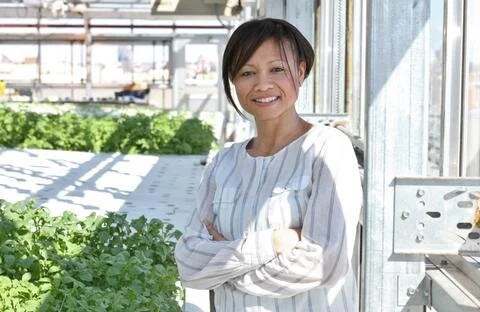
New York-based Re-Nuble is adopting yet another strategy: turning food waste into a way to grow more food. The company’s technology ‘upcycles’ organic compounds from unrecoverable vegetable food waste, generating water-soluble, organic, hydroponic nutrients for soilless farms.
“We haven’t seen anyone applying this to indoor or controlled environment ag,” Tinia Pina, Re-Nuble founder, and CEO, told AFN.
Pina’s inspiration for the business came from her stint working as a teacher in 2012, when she noticed a serious lack of healthy food options for her students. In her view, this affected their productivity – which had downstream implications for their future success. She saw an opportunity to wrap her interest in tamping down food waste into the venture, too.
Re-Nuble recently closed a $1.1 million seed round led by Global Sustainable Future. She1K, SOSV, SVG Ventures, WOCstar, and others participated in the round as well.
The fundraising process involved some education, Pina explained. Investors at first considered Re-Nuble’s need for a constant supply of food waste as a risk – but the former teacher taught them that there’s certainly no shortage.
“The other thing we had to really educate investors on was how food waste is handled differently region to region,” she said. “Agricultural economies are going to have different regulations. Here in New York, by 2022 a lot of the industrial and commercial food scraps or food waste generators have to divert to an organic recycler within 20 miles.”
Pina said she met with prospective investors all over the US, but ended up having most success raising from investors on the East Coast.
“[That’s] because I think the sophistication of seeing the potential with agtech, especially in the NYC metropolitan area, helped us. And, to be quite honest, I think the diversity of seeing a woman of color in agriculture. That is an anomaly in some states based on what I have experienced.”
The new funds will be used for typical seed-stage tasks like hiring, R&D, manufacturing, and general acceleration. Pina estimates the product market pipeline is worth at least $2 million.
Thanks to a lot of upfront diligence, Re-Nuble is confident that it has reached product-market fit and that securing customers won’t be too much of a challenge. The startup spent seven years studying different food waste characterizations and their biochemical reactions when applied under different environmental controls for a group of specialty crop varietals.
“We’ve been really drilling down and making sure the product works consistently in each type of farm, which is very different,” Pina said. “Some use deep water culture systems, some vertical farming systems are using tray racking systems and ebb and flow. Others are nutrient film techniques. We really wanted to spend the time to make sure that it is consistent in all farm types.”
In addition to its core nutrients product, Re-Nuble has also developed what it calls its ‘On-Site Food Waste Recovery System.’ This captures residual product waste — such as plant matter like vines, leaf cuttings, and perishable produce — as well as a farm’s wastewater for conversion into sterilized biostimulants and potable water. These byproducts are then reused for reduced water and agricultural input consumption.
The startup has faced some serious Covid-related challenges, according to Pina. It had a $500,000 loan rescinded that caused the team to completely redesign its manufacturing process, while also trying to work with manufacturing equipment under a cash-strapped budget.
“We’ve overcome that and we are now on pace to continue working with the farms that we’ve been doing case studies with, which we will release Q1 of next year,” she said. “That will definitely lead to growth and allow us to accelerate more farms getting access to our product.”
Revisiting "The Vertical Farm" - Dickson Despommier’s Book
The concept he discusses is fairly simple. If we used hydroponic and aeroponic systems to grow fresh produce, indoors, in large cities, we could curb our environmental impact by letting our current farms return to their natural state
20-11-2020 | Linkedin
Listen to the 21st Talks podcast on Spotify
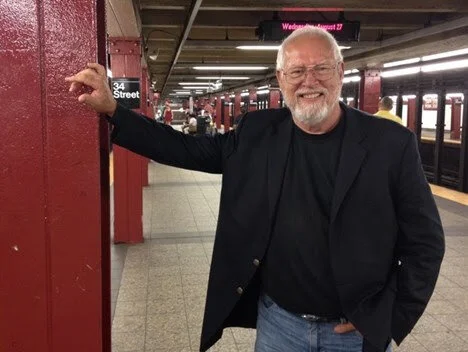
In 2010, author and emeritus professor of microbiology and public health, Dickson Despommier released his book, “The Vertical Farm: Feeding the World in the 21st Century.” The concept he discusses is fairly simple. If we used hydroponic and aeroponic systems to grow fresh produce, indoors, in large cities, we could curb our environmental impact by letting our current farms return to their natural state. Being its 10th anniversary, I wanted to revisit the book and look at it in a new context.
The Problem
By 2050, it’s estimated that there will be two billion more human beings than there are today. To feed that many people, we’ll need a landmass the size of South America to account for the food production. Unfortunately for everyone, they don’t make new continents anymore, and if the lack of land isn’t enough to worry about, year by year, the planet is losing arable land due to the changing climate, intensifying weather conditions, air quality, and more.
Modern farming is also not without its issues. A large percentage of fresh produce never reaches your plate, whether that be due to harsh weather, unforeseen pests, or other factors. In some cases, transportation can be the problem, as most fresh options travel 1200 to 1500 miles to reach their final destination.
Insecticides, fungicides, and pesticides are commonly used to kill off threats to growing produce, but water runoff with these chemicals often end up contaminating rivers, ponds, lakes, and streams. This damages natural wildlife habitats and has adverse effects on human beings.
Despommier’s Solution?
Farm upwards in buildings and skyscrapers. Avoid the use of pesticides and other chemical agents that damage the environment. Without the potential of chemicals and weather effects, you can grow produce in a controlled, ideal environment--year-round--at a rate that today’s farms simply can’t match.
When you’re producing food at this accelerated rate, there is no need to transport it 1200 to 1500 miles, which means fresher, tastier options arrive at the customers’ homes. You can also cut out the CO2 that would get pumped into the atmosphere if the food were to be transported long distances.
Because hydroponics and aeroponics are closed-loop systems, we could conceivably use 70-95% less water to produce the same amount of food as is currently produced. Despommier also talks about using vertical farms to eliminate food waste that attracts vermin and millions of gallons of contaminated water that pollutes large cities every day.
An interesting omission from Despommier’s vision is the use of aquaponics. While it’s a closed-loop system like the aforementioned, aquaponic farmers cultivate fresh-water fish to provide nutrients to their plants. In a matter of months, a farmer who has produced tons of fresh, leafy greens, could also provide local restaurants or residents with high-quality fish.
What happens to old farms and farmers?
If we were able to successfully transition to growing products from vertical or urban farms, there would be little need for farms as we know them. We would have the opportunity to reforest hundreds of thousands of acres and combat a large percentage of harmful CO2 and chemical agents. That said, I’m not keen on essentially firing two million Americans whose main source of income is farming, but neither is Despommier. The author suggests a government-provided financial incentive for farmers who actively work to curb CO2 by reforesting their land. That this might cause frustrations for some, but that’s a discussion for another day.
Vertical farms could also give rise to hundreds of thousands of new jobs--many for those displaced farmers--from the managers who will keep the facilities running to the techs who will make sure no pest or pathogen breaches a micrometer of produce. You could also bet that the vertical farming industry would give rise to job opportunities in related industries and fields.
Why this is important.
It’s not lost on me that in the coming decades, as I reach my parents’ age, the quality of my life might be severely different from theirs. My children and their children will inherit a world with rising temperatures, intensifying weather patterns (like 2020’s hurricane season), environmental refugees, and--oh yes--the two billion more people that I mentioned above. The opportunity to innovate in the farming industry is, well, 10 years ago when this book came out. We’re making strides, but mainstreaming vertical farming would require a tectonic-like shift in our mindsets and priorities or at least a billionaire champion (looking at you, Bezos, Musk, Gates) to kick things off.
Not to alarm, but with every passing day, the climate crisis becomes direr, and while it’s easy to let your mind drift to the negative, I believe Despommier’s vision is that of hope and innovation. We have all the tools we need to make the shift. We just have to do it.
But there’s one more reason I think that this book is more important now than it was at the time of its release. The passage in the book that stuck out to me most is this:
“All life on the Earth is linked either directly or indirectly to each other in mutually dependent life-renewing cycles. It is the foundation upon which that science is built. Without our interference, life would go on in an equitable manner, with all forms living within a given eco-zone sharing their part of the energy budget provided to them each day by the sun.”
This quote needs to be seen with 2020 vision. At the time I’m writing this, there are more than 242,000 Covid deaths in the United States and 1.28 million worldwide. Some scientists suggest that Climate Change has played a role in the spread of Covid-19. Others suggest that the agony and anguish of Covid-19 pale in comparison to the devastation the Climate Change will inflict on us in the future.
As the quote suggests, everything is connected. When you've tampered with one thing (like the environment), you've tampered with everything. We are the planet’s stewards. I don’t blame anyone specifically for Covid-19, but perhaps if we take larger steps to tackle the climate crisis, it will help us prepare for the next pandemic, either directly or indirectly.
The Greater Impact
Despommier leaves no stone unturned. He discusses vertical farming's local, national, and global impacts on our health, habits, and societies. He explains that, with trial and error, vertical farming can produce any crop you can imagine, and he provides technological and architectural blueprints necessary for success. He provides a broad overview of the benefits, many of which I've mentioned, but in much greater detail. Honestly, if someone has the money and ambition to start a vertical farm, conceptually, he's done most of the heavy lifting for them.
He also gives you the sense that with vertical farming, the quality of life could improve for everyone, and makes a case for allowing financially or food-insecure countries to rely on foreign providers. Naturally, there would be major pushback from those opposed to globalization, but Despommier's position is to advocate for environmental equity and sharing resources. In some cases, vertical farming could become a significant tool in avoiding major world conflicts.
Final Thoughts
I’m no farmer. I'm certainly not a scientist. I’m just a guy concerned about the days ahead. Ten years ago I heard about an exciting, inspiring concept and wanted to revisit it. That said, I won't presume that a hypothetical shift toward vertical farming wouldn't be met with significant challenges and resistance--many for legitimate reasons.
Finally, I don’t know if New York City, Hong Kong, Dubai, Mexico City, or Shanghai will ever have sprawling districts with skyscrapers that produce millions of pounds of fresh, healthy food each day. It’s simply a hopeful future and in terms of solving tomorrow’s problems, I think vertical farms are an excellent place to start.
When it comes to vertical farming, urban farming, and modern farming techniques, here are just a few companies that are ahead of the game:
Published by Jonathan Haile, MA
Source and Photo Courtesy of Linkedin

SINGAPORE: Tampines Residents To Grow Vegetables From Vertical Hydroponic Kits
The scheme is part of an initiative called Our Green Hut, which also involves starting a vertical hydroponic farm to produce more than 15 types of vegetables
The kits - about 1m wide and just under 2m high - can accommodate about 20 plants. ST PHOTO: JASON QUAH

November 21, 2020
SINGAPORE - Tampines residents will soon be able to grow their own organic vegetables for personal consumption in a cleaner, more efficient way.
Rather than the traditional method of planting in soil, Our Tampines Hub is offering residents vertical hydroponics kits that can be used to grow veggies at home, it announced on Saturday (Nov 21).
About 600 Tampines residents have already indicated interest in the vertical hydroponic project.ST PHOTO: JASON QUAH
The kits - about 1m wide and just under 2m high - can accommodate about 20 plants.
A pilot project will give about 50 kits free to residents whose homes are suitable, such as having enough sunlight.
The scheme is part of an initiative called Our Green Hut, which also involves starting a vertical hydroponic farm to produce more than 15 types of vegetables.
Mr. Masagos Zulkifli told reporters at Saturday's launch event: "The bigger plan is to actually grow food within Tampines. We are releasing some carpark rooftop gardens that will not just be producing vegetables, but also for residents to get involved in growing a commercially viable rooftop garden."
About 600 Tampines residents have already indicated an interest in the vertical hydroponic project.
"This is only the beginning," said Mr. Masagos. "We don't want this to be a one-time endeavor and then they throw the equipment away.
"We want them to prove that they want to do this as a continuous endeavor to grow food at home, starting with simple vegetables, and then maybe later on with more difficult ones."
Ms. Tan Min Choo is one of the first residents to start growing vegetables using the vertical hydroponic kit. ST PHOTO: JASON QUAH
This also feeds into the bigger aim of Singapore meeting 30 percent of its nutritional needs by 2030, a plan that has been brought forward due to the coronavirus crisis, Mr. Masagos noted, adding: "We must also get involved in understanding what we need to grow food at home so that our children understand the technology involved, as well as the production and the growth."
Ms. Tan Min Choo, 64, a retired air traffic service officer and a volunteer at Our Tampines Hub, is one of the first residents to start growing vegetables like "chye sim" using the vertical hydroponic kit.
The structure was installed on her balcony about a month ago ahead of the pilot project.
She said: "I used to live in a kampung (village), so I always liked planting vegetables and I thought there was no harm trying something new."
The kit ensures nutrient-filled water is internally circulated so Ms. Tan does not have to water the plants daily but just monitor the nutrient level using a meter every few days and add more nutrients or water if necessary. The plants take about three weeks to harvest.
"This kit makes growing vegetables so clean, whereas soil can be dirty and dusty. It also saves space because of the vertical set-up," she added.
Lead photo: The kits - about 1m wide and just under 2m high - can accommodate about 20 plants.ST PHOTO: JASON QUAH
Vertical Garden Operation Utilizes Shipping Container
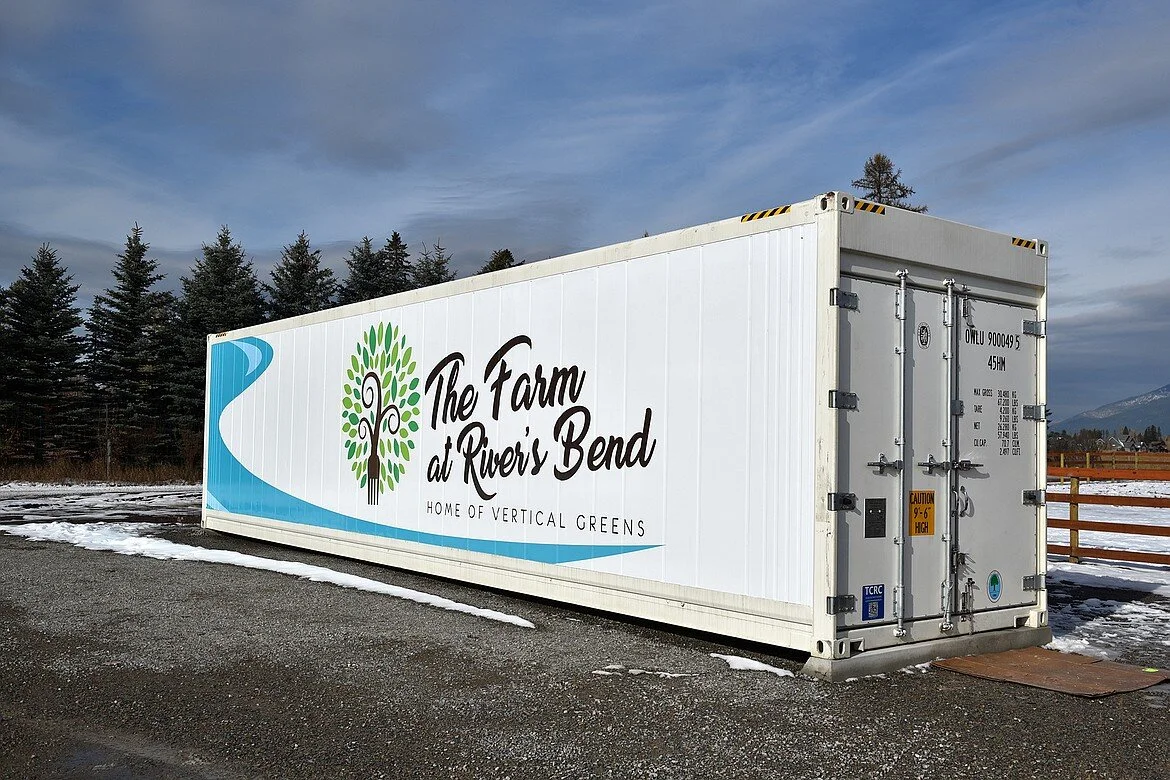
Tim and Harline Moyer, owners of The Farm at River’s Bend, are embarking on a new adventure at their property east of Whitefish. They’re beginning a vertical garden operation aimed at supplying local restaurants with fresh lettuce even in the depths of winter
Harline and Tim Moyer, and Dustin Lang at The Farm at River’s Bend east of Whitefish. The Moyers are beginning a vertical container farm on their property. (Heidi Desch/Whitefish Pilot)

By HEIDI DESCH
Editor | November 18, 2020
On the outside, it looks like a regular shipping container, but inside the promise of a full-fledged garden full of greens is represented by young sprouts.
Tim and Harline Moyer, owners of The Farm at River’s Bend, are embarking on a new adventure at their property east of Whitefish. They’re beginning a vertical garden operation aimed at supplying local restaurants with fresh lettuce even in the depths of winter.
The Moyers moved to Whitefish in the spring after running their own farm in Hawaii. They have a friend who suggested they move here, so they bought 10 acres of land and brought along their plan to operate a vertical garden.
Colored by blue and red lights, young plants begin to sprout inside the vertical container garden at The Farm at River’s Bend. (Heidi Desch/Whitefish Pilot)
“We can operate year-round sustainably because it’s not subject to the weather,” Tim said. “There’s no herbicides and no pesticides.”
Sitting on their property is a Freight Farms container that’s fully equipped to operate as a hydroponic garden. One container can grow as much food as would be produced on 2.5 acres of land and they hope to eventually have four containers, which would grow the equivalent of 10 acres worth of land.
“That will leave us plenty of space for the horses to run around,” Tim said standing beside the container. “We want to provide fresh lettuce and be good stewards of the land, and this will let us do both.”
The Moyers own the Lahaina Family Farms, a sustainable organic educational farm, on Maui. The farm operates with volunteers, and it was one volunteer who owns restaurants in New York City that introduced them to the concept of Freight Farms, a hydroponic container farm.
Tim was intrigued by the idea and knew it worked on some of the same concepts their farm did such as using as little water as possible for the plants, but the cost of electricity in Hawaii made it cost-prohibitive to run such an operation. But when the Moyers moved to Montana they knew they wanted to begin building their vertical greens farm here.
Freight Farms is a Boston-based agricultural technology company that manufactures and sells container farms, which are retrofitted 40-foot freight containers that come with a hydroponic farm system that utilizes technology to create the optimal growing conditions.
Once the vertical farm is fully operational, the Moyers expect to be harvesting 1,200 heads of lettuce per week with 13,000 plants growing at one time.
“We can deliver it at 2 p.m. and then it’s on the table at 5 p.m.,” Tim said. “It’s quick farm to table — the chef orders it, we pick it that day and then deliver it.”
A family friend Dustin Lang runs the container farm monitoring the software that runs the LED lighting and nutrient irrigation system designed to make the leafy greens or potential herbs grow at optimal levels.
Dustin Lang walks between the rows that will eventually be planted with lettuce for the hydroponic vertical garden. LED lights cast blue and red light onto the plants for optimal growth. (Heidi Desch/Whitefish Pilot)
Lang said it was a visit as a child that he took to Disney World’s Epcot and a display on life on Mars that spurred his interest in non-traditional food cultivation.
“I have been interested in garden farming,” he said. “The more I learned about hydroponics, the more I was interested. I was tired of my job, so it seemed like a good time to come here and join them.”
Plants are started in containers and then when ready are moved into a drip irrigation system that allows for vertical growing. The system uses red and blue light at set wavelengths to aid in the optimal exposure for growth, while the container maintains an ideal temperature and humidity to provide plants with the right climate for growth.
The hydroponic system delivers the right amount of water to plants during the various stages of growth.
The Moyers plan to begin selling to restaurants, but as they expand they’d also like to sell directly to customers. In addition, they expect to follow the same model as their farm in Hawaii with education by bringing on volunteers to work in the container farm.
For more information, visit www.thefarmatriversbend.com.

Eight Startups Chosen For Indoor AgTech Program
“During the Indoor AgTech program, startups work with the Sente and GrowRay teams using a structured process that better prepares them to attract serious investors and customers and places them in a fast-moving, talented ecosystem of indoor agriculture entrepreneurs,” says spokesperson Jen Peterson
November 19, 2020
By Greenhouse Canada
Sente Foundry LLC, in partnership with GrowRay Lighting Technologies, has selected eight startups to participate in their Indoor AgTech program, which has already begun and will take place virtually through December 2020.
“During the Indoor AgTech program, startups work with the Sente and GrowRay teams using a structured process that better prepares them to attract serious investors and customers and places them in a fast-moving, talented ecosystem of indoor agriculture entrepreneurs,” says spokesperson Jen Peterson. “At the end of the program, at least three startups will be selected to pilot their technologies in a state-of-the-art growing facility and possibly receive additional investment.”
Sente put out a call for applicants this past summer. Eight startups were ultimately selected :
AgEye Technologies (https://ageyetech.com/) – with offices in the US and India, AgEye Technologies develops technology that helps indoor farms become sustainable and scalable through significant reductions in operational costs.
CO2 GRO Inc. (https://www.co2gro.ca/) – uses their patented advanced CO2 Delivery Solutions to accelerate the growth of all value plants safely, economically, and naturally. CO2 GRO Inc. is based in Canada.
FloEnvy (https://www.floenvy.com/) – maker of cannabis cultivation software that captures each decision on the ground in real-time so that growers can manage their cultivation from one place at all times.
Grownetics (https://grownetics.co/) – founded to solve the world’s agricultural inefficiencies, Grownetics’ grow optimization platform leverages the latest sensing and automation tools to make growing the best plants easier than before.
PhenoLogic (https://phenologic.com/) – automates a complex part of plant & crop production, saving money and time while increasing production yields. PhenoLogic is based in Michigan.
iShence AgTech (https://ishence-grow.com/) – an Israeli Agtech company aiming to provide growers with affordable and effective solutions combining agronomic knowledge with cutting edge technology.
R.O.A.B. (https://innovationlabs.harvard.edu/current-team/r-o-a-b/) – Part of Harvard Innovation Labs, R.O.A.B Technologies is building a series of autonomous agriculture devices starting with a solar-powered roving mini laboratory built to provide farmers with analyses that can increase their productive efficiency by more than 50% while at the same time mitigating the ecological damage that farming can create.
Universal Grow Controls (http://universalgrowcontrols.com/) – Denver-based company that helps growers manage their environmental controls, including CO2 enrichment, irrigation, and fertigation from anywhere in the world.
Sente’s Indoor AgTech program features an intense set of activities to analyze and evaluate participating startups, connecting them with indoor and greenhouse customers, and introducing them to indoor AgTech investors and service providers.
Source: Sente

Want To Eat Healthy? Try Growing Lettuce On Your Kitchen Counter
After years of trying to grow vegetables in my shady backyard, I have finally given up. Feeling the need once again to grow veggies, I invested in a small hydroponic system for my kitchen
BY SHEAH RARBACK
SPECIAL TO THE MIAMI HERALD
NOVEMBER 20, 2020
After years of trying to grow vegetables in my shady backyard, I have finally given up. Feeling the need once again to grow veggies, I invested in a small hydroponic system for my kitchen.
The results are rewarding. It is small but there are edibles there. In addition to herbs, I have a robust little lettuce garden. People often think of lettuce as a low-nutrient food. And that would be wrong.
I am growing Parris Island lettuce, which is in the same family as romaine lettuce. One ounce of this lettuce provides 11% daily requirement of immunity-boosting vitamin C. Romaine also has 10% of the daily requirement of folate, which can help heart health and allergic responses to name just two benefits.
And that one ounce of romaine has 5 calories and 49% of vitamin A requirement. Romaine is for more than just a Caesar salad.
I am also growing Marvel of Four Seasons Lettuce. This is from the family of butter lettuce, also called Boston or Bibb lettuce. The flavor is soft and sweet. Vitamin A is the most abundant nutrient in this type of lettuce. In addition to vitamins and minerals, all varieties of lettuce have phytonutrients.
As a general rule, the darker the color of the lettuce, the greater the nutrition. So romaine contains more nutrients than iceberg. I have had so many clients tell me they don’t eat vegetables but when I would ask if they eat salad, they said yes.
For many people, salads might be the easiest way to reach the goal of 5 cups of vegetables and fruits each day. A spring mix blend provides a variety of greens and nutrients and the ability to easily make an interesting salad. Salad is a terrific base for nutritious add-ons. Throw on pumpkin seeds for fiber and magnesium, quinoa for added protein, or sunflower seeds for a hit of vitamin E.
Lead photo: Sheah Rarback’s small hydroponic system in her kitchen grows beautiful lettuce and herbs. SHEAH RARBACK
Sheah Rarback MS, RDN is a registered dietitian nutritionist in private practice in Miami.
The Little Farm That Could
“Farm By The Quay will serve as a hub to educate the public about urban farming while illustrating how growing food at home doesn’t have to be difficult using HAVVA solutions and technology
16 Nov 2020
Vertical farming systems can maximize use of space in an urban context.
FOR all that pottering about in one’s garden might sound fulfilling, there are many of us who are daunted by the prospect of growing our own plants.
Difficulties such as finding the right type of soil and the optimal amount of sunlight and water, all while fighting off common garden pests, can lead to frustration for those without green thumbs.
Such trials may be a thing of the past thanks to HAVVA Agrotech, as it pioneers an innovative farming solution integrating hydroponic, aquaculture, vertical farming, vermiponic, and aeroponic techniques.
These innovations will be showcased at HAVVA’s Farm By The Quay at Quayside Mall in twenty-five.7, Kota Kemuning, Shah Alam, allowing residents and visitors to experience the next step in urban sustainability.
A new frontier
“Farm By The Quay will serve as a hub to educate the public about urban farming while illustrating how growing food at home doesn’t have to be difficult using HAVVA solutions and technology.
“We will demonstrate how our system is fully scalable, ranging from small 1sqft farms to large-scale commercial farms, ” says HAVVA chief operating officer Kenzo Tan.
Doubling as HAVVA’s flagship outlet, Farm By The Quay is an organic vertical farm facility located at Quayside Mall, a few minutes’ walk from twentyfive.7’s bustling waterfront boulevard.
The vertical farm features a floor area of 195sqm, and visitors can look forward to a comprehensive line-up of activities organized by HAVVA to educate participants on the merits and methods of urban farming.
Farm By The Quay is a 195sqm vertical organic farm at Quayside Mall, twentyfive.7.
Farm By The Quay customers can also get their grocery shopping done, as it features fresh food and produce concept where vegetables can be plucked and fish freshly caught on the spot.
“Typically, urban farms in malls are located on rooftop levels, which reduces their visibility and accessibility to customers.
“However, Farm By The Quay is located at a prime spot on the ground floor within Quayside Mall, inviting exploration from visitors.
“Its design layout and fit-outs cater to the mall’s environment and conditions, and we also took into consideration factors such as safety, public access, and public engagement, ” says Tan.
From humble roots
Established in 2018 by co-founders Philip Loo and Tan, the idea for HAVVA began four years earlier when Loo visited Taiwan to learn about aquaponics, vertical planting, natural farming, and related techniques.
With this knowledge, he rented a 650sqm bungalow in George Town, and in partnership with his brother kick-started Penang’s first vertical aquaponics urban commercial farm – Loo Urban Farm.
Despite an uphill road, Loo persevered. In 2016, the eventual success of Loo Urban Farm encouraged him to submit an accelerator program for social enterprise at MaGIC (Malaysian Global Innovation and Creativity Centre), where he fortuitously met Tan.
“I was quite taken with what Philip was doing.
‘HAVVA’s business model ticked all the right boxes for us. Their operations are a good fit for the chosen space and location in our mall, ’ said Tan.
“To begin with, we had similar views on the necessity for toxic-free and nutrient-rich food.
“As he was working alone in the program without a team, I assisted him in any way that I could.
“By the end of 2016, I joined Philip and we focused on using technology to augment the growth of the business, ” says Tan.
While initial sales were sluggish, factors such as changes in market perception towards urban farming, clean eating, and organic food gave the business a welcome shot in the arm.
The company’s commitment to investing in technological and process enhancement has also paid off, as it has been accredited by organizations such as Cradle Fund Sdn Bhd and MaGIC, in addition to accolades at the Asia-Pacific Information and Communication Technology Alliance Awards (APICTA) and the Hope Awards in 2018.
New center of gravity
Farm By The Quay at Quayside Mall complements twentyfive.7’s cosmopolitan outlook and highlights the placemaking principles and master planning approach of developer Gamuda Land.
A 104ha self-sustained development in Kota Kemuning, twentyfive.7 features a gross development value (GDV) of RM4.2bil.
Its urban aesthetics and lifestyle amenities position it as the new center of gravity in Kota Kemuning and the surrounding community.
Loo (left) and Tan co-founded HAVVA to promote urban farming in Malaysia.
“HAVVA’s business model ticked all the right boxes for us. Their operations are a good fit for the chosen space and location in our mall.
“Despite being a relatively young company, their forward-thinking business plan, which targets both business-to-business (B2B) and business-to-consumer (B2C) activity, is strategically comprehensive with promising growth potential, ” says Gamuda Land director of retail and leasing Herbie Tan.
“Quayside Mall caters to changing consumer demand for open spaces in retail centres following the Covid-19 outbreak.
“Special attention in its design has been given towards spatial quality, natural light and ventilation, and extended functionality of space, along with an emphasis on fostering closer connections with nature, allowing Gamuda Land to adapt a variety of communal programs and planting schemes within the mall.
“In addition, its curated tenant mix emphasizes lifestyle draws, with a diverse range of F&B, entertainment, beauty, and lifestyle retail outlets enhancing Quayside Mall’s appeal as the beating heart of Kota Kemuning in the new norm.
Quayside Mall in twentyfive.7 will house the vertical farm on the ground floor.
“The mall also strategically integrates the outdoor environment into its design. With a promenade leading directly from the mall towards the pet-friendly twentyfive.7 Central Park, featuring lakeside activities and social spaces surrounded by lush trees, visitors to Quayside Mall will experience retail like never before.
“We believe that the introduction of urban farms, whether community-based or as viable business concerns, is vital for our greater good as it will address the problems of logistics and climate change, enhance accessibility to food resources, improve food security in cities and reduce overproduction of food by increasing own-harvested food resources – a direction that has only been reinforced by the current pandemic, ” says Herbie.
Thanks to HAVVA, twentyfive.7 residents and the public can now enjoy fresh, non-toxic, and pollutant-free produce while learning more about the urban farming movement.
Farm By The Quay is scheduled to open its doors in December 2020.
TAGS / KEYWORDS: Branded , Gamuda Land, HAVVA Agrotech, Urban Sustainability

Green Tech Farm Settles On Singapore
Hong Kong-based vertical and urban farming innovator Green Tech Farm has announced it will open a new display and sales center in Singapore. The Singapore site was chosen from a shortlist of five major cities and countries in Asia and the Middle East
BY LIAM O’CALLAGH
19th November 2020, Hong Kong
Vertical farming specialist will construct a new display and sales center in Singapore
Hong Kong-based vertical and urban farming innovator Green Tech Farm has announced it will open a new display and sales center in Singapore.
The Singapore site was chosen from a shortlist of five major cities and countries in Asia and the Middle East.
Green Tech Farm, which manufactures and sells leading-edge hydroponics units with advanced lighting, heating, cooling, and AI-controlled robotics and control systems said that the city-state's geographical location and commitment to sustainable development made it a highly suitable choice.
"We settled on Singapore for a number of reasons, one of which was its own reputation for driving environmental sustainability,” Green Tech Farm said in a release.
“We felt that Singapore would be more inclined to embrace the principles behind what we are trying to achieve given their own efforts over the years.”
The Singapore center will house several fully operational examples of the HydroPod, the company's shipping container-based vertical farming solution while also functioning as a support and learning hub for regional customers.
The site will also showcase a fully operational HydroFactory - Green Tech Farm’s, modular offering which can be expanded to fill any large space - and give visitors the opportunity to see the system perform its many functions on a far larger scale than that available in the smaller, self-contained HydroPods.
According to Green Tech Farm, the center will be operational by the third quarter of 2021.

PODCAST: Joe Swartz & Nick Greens
Our new podcast called Polygreens with Joe Swartz from AmHydro and Nick Greens from Nick Greens Grow Team brings agriculture and technology together in educational episodes. With this episode you'll learn about tips on operating a greenhouse
11/20/2020
Our new podcast called Polygreens with Joe Swartz from AmHydro and Nick Greens from Nick Greens Grow Team brings agriculture and technology together in educational episodes. With this episode, you'll learn about tips on operating a greenhouse.

Farming On Mars Will Be A Lot Harder Than ‘The Martian’ Made It Seem
Growing plants in Red Planet soil will require adding nutrients and removing toxic chemicals. To prepare for a future where astronauts could grow their own food on Mars, researchers are trying to grow crops in the lab with fake Martian dirt
Growing Plants In Red Planet Soil Will Require
Adding Nutrients And Removing Toxic Chemicals
To prepare for a future where astronauts could grow their own food on Mars, researchers are trying to grow crops in the lab with fake Martian dirt.
NOVEMBER 18, 2020
In the film The Martian, astronaut Mark Watney (played by Matt Damon) survives being stranded on the Red Planet by farming potatoes in Martian dirt fertilized with feces.
Future Mars astronauts could grow crops in dirt to avoid solely relying on resupply missions, and to grow a greater amount and variety of food than with hydroponics alone (SN: 11/4/11). But new lab experiments suggest that growing food on the Red Planet will be a lot more complicated than simply planting crops with poop (SN: 9/22/15).
Researchers planted lettuce and the weed Arabidopsis thaliana in three kinds of fake Mars dirt. Two were made from materials mined in Hawaii or the Mojave Desert that look like dirt on Mars. To mimic the makeup of the Martian surface even more closely, the third was made from scratch using volcanic rock, clays, salts and other chemical ingredients that NASA’s Curiosity rover has seen on the Red Planet (SN: 1/31/19). While both lettuce and A. thaliana survived in the Mars-like natural soils, neither could grow in the synthetic dirt, researchers report in the upcoming Jan. 15 Icarus.
“It’s not surprising at all that as you get [dirt] that’s more and more accurate, closer to Mars, that it gets harder and harder for plants to grow in it,” says planetary scientist Kevin Cannon of the Colorado School of Mines in Golden, Colo., who helped make the synthetic Mars dirt but wasn’t involved in the new study.
Soil on Earth is full of microbes and other organic matter that helps plants grow, but Mars dirt is basically crushed rock. The new result “tells you that if you want to grow plants on Mars using soil, you’re going to have to put in a lot of work to transform that material into something that plants can grow in,” Cannon says.
Biochemist Andrew Palmer and colleagues at the Florida Institute of Technology in Melbourne planted lettuce and A. thaliana seeds in imitation Mars dirt under controlled lighting and temperature indoors, just as astronauts would on Mars. The plants were cultivated at 22° Celsius and about 70 percent humidity.
Seeds of both species germinated and grew in dirt mined from Hawaii or the Mojave Desert, as long as the plants were fertilized with a cocktail of nitrogen, potassium, calcium, and other nutrients. No seeds of either species could germinate in the synthetic dirt, so “we would grow up plants under hydroponic-like conditions, and then we would transfer them” to the artificial dirt, Palmer says. But even when given fertilizer, those seedlings died within a week of transplanting.
In lab experiments, lettuce was able to grow in Mars-like soil from the Mojave Desert (pictured) as long as the soil was fertilized with nitrogen, potassium, calcium, and other nutrients. NATHAN HADLAND
Palmer’s team suspected that the problem with the synthetic Mars dirt was its high pH, which was about 9.5. The two natural soils had pH levels around 7. When the researchers treated the synthetic dirt with sulfuric acid to lower the pH to 7.2, transplanted seedlings survived an extra week but ultimately died.
The team also ran up against another problem: The original synthetic dirt recipe did not include calcium perchlorate, a toxic salt that recent observations suggest makeup to about 2 percent of the Martian surface. When Palmer’s team added it at concentrations similar to those seen on Mars, neither lettuce nor A. thaliana grew at all in the dirt.
“The perchlorate is a major problem” for Martian farming, says Edward Guinan, an astrobiologist at Villanova University in Pennsylvania who was not involved in the work. But calcium perchlorate may not have to be a showstopper. “There are bacteria on Earth that enjoy perchlorates as a food,” Guinan says. As the microbes eat the salt, they give off oxygen. If these bacteria were taken from Earth to Mars to munch on perchlorates in Martian dirt, Guinan imagines that the organisms could not only get rid of a toxic component of the dirt but perhaps also help produce breathable oxygen for astronauts.
What’s more, the exact treatment required to make Martian dirt farmable may vary, depending on where astronauts make their homestead. “It probably depends where you land, what the geology and chemistry of the soil is going to be,” Guinan says.
To explore how that variety might affect future agricultural practices, geochemist Laura Fackrell of the University of Georgia in Athens and colleagues mixed up five new types of faux Mars dirt. The recipes for these fake Martian materials, also reported in the Jan. 15 Icarus, are based on observations of Mars’ surface from the Curiosity, Spirit, and Opportunity rovers, as well as NASA’s Mars Global Surveyor spacecraft and Mars Reconnaissance Orbiter.
Each new artificial Mars dirt represents a mix of materials that could be found or made on the Red Planet. One is designed to represent the average composition across Mars, similar to the synthetic material created by Cannon’s team. The other four varieties have slightly different makeups, such as dirt that is particularly rich in carbonates or sulfates. This collection “expands the palette of what we have available” as test-beds for agricultural experiments, Fackrell says.
She’s now using her stock to run preliminary plant growth experiments. So far, a legume called moth bean, which has similar nutritional content to a soybean but is more drought-resistant has grown the best. “But they’re not necessarily super healthy,” Fackrell says. Future experiments could explore what nutrient cocktails help plants survive in the various fake Martian terrains. But this much is clear, Fackrell says: “It’s not quite as easy as it looks in The Martian.”
Questions or comments on this article? E-mail us at feedback@sciencenews.org
CITATIONS
A. Eichler et al. Challenging the agricultural viability of martian regolith simulants. Icarus. Vol. 354, January 15, 2021. doi: 10.1016/j.icarus.2020.114022.
L.E. Fackrell et al. Development of martian regolith and bedrock simulants: Potential and limitations of martian regolith as an in-situ resource. Icarus. Vol. 354, January 15, 2021. doi: 10.1016/j.icarus.2020.114055.
About Maria Temming
Maria Temming is the staff reporter for physical sciences, covering everything from chemistry to computer science and cosmology. She has a bachelor's degrees in physics and English, and a master's in science writing.
Lead photo: OSTAPENKOOLENA/ISTOCK/GETTY IMAGES PLUS
Chicago Proposed Home of Second Second Chances Farm
Garfield Produce, located in the East Garfield Park area in Chicago, is working together with Second Chances Farm to establish the Second Chances Farm Chicago in the Windy City
Garfield Produce, located in the East Garfield Park area in Chicago, is working together with Second Chances Farm to establish the Second Chances Farm Chicago in the Windy City. Garfield Produce is an indoor vertical farm and a licensed wholesale food establishment whose mission, values, and passion closely match ours.
On October 1st and 2nd, Garfield Produce’s co-founders, Mark and Judy Thomas visited Second Chances Farm in Wilmington after hearing about us during an Opportunity Zone seminar in Chicago earlier this summer. They had previously reached out to Ajit to open discussions about expanding the Second Chances Farm model to Chicago and invited him to visit Garfield Produce.
On October 21st and 22nd, Ajit visited Garfield Produce and toured vacant buildings in Opportunity Zones in Chicago. After discovering a strong connection to second chances for both people and neighborhoods, Ajit and Thomas’s pledged to continue the conversation.
Mark and Judy
Mark Thomas spent several days between November 8th and 13th at Second Chances Farm in Wilmington to further discuss the possibilities. He toured the facilities, met the returning citizens, engaged with the management team, and crunched some numbers. Both Ajit and Mark shook hands-on making the idea of establishing a Second Chances Farm in Chicago a reality in 2021-2022.
Mark, a graduate of an Ivy League college with an MBA and a CPA, was a top executive at the Tribune Company in Chicago for most of his career. He and his wife, Judy, a top corporate attorney, lived in the affluent western suburbs of Chicago. To get to work, they had to drive through the under-resourced areas on the west and south sides of the city, many of which still had the ruins of burned-out buildings from the Martin Luther King riots decades earlier.
Judy Thomas, co-founder, Garfield Produce
“I’d drive right through these impoverished landscapes and never give it a second thought,” says Mark. “But the workforce under my direction changed drastically when the Labor Union took over. Our established workforce was primarily older white males who were Italian, Croatian, and Irish. Suddenly, they were asked to manage a workforce that was around 22 years old, from the east and south sides of Chicago, mostly black and half female. This was when I became keenly aware of the problems that exist in inner-city areas of the United States.”
Mark remembers telling his wife the stories he’d heard during the day, and the shocking experiences he’d had. One employee, he says, shot another employee in the break room because they were from rival gangs.
“So, I said, Judy, it would be great if we could ever get to the point that we could create a small company so that we could hire people who lived in these tough areas,” says Mark. After Mark and Judy retired, that’s exactly what they did.
“We had done some volunteer work at an organization called, ‘Breakthrough Urban Ministries,’ which is in Garfield Park, a very tough area about 30 miles west of downtown Chicago,” Mark says. “It started out as a men’s shelter, then moved to a woman’s shelter, and then a flex area where teenagers could come, and then they started preschool programs. Our biggest frustration was that people would emerge from our job readiness programs, only to find there were no jobs. White flight had taken all the jobs and businesses away.”
In 2013, after having done extensive research and attending seminars about indoor vertical farms, Mark and Judy established Garfield Produce.
“We have a lot of experience with growing produce hydroponically, and a very strong brand in the Chicago area,” says Mark. “We look forward to finding a way we can combine our strengths with Second Chances Farm’s to continue to serve the struggling neighborhoods of Chicago by providing both jobs and healthy, nutritious foods.”

For more information:
Second Chances Farm
www.secondchancesfarm.com
16 Nov 2020

Is Your Lettuce Crop Starving For Calcium?
Tip burn is a common problem in lettuce crops lacking calcium. Young leaves can develop In lettuce, calcium deficiency often manifests as tip burn on developing leaves
By Erica Hernandez|
August 12, 2020
Tip burn is a common problem in lettuce crops lacking calcium. Young leaves can develop In lettuce, calcium deficiency often manifests as tip burn on developing leaves. Tip burn gives leaf margins a burned or crinkled appearance and will affect their appearance throughout development.
Calcium, though not a macronutrient, is essential for proper plant development. Plants absorb calcium both through their roots from nutrient solutions and through leaves and shoots during foliar applications. Xylem, the water-carrying network of cells within plants, transports calcium from the point of absorption upward through plant tissue.
Transpiration powers this upward flow as the plant photosynthesizes and releases water molecules into the environment. Calcium serves several important purposes within plants. Strong cell walls require calcium to be incorporated in their structure, with adequate supplies leading to well-formed, healthy leaves and stems. Several biological processes also employ calcium as a signaling molecule, keeping plant development on-track, or responding to changing environments.
Lettuce is a long-cultivated crop; calcium requirements have been well documented and the differences between field and greenhouse production understood. Hydroponic lettuce production calls for 100 to 150 ppm calcium throughout the growth cycle. The calcium must be supplied by the water rather than obtained from field soil. Tap water contains some calcium, but often not enough to hit this target.
Hydroponic producers may incorporate a calcium-nitrate-based fertilizer to provide both calcium and nitrogen to their crops. Calcium chloride at 1 pound per 100 gallons can also be applied as a foliar spray to help deliver calcium to leaves when transpiration is low.
Know the Symptoms
In lettuce, calcium deficiency often manifests as tip burn on developing leaves. Tip burn gives leaf margins a burned or crinkled appearance and will affect their appearance throughout development. The damage continues to affect new leaves until the cause of the deficiency is remedied. Damaged tissue can go on to become necrotic, providing a potential point of entry for secondary Botrytis infection. Overall, tip burn reduces the health, appearance, and shelf-life of lettuce heads and leaves.
Pinpoint the Root Cause
Identifying the cause of calcium deficiency in lettuce can be a tricky topic, as it is not always caused by a lack of applied calcium. Since water carries calcium through the plant as transpiration occurs, calcium movement is dependent solely on transpiration rates. It will not matter how much calcium you supply to the root zone of your crop if you are growing in a humid, low-transpiration environment. Conversely, overly dry conditions causing plants to close their stomates and cease transpiration may also lead to calcium deficiency.
Head lettuce is particularly susceptible to tip burn in humid environments. As lettuce heads develop, they enclose the apical meristem, or growing point, in an envelope of leaves. This creates a pocket of stagnant air, which can be resistant to outside air movement. Stagnant air cuts down on transpiration at the growing point, leading to less calcium being delivered and developing leaves becoming misshapen and tip burned. Alternatively, in high-light, low-humidity environments, lettuce will experience a surge in photosynthesis while closing off stomates to cut down on water loss. Again, the movement of calcium is impeded within the plant even though there may be enough at the root zone.
Remedying calcium deficiency first relies on identifying the cause. Step one is looking at the nutrient solution. Is there a high or low level of calcium in the base water? Is there a calcium source included in the recipe? Calcium is available over a wide pH range, so pH changes are often not necessary. Next, look at the environmental conditions. Appropriate airflow is essential, though it may require different equipment than other crops.
Successful lettuce growers often utilize vertical airflow fans over horizontal airflow. The downward direction of airflow allows air to be forced into and around the protected growing point of head lettuce. A gentle and constant flow is all that is necessary — high airspeeds can lead to stomatal closure and tip burn once more. Finally, make sure photoperiods and light levels are appropriate for lettuce. A daily light integral (DLI) of 17 mols/m2/d is ideal for lettuce production, with a photoperiod between 14 to 18 hours.
Erica Hernandez is a Controlled Environment Agriculture Technical Specialist at Griffin. After obtaining her advanced degree in Horticultural Biology from Cornell University, she came to work with the GGSPro team supporting greenhouse growers across the country. She works to bring proven horticultural techniques to growers and increase production efficiencies through knowledgeable advice.
See all author stories here.
Lead Photo courtesy of Griffin

Increased Demand For Specialty Leafy Greens Drives Creation of Indoor Vegetable Division
Given the rapid growth in vertical farming as well as the development of additional opportunities for leafy greens, we felt it was important to place additional emphasis on serving controlled environment agriculture to fuel its growth globally,” says Tracy Lee, who heads up the new division
Recently, Sakata Seed announced the start of a division for indoor-grown vegetable varieties. “Given the rapid growth in vertical farming as well as the development of additional opportunities for leafy greens, we felt it was important to place additional emphasis on serving controlled environment agriculture to fuel its growth globally,” says Tracy Lee, who heads up the new division. “We have been a leader in developing varieties for the indoor space for a number of years and decided that now was an excellent time to devote even more resources to serving this indoor sector. With a dedicated Controlled Environment Agriculture (CEA) division, we are in a position to develop varieties that specifically focus on the precise needs of protected culture practices.”
With additional opportunities for leafy greens, Lee refers to microgreens and baby leaves, but also fully mature products are part of the portfolio. Although indoor varieties are many times the same as open field varieties, the final application of the product is what differentiates them. For example, baby leaf beet greens, if grown to full maturity would produce that actual beet root and be a fully marketable product. Some indoor greens are grown specifically for color, crunch, flavor, or volume. “It really depends on the grower’s needs for their product recipe,” Lee added.
Trending varieties
Astro arugula is an example of a variety that offers a strong, zesty flavor to mixes. Similarly, Miz America is a mustard with a deep dark red color to give color variation that looks great in a mix. Savanna is a spinach mustard that offers deeper green color and gets darker as it matures. Joi Choi is a pak choi that offers ease of growing in a tidy little package that is considered the industry standard. Last but not least, Sakata’s Lakeside spinach has smooth, dark green leaves that start out long and slender before maturing to a traditional round oval shape. “These are all trending varieties that we’re having great success with, lending themselves really well for an indoor growing environment,” she said.
Click here for a complete overview of Sakata’s indoor varieties.
Starting top left and clockwise: Astro arugula, Miz America mustard, Lakeside spinach, and Savanna spinach mustard.
Benefits of growing indoors
Lee has seen the interest in indoor agriculture increase in recent years. Demand for leafy greens with a distinct color or flavor profile is a key driver, but apart from the final application, an indoor growing environment has many benefits. “First of all, a controlled environment helps to increase plant productivity and yield in many cases. Often, transportation distances to the final consumer are shorter as many indoor growers are located near urban population centers. In addition, growers have more precise control or are less impacted by factors like lighting, temperature, humidity, CO2, water, and nutrient distribution compared to an outdoor setting. The controls available lead to the more precise timing of crops shortened distribution routes and fresher product for the end consumer,” she commented.
Greenhouses are probably the most popular structures for indoor agriculture. Some greenhouses are considered high-tech with full input controls, while others are mid-tech, offering a mixture of lighting and input controls. There are many variables such as supplemental lighting controls, heating, nutrient delivery, substrates, etc. that vary depending on the crop, application, and geography. Indoor vertical farms generally offer no natural lighting and have full control over all inputs that the plant would experience. Hoop houses and high tunnels are also part of indoor agriculture since they offer protection for light and wind over typical outdoor production.
Global trialing
Sakata works directly with indoor growers around the world for trialing its varieties. “We trial around the globe as varieties that work well in greenhouses in the Netherlands may not show the same performance in Canada, the US, or Mexico. Although we find it greatly beneficial to work directly with our Sakata breeding programs around the globe on product development initiatives, we always place varieties into the specific geography where they will grow. This ensures that the plants behave as expected in each environment.”
For more information:
Tracy Lee
Sakata Seed America
tlee@sakata.com
www.sakatavegetables.com
Mon 16 Nov 2020
Author: Marieke Hemmes
© HortiDaily.com

High-Tech Turns Abandoned Tunnel Into The World’s Largest Indoor Farm In S. Korea
Okcheon Tunnel, the oldest part of the country’s main artery Gyeongbu Expressway, has been transformed into incubators for high-quality vegetables, strawberries, and crops for biomaterials
2020.11.16
By Jung Hyuk-hoon and Minu Kim
An abandoned highway tunnel that once connected the cities of Daejeon and Daegu in southern South Korea is now home to the world’s largest indoor farm equipped with high-tech LEDs and sensors for hydroponic growing.
Okcheon Tunnel, the oldest part of the country’s main artery Gyeongbu Expressway, has been transformed into incubators for high-quality vegetables, strawberries, and crops for biomaterials. The farm’s floor spans 6,700 square meters, larger than a similar farm run by U.S. AeroFarms, a commercial leader in fully-controlled indoor vertical farming, according to its operator Nexton.
Nexton, a LED startup that operates the tunnel farm, was established in 2017 by three LED experts from Seoul Semiconductor, the world’s second-largest LED manufacturer with more than 14,000 patents.
A towering shelf body for leafy vegetable growing has 14 tiers from the tunnel floor to the ceiling with a single shelf 200 meters long. Key products that include Ezabel and Caipira lettuce are delivered to upscale franchises and large retailers. Annual output reaches 300 tons, equivalent to that from traditional soil farming on a 165,000 square meter. A shelf in the south end of the tunnel is for low-temperature strawberry cultivation. The section of 300-meter long shelves yields about 100 tons of strawberries per year.
Nexton’s chief executive Choi Jae-bin and vice president Lee Sang-min served as CEO and research head at Seoul Semiconductor, respectively.
Choi left Seoul Semiconductor in 2013 and explored new business opportunities in the field of indoor farming after he acquired a small LED lighting company. In a recent interview, Choi told Maeil Business Newspaper that he started to search for abandoned tunnels nationwide and found Okcheon Tunnel an ideal place to do indoor farming by reducing investment and operation costs while realizing economies of scale.
Choi said Nexton can stably produce leafy vegetables and strawberries thanks to its patented technology on LED lighting that replaces sunlight for plants.
[Photo by Kim Ho-young]
Nexton’s LED is advantageous for indoor farming with low heat generation. General LEDs used in other indoor farms rise to 67 degrees Celsiusm which should be controlled by expensive air conditioning. Nexton’s LED heat does not rise above 32 degrees, Choi said.
Another strength is its LED design technology that produces the most favorable wavelength for photosynthesis. Air conditioning technology used in the LED manufacturing plant was also applied to the tunnel to support vegetable breathing.
Nexton is also devoted to the growing of biomaterial crops that can be used for functional foods or pharmaceuticals. Choi said the company is considering mass production of various functional material crops while establishing a separate growing asset for medicinal hemp and launching an overseas business as well.
Lead Photo by Kim Ho-young
Buffalo’s New ‘Container Farm Project’
It’s great to see a push in WNY, for healthier food production for underserved neighborhoods. But what happens when the growing and harvesting seasons are over, and winter sets in?
by queenseyes
November 10, 2020
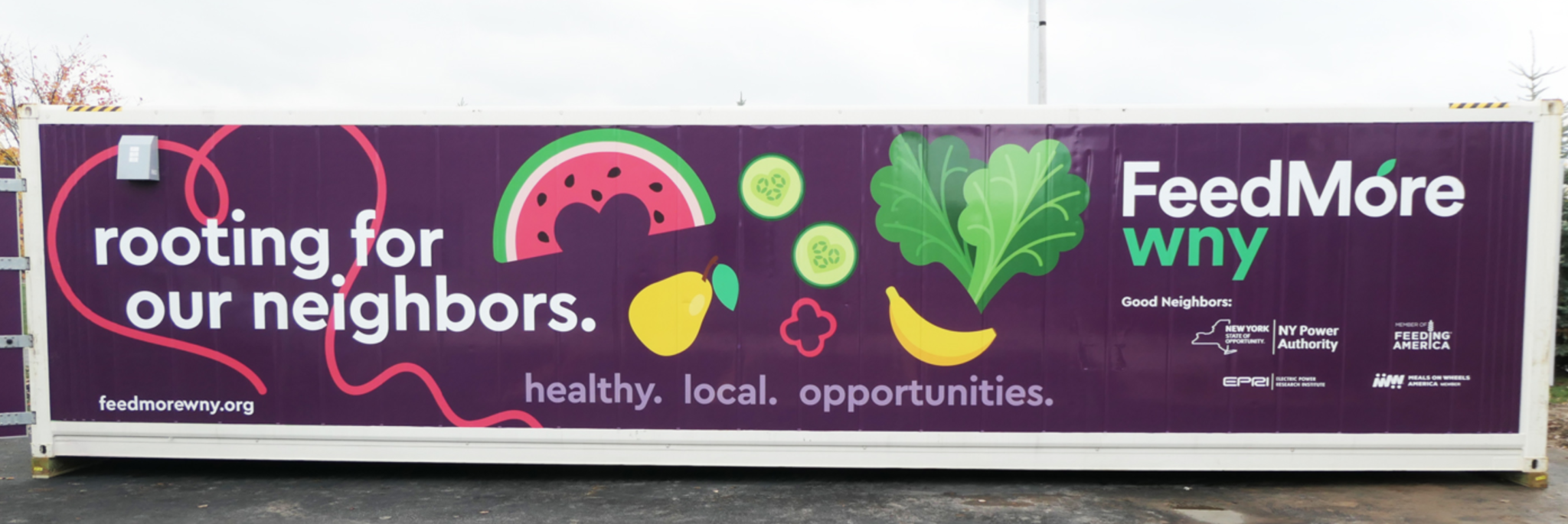
It’s great to see a push in WNY, for healthier food production for underserved neighborhoods. But what happens when the growing and harvesting seasons are over, and winter sets in? That’s a question that is now being asked, and answered, thanks to a pilot program that has been launched, which has resulted in the appearance of a specially outfitted 40-foot shipping container. This container – branded “Rooting for Our Neighbors” – will help to extend the growing season year-round, with produce being earmarked for food pantries and soup kitchens associated with the food security efforts of FeedMore WNY (the largest hunger-relief organization in WNY).
This inventive (and very exciting) effort is thanks to a research collaboration funded by the New York Power Authority’s (NYPA) Environmental Justice Program and led by the National Electric Power Research Institute (EPRI). Side benefits from the project include “environmental and energy impacts that could help reduce costs and expand crop production.”
The demonstration will:
Provide produce for FeedMore WNY nutrition programs
Help address climate change in communities that host NYPA facilities
Support New York State’s clean energy and greenhouse gas reduction goals by using this low-energy indoor farming method
“The New York Power Authority is pleased to be part of this national collaboration with the Electric Power Research Institute that will improve indoor farming methods while supporting our neighbors in need in Western New York,” said NYPA Chairman John R. Koelmel. “Under Governor Andrew Cuomo’s continued climate leadership, we will find new and sustainable ways to grow affordable and fresh produce all year while prioritizing New York State’s greenhouse gas reduction goals.”
NYPA is one of eight utilities nationwide to participate in a two-year EPRI study designed to help utilities better understand and engage in commercial-scale indoor food production, which is reliant on efficient energy and water consumption.
The new indoor production facility is located at FeedMore WNY’s offices on James E. Casey Drive in Buffalo, which makes it easily accessible to deliver produce to a Mobile Food Pantry and Meals on Wheels programs, where kale dishes will be prepared. The first growing cycle will be dedicated to the growing of kale, which is high in nutrient value and has a short harvest cycle. After the first year, additional crops will be added to the program.
“Indoor agriculture is essential to future food production and we need to understand its implications for the electric power industry,” said Gil C. Quiniones, NYPA’s president and CEO. “NYPA is eager to demonstrate a replicable, sustainable indoor farming solution that helps to address climate change in the communities that host our facilities. If utilities have solid knowledge about how lighting, water use, and other systems impact plant production, we can be good partners in helping to provide food resources to disadvantaged communities in our respective regions through these innovative farming methods.”
Benefits of the indoor growing facility include: A controlled environment, pesticide-free, ‘sunless’ environment, and far less water usage when compared to traditional farming methods. Also, these mobile units can be built anywhere, which makes them ideal for addressing problems associated with ‘food deserts’ year-round. Additional benefits include very little transportation costs, reduction of spoiled produce, and a smaller carbon footprint… all while addressing food insecurity in WNY.
State Agriculture Commissioner Richard A. Ball said, “This indoor farming project is a unique and creative way to support urban agriculture and to increase access to healthy food in our communities. Building on the work the State has been doing through initiatives like Nourish to deliver fresh foods to families in need, this pilot program will allow FeedMore WNY to provide local agricultural products year-round. I thank NYPA, EPRI and FeedMore WNY for their participation in this forward-thinking project, and look forward to the first harvest.”
An advantage of ‘Container Farm Project’ is the ability to track data such as energy loads, water use, etc., which will help the research team to tweak and optimize the system. This technology will only get better and more efficient, with higher yields in years to come.
EPRI President Arshad Mansoor said, “Against the backdrop of increasing weather events and a global pandemic, there’s been an increasing appetite for indoor food production. EPRI engineers and scientists have been at the nucleus of this development, advancing technology to run container farm demonstrations across the country. This is a worldwide movement toward sustainable communities. Indoor agriculture also is an important part of efficient electrification, which is critical to enabling decarbonization throughout the economy.
Tara A. Ellis, president and CEO of FeedMore WNY, said, “FeedMore WNY is incredibly excited for this opportunity to work with New York Power Authority and the Electric Power Research Institute in order to grow nutritious produce for distribution to our hungry community members, NYPA and EPRI are the true definition of good neighbors and we are so fortunate to have their support as we work to make sure our neighbors in need have access to nutritious food, including fresh produce.”
This new program is part of NYPA’s Environmental Justice program, which is not only dedicated to providing educational programs about clean, renewable energy, and sustainability, it is also in place to address food insecurity, while helping to better the lives of those who live in underrepresented communities near NYPA’s power assets.
“NYPA uses its expertise and resources to help benefit residents who live and work in areas near our facilities,” said Lisa Payne Wansley, NYPA vice president of environmental justice and sustainability. “This indoor food production initiative aligns with and supports NYPA’s Sustainability Plan goals to demonstrate sustainable solutions to addressing climate change in local communities where we operate.”
The COVID-19 pandemic has presented mounting food insecurity problems, which must be dealt with immediately, especially in cities with colder climates.
Senator Tim Kennedy said, “For years, FeedMore WNY has served as a critical resource for many, and that important role has only been magnified throughout the COVID-19 pandemic. Through this partnership, WNY families will have increased access to fresh, locally grown food, which will in turn fuel healthier communities and provide nutritious support to those who need it most.”
Majority Leader Crystal Peoples-Stokes said, “This collaboration is a major step forward in bringing healthy food options, mainly fresh fruits, and vegetables, to some of our city’s food deserts. We thank the NYPA and the state for dedicating its expertise and resources to EPRI and FeedMore WNY to help advance year-round indoor farming in areas that need it the most.”
Mayor Byron W. Brown said, “Low-income communities, and especially Black and brown communities, have historically faced difficulties with food security and access to fresh, healthy fruits and vegetables. The COVID-19 pandemic has only heightened those challenges, either through a loss of income, decreased mobility, or more limited access to supportive nutritional programs. Today’s announcement of this new partnership is a bold step in helping to address these systemic problems. I am confident that this collaboration between Governor Andrew Cuomo’s office, the New York Power Authority’s Environmental Justice Program, the Electric Power Research Institute and FeedMore WNY, will help advance indoor farming in our community and further strengthen Buffalo’s year-round production of fresh produce in the neighborhoods with residents who have had the most trouble accessing them.”
Tagged with:'Container Farm Project', Electric Power Research Institute, Environmental Justice Program, FeedMore WNY, New York Power Authority

VIDEO: Nature Fresh Farms Opens Up About Guest Worker Program In Short Documentary
The film focuses on the Guest Workers that have come to Canada as an opportunity to work, and for some a way to provide for their families
Leamington, ON (November 10th, 2020) – Nature Fresh Farms has released a twenty-two-minute documentary offering an inside look at their operations during the Covid-19 outbreak centering around the experiences of their guest workers.
The film focuses on the Guest Workers that have come to Canada as an opportunity to work, and for some a way to provide for their families. The documentary captures the personalities and perspectives of several guest workers, giving them a platform to share their experiences over the past summer but also speak about their overall time at Nature Fresh Farms.
“People are going to get a lot out of this documentary, no matter how familiar they are with agriculture,” explained John Ketler, Vice President. “Even if you’re familiar with Guest Workers and how valuable they are to our food system, it’s not often that you get to hear from them directly about their experiences and dreams, or their perspectives on the program they’re an integral part of. Their voices deserve to be heard.”
The Guest Workers that have chosen to come to Canada have had to make personal sacrifices in order to work here while being away from their families for months at a time, Nature Fresh Farms understands the importance of creating a supportive and safe living environment to help make the transition easier. They hope that this documentary clears up any misconceptions people may have had regarding the treatment of their employees and that there is no question if they truly value, support, and care for their team.
“Transparency is one of our company’s key pillars. Whether we are talking about how we grow our Tomatoes, or how we treat our team, we’ve always been an open book,” shared Founder and President, Peter Quiring. “We hope this documentary will help us continue to be fully transparent about who we are and what we stand for, as well as help us share the details of what happened at our farm this summer.”
In addition to the documentary, Nature Fresh Farms released an information page on their website to provide additional information answering some frequently asked questions about their on the Guest Worker Program and introduce a few of the individuals participating in the program.
-30-
About Nature Fresh Farms -
Continuously expanding, Nature Fresh Farms has become one of the largest independent, vertically integrated greenhouse vegetable farms in North America. As a year-round grower with farms in Leamington, ON, Delta, OH, and Mexico, Nature Fresh Farms prides itself on consistently delivering exceptional flavor and quality to key retailers throughout North America, while continuing to innovate and introduce more viable and sustainable growing and packaging solutions.
SOURCE: Nature Fresh Farms | info@naturefresh.ca T: 519 326 1111 | www.naturefresh.ca

SINGAPORE: High-Tech Vertical Farms To Begin Operations Next Year And Bring Fresher Leafy Greens To S’poreans’ Plates
From next year, Singaporeans can expect more of their favorite Asian vegetables to reach their plates quicker and fresher, thanks to a slew of high-tech urban farms that are set to begin operations
By LOW YOUJIN
NOVEMBER 15, 2020
&ever's dryponics cultivation technique will allow customers to harvest their vegetables just before they decide to use it.
&ever, Indoor Farm Factory Innovation and Genesis One Tech Farm are part of eight companies that have accepted SFA’s 30X30 Express Grant
The grant will help these companies accelerate Singapore’s efforts to meet 30 percent of its nutritional needs locally by 2030
The benefits of indoor farming are that it requires less space to grow crops, and optimal growing conditions can be replicated
Representatives from the three companies said prices will be competitive, and they will offer Singaporeans fresher and higher quality produce
SINGAPORE — From next year, Singaporeans can expect more of their favorite Asian vegetables to reach their plates quicker and fresher, thanks to a slew of high-tech urban farms that are set to begin operations.
For vertical farming company &ever, it can even sell its vegetables “while they are still living”, said the firm’s chief executive officer Henner Schwarz.“You don't need to refrigerate it down to 4°C (to keep it fresh),” he said. “You can actually have it at room temperature when you buy it at the supermarket, and it continues to grow at home. It stays fresh for at least a week.”&ever currently has a fully operational indoor farm using the same technology in Kuwait that produces about half a tonne of vegetables each day.
Its Singapore outfit, which will be located within the Changi vicinity and will be operating from around October next year, will be larger and produce more than double that amount — about 1.25 tonnes a day — said Dr. Schwarz.
The Hamburg-based company is just one of eight companies — an egg farm and seven vegetable farms — to have accepted the Singapore Food Agency’s (SFA) 30x30 Express Grant to ramp up local food production.
The SFA said the grant will accelerate Singapore’s efforts to meet its 30 by 30 goal, which is to secure 30 percent of the country’s nutritional needs with food produced locally by 2030.
It will also help to minimize disruptions to Singapore’s food security, due to events such as the Covid-19 pandemic.
Part of the grant requirements, said some recipients who are growing vegetables, is to ensure at least 50 percent of the crops grown are Asian greens like xiao bai cai or kangkong.
THE SINGAPORE FIRMS
Two Singaporean companies that have accepted the grant have similarly shared some of the innovative technologies that they will be using.
Over at the south-western end of the island, Indoor Farm Factory Innovation (IFFI) intends to leverage on its parent company Tranzplus’ knowledge of automation to make its work processes more efficient.
Mr. Alfred Tham, IFFI’s chief executive officer, said robotics will also help reduce operational costs at its 38,000 square foot facility at JTC Space @ Tuas when it is ready for operation in the second half of next year.
Beyond that, Mr. Tham said their machines will have the ability to analyze the condition of the plants, such as when they will be ready for harvest.
All this, he said, will not only help to reduce manpower needs but also scale up production to meet SFA’s minimum requirement of 200 tonnes of produce annually.
Mr. Tham said IFFI will be using an indoor farming methodology of soil-based cultivation, which allows them to have greater flexibility in the variety of crops that they can grow.
What this means is that the plants can be grown in separate containers, which enables them to customize the growing conditions as needed.
Moreover, it reduces the risk of cross-contamination between plants, said Mr. Tham. Still, Mr. Tham said they will be utilizing a special water treatment system to reduce bacteria.
Mr. Alfred Tham, CEO of IFFI, beside a robotic arm that will be featured in his firm's vertical farm facility in Tuas. Photo: Low Youjin/TODAY
Meanwhile, Genesis One Tech Farm intends to take its operations closer to the heartlands and will have a 10,000sq ft facility situated in Eunos that is about a three-minute walk from the Singpost Centre.
The farm’s director, Mr. Shawn Ow, expects operations to begin within the first quarter of next year.
One of the key technical features of the subsidiary of the investment holding and managing company, TSL Group, is the use of a custom-designed hybrid Nutrient Film Technology system, coupled with 5G energy-saving LED lighting in order to maximize growth cycle efficiency.
Mr. Ow said the system enables the firm to recycle the water used, thus using a fraction of the water requirements generally associated with a hydroponic system and minimizing the environmental waste impact.
But more importantly, said Mr. Ow, is that his company hopes to provide jobs for Singaporeans. It is exploring hiring residents living around the area on a part-time basis and is also in discussions with an institution supporting the rehabilitation of ex-offenders.
And as the firm is located within the heartlands, it is also not ruling out the possibility of allowing potential customers to buy directly from its facility.
Mr. Shawn Ow, director of Genesis One Tech Farm, at his company's test lab. Photo: Nuria Ling/TODAY
‘BUY LOCAL’
For Mr. Tham, he plans to start a cafe in Bukit Panjang which will not only feature its produce on the menu but a cultivation showroom to raise awareness about indoor farming.“When we talk about indoor farms, not many have seen it,” he said.
The Big Read: Singapore has been buttressing its food security for decades. Now, people realize why
Aside from taking up far less space compared to a traditional open-air farm, vertical indoor farms are also not at the mercy of the weather, said the representatives from the three companies.
Moreover, growing conditions such as temperature, humidity, and lighting conditions can be replicated so that plants that do not normally thrive in the tropics can be grown indoors instead.
Price-wise, the representatives said it will be competitive.
The prices may not be cheaper than the vegetables imported from Malaysia, but Mr. Tham said they will definitely be fresher and of higher quality. It also offers a better alternative compared to imports from further away.“If you are choosing between imports from Japan or local produce, buy local,” he said. “The reason is very simple — it reduces the carbon footprint.”
TOPICS
SINGAPORE FOOD AGENCY FOOD FARMING AGRICULTURE FOOD SECURITY

Abu Dhabi’s AgTech Ecosystem Expands Across Land, Sea And Space
The Abu Dhabi Investment Office (ADIO) announced today individual partnerships with Pure Harvest Smart Farms (Pure Harvest), FreshToHome, and Nanoracks that will see the companies receive financial and non-financial incentives totaling AED 152 million (USD 41 million)
ADIO partners with Pure Harvest Smart Farms, FreshToHome, and Nanoracks
AED 152 million (USD 41 million) incentives for ‘land, sea and space’ projects to increase AgTech capabilities for food production in arid and desert environments
New partnerships part of ADIO’s AgTech Incentive Programme, established under Ghadan 21, Abu Dhabi’s accelerator program
Abu Dhabi, UAE – 10 November 2020: Three innovative agriculture companies will develop cutting-edge projects in Abu Dhabi to boost the emirate’s agriculture technology (AgTech) capabilities across land, sea, and space. The Abu Dhabi Investment Office (ADIO) announced today individual partnerships with Pure Harvest Smart Farms (Pure Harvest), FreshToHome, and Nanoracks that will see the companies receive financial and non-financial incentives totaling AED 152 million (USD 41 million). The research and technologies developed by these companies will expand existing capabilities in Abu Dhabi’s AgTech ecosystem and promote innovation in the sector to address global food security challenges.
The new partnerships are a continuation of ADIO’s efforts to accelerate the growth of Abu Dhabi’s AgTech ecosystem through the AgTech Incentive Programme, which was established under Ghadan 21, Abu Dhabi’s accelerator program. The Programme is open to both local and international AgTech companies. The partnerships follow ADIO’s AED 367 million (USD 100 million) investment earlier this year to bring four AgTech pioneers – AeroFarms, Madar Farms, RNZ, and Responsive Drip Irrigation (RDI) – to the emirate to develop next-generation agriculture solutions in arid and desert climates.
H.E. Dr. Tariq Bin Hendi, Director General of ADIO, said: “Abu Dhabi is pressing ahead at full steam with our mission to ‘turn the desert green’ and solve long-term global food security issues. We have created an environment where innovative ideas can flourish and this has enabled the rapid expansion of our AgTech sector. Innovations from the companies we partnered with earlier this year are already propelling the growth of Abu Dhabi’s 24,000 farms. Partnering with Pure Harvest, FreshToHome and Nanoracks adds a realm of new capabilities to the ecosystem across land, sea, and space.”
Bin Hendi continued: “We are driving innovation across the entire agriculture value chain and this is producing a compounding effect that is benefiting farmers, innovators, and companies in our region and beyond.”
Pure Harvest, FreshToHome, and Nanoracks have been awarded financial and non-financial incentives to expand operations in Abu Dhabi. The competitive incentive packages include rebates on innovation-linked high-skilled payroll, high-tech CAPEX, as well as land, utility, and intellectual property support.
Since the beginning of 2020, ADIO has attracted seven AgTech companies to Abu Dhabi, each bringing a complementary skill to expand the ecosystem. ADIO’s new partnerships with Pure Harvest, FreshToHome, and Nanoracks will build on the achievements made by AeroFarms, Madar Farms, RNZ, and RDI, the AgTech pioneers ADIO partnered with earlier this year to establish R&D and production facilities in Abu Dhabi.
Partnerships with Pure Harvest, FreshToHome, Nanoracks
Pure Harvest is a home-grown, tech-enabled farming venture that uses cutting-edge food production systems to grow fresh fruits and vegetables in a climate-controlled environment, enabling year-round production anywhere, while using seven times less water compared to traditional farming methods. Pure Harvest will invest in smart farming and infrastructure technologies at its new farms in Al Ain, Abu Dhabi, to optimize growing conditions through hardware design innovations, artificial intelligence, autonomous growing and robotics, plant science research, and desert-optimized machines. The company will also progress R&D and deployment of a commercial-scale algae bioreactor production facility that will grow higher quality, healthier Omega-3 fatty acids without the limitations and challenges of traditional animal sources.
Sky Kurtz, Co-Founder, and CEO of Pure Harvest, said: “We are delighted to have received the support of ADIO to further invest in our home-grown, innovative growing solutions. It also serves as a powerful endorsement of our business case and mission as we pursue innovation to address food security locally and internationally. As one of the pioneering champions in the region’s emerging AgTech sector, this commitment will give us the resources we need to drive and expand our R&D capabilities and will position us for international expansion from our strategic base in Abu Dhabi. This partnership further demonstrates how committed the government is in supporting and enabling innovative technology companies, providing them with the tools, resources, and support to thrive and make a large-scale impact in the region.”




FreshToHome is an e-grocery platform for fresh, chemical-free produce. The company maintains complete control over its supply chain, inventory, and logistics by obtaining produce directly from the source through an AI-powered auction process. ADIO’s partnership will aid the expansion of FreshToHome’s land and sea operational and processing capabilities in the UAE, bringing expertise in aquaculture, contract farming for marine and freshwater fish species, and precision agriculture to Abu Dhabi. It will also invest in innovative fish farming technologies and cold chain.
Shan Kadavil, CEO and Co-Founder of FreshToHome, said: “At FreshToHome we use cutting-edge research in AI and precision aquaculture for furthering food security in a sustainable manner while also giving better value to consumers, fishermen, and farmers. To this end, we intend to bring our US patent pending AI-powered Virtual Commodities Exchange technology, our e-grocery platform, and our nano farm aquaculture technology to Abu Dhabi, enhancing food production and distribution for the region. ADIO has been a terrific partner to us and we are thankful for their support in helping us be part of the vision.”
US-based Nanoracks, the single largest commercial user of the International Space Station, opened its first UAE office in Abu Dhabi’s global tech ecosystem, Hub71, in 2019. Nanoracks is building the first-ever commercial AgTech space research program, the ‘StarLab Space Farming Center’, in Abu Dhabi as a commercial space research facility focused on advancing knowledge and technology for organisms and food produced in space and in equally extreme climates on Earth. The space-based technology will be applied to desert agriculture to address pressing environmental and food security challenges and to benefit long-term human space exploration.
Allen Herbert, SVP of Business Development and Strategy, and Head of Nanoracks, UAE, said: “Much of today’s technology used for vertical, urban and closed environment agriculture initially came from space research from 30 years ago, and Nanoracks is ready to synergize these technologies back to in-space exploration. We firmly believe that space research holds the keys to solving major challenges on Earth from climate change to food security. And our StarLab Space Farming Center in Abu Dhabi is just the beginning. We’re building a global research and development team that will produce and commercialize organisms, technology, and innovative products that will not only revolutionize farming in Earth’s deserts and harsh environments but also change the way humans are able to explore deeper into our universe.”


![Bishop greenhouse node 3-release[9].png](https://images.squarespace-cdn.com/content/v1/57c8695d5016e11e71be1d83/1605455646106-3SFP8ZAB64F42DKMZ4F0/Bishop+greenhouse+node+3-release%5B9%5D.png)
![Nanoracks outpost cutaway LEO-release[8].png](https://images.squarespace-cdn.com/content/v1/57c8695d5016e11e71be1d83/1605455617641-BHM7DM1BWPD7PLT248Z1/Nanoracks+outpost+cutaway+LEO-release%5B8%5D.png)

Earth911 Podcast: Eden Green CEO Eddy Badrina Talks About Vertical Greenhouse Farming
Eden Green licenses the growing system to urban farmers who can set up in old buildings and warehouses to grow fresh greens, berries, and peppers year-round
Earth911 | Nov 9, 2020
Earth911 talks with Eden Green CEO Eddy Badrina about the company’s vertical greenhouses that will help the world grow locally and end food insecurity. While Americans expect to buy fresh product year-round, flying foods from Central America and the Southern Hemisphere carries a heavy environmental cost. Urban farming can fill in critical gaps in local food supplies, providing year-round, locally grown fresh produce.
Eden Green licenses the growing system to urban farmers who can set up in old buildings and warehouses to grow fresh greens, berries, and peppers year-round. The system uses natural light augmented by lighting on cloudy days, along with recycled water to substantially reduce the carbon footprint compared to traditional farming. Badrina discusses the pressing need for food production and security to serve a growing population.
EDEN GREEN CEO EDDY BADRINA
Eden Green Technologies built a research and development greenhouse farm in Cleburne, Texas, and is preparing to launch its first commercial farming operation. The farm system includes 18-foot vertical hydroponic growing racks, lighting, and climate management equipment. With this system, a 1.5-acre urban farm can grow around 900,000 pounds of salad greens or 50 other types of produce annually, harvesting fresh produce daily for local consumption. The Eden Green systems delivers produce that is “better than organic,” Badrina said, that grows year-round, in any climate.
Badrina explains that urban farms will open new employment opportunities and encourage growers to give back to their communities. The Eden Green team will work with investors and local communities to work out the financing, build the farm, train the staff, and launch the business before handing it over to the local operator.
Listen to the podcast at Earth911.com.
To learn more about Eden Green and vertical greenhouses, visit edengreen.com.
Subscribe to Sustainability In Your Ear on iTunes
Follow Sustainability In Your Ear on Spreaker, iHeartRadio, or YouTube