


Welcome to iGrow News, Your Source for the World of Indoor Vertical Farming
Wilmington’s First Vertical Farm Clears A Final Hurdle
An amendment to the City Code was needed for Second Chances Farm, which aims to employ people returning from the prison system with urban agriculture jobs, to start operating in its Northeast location.
City Council member Zanthia Oliver and Mayor Mike Purzycki show off recently harvested hydroponic lettuce from Second Chance Farms. (Photo by Holly Quinn)
An amendment to the City Code was needed for Second Chances Farm, which aims to employ people returning from the prison system with urban agriculture jobs, to start operating in its Northeast location.
A lot of things have had to come together in order to make Second Chances Farm, founded by entrepreneur and TEDxWilmington organizer Ajit George, a reality.
As an Opportunity Zone project, there were applications and approvals; a reentry program was established with a Delaware Department of Corrections contractor; a location on Bowers Street in Northeast Wilmington was secured.
There was one more detail: The City of Wilmington, which has been supportive of the program that aims to employ people returning from the prison system with $15-an-hour “green collar” urban agriculture jobs, had to officially put it in writing that indoor farms are permitted in the city.
On Wednesday, July 30, at the offices of Second Chance Farms on West 13th Street, the legislation sponsored by City Council member Zanthia Oliver, which amended Chapter 48 of the City Code to permit indoor commercial horticultural operations, was signed by Mayor Mike Purzycki.
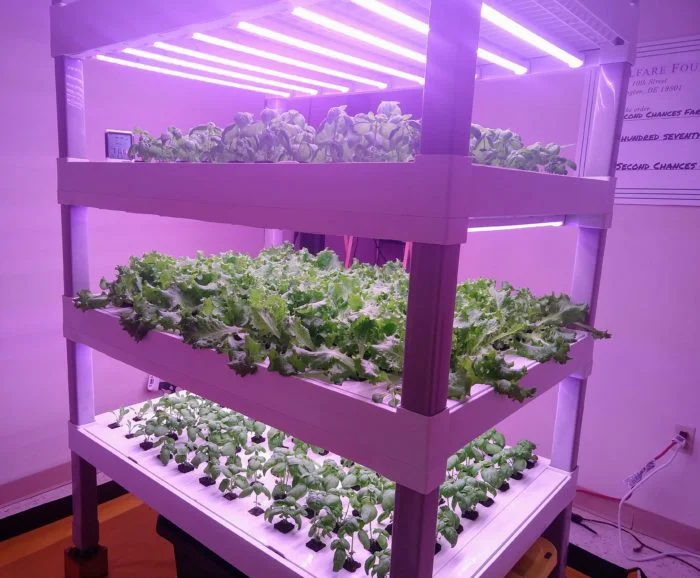
A small version of the hydroponic unit is up and running in the office, growing four tiers of lettuce and basil under the cool LED lights; the units that will be in the Northeast location — 400 of them — will be eight tiers high.
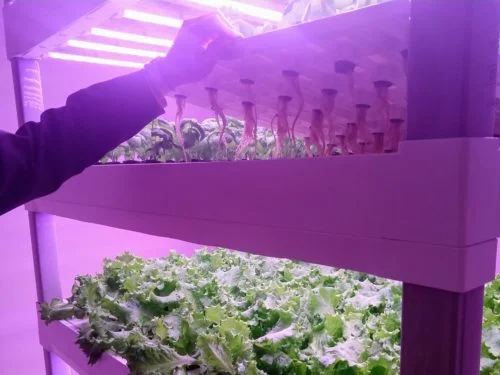
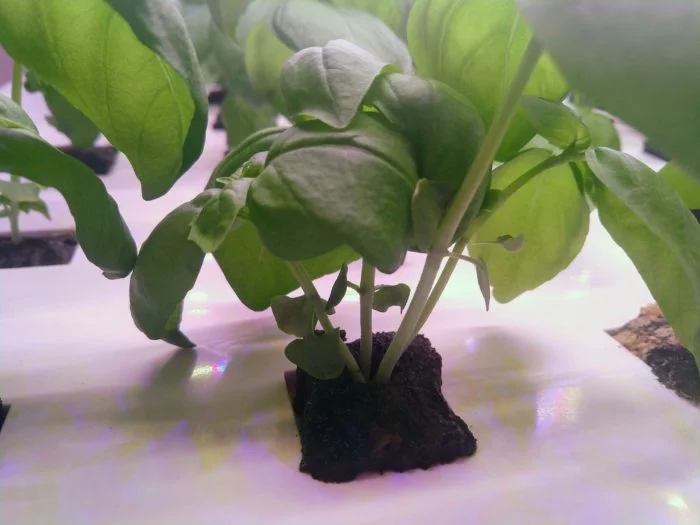
“There’s no soil used, just water,” said Evan Bartle, chief growing officer for Second Chances Farm, lifting a panel of basil plants to show the roots. What looks like soil at the base of the plants is actually rockwool — “rock that has been spun out like cotton candy,” Bartle said. The reusable medium, a standard in commercial hydroponics, is used to support the plants above the water.
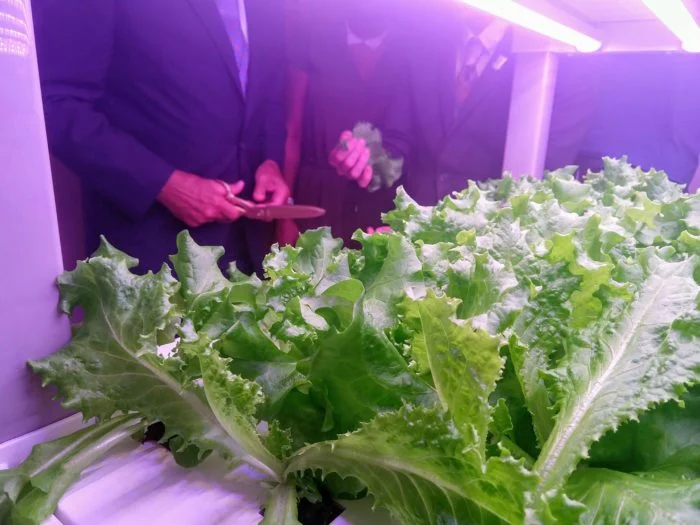
After signing the amendment, they mayor ceremonially cut the first leaves of lettuce with (slightly) oversized golden scissors and had a taste.
“This is the baby lettuce that restaurants love,” said George. (And, yes, it tastes very good — members of the press were also given samples of the lettuce to try.)
When the farm official opens on Bowers Street, in a building conveniently named The Opportunity Center, it will provide jobs for returning citizens with the goal of reducing recidivism in Wilmington, while providing locally grown, chemical-free produce to businesses in the region.
In addition to the vertical farm, the facility will offer services including CrossFit or a gym to employees and community members.
Check out more pics from the event:

(Photos by Holly Quinn)
Vertical Farming Outfit Raises $100M In Funding
Vertical farming operation AeroFarms has raised $100 million in a Series E funding round, bringing its total funding to $238 million
Credit: George Hodan
Author: Lauren Manning
Vertical farming operation AeroFarms has raised $100 million in a Series E funding round, bringing its total funding to $238 million. The funding will help the company expand its warehouse facilities that hold its vertical farms and look into growing different types of produce. The company has been on a slow and steady growth trajectory.
Ingka Group, parent company of furniture maker Ikea, led the funding round, bringing AeroFarm's total funding to $238 million. In 2019, the vertical farming company closed a deal with Singapore Airlines to provide fresh produce for in-flight food.
Based in New Jersey, AeroFarms is one of the oldest players in the indoor farming sector, founded in 2004. It is part of the Precision Indoor Plants Consortium, which focuses on growing crops specifically for indoor farming and optimizing their flavors.
Investors keep pouring dollars into indoor farming operations, which promise to provide retailers and consumers with efficiently produced, fresh and tasty produce. Indoor farming is projected to be a $3 billion market by 2024 as consumers continue to show an interest in finding more local produce.
But a numerous hurdles still challenge indoor farmers’ hopes of scaling beyond a niche industry. For starters, many indoor farms are limited in what they can produce, sticking to leafy greens and herbs. High electricity costs and water input needed to power indoor farms also have some asking whether they really are more resource-efficient than traditional farming.
In order to expand their footprint and get their products on more diners’ dinner tables, indoor farming startups are eyeing partnerships with key retailers and doubling down on efforts to be able to provide fresh leafy greens to hundreds of grocery stores, according to Reuters.
The East and West coasts have hotbeds for indoor ag innovation, but the Midwest is getting its own urban farming campuses soon thanks to Elon Musk’s Square Roots. The Brooklyn-based company inked a deal with Gordon Food Service’s campuses in Wyoming and Michigan that involves setting up 10 specially designed shipping containers to provide fresh produce to the food supply company’s supply chain. The herbs and greens grown on campus will be sold commercially to chefs and to consumers who shop at Gordon Food Service’s retail store.
Google Ventures backed Bowery Farming, which recently raised $90 million, is expanding to its third farm and has supply deals with key NYC establishments like Whole Foods, Foragers and Sweetgreen. Competitor Bright Farms is opening three new greenhouses in Massachusetts, New York, and North Carolina and sells to numerous retailers including Tops Friendly Markets, Food Lion, and Jungle Jim’s.
Vertical farming operation Plenty also raised $200 million in June and is hoping to branch into other types of crop cultivation like strawberries and tomatoes. It’s banking on e-commerce by selling its packaged salads through online grocery delivery platform Good Eggs.
The indoor ag industry is sprouting across the pond, too, with online grocery company Ocado recently taking a 58% stake in Jones Foods Co., the largest vertical farm in Europe, and joining forces with mission-driven indoor farming startup Infinite Acres.
Recommended Reading:
Filed Under: Fresh food Natural/organic Corporate
Britain’s Ocado Is Raking 17 Million Pounds In Vertical Farming To Diversify
Britain’s Ocado is raking 17 million pounds ($22 million) into the emerging “vertical farming” trade, additional diversifying the online grocer and technology group’s enterprise. Vertical farming includes producing food indoors, with crops grown on a collection of stacked ranges in a controlled atmosphere
July 8, 2019
Britain’s Ocado is raking 17 million pounds ($22 million) into the emerging “vertical farming” trade, additional diversifying the online grocer and technology group’s enterprise.
Vertical farming includes producing food indoors, with crops grown on a collection of stacked ranges in a controlled atmosphere.
“We foresee a day the place clients’ vegetables are harvested hours earlier than they’re packed, meters from the place they’re shipped,” Ocado stated in a press release on Monday.
Ocado mentioned it had shaped a joint venture known as Infinite Acres with vertical farming contributors 80 Acres Farms and Priva Holding, with every holding a 3rd of the equity.
Priva is a Netherlands-primarily based industrial methods supplier to the horticultural trade, with a variety of merchandise and options for climate control and course of automation.
U.S.-primarily based 80 Acres offers plant science knowledge and operations administration, whereas Ocado will contribute its software and hardware methods, together with robotics, automation and AI.
Ocado stated it has additionally acquired a 58% stake in Jones Food Company (JFC), Europe’s largest working vertical farm, which is predicated in Scunthorpe, northern England.
JFC’s plant produces Vegetables and herbs for British prospects with its capability anticipated to develop to 420 tonnes a year.
Ocado, which mentioned its fairness investments within the joint venture and JFC would total 17 million pounds added that the density of vertical – farms permits them to be positioned a lot nearer to prospects, probably co-located after its companions’ distribution centers, supermarkets and close to population facilities.
Ocado has a 1 % share of Britain’s grocery market solely. Nevertheless, its 7.9-billion-pound stock market valuation has been driven by its technology.
This offers worldwide retailers with the infrastructure and software to develop their very own online grocery companies to compete with the likes of Amazon.
Ocado shares had been up 3% at 0809 GMT.
U.S.-Based Indoor Farms Say They Are Prepared To Scale Up
Leafy salad greens grown under banks of LED lights, with mist or drips of water are having their day in the sun. Several top U.S. indoor farms, stacked with plants from floor to ceiling, tell Reuters they are boosting production to a level where they can now supply hundreds of grocery stores
Plenty, Bowery, Aerofarms and 80 Acres Farms say they are prepared to make their crops 'grocery store competitive.'
July 10, 2019
Posted by Chris Manning
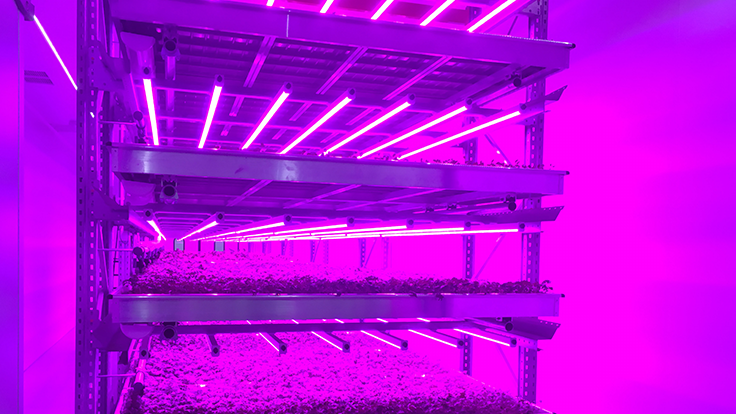
Leafy salad greens grown under banks of LED lights, with mist or drips of water are having their day in the sun. Several top U.S. indoor farms, stacked with plants from floor to ceiling, tell Reuters they are boosting production to a level where they can now supply hundreds of grocery stores.
Plenty, Bowery, Aerofarms and 80 Acres Farms are among young companies that see a future in salad greens and other produce grown in what are called vertical farms that rely on robotics and artificial intelligence, along with LED lights. While the first versions of modern vertical farms sprouted about a decade ago, in recent years the introduction of automation and the tracking of data to regulate light and water has allowed them to get out of lab mode and into stores. Now they are trying to scale up.
Continue Reading at CNBC

The Future of Food: Indoor Agriculture
The amount of people facing chronic food insecurity is estimated to be about 821 million (Food and Agriculture Organization of the United Nations).
Anya Aggarwal
8th July 2019
The amount of people facing chronic food insecurity is estimated to be about 821 million (Food and Agriculture Organization of the United Nations). The world’s population is expected to grow to 9 billion people in a mere 30 years (USDA). Effects of climate change due to carbon emissions and unsustainable energy practices are an imminent threat. The United States uses 25% of the world’s energy with less than 5% of the world’s population, and has the second highest carbon footprint (UCSUSA). The people of the world must take action to combat these detriments, but how?
One of the hottest new trends in addressing issues of food security, population growth, and environmental sustainability is through indoor agriculture. Indoor agriculture employs various technologies including hydroponics, aeroponics, and LED Grow Lights combined with a vertical farming model to provide intuitive and sustainable farming methods. The technologies surrounding this practice have the capability to mitigate many imminent global concerns.
Indoor agriculture is a major player in ensuring widespread food security, something of great concern in places where a majority of the population lies below the poverty line. Food security refers to the availability of food and a person’s access to it on a daily basis. Impoverished areas including inner cities, countries in Africa, and other such places are faced with critically low food security that causes great strain on their physical and mental health. The use of LED Grow Lights in indoor agriculture produce much higher crop yields and “create optimum growing conditions for farmers to grow a crop from the seed to its harvesting stages in lesser time” according to Future Farming.
Case studies by Independence LED, one of the leading distributors in LED Grow Lights, have shown that greens produced through indoor farming with the LED technology have significantly greater amounts of foliage and last for over a month after harvest, as compared to the highly perishable outdoor-farmed greens. Additionally, since indoor agriculture allows the grower to control the climate in the greenhouse, food can be grown year-round and in almost any location, making food more accessible in even the most remote places. The levels of sustainability and efficiency that result from indoor agriculture work to increase both the availability and accessibility of food, effectively promoting higher worldwide food security.
In the next 30 years, the world’s population is predicted to grow by at least 2 billion people, if not more. That not only means more people taking up more space, but also indicates an increase in food demand. Some sources say that the demand for food may increase by up to 70%. The USDA also expects two out of three people to live in urban areas by that time. In a world where conventional agriculture already does not satisfy the population’s needs, the predicted rapid increase cannot be contained without new technology and agricultural methods. Indoor agriculture using LED Grow Lights and vertical farming is a promising solution to the impending increase in food demand and urbanization because it allows for food and greens to be produced close to urban areas as it does not require perfect natural conditions. Rather, it uses environmentally-friendly technology to simulate good growth conditions. According to the USDA, indoor agriculture works effectively by
reducing distribution chains to offer lower emissions, providing higher-nutrient produce, and drastically reducing water usage and runoff
making it one of the most efficient, sustainable, and popular new agricultural markets. As more and more farmers turn to indoor agriculture, the practice promotes job creation, environmental stewardship, and economic growth.
For more on LED Grow Lights
Some information in this article came from: https://independenceled.com/led-grow-lights/
https://www.usda.gov/media/blog/2018/08/14/vertical-farming-future
http://www.fao.org/state-of-food-security-nutrition/en/
https://www.ucsusa.org/global-warming/science-and-impacts/science/each-countrys-share-of-co2.html

‘We Are Right At The Starting Gate’: Vertical Farming Could Change The Food System
Population growth and urbanisation are expected to support the expansion of the ancient vertical farming industry
By Katy Askew
08-May-2019
ntelligent Growth Solutions (IGS) talks vertical farming, demand growth and its unique technological proposition.
Population growth and urbanisation are expected to support the expansion of the ancient vertical farming industry.
The future food system will have to feed more people with finite land and water resources. Climate change is likely to exasperate the issue. This is the perfect storm driving interest in vertical farming.
According to forecasts from market research provider Global Market Insights, the vertical farming sector will grow by around 25% to reach a value of €11 billion in the next five years.
Scottish food tech group Intelligent Growth Solutions wants to leverage its unique IP protected processes to be an important part of this story.
Working alongside the James Hutton Institute for crop research, IGS has already opened its first demonstration indoor farm and orders are coming in from around the world.
We spoke with IGS CEO David Farquhar at The Ingredients Show in Birmingham, UK, last month to hear more about what has been described as ‘the world’s most technically advanced indoor farm’.
“We are right at the starting gate” for where this technology could take us, he suggested.
Watch the video to learn more

Heliospectra Continues Global Expansion With Tokyo Office
General Manager Yasuhiro Suzuki to Lead Installations of Heliospectra’s integrated LED and helioCORE™ Light Control Solutions for Japan’s Plant Factories and Vertical Farms
July 09, 2019
General Manager Yasuhiro Suzuki to Lead Installations of Heliospectra’s integrated LED and helioCORE™ Light Control Solutions for Japan’s Plant Factories and Vertical Farms
(GOTHENBURG, Sweden / SAN FRANCISCO, CA, 9 July, 2019) – Heliospectra AB (publ) (OTCQB: HLSPY, FIRSTNORTH: HELIO), a world leader in intelligent lighting technology for greenhouse and controlled plant growth environments, announces the formation of Heliospectra Japan Co., Ltd. and the opening of a new Tokyo, Japan office in July 2019 under the leadership of General Manager Yasuhiro Suzuki.
“With Yano Research Group forecasting indoor grown vegetable sales from Japan’s vertical farms to reach 27.8 billion yen by 2022, Japan has established itself as the global role model in demonstrating the seamless integration of automation and control systems. Using Heliospectra’s most advanced LED lighting technologies and light controls, these businesses will consistently deliver fresh, locally grown and nutritious produce to retail markets, urban food service and quality-conscious consumers,” said Ali Ahmadian, CEO, Heliospectra.
Over the years, Heliospectra has rapidly expanded their product portfolio to focus on the benefits spectra-controlled LEDs, real-time sensor feedback and dynamic, automated light response bring to growers and commercial food producers. The company has also established strong local market presence and collaborations directly with customers in Europe, Canada, the United States, South America and Oceania.
As Japan’s plant factories and controlled environment farms create new demand for the robust helioCORE™ light control and horticultural LED lighting integrations as well as the complete helioCARE™ plant science and technical services expertise that Heliospectra offers, the company will focus on building customer relationships and strategic partnerships with the Tokyo office and a local Japanese team.
“Heliospectra has created intelligent and highly advanced LED lighting and light controls that provide growers and businesses with a comprehensive, flexible and fully connected system,” said Yasuhiro Suzuki, General Manager for Heliospectra Japan. “I look forward to working with Japan’s highly sophisticated growers and large-scale facilities to improve their profitability through standardizing crop performance and yields with Heliospectra’s customizable business solutions.”
Mr. Suzuki previously served in senior leadership positions with Tetra Pak for 25 years developing strategic partnerships and an extensive business network in Japan and across Asia. He holds a bachelor’s degree in Sociology from Rikkyo University in addition to associated graduate degrees in Marketing, Management and Organizational Leadership from IMD and Ashridge Business Schools.
Investor Relations:
Ali Ahmadian, CEO of Heliospectra | +46 (0)72 203 6344 | ir@heliospectra.com
Redeye is Heliospectra Certified Advisor for Nasdaq First North - www.redeye.se
Certifiedadviser@redeye.se | +46 (0)8 121 576 90
Heliospectra AB (publ) (OTCQB: HLS, FIRST NORTH: HELIO) is the global leader in intelligent lighting technology, light control systems and related services for greenhouse and controlled plant growth environments. With the vision to make commercial crop production more connected and resource-efficient, Heliospectra integrates customized LED spectral strategies with real-time response and artificial intelligence to create predictable and reliable business forecasts and harvest results. Founded in 2006, Heliospectra is committed to helping growers and commercial producers across six continents consistently increase yields and produce crops with quality appearance, superior nutritional or medicinal value and longer shelf life, harvest after harvest. Heliospectra is the recipient of multiple international awards and recognitions. For more information, please visit https://www.heliospectra.com.
Forward-Looking Statements
The statements in this press release constitute forward-looking statements within the meaning of federal securities laws. Such statements are based on our current beliefs and expectations and are inherently subject to significant business, economic and competitive uncertainties and contingencies, many of which are beyond our control. In addition, such forward-looking statements are subject to assumptions with respect to future business strategies and decisions that are subject to change. Potential risks and uncertainties include, but are not limited to, technical advances in the industry as well as political and economic conditions present within the industry. We do not take any obligation to update any forward-looking statement to reflect events or developments after a forward-looking statement was made.
This information was submitted for publication, through the agency of the contact person set out above, at 14:00 CEST / 7.00 AM CDT on July 9th 2019.
Tags:
Heliospectra , LED Lighting Strategies , Heliospectra AB , HLSPY , HELIO , OTCQB , Ali Ahmadian
About Us
Heliospectra AB is the industry’s most proven intelligent lighting technology for greenhouse and controlled plant growth environments. With the vision to make commercial crop production more connected and resource-efficient, growers and commercial producers across six continents use Heliospectra’s holistic and flexible solutions to consistently increase yields while producing crops that achieve quality appearance, superior nutritional or medicinal value and longer shelf life, harvest after harvest. Founded in 2006 and winner of multiple international awards and recognitions, Heliospectra has raised more than $32 million in capital to date. As a publicly traded company, the majority ownership remains with some of Heliospectra earliest investors Weland Steel, Midroc New Technology and Swedish Industrial Fund. For more information, please visit https://www.heliospectra.com.

Literally Growing An Award-Winning Hardware Business Lettus Grow Wins 2019 Hardware Award At The Sparkies
Developing new indoor farming technologies is not just tackling a major problem but also winning awards. LettUs Grow in Bristol is developing aeroponics that allow crops such as strawberries and even trees to be grown indoors under LED lights.
9TH JULY 2019
Developing new indoor farming technologies is not just tackling a major problem but also winning awards. LettUs Grow in Bristol is developing aeroponics that allow crops such as strawberries and even trees to be grown indoors under LED lights.
The company won the Hardware Award at last week’s Sparkies for its technology, to sit alongside a number of awards and deals, including time in the Oracle and John Lewis technology incubators.
The company was set up by three engineers from the University of Bristol, where there is a focus on how to be as green as possible, says said Ben Crowther, co-founder and chief technology officer.
Being in Bristol and the strong ecosystem has been a key part of the success of the company. “We’ve got a really good ecosystem here to bounce idea off along the way,” he said.
You may like: Oracle Startup Cloud Accelerator’s first Bristol-based cohort pitch to top UK investors
“I’m a systems engineer and I was really interested in our food supply chain, primarily in the reduction of food waste, but then also making it more resilient to weather change and freak events to make sure we can all eat as we grow as a population and reduce the carbon footprint while doing it,” he said.
The aeroponics they developed uses 95% less water than hydroponics as it is a closed loop system based around a mist that carries water and nutrients to the roots of the plants and everything is filtered and re-used.
“Our core advantage is we have a completely novel irrigation system – our aeroponics is simple,” he said. “We don’t use high pressure nozzles that are prone to breaking, it’s a really, really simple system that we developed. That means we have increased growth rates compared to hydroponics.”
“We do use more power but the benefit is that you can position production right by the point of consumption or distribution,” he said.
“We don’t think it should replace hectares of fields. Indoor farming, greenhouses and open field farming each have their different roles,” he said. “If you can grow it in a field grow it in a field, it makes much more sense. But in many places its just not possible as it uses too much water and pesticides and the soil is degrading quite rapidly, so having a baseline production of crops that are very sensitive to environmental conditions has significant benefits.”
You may like: LettUs Grow secures £1m to build farms of the future
The company has also done a deal with renewable energy supplier Octopus Energy so that it can use cheap renewable energy, for example at night, to grow the crops. “Vertical forms will be a really important part of the electrical production grid to use the surplus renewable energy so you can use infrastructure projects to smooth out demand,” he said.
The company provides technology to people building vertical farms, and has demonstrated herbs and micro-greens which are popular with indoor farms, but can also grow strawberries and even trees.
“We use specialist horticultural lighting and we partner with LED suppliers for that,” he said. “They are tuned for different types of crops, generally on read an blue with differing levels of green and white. We partner with a world leading researcher at the University of Bristol on circadian rhythms for plants on how we can apply this to our misting technology.”
“The John Lewis one is an interesting opportunity for future collaboration,” he said. “It’s a really exciting opportunity to work with a well known UK brand to do exciting stuff which could be in a number of areas, whether that’s in-store or otherwise.”
This is a key part of the strategy. “We are interested in supermarkets and food producers in general as vertical farming can provide a very stable rate of supply, really reliably for a low carbon cost.”
The company has also developed software called Ostara that logs all the data, automate all the irrigation and lighting schedules to reduce the labour cost and make everything as easy as possible for the farmer. “We provide insights and recipes for growth as aeroponics is a novel technology and our control hardware is tied to our core irrigation technology so we are a distributed IoT system within a confined area. We also provide cloud services such as analysis and insights to our customers – if you buy a farm from us we are invested in the growth of our customers.”
TAGS: Bristol
Nick Flaherty
Nick Flaherty is one of the UK’s leading electronics technology journalists. Based in Bristol, he has been covering the latest developments in semiconductor, embedded software and electronics technology for the last 25 years as a writer, editor, analyst and consultant. His experience at the leading edge of technology has enhanced a wide range of technical trade publications around the world, including EETimes Europe and Electronic Engineering Times in the US, as well as SouthWest Innovation News, Electronics Times, Electronic Engineering and Electronics Weekly. He has edited MicroTechnology Europe and Electronic Product Design magazines and was launch editor of Automotive Electronics magazine.

SOUTH SAN FRANCISCO, California - Plenty Debuts Flavor-First Vertical Farm to Change the Way People Eat
Plenty is on a mission to change the way we eat by growing produce with craveable flavor while increasing availability to a world that long ago ran out of additional fruit and vegetable farmland, said Matt Barnard, CEO and co-founder of Plenty
July 15, 2019
SOUTH SAN FRANCISCO, Calif: Plenty, the vertical farming company that puts flavor first, today debuted its new farm, Tigris, designed for the best possible flavor while producing with extreme efficiency and cleanliness.
Tigris exerts absolute control over variables like climate and light, while using less than one percent of the land and less than five percent of the water compared to an outdoor farm.
Plenty is on a mission to change the way we eat by growing produce with craveable flavor while increasing availability to a world that long ago ran out of additional fruit and vegetable farmland, said Matt Barnard, CEO and co-founder of Plenty. The globe can grow only one-third of the fruits and vegetables required to provide people with a healthy diet,1 and those fruits and vegetables are largely available only to the affluent or people who live near a Mediterranean climate. A farm like Tigris has the potential to improve human and planetary health, and that's exactly why Plenty is here.
With Tigris and future farms, Plenty can not only create an environment that nurtures the perfect flavor in a crop, it can choose crops that have never been grown for grocery stores, due to the whims of climate or seasonality or the many food miles that fruits and vegetables travel today.
There are 70,000 edible fruit and vegetable varieties in the world, and because of the challenges of growing outdoors and putting food on trucks, we've been relegated to eat the few dozen that we find at the grocery store, said Nate Storey, chief science officer and co-founder of Plenty. Plenty has unlocked a future where people across the globe, regardless of income or geography, can experience the joy of incredible, nourishing fruits and vegetables.
Tigris is currently being commissioned and will then undergo a facility-level food safety certification pursuant to internationally-recognized third party standards, guaranteeing that it meets and exceeds the highest levels of cleanliness and safety for its produce. Plenty is available in the Bay Area today online through Good Eggs and in-person at numerous neighborhood markets, and the greens from Tigris will be widely available later this year.
2019 Five-Day Introductory Training Course on Plant Factory With Artificial Lighting (PFAL)
By urbanagnews - July 8, 2019
September 23rd – 27th, 2019
In response to increasing global demands from indoor farmers, researchers and future entrepreneurs in the exciting emerging field of plant factory with artificial lighting (PFAL), also known as vertical farm, this coming September, Japan Plant Factory Association (JPFA) together with Chiba University will host again an intensive five-day introductory training course in English on PFAL.
Since 2010, JPFA and Chiba University have been organizing various in-depth and practical sessions, including introductory to advanced courses. This five-day introductory session in English, held September 23rd – September 27th, covers what you would need to know before or after starting PFAL business or research.
The sessions will be interactive academic and practical classes, covering topics such as structure and function of PFAL, environmental control, lighting, plant physiology, nutrient solutions, seedlings, recent new technologies toward next generation PFALs, and business case studies of commercial large-scale PFALs. In addition to lectures by academic professionals and PFAL representatives, optional excursions to some commercial PFALs on the last day of the course will be organized.
*The curriculm would be the same as the introductory course last year.
1. Objective and Goal
-To offer foundation for theory and experience-based practice, with a view to foster academic and industrial development toward next generation PFAL.
-To facilitate development and dissemination of technically and economically sustainable PFAL, through providing the firsthand technical and conceptual classes by broad-ranging professionals in practice from both academia and PFAL industry.
2. Target group: Who would attend?
Motivated current/potential indoor farmers who plan to start or just started PFAL business or research. They will gain understandings of elementary theory and practice of PFAL, basic knowledge of cultivation and operational management, and keys for business success, etc.
3. Lecturers and program
■Scheduled Lectures: Chiba University / JPFA:
T. Kozai, Y. Shinohara, T. Maruo, S. Tsukagoshi, N. Lu, M. Takagaki, T. Yamaguchi, O. Nunomura and E. Hayashi
Lecturers from the PFAL industry: Representatives from 808 Factory and others(K. Kai and K.Uraisami)
Read the complete article here.

CAN (AB): Large CubicFarm System Comes To Calgary
On June 29, 2019, CubicFarms signed an agreement for a large scale commercial CubicFarm system in the Calgary, AB area and received a deposit from the customer
On June 29, 2019, CubicFarms signed an agreement for a large scale commercial CubicFarm system in the Calgary, AB area and received a deposit from the customer.
“This agreement and deposit covers the Calgary region where this customer will be the exclusive CubicFarm licensee”, said Dave Dinesen, CEO, CubicFarm Systems Corp. “We are very excited to add another customer to a large Canadian metropolitan area as we continue to build out a national presence. CubicFarms is hopeful that by this winter there will be even more locally grown produce in Alberta from a CubicFarm, in addition to the farm presently operating in the Edmonton area”.
This agreement covers an order for delivery of the largest CubicFarm System to date.
In other news, CubicFarms also announced that the common shares of the company are scheduled to commence trading on TSX Venture Exchange as a Tier One Issuer on Tuesday July 9th, 2019 under the symbol “CUB”.
“The public listing of CubicFarm Systems Corp. shares is a significant milestone for our company and for all of our stakeholders,” said Dave Dinesen, CEO, CubicFarms. “We are tremendously grateful for the support we’ve received so far, and we’re equally excited about the potential growth for the company that we see ahead of us.”
For further information regarding the new listing of Cubic please refer to the Listing Application (Form 2B) dated June 25, 2019 of the company, which is available on SEDAR.
For more information:
CubicFarms
1-888-280-9076
info@cubicfarms.com
www.cubicfarms.com
Publication date: 7/15/2019
City Council Clears Path For Vertical Farm In Wilmington
Wilmington City Council on July 11 unanimously passed an amendment to the City Code that will allow Second Chances farm, LLC to open a vertical farm in Northeast Wilmington.
July 15, 2019
Wilmington City Council on July 11 unanimously passed an amendment to the City Code that will allow Second Chances farm, LLC to open a vertical farm in Northeast Wilmington.
The indoor farm will employ former state and federal inmates from Delaware and produce healthy vegetables for purchase within the community.
Mayor Mike Purzycki’s Office has scheduled a signing ceremony for the ordinance on Wednesday, July 17th at 10 a.m. in his office.
How Hydroponics Work
The amended code permits indoor commercial operations as a matter of right within M-1, C-5, W-1, W-2 and W-3 zoning districts.
In June, Second Chances entered into a Letter of Intent to purchase a 50,000-square-foot warehouse at 3030 Bowers Street. Founder Ajit George is aiming to open the facility this fall.

Power REIT Announces Acquisitions As Part of A New Investment Focus and Publishes Updated Investor Presentation
Power REIT is expanding its focus to include agricultural real estate with a focus on Controlled Environment Agriculture (“CEA”)
New Investment Focus on
Controlled Environment Agriculture (”CEA”)
New Focus For Acquisitions
Old Bethpage, NY, July 15, 2019, Power Reit (NYSE American: PW) is announcing an expanded focus for acquisitions. In addition to its existing high quality real estate related to transportation infrastructure and alternative energy, Power REIT is expanding its focus to include agricultural real estate with a focus on Controlled Environment Agriculture (“CEA”). CEA is an innovative method of growing plants that involves creating optimized growing environments for a given crop indoors. Power REIT intends to focus on CEA related real estate for growing food as well as cannabis.
Controlled Environment Agriculture
Power REIT believes agricultural production is ripe for technological transformation and that we are at the early stages of a boom in agricultural venture capital that, among other things, will shift food production for certain crops from traditional outdoor farms to CEA “food factories.” Since a significant portion of any given CEA enterprise is real estate, Power REIT sees an opportunity to participate in the trend towards indoor agriculture.
CEA facilities are generally greenhouses or industrial properties specifically designed to efficiently grow crops. Power REIT will primarily focus on greenhouses as opposed to other forms of indoor agriculture properties based on a thesis that for many crops, greenhouses should be the most cost competitive producer given the higher capital and operating costs associated with other indoor growing facilities that do not benefit from sunlight for their crops.
Controlled Environment Agriculture for Food Production
CEA for food production is widely adopted in parts of Europe and is becoming an increasingly competitive alternative to traditional farming for a variety of reasons. CEA caters to consumer desires for sustainable and locally grown products. Locally grown indoor produce will have a longer shelf life as the plants are healthier and also travel shorter distances thereby reducing food waste. In addition, a controlled environment produces high-quality pesticide free products that eliminates seasonality and provides highly predictable output that can be used to simplify the supply chain to the grocer’s shelf.
As the amount of productive farmland continues to decline, CEA can provide a sustainable and economic solution to feed our growing population. Climate change is having a negative impact on traditional farming and is making once rich areas for farming arid and inhospitable. Hydroponic growing use 95% less water and can grow more than twenty-times traditional farming in the same area. Simply put, CEA can lower the carbon footprint associated with our food supply.
Power REIT has an active pipeline of CEA projects it is pursuing.
Controlled Environment Agriculture for Cannabis
The legal cannabis industry in the United States is projected to hit $25 billion of revenue by the year 2025.
With the passage of the 2018 Farm Bill, the cultivation of hemp was legalized and regulated across the United States. Hemp is produced from the Cannabis Sativa strain and has properties that contain almost no THC, the federally illegal hallucinogenic compound found in marijuana. Hemp has many industrial uses including textiles, animal bedding and mulch. Hemp is also commonly used to produce CBD which is used in a variety of skincare and homeopathic products ranging from oils and moisturizers to sleep and relaxation aids.
Currently 34 states have legalized marijuana for medical purposes and 11 of those states have also legalized adult recreational use of marijuana. Many other states have decriminalized marijuana use even without formally changing laws and many remaining States continue to evaluate legalization. In addition, there is the potential for federal legalization across the United States at some point in the future given the momentum generated at the State level.
Power REIT is focused on investing in the cultivation and production side of the cannabis industry through the ownership of real estate. As such it is not directly in the cannabis business and also not even indirectly involved with facilities that sell cannabis directly to consumers. By serving as a landlord, Power REIT believes it can generate attractive risk adjusted returns related to the fast growing cannabis industry and that this offers a safer approach than investing directly in cannabis operating businesses.
Acquisition of greenhouse properties in Colorado for cultivation and processing of Cannabis
On July 15, 2019, through wholly owned subsidiaries, Power REIT is announcing that it has completed the acquisition of two greenhouse properties in southern Colorado. One property was acquired for $1,075,000 and is 2.11 acres and has an existing greenhouse and processing facility totaling 12,996 square feet. The other property was acquired for $695,000 and is 5.2 acres and has an existing greenhouse and processing facility totaling 5,616 square feet. The total combined purchase price of $1,770,000 plus acquisition expenses was paid with existing working capital.
Concurrent with the closing on the acquisitions we entered into leases with a tenant that is licensed for the production of medical marijuana at the facilities. The tenant is an affiliate of a company that is active in the Colorado cannabis market and currently has two indoor cultivation facilities and five dispensary locations. The tenant has also received a preliminary approval to operate a dispensary in the town where the properties are located. The leases require the tenant to maintain a medical marijuana license and operate in accordance with all Colorado and local regulations with respect to their operations and also prohibits the retail sale of its products from the properties.
The leases provide that tenant is responsible for paying all expenses related to the properties including maintenance expenses, insurance and taxes. The term of each of the Leases is 20 years and provides two options to extend for additional five-year periods. The Leases also have financial guarantees from affiliates of the tenant.
The rent for each of the leases is structured whereby after a six-month free-rent period, the rental payments provide a full return of invested capital over the next three years in equal monthly payments. After the 42nd month, rent is structured to provide a 12.5% return on the original invested capital amount which increases at a 3% rate per annum. At any time after year 6, the rent level will be readjusted down to an amount equal to a 9% return on the original invested capital amount and will increase at a 3% rate per annum based on a starting date of the start of year seven.
The combined straight-line annual rent will be approximately $331,000 although, as described above, the rental payments are accelerated such that we receive a full return of capital over the first 42 months of the lease. David Lesser, Power REIT’s Chairman and CEO, commented, “These acquisitions represent a starting point for our new focus on greenhouse based Controlled Environment Agriculture projects and will be immediately accretive to earnings. We have an active pipeline of potential acquisitions that we are pursuing. Given the small size of our company, we believe that we can deploy capital for real estate focused on Controlled Environment Agriculture on a highly accretive basis.”
Both properties have plans to expand the greenhouse growing and processing space and the leases provide that we have the right to fund such projects on comparable terms to the original leases. Mr. Lesser commented that “this creates the built-in ability for us to deploy additional capital on risk adjusted terms that should prove to be attractive and on a highly accretive basis.”
The greenhouse properties are located in a very favorable plant-growing environment that benefits from over 360 days of sunlight annually and offers a dry climate. In addition the local communities are supportive of cannabis growing facilities unlike places which are confronted with “not in my backyard” pressures. Both properties have been granted “use by right” authority from the county to grow cannabis which provides long-term stability to allow the facility to grow cannabis. In addition, both properties are located in an Opportunity Zone. Opportunity Zones were created by the Tax Cuts and Jobs Act of 2017 and provide a deferral of and potentially an elimination of capital gains related to qualified investments.
Updated Investor Presentation
On July 15, 2019, Power REIT is announcing that an updated version of its investor presentation is available on its website: www.pwreit.com
About Power REIT
Power REIT is a real estate investment trust that owns real estate related to infrastructure assets including properties for Controlled Environment Agriculture, Renewable Energy and Transportation. Power REIT is actively seeking to expand its real estate portfolio related to Controlled Environment Agriculture and Renewable Energy.
Cautionary Statement about Forward-Looking Statements
This document includes forward-looking statements within the meaning of the U.S. securities laws. Forward-looking statements are those that predict or describe future events or trends and that do not relate solely to historical matters. You can generally identify forward-looking statements as statements containing the words "believe," "expect," "will," "anticipate," "intend," "estimate," "project," "plan," "assume", "seek" or other similar expressions, or negatives of those expressions, although not all forward-looking statements contain these identifying words.
All statements contained in this document regarding our future strategy, future operations, future prospects, the future of our industries and results that might be obtained by pursuing management's current or future plans and objectives are forward-looking statements. You should not place undue reliance on any forward-looking statements because the matters they describe are subject to known and unknown risks, uncertainties and other unpredictable factors, many of which are beyond our control. Our forward-looking statements are based on the information currently available to us and speak only as of the date of the filing of this document.
Over time, our actual results, performance, financial condition or achievements may differ from the anticipated results, performance, financial condition or achievements that are expressed or implied by our forward-looking statements, and such differences may be significant and materially adverse to our security holders.
Contact:
David H. Lesser, Chairman & CEO
(212) 750-0371
301 Winding Road
Old Bethpage, NY 11804
212-750-0371

We’ve Gone Vegetarian And Vegan But Soon We Could Be Going Vertical In Crop-Shelf Revolution
The global population is set to grow by two billion within the next 20 years, and demand for food is predicted to be 60% higher. At the same time climate change, the spread of cities and soil degradation will have shrunk the amount of land to grow what we eat
by Stevie Gallacher July 15, 2019
Invergowrie Intelligent Growth Solutions LTD have created a vertical farming indoors in Perthshire.
The world Is heading For A Food Crisis
The global population is set to grow by two billion within the next 20 years, and demand for food is predicted to be 60% higher.
At the same time climate change, the spread of cities and soil degradation will have shrunk the amount of land to grow what we eat.
The solution to global starvation, however, might be found in a shed in Invergowrie.
At the James Hutton Institute in Perth, a company is developing a system of vertical farming.
This is where food is grown in stacks in environmentally-friendly towers.
The revolutionary idea has been hailed as the future of food and is predicted to be one of the early steps on a journey which could end with our crops being grown in city-centre skyscrapers.
That’s the view of David Farquhar, the CEO of Intelligent Growth Solutions, the company developing the new farming technique.
“At the moment we’re growing broccoli seedlings, potato seedlings and strawberry seedlings for local farmers,” he explained.
“We’ve got all the way to growing actual strawberries. We’re growing things like pea shoots, baby kale, baby celery, fennel, coriander, parsley, basil, and every herb you can possibly imagine.
“These are things which would normally be grown in a Mediterranean climate.
“Imagine you’ve taken a field and cut it up into snooker table-size rectangles. You put the rectangles in a box, stack them 10 metres high and put the weather in.
“Then you control that weather via your mobile phone.”
It sounds simple but at Intelligent Growth Solutions the vertical farms, which are around 10 metres high, see cutting-edge techniques being used to grow a variety of crops.
The system attracted £5.4 million worth of investment last month, with one American agri-tech investment company enthusing “nothing else can touch” the Perth initiative.
David hopes to develop pre-packaged farming “towers” which can be installed almost anywhere – from existing farms to modern city centres.
Now everyone from governments to businesses to local farmers is keen to employ his services.
“In Singapore there’s very little arable land,” added David. “In Saudi Arabia, all you’ve got is desert. In the Cayman Islands, it costs £70 for a kilo of basil because it has to be flown in,” added David.
“The amount of miles food has to travel is expensive and bad for the environment.
“Vertical farms could solve these problems.
“Farmers want to grow seedlings for things like potatoes, broccoli and cauliflower more efficiently and cleanly. A lot of seedlings we import are diseased or have pests – we have to throw it away. With our system, we can provide seeds without diseases or pests.”
Food producers are keen to reap the benefits of vertical farming, too. And retailers love the system because it produces fruit and vegetables which have a longer life.
“Because we don’t use chemicals, retailers have suddenly realised that we could salad for them that doesn’t require to be washed,” David explained.
“And what that will do is it will cook between five and seven days extra on to the shelf life.
“We are using no chemicals anywhere in the vertical farm. Everything is grown on an organic basis — although we can’t actually we can’t actually claim it’s organic, because we’re not growing the crops in soil.
“There are no pesticides, no chemicals, nothing. It just grows in peat or it grows in coconut matting.
“That’s the same stuff used if you have a hanging basket in your garden.”
Farming in towers rather than fields may not seem natural but neither is the current state of how we grow the food we eat, according to David.
And he branded those who would rather stick to traditional farming as being stuck in the past. “You will always get Luddites, in any sector,” David added.
“In offices you use computers but there’s always someone who wants to go back to an older system.
“There will always be people yearning for the past but people are going to taste the quality of these crops, and realise it is extremely clean as well as being very, very tasty.
“And then there is the carbon footprint. You can go to the supermarket at any time of the year and pick up a packet of blueberries which have come from Peru, Uruguay or somewhere ridiculous. These have been flown here by jet.
“That is nuts. You can get on your high horse about this type of food, but please stop eating this stuff, or only eat fruit and vegetables when they’re in season – which is what we used to do.
“We’re lacking enough Vitamin C in our diets as it is!
“We keep hearing about how much food is thrown away. Well, if we can solve those kind of problems, then that’s pretty exciting.
“This is never going to replace the farmer growing barley but it might help the ones growing potatoes and broccoli and cauliflowers and soft fruits. It might well help protect these jobs.”
The food produced in vertical farms has also been given the thumbs up by food experts in terms of safety.
“As for the quality? Well, Dundee City Council sent one of their microbiologists to come and run tests on the crops,” said David.
“They said, it’s just about the cleanest if ever seen. And so it’s approved for human consumption. And I’ve actually got a tray of basil in the boot of my car.
“I’m taking it home, my wife is going to make pesto with it tonight. It tastes fantastic.”
Australia: Indoor Vertical Farming Touted As Future Source of Produce
Indoor vertical farming is being touted as a future source of fresh produce, but fledgling companies in Australia are struggling to move beyond the start-up phase
With drought gripping much of the country there are calls for the government to support new and emerging methods of agriculture.
Indoor vertical farming is being touted as a future source of fresh produce, but fledgling companies in Australia are struggling to move beyond the start-up phase.
To View Video, Please Click Here
How To Do Farm To Table In A Desert
Getting the freshest ingredients for restaurants in large cities can often be a challenge for chefs. This becomes doubly hard when your restaurant happens to be in the middle of a desert
JULY 08, 2019
Vegas has reimagined itself into a big, bold restaurant town. The stakes are high for local farms looking for a piece of the action.
Getting the freshest ingredients for restaurants in large cities can often be a challenge for chefs. This becomes doubly hard when your restaurant happens to be in the middle of a desert. Yet, Las Vegas has been making huge inroads into becoming a premier restaurant destination, where diners can expect exceptional meals made from the freshest ingredients available.
It takes a great deal of time, effort and relationship building to make it happen, says Roy Ellamar, executive chef of Harvest, an award-winning market-inspired restaurant at the Bellagio. It helps that there are actually farms near Las Vegas (who knew?) — from small, traditional family farms to cutting-edge indoor urban growers — with even more moving to the area.
“I’m a big advocate of using local agriculture and having strong relationships with our farmers and producers,” says Ellamar. “We’re in the desert, so a lot of things are flown or trucked in and the quality of ingredients isn’t as great as it could be. It’s not what I want to work with.”
Ellamar works with a variety of farmers around Nevada, including Herbs by Diane in Boulder City, 30 miles outside of Las Vegas, where he is able to get “boutique ingredients.” Herbs by Diane, an organic farm owned and operated by Diane Greene, has been around for over a decade. She hand-harvests her produce on two acres, using homemade compost and lots of mulch to combat the sandy soil and arid desert climate, she says. Greene has been working with Ellamar since she started the farm and has a close working relationship with him. “He frequently texts me when he needs something special, and I let him know when I have something different,” she says. “He has been here several times and brought some of his family here.” Besides Harvest, Greene provides everything from microgreens to edible flowers to a dozen other Las Vegas restaurants.
Small farms can only produce so much food, and with close to 40 million visitors to Las Vegas each year, there are large-scale, cutting-edge indoor farms moving to the area to take advantage of the opportunities afforded by the city. James Beard Award–winning chef Shawn McClain, the chef behind Libertine Social at Mandalay Bay and Sage and Five50 Pizza Bar at Aria, believes that Las Vegas is the perfect test market for indoor vertical farms because the city has “demanding world-class chefs” who want good produce that’s grown as locally as possible.
Last year, Oasis Biotech, one of the largest indoor hydroponic vertical-farming facilities in the United States, began operations. Among the factors that drew the Chinese-backed start-up to Las Vegas was the city’s reputation as a “food mecca and tourist destination,” says Michelle Howell, the company’s sales and marketing manager. Another factor was (strangely) the climate. “If we can make this concept work in the middle of a desert that reaches 100-plus-degree temperatures most of the year, we can make it work anywhere,” says Howell.
The 215,000-square-foot facility can produce 1,500 pounds of pesticide- and herbicide-free microgreens and lettuce a day using 90 percent less water than a traditional farm. Its LED lighting also uses 50 percent less energy than high-pressure sodium lights. Oasis Biotech is selling its produce under the brand name Evercress, with delivery times that range from 24 to 48 hours from harvest to plate, according to the company. It’s working with Get Fresh, a Las Vegas food distribution company that services many of the local restaurants and casinos.
Las Vegas chefs are discerning and demand “as close to perfect as you can get in the produce world,” says Andy Hamilton, vice-president of sales for Get Fresh. “If the folks at Oasis Biotech can figure it out here, they should be able to apply it anywhere,” he says. “The company is starting with one of the most challenging and discerning markets, and we’re optimistic that it will be successful.”
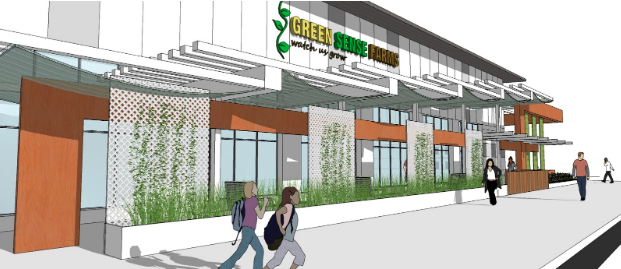
Get Fresh is also working with another indoor vertical-farming company, Green Sense Farms, that’s breaking ground in Henderson, a Las Vegas suburb, and plans to be up and running by next June. The facility will be approximately 20,000 square feet, with an estimated yearly output of one million heads of lettuce and one million herb plants, says Robert Colangelo, the company’s founding farmer and CEO. The company plans to grow a variety of lettuces, herbs and baby greens, such as arugula, kale and cress.
Green Sense Farms, based in Indiana, was approached by a large casino on the strip to dedicate the entire farm production to its operations, says Colangelo. The company’s facility will also include a retail outlet and an education and outreach center where visitors can take a self-guided walking tour to learn how the company grows food, he says.
The arrival of large urban farms to Las Vegas doesn’t mean that smaller, traditional farms will necessarily lose out, says Geno Bernardo, executive chef at The Summit Club, a private luxury golf community in Las Vegas. “There’s enough room for both urban farms and beautiful, rural mom-and-pop farms,” he says.
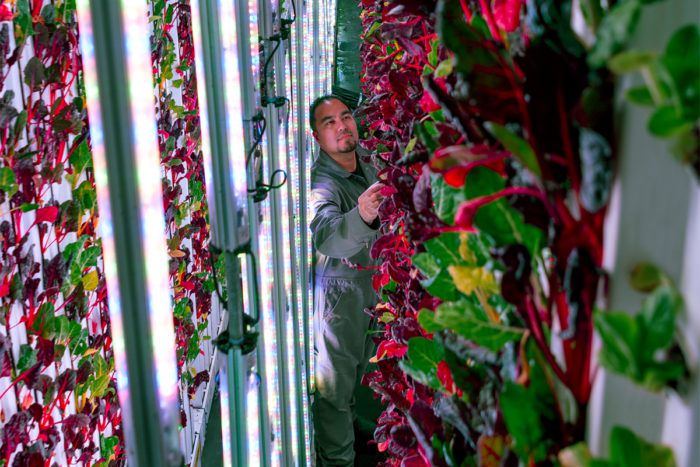
Is Vertical Farming Really the Future of Agriculture?
Indoor, LED-lit growing operations produce food without soil or sunlight — but scaling up could prove difficult
Indoor, LED-Lit Growing Operations Produce Food
Without Soil or Sunlight — But Scaling Up Could Prove Difficult
By Steve Holt July 3, 2018
A vertical farming setup from farm.one | Photo courtesy of farm.one
This story was originally published on Civil Eats.
By now, the images of shelves full of perfect greens in hulking warehouses, stacked floor to ceiling in sterile environs and illuminated by high-powered LED lights, have become familiar. Food futurists and industry leaders say these high-tech vertical farming operations are the future of agriculture — able to operate anywhere, virtually invincible against pests, pathogens, and poor weather, and producing local, fresh, high-quality, lower-carbon food year-round.
That future seemed one step closer to reality last year when San Francisco-based indoor farming startup Plenty, which grows a variety of salad and leafy greens hydroponically (without soil) and uses artificial lighting in facilities in three locations, announced that it had raised a whopping $200 million in funding from the SoftBank Vision Fund, whose investors include Amazon founder Jeff Bezos.
Flush with cash, Plenty quickly opened a 100,000-square-foot indoor farm outside Seattle that promised to produce 4.5 million pounds of greens annually—and testing some varieties not yet grown for the masses at scale, such as strawberries and tomatoes, at its research and development farm in Wyoming. To Plenty’s leadership and many observers, the cash influx signaled the economic promise of growing food indoors without sunlight and with less soil and water than field farming.
“My reaction [to the $200 million round] was both that of validation, excitement,” said Matt Barnard, Plenty’s co-founder and CEO, over a manner of farming he says yields 350 times the produce per acre on one percent of the water used by dirt farming. “Now we must move with speed and efficiency if we’re to accomplish our mission of bringing people worldwide an experience that’s healthier for them and the planet.”
Not everyone is in agreement.
“My first thought was, ‘we could build a lot of greenhouses for $200 million,’” recalls Neil Mattson, a professor of plant science at Cornell and one of the country’s leading academic voices on indoor agriculture, who’s found that high-tech greenhouses that harness sunlight are more cost- and carbon-friendly than vertical farms that use artificial light.
Most vertical farmers are only hoping to claim a percentage of the conventional produce market, not replace it. To these founders and their investors, the market for lettuce and greens, especially — grown primarily in California and Arizona and shipped worldwide — is ripe for disruption. E. colioutbreaks like the one that hit Arizona-grown romaine lettuce earlier this year, killing a handful of people and sickening hundreds, only further their case.
But behind futurists’ fervent predictions about indoor agriculture, claims about product quality, and sexy technology lies a reality known by industry insiders but too often missing from media coverage: The future success of this nascent industry is still very much an open question.
The astronomical capital costs associated with starting a large hydroponic farm (compared to field and greenhouse farming), its reliance on investor capital and yet-to-be-developed technology, and challenges around energy efficiency and environmental impact make vertical farming anything but a sure bet. And even if vertical farms do scale, there’s no clear sense of whether brand-loyal consumers, en masse, will make the switch from field-grown produce to foods grown indoors.
Tricky Economics
Walking into any supermarket will reveal a small mountain of salad greens, carrying a price tag of between $9 and $12 per pound. They may be locally grown or organic, which will add $0.50 or $1 to the price tag. Meanwhile, a 4.5-ounce carton of Massachusetts-based FreshBox Farms’ spring mix—grown in the company’s hydroponic farm in Massachusetts—costs $3.99 for a 4-ounce box, or $15.96 per pound. Or kale: the conventional variety will run you $1.33 per pound at Walmart; organic kale costs around $4.99 per pound at Whole Foods; and vertically farmed kale grown at Newark, New Jersey-based AeroFarms will cost you a whopping $14.18 per pound.
That dramatic price gap is due to the millions of dollars currently needed to build one large indoor vertical farm — and that price is not going to drop until the industry scales up. Agritecture Consulting, whose clients include current and prospective indoor farms, estimates that a 30,000-square-foot vertical farm growing leafy greens and herbs in the tri-state area around New York City requires nearly $4 million in startup capital—not including labor.
They should know: In 2016, Agritecture built farm.one in Manhattan’s TriBeCa neighborhood, which supplies hydroponic greens and edible flowers to a number of the city’s top restaurants. Chefs have been quick to catch onto the value of consistent, year-round, locally grown produce.
In 2016, AeroFarms, now considered an industry leader, spent $30 million on its flagship aeroponic farm in Newark. The majority of these costs lie in the equipment needed to grow greens without soil or sunlight—heating and cooling systems, ventilation, shading, environmental controls, and lights.
All of these costs add up to a hefty electricity bill: According to models compiled for Civil Eats by Agritecture, a 30,000-square-foot vertical farm in metro New York City should budget upwards of $216,000 annually for lighting and power, and another $120,000 on HVAC systems; costs will vary region to region depending on what each state charges for electricity.
Energy and equipment costs are, by far, the largest drivers of expenses that can bring the price of operating a vertical farm close to $27 per square foot. By contrast, Agritecture’s models show that the cost to run a 100,000-square-foot smart greenhouse is roughly a third as expensive, thanks to the use of natural sunlight and more advanced automation.
An LED-lit indoor farming operation | Photo courtesy of Agritecture
Vertical farms’ energy usage carries a significant carbon footprint. While vertical farm companies promise more-sustainable produce by growing it closer to consumers and using renewable energy to power their operations, the industry still has a long row to hoe.
Industry leaders acknowledge the energy challenges in the short term, yet tout continually improving lighting technology that has brought down costs. But Mattson, whose Cornell team studies the way plants respond to different lighting, predicts a plateau coming for improvements to LED technology.
“The best LEDs are 40 percent more energy efficient than in 2014,” Mattson says. “There continue to be improvements; however, those improvements will start to slow down over time. There’s only a finite amount of light you can generate at a given wavelength, and in 2022, I’m not expecting new lights to be 40 percent more efficient than the current lights now.”
FreshBox Farms began shipping greens from its 40,000-square-foot hydroponic facility in Millis, Massachusetts, in 2015. The warehouse farm, located 30 miles outside of Boston, runs on a combination of renewable energy and non-renewables, and CFO Dave Vosburg admits his company is “not doing any better” than field-grown greens when it comes to carbon usage.
When it eventually expands outside of Massachusetts, Vosberg says that by introducing a cogeneration system—technology that recycles otherwise wasted heat into new energy—FreshBox Farms will eventually keep costs and carbon emissions down in expensive markets like Connecticut, where commercial users pay an average of more than 14 cents per kilowatt-hour. But Vosburg says the company’s priority is to use contextually appropriate renewable energy sources to power the farms, such as wind energy in the Midwest, hydro in the Northwest, and solar in the Southwest.
“Yes, it sounds crazy to take the sun and turn it into electricity and turn that electricity back into light. It sounds ridiculous, but that’s what we’ll be doing,” Vosburg says. “It’ll be really efficient and clean and create a better product, and it won’t have the same carbon impact that we’re having today.”
And energy isn’t even a vertical farm’s top ongoing expense. The companies Civil Eats spoke to say labor is actually their largest budget item. Vertical farms typically pay workers higher, more metropolitan pay rates than both dirt farms—many of which rely heavily on migrant labor—and the more automated smart greenhouses. The fast-food chain Wendy’s announced in June that it plans to source vine-ripened tomatoes exclusively from greenhouse farms by early 2019.
Moreover, no matter how automated the indoor growing system is, vertical farmers are discovering the constant need for a human eye—or several—on the process. In fact, some estimate that if indoor agriculture continues to grow at the pace it has in recent years, vertical farms will have to hire 100,000 workers over the next decade.
That continued growth is not a given, however. Because of the high cost to launch, operate, and scale up a vertical farming operation, the industry is highly leveraged, with each new farm requiring tens of millions of dollars in investor capital before it can grow a single plant. Between 2016 and 2017, investments in vertical farming skyrocketed 653 percent, from $36 million to $271 million. The lion’s share of that investment went to Plenty, but Newark-based AeroFarms has raised $80 million in recent years and New Jersey’s Bowery Farming added another $27 million.
Just last week, Manhattan-based BrightFarms announced it had raised $55 million. Shoppers can now find produce grown indoors by more than 23 large vertical farms in more than 20 supermarket chains in nearly every major metropolitan area in the country, according to Agritecture.
While industry leaders say scaling offers the best hope for profitability in this business, many vertical farms have encountered problems when they began planning to add additional production facilities. Before Atlanta-based PodPonics closed its doors in 2016, executives from the five-year-old hydroponic farm startup met with executives from supermarket chain Kroger.
A vertical farming operation from farm.one | Photo courtesy of farm.one
Kroger indicated that it was ready to purchase 25 million pounds of produce from PodPonics annually if it would build the facilities to support that kind of production, founder Matt Liotta told a crowd at the 2017 Aglanta Conference. According to Liotta, who said PodPonics had lowered the cost to produce a pound of lettuce to $1.36, Whole Foods and Fresh Market also expressed interest in bringing PodPonics greens into their stores nationally.
“This was our wildest dream,” Liotta said. “Then we realized how much capital that was going to require, how many people we were going to have to hire. Every retailer told us the same thing: ‘We will buy it if you will build it.’ We realized we were incapable of building everything that they wanted.”
Unproven Demand for Food Grown Indoors
In early 2016, researchers from the University of Illinois-Urbana set out to determine whether consumers would spring for produce grown indoors. They asked a panel of 117 participants a series of questions about their perceptions of and willingness to pay for lettuce grown in fields, greenhouses, and in vertical farms. While vertical farming ranked fairly high in terms of produce quality and safety, the tech-heavy production method was rated less “natural” than both field farming and greenhouse and ranked last in participants’ willingness to purchase it.
For the vertical agriculture industry to eat into the profits of field-grown products—a roughly $140 billion industry—Agritecture Consulting founder and managing director Henry Gordon-Smith says it will first need to prove consumers are demanding produce grown indoors. He points out that because of a lack of demand, many vertical farming operations are not yet at full production year-round—despite touting the 12-month growing season as a main benefit of the industry.
His sense is that indoor farms that have achieved the sales to produce continually—such as Gotham Greens has with its New York City greenhouses, for example—have a customer base that’s responding to strong “local” branding rather than the technology behind the food. That may include vertical farms selling their produce using the USDA Certified Organic label, which the National Organic Board reaffirmed in January, much to the dismay of many organic dirt farmers.
“I think the automation and economics are all improving,” Gordon-Smith says, adding that the question of “whether consumers are going to pay more or whether the products coming out of vertical farms are going to align with their values” is still an open question.
But while many of the East Coast vertical farms built their business models around replacing greens being shipped cross-country from California and Arizona, Matt Barnard of Plenty hopes to add to the global population consuming fresh produce. A 2015 report found that where USDA guidelines suggest each of us in the U.S. should eat up to three cups of vegetables daily, current U.S. production is only providing enough for 1.7 cups per person. Barnard extends that supply gap to the rest of the world, especially the Middle East and Asia, where a lack of water and high pollution have hampered agriculture.
Tending to a vertical farm from SF-based startup Plenty | Photo courtesy of Plenty
“We believe the industry will be five times larger when there is supply to meet the demand,” Barnard says. “With the field unable to deliver consistent supply, new forms of agricultural capacity like Plenty must be added to the global food system.”
But as vertical farming companies like Plenty go city by city attempting to dominate local markets, it may be that small farmers get hurt the most. Barnard drew the ire of Washington State dirt farmers last year when he told GeekWire that Plenty expanded to Seattle, in part, because it was the West Coast’s “best example of a large community of people who really don’t have much access to any fresh fruits and vegetables grown locally.”
Not so, according to Sofia Gidlund, Farm Programs Manager at Tilth Alliance, which advocates for and supports local agriculture systems in Greater Seattle.
“We work with many hardworking local farmers who supply Seattle with high-quality, delicious, and nutritious food while caring deeply for our land. These farmers use sustainable farming practices, nurse the soil, create beautiful open green space and provide wildlife habitat,” says Gidlund, who adds that she does not speak for all area farmers on the issue of vertical farming. “Many consumers in Seattle choose to support local farmers, both urban or rural, because of this deep connection to the land. Providing that support is a point of pride for many Seattleites.”
Actual Data Is Coming
Peer-reviewed research into the business of vertical farming has been sparse, partly because the industry is so new. That’s set to change, however, when Mattson and a team of researchers at Cornell University finish a comprehensive study into the viability of this approach.
A three-year, $2.4 million research grant, which is funded by the National Science Foundation and kicked off in January, will compare the vertical farming industry to field agriculture in a slew of categories, including energy, carbon, and water footprints, profitability, workforce development, and scalability. The study will include one of the first nutritional analyses of food grown indoors, as well as comparing the price-per-pound to deliver strawberries, lettuce, and tomatoes grown vertically and outdoors to five U.S. metropolitan areas: New York City, Chicago, Seattle, Los Angeles, and Atlanta.
A 2016 study conducted by a few of Mattson’s colleagues at Cornell found that the energy consumption and carbon footprint associated with a vertical farm (the study calls it a “plant factory”) is significantly higher than that of a greenhouse. Vertical farming leaders counter that they use significantly less water than field farms, are more space-efficient, and do not produce emissions from trucking produce across the country. Mattson says these factors were not considered in Cornell’s previous research but will be included in the current grant.
“[Vertical farming] is not a fad,” says Mattson, who wants to use data to help the industry become more sustainable over time. “I’m not sure to what degree it’s going to scale up, but this is happening. So we need to understand the economic and environmental implications— both the good and the bad.”
From ‘Micro-Factories’ To Urban Farming: These Innovative Firms Are Shaping The Future
The World Economic Forum today unveils its 2019 Technology Pioneers: tech firms from around the world, shaping their industry and their region in new and exciting way
July 4, 2019
By Newsroom
The World Economic Forum today unveils its 2019 Technology Pioneers: tech firms from around the world, shaping their industry and their region in new and exciting ways. The 2019 cohort was selected by a committee of 59 leading technology experts, investors and entrepreneurs.
“Our new tech pioneers are at the cutting edge of many industries, using their innovations to address serious issues around the world,” says Fulvia Montresor, Head of Technology Pioneers at the Forum. “This year’s pioneers know that technology is about more than innovation – it is also about application. This is why we believe they’ll shape the future.”
As part of their selection, all Technology Pioneers can participate in a two-year programme with the Forum, when they have the opportunity to collaborate with their emerging tech peers, engage with industry leaders and work with public and private experts around the world. The 2019 cohort is invited to participate at the Forum’s upcoming meeting, the 13th Annual Meeting of the New Champions, Dalian, People’s Republic of China, 1-3 July.
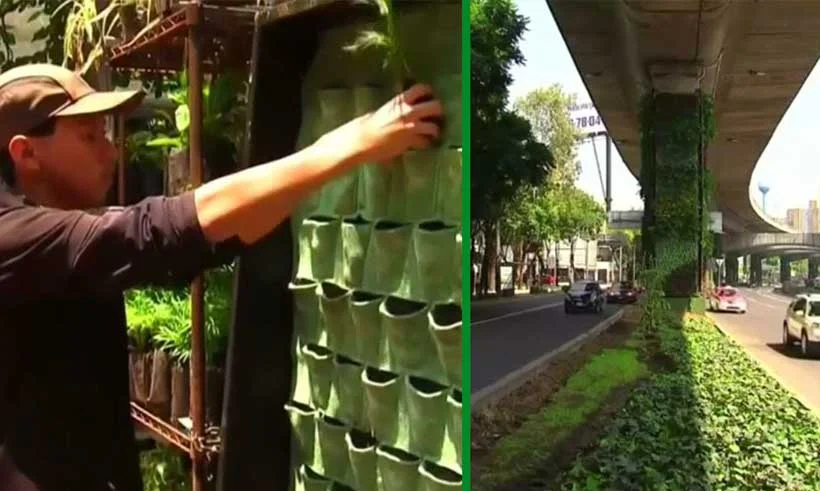
Of the 56 firms selected, 25% of them are female-led and they are drawn from a pool that stretches beyond the traditional tech hubs like Silicon Valley. This year’s group includes, among others: healthcare app DabaDoc from Morocco; Via Verde from Mexico facilitating vertical gardening; manufacturing-focused DataProphet from South Africa; and the first Technology Pioneer from Saudi Arabia, trucking and logistics innovator Homoola.
Countries represented are: China, Finland, Germany, Israel, Mexico, Morocco, the Netherlands, Republic of Korea, Saudi Arabia, South Africa, Singapore, Switzerland, the United Kingdom and the United States.
The Technology Pioneers are at the cutting edge of a wide range of industries that span agtech, smart cities, cleantech, supply chain, manufacturing, cybersecurity, autonomous vehicles, drones and others.
China’s Dorabot uses robots to create seamless delivery and logistics services. Also based in China, Alesca Life creates cloud-connected farms and farm digitization software to improve the efficiency of food production so that hotels, restaurants or even private homes can produce food in automated “cabinet farms” that use up to 25 times less water and land than traditional methods.
Another Technology Pioneer aiming to address food shortages, US-based Inari Agriculture,uses CRISPR gene-editing technology to produce healthier crops that require much less land and have a significantly lower impact on the environment. Using green technology in another way is Mexico’s Via Verde. This pioneer creates, installs and maintains vertical gardens to transform urban infrastructure into green spaces that generate oxygen, improve air quality, reduce urban heat islands and provide other social and psychological benefits to highly populated cities.
Leading the way in autonomous vehicles is the US company Perceptive Automata. They are combining behavioural science, neuroscience and computer vision for autonomous vehicles to understand how pedestrians, bikes and drivers communicate on the road beyond codified traffic laws. At the cutting edge of manufacturing, DataProphet in South Africauses AI to improve quality and yield.
Other Technology Pioneers are leveraging technology to address social issues. One example is Israeli TIPA,a clean-tech innovator addressing the global plastics crisis with compostable plastics packaging. US-established Marinus Analytics addresses human trafficking by leveraging machine learning and artificial intelligence to empower law enforcement and government agencies to protect vulnerable communities.
The 2019 cohort of Technology Pioneers:
Africa
DataProphet (South Africa) – artificial intelligence for manufacturing
Asia
Alesca Life (China) – data-driven, indoor vertical farming and crop management solutions
Coeo Labs (India) – meeting clinical needs in critical care
Dorabot (China) – artificial intelligence-powered robotic solutions for logistics and beyond
Eureka (Singapore) – an artificial intelligence platform for mobile operator and enterprise partnerships
Guangzhishu Technology (China) – providing blockchain-based privacy-preserving computation solutions
Holmusk (Singapore) – leveraging real-world data to address mental health issues globally
Sky Labs (Korea) – developing a cardio tracker to identify arrhythmia, which is difficult to diagnose
Tookitaki (Singapore) – artificial intelligence-powered regulatory compliance solutions for financial institutions
Europe
Bitfury (the Netherlands) – developing and delivering cutting-edge blockchain hardware and software solutions
Black Bear Carbon (the Netherlands) – bringing the circular economy to tires
Callsign (UK) – revolutionizing how people digitally identify themselves
Garrison (UK) – a unique technology providing secure internet access
ICEYE (Finland) – satellite imaging for every square metre on Earth, every hour
Luminance Technologies (UK) – an artificial intelligence platform for lawyers
Open Mineral (Switzerland) – disrupting how base metal commodities are traded
Photanol (the Netherlands) – making biodegradable plastic from CO2, which is only the beginning
Volocopter (Germany) – certified multicopter offering urban air mobility services
Latin America
Via Verde (Mexico) – creating resilient urban environments using vertical green gardens
MENA
DabaDoc (Morocco) – transforming the patient-doctor relationship through networked care
Homoola (Saudi Arabia) – bringing rideshare to the trucking industry
MeMed Diagnostics (Israel) – translating immune system signals into simple diagnostic insights
QED-it (Israel) – enterprise solutions for data privacy using zero-knowledge proofs
TIPA (Israel) – developing and producing compostable flexible packaging
North America
7 Cups (USA) – technology to scale compassion, solving mental health challenges
Airobotics (USA) – pioneers in autonomous robotics with aerial insights and analytics
Airtable (USA) – empowering human creativity by democratizing software creation
Arcadia Power (USA) – making clean energy an easy choice, for everyone
BigID (USA) – helping organizations know their customers by knowing their data
Bright Machines (USA) – bringing intelligence and automation to manufacturing
CyberCube (USA) – cyber-risk analytics to grow insurance in a connected world
Descartes Labs (USA) – building a cloud-based platform to digitize the physical world
Drishti (USA) – extending human potential in increasingly automated factories
Full Harvest (USA) – the first B2B marketplace for imperfect and surplus produce
GHGSat (Canada) – satellite monitoring of emissions from industrial facilities
goTenna (USA) – a leading mobile mesh networking platform
ImpactVision (USA) – real-time food quality and safety decisions
Inari Agriculture (USA) – from nature’s diversity to better seeds
LunaPBC (USA) – people-driven health discovery platform
Marinus Analytics (USA) – artificial intelligence-based tools to help the vulnerable in the digital world
Microvi (USA) – safe water, sustainable chemicals and a clean environment for all
One Concern (USA) – artificial intelligence for natural disaster resilience
Onshape (USA) – a cloud design platform that speeds up product development
Openwater (USA) – changing the way people read and write their bodies and brains
Perceptive Automata (USA) – human intuition for machines
Quantela (USA) – providing a digital platform for smarter urban infrastructure decisions
Relativity Space (USA) – 3D-printed rockets to build the future of humanity in space
Remitly (USA) – digital remittance services helping immigrants send money overseas
Rigetti Computing (USA) – on a mission to build the world’s most powerful computers
Shape Security (USA) – protecting the Global 2000 from bot attacks
Skuchain (USA) – empowering enterprises to grow their global trade with blockchain
Spring Health (USA) – a comprehensive mental health solution for employers
Starsky Robotics (USA) – bringing driverless trucks to the market
Trackonomy (USA) – powering end-to-end visibility and control across global supply chains
Truepic (USA) – restoring trust to digital photos and videos
Vineti (USA) – creating essential software for personalized therapies

Increasing Funding Pouring Into Vertical Farming Startups Across The World
Berlin-based vertical farming startup InFarm has raised a US$100 billion fund in its Series B investment led by Atomico with other existing investors including Balderton Capital, Astanor Ventures, Cherry Ventures and TriplePoint Capital joining
July.8, 2019 - Yining Chen
The expanding horticulture LED lighting business marks the development of high-tech farming including vertical farming which has attracted increasing investment recently. Vertical farming companies from Europe and the US have reported funds from worldwide investors.
Berlin-based vertical farming startup InFarm has raised a US$100 mllion fund in its Series B investment led by Atomico with other existing investors including Balderton Capital, Astanor Ventures, Cherry Ventures and TriplePoint Capital joining. Founded in 2013, the Germany company has developed the world’s largest urban farming platform, aiming to create self-sufficient and sustainable food production in worldwide cities. InFarm has partnered with 25 major food retailers in Germany, Switzerland, Austria and France, providing more than 150,000 plants monthly.
(Image: InFarm)
Meanwhile, Scottish vertical farm technology company Intelligent Growth Solutions (IGS) announced a £5.4 million (US$6.76 million) Series A funding led by US-based S2G Ventures. The investment will allow IGS to extend its business in software development, engineering, robotics and automation.
The company develops vertical farming solutions to boost LED grow light efficiency, enhancing plant production. Its R&D team has developed, patented and productized a IoT-enabled power and communications platform consisting of patented electrical, electronic and mechanical technologies. This technical solution enables the potential for reduction of energy usage by up to 50 per cent and labor costs by up to 80 per cent when compared with other indoor growing environments. It also can produce yields of 225 per cent compared to growing under glass.
Furthermore, Ocado, an online grocery company based in the UK, announced that it investing £17 million (US$21.3 million) in high-tech farming. The investment includes forming a joint venture focusing on vertical farming, named Infinite Acres, with Dutch horticulture technology developer Priva and US-based 80 Acres. In addition, Ocado also purchased 58 percent stake in Jones Food, who grows herbs with LED light-based vertical farm.
With the investment, the British on-line supermarket aims to improve food production with its technology expertise in robotics and AI.

U.S. Vertical Farms Are Racing Against The Sun
Leafy salad greens grown under banks of LED lights, with mist or drips of water are having their day in the sun. Several top U.S. indoor farms, stacked with plants from floor to ceiling, tell Reuters they are boosting production to a level where they can now supply hundreds of grocery stores
JULY 5, 2019
(Reuters) - Leafy salad greens grown under banks of LED lights, with mist or drips of water are having their day in the sun. Several top U.S. indoor farms, stacked with plants from floor to ceiling, tell Reuters they are boosting production to a level where they can now supply hundreds of grocery stores.
TO VIEW VIDEO, PLEASE CLICK HERE
Plenty, Bowery, Aerofarms and 80 Acres Farms are among young companies that see a future in salad greens and other produce grown in what are called vertical farms that rely on robotics and artificial intelligence, along with LED lights. While the first versions of modern vertical farms sprouted about a decade ago, in recent years the introduction of automation and the tracking of data to regulate light and water has allowed them to get out of lab mode and into stores. Now they are trying to scale up.
Plenty and others say their customized, controlled lighting - some more blue light here, some more red light there - makes for tastier plants compared to sun-grown leaves and that they use 95% less water than conventional farms, require very little land, and use no pesticides, making them competitive with organic farms. And because vertical farms exist in windowless buildings that can be located in the heart of urban areas, produce does not have to travel far by fossil-fuel-guzzling trucks to reach stores.
The companies’ expansion comes as plant-based burger makers Beyond Meat Inc and Impossible Foods captivate investors and make inroads in high-end restaurants and fast-food chains.
But whether the sunless farms can compete financially with their field-grown brethren, given big upfront investments and electric bills, remains a question.
“We’re competitive with organic today and we’re working very hard to continue to make more and more crops grocery store competitive,” said Matt Barnard, chief executive and co-founder of Plenty, which is based in Silicon Valley.
Chef and Plenty advisory board member Nancy Silverton prepares a salad during a demonstration in San Francisco, California, U.S., June 11, 2019. Picture taken June 11, 2019. REUTERS/Jane Lanhee Lee
Plenty’s salads sell on organic grocery delivery site Good Eggs for 99 cents an ounce, while a leading brand, Organic Girl, on grocery chain Safeway’s online site was priced at 80 cents an ounce.
Plenty said its new farm, dubbed “Tigris,” can produce enough leafy greens to supply over 100 stores, compared with its previous farm that could only supply three stores and some restaurants.
The technology world is paying attention. In its last round in 2017 Plenty raised about $200 million from investors including Japan’s Softbank, Amazon founder and CEO Jeff Bezos and former Alphabet Chairman Eric Schmidt. New York City-based Bowery raised $95 million in a fund-raising round led by Google Ventures and Temasek last year.
Bowery said its third farm coming online soon will help it supply hundreds of stores from dozens today, and Aerofarms, in New Jersey, said it is doubling its space to meet demand.
None of the three companies would give details about costs.
Former Vertical Farm CEO Matt Matros is skeptical that sunless farms can make economic sense. He invested in and ran Chicago-based FarmedHere in 2015, but changed its business into food processing.
“The issue with indoor farming was that you could really only grow a couple things efficiently — namely basil and micro greens. But the problem is the world just doesn’t need that much basil and micro greens,” Matros said.
80 Acres Farms in Cincinnati says it already grows and sells tomatoes and cucumbers, and Plenty is testing cherry tomatoes and strawberries in the lab.
Plenty CEO and co-founder Matt Barnard tastes a salad prepared by chef and Plenty advisory board member Nancy Silverton during a demonstration in San Francisco, California, U.S., June 11, 2019. Picture taken June 11, 2019. REUTERS/Jane Lanhee Lee
Agriculture technology investor Michael Rose says vertical sunless farms are more expensive to run than modern greenhouses that rely on sunlight, supplemented by LED lights. He sees limited areas where it makes sense, such as the Middle East, where much of the food is imported, or China’s mega-cities where pollution and urban sprawl limit the availability of premium fresh food.
At Plenty’s new farm, robots put seedlings in tall, vertically hung planters. The planters move along a wall of LED lights for 10 days, and are then put through a harvesting machine that shaves off the leafy greens.
The machines minimize labor needs, and Plenty says the speed of production also helps control pests.
“We use no pesticides,” said Nate Storey, co-founder and chief scientist at Plenty. “We don’t even have to use things like ladybugs, because we go so fast in our production that we out-race the pests themselves.”
Reporting by Jane Lanhee Lee; editing by Peter Henderson and Leslie Adler
Our Standards:The Thomson Reuters Trust Principles.