


Welcome to iGrow News, Your Source for the World of Indoor Vertical Farming

Twitter Former CFO Joins SoftBank-Backed Farming Startup Plenty
Twitter Inc.’s former chief financial officer has joined Plenty Inc. in that role as the indoor farming startup prepares for international expansion and improvements to its vertical growing technology.
By Selina Wang
March 15, 2019
Mike Gupta will help company as it expands internationally
An IPO pro, Gupta led market debuts for Twitter and Zynga
Mike Gupta Photographer: Jim Graham/Bloomberg
Twitter Inc.’s former chief financial officer has joined Plenty Inc. in that role as the indoor farming startup prepares for international expansion and improvements to its vertical growing technology.
Mike Gupta helped take Twitter public in 2013 and left for Docker Inc. two years later. Earlier, Gupta was treasurer at gaming company Zynga Inc., helping to lead its initial public offering, and had previously spent about eight years in various roles at Yahoo.
“It’s not new for me to be in hypergrowth companies that are entering unchartered territory," Gupta said in an interview. "This is a very capital intensive business so having someone who can think about how we raise and deploy capital in the long run will be very important.”
SoftBank Group Corp.-backed Plenty has made several high profile hires in recent years, including Tesla Inc.’s former battery directory Kurt Kelty and the electric carmaker’s former vice president of engineering, Nick Kalayjian.
Founded in 2014, Plenty boasts it can yield more produce in a given area than conventional farms, with only a fraction of the water. Its backers include funds that invest on behalf of Eric Schmidt, a director of Alphabet Inc., and Jeff Bezos, chief executive officer of Amazon.com Inc. Plenty is betting that with its technology and a previous $200 million investment from SoftBank, it will be able to scale its farms around the world.
The startup is in the process of building a new version of its farms, called Tigris. Matt Barnard, a co-founder and chief executive officer of Plenty, said that the new farm will be able to produce more than 40 times the amount of leafy greens that its current farms can grow, while using less energy. Plenty aims to roll out Tigris later this year.
The company currently has 200,000 square feet of indoor space in south San Francisco, but is only using a small portion for produce it sells. The majority of the space is used for testing and research and development. Plenty, which has been delivering produce in the Bay Area since June 1, sells its its food online and in neighborhood grocery stores.
Vertical farming technologies have yet to revolutionize agriculture and several companies have shut down in recent years because they weren’t economically sustainable. While most vertical farms grow produce on parallel shelves, Plenty uses tall columns from which plants sprout horizontally. The company says the method allows it to more cheaply remove excess heat emitted by LED grow lights and reduce energy needed to deliver nutrients to the plants.
Plenty has a team working on early stage development in China, and is in discussions with distributors and partners in Japan, Abu Dhabi and other regions.
Video: Vertical Farming: Growing Food In The Air And The Role of Big Data
Posted on 8 Mar 2019 by Nick Peters
The world’s food chain faces a growing crisis from climate change, population growth and the contamination of water and soil via intensive farming.
With insect populations, so vital to plant propagation and fertilisation, also under threat, the planet is heading for a crisis, one that cannot be solved by simply tweaking the existing, creaking system of agriculture. A new type of agriculture – vertical farming – has been developed that offers hope, and food, for the future. And it is all made possible by data and lean manufacturing.
Vertical farming is not a new concept. The theory that food can be grown in large quantities inside tall buildings has been around for decades. Only recently has it become possible at a price point that matches that of produce grown using traditional methods, and that is thanks to the same digital manufacturing technologies that are revolutionising our factories.
AeroFarms of Newark, New Jersey, is a pioneer of aeroponic farming with an ambition to set up vertical farms in towns and cities across the world to meet the growing ecological and human crisis of the next few decades. (Unlike hydroponics, where plant roots sit in a small container of water, aeroponics involves ‘misting’ roots with water and nutrients.)
Nick Peters, Editorial Director of The Manufacturer, discussed the project with CEO David Rosenberg:
The technologies that enabled David Rosenberg and AeroFarms to create the food chain of the future inside urban factories were provided by Dell EMC.
Nick Peters spoke to Nigel Moulton, Global CTO at Dell EMC, about AeroFarms and how successful businesses navigate their way on the digital journey:
This story appears in the March edition of The Manufacturer. Be sure to get your copy every month. Subscribe here!
Learn more about AeroFarms here and more about what Dell Technologies did for Aerofarms here

Swedish Vertical Farming Company Plantagon International Bankrupt
Another major vertical farming bankruptcy. This week, Plantagon International has been declared bankrupt. Cash flow problems turned out to be insurmountable for the Swedish company.
Agritechture
Plantagon International is headquartered in Stockholm and describes themselves as an Agritechture company. "Plantagon moves food and food production into the city by implementing technical solutions into existing city infrastructure", they explains on their website. "In practical terms, that means using existing assets and real estate with lower need for capital investments."
The company made it into the news regularly with their city and indoor farming concepts and plans - like the 'plantscraper' and office blocks containing 60-metre high urban farms. Last year, the first Plantagon farm was opened, partly owned by Plantagon International.
Cashflow
This week, Plantagon International was declared bankrupt. According to Henrik Borjesson with Fylgia, the company handling the bankruptcy, the issue - it might not be a surprise since the company is declared bankrupt - is money and the (lack of) cashflow. "Currently it is too early to make more comments on the case. Our focus is to get a clear view on the situation and to sell the products we have in the bankruptcy. There's no hard value assets involved - it's mainly patents and trademarks. The company has a clear idea and view, but hasn't been able to get it into business. Now, we're looking for someone who wants to pick up the ideas, patents and trademarks, and goes on with it."
Back in 2017 Plantagon announced its 40th approved patent - with 28 more to be pending. The patents filed within four patent families, all related to growing plants indoors.
Left: the building in which the Plantagon CityFarm Stockholm is located. Above right production in the Plantagon CityFarm Stockholm. Right below: one of the Plantagon concepts.
Stockholm farm
As said, last year the Plantagon City Farm in Stockholm started production. The company is an example of modern indoor farming, located under office tower DN Skrapan and equipped with over 244 vertical positioned, 2500 mm long LED-fixtures and re-using the heat harvested from the lamps in the building.
Plantagon International is a shareholder of the Stockholm farm. Money for this enterprise was also collected through a crowdfunding: last year over 420.000 euro was invested by 477 investors, both private as corporate, and according to the Fundedbyme-page, this resulted in 4.21% of the company's shares.
During the crowdfunding, the company declared plans to open 10 large-scale farms. "With Plantagon CityFarm, you can now buy local and sustainable vegetables. The first facility in Stockholm is fully-financed and begins its production under 2018's 1st quarter. Our target is to build 10 CityFarms in Stockholm by 2020", the crowdfunding website read.
Farm
Whereas the farm itself is unavailable for comments today, insiders report the company has had trouble selling the produce for the needed price. Within two months after production started, the CEO left the company.
The future of the Stockholm farm is currently unclear, as well as the situation of the international offices. On their website, Plantagon reports on Shanghai, Mumbai & Singapore offices.
Publication date : 2/22/2019
Author: Arlette Sijmonsma
© HortiDaily.com
Tech Connection Boosts NY Vertical Farmers
By AFP
24 February 2019
A Bowery Farming employee inspects some of their greens grown at the hydroponic farming company in Kearny, New Jersey
Workers at Bowery Farming's warehouse near New York have swapped out a farmer's hoe for a computer tablet that takes real-time readings of light and water conditions.
Launched in 2015, Bowery is part of the fast-growing vertical farming movement, which employs technology in a controlled, man-made setting to grow fresh vegetables indoors all year long.
Champions of the practice see vertical farming as a key tool to meet the world's food needs at a time when the population is rising and the climate is changing.
Irving Fain, CEO and co-founder of Bowery Farming, talks about his hydroponic grown greens
The company's chief executive and co-founder, Irving Fain, said his company's Kearny, New Jersey site uses fewer resources than traditional farms and does not employ pesticides.
"I have been a big believer my entire life in technology as being able to solve not only hard problems, but also important problems," said Fain, who previously ran a company that provides data analysis for big companies on their loyalty programs.
Bowery employs more programmers than agricultural scientists. The company says its use of algorithms enables it to be 100 times more productive per area compared with a traditional farm and to use 95 percent less water.
- Lower electricity costs -
Greens are grown at Bowery Farming, a vertical farming site founded in 2015
Vertical farming has long been practiced in Japan and some other places but it did not take off in the United States until recent technological leaps made it viable.
A key component has been LED bulbs, which have enabled indoor farmers to drastically cut electricity costs.
But Bowery is also making heavy use of robotics and artificial intelligence to keep prices under control.
Bowery makes heavy use of robotics and artificial intelligence to keep prices under control
The combination of these newer tools "is how we really rethink what agriculture will look like in the next century and beyond," Fain said.
The company has also benefited from more than $120 million in funding from tech titans including Google Ventures and Uber Chief Executive Dara Khosrowshahi.
The Silicon Valley connection has also boosted San Francisco-based Plenty, another prominent vertical farming company, which has garnered more than $200 million from Amazon Chief Executive Jeff Bezos, Softbank and others.
US-based Crop One and Emirates Flight Catering have launched a $40 million joint venture to build a giant vertical farming facility in Dubai.
- Profitable? -
AeroFarms co-founder and chief marketing officer Marc Oshima looks at baby kale
The world's biggest vertical farm is in Newark, New Jersey and operated by AeroFarms.
The company, founded in 2004 and considered a pioneer in the sector, remains privately-held and does not disclose financial data. But the company says it is now profitable after a series of fumbles.
David Chang, founder of the noodle restaurant brand Momofuku, is an investor.
AeroFarms exclusively uses company-made technology that has now made its way to China, the Middle East and Europe, said its co-founder Marc Oshima.
AeroFarms's vertical grow towers in Newark, New Jersey
In a warehouse that was once a steel mill with 40-foot (12-meter) ceilings, the company is growing kale and arugula leaves set in rows of 12 metal racks each. The roots are suspended in the air as they are intermittently irrigated while the leaves bask under LED lights.
AeroFarms experiments regularly with lighting and nutrients with an eye towards finding the optimal recipe for each plant and developing the best algorithm.
The company produces watercress that reminded a reporter of her grandmother's soup, kale as tender as spinach and arugula with a hint of spice.
Basil from Bowery Farming was tinged with the flavor of lemon.
But it can take a while for vertical farms to find solutions that are viable.
"The big, big vertical farms are having a difficult time being profitable because they are so capital-intensive at the beginning," said Henry Gordon-Smith, founder of Agritecture, a consultancy.
Large farms typically need seven or eight years before they are profitable, with smaller farms requiring perhaps half as long.
But entrepreneurs in the business are confident in their prospects as more young people in cities express worry about climate change and pesticides.
Baby kale is grown at AeroFarms
"Vertical farming is not THE solution to food security," said Gordon-Smith. "It is one out of the possible solutions."
Critics of vertical farming say it has a large carbon footprint due to heavy use of lighting and ventilation.
But defenders say that this negative impact is more than offset from the benefits of lower water use, the location near population centers and the non-use of pesticides.
A bigger issue may be the limitations of the output itself, at least in terms of nutrition.
"You can't feed the world with salad alone," said Princeton University plant researcher Paul Gauthier, who says vertical farmers will need to develop more protein-rich offerings.
Gauthier -- who grew spicier peppers in his own lab by subtly increasing potassium levels -- said vertical farming could supply fresh food to so-called food "deserts" where it is absent and could in the long-term meet growing food demand as the climate changes.

The Best Crops For Vertical Farming
Written by Chris Michael | January 17, 2017
A vital question: "What are the best crops for vertical farming?"
"Vertical farming is not about how much production you can possibly cram into a space. It’s about growing better food closer to market and maximizing your production as a function of the resources you invest, such as capital, light, water, energy, and labor." - Chris Michael, Bright Agrotech
Vertical farming with ZipGrow is one of the most efficient type of growing in modern farms, but one question that people get hung up on is:
What can you actually grow on vertical planes?
It's a vital question! Anyone considering a vertical farm should be planning out their crops as part of the process. As a farmer, you have to make sure that you can actually sell what you grow and that your production costs won't be too high.
Part of that is good crop choices.
Although choosing crops should be part of a whole feasibility study for your farm, we thought a guide on some of the best vertical crops for vertical farming would be helpful to people in the middle of the planning process.
What can you grow vs. What should you grow
With the right set-up, you can grow almost anything in a vertical farm.
Just because you can, however, doesn't mean that you should. Here are several factors to choosing an appropriate crop for your vertical farm.
1) Economic viability
Even if a crop is biologically viable (you can grow it) it might not be economically viable (you can't make money on it!).
If you can't make money on a crop, there could be several reasons:
Lack of demand (no profit)
Inappropriate technique (high production costs)
Climate (high heating, cooling, light costs)
Of course, each of those factors require a little balancing to master. "High" cost is relative to the margin that you're getting on the output.
Once you understand your demand, budget, and climate requirements, there are a few other factors to consider with your crops:
2) Timing and liability
A "turn" is the time it takes from the seedling going into the system to the mature plant coming out and going to market.
Focusing on crops with really fast turns (lettuce, mustard greens, collard greens, basil, mint) allows you to minimize your liability by never being more than six weeks or so away from production.
Slow-turn crops (like herbs and fruiting crops) are typically a bit trickier but can have higher margins than greens, depending on your local markets. We typically recommend a high greens-to-herbs ratio. For example, a new farmer could start with 80% of his space planted with greens and 20% planted with herbs.
(You can play with percentages and yield in our free Production Calculator.)
When you know what you do and don't want, you can start browsing through crop lists and seed catalogues! Here are some of ours and our farmers' favorites:
Lettuces (Romaine, Butterhead, Red Leaf, etc.)
Lettuces have fairly consistent demand across much of the world and throughout the year. There are dozens of varieties of lettuce, making it fun to grow and offer to customers. One of our favorites is Amish Deertongue Lettuce (pictured in the photo above).
Kales (Tuscan, Winterboar, and Dinosaur)
Kales are fairly easy to grow, although the crop requires extra care when harvesting if farmers are to get the highest yield. Each type of kale has its own variation on the rich taste and dark colors. The Tuscan kale above is one of the most popular varieties.
Chard & collard greens
Collard greens are like a thicker, deeper version of spinach. They can get quite large in the proper conditions; in the picture above, Sam gets ready to chomp down on a foot-wide collard green leaf!
The gentler version of collard greens, chard is a French green that cooks like spinach. Like kale or collard greens, chard can be harvested multiple times (taking only 30% of the plant each time) and grows back for larger yields later on.
Chives and mint
Chives and mint are some of the best crops for beginners. Although categorized with herbs, both chives and mint have a quick turn and grow densely like a grass. It is also easy to harvest. Here, Dr. Nate prepares to harvest chives by cutting all the way down the face of the ZipGrow Tower.
Basil (Sweet, Lemon, Cinnamon, etc.)
Basil is possibly the most loved ZipGrow crop. It grows better in the ZipGrow Towers than any other technique in the world, and creates demand almost everywhere it goes. While a bit trickier to grow, harvest, and store, many farmers include basil in their crop offering. Some farmers even specialize in the popular crop.
Small woody herbs
Small woody herbs like rosemary and it's kin, thyme and oregano, represent a rather picky group of crops. As woody herbs, they prefer "dry feet", and have a relatively slow growing cycle. Since the shrubby herbs are so potent and unique, many farmers still find the traction to sell them in their markets.
Learn more about crops
Want to learn more about individual crops? Learn more at Upstart University:
Here’s What You Need to Know About Growing Bok Choy in Hydroponics
Best Conditions & Methods for Growing Parsley in Hydroponics
Everything You Need to Know About Growing Chard Without Soil
OR see which crops farmers like you are growing all over the world through their own pictures and posts.
Get help building your crop list
The Best Crops for Hydroponics introduces the best crops for hydroponics so that growers can be experts on their produce.
Start learning:
Ideal conditions (EC, pH, temp., and more)
Plant lifecycle from seed to harvest
Common pests and diseases
Typical pricing
Unique considerations
Growing Up: How Vertical Farming Works
FOR thousands of years, human populations have farmed the land for food. But with a sharp rise in the number of people on our planet over recent centuries – as a result of the industrial revolution, increased living standards and falling mortality rates – the pressure on traditional farming has continually increased.
Fred Mills
6 March 2019
With the global population set to exceed 10 billion people by 2050, the challenge of providing enough food for everyone in a sustainable, efficient and cost-effective way is rising in significance. Shedding the restrictions of seasonal weather patterns, overcoming transportation challenges and significantly enhancing yields, the growing trend of “vertical farming” could herald the future of food production.
FOR thousands of years, human populations have farmed the land for food. But with a sharp rise in the number of people on our planet over recent centuries – as a result of the industrial revolution, increased living standards and falling mortality rates – the pressure on traditional farming has continually increased.
While modern techniques have enabled enhanced production rates, more than 11% of the world’s total land area is now used for crop production - creating environmental challenges that range from habitat clearing to soil degradation - and placing immense pressure on our planet’s resources.
Furthermore, as our cities expand, the distances between suitable farming land and the large populations who consume their produce are growing, raising the impact of transportation.
Added to these challenges is a changing climate that is disrupting seasonal weather patterns and the lack of suitable soils in close proximity to rapidly expanding areas.
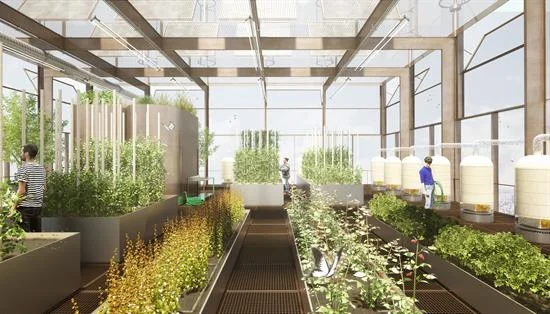
One potential solution is the quite literally growing trend of "vertical farming" - a concept that sees the sprawling crop farms of old condensed into much smaller factory-like sites where conditions can be optimised and yields significantly increased.
Vertical farms use multi-layered controlled environments to deliver significantly greater yields (image courtesy fo AeroFarms).
Facilities like Aerofarms’ in New Jersey see crops produced in an enclosed environment where almost everything from the lighting and ambient temperature to soil conditions and nutrients are carefully controlled.
The facility uses extensive vertical racking to optimise space as compared to a conventional crop farm, enabling it to be located on a far smaller site and much closer to an established urban area.
Such a location reduces the extent of haulage or “food miles” required to transport produce to consumers, cutting CO2 emissions.
Geography aside, the creation of controlled conditions delivers many benefits.
Firstly, the process of crop production is insulated from seasonal weather patterns that are highly susceptible to disruption as a result of our changing climate.
On a vertical farm, lighting, water and temperature can all be optimised to remove climatic risks and enhance production rates. As a result, sites like MIRAI’s facility near Tokyo – the world’s largest city – are able to generate yields 50 to 100 times greater than that of a traditional crop farm.
The use of a controlled environment also eliminates the losses from birds and insects that must be factored on conventional farms, cutting the need for harmful pesticides to be used and improving the quality of produce.
By removing external factors, like weather and insect damage, vertical farms can produce more nutritious food with fewer pesticides.
Vertical farms also optimise the level of nutrients that crops receive, solving the challenge of finding a sufficient extent of suitable farming land in close proximity to a major urban area.
In many instances, soil is removed altogether and crops are grown on membranes where they are sprayed with nutrient-rich solutions.
Of course, vertical farms do have their limitations and critics have pointed to the level of energy required to maintain such refined environments.
While these concerns are valid, several vertical farms are powered by renewable technologies and recycle many of their resources.
The use of energy efficient LED lighting reduces power consumption, while the blue and red shades of light are even more economical to run.
Using blue and red LED lighting makes vertical farms more economical to run (image courtesy of AeroFarms).
The optimised crop production process also allows vertical farmers to reduce the amount of water used, and many vertical farms are served by rainwater harvesting systems. Some even collect and recycle the water that condenses within the controlled environment itself.
This closed-cycle approach has the added benefit of preventing nutrients and fertilizers from damaging the land or being washed in rivers and streams.
Though the cost and availability of land for vertical farms in urban areas can prove challenging, many facilities are finding home in re-purposed shipping containers, former factories and disused warehouses.
Above: Adapting disused structures reduces the initial cost of vertical farms. (image courtesy of GrowUp Urban Farms).
More sophisticated schemes, like the proposal by Studio NAB below, could even see the vertical farming concept broadened to include the production of fish and honey while re-connecting consumers with the food production process and establishing sustainable jobs for the surrounding community.
Above and Below: Studio NAB's vertical farm proposal (images courtesy of Studio NAB).
While the vertical concept still represents a small part of the global food production industry, the benefits it offers to our ever-expanding population could come to tilt the farming landscape by 90 degrees.
Images courtesy of Kyodo Via, Ilimelgo Architects, AeroFarms, David Williams, Mandy Zammit, Priva, GreeOx, Grow to Green, GrowUp Urban Farms, Heather Aitken and Studio NAB.
We welcome you sharing our content to inspire others, but please be nice and play by our rules.

Indoor Agriculture May Hold The Future of Food
Paris has meanwhile come up with its own urban agriculture model, dubbed “Pariculteur,” a series of town hall-mandated projects designed to cover as much of the capital as possible with greenery via a rise in urban farming. An initial 10 hectares for the project is set to grow to 30 hectares by next year
Published: February 24, 2019 AFP
AeroFarms co-founder Marc Oshima. AeroFarms of Newark, New Jersey, is the largest vertical farm in the world.Image Credit: AFP
Paris: In a world faced with the conundrum of mountains of waste and obesity for some and dire shortages and malnutrition for others the future of food is a main dish on today’s global menu.
A key ingredient is the trend in ever more imaginative forms towards urban agriculture, a multi-faceted recipe already being poured over by some 800 million people globally, according to the UN’s Food and Agriculture Organisation.
The trend takes many forms - from collective market gardens in even the most run-down of urban districts to connected vertical farms using indoor farming techniques to meet spiralling food demand in areas largely bereft of arable land.
Today, with our containers, we are 120 times more productive per square metre than on open ground.
- Guillaume Fourdin | Founder, Agricool
Yves Christol, of French cooperative In Vivo, has identified six models of the genre.
They include a key European variant, electronically managed without recourse to pesticide - or even soil or sunshine.
Green beans means ... Iceland
“That has allowed Iceland to become a major producer of green beans,” says Christol, thanks to geothermal heating.
Asian countries are also in on the act, not least Singapore, with the high density population city state bent on ensuring high-tech food autonomy.
Japan and China have sought to give new life to sites which once hosted electronics factories even if the strategy appears costly.
AeroFarms co-founder Marc Oshima. AeroFarms of Newark, New Jersey, is the largest vertical farm in the world.Image Credit: AFP
China has launched some urban farms even in areas where the soil has been polluted by heavy metals and would be too costly to clean up.
The US model, as cities including New York and Chicago seek to become sustainably hunger-proof, includes hydroponic gardens - effectively eschewing soil and using mineral nutrients in a water solvent, although profitability can prove elusive.
But scale is an issue and the concept will not be viable “so long as the price of the vegetables is not increased fourfold,” to cover energy costs, says Christol.
Strawberry containers for ever
The cost of transporting food is something which particularly exercises entrepreneurs such as Guillaume Fourdinier, a founder of French start-up Agricool in Paris and Dubai.
His firm produces strawberries year round in shipping containers fitted out with LED lighting. Urban agriculture’s raison d’etre, he says, comprises fighting against “the ecological disaster of transport”.
“Today, with our containers, we are 120 times more productive per square metre than on open ground,” says Fourdinier.
“We produce in decentralised fashion and closer to customers,” he adds of strawberries sold marginally cheaper than their organic equivalent.
Paris has meanwhile come up with its own urban agriculture model, dubbed “Pariculteur,” a series of town hall-mandated projects designed to cover as much of the capital as possible with greenery via a rise in urban farming.
An initial 10 hectares for the project is set to grow to 30 hectares by next year.
Urban ecologist Swen Deral, who oversaw a pan-European urban agriculture project last year, says if the concept is to be financially viable in cities it has to go “beyond production”.
“Either they recycle, or else they create services linked to urban agriculture, educational activities, restaurants and the like,” he explains.
Researchers point to urban agriculture’s additional benefit of fighting against the effects of climate change as its proponents seek to reinvent urban existence.
Francois Mancebo, researcher at France’s Reims University, summed up the challenge in an article published by peer-review open access publisher MDPI and entitled “city gardening: managing durability and adapting to climate change thanks to urban agriculture.”
Mancebo says the concept must become an integral part of urban planning with local politicians underlining the need for active participation of city dwellers.

New Opportunities For Agriculture Bloom in Cleanrooms
February 28, 2019
Some call it the future of farming and in some places it’s already here. It’s called indoor vertical farms, an alternative to conventional outdoor agriculture and it’s being tried in Europe, Asia and the U.S.
CGTN’s Hendrik Sybrandy reports.
“Why don’t we start on this one right here,” said Nathan Lorne, as he began a recent tour of his facility under a purplish glow.
Lorne is the Sales Manager at Infinite Harvest, an indoor hydroponic vertical farm in Lakewood, Colorado that grows four varieties of exactly one crop, lettuce. CGTN’s Hendrik Sybrandy takes us inside the facility.
“What you see here is a Bibb lettuce,” Lorne said. “The variety is Flandria.”
Inside a 500 square meter warehouse, under red and blue lights, because that’s what leafy green vegetables like, sit 52,000 heads of lettuce stacked from floor to ceiling. An automated system controls the variables that allow these crops to survive and thrive.
“Whether it be temperature, humidity, CO2, water temperature, light schedule, the list goes on and on,” Lorne said.
Welcome to at least a part of farming’s future, something that’s being tried in Europe and Asia, as well as other parts of the U.S.
“All of those problems that we see in agriculture as we know it are more or less solved by an operation like this,” Lorne added.
It solves problems like soil-borne contamination, labor costs and drought. It minimizes the need to truck food long distances, trips that often lead to food waste. It’s an answer to the age-old farmer’s dilemma.
“How do we optimize an environment to maximize the production of a crop,” said Josh Craver, an assistant professor of Controlled Environment Horticulture at Colorado State University.
The school dabbles in what’s called controlled environment agriculture. At a time when more and more people want locally produced, high-quality food, vertical farms are bringing that food to the dinner table. Of course man does not live on lettuce alone. This type of agriculture may not make sense for row crops like corn and wheat. While LED lighting has made indoor farming much more possible, it does use its share of power.
“It is relatively expensive to have these structures and to manage these structures year-round, but what you get in return is this premium high-quality crop that oftentimes can be sold for a premium,” Craver said.
Infinite Harvest is constantly tweaking its treatment of lettuce which can be a bit finicky.
“You can ask a plant to do something,” Lorne said. “You can’t tell it to do something.”
Unlike other lettuce farms, which harvest two or three times a year, Lorne says, “this company, whose produce is consumed in restaurants, hotels and hospitals, doesn’t take seasons off.”
Infinite Harvest says it will soon be profitable.
“I don’t think vertical farming or indoor farming will necessarily replace agriculture in the long run,” he said. “I think it will change it though.”
Now, Infinite Harvest is even looking to branch out and produce things like berries.

‘Vertical Farms’ Envisioned As Path Out of Recidivism
Alex Vuocolo February 20, 2019 Ajit Mathew George, Second Chances Farm
By Peter Osborne
DBT Editor
Ajit Mathew George sees a future where state or federal inmates from Delaware will have farming jobs — and futures as entrepreneurs — waiting for them when they’re released.
All within the Wilmington city limits.
“On average, about 100 men and women are released from Delaware prisons every month to three Wilmington ZIP codes [19801, 19802 and 19805],” says George, who formed Second Chances Farm to hire and offer turnkey entrepreneurial opportunities to men and women returning from prison.
He plans to open “vertical farms” inside abandoned warehouses and empty office space close to where these former prisoners live. They’ll be growing crops on LED-lit hydroponic towers that do not require soil, pesticides, or even natural sunlight.
George anticipates hiring 10 to 15 workers for every 10,000 square feet of farming space, with farms as large as 100,000 square feet. Each worker will be paid $15 per hour during a six- to 12-month apprenticeship period.
All he wants to do is reduce recidivism in Delaware; develop a new industry; produce local organic food on a year-round basis; and create and nurture a new crop of entrepreneurs within Opportunity Zones. His dream is to add a fourth “C” — Crops — to the “Chemicals, Credit Cards (formerly Cars) and Chickens” for which Delaware has long been known.
Winning recognition
That’s the kind of vision it takes to be named “Best Idea” at the Pete DuPont Freedom Foundation’s Reinventing Delaware 2018 competition in early December.
“Our Reinventing Delaware process seeks to identify bold and innovative ideas that will make Delaware a better place to live, work and raise a family,” said Stephen Sye, the foundation’s executive director. “The 100 business leaders and entrepreneurs who attended our annual dinner on Dec. 5 felt that Second Chances Farm fits that vision and we look forward to seeing how the program evolves.”
Example of vertical farming, via Second Chances Farm
Opportunity Zones are census tracts designated by the governor and approved by the federal government for the purpose of economic development and investment in low-income areas. They were created as part of the Tax Cuts and Jobs Act of 2017 with eight of Delaware’s 25 Opportunity Zones being in Wilmington.
Once George obtains zoning approval and the IRS releases final regulations governing opportunity zones, they’ll be off and running. He hopes to open Second Chances Farm No. 1 in Wilmington by September in a location still to be determined — although he is looking at abandoned industrial warehouses, older office space and shopping centers, and is even considering vacant downtown offices with high ceilings like MBNA/Bank of America’s old Bracebridge complex.
The cost of what George calls “Compassionate Capitalism” — yes, two more C’s — is $1 million to north of $4 million, depending on each farm’s size and location. The Welfare Foundation, which supports nonprofits focused on social-welfare causes in Delaware and southern Chester County, awarded Second Chances Farm No. 1 a startup grant of $175,000 following the Reinventing Delaware event.
In the last five years, $500 million of venture capital has been invested in indoor farming projects in the United States alone, including San Francisco-based Plenty securing $200 million in financing last year from Softbank, the Japanese firm led by billionaire Masayoshi Son, and investment companies associated with former Alphabet chairman Eric Schmidt and Amazon founder Jeff Bezos.
George points out that the Delaware Department of Correction spent $282 million in 2017. The state’s cost to house an inmate works out to $43,882 per year, or more than $120 per day per inmate. As of Jan. 30, Delaware was dealing with 4,517 inmates and 970 accused offenders on pretrial detention, with an additional 13,888 people on probation.
George says incarceration can lead to a “lifetime sentence of unemployment.”
“Barriers to re-entry can be difficult and frustrating,” he said. “Sixty percent of all previous offenders are unemployed. For this reason, 68 percent of all those released from Delaware prisons are re-arrested and reconvicted within three years of release. As a result of this crippling system, Delaware has some of the highest recidivism rates in the country.”
He said “vertical farming allows for up to 100 times more production per square foot than traditional farms. Second Chances Farms will be able to get from harvest to shelves in under 24 hours, compared to the 6-plus days and thousands of miles traveled by field-grown produce.”
Local goods in demand
Delaware Secretary of Agriculture Michael T. Scuse said there’s a need for vertical farming in Delaware due to the high demand from consumers to buy locally year-round.
“Vertical farming allows individuals who want to enter into agriculture, but don’t have access to a large amount of land or machinery to be involved in production agriculture,” said Scuse. “It introduces a new type of agriculture to Delaware that can provide an economic benefit by increasing production of specialty crops that Delawareans want to buy at their local farmers’ markets, grocery stores, and restaurants.”
Scuse added that the team that will be running the operation “has served their time and paid their debts to society and now have a chance to be meaningfully engaged in their community through agriculture. The chance to be able to run a high-tech hydroponic farm is a great way for these individuals to get started in
an agricultural enterprise.”
A further benefit of the Second Chance Farms, said George, will stem from Delaware’s “prime location” in the mid-Atlantic, within easy striking distance of various major cities.
“It reduces the carbon footprint of long-distance transport, but also ensures ultra-freshness while satisfying the desire by many top chefs and restaurants” interested in a short farm-to-market timetable.
Second Chances Farm will be setting up Opportunity Funds that enable investors to participate in vertical farms throughout the mid-Atlantic area. It also hopes to sign five to 10 companies for a Corporate Community Supported Agriculture (CSA) program. Participants will receive weekly packages of fresh vegetables grown within 50 miles of their locations or let Second Chances Farm deliver their “units” to a designated nonprofit for distribution to their constituents.
“By planting these seeds in economically disadvantaged areas designated as Opportunity Zones, we can grow and nurture a new crop of “Compassionate Capitalists” and “Green Collar” jobs,” George said. “The only way to grow is up!”
Any company that is interested in learning about how to be part of the Corporate CSA can contact Evan Bartle, Second Chances Farm’s Chief Growing Officer (evan@secondchancesfarm.org). Potential investors should contact Jon Brilliant, Second Chances Farm Managing Member (jon@secondchancesfarm.org).
Affinor Growers Inc. - Corporate Update
February 27, 2019 | Source: Affinor Growers Inc.
VANCOUVER, British Columbia, Feb. 27, 2019 (GLOBE NEWSWIRE)
Affinor Growers Inc. (“AFI” or the “Company”) (CSE:AFI, OTC:RSSFF, Frankfurt:1AF) is pleased to provide an update on its operations.
Over the past four months, the Company has been working on several fronts in order to broaden the Company’s operations and build a strong foundation for future success. In doing so, the Company is extremely pleased to announce the development of three new tower designs, two significant agreements, as well as an invitation to the BC Tech Summit 2019 from the BC Ministry of Agriculture in order to showcase our new towers.
Technology Development
Since October 2018, the Company has been working aggressively with our manufacturing partner, Cobotix Manufacturing Inc. (“Cobotix”), to develop new tower designs and new technologies. The result of this work is three new tower designs. We have a newly designed vertical farming tower for soiled-based growing, a new hydroponic version of the vertical farming tower and a newly designed vertical farming tower that is a hybrid of hydroponic and aeroponic growing.
The new designs allow the Company to increase its footprint in the vertical farming space and gives the Company a product line that, we feel, can compete with other hydroponic and aeroponic growing systems on the market. In addition, the new designs also open up the home and light-duty commercial markets for the Company, markets in which we see great potential for growth.
Randy Minhas, President and CEO commented, “This is a significant step forward for the Company. As a technology company, it is absolutely crucial that we continue to innovate and develop in order to remain competitive. I am extremely pleased with the new tower designs and look forward to introducing the towers to the market.”
Agreement with Fundamental Lighting Solutions Corp. (“Fundamental Lighting”)
The Company is pleased to announce that it has reached a four-year, worldwide exclusive, distribution agreement with Fundamental Lighting. Fundamental Lighting is a corporation out of Monroe, Washington and they have developed high-efficiency, white LED lights and coloured LED growing lights to be used for indoor growing operations, including greenhouses. The Company will have the exclusive right to distribute the lights for Agricultural projects and earn a commission on the sale of the lights.
In addition, the Company is helping Fundamental Lighting develop cannabis specific growing lights (“Cannabis Lights”) to compete with the widely used high-pressure sodium lights. The design work and the research for the Cannabis Lights has been completed and the process is moving to the prototype phase. We expect to have eight Cannabis Lights manufactured and ready for testing in the next 6-8 weeks.
The design team behind the LED lights and the Cannabis Lights is led by Mr. Wayne Bliesner. Mr. Bliesner is the CEO and Head Scientist at Fundamental Lighting. Mr. Bliesner is in charge of the company direction, choosing executives, scientific research, managing the lab team, and new production R&D. He earned a Master’s Degree from the University of Washington in Aeronautical Engineering and spent 20 years at Boeing as a lead engineer, where he has multiple patents there in several technologies.
He also spent 16 years as an independent scientist developing ground breaking technologies. He has raised over $10 million for R&D as an independent scientist and is attached to over 100 patents in the U.S., Canada, Europe, and Australia.
Mr. Minhas commented “This is a very significant agreement for the Company. We are looking forward to working with Mr. Bliesner and his team. The LED growing lights will be a great complement to our new towers. In addition, the development of the Cannabis Lights will be a game changer. Currently, the cannabis market is dominated by high-pressure sodium lights, which emit a significant amount of heat and use a significant amount of electricity. The LED Cannabis Lights will significantly reduce the electricity usage, lower the heat emissions within a grow facility and last considerably longer than the high-pressure sodium lights. We’re very excited to get these lights manufactured and tested in the coming months.”
Agreement with the University of Fraser Valley (“UFV”)
The Company is pleased to announce that we have entered into a two-year agreement with the UFV to complete strawberry grow trials in the newly designed soil-based, vertical growing tower with the use of the LED lights from Fundamental Lighting.
The Company will install a total eight towers at the two Surrey Biopod greenhouses, replacing the two larger, first generation, towers from several years ago. The Surrey Biopod facility is a partnership between the University of the Fraser Valley, the John Volken Academy (“Volken Academy”), and the City of Surrey. The Volken Academy provides life and job skills to addicted youth, and the Biopods offer Volken students the opportunity to learn growing and research skills in an urban greenhouse environment.
The grow trial will consist of four towers in each Biopod greenhouse with half of the towers being used to grow strawberries using conventional substrate and the other half growing in organic substrate. In addition, the Company will install white LED lights in one greenhouse and coloured growing LED lights in the second greenhouse.
The project will be overseen and managed by Dr. Laila Benkrima. Dr. Benkrima is currently a Horticulture Instructor with the UFV and runs the Surrey Biopod program. Dr. Laila Benkrima holds a Ph.D. in Plant Biology and MSc in Plant Physiology from the University of Paris (France). She has over 25 years of experience in research and development within the horticulture and plant biotechnology industries. She has been responsible for the planning, development and creative problem solving of various projects from plant micropropagation and functional/medicinal crop cultivation to hydroponics and laboratory design.
Mr. Minhas commented “We’re very please to be working with the University of Fraser Valley and Dr. Benkrima. This agreement gives us access to fully operational greenhouses and the ability to test our newly designed soil tower with the LED white lights and coloured growing lights. The data received from these grow trials will greatly enhance our ability to market and sell these towers.
This is also a great opportunity for the students at the Volken Academy and at-risk youth to gain hands on experience with vertical farming technology. We are certainly thrilled to be able to participate in the Surrey Biopod project for the next two years and we are pleased to say, we will be donating all eight towers to the Surrey Biopod project at the conclusion of the agreement.”
BC Tech Summit 2019
The Company is excited to announce that we have been invited to the BC Tech Summit, March 12-13, 2019, at the Vancouver Convention Center by the BC Ministry of Agriculture. The Company will use the BC Tech Summit to launch its new hydroponic growing tower and our hybrid hydroponic/aeroponic tower. In addition, we will also be showcasing the LED white lights and the coloured growing lights as part of our exhibit. The Company’s exhibit will be part of the BC Ministry of Agricultures showcase.
Mr. Minhas commented “We are thrilled to be attending the BC Tech Summit with the BC Ministry of Agriculture and very grateful to have been given this opportunity. It is a great honour to be invited to this event. This will be a great platform to launch our new towers and showcase Fundamental Lighting’s LED lights.”
Randy Minhas
President and CEO
About Affinor Growers
Affinor Growers is a publicly traded company on the Canadian Securities Exchange under the symbol ("AFI"). Affinor is focused on developing vertical farming technologies and using those technologies to grow fruits and vegetables in a sustainable manner.
Neither Canadian Securities Exchange nor its Regulation Services Provider (as that term is defined in the policies of the Canadian Securities Exchange) accepts responsibility for the adequacy or accuracy of this release.
This news release may contain assumptions, estimates, and other forward-looking statements regarding future events. Such forward-looking statements involve inherent risks and uncertainties and are subject to factors, many of which are beyond the Company's control that may cause actual results or performance to differ materially from those currently anticipated in such statements.
AFFINOR GROWERS INC.
www.affinorgrowers.com

Local Grown Salads Launches Indoor Vertical Farms In Opportunity Zones
Local Grown Salads launches Indoor Vertical Farms in Opportunity Zones in Washington DC, Baltimore, and Nashville. Farms produce organic Ready-To-Eat Salads.
BALTIMORE, MD, UNITED STATES, January 10, 2019 /EINPresswire.com/ -- Local Grown Salads is opening Indoor Vertical Farms in Opportunity Zones located in Baltimore, Washington DC, and Nashville.
Local Grown Salads will be providing Ready-To-Eat salads, Ready-To-Use Herbs and vegetables that are GMO Free, Organic, Herbicide & Insecticide free, and certified insect free.
Wonderfully Fresh - Harvested and delivered on the same day.
Massive Selection - 25 different salads.
No prep needed - these are ready-to-eat.
No Food Safety concerns - FSMA & SFQ Quality Code level.
Good For The Environment - Reduced Carbon Footprint, No nasty runoff. No killing the bees.
Local Grown Salads is looking to provide LGS First Account status to a small set of restaurants, caterers, or food delivery companies prior to the official launch.
The LGS First Accounts will have special pricing, guaranteed availability, first access to product, and other advantages.
LGS First Accounts are select food service companies that will use Local Grown Salads' Ready-To-Eat Salads to provide extra-ordinary products to consumers.
LGS First Accounts will be located within 2 hours of one our locations and sell at least 5,000 high quality meals a week.
Local Grown Salads has limited the volume available and will be selective about who will receive this market advantage.
About Local Grown Salads Patent Pending Indoor Vertical Farming technology:
• Grows fresh produce year-round in a controlled environment with the highest standards of food quality and food safety
• Creates product that is organic, pesticide free, herbicide free, and GMO free
• Decreases transportation costs, thereby reducing the carbon footprint
• Helps to address the problem of food deserts
• Allows indoor farming that helps save the planet’s arable land
About Local Grown Salads and Opportunity Zones:
Opportunity Zones are a tax incentive established by Congress in the Tax Cuts and Jobs Act of 2017. 8,700 Opportunity Zones have been designated. The Opportunity Zones are low-income and food desserts. Local Grown Salads is expecting to create 20 jobs in its farms and provide fresh healthy food at wholesale prices to the community.
The Local Grown Salads farms can re-purpose older (heritage) buildings which are not challenged for other uses.
Zale Tabakman
Local Grown Salads
+1 416-738-2090
email us here
Visit us on social media:
LinkedIn
Distribution channels: Food & Beverage Industry

Vertical Farms Attracting Greater Interest And Investments In The GCC

#UAE | 28 NOVEMBER, 2018
One of the GCC countries leading this change is the UAE
Dubai: A growing importance is being given to vertical farming, among other Controlled Environment Agriculture (CEA) methods across the GCC and is generating interest and increased investments from regional and overseas players. According to Orbis Research, the MEA vertical farming market is expected to reach USD 1.21 billion by 2021 at a CAGR of 26.4% from only USD 0.38 billion in 2016.
One of the GCC countries leading this change is the UAE, which has upcoming projects facilitated by the government as well as private players to help increase food security in the region. These include the UAE Ministry of Climate Change and Environment allotting space for 12 vertical farms to be built by Shalimar Biotech Industries, and the world’s largest vertical farm for Emirates Airlines by Crop One Holdings Inc. With around 90 per cent of food being imported in the UAE, territorial problems of water scarcity and small percentages of arable land, vertical farming is becoming increasingly vital to ensure food security within the region.
H.E. Mariam Al Mehiri, Minister of Future Food Security and a leading campaigner of urban farming plans to create a ‘Food Valley’ or a technology hub, dedicated to the development of food and farming automation. The Food Valley, and other government-led initiatives, are being introduced to attract and enable a new generation of farmers to help build future sustainability.
Commenting in a recent interview with euronews, the Minister said “[The idea] comes from the Silicon Valley in the United States, where you have technologies, or start-ups, sprouting and developing into commercial giants.” explains the Minister. “We want to bring this to the UAE and build a Food Valley that’s all about food technologies.”
The Middle East and Africa: A prime location for CEA to successfully take off.
By capitalizing on vertical space, and controlling the environment for year-round optimal growth, CEA can produce significantly more yields per square foot than traditional agriculture, while using only a fraction of the water.
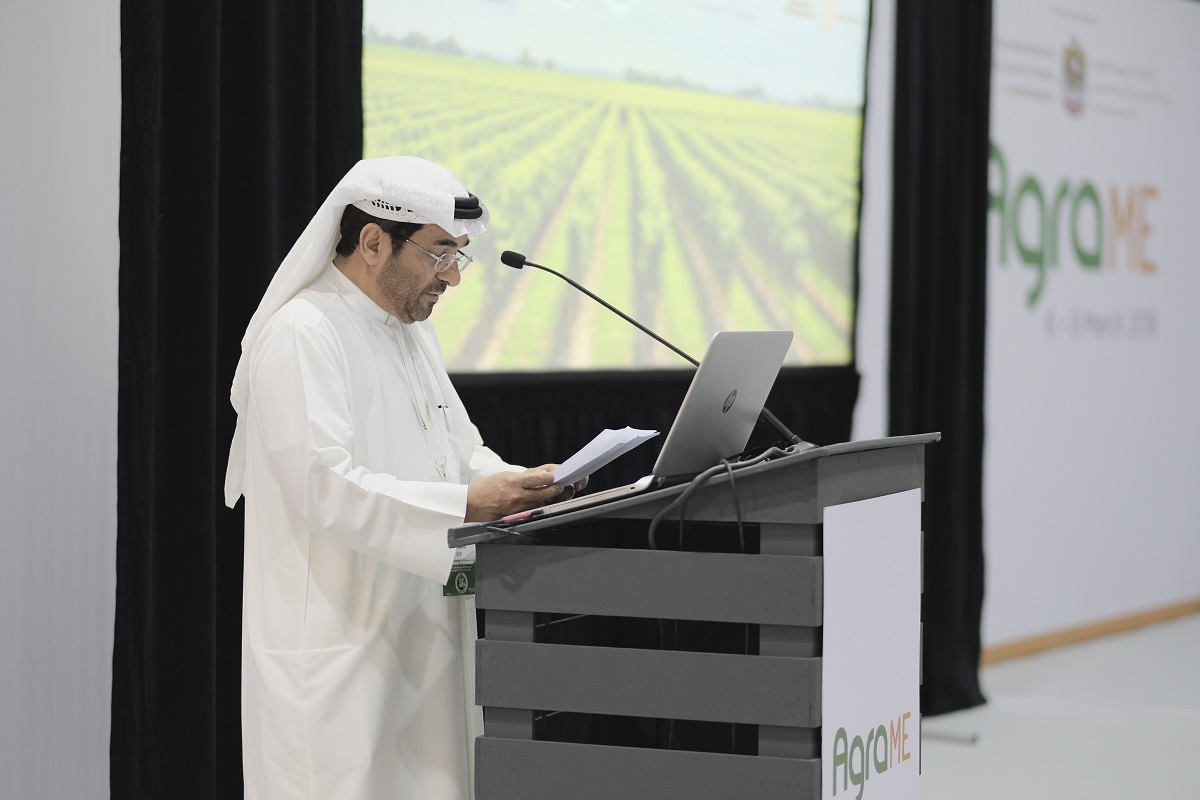
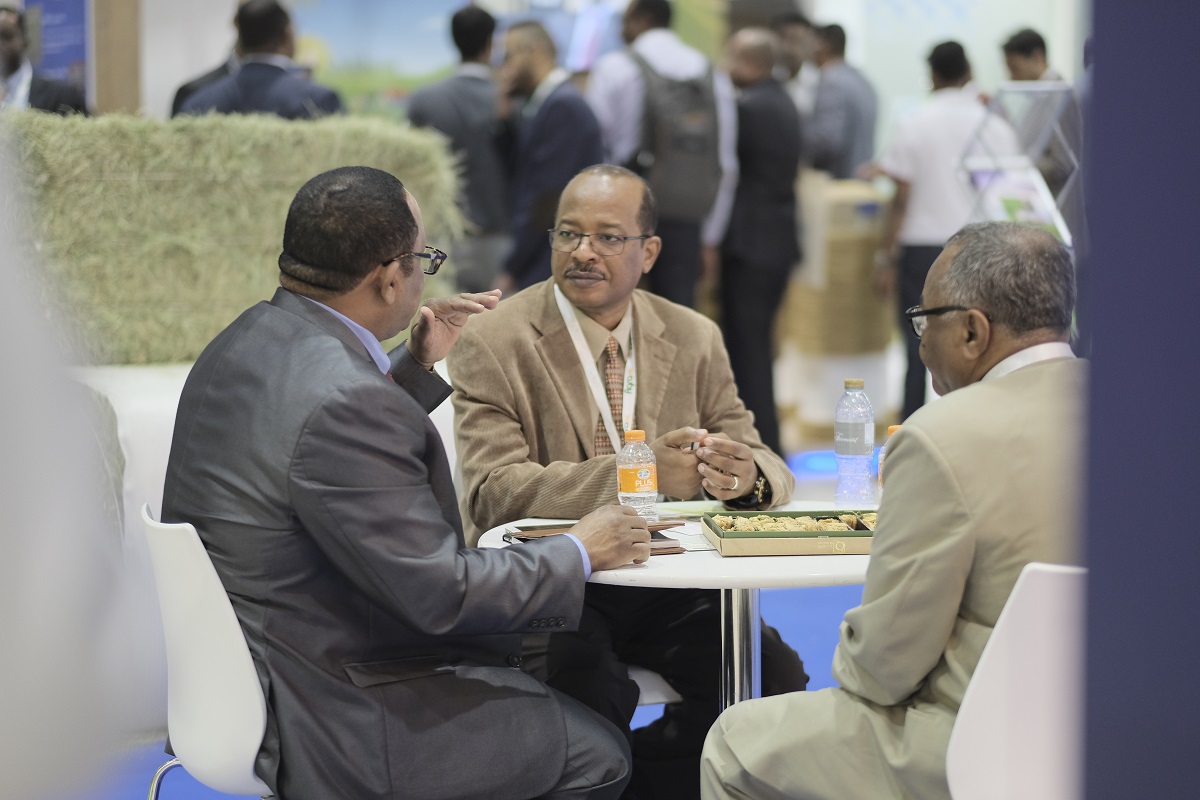
AgraME 2019 is once again creating a platform for the latest technology to be showcased to the regional agribusiness market, along with promoting knowledge sharing between leaders in the global industry and key local players around urban farming techniques and methods.
Henry Gordon-Smith, Founder and Managing Director of Agritecture and an acknowledged global thought leader in urban agriculture, stated that the Middle East has an unprecedented ability to reshape critical infrastructure that supports modern human life; “The potential is certainly there to transform what has historically been a relatively small traditional farming industry into perhaps the most technologically advanced agriculture industry in the world. This means economic development, increased production of nutritious local produce, and lowered food costs, all with minimal water consumption and increased resilience to climate change and foreign markets” said Gordon-Smith who will be speaking at the AgraME Conference in March.
Commenting on the Middle East market, Bob Hunsche, Sales Manager, Van der Hoeven said; “We are really starting to see the horticulture industry take off in the Middle East. We have just completed the largest greenhouse project in the UAE (11 ha). With the most advanced technology in terms of climate and humidity control, the facility is expected to locally produce 3,000 tonnes of tomatoes year-round with the aim of helping the UAE become more self-sufficient in its food production. AgraME 2018 was a great event and we are really looking forward to connecting with more projects at the 2019 show!”
Samantha Bleasby, Exhibition Director of AgraME said, “With the aim of increasing food security in the Middle East and attaining the UN Sustainable Development Goal (SDG) of zero hunger, we are excited to present the industry with new technologies from around the globe and free-to-attend learning and networking opportunities that will increase productivity in the region with sustainable use of water and land resources”
The show is attracting key players in the CEA industry such as Certhon, Agrotonomy, Veggitech, Wuxi, iGrowths Technology Co. Ltd, Ozorganic Urban Farming LLP and Van der Hoeven.
Taking place from 5 – 7 March 2019 at the Dubai World Trade Centre, AgraME 2019 will bring to Dubai some of the leading innovators and urban farming experts to provide the industry with valuable information and knowledge.






For more information about AgraME, please visit: www.agramiddleeast.com
-Ends-
Media Contact:
Josse Dulka
Group Communications Manager | Global Exhibitions
PO Box 9428, Dubai, United Arab Emirates
Direct line: +971 (0) 4 407 2753
Switchboard: +971 (0) 4 336 5161
Josse.dulka@informa.com
www.informaexhibitions.com
© Press Release 2018
Disclaimer: The contents of this press release was provided from an external third party provider. This website is not responsible for, and does not control, such external content. This content is provided on an “as is” and “as available” basis and has not been edited in any way. Neither this website nor our affiliates guarantee the accuracy of or endorse the views or opinions expressed in this press release.
The press release is provided for informational purposes only. The content does not provide tax, legal or investment advice or opinion regarding the suitability, value or profitability of any particular security, portfolio or investment strategy. Neither this website nor our affiliates shall be liable for any errors or inaccuracies in the content, or for any actions taken by you in reliance thereon. You expressly agree that your use of the information within this article is at your sole risk.
To the fullest extent permitted by applicable law, this website, its parent company, its subsidiaries, its affiliates and the respective shareholders, directors, officers, employees, agents, advertisers, content providers and licensors will not be liable (jointly or severally) to you for any direct, indirect, consequential, special, incidental, punitive or exemplary damages, including without limitation, lost profits, lost savings and lost revenues, whether in negligence, tort, contract or any other theory of liability, even if the parties have been advised of the possibility or could have foreseen any such damages.

Pick-Your-Own Fruit And Veg At A Retail Park?
Source: Holdsworth Associates PR
03/02/19
Is there a business case for widescale commercial vertical farming in the UK or will it remain a niche opportunity for high-end restaurants and retail? This is the challenge to be discussed by early adopters at the Agri-Tech East conference ‘Innovating for Controlled Environment Agriculture’ next month (19 March). Advances in logistics and the falling cost of LED lighting may enable year-round growing of undercover produce in the UK, but will energy costs and technical issues delay scale-up and integration within the food supply chain?
GrowUp Farms' vertical lettuce growing | credit: GrowUp Farms
“We do think there is the potential for indoor farming to be commercially viable and there are some immediate gains for growing crops such as leafy salads in high hygiene environments,” comments Lindsay Hargreaves, MD of Frederick Hiam, a farming and fresh produce business with farms in Suffolk and Cambridgeshire. “Growing indoors provides greater control of quality and quantity and fewer inputs of plant protection products.
“There is also the matter of growing crops closer to the point of consumption. Being able to grow more exotic crops in East Anglia close to distribution centres would reduce the food miles. Additionally, there are opportunities to grow crops for pharmaceuticals, cosmetics and vaccines within a controlled environment.”
There are many approaches to indoor cultivation, such as deep-water hydroponics, vertical soilless cultivation, and aeroponics, where exposed roots are sprayed with nutrients. All of these methods are to be discussed at the conference along with advances in monitoring and robotics.
However, despite the news that Sterling Suffolk, one of the UK’s most technically-advanced glasshouses, is set to produce millions of tomatoes starting in February 2019, the cost (£30M) and the technical challenges mean there are few commercial installations in the UK.
Also, it is proving difficult to demonstrate to retailers that controlled environment agriculture (CEA) can bring tangible benefits to their supply chain.
Kate Hofman, co-founder of GrowUp Farms, which from 2015 to 2017 operated 'Unit 84', a commercial-scale aquaponic urban farm inside an industrial warehouse. The 8,200 square feet of growing space could produce enough for 200,000 salad bags and 4,000 kg of fish each year. It sold directly into restaurants, through a New Covent Garden distributor and also through bricks and mortar supermarkets and Farmdrop, the online supermarket.
Kate comments: “A key learning over the last six years is that we can’t just focus on technology – we have to partner along the supply chain to create a business model that ultimately delivers commercial success for growers and retailers.
“One of the major challenges for CEA is to optimise operations to bring down the cost of production to match existing imported products. Our prototype urban farm showed that it was possible to use CEA commercially, and we were able to demonstrate the demand for the produce we could grow. This ranged from specialist micro-greens and cut herbs through to mixed baby leaf salad.
“We are now working on scaling up our business. This will involve relocating, so that our production is co-located with a renewable energy plant and working in partnership with more traditional farming businesses to integrate their experience and expertise.”
There are also technology challenges to be addressed when trying to meet the highly variable consumer demand for high quality, fresh produce.
G’s Fresh supply baby leaf crops all year round, with much of the winter supply grown in Spain and Italy to ensure security of delivery. In summertime it produces a huge amount of outdoor salad crop, particularly lettuces and celery in the UK. Ben Barnes is investigating how controlled environment agriculture can increase the long-term viability and profitability of both of those parts of the business.
The organisation has a large standard greenhouse facility that is used to propagate seedlings for planting out into the field. It is running two projects: Smart Prop, which is looking at increasing the efficiency of the propagation facility to improve growth and make stronger plants so they transplant better back into the field. And Winter Grow, a pre-commercial trial, to see if it is feasible to produce baby leaf crops during the winter at an affordable price point.
Ben explains: “I'm going to be talking at the Agri-Tech East event about the commercial journey, in terms of the go and no-go decision-making process and what the key things are that we need to learn in order to be able to make those kind of investment decisions.
“One element of this is the development of ‘lighting recipes’ to enhance plant growth characteristics. We've got multi-spectrum LED lights, so we can turn up the different amounts of red, blue, green and white, and even far red light. These are fairly expensive, so once we have worked out what works best we can buy fixed spectrum lights, which are a tenth of the cost.
“You think LEDs are very efficient, but they still generate a heck of a lot of heat when you’ve got them turned up to full. It is more about keeping the space cool, and the plants obviously are transpirating so we've got dehumidifiers in there sucking the moisture out of the air.
“One of the biggest problems with the vertical farming concept is this interaction between moisture and temperature. You’ve got the two factors constantly fighting against each other and that ends up sucking up huge amounts of energy if you're not careful.”
Dr Belinda Clarke is director of Agri-Tech East, an independent membership organisation that is facilitating the growth of the agri-tech sector, comments that the commercial challenges need addressing along with the technical and agronomic aspects: “The promise of CEA is sustainable, intensive production but achieving that may require a different type of value chain.
“It could be that supermarkets of the future allow you to pick your own fruit and baby leaf instore, or we may see large-scale distribution of veg boxes, with produce grown indoors in optimum conditions or perhaps traditional growers would have more flexibility to grow a greater range of produce all year around with less waste.
“These ideas all have potential but also require significant capital investment and creative solutions for energy management. These are some of the themes we will discuss in the conference.”
'Bringing the outside In – Innovating for Controlled Environment Agriculture' taking place on 19 March from 10.00 – 16.00 at Rothamsted Research, Harpenden. It will look at the different growing systems, emerging technologies, the challenges of implementing a system and the logistics involved with integrating a controlled environment agriculture into the food value chain
www.agritech-east.co.uk/upcoming-events/
About Agri-Tech East: www.agritech-east.co.uk
Agri-Tech East is a business-focused membership organisation that is supporting the growth of a vibrant agri-tech cluster of innovative farmers, food producers & processors, scientists, technologists and entrepreneurs.
Agri-Tech East brings together organisations and individuals that share a passion for improving the productivity, profitability and sustainability of agriculture. It aims to help turn challenges into business opportunities and facilitate mutually beneficial collaboration.

Agri-Tech Business Wins Vodafone Funding
15 Feb 2019
Josh Morris Digital Staff Writer
A Bristol-based agricultural technology company has been awarded £45,000 in funding from Vodafone.
LettUs Grow, which is developing aeroponic and vertical farming techniques was awarded £35,000 by the telecommunications giant as part of its Techstarter awards, as well as a further £10,000 Techstarter Champion’s award.
Jack Farmer, co-founder and operational lead at LettUs Grow, said: "We are seriously excited to be working with Vodafone. As much as the funding is incredibly useful, we are particularly keen to collaborate with them from a technical and a commercial standpoint. That mentorship is really going to help us to develop our business.
"We are looking to work with Vodafone and a number of other key partners this year, to implement our hardware and software and deliver profitable pilot farms – both greenhouse and vertical – before then working with these partners to scale nationally and internationally.
"We are very excited technically to work with Vodafone on both our communications platform and also the application of data analysis in large scale farms."
Nick Jeffery, chief executive, Vodafone UK, said: "The range and calibre of the Vodafone Techstarter winners show that the UK is home to a thriving social tech sector.
"We believe some of the biggest challenges in society can be addressed using technology and innovation. These awards are just one way we can recognise, celebrate and support start-ups developing and using technology as a force for good."

What Plantagon’s Bankruptcy Could Tell Us About the Future of Large-Scale Vertical Farming
Via a mix of agriculture, technology, and architecture, the company planned to build farms in office towers, underground parking garages, and on the facades of existing buildings
March 1, 2019
Following last week’s declaration of bankruptcy, Swedish urban agriculture company Plantagon has spoken publicly about what went wrong. In an interview with Swedish website AGFO, Plantagon’s vice president, Owe Pettersson, cited cash flow problems and indicated it had been difficult to attract enough capital to remain financially sustainable.
Its ambition alone made Stockholm-based Plantagon a company to watch in vertical farming, a space predicted to be worth $9.9 billion worldwide by 2025. Plantagon’s aim was to move food production into high-density cities on a large scale by integrating farms into existing city infrastructure. Via a mix of agriculture, technology, and architecture, the company planned to build farms in office towers, underground parking garages, and on the facades of existing buildings.
This rendering of its World Food Building “plantscraper” shows the sheer scale on which Plantagon was thinking:
As of this writing, the company had one facility already open for production, under the famous DN Skrapen tower in Stockholm. Plantagon also intended to roll out 10 more farming locations in the city by 2020, and has 55 approved international patents.
“This will be one of the most advanced food factories located in a city that we have today,” Pettersson said in an interview last year.
Business in real life, however, rarely happens as neatly as a well-executed rendering. Plantagon had raised $4.5 million SEK (a little less than $500,000 USD), but the company was, according to insiders, having trouble selling the produce it grew. Within two months of production starting on the DN Skrapen farm, the CEO left the company. “The company has a clear idea and view, but hasn’t been able to get it into business,” said Henrik Borjesson of Fylgia, the company handling the bankruptcy.
Pettersson said (translated from Swedish) in this most recent interview that outside financial issues, a project of this scale might be a little ahead of its time.
Vertical farming itself is a hot topic, if you go by what the headlines say. Companies large and small are bringing new visions for this indoor farming concept to market. In Europe, Agricool is growing fruit and just raised another round of funding. And German retailer METRO is experimenting with in-store farms via its Farmlab.One initiative.
In the U.S., Crop One Holdings raised $40 million last year to build “the world’s largest vertical farm. Boston, MA-based Freight Farms is architecting proprietary all-in-one farms in shipping containers. AeroFarms has a 70,000-square-foot facility backed by IKEA and Momofuku’s David Chang.
But as Princeton’s Paul P.G. Gauthier, who leads the Princeton Vertical Farming Project, suggested last year, there are dozens of failures out there that get far less attention than the mega success stories. We need to hear about those failures, to see the data behind them, in order to understand what went wrong and avoid making similar mistakes in future — whether those mistakes are in the operating of the farm or, as may be the case with Plantagon, in trying to scale too high too soon instead of starting with something smaller, like a shipping container. Only when we know the facts behind these stories does vertical farming have a chance on a scale as large as the one Plantagon envisioned.
Plantagon may indeed have been ahead of its time in terms of the size of its project, and the speed at which it wanted to get there. The gap between promising innovation and actually delivering on it is something that trips the tech industry up again and again. Plantagon’s past interviews have shown the company had plenty of optimism and vision for the future. What got mentioned less were the complications the vertical farm industry is still grappling with as it tries to scale — business models, energy consumption, the cost of not just building but running a facility that relies on software and machine-generated light to function.
The existing Stockholm farm’s future is currently unclear. Plantagon is currently looking for new owners. Where the company’s massive existing project stands in six months’ time will give us a good indication of whether moving large-scale farms into existing city spaces is a reality we should plan for, or if it’s time to pick up a new playbook and find a different way to spread the benefits of vertical farming.

The Role of Sensors And Data Collection In A Successful Vertical Farm
It’s widely recognized that vertical farming has many advantages over traditional crop-growing methods. Simply put, despite relatively high setup and operational costs, the production per unit of growth area in vertical farms easily exceeds that in the most advanced greenhouses. But to consistently hit this level of production, you need to ensure growth conditions are continuously at their best. This is where sensors and data play a pivotal role, and why they’re ready to transform the future of vertical farming.
What data do you need to capture?
To use sensors and data effectively, you first need to know what kind of data is valuable and why. The most important values to measure are the following conditions for growth:
• Climate (characterized by a combination of air temperature, humidity levels, CO2 levels and air speed)
• Plant temperature
• The nutrient composition of the irrigation water
• The light level and spectrum (as perceived by the plants)
• Plant morphology, deficiencies and growth (phenotyping)
These conditions are significant for different reasons. The difference between plant temperature and air temperature, for example, can tell us whether the leaves’ stomata are open. If they aren’t, the plant cannot absorb CO2 and convert it into biomass. Likewise, we can continually measure the pH (acidity) and EC (electrical conductivity) of the irrigation water to ensure optimal plant growth. We are also cooperating with several companies that are developing sensors to measure other parameters of the irrigation water (such as f.e. iron or magnesium).
You might be surprised to see that we measure the light level and spectrum as perceived by the plants, presuming that we can deduce this already from the type and number of LED lighting modules installed. However, our research has found that the plants’ perceived light level can deviate up to as high as a factor of two from the light level installed depending on the optical properties of the materials used between and above the plants. This value largely depends on the degree to which the plants cover the growth area, and with such a high potential deviation rate, is one we need to measure and track to ensure optimal growth conditions.
The value of monitoring every stage of the growth process
Sensors enable us to monitor these growth conditions, recognize anomalies and identify problems as early as possible. By detecting problems at an early stage, we can respond pro-actively instead of reactively. This holds especially true for system-related problems – such as the temperature deviating from an intended setpoint – which can be rectified almost immediately.
In addition to measuring growth conditions, measuring growth results also provides valuable data – using parameters such as plant size, height, weight and color. We can use cameras to capture images of the plants in the growth layer, for example, following growth development over time and gauging whether growth meets expectations or not by comparing it to data captured in previous growth cycles under similar conditions. Like sensors, cameras can also help to prevent problems early by enabling the detection of early-stage growth deficiencies (such as tip-burn) and diseases.
How our sensor and data platform can help
Our sensor platform allows us to measure the conditions most important for plant growth. These conditions include climate parameters and irrigation parameters (including water supplied/drained in addition to pH and EC). At the GrowWise Center in Eindhoven’s High Tech Campus (HTC), we collect about 1,600 unique setpoint and sensor readings every ten minutes from our eight climate cells – valuable ongoing research that helps us to continuously build on our knowledge base and improve the solutions we can offer.
The sensors can be placed anywhere within a growth layer and wirelessly communicate the data they gather to the system backend. Cloud applications then retrieve this data and visualize the information that is most relevant and useful to plant specialists and growers. The development of the sensor platform is part of Horizon 2020 Internet of Food (H2020 IoF), a European Commission (EC) innovation project, in which we are closely collaborating with Staay Food Group.
The future of vertical farming
The benefits of modern sensor technology and data science are already manifold, but technological advancements in areas such as AI promise to be truly revolutionary. Signify is currently researching AI-based algorithms that can train models to couple realized growth conditions with realized growth results, for example, in a process known as ‘supervised learning’. This will ultimately enable us to predict the precise growth conditions to achieve optimal growth – and meet the most specific grower needs. AI techniques like machine learning can also be used to analyze images of plants’ growth to immediately detect any unexpected deviations or growth deficiencies.
Right now, our sensor and data platform combined with cloud applications adds considerable value for our plant specialists and customers – from monitoring the growth process and detecting problems as early as possible to accelerating the development of new optimized growth recipes. It’s clear that sensors and the data they capture play a pivotal role in the continuing evolution of vertical farms.
Signify and our customers will not just be a part of this revolution – we will drive it.

Pick-Your-Own Fruit And Veg At A Retail Park?
Source: AgriTech East
02/12/19
Is there a business case for widescale commercial vertical farming in the UK or will it remain a niche opportunity for high-end restaurants and retail? This is the challenge to be discussed by early adopters at the Agri-Tech East conference ‘Innovating for Controlled Environment Agriculture’ next month (19 March). Advances in logistics and the falling cost of LED lighting may enable year-round growing of undercover produce in the UK, but will energy costs and technical issues delay scale-up and integration within the food supply chain?
“We do think there is the potential for indoor farming to be commercially viable and there are some immediate gains for growing crops such as leafy salads in high hygiene environments,” comments Lindsay Hargreaves, MD of Frederick Hiam, a farming and fresh produce business with farms in Suffolk and Cambridgeshire. “Growing indoors provides greater control of quality and quantity and fewer inputs of plant protection products.
“There is also the matter of growing crops closer to the point of consumption. Being able to grow more exotic crops in East Anglia close to distribution centres would reduce the food miles. Additionally, there are opportunities to grow crops for pharmaceuticals, cosmetics and vaccines within a controlled environment.”
There are many approaches to indoor cultivation, such as deep-water hydroponics, vertical soilless cultivation, and aeroponics, where exposed roots are sprayed with nutrients. All of these methods are to be discussed at the conference along with advances in monitoring and robotics.
However, despite the news that Sterling Suffolk, one of the UK’s most technically-advanced glasshouses, is set to produce millions of tomatoes starting in February 2019, the cost (£30M) and the technical challenges mean there are few commercial installations in the UK.
Also, it is proving difficult to demonstrate to retailers that controlled environment agriculture (CEA) can bring tangible benefits to their supply chain.
Kate Hofman, co-founder of GrowUp Farms, which from 2015 to 2017 operated 'Unit 84', a commercial-scale aquaponic urban farm inside an industrial warehouse. The 8,200 square feet of growing space could produce enough for 200,000 salad bags and 4,000 kg of fish each year. It sold directly into restaurants, through a New Covent Garden distributor and also through bricks and mortar supermarkets and Farmdrop, the online supermarket.
Kate comments: “A key learning over the last six years is that we can’t just focus on technology – we have to partner along the supply chain to create a business model that ultimately delivers commercial success for growers and retailers.
“One of the major challenges for CEA is to optimise operations to bring down the cost of production to match existing imported products. Our prototype urban farm showed that it was possible to use CEA commercially, and we were able to demonstrate the demand for the produce we could grow. This ranged from specialist micro-greens and cut herbs through to mixed baby leaf salad.
“We are now working on scaling up our business. This will involve relocating, so that our production is co-located with a renewable energy plant and working in partnership with more traditional farming businesses to integrate their experience and expertise.”
There are also technology challenges to be addressed when trying to meet the highly variable consumer demand for high quality, fresh produce.
G’s Fresh supply baby leaf crops all year round, with much of the winter supply grown in Spain and Italy to ensure security of delivery. In summertime it produces a huge amount of outdoor salad crop, particularly lettuces and celery in the UK. Ben Barnes is investigating how controlled environment agriculture can increase the long-term viability and profitability of both of those parts of the business.
The organisation has a large standard greenhouse facility that is used to propagate seedlings for planting out into the field. It is running two projects: Smart Prop, which is looking at increasing the efficiency of the propagation facility to improve growth and make stronger plants so they transplant better back into the field. And Winter Grow, a pre-commercial trial, to see if it is feasible to produce baby leaf crops during the winter at an affordable price point.
Ben explains: “I'm going to be talking at the Agri-Tech East event about the commercial journey, in terms of the go and no-go decision-making process and what the key things are that we need to learn in order to be able to make those kind of investment decisions.
“One element of this is the development of ‘lighting recipes’ to enhance plant growth characteristics. We've got multi-spectrum LED lights, so we can turn up the different amounts of red, blue, green and white, and even far red light. These are fairly expensive, so once we have worked out what works best we can buy fixed spectrum lights, which are a tenth of the cost.
“You think LEDs are very efficient, but they still generate a heck of a lot of heat when you’ve got them turned up to full. It is more about keeping the space cool, and the plants obviously are transpirating so we've got dehumidifiers in there sucking the moisture out of the air.
“One of the biggest problems with the vertical farming concept is this interaction between moisture and temperature. You’ve got the two factors constantly fighting against each other and that ends up sucking up huge amounts of energy if you're not careful.”
Dr Belinda Clarke is director of Agri-Tech East, an independent membership organisation that is facilitating the growth of the agri-tech sector, comments that the commercial challenges need addressing along with the technical and agronomic aspects: “The promise of CEA is sustainable, intensive production but achieving that may require a different type of value chain.
“It could be that supermarkets of the future allow you to pick your own fruit and baby leaf instore, or we may see large-scale distribution of veg boxes, with produce grown indoors in optimum conditions or perhaps traditional growers would have more flexibility to grow a greater range of produce all year around with less waste.
“These ideas all have potential but also require significant capital investment and creative solutions for energy management. These are some of the themes we will discuss in the conference.”
'Bringing the outside In – Innovating for Controlled Environment Agriculture' taking place on 19 March from 10.00 – 16.00 at Rothamsted Research, Harpenden. It will look at the different growing systems, emerging technologies, the challenges of implementing a system and the logistics involved with integrating a controlled environment agriculture into the food value chain
www.agritech-east.co.uk/upcoming-events/
About Agri-Tech East www.agritech-east.co.uk
Agri-Tech East is a business-focused membership organisation that is supporting the growth of a vibrant agri-tech cluster of innovative farmers, food producers & processors, scientists, technologists and entrepreneurs.
Agri-Tech East brings together organisations and individuals that share a passion for improving the productivity, profitability and sustainability of agriculture. It aims to help turn challenges into business opportunities and facilitate mutually beneficial collaboration.

WUR Hosts International Workshop On Vertical Farming
October 13-15, 2019 | Wageningen
VertiFarm2019, an international workshop on vertical farming, on 13-15 October in Wageningen, the Netherlands, combines a number of oral presentations of world leading horticultural researchers, panel discussions with renowned companies as well as short oral and poster presentations on the latest research results on vertical farming, also called indoor farming or plant factories with artificial light (PFAL).
The workshop welcomes scientific presentations on all aspects of vertical farming, ranging from plant physiology, breeding, climate control, engineering, systems design, urban planning, economics, consumer demands and business development. Although at this moment vertical farming largely deals with vegetables, there are also opportunities for production of ornamental (young) plants. Therefore, the workshop also welcomes presentations on ornamentals in vertical farms.
This workshop is open to everyone who is interested in vertical farming. "We expect that a nice mix of researchers, advisors and private companies will participate and that it will be a good place not only for hearing the latest knowledge on vertical farming, but also for networking", the convenors say.
There are also excellent opportunities for sponsoring the workshop.
Keynote speakers include: Bruce Bugbee, Erik Runkle, Eri Hayashi, Emiel Wubben, Luuk Graamans, Qichang Yang, Marie-Christine van Labeke, Danny Geelen, Francesco Orsini, Murat Kacira.
Panel discussion include persons from Aerofarms, 808Factory, Urban Farms Global, Infarm, Own Greens, Philips Lighting, Heliospectra, Osram, Grodan and more to be announced soon.
For more info see the attached brochure or
visit www.wur.eu/vertifarm2019
Wageningen ranked best agricultural university in the world for fourth consecutive time
Wageningen University & Research has taken the top spot as the world’s best agricultural university for the fourth consecutive time in the influential QS Ranking. As in previous years, WUR secured first place in the “Agriculture and Forestry” category. Wageningen is currently in 125th place in the QS Global World Ranking, which rates institutions based on general characteristics.
Publication date : 2/5/2019
Vertical Farming Could Be About To Transform The Way Our Greens Are Grown
Vertical indoor farming is becoming popular, with an increasing number of businesses using the technique.
One such company is Crop One Holdings, which recently launched a $40 million joint venture with Emirates Flight Catering.

Published 02-22-19 CNBC.com
Vertical farming could be about to transform the way our greens are grown
We all know that a bowl of fresh green salad represents a healthy addition to any meal. And while the benefits of eating your greens are well-known, the way that they're grown is changing.
Vertical indoor farming is becoming popular, with an increasing number of businesses using the technique to grow produce such as salad leaves and micro herbs.
One such company is Crop One Holdings, which is headquartered in San Mateo, California. The business recently launched a $40 million joint venture with Emirates Flight Catering.
The aim is to build the planet's largest "vertical farming facility" in Dubai and produce herbicide and pesticide free greens. That farm, according to the business, will produce three tons of produce per day.
Crop One Holdings' production technique is advantageous for several reasons, according to its CEO.
"Most field grown produce is grown in soil and we don't use any soil, we only use water as our growth medium," Sonia Lo told CNBC's Sustainable Energy. "That means that we can have quite precise control on the nutrients," she added.
The company's chief scientific officer, Deane Falcone, echoed Lo's sentiment. "Being indoors you have the ability to control all the environmental variables, for example temperature, humidity (and) carbon dioxide levels that we feed to the plants."
Having control over those variables meant that producers could control the way plants grow, Falcone added. "The second thing is that you can grow at very high density and… that leads to a very high output for the same amount of growth area."
Indeed, the business says that just one of its 320 square foot "growing units" can act as a substitute for as much as 19 acres of farmland, using less water than "field-based growing."
CEO Sonia Lo added that in terms of productivity, Crop One Holdings' facilities can produce 32 harvests per year, on average, compared to a field-based farmer's "one or two" harvests.
For the University of Cambridge's Steve Evans, changes in the agriculture sector are set to play an important role going forward.
"In a world where there's a large number of people and they're becoming increasingly prosperous and they want to eat more and more rich diets, we have to learn how to grow the food with the land that's available," Evans, who is director of research in industrial sustainability at the university's Institute of Manufacturing, explained to CNBC.
"The world isn't expanding, so we're going to go vertical simply because of that need," he added.
Anmar Frangoul Freelance Digital Reporter, CNBC.com
How Vertical Farming Startup Bowery Approaches Biodiversity
06 feb 2019
From January 7 – February 16, Food+Tech Connect and The Future Market are hosting Biodiversity: The Intersection of Taste & Sustainability, an editorial series featuring interviews with over 45 leading food industry CEOs, executives, farmers, investors and researchers on the role of biodiversity in the food industry. Read all of the interviews here.
Bowery is an indoor agriculture company growing leafy greens and herbs in a high-tech warehouses. Utilizing robotics, hydroponics, sensors, machine learning and predictive analytics, the company aims to grow food more efficiently and sustainably than traditional agriculture.
Below, I speak with Susan MacIsaac, head of agricultural sciences at Bowery, about how the vertical farming company is expanding on the traditional definition of biodiversity by utilizing previously unusable industrial space to grow over 100 crop varieties. MacIsaac also explains how Bowery’s farming practices allow it to grow a variety of crops on a smaller footprint of land, and how the company is cultivating crops specifically suited for indoor farming.
_________________________________
Danielle Gould: Is biodiversity a priority for Bowery? If so, how and why?
Susan McIsaac: Yes, at Bowery we believe that indoor farming practices expand on the traditional definition of biodiversity. Right now, there’s not enough arable land in the world to feed a population of this size using today’s conventional practices, and we have already lost more than 30 percent of our arable land in the U.S. as a result of traditional methods. While we believe it’s crucial for outdoor growing to reflect biodiversity, at Bowery we understand there’s a clear need to improve upon the industry at large and think beyond the field. Just like efforts around biodiversity improve longevity and health of an ecosystem, we’re growing food in a more sustainable way. We’re reappropriating previously unusable industrial space to grow over 100 types of crop varieties, and are able to grow reliably, year-round using more than 95 percent less water, regardless of weather or seasonality. Bowery’s farming method is a scalable, sustainable way to grow more kinds of food for a healthier environment, and a better future.
DG: How does Bowery define and think about biodiversity? What role might indoor ag play in promoting biodiversity?
SM: Biodiversity is an essential agricultural practice in order to produce food for the long term, since monocultures strip the land of essential nutrients and create more vulnerabilities for pests and contaminants. Bowery is a more evolved growing approach in line with this thinking. Of course, we don’t use soil, aren’t impacted by seasonality and our closed system dramatically reduces the risk of pests and contaminants. But, Bowery’s impact on resources and support in plant diversity is similar. Our system and proprietary technology allows us to grow a dynamic portfolio of different crops on a smaller footprint of land to feed a growing population in years to come.
DG: What is the business case for biodiverse indoor agriculture?
SM: Agriculture sits at the epicenter of many global issues today. Over 70 percent of our global water supply goes to agriculture, we use over 700 million pounds of pesticides each year in the U.S. alone, contaminating our water and causing serious health risks, and industrial farming practices have caused a loss of over 30 percent of the arable farmland in the last 40 years. Additionally, seasonality and varying weather patterns leave farmers with unpredictable yields; traditional farming methods can also lead to topsoil erosion and create unnecessary monocultures. At Bowery, our farms grow crops twice as fast as traditional farms, year-round. We use more than 95 percent less water than traditional farming methods and completely eliminate the need for pesticides. Bowery farms are 100 times more productive than traditional footprint of land because we grow in vertical stacks, harvest many more crop cycles per year, and achieve a higher yield per crop cycle than the field. We’re also able maintain a high level of genetic diversity and offer a wide range of climates for plants to thrive.
DG: What investments need to be made to create a more biodiverse food system?
SM: We need to think beyond what’s grown in the field and also invest in more advanced growing methods. Right now, we’re looking into cultivating crops that are best suited for indoor agriculture, which will be a huge milestone for the industry. There are certain types of crops that don’t thrive in current climate conditions, and by optimizing their growth indoors, we can maintain a high level of diversity.
DG: How might we get more indoor agriculture farms to invest in biodiverse agriculture?
SM: As a nation, we currently depend on cheap, mass-produced food, sacrificing quality for quantity at the expense of our health and environment. Our global population will grow to 9-10 billion people by 2050, and we need 70 percent more food in order to feed a population of that size. The result is a world in which the current food system must support the needs of an expanded population with a rapidly dwindling set of resources. Biodiversity is crucial in maintaining the quality and quantity of food produced and ecosystem at large, but we also need to invest in alternate methods that support traditional agriculture. It’s the “high tides lift all boats” mentality – indoor farming companies need to keep an open dialogue with traditional growers. By working together to rethink the current agricultural system and address the needs of an ever-increasing population, we all win.
DG: What are some of the most important things food manufacturers, retailers, chefs and other key actors across the food supply chain can do to support biodiverse agriculture?
SM: At a high level, our current food system must support the needs of an expanded population with a rapidly dwindling set of resources. We’re seeing a shift towards more sustainable practices in the food industry as a way to address these issues, but there’s still a lot of work to be done. When it comes to indoor farming, Bowery’s goal is to educate more retailers, chefs and stakeholders in the industry on the crucial benefits of our growing method and offer indoor-grown produce on menus and shelves. We have incredible support from key food industry leaders and retailers like Tom Colicchio, José Andrés, Carla Hall, David Barber, Whole Foods, sweetgreen and Dig Inn, who understand the unique freshness and diversity of Bowery’s crops and the technology that allows us to promote this level of quality.
DG: What is your vision for what a more biodiverse food system looks like in 10-15 years?
SM: Biodiversity is one important part of a larger mission to create a more sustainable food system, and Bowery’s ability to grow a wide array of crops in a more efficient way is a testament to how we can continue to innovate in the next 10-15 years. We’ve intentionally designed our technology and systems to maximize our ability to scale Bowery quickly, profitably, and effectively. Plus, our R&D efforts will allow us promote even more genetic diversity in cities around the world.
Read all of the interviews here and learn more about Biodiversity at The Future Market.
_______________________________
Susan MacIsaac, Head of Agricultural Science at Bowery
Susan MacIsaac is the Head of Agricultural Science at Bowery, overseeing a team that focuses on new growing methods and develops the next generation of products beyond leafy greens. Before joining Bowery, she worked at the Climate Corporation, a leading company in digital agriculture. There, she led a diverse team of scientists and agronomists in the development of new digital tools that help farmers make decisions about how to manage their crops. Prior to Climate Corporation, Susan led a team at Monsanto focused on developing and deploying advanced analytical tools for the development of enhanced flavor and yield in crops. She is a plant scientist by training, and enjoys working on the cutting edge of science and technology.