

Welcome to iGrow News, Your Source for the World of Indoor Vertical Farming
Target Experiments With In-Store Vertical Farms
Last year Target announced a collaboration with the Massachusetts Institute of Technology and design firm IDEO to explore urban farming and other food-related research
Target Experiments With In-Store Vertical Farms
Author: Daphne Howland @daphnehowland
Published: Oct. 7, 2016
Dive Brief:
As part of its food innovation efforts, Target is researching vertical farming, an agricultural technique to grow plants and vegetables indoors in climatized conditions, and says food from the in-store gardens could go on sale as early as next spring, Business Insider reports.
The effort is a key part of growing the retailer's $20 billion food business, Target's Chief Strategy and Innovation Officer Casey Carl told Business Insider. “We need to be able to see more effectively around corners in terms of where is the overall food and agriculture industries going domestically and globally,” he said.
Last year Target announced a collaboration with the Massachusetts Institute of Technology and design firm IDEO to explore urban farming and other food-related research.
Dive Insight:
Target's investments in grocery innovation could be a huge differentiator in a fiercely competitive grocery environment, which includes Wal-Mart (which gets more than half its revenue from grocery) and a host of full-line grocery stores.
That would be especially so if Target and its research and innovation partners can grow tomatoes and other foods from rare seeds saved in various “seed banks” around the world. Those plants have the potential to yield varieties not seen or tasted in quite a long time, which could set Target's produce apart from that grown by agribusiness.
Grocery has been an especially tough area for Target, showing slim margins and presenting tricky loss prevention challenges. Earlier this year the retailer took steps to head off problems with perishable losses higher than the industry average: Target has found it particularly difficult to stave off spoilage because customers aren't coming in often enough for perishable foods.
In response, Target announced it is assembling dedicated grocery teams, ranging from 10 to 60 employees, to work exclusively in grocery sections and receive special training on packaged and fresh food. There are also plans to increase grocery promotions and marketing efforts.
Target has already rolled out the revamped grocery effort in about 450 stores, with another 150 to follow by October. Target's consistent emphasis on fresh and organic foods may help its smaller TargetExpress stores, which contain a large amount of grocery offerings with the hope that nearby customers will use them as a grab-and-go destination for a quick snack or dinner.
Recommended Reading:
Follow Daphne Howland on Twitter
Singapore Can Play Key Role in Food Technology
Singapore can play a key role in food technology.
Singapore can play key role in food technology: Khaw
PUBLISHED OCT 7, 2016, 5:00 AM SGT
Singapore may have a small agriculture sector and has to import over 90 per cent of its food, but it can play a role in food security.
Making this point yesterday, Coordinating Minister for Infrastructure and Minister for Transport Khaw Boon Wan said Singapore is keen to share its technology and R&D with other Asean member states.
"Even though the agriculture sector is small in Singapore, we can contribute and play our part in food security," he said at the opening ceremony of the 38th Meeting of the Asean Ministers on Agriculture and Forestry (AMAF) yesterday at Marina Mandarin hotel.
"As an urbanised state, Singapore promotes the development of urban farming solutions and progressive farming technologies."
There is potential for the city-state to be a "living lab" for new food production technologies, Mr Khaw added.
Singapore, for instance, has been developing indoor vertical farms that can produce five times more leafy greens than conventional farming systems.
At the same time, the Agri-Food and Veterinary Authority of Singapore is collaborating with A*Star to study whether a novel food packaging material can extend the shelf life of chilled poultry meat.
The annual meeting is where representatives from Asean nations gather to discuss cooperation in food, agriculture and forestry. The last time Singapore chaired the meeting was in 2006.
Yesterday also marked the opening of the 16th meeting of the AMAF Plus Three (China, Japan and South Korea).
Professor Paul Teng, adjunct senior fellow in food security in the Centre for Non-Traditional Security Studies at the S. Rajaratnam School of International Studies, said Singapore can take the lead in using biotechnology to produce new crop varieties that are more weather- and pest-resilient.
And while vertical farming is good to have, it will contribute to only a small part of any country's food security, said Prof Teng.
He added: "Extensive crops like rice, soya beans and maize require large swathes of countryside."
In his speech, Mr Khaw highlighted anti-microbial resistance as an emerging concern which can significantly affect food security and safety as well as the food trade.
Anti-microbial resistance refers to micro-organisms, such as bacteria and fungus, that have become resistant to anti-microbial substances.
Asean ministers yesterday agreed to promote the prudent use of anti-microbials and enhance surveillance and research in this area.
The next AMAF will be held Thailand next year.
A version of this article appeared in the print edition of The Straits Times on October 07, 2016, with the headline 'Singapore can play key role in food technology: Khaw'. Print Edition | Subscribe
Here’s How Scraps Can Help Grow The Food Of The Future
This mobile aquaponic farm could be a game changer.
Senior Reporter, The Huffington Post
Americans waste millions of tons of food each year. But what if that same waste could help power a more sustainable food supply?
It’s tough to think of something more mundane than getting your electric bill in the mail. But that’s what launched two Chicago scientists down a path that just might lead to a farming revolution.
About five years ago, chemistry professor Elena Timofeeva and physics researcher John Katsoudas, who both work at the Illinois Institute of Technology, began to dabble in aquaponics, a soil-free method of farming that grows plants and aquatic life through connected systems.
The two, who are married, built an aquaponic system in their basement and began growing produce. But the eye-popping electric bill quickly showed them that the cost of powering their fledging farm was far greater than what they could grow. Power costs, it turns out, are a major drawback to the aquaponics industry.
“A couple of pounds of tomatoes were not worth the extra $200 on our bill,” Timofeeva told HuffPost.
The scientists began wondering what a more cost-effective approach to powering an aquaponic farm might look like ― a challenge they have been chasing ever since then.
They believe they’ve found an answer: a stackable, mobile aquaponic growing system that can be operated totally off the grid.
Physics researcher John Katsoudas and chemistry professor Elena Timofeeva of the Illinois Institute of Technology in Chicago believe their new invention could help feed the world.
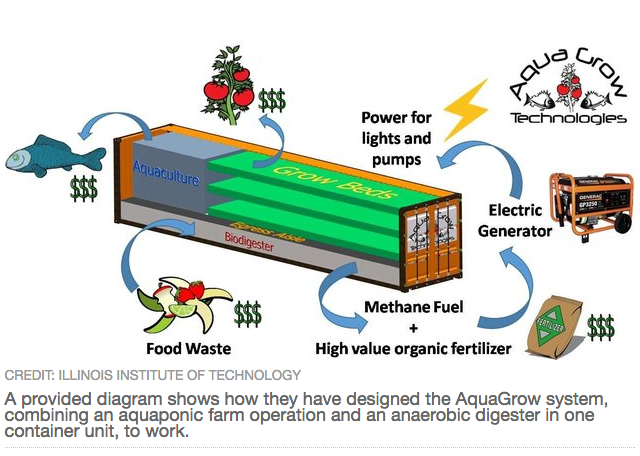
The system they invented, housed inside a 45-foot shipping container, generates energy by feeding food waste into a biodigester that works like a mechanical stomach to convert the material into methane. The gas is used as fuel for a generator that powers the aquaponic farm’s pumps and lights.
The units, developed in a collaboration with Nullam Consulting, a firm specializing in anaerobic digestion systems, will be sold for $150,000, according to Timofeeva. Aquaponic farmers can recover their investment in two or three years, she and Katsoudas said, with up to $80,000 in annual profit from what they grow with the system.
Farmers can harvest 14,500 pounds of fresh produce annually with the system — like leafy greens, tomatoes, peppers and even root vegetables. Additionally, 1,100 pounds of fresh fish could be raised inside the system, and 45 tons of organic fertilizer is a byproduct of the anaerobic digester. Plus, farmers can collect fees from providers of food scraps, like grocery stores and food processing facilities.
The aquaponic system uses dramatically less water than traditional farming, and diverts a significant amount of food waste from landfills.
“We want to bring all the technology and innovation together in a very compact, mobile, independent system that can be transported while still producing, and can be dropped wherever food is needed,” Timofeeva said.
A provided diagram shows how they have designed the AquaGrow system, combining an aquaponic farm operation and an anaerobic digester in one container unit, to work.
The ambitious concept is still in its early stages. The scientists are raising funds to build a full-scale prototype of their design. They’ve already attracted attention from the likes of Silicon Valley’s Cleantech Open Accelerator, which named the couple’s startup, called AquaGrow, a semi-finalist in its funding competition.
Some researchers have been skeptical of aquaponic startups’ claims and question the AquaGrow projections.
Stan Cox, a lead scientist at the Land Institute, a nonprofit based in Salina, Kansas, has been a prominent critic of indoor vertical farms, which typically rely on systems like AquaGrow’s.
Cox questioned whether such a system could produce enough food to justify the resources needed to power artificial light and climate-control mechanisms to protect the plants.
Aquaponics, obviously, is a lot more complex than growing a plant in a traditional way outdoors.
“When we’re growing a crop out in the field, the energy situation is pretty simple,” Cox told HuffPost. “When you’re going through a more convoluted process converting biomass [through the digester] and using artificial light, there’s a loss of energy at every step.”
Aquaponic Farming Is The Next Big Agricultural Thing
Stephen Ventura, a soil science professor at the University of Wisconsin-Madison who also has expressed skepticism of similar operations, said he sees promise in the AquaGrow project, but is concerned with its complexity.
“They are talking about moving and containing an immense amount of material,” Ventura wrote in an email to HuffPost. “And they’re talking about doing this with not one but three biological systems that are finicky to manage, let alone keep in mutual balance.”
Still, Timofeeva and Katsoudas are confident. They project that their system will require some 900 pounds of food waste per day to operate. Farmers can easily obtain that much material by developing a relationship with a local grocery store or school cafeteria, both of which have a reputation for wasting many tons of food daily, Timofeeva said.
As for the tricky logistics of the AquaGrow system, Timofeeva and Katsoudas said they’ve already succeeded in achieving balance within their system and making it easy for an operator to maintain that balance. They still need a prototype to prove it.
The scientists said AquaGrow will help feed a growing world population in a more sustainable way, allow under-resourced neighborhoods access to fresh foods, and offer an easily movable source of sustenance for communities hit by a hurricane or other natural disaster.
“Nothing prevents these systems from being picked up and dropped off in the event of a FEMA emergency. They’re ready to go,” Katsoudas said.
And, with problems like world hunger and climate change, help is urgently needed.
“We’re taking what we’ve got in the labs and we know we can do to actually turn it into something that can be utilized right now,” Katsoudas added. “We know the world’s going to need technology like this.”
Joseph Erbentraut covers promising innovations and challenges in the areas of food and water. In addition, Erbentraut explores the evolving ways Americans are identifying and defining themselves. Follow Erbentraut on Twitter at @robojojo. Tips? Email joseph.erbentraut@huffingtonpost.com.
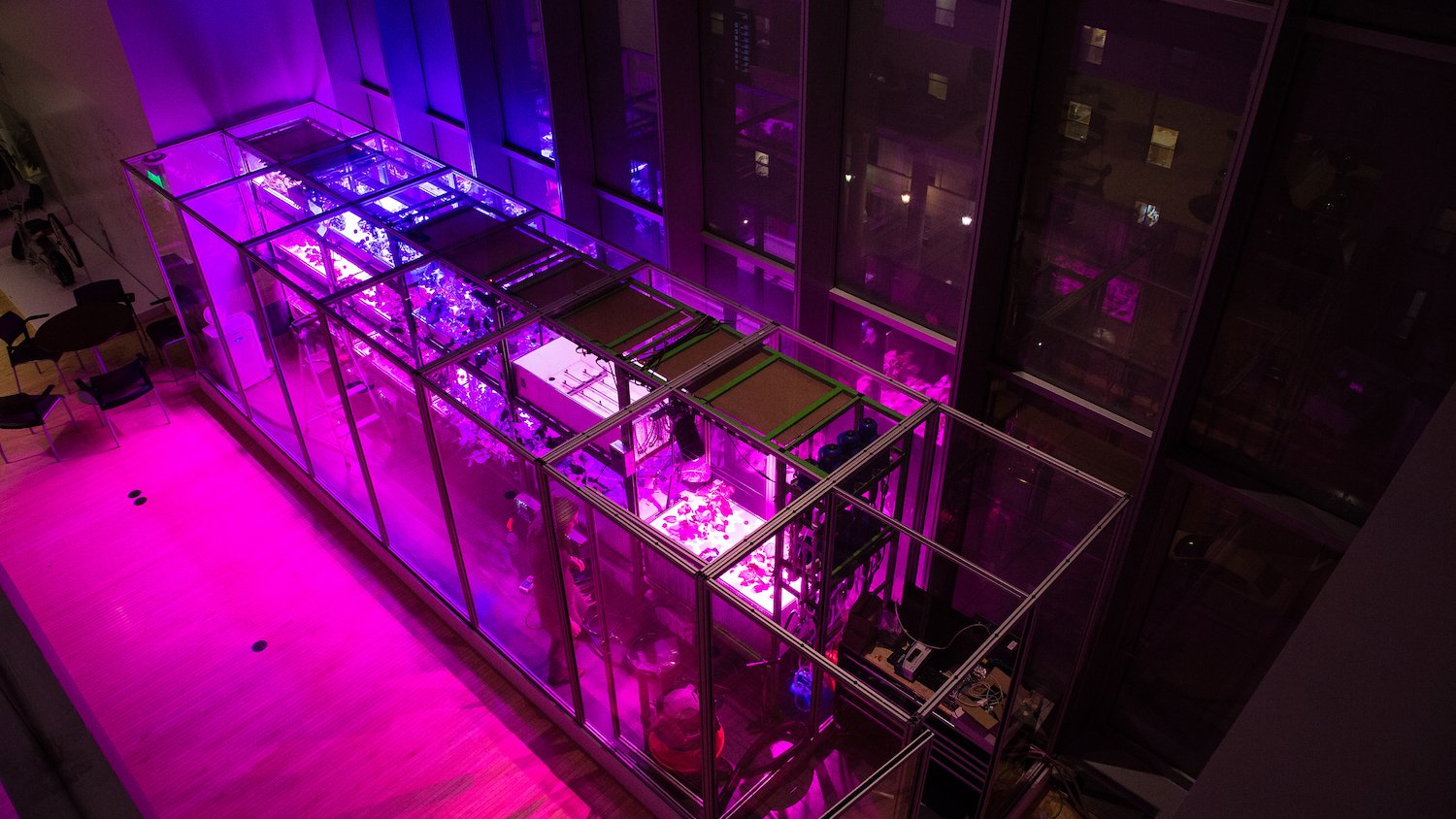
Target Plans To Test Vertical Farm 'In-Store Growing Environments' In 2017
Target plans to test vertical farm 'in-store growing environments' in 2017
Target plans to test vertical farm 'in-store growing environments' in 2017
DANA VARINSKY0OCT 5, 2016, 09.30 PM
Vertical farming, an agricultural technique that involves growing plants indoors in precisely programmed conditions, is spreading rapidly. Kimbal Musk (Elon's brother) is open in Brooklyn, the world's largest vertical farm is set to open this fall, and personal indoor growing boxes are being developed for home use.
Soon, an unlikely company will also start using the technology: Target.
"Down the road, it's something where potentially part of our food supply that we have on our shelves is stuff that we've grown ourselves," Casey Carl, Target's chief strategy and innovation officer, tells Business Insider.
In January, Target launched the Food + Future CoLab, a collaboration with design firm Ideo and the MIT Media Lab. One area of the team's research focuses on vertical farming, and Greg Shewmaker, one of Target's entrepreneurs-in-residence at the CoLab, says they are planning to test the technology in a few Target stores to see how involved customers actually want to be with their food.
"The idea is that by next spring, we'll have in-store growing environments," he says.
During the in-store trials, people could potentially harvest their own produce from the vertical farms, or just watch as staff members pick greens and veggies to stock on the shelves.
Most vertical farms grow leafy greens, but the CoLab researchers are trying to figure out how to cultivate other crops as well.
"Because it's MIT, they have access to some of these seed banks around the world," Shewmaker says, "so we're playing with ancient varietals of different things, like tomatoes that haven't been grown in over a century, different kinds of peppers, things like that, just to see if it's possible."
Because the CoLab is a research partnership, the projects don't only focus on technologies that could one day be used in Target's stores or supply chain.
For example, the team is currently developing a small vertical farm would allow farmers or researchers to conduct agricultural experiments and trials. A medium sized version, which is being tested in an off-campus MIT facility, would measure a few hundred square feet and could be used to grow produce for a restaurant or store.
The largest vertical farm the team has developed, at just under 8,000 square feet, could grow crops for an entire neighborhood or community. That big farm is currently being tested in India, where the team is attempting to grow non-food crops, like cotton, that often use up soil, water, and resources that could otherwise be used to grow food.
The CoLab team has also used the same research to create a self-contained growing box that can educate kids about how food is grown. On September 30, that product, called Poly, is being given to 35 public school classrooms in Boston and Minneapolis. Shewmaker says the team hopes to eventually make a market-ready version that could be sold to textbook or curriculum companies.
Carl says anticipating and shaping the future of food - at Target and beyond - is essential to the company's growth.
"Food is a big part of our current portfolio today at Target - it does $20 billion of business for us," he says. "We need to be able to see more effectively around corners in terms of where is the overall food and agriculture industries going domestically and globally."
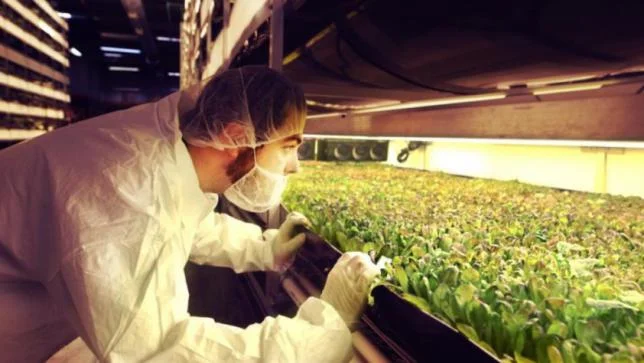
Vertical Farming Takes Shape
Vertical farms evolve to end hunger.
Vertical farming takes shape
Vertical farms evolve to end hunger.
We can certainly do more to reduce food wastage in our supply chains. It is not just Bangladesh where a lot of the produce goes to waste due to inefficient marketing and distribution channels; it is estimated that about half of all perishables in countries like Indonesia, Vietnam, Cambodia and Thailand go to waste before they reach retail markets. According to the World Bank, as much as 25 percent to 33 percent of all food produced in the world is wasted, which is equivalent to 1 billion metric tons. So, while all the focus and hype around food security seems to revolve around greater productivity, why aren't policymakers concentrating more on preserving the food already produced, which is then allowed to go to waste? This issue has been on the cards for many years and unfortunately, we have not seen much in terms of concrete policy interventions to bring about qualitative change in policy that would help farmers get their produce to markets faster.
While the world debates on and on about food security, technology is lending a hand to turn things around. Urban, concrete structures are being transformed into farms. For instance, in Newark (New Jersey, USA), a 69,000ft former steel factory has been converted into the world's largest urban farm. Once completed, it will grow anywhere up to 2 million pounds of kale, arugula and romaine lettuce annually. Technology is driving this new nascent sector but the implications are obvious. Climate-induced changes threatening to alter the topography of Asian farmlands in the decades to come and weather becoming more and more erratic with more droughts, floods, typhoons, etc. it is time to think outside the box. If we are to end 'global hunger' (one of the UN's 17 Sustainable Development Goals) over the next 15 years, urban farming will have to take centre-stage along with food wastage to meet the hungry mouths of the future.
Japan, a tech-driven nation, has introduced the world's first indoor farm. The setting is a 25,000ft abandoned semiconductor factory in Miyagi province. The technology comes from an American company that uses tall towers of LED-light trays, which it is claimed, consumes 95 percent less water to grow green produce than it would ordinarily take (i.e. if they were grown traditionally in fields) because the company claims to use mist instead of water to grow plants. If the technology is as good as claimed, it can yield 75 times more crops without the use of pesticides. Media reports have stated that the indoor farm produces 10,000 heads of lettuce daily which makes this farm 100 times more efficient than a comparable traditional farm.
The question of vertical and/or indoor farming is no longer confined to the realm of science fiction but science fact. The benefits of vertical farming are already being reaped by Bangladesh farmers in certain areas. According to a report published by the Voice of America in February, 2015, “In Chandpur village in southwest Bangladesh, lush vines sprouting pumpkins and gourds cover the tin roofs of small homes. This bounty sprouts from an unlikely source: large plastic sacks on the ground and other containers. In the southwest of the country, most of the coastal belt suffers from salinity that renders the land useless. And it is in this setting that vertical gardening is taking root among hundreds of villagers with the use of plastic sacks, giant containers made of plastic sheets and bamboo, etc.” WorldFish Centre, a non-government organisation working with villagers believes that vertical gardens work in Bangladesh because we suffer from heavy monsoon that dilutes salt in soil. And from July to October, the soil is inundated with 1.5 metres of rain due to the heavy rains. The flushed soil is collected by villagers in the post-rainy season which is then put into containers to grow vegetables. While the above scenario illustrates what is possible in rural areas, can we ignore the urbanisation trends globally? In 2008, we were confronted with the news that more than half the world population was living in urban areas. Indeed, projections point to the fact that two out of every three people will be living in an urban setting by 2050, and 40 percent of the projected urban growth between now and then will take place in countries like China, India and Nigeria. Bangladesh too is experiencing rapid urbanisation with roughly a tenth of the population living in the capital city Dhaka.
Vertical farming, as we are seeing in more advanced economies, is making inroads into agriculture. The higher start-up costs because infrastructure has to be bought or leased and costs associated with training up of personnel and maintenance of infrastructure begs the question whether this can be successfully replicated in economies such as ours. But one should remember that as the technology matures, costs should come down. At the end of the day, it is all about boosting food production and with more and more people moving to the cities, every initiative to enhance urban food security becomes imperative to policymakers. New technology initiatives being undertaken elsewhere should be looked into by our policymakers and city planners to make the best use of available urban space for productive uses.
The writer is Assistant Editor, The Daily Star.
Ag Company Grown in Portage Has Global Aspirations
The founder of a Portage-based commercial farming operation believes his indoor farming methods can be a sustainable solution throughout the world
Ag Company Grown in Portage Has Global Aspiration
By Dan McGowan, Writer/Reporter
PORTAGE -
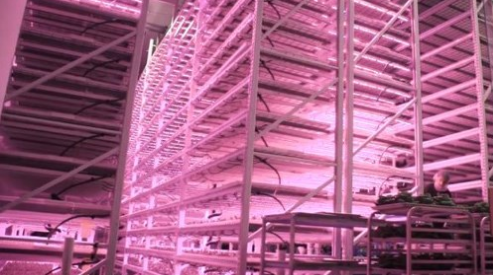
The founder of a Portage-based commercial farming operation believes his indoor farming methods can be a sustainable solution throughout the world. Chief Executive Officer Robert Colangelo says Green Sense Farms LLC's vertical farming model allows consumers to buy produce right where its grown, which can be in a building "virtually anywhere." The company's goal is to first build networks throughout the U.S., Canada, Scandinavia and China and then continue to spread globally. Plants, which are grown on racks that reach as high as 24 feet, are kept in constant growing conditions through lighting, watering and feeding processes Green Sense Farms says uses only a fraction of the resources of traditional farming techniques.
In an interview with Inside INdiana Business, Colangelo said "we are the modern, new farmer."
Colangelo is a third-generation Chicagoan but says he's happy to be a transplant in the Indiana agribusiness community, which has been very supportive of what he's trying to accomplish. He adds that northwest Indiana is an "iconic" location to have a business. "We're at the bottom of Lake Michigan on the Crossroads of America, Interstate-94 and 65, they tell me that we can reach 80 percent of the U.S. population in a day's drive from where we're located."
Colangelo tells Inside INdiana Business all future farms will be located "where large volumes of meals are sold," which includes grocery chain hubs, military bases, corporate campuses, schools or hospitals. "We put our farm here (in Porter County) originally, because we were close to the Midwest distribution center for Whole Foods in Munster," he said. "What we've learned is that close isn't good enough. You really want to be inside the distribution center." The Portage farm, Colangelo says, is the largest commercial, indoor vertical farm in the country.
The company's first farm in China opened in August and through a partnership with Ivy Tech Community College, Colangelo says ground will be broken soon on a new farm in South Bend, which will supply area universities, hospitals and grocery stores. He says 10 other spots are currently in the development pipeline.
Green Sense Farms says some characteristics of the markets it continues to scout include:
- large population centers
- high numbers of educated consumers who pay a premium for produce that is GMO-, pesticide- and herbicide-free
- produce travels a great distance
- growing seasons are short
- resources like land, clean water and clean air are limited
Colangelo says recently-loosened crowd-funding regulations have opened up his company to more potential investors. Indeed, Green Sense Farms has launched an online fundraising campaign, which has led to commitments totaling more than $200,000 in two weeks. You can connect to more about the crowdfunding efforts by clicking here.

Urban Produce To Hire Indoor Growers
Prospective growers will attend Urban Produce University in Irvine to prepare to work for prospective licensees in China, Canada, Mexico and Japan in 2017, according to a news release
By Mike Hornick October 03, 2016 | 1:44 pm EDT
Urban Produce, Irvine, Calif., plans to hire Controlled Environmental Agriculture indoor organic vertical growers to support its licensees as part of phase two of the company’s expansion program.
Prospective growers will attend Urban Produce University in Irvine to prepare to work for prospective licensees in China, Canada, Mexico and Japan in 2017, according to a news release.
Urban Produce, which launched in January 2015, holds patents in seven countries including the U.S. and Canada.
“As we move into the next phase of our business we look forward to building vertical growing units all over the world,” Ed Horton, President and CEO, said in the release.
With world population projected to increase 70% by 2050, Urban Produce’s plans for expansion aim to help combat global hunger and eradicate food deserts.
“Our goal of sustainability incorporates our atmospheric water generation and the use of solar-generated power in order to build anywhere,”

Certhon And Korean Lettuce Producer Sign Agreement
The Korean lettuce producer and Certhon, leading expert in designing and implementing complete greenhouse projects, signed an agreement to develop and realize a high-tech automated hydroponic greenhouse facility
Certhon and Korean lettuce producer sign agreement
30 September 2016
In the presence of Dutch Prime Minister Mark Rutte and Minister for Agriculture Martijn van Dam, a Korean lettuce producer and Certhon signed an agreement .This agreement was signed September 27th at the Netherlands-Korea Trade Dinner in Seoul during an economic mission in South Korea to confirm the collaboration between the companies.
The Korean lettuce producer and Certhon, leading expert in designing and implementing complete greenhouse projects, signed an agreement to develop and realize a high-tech automated hydroponic greenhouse facility of 1,4 ha. Moreover, there is a desire for the construction of a demonstration greenhouse of approx. 3000 m2 for hydroponic lettuce production, located in Gyeonggi-do (South Korea). Certhon will take the lead in the outline, design and realization of the project.
The companies signed the agreement during an economic mission in South Korea, led by prime minister Mark Rutte, accompanied by sixty Dutch companies of the top sectors Agri Food, Horticulture and Creative Industries to further strengthening the already close bonds between the Netherlands and South Korea.
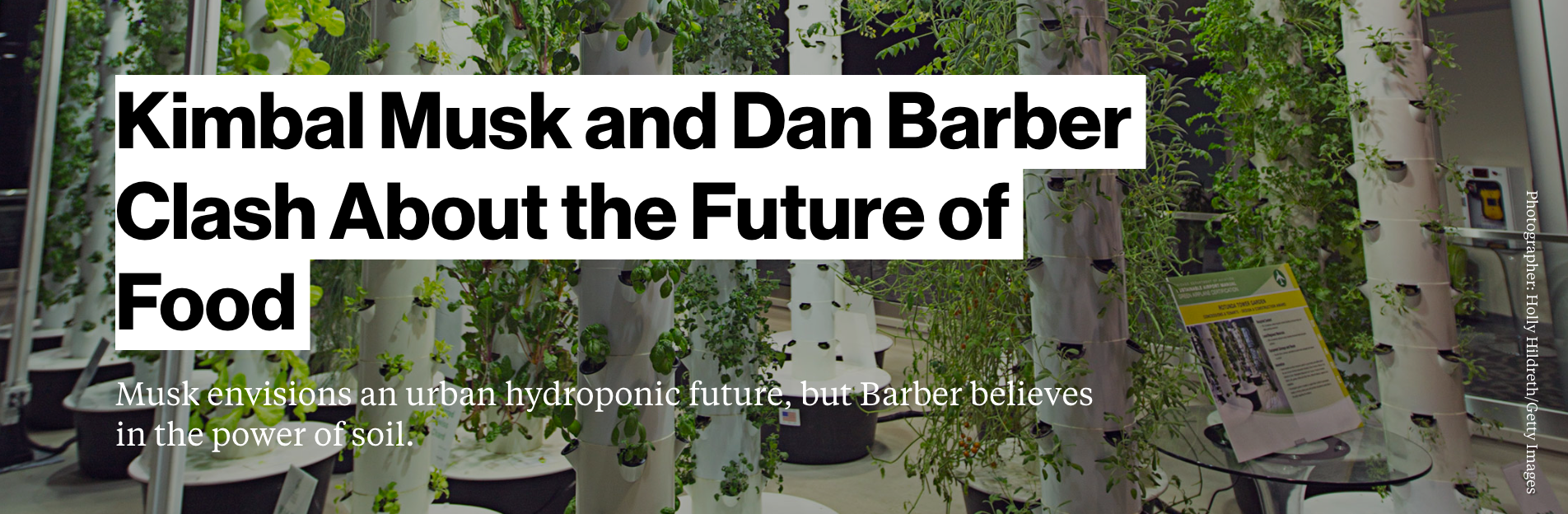
Kimbal Musk and Dan Barber Clash About The Future of Food
September 28, 2016 — 8:36 AM CDT
Kimbal Musk, co-founder of farm-to-table restaurant group the Kitchen, board member at Chipotle, Tesla, and SpaceX, and younger brother to Elon, thinks hydroponic vertical farming—that is, soil-less, indoor, LED-lit agriculture—is the future of food.
Dan Barber, renowned chef, restaurant owner, author of bestseller The Third Plate, and crop rotation evangelist, strongly disagrees.
In August, Musk announced a new venture called Square Roots. He hopes it will get millennial city dwellers to become farmers—who grow their goods in shipping containers. In his Medium post, he described “campuses of climate-controlled, indoor, hydroponic vertical farms, right in the hearts of our big cities.”
Chef Dan Barber (left), Kimbal Musk (center), and Elly Truesdell speak onstage at The Next Kale and Quinoa panel at the New York Times Food For Tomorrow Conference 2016 on Sept. 27, in Pocantico, N.Y. Photographer: Neilson Barnard/Getty Images for The New York Times
Musk's vision calls for containers with hydroponic vertical farming technologies, controlled temperatures, artificial lighting, and soil-less nutrition. At the New York Times Food Conference on Tuesday at Barber’s Blue Hill at Stone Barns in Pocantico, N.Y., Musk explained how lights inside the containers can be dialed to yield particular flavors and, most of all, how it can bring young people into farming industry. The influx of young blood is badly needed. The average age of farmers climbed from 50.5 years old in 1982 to 58.3 years old in 2012.
Musk is hardly the first to champion vertical farming. Frequent travelers may have noticed the aeroponic model at Chicago’s O’Hare airport, where such herbs as purple basil and chives grow alongside vegetables, including green beans, Swiss chard, and Bibb lettuce, year-round. Companies like Vertical Harvest in Jackson Hole, Wyo., FarmedHere in Bedford Park, Ill., and Alegria Fresh in Irvine, Calif., are also betting on versions of the new technology. A 2015 report by New Bean Capital, Local Roots, and Proteus Environmental Technologies hailed indoor agriculture as "the next major enhancement to the American food supply chain."
Proponents boast about the water saved, the pesticides avoided, and the faster growing times in an environment in which seasons don’t matter.
Not everyone, though, is on board with dirt-less farming.
“It’s not making me hungry,” Chef Dan Barber told the audience at a panel on new food trends. Barber is a preacher of the power of soil. He often explains how crop rotations—growing not just wheat, but also legumes, rye, and lesser known plants—not only provide tables with more diverse foods but improve the flavor of the primary crops, such as the wheat itself.
“I’d rather invest intellectual capital into the soil that exists outside,” said Barber, though he added that he doesn't know much about vertical farming. Still, he wants to see more excitement about what goes on underground, instead of growing food above it. “When Kimbal says you can dial in the flavor and colors you want, I don’t know that I want that kind of power,” Barber said. “I’d rather have a region or environment express color and flavor.”
Elly Truesdell, the Northeast regional forager—a fancy term for buyer—for Whole Foods Market, agreed with him. “I’ve never had a piece of produce from a hydroponic grower that tastes as delicious to me [as the soil grown version],” she said on the panel.
Both Musk and Barber agree that the current corn- and soy-centric agricultural system that grows more feed for animals than food for humans is broken; they just see vastly different solutions to the problem.
Even Musk isn’t pretending that shipping containers are already producing the big league results he's promising. “We buy 99.99 percent of our products from soil-grown foods,” he admitted of his restaurants.
Why ShopRite and Compass Group Have A Taste For Urban Farming
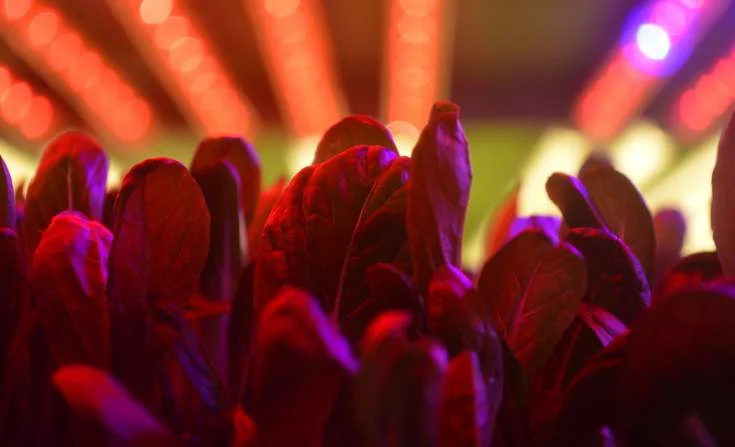
Vertifical farms startup Aerofarms can control pests and tweak produce flavors by changing the spectrum on the LED lights it uses within urban warehouses
Why ShopRite and Compass Group have a taste for urban farming
Wednesday, September 28, 2016 - 2:18a
Vertifical farms startup Aerofarms can control pests and tweak produce flavors by changing the spectrum on the LED lights it uses within urban warehouses.
Will the U.S. urban agricultural movement become mainstream? It’s certainly about to garner far more visibility, thanks to legislation proposed this week by Sen. Debbie Stabenow (D-Mich.), a ranking member on the Senate’s committee for Agriculture, Nutrition and Forestry.
Her bill, dubbed the Urban Agriculture Act of 2016, would expand the U.S. Department of Agriculture’s support for farm cooperatives in metropolitan areas, make it simpler for farmers running rooftop gardens or vertical farms to apply for USDA programs and fund research into new water and energy technologies that might accelerate adoption. Stabenow introduced her ideas in Detroit, a fertile example of what’s possible with the right public and private sector focus.
"A steady increase in the number of urban farms in the Capital City is beginning to impact health and nutrition awareness, good food access and food security, even as it is transforming fragile neighborhoods," noted Joan Nelson, executive director of the Allen Neighborhood Center, which runs a wholesale market for local produce and foods in Lansing, Michigan.
Although it’s a long way from becoming law, debate on the Urban Farm Act could help bring new legitimacy to the farmers, gardeners and technologists cultivating this movement. While no one really believes urban farms will be capable of supporting all of the food needs of their home cities, they’ll definitely be part of the solution, according to experts speaking last week at VERGE 16 in Santa Clara, California.
The Food and Agriculture Organization of the United Nations estimated last year that about 15 percent of the world’s food supply was attributable to farms or greenhouses in urban locations.
There’s a romanticized notion of local food production, and there’s a complete underappreciation of the complexity involved to be successful.
"I really see the future of agriculture in the ag of the middle sector," said Helene York, global director, responsible business for giant foodservice company Compass Group, during a keynote interview at VERGE. "Not in really big ag, not in really small ag. Not in hyper-local and not in global. But really about where do we find the best locations to grow some of the best food."
York is affiliated with one of Compass’ highest profile accounts, Google. While she’s not at liberty to discuss the sources that the technology company is studying for its corporate cafeterias and catering operations, she’s researching ingredients such as sustainably farmed seaweed. Kelp fettuccine, anyone? It could become a menu item, if we’re willing to set aside preconceived notions of taste.
"I am optimistic in the role of technology working with private industry as well as governments," York said.
Advancing food 'literacy'
One of the more important roles that urban farming operations will play is in advancing food literacy, and teaching urban citizens to appreciate organic produce that isn’t readily available in some lower-income neighborhoods. In San Francisco, for example, thousands of schoolchildren visit Alemany Farm, a site of several acres bounded by freeways, near public housing, and created from a former junkyard. There they can taste food that isn’t necessarily bred for shipping, so that that have a better appreciation for the concept of fresh.
The power of urban agriculture, in this case, is really education.
"The power of urban agriculture, in this case, is really education," said Eli Zigas, food and agriculture director for the nonprofit organization SPUR, during a VERGE panel. "They come and volunteer, they get their hands in the dirt and they learn about food and where it comes from. I think that’s one of the most valuable things, if not the most valuable thing, that urban agriculture provides to a city, and why a city would want to have it.”
Urban farmers that try to compete head-to-head against rural, organic farming operations will find it difficult to compete profitably. Rather, municipal governments should consider policies that frame and support urban farming operations in the context of a broader regional network.
"We’re going to have a national and international food system for a very long time," Zigas said.
Growing economic opportunity
For vertical farms specialist Aerofarms, urban farming is as much about creating new jobs as it is about reshaping the food supply, according to company’s co-founder and CEO David Rosenberg.
This week, the company opened its ninth aeroponic facility, housed in a former, converted steel factory in Newark, New Jersey. Aerofarms uses special lights to grow plants on trays stacked vertically to maximize growing space. (The new Newark facility has 13,000 of them.) These lights can do everything from deterring insects (sans pesticides) to tweaking the flavor of a leafy green. Rosenberg said his company can produce up to 22 crop turns per year.
"Our productivity per square foot is about 75 times higher than for a field farmer," he told VERGE attendees, adding that the approach uses about 95 percent less water.
Aerofarms is forging relationships with nearby grocery chains, such as New Jersey-based Wakefern Food, which owns the ShopRite supermarket co-op chain. Its crops are delivered to local distribution centers, where they can be shipped to where demand is greatest. The produce commands about the same price as organic field farmers.
Aerofarms also sells to the corporate foodservice company Compass Group, with which it is working on new recipes that are pushing people to think outside of traditional eating habits. One example: The two organizations are addressing the food waste dilemma by experimenting with ways to use all of a vegetable, including the stems.
"There’s a romanticized notion of local food production, and there’s a complete underappreciation of the complexity involved to be successful," Rosenberg said.

Freight Farm Lettuce Used in Campus Dining Halls on Friday
On Friday, Sept. 30, the first harvest of over 1,000 head of lettuce from the on-campus Freight Farm will be used in dining halls across campus
Thursday, October 13, 2016
Freight Farm Lettuce Used in Campus Dining Halls on Friday
Sep. 28, 2016
On Friday, Sept. 30, the first harvest of over 1,000 head of lettuce from the on-campus Freight Farm will be used in dining halls across campus.
The lettuce will be distributed to Fulbright, Pomfret, and Brough dining halls, as well as the Arkansas Union, and will show up everywhere from salad bars to burgers.
The lettuce has been growing since Aug. 11, in an insulated, "farm in a box" container.
The 40' x 8' x 9.5' container, produced by Freight Farms, is a fully functioning hydroponic farm built inside of an up-cycled shipping container.
Inside the container, LED light strips provide crops with spectrums of red and blue – the light spectrums required for photosynthesis. A hydroponic system delivers a nutrient rich water solution directly to roots, using only 10 gallons of water a day. Energy-efficient equipment automatically regulates temperature and humidity through a series of sensors and controls.
After the first harvest, the farm should consistently produce crops of up to 500 heads of lettuce.
Before bringing the Freight Farm to campus, Chartwells Dining Services, part of the Division of Student Affairs, was looking to find a sustainable solution. The project has the potential to shorten the food supply chain, cut transportation emissions, decrease transportation costs, and overall all, significantly reduce the campus carbon footprint.
Ashley Meek, Chartwells' licensed, registered dietitian and farm manager, said the freight farming project is one way of addressing campus sustainability while giving students a way to pursue their academic interest outside of the classroom. Meek has two student interns who help her manage the farm – Taylor Pruitt and Merissa Jennings – who are both interested in the future of agriculture and food sciences.
"We hope the Freight Farm supplies sustainable culinary operations to campus, and also gives those students working with the Freight Farm a place to get their hands dirty in the science behind hydroponic farming," Meek said.
Any overages from the crops are slated for donation to the Razorback Food Recovery, enabling the campus to use every bit of each harvest.
1 University of Arkansas
Fayetteville, AR 72701
479-575-2000
The US Start-Up Helping Indoor Farming Become A Growth Industry
What makes indoor farming attractive is its resource-efficiency compared with conventional farming methods.
Not so long ago, in the basement of a building in Copenhagen’s trendy meatpacking district, you could find a hydroponic garden growing leafy greens - such as romaine lettuce, pea shoots, and parsley. Oh, and dill, lots of dill. (This is Denmark, after all.)
The project was called the Farm, and it was the brainchild of Space 10, a “future-living lab and exhibition space”. Its remit is to explore possible solutions to major global challenges in order to “create opportunities for a better and more sustainable way of living”. That includes the future of food – and indoor farming in particular.
Hence the Farm – which, in its own way, typifies a shift in thinking about farming methods. According to the UN’s Food and Agriculture Organization (FAO), the global population will hit nine billion by 2050. And to feed all those people, food production must increase by 60 to 70 percent by 2050. Little wonder, then, that seemingly radical ideas like indoor farming are being considered as possible solutions.
What makes indoor farming attractive is its resource-efficiency compared with conventional farming methods. In fact, according to Agrilyst, which creates “intelligent indoor farming platforms”, hydroponics requires about 10 times less land and 20 times less water than conventional farming.
The trouble is, indoor farming still gobbles up a lot of energy and resources – which is what makes Agrilyst’s indoor farm-management platform interesting. The US start-up claims it enables farmers to monitor and optimise plant performance, and use fewer resources and less energy in order to produce a greater yield. Another way of putting it is that Agrilyst’s platform helps farmers become more sustainable and profitable.
The platform tracks and analyses indoor farm data in one place – enabling farmers to monitor and maintain optimal plant performance, and therefore reduce operating expenses. In particular, farmers receive real-time analytics and data aggregated from hardware, such as crop sensors, as well as lab results and spreadsheets.
At the same time, Agrilyst uses the data aggregated on the platform, coupled with academic research and industry knowledge, to develop new solutions for optimising performance. Its aim is therefore to make indoor farming easier, greener, and more productive.
From an environmental perspective, the platform’s appeal is apparent: it uses data analytics and recommendations to help indoor farmers to reduce energy and resource use. The economic case is clear, too: by aggregating data from indoor farms around the world, Agrilyst provides growers with insight and intelligence to improve performance – in turn helping to increase yield and profits.
Critically, the social aspect stems directly from this: by increasing yield and quality, indoor farmers can provide their communities with better tasting, healthier, and safer produce, while contributing to the global need for increased food production.
Platforms such as Agrilyst’s seem to make it easier than ever for farmers to say hello to hydroponics. Indeed, if you’ll excuse the pun, indoor farming is fast becoming a growth industry. Experiments in indoor farming may be taking place in the basement of buildings in Copenhagen. But they won’t be underground for much longer.
This innovation is part of Sustainia100; a study of 100 leading sustainability solutions from around the world. The study is conducted annually by Scandinavian think-tank Sustainia that works to secure deployment of sustainable solutions in communities around the world. This year’s Sustainia100 study is freely available at www.sustainia.me – Discover more solutions at @sustainia and #100solutions
This Singapore Device Turns Your Home Into An Urban Farm
Creator Brian Ong hopes his device will help people grow and eat more fresh, wholesome food
This Singapore device turns your home into an urban farm
Creator Brian Ong hopes his device will help people grow and eat more fresh, wholesome food
26 Sep, 2016
The late founder of modern Singapore, Lee Kuan Yew, rolled out a plan in 1967 to transform the republic into a “garden city”; today, parks and gardens green spaces adorn the city’s urban landscape amidst the ever-growing high-rise developments.
Even in HDB flats, many Singaporeans are fond of keeping potted plants along the dreary-looking corridors.
But the problem with urban life is that time constraints create unhealthy gardening habits. So unless it’s cactus or a similarly resilient plant, many plants die from the neglect and lack of water.
Brian Ong, a Masters of Architecture graduate from the Singapore University of Technology (SUTD), has created a device that helps urban farmers/botanists automate plant care.
There is no team behind Hydra. Ong as a one-man inventor, and was spurred to embark on this project because of his own pain point.
“This project started off when I was in university. As my schedule got busier, my plants began to suffer as a result. As I could not find any suitable watering solutions for the indoor garden (the systems I came across on the market had various shortcomings), I decided to design one for myself,” says Ong, in an interview with e27.
Another factor was the growing trend of urban farming, In a nutshell, the concept revolves around urban dwellers growing high-quality produce within confined spaces, in a sustainable fashion.
“More people are striving to grow their own mini edible gardens to provide a small but steady stream of herbs and vegetables to their kitchen,” he says.
Ong took to taking apart and scrutinised the shortcomings of current indoor watering systems on the market.
“Some systems are difficult to install in existing indoor setups – for example, drip systems that require a connection to a tap,” he says.
“Other systems are not very discreet – for example, capillary action solutions (water channelling) that have one bottle per pot or gravity solutions that require the water source to be placed above the pots. Some systems also run on battery power, which is not good for everyday use,” adds Ong.
The solution
Thus, the findings came to one clear-cut conclusion – Hydra needs to be a simple plug and play device.
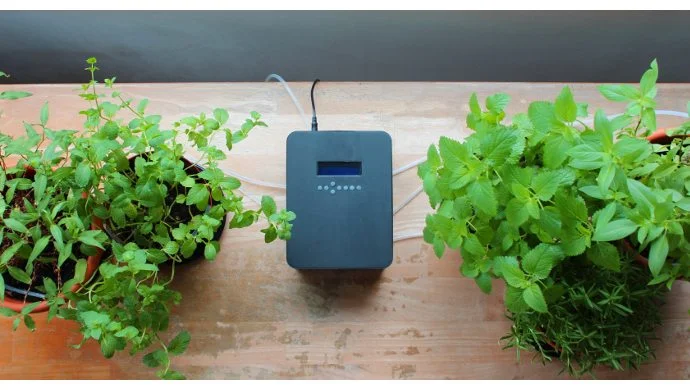
Hydra essentially acts as a hub and “is designed to be simple to install in any existing indoor/balcony garden setup and easy to maintain. It draws water from a bucket on the ground and distributes it to up to 10 plants via tubes once a day,” says Ong.
“Each output’s watering volume can also be adjusted independently of one another, so the needs of different plants can be catered to,” he adds.
For those who seek to build a mini indoor farm, Ong says it is also possible to water more than 10 plants if the pots are set up in a way that allows water to be drained from one pot to the next. Water can also be pumped up to a 2.25 metres height.
The user also can plug in multiple sources of water, so it’s possible to water plants for weeks without refilling the water source(s). And once the system has been properly rigged up, the user can start calibrating the sequence.
First, the current time and water dispensing time have to be set. Then comes dispensing volumes, which can be set in three different ways: visual dispensing (see a rough gauge of much will be dispensed), preset volumes, and volumetric dispensing (meaning specific user set volumes).
It’s not smart
One surprising thing about Hydra is that — despite the trend of IoT devices such as this — it is not smart.
Ong opted for the low-tech route because “a smart watering system would have incorporated soil moisture sensors in each pot, which would have increased costs and led to a whole bunch of wires running around the place.”
The goal, Ong emphasises, is to create a simple automated watering machine without bells and whistles.
Development
Hydra has been in development for close to 11 months. The initial funding for the prototype and samples for various parts amounted to around S$2,000 (US$1,470).
Ong is seeking to raise capital via Kickstarter. Currently, it has raised nearly half of its S$55,000 (US$40,400).
So if you would like to go on a long holiday without fretting about your plants withering away, Hydra might be a good fit for the home.
Just remember to cover the water source(s) or your home will be ground zero for a Zika mosquito breeding spot.
Proposed Legislation Would Support Urban Farming With USDA Resources
Proposed legislation would support urban farming with USDA resources
September 26, 2016 11:00 a.m. Updated 9/26/2016
U.S. Sen. Debbie Stabenow announced Monday that she is introducing legislation that addresses the needs of urban farmers by offering them U.S. Department of Agriculture resources and programs.

Stabenow, D-Mich., made the announcement with Detroit Mayor Mike Duggan and Michigan urban agriculture leaders at D-Town Farm, Detroit's largest urban farm, on the city's far west side.
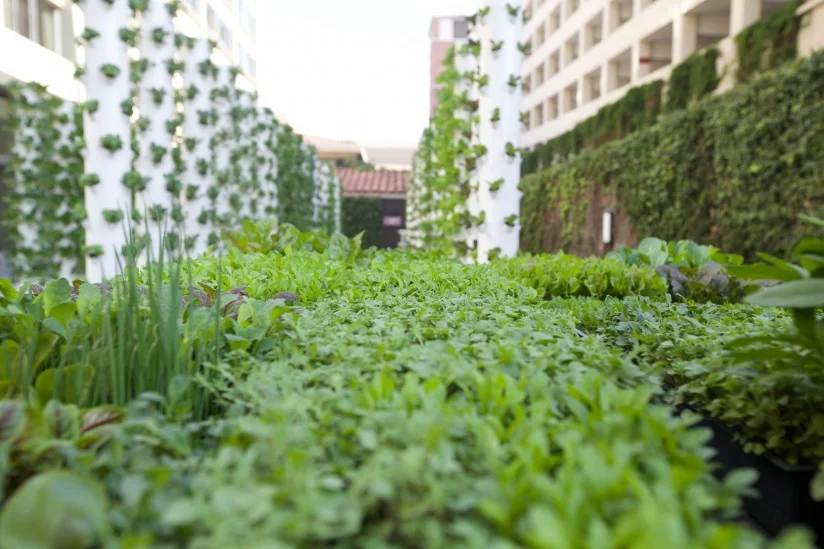
The Urban Agriculture Act of 2016 would create new economic opportunities for urban farmers through agriculture cooperatives, rooftop and vertical farms, access to research that explores marketing opportunities for urban agriculture, and developing methods for lowering energy and water needs.
The legislation is to be formally introduced this week.
“The next step (if the legislation passes) is urban farmers will have the capacity to use all of the USDA services that rural farmers have,” Stabenow said.
The bill includes $10 million to support cutting-edge farming research and it would open a new USDA office in Washington, D.C., to help urban farmers get started or improve their existing business, the senator said. Another $5 million would go toward supporting community gardens and education for nutrition, sustainable growing practices, soil remediation and composting.
It would also benefit urban farmers in large and small cities.
Stabenow said the bill builds on the farm legislation she authored and was signed into law in 2014.
“I’m going to brag a bit,” she said. “Malik (Yakini of the Detroit Black Community Food Security Network that runs D-Town) and other people involved for a long time in Detroit farming are the experts on urban farming. When I talk to folks around the country about urban farming, they say, ‘Why are you asking me? The urban farming expertise is in Detroit.’”
Yakini said at the news event that he is hesitant to comment on the legislation. “I’ve not seen the bill,” he said. “We hope it will be helpful.”
He added that legislation that would make access to capital easier for urban farms would be appreciated. “The challenges are access to capital and access to land, even though a third of the city is vacant land,” he said.
BrightFarms’ Indoor Farming System Lands $30M to Grow
Leafy greens and tomatoes don’t have to travel hundreds of miles to reach salad plates anymore.
Consumers can easily make garden salads year round because grocery stores get their greens from farms across the country where items like lettuce are always in season. But those leafy greens and tomatoes don’t necessarily have to travel hundreds of miles to reach salad plates.
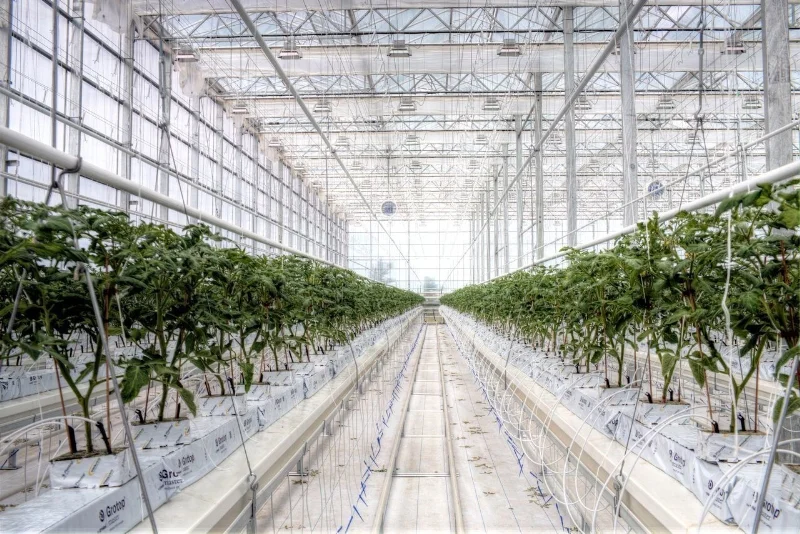
Agtech startup BrightFarms uses indoor farming to try to shorten grocery store supply chains, and also lower costs by using less land, water, transportation fuel, and pesticides than traditional farming. The New York-based company announced last week that it raised $30.1 million from investors to take this greenhouse model to new markets across the country.
The BrightFarms investment eclipses the $18 million raised by Harrisonburg, VA-based Shenandoah Growers earlier this year. That company, which sells herbs and herb plants grown in its greenhouses, raised funds from S2G Ventures and Middleland Capital, according to AgFunder. Despite those deals, indoor agriculture remains a small part of overall agtech investment.
The technologies claiming most of the $1.8 billion in global agtech investments in the first half of the year were food e-commerce, biomaterials and biochemicals, soil and crop technology, and precision agriculture, according to AgFunder. That six-month total marked a 20 percent decline compared to the same period in 2015. Indoor agriculture accounted for $21 million across 10 deals in the first half of 2016—just 1 percent of all agtech funding raised and just 3 percent of all deal flow, according to AgFunder. Still, a number of startups, including BrightFarms, are betting on consumer and investor interest in indoor farming.
The indoor farming market is shaking out into several segments. BrightFarms is a food supplier, distributing the food it grows to contracted retailers, who in turn sell the produce to consumers. That’s the same approach taken by Brooklyn, NY-based startup Edenworks, which grows produce inside a warehouse and supplies stores in New York. Other companies are providing businesses with the hardware to do their own indoor farming. Atlanta-based PodPonics, for example, sells shipping containers and software to manage food-growing operations inside them. Boston-based Freight Farms also sells refashioned shipping containers outfitted with LED lights and climate controls.
Some startups are bringing indoor growing options directly to consumers. Somerville, MA-based Grove sells high-tech growing cabinets that consumers can place in their homes. And Cambridge, MA-based SproutsIO, which like Grove shares MIT roots, has developed a microfarming system that fits on a kitchen countertop.
All of these startups pledge to provide locally grown food that reduces water use and eliminates pesticides. For its part, BrightFarms claims its greenhouses use 80 percent less water, 90 percent less land, and 95 percent less shipping fuel compared with crops grown outdoors and shipped to market via conventional supply chains.
BrightFarms currently operates greenhouses near Chicago, Philadelphia, and Washington, DC. It says it has long-term, fixed price contracts to provide produce to several supermarket companies including Mariano’s, a Chicago-area grocery retailer owned by Kroger (NYSE: KR); ShopRite, whose footprint includes New York and New Jersey; and Giant Foods, which has stores in the central Atlantic states.
When BrightFarms opened its newest greenhouse in Illinois, CEO Paul Lightfoot told the Chicago Tribune that the 160,000 square-foot facility cost about $10 million, which included land acquisition and construction. In the funding announcement, the company did not say where it will use the fresh capital to expand.
Frank Vinluan is a contributing editor at Xconomy, based in Research Triangle Park. You can reach him at fvinluan@xconomy.com Follow @frankvinluan
High Times: Vertical Farming Is On the Rise — But Can It Save the Planet?
Farming as we know it is failing.
Farming as we know it is failing. Mom-and-pop operations are struggling to survive and Big Ag cares far more about its bottom line than about your health, or the health of the planet. Ecologists, anti-GMO activists, even sticker-shocked soccer moms in the produce aisle agree: It’s time for a revolution. Now, some experts are saying, this revolution may come via vertical farming, in which produce is grown indoors, in stacked layers. After years of technological trial and error, the practice is primed for blastoff.
The basic idea is not new. For centuries, indigenous people in South America pioneered layered farming techniques, and the term “vertical farming” was coined by geologist Gilbert Ellis Bailey in 1915. But the need for its large-scale implementation has never been greater. Under our current system, U.S. retail food prices are rising faster than inflation rates, and the number of “food insecure” people in the country — those without reliable access to affordable, nutritious options — is greater than it was before the era of agricultural industrialization began in the 1960s. And we’re only looking at more mouths to feed; according to the UN, the world’s population will skyrocket to 9.7 billion by 2050, an increase of more than 2.5 billion people.
Additionally, climate change is threatening the sustainability of our current food production system. Rising temperatures will reduce crop yields, while creating ideal conditions for weeds, pests and fungi to thrive. More frequent floods and droughts are expected, and decreases in the water supply will result in estimated losses of $1,700 an acre in California alone. Because the agricultural industry is responsible for one-third of climate-changing carbon emissions, at least until Tesla reimagines the tractor, we’re trapped in a vicious cycle.
So how do we break out?
“We have to extinct outdoor farming,” Dickson Despommier, PhD, emeritus professor of microbiology and public health at Columbia University and author of “The Vertical Farm: Feeding the World in the 21st Century,” told Salon. “We have to put the earth back to the way it was when trees were the most abundant crop. If we paid farmers to plant carbon-sucking trees instead of corn — what’s called carbon farming — the earth’s atmospheric makeup could be completely different in 20 years’ time. But this means looking elsewhere for a food source.”
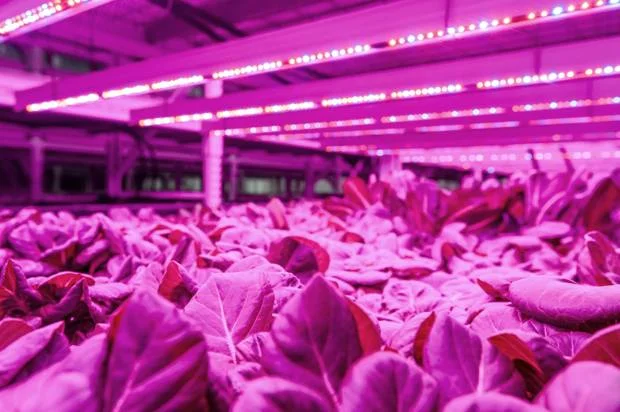
In vertical farming, that food source starts with a building – any building – usually comprising more than one floor. On every level are flat racks of plants taking root not in soil, which is unnecessary for growth, but instead in a solid, sustainable, and pesticide-free substrate, like mashed-up coconut husk. In these hydroponic systems, plants are fed a nutrient solution from one of a variety of devices, including a misting nozzle, a slow-feed drip, and a wicking tool (like the volcanic glass called perlite) that carries nutrients from an in-house reservoir directly to the roots.
CA Farmers Use Advanced Drone Tech to Save Water http://videos.tout.com/dry/mp4/7ef39d7e62d9b298.mp4
The buildings are equipped with artificial lighting in place of sun, and they’re temperature and humidity controlled. Unlike in the great outdoors — where wind, precipitation, and season are out of a farmer’s hands — growing conditions are controlled and plants are able to reach maturity twice as fast. Often, the spaces are hermetically sealed to prevent common plant diseases, like wheat rust, from blowing through. And the final product? It tastes the same as crops grown outside, even better if those outside crops came from degraded soil. While leafy greens have traditionally been the most cost-effective crop to grow indoors, improved technology is also allowing for a broader range of options (think tomatoes, berries and ramps).
Vertical farming operations are sprouting in the U.S. and around the globe. Earlier this year, the $39 million AeroFarms, comprising 12 layers spread over 3.5 acres, opened in an old steel mill in Newark, New Jersey. Production yields the equivalent of 13,000 acres of farmland in the region. It also utilizes 95 percent less water than traditional vegetable farms since the H2O is recirculated.
In Philadelphia, Metropolis Farms, which already operates the world’s first vegan-certified vertical farm in North America, is planning a network of 10 vertical projects throughout the city, including the world’s first solar-powered vertical farm. Because the technology has advanced so much in recent months, according to president Jack Griffin, this network will cost 5 percent of what AeroFarms did, require 80 percent less real estate, and allow for a greater yield. Similar projects are seeing success in Japan and Berlin —and in Sweden, a plantagon, or plantscraper, 16 stories tall is in the works.
The goal, in addition to creating green-collar jobs, is to bring nutritious produce to urban areas where high-quality, fresh food is hard to come by. With 70 percent of the world’s population expected to reside in cities by 2050, utilizing agritecture to eliminate these food deserts is an increasingly attractive option. In the U.S., $32 million in venture capital was invested in indoor agriculture in 2014, and proponents say the industry has a revenue potential of $9 billion.
But not everyone is convinced the idea won’t go to seed. Early this year, in an article for Alternet, environmental writer Stan Cox argued against growing food in high-rises because of the method’s large energy requirement — specifically, the need for LED lighting in lieu of sunshine. Louis Albright, PhD, emeritus professor of biological and environmental engineering at Cornell University, called vertical farming “pie in the sky” for the same reason.
“The sun is equivalent to $400,000 worth of electricity per acre when growing outdoors,” Albright told Salon. “What vertical farming can save in transportation costs is quite small comparatively. It’s not viable.”
But proponents of vertical farming say such rebukes are based on outdated information — the efficiency of LED lighting has increased dramatically, by 50 percent between 2012 and 2014. Progress is expected to continue — the U.S. Department of Energy has recently adopted new LED efficiency standards, set to be finalized by January 2017. Meanwhile, vertical farms are hiring engineers and ergonomists to reduce the footprint even further.
“We designed our own LED lights to dial into wavelength spectrums,” Allison Towle, director of community engagement at the Los Angeles vertical farm Local Roots, told Salon. “We control them to emit only red or only blue or only white light, whichever helps a specific plant grow, which reduces energy output. Our R&D phase was two years long, because we developed these specific recipes, meaning for each plant we determined the right kind of lighting, the right nutrient makeup in the water, and the right amounts of each. This has brought outdoor growth times down by 40 percent.”
Robert Colangelo of the Indiana-based Green Sense Farms, which has 10 new projects in the deal pipeline, says improvements in LED efficiency are largely responsible for his current expansion, which involves building a network of vertical farms throughout the U.S., Canada, Scandinavia and China. The plan is to launch at points of consumption — grocery stores, hospitals, colleges and military bases — for direct-to-consumer sales. The food will be fresh, and the distribution-related carbon emissions, nonexistent.
“Comparing the energy requirement of growing outdoors versus growing inside is like comparing apples and oranges,” Colangelo told Salon. “We use LED lighting and they use sunlight. But they need tractors and other mechanical equipment, more water, fertilizer. It’s two different growing processes. Instead of comparing them, look at the crops and evaluate the most sustainable way to grow each one. Commodity crops, like soybeans, will likely always be grown outdoors. Leafy greens are better inside. What vertical farming has done is stratified the industry.”
In the future, some vertical farmers, like Colangelo, are looking to incorporate biopharmaceuticals into their growing rosters. And NASA, which counts itself as a vertical farming pioneer, may end up using the method for growing food on other planets, in a more sophisticated version of the techniques used in “The Martian.” But for now, the industry is still in its infancy.
“It’s like the beginning of the Internet, or even the Internet 10 years ago,” Despommier told Salon. “Look how far that’s come. There are people who looked at the airplane and thought: ‘That will never fly.’ But people are going to continue innovating. In 10 years’ time, we’ll all be getting our food this way.”
Bay View Grows Mushrooms
Mushrooms don’t require as much light as vegetables, making them a good fit with indoor urban farming.
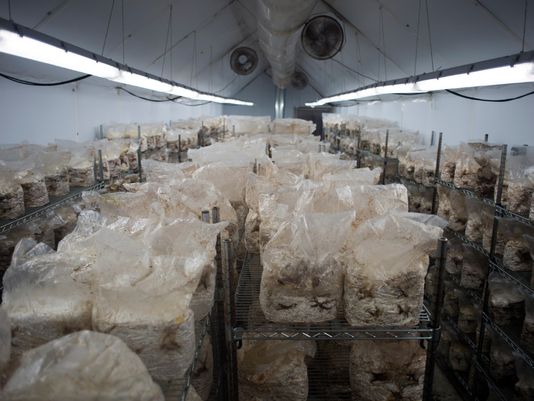
Three urban farmers are growing mushrooms in an old industrial building on Milwaukee’s south side, using coffee grounds from local coffee shops as mushroom food, and selling the finished fungi to restaurants.
Grow Local, a natural-foods business from Neenah in the Fox Valley has the 6,000 square-foot mushroom operation in the old W.B. Bottle Co. building at 822 E. Bay St. in Milwaukee's Bay View neighborhood.
Grow Local owners Steve Catlin, Calvin Andersen and Alex Fehrenbach share the building with other businesses, including a furniture store and a carpentry shop. They grow about 100 pounds of mushrooms a week for restaurants, with plans to boost that to 500 pounds a week over the next year.
By Rick Barrett
“We are in full production mode, but we are still investing more in this space, building out our system and network,” Catlin said.
Mushrooms get their nutrition by metabolizing nonliving organic matter. The Grow Local mushrooms’ food includes coffee grounds from Stone Creek and Kickapoo coffee shops.
The fungi are grown in a big, open room that’s essentially a humidity and light-controlled greenhouse.
Catlin developed a system for growing the gourmet mushrooms, including the shiitake and oyster varieties, that uses coffee grounds, sawdust and wood chips as the substrate.
Mushrooms don’t require as much light as vegetables, making them a good fit with indoor urban farming.
“I am kind of an evangelist for getting people to grow mushrooms. You can grow them on your own if you can maintain a semimoist mulch bed,” Catlin said.
Catlin is a 2011 Marquette University graduate, with a degree in psychology and philosophy. Andersen and Fehrenbach are University of Wisconsin-Madison graduates with degrees in biological systems engineering and geography.
Their business produces greens, herbs and fish in Neenah, and the mushrooms in Milwaukee.
Most of Grow Local’s products are sold in the Fox Valley, but it also sells to some Milwaukee-area restaurants. The business aims to develop a direct-to-consumer market that would partner with other farmers and would provide customers with information on how their food was produced.
Catlin said he wants to offer people year-round the experience they get at farmers markets. "You look the farmer in the eye, and that person tells you the reasons why their product is good,” Catlin said.
The Bay View neighborhood — with its young, health-conscious residents — could be a prime location for that.
“One of our niches is year-round production of chemical-free products,” Catlin said. “There are a lot of organic farmers quietly doing an awesome job.”
The trio wrote their business plan while they were in college. They started with the 2,000-square-foot greenhouse in Neenah, using a system in which the waste produced by farmed fish supplies nutrients for plants grown hydroponically. The Neenah location also has a herb garden.
The large, open space in the former bottling plant in Bay View was perfect for growing mushrooms.
“And we don’t see this as our last space, for sure,” Catlin said.
Milwaukee has been a leader in urban farming, whether it’s growing mushrooms indoors or fruits and vegetables on vacant lots.
“We were getting excited about all of the changes in local foods in Wisconsin, especially in Milwaukee. We were inspired by Will Allen and some other farms in the area,” Catlin said.
Allen is the founder and CEO of Growing Power, a nonprofit focused on urban farming and creating sustainable food systems. He started with 3 acres of land on Milwaukee’s north side in 1993 and now has locations in Milwaukee, Chicago, Detroit and other places throughout the world.
“We have the largest urban farm in the world, but we need more folks who really want to scale it up,” Allen said.
“There are going to be people who do this on a small scale, and that’s great … but we need to scale up to the point where we can grow some jobs and put people to work,” he said.
Allen, named one of the 100 World’s Most Influential People by Time Magazine, believes that urban farming can help address poverty and related social issues.
“The answer to end poverty and violence is to give people living-wage jobs, and this is an industry that can do that. We don’t see other industries moving into troubled communities,” Allen said.
Growing Power has trained mushroom farmers from all over the world. It also has greenhouses for year-round production of fruits and vegetables in cold climates.
Increasingly, consumers have sought locally-grown foods.
“The market is there. The problem is there’s not enough production. We have to grow some farmers,” Allen said.

Indoor Farms: Where Venture Capital Doesn’t Always Make Sense
So where should startup indoor farms look for early stage funding?
This week I took part in NYC AgTech Week, a week-long event that attracted indoor agriculture enthusiasts from across the globe for a series of presentations, tours, and panel discussions. On Tuesday evening, indoor ag software startup Agrilyst hosted a panel discussion on funding for indoor farms and other agtech startups.
For an area of agtech that gets so much hype, if AgFunderNews click rates are anything to go by, we are always amazed at the relatively low volumes of funding that go into it. In 2015, indoor agriculture startups — encompassing physical indoor farms and any hardware or software products serving them — raised $77 million, and during the first half of this year that figure was just $21 million. That’s from a total $4.6 billion in agtech investment in 2015 and $1.8 billion in the first half of 2016.
Having said that, the subsector has captured some of agtech’s largest deals, and this week’s $30 million Series C from BrightFarms is no exception. BrightFarms says this is the largest equity funding round for a US indoor ag company. The largest deal on record was 2014’s $100 million investment from private equity behemoth KKR into Sundrop Farms, the Australian greenhouse project. New Jersey-based vertical farming group AeroFarms has also raised big money, with Goldman Sachs and Prudential contributing $40 million to a $70 million debt financing for a specific farm project last year and the company has raised more in equity funding for the business too.
These deals are so big because scaling an indoor farming business is no small feat. The time it takes to do so is a big question for venture capital firms and has kept many away, argued James Smits from Beta Bridge Capital, who was speaking on the panel. Venture capital investors typically want to hold investments for around five years, but scaling an indoor farming company could take at least that time.
Beta Bridge, which focuses on seed stage investments, is instead accessing the indoor ag market through software and invested in Agrilyst’s seed round earlier this year. Agrilyst is likely to behave a lot like any other SaaS platforms in Smits’ portfolio and very different from asset-heavy indoor farming businesses.
There are of course some VCs that have invested in indoor farming startups, and the main players all have VCs in their investor line-up. It’s particularly suitable at the growth stage, such as Catalyst Investors in BrightFarms’ latest round. In this case, BrightFarms has de-risked its business model with proven technology in existing facilities and long-term produce purchase agreements with grocery making it a very different proposition to investing in a startup indoor farm with little operating history.
So where should startup indoor farms look for early stage funding? If you look at the investor base of indoor farms so far, you’ll notice there’s actually a very broad range of investors available to the sector, including family offices and impact investors. They may have longer investment time horizons and missions than a typical VC, and so can stick with the business through the early stages and into growth.
Regional investors are another potential source of funding such as NYS Innovation Venture Capital Fund, a New York state-funded vehicle, which is looking closely at the agtech space. Speaking on the panel from the fund, Lindsay Freeman Avagliano said that the fund’s mission was to make a positive impact on communities in New York through funding local innovation. The relatively new fund, which has $100 million to deploy, will reserve follow-on funding for the majority of investments it makes, she told the audience.
Then there are other routes altogether, namely project financing and debt for specific initiatives like the Goldman Sachs deal. This funding can be longer term and support the construction of facilities and purchase of equipment — instead of providing equity funding for a startup’s general overheads.
Speaking to this on the panel was Angela Ferrante from SparkFund, which offers loans to businesses to purchase energy efficient tools for their businesses, and has loaned to indoor farms to purchase LED lighting. This is a novel way of getting access to the equipment you need without giving away equity.
There’s also the crowdfunding route, which is a great way to find mission-oriented individual investors, who are passionate about the space.
So while venture capital might not always make sense for indoor ag startups, there are other options for startups to consider.
By Louisa Burwood-Taylor
What do you think? Where do you think indoor farming startups should seek funding? Get in touch Media@AgFunderNews.com.
Indoor Farming Opportunity
If you’re in Dallas and interested in operating two Growtainer™ farms, please contact me by email
Indoor Farming Opportunity
If you’re in Dallas and interested in operating two Growtainer™ farms, please contact me by email. Very interesting opportunity for a couple of people that want to run their own business growing gourmet greens and supplying local restaurants. Includes all LED lighting, Climate Control, Ebb and flood system and fully equipped NFT system. Completely plug and play, just bring seeds and substrate and you’re in business. These are the original Growtainer™ prototypes at Agrilife Research Center in Dallas, available for a couple of entrepreneurs that want to run their own business. Plus you get to hang out with me….gb@greentech-agro.com
Glenn Behrman, President of GreenTech Agro announced today that the Growtainer™ version 2.0 is officially just weeks away from launch. Offered at a very competitive price with a dramatically increased potential yield, Growtainer™ 2.0 has been completely re-designed to be more affordable for a quick ROI and more efficient in every way. It’s easier to operate and comes with a maximum yield, moveable and adjustable Growrack™ system. The proprietary Growrack™ system was designed by GTA and manufactured in Holland. Growtainers™ are available in a 40’ or 45’ version and can be custom designed for any climate. Developed for food production, horticulture or floraculture, they are available with complete climate control or refrigeration for vertical vernalization.
An operator can now produce 2 to 3 times as much produce in the patent pending Growtainer™ compared to other container based products in the market today. For example: Growing in 50’s = 12,000 plants per cycle, 72’s = 17,280 plants per cycle, 98’s = 23,520 plants per cycle. You do the math, very easy to calculate the ROI.
Glenn announced that GTA is finally ready to talk to investors and to choose two or three distributors. He said at Indoor Ag that he wouldn’t sell a Growtainer™ unless it was perfect and version 2.0 is perfect.
For more information, email: gb@greentech-agro.com
www.growtainers.com
Edible Learning Lab – A Year In Growth
“Our mission is to bring edible education to all kids K through 12, and it’s something we think about all the time”
Edible Learning Lab – A Year In Growt
Nick Spanos, nick@buffalobulletin.com
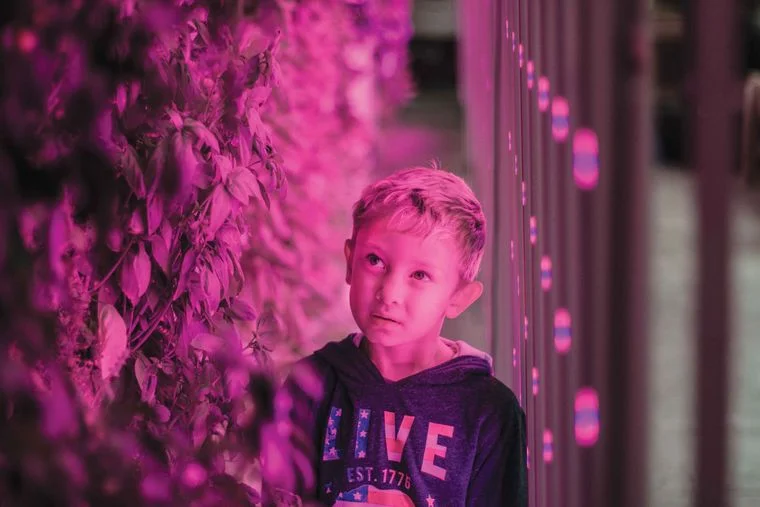
On most afternoons, a magenta glow can be seen reflecting out from the eastside stairwell of the Bomber Mountain Civic Center. If you follow the light down the stairs and through the side door, you’ll find yourself in what was once the middle school’s music room, but in place of scattered music stands and an upright piano collecting dust, you’ll find a room budding with life, literally.
The converted space houses a fully functional edible learning lab complete with raised planting beds, a fully equipped teaching kitchen and a vertical hydroponic system with red and blue LED grow lights to stimulate plant growth – the source of the magenta glow.
The Edible Learning Lab program is the brainchild of admitted foodies and entrepreneurs Tim Miner and Dave Creech.
They launched the program in Buffalo last September, and in the lab’s first year of operation it has prospered, producing well over 100 pounds of food and educating hundreds of Johnson County students in the process.
“Our mission is to bring edible education to all kids K through 12, and it’s something we think about all the time,” Miner said.
Edible education means giving students hands on experience growing their own food, but it also means teaching them the biological processes that bring food from a seed to a family’s table.
Educating the kids and introducing students to healthy eating practices is something that Miner sees as invaluable.
“We think it’s important because this is one of the solutions or one of the processes that can lead to health changes,” he said.
Miner also mentioned the staggering number of health problems caused by dietary related issues in the U.S.
“We feel that educating kids at an early age is going to set them on the right trajectory. It’s going to give them understanding and love for the relationship they have with food,” Miner said. “It’s going to create a more sound foundation for that relationship, and over time kids are going to be making healthier choices and they’ll be exposed to things they wouldn’t otherwise be exposed to, and we feel that’s our way to plant the seed for change going forward.”
The strong vision that Miner has for the learning lab wasn’t always set in stone. He’ll be the first to tell you it’s been an evolving journey from day one to now.
“I would love to tell you that we had this crystal clear idea of what an edible learning lab would be, what it would look like and how it would be organized, but the reality is this has been kind of a snaking back and forth approach. When we first started working on the rough outline of the curriculum we had intended it to be for adults,” Miner said. “I was on the board of the BDTA at the time, and I was serving with Lisa (Mueller) who was the CEO of the Boys & Girls Club, and we were talking about the curriculum and I was telling her how surprised I was by the number of kids who couldn’t pick broccoli out of a line up of vegetables, and she said, ‘You’re working on the course, do you think you could apply that to kids?’”
Miner responded with an immediate yes, and when Mueller came back a week later and said she might be able to secure grant money for the project, Miner was fully on board.
Miner and Mueller worked together to prepare the grant application just before the deadline and were approved for the maximum award of $125,000 a year for five years, and after Miner and Creech reworked the curriculum and ordered the equipment for the lab, everything began to fall into place.
A year later, Miner is just putting the finishing touches on the project.
“We’re placing our last orders for equipment, we’ve fully equipped the kitchen and are working on the rain harvesting system, which will allow us to capture over 200 gallons of rainwater from the downspouts to be used in the lab,” Miner said.
The concept of the edible learning lab has always been something that Miner and Creech wanted to be applicable and repeatable on a national scale.
“The plan has always been to open as many of these labs around the ounty as possible. Right now we’re talking to about 100 schools. We’re really interested in having this information being presented to all schools around the country,” Miner said.