

Welcome to iGrow News, Your Source for the World of Indoor Vertical Farming
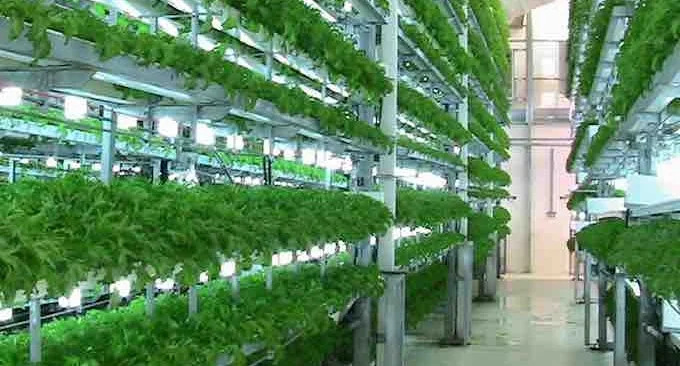
Vertical Farming Market worth 3.88 Billion USD by 2020, at a CAGR of 30.7%
Lighting functional device expected to lead the vertical farming market
Arshad Singh
Vertical Farming Corporate Communicator at MarketsandMarkets
Vertical Farming Market worth 3.88 Billion USD by 2020, at a CAGR of 30.7%
Sep 21, 2016
The factors which are driving the vertical farming market include need for high quality food with no use of pesticides, less dependency on the weather, increasing urban population, and need for year round production. The largest market in the functional device segment is lighting market owing to the high acceptance of LEDs to replace traditional lighting. LEDs have been developed which provide optimum electromagnetic spectrum for photosynthesis, consume less energy, and have minimal heat signatures which keeps the energy requirement for temperature maintenance at a minimum.
Download Free PDF Brochure @http://www.marketsandmarkets.com/pdfdownload.asp?id=221795343
The vertical farming market is estimated to reach USD 3.88 billion by 2020, at a CAGR of 30.7% between 2015 and 2020.
Lighting functional device expected to lead the vertical farming market
Lighting as a functional device, in terms of value, is expected to hold the largest share of the vertical farming market by 2020. The traditional lighting system is being replaced by LED lighting system which is more efficient, emits electromagnetic spectrum ideal for photosynthesis and generates low heat. The increased acceptance of LED lighting system by end users is driving the growth of this market.
Hydroponics as a growth mechanism segment dominates the vertical farming market
The market for hydroponics as a growth mechanism is expected to be the largest between 2015 and 2020. This is mainly because of the benefits associated with it such as quicker growth, faster harvest, higher yield, and low nutrient wastage as mineral nutrients are dissolved in water and are fed directly to a plant’s root system without any involvement of soil.
APAC expected to hold the largest market share and grow during the forecast period
The APAC vertical farming market is expected to hold the largest share by 2020 owing to major driving forces such as growth in urban population, less availability of cultivable land, government initiatives, and demand for food with low impact on environment, the vertical farming market is growing in this region.
Global Vertical Farming Market, by Functional Device
- Lighting
- Hydroponic Components
- Climate Control
- Sensors
Global Vertical Farming Market, by Growth Mechanism
- Aeroponics
- Hydroponics
- Others
This research report categorizes the global vertical farming market based on functional devices, growth mechanism, and regions. This report describes the drivers, restraints, opportunities, and challenges with respect to the vertical farming market. The Porter’s five forces analysis has been included in the report with a description of each of its forces and their respective impact on the vertical farming market.
Major players involved in the development of vertical farming market Aerofarms (U.S.), FarmedHere (U.S.) Koninklijke Philips N.V (The Netherlands), Illumitex Inc. (U.S.), Sky Greens (Singapore), and others.

Independence LED Lighting
LED Grow Light Plant Growth Time Lapse For Basil With Aquaponics.
Inside Look: Independence LED Lighting Creates Better Produce!
Next-Generation Food Supply! See this time-lapse video showing 30 days growth in the controlled environment under Independence LED lighting. The LED Grow lighting creates a heavier and leafier product, which in this case is basil.
To view state-of-the art Horticulture LED Lighting for advanced Agriculture learn more here: http://independenceled.com/led-grow-lights/
LED Grow Lights can dramatically change the economics of indoor framing for warehouse and greenhouse facilities. Independence LED Lighting is ideal for Horticulture LED Lighting that advanced Agriculture LED Lighting for Indoor Farming such as the production of cost-effective Indoor Vegetables at Grow Operations.
Since LED lighting for commercial farming is “green” and on the rise, we welcome content submission such as LED grow light videos, LED grow lights photographs, and LED grow light production case studies.
Submit LED horticulture and LED agriculture content here via: Contact GREENandSAVE

Programming Sun and Rain: Students Run an Indoor Farm at School by Computer or Mobile App
High-school students grow an acre’s worth of vegetables in an old shipping container that’s been transformed into a computer-controlled hydroponic farm.
Green beans and other vegetables growing in the computer-controlled climate of a hydroponic farm in an old shipping container at Boston Latin School. Students monitor and control it all, on site or with a mobile app.
BOSTON – On the cramped urban campus of Boston Latin School, high-school students grow an acre’s worth of vegetables in an old shipping container that’s been transformed into a computer-controlled hydroponic farm. Using a wall-mounted keyboard or a mobile app, the student farmers can monitor their crops, tweak the climate, make it rain and schedule every ultraviolet sunrise.
In a few decades, nine billion people will crowd our planet, and the challenge of sustainably feeding everybody has sparked a boom in high-tech farming that is now budding up in schools. These farms offer hands-on learning about everything from plant physiology to computer science, along with insights into the complexities and controversies of sustainability. The school farms are also incubators, joining a larger online community of farm hackers.
“We are constantly experimenting,” said Catherine Arnold, a Boston Latin history teacher who oversees the environmental club that runs the farm as an extracurricular activity. It was built by a Boston startup called Freight Farms, which “upcycles” discarded shipping containers into “Leafy Green Machines” for small-scale growers and restaurants, as well as a dozen schools and colleges.
“My students can collect data on the farm from anywhere, whenever they want to.”
Graeme Marcoux, of Salem, Mass., who teaches a high school vocational course in hydroponics and aquaculture
The latest version of a freight farm costs $82,000. Boston Latin has a cheaper, earlier version, paid for with a green-schools grant. The students have been giving their food away but plan to sell produce to parents and neighbors this year, to cover the annual cost of seeds, nutrients and other supplies.
On a recent morning, Arnold showed off rows of spinach, peppers, tomatoes, lettuces, green beans and herbs hanging below drip irrigation that was bathing the roots in a recirculating mix of water and nutrients. The plants grew out of a recycled plastic mesh rather than soil and were lit by thin strips of LED lights.
When the school’s farm opened in 2014, Freight Farms staffers taught students about crops that have a proven hydroponic track record and their preferred mixes of temperature, nutrients, moisture and other factors. But Arnold said the real learning comes from trying new things.
“They never said you can grow green beans, but we have two varieties,” Arnold said. “This year, we’re going to try carrots and turnips. Anything the students want to try, we’re going see what happens.”
A video camera and sensors send real-time data about the growing environment to a computer that triggers farm systems set to schedules and thresholds (such as carbon dioxide or nitrogen levels). Students monitor and control it all, on site or with a mobile app. According to Graeme Marcoux, a high-school environmental and marine science teacher in Salem, Massachusetts, whose school set up a freight farm last spring, the remote access is essential, because only so many students can work inside a 320-square-foot box, and because farming doesn’t stop when the bell rings.
“My students can collect data on the farm from anywhere, whenever they want to,” said Marcoux, who teaches a vocational course (worth one science credit) in hydroponics and aquaculture.
Besides passing on technical knowhow, Marcoux encourages class debates about food sustainability. The many high-tech automated “vertical farms” popping up in cities around the world have a shared mission of growing more food locally, while using a lot less land and water than conventional farms. Being indoors means no pesticides, and their closed systems mean they don’t poison waterways with fertilizer runoff.
“To imagine you could help feed people with this computer was amazing to these kids. Most of them don’t think about technology and food going together, when clearly they do, even in traditional farming.”
Will Borden, director of academic technology, Shady Hill School, Cambridge, Massachusetts
But critics say that indoor farms are energy hogs. A farm like the one at Boston Latin, for instance, uses enough energy to power about two and a half American households. Of course, conventional agriculture also has many hidden energy costs, from shipping food, refrigerating storage facilities, manufacturing and operating massive farm equipment, and moving and treating all that irrigation water. Plus, rapid gains in LED efficiency and renewable energy will help shrink the carbon footprint of indoor farms.
“It’s a great debate to have with the students, because by the end of that debate everybody has a much deeper sense of what actually makes something sustainable,” said Marcoux.
The Freight Farm app links to a repository of articles about everything from crop scheduling to food safety. There’s also a Facebook group of freight farmers who are a ready source of ideas and advice on topics such as how to deal with tiny spots on your lettuce or how best to keep the humidity under control.
The potential of networked farmers swapping expertise and experimental results – call it crowdsourcing crops – is also at the heart of OpenAg, an initiative of MIT’s Media Lab, led by research scientist Caleb Harper. In 2015, the OpenAg group gave a handful of local schools prototypes of their “personal food computers,” which are tabletop hydroponic farms that users program with “climate recipes.” Every recipe, as well as the user-interface code, is open-source and posted online for use by a global community of green-thumbed hackers.
One of the early food-computer recipients was the Shady Hill School, a private preK-8 academy not far from MIT in Cambridge, where students grew basil, sage and various leafy greens.
Every grade had some access to the food computer. The first-graders, for instance, featured it in their “farm to table” unit, alongside food grown in an outdoor garden.

James O’Brien, a Connecticut high school senior, built and programmed his own “food computer” after watching a TED talk on YouTube; then he demonstrated the computer and the lettuce he grew with it to middle schoolers at a local summer camp. Photo: Eileen O’Brien
“They could not only measure the plants, they could see and measure the growing roots,” said Will Borden, Shady Hill’s director of academic technology.
“To imagine you could help feed people with this computer was amazing to these kids,” he added. “Most of them don’t think about technology and food going together, when clearly they do, even in traditional farming.”
The food computers for the pilot schools came pre-assembled. But for everyone else, they were totally DIY, using downloadable step-by-step instructions. For example, James O’Brien, a senior at Staples High School in Westport, Connecticut, was inspired to build a food computer after watching a Caleb Harper TED talk on YouTube last summer.
On his own, O’Brien machined and assembled the parts, bought the sensors, wired them into a circuit board, and programmed the computer’s brain. He demonstrated his food computer and the lettuce he grew with it to middle school kids at a summer camp run at a local farm. In August, he started a nonprofit called Workshop Garden Technologies to create after-school programs for middle-school students using food computers.
OpenAg is now readying a more refined and user-friendly kit version of the food computer for a second round of school pilots planned for the spring. It will also be possible to program the “climate recipes” with a simpler, block-based coding language, such as Scratch (another Media Lab creation).
There will still be a strong DIY element, however. The idea is that lesson plans, like climate recipes, will be created, shared and improved upon by the community of school food-computer users.
“We want to include kids in a co-creation process, to let them play with the food computer and help us improve the engagement and experience of growing with it,” said Hildreth England, OpenAg’s program coordinator. “Kids are natural tinkerers. It’s a perfect fit.”
This story was produced by The Hechinger Report, a nonprofit, independent news organization focused on inequality and innovation in education. Read more about Blended Learning.
By Chris Berdick
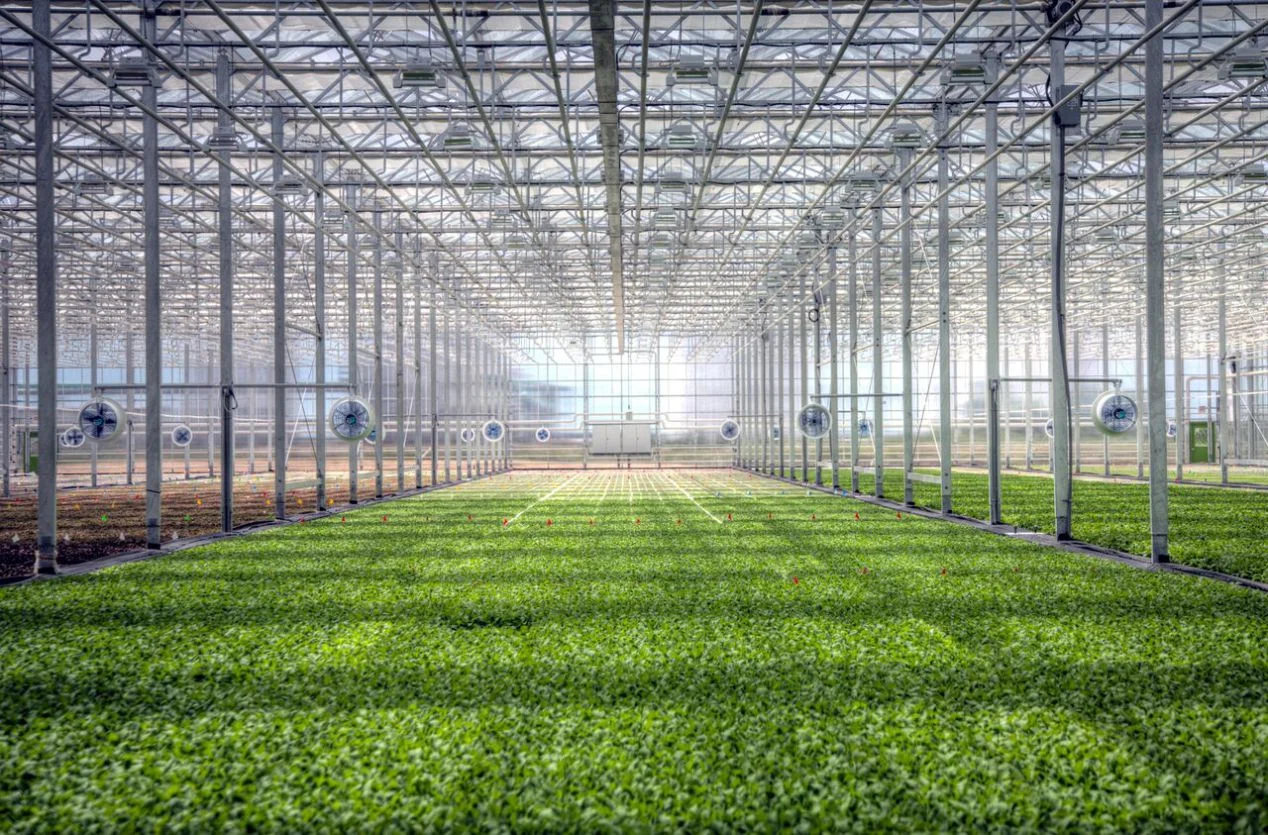
BrightFarms Raises $30.1 Million to Set Up Futuristic Greenhouses Across the U.S.
On a mission to make all fresh fruit and vegetables locally!
Agriculture tech startup BrightFarms has raised $30.1 million in Series C funding to bring its high-tech greenhouses, and fresh produce, across the U.S.
The company is on a mission to make all fresh fruit and vegetables locally, rather than require them to be hauled from long distances or imported from overseas before they are sold at groceries.
Taking a page from the playbook of solar power providers in the U.S., BrightFarms offers customers a long-term, fixed rate on the salad greens and tomatoes it grows in its greenhouses to grocers.
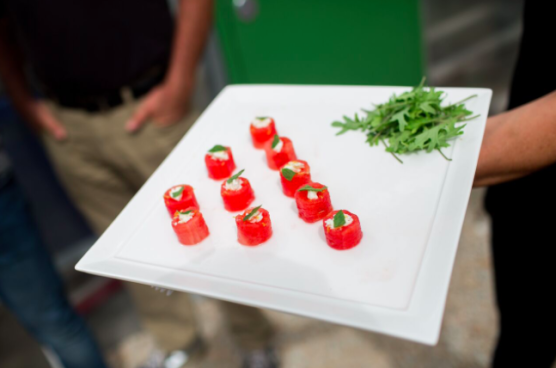
BrightFarms-raised produce.
The startup’s CEO Paul Lightfoot explained that after BrightFarms locks in a “produce purchasing agreement,” it raises funds from various sources including economic development programs and different banks or equity firms to build a new greenhouse.
In effect, a big chunk of the company’s cost of goods is already committed revenue before they open up a greenhouse’s doors and start growing.
The new round of funding was led by Catalyst Investors, and joined by BrightFarms earlier backers WP Global Partners and NGEN.
Catalyst’s Tyler Newton said his firm backed BrightFarms largely due to its business model innovation and ability to “out-execute” other food producers in the U.S.
Consumers definitely want to buy groceries made by local businesses, and to help support jobs that pay a local living wage in their own back yard. According to research by the U.S. Department of Agriculture, local food sales totaled $12 billion in 2014 and are expected to grow to $20 billion by 2019.

A BrightFarms greenhouse that grows tomatoes and salad greens.
“Where the seasons don’t cooperate, we just didn’t have the option to buy local before. So that feels good. But when you taste a tomato or some arugula from BrightFarms, and compare it to something that’s been shipped from out West, there is an obvious taste advantage, too. That’s what grocers want,” Newton said.
BrightFarms is going after a huge market that doesn’t have a lot of competition outside of the states of California and Arizona, today.
America’s farms contribute $177.2 billion, or about 1 percent of the nation’s gross domestic product each year according to the most recent available calculations also from the U.S. Department of Agriculture.
And 90% of the salad greens consumed in the U.S. are produced in California and Arizona, then shipped across the country or exported out of it.
Other agriculture tech startups like AeroFarms or FreightFarms are building out indoor and container-based farms, in urban areas to meet rising consumer demands for locally-produced, and delicious fresh foods.
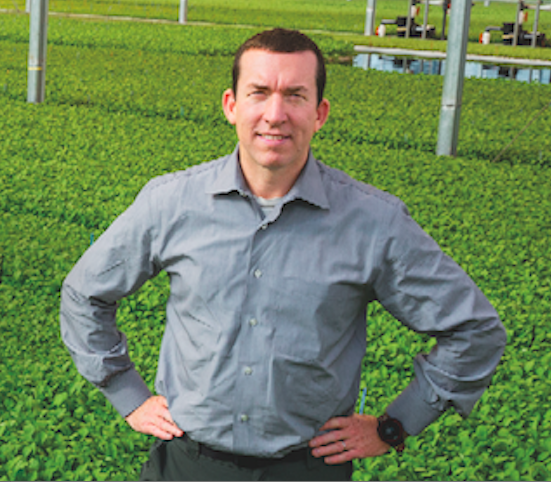
BrightFarms CEO Paul Lightfoot
But Lightfoot believes that his company’s greenhouses – which take advantage of natural sunlight, obviously—can prove more environmentally sustainable and cost-efficient than indoor farms, and produce more supply than container-based and rooftop farms.
He says that’s because BrightFarms controlled environment greenhouses don’t need to use as much electricity for grow lights and temperature controls as indoor farms. Both are significantly more water efficient than traditional farms, even those using precise irrigation systems.
So far, BrightFarms operates three greenhouses, each employing 25 full-time workers, in the greater Philadelphia, Washington D.C. and Chicago metro areas.
If drought conditions continue, Lightfoot said, the company could someday move into the “salad bowl” state of California, or other agricultural hubs, displacing traditional, and often water-intensive, farms.
But for now it will focus on metro areas where demand for fresh produce is high but there isn’t a lot of arable land or weather to support traditional farms.
BrightFarms’ customers and partners have so far included grocers like Kroger, Ahold USA, Wegmans and ShopRite.
Besides using the new Series C capital to build out additional greenhouses, Lightfoot says the company will explore new crops and is likely to start growing peppers and strawberries in the near future.
Featured Image: BrightFarms Inc.
By Lora Kolodny
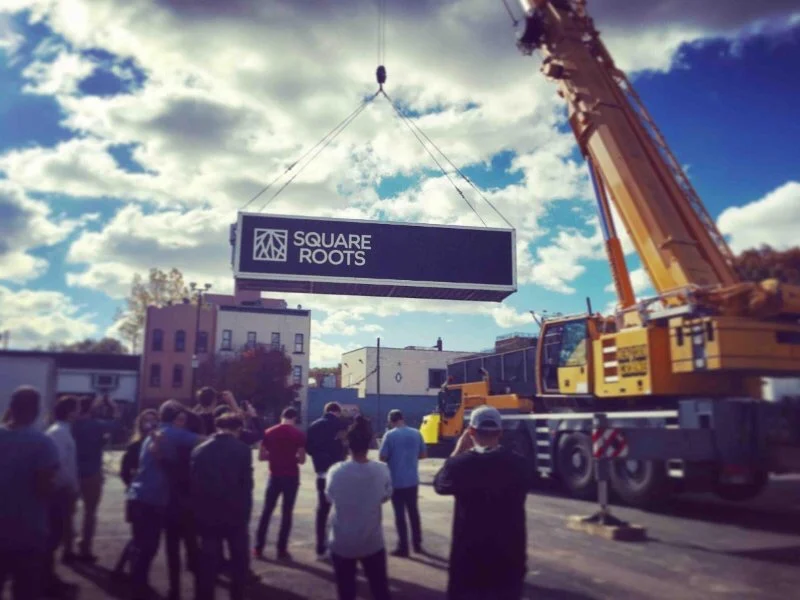
Elon Musk’s Brother Aims to Revolutionize Urban Farming with Square Roots
Kimbal Musk, Elon Musk’s younger brother has launched a new accelerator and company in Brooklyn called Square Roots that will invest in startups, growing fresh produce in cities.
By opening an urban farm in Brooklyn, New York, Square Roots aims to revolutionise the way Americans think about food and produce.
The accelerator will also provide mentorship and resources to millennial urban farmers, using shipping containers with hydroponic growing towers.
What is Square Roots?
Square Roots is a new agriculture venture that is located in the old Pfizer factory, Brooklyn, New York that holds 10 farms and young farmers who tend to the fresh produce.
Along with Tobias Peggs he two entrepreneurs will use 10 steel, 320 square foot shipping containers full of organic greens and herbs to make vertical farms inside the Pfizer building.
The young millennial farmers “Will get hands-on experience running a vertical farming business with us- but we’re here to help them become future leaders in food, wherever that journey leads,” said co-founder Tobias Peggs.
The incubator program that starts this this fall will give food-tech entrepreneurs space to develop and increase farming startups.
They will use technology developed by startups freight Farms and Zip Grow using climate controlled LED lights and a hydroponic system.
Who is Kimbal Musk?
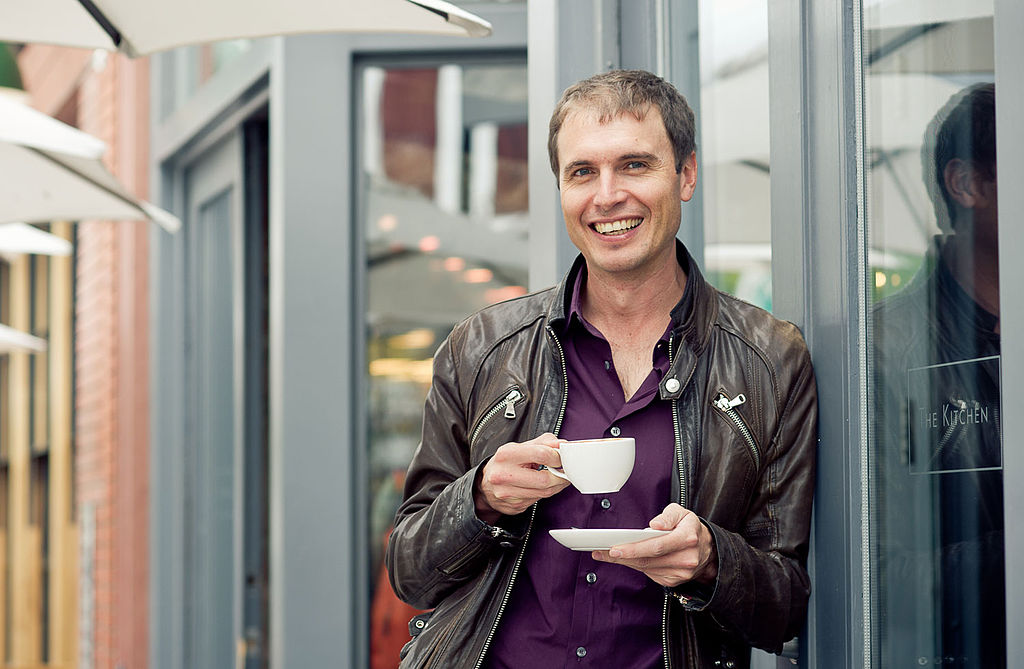
Photo was taken of Musk outside The Kitchen in Boulder
Kimbal Musk is the younger brother of Elon Musk, the CEO of Tesla, who has invested in SolarCity and SpaceX.
Originally from South Africa the brothers worked together to found Zip2, a startup in 1995 that allowed newspapers to build their own city guides.
After selling the company for $300 million in 1999 to Compaq, Elon Musk founded PayPal, the online payments platform, Tesla and his other space ventures.
Kimbal took a different route, moving to New York to take French cooking classes at international Culinary Center.
When he volunteered to feed firefighters after the terror attacks on September 11 2001, Musk had an epiphany, citing “That sense of community that I felt was just profound to me,” opening a restaurant soon after.
Kimal Musk then opened the restaurant The Kitchen Upstairs and taking an executive job at social networking startup, OneRiot, before launching Next Door, to merge community and fresh food, and quality burgers together. There are five restaurants in Colorado at present with plans to expand.
What is Urban Farming?
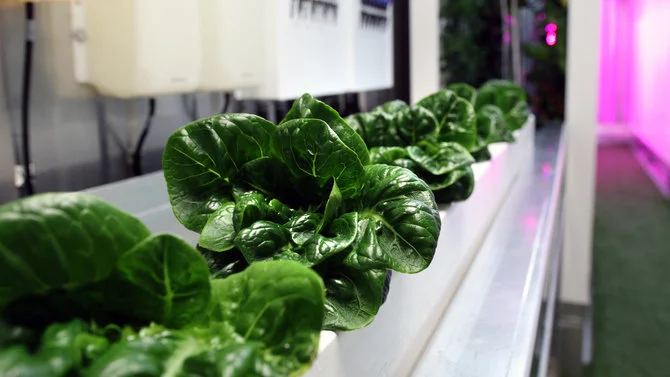
Photo Credit: Freight Farms
Urban farming or agriculture is producing food in cities or heavily populated areas where space is scarce.
The difference between urban farming and community gardening is the commercial aspect involved. The former is based on selling produce rather than for personal needs.
Food can be sold to restaurants, farmers markets or community enterprises.
Why Choose Urban Farming?
Many advocates of urban farming point to the fact that vertical farms expend 80 percent less water than outdoor farms and require much less space, which is significant in urban areas.
With seven billion people earth, the planet is under massive strain with pollution, habitat damage and climate change.
Urban farming decreases the ‘food miles’ linked to long-distance transportation, making it a more sustainable way to grow food.
By increasing greenery in cities, this increases shading, and reduces toxic emissions. Urban farming also helps people reconnect to their food, understanding how it is grown.
Why is Urban Farming So Important for Americans?
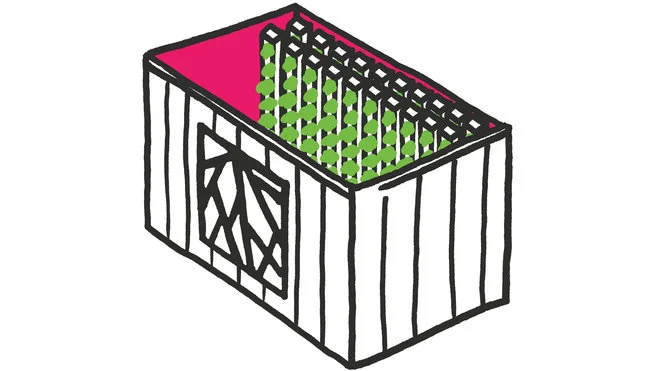
Photo Credit: Square Roots
Tobias Peggs noted that he is often approached by young people who are frustrated with the industrial food system but don’t know what to do about it.
Peggs said, “Seeing this frustration, and pent up energy, was a big part of the original inspiration for founding Square Roots.”
Musk said in a Medium article that people want real food:
“Young people especially are turning away from McDonald’s towards healthy, locally-sourced options like Next Door and Sweetgreen.”
According to thestateofobesity.org, in 2016 adult obesity rates now exceed 35 percent in four states, 30 percent in 25 states and are above 20 percent in all states.
What Impact will Square Roots Have on Urban Farming?
Square Roots aims to help young urban farmers to start thinking about innovative food production.
With investors such as food tech VCs Powerplant Ventures, Lightbank, GroundUp, FoodTech Angels and The Kitchen, there is plenty of scope for this venture to work.
If successful, Musk will be able to build more farms similar to the Square Roots in Brooklyn, within New York and expand to other US cities.
By Tanya Geddes
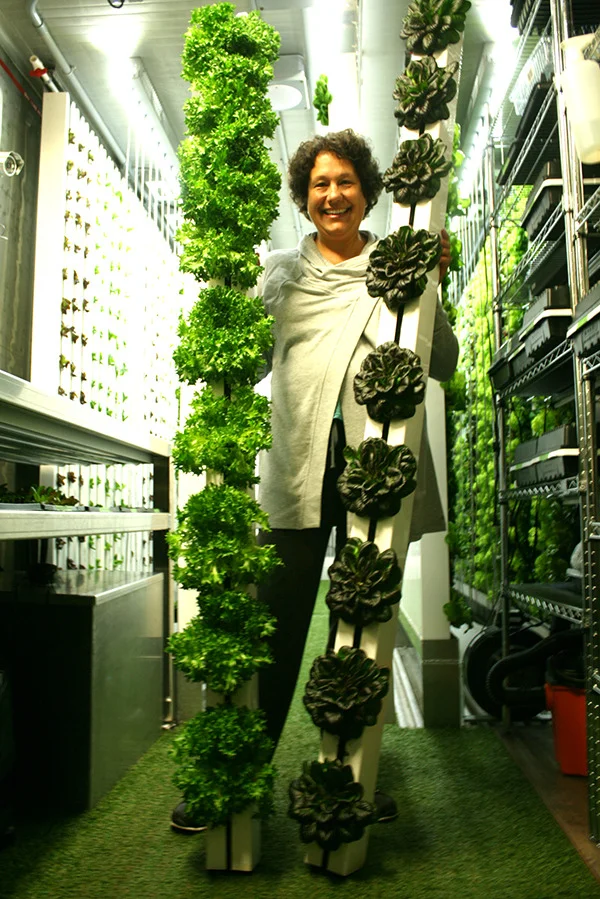
Containers Could Hold The Future of Farming
Containers could hold the future of farming
Containers could hold the future of farming
by: Wolf Depner - Saanich News
- posted Sep 20, 2016 at 3:00 PM
Tamara Knott looks over some of the plants growing in her Leafy Green Machine, inside a refurbished shipping container on her West Saanich Road property.— Image Credit: Wolf Depner/News Staff
The future of farming might be found inside the 40 x 8 x 9.5 feet dimensions of the Leafy Green Machine.
Those are the dimensions of a refurbished shipping container that stands on an agricultural lot in the 6000 block of West Saanich Road.
From the outside, the green-and-metallic box underwhelms. Step inside it though and you enter a world that evokes the agricultural wizardry of Matt Damon’s character in The Martian.
Tamara and Bruce Knott, who own the container, burst out in approving laughter when they hear this comparison.
“Except,” says Tamara, “he was growing those potatoes with a particular type of material with which we have nothing to do. I keep my vegans very happy.”
Differences in fertilizers aside, the Knotts also grow different crops, mainly lettuce as of now. Yet even the most cursory survey of the container underscores the technological sophistication of the Knotts’ business.
“Yeah, we are kind of nerds,” says Tamara.
Developed by the Boston-based company Freight Farms, the container houses an automated lighting and irrigation system that can roughly produce the yield of 1.5 acres of farmland.
Its heart consists of 256 vertically suspended cuboids (rectangular prisms). Each of these narrow “towers”, as the Knotts call them, can hold anywhere between 14 to 17 heads of various types of salad greens.
Each head begins life as a granular seed planted inside what Bruce calls a “peat plug” about the size of a pinky finger.
After growing in horizontally placed trays that receive a steady supply of nutrient-enhanced water, the plants are then planted several inches apart in the towers, each lined with a growing medium completely free of dirt and of a texture that Bruce compares to a “coarse brush.”
The towers are then hung between two horizontal metal cuboids.
The upper supplies each of the towers and the produce within them with nutrient-enriched water; the lower catches the run-off and sends it back into the irrigation system, where sensors continuously monitor the nutrient content, ph level and temperature of the water running through the system to ensure optimal growth.
“We don’t discharge any of that [water],” says Bruce. “We use it all. It just continues [to circulate through the system] and we just keep adding water at a rate of about five gallons a day, as the plants use it.”
This volume of water use marks a drastically reduced rate. “In terms of a conventional farming operation for these types of crops, the estimate is that the water use is 90 per cent less,” says Tamara.
Narrow ropes of energy-efficient LED lights, which Bruce says “look a little bit like disco lights,” add to the futuristic atmosphere.
Cascading off the container’s ceiling like party streamers, they emit blue and red light following a specialized schedule that ensures the plants receive optimal energy and rest. “For photosynthesis, plants predominately use light in the red and the blue spectrum, so we just give them that, because that is what they need to thrive,” says Tamara.
“They actually reflect the yellow and green back at our eyes, because they are not using it for photosynthesis.”
Aside from using far less water than outdoor farming, this type of indoor farming also foregoes pesticides and herbicides and requires far less land.
“You can put this unit on almost two parking spots downtown ... and you can feed a lot of people,” he says.
Finally, it can provide fresh produce year-around.
As such, it offers itself as a solution to a future marked by water shortages, declining supplies of arable land and growing urban populations facing various food security issues.
“The water, the lack of waste, the proximity to the people who are actually going to consume the food — we like all those things,” says Bruce. “That is why we sort of thought, this is the way of the future and we just want to be part of that future.”
With 85 million discarded sea containers available, others may follow the Knotts’ example.
If so, foodies might be in for a treat as well.
The Knotts, who describe themselves as “salad snobs,” say they “are pretty pleased with the quality of products.”
After spending three to four months to get their operation off the ground, the Knotts have been on the market for about a month now, selling to three local restaurants and customers at the local farmers’ markets. The Knotts are also organizing a network of pick-up points across Greater Victoria, where customers can pick up prepaid weekly produce baskets. “So folks are able to get their fresh produce, particularly at a time of year when none of the farmers’ markets are operating,” says Tamara.
So how do people react when the Knotts tell them where their lettuce comes from?
“Mostly, they say, ‘Cool! You can do that?’” says Tamara. “It has been really positively received and people are really excited about it. They think it is just a really, really neat idea.”
Buyers to Gain Product Consistency Thanks to Vertical Growing Solution
Work is beginning on a £2.5 million purpose-built facility at the institute in Invergowrie, which will be the first in the UK to house automated growth towers for vertical, indoor farming.
Achieving the optimum light environment to maximise growth and enhance plant quality and consistency is no longer the stuff of dreams. A new initiative from the James Hutton Institute, near Dundee and Intelligent Growth Solutions is set to make this a reality. Produce Business UK investigates
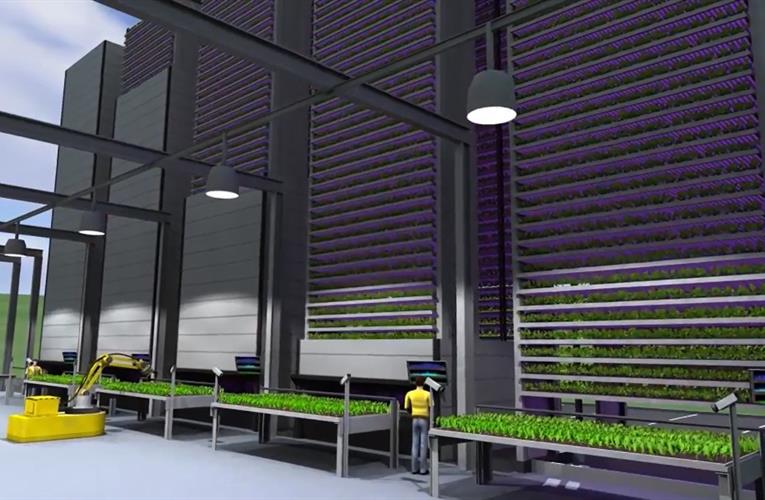
Work is beginning on a £2.5 million purpose-built facility at the institute in Invergowrie, which will be the first in the UK to house automated growth towers for vertical, indoor farming. The facility involves the creation of four towers, each nine metres tall. It will incorporate an automated system allowing trays to move up and down the tower, to provide access for maintenance, seeding and harvesting. What makes the system unique is the degree of control over the light environment that can be achieved.
Lighting gap
Intelligent Growth Solutions has been exploring this concept for several years. Founder and CEO Henry Aykroyd believes there is a gap in the market: lighting companies think about lights, researchers focus on plants, and growers are concerned about economics. All are separate but together they could provide a viable growing concept.
Aykroyd is convinced of the importance of vertical growing since it could avoid the need for pesticides, and takes up a relatively small area. By taking advantage of the decreasing cost of LEDs, and combining this with research expertise and integrated automation, Aykroyd felt he could change the way vertical growing was viewed.
A pilot scheme was set up in Scotland, near the world-famous plant research establishment, The James Hutton Institute. And following negotiations with the institute, planning permission was obtained for the project. A wide range of leafy plants will be grown using semi-hydroponic systems. Water consumption will be kept to a minimum and temperatures carefully regulated. Researchers from James Hutton will be closely involved at all stages, investigating growth patterns so as to identify optimum plant growth within the light spectrum.
Sensory development
Dr Robert Hancock of the institute explains. “What Intelligent Growth Solutions has done is to create a much better lighting system. This is possible due to major improvements in LED technology that have taken place. Up until now, growers have focused on areas of the light spectrum which drive photosynthesis.
“Plants normally live in an environment where they use the full spectrum of light at different wave lengths to interpret their environment and adjust their growth and metabolism accordingly. We know that plants use different parts of the light spectrum to respond to events. A classic example is the shade avoidance response where plants recognise a shift in the red to far-red spectral ratio caused by light absorbance by other plants growing in close proximity. Plants respond to this potential competition by putting on elongation, making a tall spindly plant. By manipulating the light spectrum, the architecture of the plant can be adjusted to suit the demands of growers and supermarket buyers.”
The researchers will not stop there. Hancock says: “We eventually hope to develop a series of sensors to identify suboptimal growing conditions in real time and well before physical symptoms manifest themselves. Colleagues at James Hutton are already doing this in the fields by imaging crops beyond the visible spectrum, a technique known as hyperspectral imaging, to identify the onset of disease or stress before it impacts crop yields.
“Within the growth towers our ultimate aim is to be able to interpret sensor signatures that indicate specific stresses such as high or low temperatures, water stress or nutrient imbalances. We want to build algorithms that allow a constant evaluation and optimisation of the growing environment. This could eventually become automated so that growers can simply seed the facility and return when the crop is ready to harvest.
“Furthermore by providing a consistently high-quality crop we will be able to reduce waste by eliminating supermarket rejections. Not only that but by manipulating light and other environmental conditions we will be able to schedule the crop to meet demand.”
The special lighting systems that have been created by IGS enables LED efficiency to be increased by up to 50%, while varying the intensity of light by 0.01% increments across all wavelengths, effectively recreating the effect of solar radiation on plants. This enables the lighting to be carefully targeted and feedback systems developed.
Cost effective
As a result, IGS predicts that vertical growing and lighting costs will fall quickly to allow crops such as strawberries and tomatoes to be added to the leafy salads and herbs already grown indoors within a closed environment.
Aykroyd says: “Our project at The James Hutton Institute is an exciting opportunity for the vertical farming market in the UK and beyond. The project will facilitate the development of our technology to demonstrate its scalability and the opportunities to deliver this at a global level.”
“Our mission is to enable our customers to be the lowest cost producers by growing local globally, with better quality produce and saving natural resources.
“Modern agriculture faces a number of challenges, which will only be exacerbated as climate and population conditions change. These include water scarcity, land-use and the problems associated with monoculture, the use of pesticides and their impacts on health and the natural environment due to their use.
“By growing closer to the market in controlled vertical farming conditions, it is possible to predict accurately and grow to market demand. The products are fresher, have a longer shelf life, and crop losses due to weather, disease, drought, or pests are effectively eliminated.
“The precisely controlled lighting and power management opportunities which our technology addresses are essential for more efficient growing capabilities. Our real-time software can ‘grab’ power when the grid has surplus power and ‘shut down’ at peak times, and will offer a scalable solution for the vertical farming market.
“Vertical farming is not the ultimate solution to urbanisation and food security, but it can be part of it, freeing up land and reducing waste.”
By Angela Youngman
Garden going up: Work begins to turn old MFA mill into high-tech indoor farm
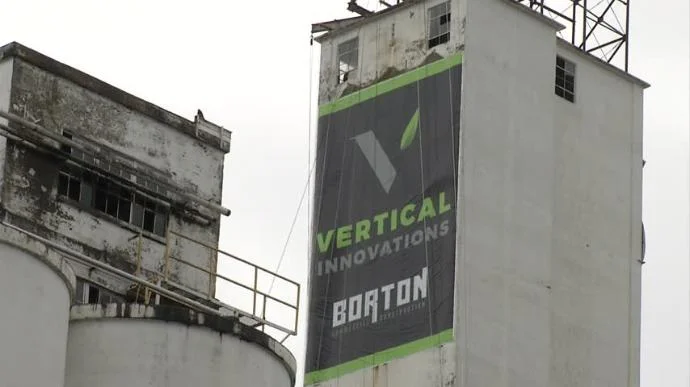
For decades, the landmark MFA logo towered over downtown. The colorful sign on the tall white grain elevator served as a nod to our farming heritage. This week, workers rolled out a new banner highlighting the building's new tenant, Vertical Innovations, LLC.
SPRINGFIELD, Mo. For decades, the landmark MFA logo towered over downtown. The colorful sign on the tall white grain elevator served as a nod to our farming heritage. Now, after 65 years, it is gone. In its place is a sign announcing something new to come.
This week, workers rolled out a new banner highlighting the building's new tenant, Vertical Innovations, LLC.
"It was about a six hour project," stated David Geisler, Manager and General Counsel of Vertical Innovations. "That is a lot of work to fasten a banner 200 feet in the air," he laughed.
Vertical Innovations is turning the long-vacant Missouri Farmers Association grain silo complex into a massive indoor vegetable farm. The structure, which has been vacant for years, is owned by Missouri State University, and is being leased to Vertical Innovations for the project.
Geisler explained, "If it works, we are going to be able to supply a large amount of food for the people of Springfield that we know is safe, it is traceable. They are going to be able to say, this is hours old. It is going to be fresh."
There's obviously no sunlight in the tall tubes. So, artificial light and other technologies will help the garden grow. Several new employees will be brought on board to tend the crops and facility.
"Essentially, we are going to be a true vertical farm. We will be a farm using some new ideas we have that nobody else has done before," Geisler said.
As you can imagine, there are not a lot of companies left that build grain elevators. So, for this project, the developer had to hire the modern incarnation of the company that built this place back in 1955. Borton Contractors & Engineers, based in South Hutchinson, KS, is now busy retrofitting the structure for its new purpose.
Geisler said, "I think that is part of the beauty of the project is it allows us to take these icons of our agricultural heritage and reuse them in the 21st century environment. It is refreshing."
Developers and supporters have high hopes for the future of farming in urban environments. Though a grand opening is still months away, Geisler believes this project could be the first of many.
"I think we will provide a model, a blueprint if you will, for how we can use abandoned grain elevators in other cities. But, Springfield will always be first."
As for the old MFA signs, Geisler says the one removed from the north side of the headhouse has been saved for preservation. The emblem facing south, which remains in place, will likely also be taken down and preserved.
By Michael Landis
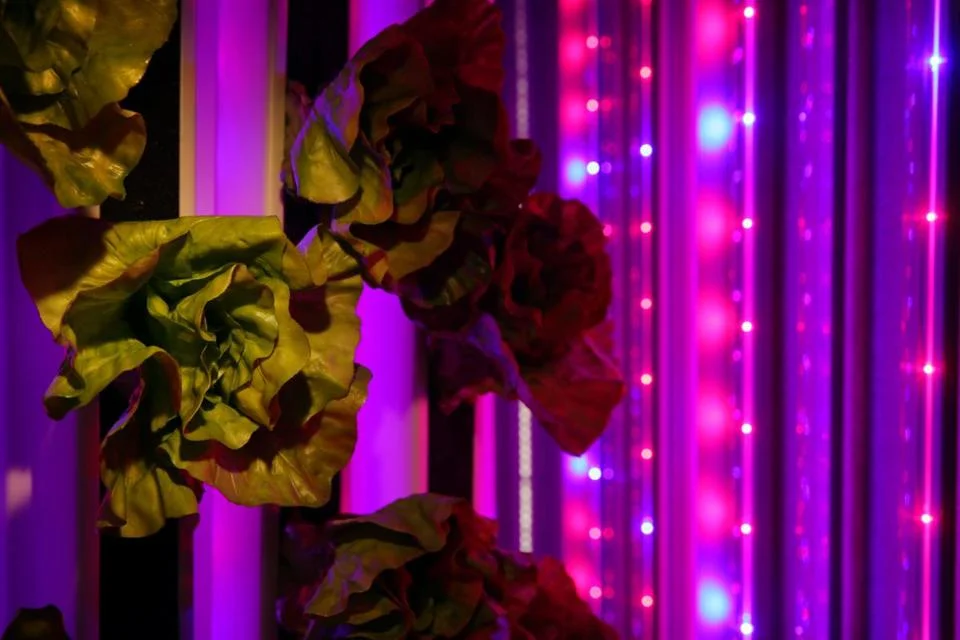
Startup That Grows Crops in Shipping Containers Unveils Sleek, New Design
At first glance, the tall metal box on the Greenway looks somewhat innocuous. But open the doors and there’s a salad disco happening inside
At first glance, the tall metal box on the Greenway looks somewhat innocuous. But open the doors and there’s a salad disco happening inside.
The large white container, which will be situated in the park all day Friday at the corner of High and Purchase streets, is the latest product from Freight Farms, the local startup that enables would-be farmers to grow produce anywhere using its tricked-out shipping containers.
The company, which has raised nearly $5 million in funding, has become somewhat of a darling to the startup set. Google is using one of its hydroponic containers to feed its 20,000 employees in Palo Alto, and last month Freight Farms partnered with Elon Musk’s chef brother, Kimbal, to help launch his urban farming accelerator, Square Roots.
Since launching in 2010, the company has sold 100 of its signature device, the Leafy Green Machine, said its president, Jon Friedman.
The prototype is a slightly smaller version of the modular growing system. He dubbed it the Leafy Green C (the C stands for community, or compact ... they haven’t decided yet). It’s about one quarter the size of a typical shipping container, clocking in at about 10 feet long, 9 feet high, and 8 feet wide. And it can grow 200 heads of lettuce each week.
Inside is where the fun starts.
Farmers plug their seedlings into six-foot tall, gutter-like “towers” that act as a growing medium for the young shoots. Each tower is then hung from the ceiling and lit with blue and red LED lights, which can be tweaked to emulate the sun as it cycles through the day.
Imagine dozens of vertical spinning towers of lettuce. The entire system gives off a very disco-like feel.
The original containers, which each cost $85,000, are now in nine countries, six islands, 25 states, and 12 schools. But Friedman said the system’s new design has a different customer in mind. It will be half as expensive as the original model (the exact price is not yet set, he said). He’s hoping to attract restaurants, communities and perhaps even individuals who are excited about the idea of container farming but don’t necessarily need nearly an acres worth of produce a week. The company will begin taking preorders in November.
Part of the draw, said Kyle Seaman, the company’s farm technology director, is the newly-designed app called Farmhand that allows the owner of the unit to control all aspects of the container from a smartphone, adjusting the light, heat, nutrients, and water.
“The app informs the farmer if something goes wrong,” said Seamen.
Should their lettuce need some love, they’ll get a ping on their phone. Now, if they can just make it connect to Spotify, they’ll be in business.
Janelle Nanos can be reached at janelle.nanos@globe.com. Follow her on Twitter @janellenanos.
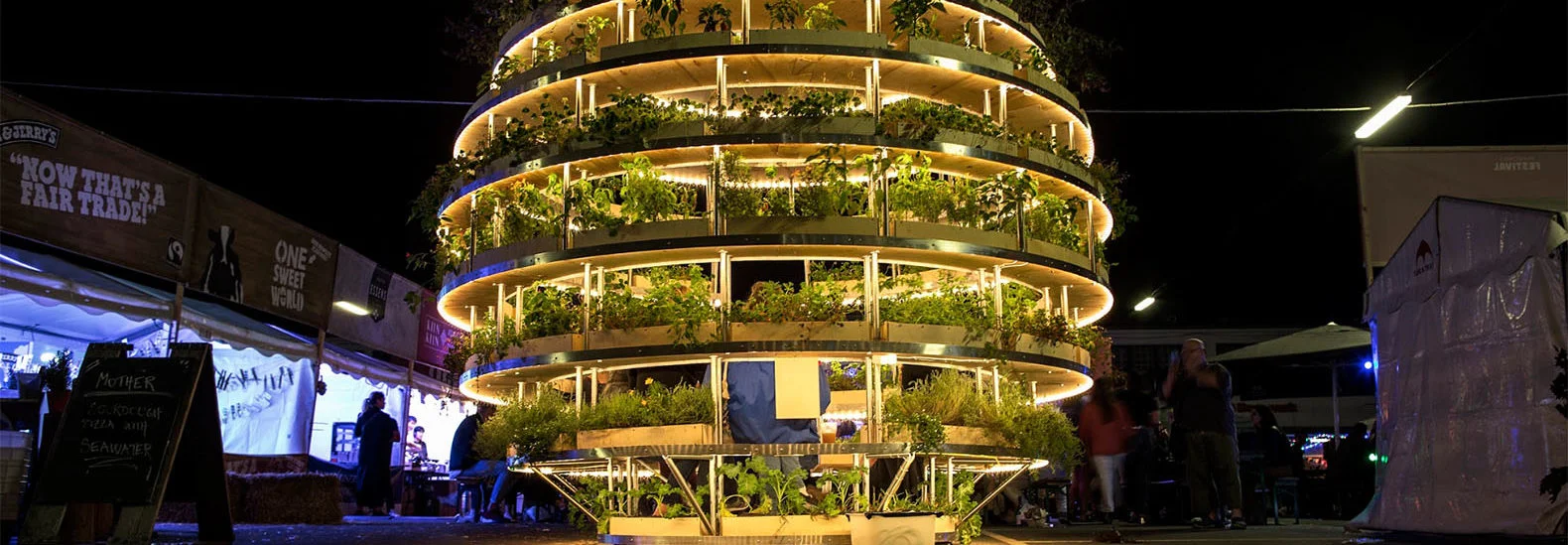
The Growroom is a spherical farm pod that brings agriculture to city streets
With a rapidly increasing population, food demands are skyrocketing, but current factory farming methods are hardly sustainable. Space10 wants to address that problem with brilliant solutions like The Growroom.
Space10 and Danish architects Mads-Ulrik Husum & Sine Lindholm created an innovative, beautiful urban farm dome that shows how we can bring nature and food farming back to our cities. With a rapidly increasing population, food demands are skyrocketing, but current factory farming methods are hardly sustainable. Space10 wants to address that problem with brilliant solutions like The Growroom.
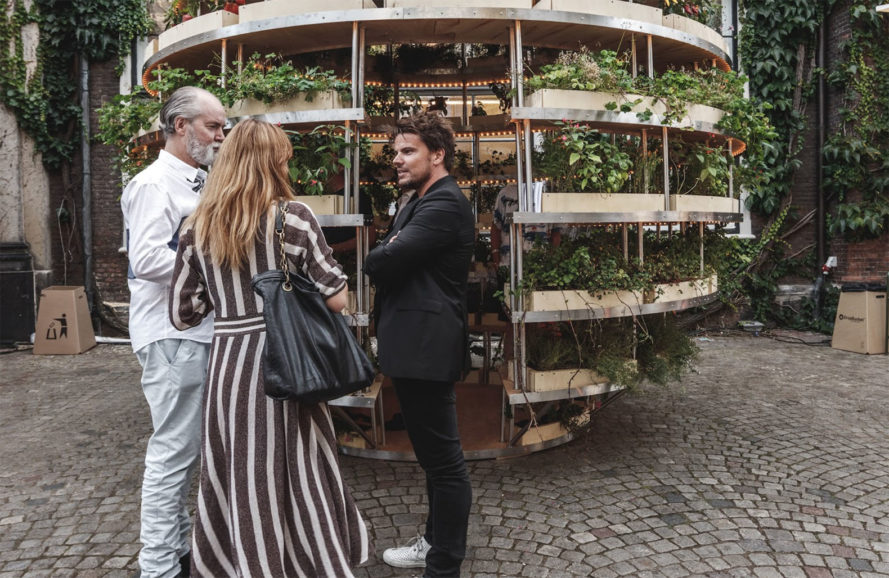
The Growroom was exhibited first at the CHART ART FAIR in Copenhagen, a fair that exhibits exceptional design from the Nordic region. According to Space10, the Growroom is meant to “spark conversations about how we can bring nature back into our cities, grow our own food and tackle the rapidly increasing demand for significantly more food in the future.”
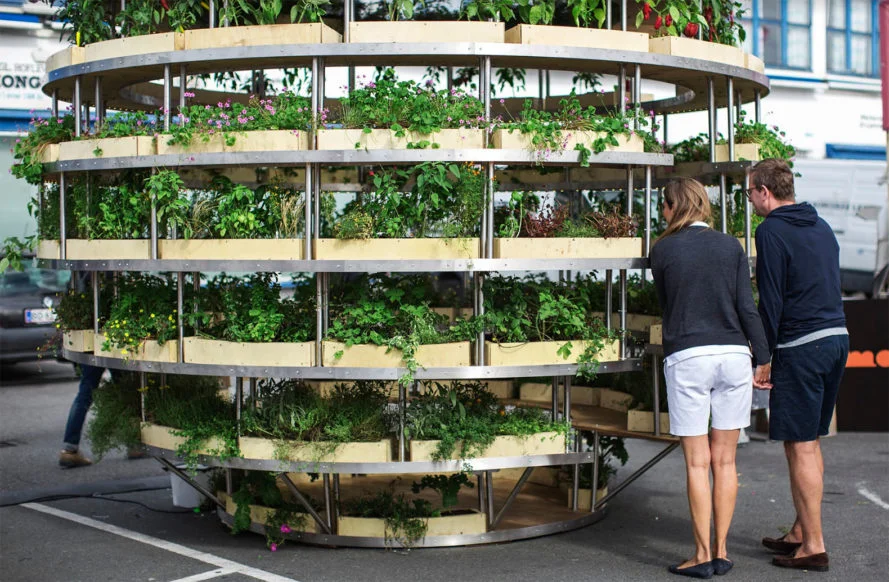
The Growroom is filled from floor to ceiling, end to end, with vegetables, herbs and other edible plants, with a cozy space in the center to reflect and relax. It is a beautiful way to explore how we can bring more food to our cities in a self-sustaining eco system that can supply hyper-local food that is seasonal, fresh and high quality. Growroom gives us “food that tastes better, is healthier for us, more nutritional and doesn’t put massive pressure on our dwindling supplies of fresh water nor our environment,” says Space10.
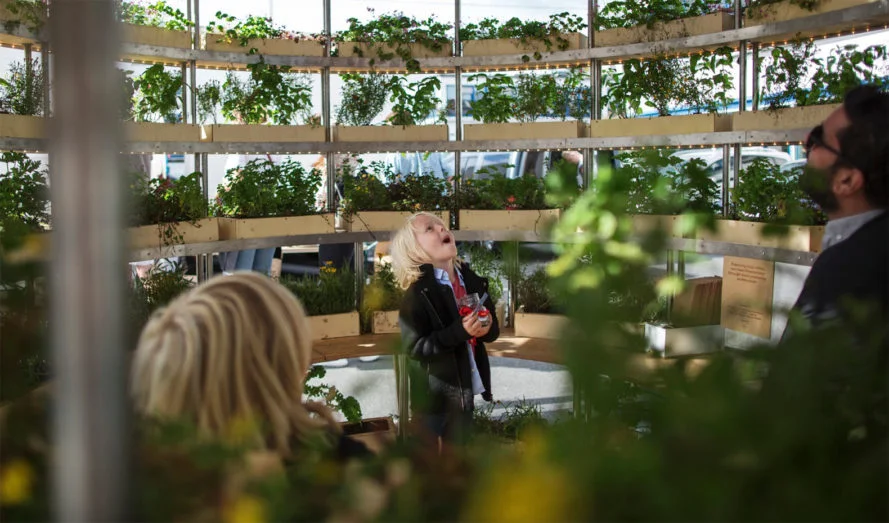
Earlier this month, people were able to step into the “farm” and experience the Growroom with every sense – from the smell of the plants to the light filtering in between the garden spaces. It’s easy to imagine how such a space could become a feature of every neighborhood, providing a green escape from city life that also provides nourishment. “We’re inviting [people] to step inside the growing green haven, smell and taste the abundance of herbs and plants, and hopefully it will spark passion about growing your own food in the future,” said Carla Cammilla Hjort, Director of Space10.
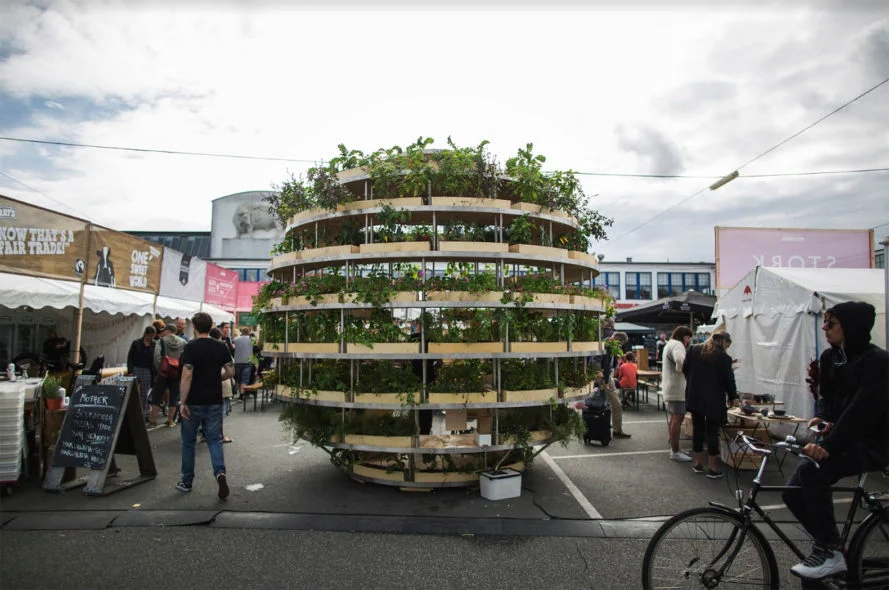
Space10 co-created ‘The Growroom’ together with architects Mads-Ulrik Husum & Sine Lindholm, interaction designer Thomas Sandahl Christensen and gardener Sebastian Dragelykke, Tradium and Raaschou. Hjort says, “At Space10, we envision a future where we grow much more food inside our cities. Food producing architecture could enable us to do so.”
By Kristine Lofgren
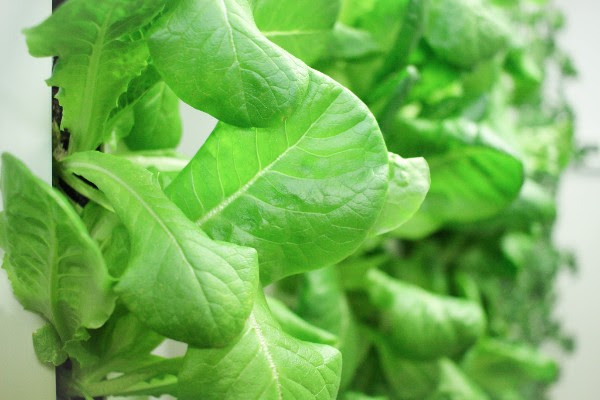
Modular Farms Newsletter #3
Toronto & Modular Farm!
Now that the dog days of summer have passed, we figured it was once again time to get you all formally updated on our whereabouts. Amidst the record-breaking heatwave that has been plaguing Toronto for the last few weeks, we have managed to keep cool by doing what we do best - working away in our climate-controlled Modular Farm!
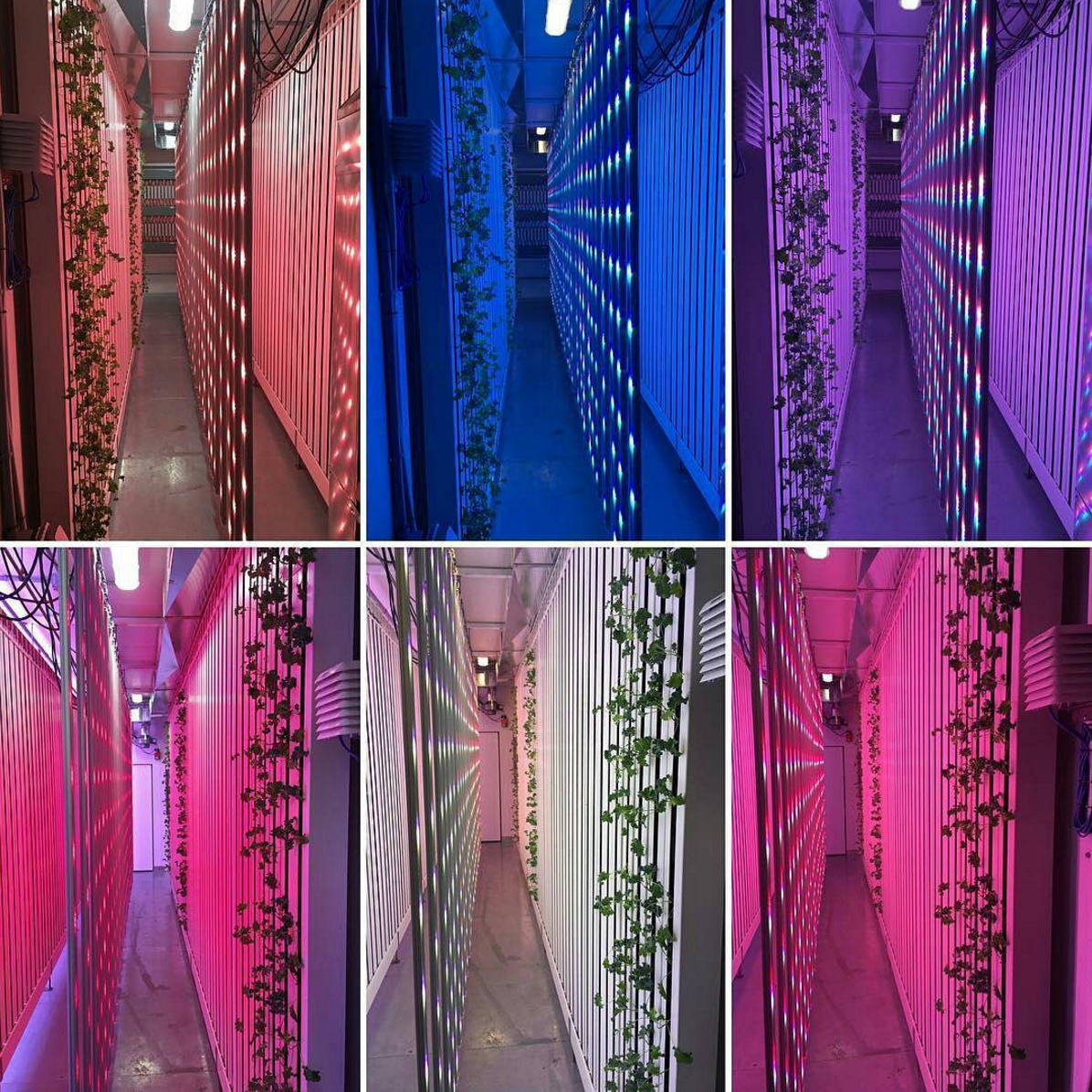
The moment we have all been anticipating has finally arrived. The technicians have finished their work, our initial run of Modular Farm raised Kale has been harvested, and our first sets of Collard and Lettuce seedlings have been transplanted. Also, as you can see from the above photo, we've begun experimenting with the various colourful spectrums our Intravision Spectra Blade LED lights have to offer. If all proceeds as planned, expect to receive a formal invitation to our official unveiling very soon.
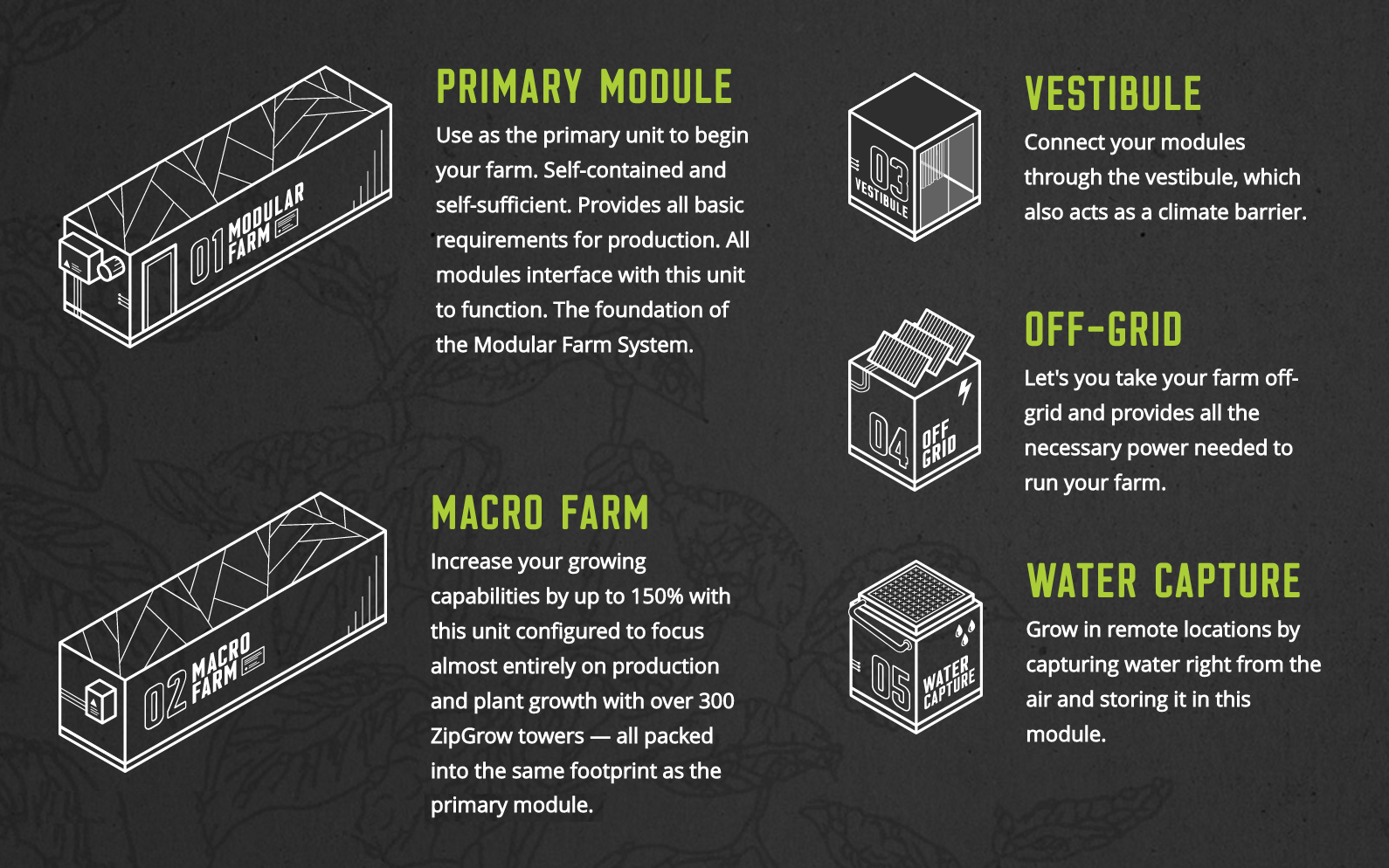
On the R&D side, our team has been very busy designing the new line of secondary modules. With the Primary Module almost complete, we've turned our attention to developing the Vestibule, Off-Grid and Macro Farm modules next, as we consider them to be the most vital secondary modules. Once completed, those who have already purchased a Primary Module will be able to easily scale up their production capabilities, have an active climate and pest barrier, and have the ability to power their farms even in the most remote locations.
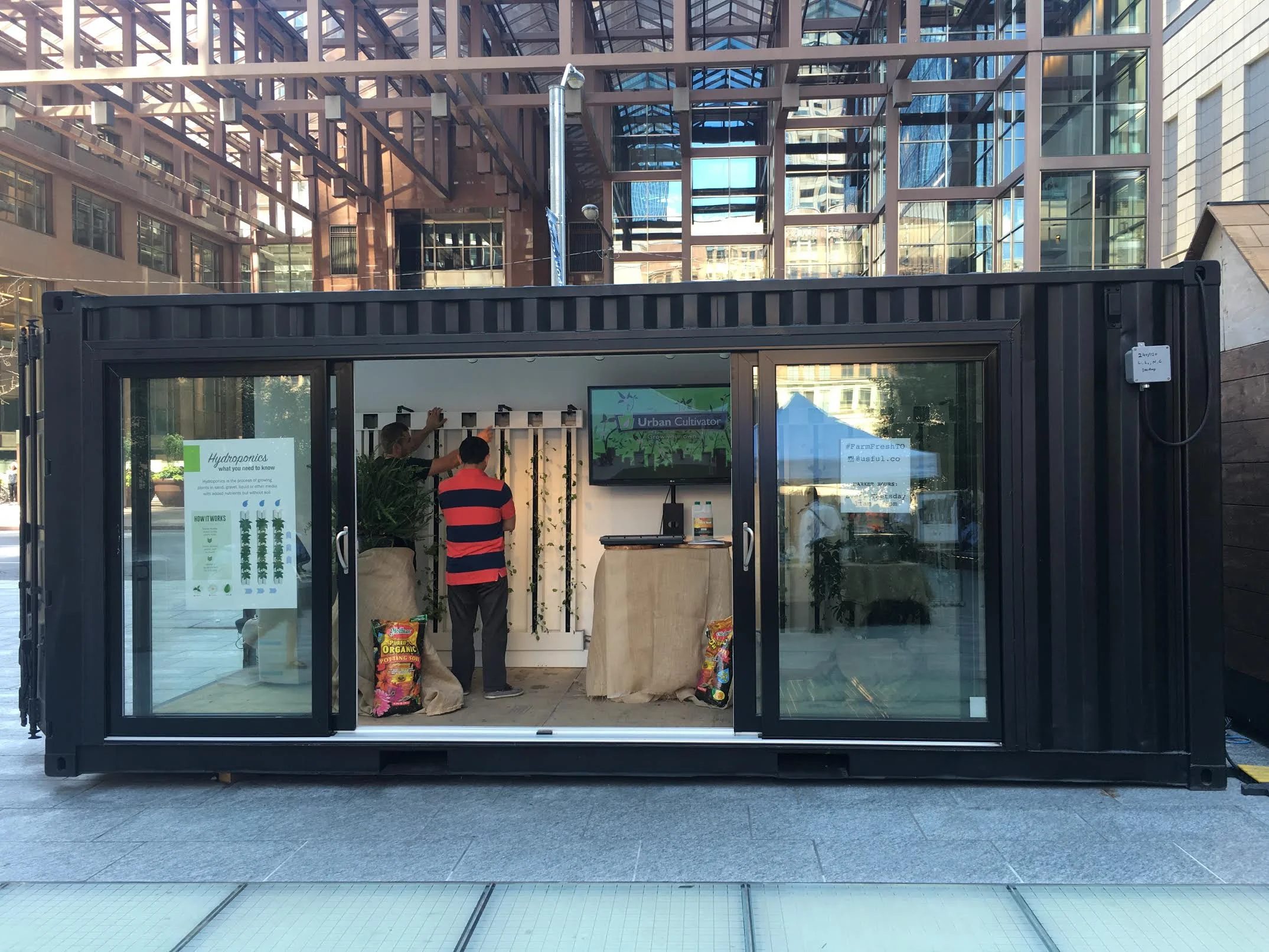
Every Thursday afternoon for the past month and a half we've had the pleasure of being a part of the #FarmFreshTO pop-up farmer's market at the Bay Adelaide Centre. Unlike other farmers markets around the city, which tend to be more focused on simply buying and selling produce, the main mission of #FarmFreshTO has been to raise awareness of urban vertical farming practices and sustainable living.
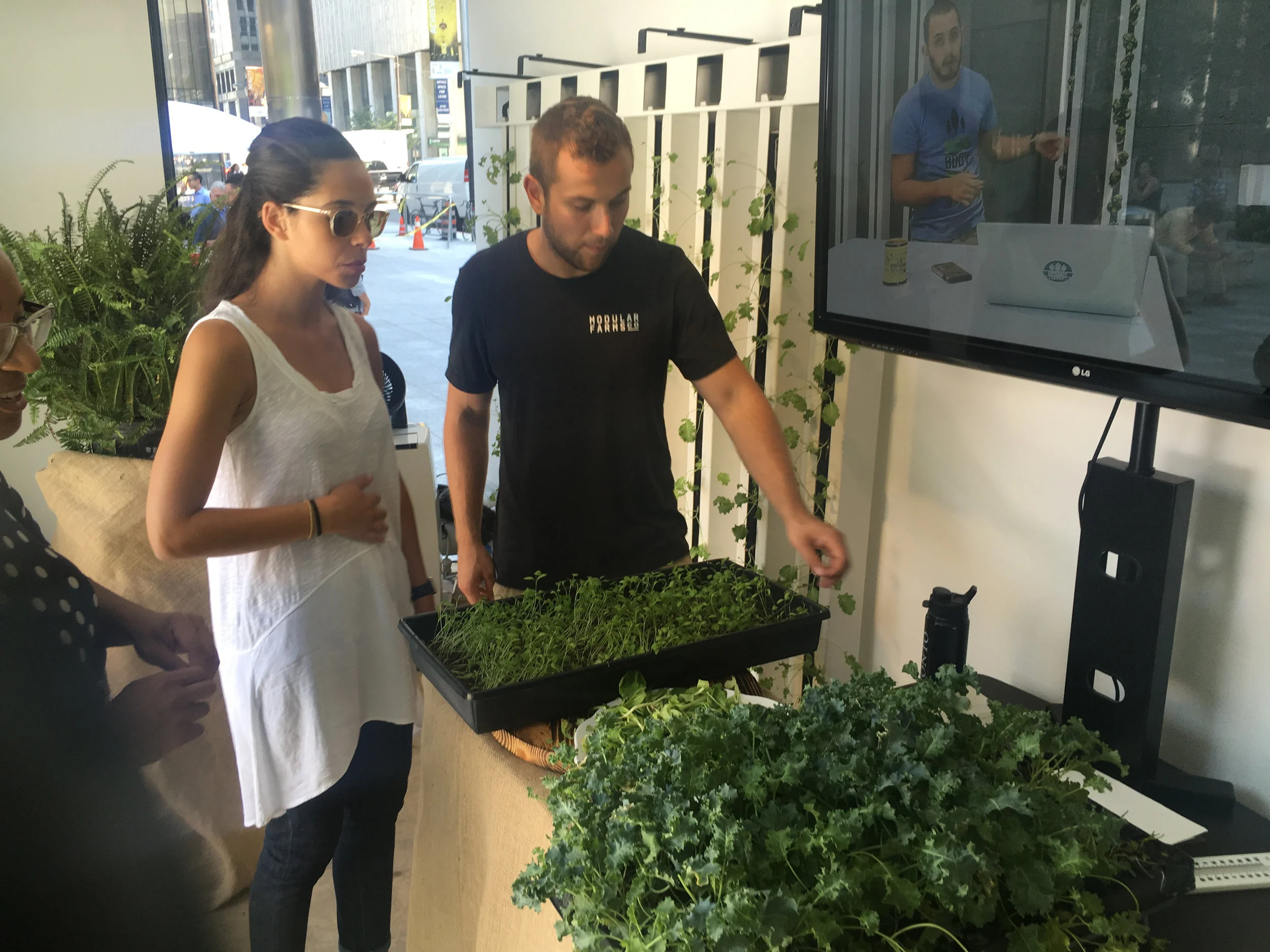
We've greatly enjoyed engaging with, and educating, the public on the benefits and applications of our technology; we can't thank Usful enough for giving us such an amazing opportunity. If you're in the area we highly recommend coming down to Arnell Plaza on a Thursday to say hi, treat yourself to some samples, and get a hands-on look at our technology. Just be sure to do it soon, as the final day of the market is September 15th.
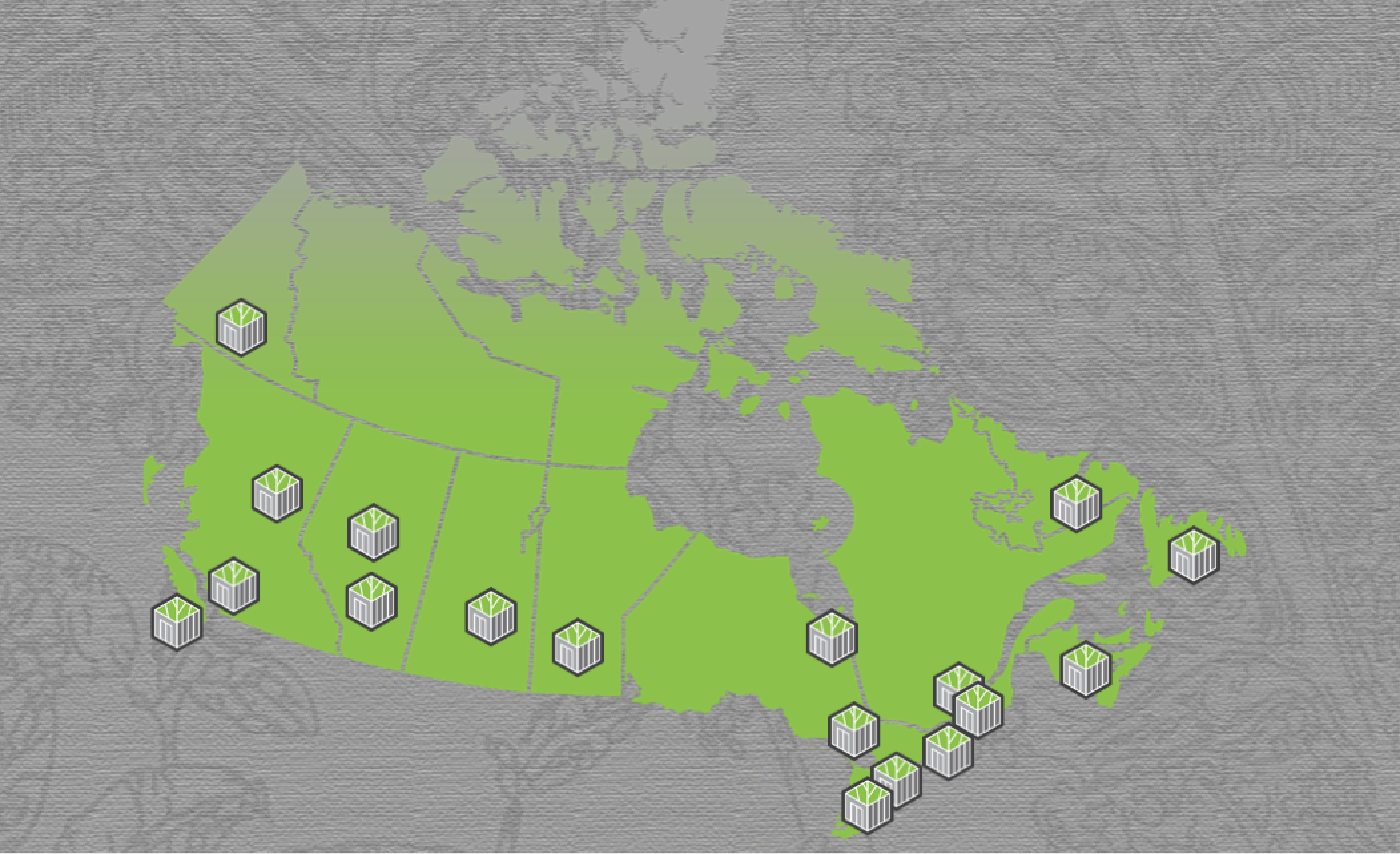
Ending the food insecurity issue in Canada has always been, and will always be, the main reason for our existence. While this may seem like a daunting task, we've already seen great strides being made across the country by passionate, like-minded people who have been utilizing ZipGrow technology to feed themselves, their families, and communities in a sustainable fashion. We currently have Modular Farms scheduled for delivery from coast to coast in the next 12 months, however, there are so many Canadians still in desperate need of our help, and we need your help to get them properly fed. Contact us today to find out if a Modular Farm is a good fit for your family and community.
Stay tuned for the next installment of our newsletter!
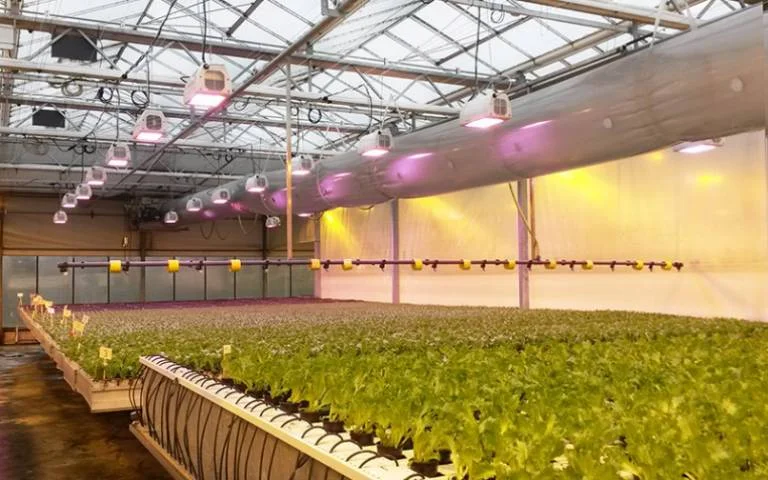
IES Launched Full Range Of LED Horticulture Grow Lighting Products
IES is one of the leading global developers of greenhouse and indoor farming and gardening LED lights solution.
IES is one of the leading global developers of greenhouse and indoor farming and gardening LED lights solution. With an international team of agriculture experts and researchers, IES focuses on driving innovation and development in their industry which has earned them the status of being a global leading light in the field of supplemental lighting. Recently,
Technological advancements have paved the way to more unconventional methods of cultivating plants, growing and caring for them which include indoor farming and gardening. IES is directed by their desire to generate and cultivate innovative and hi-tech LED Horticulture Lighting technology. Their main point of focus is to satisfy their customers through their high standards of quality in both their products and their customer services. The company spokesperson said: Our Horticulture LED Solutions develops light systems to condition any crop in growth. We do not only provide mere lighting, but we provide the best possible care to increase profit for the grower, we call this custom made plan a ‘light recipe’.”
The range of products has been created to cater to the needs of contemporary indoor and greenhouse farming and gardening lighting needs, the comprehensive range of products includes LED lights specially designed for a greenhouse, hydroponics, aeroponics, home garden, farm, vegetable shed, botanic garden, flower exhibitions, horticulture, hydroponics, hemp cultivations, medical plants cultivations, etc. the spokesperson continued: “Our light recipes are suitable for different segments within horticulture, e.g. vegetable production, tissue culture and young plant production, cut flowers, seedlings and nurseries. Horticulture LED Solutions is offering knowledge of LED Plant lighting around the world to you.”
Consistent global standards of quality and various certifications are the testament to the company's commitment towards maintaining the highest levels of superiority. The company takes a lot of pride in the fact that they maintain a large worldwide customer based with clients in every part of the world including Europe, America, the Middle East and Southeast Asia, their product are available for sale on all major online marketplaces and the complete details of each product is available on the IES horticulture lighting website.
The company looks forward to expanding their global customer base to become a major LED grow lighting manufacturer globally and continue serving their esteemed clients with top of the range products.
About:
IES Lighting Co., Ltd is a horticulture and agriculture LED light producer based in China.
For more information please visit: http://www.grow-lighting.com/
Contact: Jessie
info@grow-lighting.com
Shenzhen,China
Media Contact
Company Name: IES Lighting Co., Ltd
Contact Person: Jessie
Email: info@grow-lighting.com
Country: China
Website: http://www.grow-lighting.com/
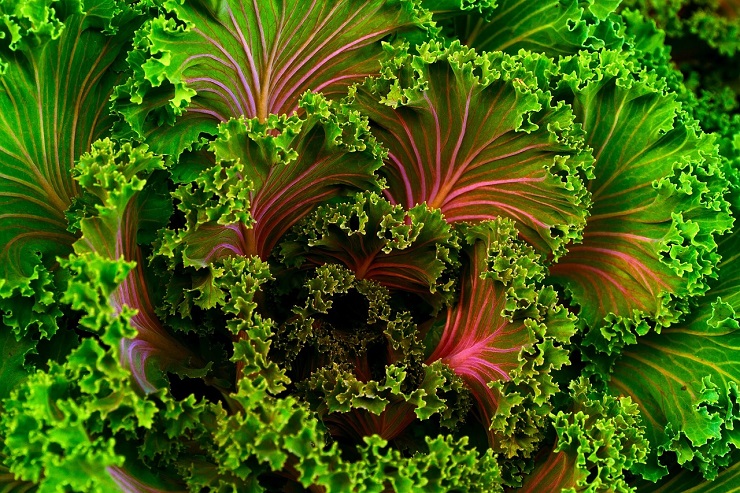
2 Acres of Farming In A Shipping Container
With the increasing demand for agricultural products, it has become necessary to practice alternative methods for bringing up the supply levels
2 Acres of Farming in a Shipping Container
Anna Domanska , September 13, 2016 / 2153 0
With the increasing demand for agricultural products, it has become necessary to practice alternative methods for bringing up the supply levels. It has to be taken into consideration that land simply cannot be cleared off to make space for more farms. With this in mind, the technique of vertical farming proves to be beneficial. To explain this further, vertical farming is a technique in which plant cultivation will take place inside skyscraper greenhouses. A specific environment is created using solar or wind turbine energy which is suitable to the plant growth. Furthermore, this type of farming can be done year-round.
The Vertical Farming Accelerator called Square Roots
In order to take this technique further into the agricultural market, entrepreneur Kimbal Musk along with Tobias Peggs is planning to launch a new urban farming incubator program, called Square Roots. Under this program, vertical farming will take place in the Pfizer factory situated in Brooklyn, New York. These vertical farms will be created inside 10 steel containers 320-square-foot each. Each of these containers will be managed by a young agricultural entrepreneur for one year. These entrepreneurs will be given hands-on training in running a vertical farm business by Square Roots. They will have full access to their respective farms at any time they want. In this case, the entrepreneurs can choose to grow anything they like. The entrepreneurs who are interested are supposed to pitch their start-up concept in front of Square Roots.
Such containers will contain rows of organic herbs and these plants will be monitored for watering and proper nutrient content. Due to constant monitoring, many plant diseases and spoilage could be discovered before it starts spreading further. Such farms are located in or around the city. Due to this, the consumer will acquire fresh food products which are a major benefit of vertical farming. The technology used will be developed by vertical farming start-ups Freight Farms and ZipGrow. The plants grown in such containers will be rooted in water instead of soil and cultivated under LED lights. The team of experts has decided to grow green crops inside these containers. This is because such crops are small enough for the entrepreneurs to understand vertical farming thoroughly. One such container is efficient enough to grow crops equivalent to 2 acres of farmland.
Benefits of Vertical Farming
Musk and Peggs strongly believe that urban farming has a number of advantages over traditional farming. Significantly, vertical farms expend 80% less water than outdoor farms and require much less space. On the other hand, Square Roots aims to help young farmers understand this technology better so that it can be implemented efficiently. Such entrepreneurs will be trained under the best mentors provided by Square Roots. The most important advantage of vertical farming is that it’s healthier than the products of industrial farming. The food produced through industrial farming is high-calorie, low nutrient and processed thousands of miles away. Whereas vertical farming does not compromise with the nutritional value.
Kimbal Musk and his ventures within the Agricultural Industry
Kimbal Musk is an American entrepreneur, known for his investments in several technology and food companies. He is an environmentalist who has introduced technological ideas which help in the sustainable growth of society. Musk co-founded The Kitchen which is a chain of restaurants which stocks up its food sources from local farmers. He has also co-founded a venture called The Kitchen Community, which is a non-profit organization. The Kitchen Community builds learning garden in schools around the USA. This organization has already planted vegetable gardens at more than 200 schools nationwide.
The technique of vertical farming is a progressive step towards the sustainable development on a global scale. As this technique requires minimum resources, it gives an output as good as the traditional farming method. Also, it helps in solving the problem of cutting down vegetation to meet the increasing demand of food.
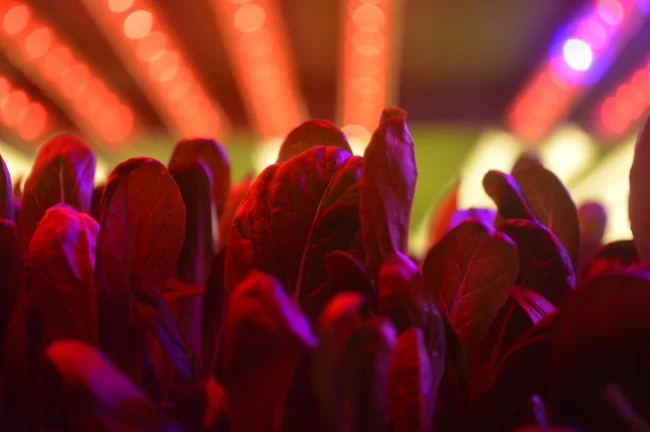
Growing in the Air
A Newark-based AeroFarms seeks to transform agriculture through aeroponics technology that grows greens soil-free and indoors.
Forget sunshine and soil to grow leafy greens and fresh vegetables for health-conscious consumers. A US venture firm is leading a new wave of future agriculture by adopting the latest technology to produce something more fresh, safe and environmentally conscious at the heart of urban spaces.
Instead of growing crops on land with the use of pesticide and water, a Newark-based AeroFarms is running high-tech greenhouses to produce high quantities of nutritious and quality fresh food all year round. Indoor vertical farming -- a concept invented by Dickson Despommier, an ecologist and an emeritus professor of Columbia University -- is what the firm has been promoting.
The firm grows massive amounts of edible greens in stacked rows that reach to the ceiling in a controlled-environment where the temperature, nutrients and lighting are constantly monitored and adjusted. At AeroFarms, plants grow under light-emitting diodes on permeable micro fleece cloth irrigated with a nutrient-infused mist. It uses 95 percent less water, about 50 percent less fertilizers and zero pesticides.
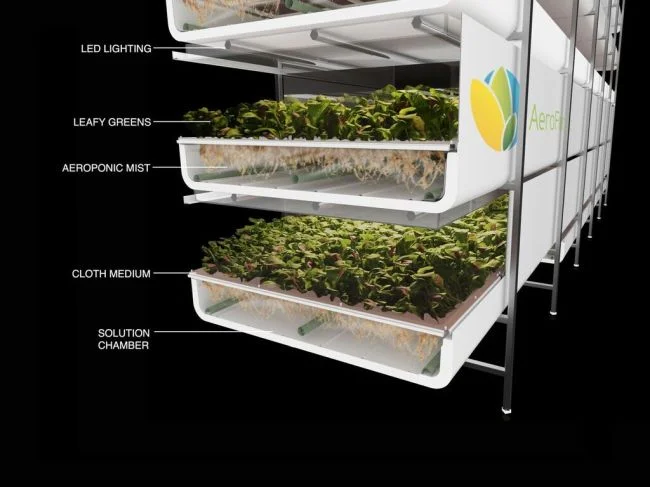
An illustrated image of AeroFarms' vertical farming (AeroFarms)
The US firm is also working on turning an old steel mill in Newark, New Jersey into the world’s largest indoor vertical farm.
In the 6,503 square-meter space, the firm aims to produce up to 907,184 kilograms of baby greens per year, said Marc Oshima, the co-founder and chief marketng officer of AeroFarms in an email interview with The Korea Herald.
Indoor farming can ease growing concerns about climate change, population growth and fast urbanization, he said. Not only is vertical farming sustainable and socially responsible, it is a promising business as it produces greens that are tasty, rich and more nutritious, he added.
Vertical farming, in particular, can be a solution for tech-savvy South Korea that has millions of people living in congested city areas, as it offers a greater level of control to consistently grow high quality food, he said. Korean municipalities have been investing in local startups to conduct research and development in indoor farming. But there has not been many local companies involved in such business so far, according to local experts, citing the lack of economic feasibility and efforts in securing the market.
The following are the questions and answers of the interview.
1. What inspired you to start a high-tech farming business?
We are committed to building, owning, and operating indoor vertical farms that grow delicious, safe, healthy food in a sustainable and socially responsible way all over the world.
We build our farms in repurposed spaces benefitting communities and creating local jobs. Our R&D facility was once a night club and one of our farms is a former paintball/laser tag arena. We are currently building the world’s largest indoor vertical farm in an old steel mill in Newark, New Jersey. It will be 70,000 square feet (6,503 square meters) and have the capacity up to 2 million pounds (907,184 kilograms) of produce per year.
2. What are the benefits of vertical farming for customers, businesses and communities?
Our way of farming mitigates food safety risks: no soil, completely insulated from neighboring operations, no pesticides ever, and we can track a package of greens down to the exact square foot of growing. Most of the common food safety risks simply are not an issue with our system. In addition, all of our farmers and staff go through rigorous food safety training, and we are certified with United States Department of Agriculture Good Agricultural Practices.
Food-borne illnesses from vegetables are mainly a product of the practices needed to sustain large-scale commercial agriculture. Overuse of antibiotics in factory farming of livestock have created resistant bacteria, which are then sold to farmers in the form of manure or fertilizer.
Also, all of our farms have been in repurposed spaces. Our technology can really fit anywhere, but we have been focusing on dormant warehouse space that is close to existing retailers and food service distributors. A big part of our mission is to decrease food miles and travel time so that our greens are as fresh as possible when you eat them. That is why we focus on urban warehouse space specifically. But also, it’s gratifying to breathe some new life into areas that may have lost manufacturing businesses decades ago. The communities we enter are so ready for us to come in and start growing and hiring.
3. What differentiates AeroFarms’ greens from other greens produced through conventional farming methods and mass production?
Just because the supermarket shelves are stocked doesn’t mean that all is well. Food in the US travels thousands of miles and is often up to two weeks old when it reaches consumers.
That’s why distribution is a huge part of our thought process when opening new facilities. AeroFarms builds farms on major routes and near distribution centers so that our greens spend minimal time in transit. That means longer a shelf life, less shrink, better taste and also better nutrition. The second a leaf is harvested the nutrition starts to degrade, so when we can cut transit time down by growing locally we give consumers an even healthier product. So not only do our greens reach the store with more of their original nutrition, our precise control of every aspect of the nutrients, water and environment our plants use to grow means we can create the perfect conditions to optimize for flavor, taste, color, and yield to have a truly sustainable business. Our products are available to the consumer at the exact same price as field grown produce while delivering superior value.
4. Will high-tech vertical farming be the future of farming?
Vertical Farming is growing as quickly as it is because the relief of pressure on our natural resources currently caused by industrial farming is striking a chord. Traditional farming will always be an important part of the food supply, but we would like to see vertical farming become a substantial percentage of overall production. From a food security point of view it’s just smart, but also from a biodiversity and flavor point of view.
5. Who does your business mainly target?
Our greens are incredibly tasty and tend to convert even people who don’t think they like to eat leafy greens -- so there’s really no one in America who is not a potential customer. Our goal is to democratize access to good, healthy food that is responsibly grown.
6. Do you think that vertical farming could be a good business opportunity in Korea?
Absolutely. Vertical Farming is a great solution for dense urban areas because fresh food often has to travel long distances from rural areas to these cities. More importantly, vertical farming offers a far greater level of control to be able to consistently high quality food.
7. What are the challenges you have faced so far? Has there been any opposition from local farmers?
The biggest challenge for us so far has been getting to market fast enough. We have more demand from retailers than we can supply, which is why we’re working hard to bring new farms on line as quickly as possible. We don’t really see ourselves in competition with local farmers. What we’re looking to disrupt is the giant industrial farms in California and Arizona, which have energy and water needs that are vast and generally unreported. Plus, with 20 crop turns a year, we can provide fresh local green in February, when we’re really not competing with anyone.
Marc Oshima, co-founder and chief marking officer of AeroFarms
8. What kind of advice do you have for Korean start-ups or government-funded entities interested in vertical farming?
Growing indoors is not easy to do and we really want to underscore the importance of food safety. At the end, we recommend that experts like AeroFarms get engaged to help in the process.
9. What are your future strategies?
We are looking to build 25 farms over the next five years, and that is a very conservative number given the demand. We currently have farms in development in four different continents including Asia.
By Cho Chung-un (christory@heraldcorp.com)
Agrilyst Reports Indoor Agriculture Over 4k Times More Productive Than Outdoor Commodity Crop Production
The opportunity to harvest more times a year and higher retail prices are making indoor farming more productive than conventional outdoor operations.
Better yields, the opportunity to harvest more times a year and higher retail prices are making indoor farming more productive than conventional outdoor operations, according to a new report from data software company Agrilyst.
The State of Indoor Farming details the results of a survey of over 150 indoor growers in the US, representing around 9% of the country’s current indoor farming market.
While unable to make a 100% like-for-like comparison to outdoor operations for all types of produce, the report builds a comparison between outdoor farms and indoor operations using historical USDA and other public data.
According to the report, indoor horticulture operations stand to make $2.2 million an acre each year compared to an outdoor lettuce operation which makes $12.4k an acre and an outdoor tomato operation, which makes $13k an acre.
Indoor greens growers surveyed reported an average of 340k pounds per acre annually, compared to about 30k pounds per acre reported by the USDA for lettuce under conventional outdoor production. That’s an 11x increase in yield. The majority of this is down to the increase in the number of harvests per year; outdoor lettuce growers harvest four to fives times a year compared to the potential for indoor growers to harvest 18 times a year due to a shorter growing period under controlled conditions.
But even without this cyclicality benefit, indoor growers can produce 2.8x more annually on yield increases alone, according to the report.
There were similar productivity gains for tomato growers, according to the report.
Adding to these harvest and yield figures, the price of indoor-grown produce is also much greater than outdoor-grown produce.
According to the report, indoor greens farmers are getting 10x more, and indoor tomato growers are getting 2.5x more than their outdoor counterparts. A large reason for this is the distribution channels of these growers: direct to consumer or restaurant sales.
Likely a result of this positive trend, 86% of the indoor growers surveyed plan to expand their operations in the next five years. For all respondents, even the minimum planned expansion is 4.7x larger than their current farm size, which suggests significant market growth in the coming years.
They also want to invest in technology. On average, growers have an annual budget of $12 per square foot to invest in technology for both increasing plant yields and managing operations more efficiently. They also have an annual budget of $15 per square foot to invest in technology to improve crop quality.
Topping the list of new technologies, 39% of growers are interested in purchasing a farm management system in the next year, with 90% of all growers surveyed believing that they can increase their crop yields with data analytics. In addition, 28% of growers are interested in purchasing post-harvest automation systems, 28% are interested in purchasing LED lighting, and 27% are interested in purchasing climate control systems. The lowest priority item listed was organic nutrients.
But it is not plain-sailing for indoor agriculture. There are many challenges for the sector to overcome to be truly efficient and sustainable.
Keeping operating costs down is the biggest challenge, according to survey respondents, followed by the difficulty in predicting and stabilizing operating costs. Labor costs are one of the biggest and the report delves into the average workforce dependent on the size of the farm, and type of crop.
The report also touches on the issue of organic certification, which we covered in a post here last week.
To find out more about the make-up of the survey respondents, how exactly they plan to spend, and more in-depth analysis of the challenges they face, download the report here.

Green Sense Farm Crowdfunding Offer Quickly Hits Goal on StartEngine
Green Sense Farm, raising capital under Reg CF on StartEngine, quickly hit its goal within the first 24 hours of listing.
Green Sense Farm, raising capital under Reg CF on StartEngine, quickly hit its goal within the first 24 hours of listing.
Green Sense Farms is a “vertical farm”. The company has established a vision of building a network of indoor vertical farms, and locate them at perishable food distribution centers owned by large grocery stores. The company also intends on creating locations at institutional campuses or wherever large volumes of food are served. If you think about it, a vertical farm makes sense. Grow the food close to where it is going to be consumed and you save on transportation (no lettuce from 3000 miles away), minimize associated pollution and harvest only when ripe. Green Sense says it is the market leader in the emerging indoor vertical farming market. The company first launched in Portage, Indiana in a 20,000 square foot facility. They now have ten development farms in their pipeline in the US, China, Canada and Scandinavia. They formed a Hong Kong company to help build out China operations. The first farm opened in China last month.
The concept is easy the practice is hard.
Green Sense Farm says it can harvest year round using the fraction of resources necessary in a traditional farm. No pesticides, herbicides, GMO seeds necessary.
Watch the video below published last year about the company.
Have a crowdfunding offering you'd like to share? Submit an offering for consideration using our Submit a Tip form and we may share it on our site!
By JD Alois

Green Sense Farms Reaches Crowdfunding Goal on Day 1
Green Sense Farms, an indoor farm company based in Portage, has raised more than $120,000 in a crowdfunding campaign.
Green Sense Farms, an indoor farm company based in Portage, has raised more than $120,000 in a crowdfunding campaign on startengine.com.
The market-leading company, which raked in $788,000 in revenue last year and just opened its first farm in China, reached its minimum goal of $100,000 on the first day but hopes to raise up to $1 million to build a network of indoor vertical farms. These would be built at perishable food distribution centers owned by large grocery stores and institutional campuses that serve a lot of food daily, such as at hospital cafeterias.
“We’re not subject to rain or drought," Founder and CEO of Green Sense Farms Robert Colangelo said. "We precisely control the indoor environment, to create the perfect conditions for our plants to grow year-round, every single day.”
Last year, the U.S. Securities and Exchange Commission adopted rules that allow companies to sell securities through crowdfunding, which SEC Chairwoman Mary Jo White said would give smaller companies a more innovative way to raise capital while protecting investors.
Companies can go online to raise up to $1 million through crowdfunding over a 12-month period. They're required to disclose independently audited financial information, including from tax returns, and the crowdfunding platforms have to provide investors with disclosures and educational materials.
Green Sense Farms, which reports having $2.6 million in assets, grows GMO-free leafy green vegetables indoors, using less water and land than traditional agriculture. The company says more sustainable farming practices are needed because climate change is reducing the amount of arable land and the world's population is projected to reach 9.7 billion by 2050.
"Green Sense Farms has been the fortunate recipient of numerous stories about our exciting innovative indoor vertical farming technology," Colangelo said. "All this press has generated many inquiries from individuals asking how they can invest in our sustainable farm. We’re pleased to announce that the recently released crowdfunding regulations now allow for individuals to make direct equity investments in growth companies like ours."
The company, which started with a 20,000-square-foot farm in Portage, is seeking investments of at least $100 to fund R&D for new farm designs and to expand its network. It's eyeing indoor farms near colleges, hospitals, military bases and corporate campuses, including abroad in Canada, Scandinavia and China.
"Just as Green Sense Farms has disrupted produce distribution and cut out the middleman, the new crowdfunding regulations have democratized the capital markets, allowing individuals the opportunity to take advantage of public offerings without the use of traditional stock brokers," Colangelo said.
For more information, visit www.startengine.com/startup/green-sense-farms-llc.

15 Ways Urban Farming Can Revitalize a Neighborhood—And Help Farmers Too
What if farms and food production were integrated into every aspect of urban living?
15 Ways Urban Farming Can Revitalize a Neighborhood—and Help Farmers Too
What if farms and food production were integrated into every aspect of urban living?
By Michael Ableman / Chelsea Green Publishing
September 8, 2016
Friendly team harvesting fresh vegetables from the rooftop greenhouse garden and planning harvest season on a digital tablet
Photo Credit: LUMOimages/Shutterstock
[Editor's note: What if farms and food production were integrated into every aspect of urban living—from special assessments to create new farms and food businesses to teaching people how to grow fruits and vegetables so farmers can focus on staple crops? That’s the crux of Michael Ableman’s Urban Food Manifesto, which has been ten years in the making and is spelled out in his new book, Street Farm. The book tells the story of Sole Food Street Farms, and the role it has played in revitalizing not only a neighborhood, but the lives of its individual farmers. The urban farming manifesto below—as told through Street Farm—is a story of recovery, of land and food, of people, and of the power of farming and nourishing others as a way to heal our world and ourselves. You can also check out this Q&A with Ableman, where he describes in more detail the promise of urban farming.]
I have been developing the following 15-point Urban Food Manifesto over the last ten years.
Some of the ideas may sound radical; others will likely seem terribly obvious.
Some are practical, some more ideological, but either way they are focused on the municipal and on individual ways to address what I consider to be some of the most prominent challenges in how we feed ourselves.
1. Every municipality should establish publicly supported agricultural training centers in central and accessible locations. I’m not talking about think tanks or demonstration gardens. I’m talking about working urban farms that model not only the social, cultural, and ecological benefits of farming in the city, but the economic benefits as well. We can talk about all of the wonderful reasons to farm in urban areas, but until we can demonstrate that it’s possible to make a decent living doing it, it’s going to be a tough sell.
2. Regular folks are now so removed from the work of farming that they need to literally see what’s possible. They need access to those who have maintained this knowledge and those who are serious and active practitioners. Every city should have teams of trained farm advisers in numbers proportionate to the population devoted to urban food production. Those agents should operate out of their local urban agriculture centers to run training workshops and classes; they should also venture out into the community to provide on-site technical support in production, in marketing, and in food processing and preparation.
3. The nutrient cycle that once tied farms with those they supplied has been interrupted. We need a full-cycle food system that allows for the return of organic waste via central regional composting facilities that can support the nutrient needs of both urban farms and farms on the fringes of our urban centers. Every community could be composting all its cardboard, paper, old clothing, shoes, restaurant and grocery store waste, and on and on. We need to reduce what comes into our communities from elsewhere, but we also need to reduce what leaves those communities, especially if it has nutritional or soil conditioning values for our land.
4.My fields at Foxglove Farm have as many rocks as grains of soil. Removing those rocks represents a huge amount of work for me, but each one of those rocks also represents an enormous amount of embodied energy, if I could just release it. Every community should own a portable rock grinder that could be taken to farms and used to grind rocks in and around fields that contain essential minerals now being mined elsewhere at great ecological cost. There are huge holes in the world, entire mountains removed, to supply minerals such as gypsum and lime and rock phosphate to our farms. We cannot talk about a sustainable agriculture unless we address where the minerals—especially phosphorous—are going to come from.
5. We’ve all heard about peak oil; we need to prepare for peak water and peak phosphorous. We can grow food without oil, but we cannot grow it without phosphorous and water. Phosphorous is a mined mineral, which now has limited reserves, most of which are located in China, Morocco, and the Western Sahara. Some scientists believe that at the rate we now use it, remaining reserves will be depleted within fifty to one hundred years.
6. Let’s get over our phobia around human waste, stop spending billions of dollars to flush it away and pollute our rivers and oceans, and start recycling it onto our farms and gardens. Urine is the best local source of phosphorous, and we need to figure out creative ways to recycle it.
7. Every community should support the construction and funding of a permanent covered year-round farmers market space in a dominant central location. Providing this type of physical space is just as important to our civic health, if not more, as the public swimming pool, the sports fields, schools, churches, and libraries.
8. Every new permit for a housing development should be contingent on inclusion of an approved food-production component on a scale relative to the number of people who will live in the development. And every new office or retail building should be engineered for a full-scale rooftop food production component, including greenhouses warmed by the spent heat vented from the building.
9. Every neighborhood, school, and church should be required to restructure existing institutional-kitchen facilities to accommodate cooperative canning, freezing, and dehydrating services for their neighborhoods during non-peak hours.
10. Every real estate transaction should include a small urban farmland preservation tax from which lands could be purchased specifically for the production of food, and those lands could have protective easements that require agricultural use in perpetuity.
11. A great deal of privately owned arable land currently lies fallow. This land could be made available to new farmers under long-term leases. We need to recognize that there is not necessarily any relationship between landownership and land stewardship. The only requirement for landownership in our society is access to capital. That’s not enough. I believe that ownership of land should come with a set of responsibilities.
12. Building inspections are common practice prior to many real estate transactions; we should require land inspections, including ecological assessments and baseline documentation, on every piece of land over five acres. Every land purchaser should be required to attend a stewardship and restoration training course based on the particularities of that piece of land. This will help move land away from its status as commodity and bring some sense of stewardship into ownership.
13.When I was in school my favorite classes were wood shop, metal shop, mechanics, and home economics, which included cooking and sewing. Those subjects were well respected. I looked forward to shop class far more than math or science or English. It was a time when I could make something real and tangible. (Every wood shop teacher I’ve known was missing a finger or two, and I am sure that was a requirement for those positions. I made the connection very quickly between those missing fingers and the machines we worked with.) Life skills classes are coming back into schools, but we need to give farming and cooking and mechanics and plumbing and carpentry the same status and attention as math or English or the sciences.
14. It sounds radical, but in the future full-time professional farmers may no longer have the luxury of raising fruits and vegetables. This should become the responsibility of individuals and families to grow for themselves in their front and backyards, on their balconies and rooftops, and in community garden plots. We could probably survive without another carrot or tomato, but we cannot live without grains and beans and protein sources.
15. Every municipality should initiate a phase-out of all home lawns—effective immediately—but they must also provide neighborhood training programs and technical support for home- and building owners to replace those lawns with food production.
It may be that along with growing food, the real work of farmers in the future should be seen as the sequestration of water and carbon. Anyone who has land, or is managing land, has a huge opportunity and a responsibility to address two of our greatest global challenges—water and climate.
Slowing and spreading surface water and allowing it to percolate and not run off, along with learning to use land and improve soils to store and hold carbon, are urgent and essential roles that farmers need to play now and into the future.
Michael Ableman is the cofounder and director of Sole Food Street Farm and an early proponent of the urban agriculture movement. He has created urban farms in Watts, California; Goleta, California; and Vancouver, British Columbia. Ableman has also worked on and advised dozens of similar projects throughout North America and the Caribbean, and he is the founder of the nonprofit Center for Urban Agriculture. He is the subject of the award-winning PBS film Beyond Organic narrated by Meryl Streep. His previous books include From the Good Earth, On Good Land, and Fields of Plenty. Ableman lives and farms at the 120-acre Foxglove Farm on Salt Spring Island in British Columbia.
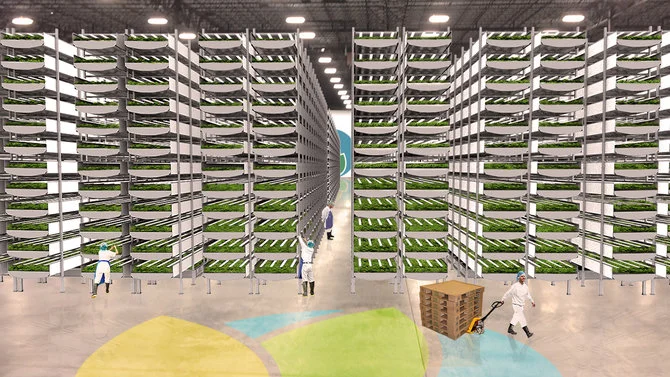
How to Grow Crops Without Sun, Soil or Water
A massive new indoor farm is about to open in New Jersey
How to Grow Crops Without Sun, Soil or Water
By Gillie Houston Posted September 08, 2016
A massive new indoor farm is about to open in New Jersey.
When you think farm, you might imagine sun-drenched fields of fertile soil. You probably don't imagine a very large building in Newark, New Jersey. But AeroFarms, a startup that's developed technology allowing plants to grow without sunlight or dirt (and with very little water), might be about to change that.
Related
- Elon Musk's Brother Launches "Urban Farming Accelerator" in Brooklyn
- Do Farm Subsidies Cause Diabetes?
- Funiture Giant IKEA Wants to Help Restaurants Build Their Own Indoor Farms
According to CNN, the company's first 69,000-square-foot farm is slated to open in Newark, New Jersey this September and will produce leafy greens and herbs, like kale and basil. If this sounds a bit dystopian, consider that this approach could have major environmental benefits: AeroFarms says its new structure will require 95 percent less water than the average outdoor farm.
The farm's technological design was inspired by the aeroponic farming techniques already used by astronauts at the International Space Station. At the AeroFarms facility, humidity, temperature, and light are all strictly controlled to create the most growth-friendly environment possible—free of seasons, days or nights. Each of the plant beds, which will cycle through 22-30 harvests every year, grows on a cloth made of recycled materials, under which their roots are misted with a nutrient solution. LED lights replace the sun and shine at the optimal wavelength for each plant.
AeroFarms founder David Rosenberg says the company anticipates the large-scale vertical farm will produce 2 million pounds of greens a year, setting a precedent for the potential of urban indoor farming. The tech entrepreneur, whose ambitions extend far beyond the farmers market, hopes that the technology his company is pioneering will soon be able to help feed the 54 percent of the world's population who live in urban areas, where growing fresh ingredients is difficult. "We are building this company to be wildly impactful. Not just to build a few farms, but to change the world," Rosenberg says.
Though the lack of soil usage in the growing process means AeroFarms crops aren't eligible for organic certification, all of the plants grown in the facility are free of pesticides, herbicides, and fungicides, and use non-GMO seeds. The company also collects extensive data from their plants in order to improve their growth algorithms and future crops. "We build our own software, which take images of leaves to understand height, width, length, stem ratio, curving, color, spotting and tearing," says Rosenberg of the farming method.
Co-founder Marc Oshima, says their crop beds—which the company currently sells exclusively to local markets, shops, and restaurants—are highly computerized, but still require human touch. "We think of ourselves as plant whisperers, listening and observing everything we can do to optimize our plants," he says. "Our growing approach is really leading the way, marrying biology, engineering, and data science."
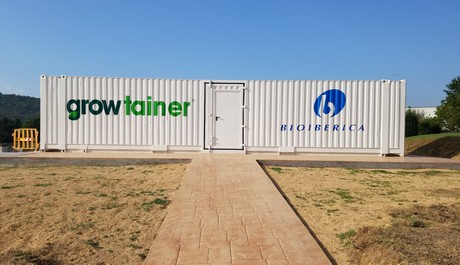
Spanish Pharmaceutical Giant Puts Growtainer into Operation
After installing the first international Growtainer in the UK last year, GreenTech Agro is expanding its presence in Europe with the recent installation of another Growtainer at Spanish biotechnological giant Bioibérica.
The Growtainer is the brainchild of Glenn Behrman, founder of GreenTech Agro and CEA Advisors. Two years after introducing his first Growtainers for sale in 2014, Behrman has now installed another EU Growtainer at the factory of leading Spanish pharmaceutical company Bioibérica in Pallafols, outside of Barcelona. Their enthusiasm for the Growtainer and vertical production has been driven by their interest in new, modern and sustainable indoor farming practices. They will use the Growtainer to produce leafy greens, herbs and vegetables for their canteen at the factory site, in order to gain more hands on experience with indoor growing.
"Bioibérica is a forward thinking company that is committed to discovering new technologies and industries", said Behrman. "They are open to new innovations and other industry angles that have a potential for capitalization.”
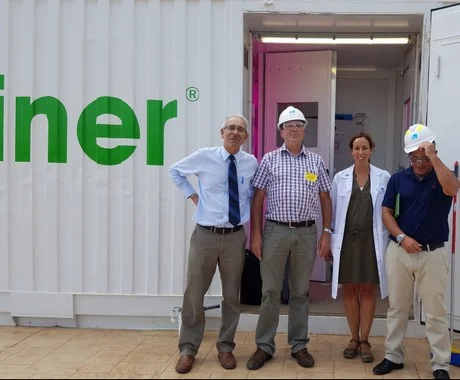
For the Bioibérica project, Behrman collaborated with Dutch horticultural installer Stolze, whose team transformed the used shipping container, outfitted by RCC Container Trading, into a vertical farm. After the installation at the Port of Rotterdam, the Growtainer was shipped to Spain where Behrman and an expert crew from Stolze completed the delivery with a final installation last week.
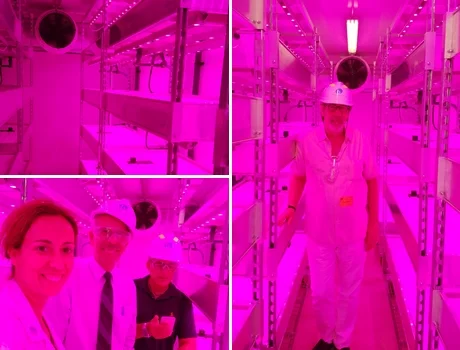
Proprietary technology
Inside Bioibérica's Growtainer there are a total of 12 Growracks divided into two separate production chambers. Ten of the Growracks have 4 layers and will be used for regular cultivation, and two racks with 5 layers each will be used for propagation.
Besides having a dedicated proprietary technology for ebb and flow irrigation installed, the Growracks are equipped with Philips GreenPower LED Generation 2 production modules, which are specifically designed for multilayer cultivation in conditioned environments with no daylight. The LED modules ensure a uniform light distribution across the shelves, which means that every plant receives the same level and quality of light.
The irrigation in the Growtainer is divided into six separate zones in order to provide flexibility and allow a wide variety of production of crops at various growth stages. Behrman worked closely with Stolze's engineers to design a sophisticated control system to manage the irrigation, climate, humidity and CO2 levels inside the Growtainer. The entire climate and crop control can be managed remotely via a computer or mobile phone.
Canteen & Research
Bioibérica will grow several crops inside the Growtainer, in the first place to supply their nearby canteen with everyday fresh and safely grown veggies. "They will use it to feed their employees first and gain indoor farming experience with it. While this is an important objective of the installation, Bioiberica is laser focused on the potential advances in their Bio stimulant products. They are excited to incorporate the Growtainer’s state of the art technology based production capacity for further research within their existing business models."
Behrman, who has a long term background in horticulture, has gained a lot of experience with technology based production and container farms over the past few years. "Thanks to the close cooperation with Stolze, VK Pro and RCC Containers, the Holland built Growtainers have become a real state of the art, completely proprietary system. While there are currently many other individuals in the US that offer shipping container farm systems, none of them is as flexible or sophisticated as this one, because this Growtainer version has focused on and tried to improve everything everybody else is trying to do."
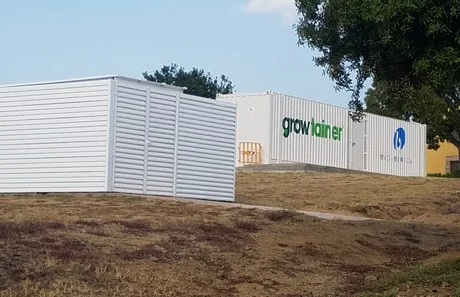
Financing and substantial support
At the moment Behrman is continuing to improve the Growracks and building more Growtainers for clients in the United States. "But we have many other exciting plans to announce soon", said Behrman, not only referring to the several new installations in process. "We are almost ready to announce a more manageable crop specific Growtainer for the beginning farmer, with financing and a substantial support system in place, an onsite production initiative with a major US Supermarket Chain and other projects which focus on the highest and best economic use for this exciting and evolving technology.”
For more information:
CEA Advisors - GreenTech Agro
Glenn Behrman (e-mail)
www.growtainers.com
Publication date: 9/7/2016
Author: Boy de Nijs
Copyright: www.hortidaily.com