


Welcome to iGrow News, Your Source for the World of Indoor Vertical Farming
14 High-Tech Farms Where Veggies Grow Indoors
Farming is moving indoors!
In the 21st century, a significant change is underway in the food industry: farming is moving indoors. The perfect crop field could be inside a windowless building with controlled light, temperature, humidity, air quality and nutrition. It could be in the basement of a Tokyo high-rise, in an old warehouse in Illinois, or even in space. Just look at our collection of awesome indoor farms, where the sun never shines, the rainfall is irrelevant, and the climate is always perfect.
Basil, arugula and microgreens.
A worker checks crops at the FarmedHere indoor vertical farm, in Bedford Park, Illinois, on February 20, 2013. The farm, in an old warehouse, has crops that include basil, arugula and microgreens, sold at grocery stores in Chicago and its suburbs.
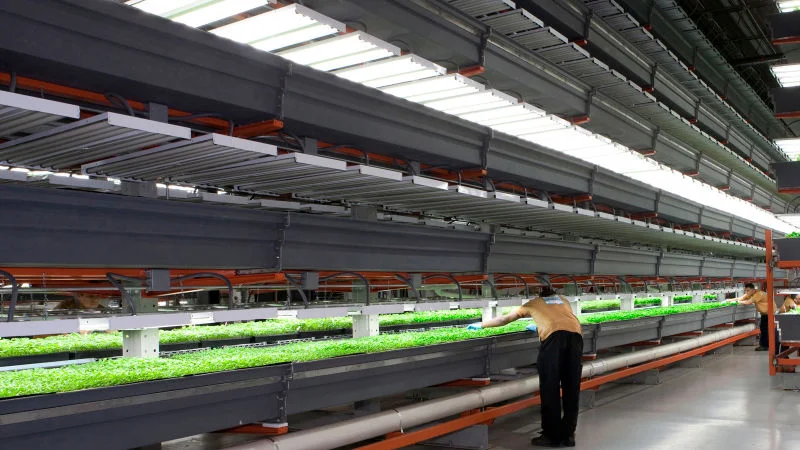
Photo: Heather Aitken/AP
Your endive grows in total darkness.
Red endives at the California Vegetable Specialties indoor farm in Rio Vista, California (April 20, 2006). The growing process is long and fragile, with the endives' roots grown outside first and then moved in, where they are left for up to 11 months to grow into mature endives in total darkness.
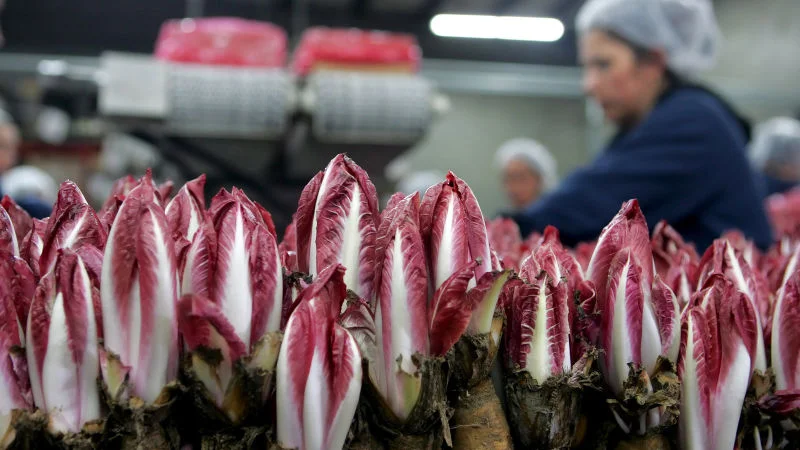
Photo: Jeff Chiu/AP
Under fluorescent lights.
Toshihiro Sakuma checks the condition of plants under fluorescent lights at a greenhouse built inside a Tokyo building on July 1, 2005.
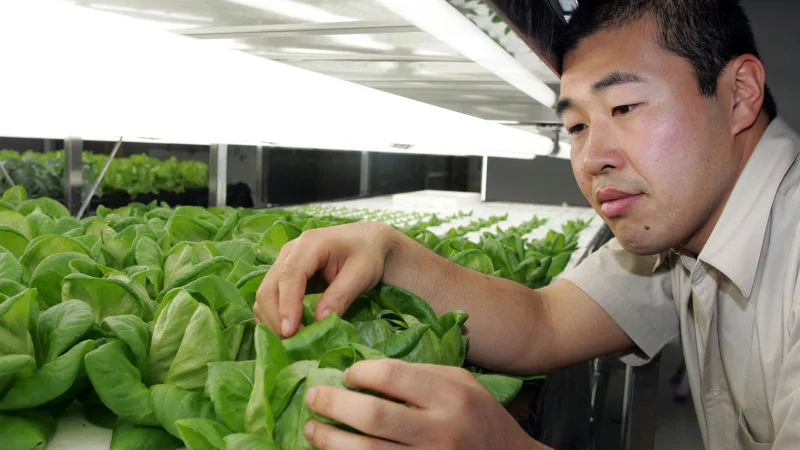
Photo: Shizuo Kambayashi/AP
Sunless farming.
Fittonia plants are seen as they grow in a special darkened room illuminated by blue and red LEDs at PlantLab, a private research facility, in Den Bosch, central Netherlands, March 28, 2011.
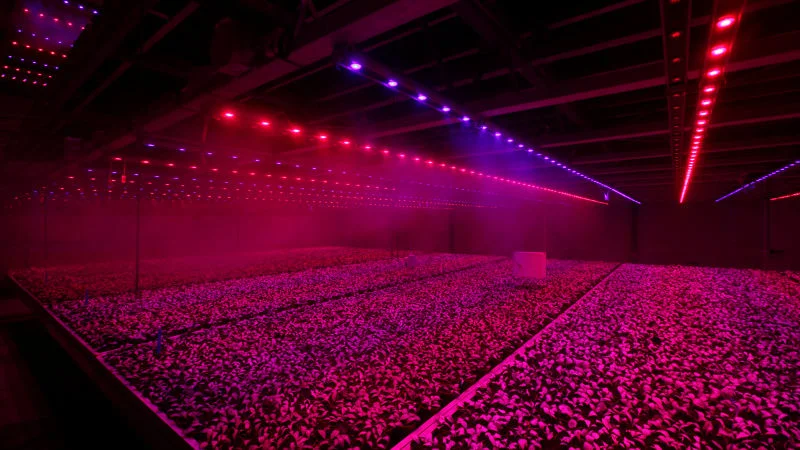
Photo: Peter Dejong/AP
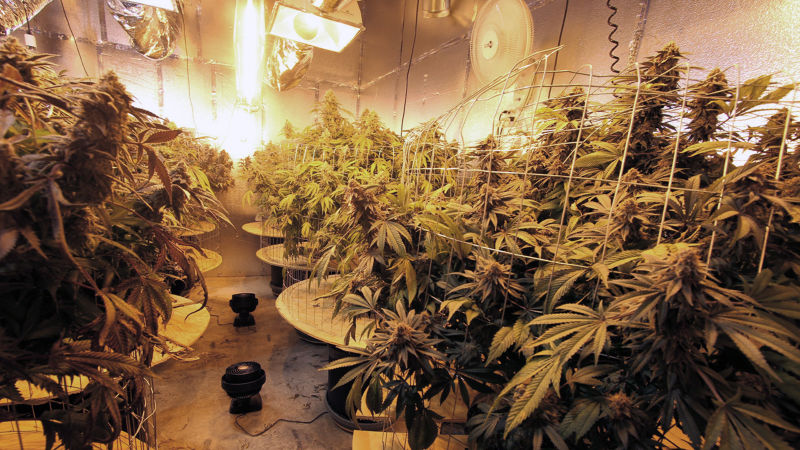
Medical cannabis growing operation.
This facility can be found in Oakland, California. The electricity bill is over $4,000/month.
Illegal cannabis growing operation.
This indoor marijuana farm in California was raided by police.
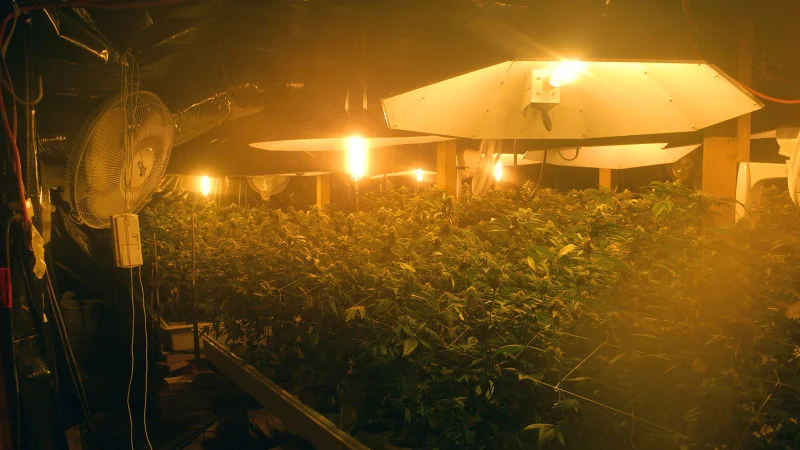
Photo: Arcata Police Department/AP
Legal cannabis growing operation.
In the Netherlands it was legal to grow hemp for a long time. This is what cultivating the world’s finest indoor marijuana looked like a few years ago.
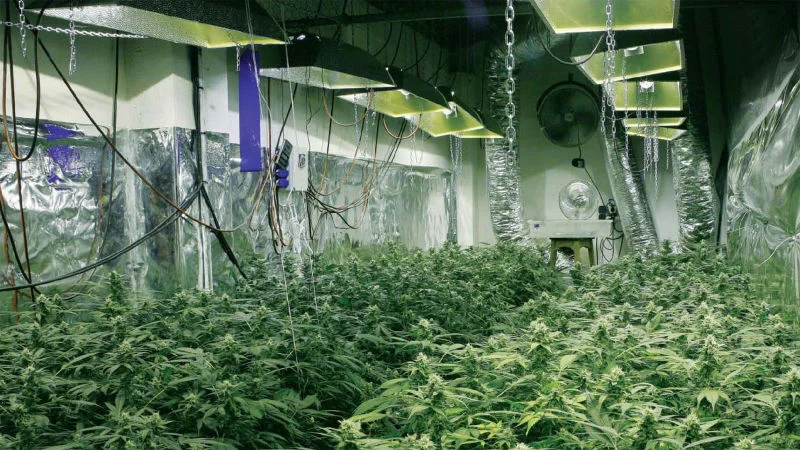
Photo: World Of Seeds
Japanese indoor greenhouse.
Flowers grow under fluorescent lights in greehouse named "Pasona O2" in the basement of a highrise office building in Tokyo. The new style of greenhouse, built by the human resources service company Pasona Inc. in 2005 at the center of Tokyo's business district, is a facility to train aspiring farmers with high-tech methods involving hydroponics and light-emitting diodes (LED).

Photo: Yohei Yamashita
Rice plants at an indoor paddy field in "Pasona O2". Pasona hopes this greenhouse can help promote the pleasure of agriculture to businessmen and businesswomen, and inspire a new generation of farmers.
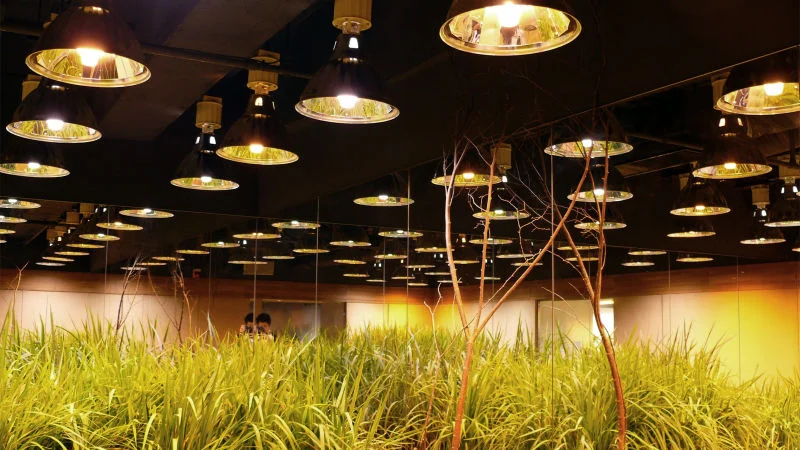
Photo: Yohei Yamashita
Tomatoes grown by hydroponics cultivation in "Pasona O2."
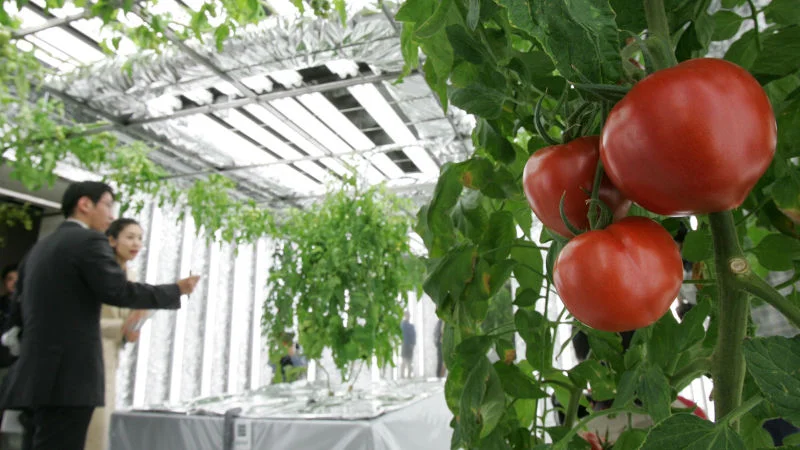
Photo: Katsumi Kasahara/Ap
A staff of "Pasona O2" checks vegetables grown under fluorescent lights.
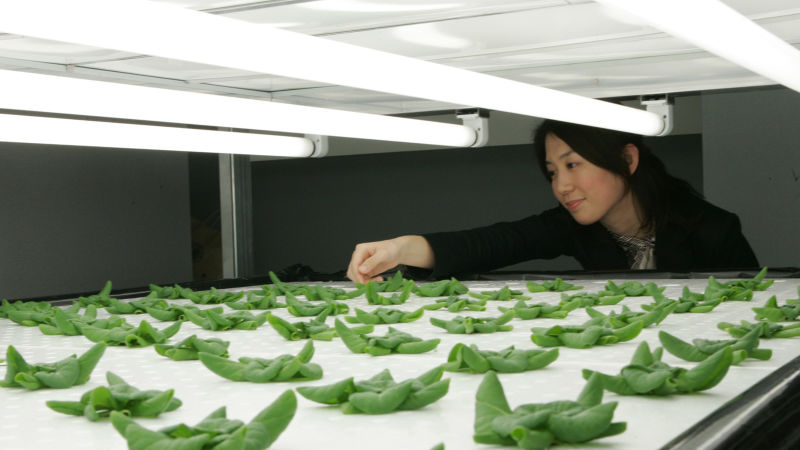
Photo: Katsumi Kasahara/Ap
Hydroponics gardening for the masses.
"The Volksgarden brings simple, clean, and amazingly effective hydroponics gardening to the comforts of your own home," says the company Urban Led Growth. This unit allows to grow up to 80 plants at once. Herbs, vegetables, fruits, and grains can be harvested easily and continuously thanks to the rotating cylinder housing.
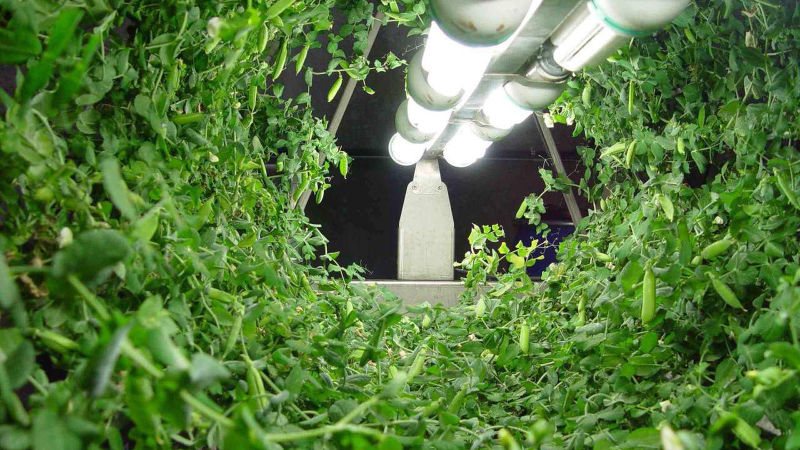
Photo: Urban Led Growth
Put an AeroGarden into your kitchen.
This dirt-free indoor garden planter uses aeroponics: vegetables, salad greens, herbs or flowers grow in this pod while being both slightly exposed to air and slightly submerged in the nutrient solution. The AeroGarden has built-in lights and a “Smart Garden” alert button to tell you when your plants need more nutrients or water.
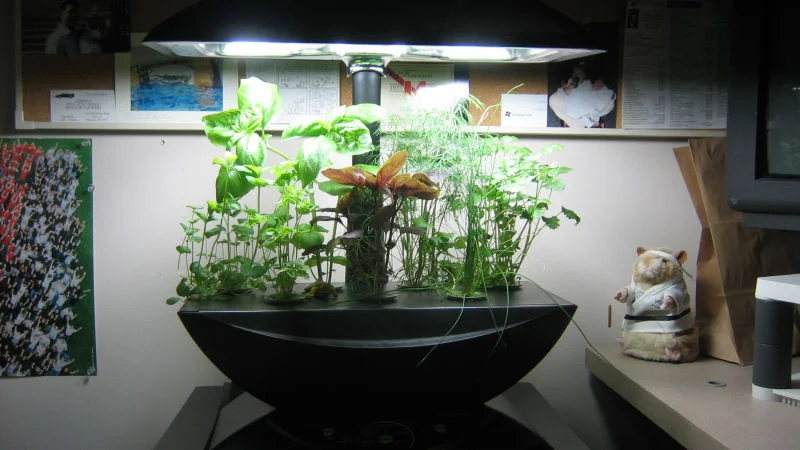
Photo: timmycorkery
An automated, hydroponic, recirculating vertical farming unit.
This is one of the four indoor, climate controlled, automated, hydroponic, recirculating vertical farming units at Green Farms A&M. Green Farms Agronomics & Mycology is located in Valparaiso, Indiana, and was founded in the fall of 2010.
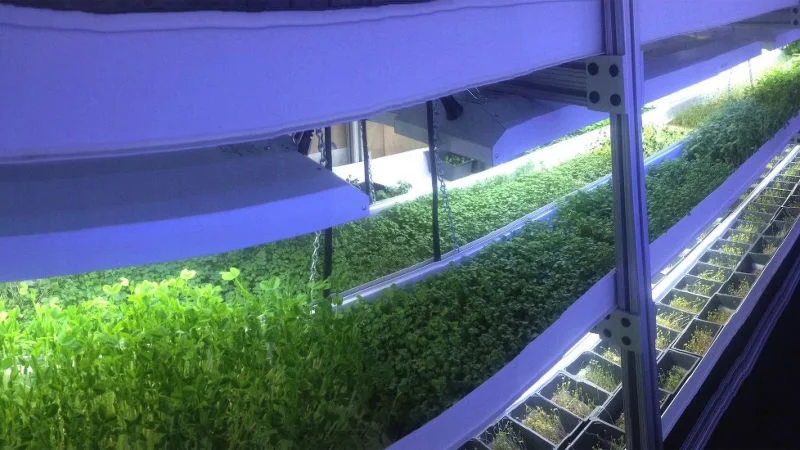
Photo: GreenFarms
Chicago urban garden.
The first "Aeroponic Garden at Any Airport in the World." In 2011, the CDA and HMS Host Corporation collaborated to install a garden in the mezzanine level of the O'Hare Rotunda Building. In this garden, plants' roots are suspended in 26 towers that house over 1,100 planting spots. A nutrient solution is regularly cycled through the towers using pumps so that no water evaporates or is wasted, making the process self-sustaining. No fertilizers or chemicals are used.
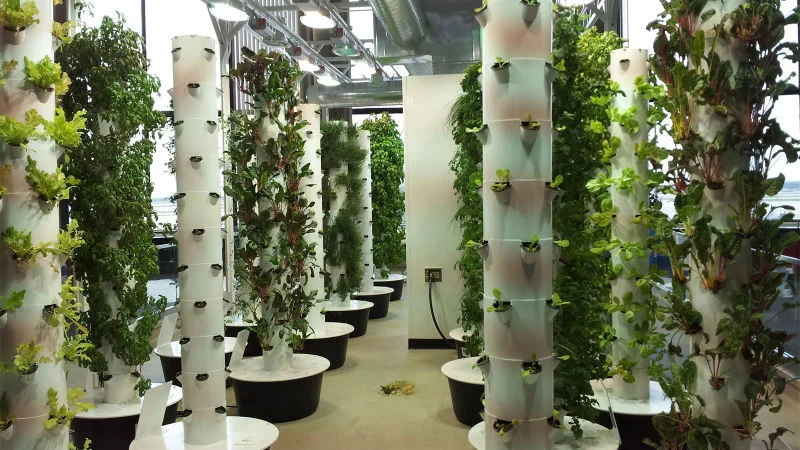
Photo: Gkkfea
Astroculture.
A view inside the "Astroculture" plant growth unit, during Space Shuttle mission STS-73, in 1995. Quantum Devices Inc., of Barneveld, Wisconsin, builds the light-emitting diodes used in medical devices and for growing plants, like potatoes, inside the plant growth unit developed for use on the Space Shuttle by the Wisconsin Center for Space Automation and Robotics (WCSAR). The astroculture facility has flown on eight Space Shuttle missions since, including this one in 1995 in which potatoes were grown in space.
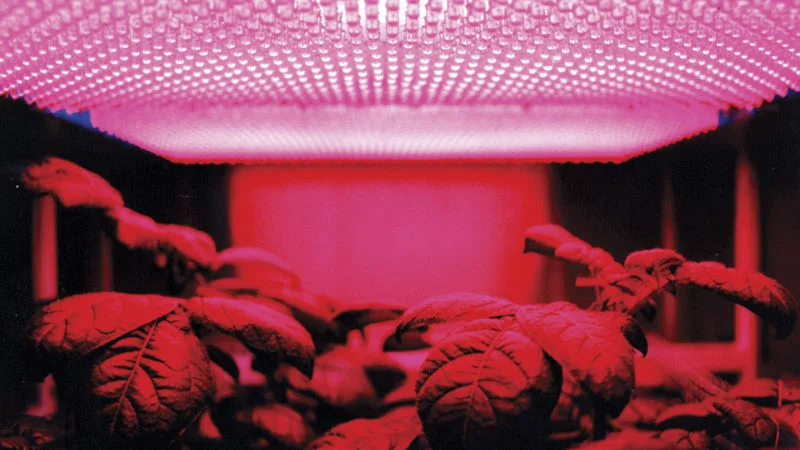
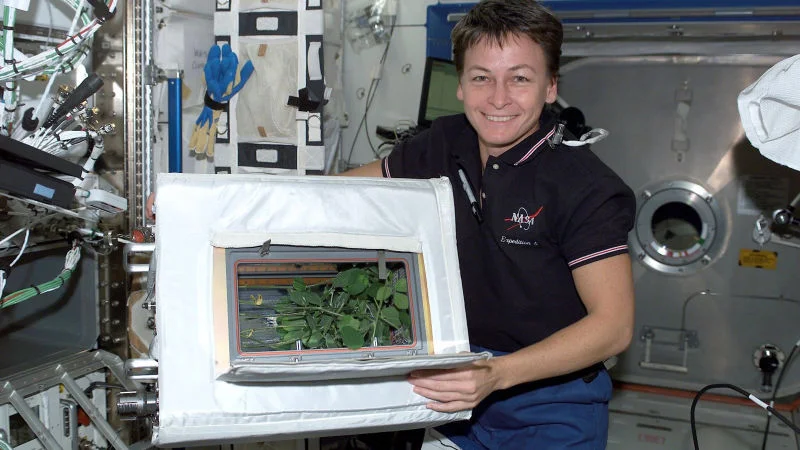
Soybean growth aboard ISS.
Expedition Five crewmember and flight engineer Peggy Whitson displays the progress of soybeans growing in the Advanced Astroculture (ADVASC) Experiment aboard the International Space Station (ISS), in 2002. The ADVASC experiment was one of the several new experiments and science facilities delivered to the ISS by Expedition Five aboard the Space Shuttle Orbiter Endeavor STS-111 mission. An agricultural seed company will grow soybeans using the ADVASC hardware, to determine whether soybean plants can produce seeds in a microgravity environment. Secondary objectives include determination of the chemical characteristics of the seed in space and any microgravity impact on the plant growth cycle.
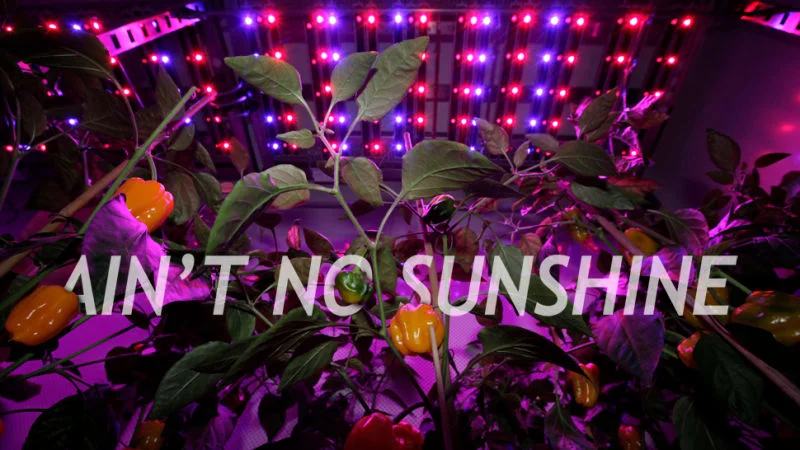
Top photo: Yellow peppers under blue and red Light Emitting Diode (LED) lights at PlantLab, a private research facility, in Den Bosch, central Netherlands, March 28, 2011. Photo: Peter Dejong/AP
By Attila Nagy
Sky-High Vegetables: Vertical Farming Sprouts In Singapore
Singapore is taking local farming to the next level, literally, with the opening of its first commercial vertical farm
Sky-High Vegetables: Vertical Farming Sprouts In Singapore
November 9, 20123:31 PM ET
Singapore is taking local farming to the next level, literally, with the opening of its first commercial vertical farm.
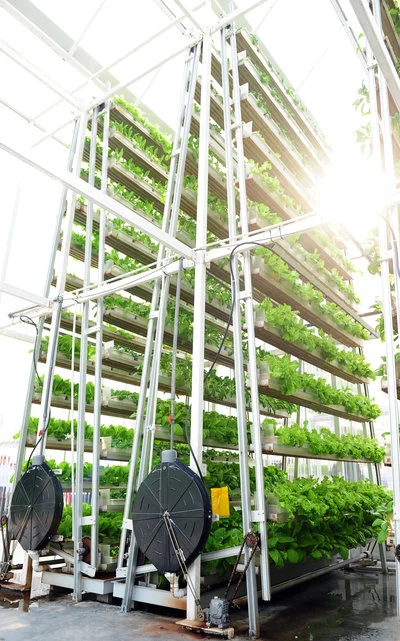
Entrepreneur Jack Ng says he can produce five times as many vegetables as regular farming looking up instead of out. Half a ton of his Sky Greens bok choy and Chinese cabbages, grown inside 120 slender 30-foot towers, are already finding their way into Singapore's grocery stores.
The idea behind vertical farming is simple: Think of skyscrapers with vegetables climbing along the windows. Or a library-sized greenhouse with racks of cascading vegetables instead of books.
Ng's technology is called "A-Go-Gro," and it looks a lot like a 30-foot tall Ferris wheel for plants. Trays of Chinese vegetables are stacked inside an aluminum A-frame, and a belt rotates them so that the plants receive equal light, good air flow and irrigation. The whole system has a footprint of only about 60 square feet, or the size of an average bathroom.
Advocates, whose ranks are growing in cities from New York City to Sweden, say vertical farming has a handful of advantages over other forms of urban horticulture. More plants can squeeze into tight city spaces, and fresh produce can grow right next to grocery stores, potentially reducing transportation costs, carbon dioxide emissions and risk of spoilage. Plus, most vertical farms are indoors, so plants are sheltered from shifting weather and damaging pests.
But is vertical farming just a design fad, or could it be the next frontier of urban agriculture? That depends on your angle — and location.
Implementing these "farmscrapers" on a commercial scale has been challenging, and making them economical has been almost impossible.
It's still up for debate whether vertical farms are more efficient at producing food than traditional greenhouses, says Gene Giacomelli, a plant scientist at the University of Arizona, who directs their the Controlled Environment Agriculture Center.
The limiting factor is light. The total food produced depends on the amount of light reaching plants. Although vertical farms can hold more plants, they still receive just about the same quantity of sunlight as horizontal greenhouses.
"The plants have to share the existing light, and they just grow more slowly." Giacomelli tells The Salt. "You can't amplify the sun."
For American cities, like New York and Chicago, Giacomelli thinks putting plain-old greenhouses on rooftops could be just as efficient as vertical farms – and a lot easier to implement.
In fact, two companies are already working on that approach. Gotham Greens is producing pesticide-free lettuce and basil for restaurants and retailers from rooftop greenhouses in Brooklyn, while Lufa Farmsgrows 23 veggie varieties in a 31,000 foot greenhouse atop a Montreal office building.
But for the island of Singapore, where real estate is a premium, vertical farming might be the most viable option. "Singapore could be a special case, where land value is so exceptional high, that you have no choice but to go vertically," Giacomelli says.
The Sky Greens vegetables are "flying off the shelves," reports Channel NewsAsia — perhaps because the vertical veggies are fresher than most available in Singapore, which imports most of its produce from China, Malaysia and the U.S. They do, however, cost about 5 to 10 percent more than regular greens.
"The prices are still reasonable and the vegetables are very fresh and very crispy," Rolasind Tan, a consumer, told Channel NewsAsia. "Sometimes, with imported food, you don't know what happens at farms there."

Construction Begins For Plantagon Vertical Farm In Sweden
Although vertical farming has been talked about for over a decade, technical barriers have prevented construction of these unique urban farming solutions. But for the new Swedish company Plantagon, vertical farming is no longer an elusive architectural feat
Construction Begins For Plantagon Vertical Farm In Sweden
by JOSEPH TOHILL on 02/22/2012
in EARTH, LIVING, SOCIAL, TECHNOLOGY
Although vertical farming has been talked about for over a decade, technical barriers have prevented construction of these unique urban farming solutions. But for the new Swedish company Plantagon, vertical farming is no longer an elusive architectural feat. In fact, construction has just begun on the Plantagon vertical farm in Linköping, Sweden, with the hopes that urban dwellers will soon be enjoying food produced on a large-scale in their very own city.
The Plantagon urban greenhouse will achieve a height of 177 feet, and boast 18 levels of vegetable gardens. In addition to providing a source of fresh food, Plantagon will also develop “integrated solutions for energy, excess heat, waste, CO2, and water in cooperation with several partners” said a news release.
Hans Hassle, CEO of Plantagon, stated: “we’re developing and fine-tuning the technical systems required for vertical farming in urban areas, together with several well-known Swedish partner companies. We want to gather expertise in the field, and our long-term objective is to create an international Center of Excellence for Urban Agriculture here in Linköping.”
For years, supporters of vertical farms have been baffled with how to effectively provide an equitable distribution of light to the plants in a tall vertical structure. If the vertical farm were to rely exclusively on natural light, plants on the outside of the structure would receive more light than plants towards the middle. As a result, the crops would grow unevenly.
To get around some of these technical issues, the Plantagon vertical farm situates the plants on a vertical, rotating “corkscrew” platform inside of an enormous curved-glass, geodesic spheroid structure. This design allows the plants to receive an equitable distribution of light. Although the Plantagon may not yet feature the most efficient vertical farm design, it is by far the most effective one to date.
It will be interesting to see where the state of vertical farming will be in another five years.
Vertical Farms: From Vision to Reality
Vertical farming: help feed the growing global population and undo the environmental damage caused by conventional agriculture.
Agriculture
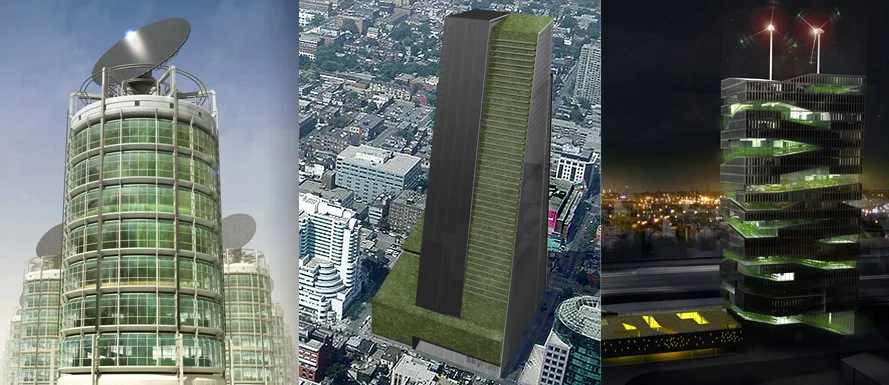
Vertical farm designs by Chris Jacobs, Gordon Graff, SOA Architectes
(Updated October 17, 2011)
Dr. Dickson Despommier laughs when he recalls how crazy people thought he was just a few years ago. But Despommier, the most passionate proponent of vertical farming—the growing of crops indoors in multi-story urban buildings—is now seeing his vision being realized. He believes vertical farming can help feed the growing global population and undo the environmental damage caused by conventional agriculture.
“Farming has upset more ecological processes than anything else—it’s the most destructive process on earth,” Despommier told me. As of 2008, 37.7 percent of global land and 45 percent of U.S. land was used for agriculture. The encroachment of humans into wild land has resulted in the spread of infectious disease, the loss of biodiversity and the disruption of ecosystems. Over-cultivation and poor soil management has led to the degradation of global agricultural lands. The millions of tons of toxic pesticides used each year contaminate surface waters and groundwater, and endanger wildlife.
Agriculture is responsible for 15 percent of global greenhouse gas emissions, and accounts for one-fifth of U.S. fossil fuel use, mainly to run farm equipment, transport food and produce fertilizer. As excess fertilizer washes into rivers, streams and oceans, it can cause eutrophication: Algae blooms proliferate; when they die, they are consumed by microbes, which use up all the oxygen in the water; the result is a dead zone that kills all aquatic life. As of 2008, there were 405 dead zones around the world.
More than two-thirds of the world’s fresh water is used for agriculture. And around the world, farmers are losing the battle for water for their crops as scarce water resources are increasingly being diverted to expanding cities. As climate change brings warmer temperatures and more droughts, the water crisis will worsen.
To feed the growing and increasingly urban global population of 9 billion expected by 2050, we need to boost food production by 70 percent through higher crop yields and expanded cultivation. The FAO estimates that we will need nearly 300 million more acres of arable land to do this, but most of the remaining arable land lies in developing countries, and many of the available land and water resources are currently providing other important ecosystem functions. Pressing them into service to produce food will upset many more of the planet’s ecosystems.
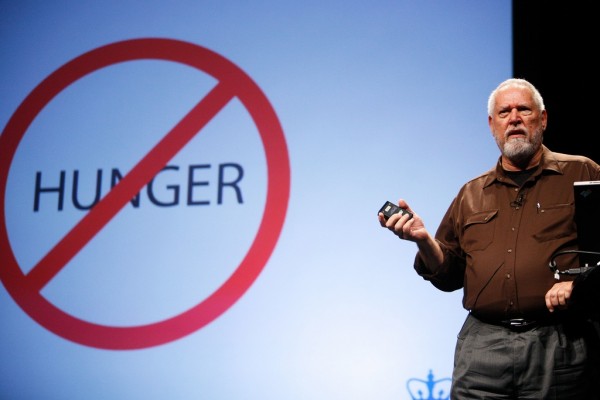
Dickson Despommier.
In 1999, while exploring the negative impacts of agriculture, Despommier, a professor of environmental health sciences at Columbia University’s Mailman School of Public Health, and 105 graduate students came up with the concept of the vertical farm—a multi-story building growing layers of crops on each floor. Vertical farm crops can be grown using hydroponics, where plants grow in water or a growing medium with nutrients delivered directly to their roots; aeroponics, which uses a mist to deliver nutrients to plant roots; aquaponics, when fish are raised concurrently and their waste is used as nutrients for crops; or even in soil if the building is designed accordingly.
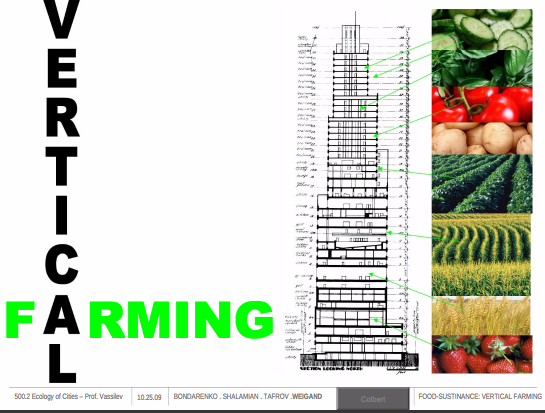
At present, lettuce, leafy greens, herbs, strawberries and cucumbers are the most commonly grown crops in vertical farms, but in theory, corn and wheat could be grown, as well as biofuel crops and plants used to make drugs. Hydroponics use 70 percent less water than conventional agriculture; aeroponics use even less; and all water and nutrients not taken up by the plants are recycled.

LED lights. Photo credit: John Abela
Climate controls and LED lights programmed to deliver the wavelengths of light that plants prefer create optimum growing conditions. Methane generated from restaurant or crop waste can supply energy and heat for vertical farms.
As a balanced mini-ecosystem, the vertical farm has many advantages. A vertically farmed acre can produce the equivalent of 4 to 6 soil-based acres, depending on the crop (for strawberries, 1 vertical farm acre produces the same amount as 30 outdoor acres). Plants can be grown year-round, unaffected by weather conditions such as droughts, floods or pests. Vertically farmed food is safe from contamination(for example, from e-coli or radiation), and is grown sustainably and organically without the use of fertilizer, pesticides or herbicides.
Fossil fuel use is minimal because there’s no need for farm equipment, transportation of produce into cities, storage or distribution. Unused urban buildings can be revamped as sustainable centers providing healthy food in neighborhoods where fresh produce is scarce, and also creating new job opportunities. In war or disaster zones or refugee camps, modular vertical farms could provide much needed fresh produce. And if vertical farms were implemented on a large scale, we might one day be able to reclaim farmland and restore our soil, forests and ecosystems. Without fertilizer runoff, coastal waters could be revitalized and our fisheries might once again flourish.
Some skeptics have said that the amount of electricity that would be needed to replace sunlight in vertical farms would be prohibitively expensive and unachievable. But Despommier counters that the cost of LED lighting is offset by savings from the elimination of fossil fuel use in fertilizer, transport, storage and distribution, as well as from less spoilage and waste. This, however, remains to be proven, since no one has yet done a life cycle cost comparison between vertical farm-grown crops and those produced conventionally.
Another criticism, no doubt in response to early designs of futuristic vertical farms towering over a city, is that the steep capital investment needed is prohibitive and doesn’t make economic sense. Despommier himself acknowledges that integrating multiple stories of crop growing presents engineering issues that need to be solved. But why do vertical farms have to be in skycrapers?
One year ago, no vertical farms existed. Today the modestly sized vertical farms springing up around the world are proving the skeptics wrong.
Kyoto, Japan’s Nuvege is growing a variety of lettuces in a 30,000-square-foot hydroponic facility with 57,000 square feet of vertical growing space. Amidst fears of radiation contamination from the Fukushima nuclear plant, Nuvege can tout the safety and cleanliness of its crop. Over 70 percent of its produce is already being sold to supermarkets, with 30 percent going to food service clients such as Subway and Disney.
PlantLab in Den Bosch, Holland, is constructing a three-story underground vertical farm that completely eliminates the wave lengths of sunlight that inhibit plant growth. With the latest LED technology, PlantLab can adjust the light composition and intensity to the exact needs of the specific crop. The room temperature, root temperature, humidity, CO2, light intensity, light color, air velocity, irrigation and nutritional value all can be regulated. PlantLab claims it can achieve a yield three times the amount of an average greenhouse’s while using almost 90 percent less water than traditional agriculture.
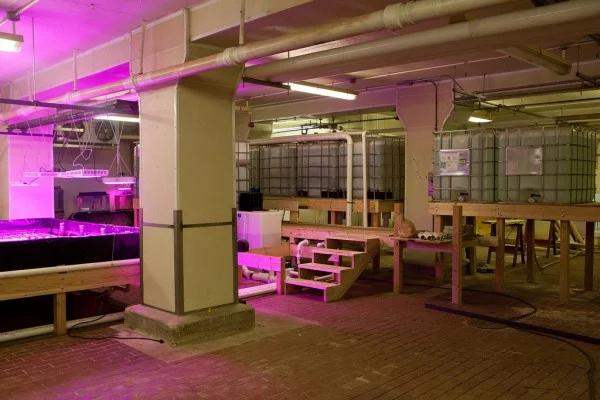
Growbeds and fish tanks in The Plant. Photo credit: Plant Chicago
In the U.S., a dilapidated 93,500-square-foot former meatpacking facility in Chicago is being transformed into a net-zero aquaponic and hydroponic vertical farm. The Plant will also include an artisanal brewery, kombucha brewery, mushroom farm and bakery. Waste from the food businesses will be used to generate methane in an anaerobic digester, which will produce enough steam and electricity to meet the full energy needs of the facility.
In Seattle, ecological designer Dan Albert and his wife run a 100-square-foot, two-level vertical farm called Civesca (the name is due to change) in a simple warehouse. They will begin selling their aeroponically grown salad greens, mustard greens, and kale to a few local restaurants on Nov. 1.
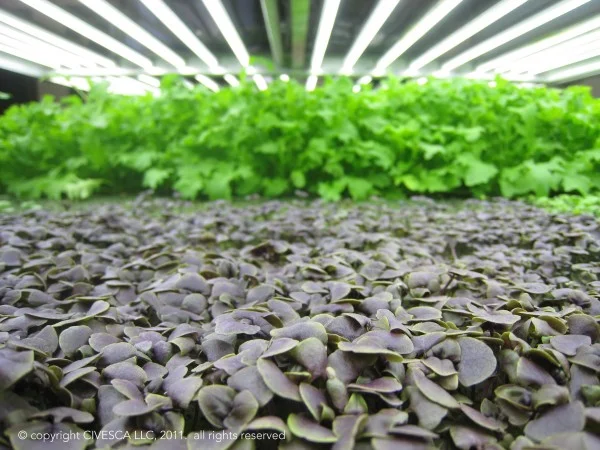
Purple basil and mizuna growing in Civesca.
Albert gives high praise to his aeroponics technology, created by Ithaca, NY-based AeroFarms. The modular system incorporates aeroponics, programmable LED lights, climate controls, and a proprietary horizontal cloth conveyor that takes the plants from seed to harvest. AeroFarms says its customizable system increases yield up to 60 times that of conventional agriculture, uses 80 percent less water than hydroponic systems and only 3 percent of the land required by conventional agriculture.
In New York City, Big Box Farms is a hybrid vertical farm, growing salad greens inside a one-story industrial warehouse. It stacks plants between 10 and 20 layers high, up to 20 feet high, and uses a proprietary controlled and automated environment and harvesting system that employs LED lights, hydroponics, and 5 percent of the water used by conventional agriculture. The farms will be built right next to food suppliers and distributors to provide them with “private label,” just-harvested products.
About 3 million New Yorkers have no access to supermarkets or fresh produce in their neighborhoods. Vertical farms and other types of urban farming could help low-income residents shop and eat more healthfully. Despommier was a core member of the Earth’s Institute’s Urban Design Lab, whose fall 2003 Urban Ecology Studio project on remediating the Gowanus Canal in Brooklyn produced the first concrete vertical farm design (called Agro-wanus by Andrew Kranis) based on his ideas. The Urban Design Lab recently published a report examining New York City’s capacity for urban agriculture, ranging from community gardens to rooftop greenhouses.
Kubi Ackerman, project manager at the lab, told me that the report focuses on “existing” and “shorter-term” solutions, only mentioning vertical farms in passing, “But I’m a fan of Dickson Despommier’s. His work is interesting and there’s real value in having that vision out there to grow the discussion.”
And the discussion is indeed growing. Vertical farms are also being constructed in Manchester, England and Milwaukee, WI. And there is interest around the world—from Newark, NJ to Beijing, China, and in Singapore, Doha, Vancouver, Milan, Amman, Riyadh and Las Vegas. As more vertical farms are created, the engineering and technology will continue to evolve. And one day, NYC may well have vertical farms of all sizes in every borough, providing fresh produce to retailers, restaurants, and community residents. I think it’s only a matter of time…
By Renee Cho