
Welcome to iGrow News, Your Source for the World of Indoor Vertical Farming

The Future of Food
The Future of Food
MARCH 20, 2017 18:06
From computer-monitored growing chambers and vertical farms to superfoods, the increasing needs of a burgeoning population have led to technology-fuelled innovations in agriculture
If history is to be believed, the plow and seeder were invented by the Mesopotamian civilisation in 3000 BC. In 2017, if you do a Google search on technology used in farming, the results would display similar tools, with the exception of the innovations of the last century.
How does limited evolution in farming technologies fare against the challenge of feeding a population this world has never seen before? In the late 1950s, when serious food shortages occurred in developing nations across the world, efforts were made to improve the growth of major grain crops like wheat, rice and corn, by creating hybrid grains that responded well to the application of fertilisers and pesticides. This meant, especially for countries in Asia, high yields per hectare. However, the repercussions of ever-increasing use of chemicals are now visible, with many diseases being traced back to the use of chemically-grown food. A technology that was supposed to help feed the growing world has proven to be more hindrance than help. Today, more people are moving towards organic produce, but the question remains – how do we connect growing more and better with healthy and organic?
At a TED Talk in December 2015, Caleb Harper, Principal Investigator and Director of Open Agriculture Initiative at MIT Media Lab, gave a peek into the future of urban agricultural systems.
His team has created a food computer, a controlled-environment agriculture technology platform that uses robotic systems to control and monitor climate, energy, and plant growth inside a specialised growing chamber. Climate variables such as carbon dioxide, air temperature, humidity, dissolved oxygen, potential hydrogen, electrical conductivity, and root-zone temperature are among the many conditions that can be controlled and monitored within the growing chamber. While the food computer remains a research project at the moment, there are companies using technology in their current food-growing ecosystems.
Japan has been experimenting with Sandponics, a unique cultivation system that uses no soil, only sunlight and greenhouse facilities.
A small section of sand is supplied with a mix of essential nutrients, and in some cases, the same section of sand has been in use for over three decades. The first systems were developed in the 1970s and are still evolving today. They have proved to be not just efficient, but affordable and scalable too.
The 750-square-kilometre island of Singapore, feeds a population of five million by importing more than 90% of its requirement. With available farmland being low, the only way to grow food is to go vertical. This is where vertical farms and farming entrepreneurs and companies such as Sky Greens have come up with innovative solutions that are not resource-intensive.
India initiatives
India isn’t far behind in exploring urban farms either. Chennai-based Future Farms, Jaipur-based Hamari Krishi and a few others are bringing the urban farm revolution to India.
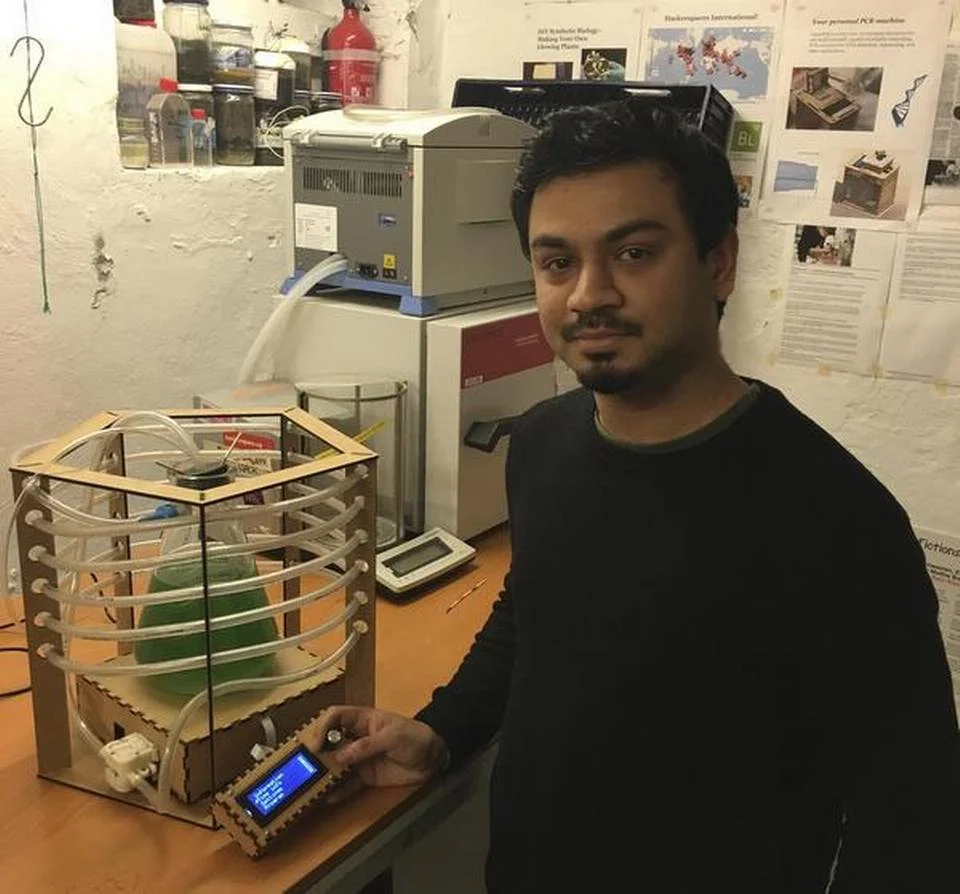
Most of the above technologies will help increase the yield in terms of quantities, but what about the nutrient value? Around the world, companies and researchers are spending time to find the next superfoods, something that our species might not be able to survive without. While some might think cricket (yes, the insect) flour is too extreme, there are those who consume it. Keenan Pinto, an engineer with a background in molecular biology and biotech, has created a bio-reactor for micro-algae after hearing that Spirulina could hold the key to fighting malnutrition. Companies such as Soylent (USA) and Onemeal (Denmark) have been making highly-engineered minimalist food powered by micro-algae, that only need water to make a liquid meal with 20% of daily nutritional value of a person.
NASA’s data has already shown evidence of drastically depleting groundwater resources in North India, and Pinto believes this makes initiatives like the Soil Health Card (a scheme launched by the Government under which farm soil is analysed and crop, nutrient and fertiliser recommendations are given to farmers in the form of a card) the need of the hour.
In the past two years, the image of agriculture and farming technologies has changed from a sickle and plough to computers and vertical farms.
As need grows, our food systems are destined to evolve, and it is our job to evolve with them.
Plant Based Foods Association Celebrates One-Year Anniversary at Expo West
Plant Based Foods Association Celebrates One-Year Anniversary at Expo West
March 18, 2017/0 Comments/in Miscellaneous, News /by Michele Simon
Since our launch at Natural Products Expo West 2016, we have been amplifying our collective voice for our member companies. Our return to Natural Products Expo West in 2017 marked our one-year anniversary and gave us the opportunity to look back on our successes and spend some quality time with our members.
Panel: Why Plant Based Foods Are Good for Your Business & the Planet
We loved putting together this panel featuring the best in our industry: Mo George-Payette, CEO of Mother’s Market, Lisa Feria, CEO of Stray Dog Capital, Aubry Walch, co-founder of the Herbivorous Butcher and our very own Executive Director Michele Simon as moderator.
Simon started things off by comparing the environmental impacts of plant-based foods with their animal-based counterparts to drive home the point that switching to more plant-based foods is an effective way to protect our planet.
Simon then presented recent data from SPINS to illustrate the rising sales of plant-based foods, which top total revenues of $5 billion annually. She finished with a discussion of the Dairy Pride Act and our strategic response to this attack on our members.
Mo George-Payette of Mother’s Market reflected on the rise of plant-based options throughout her years in the natural foods industry. “We can remember back to when it was only tofu,” she remarked. She also noted the importance of product placement for plant-based foods, and the rise of flexitarians in boosting sales.
Aubry Walch, co-founder of The Herbivorous Butcher, (PBFA member) discussed her company’s decision to not “dance around terms” and instead use the names consumers are used to seeing in an ordinary butcher shop. This approach is a natural extension of their effort “to bridge a gap between omnivores and the plant-based world.”
Lisa Feria, CEO of Stray Dog Capital, (PBFA sponsor) discussed how fueling companies and services that promote plant-based diets is an effective way to help animals. Feria also highlighted the importance of supporting women in the business world, suggesting that we “pull up as we go up.”
You can watch this panel on The Herbivorous Butcher’s Facebook page here.
Panel: Eating Animals
On Saturday, our ED Michele Simon participated in the Eating Animals panel, featuring David Bronner, CEO of Dr. Bronner’s, (PBFA sponsor) Aaron Gross, CEO of Farm Forward, and Leah Garcés, director of Compassion in World Farming, as moderator. Simon discussed the challenges faced by plant-based companies when competing with subsidized animal agriculture and emphasized how everyone can support plant-based companies by voicing their opinions to their political representatives.
You can watch Michele Simon’s segment of this panel on PBFA’s Facebook page here.
Panel: Eating Animals
On Saturday, as the trade show floor came to a close, it was time to celebrate all we have accomplished in this past year. An astounding 400 of our plant-based allies attended our celebration, creating a palpable energy in the room as they chatted and snacked on supreme pizza and strawberry cheesecake generously donated by founding board member Daiya Foods. We are also grateful for our additional generous event sponsors who made our reception possible: Follow Your Heart, Miyoko’s Kitchen, Tofurky, Upton’s Naturals, PlantBased Solutions, Nutpods, and Natural/Specialty Sales.
PBFA board president and Tofurky CEO Jaime Athos introduced our ED Michele Simon who addressed the bustling crowd. Simon drew attention to PBFA’s successes over the past year. Growing from 22 founding members to 80 members and 55 affiliates in PBFA’s first year alone shows the excitement within our industry. “The energy in this room shows that we are stronger together,” said Simon. “It truly takes a plant-based village to make this all happen.”
You can watch Simon’s speech on PBFA’s Facebook page here, and view our photos from Expo West on PBFA’s Facebook page here.
Jill Ettinger of Organic Authority covered the explosion (and our reception!) of plant-based foods in her article: “Natural Products Expo Breaks Attendance Records as Plant-Based Foods Chart New Course for Industry.”
We had a great time at Expo West and look forward to returning again next year.

Panelists, from left to right: Michele Simon, Mo George-Payette, Aubry Walch, and Lisa Feria.

PBFA board member Miyoko Schinner, founder and CEO of Miyoko’s Kitchen, chats with guests.
Urban Agriculture Director Brings Fresh Produce To Those In Need
Urban Agriculture Director Brings Fresh Produce To Those In Need
Battling food deserts with community gardens, farmers markets.
By Andrew Alexander - For the AJC
Posted: 5:16 p.m. Thursday, March 16, 2017
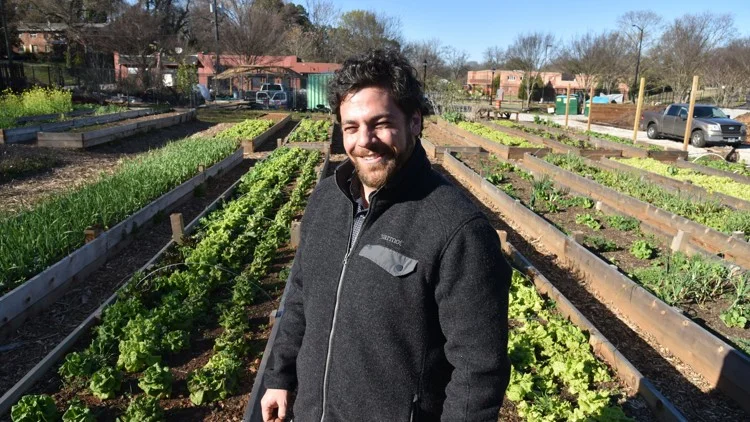
At first glance, the urban Atlanta neighborhood of Washington Park doesn’t seem a likely place for an organic farm. But at the corner of Lawton Street and Westview Drive in west Atlanta, the non-profit organization Truly Living Well’s new Collegetown Garden brims with organic cabbages, kale, turnips, beets, carrots and more, all thriving in tidy rows of planter boxes. Pear, plum and apple trees blossom radiantly in the early spring sun, and a busy hive of honeybees buzzes away nearby.
“This can really be a lighthouse for nutrition for this neighborhood,” says Mario Cambardella, the City of Atlanta’s first director of urban agriculture. Some might zero in on the signs of urban neglect and decay just outside the garden gates, but Cambardella is quick to point out the historic homes, the nearby elementary school and, on a street-facing the end of Truly Living Well’s new garden, the site of a future farmers’ market for the food being grown there.
“This is really building the local food economy. Urban agriculture can really transform a community.”
Cambardella was hired by the Mayor’s Office of Sustainability in 2015 to help guide projects like the Collegetown Garden to success. In the new position, Cambardella is responsible for a wide range of activities related to urban agriculture in the city, including agricultural policy development. He cultivates partnerships with local non-profits like Truly Living Well and also assists individuals and organizations in navigating the often byzantine process of permitting and zoning related to starting their urban agriculture projects.
“Urban agriculture is relatively new to this generation of constituents, so having a point person for all these different issues is a much-needed service,” he says. “People have been asking for help getting through the process. I like to think I’m creating the most efficient means to get that community garden growing as fast as it can.”
His daily work can encompass anything from helping an individual place a planned garden’s water meter to permitting a future farmers’ market.
“We want to empower what constituents do,” he says. “It’s one of the aspects of my job I love. It’s not about what program I can start, it’s about the programs I can help.”
For Cambardella, gardening and community are both part of a long family tradition. Cambardella’s grandfather hails from Italy in a small farming community south of Naples. As Cambardella tells it, his grandfather’s first attempt to come to the United States — travelling independently and working in the coal mines of Pennsylvania — was a disaster. His grandfather went back to his home country after just nine months, but returned a few years later with a new wife and other families from his village and settled in Brooklyn in the 1930s. Together, the community successfully created small gardens and relied on each other, much as they had in Italy.
“My father still remembers having to turn the compost and cover the fruit trees in winter to keep them warm,” Cambardella says. “They made it through some of the roughest times in America. When you have this network supporting each other, it can show what sustainability really means.”
His mother’s side of the family comes from Texas and likewise honored a long tradition of living off the land. “That heritage got passed down to me,” he says. “I always had it in me to scratch a little earth and see if I could grow something.”
Cambardella grew up in Sandy Springs and attended Riverwood High School. He majored in Landscape Architecture at the University of Georgia and then went on to get master’s degrees in landscape architecture and environmental planning and design at UGA, as well. In 2012, he co-founded an Atlanta-based business, Urban Agriculture Inc., that provides planning, design and construction management of food-producing landscapes for commercial, municipal and residential clients. He signed on as the City of Atlanta’s first director of urban agriculture in December 2015, and currently lives in Chamblee with Lindsey, his wife of four years.
Many of the things he’s been working on speak to Atlanta’s potential to lead the way in the realm of innovative urban agriculture. Some of his pet projects include helping Georgia Power explore the idea of using the land under power-line easements for high-level urban agriculture and developing a potential food forest in southeast Atlanta on the site of a former farm now surrounded by urban development.
One goal is to transform Atlanta’s urban food deserts by bringing local, healthy food within a half-mile of 75 percent of all residents by 2020. “I have to show up everyday and give 110 percent,” says Cambardella. “I have to be looking toward 2020. That’s a goal worthy of working toward.”
And in the end, for him, urban agriculture is about far more than just food. “If we can fuel this type of activity, we can really build up points of access,” he says. “And it’s about more than just lettuce. It’s the eyes on the street, it’s the kids coming to play and learn, it’s all these forces for good that create growth and cultural understanding. What’s coming out of the ground has so much value.”
Five of Brooklyn's Most Innovative Urban Farms
It may be a cliché to lament the loss of farms in New York City. These five Brooklyn-based urban farms, mostly co-founded by former Wall Street professionals, are using the most creative and entrepreneurial techniques, from aquaponics to vertical growing, to bring fresh, locally grown produce to New Yorkers.
FIVE OF BROOKLYN'S MOST INNOVATIVE URBAN FARMS
New YorkSustainability Mar 16, 2017 Kouichi Shirayanagi, Bisnow
It may be a cliché to lament the loss of farms in New York City. These five Brooklyn-based urban farms, mostly co-founded by former Wall Street professionals, are using the most creative and entrepreneurial techniques, from aquaponics to vertical growing, to bring fresh, locally grown produce to New Yorkers. Beyond the health benefits of eating fresher produce, locally grown food benefits the environment by cutting out the need to transport and preserve perishable fruits and vegetables, which can take more than a week to get from the farm to a New York City dinner plate.
Gotham Greens Location: 810 Humboldt St., Greenpoint Co-founded in 2009 by a sustainable development manager and an ex-JP Morgan Chase private equity fund manager, Gotham Greens produces organic leafy greens, lettuces and tomatoes from the tops of buildings in Greenpoint and Gowanus as well as in Hollis, Queens. Early in the business, partners Viraj Puri and Eric Haley developed a relationship with Whole Foods to distribute their produce. In 2013, Gotham Greens built a 20K SF greenhouse on the roof of the Whole Foods store in Gowanus. The project marked the first time a greenhouse integrated with a major grocery store. The first Gotham Greens greenhouse, built in 2009 in Greenpoint, is 15K SF and produces 100,000 pounds of produce a year.
Red Hook Community Farm Location: 560 Columbia St. and 30 Wolcott St., Red Hook Managed by environmental educator Saara Nafici, Red Hook Community Farm produces more than 20,000 pounds of produce a year from two Brooklyn sites. The 120K SF farm on Columbia Street uses ground compost two-feet deep to create a diverse environment of microorganisms and insects that nourish the produce. Red Hook Community Farm also built a 48K SF site on Wolcott Street in collaboration with the New York Housing Authority. Members of Green City Force, an AmeriCorps program, maintain the farm. The organization maintains a Saturday farmers market at the Columbia Street site between June and November to sell the farm's produce.
Eagle Street Rooftop Farm Location: 44 Eagle St., Greenpoint Managed by educator and journalist Annie Novak, the Eagle Street Rooftop Farm occupies 6K SF on top of a warehouse in Greenpoint. The farm grows a wide variety of vegetables, spices and greens, including hot peppers, eggplants, sage, parsley, cilantro and dill. Novak sells produce from the farm at an on-site Sunday farmers market.
Brooklyn Grange Location: McGolrick Park, Greenpoint Co-founded by former E*Trade Financial consultant Ben Flanner and longtime sustainable food advocate Gwen Schantz, Brooklyn Grange grows over 50,000 pounds of produce per year in over 87K SF on two rooftops, one in Brooklyn and one in Queens. The Brooklyn Grange education program brings 17,000 New York City youths each season for tours through their farms. The organization is supported by a produce share program in which members subscribe to weekly deliveries of fresh produce. The farm grows a variety of produce, including from salad greens, mix herbs, eggplants, chard, carrots, peppers and flowers.
Square Roots Location: 630 Flushing Ave., Sumner Houses Square Roots operates vertical farms from shipping containers. Specializing in greens and herbs, the indoor growing process allows for year-round growing using 80% less water from traditional outdoor farms. Like Brooklyn Grange, Square Roots is funded by a food-share program where members can buy in $7, $15 and $35 per week packages. The working collective also has an active, year-round events business.

McNamara: “To Fix The Food System, Move It Back Into The Hands of More People”
Brad McNamara, CEO and co-founder of Freight Farms, is speaking at the inaugural Boston Food Tank Summit, “Investing in Discovery,” which will be held in collaboration with Tufts University and Oxfam America on April 1, 2017.
Brad McNamara, CEO and co-founder of Freight Farms, is speaking at the inaugural Boston Food Tank Summit, “Investing in Discovery,” which will be held in collaboration with Tufts University and Oxfam America on April 1, 2017.
Freight Farms is an agriculture technology company that provides physical and digital solutions for creating local produce ecosystems on a global scale. Brad and his co-founder, Jon Friedman, developed the company’s flagship product, the Leafy Green Machine, to allow any business to grow a high-volume of fresh produce in any environment regardless of the climate. His hope is for Freight Farms to be scattered across the globe making a dramatic impact on how food is produced.
Food Tank had the chance to speak to Brad about his work developing Freight Farms and his vision for the future of our food system.
Brad McNamara, CEO and co-founder of Freight Farms, is speaking at the inaugural Boston Food Tank Summit, “Investing in Discovery.”
Food Tank (FT): What originally inspired you to get involved in your work?
Brad McNamara (BM): It was a coming together of many different factors. My co-founder, Jon, and I had worked together in the past, and we were both intrigued by the food system and how we could make a difference. Around 2009, Jon was focused on food systems and system design, and I was passionate about the purity of food and the increasing trend towards food awareness. When the two of us first reconnected over a cup of coffee (and then a beer), we got to talking about the complexity of the food system and what we could do to combine our interests. With backgrounds in design and environmental science, our goal was to research methods to allow urban agriculture to emerge as a competitive industry in food production. We mainly focused on rooftop development, then determined the criteria for success and scale to be outside the realm of possibility with agricultural installations that were already in existence. When costs and logistics soared, we turned to shipping containers (there’s Jon’s design background coming into play), and the idea for Freight Farms took off with the goal to build farms in areas that couldn’t support more traditional methods.
FT: What makes you continue to want to be involved in this kind of work?
BM: Our world and our climate are changing, and it is so apparent that there is more work to be done. According to the U.N., food production needs to increase 70 percent by 2050, to feed an ever-urbanizing population. Land and water scarcity take on even more pressing importance, as does urban agriculture. The future is so much bigger and more complex than we could have ever imagined. Over the past few years, we’ve gotten to witness the emergence of a new industry of agriculture technology, and it’s poised to make a dramatic impact on the food system. One of the most amazing things we’ve been able to watch is how many are interested in joining the movement towards a better future. Our network of freight farmers are making dramatic impacts on their local food systems every day, drastically improving food security in their community. They inspire all of us to continue this work.
FT: Can you share a story about a food hero who has inspired you?
BM: My food hero is a customer of ours. His name is Ted Katsiroubas, and he runs Katsiroubas Bros. Fruit and Produce, a wholesale produce distribution company located in the heart of the city of Boston. The business is over 100 years old and was handed down from generations before. I admire how Ted has innovated in the face of a dramatically changing food landscape. As the demand for local, fresh produce has risen, the company expanded to begin working with local farms in the region to meet demand. For those familiar with wholesale distribution, sourcing locally can be a difficult task especially when you are restricted by the growing seasons and volume constraints of small local farmers. That’s why traditionally wholesale distributors rely on shipping produce long distances from warmer climates. But Ted brings a fresh approach to an old school industry. He continues to push the envelope and propel the industry to stay on top of the latest technology through collaboration with other distributors. If anyone were to fall into the category of my food hero, it would be Ted because of his willingness to look to the future and go against the conventional wisdom of how the food industry tells him to conform.
FT: What do you see as the biggest opportunity for fix the food system?
BM: I think the biggest opportunity to fix the food system is to bring it back into the hands of the people. By transitioning to a more decentralized food system, and minimizing the gap between consumers and producers, we will take a critical step towards an environmentally and economically sustainable food system. I think all the various types of technology, the hardware, the software, and the social awareness, all point in the direction to empower the individual. So the real opportunity to fix the system is to utilize what we know to be true—when you give opportunity and power to regular people from all walks of life, that’s when you can change a whole system.
FT: What would you say is the most pressing issue in food and agriculture that you would like to see solved?
BM: There are so many people advocating for a better food system, and we all must be better at communicating and cooperating if we want to make an organized effort to challenge the way things operate currently. From small farmers and producers to organizations and companies. What has become incredibly apparent in the past couple decades is that there is no one size fits all solution. Whether it’s urban or indoor agriculture, hydroponics, aeroponics, aquaponics, or traditional soil-based farming, we all play an important role. We need to have a more holistic view of the food system and how each method can contribute to a better future. If we don’t all work together, it’s going to be difficult to disrupt BigAg. I think taking a broader view is key. There has been so much progress made in agriculture, but we still have a long way to go to create a food system that will serve future generations. It is important to continue working with and connecting with each other to empower and support the next generation of farmers.
FT: What is one small change everyone can make in their daily lives to make a difference?
BM: Maybe it is a bit cliché, but the notion of voting with your dollars. I’m sure others have said it, but it is so important. If every consumer changed 5 percent of their food shopping habits by buying more seasonal and local produce, the impact would be enormous in changing the landscape of the local grocery store.
FT: What advice can you give to President Trump and the U.S. Congress on food and agriculture?
BM: My advice is to be conscious of all the complexities present within the food and agriculture system. There are so many moving pieces that small shifts in the workforce, water use, and the climate have a massive impact throughout the entire system. It is essential to keep a holistic understanding of the relationships between all the components in our food and agricultural system and to consider the ripple effect policy decisions will have on the smaller players involved.
Click here to purchase tickets to Food Tank’s inaugural Boston Summit.
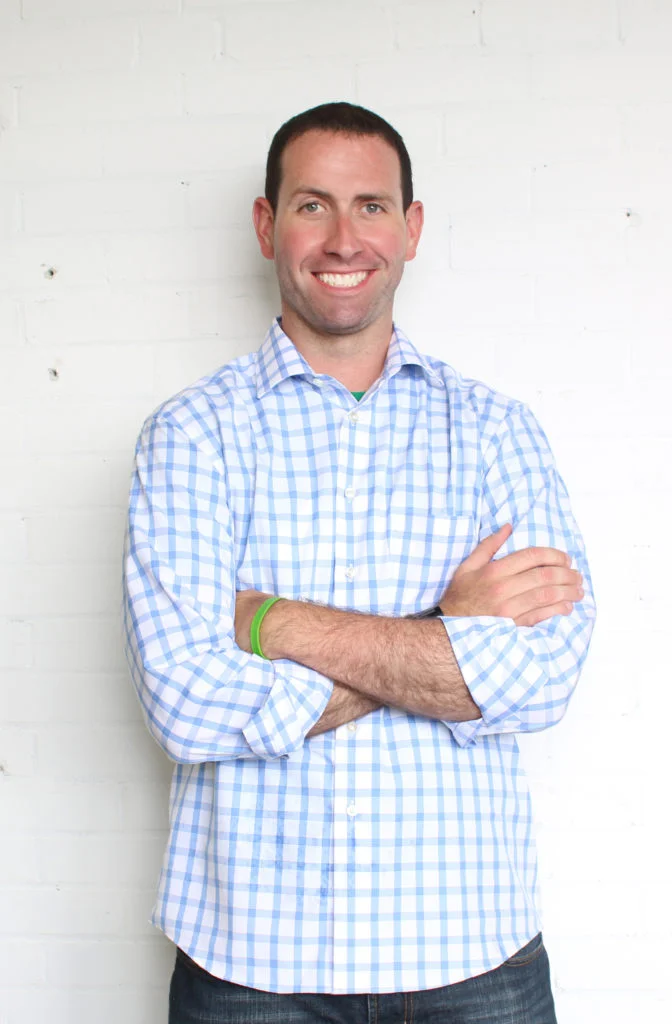
Brad McNamara, CEO and co-founder of Freight Farms, is speaking at the inaugural Boston Food Tank Summit, “Investing in Discovery.”

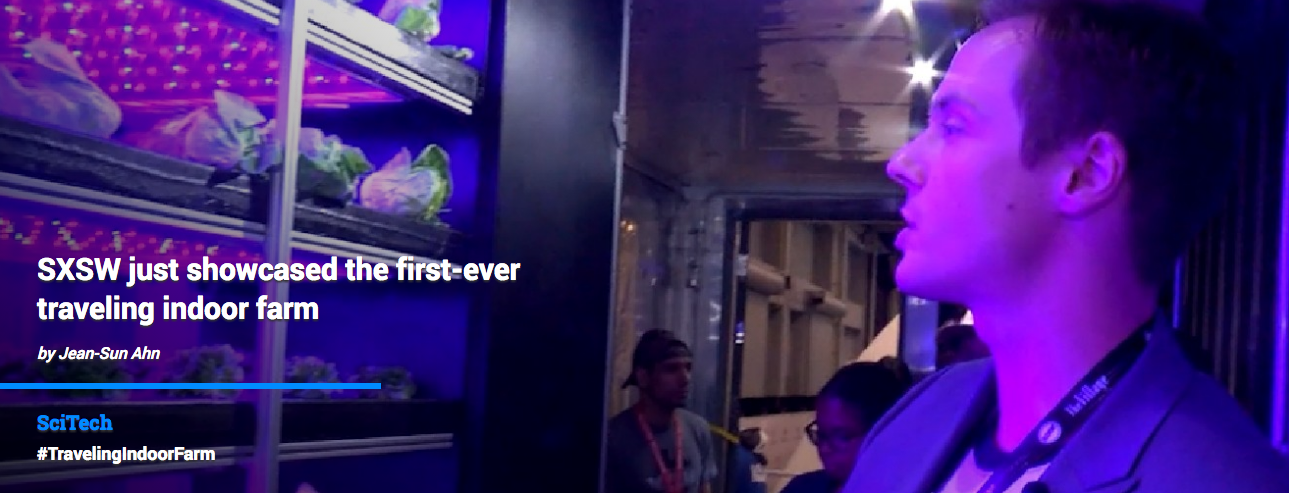
SXSW Just Showcased The First-Ever Traveling Indoor Farm
SXSW Just Showcased The First-Ever Traveling Indoor Farm
March 16, 2017
Each year some of the most imaginative and innovative minds from all over the world gather at South by Southwest (SXSW) in Austin, Texas. The first-ever traveling indoor farm was presented this week.
The SXSW trade show offers exhibitions that range from promising startups to well-established global corporations, affiliate KEYE reported. Companies from across the world descend on Austin to display their products in hopes of catching the eye of an investor, networking or just showing what they have to offer.
Local Roots has created a traveling indoor farm that uses a scalable, proprietary growing system that promises to provide "predictable production and quality."
"We have a circulating irrigation system and we recapture all of the water that flows through the system to reduce our water consumption down just what the plant needs to be able to grow," said founder and CEO of Local Roots Eric Ellestad.
Ellestad said his company is proof that technology is needed everywhere.
"The root zone lives down in the irrigation system drinking its nutrient-filled water day in and day out," Ellestad said.
Local Roots compares their technique almost the same as outdoor farming since they are using the same seeds, nutrients, minerals and light to activate photosynthesis. The major differences are that the light is supported by LED lights instead of the sun. The soil has also been removed in order for plants to be able to collect dissolved nutrients in the water.
The California-based company promises that their plants grow twice as fast and plants grow with much higher nutrient densities.
This Bronx Distribution Hub Could Help Local Farmers Reach More Tables
This Bronx Distribution Hub Could Help Local Farmers Reach More Tables
GrowNYC's Marcel Van Ooyen is working to launch a 75,000-square-foot food distribution hub in Hunts Point
By Cara Eisenpress
Van Ooyen wants to serve local and midsize farmers in the state.
The popularity of farm-to-table eating has created demand in the city for a local farmers’ wholesale market. Gov. Andrew Cuomo in August committed $20 million to fund a 75,000-square-foot food-distribution hub in Hunts Point and chose GrowNYC to develop and operate it. The 40-year-old nonprofit runs farmers’ markets and community gardens as well as recycling, composting and education programs. The Bronx distribution hub is the biggest project Marcel Van Ooyen has taken on in his 10 years as GrowNYC’s head. He said he hopes it will open in early 2019.
What's the purpose of the hub, and how will it work?
The hub will source, aggregate and distribute locally grown produce to food-access programs and like-minded restaurants and retail outlets. We anticipate well over 100 farmers will benefit. Farmers who grow for the wholesale markets will deliver large quantities to us. We'll break it up and distribute to public and private buyers. We'll have additional space for farmers to store food, and eventually light processing.
Why build it?
Ninety-eight percent of what we eat comes through wholesale channels. The current hub for local farmers is only 5,000 square feet, so we will replace it to serve more of them.
The limiting factors to supporting local, midsize farmers are having the infrastructure for them to drop produce off and us to deliver it and to be able to pay them a real return on what they're growing. It's difficult for these farmers to compete with the huge farms in California.
So how do you pay farmers a real return?
We let them set the price. By being a nonprofit and not trying to make any money other than [to cover] our operating costs, GrowNYC is able to even the playing field.
How do you get fresh, local food to underserved New Yorkers?
We worked with the Department of Health to create Healthy Bucks, a food stamp incentive program that has become a national model. Through our programs, like Youthmarket, we can distribute in areas that haven't been traditionally served. The same kale that is going into Gramercy Tavern is at a farm stand run by teens in Brownsville, Brooklyn, on the same day.
Is the obsession with farm-to-table more than a trend?
It's the last frontier for environmentalism. We spend millions of dollars protecting the watershed around New York City and building the infrastructure to keep water clean and safe and deliver it to everyone at a reasonable price. We spend a lot of time regulating the air. But food is something we've left to private industry.
Is there enough local food to serve restaurants that say their food is local?
Consumers have to be skeptical and ask. We need to make sure that people are living up to their promises. With more local wholesale, the issue of "faux-cal" may disappear because there's access to that product on a consistent basis.
What does the White House's environmental position mean for the city?
Cities have been the innovators in fighting global climate change. As a citywide organization, we provide an outlet to create change in communities even if they can't get it on a federal level. You're not going to be worried about Trump's tweets while you're shopping in a Greenmarket. Hopefully, you're thinking good thoughts.

Van Ooyen wants to serve local and midsize farmers in the state

Mother Nature Gives Indoor Farms A Boost
Mother Nature Gives Indoor Farms A Boost
By Tom Karst March 14, 2017 | 10:00 am EDT
Tom Karst, national editor
There are times that Mother Nature is just too darn unpredictable.
When everything goes without a hitch, the U.S. typically has an abundant supply of vegetables. But throw in rainy weather, delays that move back planting and harvesting, and all of a sudden you have a case of panicky buyers who are keen to look for more predictable and nearby sources of supply.
Retailers and consumers in the United Kingdom in February suffered a shock when rains in Spain caused some stores to ration their supply of greens. Some California companies saw an opportunity and shipped lettuce to the U.K.
Now it’s California facing rain-related production problems. The Packer has covered the gaps in vegetable supply in California, and various marketers predict it will get worse before it gets better. The rains that brought relief to the Golden State could give buyers a roller coaster ride later this spring.
In the context of these issues, we are reminded of the conviction that one region’s disaster is an opportunity for someone else.
The Packer’s Ashley Nickle covers the issue this week in a story that reports indoor farms are seeing increased demand as weather-related production issues in Arizona and California have affected the supply of leafy greens.
Nickle reports New York, N.Y.-based BrightFarms, which has greenhouses in Illinois, Virginia and Pennsylvania, has seen retail orders rise in recent weeks.
Likewise, Buffalo, Mich.-based Green Spirit Farms and Portage, Ind.-based Green Sense Farms reported a jump in interest because of supply glitches in the West.
The latest supply disruption helps make the case for indoor farming operations.
The rains that brought relief to the Golden State could give buyers a roller coaster ride later this spring.
I recently visited with Paul Lightfoot, CEO of BrightFarms about this issue. He said leafy greens buyers are looking for locally sourced and stable leafy greens supply for a number of reasons, including supply disruptions caused by rain and mildew, the pull of overseas demand on U.S. product and even worries about the potential shortage of labor in growing regions.
Supply chain disruptions, combined with what Lightfoot believes is a consumer-led transition from “long distance” to local supply of food makes him optimistic about the future.
BrightFarms secured $30 million in financing last fall that he said will allow the company to expand into about 14 markets over the next four years, growing from three facilities now to 17 facilities in five years. On the immediate horizon is a project in Ohio, he said, followed in short order by a facility in Kansas City.
“We really view that (financing) as our opportunity to build a national platform, to build out in every major market in the Midwest and the Northeast,” he said.
After building out production facilities over several years, Lightfoot said the company may considering expanding commodities offered beyond the current lineup of leafy greens and selected tomato varieties, perhaps to include cucumbers, peppers and even strawberries.
Even if BrightFarms does have a “tiger by the tail,” as Lightfoot says, it is hard to say how much the local indoor farm trend will play out over the next decade.
For now, unpredictable Mother Nature is giving BrightFarms and similar farms an assist.
Tom Karst is The Packer’s national editor. E-mail him at tkarst@farmjournal.com.tkarst@farmjournal.com

Cuba In Your Backyard: The Indian Startup Bringing Organic Farming to Your Rooftop
Cuba in your backyard: The Indian startup bringing organic farming to your rooftop
Homecrop gives you everything you need to make your own small farm at home.
- Shilpa S Ranipeta
- Tuesday, March 14, 2017 - 19:47
Before the collapse of the Soviet Union, Cuba was heavily dependent on the USSR for petroleum, fertilizers, pesticides and farm products. But when the Soviet Union collapsed in 1991, and eventually sanctions were imposed on Cuba, the country was left in the lurch. According to cubahistory.org, the country lost nearly 80% of its imports and exports and the GDP plummeted by 34%.
The effects were seen almost immediately. There was acute food shortage. Calorie intake fell to less than half of what it was before. In such a situation, Cubans had no choice but to grow food themselves. Tiny pockets of land emerged all across the country. What started as a concept called Organoponicos is now being replicated around the world as a sustainable urban farming solution.
It’s as simple as converting your terrace, backyard or balcony into a small farm. And at a time when almost every fruit and vegetable being grown is sprayed with pesticides, what if you could control what goes into growing your food? This is where 26-year old Manvitha Reddy stepped in to start Homecrop – a startup that helps you grow pesticide-free vegetables at home. Reddy has designed rooftop and backyard kits that have everything you need to make your own farm at home.
The main technique used here is square foot gardening. In areas as small as 15 square feet, Homecrop gives you a kit that includes a high intensity polystyrene trough, a leak proof support structure for trellis, a shade net, a mat for drainage, garden tools, natural growth enrichers and service from the Homecrop team.
Simple farming techniques used since ancient times are incorporated into building a home farm. For example, all of Homecrop’s farms are soil-free. Instead, Coco peat is used. This does not require much depth and it lets roots take in more nutrients and gives them more aeration. The crops are irrigated using an age-old irrigation method called Olla’s where water is filled in clay pots, which are porous enough to let water seep through. This reduces the use of water by 60-70% letting you water the plant just once in every 2-3 days. Most importantly, rooftop gardens bring down a house’s temperature by a few degrees.
Reddy launched Homecrop in January this year with an initial investment of just 5 lakh rupees. Ideation took a year under the guidance of National Academy of Agricultural Research Management (NAARM)’s incubator a-IDEA. The incubator helped her research various agricultural methods for her idea and provided her with access to vendors for the kit.
She started by catering to households and is now targeting gated communities. “There is so much unused space in a house or a gated community. The idea is to use whatever available space there is, to make edible landscapes,” Reddy says.
Homecrop currently offers two kits – the budget kit, which can be used for backyards at a cost of Rs 7500 and the premium kit, which can be used for rooftops at a cost of Rs 15,000. With operations currently only in Hyderabad, Homecrop has so far covered 400 square feet.
Once it completes 300 installations, Homecrop will look at raising additional funds.
Homecrop is now working with NAARM to standardise the process. It is also coming up with kits for balconies in a month and a half. This will be a vertical self-watering tower on which one can grow up to 18 plants in an area as less as two square feet. Post this, Homecrop will launch do-it-yourself kits and expand operations nationally.
And if all of Homecrop’s efforts bear fruits, or vegetables, it hopes to break even in the next one year

How to Create 3,000 Urban Gardens
How to Create 3,000 Urban Gardens
Non-profit Victory Gardens Initiative fills city’s food deserts with fresh produce.
By Naomi Waxman, Milwaukee Neighborhood News Service - Mar 14th, 2017 11:24 am
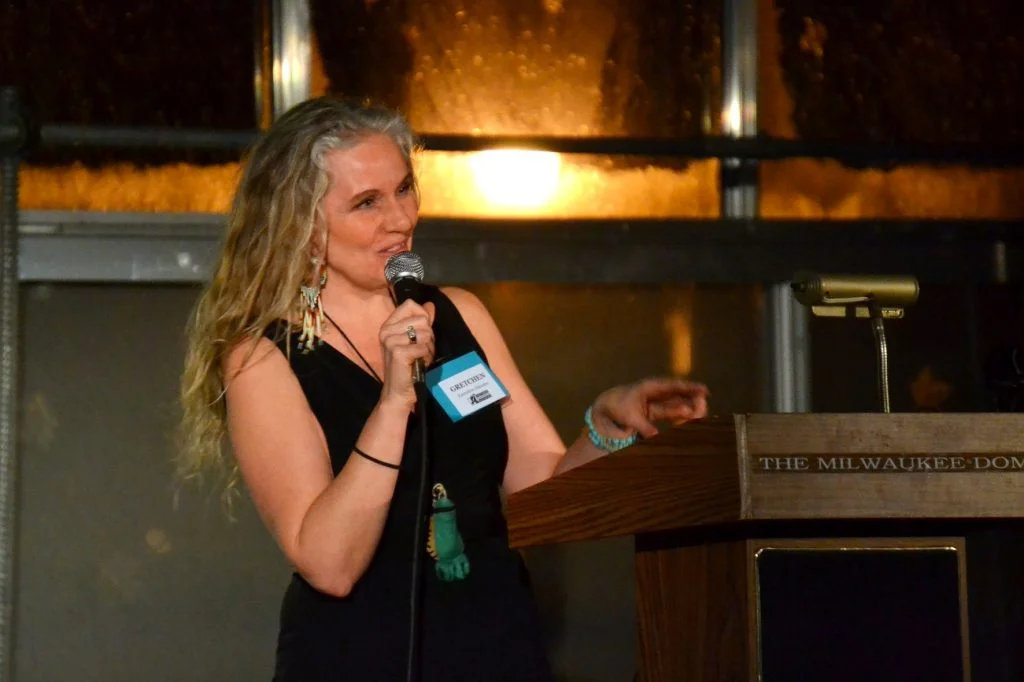
Gretchen Mead’s dedication to food activism began in her front yard, with a single garden plot.
“The core niche of what I do is about home, growing your own food in your own home and giving your children the nourishment they need for their brains and bodies,” said Mead.
Since 2008, that single plot has blossomed into the Victory Garden Initiative (VGI), a thriving community of staff and volunteers committed to helping Milwaukee residents grow their own food and cook nutritious meals for their families.
Mead was a social worker in a child and adolescent medical psychiatry unit when the profound negative impact of poor eating habits became glaringly apparent to her. Her young patients, often diagnosed with serious mental health issues, typically consumed what Mead calls “SAD,” or the standard American diet, laden with processed foods and high amounts of carbohydrates, wheat and meat products.
“No one asks them, ‘What did you have for breakfast? Do you have regular sleep cycles?” said Mead.
These questions emanate from Mead’s personal experiences with food and health. Raised on a farm in northern Illinois, the natural world was her “best teacher and playmate,” a place of solace, recreation and healing. Her mother, a farmer, filled their home with food she produced herself.
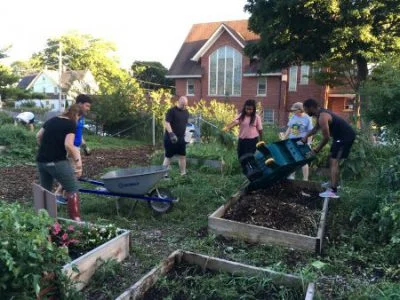
Volunteers dig deep in the Victory Garden Urban Farm, located in Harambee at 220 E. Concordia Ave. Photo courtesy of Victory Garden Initiative.
After moving to Milwaukee as an adult, Mead noticed an unwelcome change in her body, a sluggishness that was hard to pin down.
“I realized how [poor eating] was controlling my ability to be the person I wanted to be,” Mead said. “I cleansed my diet and was able to be happy and healthy and well again.”
These revelations ignited Mead’s desire to strengthen Milwaukee communities through the power of food. Nearly 18 percent of Milwaukee County residents were designated “food insecure,” or struggling to avoid hunger, in 2014.
“If you can feed yourself you are, in a fundamental way, much more of a free person,” said VGI volunteer Dale Skaggs. He recalled his first encounter with Mead at a conference held by Growing Power in 2009, and a lesson she shared about how leadership is a dance.
“She talked about how leaders need to understand that the second person to get up and dance is just as important as the first because it validates the first, and then the third, and pretty soon you’ve got the whole community dancing.”
Since its founding, VGI has facilitated the creation of 3,000 gardens, as well as a 1.5 acre farm in the Harambee neighborhood. The program also provides educational opportunities for children and adults, encouraging residents to learn about the growing process and how best to feed themselves and their families.
Mead’s favorite VGI event is the annual Fruity Nutty 5 Orchard Contest, a competition where groups of neighbors can apply to win a community orchard. Each of the five winning neighborhoods receives up to 30 fruit- and nut-producing trees that must be planted within a four-block radius. So far, VGI has awarded 28 Fruity Nutty orchards in Milwaukee.
An effect of the contest is that “someone in the community perks up, starts knocking on doors, becomes a de facto community organizer and begins introducing him or herself to neighbors,” said Mead. “What they find is they didn’t know there were 10 other people in their community who care about food, but now these people are talking to each other and leaders emerge.”
Previously known as Concordia Gardens, the Victory Garden Urban Farm is close to Mead’s heart as well. Located at 220 E. Concordia Ave., the farm offers programming ranging from community composting and rainwater harvest workshops to food pantry partnerships, volunteer and community service opportunities, and a pay-what-you-can fruit and vegetable Community U-Pick Garden. The urban farm is also home to YEP!, VGI’s youth education program, which provides workshops and internships for young people eager to get their hands dirty
“She had her own garden box and she cultivated her own seeds, picking the weeds every week and watching it grow,” she said. “[Joscelyn] picked up some really good eating habits. She wanted to learn to cook leeks, how to use the kale from the garden. We took home a lot of cucumbers, a lot of tomatoes, a lot of baby spinach. It was a great experience overall.”
Former VGI staff member Jazz Glastra praised Mead’s commitment to community partnerships as a means of spreading the word about healthy food.
“She understands that real change cannot be achieved by one person or even one organization,” said Glastra. “Partnerships are important and Gretchen works with as many people as she can.”
VGI’s partners include the Clarke Square Neighborhood Initiative, Layton Boulevard West Neighbors and the 30th St. Industrial Corridor.
For all the joyful chaos of contests and raised bed-building blitzes, what fundamentally drives Mead is a desire for all people, young and old, to reap the physical, emotional and spiritual benefits of eating nutritious food.
“We eat not because it’s gratifying or tastes good on your tongue, but because it’s good for your body.”
This story was originally published by Milwaukee Neighborhood News Service, where you can find other stories reporting on fifteen city neighborhoods in Milwaukee.

New Technologies Are Creating New Ways To Grow Fresh Produce
New Technologies Are Creating New Ways To Grow Fresh Produce
Vertical farming operations are popping up everywhere and this new technology can complement traditional agriculture
AF Columnist
Published: March 13, 2017
Opinion
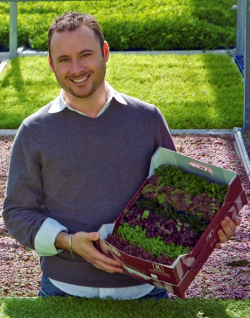
We were in Holland and our group stood in amazement at the growing capabilities of Koppert Cress.
Owner Rob Baan, a policeman’s son turned world entrepreneur, was emphatic that neither soil nor light is needed to grow food — only heat. And all of those components could be provided by technology, he said.
In a large glasshouse Baan grew microgreens in cellulose under LED lights. In the vast kitchen on site, we tasted the bounty and I remember it still: an absolute bursting of flavour and texture exploding on the palate.
The Business Plan Was Simple.
Take the product to the chef first, ask them what they liked, disliked, and were looking for in food trends. Go home, turn on some LED lights, and grow what the chef wants. Baan’s global empire (Koppert Cress distributes microgreens across Europe and has a U.S. division) is proof that fresh food can be grown inside. It is the ultimate urban farm.
Later, in a cooking class in Canada, I noted that chefs had microgreen boxes or microgreen appliances in the kitchen. Again, no natural light and no soil were present, and the greens were grown in stacked trays. But it made a huge difference to a dish when that fresh green top was pruned off the tray from the inside of that black box. A variety of these are now available for home kitchens. Retail stores in the U.K. introduced living vegetable aisles where the food was grown on site and the customer picked it from the vertical display.
And in travel, I’ve found hotels now boast rooftop gardens and restaurants are quick to highlight their little herb patch. That’s good news because it means we have a movement to grow food that has been unmatched in recent history. How far we go is really limited only by imagination. We can grow food in a field or black box, and both will metabolize similarly.
European scientists have long been curious about food produced in a black box. Their quest for perfection demands vegetables and fruit be fresh and without blemish. Not only must the shape and colour be right, but so must the degree of ripeness. Just as the Chinese form the square watermelon in a box, growing food in black boxes allows for the perfect product every time.
Why is This So Important To Traditional Farmers? And Why is it a Threat?
While it is true that farming is truly evolving on many technical platforms, the idea of food production indoors and without soil or light is leaping ahead in the area of vegetable and biomedical production. The yield is 20 to 30 times that of a conventional field, variety dependent, and the crop is not under weather distress as the environment can be remotely controlled. Lufa Farms, headquartered in Montreal, started the rooftop movement now popular around the world. But it was Vancouver that got folks thinking about filling the space on every floor with food all the way to the roof. Canada started thinking about going vertical.
As cities develop, food policies and municipalities enacted bylaws restricting chemical usage, the natural progression has been to move farms in and up. Touring the Delta area of British Columbia and the Golden Horseshoe in Ontario are jaw-dropping farming experiences. The agricultural output is staggering.
Vertical farming goes a little further and takes those huge flat areas often seen in greenhouses and tiers them with suspending boxes that grow food, particularly leafy greens. These products are often organic, or at least chemical free, saving that production cost while responding to consumer demand.
Some of the designs I researched took advantage of the moderate climate and were glass structures that allowed for natural light. None used soil and either had a growing medium or were hydroponic. A new structure in Canada based out of Truro, Nova Scotia is a closed system based on LED lighting that was built on the premise of food that is nutrient dense, fresh to use in the culinary world, and the structure itself can be built almost anywhere.
One of the challenges in this vast nation is the development of a delivery system that can get perishable, nutrient-dense foods to rural and remote communities. Vertical farming offers a solution to these issues — and creates jobs for the local people, attracts local distributors, and makes good food affordable.
A sack of seed could feed a village and that is an important consideration as we move forward in food policy. Another area of interest for me is the biomedical component as it complements natural health and there is an assurance of purity that we cannot confirm from imported product.
Vertical farming does not threaten agriculture, but it does change it. New technologies will continue to enhance farms in Canada, secure food in urban spaces, and allow our nation to be a world leader in terms of technology and health.

Hong Kong's Skyline Farmers
The Bank of America skyscraper farm was the first in Hong Kong’s commercial district, and a critical proof of concept for Rooftop Republic
HONG KONG’S SKYLINE FARMERS
By Bonnie Tsui
March 13, 2017
It was a breezy afternoon in Hong Kong’s central business district, and the view from the roof of the Bank of America Tower, thirty-nine floors up, was especially fine—a panorama of Victoria Harbour, still misty from the previous day’s rain, bookended on either side by dizzying skyline. Andrew Tsui nodded at the billion-dollar vista—“no railings,” he said—but he was thinking of the harvest. Specifically, he was examining a bumper crop of bok choy, butter lettuce, and mustard leaf, all grown here, at one of the most prestigious business addresses in the city. Spade in hand, Tsui scraped at the electric-green moss that had begun to sprout on the sides of the black plastic grow boxes—a result, he said, of the damp sea air off the harbor. “I really like this work,” he told me, still scraping. “It’s soothing, like popping bubble wrap.” A faint breeze ruffled the lettuces.
Tsui is a local boy, born in Beijing and raised in Hong Kong. Two years ago, with Pol Fàbrega and Michelle Hong, he founded Rooftop Republic, the company behind the Bank of America farm and nineteen others around the city. Though Hong Kong now imports ninety per cent of what it eats—mostly from mainland China—Tsui will remind you that, only half a century ago, sixty per cent of the supply was homegrown. “We are not trying to go back to growing everything here—that’s impossible,” he said. “But city people are pretty vulnerable when it comes to food.” Recently, Tsui noted, concerns over safety and contamination—milk and baby formula tainted with toxic melamine; pigs illegally fed growth-enhancing asthma drugs—have driven residents to look more closely at the regional food chain. A decade ago, organic farms in Hong Kong’s rural New Territories were nearly nonexistent; now there are more than four hundred and fifty of them. Meanwhile, Hong said, demand for Rooftop Republic’s urban-farming classes and projects has spiked. “Food labelling and organic certifications may not be clear or fully transparent here, so many people have become keen to grow their own food, at least in part,” she told me.
The Bank of America skyscraper farm was the first in Hong Kong’s commercial district, and a critical proof of concept for Rooftop Republic. It is situated on a decommissioned helicopter landing pad—the “rooftop of all rooftops,” Tsui called it. When I visited, in November, he and his colleagues had just finished harvesting some Chinese vegetables, which would be trucked off to a local food bank, cooked, and packed into lunch boxes for the poor. Tsui picked a mustard leaf and handed it to me. It was bracingly peppery and spicy, with a wasabi finish—indiscernible, in other words, from mustard grown on terra firma. And this was no small accomplishment. The helipad site is windy, and when Rooftop Republic got started there it also lacked water access. Undeterred, Tsui and Fàbrega set the beds low on the roof, so they wouldn’t blow away during typhoon season, and installed pumps and an automatic irrigation system. They rotated crops with the seasons—amaranth, Chinese spinach, and sweet potatoes in summer; romaine lettuce, radishes, and kale in winter. Dedicated farmers come every one or two weeks to tend the crops. “This batch of soil—we know it now,” Hong said.
Each project that Rooftop Republic designs is equally site- and client-specific. At its farm atop Cathay Pacific’s headquarters, near Hong Kong International Airport, airline employees perform the labor. They choose the crops they want to grow, harvest the produce, and take it home. At the EAST Hotel, in the Tai Koo area, Rooftop Republic helped set up a small garden on a long, skinny deck near the fourth-floor swimming pool. The week I visited, the hotel employees had just harvested their first okra, which would go into the restaurant’s vegetarian curries, and green beans and peppers were beginning to sprout. Jonathan Wallace, EAST’s manager, said there are plans to expand. “Our rooftop doesn’t do much outside of housing a window-cleaning gondola,” he told me. Indeed, outdoor space all around Hong Kong tends to be underutilized. Aside from satellite dishes, cooling vents, and the odd deck, many rooftops are empty.
This has left Rooftop Republic with plenty of room to grow. In the past two years, the company has averaged one new farm a month; by the end of 2017, it expects to have set up about fifty farms and transformed forty-five thousand square feet of skyline into urban farmland. And its influence goes beyond Hong Kong. Recently, the city of Seoul invited the group to an agricultural conference; Tsui and Fàbrega are also consulting with organizations in Beijing and Singapore. Their priority now is to train more personnel, including through a certification course created jointly with an N.G.O. called Silence, which focusses on the hearing-impaired. “We’re not short on weekend farmers, but we need to find more skilled full-time farmers,” Tsui told me. “At the same time, there’s no shortage of disadvantaged people in Hong Kong.” It’s a stabilizing thing to create that workforce, he said. And the rooftops could soon need them.
Bonnie Tsui is the author of “American Chinatown.” She is writing a book about swimming for Algonquin.
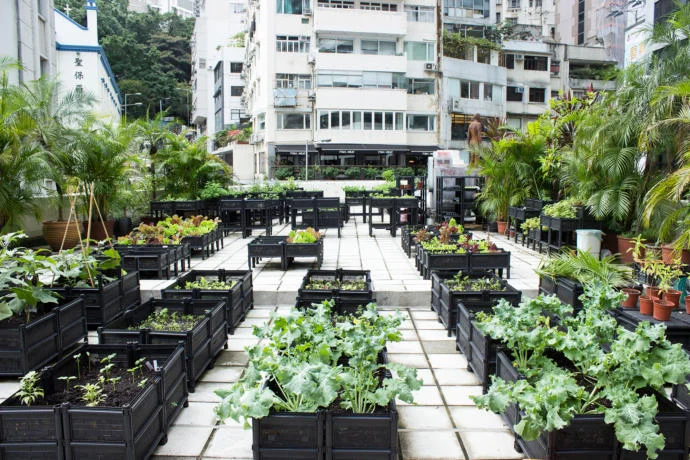
A rooftop farm at the Hong Kong Fringe Club, in Central District.PHOTOGRAPH COURTESY ROOFTOP REPUBLIC / THE HONG KONG FRINGE CLUB
From Shipping Container Farm, Casper, Wyo. Pastor and Hydroponic Lettuce Grower Preaches Local
From Shipping Container Farm, Casper, Wyo. Pastor and Hydroponic Lettuce Grower Preaches Local
March 13, 2017 | Trish Popovitch
Matt Powell opens the door to his hydroponic lettuce farm, housed in a used refrigerated storage container on the corner of his Casper, Wyoming property, and the Marriage of Figaro fills the air.
“My little Mp3 there is loaded up with Mozart and Bach. The study I heard said they tested growing plants in three sound proof environments. They had classical in one, death metal in another and silence in a third. Classical did the best, death metal did the second best,” laughs Powell explaining how his fresh hyperlocal greens are grown with the aid of some classic tunes as they stay cool in their farm-in-a-box environment.
The enclosed vertical farm, Skyline Gardens, came with the hydroponics already in place from Boston-based Freight Farms. This made it a little easier for Pastor Matt Powell, former computer salesman and current professional theologian, to find his way to a sustainable side business in an area in need of sustainable businesses. Using filtered water, nutrients, red and blue grow lights and of course, classical music, Powell will produce, at capacity, approximately 500 heads of fresh greens for the people of Casper every week. Business is growing steadily and a few harvests have already occurred.
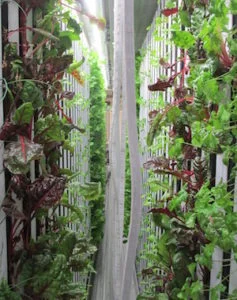
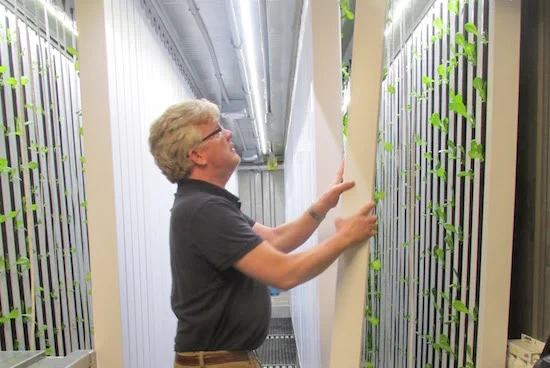
Each variety of lettuce, Swiss chard and culinary herbs grows in isolation in one of the easy to remove and handle vertical growing towers. Powell labels the towers with dry erase marker to keep track of varieties, planting time and harvest requirements. As Powell explains, shipping container farms are ideally suited to the short growing season and temperamental weather of the Equality State. “It’s an enterprise that’s really custom suited to this area and just the lifestyle around here. People have land and it’s fairly easy to put one of these boxes down,” says Powell.
The company is still in its infancy with just six months under its belt. Most of that time was spent training in hydroponics, learning the equipment and realizing the substantial amount of legwork and marketing even the most tasty lettuce line needs to grow. “There is the barrier to entry: it’s expensive. And it’s definitely a learning curve,” says Powell. “You’ve got to be a problem solver and you got to be flexible and willing to learn. There’s a lot to learn on the farming end of it and there’s a lot to learn on the marketing end of it.”
Freight Farms uses discarded and retired refrigerated storage containers to build their hydro farms. Powell’s was the first one they sent to Wyoming so they had to add a wind barrier to the outside of the fan so it wouldn’t be pulled off or damaged by the high winds. The container ships out of Boston but the ZipGrow vertical hydroponic towers inside come from the folks at Bright Agrotech in Laramie, another indoor agriculture-focused Wyoming company.
Skyline Gardens will produce approximately 500 heads of lettuce per week at capacity.
Skyline is almost at profit level on the month to month books, but Powell predicts three years at this rate of growth to pay startup costs back in full. Self-funded, Powell realizes the wariness of banks, especially in a place like Wyoming where sustainable agriculture is still finding its feet, to fund container farms and similar new social enterprise style businesses.
Powell’s background in sales has certainly aided him in selling the idea of hyperlocal lettuce to Casper’s farmers’ market attendees as well as a few area restaurants. Although some early leads grew cold due to, in Powell’s assessment, the difference in price between his product and other wholesalers. “A lot of them want me to meet the price points of [their current suppliers] but I always say it’s a whole different product. When you have to deal with corporate offices out of state…that always makes it harder, so I’m working on that. I mean direct sales has a lot to be said for it. I get the whole profit to myself. I can control the way and time that I sell it.”
Powell has several direct sales customers who buy CSA style as well as his wholesale contracts. He also sells through a local aggregation group, Fresh Foods Wyoming, which takes his produce to the farmers market for him. Deliveries have proven the most time consuming aspect of the business so far and for now Powell wants to concentrate on solidifying his customer base with no plans to expand.
“Right now I think this is enough for me. I have my main job and I’m not planning on leaving that any time soon. Even now, in the startup phase, the time commitment is substantial,” says Powell.
As the ‘grow local’ and ‘sustainable’ concepts continue to build traction in Wyoming, Powell says he’s not worried about a crowded market just yet. “I’m not too worried about competition,” says Powell as he explains how his one container farm could supply a single local restaurant completely and exclusively. “There’s plenty of room in town for competition.”
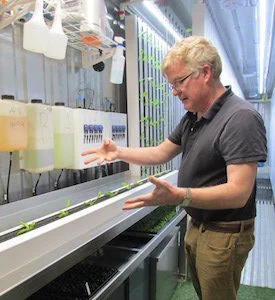
Pastor Matt Powell, the owner of Casper, Wyo.-based Skyline Gardens. Photo courtesy of Skyline Gardens
Newbean Capital and Local Roots Jointly Authored A White Paper Entitled ‘Indoor Crop Production
Newbean Capital and Local Roots jointly authored a white paper entitled ‘Indoor Crop Production: Feeding the Future’ which can be downloaded in full below by entering your name and email address. The paper was launched at the 3rd Indoor Ag-Con on March 31, 2015
Two Ranchi Women Turn Rooftops Into Organic Farm
Two Ranchi Women Turn Rooftops Into Organic Farm
TNN | Mar 11, 2017, 06.00 AM IST
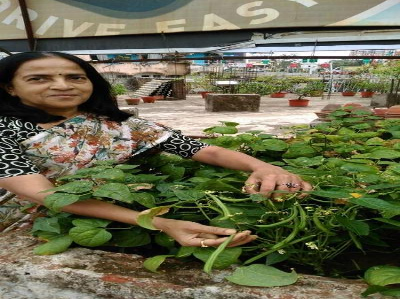
Ranchi: Fifty-year-old Shobha Kumari doesn't need to visit the market to buy vegetables anymore. All she does is climb up to her terrace and pick some.
Krishna Singh's (49) friends go green with envy every time they see her terrace while her own heart swells with pride.
Green love is blooming on the rooftops of these two residents of Ranchi, who have taken out time from their daily life to grow lush, fresh and pesticide-free vegetables, fruits and flowers on the rooftops of their houses.
The urban terrace gardens not only cut a pretty picture but does its bit in conserving nature and supplying healthy produce that goes into the dishes prepared in these two homes.
Both Shobha, a resident of Nivaranpur near Main Road Overbridge, and Krishna (49), who lives in Friends Colony in Pandra, use vermi-compost and cow dung as manure to grow vegetables, fruits and flowers in pots, drums and cement sacs.
Every day, they devote two hours to nurturing the plants with much love and care, the job acting as the perfect stress-buster for them. And as they watch the saplings grow, all tall, lush and beautiful, their joy knows no bound.
"A few days ago, I had grown 2.5kg beans. This apart, my terrace has tomatoes, chillies, brinjals, coriander leaves and other vegetables. I also grow oranges, guavas, litchis, pomegranates and strawberries, besides roses and marigold. I have altogether 250 pots," said a very proud Shobha, whose rooftop garden sprawls across 2,500sqft.
The widow with a green thumb consciously chose to grow her own veggies in 2012 after realising that vegetables available in the market were not only expensive but also harmful because of use of pesticides.
"We cannot ignore the health hazards just like this. Nothing can beat the feeling of seeing my family members relishing my labour of love when they eat dishes prepared with the vegetables I have grown. It's really amazing to nurture these plants. In return, I get satisfaction," Shobha said.
Krishna's rooftop garden spreads across 5,000sqft, which she had reared with equal love and dedication for the past eight years.
"Earlier I used to grow flowers like roses, sunflowers and petunia in small pots. Then, I developed a passion for growing veggies in cement sacs. For manure I stick to cow dung, karanj and neem twigs to protect the plants from insects. I felt elated after preparing vegetables picked from my own garden. Thereafter, there was no looking back," she said.
This 49-year-old is a proud owner of 300 pots, bearing tomatoes, coriander, brinjal, methi, green chillies and radish. "My three children are based outside now, but I click photographs of my rooftop garden and send them. I am excited about preparing vegetable dishes for them when they will come in December. The vegetables are grown without use of pesticides, they are very natural and healthy," the homemaker, whose husband works in AIR, Ranchi, said.
Every day, she uses some vegetables like tomatoes in cooking. "I had grown 10kg tomatoes, one kg coriander leaves and 10kg green onions, which I distributed among my friends," she added, proudly.
Krishna starts growing the vegetables from October every year. "These are winter veggies, which will continue to blossom till March. This is the perfect time for gardening," she signed off.

Livewell Northwest Colorado: Bring Growing Back Home
Livewell Northwest Colorado: Bring Growing Back Home
Andy Kennedy/For Steamboat Today
Saturday, March 11, 2017
In a TEDx Mile High Talk, former three-time Olympian and health expert Jeff Olson described the call of duty during World War II, when Americans bonded together to grow more than 40 percent of the country’s fruits and vegetables in victory gardens. The premise was that larger agriculture ventures could go toward feeding our troops overseas.
But, when the war was over, the gardens withered, and during the next two decades, when the American family working-dynamic began to shift, there was another more toward agricultural imperialism. This imperialism birthed a larger global agriculture, as the U.S. government emphasized to its small farmers to “get big or get out,” for high-production and low-margin growing.
Olson warned that modern “industrialized food is a tragedy of human health, an irony of ecology and a paradox of economics.”
Olson elaborated that the solution to this terrible trifecta is the future of “closed-environment agriculture,” or greenhouses with a vertical twist.
Pioneered by the Dutch and now adopted by most industrialized nations — including 2.8 million acres of greenhouses in China — greenhouse growing is, indeed, feeding the world, and sadly, the U.S. is dead last in this effort. We used to be a net exporter of fruits and vegetables, and we are now a net importer of produce.
While greenhouses can be a viable solution, a better solution could be indoor vertical growing — a marriage of Jetson-like food technology with design wizardry of Steve Jobs.
We stand at the convergence of humanities and technology, and vertical aeroponics serves as nature with aerodynamic design. Imagine 43,000 square feet — about an acre — of your favorite greens. Vertical aeroponics can do it in 4,000 square feet. That’s 90 percent less space, with 90 percent less water, giving three times the nutrient density in the plant. Used by NASA and studied by universities around the world, vertical growing has proven efficient time and again.
I recently traveled to Florida to see the start of this revolution at Living Towers Farm, just north of Orlando. For more than six years, Jan Young’s organization has been growing “beyond organic” food for those in need, teaching the techniques of vertical growing to students and in-home gardeners and selling quality food that “doesn’t have to cost the Earth or have a negative impact on it.”
Even though Florida has the weather for outdoor gardening, it does not have the soil for it. Growing vertically yields more and healthier plants. Young’s eggplants, for instance, yield 8 to 10 fruits on a regular basis — about 30 percent more yield than traditional gardening.
Seeing the vision of Living Towers in person and pondering the economics of vertical growing spins my imagination to what this could mean for a local economy. For example, an acre of commodity corn earns a farmer $1,200; an acre of traditionally grown, organic food earns $12,000; and an acre of vertical aeroponics earns a quarter of a million dollars in revenue for one harvest, according to Olson.
Bringing the concept of Victory Gardens full circle, Olson has teamed up with an organization called Veterans to Farmers, which turns protectors into providers with an urban agricultural training program, creating “agropreneurs.” One of the program’s graduates launched the first vertical growing farm on the Front Range that sold out within a year of production, selling produce to fine dining restaurants on the Front Range.
“People are hungry for beautiful food,” Olson said.
Despite being known as an agricultural state, 97 percent of Colorado’s leafy greens are imported from thousands of miles away. With only a 25 percent increase in Colorado-grown food shift, we’d see 31,000 new jobs, generating more than $1 billion in new wages.
In my own home, we have two commercialized, state-of-the-art vertical growing systems, as do many other friends and peers in town — the Tower Garden has been around six years and is fairly well-known by now as an in-home solution to one of the shortest growing seasons on the planet.
However, it’s the larger installations that now inspire me. The vertical farms popping up around the country are something I would like to emulate. For several years, I have been inspired by the O’Hare Airport installation — more than 100 vertical towers in terminal D that outgrew their mission to feed the restaurants so quickly, they now offer a farmers market for travelers, as well.
I have brought this inspiration to several local nonprofits to start working on a project I hope will soon be growing local food on a larger scale, both for families in need and for those who want fresh produce. For more information, contact Andy Kennedy at andyjkennedy@gmail.com.
To view Jeff Olson’s full TEDx Talk, visit youtube/ttvIeugcigk.
Andy Kennedy a member of the Northwest Colorado Food Coalition
A Staten Island Urban Farmer - A 26-Year-Old Farmer Grows 50 Types of Produce In The Courtyard Of A New Rental Complex
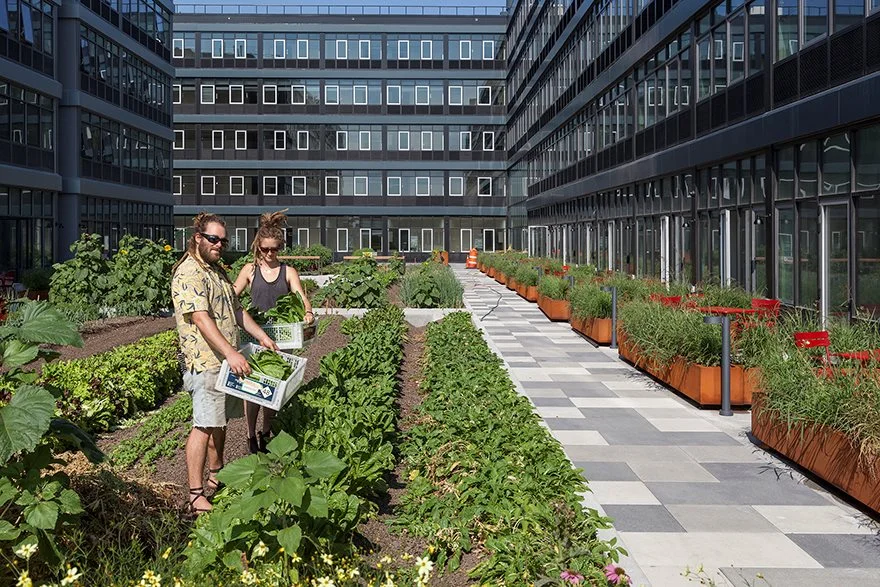
Zaro Bates operates and lives on a 5,000-square-foot farm on Staten Island, which may make her the city’s only commercial farmer-in-residence
A Staten Island Urban Farmer
A 26-Year-Old Farmer Grows 50 Types of Produce In The Courtyard Of A New Rental Complex
MARCH 10, 2017
Zaro Bates operates and lives on a 5,000-square-foot farm on Staten Island, which may make her the city’s only commercial farmer-in-residence. But instead of a shingled farmhouse surrounded by acres of fields, Ms. Bates lives in a second-floor studio in a midrise apartment complex built on the site of a former naval base overlooking New York Bay.
The farm itself sits in a courtyard between two buildings at Urby, a development with 571 rental apartments that opened in Stapleton last year. Ms. Bates draws a modest salary and gets free housing, which sounds like a good deal until you discover how much work she has to put in.
The 26-year-old oversees a weekly farmstand on the complex premises from May through November and donates to food banks. In her repertory? Some 50 types of produce — greens, summer vegetables, flowers, herbs and roots. She does this with help from her business partner and husband, Asher Landes, 29.
Let the doubters doubt.
“A lot of people instinctively call it a garden, but we really try to manage it for a commercial market,” Ms. Bates said. “It’s funny that people have different kinds of notions of what a farm is. Some people think it needs to have animals, that it needs to have acreage. We intensively crop this space so that we can produce for market, and that’s why we call it a farm.”
Farming, of course, is a New York tradition. In the late 1800s, loam and livestock were predominant north of Central Park and in what is now the East 50s. In “Win-Win Ecology,” Michael L. Rosenzweig argues that ecological science has rooted itself in the common ground of development and conservation: the use of rich natural resources in places where we work and live.
Farms like Ms. Bates’s, in addition to more traditional farmland, have been around for quite some time. Thomas Whitlow, an associate professor of horticulture who specializes in urban plants at Cornell University, Ms. Bates’s alma mater, said that in the 1940s some 40 percent of fresh market produce in New York was grown in victory gardens.
“Certainly, urban populations in general are very adaptable as conditions change,” Dr. Whitlow said. “They can change within the space of a year. Just a hundred years ago we were almost a hunter-gatherer society and did indeed have farming in major metropolitan areas.”
Ms. Bates had hardly seen farmland as a child. Her parents, who moved to Carroll Gardens, Brooklyn, in the early 1990s, rarely took the family upstate. They had the backyard of their home, but no green thumbs between them. The yard was a play space.
After graduating from the College of Agriculture and Life Sciences at Cornell, where she studied developmental sociology, Ms. Bates volunteered as a groundskeeper at the Kripalu Center for Yoga and Health in Stockbridge, Mass.
“That was the first time that I drove a tractor, did wood chipping, shoveled heaps of snow in the Berkshires winter, then planted in the springtime and just worked outside with a team of people through the seasons,” she said. “That was my first experience with that type of work and really falling in love with that.”
Afterward she intended to travel, maybe visit South America. Her plans were postponed by an apprenticeship at Brooklyn Grange, a rooftop and urban farming consultancy group, where Ms. Bates farmed under the tutelage of the chief operating officer, Gwen Schantz.
“We love designing and installing green spaces for clients, but it’s equally exciting to see others taking this work up, especially young, savvy farmers like Zaro,” Ms. Schantz said.
The group played an advisory role in two fundamental aspects of Ms. Bates’s life. First by helping her start her own consultancy, Empress Green, and by providing the pretenses under which she met Mr. Landes. The two now live at Urby and work on the farm during the spring, summer and autumn growing seasons, traveling abroad in the winter.
The couple had consulted for Ironstate Development, the developer of Urby, ahead of the farm project, and are now consulting with it on a future residential farm project in New Jersey. While Ms. Bates is the affable and gregarious face of Empress Green, Mr. Landes caters to the bees in 20 colorful hand-painted hives on the roofs at the Stapleton development. By his estimate, there are nearly two million bees, and each hive produces 50 to 80 pounds of honey a season.
“In the spring this will be brimming with hemlock and filled with flowers and all the trees will be filled with flowers,” Mr. Landes said of the farm. The bees will “be able to fly about nine miles to find good food. You stand up here and it’s just like a highway. It’s amazing.”
The honey, herbs and produce from the farm are sold at a stand for the community.
“What we did was similar to other farmers’ markets in the city,” Ms. Bates said. “But because it was enclosed in a space that invites hanging out for a while, we really invited people to make it more of a Saturday afternoon activity. That was not just for Urby residents, but also anyone from the general public.”
Ms. Bates and Mr. Landes try to plant according to requests from local residents. The proceeds go to the couple’s company, supplementing the annual salary they each receive from Urby. (Urby and Ms. Bates declined to disclose the amount.) They also host workshops and a book club.
“The priority is to residents,” Ms. Bates said, “but also to build community.”
She has considered offering a community-supported agricultural association in which residents enroll to receive a regular supply of produce, but that would limit her client base. Her current all-are-welcome approach has Ms. Bates seeking other methods of distribution because, while there is a steady growth in demand, she produces more than she can sell even while supporting Urby’s communal kitchen, where Urby’s chef-in-residence hosts classes for tenants. Ideas include a subscription-based meal delivery service.
Even so, she is focused on expansion. Urby is developing another farm plot in the same complex, where now there is just a slab of concrete. Ms. Bates also hopes to offer more educational opportunities as the farm’s output increases.
Residents “want to contribute in some way, or they just feel like their kids should know what a tomato looks like growing in the ground,” she said. “A lot of New Yorkers don’t grow up seeing that.”
A version of this article appears in print on March 12, 2017, on Page RE1 of the New York edition with the headline: The Farm in the Courtyard.
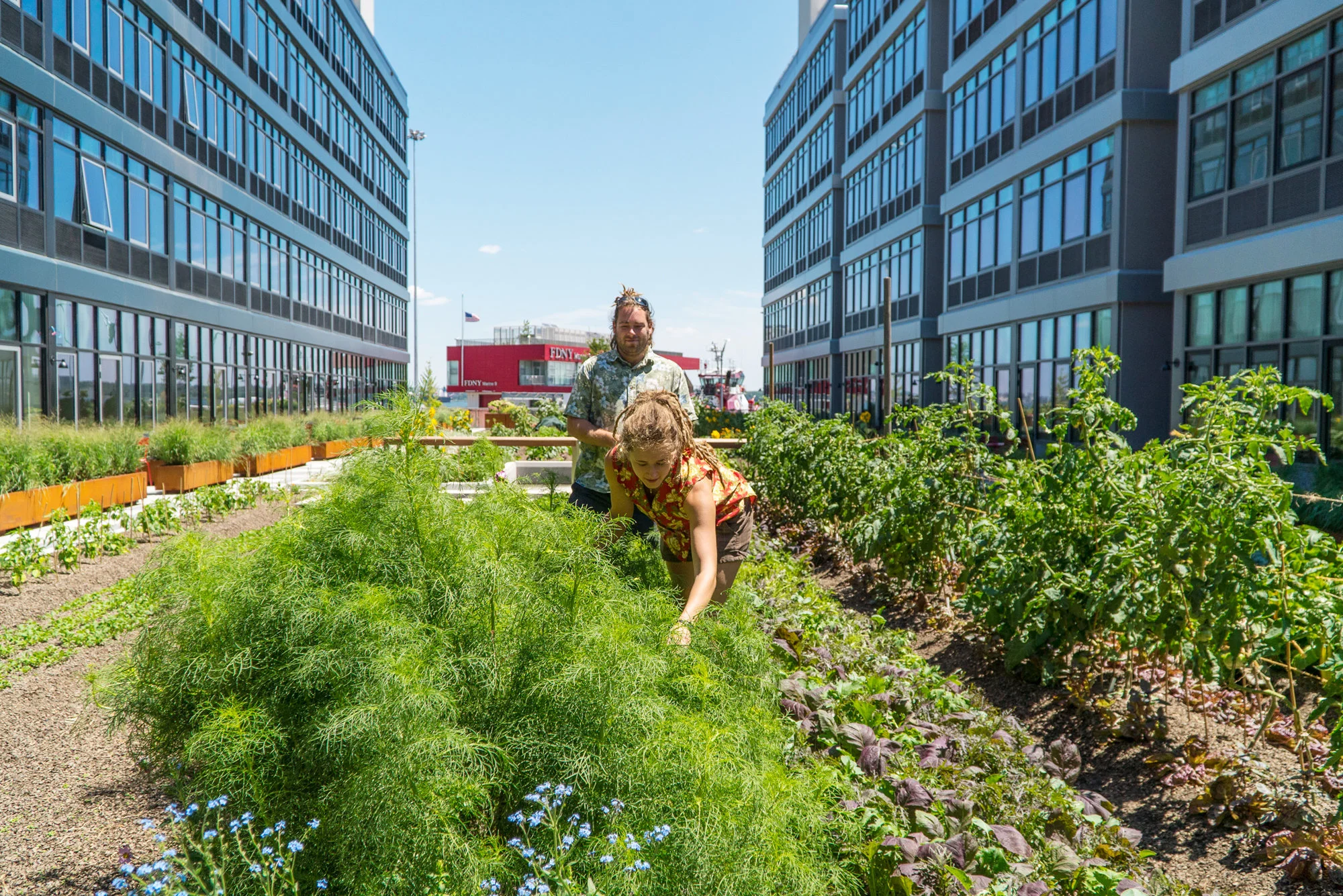
Zaro Bates and her husband, Asher Landes, farm land between two apartment buildings in Stapleton, Staten Island. They live at the complex, too.
Credit: Emon Hassan for The New York Times
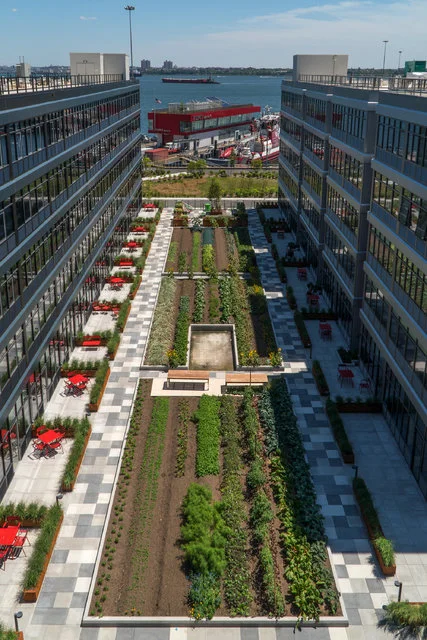
The farm, seen from a rooftop.
Credit: Emon Hassan for The New York Times
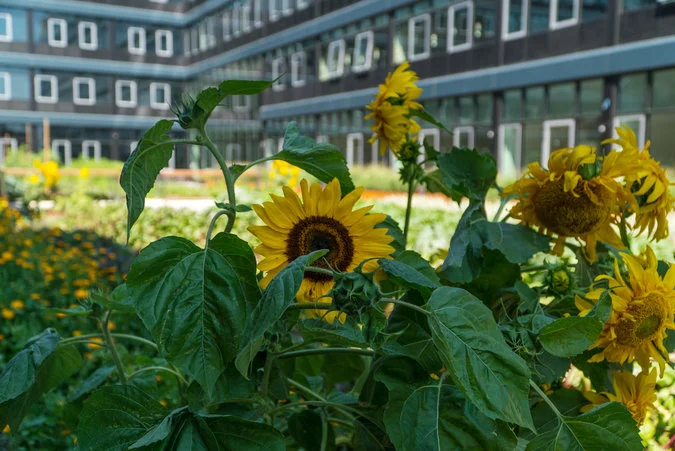
The sunflowers of last July.
Credit: Emon Hassan for The New York Times
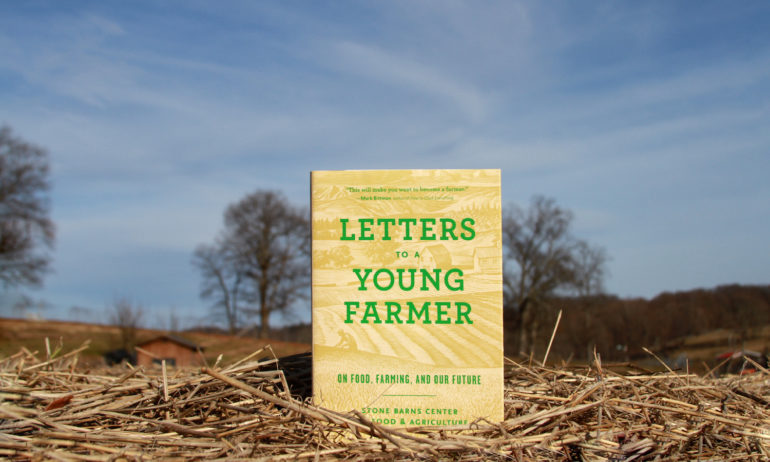
Letters To A Young Farmer: Stone Barns Center Releases Its First Book
Today, Stone Barns Center for Food and Agriculture released Letters to a Young Farmer, a book which compiles insight from some of the most influential farmers, writers, and leaders in the food system in an anthology of essays and letters.
Letters To A Young Farmer: Stone Barns Center Releases Its First Book
Today, Stone Barns Center for Food and Agriculture released Letters to a Young Farmer, a book which compiles insight from some of the most influential farmers, writers, and leaders in the food system in an anthology of essays and letters.
The United States is on the cusp of the largest retirement of farmers in U.S. history, with more farmers over the age of 75 than between the ages of 35 and 44. Letters to a Young Farmer aims to help beginning farmers succeed through advice and encouragement, while inspiring all who work in or care about the food system. Among the 36 contributors to the book are thought leaders Barbara Kingsolver, Bill McKibben, Michael Pollan, Dan Barber, Temple Grandin, Wendell Berry, Rick Bayless, and Marion Nestle. I was honored to contribute to the book as well!
Stone Barns Center for Food and Agriculture is a nonprofit sustainable agriculture organization with a mission to create a healthy and sustainable food system that benefits all. The organization trains farmers, educates food citizens, develops agroecological farming practices, and convenes changemakers through programs such as a Summer Institute for High School Students and a two-day Poultry School conference.
Food Tank spoke with Jill Isenbarger, CEO of Stone Barns Center, about Letters to a Young Farmer, the need to encourage young farmers, and hope in the future of the food system.
Isenbarger says “we created this book to give voice to farmers and illuminate the choices that can lead to a stronger future, for them and for all of us who eat. It reminds us that farming has always been a political act. These young farmers, who choose to farm rather than go into law or medicine or finance—they are taking a stand; they are expressing their commitment to the land, to their communities, to the food movement.”
Food Tank (FT): Why do young farmers need encouragement?
Jill Isenbarger (JI): Farmers are becoming an endangered species. The number of farms and farmers continues to shrink, and farmers are aging off of the land at an alarming rate. The average age of a farmer in the United States is 58.3 and climbing, and only six percent of farmers are under the age of 35.
Young farmers need encouragement because our society doesn’t value them the way they should be valued. “You’re just a farmer” is the common refrain. Barbara Kingsolver, Wendell Berry, and Bill McKibben all write about this in the book. We’ve also lost many agricultural traditions based on community, a common history of stewardship and hard work.
To support the kind of dignified labor and environmentally sound land stewardship that will help us create a more sustainable farming system, we simply may have to pay more for our food. According to the USDA, in 1960, Americans spent 17.5 percent of their income on food. By 2013, that had dropped to 9.9 percent. As a country, we’ve grown accustomed to cheap food—food that is not only inexpensive, but food that doesn’t taste good and isn’t good for us. Paying more for quality, nutritious food (and helping those of lesser means gain access to it), grown by farmers able to earn a living wage and provide health care to their workers—that would go a long way to helping raise us all up.
FT: What unique obstacles do young farmers face?
JI: Bill McKibben writes about surviving the “carbon binge,” and the challenges that a changing climate will bring to farmers who grow our food. Marry this with the challenges of finding affordable land to farm, paying off student loans, the dearth of start-up capital and a lack of regional agricultural infrastructure in some parts of the country, and you have a daunting set of obstacles that most young farmers face.
It is hopeful to note that H.R. 1060, the Young Farmer Success Act, a bipartisan bill sponsored by Rep. Joe Courtney (D-CT), Rep. Glenn Thompson (R-PA), and Rep. John Faso (R-NY), was reintroduced in the House of Representatives in February. This bill will help provide college loan relief to young farmers. So, some in Congress are paying attention, especially among them Rep. Chellie Pingree (D-ME), herself a contributor to our book.
FT: What are some of the most important areas for young farmers to focus their skills?
JI: One is soil health, the very foundation of sustainable agriculture. There’s a saying, “civilizations rise or fall on the health of soil.” Farming with nature is the key; farming that builds up soil, uses water wisely and with an eye on the future—we absolutely need more of this. Wes Jackson talks about this in his letter: “Ecological agriculture has the disciplines of ecology and evolutionary biology to call on, based on millions of years of emerging efficiencies such as those seen in nature’s prairie ecosystems.”
At Stone Barns Center, we focus on two aspects of building soil health: one is through farming, and we teach and experiment with agroecology. The other is the concept of creating what we call a farm-driven cuisine in America—catalyzing a culture of eating based on what ecosystems, including farms and their soils, need to be healthy and regenerative.
Young farmers need to focus not just on the practical skills to grow, harvest, and sell their products; they also need to focus on building strong connections to their communities, sharing their deep love of land and place, and helping people understand the value and importance of farming done well.
FT: Which letters inspired you the most?
JI: So many of the letters and essays are extraordinary and inspiring and deeply moving. They flow with humor and insight, gratitude and humility. I love the wry wit of Barbara Damrosch, Mary Berry, Bill McKibben, and Gary Nabhan, and the lyrical insights of Raj Patel and Barbara Kingsolver. I was drawn to Amy Halloran’s line, “Eating is hunting in nature for food.” It pulls you back to the bond that we need to have with the earth. It is primal. I appreciate Wendy Millet’s articulation of her “hundred years” value, the idea of taking a long-term perspective on economically and ecologically sustainable management.
FT: What were the most common themes you found in the letters?
JI: There are many overlapping ideas that ripple out in their own ways, but these are a few themes that arose in a number of the essays and letters:
- Bridging the gulf between nature and agriculture, between land conservation and food production—and finding the path toward to a more sustainable future.
- Renewing respect for farmers in a society that has taught children farming is a lowly occupation, and in a country that was founded by and largely composed of farmers until the mid-20th century.
- The changing nature of today’s young farmers, from generational—ones that inherited their roles and land—to the self-selected farmers who want to be agents of change.
FT: What have farmers’ reactions been to the book?
JI: “When are you putting together the next book? I want to write a piece.” This has been a heartening response. Sharing the stories about the people who grow our food and steward our lands and waters is powerful and important. Farmers are a hearty, optimistic, and determined breed. To have received their support and encouragement is a great honor and means that we are advancing our mission in an important and meaningful way.

Indoor Ag-Con Returns to Las Vegas to Discuss Farm Economics and New Technology Trends in Hydroponics, Aquaponics & Aeroponics
Indoor Ag-Con Returns to Las Vegas to Discuss Farm Economics and New Technology Trends in Hydroponics, Aquaponics & Aeroponics
Indoor Ag-Con – the indoor agriculture industry’s premier conference – will be returning to Las Vegas for the fifth year on May 3-4, 2017 to discuss the prospects for this increasingly important contributor to the global food supply chain.
LAS VEGAS, NV (PRWEB) MARCH 10, 2017
Indoor agriculture – growing crops using hydroponic, aquaponic and aeroponic techniques – has become popular as consumer demand for “local food” leads growers to add new farms in industrial and suburban areas across the country. Indoor Ag-Con – the industry’s premier conference – will be returning to Las Vegas for the fifth year on May 3-4, 2017 to discuss the prospects for this increasingly important contributor to the global food supply chain.
The two-day event will be held at the Las Vegas Convention Center, and is tailored toward corporate executives from the technology, investment, vertical farming, greenhouse growing, and food and beverage industries, along with hydroponic, aquaponic and aeroponic startups and urban farmers. It is unique in being crop-agnostic, covering crops from leafy greens and mushrooms to alternate proteins and legal cannabis. Participants will receive an exclusive hard copy of the newest edition in a popular white paper series, which is sponsored by Urban Crops and will focus on the US industry’s development.
The event will consist of keynotes from industry leaders and extended networking breaks, along with a 50+ booth exhibition hall. This already includes industry majors such as Certhon, Dosatron, DRAMM, Hort Americas, Philips Lighting, Priva, and Transcend Lighting. A new addition for 2017 is “lunch and learn” sessions covering practical topics such as health and safety. Confirmed speakers include executives from Argus Controls, Autogrow, Bright Agrotech, CropKing, Fresh Box Farms, Grobo, Intravision, Plenty, Priva, Shenandoah Farms and Village Farms among many others. “We’re expecting that the big themes for this year will be farm economics and the commercialization of newer technologies such as machine learning, and are excited to have gathered experts from across the world to speak. The entrepreneurs in our funding session have raised more than $50mn for their indoor farms in the past year alone, and one speaker is operating a 100k ft2 commercial controlled environment farm” commented Nicola Kerslake, founder of Newbean Capital, the event’s host.
Agriculture technology companies, suppliers and automation companies will have the chance to meet and mingle with leading vertical farmers and commercial greenhouse operators at a drinks party on the first evening of the event. Event sponsors include Autogrow, Urban Crops, Kennett Township, Freight Farms, Grodan, Joe Produce, Crop One Holdings and Grobo.
Beginning farmers, chefs and entrepreneurs can apply for passes to the event through the Nextbean program, which awards a limited number of complimentary passes to those who have been industry participants for less than two years. Applications are open through March 31, 2017 at Indoor Ag-Con’s website. The program is supported by Newbean Capital, the host of Indoor Ag-Con, and by Kennett Township, a leading indoor agriculture hub that produces half of the US’s mushrooms.
Indoor Ag-Con has also hosted events in Singapore, SG and New York, NY in the past year, and will host its first event in Dubai – in partnership with greenhouse major Pegasus Agriculture – in November 2017. Since it was founded in 2013, Indoor Ag-Con has captured an international audience and attracted some of the top names in the business. Events have welcomed nearly 2,000 participants from more than 20 countries.
Newbean Capital, the host of the conference, is a registered investment advisor; some of its clients or potential clients may participate in the conference. The Company is ably assisted in the event’s production by Rachelle Razon, Sarah Smith and Michael Nelson of Origin Event Planning, and by Michele Premone of Brede Allied.
5th Annual Indoor Ag-Con
Date – May 3-4, 2017
Place – South Hall, Las Vegas Convention Center, Las Vegas, NV
Exhibition Booths – available from $1,499 at indoor.ag
Registration – available from $399 at indoor.ag
Features – Two-day seminar, an exhibition hall, and after-party
For more information, please visit http://www.indoor.ag/lasvegas or call 775.623.7116