Welcome to iGrow News, Your Source for the World of Indoor Vertical Farming

Farm-To-Table Amenities Yield Profits
Farm-To-Table Amenities Yield Profits
Even on small infill sites, residential builders and developers are making room for vegetable gardens.
Farm-to-table-centered communities are a big draw for home buyers, but they can also mean more profits for builders and developers. With creative land planning, communities of all sizes can tap into the growing interest in fresh produce and backyard gardens.
Farmscape, the largest urban farming venture in California, works with developers, architects and cities to turn cookie-cutter urban communities into agrihoods. The gardens not only attract a higher future sale, but also draw in a wider demographic of individual property buyers who are looking to live in a more interactive community environment, says Farmscape co-founder Lara Hermanson. Here, BUILDER talks with Hermanson about the benefits and challenges of agriculture-based amenities.
How many agrihoods have you worked on? What do they entail?
Farmscape currently has 15 agrihoods in various stages of development. Several multifamily projects were completed last year and have been feeding those apartment communities since July. Trellis (a new Pulte development in Walnut Creek, Calif.) just broke ground last month. We also have a half dozen additional projects still going through the entitlement process. All our projects start with the design, and we take into account the architecture, branding and community demographics as well as the microclimate.
From there, we assist our clients through the entitlement process, appearing at all review meetings to help educate city councils, community members, and design review commissions on what this new amenity/landscape entails. After approvals, we work with the installation team to get the project built, and then get sent to the HOA or apartment management team to schedule maintenance. Finally, we get in front of our end user-the community, to create volunteer opportunities and workshops so they can get their hands dirty as well.
How much do they cost?
Installation for a small agrihood starts around $20K and goes up from there depending on complexity and size. A small agrihood could consist of 8-10 raised beds, 6 orchard trees and mulching. Large agrihoods can include more sizeable orchards, row crops, vineyards and ornamental garden. Large or small, the final result is a product that encourages residents to enjoy the perks of rural farm life with none of the responsibility.
What type of value do they add to a project?
Good landscaping and maintenance can add around seven percent to a commercial or residential property. Excellent landscaping (such as Farmscape's gardens) can increase the value to up to 28%. Agrihoods also have the ancillary benefit of creating a sense of place for communities, increasing resident well-being, and enhancing pride of ownership. We have experienced easy approvals in city councils, thanks to resident enthusiasm for agrihood projects.
What are some other benefits?
Generally, developers can expect fewer resubmits and greater community support during the entitlement process alongside Farmscape supporting developers through the design, installation, maintenance and programming phases. Additionally, In Santa Clara, the community rallied behind the Win6 agrihood development, with over 300 community members regularly attending City Council meetings in support of the project. They even created #Agrihood t-shirts and an online campaign to move the dial for the developers.
Does a community need a lot of land to have residential farming?
Not necessarily. A small agrihood can be designed to suit a 500 square foot space, and are very appropriate for infill developments. Larger suburban development can expand to several acres. We design each project to match the neighborhood and the future residents.
Running with setup costs from $55,000 to larger plots of $1 million per development, the gardens include row crops, raised beds, orchards, vineyards, and edible-inspired ornamental landscaping. Farmscape trains and manages local team members in the Farmscape method, and offers continual training and support to agrihood communities. The final result is a product that encourages residents to enjoy the perks of rural farm life with none of the responsibility.
Why do you think there is such an interest in gardens?
I think there's several reasons. Most households have two working adults, who don't have a lot of downtime for gardening. Coming home to an awesome vegetable garden, that they don't have to work themselves, is a great perk. Also, the drought in California has made everyone re-think their landscape. Agrihoods, with smart drip irrigation, use a lot less water than traditional lawn. Besides, no one wants their home to have the same landscaping as an office building. But most importantly, people love to eat good food. If they can eat a fresh picked salad every day and take a homegrown peach to work, life is pretty good.
About the Author
Jennifer Goodman is Senior Editor at BUILDER and has 17 years of experience writing about the construction industry. She lives in the walkable urban neighborhood of Silver Spring, Md. Connect with her on Twitter at @Jenn4Builder.

A D.C. Urban Farm Takes On Urban Problems
A D.C. Urban Farm Takes On Urban Problems
Monday, March 6, 2017 - 12:44am
Urban farming can serve needs of local communities beyond nutrition.
Little more than grass used to grow on the two-acre plot behind a middle school in the District of Columbia where tomatoes, okra and infrastructure for food entrepreneurs will begin cropping up this year.
In a ward of the city with just two grocery stores serving more than 70,000 residents, fresh produce is hard to come by. But the Kelly Miller Farm, which will be situated behind a middle school with the same name, aims to offer much more: youth programs, a community garden accessible to seniors and a commercial kitchen from which area residents can launch food-based businesses.
"It’s like a food system in a box — in one space, in one community," said Christopher Bradshaw, executive director of Dreaming Out Loud. The D.C. food justice nonprofit is partnering with the city and a half-dozen other organizations to run the farm in a way that generates revenue while also meeting the community’s unique needs. "I don’t know too many places combining those things," Bradshaw said.
With $150,000 in seed money from the U.S. Department of Agriculture (USDA) — through programs promoting farmers’ markets and specialty crops — and a mix of other local grants, the founders plan to build infrastructure such as hoop houses and a greenhouse while transforming a gutted shipping container into a commercial kitchen space. Construction is scheduled to begin in the spring and be completed by midsummer.
A USDA spokesman said the farm will serve as a model for organizations across the country that want to help consumers understand how their food is produced, especially in urban settings. But what sets the farm apart from a rooftop garden in the district’s restaurant row is that it’s catered to the people who live in this often-underserved part of the city, not just the ones who work or spend money there.
After attending the district’s historically black Howard University, Bradshaw, 35, stumbled into urban agriculture while trying to teach in an after-school program at a public charter school that has since closed. The students would arrive each day with stomachs full of the Teddy Grahams and Kool-Aid the school provided as snacks only to bounce off the walls during his lessons on "character development." Then, they’d crash.
Realizing he couldn’t teach the children without first addressing their most basic needs, Bradshaw’s nonprofit started a school garden and then a farmers’ market, so parents could buy better food, too. The latter often proved an exercise in staying power more than money-making and, eventually, Bradshaw decided to pursue broader, community-level programs.
Last year, when Bradshaw reached out looking for rentable, farmable land, the district happened to be looking for a partner to help create a model urban farm for the city. The two joined forces.
Bradshaw said he couldn’t have come as far as he has without the help of both city and federal partners who have prioritized food access over the past eight years. Having an outspoken advocate for this brand of work in the White House’s first lady hasn’t hurt, either — although it’s left him leery about the prospects of a new administration this year.
Involving The Community
Bradshaw started the Kelly Miller Farm project, now months in the making, with a step he now knows is crucial to success: Asking people who live in the community what they want.
A short walk from two housing projects in a neighborhood whose population is 96 percent African American and 11 percent unemployed, the farm will serve many people who lack access to healthy food and rely on federal nutrition assistance programs such as SNAP, or food stamps. It became clear to Bradshaw and other organizers in the community that residents wanted and needed food options beyond corner stores.
Josh Singer, a community garden specialist with the district’s Department of Parks and Recreation, said the city model needs to go further than growing a lot of food on a little land to address urban problems such as affordable food and housing. If such projects ignore the context in which they’re growing food and the groups that are already at work in those communities, they may do more harm than good, he said.
"A lot of times, organizations will use these poor communities and their statistics to get grants to do work that the community never wanted in the first place," Singer said. With the Dreaming Out Loud project, however, "we have a whole coalition focused on making this space serve the local community."
Given the area’s specific challenges, growing microgreens to sell at high-dollar to the city’s hottest restaurants — as some urban farms do to make money on expensive land— would not be appropriate, Singer said.
From the beginning, the organizers of this farm wanted to do more than show residents how food is grown; they wanted them to be able to do the work themselves. That’s why the space incorporates a kitchen and incubator where entrepreneurs can work on their recipes and business plans alongside a compost space where locals can get dirt under their nails. Bradshaw said the farm is fundraising to hire a manager and assistants from within the community but that volunteer work is welcome, too.
Partner nonprofits will use the space to teach children from the middle school about food production or to host therapeutic gardening sessions for seniors recovering from addiction. The produce will be sold at a nearby farmers’ market Dreaming Out Loud runs in the ward and possibly through a subscription program. (Bradshaw would like parents to be able to pick up a weekly produce box with their kids from the school.)
Initially, some residents were concerned about the project’s impact on their own properties; construction to rebuild the middle school a few years ago involved work with a wrecking ball that some say damaged the foundations of their homes and left them suspicious of new projects. But after a few meetings during the project’s early stages, many began suggesting ideas for the space.
Boe Luther, 52, has lived in the ward’s Clay Terrace neighborhood his entire life and said the farm project couldn’t come at a better time. As the owner of two ice cream trucks and a regular at the neighborhood’s existing community garden, Luther is eager for others to have the chance to become food entrepreneurs. They could use the project’s kitchen space to make salad dressings or salsas, he said, or grow cut flowers to sell at the market.
"We’ll have to do the research and see what people want," Luther said. "But a lot of citizens of Ward 7 are happy about it."
Walking The Talk
Beyond the neighborhood, organizations that work to improve access to nutritious food in the city’s poorest areas are rooting for the farm’s success. The city’s newly minted food policy council, of which Bradshaw is a member, sees the farm as a stage for many policies they’ve espoused on paper, including growing both farms and food access in the city’s poorest enclaves.
"The Kelly Miller Farm is embodying those values, said Laine Cidlowski, the district’s food policy director.
After seeing firsthand the big impact of a small garden, Luther thinks a vibrant farm has the potential to bring much more than food to the neighborhood: "Jobs, training, careers, opportunities, peace of mind, serenity — it brings all of that."


The Urban Farming Pioneer Who Wants To Feed The City’s Soul
The Urban Farming Pioneer Who Wants To Feed The City’s Soul
Bjorn Low made the work of growing food in urban spaces ‘sexy’, but his other mission is to help city-dwellers reconnect with life. His story on Game Changers.
By Steffi Koh
- Posted 05 Mar 2017 10:15
SINGAPORE: For four years after giving up his corporate job which was making him miserable, Bjorn Low spent a happy four years working on organic farms in far-flung places such as Scotland, Spain and Japan.
But when he returned to Singapore to start up a farm here, he hit a costly roadblock – he could ill-afford the land he needed. “I wasn’t shocked but surprised,” he said.
“To buy 10 acres of land (about the size of 10 football fields) in the middle of Wales with a river running through, with a farmhouse, cost less than a HDB flat in Singapore then.”
How could one farm without land? While looking around Singapore, the many green spaces in the midst of urban development triggered an epiphany – why not make use of the many under-utilised spaces to grow food?
That’s when the mission of turning Singapore into an “edible garden city” – which eventually became the name of his enterprise – took shape.
GETTING CHEFS TO CHOOSE LOCAL
Inspired by what he called a “global movement” of chefs wanting to connect with local farmers, Mr Low started out setting up edible herb gardens - initially using something as simple as stacked wooden boxes - and was soon approached by various hotels and restaurants.
But to grow his business, he needed international chefs and bartenders here to demand locally-grown herbs too.
Convincing them proved to be a challenge. “A lot of the chefs are very used to using Western herbs but they don’t grow very well in our climate,” said Mr Low.
“You need to spend millions of dollars to set up that infrastructure. Using a lot more local herbs and vegetables allows us scale up our operations much faster with lower infrastructure costs.”
An opportunity arose when Spa Esprit Group’s CEO Ms Cynthia Chua approached Mr Low, 36, and together with French chef Benjamin Darnaud – a believer in growing one’s own vegetables – they started Open Farm Community, a restaurant set in an urban farm on Minden Road.
“Urban farming in Singapore was previously unheard of,” said Ms Chua. “But now there is a momentum, there is a rhythm, and it was started because of people who are passionate about it like Bjorn.”
As Mr Low’s business partner, she helped put Edible Garden City on the radar of dining establishments such as the Tippling Club and Jamie’s Italian, encouraging them to use herbs grown in Singapore like cinnamon basil and white pea flowers.
FOOD FOR THE SOUL
But for Mr Low, the success of Edible Garden City goes beyond being a movement for locally-grown ingredients, to something almost existential in nature.
He described how working on overseas farms had helped his wife, Crystal, and him to escape the accumulated stress of working in the advertising industry.
“Working on the farm made me realise that actually, there is more to life than material wealth,” said Mr Low. “Being in touch with nature, and growing (my) own food, was able to fill up the void in my soul.”
He noted how “being able to nurture something to life” has been observed to help people out of depression. He added: “I’ve a history of depression in my family, so there’s multi-layered motivation for me to continue to do this - not just myself but for everyone in the community.”
His simple and wholesome outlook on life turned out to be contagious.
His employee, Mr Christopher Leow, 29, never thought that he could be a farmer in Singapore until he stumbled upon Mr Low at one of his talks.
“He made farming attractive to young people. He made it very sexy,” said Mr Leow, who used to manage a mobile coffee business. He is now one of 22 employees at Edible Garden City, which had started out with a staff of just three in 2012.
MUSHROOMING SUCCESS
The company’s revenue has since quadrupled to S$800,000 annually in the last four years, a point of success which has helped bury Mr Low’s family’s initial doubts.
“They realised that it’s become a career for me and a business that’s sustainable,” said Mr Low.
Edible Garden City now operates from an 8,000-sqm plot of land in Queenstown. Calling the place “home”, Mr Low said that with the security of a nine-year lease, his team can now “go full steam ahead with experiments” to show how under-used spaces can produce food and add to the aesthetics of the area.
The company is also working with the Spa Esprit group to create skincare and beauty products out of organic herbs. Calendula flowers with their anti-microbial and anti-fungal properties, for instance, can be made into creams, soaps and tea, said Mr Low.
“We have to innovate and add value to the crops we are growing so that we can make it a more sustainable industry,” he said.
One project will see Edible Garden City training and employing adults with Down Syndrome to grow mushrooms out of coffee and food waste, as part of their exploration into “closed-loop” farming.
“Essentially, we’re able to deal with the food waste problem in the city itself, and not having to cart it to a landfill,” explained Mr Low. He hopes this model can be scaled into other sites and even abroad - creating employment for slum-dwellers like those in Bangkok and Jakarta.
“It’s really important for me that it takes off, because I feel that, inherently, we can help urbanites reconnect with nature,” said Mr Low. “Gardening and horticulture has a way to let people understand what life is about.”
Indoor Farming Takes Root At UTM
On the second-floor lobby of the Innovation Complex at the University of Toronto Mississauga, a plastic tower sprouts a variety of produce including curly starbor kale, buttercrunch and collard greens
Indoor Farming Takes Root At UTM
Friday, March 3, 2017 - 4:16pm
Sarah Jane Silva
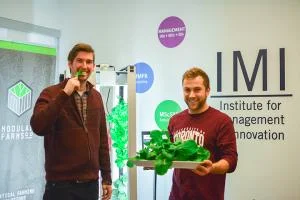
On the second-floor lobby of the Innovation Complex at the University of Toronto Mississauga, a plastic tower sprouts a variety of produce including curly starbor kale, buttercrunch and collard greens.
Rising almost six feet off the ground and illuminated by high output fluorescent bulbs, it gives the often high-traffic, student-centred space a futuristic feel.
As part of their final capstone project, Master of Science in Sustainability Management (MScSM) students, Conner Tidd and Kevin Jakiela have partnered with Modular Farms Co., a startup company that specializes in vertical farming systems, to create distribution channels and service packages for their indoor gardening farm wall.
“You can grow pretty much anything,” said Jakiela. “Here, we’ve already grown three different types of lettuce, Genovese basil, joi choi, peppermint and parsley.”
From seed to harvest, it takes about four weeks to grow leafy greens and herbs. “And if you stagger it correctly you can harvest it almost every day,” added Tidd.
But it’s more than what they’re growing that sets them apart. It’s also how.
The farm wall grows plants hydroponically — that is, with nutrient solution instead of soil. The water nourishes the roots, collects in a gutter and then recirculates back to a nutrient tank that feeds back into the hydroponic system. It costs just under $25 a month in electricity.
The seedlings, nestled in plugs made of peat moss, begin in a tray and are placed under a humidity dome where they germinate and are fed different levels of nutrients and pH. After a couple of weeks, they're ready to be transplanted into the tower.
Found within the tower, wicking strips help water find the path of least resistance by controlling the water flow and taking the water directly to the seedling roots. “It’s a white cloth that you open up and put the plug in and then you close it like a sandwich and put it into the tower,” said Jakiela.
Although the produce the farm wall yields is not organic-certified yet, Just Vertical uses organic-based practices, foregoing herbicides and pesticides. “When you’re outside, you’re exposed to pests and fungi,” said Tidd. “Unless you’re using herbicides and pesticides, it’s going to be a problem especially when you’re growing strawberries and tomatoes.”
“With Just Vertical, Kevin and Conner have a great product in place, and manufacturing is lined up so now the initial focus will be on market validation,” said Sam Dumcum, the programs, strategic relationships and innovation lead at ICUBE, UTM's on-campus incubator that provides start-up support to new ventures at any stage.
“Who are the customers that want to grow fresh produce in their home with organic practices and how do we find them?”
Dumcum says that by focusing on market research during the next phase of their startup, Just Vertical will be able to have a solid base with which to advertise and sell their product, but also to appeal to investors.
“And as far as being part of an incubator goes, when you’re around other entrepreneurs, other ideas just pop up.”
Vertical Farming: Is This The Answer To The World’s Food Shortage?
Science stacks up in favour of high-rise farms as a sustainable food source – essential as the world’s population rockets
Vertical Farming: Is This The Answer To The World’s Food Shortage?
Science stacks up in favour of high-rise farms as a sustainable food source – essential as the world’s population rockets
At the turn of the millennium, a professor of environmental science at Columbia University in New York took a detour from the curriculum. He asked students what the world would be like in 2050. Dickson D Despommier’s class estimated its population would swell to nine billion people making food production a huge issue.
One solution they considered was to grow crops on every rooftop in New York City. After a lengthy process of studying aerial maps and working out which crops were most efficient, students judged rooftop gardens could feed only about 2 per cent of the 2050 population of New York. “They were terribly disappointed,” Despommier told The New Yorker.
But he got thinking: what if you could stack crops on top of one another like shelves in the fridge, or the floors of a building? The following year he coined the term “vertical farming”. But it would take several years for light technology to make these vertical farms possible.
With scientists having worked out how to manipulate the light spectrum to help plants grow, hundreds of vertical farms have cropped up in Asia and several large farms have been established in the US. Now vertical farming is coming to the UK. Supporters say it will address food supply issues as the world’s population becomes increasingly urban.
“Vertical farming has been born out of the challenges facing modern society,” says Henry Aykroyd, chief executive of Intelligent Growth Solutions, a company building a £2.5m vertical farm at the James Hutton Institute in Invergowrie near Dundee. As the city-dwelling population of the world increases to more than 70 per cent by 2050, people will find themselves further than ever from the places where cattle grazes and food is grown.
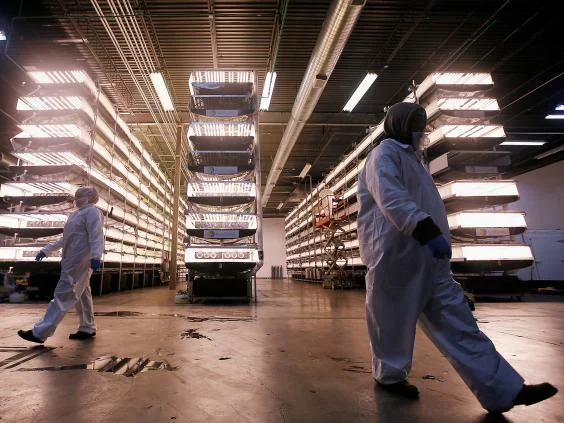
Workers at AeroFarms in Newark, New Jersey where LED lamps nourish plants in a former paintballing venue (Reuters)
A new solution is needed to keep up with year-round demand for everything from humble salad leaves to exotic produce like pineapples and avocados. According to Aykroyd, that solution is vertical farming.
Phillip Davis, a scientist from Stockbridge Technology Centre, has been helping the first vertical farms in the UK get off the ground. “The science behind it has been going on since Darwin was doing light measurements but it’s only in the last five or six years that the LEDs are bright enough to grow plants,” he said.
In the millions of years that plants have grown under sunlight, they’ve learned to sense different qualities of light to turn into energy using photoreceptors as their “eyes”. These photoreceptors only “see” blue or red light. It’s now possible to make LEDs that emit the blue and red light the plants need, excluding other parts of the spectrum. “By changing the light quality we can change the way the plant grows,” Dr Davis explained. “You can change how tall it grows, how fast it grows and when it flowers using spectrums of light.”
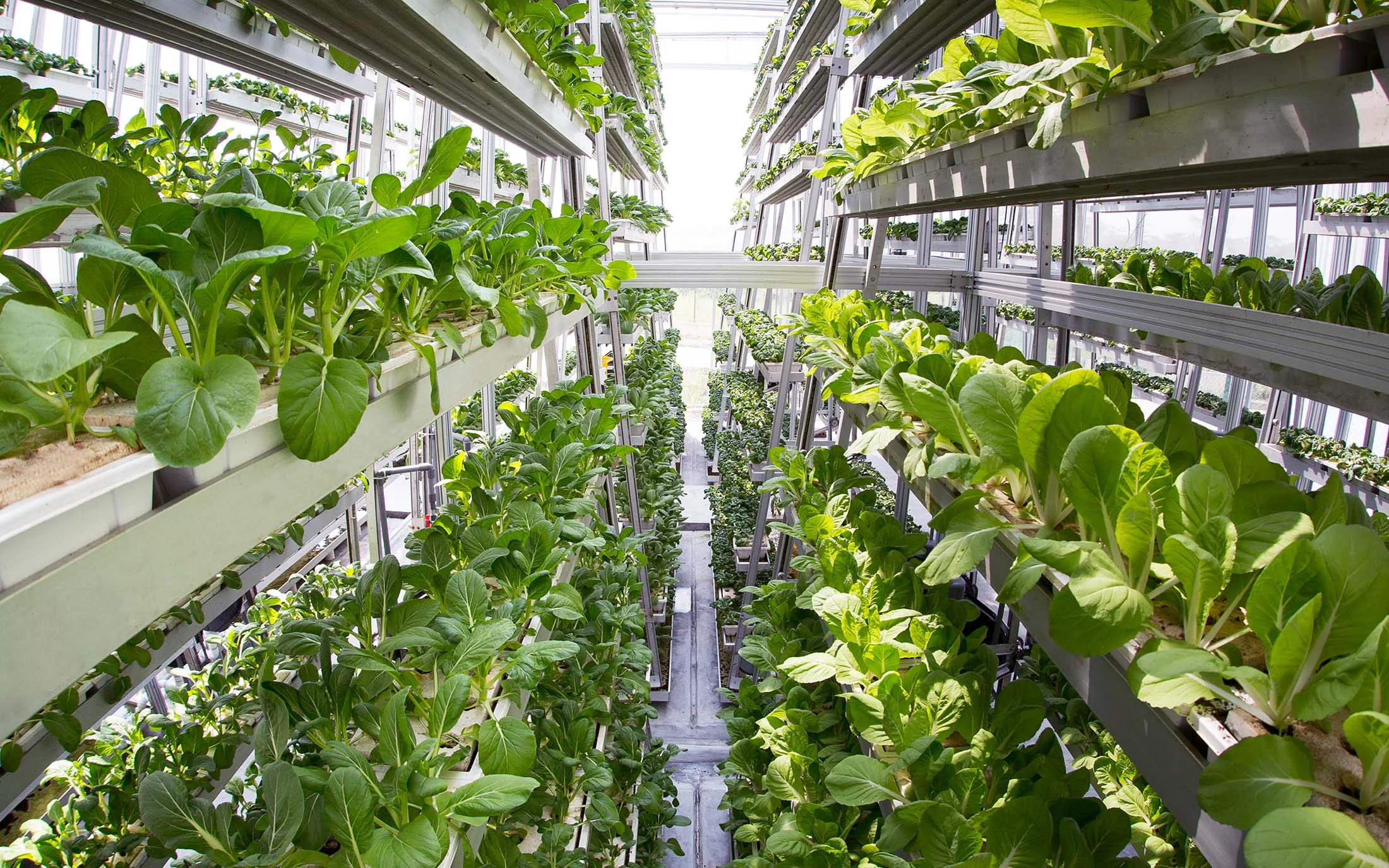
These LEDs make it possible to grow salad and other crops that have a short shelf life in places where there is little space and no natural light. Tom Webster, a biologist, and his business partner Kate Hofman founded GrowUp Urban Farms in a warehouse with no windows in Beckton, east London. “The idea is to grow food close to where it is consumed, in commercial volumes,” says Webster one weekday afternoon as he inspects a control panel showing the amount of water, waste and light in the growing beds. Behind him pea shoots, watercress and baby kale grow on wide metal trays stacked to the roof.
Each metal tray is lined with a mat made of carpet fibres. The crops are hydrated using water from fish tanks next door, which contains nutrients courtesy of the fish poo. Growers control light and heat to simulate night and day. “Even plants like to rest at night,” says Webster. A white sock, running behind each shelf, blows cooling air over the crops to counter the heat and humidity that gathers above the leaves. The system is between 70 and 90 per cent more water-efficient than traditional agriculture and, because the shelves can be stacked 10 high, it is 10 times more productive per square metre of space.
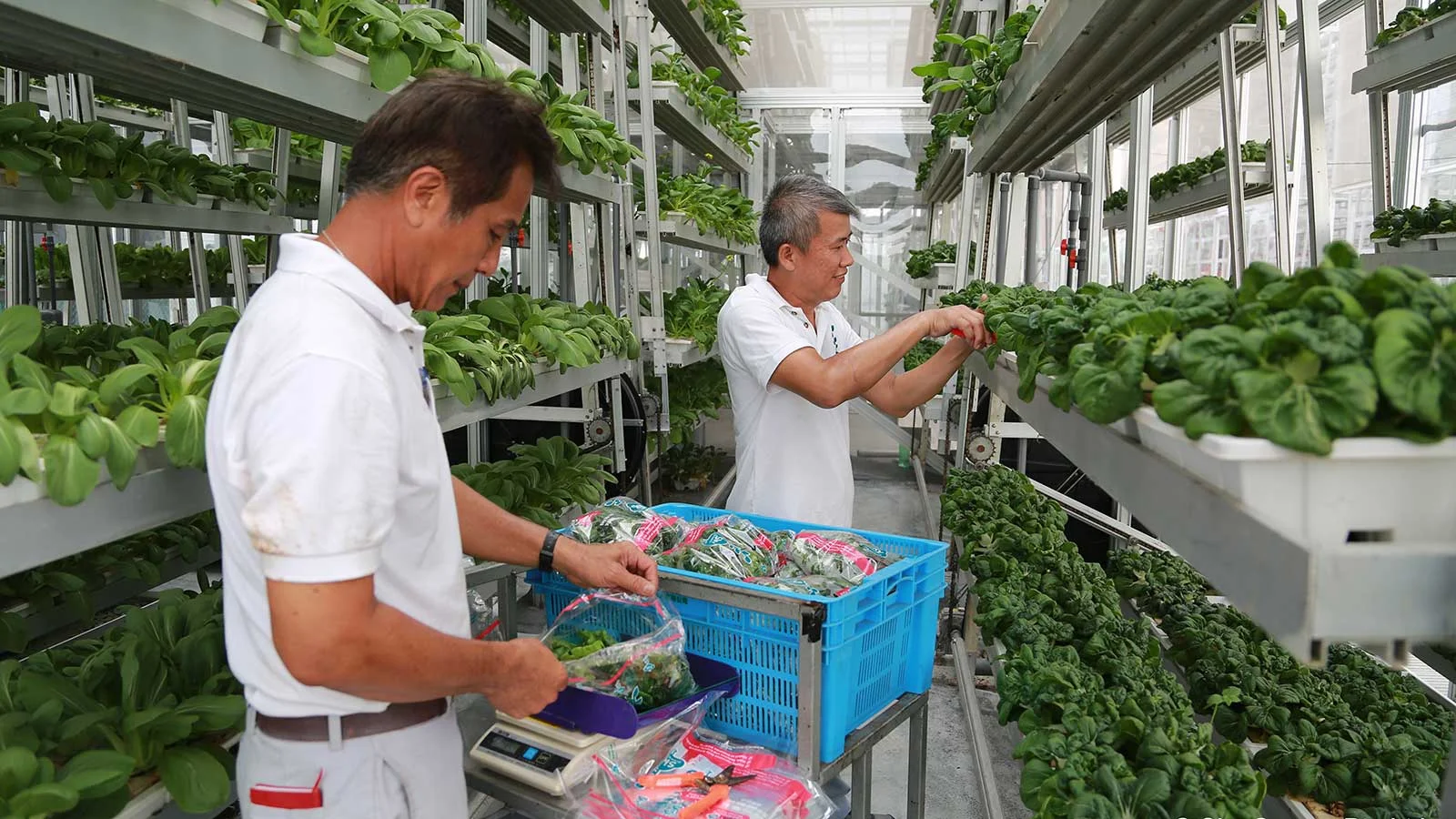
The whole cycle from seed to harvest takes between seven and 21 days, meaning at least one crop a month, regardless of weather or the season, keeping the shelf price of the salad stable. When the shoots are ready for harvesting, one of the farm’s few employees uses a lift on wheels to go between the beds, cutting the greens so they can be sorted into boxes and moved to a small walk-in fridge. From here the microgreens and herbs are transported to retailers ready for sale. It’s always boxes, never bags, as this helps to prolong the shelf life of the greens.
GrowUp supplies salad, including microgreens and herbs, to organic food retailers. Its microgreens are scattered on plates in restaurants across the capital. Sister community interest company GrowUp Box uses smaller, greenhouse versions of the warehouse ‘aquaponics’ system to teach communities how to grow salads on their own roofs, echoing Despommier’s students, who hoped to feed their city this way

Inside The Computerized Lettuce Factory Of The Future
Inside The Computerized Lettuce Factory Of The Future
High-tech farms in urban warehouses can grow 100 times more food using 95% less water than old-fashioned operations depending on soil and sunshine.
Farming, even in its modern, hyper-industrialized form, still relies on some very old-school technology: the sun, dirt, seasons, tractors. It’s all a bit messy and inefficient, at least by the standards of modern technologists, who are more accustomed to server farms that churn through data 24/7.
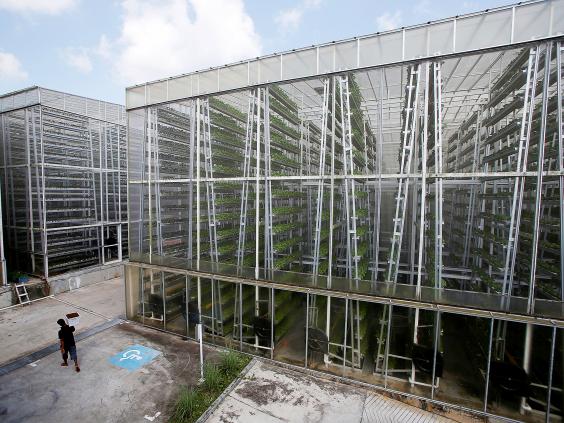
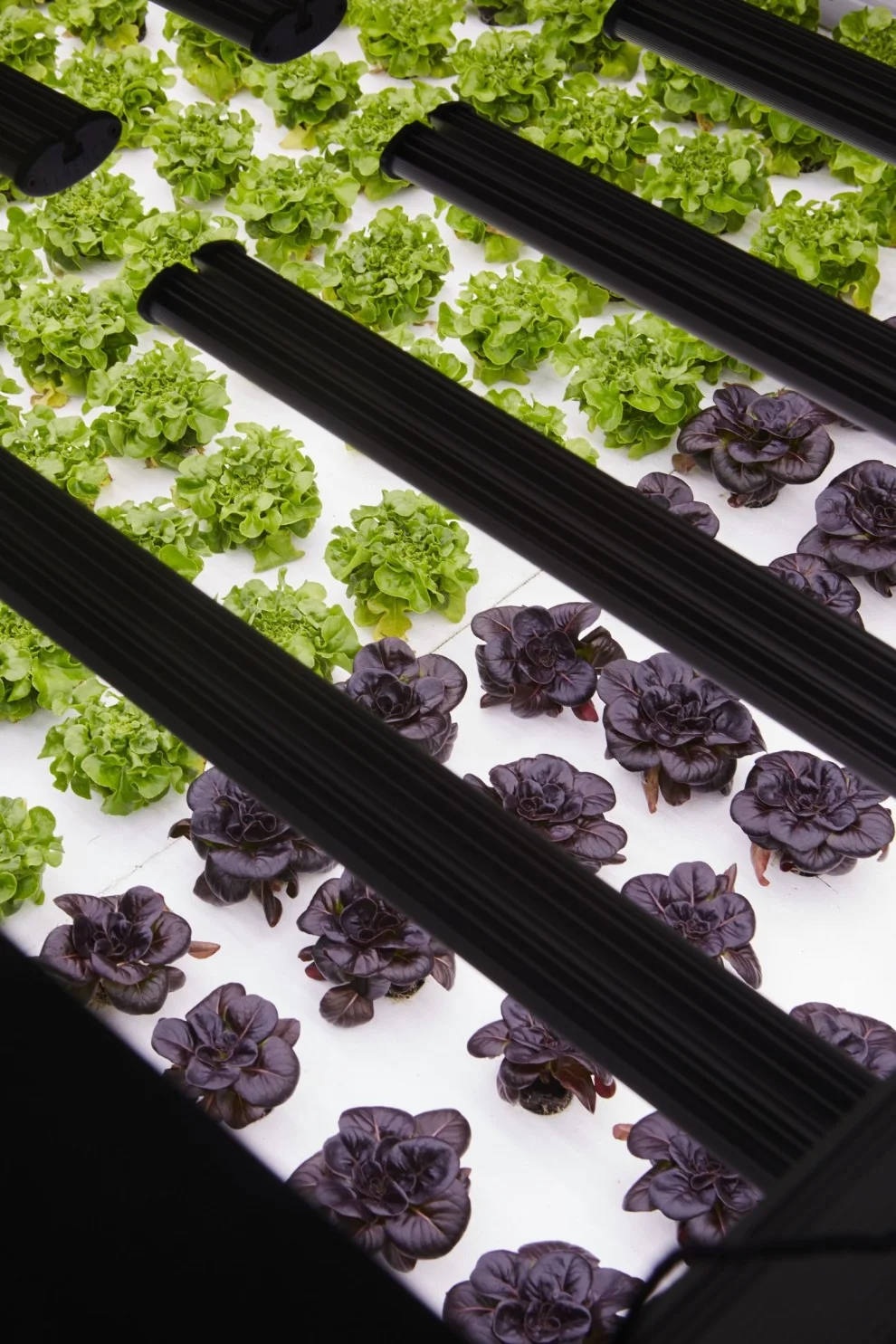
It’s not that surprising, then, that the self-declared farms of the future look more like an Amazon data center than an organic apple orchard. A wave of companies are rushing to figure out how to grow commercial volumes of food in giant urban warehouses, using LED lights instead of sun, and stacked shelves of nutrient solution instead of soil.
This particularly tech-centric model of urban farming us run by computer systems that monitor thousands of points of data and constantly adjust growing conditions. Marc Oshima, co-founder of AeroFarms, one of the world’s largest vertical farms, says the company uses “in-depth growing algorithms where we factor in all aspects from type and intensity of light to nutrients to environmental factors like temperature, humidity, CO2 levels, and we create the perfect recipe for each variety.”
While conventional agriculture companies engineer their crops to design plants suited to their environment — improving mildew resistance, for example — these companies are engineering the environment to match the plant.
None of this is cheap to set up. New Jersey’s AeroFarms has raised more than $50 million and says it can grow 2 million pounds of food each year in the “growing towers” in its 70,000 square foot facility in Newark. Gotham Green invested $8 million to build a rooftop farm in Chicago’s Pullman neighborhood. In February, New Jersey startup Bowery Farming, which attracted $7.5 million in a seed round, began selling locally grown leaf vegetables at Whole Foods and a few area restaurants, including Tom Colicchio’s Craft in Manhattan.
These high-tech farms — often led by entrepreneurs with backgrounds in finance and other non-farm businesses — are “definitely more expensive, but the expense is balanced out by more productivity,” said Irving Fain, CEO of Bowery and former Citigroup investment banker. Bowery estimates his facility is 100 times more productive per square foot than a typical farm.
Fain said Bowery’s operating system automatically monitors “hundreds of thousands of points of data on plant health, quality, growth, yield, taste and flavor.” Bowery is also designed to “take processes that are manually intensive and automate them” so that “the farm runs itself,” more or less. And because the environment is tightly controlled and there are no seasons, there are more harvest cycles — AeroFarms has up to 30 harvests each year.
So far, these capital-intensive indoor farms have focused on growing trendy greens that can be sold to the area’s salad-eating yuppies — baby kale, butterhead lettuce, arugula, and basil. A box of AeroFarms greens goes for $3.99, and Bowery Farming’s salad greens retail for $3.49, which is a lot more than a head of iceberg lettuce. And that’s the main challenge these startups face: there’s no shortage of cheap produce in supermarkets today.
It’s a pricey, niche product for now, but the companies have bigger plans. “As we scale, we plan to continue to drive down our costs and deliver the highest quality produce at a price that makes it even more accessible to all,” said Fain.
Oshima said AeroFarms is looking at other crops: berries, peppers, and cucumbers. “Our lens is on how we can transform agriculture around the world,” he said.
Realistically, these vertical farms “will never grow enough to feed cities,” said Danielle Nierenberg, cofounder of the nonprofit Food Tank. Grains like wheat, for instance, simply require more space than a warehouse can ever provide. But at the very least, she said, they bring some fresh food to urban communities, and may one day even create a new type of urban green space.
Bowery grows its greens hydroponically in a commercial warehouse in Kearny, New Jersey. The company says its farm requires 95% less water than a traditional farm and uses no pesticides or chemicals — and its location means its greens need to travel less than an hour to make it onto Manhattan restaurant plates.
These products can’t be called organic — that label generally refers to food grown in soil —so Bowery describes the model as “post organic.”
“This is the next evolution in produce,” said Fain. “The USDA’s organic standards were written at a time when the technology that’s available today simply didn’t exist.
The high startup costs associated with these ventures — the lights, the software, the urban real estate — mean the risks are also high. “Unless you’re in a place with geothermal power, this can be very energy inefficient,” said Food Tank’s Nierenberg. “In the same way we romanticize rural agriculture, we can romanticize growing food in urban places.”
In January, the hydroponic farm FarmedHere closed its 90,000 square foot facility in Chicago and pulled the plug on plans to invest $23 million in a new farm in Louisville, Kentucky. The company’s high labor and energy costs meant it needed to sell huge volumes of produce to break even, CEO Nate Laurell told the Chicago Tribune. “The more I learned about the reality of farming, it led to a change of strategy”
Atlanta vertical farm PodPonics closed last year. Its co-CEO Matt Liotta recently spoke of the tough realities of the business at an industry conference. PodPonics achieved a cost per pound of $1.36 — less than the cost of shipping organic lettuce from California. The company had an offer from Kroger to order $25 million woth annually, if it could build the farm to support it.
“This was our wildest dream, we were ready to go, this was everything we wanted. And then we realized how much capital this was going to require, how many people we were going to have to hire,” said Liotta. “We were simply incapable of building everything they wanted.”
“This is really a manufacturing game,” Liotta said. “It is not an art. If you want to do art, get a garden.”



Urban Farming Insider With Professor Aaron Fox: Urban Farming Expert and Educator
Urban Farming Insider With Professor Aaron Fox: Urban Farming Expert and Educator
Dr. Aaron Fox is an urban farmer and professor who was recently hired to start an Urban and Community Agriculture program at Cal Poly Pomona in the Los Angeles area.
He and his colleague, Eileen Cullen, are developing classes on production, business, policy and community development all related to urban farming.
They will be offering a “Minor in Urban and Community Agriculture” starting Fall 2018. We caught up with Aaron to discuss his insights on urban farming, discussing:
- Is urban farming just a fab?
- How do you plan for a commercial urban farm correctly?
- What are trending crops he is hearing urban farmers are growing
- What conventional urban farming wisdom is wrong
- Questions he most commonly answers from his students interested in urban farming, and his answers
and much more! Interview below:
Introduction
UV: Can you tell us a little more about the urban farming minor program you're developing at Cal Poly Pomona, a little bit about yourself, and your students?
Aaron: We're getting lots of students that want to learn how to produce food, but they want to do it in the places where they're coming from, like East LA and
more densely populated areas.
So that requires some particular skills and a little bit different than traditional ag programs.
So they hired two of us. They hired me. I was most recently at Michigan State University. And they also hired another professor, Dr. Eileen Cullen, who was a professor at University of Wisconsin, Madison.
UV: What's your background?
Aaron: My background is, I did my PhD at North Dakota State University in organic agriculture. I was particularly looking at pest management in organic systems but honestly it was in larger scale, more traditional agriculture.
My real experience with urban food systems was actually prior to graduate school when I was working actually in the area you're in right now. I was up in Monterey (California).
I was working in Salinas a lot on school gardens, nutrition, education. I was helping out a local farmer there on her CSA.
So I got a lot of experience actually prior to my academic career in urban agriculture.
I think one of the other reasons that I was hired for this position is I'm really passionate about teaching, and Cal Poly Pomona is a school that focuses on teaching and in particular it focuses on a learn-by- doing approach, so they really want students to get hands-on experience, and that's how most of my classes are run.
Last week we had a drip irrigation class and so we just installed a drip irrigation system up in a garden on campus. And we have composting labs where we're building composting systems, etc.
So it's actually a pretty exciting time to be here right now because we're really building this program from the ground up and we're getting a lot of good feedback, not only from the students but from numerous community organizations in the area that want to partner with us.
UV: And are those organizations commercial or what is their nature?
Aaron: It's a wide variety. We're getting commercial operations, especially indoor
vertical farm operations that are interested in our students, potential hires, or interns.
Then we're also working with non-profit organizations that are working on food access and food justice and trying to bring urban agriculture into the greater Los Angeles area, specifically to address a lot of the food insecurity issues that are happening here.
Is urban farming over-hyped?
UV: So the next question I have is, I was talking to someone the other day and he's been involved in urban farming for many years, before it became what is it today. He was kind of griping about the overdatafication and he was describing the urban farming movement, or at least parts of it as almost like a fetish.
So what is your opinion on the gaudiness of urban ag versus its actual utility? Some people might say, you can't really do urban ag at scale, but at the same time it does have these proven community benefits for urban communities.
How do you separate the wheat from the chaff there as far as the concept of urban ag and its utility?
Aaron: There's lots of research on how urban agriculture can benefit communities, on how it can improve access to nutritious food, how it can enhance incomes, how
it can have social benefits for bringing people together, etc.
Personally for me, especially when I have these young students that are coming in and wanting to do this, one thing that's really exciting is that in agriculture for a very long time now, we've been trying very hard to figure out how to get the next generation of folks interested in agriculture.
We haven't really done a very good job. I mean, the average age of a farmer in the United States is 58 of course. But it's been around that same age for like 30 or 40 years now.
So I think one thing that we're realizing is that through urban agriculture, we can get folks excited about food and farming again. That's really important because we've gotten so disconnected from food and from farming that we don't value it anymore. We don't value our farmers.
We don't value our food. There's consequences to that.
So there are lots of tangible benefits, but I think there's also some broader implications too, to not just urban agriculture but to agriculture as a whole.
Most common beginner urban farming questions?
UV: Right. So next question. You mentioned your students and their enthusiasm. I think that's really interesting because I think a lot of people who come to our
site, they may not be students formerly but they come to the site to engage in student-like activity of learning about urban farming and getting their feet wet at the very least.
So I think it would be helpful if you talked about a couple questions or concepts about urban farming that you repeatedly deal with with students, maybe stuff that seems to be difficult or important to understand and you think that anybody, whether they're a student or not who are trying to learn urban farming, what are a couple of those tough questions and what are the answers?
Aaron: Okay. That's a big question. Honestly, the thing that ends up tripping people up the most with this is not actually growing the plants. We're trying to make sure we impart that with our students.
(Also), we want to make sure that they're not just prepared to grow something in a vacant lot or grow something hydroponically indoors, but that they also understand that to be a successful in this you have to understand policy and rules. You have to understand business.
You have to understand marketing. You have to understand social issues and community issues.
One of the biggest things that I start off with in one of my classes is, I ask them, "What you really need to figure out is your purpose and why you're doing this."
Because that should really dictate everything else. If you're doing this for profit and you're trying to make a business model out of this, you're going to go down a very different path and you're going to be looking for very different things than if you're doing this for an education purpose or for a community purpose.
So I think the growing aspect, it's not that it's easy but that it's relatively straightforward and that there will be trouble-shooting along the way, but the difficult part is actually figuring out why you're doing this and what your goals are.
Honestly, all the (urban) farmers I've ever worked with, it almost always ends being the same thing. I hear them say, "I grow the best tomatoes," or, "I grow the most beautiful greens and nobody's buying it."
That's not where you should be. You should actually reverse that and you should figure out who you're going to be selling to, what they want and then you grow it. Right?
Rather than growing something and then figuring out what to do with it. I think that's tough for a lot of folks to ... That's not how a lot of us get into urban farming, right?
(We typically start) not from the business and marketing aspect. To be successful, you're going to have to take that into account. That applies to if you're doing it for a
community garden too.
I've got lots of folks who say, "We got permission rom the city to use this land and we've got it all set up. And we've got irrigation and ools. And nobody's coming out."
I'm like, "Well, you probably should have figured out who was going to use this before you set it all up."
You gotta figure out what the purpose is and who this is going to affect before you take your first step.
UV: So to rephrase with that kind of anecdote, one thing you find is that people neglect certain parts of the planning process.
Aaron: Yes.
UV: Okay. Right. So a follow-on question to what you just said, you highlighted how
there's differences between a profit urban farming system and, let's take for example, a community benefit system.
So you could you go through a couple bullet points of what each one has maybe in common, maybe what the differences are. People might ask, "Is the crop that you're going to grow be targeted for size or what are the characteristics for isolating those two specific use-cases?
Aaron: Yeah, I think the easiest thing to concentrate on that subject is if the crops are going to be growing for profit system, you're going to need to figure out the crop that's going to bring you the highest return.
We built an indoor growing facility here on campus just out of a shipping container, and I made the same mistake. I let my student just go down the path before we actually figured out exactly what the purpose of this thing was.
Once he built it all out, we realized there was really nothing that he was going to be able to grow in there that was going to pay for all the cost of maintaining it.
Except for maybe micro-greens, and so that's what he was left with.
Especially if you're in Southern California where we have like essentially 365 days of sunshine. We've had farmers tell us, "Why are you growing something indoors. You can just do it in a greenhouse here."
So you have to think about, especially from a small-scale urban standpoint is, what can you produce that is not only in demand but that you can have a competitive edge on?
It's basically figuring out what is it that the market wants that they can't get now that you can provide?
Whereas so it's going to be really specialty niche things, and you're probably going to focus on just a handful of products.
UV: What kind of stuff would that be?
Aaron: There's lots of opportunities now for things like micro-greens, for specialty mushrooms.There's some big things right now that we've been asked about.
There is some opportunity for tropical specialty fruit, but you have to be careful because that's kind of a longterm investment and you have to make sure you have the resources to put in a longterm investment for something like fruit trees.
There's some other opportunities as well, there's some folks that are doing quail eggs and things like that in an urban environment and they're finding some good markets for that. It's really kind of finding the specialty market that you can connect with and communicate with and find what they need.
There's lots of opportunities for different culturally significant produce items that are harder to find in traditional venues. Things like that.
UV: Okay. That's the for-profit use-case. What about the community benefit side of
it?
Aaron: I think maybe I'll talk about specifically things for educational purposes. Again, if you're supposed to be using it as a teaching garden, you need to figure out what are you going to be teaching.
A lot of folks, they set up a school garden, they just are like, "Well, I'm going to do a pizza garden." And that's perfectly fine, but you have to actually think about what curriculum you're going to be teaching in that class.
Specifically, how are you going to get buy-in from the stakeholders? How is the principal and the teachers and the parents going to maintain interest in your garden.
It's going to come down to your garden meeting the needs of those stakeholders.
We have a couple students that I've been working with and they said, "You know, I was given permission to take this plot of land over at this school and I've put a lot of effort into it, but I'm not really getting any interest from the administrators or from the parents or from the teachers."
They said what they're really interested in right now is focusing on cultural heritage and they feel like the garden is secondary. And I told her, "This is a golden opportunity. You just need to shape the garden so that it's growing things that are culturally appropriate.
You can teach those lessons about cultural heritage in the garden."
Then from a non-profit standpoint, basically it's making sure that the community you're serving is served by the things you're growing. It's interesting.
This is kind of like a longterm process. But in an urban environment where you're trying to get more stakeholders involved ... I have this non-profit that I was working in Long Beach, and they were growing all these funky heirloom tomatoes that were I'm sure delicious, but nobody wanted them.
Because in the community they we're in, they wanted the boring spherical red tasteless tomato because that's what they were used to.
So you have to take baby steps with some of these things and meet folks halfway, try and provide some opportunities for them to listen to you, you to listen to them and figure out how you can meet everybody's needs.
UV: Great. So one question for you and then I'll have to finish with a couple of rapid-fire questions. The last formal question I have is, you mentioned your background is in pest management with the commercial scale. In your opinion, do you think beginners in urban farming need to worry about pests? And if they do, what are some issues they may encounter and how does the commercial pest management downsize to the urban farming pest management, if it does?
Aaron: Yeah. That's a great question. Because I've actually had some urban farmers tell me that they're working on such a small scale that they don't really need to worry about pests because they're so intensive and they're so on top of things that they'll just be able to deal with it when it comes up. And I think, honestly, that's just a huge gamble.
I think they're just lucky that they haven't encountered anything yet. The main thing that you can gather from the larger scale commercial growers is just all the cultural methods of managing pests.
There's reasons why the larger guys are rotating their crops. There's reasons why they're doing cover crops. All these things.
The feedback I get from the smaller scale urban guys, it's like, "I just don't have the time and space for that." If that is the case, I understand that there's some legitimate space issues, you're going to have to prepare for that and realize that you're inviting in some potential pest issues.
So I think pests have definitely been a problem. We've got some invasive pests down here that are just preventing folks from growing any brassicas in the summertime. And that's huge. That's a huge swath of crops there.
UV: What are some examples of those pests?
Aaron: Bagrada bug is the one I hear about the most. It just tears up (brassicas). There's a lot of opportunity to grow kale because there's a lot of restaurants and smoothie shops and juice shops and stuff that really want kale, but you try and grow it i the summertime down here and it just gets torn apart by bagrada bugs.
UV: Okay. Bagrada. Bagrada bugs. And is like a kind of aphid or what is that?
Aaron: It's in the same broad category of sucking insects. Yeah. It's a true bug.
What's interesting about that is it's originally from somewhere I think in Africa. How did it get here? Where was it first seen? Did it come in through Mexico or something like that?
The fist place they saw it was at the Port of Los Angeles. That's how things get in around here.
So that's a big one. I think it's really those types of big invasive ones that we have real problems with. With aphids and things, folks feel pretty comfortable with ways of controlling them.
Again, whether they're using just physical control methods, like spraying them off their crop, or actually introducing some biological control or using some kind of natural pesticide, etc.
But it's every once in a while that these big pests come in and there's no solutions to it. It sometimes comes down to cultural methods. There's folks in the UC system that just kind of said like, "Just stop growing brassicas for a while." Which again is a tough call.
But I'm actually doing some research right now, looking at whether we can figure out some ways to control some of these big insect pests, like bagrada bugs.
There's some opportunities actually in smaller-scale agriculture because of course the big guys are dealing with this. But one thing that I'm looking into, and this sounds crazy, is actually using a reverse leaf-blower to suck the things up.
Aaron F. Fox: Again, you can't do that in larger scale. It's just the logistics and feasibility are absurd. But if you're dealing with an acre or less, that's not too hard a proposition.
Rapid Fire Questions
UV: Cool. Well, I don't want to be irresponsible of your time. But the other quick questions we usually do, first one being what is your favorite fruit or vegetable? Or both if you can't decide?
Aaron: Okay. Vegetable, I've got a huge list of it, but I think I'll say that I reallyappreciate cool season crops.
I know that they don't get a lot of respect. But Ilove beets and I love broccoli and I love Brussels sprouts. I feel like they've gotso much flavor and there's so many interesting things you can do with them.
I feel like I'm having to contain myself here.
Fruits are interesting because I've always loved blueberries, but my wife and Ihave both spent some time living abroad in tropical countries.
So we love a lot of these tropical fruits. Typically the places we've lived before Southern California, we didn't have access to them, but on campus here we're starting togrow a few tropical things, like we've got some mangoes growing, we've gotsome rambutan growing.
So we'll see if those turn out. We're actually growing coffee here, so it's cool to see what we're going to be able to accomplish.
UV: Next question is, what's your favorite urban-thought- related bookthat you think people should check out? Since that's kind of a narrow topic, if you can't think of one, what's your favorite book in general that you think people should check out?
Aaron: That's a good question. One thing that I find is that folks will read one book orone method and they'll feel like that's the only way to do it.
So what I would really suggest folks do is get your hands on books that tell you to do things just in as completely different ways as possible.
I try and teach my students about spin farming and I try and teach them about permaculture and we talk about just how radically these two things can be.
(We also talk about of course, how similar they are as well.)
I think it's good to really expose yourself to abroad swath of material out there and get an idea of all the different ways of doing this and really start figuring out your own way.
UV: Okay. With that being said, do you have a specific title in mind?
Aaron: I think I will refrain from giving a specific title. I think there might actually even be legal issues with me sponsoring something.
UV: What about a non category-specific book, any book?
Aaron: Any book? Oh my goodness. Typically when folks ask me what my favorite book is, one of the books that comes to mind is a book called "Mountains beyond Mountains."
It's about Paul Farmer who's this public house expert that setup a clinic in Haiti. It's really inspiring, but honestly one of the most inspiringparts is just the concept that the title says.
Basically, it's this Haitian proverb ofsaying that beyond mountains there are mountains, right?
There will always be challenges and there will always be things to overcome. And that's not supposed to be a pessimistic way of looking at it.
It's just a way of saying beprepared and be savvy and be ready to take on this adventure and to be excitedabout it and to be passionate about it, but also be realistic about it.
UV: The last one is what's one belief about urban farming that you believe in and that's contrary to conventional belief or conventional wisdom?
Aaron: That's interesting because I kind of am the "conventional wisdom guy" here, so...You're talking to a scientist.
Let me see if I can come up with something.
Well, one thing I would like to say is this idea that (urban farming) is a fad, right?
I have a lot of old-timers tell me this whole thing of growing in a city and having local food and farmers markets and stuff, we did that in the 1970s, and it went away. So they said, "What's the point ofyou doing it again? What can you actually accomplish here?"
I do not think that this is a fad. I think that this is a really legitimate way of bringing people together, creating communities through food and creating really awesome entrepreneurial opportunities for people in the city.
I think if we can stick to some of those core values, this is just going to continueto take off. I think that there's a lot of government support now. There's a lot ofcommunity support.
There's a lot of industry support for this. And I think, yeah, not every urban farm is going to thrive and survive and not every farmersmarket is going to last indefinitely, but I think this is a really exciting time because I think we're making some really lasting change here and really buildinga really lasting movement.
UV: Great. If people read this article and they want to enroll in your program or atleast find out more information or apply, where should they go?
Aaron: We're still building our website right now, but they can connect with me on Twitter and they're welcome to send me emails.
Twitter, my handle is my fullname. So that's @aaronfreemanfox.
I update, especially on the classes I'm teaching and the activities we're doing and the field trips we're going on, the people we're meeting with.
And then that's connected to Facebook as well. Then for enrollment purposes, we'd love to have folks come out and enroll and be part ofour program.
There's a couple things that are going on. One, in 2018, we're rolling out anurban agriculture minor.
So you would come here at CalPoly Pomona and you can major in whatever you want to major in and you would have a minor in urban agriculture.
Then we're also talking abouthaving a public program, a certification program in urban agriculture that you wouldn't have to be a Col Poly Pomona traditional student for.
Thanks Professor Fox!
Aaron Fox, Ph.D.is an professor of urban and community agriculture at California State Polytechnic University in Pomona. Follow him on Twitter at @AaronFreemanFox or Facebook at AaronFox. To find out more about the urban agriculture minor program launching at Cal Poly Pomona, check out https://www.cpp.edu/~agri/plant-science/
Modular Farms Newsletter #7
February was a very historic month for Modular Farms. We harvested our first batch of fruiting crops, trained our first class of Modular Farmers, put FarmWalls up in schools and food banks, and began wrapping up production of our first set of Modular Farms!
Modular Farms Newsletter #7
February was a very historic month for Modular Farms. We harvested our first batch of fruiting crops, trained our first class of Modular Farmers, put FarmWalls up in schools and food banks, and began wrapping up production of our first set of Modular Farms!
We are extremely proud and thankful for all the tireless work and dedication that has been put forth by our team, our neophyte farmers, and our community partners. Together, our continued efforts are bringing Canada that much closer to having a truly sustainable and secure means of local food production from coast to coast.
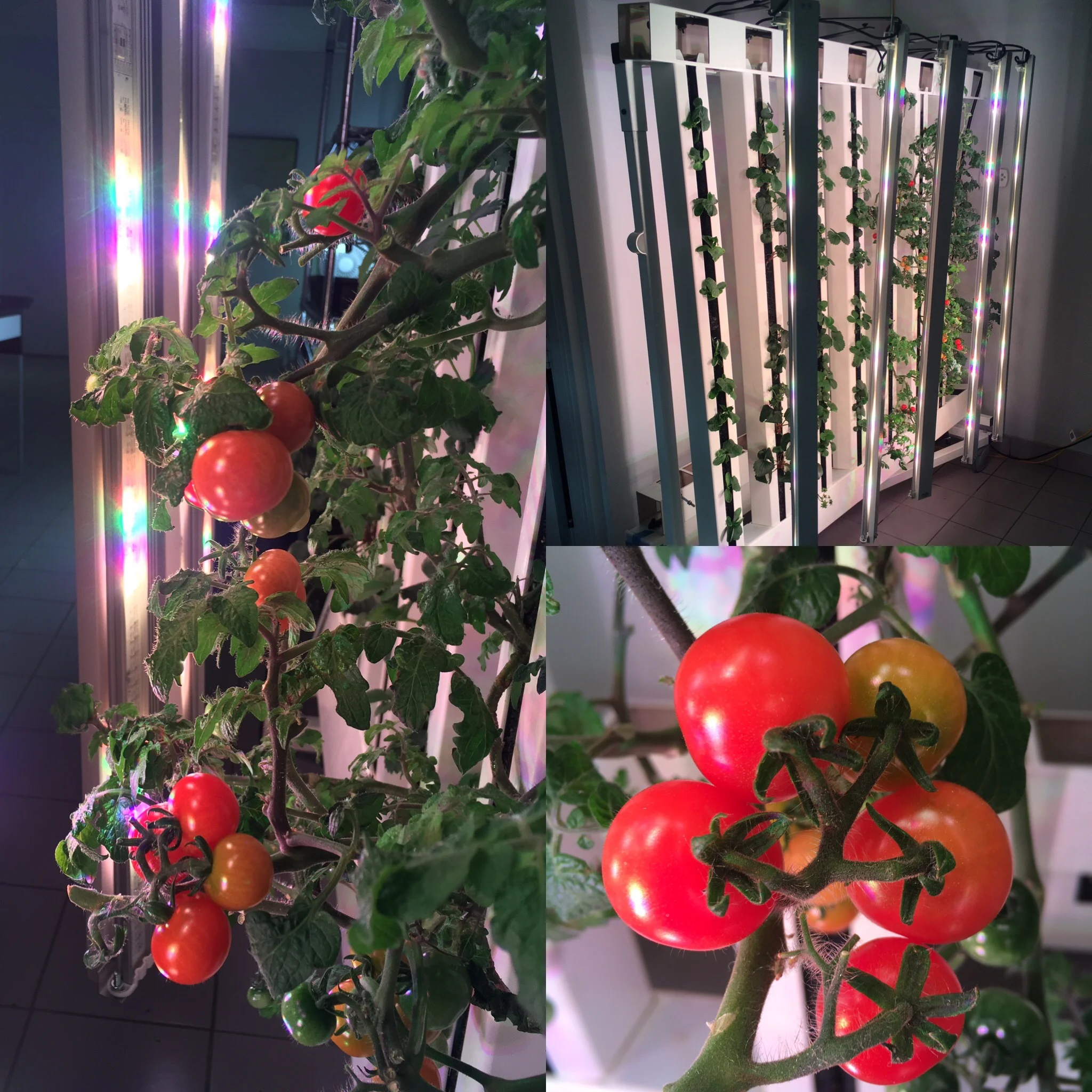
Our foray into cultivating fruiting crops on our office ZipGrow towers has been a great success so far. As you can see from the above photos, our daily Tomato harvests are in full swing and the yields have been more bountiful than we initially imagined. Our first big batch of Strawberries are also beginning to ripen and soon Cucumber and Hot Pepper sprouts will find a home alongside them.
We also decided to give our ZipRack a big upgrade this month by swapping out its standard T5 white lights for Intravision Spectra Blades. The Blades are the same lights we chose to utilize inside our Modular Farms, and for good reason - they make a world of a difference. The spectrum variable LEDs add a new depth of flavor and vibrancy to anything being grown beneath them, while simultaneously increasing their photogenicity by 1000%.
We are proud to announce that February 2017 marked the first official month of Modular Farmer training. Over the past few weeks, our first crop of farmers-to-be have made their pilgrimage to Cornwall, where they received some rigorous, hands-on, tutelage from the Smart Greens gurus. All that's left now is for them to receive their farms and begin the rewarding process of reshaping Canada's access to locally grown, sustainable produce one area at a time.
The first few areas to reap the benefits will be Calgary, via the Vertically Fresh Farms team, and Sudbury, via our first Western Ontario-based Smart Greens brand farm, courtesy of Stephane Lanteigne.
The west coast extension of our team - Ethan and Cole - have been doing some incredible philanthropic work within their community. Their company, Living Garden Foods, has recently partnered with the US-based Modern Steader in order to bring their industry leading hydroponic-based classroom curriculum north of the border. They have also help to set up some student-run FarmWalls at the Zion Lutheran Church in Cloverdale, BC, which operates a food bank that is now proud to offer those in need regular servings of fresh salad vegetables.
If you're Canadian, and have found yourself on the fence when it comes to purchasing a FarmWall, now might be the time to pull the trigger. For a limited time, all of our FarmWalls are currently being shipped free of charge to all customers residing in Canada. However, we must warn you that owning and operating a FarmWall will turn you into a snob. You will start questioning the taste and freshness of any other produce you eat that was not directly seeded, grown, and picked by you.
Once again we managed to scrape together some time-lapse footage to get you all quickly brought up to speed on this months transpirings at our office. As you can see, emails were answered, seeds were sown, fruits were ripened, wood was cut, and farms were built; another month in paradise.
Stay tuned for the next installment of our newsletter!
Hungry for more?
Here's some recent updates and tips from our friends at Bright Agrotech -
Learn by Doing: How to Use a Pilot System to Learn Vertical Farming
by: Amy Storey
Modern Hydroponic Production: Why All the Right People Are Wrong
by: Nate Storey
The 6 Main Challenges of Classroom Gardens (And How to Overcome Them)


Wannabe Urban Gardners, How About This Indoor Farm to Get You Started?
If the idea of urban gardening appeals but you're concerned about space, then the Altifarm is definitely worth a look.
Wannabe Urban Gardners, How About This Indoor Farm to Get You Started?
By Trevor Mogg — March 2, 2017 12:40 AM
If the idea of urban gardening appeals but you're concerned about space, then the Altifarm is definitely worth a look.
If you’ve always fancied tending your own vegetable garden but live in a place so small that such a hobby seems impossible, then there may be a solution.
The Altifarm is a modular solution for wannabe urban gardeners that lets you grow vegetables and herbs year-round, inside your apartment.
The Indiegogo project recently blasted through its funding target, so the Altifarm could be in your lounge, or possibly on your balcony if you have one, within months.
Described as “a complete home farm,” the kit comprises four tiers to keep it compact and, according to its Mumbai maker, can be set up in just five minutes. It’s on wheels, too, so you can easily move it around if necessary,
And here’s another bonus: If watering your garden feels like too much effort, or you’re worried about forgetting such duties, then fear not. The setup includes an automatic watering system, with your only responsibility to fill up the reservoir around once a week.
If your apartment doesn’t let in much natural light, the Altifarm also offers a low-power light pack that provides all the necessary light wavelengths to get your greens growing fast. There’s even a purpose-built greenhouse extension pack — essentially a clear plastic covering with a zipper — to protect your plants from extreme weather should you choose to put your Altifarm outside.
If you’re still making excuses about why you can’t grow your own food at home, then consider how everything that you produce will be free from all of those nasty chemicals used in modern-day industrial farming.
More: New farming startup takes agriculture indoors
Of course, as the Altifarm is fairly small, growing large fruit and vegetables would be something of a challenge. But the startup helpfully suggests nourishing edibles such as strawberries, raspberries, bell peppers, lettuce, herbs, and even broccoli and cauliflower. But take note, the setup doesn’t come with soil or seeds, so it’s entirely up to you how you fill it. The green-fingered crew behind the kit has a website providing tips on how to get started with your Altifarm with posts such as “12 awesome foods that are perfect for your indoor garden” and “a guide to growing vegetables and flowers from seeds.”
The Altifarm’s Indiegogo page offers a range of deals depending on how many extras you purchase with the base product. Prices start at $179, offering a decent saving of $70 on the expected retail price.
Read more: http://www.digitaltrends.com/home/urban-gardeners-altifarm/#ixzz4aB3T3NLa
Follow us: @digitaltrends on Twitter | DigitalTrends on Facebook

ICCEA 2017: Dr. Toyoki Kozai’s Take On Vertical Farming
ICCEA 2017: Dr. Toyoki Kozai’s Take On Vertical Farming
The celebrated researcher and ICCEA Panama keynote speaker looks back on his career and toward the future of controlled environment agriculture.
March 2, 2017
Patrick Williams
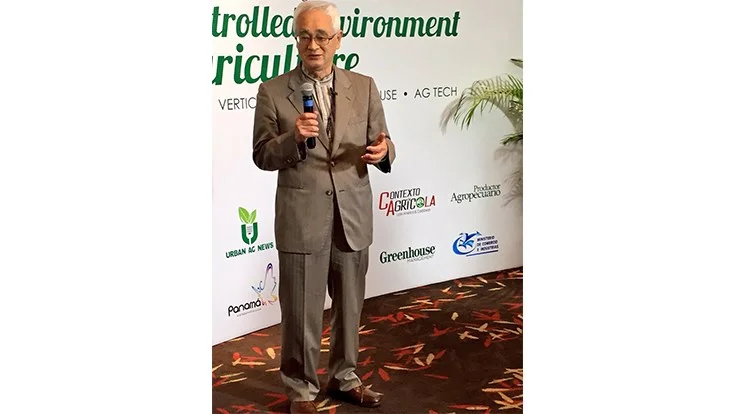
Also known as the “Father of Vertical Farming,” Dr. Toyoki Kozai, professor emeritus at Chiba University in Chiba, Japan, has been making strides in controlled environment agriculture for decades. From his work on energy savings and artificial lighting to his studies with in vitro plant propagation and medicinal plant production, Kozai has earned the high esteem of controlled environment agriculturalists worldwide.
Kozai, who previously served as president of Chiba University and has edited numerous papers, book chapters and the books “Plant Factory” and “LED Lighting for Urban Agriculture,” will give the keynote speech on May 17, 2017 at the International Congress on Controlled Environment Agriculture in Panama City, Panama. Produce Grower is proud to be a media partner for the event.
As ICCEA Panama approaches, Produce Grower magazine caught up with Kozai to discuss his vertical farming and lighting research, new technologies and methods of production, and which countries and companies are expressing interest in the growing market.
Produce Grower: Your keynote topic is titled "LED lighting for Urban Agriculture." How is LED lighting different for urban agriculture than for agriculture in other types of controlled environments?
Dr. Toyoki Kozai: By using LED, we can choose an optimal light quality for vegetative growth, reproductive (flowering) growth, and/or secondary metabolite production of crops with use of minimum electricity consumption. Inter-crop supplemental lighting can be conducted most efficiently by using LEDs. LED technology has still been advancing rapidly and the cost performance of using LEDs will be improved further in the near future. Optimal LED lighting recipe for value-added plant production will open a new business (cosmetics, medicinal, plant-derived food/soft drink additives).
PG: What else can ICCEA Panama attendees expect from your presentation?
TK: I will talk about the applications of AI (artificial intelligence) with big data mining, ICT (information and communication technology) with camera image processing, and global and local network with open source database.
PG: How has the vertical farming industry changed since you were a keynote speaker at ICCEA 2015?
TK: Many big private companies such as Philips, Panasonic, Syngenta (Seeds), Apple computer, etc. are entering the vertical farming business.
PG: Can you give us examples of some of the research you have done over the years on vertical farming?
TK: Online estimation of rates of photosynthesis, transpiration (water uptake) and respiration in vertical farms.
Reduction in electricity costs for lighting and air conditioning by improving LED lighting system and lighting period scheduling, operation modes of air conditioners, and optimization of environmental factors other than light.
Standardization and guideline drawing-up of units and terminology used in vertical farming.
PG: Which research projects have you found to be most fulfilling?
TK: The most fulfilling project for the next generation of vertical farms is the online estimation of rates of photosynthesis, transpiration (water uptake) and respiration in vertical farms.
PG: What is a Plant Factory with Artificial Light (PFAL), and why is it important for CEA?
TK: PFAL is a group of vertical farms. PFAL is characterized by its high airtightness, high thermal insulation with a high hygiene level, where they can produce clean and high quality vegetables ready to eat without washing. The PFAL is best not suited to maximize the yields with highest quality using minimum resources and minimum emission of wastes currently, but it will become best in the coming decades.
PG: In an interview with Greenhouse Management magazine in 2015, you said Japanese CEA greenhouse innovation is behind the Dutch? Do you still feel that way? Is Japan catching up at all?
TK: Yes, I feel that Japanese CEA greenhouse innovation is still behind the Dutch. Japanese CEA greenhouses are small scaled and cannot invest a lot for innovations. On the other hand, most greenhouse growers are making profits because the retail prices of vegetables are high in Japan. This situation make Japanese greenhouse growers a bit lazy.
PG: What response would you have for a person who does not think that the high cost of vertical farms is worthwhile? What about in regard to LED lighting?
TK: The cost of vertical farms has been decreasing year by year.
The initial cost per floor area of vertical farms is currently about 10 times higher than that of [a] greenhouse with environment control units. On the other hands, the productivity per unit floor area of leafy vegetables is about 10 times higher than that of greenhouse, meaning that initial cost per production capacity is comparable. Also, the yield in vertical farms is not affected by weather and pest insects. The direct production per kilogram of fresh vegetables in vertical farms and greenhouses is currently comparable in Japan.
However, you need very high skills (knowledge, experience, etc.) to manage the vertical farms.
The price of LEDs has been decreasing year by year. On the other hand, the introduction of LEDs to vertical farms is justified only when they know which LED is best and how to use it.PG: You recently released the book "LED Lighting for Urban Agriculture." What led you to develop this book? How is it different from other books on the market?
TK: Recent technological developments in LEDs, image processing, big data mining, [and] DNA sequencing are remarkable. I intended to include such recent technological developments in "LED Lighting for Urban Agriculture." In “Plant Factory” published by Academic Press in 2015, these technologies were described very little.
PG: What does the future look like for vertical farming?
TK: It is promising. Commercialization of vertical farms started in Asian countries such as Japan and Taiwan since 2010. It is going to be started in the Netherlands this year. Russia has a strong interest in the vertical farming business.
Commercialization of strawberry production in vertical farms started in Japan two years ago. Commercialization of high-wire cherry tomato production has been considered in the Netherlands. Many private companies are interested in the production of medicinal plants in vertical farms.
Patrick Williams is the associate editor of Produce Grower magazine. pwilliams@gie.net

Fish And Fresh Greens At The Farmory in Green Bay
Inside an old armory now called the Farmory - fish swim and greens grow. A collaboration of many aimed at creating this indoor farming system, to eventually help people learn how to help themselves.
Fish And Fresh Greens At The Farmory in Green Bay
By: Kris Schuller
Posted: Mar 02, 2017 07:04 PM CST
Updated: Mar 02, 2017 10:18 PM CST
GREEN BAY, Wis. (WFRV) - An old armory turned into the Farmory continues to move forward in Green Bay. We head inside this indoor farm that one day may provide the perch for your favorite fish fry.
Inside an old armory now called the Farmory - fish swim and greens grow. A collaboration of many aimed at creating this indoor farming system, to eventually help people learn how to help themselves.
“We want to transform the local food economy and show there is an opportunity for Wisconsin residents to grown year-round either in their homes or businesses for themselves.” said Alex Smith, director of the Farmory.
In operation for a year, part of NeighborWorks Green Bay, this non-profit indoor aquaponics farm grows yellow perch in tanks and leafy greens in potted soil.
“It's a symbiotic relationship between the two,” said Jimmy Pandl, a member of the board Farmory. “The fish waste feeds the plants; the plants need the water and it's recirculated to help the fish grow.”
Farmory Director Smith says the goal is to have 50 aquaponic systems in operation by the fall and to grow 173,000 pounds of mixed salad greens each year. In fact, it is a crop that is already bringing in cash.
“February 1st, we actually sold our first batch of mixed greens to The Cannery and they’ve been using them ever since,” said Smith.
As for the perch Pandl expects they'll bring 50,000 fish per year to market.
“We want to do perch because of the history in the community here and because of the demand really - we know we can sell it,” said Pandl.
“People love yellow perch, it's the Wisconsin fish for any fish fry,” said Smith.
But to operate at capacity as an indoor agriculture center the Farmory needs to raise $3.4 million. Smith says those efforts are underway and the goal will be met. She believes the community sees the Farmory's value and the area's need.
“The Farmory is really here for a long-term solution to the food insecurity in this community,” Smith said.

Indoor Farming Company Launches in Kearny
Indoor Farming Company Launches in Kearny
Caitlin Mota | The Jersey Journal
By Caitlin Mota | The Jersey Journal
on March 02, 2017 at 2:34 PM, updated March 02, 2017 at 4:16 PM
KEARNY - A new farming company is growing its produce at a quicker and more cost-effective rate than traditional farms.
The secret to the success? The produce is grown indoors.
Bowery, based in the southern section of Kearny, was founded two years ago by Irving Fain and officially launched last week. The company dubs itself as the first to grow "post organic produce."
"We have completely pure and clean crops," Fain said.
By growing produce - like kale and arugula - indoors, Fain said the company eliminates dealing with harsh weather conditions and is able to bring its products to local retailers quicker then other distributors.
Fain previously worked in software and described himself as an entrepenuer. He wanted to take what he learned in the tech industry and find a way to address agricultural issues.
"I saw the power of technology and the power of innovation technology," he said.
More than 70 percent of the country's water supply is used for agriculture, Fain said, though only a fraction of that is necessary for crops to grow.
Sneak peek: Newark's Whole Foods opening Wednesday
Using hydroponic techniques and software that controls the atmosphere inside the farm, produce crews significantly quicker without using any pesticides.
Bowery currently sells six products in locals stores, including the new Whole Foods that opened in Newark on Wednesday. Celebrity Chef Tom Colicchio uses the produce at his New York restaurant and has made investments in the company, Fain said.
The company currently employees 13 people with more hires expected as the it expands. A second farm is already in the works, though Fain said the exact location in the tri-state area hasn't been decided.
Caitlin Mota may be reached at cmota@jjournal.com. Follow her on Twitter @caitlin_mota. Find The Jersey Journal on Facebook.

America’s First Urban ‘Agrihood’ Feeds Detroit’s Poor For Free
Asof 2008, more people live in cities than in rural areas. The United Nations predicts that by 2050, 66% of the world’s population will reside in urban centers. This urbanization comes with its own unique set of challenges — especially when it comes to food
America’s First Urban ‘Agrihood’ Feeds Detroit’s Poor For Free
After hitting rock bottom, Detroit is looking up.
Asof 2008, more people live in cities than in rural areas. The United Nations predicts that by 2050, 66% of the world’s population will reside in urban centers. This urbanization comes with its own unique set of challenges — especially when it comes to food.
Detroit has been a food desert since 2005. The US Dept. of Agriculture defines a food desert as an area where residents are unable to access fresh, nutritious, affordable provisions. In 2010, 23.5 million Americans lived in conditions like these. Food deserts make it difficult for residents to eat well, contributing to obesity and increasing risks for illnesses like diabetes and heart disease.
America’s First Urban Agrihood
The Michigan Urban Farming Initiative, a non-profit, was founded in 2012 to empower urban communities. The group uses agriculture as a platform to promote education, community and sustainability. In November, the Initiative debuted the first urban agrihood — a community designed to provide city dwellers with easy access to locally grown food.
Detroit’s agrihood sits in the North End neighborhood, which once housed middle and upper class families. Now mostly vacant, the North End is in decline. Only one grocery store remains.
Tyson Gersh is the president, co-founder and farm manager of the Initiative. He tells Paste Magazine to think of the agrihood as “a residential development strategy with a working farm at the center.”
The Initiative’s agrihood consists of a three-acre development, including a two-acre garden, a sensory garden for children and an orchard with more than 200 fruit trees. The urban garden provides over 50,000 pounds of fresh, local produce every year to the 2,000 families who live within a two mile radius of the farm. And they do it all for free.
Similar communities exist in areas in Illinois, Arizona, Vermont, Idaho and California. Others are under development in Washington, North Carolina, Florida and Ohio. Detroit’s agrihood is notable mainly because of its location. In Detroit, where the median household income is barely over $25,000 a year, building an agrihood is much different than building one in Davis, California, where the annual median income is almost $75,000.
A Brief History of Community Gardening
The name agrihood seems fresh and modern, but community gardening is far from being a new idea. During World War II, private plots in urban centers produced 40% of the nation’s fresh vegetables. Most of these victory gardens closed down after the war ended.
Agrihoods also share similarities with Israel’s kibbutzim. First established in 1909 in what was then the Ottoman Empire, these small communities let early Zionists farm the land and live according to principles of equality, communal ownership and social justice. Kibbutzim are credited with contributing to the agricultural and political development of the state of Israel.
Today, community gardening is coming back in a big way: In a 2014 study, the National Gardening Association said that from 2008 - 2013, there was a 17% increase in home and community gardening. Surprisingly, the fastest growing demographic of food gardeners are Millennials.
New Plans Take Root
The Initiative’s agrihood isn’t done yet: Next, it plans to build a 3,200 square foot community resource center. There are plans for a center for education, a water cistern and a health food cafe. Most impressively, the Initiative will collaborate with a local General Motors assembly plant to build a collection of tiny homes inside a shipping container.
Each home will contain 320 square feet of living space, including two bedrooms, a bathroom and a kitchen. Employee volunteers will build the units using 85% scrap metal materials donated by GM. Once completed, university student caretakers will live in the units, run the farm and use the land to conduct agricultural research.
In 2015, Detroit News declared that the city was no longer a food desert. Agrihoods can’t take all the credit for this new development, but they’re certainly helping.
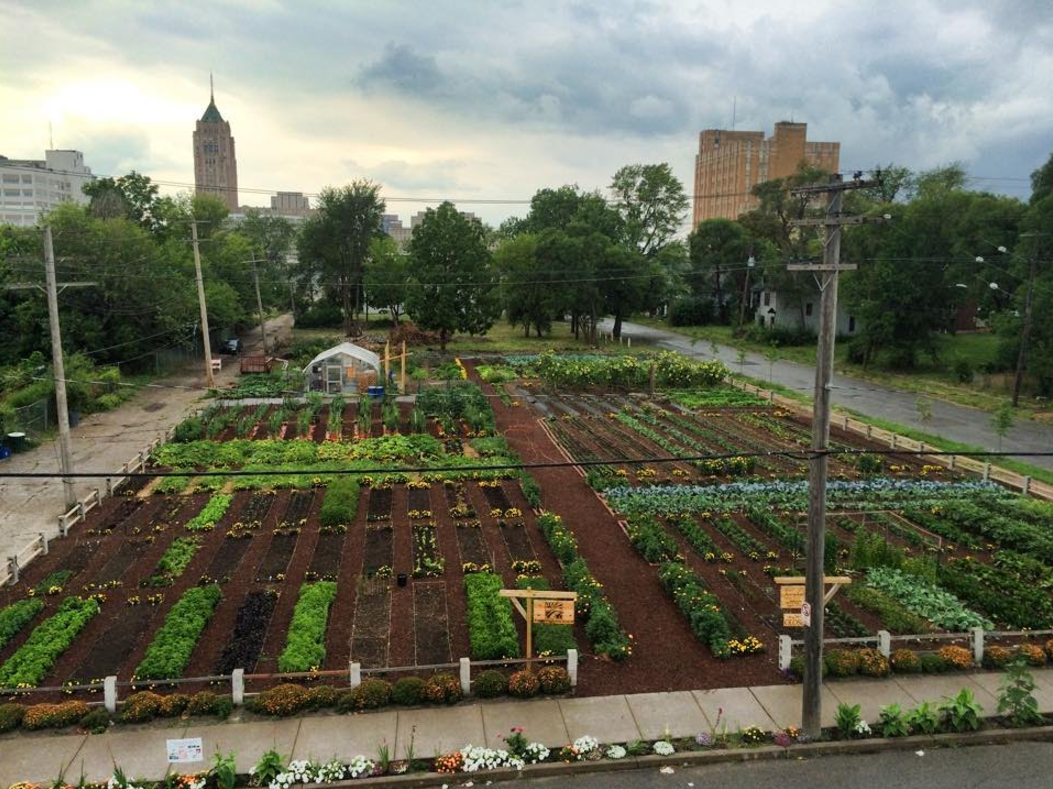

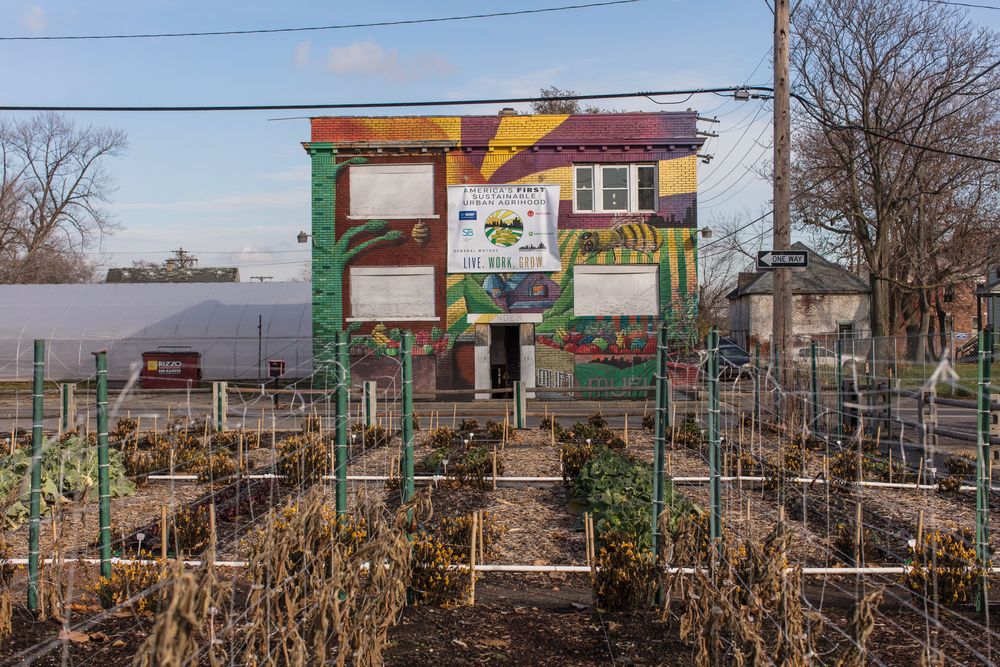
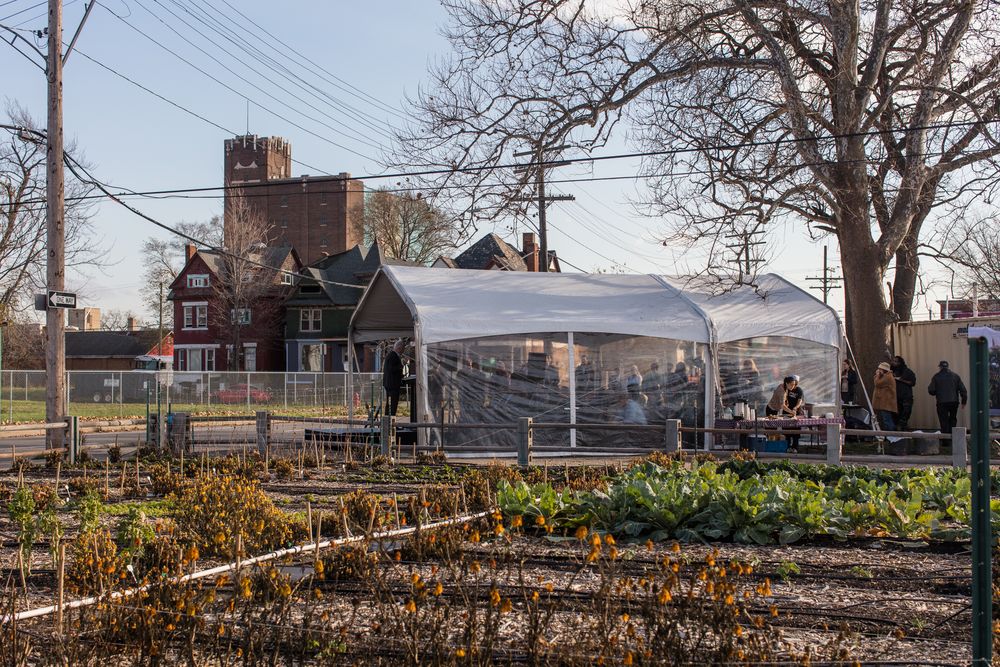

The Future Of Urban Farming Might Actually Be Suburban Farming
The Future Of Urban Farming Might Actually Be Suburban Farming
After dealing with the high costs and logistical nightmares of developing in urban areas, one farming startup realized that they could streamline their process by moving just a bit outside the city limits.
- ADELE PETERS 03.02.17 10:30 AM
When the urban farming startup BrightFarms first launched, it envisioned building its hydroponic greenhouses directly on grocery store roofs and on vacant city lots. Now, it says that the smartest place to grow food for cities may be just outside of them.
The company’s newest site will be in the town of Wilmington, Ohio. With a population of only 12,459, it's not the target market. But it's near Dayton, Columbus, and Cincinnati, which together have a population over a million people.
BrightFarms also has greenhouses in Bucks County, Pennsylvania; Culpeper County, Virginia; and Rochelle, Illinois—all also near, but not in, large cities. The new strategy lets the company avoid the costs and challenges of working on urban sites, while still providing a local version of foods like salad greens that would normally travel thousands of miles.
"Like most good strategies, it was driven by some painful experiences," Paul Lightfoot, CEO of BrightFarms, tells Co.Exist. "Basically, we had a couple of failures. We tried to develop a giant rooftop of a building in Sunset Park, Brooklyn, and we also tried to develop an environmentally soiled parcel of land in the city of Washington D.C., owned by the city."
In both cases, the landowners were eager for BrightFarms to build, and they had strong support from the communities and city leaders. But both sites had challenges. In Brooklyn, the roof needed complex engineering work that couldn't be completed on the startup's timeline; in D.C., the city had to do environmental remediation that also took longer that was commercially viable.
Both cities also had complex regulations that weren't created with urban agriculture in mind. "We found ourselves dealing with a regulatory framework that didn't understand us, and didn't have the ability to adapt to us," Lightfoot says. The projects were classified as "industrial" rather than agricultural, which triggered regulations that didn't fit.
In smaller communities, the experience was radically different. In Virginia, because it was considered an agricultural project, it was exempt from the typical permitting process. "I think we got the permit in a week," Lightfoot says. "In D.C., we spent a year getting it."
The company realized that even if it built outside city limits, it could still stay close enough that transportation would be negligible. BrightFarms sells its produce in 150 stores in the D.C. market, and even if its greenhouses were inside city limits, it would still require driving fairly long distances to make deliveries to all of the stores.
"Being in the city center is not logistically a benefit," Lightfoot says. "Being 30 miles out of the city is just as good as being in the city. The extra cost of building in a city has absolutely no benefit except for maybe shallow, fake marketing, but it has a real significance in terms of capital costs, and in some cases, operation costs as well, including utilities and transportation."
BrightFarms' greenhouses often make use of underutilized spaces: In Rochelle, Illinois, they've set up on an empty lot between a distribution center and a factory that was once farmland, then an industrial park.
Even though BrightFarms sometimes establishes its greenhouses near traditional farms, the startup isn't directly competing with the other operations because it's focused on tomatoes and greens that typically come from California or Arizona. The greenhouses grow the food with a tiny fraction of the water, and provide it fresher to customers. Less perishable crops, such as root vegetables and corn, are left to traditional farms.
BrightFarms plans to use the same model, building outside cities, as it moves forward. After closing a $30 million equity round in September 2016, it plans to open 14 more greenhouses over the next four years.
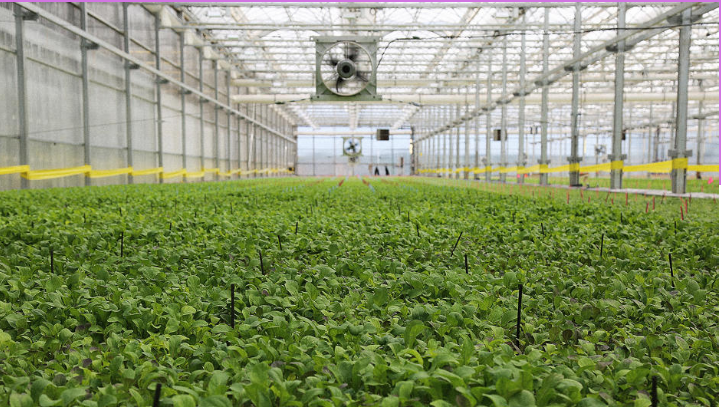
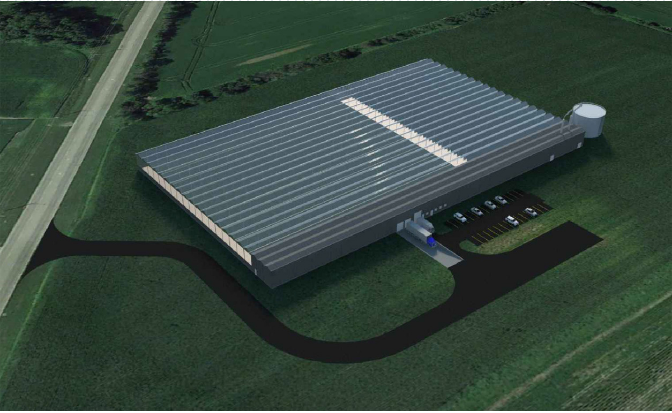
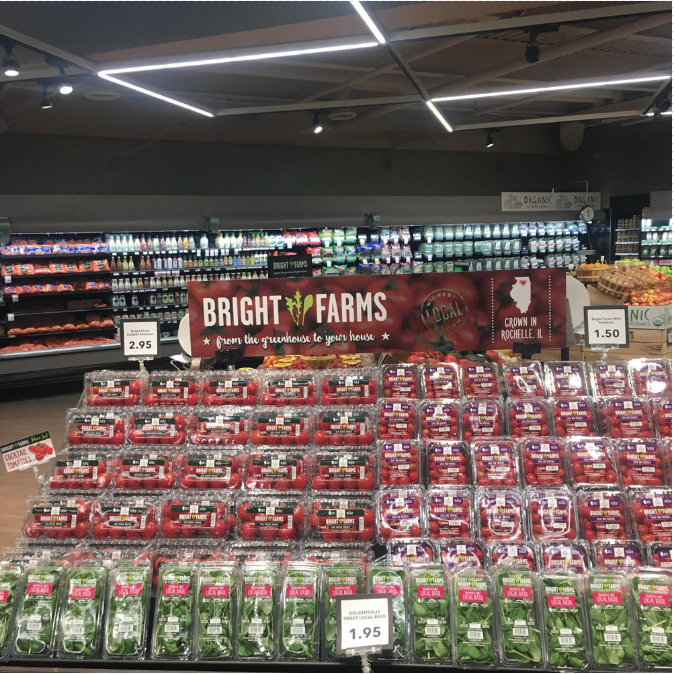
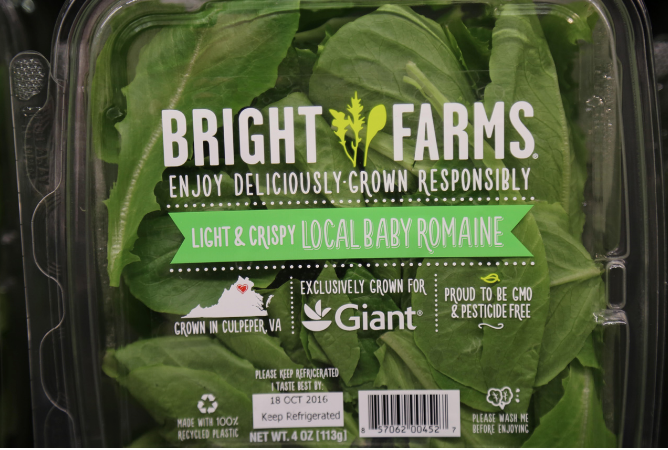

This Vertical Farm Wants to Pioneer ‘Post-Organic’ Food
This Vertical Farm Wants to Pioneer ‘Post-Organic’ Food
by Jan Lee on Wednesday, Mar 1st, 2017 FOOD & AGRICULTURE

Once upon a time, every farmer on earth practiced something called organic agriculture, although they never bothered to coin the phrase.
The cultivators of this amazing pre-industrial concept spent their days diligently tending and harvesting their crops without the aid of manufactured products. They protected their plants with things no longer in abundance: worms, snails, ladybugs, and a full arsenal of homeopathic concoctions passed down from hundreds of years of ancestral heritage. And it was, for sure, a tough row to hoe.
Today’s natural agriculture is still organic by definition, but the mechanics to raising that chemical-free produce are a world away from what your parents might have tried in their backyard.
Most states have regulations and long lists that define organic agriculture and what can, by law, be used during large-scale organic farming. And while today’s organic farms may skillfully manage to avoid the use of controversial chemical sprays with complicated names like permethrin and thiamethoxam (which have both been suspected of contributing to the decline in bee colonies), they typically rely on concentrated non-chemical fungicides and pesticides for large-scale production.
An entrepreneur in Kearny, New Jersey, thinks he’s found the next evolution for agriculture: post-organic. If that doesn’t sound like a very inventive name for a process, the system itself makes up for it.
Irving Fain’s concept of farming does away with the swaths of green space we normally associate with wholesome agriculture. He traded acreage for an urban warehouse, a carefully-managed environment and a proprietary technology that produces food 100 times faster than conventional farming. And all of that without pesticides, soil stimulants or other additives, Fain and his company claim.
Warehouse-based vertical farming isn’t entirely new. Farmers have been dabbling in various versions of indoor farming for centuries, finding new ways to capitalize on its water-saving techniques and, in so doing, finding faster ways to ensure quality production.
But Fain’s company, Bowery Farming, uses its own self-automated technology to respond to and manipulate the environmental factors upon which plants rely.
And unlike most full-scale indoor farming operations, Bowery’s system can “sense” when it’s time to pluck the crops – something that is usually done by sight and schedule in conventional farms. That means less wasted product and more predictable harvesting seasons. It also means a more predictable bottom line.
So far the company’s ‘post-organic’ greens are available in two Manhattan restaurants, a pair of Whole Foods Market stores in New Jersey, and Foragers Market in New York’s Chelsea neighborhood.
With increasing concerns about drought and climate change, vertical farms that can operate in limited space with less water and virtually no natural sun may become the next stage in agriculture.
Whether the ‘post-organic’ concept will eventually be able to overtake the organic market’s sizable revenues ($43 billion yearly), remains to be seen. But in there’s something to be said for an industry that uses 95 percent less water than conventional farming and won’t wither with climate change.

Property Tax Breaks Aim To Help Urban Farms Crop Up
Up and down the state, property owners can receive tax breaks for allowing their unused, and often blighted, urban lots to transform into commercial or noncommercial farms under a law that went into effect in 2014
Property Tax Breaks Aim To Help Urban Farms Crop Up
By Tara Duggan
Updated 4:47 pm, Wednesday, March 1, 2017
Kevin Bayuk (left) and Dorsey Kilbourn of the Urban Permaculture Institute of San Francisco work at the 18th and Rhode Island Permaculture Garden in S.F. in 2014. The garden is owned by a private landowner who later received a property tax break for allowing the land to be used for agriculture under the state’s Urban Agricultural Incentive Zones act. less
Up and down the state, property owners can receive tax breaks for allowing their unused, and often blighted, urban lots to transform into commercial or noncommercial farms under a law that went into effect in 2014. It hasn’t yet resulted in a rash of urban farming, as just four property owners in the state have enrolled so far, including one in San Francisco. But state Assembly member Phil Ting D-San Francisco, wants to extend the law so more cities, and landowners, can take part.
“Urban farming needs more time to take root and help more Californians access nutritious food in their own neighborhoods,” Ting said in a press release. “An urban farm can be an oasis. There is great interest to tame the concrete jungle with green spaces that transform blight into bounty.”
Since the law was enacted, San Francisco, Sacramento, San Jose and San Diego have all passed local ordinances providing financial incentives to turn unused lots into urban agricultural zones for a range of uses, including vegetable farming, beekeeping and nonprofit teaching gardens. The law expires in 2019, and with AB465, Ting proposes extending it to 2029 to allow more cities and counties — which must have a minimum of 250,000 residents — to follow suit.
One of those is Los Angeles, which is working toward passing an ordinance. Unincorporated parts of Los Angeles County, as well as Santa Clara County, already offer the tax breaks.
To apply, property owners must allow farms to stay at least five years to receive the tax break and have property of 0.1 acre to 3 acres in size, with no dwellings on-site. The law assesses the plots’ property value at about $11,000 per acre, the same as irrigated farmland, which can greatly reduce the owner’s property taxes.
In San Jose, a property owner with two adjacent parcels has just turned the land over to Valley Verde, a nonprofit that gives low-income families tools and training to grow their own vegetables in planter boxes.
“It’s a win-win for the owners,” said Art Henriques of San Jose’s planning department. “And the nonprofit gets at least a five-year opportunity to do something productive for some people in the community.”
Tara Duggan is a San Francisco Chronicle staff writer. Email: tduggan@sfchronicle.com Twitter: @taraduggan
Vertical Future: London Based Start-Up to Launch Device to Tackle Air Pollution In Major Cities
Vertical Future’s overall mission focuses on three themes: food, digital and living. The company’s first step will be to launch a network of so-called vertical farms across London in disused buildings and recycled shipping containers
Vertical Future: London Based Start-Up to Launch Device to Tackle Air Pollution In Major Cities
The World Health Organisation estimates air pollution annually costs the UK £62bn
- Zlata Rodionova
The Independent Online
This year London reached its annual limit for pollution in just five days, according to data from the capital’s main monitoring system. Reuters
A London-based tech start-up is developing a secretive tool designed to limit the impact of air pollution in major cities.
Husband-and-wife team Jamie and Marie-Alexandrine Burrows this week launched Vertical Future, a company backed by HSBC, which aims to tackle the negative effects of urbanisation and make our cities a “healthier place to live”.
The company’s digital product to monitor and reduce air pollution is currently in development with a prototype expected by August 2017.
“We want to make cities better for our children,” Mr Burrows said.
“Our various urban initiatives are long-term responses to tackle the negative effects of urbanisation. To promote fast and sustainable growth, we are looking to work with research organisations, investors, government, and third sector organisations that share similar views on health and urbanisation” he added.
Vertical Future’s overall mission focuses on three themes: food, digital and living.
The company’s first step will be to launch a network of so-called vertical farms across London in disused buildings and recycled shipping containers.
Vertical farming refers to a method of growing crops, usually without soil or natural light, in beds stacked vertically inside a controlled-environment building.Each farm promises to provide year-round produce for school and local communities, create jobs and improve awareness of food sustainability as well as reducing the distance that food travels from crop to plate.
The first site in South East London will be operational from April 2017 and plans are being drawn up for a second site.
This year London reached its annual limit for pollution in just five days, according to data from the capital’s main monitoring system.
The World Health Organisation estimates air pollution annually costs the UK £62bn, and London Mayor Sadiq Khan has made tackling the problem a priority of his administration.


The Indoor Farming Compound Founded by Kimbal Musk — Elon's Brother — Now Delivering Greens
Farmers from Square Roots — a Brooklyn-based urban farming accelerator program co-founded by Kimbal Musk (brother of Elon) — are now delivering their produce to local offices
The Indoor Farming Compound Founded by Kimbal Musk — Elon's Brother — Now Delivering Greens
Leanna Garfield
Business InsiderMarch 1, 2017
Farmers from Square Roots — a Brooklyn-based urban farming accelerator program co-founded by Kimbal Musk (brother of Elon) — are now delivering their produce to local offices.
The farmers are growing greens inside 10 steel shipping container farms. Unlike traditional outdoor farms, these vertical farms grow soil-free crops indoors and under LED lights.
While Square Roots mainly sells greens at farmer's markets in New York City, in late February, the accelerator started delivering directly as part of a weekly subscription service for companies in the area, including Vice Media, Kickstarter, and WeWork. According to Metro, subscribers can order bags of Square Roots greens online, and the farmers will drop them off. One bag costs $7 per week, and a seven-pack costs $35.
The farmers have experimented with a number of business models since their first harvest in January. With the new delivery service, they are hoping to meet consumers where they are, Square Roots' cofounder, Tobias Peggs, tells Business Insider.
"What the farmers heard time and time again was that a lot of people in New York wanted local food, and wanted to play their part in the real food revolution — but they only ate at home once or twice per week," he says.
In fall 2016, Peggs and Musk launched Square Roots — one of Musk's many food ventures. For over a decade, he has run two restaurant chains, The Kitchen and Next Door, which serve dishes made strictly with locally-sourced meat and veggies. In 2011, he started a nonprofit program that has installed "Learning Gardens" in over 300 schools, with the intention of teaching kids about agriculture.
Square Roots hopes to expand to 20 cities by 2020.
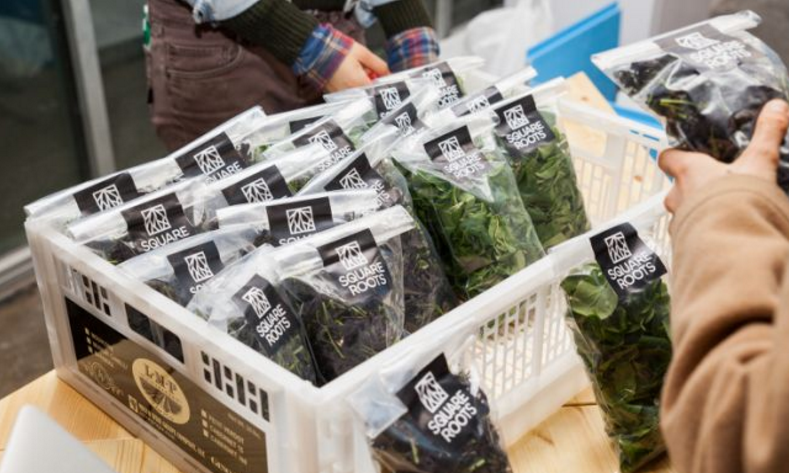
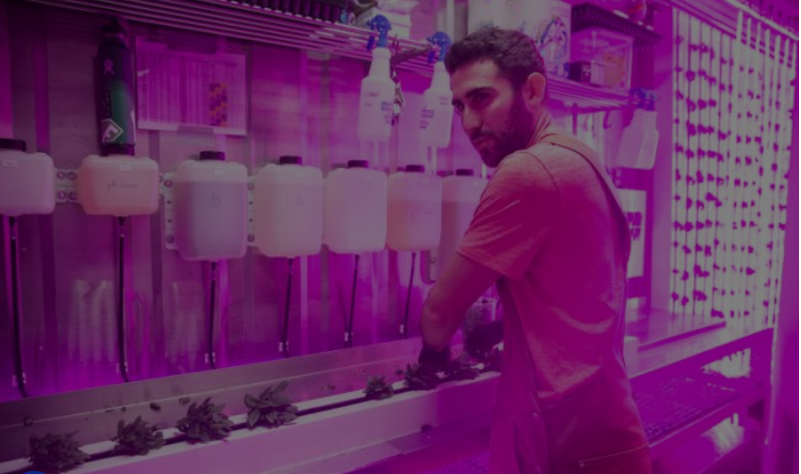
Grow Pod Solutions Develops New Vertical Farm Technology That Needs No Sun or Soil
Grow Pod Solutions Develops New Vertical Farm Technology That Needs No Sun or Soil
New system also uses significantly less water than conventional farms
Feb 28, 2017, 11:10 ET
CORONA, Calif., Feb. 28, 2017 /PRNewswire/ -- Grow Pod Solutions (www.growpodsolutions.com), the premier developer of technology-enriched automated indoor farms, announced the development of their new Hydrologic Technology (HLT), which grows crops with no sunlight or soil, and uses about 90% less water than a conventional outdoor farm.
"This is the world's most sophisticated indoor farm," said George Natzic, President of Grow Pod Solutions. "Our new technologies will not only improve the way food is grown and distributed, but will literally change the world."
The system uses an offshoot of hydroponics to grow plants without soil. The process differs from conventional soil methods, and uses water and a nutrient solution flowing through the growing medium, producing significantly better results.
Grow Pod Solutions' Hydrologic Technology (HLT), utilizes special hydroponics that delivers more oxygen to plant roots, stimulating growth and preventing disease. With Grow Pod's disease-free environment, plants grow at higher density compared to other forms of cultivation.
Inside the GrowPod HLT Container, all elements of the environment, including light, humidity, and temperature, are controlled. There is no need for artificial chemical additives or fertilizers because the system uses no soil. There are never any pesticides because there are no bugs inside the pod.
"This goes beyond organic," Natzic said. "We can produce the cleanest food in the world."
Grow Pod Solutions' portable farms are customized to grow specific varieties of fruits, vegetables, herbs and cash-crops, and can be placed virtually anywhere in the world. The entire environment is controlled remotely from any computer or smart phone utilizing the Grow Pod Solutions Management App. GrowPods can utilize alternative energy, thereby operating entirely "Off the Grid."
For more information, call: (951) 549-9490 or visit: www.growpodsolutions.com
About Grow Pod Solutions:
Grow Pod Solutions develops transportable growing environments, utilizing new technologies that produce superior quality crops and higher yields, in a completely secure, remotely managed and monitored environment.
Grow Pod Solutions provides non-profit organizations, restaurants, cash-crop entrepreneurs, and urban farmers, the ability to grow fresh, organic produce year-round. As a sealed system, water needs are minimal; and with on-board water and air filtration systems, plants, vegetables and crops are grown to their fullest potential.
Connect:
Call: (951) 549-9490
Email: info@growpodsolutions.com
Visit: www.growpodsolutions.com
Facebook: facebook.com/GrowPod-Solutions-1660511410944495
Twitter:@GrowPodSolution
Media Contact:
Innovation Agency
310-571-5592
www.inov8.us
info(at)inov8.us
SOURCE Grow Pod Solutions
Related Links
http://www.growpodsolutions.com
Preview: Grow Pod Solutions Acquires Mobile Farming Systems
Also from this source
JAN 27, 2017, 12:42 ETGrow Pod Solutions Acquires Mobile Farming Systems
JAN 23, 2017, 12:43 ETAgricultural Tech Investment Rises to Record $25 Billion
Philips Lighting and Ecobain Gardens Transform First Commercial Vertical Farm Operation in Canada
Philips Lighting (Euronext Amsterdam ticker: LIGHT), a global leader in lighting, today announced the completed installation of Philips GreenPower LED Production Modules at Ecobain Gardens, the largest commercial vertical farm operation in Canada
hilips Lighting and Ecobain Gardens Transform First Commercial Vertical Farm Operation in Canada
Business Wire February 28, 2017
Philips Lighting and Ecobain Gardens Transform First Commercial Vertical Farm Operation in Canada. (Photo: Business Wire) Multimedia Gallery URL
Philips Lighting (Euronext Amsterdam ticker: LIGHT), a global leader in lighting, today announced the completed installation of Philips GreenPower LED Production Modules at Ecobain Gardens, the largest commercial vertical farm operation in Canada. By upgrading the fluorescent lighting previously used in the facility to LED, Philips Lighting is helping the vertical farming pioneer to produce at commercial scale, accelerate growing cycles and grow healthier, more consistent plants, while saving up to $30,000 Canadian in energy costs per year.
This Smart News Release features multimedia. View the full release here: http://www.businesswire.com/news/home/20170228005329/en/
Producing both organic and non-organic, nutrient-rich herbs and microgreens in a fully controlled indoor facility, Ecobain Gardens was established in 2013 and is the first commercial vertical farming operation in Saskatchewan, Canada. The facility produces 18,000 pounds of produce each year in less than 1,400 square feet. Its farming method uses up to 98 percent less water, zero harmful chemicals or pesticides and the newest energy-efficient LED lighting available from Philips Lighting. The vertical growing technology and local distribution systems reduce energy use, travel time and proximity of the crop, spoilage rates and overall operating costs.
Ecobain Gardens has partnered with food distributor Star Produce to distribute its produce throughout Canada to retailers such as Loblaws, Federated Co-op, Safeway, Sobeys, and other local grocery stores.
“Our goal is to grow our operation to a scale where we can make a difference to the people of our community who need quality nutrition, no matter their economic standing or geographical location,” said Brian Bain, Cofounder and CEO of Ecobain Gardens “The innovative LED products provided by Philips Lighting are helping us build cost effective, smart, productive farms to safely service this massive void we have in our food system. Our passion for growing plants and providing the best possible product, in unique and alternative ways, has helped shape our business and perspective on farming.”
After evaluating several LED lighting suppliers, Ecobain Gardens selected Philips GreenPower LED Production Modules to replace its original fluorescent lights in order to improve plant growth and quality, as well as significantly reduce energy consumption. Once the more energy efficient system was installed, Ecobain achieved dramatic changes in its crops. Growing cycles are considerably shorter and it is now producing more than 10,000 basil plants a week, which is at commercial scale. The low heat output of the Philips LED lights produces healthier, more consistent plant growth by reducing the heat stress on the plant canopy and root zone and by providing more uniform lighting. Plants also have a better dry weight compared to fluorescent lighting or LED lighting systems from other manufacturers.
In addition, the LED lighting system helped to reduce Ecobain’s HVAC system costs by almost 50 percent while providing Ecobain with increased space efficiency due to the minimal heat radiated by the modules. These benefits enable tighter placement of crop rows and therefore more yield from the same growing area.
Paul Boers Ltd, the Philips Horticulture Partner supporting the Ecobain project, worked with Philips Lighting and the local power provider, SaskPower to define an electric rebate structure, which resulted in a rebate of more than $70,000 Canadian dollars for Ecobain Gardens.
“We collaborate closely with our partners and customers to achieve vertical farms that deliver superior produce quality as well as economic performance, resulting in an attractive return on investment,” said Udo van Slooten, Managing Director for Philips Lighting Horticulture LED Solutions. “In partnership with Ecobain Gardens, we are taking vertical farming to the next level by demonstrating the potential of their investment as well as guiding them and their investors through the analysis and decision making process.”
For more information on Philips Horticulture products, click here: http://www.usa.lighting.philips.com/products/horticulture.html
About Philips Lighting
Philips Lighting (Euronext Amsterdam ticker: LIGHT), a global leader in lighting products, systems and services, delivers innovations that unlock business value, providing rich user experiences that help improve lives. Serving professional and consumer markets, we lead the industry in leveraging the Internet of Things to transform homes, buildings and urban spaces. With 2016 sales of EUR 7.1 billion, we have approximately 34,000 employees in over 70 countries. News from Philips Lighting is located at http://www.newsroom.lighting.philips.com
View source version on businesswire.com: http://www.businesswire.com/news/home/20170228005329/en/
MULTIMEDIA AVAILABLE:http://www.businesswire.com/news/home/20170228005329/en/