


Welcome to iGrow News, Your Source for the World of Indoor Vertical Farming
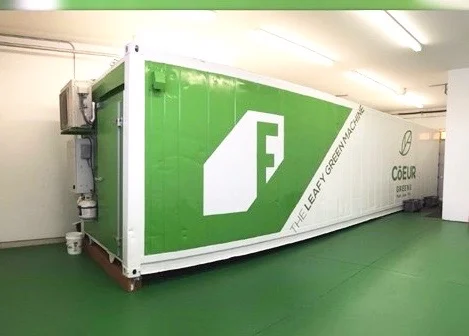
Idaho Company Farms Fresh Produce Using Modified Shipping Container
Idaho Company Farms Fresh Produce Using Modified Shipping Container
HAYDEN, Idaho – When it comes to local vegetables, some restaurants like to use the phrase “farm to table.” But what about when that farm is not in a field, but indoors – in a climate controlled shipping container?
To set this story up, let us remind you that the weather outside is cold – really cold, really gross.
Come inside Coeur Greens in Coeur d’Alene and you can see in here they have a standard shipping container. Inside is where things get really cool.
A miniature farm is inside the container. Drew McNabb, the farm manager, said they can grow enough produce in there to fill two acres of conventional farmland. It was 68 degrees inside the container when we checked.
It was a dream that was a long time coming for McNabb.
“I always wanted to be a farmer. Farming in this area, you’d only be busy two months out of the year, and I wanted to be busy 12 months out of the year,” he said.
That is where technology saves the day. The startup, Coeur Greens, purchased a decked out shipping container from a company in Boston.
“These are different nutrient tanks,” he said.
Seeds are planted in small containers and then grown using artificial light.
“Behind me there will be 4,500 mature plants that will receive water coming down from these orifices shooting down,” McNabb said.
They call it vertical farming – the roots of the plants intertwined in a mesh that hangs down. Coeur Greens is about to plant their first batch of lettuce. Other varieties of leafy greens will be on the way.
“Whether it’s arugula, kale, bok choy, Swiss chard,” McNabb said.
He said they will be able to crank out 1,100 heads of greens per week. That is year round too.
Once Coeur Greens is in full swing, they hope to package and sell their veggies to local retailers, restaurants, and school districts.
To learn more about their work, visit their website.
KREM

Smart Cultivation Platform Facilitates Indoor Farming
Smart Cultivation Platform Facilitates Indoor Farming
December 13, 2016
Credit: The Hong Kong Polytechnic University
Researchers in Hong Kong have developed the Smart Indoor Cultivation Platform that can be set up in urban buildings and save water consumption by 95% compared with conventional methods.
To facilitate indoor farming, a research team comprising Prof. Michael Tse, Dr Martin Chow, Dr Loo Ka-hong and Dr Lai Yuk-ming at the Department of Electronic and Information Engineering developed the Smart Indoor Cultivation Platform. It adopted novel technologies including effective photosynthetic-active-radiation lighting system, hydroponic and aeroponic irrigation systems, network sensing and novel environmental control system for optimising growth profiles.
Under this system, the programmable photoperiod and light intensity with specific wavelengths in the lighting system can accelerate the growth of the plants. The sensors and automatic control system can optimise the growth environment for different plant species. This computerised way of managing the cultivation process also helps develop optimal growthprofiles. Through automatic data collection and analysis, the best cultivation methods for plants can be determined.
Compared with conventional method, this system can reduce water consumption by 95% and can be set up in urban buildings. This can encourage city dwellers to plant indoors to maintain sustainable and stable food supply.
Dr Lai Yuk-ming earlier won a silver medal at the 2016 International Invention Innovation Competition in Canada (iCAN 2016) with this invention.
Explore further: Effects of spectral quality, intensity of LEDs
Provided by: Hong Kong Polytechnic University
Read more at: http://phys.org/news/2016-12-smart-cultivation-platform-indoor-farming.html#jCp

Agrilyst Founder Up For Vertical Farming Award
“Farms have a vast amount of production data, and, unfortunately, the information exists in fragmented, independent systems,” Kopf wrote this year.
Agrilyst Founder Up For Vertical Farming Award
Allison Kopf at TechCrunch Disrupt NY.
Brooklyn’s own Allison Kopf is up for Changemaker of the Year for 2016 from the Association for Vertical Farming, a leading industry group.
It’s been quite a year for the young founder, who raised over $1 million in seed funding and headlined TechCrunch Disrupt New York 2016 after winning 2015’s San Francisco iteration. Her company, Agrilyst, makes data analytics software for farmers, with a focus on indoor farmers.
“Farms have a vast amount of production data, and, unfortunately, the information exists in fragmented, independent systems,” Kopf wrote this year. “As a result, growers are spending time and money creating optimization plans while still performing in a sub-optimal state. Farms are leaving revenue on the table. Our goal with the Agrilyst platform is to turn a burden for growers, data management, into their most useful tool.”

Vertical Farming Market 2016 - Global Industry Demand, Research, Trends and Forecasts to 2021
Market Analyst, Intense Research
Vertical Farming Market 2016 - Global Industry Demand, Research, Trends and Forecasts to 2021
- Posted on December 14, 2016
Prime agricultural land can be scarce and expensive. With worldwide population growth, the demand for both more food and more land to grow food is ever increasing. One solution to our need for more space is vertical farming, involves growing crops in controlled indoor environments, with precise light, nutrients, and temperatures. In vertical farming, growing plants are stacked in layers that may reach several stories tall.
Scope of the Report:
This report focuses on the Vertical Farming in Global market, especially in North America, Europe and Asia-Pacific, South America, Middle East and Africa. This report categorizes the market based on manufacturers, regions, type and application.
Request a Brochure of This Report, here @ http://www.marketresearchstore.com/report/global-vertical-farming-market-by-manufacturers-regions-type-84569#RequestSample
Market Segment by Manufacturers, this report covers
AeroFarms
Gotham Greens
Bright Farms
Vertical Harvest
Home Town Farms
Infinite Harvest
Lufa Farms
Beijing IEDA Protected Horticulture
FarmedHere
Garden Fresh Farms
Metro Farms
Green Sense Farms
Mirai
Green Spirit Farms
Indoor Harvest
Sky Vegetables
Sundrop Farms
Ecopia Farms
Alegria Fresh
TruLeaf
Farmbox
Greener Roots Farm
Uriah's Urban Farms
Urban Crops
Sky Greens
GreenLand
SCATIL
Agro Strategies
Metropolis Farms
Harvest Urban Farms
UrbanFarmers
Atlantic Beach Urban Farms
Kingpeng
Podponics
Urban Barns
CityFarm
Brooklyn Grange
Plantagon
Spread
Market Segment by Regions, regional analysis covers
North America (USA, Canada and Mexico)
Europe (Germany, France, UK, Russia and Italy)
Asia-Pacific (China, Japan, Korea, India and Southeast Asia)
South America, Middle East and Africa
Free Inquiry For Buying This Premium Report, heret @ http://www.marketresearchstore.com/report/global-vertical-farming-market-by-manufacturers-regions-type-84569#InquiryForBuying
Market Segment by Type, covers
Lighting
Hydroponic Component
Climate Control
Sensors
Market Segment by Applications, can be divided into
Application 1
Application 2
Application 3
There are 13 Chapters to deeply display the global Vertical Farming market.
Chapter 1, to describe Vertical Farming Introduction, product scope, market overview, market opportunities, market risk, market driving force;
Chapter 2, to analyze the top manufacturers of Vertical Farming, with sales, revenue, and price of Vertical Farming, in 2015 and 2016;
Chapter 3, to display the competitive situation among the top manufacturers, with sales, revenue and market share in 2015 and 2016;
Chapter 4, to show the global market by regions, with sales, revenue and market share of Vertical Farming, for each region, from 2011 to 2016;
Chapter 5, 6, 7 and 8, to analyze the key regions, with sales, revenue and market share by key countries in these regions;
Chapter 9 and 10, to show the market by type and application, with sales market share and growth rate by type, application, from 2011 to 2016;
Chapter 11, Vertical Farming market forecast, by regions, type and application, with sales and revenue, from 2016 to 2021;
Chapter 12 and 13, to describe Vertical Farming sales channel, distributors, traders, dealers, appendix and data source.
About Market research Store
Market Research Store is a single destination for all the industry, company and country reports. We feature large repository of latest industry reports, leading and niche company profiles, and market statistics released by reputed private publishers and public organizations. Market Research Store is the comprehensive collection of market intelligence products and services available on air. We have market research reports from number of leading publishers and update our collection daily to provide our clients with the instant online access to our database. With access to this database, our clients will be able to benefit from expert insights on global industries, products, and market trends.
Contact Us:
Joel John
3422 SW 15 Street, Suit #8138,
Deerfield Beach, Florida 33442, USA
USA Tel: +1-386-310-3803
GMT Tel: +49-322 210 92714
USA/Canada Toll Free No.1-855-465-4651
Email: sales@marketresearchstore.com
Web: http://www.marketresearchstore.co

Funding To Boost Growth For TruLeaf Farms
BIBLE HILL, N.S. – An indoor, multi-level farming company in Bible Hill is poised for its next growth spurt after receiving a major funding injection and new business expertise.
TruLeaf Sustainble Agriculture Ltd., based in the Perennia Innovation Park, said in a news release it has closed an $8.5 million equity-finance round, which will enable it to “continue its mission” of becoming a global leader in vertical farming technology.
The company has also added Mike Durland, former CEO and group head of Scotiabank’s Global Banking and Markets Division, and Neil Murdoch, former CEO of Connor, Clark & Lunn Capital Markets, to its board of directors.
“This new round of financing and the additions to our board will help us to expand the breadth of our product offerings and increase the number of markets that we serve,” said Gregg Curwin, president and CEO of TruLeaf and GoodLeaf Farms.
“Mike and Neil bring a high level of business acumen and strategic expertise that will help us scale our business.”
TruLeaf, founded in 2011 in Bible Hill, has developed an indoor farming system that can grow fresh plants for food and medicines anywhere in the world, regardless of environment, 365 days of the year, the release said. The system integrates growing technologies in a controlled environment to grow high-quality, predictable yield and clean plants with innovative and efficient technologies.
Vertical farming combines proven hydroponic technology with advancements in LED lighting and environmental control to allow year-round production of plants indoors.
“Vertical farming is nearly 10 times more efficient than traditional agriculture and is more productive, takes up less land and uses dramatically less water,” the release said

Lessons from Japan: What the Western Indoor Ag Industry Can Learn from the East
Lessons from Japan: What the Western Indoor Ag Industry Can Learn from the East
DECEMBER 13, 2016 PIETER DE SMEDT
Editor’s Note: Pieter De Smedt is the US country manager for Urban Crops, a global indoor farming group building fully robotized vertical plant factories. Urban Crops recently opened its regional headquarters in Miami, Florida, and is in the process of hiring new sales agents for the North American region. If you are interested in applying, email Pieter here.
It is well known in indoor agriculture circles that Japan has more experience with indoor farming than the US and Europe, and its plant factories are more advanced. Here De Smedt offers his key takeaways from an event bringing the industry from both sides of the world together.
The East Meets West: Joining Forces in Ag Tech & Controlled Environment Ag event took place in Salinas, California a couple of weeks ago. It offered a day of insightful presentations by a number of Japanese and US-based companies and organizations. The main goal was the exchange of information on the current state and future direction of the indoor agriculture industry in each geography. Equally insightful were the different networking opportunities in between sessions – it is not every day one gets the chance to exchange thoughts with people in your industry from the other side of the globe.
Here are my four key takeaways from the event:
1. Data trumps dreams
When looking back at the overall event and the presentations made by the Japanese companies and organizations, the most striking comparison between Japanese indoor agriculture operations and their US counterparts was their use of data. Japan’s indoor ag practitioners are much more data driven than the typically more visionary and – let us be honest – dreamy, story-telling tone of their US peers.
This focus on data applies at the level of the plant factories themselves, i.e. the technical, biological, and financial efficiency of any given plant factory is analyzed by looking at big data and crunching the relevant numbers. Progress is achieved through decisions made as a result of this analysis. The cloud-based program SabaiX by PlantX exemplifies this (http://www.plantx.co.jp/index-eng.html) with increased yields as a result. The same applies for Dr. Toyoki Kozai of Chiba University in Japan, known as the “Father of the Modern Plant Factory” who presented his new book “LED Lighting for Urban Agriculture” at the event.
There was a little less excitement about the data presented on the performance of Japanese plant factories: 42% of the indoor plant factories were in the red, 33% break-even, and only 25% were generating some level of profit. The reasons for these sobering performance figures range from excessive capital expenditure and operating expenditure, inefficient production processes, a poorly constructed business plan that fails to capture enough margin by selling to the wrong parties, and so on.
We can assume that similar figures and the underlying drivers would emerge in the US market as well. This is typical of any innovative industry that is drawing in some over excited capital. In the mid- to long-term, the suppliers and growers that will survive will be those who can set up the right infrastructure combined with a correct production process integrated in an efficient sales plan. This has also become apparent at Urban Crops, where we assist our clients in doing just that by looking at their requirements and delivering a design feasibility study that pairs the best and most cost-effective system while giving a clear overview of the required investment and operating costs.
2. Automation will have an increasing role to play
The Japanese data presented by Factory 808 (a Japanese vertical farm) demonstrated that labor accounted for one-third of their operating costs. The total cost is even higher when indirect employee-related costs are taken into account such as training, disinfecting chambers, food safety issues, real estate requirements, and so on. This confirmed Urban Crops’ thesis that for larger scale production facilities, investing in the robotization of your plant factory has a variety of benefits to offer.
3. The large outdoor farming businesses are rearing their heads
Although they have no doubt been following the developments close-up, this was one of the first times that I saw a proportionately large number of open field farming companies attend an event with an exclusively indoor ag focus. Rocket Farms, Del Cabo, Church Brothers, and others were present in the crowd. On the one hand, this can be explained by the location of the event in the heart of the salad bowl, Salinas, California. Nevertheless, it seemed to imply that these companies are looking to diversify their production methods and – perhaps even more importantly – locations. Could we start to see California-based farming groups setting up indoor grow facilities near some of their larger markets?
4. Looking beyond food production
A lot of the incumbents in the indoor ag market are currently focused on leafy greens production and other food. That’s because, to a large extent, the marketability of indoor ag and relatively high prices offered for local food is driving the industry.
Valuable as that may be – considering the early stage of the industry – Dr. Don Wilkerson reminded us that there are other high value, per pound crops that we ought to look at. His company iBio CMO produces a range of crops for the nutraceutical sector. Although somewhat less romantic than urban local food production, the impact on sustainability as well as the economics is equally, if not even more, impressive.
We have noticed this with our customers as well. Urban Crops has a selection of growth recipes for 160 plant varieties. We continue to expand this selection based on our own assessment of the market as well as requests from our customers to grow new kinds in their systems. Engineering and biological flexibility is, therefore, key.
The East Meets West: Joining Forces in Ag Tech & Controlled Environment Ag event demonstrated that we must continue to go beyond our own borders and stay in tune with developments in all parts of the world if we want to stay relevant.
A global industry requires a global understanding.
Furniture Maker Partners On Urban 'Agrihood' Project
A furniture maker is teaming up on a building renovation project that will bring a community resource center focused on agriculture to a Detroit neighborhood
Furniture Maker Partners On Urban 'Agrihood' Project
December 12, 2016
| By Charlsie Dewey |
TAGS GM / HERMAN MILLER
A furniture maker is teaming up on a building renovation project that will bring a community resource center focused on agriculture to a Detroit neighborhood.
Zeeland-based Herman Miller said last month it is joining forces with Sustainable Brands, BASF, General Motors and Green Standards to support The Michigan Urban Farming Initiative, or MUFI, a Detroit-based nonprofit with a mission to use urban agriculture as a platform to promote education, sustainability and community and to uplift and empower urban neighborhoods.
MUFI said it is “debuting America's first sustainable urban agrihood,” an alternative neighborhood growth model in Detroit's lower North End, which “positions agriculture as the centerpiece of a mixed-use urban development.”
Community Center Design
Herman Miller will lend its design expertise to the new MUFI Community Resource Center, or CRC, being renovated in the agrihood — to create “purposeful, multi-use spaces” that will “enhance collaboration and foster a sense of community.”
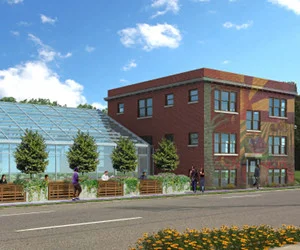
The project partners plan to restore a three story, long-vacant building across from MUFI's urban garden into the Community Resource Center and transform adjacent vacant land into a healthy food café.
The 3,200 square foot, box-shaped CRC will offer educational programs, event and meeting space and serve as MUFI’s new headquarters.
It will also house two commercial kitchens on the first floor that will service the café and allow for the future production and packaging of "valued goods."
The project is scheduled to be unveiled as part of the Sustainable Brands '17 Detroit conference, held at the Cobo Center from May 22-25.
Surplus Furniture
Herman Miller will also help outfit the CRC through its recently announced rePurpose partnership with GM.
GM is repurposing tens of thousands of surplus office assets resulting from the renovations occurring at its Warren Technical Center, Milford Proving Ground and global headquarters in Detroit.
Managed by the Toronto-based environmental firm Green Standards, rePurpose diverts 99 percent of no-longer-needed office furniture and supplies from landfills and "transforms them into valuable in-kind donations" to nonprofits.
Since Herman Miller launched the rePurpose program in 2009, it has diverted more than 27,000 tons of product from landfills and generated $18 million in charitable in-kind donations.
Agrihood
MUFI's urban agrihood features a two-acre urban garden with more than 300 vegetable varieties, a 200-tree fruit orchard, a children's sensory garden and more.
Annually, the urban garden provides fresh, free produce to about 2,000 households within two square miles of the farm.
Since its first growing season in 2012, MUFI has distributed more than 50,000 pounds of free produce.
"Over the last four years, we've grown from an urban garden that provides fresh produce for our residents to a diverse, agricultural campus that has helped sustain the neighborhood, attracted new residents and area investment," said Tyson Gersh, president and co-founder, MUFI.
He said this is part of a larger trend being seen across the country where “people are re-defining what life in the urban environment looks like.”
“We provide a unique offering and attraction to people who want to live in interesting spaces with a mix of residential, commercial, transit and agriculture,” Gersh sai

International Congress on Controlled Environment Agriculture (ICCEA) Announces Next Event
International Congress on Controlled Environment Agriculture (ICCEA) Announces Next Event
Following the 2015 first-of-its-kind educational event focused on the science and techniques used in successfully operating a controlled environment agriculture facility, the Foundation for the Development of Controlled Environment Agriculture (FDCEA) announces they will once again host the International Congress on Controlled Environment Agriculture (ICCEA) in Panama City, Panama in May, 2017.
According to David Proenza, one of the FDCEA Founders and a pioneer of the vertical farming movement, he believes the time has come for greatly improving the technology and knowledge behind the way we grow and produce food crops. He states, “Growing parameters such as soil temperature, humidity, air temperature and flow, CO2 and nutrient distribution can be enhanced through the intelligent use of technology: hardware, software, wireless sensors, LED lighting and through ever-developing, disciplined science.” The end results are better quality; clean, nutritious and safer foods all derived from a protected environment and enhanced food production.
As a current “traditional” farmer of watermelons he goes on to say, “Traditional methods of agriculture are burdened by numerous obstacles and difficulties, most of which can be solved by growing through the use of controlled environment agriculture (CEA) and by applying “Ag Tech” to either greenhouses or indoor, vertical farms.”
According to Chris Higgins, co-Founder of the FDCEA and owner of Urban Ag News, “The FDCEA has organized the ICCEA to inspire all interested parties to innovate and collaborate.”
The ICCEA 2017 is an event where attendees will have the opportunity to learn from renowned experts in the applied fields of science, agriculture, horticulture, lighting, robotics and (Ag) engineering. The FDCEA seeks to make CEA (whether greenhouse, vertical farm, or other) the answer to the future of agriculture with a primary focus on the creation of sustainable and profitable agriculture businesses.
The theme of ICCEA 2017 is “Using Science and the Market to Build a Successful Controlled Environment Agriculture Business”. It will be held on May 17, 18 and 19 in Panama City, Panama.
For additional information on this event, please visit one of the following:
To register for specific information on attending or exhibiting at ICCEA2017, visit ICCEA Panama athttp://icceapanama.org/about/
To get more information on the Foundation for the Development of Controlled Environment Agriculture, visit their website at http://www.fdcea.com/
For continual updates on this event as well as others, visit Urban Ag News (http://urbanagnews.com/) and register for their newsletter and eMagazine (http://urbanagnews.com/subscribe/).
Remember global food safety and security depends on our ability to evolve and look beyond traditional agriculture. See you in Panama in 2017!

Vertical Farming Platform TruLeaf Raises $8.5 Mln In Funding
Vertical Farming Platform TruLeaf Raises $8.5 Mln In Funding
- December 8, 2016
- By Kirk Falconer
TruLeaf Sustainable Agriculture Ltd, a Bible Hill, Nova Scotia indoor farming company, has closed an $8.5 million equity financing. Mike Durland, a former Scotiabank executive, led the round and was joined by a group of Canadian investors. With the deal, Durand and Neil Murdoch, a former Connor, Clark and Lunn Financial Group executive, will join the company’s board. Founded in 2011, TruLeaf has developed a vertical farming technology system to grow nutrient-rich, pesticide-free produce. It will use the funds raised to expand its product offerings and enter new markets. TruLeaf is also backed by Innovacorp.
PRESS RELEASE
TruLeaf Closes $8.5-million Round of Financing
TORONTO, ON/BIBLE HILL, NS, December 7, 2016- TruLeaf Sustainable Agriculture Ltd. (TruLeaf), the indoor, multi-level farming company from Bible Hill, Nova Scotia has closed an $8.5-million equity-finance round. This funding will enable the company to continue its mission of becoming a global leader in vertical farming technology. TruLeaf develops sustainable farming systems that can be built anywhere that enable fresh, nutrient-dense, pesticide-free produce to be grown locally all year round.
Mike Durland, Former CEO and Group Head of Scotiabank’s Global Banking and Markets division led this funding round along with a small group of strategic investors from Toronto. In addition, Mr. Durland and Neil Murdoch, Former CEO Connor, Clark & Lunn Capital Markets, will become members of TruLeaf’s Board of Directors.
“This new round of financing and the additions to our board will help us to expand the breadth of our product offerings and increase the number of markets that we serve,” said Gregg Curwin, President & CEO, TruLeaf. “Mike and Neil bring a high level of business acumen and strategic expertise that will help us scale our business.”
TruLeaf is positioned to meet the growing appetite for local food in Canada that has arisen in the last 10 years, by scaling its GoodLeaf Farms consumer brand. A 2013 BMO Food Survey found that Canadians buy locally grown vegetables above all other products. Ninety-seven per cent of those surveyed said they bought local because the food is fresh and tastes better.
TruLeaf is seeking to become a leader in sustainable agriculture through the use of vertical farming. Vertical farming combines proven hydroponic technology with advancements in LED lighting and environmental control to allow year-round propagation and production of plants indoors, inside stackable levels. Vertical farming is nearly ten times more efficient than traditional agriculture and is more productive, takes up less land and uses dramatically less water.
“There are a number of important macro forces which position TruLeaf for success in the coming years,” said Mr. Durland. “Food scarcity, water challenges, the increasing demand for pesticide-free foods, and the environmental impact of large scale farming, all mean that new ways of growing and distributing foods will be key for feeding the world. We want TruLeaf to be a company that achieves a triple-bottom line by creating sustainable – and ultimately carbon neutral – food production, delivering nutrient-rich plants to communities that may not otherwise have access to them, and achieving a strong return for investors and stakeholders. We want to grow the best products for consumers in Canada.”
A native Nova Scotian and Saint Mary’s University graduate, Mr. Durland recently retired from his executive post at Scotiabank to focus his efforts on fostering growth and investment in innovative companies across the country. Recently, he provided important funding for Saint Mary’s University’s Masters of Technology, Entrepreneurship & Innovation program, which supports an innovation competition held in Halifax each year. Mr. Durland’s interest and passion for TruLeaf was spawned out of his desire to invest in the local Nova Scotia economy.
“This is a complex business that requires a strong and experienced team,” said Jeff Watson, Board Chair, and fellow Nova Scotian. “TruLeaf has developed innovations in technology that put it ahead of new entrants in the industry. With our knowledgeable management team and shareholder group, highly-skilled board of directors, and strong capital position, TruLeaf is now well-positioned to solve a massive global problem.”
About TruLeaf Sustainable Agriculture Ltd.
Founded in 2011, and located in Bible Hill, Nova Scotia, TruLeaf has developed an indoor farming system that grows fresh plants for food and medicines anywhere in the world, regardless of environment, 365 days a year. The system integrates growing technologies in a controlled environment to grow high quality, predictable yield, and clean plants with innovative and efficient technologies.
Media Contact:
Holly Thornton
Account Manager, PUBLIC Inc.
holly@publicinc.com
P: 647 642 6846

Green Collar Foods Bringing Affordable Indoor Farming To Bridgeport, CT With New Partner
Green Collar Foods Bringing Affordable Indoor Farming to Bridgeport, CT with New Partner
Green Collar Foods (GCF) and Pivot Community Development Corporation (CDC) have teamed up to empower inner-city farmers by constructing an indoor farm in Bridgeport, CT to grow kale, arugula and cilantro for sale into local institutions and retailers.
Bridgeport, CT (PRWEB) May 26, 2016
Green Collar Foods (GCF), a Controlled Environment Agriculture (CEA) business, has officially secured a partner in Bridgeport, Connecticut to construct an indoor farm.
GCF’s mission is to empower inner-city farmers with an affordable CEA business solution that is technologically intuitive and financially profitable. It is also committed to growing high quality, clean food in communities so often overlooked.
Pivot Community Development Corporation (CDC), the commercial arm of Pivot Ministries Inc., an organization assisting men challenged by alcohol and substance abuse, has invested in the construction of a small-scale grow facility in Connecticut by GCF, which is set for unveiling on June 15. Pivot CDC has also committed to raising further funding for a larger-scale grow facility in Bridgeport planned for 2017. The facilities will grow kale, arugula and cilantro for sale into local institutions and retailers keen to find local supply.
Pivot CDC learned about GCF’s strategic plans, their progress in Detroit Michigan, and overall approach in January 2016. Intrigued, they asked GCF for a proposal on the speed and type of CEA implementation possible in Bridgeport.
The founders of GCF, deciding to leverage years of commercial and engineering experience while building on the recent success of its indoor farm in Detroit, Michigan, agreed to establish a small scale, Stage I paid marketing hub so various Pivot CDC stakeholders and future private funders of the full scale GCF Bridgeport location could see their approach and process in real time.
The Bridgeport grow facility is located next to 1190 Pembroke Street, a location that Pivot CDC recently worked with Bank of America and private financial donors to renovate.
Pivot Ministries Inc. and Pivot CDC are committed to showcasing sustainable community impact. More importantly, they are using these projects to showcase what a broader vision can look like to serve the city of Bridgeport. Pivot also sees the GCF partnership and the future 6,000 sq. ft. CEA grow facility as a natural extension of their existing greenhouse in the back of their property at 485 Jane Street.
As noted by Thomas Orr, President, Pivot CDC: “Our engagement and partnership with the team at Green Collar Foods has been truly exceptional to date. Rarely is this type of business execution, professionalism, technology and agricultural skills made available within inner city environments. We are so proud to be a part of this exciting and impactful growth story, and look forward to realizing our collective vision of a full scale GCF Bridgeport grow facility in 2017”.
Unsurprisingly, GCF is keen to ensure that every new partnership represents another blue-print on how their business model can accommodate the various types of future growers who will ultimately carry the GCF brand.
With this success now complete, and with experience navigating elements of local Bridgeport community development, GCF takes one step closer to completing one of five “shovel-ready” inner-city ventures in their pipeline.
Pivots CDC, as well as industry insiders, recognize the unique approach of Green Collar Foods in helping to rejuvenate inner cities, by creating jobs, growing healthy local food and establishing sustainable business enterprises.
GCF was recently added to AgFunder.com, the premier marketplace for the most promising Ag and AgTech start-ups seeking to raise investment capital from accredited investors.
Michael Dean, LLM, Co-Founder and CIO of AgFunder noted: “Green Collar Foods continues to impress with not only their novel approach and insights into the CEA market, but their ability to secure partners and Universities in areas so often overlooked. Their early success in Bridgeport Connecticut is another example of why we are so happy to have them as part of the AgFunder platform and our growing alumni network”.
How To Contact:
GCF contact: Ron Reynolds - 1-800-569-6941
Pivot CDC contact: Thomas Orr - tomorr@optonline.net
About Green Collar Foods:
Green Collar Foods (GCF) is a simple, yet influential controlled environment agriculture (CEA) platform designed for society’s most promising, yet challenged, inner-city environments. GCF is focused on empowering its business owners with the agricultural, commercial & technological tools required to successfully produce specialty crops that yield financial returns. Green Collar Foods leverages its technology platform, which combines Microsoft Azure’s IoT suite with GCF’s centralized machine learning platform and proprietary farm management software to create the GCF AgCloud. This enables continuous learning for GCF, its clients and University partners to extract efficiencies, record plant recipes and improve yields. The GCF AgCloud was built in collaboration with technology partner and investor Shaping Cloud.
If you want to learn more Green Collar Foods, see our website greencollarfoods.com
About Pivot CDC:
Pivot Community Development Corporation seeks to equip those in need with the economic and life skills necessary to become more productive members of the community of Bridgeport, and throughout the State of Connecticut. Pivot CDC will accomplish this mandate by providing jobs training programs, and through offering transitional housing, and social services. All of the training and services offered through our programs will be conducted under the highest standards of moral excellence, with the goal of empowering residents to engage their communities as a positive and sustaining influence.

Asia Digs Deep To Upgrade Its Agriculture
Asia Digs Deep To Upgrade Its Agriculture
Perfect storm of population growth and climate change spurs farming innovation
TADANORI YOSHIDA, Nikkei senior staff writer
Consider it a wake-up call from nature. Asian crops were devastated by a severe drought this year, highlighting the urgent need to stabilize farm output and brace for the consequences of climate change. And with the region's population projected to continue growing over the long term, this is no easy task.
The good news is that answers are starting to emerge. Agribusinesses are harnessing information technology. Organic farms and so-called plant factories are becoming hothouses for innovation. International investors are keen to water the seeds.
This week, we head out into the fields -- and some cutting-edge facilities -- to glimpse the future of Asian farming.
TOKYO Even the most technologically advanced indoor farm starts with a very basic problem. When you take sunlight out of the equation you gain more control, but you also lose a whole lot of free energy.
The bankruptcy of a Japanese farming venture in 2015 highlighted this dilemma. The factory had been touted in the media as the future of farming. Partly due to power costs, however, its break-even price was simply too high compared with conventional farms.
Still, the bankruptcy does not mean the hype was baseless. Under new ownership, the factory is becoming a viable business by finding buyers who are willing to pay a premium for high-quality produce. Similar indoor farming ventures are adding value by growing vegetables rich in specific nutrients.
And then there is Spread, which is taking a different approach. It wants to win in the mass market -- in supermarkets -- and that means competing against veggies grown in the field.
Spread's secret? Volume. The company packs a lot of lettuce into its 3,000-sq.-meter factory in western Kyoto, Japan's ancient capital. The heads grow on rows upon rows of shelves under fluorescent lights. The factory has the capacity to ship 21,000 of them per day -- enough to make the lettuce profitable even if it sells for 198 yen ($1.79). The average price in Tokyo as of November was 251 yen, according to Numbeo, which tracks the cost of living in big cities.
The facility, which started operating in 2008, was stuck in the red for the first five years. But efficiency improvements lifted it into the black in the year ended March 2014. Shinji Inada, Spread's CEO, explained that putting the hardware in place is only half the battle. "It is up to the staff to adapt to the environment," he said. "Once the business becomes profitable, profit is generally stable."
Just because the lettuce grows indoors does not mean the weather is a complete nonfactor. Air conditioning must be set up to keep the temperature steady for all four seasons. Even then, there are changes in humidity. So it takes time to determine how to manage all the variables, including the light and carbon dioxide essential for photosynthesis.
All this is part of Spread's plan to live up to its name. The company is building expertise for a new factory in Kansai Science City, a research hub that straddles the prefectures of Kyoto, Osaka and Nara. The plant, now under construction, will use artificial intelligence to automate tasks like sowing seeds, replanting and harvesting. The new facility is expected to be completed in 2017.
Whether by growing crops indoors or other means, Asia needs to boost yields and mitigate extreme weather. Consumption in big markets like China and India is likely to continue growing steadily.
"Asia cannot produce enough to support itself," the Netherlands' Rabobank wrote in its "Asia-Pacific: agricultural perspectives" report. The bank noted that "limited arable land, inadequate water and poor resource management" are constraining production.
That is at the best of times. This year, vast swaths of Asia were hit by drought linked to the El Nino weather phenomenon, resulting in massive crop failures.
RESILIENT RICE To feed itself, Asia needs solutions, and Singapore's Temasek Life Sciences Laboratory aims to provide some.
The nonprofit research institute is funded by Temasek Trust -- the philanthropic arm of sovereign wealth fund Temasek Holdings. TLL, as the lab is known, spent eight years developing Temasek Rice, a resilient breed capable of withstanding extreme weather conditions and producing higher yields.
Temasek Rice was created using a modern technique known as marker-assisted selection. This allows scientists to zero in on desired traits and breed new, improved crops. Yin Zhongchao, TLL's senior principal investigator, said this type of breeding can enhance food security by increasing production "in a more efficient and sustainable manner."
Since land is limited in Singapore, TLL's rice is being grown in Indonesia, and the lab wants to partner with more companies to boost production.
The 2008 global food crisis was a key motivator behind the Temasek Rice project. Rising oil prices and severe weather sent food prices soaring. In developing countries, domestic rice prices climbed as much as 90% between the third quarter of 2007 and the same period of 2008, according to the FAO.
Peter Chia, TLL's chief operating officer, said the crisis showed "how vulnerable rice cultivation could be as a result of climate change."
"As agriculture becomes more knowledge intensive," he added, "our role in agriculture is not limited to production but using science, innovation and technology to create a positive impact across the whole value chain."
Thanks to the spread of mobile communications, farmers have quite a bit of knowledge at their fingertips. Even without souped-up seeds, detailed weather data and other information can help them to cope with climate change -- and other threats that come their way.
This past January, Vietnamese state telecom company VinaPhone started a service called Nong Thon Xanh, or Green Country. Basically, it turns mobile phones into farm assistants.
Through a social network, farmers can subscribe to three packages. For 10,000 dong (45 cents) per month, they get access to an agricultural warning package that includes a range of information: weather forecasts, prices, plant disease alerts, guidelines on relevant state policies, advisories on abnormal conditions affecting agriculture and so on. Coffee and rice packages, available for 31 cents and 22 cents a week respectively, offer tailored guidance to help farmers prevent diseases from wiping out their crops.
With a local partner, AgriMedia, VinaPhone has set up automated weather stations across the country. AgriMedia, in turn, has partnered with Japan's Weathernews in an effort to improve its forecasts.
VinaPhone's next step will be to build a call center, where agriculture experts will be on hand to answer questions from farmers. It also plans to expand the advice to cover gum trees, pepper and cashews.
In Indonesia, startup 8Villages provides similar services.
The advent of the internet of things -- the ever-growing web of connected gadgetry -- is bringing further big changes to the field. Japanese companies Kubota and NTT group have allied to develop automated agricultural machinery that taps big data. They envision a system that analyzes crop conditions and issues the machines instructions, be it to harvest vegetables or spray pesticides.
Singaporean startup Garuda Robotics is using drones to help Southeast Asian farmers increase yields.
The company's fully autonomous drone features a powerful built-in camera along with advanced sensors for detecting biomass and measuring temperatures. When it zooms over an oil palm plantation, it generates data including aerial maps and 3-D land contour models. This data is fed through an artificial intelligence system, which generates a report on tree health and land optimization.
This way, farmers can allocate fertilizer and other resources to the areas that need the most care, reducing costs and waste.
"It is difficult to use traditional methods, like getting people to count the number of trees, and get accurate data," said Mark Yong, Garuda Robotics' founder and CEO. "A 100,000 hectare [plantation] could have about 1 million trees."
Precision, he stressed, makes all the difference. "The problem with agriculture is variation such as weather, rainfall, soil quality and fertilizer. So there is a need to capture accurate data and find out what is happening on the plantation."
The Philippines has a new tool of its own for keeping tabs on farms -- a microsatellite. The launch of the craft in March marked not only the country's first foray into space but also a big upgrade for its relatively underdeveloped agricultural sector.
The government is using the satellite, the Diwata-1, to survey farmland and vegetation. Data and images are delivered daily to a ground station called the Philippine Earth Data Resources and Observation Center. With this and other information, experts at the center can advise farmers on the prevalence of pests and estimate rice yields. This can help the government decide whether to import rice or source it locally.
Researchers at the University of the Philippines are also using the data in studies on "smart agriculture." The satellite is expected to orbit for 18-20 months before its twin, the Diwata-2, is launched. The government has earmarked a total of 840 million pesos ($16.88 million) for the two satellites and the ground station.
From a consumer's perspective, of course, crop yields are not the only concern. Asia's rising middle class is wary of residual pesticides or other contaminants on vegetables grown in China and elsewhere. People want to know the food they are eating is safe, and to an extent, they are willing to pay more for that peace of mind.
It should not be surprising, then, that organic farming is booming across the region. And as it turns out, organic techniques may have some advantages when it comes to growing tasty veggies capable of withstanding harsh weather.
SCIENCE OVER INTUITION This brings us back to Japan. In August, some 20 farmers from around the country gathered in the city of Chiba, near Tokyo, for a workshop. The classroom was a vinyl greenhouse. "I'm going to teach you scientific techniques for organic farming," said the lecturer, consultant Masaaki Koiwai, who crisscrosses the country touting organic agriculture as a way to improve yields and quality.
There is a tendency to assume that farmers -- particularly organic farmers -- rely on intuition developed over years of experience. But Koiwai assured his students it does not have to be that way. He talked about spinach farmers who had taken his advice. The spinach they produced had higher sugar content than a melon. How was this possible? They sprinkled a little something extra on the field: powdered bamboo, which happens to be full of carbohydrates.
Koiwai's approach centers on the idea of "complementing photosynthesis." The conventional wisdom used to be that plants absorb only inorganic substances, but recent studies have shown they can also take in organic ones with much larger molecular structures. Based on this, Koiwai argues that effective use of organic fertilizers can pay dividends. Even if extreme weather slows carbohydrate production, for instance, plants can continue to grow steadily if they can soak up the nutrients through their roots.
A company that analyzes vegetables found that Koiwai-taught farmers tended to produce crops with much more sugar and vitamin C than average. There was no significant difference, however, between vegetables from other organic farmers and ones grown with chemical fertilizers. This suggests organic farming is only as good as the science behind it.
Over in Indonesia, a startup called iGrow is giving even city dwellers the opportunity to get into organic farming. The company pitches its concept as "playing FarmVille in real life," referring to a popular online game. The service allows customers to invest in small organic farms, choosing what they want to grow and where they want to grow it.
As of August, iGrow said it had partnered with 2,000 farmers and 7,000 small-scale investors, who invest anywhere from $110 to $1,100 each. The operation is cultivating more than 1,000 hectares of land, a third of which has already produced harvests. The founders said they are exploring expansion outside Indonesia, and mentioned Turkey and Japan as possibilities.
There is no denying that Asia faces huge agricultural challenges. But there is reason for optimism, too.
Big companies outside the region also see opportunity in meeting Asia's agricultural needs. Bayer, the German chemical and pharmaceutical maker, is developing new agrochemicals for rice and is looking to create tailored products for Asia, such as flood-resistant rice strains.
A mix of cooperation and competition between governments, corporations, startups and investors may just be a recipe for agricultural sustainability.
Nikkei staff writers Justina Lee in Singapore, Erwida Maulia in Jakarta, Kim Dung Tong in Ho Chi Minh City and Cliff Venzon in Manila contributed to this article.
Arcturus Announces 25,000-Sq Ft $5 Million "LED" Vertical Farming Project
Arcturus Announces 25,000-Sq Ft $5 Million "LED" Vertical Farming Project
NEWS PROVIDED BY
Arcturus Growthstar Technologies Inc.
Dec 08, 2016, 08:00 ET
SHARE THIS ARTICLE
VANCOUVER, British Columbia, December 8, 2016 /PRNewswire/ --
Arcturus Growthstar Technologies Inc. (the "Company" or "Arcturus") (OTCQB: AGSTF) (CSE: AGS.CN) is pleased to announce that it has partnered with CBO Financial, Inc. ("CBO") for the development and operation of a major "LED" vertical farm project in Baltimore, Maryland. Arcturus is also pleased to announce that it has concurrently signed a Letter of Intent ("LOI") to lease 25,000-sq ft of commercial shell space from Volunteers of America Chesapeake to accommodate the Baltimore farm.
Volunteers of America Chesapeake ("VOAC"), one of the largest and most respected nonprofits in the region, owns a building in Baltimore, MD that will undergo additional improvements to accommodate Arcturus' Controlled Environment Agriculture ("CEA") technology, which uses LED lights to grow plants on vertically stacked levels. As a partner in this indoor farm, VOAC has agreed to contribute generous rent concessions to Arcturus. The farm will be co-located in a residential reentry center, which helps ex-offenders reenter society and the workforce after serving federal prison sentences. The farm will provide job training and therapeutic opportunities for VOAC's residents. Arcturus, CBO and VOAC intend to use this Baltimore model to expand the Company's CEA technology and training and therapeutic programs developed by VOAC into other markets throughout the United States.
Arcturus previously announced that CBO would act as the Company's financial advisor with respect to New Market Tax Credits (NMTC) for certain vertical farming projects. As part of this Baltimore farm transaction, CBO Financial will be arranging for $5,000,000 in NMTC based financing. CBO will also plan, co-finance, and perform day-to-day operations at the farm, and Arcturus will provide the system design, off-take agreements, co-finance, and offer ongoing O&M support. The Baltimore Farm is expected to be a showcase for Arcturus' LED horticulture lighting technology and the first of many projects that CBO and the Company will work on together in collaboration with Volunteers of America Chesapeake.
The NMTC program is a $65 billion federal program designed to incentivize private investment in low-income communities. NMTCs are provided to financial institutions in exchange for equity investments that eligible businesses can use to subsidize project development costs. CBO Financial helps driven organizations, such as Arcturus, to finance facilities that will provide goods and services that benefit populations in need and revitalize communities.
"We are pleased to have partnered with CBO Financial and Volunteers of America Chesapeake on this project and believe that its success will be a bellwether for public private partnerships within the urban farming industry," says Mr. William Gildea, Arcturus Growthstar Technologies Inc.'s CEO and Chairman. "With Volunteers of America Chesapeake's diversified real estate holdings, CBO Financial's experience in community development and expertise in navigating the NMTC process and Arcturus's CEA technology, this is a perfect partnership. Our goal was always to create impactful social and corporate programs that are mutually beneficial for all involved, from the community, to the company and our shareholders. Partnering with Volunteers of America Chesapeake and CBO Financial puts us in the position to achieve that goal. We hope this is the first of many joint-projects for our companies."
"We are delighted to be involved with this project, which produces fresh food and quality jobs in a low income community and provides job training and therapy opportunities for VOAC residents. We expect this to be a prototype for future, profitable commercial scale projects that include social service oriented job training and therapeutic programs," says Craig Stanley, CEO of CBO Financial.
"Volunteers of America Chesapeake has been supporting and providing resources for the ex-offender community for over 35 years in Baltimore, Maryland," says Russell Snyder, CEO of VOAC. "We are committed to help the residents of our residential reentry center gain job skills and employment opportunities through social enterprise opportunities like vertical farming and we are pleased to partner with Arcturus and CBO Financial in this innovative project."
For further information, contact William Gildea, Director, at 617.834.9467.
On behalf of the Board,
Arcturus Growthstar Technologies Inc.
William Gildea, CEO & Chairman
About Arcturus
The Company's business model includes developing and acquiring technologies that will position it as a leader in the evolution of Controlled Environment Agriculture (CEA) for the global production of various types of plants. Arcturus provides scalable, indoor CEA systems that utilize minimal land, water and energy regardless of climate, location or time of year and are customized to grow an abundance of crops close to consumers, therefore minimizing food miles and its impact to the environment. The Company holds an exclusive, worldwide license to use a patented vertical farming technology that, when compared to traditional plant production methods, generate yields up to 10 times greater per square foot of land. The contained system provides many other benefits including seed to sale security, scalability, consistency due to year-round production, cost control, product safety and purity by eliminating environmental variability.
The Company is also in the business of designing and distributing LED lighting solutions utilizing the COB and MCOB technology. The Company is focused on delivering cost efficient lighting to North America via advanced e-commerce sites the Company owns and operates. LEDCanada.com which caters to B2B customers is a supplier of the newest and highest demand LED solutions. The Company also owns and operates COBGrowlights.com which caters to both large and small agriculture green houses and controlled cultivation centers.
Neither the Canadian Securities Exchange nor its Market Regulator (as that term is defined in the policies of the Canadian Securities Exchange) accepts
responsibility for the adequacy or accuracy of this release. The Canadian Securities Exchange has not in any way passed upon the merits of the proposed transaction and has neither approved nor disapproved the contents of this press release.
This news release may include forward-looking statements that are subject to risks and uncertainties. All statements within, other than statements of historical fact, are to be considered forward looking. Although the Company believes the expectations expressed in such forward-looking statements are based on reasonable assumptions, such statements are not guarantees of future performance and actual results or developments may differ materially from those in forward-looking statements. Factors that could cause actual results to differ materially from those in forward-looking statements include market prices, exploitation and exploration successes, continued availability of capital and financing, and general economic, market or business conditions. There can be no assurances that such statements will prove accurate and, therefore, readers are advised to rely on their own evaluation of such uncertainties. We do not assume any obligation to update any forward-looking statements except as required under the applicable laws.
For further information, contact William Gildea, Director, at +1-617-834-9467.
SOURCE Arcturus Growthstar Technologies Inc.
Indoor Farm Urban Till Suspends Deliveries 'Until Further Notice'
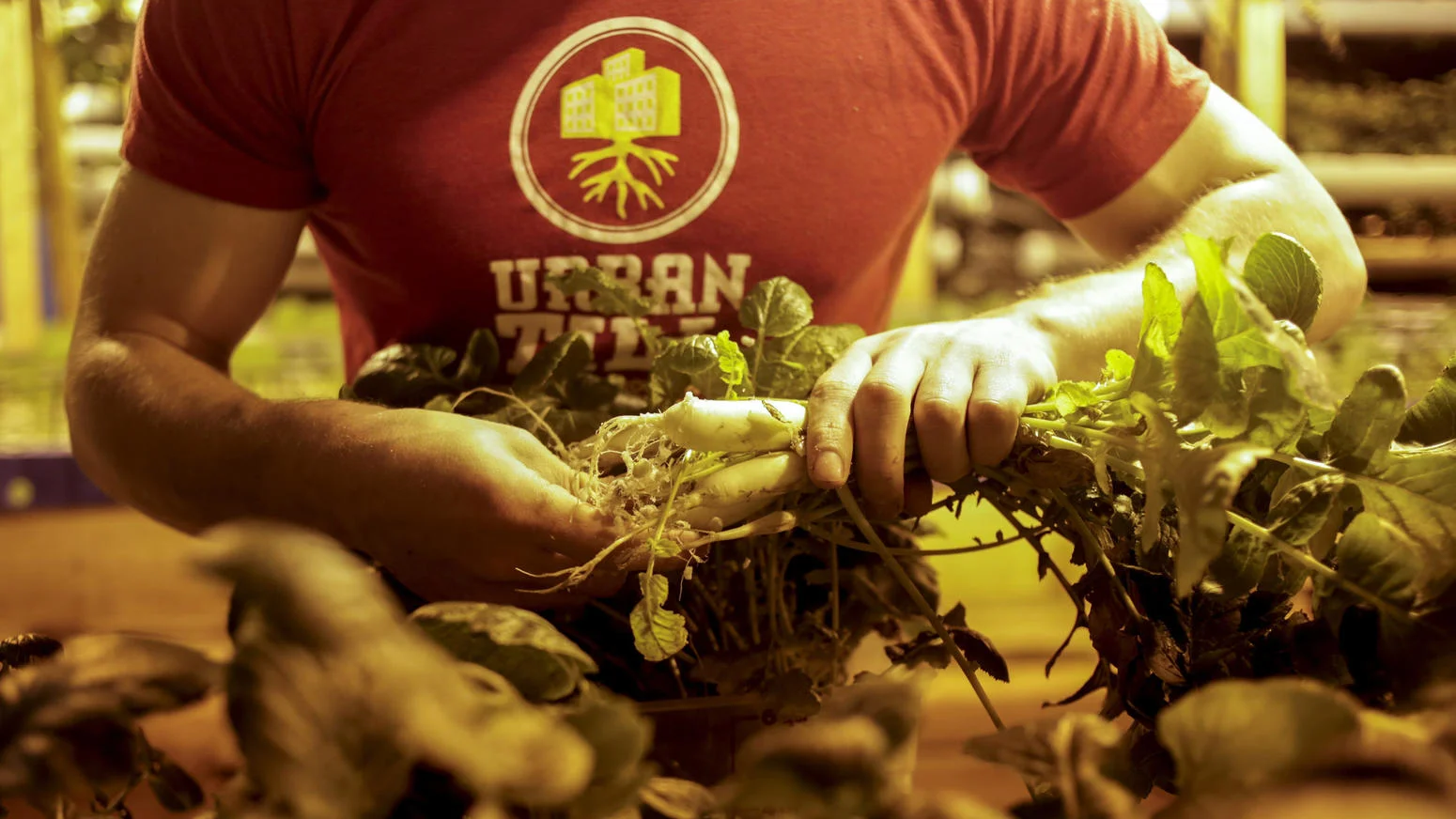
Urban Till, a Chicago-based indoor farming company delivering herbs and microgreens to local restaurants, has suspended its service.
In an email, the company said it was suspending deliveries until further notice “due to constraints that severely handicap our daily operations.” Urban Till CEO Brock Leach said the company stopped deliveries weeks ago, and that it’s pursuing other opportunities to continue providing produce to customers.
In late 2015, Urban Till said it worked with more than 200 local clients and employed about 20. At the time, the company was planning a more than 100,000-square-foot facility in Las Vegas and said it was negotiating to do an indoor vertical orchard in San Bernardino, Calif.
The company, founded by Leach in 2011, has said it offers produce and herbs including arugula, chives and rosemary grown using hydroponics — meaning without soil using mineral nutrient solutions in water. Urban Till's facility is housed in the former Sunbeam factory on the Far West Side.
mgraham@tribpub.com
Twitter @megancgraham
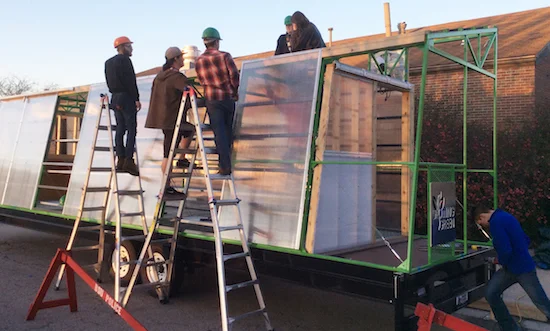
‘Insurgent Architecture’ Students Built a Mobile Greenhouse to Overcome Urban Farming Challenges
‘Insurgent Architecture’ Students Built a Mobile Greenhouse to Overcome Urban Farming Challenges
December 7, 2016 | Karen Briner
It is believed to be a world first: a fully functioning greenhouse on wheels that plugs in much like an RV and that could offer up solutions to some of urban farming’s biggest challenges. The mobile greenhouse prototype, which goes by the name GrOwING GREEN, was born of a collaboration between architecture students at Ball State University and Butler University’s Center for Urban Ecology (CUE). It has already been recognized by the American Institute of Architects with a state award for excellence in architecture.
Timothy Gray, a professor of Architecture at Ball State, whose fourth year students designed and constructed the mobile greenhouse, points out that the mobility aspect opens up a world of possibilities, including the idea of bringing the farm to the people. As stated on their website, the prototype, “lends itself to the shifting and temporal nature of the urban farm.”
Tim and his students, who have worked on four other projects in support of urban farming, had previously created a classroom using a shipping container and recycled components for the CUE Farm in Indianapolis. When CUE received a grant to do some improvements to the farm, they turned once again to the architecture professor and his students.
Why a mobile greenhouse, one may ask? It turns out necessity is often the mother of invention and the CUE farming site happens to be on a floodplain. For this reason the law doesn’t allow permanent structures on the site. So, Tim explains, the initial incentive for mobility was part of figuring out a way to build a facility that was not permanent. The structure is legal because it is mobile and therefore viewed as a temporary structure, falling into a different category in terms of the restrictions imposed by the building department.
The mobility aspect enabled Timothy and his students to stage the project at Ball State University, in Muncie, Indiana and then deliver it to the site at Butler University – about an hour and 15 minute drive away. He points out how mobility would allow the greenhouse facilities to be shared between small urban farms. Another potential benefit is its use as a teaching tool to create awareness of healthy eating and lifestyle. The community is invited to the farm where the facilities they’ve built serve as demonstration projects to extend the discussion of sustainable farming and architecture. The mobile greenhouse could make community engagement more robust as you can literally take the farm out into the community.
The greenhouse cost $40,000 to build, with some materials being donated by community and industry partners and students donating their labor. A professional electrician installed the electrical systems and Butler University provided facilities for installation of the irrigation system. Tim says that if it were to be produced in quantity, costs could be kept down once manufacture was centralized and the mobility would allow transportation and delivery to sites throughout the region.
With many urban farms situated on marginal properties that may have easements and power lines running through them, and where code restrictions makes building permanent facilities difficult or impossible, the mobility allows the structures to fall under a different area and code, making them legal. “I call that building between the seams of the building code,” says Timothy.
Another advantage is that if the farm must move – a prospect that is not uncommon for those farming on borrowed urban land and temporary sites – the facilities can then move with the farm and all is not lost.
“I’ve called these projects that we’ve done – all five of them – ‘insurgent architectures’ because they’re small interventions that can make a big difference and they sort of nest in the seams between these building codes.” He points out that building codes can create hurdles that make it very difficult, if not impossible, for small farmers to get any traction, adding that farming is hard enough work without farmers having to deal with all the intricacies of the building codes. The temporary structure offers them a way to do things legally while avoiding restrictive red tape.
The greenhouse, which is built on a custom-made trailer, measures 32 feet long by eight feet wide, is about 10 feet high and tapers down to about 8 feet at the low side. It has an irrigation system just like a conventional greenhouse. “You just have to unhook it – it sort of plugs in like an RV,” says Timothy, who hauled it the 60 or so miles between Muncie and Indianapolis with his Ford F150, demonstrating that it doesn’t take a special truck to transport it.
In building the greenhouse they minimized the use of any material that would deteriorate over time. The steel frame is powder-coated and they decked the trailer with a composite recycled wood product that is designed to hold up well when it’s wet and the demisting system is operating. Instead of chemically treated wood, they used naturally resistant cedar, as well as wood from a local Indiana business that uses a heat process to make it decay-resistant.
The irrigation system runs on a hose hook-up and a pressure regulator on the inside of the greenhouse limits the hose pressure to 40 PSI. The irrigation system doesn’t have any pumps, running entirely off the hose pressure. There are four different irrigation zones throughout the greenhouse that can deliver more or less water, depending on the needs of the plants. For passive ventilation there are two big south-facing windows and four high windows that face north. The windows are heat sensitive, opening and closing on their own with no assistance. There is a heat thermostat so that when it gets too hot, the fans will kick in. For added temperature regulation, there is also an air conditioner and heater that run off electricity.
Designed for flexibility, Tim says that just about anything can be grown in the greenhouse. For this reason the shelving system is easily adjustable; shelves can be moved up and down, or even be removed for plant starts that need to grow a little taller.
CUE farm manager, Tim Dorsey, grows a large diversity of crops on the farm and starts are grown almost all year round. For most of the crops, when plants reach a certain point, they are taken outside for a few hours a day and then brought back in. This is done until the root system is a little bit more established, before planting them in the ground. To facilitate this process, a ramp off the back allows plants to be easily wheeled out in a cart. The exterior is made of polycarbonate panels that are a mix of clear and milky-white, making a variety of lighting combinations available to the grower.
The project has been generating interest from as far afield as Liverpool, England, and a local university here is trying to raise money to do a similar project. Tim feels it would be pretty easy to replicate and do a second generation, possibly making a few changes and tailoring it to the needs of a specific user. He hopes the mobile greenhouse will offer some solutions to urban farming, or at least start a discussion about generating more grassroots innovation in terms of facilities that support urban farming.

Minneapolis Kids Rap About Urban Agriculture — And We’re Into It
Minneapolis Kids Rap About Urban Agriculture — And We’re Into It
By Dan Nosowitz on December 7, 2016
via Appetite for Change
Remember that "Hot Cheetos & Takis" video featuring those cute Minneapolis kids from back in 2012, which got more than 14 million views on YouTube? From that same studio comes something a bit more grown up.
Appetite For Change, a Minneapolis-based nonprofit dedicated to using food as a means for economic and social growth, recently released a new video with a slightly different message—but some familiar faces.
The nonprofit teamed up with Beats & Rhymes, a program also based in Minneapolis that allows kids to write and produce music in a professional setting, to create a the song and video for “Grow Food.” Using the same familiar touchstones—808 beats, Atlanta-style spooky bass lines, an array Grantland described as “a banger”—Beats & Rhymes has come up with a song that’s somehow both a plea to fight against food deserts and also pretty…good. Here’s the video.
“Grow Food” rails against the proliferation of processed food, unhealthy school lunches, and bad eating habits while promoting gardening, urban farming, and eating your veggies. A sample line: “I get the C from the oranges, I get the B from the broccoli, I get the A from the milk, I get my vitamins properly. My food be packed with them minerals, I hope you taking this literal!”
You can learn more about Appetite For Change over at their website.

Indoor Farms of America Delivers First Vertical Indoor Aeroponic Farms to Native American Communities
Indoor Farms of America Delivers First Vertical Indoor Aeroponic Farms to Native American Communities
NEWS PROVIDED BY
Dec 06, 2016, 12:01 E
LAS VEGAS, Dec. 6, 2016 /PRNewswire/ -- Indoor Farms of America is pleased to announce today the delivery of the first vertical aeroponic farms to two different Native American Communities in the U.S.
"Our staff is very excited about these two farms, sold to Native American tribal interests and members, one in the western New Yorkregion of Salamanca, south of Buffalo, and one in Mayetta, Kansas, serving the people of the Prairie Band of the Potawatomi Nation," said Ron Evans, President of Indoor Farms of America.
Evans noted, "We had the folks from the PB Nation visit our Las Vegasfacility for training, and it was a great day. We learned about their plans to use the vertical aeroponic equipment for education within their community, and for interaction experiences between tribal elders and the young people, who are the future."
These two farms represent the first two vertical aeroponic farms sold for use and operation by tribal people in the U.S. "As we expand our introduction of our crop growing equipment to the Native community, through our subsidiary, Native Indoor Farms, we are grateful to those folks with the vision to see the real benefits of having such a farm," stated David Martin, CEO of Indoor Farms of America.
Martin added: "Not only will the residents have immediate access to fresh and naturally grown produce on a year round basis, but they now have access to an economic model that, based on our discussions with tribal members, speaks to their cultural needs as a people. Growing high quality fresh food, in a clean, controlled environment all year long, first for themselves, and secondly for sale into their local communities, has many tangible attributes that the tribes recognize."
One example is the patented method of introduction of natural minerals into the watering system of the aeroponic equipment. "Tribes can introduce the real elements of nature directly from their own lands into the farming operation in a manner that will enhance the nutritional value of the food, as well as ensure the food grown tastes, quite simply, amazing," according to Martin.
For more information, visit the company website at indoorfarmsamerica.com
CONTACT:
David W. Martin, CEO • 136855@email4pr.com • IndoorFarmsAmerica.com
4000 W. Ali Baba Lane, Ste. F Las Vegas, NV 89118
(702) 664-1236or (702) 606-2691
SOURCE Indoor Farms of America
Related Links
Arizona Urban Farming Startup Embraces Aquaponics to Increase Access to Healthy Food
Arizona Urban Farming Startup Embraces Aquaponics to Increase Access to Healthy Food
December 6, 2016 | Vanessa Caceres
Farmers need to be good at a little bit of everything—from growing and marketing to strategic planning. Chaz Shelton of Merchant’s Garden in Tucson, Arizona, approaches farming from a slightly different angle. He earned his MBA at Indiana University-Bloomington and is using that broad business knowledge to manage his hydroponic and aquaponics operation with co-founder Bill Shriver.
Shelton’s interest in farming began more out of an interest in public health. While working with the Philadelphia Department of Public Health in Pennsylvania several years ago, he often saw how poor eating led to adverse health outcomes. He solidified his idea that instead of shipping food from faraway farms into urban environments, he could bring farming into the city.
That led two years ago to the formation of Merchant’s Garden, an urban farming enterprise whose mission, according to the company website, is to “make fresh food accessible and affordable to everyone using the science of aquaponics and hydroponics.” The farm was started with the help of investors and the business accelerator organization Startup Tucson. It launched just as Shelton was finishing up his MBA. Shelton and his co-founders initially had trouble finding land for their urban farm, but they were eventually approached by the local school district, which had space available in a closed down school about 1½ miles from town.
Merchant’s Garden now operates a 10,000-square-foot greenhouse; Shelton thinks of the founders as “agropreneurs,” who are creating technology today to feed people tomorrow.
Utilizing an aquaponics system, Merchant’s Garden grows lettuce, various other leafy greens, basils, and a Mexican mint marigold (it’s an edible flower with pedals that are mint). The farm supplies products to about 20 area restaurants, an area food bank, and to the Tucson school district. Produce is selected and delivered within the same day, to ensure freshness.
Starting Merchant’s Garden in Tucson versus another urban area had several advantages. “We have a robust knowledge capital with the University of Arizona, which is only a mile away from us,” Shelton says. “They are a leading university for controlled environment agriculture and hydroponics and aquaponics.” With the state’s desert climate, the ability to grow produce year-round, as Merchant’s Garden is doing, appeals to many.
The city of Tuscon was also named in 2015 a World City of Gastronomy by United Nations Educational, Scientific and Cultural Organization. “There’s been a lot of attention and buzz around food here,” he says.
To increase margins and plot a path toward profitability Merchant’s Garden has remained a lean start up. The operation grows, harvests, and delivers produce on its own, with only three full-time employees and one part-timer. “We didn’t want to work with distributors because we want open channels of communication, so someone could tell us ‘This lettuce tastes weird’ or ‘This item is hot right now,’” Shelton says. “The person making the delivery is the farmer.”
The lean, direct approach puts Merchant’s Garden on the right track to profitability, notes Shelton. “We should be cash positive within a year,” he says. “That’s pretty fast for the investment made.”
Eventually, the founders of Merchant’s Garden hope to expand their business concept of urban farming to cities around the nation, including through rooftop farming; they are in early talks to start another location in Phoenix. “We want better access to this kind of food than to McDonalds,” Shelton says.
Shelton also would like to have the farm serve as a place where the public and customers can come and see how their food is grown and engage in the harvesting process.
Shelton advises other sustainable farmers to get market data about their area, test new ideas, and learn from successes and failures. And while farming is not usually a cash cow, pun intended, he does recommend one green (as in money) tip: “Don’t be afraid of capital,” he says.
Affinor Growers Installs Second Tower at the Agriculture Research Demonstration Greenhouse BioPod Initiative
Affinor Growers Installs Second Tower at the Agriculture Research Demonstration Greenhouse BioPod Initiative
Vancouver (Canada), December 6, 2016 - Affinor Growers (CSE:AFI, OTC:RSSFF, Frankfurt:1AF) ("Affinor" or the “Corporation), is pleased to announce it has installed the second vertical growing tower with the University of the Fraser Valley Agriculture Training and Research Demonstration Greenhouse at the John Volken Academy in Surrey, British Columbia. The four level automated tower will allow Affinor Growers to continue to demonstrate and validate various crop models, and continue selling license agreements.
The tower will be planted with strawberries in January 2017 and holds 265 plants in a little over 100 square feet. The new equipment will double the production of the first tower installed last April 2016 and more than triples the production per square meter when compared to the traditional soil beds within the same greenhouse. The nature of the install is to continue to grow and confirm yields and viability of the technology with commercial plant density conditions.
Jarrett Malnarick, President and CEO"Affinor is excited with our on-going work at the UFV BC Agriculture Center of Excellence and continuing our relationship for agri-tech innovation and research to validate agriculture crop models for our technology while providing valuable agriculture skills training opportunities."
For More Information, please contact:
Jarrett Malnarick, President and CEO
604.837.8688
jarrett@affinorgrowers.com
About Affinor Growers Inc.
Affinor Growers is a publicly traded company on the Canadian Securities Exchange under the symbol ("AFI"). Affinor is focused on growing high quality crops such as romaine lettuce, spinach, strawberries using its vertical farming techniques. Affinor is committed to becoming a pre-eminent supplier and grower, using exclusive vertical farming techniques.
On Behalf of the Board of Directors
AFFINOR GROWERS INC.
"Jarrett Malnarick"
President & CEO
The CSE has not reviewed and does not accept responsibility for the adequacy or accuracy of this release.
FORWARD LOOKING INFORMATION
This News Release contains forward-looking statements. The use of any of the words "anticipate", "continue", "estimate", "expect", "may", "will", "project", "should", "believe" and similar expressions are intended to identify forward-looking statements. Although the Company believes that the expectations and assumptions on which the forward-looking statements are based are reasonable, undue reliance should not be placed on the forward-looking statements because the Company can give no assurance that they will prove to be correct. Since forward-looking statements address future events and conditions, by their very nature they involve inherent risks and uncertainties. These statements speak only as of the date of this News Release. Actual results could differ materially from those currently anticipated due to a number of factors and risks including various risk factors discussed in the Company's disclosure documents which can be found under the Company's profile onwww.sedar.com. This News Release contains "forward-looking statements" within the meaning of Section 27A of the Securities Act of 1933, as amended, and Section 21E the Securities Exchange Act of 1934, as amended and such forward-looking statements are made pursuant to the safe harbor provisions of the Private Securities Litigation Reform Act of 1995.

Feed The World? The Farm Without Any Soil
Feed The World? The Farm Without Any Soil
THE CHRONICLE HERALD
Published December 5, 2016 - 8:59pm
Last Updated December 5, 2016 - 9:09pm
Loblaws backing retail test run for TruLeaf, Truro’s innovative indoor farmer
Bible Hill-based TruLeaf Sustainable Agriculture has started retailing its innovative, indoor-grown greens — partnering with Loblaws-owned grocer Dominion to distribute via that chain’s 11 Newfoundland stores.
Gregg Curwin, TruLeaf’s founder, president and chief executive officer, told The Chronicle Herald that Dominion began selling five TruLeaf products in October under TruLeaf’s GoodLeaf Farms brand.
Curwin said a five-ounce “clamshell” container of baby greens was selling for $4.99, about the same price as the regular Californian-grown premium-priced organic produce that currently comprises 90 per cent of all of Canada’s supply.
Curwin said the deal — to his knowledge the first time Loblaws had sold products made using hydroponics — was a pilot for launching across other markets including, initially, Atlantic Canada and the Greater Toronto Area.
He said Loblaws provided valuable advice relating to TruLeaf’s development.
Leading up to the big deal
The Dominion deal followed an April agreement with Gordon Food Service to sell into Nova Scotian restaurants and food service businesses for the first time, he said.
In October, the Truro and Colchester Chamber of Commerce recognized the 27-employee TruLeaf with an innovation award, while the previous month saw the Delta Management Group present a national Clean50 award to TruLeaf for developing and scaling its “smart plant” system.
Curwin said TruLeaf was on track to tap Greater Toronto Area consumers by opening there in late 2017. That facility would be about three times larger and more productive than the company’s existing 4,000-square-foot operation that produces 150,000-200,000 lbs. of greens annually. (See Chronicle Herald, Oct. 17.)
Going inside, getting vertical
To date, five-year-old TruLeaf has landed $2.5 million in financing, most of it from the Atlantic Canada Opportunities Agency and Crown capital agency Innovacorp, Curwin confirmed. The company’s private investors included vintner and former grocer Pete Luckett, as well as former Ocean Nutrition CEO Martin Jamieson, he said.
Curwin said TruLeaf’s products can’t be labelled as organic in Canada because they’re grown hydroponically. But he said pesticide-free and sustainably-based TruLeaf is going after the same consumers who bought organic produce.
He said TruLeaf plans to license the technology globally in “a few” years, following “significant” interest during the past two years.
Curwin said growing vertically indoors, rather than horizontally in fields, makes sense in a world marked by food insecurity, overpopulation, overcrowding, and environment-related risks such as climate change. TruLeaf’s model also allows food to be brought closer to consumers, he said.
TruLeaf’s Facebook page says it wants to “enable every community to grow the world’s healthiest food locally and sustainably.”
New Brunswick-raised Curwin studied at Saint Mary’s University before working for two decades in health care. He became intrigued with indoor farming after seeing a picture of a Japanese multi-level farm.
He said TruLeaf has been supported and advised by Dalhousie University’s Truro-based Faculty of Agriculture as well as provincially funded agricultural incubator Perennia and the National Research Council.
The science bit: TruLeaf’s tech
Using its trademarked but unpatented Smart Plant System, TruLeaf quadruples the amount of space available for farming by growing its plants on 10 levels. A fine-tuned LED array provides “sunlight.”
Excess water and humidity in the air is reclaimed to boost efficiencies, allowing the system to grow easily-transportable leafy greens with 90 per cent less water and less effluent and other waste — while yielding approximately 30 times as much food per square foot as a traditional farm, the company says.

Financing Options Announced For Indoor Farms of America Equipment
Financing Options Announced For Indoor Farms of America Equipmen
LAS VEGAS, NEVADA - Indoor Farms of America has announced the immediate availability of multiple sources of financing for the robust product line of Container Farms and fully scalable vertical aeroponic growing equipment, according to a press release.
"These financing options for our products opens doors to many folks who want the best equipment available for indoor farming on the market, but may lack sufficient cash or capital structure to pursue the purchase of one of our farms," said David Martin, the CEO of Indoor Farms of America.
Indoor Farms of America spent nearly two years in research and development developing what now has multiple U.S. patents awarded: high yield vertical aeroponic crop growing equipment.
The company has also tested growing larger plants, such as heirloom tomatoes, squash, and cucumbers. This line of aeroponic equipment is nearing readiness for release as well.