


Welcome to iGrow News, Your Source for the World of Indoor Vertical Farming
10 Exciting Developments Fusing Food And Real Estate
10 Exciting Developments Fusing Food And Real Estate
A new report, Cultivating Development, shows how culinary innovation and foodie culture can help build community
BY PATRICK SISSON NOV 29, 2016, 2:15PM EST
There’s no question that attitudes towards food and healthy living have evolved over the last few decades. Cuisine and food culture have undergone dramatic shifts, from the proliferation of celebrity chefs to ever-more sophisticated palettes; since 1994, the number of farmers markets in the country have increased fivefold. It only makes sense that developers, always on the lookout for the next standout residential and commercial development, would start factoring these trends into their new projects.
In a new report, Cultivating Development, the Urban Land Institute examines how the real estate industry has begun to embrace culinary sophistication and foodie culture, positioning shared gardens and upscale food halls as must-have amenities and retail anchors. These additions not only fuel commerce and community, but can lead to more sustainable, equitable development that legitimately improves the health of residents. Here are 10 of the projects highlighted in the report, from healthy residential developments to indoor farming centers, that both help the bottom line and add value to the community.
Refresh Project (New Orleans, Louisiana)
Turning a food desert into an oasis, this community development project located between the Treme and Mid-City neighborhoods goes beyond adding a healthy grocery option to assembling the resources for healthier lifestyles. Spearheaded by the local group Broad Community Connections, this developmet replaced a vacant supermarket with a Whole Foods Market and a variety of healthy nonprofits, such as the Tulane University Goldring Center for Culinary Medicine, a first-of-its-kind program that teaches healthy eating and cooking in a clinical setting, the ReFresh Community Farm, and Liberty’s Kitchen, an on-site food service and life skills training center. The project didn’t just encourage better eating habits, but offered more holistic health and wellness assistance as well as career opportunities.
Arbor House (Bronx, New York)
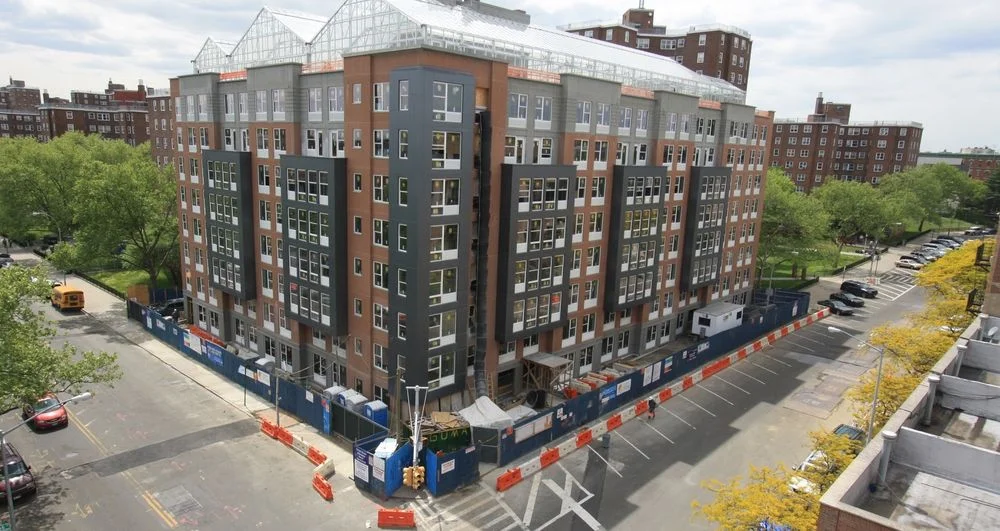
This new housing development seeks to provide not just affordable housing, but a healthy diet, to a community that’s been disproportionately affected by diabetes and heart disease. A 10,000-square-foot hydroponic rooftop farm atop the 124-unit property will grow fruits, vegetables, and herbs, which will then be sold in a neighborhood lacking a surfeit of healthy options.
The Pinehills (Plymouth, Massachusetts)
This new village center models itself after more a traditional layout and design, meaning extensive open space (only 30 percent of the land is developed) and a large two-acre village green as a centerpiece. The retail area, anchored by The Market, the state’s first “healthy market,” is linked to nearby homes via a network of walking paths.
Mariposa (Denver, Colorado)
Built by the city housing authority, this 800-unit mixed-income development utilizes clever design and an array of public programming to encourage healthy living, including a weekly farmer’s market, the on-site Osage Cafe, and a community bike-share program.
Mercado La Paloma (Los Angeles, California)
Established nearly 15 years ago, this former garment factory-turned-food industry incubator has been a celebrated success, earning plaudits from the U.S. Congress. Nearly 200 locals, from social service workers and artists to immigrant entrepreneurs, are employed at this complex, which helps provide startup capital, a health center, as well as conference rooms and performance spaces. An in-house initiative to provide nutrition information, La Salud Tiene Sabor, has spread to local restaurants and markets.
Summers Corner (Summerville, South Carolina)
A “community in a garden” near Charleston, this planned development includes a bike trail system, demonstration gardens, and an outdoor market. The main garden houses the Clemson University master gardener program, which gives residents the opportunity to sharped their skills in the company of experts. Produce from the garden are also used at the nearby Corner House cafe.
Aerofarms (Newark, New Jersey)
This recently opened indoor farm, set inside a former steel mill, will eventually grow two million pounds of produce annually, and serve as an anchor for the RBH Group’s Makers Village project, a three-acre sustainable production district set to activate the local job market.
Eco Modern Flats (Fayetteville, Arkansas)
Using healthy lifestyles as a selling point, a local developer turned these blocks of ‘60s-era apartments into greener, more sustainable homes, featuring a landscape redesigned to include native plants, rainwater harvesting, and rooftop gardens. Parking was also moved to help create a massive communal garden, one of many community features that helps build relationships among tenants.
Aria Denver (Denver, Colorado)
Set to open in 2018, this infill community on the site of a former convent will knit together 450 homes and a variety of gardening and health amenities, including a pay-what-you-can farm stand, a permaculture pocket gardens, a 1.25-acre production garden, shared kitchens, as well as access to healthy cooking classes. The developers believe “giving up” land for these amenities ends up raising the value of the project as a whole, both making it more attractive and bringing in more community partners.
Rancho Mission Viejo (Orange County, California)
A massive series of planned developments intertwined with farms and ranches, this residential and retail project offers a more sustainable and community-oriented model for homebuilding. The first village, Sendero, includes two communal farms amid 941 homes, and when finished, the entire development will include schools, parks, clubhouses, and other recreational facilities. .

Rising Need For Nursery, Indoor And Vertical Farming
There will be a new vertical agriculture revolution, because right now we use up a third of the usable land of the world to produce food, which is very inefficient. Instead we will grow food in a computerized vertical factory building (which is a more efficient use of real estate) controlled by artificial intelligence, which recycles all of the nutrients so there’s no environmental impact at all
Rising Need For Nursery, Indoor And Vertical Farming
by Frank Tobe
November 28, 2016
To meet rising food demands from a growing global population, over 250 million acres of arable land will be needed – about 20% more land than all of Brazil. Alternatively, agricultural production will need to be more productive and more sustainable using our present acreage. Meeting future needs requires investment in alternative practices such as urban and vertical farming as well as existing indoor and covered methods.
Ray Kurzweil, futurist, inventor and Google’s Director of Engineering, said in an interview in The Times in 2013:
There will be a new vertical agriculture revolution, because right now we use up a third of the usable land of the world to produce food, which is very inefficient. Instead we will grow food in a computerized vertical factory building (which is a more efficient use of real estate) controlled by artificial intelligence, which recycles all of the nutrients so there’s no environmental impact at all.
Fully automated regional vertical farms for leafy greens and other commodity crops has long been a vision of the future. Capital costs and other vagaries have prevented such development to date, but lower costs for technology and automation plus higher costs for labor, land and other resources, are making Kurzweil’s predictions come true. There are dozens of vertical farms around the world today with more being built.
Spread, a Japanese factory farmer with a large facility near Kyoto that serves the two metropolitan areas of Kyoto and Osaka, is nearing completion of a fully automated 52,000 sq ft facility where 98% of water will be recycled and seeding, watering, applying fertilizer and harvesting will all be automated. No earth; just shelves on top of shelves from floor to ceiling. They predict 30,000 heads of lettuce can be harvested and delivered daily throughout the year.
Propelling this indoor and vertical farming movement are three influential trends. The Boston Consulting Group, in 2015, produced a study entitled “Crop Farming 2030, the Reinvention of the Sector,” and cited (1) the steady global movement toward precision farming, (2) the availability of economical automation and robotics, and (3) the growing labor shortage as the drivers of the movement.
Vertical farming:
Food grown year round in buildings near urban centers provides many advantages: being close to the point of consumption reduces both distribution costs and spoilage. Outdoor farming is vulnerable to pests and disease, which in turn means intensive use of pesticides and herbicides causing problems with runoff as well as food safety. Vertical farms protect crops from weather and pests and reduce or eliminate the use of pesticides and herbicides. Hydroponic and aeroponic water methods save massive amounts of water compared to outdoor farming. Consequently, as these farms become more prevalent, they could provide a major new role for the ag industry to produce a wide range of commercial crops with major savings in space and water use. In the case of Spread, cited above, they are able to grow lettuce indoors using less than 1% of the water that California Central Valley growers use to grow the same product!
Agriculture accounts for around 70% of water used in the world today according to the OECD (Organization for Economic Co-operation and Development). As population and climate change progress, food needs will grow, and more efficient use of water in ag must happen as well. Vertical farms reduce water usage through recirculating hydroponics, evaporative cooling, control of in- and out-airflow, and other methods. Urban Crops, a Belgian factory farmer and technology provider uses this chart to show the benefits of vertical factory farms versus other methods:
Greenhouse and wholesale nurseries
Greenhouse technology is ideal to protect plants from adverse climatic conditions, insects and disease and to nurse, propagate and grow plants to usable and/or harvestable size. Greenhouses can be framed or inflated structures covered with glass or transparent or translucent material. Greenhouse yields are often 10-15% greater that outdoor yields, consistency and quality tend to be greater, and the growing season is longer.
Similar to vertical farms, greenhouses have high upfront costs and operating expenses, and crop selection must not require pollination. Whether plants are grown in the field or indoors, nurseries transplant, graft, or germinate plants to create seedlings for resale. Their processes are quite complex on two levels: (1) the technical aspects of growing plants which require management of the environment, plant nutrition, propagation, transplanting, irrigation, and pest and disease control, and (2) the business aspects of managing production, labor, customers, distribution and other activities associated with a business. Many nurseries use automation and some level of robotics. Harvest Automation and their mobile robots rearranging potted plants and Urbinati and Visser and their robotic transplanting devices are all examples of the levels of automation utilized in nursery operations.
Commercial and emerging providers:
- AeroFarms – A NJ indoor farmer that is marketing their technology to other prospective vertical farmers. AeroFarms grows a wide variety of leafy greens without sun or soil in a fully-controlled indoor environment using a system of aeroponic misting of the roots for faster harvest cycles, predictable results, food safety and less environmental impact.
- Aris – is a Dutch engineering and systems provider. Many of their projects are integrated with vision and robotics that identify, grade, sort and analyze everything from orchids to chickens, from potted plants to seedlings. Using their systems, nursery clients can then grade and robotically cut branches which can then be potted.
- ALCI Visionics & Robotics – A French integrator of vision and robotics technologies for meat and fish slicing and packaging and for nurseries and growers for potting plants and seed germination, analysis and classification for corn, rice and wheat.
- Conic Systems – a Spanish provider of greenhouse equipment including robotic and software-controlled grafting, seeding and planting systems.
- Demtec – A long established Belgium-based maker of a wide range of horticultural machinery including potting machines, seeders, planters and transplanters. Many of these processes have integrated industrial and mobile robots into their systems. Demtec robotics also play a big part in flat and shelf handling, packaging, palletization, and shipping.
- Egatec A/S – a Danish integrator of end-of-line packaging, boxing and palletizing systems for the ag and food processing industries.
- Harvest Automation – a Boston-area mobile robotics provider with nursery applications for spacing, a task that involves bending over, picking up one or two containers often weighing up to 22 pounds each, walking a few steps and then bending over again to place them in a predefined pattern. The company recently divested a warehousing variation on their mobile robot to better focus on ag industry applications.
- Helper Robotech – a Korean manufacturer of robotic grafting, smart seeding and other smart devices. They also make a wide range of nursery products to nurture seedlings to maturity.
- HETO Agrotechnics – a Dutch manufacturer of horticulture machines including robotic potting systems and pick and place systems for potted plants.
- Hortiplan – a Belgian integrator, reseller and provider of nursery equipment, supplies and mobile gully systems – which move in an automated way from the planting side to the harvesting station. Hortiplan also designs and sells lighting, irrigation and handling systems.
- Irmato Jentjens – An established Dutch builder of systems for automating food handling and packaging. Irmato also makes the Rombomatic, a robotic cutting system for nurseries that examines, assesses, cuts, powders and inserts cuttings into pots and other mediums. Jentjens is a funding partner in a variety of sensing and manipulation projects under the EU’s Clever Robots for Crops program. These include a sweet-pepper harvesting robot, an apple harvesting robot, precision and canopy-optimized spraying robots and other AI-based ag systems.
- Iron Ox – A Silicon Valley startup presently in stealth mode but hiring with a plan to provide a fully robotic, fully controlled environment for ag in a greenhouse growing leafy greens (lettuce, basil and bok choy) using natural light but mobile bots to move plants through each stage of development to harvesting, packaging and palletizing.
- ISO Group – a Netherlands-based supplier of automation solutions for nurseries. They adapt industrial robot technology for horticulture uses such as grafting, planting, vision inspection and replanting.
- Logiqs BV – a Dutch manufacturer of internal transport and logistics systems for greenhouses for growers of cut flowers, tree nurseries, flower bulbs, potted plants and vegetables. Their new modular GreenCube vertical cultivation system uses trays sensors and vertical transporters, also with sensors, for movement between layers and movement to and from the various stages of nursery growing operations.
- CMW Horticulture – a UK integrator and reseller of a whole range of greenhouse and nursery automation products including Logiqs mobility and handling systems
- Mirai Group – A Japanese farmer that, in 2009, became a member and leader of the Japanese government public-private consortium to develop low-cost plant factories. Today Mirai provides R&D and design-build services to grow leafy plants for farmers interested in vertical farming similar to what Spread is doing. Mirai is also producing and wholesaling leafy vegetables from a large plant factory located near Chiba, Japan.
- Photon Systems Instruments – An established Czech Republic provider of ag instruments including high throughput conveyor and robotic nursery phenotyping systems.
- Priva Group – a Dutch engineering, design and systems integrator for greenhouse nurseries. Recent projects include developing a leaf-removing robot for tomato plants. The lowest leaves of tomato plants are regularly removed to promote ripening (this process is called de-leafing).
- QUBIT Phenomics – a Canadian provider of conventional and robotic plant screening systems for nurseries and growers. The company’s PlantScreen™ Field Phenotyping System allows growers an automated non-invasive measurement of photosynthesis, leaf biochemical status, water status and canopy temperature. Greenhouses are the primary marketplace but the company hopes to break into field operations as well. Many major biotech companies and universities have partnered with Qubit in the study of plant responses to various stresses.
- Spread – A Japanese lettuce grower, is constructing the world’s largest plant factory near Osaka and Kyoto. The new factory, scheduled for mid-2017, will be as robotically automated as possible. Spread’s existing facility, from which they are learning what tasks can be automated, produces 21,000 heads of lettuce per day using LED lighting, controlled air conditioning and recirculating water. Spread is planning to construct and operate 20 new factories in the next 5 yearsin addition to selling the technology for others to build their own plant factories.
- Urban Crops – A Belgium startup pioneering the distribution of robotized vertical farming and plant factories. The company offers two types of products, one fits into a 40’ container and can be fully automated or not, and another is custom built for larger spaces. Currently the company has made a small number of sales and has partnered with companies such as Belgocatering, a Belguim based catering company, and a UAE group of investors.
- Urbinati – an Italian manufacturer of nursery technology including automated, and in some cases robotic, seeding, pot filling, transplanting, handling and irrigation devices. They also sell backroom processing robots such as palletizers.
- Transplant Systems – a NZ integrator and reseller of nursery machinery and robots from Urbinati and others.
- Visser – a Dutch provider of horticulture automation systems and complete production lines for large and small nurseries and greenhouses including a robot seeder, transplanter and packing and palletizing robots.
Agricultural Robotics: 160+ profiles
Working together with Tractica, a Colorado research firm, my team and I compiled a list of over 200 global businesses and agencies involved in developing robotic solutions for the ag industry. From that list, I was able to interview and profile over 160 companies and 16 research labs as follows:
- Academic and research labs (16)
- Backroom and post processing (5)
- Dairy and milking (10)
- Drones, analytics and data service providers (26)
- Farm equipment manufacturers (23)
- Harvesting, weeding and thinning robots (21)
- Hobby farming (2)
- Indoor and vertical farming (23)
- Integrator, distributor and reseller (20)
- Self-driving vehicles (15)
- UAS/UAV vendors (15)
This research report will be published in the next few weeks and will contain the whole list, the profiles, and the conclusions drawn from the research, interviews and analyses. The report will be $4,200 for a Basic License (1-5 users) or $6,300 for an Enterprise License.
Note: the link to the report is to the previous report with the same title and will be updated with new information just as soon as the new report is published.
Frank Tobe is the owner and publisher of The Robot Report, and is also a panel member for Robohub's Robotics by Invitation series...read more
agriculture roboticsrobohub focus on agricultural roboticsTractica
Glorious Green Office In Tokyo A Showpiece For Urban Agriculture
The Pasona Group’s blooming headquarters doubles as a promotional tool for farming
Glorious Green Office In Tokyo A Showpiece For Urban Agriculture
The Pasona Group’s blooming headquarters doubles as a promotional tool for farming
BY PATRICK SISSON NOV 28, 2016, 11:23AM EST
Tokyo’s streetscape typically leans towards the modern and mechanized, crowded with bright signs, busy neon lights, and new office towers. But a few blocks from the city’s main train station, the nine-story office of a progressive human resources firm presents a more pastoral addition.
The headquarters of the Pasona Group, one of the country’s largest staffing and talent agencies, literally blooms, a garden in the sky that provides Tokyo with a striking display of foliage. More than 100 types of roses grow on the building’s “green curtain” exterior during the late springtime, and in autumn months, vines growing on the trellised facade display fall colors. And that’s just the outside. The ground floor entrance, lined by citrus plants such as limes and kumquats, leads to a lobby with a functioning rice paddy and urban farm.
“We’re trying to broadcast what you can do in a metropolitan environment,” says Yukie Yoneyama, who works for the company’s urban farm division, which began seeding and planting the midcentury office building in 2010.
Pasona’s investment in a greener office isn’t just about creating a better environment for the company’s more than 1,500 Tokyo employees, though the plant-filled tower does create a less-stressful workplace and cut the building’s annual carbon emissions by 7-8 tons. The living office is part of a larger strategy by the self-described “social solutions company” to help catalyze rural economies and live up to its mission to provide jobs where they’re needed. It’s a physical manifestation of Pasona’s philosophy.
Company founder Yasuyuki Nambu started the staffing agency in 1976 to help provide jobs to mothers looking to re-enter the workplace. As the company grew over the last few decades, Nambu’s social justice focus has expanded to embrace numerous issues in Japan via an array of subsidiaries (Pasona Heartful, for instance, provides jobs for the disabled).
Over the last few decades, the combination of an aging population, a long-term recession, and unemployment has hit the Japanese farming sector hard. Nambu’s proposed solution to the crisis is to “make farming cool again,” investing in ornate projects like the urban farm, which seeks to re-connect city dwellers with agriculture, and funding community-focused businesses in rural areas.
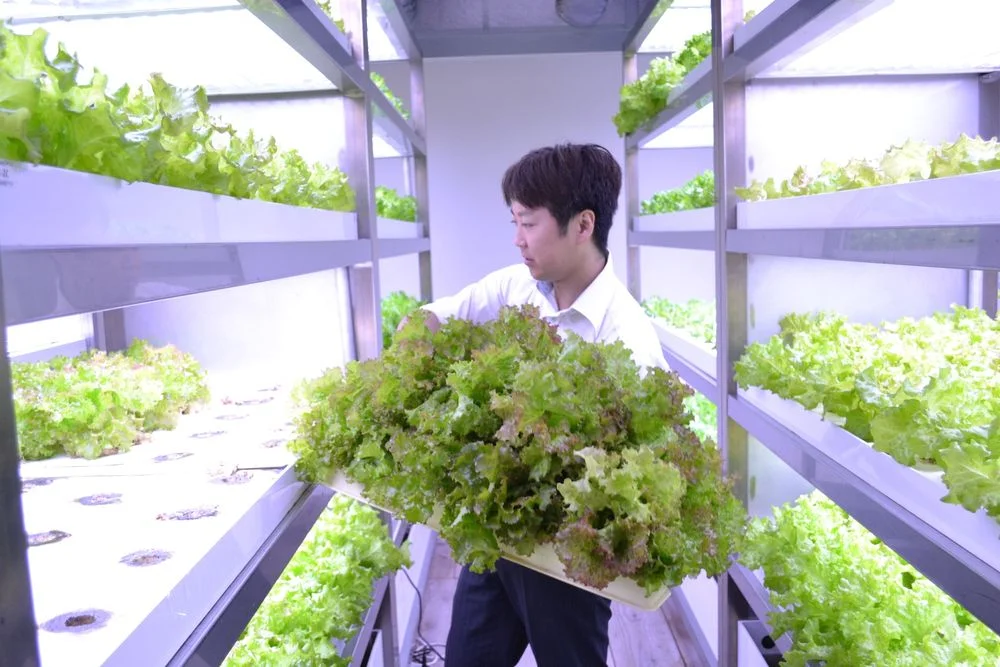
The Pasona HQ certainly offers a sleek, camera-ready model of urban agriculture. With 43,000 square feet of space dedicated to growing more than 200 kinds of crops, nearly every corner of the Kono Designs-created office features some spin on urban agriculture. One of the conference rooms features overhead trellises holding ripe, red tomatoes, while apples and blueberries grow on the grass-covered rooftop. The indoor rice paddy, built from scrap wood and harvested multiple times a years, anchors an employee lobby, which hosts regular concerts during lunch hour. A floor of open meeting spaces includes hydroponic growing systems for herbs—small containers for sprouting seeds are hidden inside benches—offering aromatherapy between appointments. Rows of lettuce plants, raised in a “vegetable factory” along with other produce, help provide more than 10,000 meals a year in the employee cafeteria.
“One of the biggest benefits growing indoors is that we don’t need to worry about seasons,” says Yoneyama, while pointing out the special lighting and watering systems that run throughout the building. “Under normal conditions, lettuce takes 60 days from seed to harvest. We can grow it here in about 45 days.”
In a country where produce prices can by sky-high, Yoneyama says the aim of the company’s agriculture program isn’t to cut costs—rather difficult, when factoring in the cost of indoor lighting—but to spur development. Regional development has been a high priority for many companies, and Nambu believes spurring entreprenurial opportunities is the solution.
“The agricultural industry was hit by all these forces at the same time, so the question is, how do you help the agriculture and tourism industries they depend on?” she says.
In effect, Pasona’s green office is a commercial for regional development, turning normally staid downtown commercial space as a promotional tool. The rice strains planted in the lobby all come from areas hit hard by the 2011 tsunami. The company also supports a farm on Awaji Island, in south-central Hyogo Prefecture, that helps train future farmers and promote local agriculture (products such as dressings and sauces are sold in the company’s lobby).
Long-term, the company plans to continue supporting and promoting small-scale, regional farms and companies, and offer its expertise on urban farming to interested companies or architects. With a renewed focus on corporate social responsibility and healthier workspaces, Pasona fields inquiries from around the world.
“This is something that can really take off and provide a lot of benefits,” says Yoneyama. “We want to look outward.”
Green Acres Are Flourishing On Campus Rooftops Across The Country
Sustainability-minded green roof projects are appearing from Montreal’s Concordia to the University of Saskatchewan
Green Acres Are Flourishing On Campus Rooftops Across The Country
Sustainability-minded green roof projects are appearing from Montreal’s Concordia to the University of Saskatchewan
Leanne Delap
November 28, 2016
Rooftop gardens are having a moment at Canada’s universities. The eco-benefits of green roofs cycling storm water away from the sewage system, combined with the health and social benefits of growing fresh food for consumption right on campus, make the concept a win-win.
Ryerson has been ahead of the urban farming curve. About 10 years ago, says Mark Gorgolewski, a professor in the department of architectural science, CarrotCity.org was formed. “A group of architecture students were interested in food issues,” he says, “and wanted to do thesis projects that addressed the relevance of architectural design to urban food growth, preparation and enjoyment.”
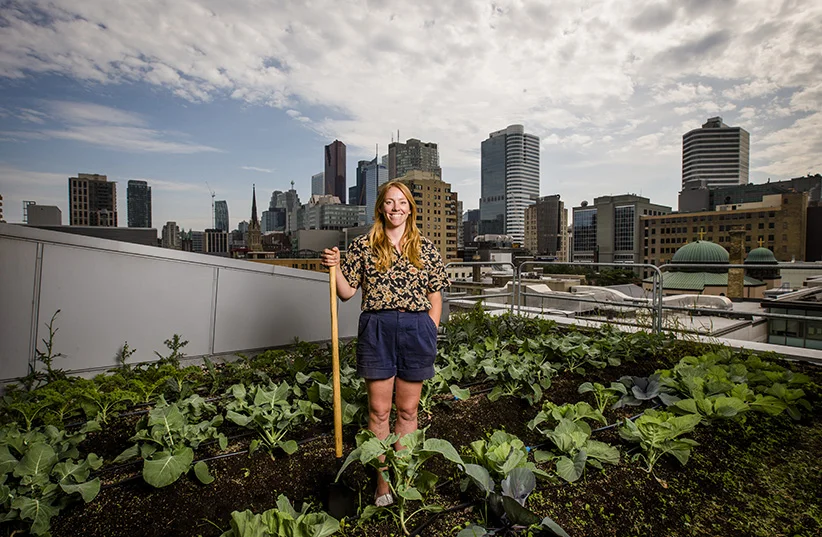
From this student work flourished a website database, a book, a symposium and a travelling exhibition. By 2011, the group was involved in early efforts at growing food in various underutilized spaces around campus. In 2013, production was centralized on (and elevated to) the 10,000-sq.-foot Ryerson Urban Farm atop the George Vari Engineering and Computing Centre. The rooftop had been built as a green space, and from its opening in 2003, when it was known as the Andrew and Valerie Pringle Environmental Green Roof, it has been planted with day lilies and some 80 varieties of local weeds.
All those weeds created “rich, organic life” in the soil, says Arlene Throness, the Urban Farm manager, which they sheet-mulched and deepened for food production.
The Urban Farm now operates on a five-year crop rotation; there are 30 different crops and hundreds of cultivars. Members from the student body, staff and surrounding community all tend to the space and take home a basket of food a week as return on investment. Some produce is sold on campus at a farmers’ market; some is sold to campus kitchens. The yield, says Throness, is some 8,000 lb. a year.
The architecture connection still stands, though Urban Farm also crosses over into other faculties at the school, including nutrition, as well as environmental sciences.
The green is spreading: At OCADU there is a greenhouse that operates with no electricity and can produce lettuce in the dead of winter. Trent, the University of Toronto and Concordia all have greenhouse gardens in the sky.
And at the University of Saskatchewan, an opportunity arose on top of the phytotron (a research greenhouse). The condensers were moved, leaving a bare expanse visible from an open walkway.
“Aha,” said Grant Wood, a professor of urban agriculture, who worked with the university’s office of sustainability to come up with “the rooftop.” After getting the engineering students to check on load-bearing weights, and “a lot of paperwork,” says Wood, pallets and recycled containers were moved onto the roof. The team started with 500 sq. feet of planting, for a yield of about a thousand pounds of produce this past year; the goal is to double that next year.
The garden is being used as a teaching space for both university classes in various disciplines and agricultural camps for school kids over the summer. Crops are sold to campus food services, which advertise the fresh bounty the way restaurants point to local suppliers on their menus.
“We grow the veggies, sell them to culinary services,” says Woods. “They feed students and staff and then put the waste into a dehydrator that goes back into compost. It all takes place in less than a mile. We are working in food feet: sustainability at its ultimate.”

The Future of The Future Farmers of America
With more than 650,000 members, FFA is teaching a new generation dedicated to feeding the world’s growing population.
The Future of The Future Farmers of America
With more than 650,000 members, FFA is teaching a new generation dedicated to feeding the world’s growing population.
Nov 28, 2016
Sarah Baird is a writer and editor based in New Orleans.
As long as I can remember, I’ve coveted a jacket.
Nothing that you’d find on any runway in Milan, though, or draped over the shoulders of a peacocking Kardashian. Instead, from the time I was a preteen, the piece of outerwear that has made my Kentucky-raised heart skip a beat is the signature jacket of the Future Farmers of America.
Equal parts structured and supple, rugged and genteel, the midnight blue showpiece always seemed to encapsulate what I cherished about growing up in a farming community—though I was never particularly adept at fixing tractors or birthing calves.
For years I pined after one, even tinkering with the idea of taking enough floriculture classes to maybe, just maybe, pass off getting my name looped in perfect cursive onto a jacket of my own.
But that level of scheming just never felt right. See, FFA jackets aren’t just handed out willy-nilly: They have to be earned. An FFA jacket carries with it a level of agricultural know-how and more important, pride in the work accomplished by American farmers day in and day out. The jacket, and what it means to wear one, cannot be bought.
Or so I thought.
Last year, while wandering around an antiques store in Williamsburg, Brooklyn, I poked my head around a corner to find a couple of French tourists cooing over a style of coat that was, well, quite familiar. As the girl slid her arm into one of my beloved blue-corduroy sleeves, my eyes bulged. There was no way she’d ever been within shouting distance of a shovel.
Evidently an FFA jacket can be bought—to the tune of $500.
“Oh God, she can’t wear that!” I screamed inside my head, resisting the urge to flip over a table covered with art deco ashtrays, Incredible Hulk style. Despite my own indignant nostalgia, I was struck by a difficult question: Is farming alive and well in America?
Farmland is rapidly losing out to urban sprawl, and the debate over genetically modified crops (and the sprawl of big ag) has grown more contentious than ever. Our nation’s farmers are graying, with few protégés following in their wake. This is even before we get to the financial hurdles upstart farmers face, hurdles that mount each year, with little sign of slowing.
So what do the Future Farmers of America look like today? Who are the teenagers in Indiana or Arkansas wearing the jackets I love so dearly, and what are they worried about? What kind of future do they see for themselves?
George Strait soundtrack prepped, I hit the road to find out.
•••
Nine billion.
That’s the number you’ll encounter over and over, repeated like a mantra, when talking with FFA members. It is the molten core of what drives FFA today, the organizational touchstone that motivates and centers the masses.
It’s estimated that the earth’s population will hit 9 billion by 2050. In most conversations, this fact is followed without fail by the quasi-rhetorical question: How are we going to feed all of those humans?
The statistic is so deeply engrained in the FFA psyche that it’s almost alarming not to hear a member rattle it off during conversation. Some people utter it with race-against-the-clock anxiety. For others—mostly students—the number “9 billion” is spelled out in a word bubble above their heads, the zeros floating away like an airplane contrail. It’s a quantity almost too big to fathom.
The solution to the problem, too, seems to always appear just out of reach.
“I believe in the future of agriculture, with a faith born not of words but of deeds…in the promise of better days through better ways,” the FFA creed begins. What that future looks like now, though, is perhaps more complex than ever.
Since its founding in 1928, FFA has seen tens of millions of students flow through its ranks, and over the decades, has become a primary example of both a youth organization with influence (it does a good deal of lobbying) and phenomenal staying power.
Larry Case, who served as national FFA advisor between 1984 and 2010, believes that two turning points significantly altered the makeup and spurred the growth of the organization.
The first was when membership was opened up to women. “They opened up membership to girls in 1969, and thank goodness they did that,” he said. Today about half of all FFA members are female, including all but one member of the 2015–16 national leadership team. What’s more, at almost every FFA school I visited, women were some of the most vocal supporters of agricultural education.
The second critical juncture came in the late 1980s, when Case and his team began pushing teachers to expand and diversify the FFA curriculum—adding a focus on agri-science and biotechnology—to attract students who weren’t from traditional farming backgrounds.
“This broadened curriculum is the main thing that I believe attracts a larger base of students,” Case said.
The approach worked better than anyone could’ve imagined. Over the past 10 years, FFA numbers have ballooned to almost 650,000 members ages 12 to 21 nationwide. There are now 7,859 chapters in all 50 states, Puerto Rico, and the U.S. Virgin Islands, and FFA students earn $4 billion annually through their hands-on work experience.
The shift led to another stat that, like “9 billion,” regularly works its way into conversation with FFA members: 210, which is the number of career pathways FFA supports. Many would-be future farmers see the old standby ag careers—rancher, commodity crop grower, family-farm inheritor—as less desirable, or realistic, choices.
“A huge misconception is that if you're in FFA, you're going to graduate and go be a farmer,” said 2015–16 National FFA Secretary Nick Baker. “While that is certainly an extraordinarily admirable profession, there’s also agricultural mechanics, agricultural technology, genetic engineering, and the veterinary field. I mean, the list of job options really goes on and on.”
FFA has also gobbled up the remnants of what used to be called vocational education; welding, carpentry, electrical work, and mechanics all fall under the FFA banner, more or less, not to mention futuristic-sounding gigs like flavor technologist and biosecurity monitor.
From an organizational perspective, this hand-over-fist growth means ensuring fund-raising efforts are kept at an equal clip.
FFA is a nonprofit and looks not only to alumni and individual givers as a means of monetary support but to corporations such as John Deere and Monsanto. (Although FFA received a federal charter in 1950, it receives no federal funding.) A cursory glance at the money trail shows that it’s pretty much impossible to divorce FFA from big ag and big pharma. For starters, Monsanto and Zoetis (the billion-dollar animal pharmaceutical company) both donate upwards—way upwards—of a million dollars a year in both general giving and individual scholarships.
And the ties go beyond financial support. In 2014, Brett Begemann, the president of Monsanto, was the keynote speaker at the National FFA Convention. When FFA decided to move and expand its national office in 1998, the land for the new building was given to them by Dow Chemical. The headquarters are smack-dab behind a shopping center built on what is assuredly former farmland.
Overall, corporate giving makes up 94 percent of FFA’s annual budget.
•••
David Tucker is what most people would believe to be the dictionary definition of an FFA student, the kind of kid for whom wearing the blue-and-gold jacket is nothing short of a birthright.
A towheaded, good-natured 16-year-old with a small stature and a lopsided smile, Tucker is a sixth-generation cattle farmer and president of the FFA chapter at Locust Trace AgriScience Center in Lexington, Kentucky. He has always known cattle farming would be his future.
“I learned to count using calves that was just born,” Tucker said, laughing and toying with his faded ball cap bearing the logo of a local stockyard. “’Two cows plus two cows equals four cows.’ That’s how I counted. It took them forever to teach me I didn’t need to say cows after the number.”
Located next to a penitentiary on the outskirts of town, Locust Trace is a five-year-old, 82-acre public vocational high school, complete with two barns, state-of-the-art greenhouses, a food science kitchen, a veterinary lab, and six-and-a-half acres devoted solely to gardening. At the school of 315 kids—most of whom split their days between here and their regular schools—it’s not hard to notice how Locust Trace weaves sustainability into all facets of its campus. The school prides itself on net-zero energy consumption, using industrial-size fans as a main source of cooling throughout its building as well as photovoltaic solar panels. It collects rainwater for irrigation and even has fashioned an underground cistern to hold the collected rainwater in case of drought.
When I arrived, principal Ann Stewart DeMott, a fifth-generation farmer, was shooing away a couple of barn cats that live in her office. (Bella and Spirit serve as “therapy felines” for kids with anxiety.) The school is full of students from all different backgrounds, she told me, most of whom have little—if any—farming experience. No matter: They get the hang of things quickly. In an era when kids are helicopter-parented ad nauseam, these ag students are retooling antique tractors by hand and mucking out stalls for school credit by the time their first semester is up.
“My dad works for Toyota, and my mom is a teacher. I hadn’t been closer than 40 feet to a horse before I came here,” said Dion Compton, 17, as we walked past the campus stables. Dion, one of several African American students at Locust Trace, has a twang that makes it seem like he’s been around farms forever. “I mean, I’d been to SeaWorld and knew I liked animals, but didn’t think that’s something I could do.” Now, when he graduates, he’ll be attending an equine technical school to make horses his career.
There’s a lot of pride to go around at Locust Trace, especially when it comes to hands-on experience. A visit to the veterinary lab found students in scrubs, learning all about how to properly measure an animal’s weight, height, and body temperature. A couple years ago, students took the bones from a recently deceased horse and reconstructed them for use as a learning tool. They nicknamed the skeletal horse Persephone. No one is squeamish.
In the equine barn, Amanda Berry—a student with a frizzy shock of dishwater blond hair—talked to me about how expensive it is to take care of farm animals, all while a horse named Taco rattled his feed bucket behind her. Will Bischoff hoisted a baby goat on his chest as he explained how a new Harry Potter–themed game he has created for the school has helped him to learn leadership skills. When we made it to the livestock barn, Tucker trotted out an orphaned calf named Sassy, showing her off like a pro.
The challenges that farmers will face in the future are never far from the minds of students at Locust Trace, especially when it comes to loss of local farmland. “The towns are growing into the farmland around here, and that’s a big issue,” Tucker said. “Also, a lot of these kids have no clue where their food comes from. They think it just magically appears at Kroger. We will have to teach them that it comes straight from the field, where we’ve had to take care of it and raise it. It’s had a life”—he paused reverently—“so it can help keep us healthy and keep us fed.”
•••
A pinprick of a destination nestled in the heart of Kentucky’s former tobacco country, Robertson County feels about as anticorporate as a place can be.
Meet the farmers working to solve the problems of tomorrow, today.
We’re fortunate here. We have a really supportive community and a supportive administration for our ag program,” said Frank Gifford, the FFA advisor. In the next room over, his first-year students were in the middle of a canning lab, chopping up and cooking down tomatoes to make salsa from scratch.
Despite its size, Robertson County is perhaps the most quietly entrepreneurial chapter I visited. Among a range of projects—from selling bobwhite quail to making vinyl signage—the FFA chapter started beekeeping two years ago and during the last harvest, bottled and sold 200 pounds of honey from 10 hives. (I happily accepted a jar of my very own.)
“We try to generate at least enough money to put it back into the projects and make them stronger. If we make a profit above and beyond, we use that money to start something else. From the greenhouse sales to livestock sales to honey sales to ag mechanics projects, our ag program is financially self-sufficient,” Gifford said.
One of the Robertson County students’ biggest concerns echoes an issue Kentucky FFA Executive Secretary Matt Chaliff has identified: How do farmers in remote areas get their products to a larger market, and more important, how do they compete—in terms of price, quantity, and more—once they get there?
“If you think about a student [farmer] in far eastern Kentucky, like Perry County, if they’re growing some kind of vegetable, they need to have that [produce] ready at just the right time,” Chaliff said. “Then, they’re two hours away from a large city market. And if you think about a fresh product, like sweet corn, making sure that they have an actual market before they grow it is a critical component.”
That’s before they’re even in front of a consumer.
•••
While rural schools like Robertson County are still FFA’s bread and butter, urban and suburban chapters seem to be gaining the most steam, and attention, on a national level.
City- and suburb-based programs comprise 27 percent of the FFA membership today, but with the momentum that’s building, it’s clear the number is only going to tick upward. There are already FFA chapters in 19 of the 20 largest U.S. cities.
At Seneca High School in Louisville, Kentucky, the agriculture curriculum all but fizzled out before Kristan Wright took over the program a little more than six years ago. Now, two classrooms are bursting at the seams with students, creatures, and colorful craft projects: skeletal models made out of dried pasta, FFA seals constructed from paper plates, illustrations of animal digestive systems.
The students at Seneca talked about agriculture like they had something to prove. Many expressed that because they live in an urban environment, they have become makeshift evangelists proclaiming the importance of farming to their city-dwelling peers.
“There’s such a huge divide between rural and urban life,” said Lexie Hughes, her hands moving emphatically. The daughter of a hairdresser and a truck driver, she is perhaps the most vocal of her peers. “Urbanizing everything in agriculture is the future. Rural agriculture is going away. It’s gone.”
Aaliyah Moss—who cites Food, Inc. (a Participant Media film) as her favorite movie and wants to be a biotechnologist—felt similarly. “Agricultural literacy is so important. Something we do really well at Seneca is take the urban aspect and the rural aspect, and we put them together for people to understand,” Moss said.
“And if I could add something?” Hughes interrupted. “It’s the youth that are redirecting the future of agriculture. I feel like we’re such an outspoken generation. We want to know everything about everything. We’re such curious people, and we’re going to educate ourselves about all the different kinds of agriculture rather than just seeing it as cows, sows, and plows.”
In Beech Grove, Indiana—a bedroom community outside of Indianapolis that feels like a Midwestern Mayberry—FFA advisor Chris Kaufman agrees.
“When we started the program here at Beech Grove five years ago, the idea was to get urban students who have no experience with agriculture more in the pipeline to get jobs at [places like] Eli Lily,” Kaufman said. Indianapolis is a hotbed for big drug companies, and their influence on the surrounding communities is difficult to miss. “One of the issues is that we’re three or four generations away from the farm, so even common farm practices, kids just have no idea. Being so far removed, you forget that you need to be a part of it.”
A former traveling agricultural education specialist for the state of Indiana, Kaufman also feels students in urban settings are often fed what he calls misinformation about organic versus conventional farming.
“Since we’re so far removed from the farm, people start hearing these buzzwords like ‘organic’ and ‘GMO-free’ and get excited about it. In reality, those are more marketing schemes than anything. If you go out in the country and ask a kid if he cares about GMOs, he’s going to say no. But in the city, if you tell a kid that something’s GMO-free, they’re going to be like, ‘I’ll pay more for it!’ We’re just tricking people into thinking these things are better for them, when they’ve not been proven to be better or more beneficial.”
And so the debate begins.
•••
How to talk to students about organic farming is a controversial topic within FFA.
“We present all the information we can and let the students make an informed decision,” said Sheila Fowler, vice principal at the Chicago High School for Agricultural Sciences. An hour later, I saw an example of this in the plant science classroom, where students were comparing and contrasting the merits of guerrilla gardening versus conventional farming versus GMOs. It felt refreshing.
But this kind of democratic approach seems to be more the exception than the rule. When I asked Nick Baker how frequently he encountered teachers offering up information about organic farming, it was clear that it was still fairly unusual.
“Organic farming isn't quite as prominent as your conventional agricultural practices, but I will say this: I have been very impressed with the open-mindedness of agriculture teachers this year to teaching about organic farming,” Baker said in a measured tone. “A lot of times in the ag community, you're conventional or you're organic, but you're not both. Really, when it comes to this industry, in my opinion, it needs to be a ‘both and’ kind of situation.”
When it comes to GMOs and the rise of large-scale, newfangled farming technologies, such as drones and no-till farming, opinions get even more complicated. “GMOs are good for you, and they’ve been made to feed the entire world,” said Ayden Paulson, a junior from Seneca who likes to score points in FFA debate events by riling the other team about PETA. “When you hear ‘genetically modified,’ you automatically think that it’s bad. But GMOs make sure our food is safe, and we’re trying to make it better for everyone.”
Not everyone in his chapter agrees. “A problem is everything is becoming more industrialized. Bringing different technologies to farms, it means less work for the people, and the less we work, the less we learn. Technology is making things easier but causing things to be worse at the same time,” chapter mate Moss said with a shudder.
“Plus, that’s where the pink slime comes from.”
“Sustainability” is a complicated term and one with a strangely malleable meaning within FFA circles. There’s environmental sustainability, sure, and there’s protecting public health and animal welfare, but most FFA members are far more concerned about the sustainability of the human population. (There’s that 9 billion stressor again.) In most cases, this means embracing any and all new technologies, chemicals, and agri-science solutions that allow for more food to be grown on smaller plots of land—whether or not it tinkers with plant DNA or pushes small farmers out of business.
If you need confirmation that large-scale agriculture is attempting to co-opt the word “sustainable,” simply visit the Monsanto website, where the conglomerate bills itself as “a sustainable agriculture company.” If nothing else, the company recognizes the importance of reshaping words for its own benefit.
Of the hundreds of scholarship competitions FFA offers at the national level (with sponsors such as Monsanto, DuPont, and CSX), only one focuses on or rewards innovative student ideas for organic production.
•••
If Locust Trace teased out the notion that ag-specific schools might be the key to the future of farming, then the Chicago High School for Agriculture Sciences strongly seconded the motion.
The last working farm in the city of Chicago, located on the South Side, CHSAS is the national gold standard for agricultural high schools—rural and urban alike—and the envy of many an FFA advisor. From Indiana to Louisiana, its reputation precedes it.
Founded in 1985, the school prides itself on being a part of the national effort to “broaden the scope of teaching in and about agriculture, beginning at the kindergarten level and extending through adulthood.” It’s an ambitious goal but one that has been embraced with vigor. Boasting more than 70 acres of cooking labs, tractor barns, and mechanic garages, the school is a role model in every possible way.
“Don’t forget to take her to the barn!” Fowler reminded my student tour guides, one of whom was wearing a sweatshirt with a photo of her dog printed on it. They assured her that everything was under control, then went back to explaining all about the new agriculture “pathway” (essentially, a career prep trajectory) in biotechnology. It will fall in line with six other categories—including horticulture and food science—that CHSAS students use as a vocational and curriculum guide throughout high school.
Along the way to the barn (which was pretty special in its own right), we passed some phenomenal scenes, the likes of which were completely foreign to my notion of a classroom. We strolled through a garage where students were power drilling high up on a platform while below, others sorted pumpkins they’d grown, then harvested from the field with a tractor. We visited the CHSAS farm stand, an after-school shop on school grounds that’s open to the community and sells products, like zucchini bread, grown and hand-crafted by the students. I heard about the fully functional tiny house students constructed two years ago for the Chicago Flower and Garden Show, and how each pathway contributed something unique to the process. (It’s still for sale, if you’re interested.)
CHSAS farm stand on campus in Chicago sells various seasonal vegetables picked by the students. (Photo: Scott Thompson)
Even though you can see strip malls off in the distance, CHSAS feels like its own world. There are cornfields, cabbage plots, and a freshly planted apple orchard. Somewhere beyond a baseball field, cattle graze. The students laugh as they tell me about how the cows sometimes escape, roaming into the middle of a busy road and the lot of a nearby Ford dealership.
“I can’t imagine someone driving down the middle of 115th Street, then being like, ‘What is this cow doing here?’ ” Nicole Stallard, one of my tour guides, said, doubling over with the giggles.
•••
“Family” is a popular word in FFA circles.
Ask anyone—and I mean anyone—in an FFA chapter if he or she feels kinship with fellow members, and the student will likely explode with praise for his or her ag-loving brothers and sisters. Heck, even without asking, I came to expect that chapter members would tell me within seconds of meeting just how much affection there is to go around. There’s a sort of tenderness about FFA students that comes perhaps from working closer with the earth—tending to sick animals, nurturing fledgling plants. Unlike the majority of their teenage peers, they seem to have a larger purpose, understanding, and respect for their place in the world.
What’s more, the FFA chapters I visited were not only more racially and socioeconomically diverse than I expected but also incredibly welcoming of students with learning or developmental disabilities. Inclusion, it seems, is a point of pride among many FFA chapters.
Nathan French from Seneca says the impact FFA has had on his life is extraordinary.
“Everyone in FFA is like family to me. Freshman year I was mostly sick, so I didn’t do anything, but sophomore year I finally found a talent for impromptu speeches, thanks to two fantastic teachers,” French said, grinning. Not only did he win first place at the Kentucky FFA regional competition last year for speaking about beef, but he took home the top prize in the talent competition for a dance he choreographed to a Black Eyed Peas song.
As one might imagine, building a familial culture starts with supportive teachers, and FFA advisors are nothing if not beloved. The recent swell in agriculture programs across the country means that ag teachers are also in high demand, especially in places that traditionally haven’t been hotbeds of FFA action.
“I’ve been at the school...forever?” JaMonica Marion, FFA advisor at CHSAS, said, laughing. A 2001 graduate, she officially returned to teach in 2006. “The majority of the teachers in our ag department are now alumni, so we get to provide the students with firsthand knowledge. We can actually relate to them because we were in their seats.”
At times, the intimacy found at the chapter level feels in stark juxtaposition to the highly formal national structure of the organization, embodied most readily by the national FFA officers. A group of six peer-elected students, the officers serve as the face and fearless leaders of the organization, even taking a year off from schooling to devote themselves to 365 days of FFA-related lobbying, fund-raising, and general hype.
Grooming for national FFA office begins early, with state FFA officers whisked away each year on a (corporate-sponsored) international trip to learn about agricultural production in such countries as Japan and South Africa. They’re also sent to several forms of leadership boot camp, the biggest of all being the one for national officers at Tyson Farms.
Tyson CEO Donny Smith is a proud FFA alum and a huge role model for Nick Baker, who hopes to be an agricultural lobbyist after serving in the Marines.
“[Smith] usually spends about two or three hours every year with the national officer team talking about leadership. He compares [leadership] to a peach tree,” Baker said. “We [as national officers] are the roots; we are supplying the FFA members with what they need in order to be successful. Then they can go be the peaches that people see and admire about this tree that is our organization.” He paused.
“It's always interesting to get to visit with Mr. Smith.”
Whatever leadership training they’re doing, it’s working. The interpersonal and public speaking skills the national officers possess are impressive, and their fervor can border on proselytizing at times. For the most part, they stay on message better than most elected officials I’ve met and are both personable and persuasive in their arguments. It’s not difficult to see why hundreds of thousands of young people have faith in them.
Today, FFA has grown to such staggering heights nationally that it seems to more closely resemble a political party than any sort of school club. The sheer number of members alone is a little baffling, and the power that could be wielded by 650,000 young people rallying around a single cause is a sensational, or terrifying, thing to think about. It has revolutionary potential.
If anyone knows this, it’s the students (and, uh, maybe some corporations).
•••
For all the momentum behind the youth agriculture movement, one thing still strikes me as kind of odd: Since 1988, FFA isn’t even the Future Farmers of America anymore—at least, not technically. Just like Kentucky Fried Chicken is now just an acronym, KFC, FFA’s official name is simply the National FFA Organization.
We’re so much more than farming and ranching these days. It’s a good thing! National advisors and officers will argue. To some degree, that’s true. But I can’t help feeling a twinge of sadness that farming has been lost, in name, from its very own organization.
So what will the exalted FFA heroes of tomorrow look like, if not traditional farmers?
In 2014, the Smithsonian’s National Museum of American History ran a campaign in search of five exemplary FFA members “whose lives and careers have been shaped by agricultural education.” The honor was, undoubtedly, pretty grand. After ascending to national glory, the personal FFA jackets of these handpicked ag titans were to become part of an exhibit at the museum celebrating agricultural innovation and heritage.
President Jimmy Carter's FFA Jacket, which is displayed in the Smithsonian's National Museum of American History in Washington DC. (Photo: Courtesy the Smithsonian)
After a months-long search, the selected winners were announced, and they clearly represented the diversity of FFA’s membership. Among others, there was Corey Flournoy, the first African American national president, and Karlene Lindow Krueger, a pioneering Wisconsin hog farmer. Former President Jimmy Carter was the cherry on top, “Plains, Georgia” emblazoned on the back of his blue-and-gold jacket.
So when they do an all call 50 years from now for the next round of distinguished alumni, will the chosen few be organic rabbit breeders or scientists who grow meat in labs? Compost revolutionaries or mechanics who work on no-till farming? Ag-drone scientists? Or all of the above?
While the paths of our future agricultural leaders remains to be seen, it’s safe to say that today, FFA students hold a respect for the land and an optimism about building a better world that is unmatched. The kids I spoke to are not only hopeful but purposeful and ready to take up their larger mission on the planet to do what they believe is best.
“Knowing that the first job on this earth was a farmer and the last job will be a farmer,” Taylor McNeel, 2015–16 national FFA president, explained, taking a long, deep pause. “It’s pretty cool to be a part of that.”
Container Farms Add Local Flavor To Fresh Fruit Production
French startup Agricool believes the fruit flown around the world and stacked onto supermarkets shelves ain't what it used to be, so it has hatched a plan to recapture the authentic flavors of yesterday's fresh produce
Container Farms Add Local Flavor To Fresh Fruit Production
November 24th, 2016
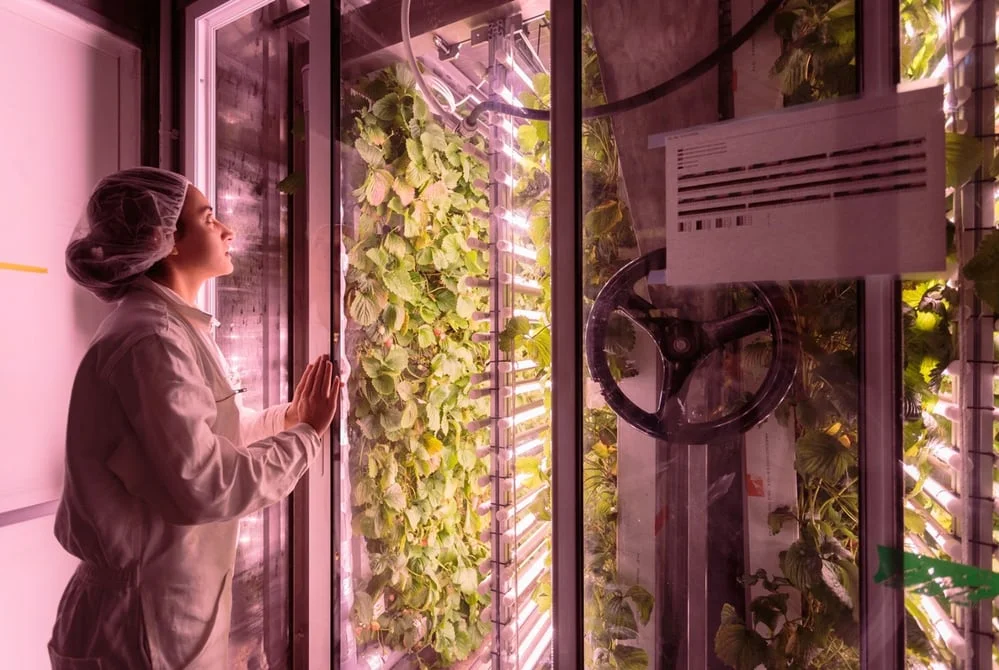
Agricool focuses on growing fruit in its shipping container farms, rather than leafy greens(Credit: Tony Trichanh)
French startup Agricool believes the fruit flown around the world and stacked onto supermarkets shelves ain't what it used to be, so it has hatched a plan to recapture the authentic flavors of yesterday's fresh produce. The company has just raised €4 million (US$4.2 million) in funding to develop specialized shipping containers that can be used to grow full-flavored fruit a little closer to home.
The firm's fresh fruit approach sets it apart from similar shipping container farm outfits like Cropbox and Freight Farms, which typically focus on leafy greens. The first fruit that Agricool is focusing on is the strawberry, a produce it says is the poster-boy for tasteless supermarket fruit.
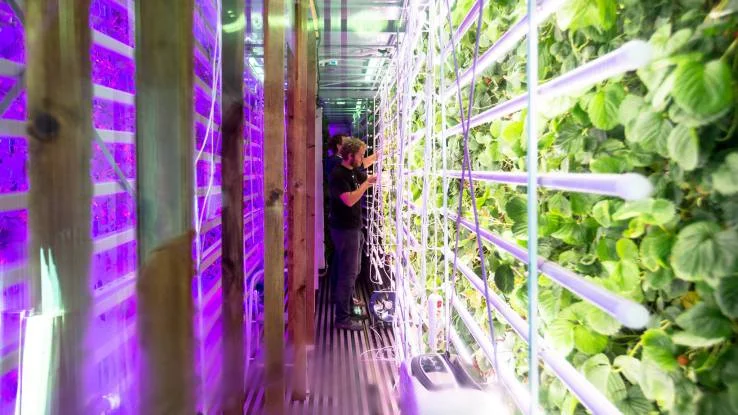
Agricool kits out its shipping containers as hydroponic growing units, designed to optimize growing conditions like nutrient levels, irrigation, LED lighting and CO2. The air drawn in from outside is filtered in an effort to minimize the possibility of pollution entering the containers.
"We have 30 engineers in house, working all day to improve the technology," company co-founder Guillaume Fourdinier explains to New Atlas. "If you don't do that, you are only able to grow leafy greens. Our mission is to bring back taste in our fruits and vegetables, and we don't feel that it has been lost for leafy greens."
Vertical grow-walls, rather than stacked trays, are used as this is said to make it possible to grow more per square meter, with each container able to house more than 4,000 strawberry plants. Agricool says each container can produce 120 times more than would be the case on the same area of a field. The crops produced are also claimed to be more vitamin-rich, free of harmful chemicals and pesticides and conveniently, don't need washing before they're eaten.
The closed loop system employed for water and nutrients uses 90 percent less water than would be required for conventional cultivation and only electricity from renewable sources is used. What's more, the basic tending of the containers can be done by people with no experience in farming, while Agricool actually monitors the health of the crop and controls water and nutrient feeds remotely.
Only 30 sq m (323 sq ft), or the area of two car parking spaces, is required for each container. It is hoped that this distributed mode of growing can ultimately serve whole urban areas, while also helping to cut transportation time, costs and emissions.
Agricool was founded last year by Fourdinier and his colleague Gonzague Gru, both children of farming parents, because they couldn't find high-quality fruit and vegetables in cities. This, they say, is because crops are harvested too soon so that they don't spoil during transport and because they're chosen for their ability to travel, rather than for taste.
The firm's first prototype was installed in Bercy, in the 12th arrondissement of Paris, France, late last year and there are now three prototypes in operation. It has spent this year conducting research and development, and the new funding will be used to speed up Agricool's growth, with the goal for next year to roll-out 75 containers, distribute 91 tons of strawberries and begin work on two new types of crop.
Source: Agricool
Veggie Plant Growth System Activated on International Space Station
May 16, 2014
Veggie Plant Growth System Activated on International Space Station
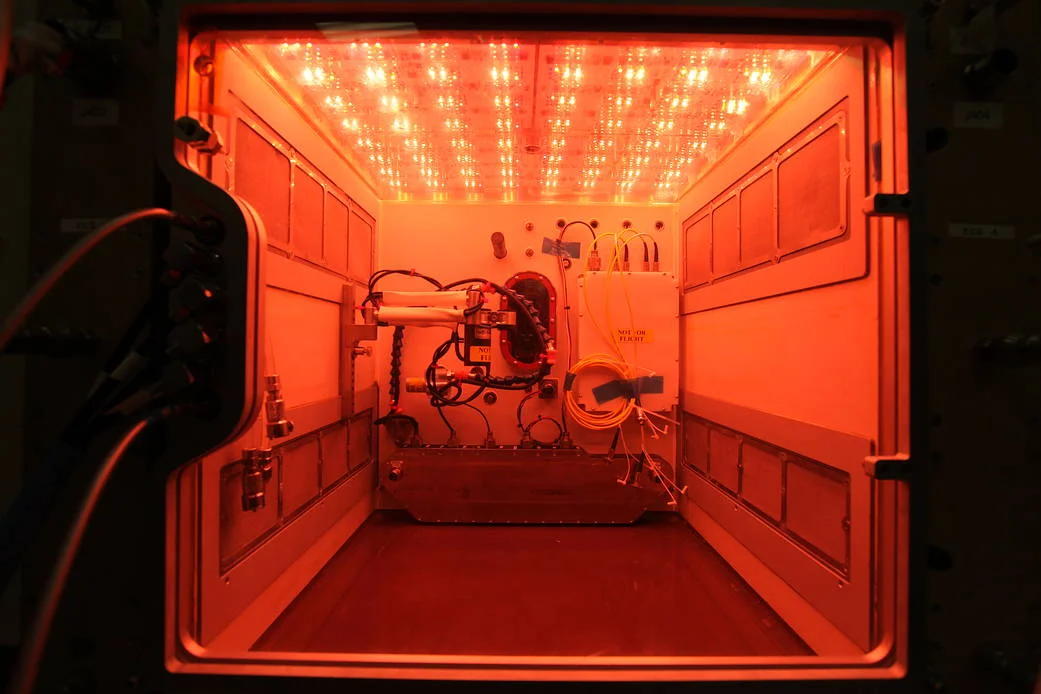
Expedition 39 flight engineer and NASA astronaut Steve Swanson opens the plant wicks in the Veggie plant growth system May 11 on the International Space Station. The six plant pillows contain 'Outredgeous' red romaine lettuce seeds.
Researchers activated the Veggie plant growth system May 9 inside a control chamber at the Space Station Processing Facility at NASA's Kennedy Space Center in Florida to shadow the activation and procedures being performed on Veggie on the International Space Station.
By Linda Herridge
NASA's John F. Kennedy Space Center
If you plant it, will it grow—in microgravity on the International Space Station? Expedition 39 crew members soon will find out using a plant growth system called “Veggie” that was developed by Orbital Technologies Corp. (ORBITEC) in Madison, Wisconsin, and tested at NASA's Kennedy Space Center in Florida.
The first fresh food production system, along with the Veg-01 experiment, were delivered to the space station on the SpaceX-3 mission from Cape Canaveral in April and transferred to the Columbus module for storage until it was time for in-orbit activation.
Expedition 39 flight engineers and NASA astronauts Steve Swanson and Rick Mastracchio installed Veggie in the Columbus module May 7 in an Expedite the Processing of Experiments to the Space Station (EXPRESS) rack.
Wearing sunglasses, Swanson activated the red, blue and green LED lights inside Veggie on May 8. A root mat and six plant "pillows," each containing 'Outredgeous' red romaine lettuce seeds, were inserted into the chamber. The pillows received about 100 milliliters of water each to initiate plant growth. The clear, pleated bellows surrounding Veggie were expanded and attached to the top of the unit.
Inside each plant pillow is a growth media that includes controlled release fertilizer and a type of calcined clay used on baseball fields. This clay increases aeration and helps the growth of plants.
Dr. Gioia Massa is the NASA science team lead for Veggie. She sees Veggie and Veg-01 representing the initial steps toward the development of bioregenerative food production systems for the space station and long-duration exploration missions.
"The farther and longer humans go away from Earth, the greater the need to be able to grow plants for food, atmosphere recycling and psychological benefits," Massa said. "I think that plant systems will become important components of any long-duration exploration scenario."
About 24 hours after Veggie was activated on the space station, back on Earth, "pseudo-naut" researchers activated identical plant pillows in the Veggie control chamber in the International Space Station Environmental Simulator laboratory at Kennedy's Space Station Processing Facility. Researchers will monitor the plant growth and perform the same procedures as Swanson is doing on the space station.
"My hopes are that Veggie will eventually enable the crew to regularly grow and consume fresh vegetables," Massa said.
One of the plant experiment's goals is to verify the Veggie hardware is working correctly. Another goal is to establish that the space lettuce is safe to eat.
On the space station, the Veg-01 plants will grow for 28 days. Photographs will be taken weekly, and water will be added periodically. The pillow wicks were opened to help the seedlings emerge. As the plants grow, the pillows will be thinned to one plant per pillow, and microbial samples will be taken to check for any microorganisms that may be growing on the plants. At the end of the cycle, the plants will be carefully harvested, frozen and stored for return on the SpaceX-4 mission later this year.
Veggie will remain on the station permanently and could become a research platform for other top-growing plant experiments. ORBITEC developed Veggie through a Small Business Innovative Research Program. NASA and ORBITEC engineers and collaborators at Kennedy worked to get the unit's hardware flight-certified for use on the space station.
"Veggie could be used as a modular plant chamber for a variety of plants that grow up rather than in the ground," said Gerard Newsham, the Veggie payload support specialist with Jacobs Technology on the Test and Operations Support Contract. "This is just the beginning."
Another set of six plant pillows, containing 'Profusion' Zinnia seeds could be activated in Veggie for the Expedition crew to grow and enjoy as they wait for word that the red romaine lettuce is safe to eat. If the lettuce is safe to eat, Massa said an additional set of plant pillows containing the romaine lettuce seeds will be activated in Veggie.
"I hope that the astronauts on the space station eventually will use the equipment to 'experiment' with their own seeds or projects," said Nicole Dufour, who coordinated and led the testing of the flight hardware at Kennedy and wrote the crew procedures for the astronauts to use on space station. "Veggie is designed for crew interaction and to enjoy the plants as they are growing."
Dufour said she hopes Veggie serves as a regular facility the crew uses to grow food crops. Dufour is an engineer in the Flight Mechanisms and Flight Crew Systems Branch of the Engineering and Technology Directorate.
Brian Onate, former Veggie project manager, helped shepherd the plant growth system from initiating the build of the flight units in 2012 to just a couple of months before its delivery to the space station.
"I hope to see Veggie's success as the first step in food production that will allow astronauts on the space station to enjoy fresh food and gain knowledge as we explore beyond low-Earth orbit," Onate said.
Why Vertical Farming Is More Than Just Growing Indoors
Feeding urban populations is especially challenging in a linear system. We need to grow food as close as we can to the people who need it
Why Vertical Farming Is More Than Just Growing Indoors
Nicolette Maio · November 22, 2016
As part of Circulate’s collaboration with the Disruptive Innovation Festival, we’re featuring insight from some of this year’s Open Mic contributors in advance of their performance at the DIF. Find out more at thinkdif.co, and don’t forget to catch up on this session with a panel of vertical farming experts.
Feeding urban populations is especially challenging in a linear system. We need to grow food as close as we can to the people who need it. Instead of transporting foods from every corner of the earth, we need to grow food directly in the cities and create more local economies based on necessity. Where we do that can vary: from a vacant lot, a rooftop, in a greenhouse, or even inside of a building.
Farming indoors has its fans and its critics, but it becomes a practicality as the populations of cities increases. Many people are thinking into the future for what food production hubs should look like for sustainable cities of the future.
Could we be on the verge of creating hybrid forms of food production? Can the indoor farmer and the bio-nutrient farmer find common ground? Will Allen is a key figure in knowing how to farm for the future. His revolutionary ways as an urban grower demonstrate the brilliance of a closed-loop system. His organisation, Growing Power, based out of Milwaukee, WI, has implemented greenhouses with stacked functions. The bottom level is an aquaponics system, which feeds the fish poop to the plants’ roots, then circulates back to the fish tank as clean water. It is not just about growing indoors, it is about creating a closed loop that reuses and eliminates waste.
Let’s think bigger. It’s also about incorporating alternative energy instead of fossil fuels wherever possible into the indoor growing system. In Suwan, South Korea there is a three-story 450 metre squared building that the Rural Development Agency is utilising for vertical farming. They have sourced nearly 50% of their heating, cooling and artificial lighting requirements to renewable resources, such as geothermal and solar power. More experimental models like this one are urgently needed.
Permaculture enthusiasts would say, “the problem is the solution.” Where does the potential for growing indoors lie? Could empty warehouses and abandoned buildings be repurposed as mushroom farms? Can sustainable energy be a bigger part of the closed loop? As crazy as it may sound, can harvesting insects provide a new source of protein and reduce the demand for factory-farmed meat? How we grow, what we grow, and where we grow will be shaped by the innovators of today.
Visit thinkdif.co to find out more about the Disruptive Innovation Festival. Don’t forget to create My DIF account to build your own schedule, get session recommendations based on your interests, and 30 days of bonus catch up time after the DIF has ended.
Agricool Harvests $4.3 Million To Grow Fruits And Vegetables In Containers
DISRUPT LONDONDisrupt London Starts Today - It's Not Too Late To Get Tickets Get Yours Today
Agricool Harvests $4.3 Million To Grow Fruits And Vegetables In Containers
Posted Nov 22, 2016 by Romain Dillet (@romaindillet)
French startup Agricool has raised $4.3 million (€4 million) from newly launched VC firm Daphni as well as Parrot founder Henri Seydoux and Captain Train (acquired by Trainline) co-founder Jean-Daniel Guyot. Agricool’s product is quite unusual as the company wants to grow strawberries and later other fruits and vegetables inside shipping containers.
With many people moving to mega-cities, it has become increasingly difficult to provide good food to people living in these cities. In just a few decades, there will be many, many cities with tens of millions of people living there. It’s a logistical and environmental challenge.
That’s probably one of the reasons why processed foods have taken off. It’s so much easier to ship across great distances instead of relying on perishable goods.
And yet, many cooks are trying to reverse this trend, looking for fresh and local ingredients for their recipes. It’s a good trend, but it also means that you’re limiting your options, especially in places with a hostile weather.
Why do we keep seeing the same bright red tomatoes that never go bad and don’t taste like anything? Intensive farming has been great to fight hunger issues, but it’s time to look further — in this case, it means going back to what makes food tastes great in the first place.
Agricool is trying to do something about this and started with strawberries. Instead of relying on trucks filled with strawberries coming from Turkey, Germany, Spain or Italy, the startup tried to produce strawberries right where they were, in Paris.
If you can control the light, the water, the substrate and other factors, the startup noticed that you can grow strawberries anywhere — including in a shipping container.
Then, it’s a matter of optimizing all these factors so you can produce more strawberries from a single container, or cooltainer as the company calls them. The company doesn’t want to use any pesticide and my guess is that it’s going to take a while to make these strawberries as cheap as existing strawberries.
The company is now renting a big warehouse to fill with containers. There’s probably a fair share of A/B testing going on, but with fruits and not website designs. With today’s funding round, Agricool wants to create 75 containers in 2017 and install them around Paris — the goal is to produce 91 tons of strawberries.
The startup also wants to test other crops soon. Maybe some vegetables and fruits will be harder than others when it comes to growing them in a container. It’s going to be a long, capital-intensive venture to iterate on those containers. But it’s an interesting take on the food industry.
Vertical Farming: The Future of Agriculture?
For those of you unaware of the quiet revolution going on in agriculture, vertical farming is shaping the future of food
Can This Modern Cultivation Practice Of Growing Plants In A Closed Environment Meet Our Food Demands In A More Sustainable Way?
For those of you unaware of the quiet revolution going on in agriculture, vertical farming is shaping the future of food.
World population is expected to reach a colossal 11 billion by 2100 (though it varies depending on whose model you use). As a result, many have begun to askhow are we going to feed even more hungry mouths? The answer, at least in part, comes in the form of vertical farming, a new, revolutionary, and sustainable way to grow our food that can also help to reduce the carbon footprint of food production.
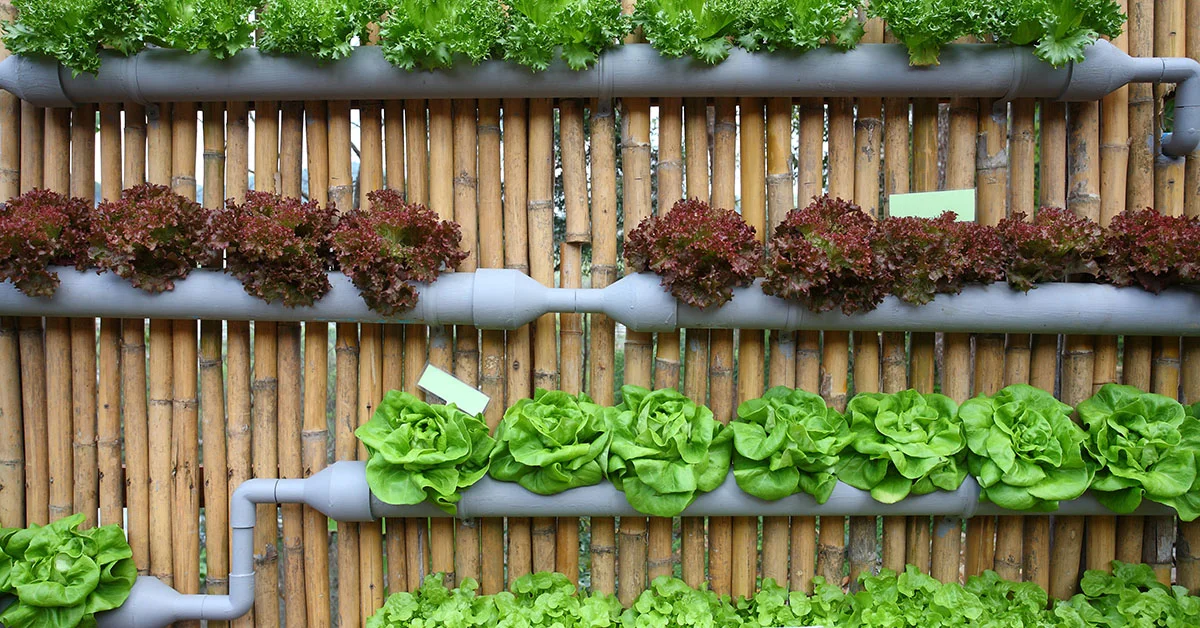
Vertical farming involves growing plants in stacks of hydroponic towers, lit with LED lamps, in a strictly controlled environment. The towers of crops are fed with water laced with nutrients, the strict control of the environment allows for optimum yield from the crops every time. Global Vertical Farming market was worth 600 million USD in 2014.
Vertical farming has numerous advantages over the practices of regular farming. As well as producing a consistent and high yield crop 365 days a year, the crop can be grown in a compact and protected environment — one that is not affected by weather patterns or climate change. All with the added bonus of zero waste (through water recycling) and zero net energy use. All the water used in the hydroponic stacks is recycled and reused — urban waste water can even be recycled for use in vertical farms.
Green Sense Farms in Portage, Indiana, is in the process of building a network of indoor vertical farms across the globe. Their goal is to not only reduce the carbon footprint and environmental consequences associated with traditional farming, but to provideconsumers with locally produced, fresh, leafy greens, to try to foster healthier and more environmentally friend communities. Green Sense Farms is using LEDs built by Dutch tech giants Philips to cut power costs through cheaper LED light, as well as tweaking light wavelengths to try to grow the perfect crop. The Economist praised their farms for the innovative work that they are doing to provide new ways to better feed the planet:
“The crops grow faster, too. Philips reckons that using LED lights in this sort of controlled, indoor environment could cut growing cycles by up to half compared with traditional farming. That could help meet demand for what was once impossible: fresh, locally grown produce, all year round.”
The versatility of location is the greatest strength of vertical farming, especially in the fight against climate change. The farms can be located at, or nearby to, distribution centres, supermarkets, or anywhere that sells or serves large volumes of food, and thus reduce the carbon footprint associated with transporting food from farms to tables – it is the antithesis of globalization.
One of the most globally renowned vertical farming start-ups is Urban Crops, whose headquarters are located in Waregem, Belgium, (though they have recently launched a US division in Miami that will be responsible for the entire American continent, North and South). They don’t see vertical farming as a radical departure from traditional farming, rather they see it as a more refined and efficient evolution of farming. Urban Crops grow their produce under a purple light delivered by red and blue LED lamps that create the perfect conditions for growth; the plants are fed via a hydroponic system of water infused with special minerals and nutrients. Their set-up can turn 50 square meters into 500 square meters of usable farm space and their 30 square meter space produces 220 lettuce plants every day with only five percent of the water that would be needed in traditional farming.
Despite all of these perceived benefits, there have been some who have rejected the idea of vertical farming as a realistic way forward for humanity. TreeHugger has had trouble digesting the concept of vertical farming for a number of years, supporting the belief held by Stan Cox of Alternet that:
“Although the concept [of vertical farming] has provided opportunities for architecture students and others to create innovative, sometimes beautiful building designs, it holds little practical potential for providing food.”
Cox’s main gripe with vertical farming is with the logic (or lack of it) at the heart of the technology; that using renewable energy to power indoor lighting to grow plants with is nothing but a waste of energy a resources. The transfer of energy from sunlight, to solar arrays, to power lamps that feed plants with light energy, is, in his eyes, nothing but a waste of energy (due to transmission losses) and infrastructure. He argues that it is much better to:
“Let crop plants do what they do best: capture cost-free, emissions-free sunlight for themselves, directly.”
Although much of the loss in terms of infrastructure cost could be accounted for if the farms were powered by solar panels on-site – for example by Elon Musk’s solar roof.
Cox also forwards the idea that traditional farming is still viable, that they are simply ploughing the wrong land as it’s become more economically viable to ship produce long distance. The solution is to grow more crops locally, rather than relying on huge sprawling farms and cattle ranches that are not sustainable. Since world hunger is ultimately a result of poor distribution, not a lack of resources, the sensible option seems to be to localize food production as much as possible — whether through vertical farming or more traditional farming techniques.
In contrast to these two polarized opinions Paul Mahon, from Ontario Farmer Publications, doesn’t believe that vertical farming in its more extreme form is how farming is going to develop (at least not in the immediate future).
“Horizontal Farming [a self-coined term] is moving towards that sort of idea, farmers are using hydroponics to ensure a constant supply of water to the roots and crops. GPS and modern technology is allowing farmers to be much more precise in their measurements and their use of land. They are moving to smaller and smaller plots of land for the same yield, and are now able to match nutrients with soil types and capability.”
So the future of farming could marry traditional techniques with some of the small space advancements made with vertical farming to produce higher yields from smaller plots of land. This marriage of techniques has been adopted by Green Living Technologies in their Mobile Edible Wall Unit, which allows users to grow produce outside on an A-Frame mounted flowerbeds to allow for more economic use of space. This could be viewed as a validation of Stan Cox’s opinion that traditional farming isn’t as flawed as many are suggesting.
However, these solutions do not deal with the massive carbon footprint associated with traditional farming, or have the advantages of being immune to climate change and weather conditions in the way that vertical farming is. Although Polyculture farming has offered a way to reduce the carbon footprint of horizontal farming, in a way that is easy for everyone to adopt, it still requires large areas to grow substantial quantities of food. This is where vertical farming truly outstrips more traditional techniques —in urban and more highly populated areas where space is a valuable resource.
With plans in Sweden to build a 16 story “plantscraper” in the works, and MIT working with Target to produce their own greens in-store using vertical farming techniques, there doesn’t seem to be any dispute that vertical farming is going to play a role in the future of agriculture. We will just have to wait to see the extent to which it will dominate agriculture in the future. In the meantime, there are numerous ways that we as individuals can reduce the carbon footprint of agriculture. For example, instead of planting lawns you could grow your own produce, or try to incorporate polyculture farming into your garden. We all need to be responsible for the future of our food, rather than consider it to be someone else’s job.
Josh Hamilton is an aspiring journalist from Belfast, Northern Ireland, living in London, Ontario. Lover of music, politics, tech, and life.
Submit your story or essay to Buzzworthy Blogs
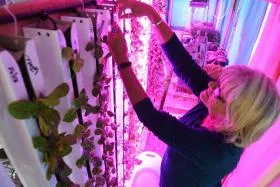
Nowhere To Go But Up: Green Wolf Vertical Farm Supplies Local Restaurant
Greens aren’t the only “micro” aspect of Seleska’s production. That converted sunroom is packed full of produce, and leaves little wiggle room for large-scale projects
Nowhere to go but up: Green Wolf Vertical Farm supplies local restaurants
Posted: November 19, 2016 - 7:18pm.
By Ben Egel
ben.egel@amarillo.com
Marre Seleska’s house looks unimposing. Well-kept, sure, with a spacious kitchen and a room for her father Gene to smoke cigars in, but off the main road in the sleepy Carson County town of Panhandle.
In a repurposed sunroom near the back of the house, imposing burlap pillars filled with lettuce, kale and bok choy stretch from floor to ceiling, roots plunging downward into a growing medium made from recycled plastic bottles. This is where Green Wolf Vertical Farm holds court, and the luscious towers truly support the “vertical” aspect of Seleska’s brainchild.
The real prize, though, is the farm’s microgreens — shallow, long flats of dill and chervil, garden cress and amaranth growing in compressed plugs of peet, vermiculite and coco coir. In one to five weeks, they’ll dot plates at Imperial Taproom and Yellow City Street Food.
Most commercial microgreens are delivered to restaurants pre-cut, meaning they go bad within a few days. Seleska delivers her plants to Yellow City Street Food and Imperial Taproom every week for $25 per flat.
Long shelf lives aren’t the only thing that makes Green Wolf’s microgreens stand out. Yellow City Street Food co-owner Scott Buchanan orders two flats per week because of a substantial taste difference between Seleska and her competitors.
“You can get some from Ben E. Keith or whatever that are already clipped and they’re already kind of devoid of a lot of flavor, but we get fresh racks from her that are growing,” Buchanan said. “The flavor’s insane — it’s not novelty at all.”
Buchanan and his wife Rin met Seleska at the Canyon Farmer’s Market earlier this year, and started using her greens a couple weeks later. Yellow City Street Food tops its dishes with a citrus blend, spicy blend or wasabi arugula.
“They’re pretty, but they also pack a lot of flavor. Hers do especially,” Scott Buchanan said.
“Chefs are artists. They’re food artists, and they like color and flavor,” Seleska said.
Seleska, 59, tried growing leafy greens in a field after moving up from the metroplex three years ago, but found the packed clay left from the Panhandle’s dried-up playa lakes too tough to give life. Vertical growth requires less property and lets Seleska use materials besides the natural soil.
Greens aren’t the only “micro” aspect of Seleska’s production. That converted sunroom is packed full of produce, and leaves little wiggle room for large-scale projects.
Eager to expand past her current space limitations, Seleska began building a 20’x40’ greenhouse in September. Now completed, the first crops will be harvested around Christmas.
Seleska has grown about 15 different crops in her current towers, she said. That number figures to multiply once 70 greenhouse towers are filled, with eggplants, heirloom tomatoes, and purple bell peppers all already planned once winter passes.
Towers are flushed with nutrified water pumped from a 300-gallon reservoir in the back of the greenhouse. A return channel collects any water not soaked up by thirsty plants, and moves the liquid back to a sump tank and back into the nutrient reservoir through PVC piping.
The hydroponic system uses about 90 percent less water than a dirt farm, Seleska said.
Her sister, Robyn Clark, drives from Claude to help out at Green Wolf once per week, “or whenever my big sister bullies me into it.”
The sisters’ maternal grandmother, Winnie Slaton, instilled in them a love of cooking and gardening when they were young, a love which seems to have only grown stronger over the years. On the day Robyn spoke to the Globe-News, Marre had called her at 5:00 a.m., eager to ask her sister’s opinion on a potential hybrid microgreen.
“I call her my mad scientist. She’ll take all these different seeds and see what they taste like together,” Clark said.
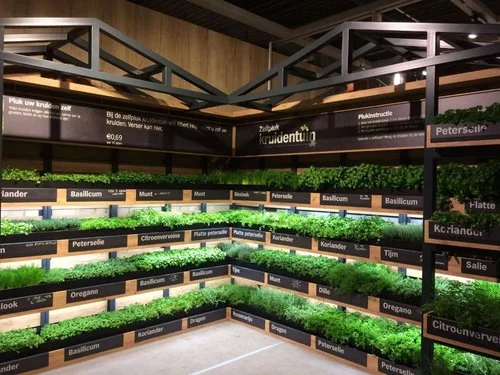
Developments In Fresh Produce
Developments In Fresh Produce
The first in-store Farming unit in the Netherlands has opened it's doors three weeks ago at the renovated AH XL store in Purmerend. The XL store is completely refurbished and implemented some new innovative concepts. The very first "self service herb garden" where the customer can harvest their herb of choice by using the pair of scissors provided at every herb garden module and a bag to put their freshly cut herbs in. There are 13 herbs to choose from. Customers will only take as much as they need so this will eliminate unnecessary food wastage. All herbs have one price so customers can mix the herbs to their liking.
The herb garden is divided into two sections "one more week" and "ready to cut". The herbs arrive as semi finished products and grow their last week with the help of Led grow lights. This way the customer can see the growth with their own eyes. The low maintenance watering system makes sure all the herbs receive the right dosage of water at all times.
We keep getting positive feedback from our customers and so far our concept of the "self service herb garden" has been shared more than 600 times world wide! Freshness adds to any food experience and you can't get any fresher than this!
These 3 Women Are Changing the Future of Food Sustainability
Last weekend, the Change Food Fest in New York City gathered food advocates from large and small businesses to explore the changing landscape of sustainability in the food industry
These 3 Women Are Changing the Future of Food Sustainability
These women presented at the Change Food Fest conference last weekend in New York City
Nov 18, 2016 | 12:00 pm
By
Pauline Lacsamana - Editor
These three women are paving the way for sustainability in food technology.
Last weekend, the Change Food Fest in New York City gathered food advocates from large and small businesses to explore the changing landscape of sustainability in the food industry.
Change Food is a non-profit organization that emphasizes the importance of the food we eat and its relationship with our environment. One of the goals of Change Food is to educate people about sustainable food and farming, according to the organization’s website.
In an opening statement for Change Food Fest, Diane Hatz, Change Food’s founder, addressed the issue of communication between the technology movement and the food movement, also noting the lack of funding for successful food tech businesses because of them being potentially “risky” investments.
“Technology is not the answer; technology is the means to get us to the answer,” Hatz said. “People are the answer. We are the foundation of ours and each other’s success and we really need to take note of that.”
Another woman with a sustainable food vision is Erica Orange, CEO and executive vice president of The Future Hunters, who presented the Green-to-Blue model as a spectrum of activity for food sustainability for businesses to strive toward. The model consists of three phases: Doing Green; Being Green; and Being Blue.
Doing Green is the outdated model in which companies need to be competitive in the sustainable food market. Grocers selling organic food and reusable tote bags are examples of this model. Being Green is the desired model in which sustainability is used as an “intrinsic guiding principle” in the company structure, influencing how products are produced, what materials the products are made with, and what labor went into it. Being Blue, the future model, means businesses would be putting more back into the eco-system than what was taken from it in the first place. An example of this would be using urban farming to optimize space to grow more food.
Last is Kim Huskey, the food service director at Google, who shared her mission of encouraging a more plant-based diet at the Google offices, not only for employees and visitors nationally, but also globally. The food division of Google aims “to inspire and enable the world to make food choices and use food experiences to develop more sustainable lifestyles and communities.”
To make this goal a reality, Google partnered with the Culinary Institute of America and Harvard School of Public Health for Menus of Change. This food initiative involves “globally inspired plant-centric dishes, minimally processed foods, and appropriate portions,” which make vegetables and legumes more desirable using culinary techniques on vegetables that have traditionally been reserved for meats.
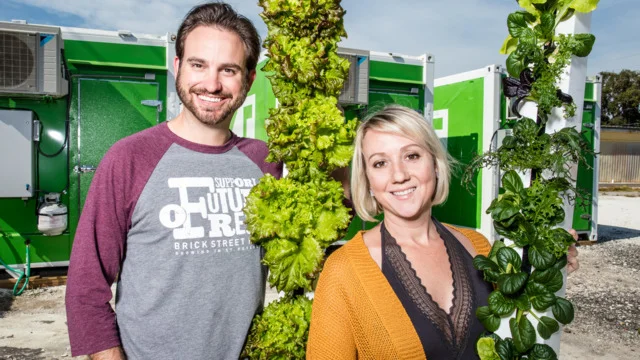
Farm Fresh: A St. Pete City Farm Uses Technology To Grow Its Local Bounty
Farm Fresh: A St. Pete City Farm Uses Technology To Grow Its Local Bounty
High-tech agriculture has blossomed in the city at Grand Central District's Brick Street Farms.
Nov 18, 2016 1 PM
Ever seen a farm with high-tech software or LED lighting? If not, pay a visit to Brick Street Farms.
The indoor hydroponic farm, owned by wife-and-husband duo Shannon O'Malley and Bradley Doyle, doesn't look like much from the outside. But spread out over green upcycled freight containers, planted inside a wooden fence that surrounds the former site of an abandoned junkyard at 2001 Second Ave. S., Brick Street has spent close to a year quietly blossoming in St. Petersburg.
What makes up this city farm's local, vertically grown bounty? Herbs and leafy greens.
"We started harvesting about two or three weeks ago," says O'Malley, who works for a St. Pete-based IT company, as does her husband. "We're almost at full scale right now, so it's been kind of a slow burn getting everything ready."
It's taken a significant amount of work to turn their less-than-half-acre Grand Central District property — which was "very dilapidated" and hadn't had utilities in 20 to 30 years — into an urban farm. They've cleaned up old car parts that were left behind, added electric and water, and even had environmental testing done on the site to ensure it's safe.
For the couple, who’ve put their enthusiasm for at-home hydroponics, which began as a hobby, into producing organic fields of green at Brick Street, that part's been exciting.
"That's one of the coolest things about the project, on top of the farms and obviously indoor hydroponics, being able to [clean up] a piece of property that's been kind of an eyesore in St. Pete for quite a long time," Doyle says.
A Pennsylvania native and a homegrown Floridian respectively, O'Malley and Doyle met five years ago, but didn't get together until after a happenstance encounter: On Christmas Day, as she headed out for a jog on Bayshore Boulevard, he was ending his own. Doyle remembered who she was and stopped her, asking, "What are you doing here?"
"I'm back in town," said O'Malley, who had moved away for a bit.
He asked her out, they met up for a drink later that night and that was that. The couple’s lived in St. Pete for three years now.
The farm has been quietly blossoming in the Grand Central District for nearly a year.
According to O'Malley, the urban agriculture movement, or agritechture, is huge in densely populated northern and western U.S. cities, along with European and Asian countries. She points to locales like Brooklyn, Boston and Los Angeles as having great examples of urban farming. But for some reason, it hasn't really taken off in the South. The then-aspiring entrepreneurs asked themselves, “Why can’t we do that in St. Pete?”
The owners say Brick Street is the only commercial agriculture farm with indoor hydroponics in Tampa Bay, and that they're the state's lone pair of vertical hydroponic farmers growing indoors. Yes, there are hydroponic farmers who do their thing outside or in greenhouses, but those operations present environmental challenges that they don't have to deal with.
For starters, they aren't confined by farming seasons. Brick Street is able to produce cold-loving greens, including heirloom lettuces, kales, collard greens and herbs, that are typically difficult to grow in Florida's almost-year-round summer.
"You know our summer is about nine months long," Doyle says with a laugh.
Operating an indoor hydroponic farm also allows them to offer more stable, consistent pricing on their food. No one's worrying about a freeze, or a random heat spike during the middle of "winter." Unlike the world of traditional farming, O'Malley says they know what their costs are and what kind of volume they're able to deliver.
An additional benefit of having this kind of controlled, specialized environment is accelerated growth; the farm's able to shorten the growing cycle by a few weeks and go from seed to harvest in six to eight weeks. The climates of Farm 1 (where the lettuces are), Farm 2 (empty at the moment, but it'll have an extensive selection of microgreens and edible flowers, depending on the reception they get from St. Pete), and Farm 3 (home to kales, collards and basil) are kept at temperatures ideal for what's growing inside. They also don't need fuel or big machines; the carbon-neutral Brick Street ups its sustainable efforts by being electric and using a small propane tank.
But zero runoff is one of the biggest advantages.
"We talk about, especially in Florida and Florida farming, the fertilizer that's used and the runoff when it rains. It runs right into our water systems, the waters that we count on for tourism and those types of things, and we have none of that here," Doyle says. "All of our water is a closed-loop system. All of the water is completely recycled and reused through filtration systems inside. When we feed our plants with the water and with our nutrients, nothing leaves the farm. Everything stays inside, so you don't have any of that runoff."
The life cycle here begins with an organic, non-G.M.O. seed, pelleted or non-pelleted.Todd Bates
Though the U.S. Department of Agriculture is still determining whether or not hydroponic farms can be certified organic, Brick Street puts organic, non-G.M.O. seeds and materials to use while foregoing herbicides and pesticides, which O'Malley says helps create a sterile environment.
At 40 feet long, the farm's three insulated transatlantic freight containers have traveled across the globe and arrived in St. Pete on a flatbed before being lowered to the ground with a crane. They house different sets of greens, yet each can grow at least an acre's worth of food, which equals 4,000 to 5,000 or so plants.
"They are easily portable if we wanted to move them around, which is a great option. We can also stack them. So barring city code, we could actually go three high," O'Malley says.
Expansion is definitely in the plan. But first, let's go inside a farm.
Everything starts as a pelleted or non-pelleted seed. The seedlings, nestled in plugs made of peat moss, begin in a lower tray under the workstation (the only area of the container that uses white light), where they germinate for around a week. Once they develop what are called "true leaves," they graduate to seedling trays.
The farm uses high-efficiency LED growing lights — red and blue only. As Doyle explains, plants don't use the sun's white light. Brick Street's greens have an unexciting brown color until they're pulled away from the LEDs. That's when they really stand out, in shades that range from eggplant to chartreuse. (Oh, and another thing: that loud hum heard in every container comes from high-powered vortex fans that create outdoor-like "wind.")
Seedlings are fed different levels of nutrients and pH, through an all-natural nutrient delivery system (or harvest system), than their adult counterparts hanging in vertical grow towers. As recycled city water, which undergoes reverse osmosis and "pH down" processes to bring its pH levels to neutral (this prevents a bitter taste), pumps through the system, sensors detect the level of nutrients and pH that the plants need, auto-dosing each to keep them at certain settings.
When you hear the pumps turn on, it's feeding time.
Another part of the plants' life cycle is spending six hours per day in the dark, giving them time to rest, regenerate and absorb nutrients. Greens gotta sleep, too, ya know.
"Because we can make night day and day night, we're running their daytime during the night because electricity is cheaper, and it's more energy efficient," Doyle says. "That's [another] reason we can go from seed to harvest in about six or seven weeks instead of about eight or nine. In Florida, or anywhere in the States for that matter, you only get about, maximum, 12 hours of sunlight a day. We get 18."
They're ready to be transplanted into a tower when their roots have "a nice curlicue at the bottom" and two sets of true leaves. If a crop's head is small, like that of Breen mini romaine, the farm can fit 16 plants on a tower; with fuller heads, a tower can comfortably grow six.
In Farm 1, which has a sweet scent and can be as cold as 60 degrees, there's Red Cross Butterhead, Rex lettuce (an ideal hydroponic similar to butterhead), heirloom Vulcan lettuce (for all you Star Trek fans) and arugula, to name a few. Greens that like it about 3 to 6 degrees warmer — think green and purple kales and basils, or long-and-spiny Toscano Italian kale (meant to be treated like spinach in the kitchen) — are born in the acidic-smelling Farm 3, just two containers down. These plants take in around 50 percent more nutrients than the lettuces.
Alongside some of the lesser-known varieties, the farm also creates its own spring mixes, alternatives to a standard bag of Costco or Publix spring mix. Doyle and O'Malley don't shy away from experimentation, either. They're playing with a multicolor ice lettuce appropriately dubbed "ice plant" because it always looks wet, and like it's donning little crystals.
The lineup of what’s growing will always spotlight basics, romaines and collards among them, with some unconventional finds rotated through to switch it up. Harvest can take place three to four times a week.
“We harvest on demand. It’s one of the benefits of being so local,” O’Malley says. “But most produce, especially greens that we have in Florida, are brought in from the west coast and southern California, so by the time it reaches us, it’s already seven to 10 days old. We’re harvesting within hours of delivery or pickup.”
Restaurants and chefs are their main distribution channels. Love Food Central is now working with Brick Street, and the owners hope to keep ‘em coming. They’ve reached out to locals such as Ciccio Restaurant Group, the cafe at Rollin’ Oats and Urban Restaurants Group. O’Malley says the Urbans have started expanding into bowls and salads, and that they’re interested in the collards, which have been in high demand. The Ciccio crew dug the kales and lettuces, too, though nothing has been finalized.
On its website, the farm’s gearing up to spotlight bags of choose-your-own greens — plus small (six heads) and large (between 12 and 15 heads) bags filled with what will essentially be a farmer’s choice mix — for those who want to place online orders. Open farm hours are coming to accommodate pick-up orders and educational tours for small groups three days a week. And the couple also want to have a presence at more local markets; Brick Street will make its debut to St. Pete Beach’s Corey Avenue Sunday Market on Nov. 20.
Although the technology allows them to monitor the farm remotely via an app that controls the lights, temperature, humidity and nutrients (just like the touch-screen Agrotech interface, or the “brain of the system,” does inside the containers), their goal is to be on-site full time.
And about those expansion plans: O’Malley and Doyle aim to dedicate half the property to their containers, which they’ll happily stack if necessary. The idea is to eventually go from vertical to horizontal growing, adding produce such as tomatoes, cucumbers and peppers to the product line. Ultimately looking to grow into their new home, they’re also working with an architect to develop a neighborhood event space, for gatherings with area chefs and city farm dinners featuring their food, on the other half.
Brick Street wants to bring the local food movement — a la Brooklyn and the rest — firmly to St. Pete. With a booming restaurant scene, tourist season picking up and a community that’s no stranger to supporting local, O’Malley says she thinks the city’s ready for it.
“I’ve noticed all generations are interested in it. It’s not just the millennials. It’s not just the 30-somethings. Folks really are looking to get away from the traditional model,” she says. “And it’s funny, knowing where your food comes from is not this radical idea. It’s just we’ve gotten so far away from it. People aren’t used to being able to see it and touch it.”
Now they can.
“For all these restaurants up and down Central Avenue and into downtown,” Doyle says, “it’s not any more local than literally less than a mile away.”
Having your own urban farm ain’t easy. Here are a couple things the Brick Street Farms founders learned along the way.
More seeds the better? Eh, not exactly
Filling a peat moss pod, where each seed starts, with multiple seeds sounds like a lucrative idea, but it’s not worth it.
“People think because you have these little plants you can put a whole bunch in and you can get a higher production and get more money. Well, that’s not true,” O’Malley says. “We even found [that] out with the seedlings, so it really is only one seed per plug. If you put in more than one, what happens is they compete for the nutrients, they compete for the light, and they actually end up dwarfing. They won’t grow at all, or maybe one will, but it’ll be tall and spiny.”
Go get yourself a wicking strip
Wicking strips go hand in hand with the vertical grow towers used at Brick Street. Found inside each tower, the strips help water find the path of least resistance, and they’re also what each plant’s root system follows (see picture above). Though the strips are a simple — and cheap — component of the operation, they’re important.
“All it does is control the water flow and take the water directly to the seedling roots. Otherwise, water runs wherever it wants to go,” Doyle says. “When we were growing in our backyard before we started growing commercial, we started growing in the towers. We forgot to put the wicking strips in, and we couldn’t figure out why everything kept dying. Because [the plants weren’t] getting any water, the water went wherever it wanted to go
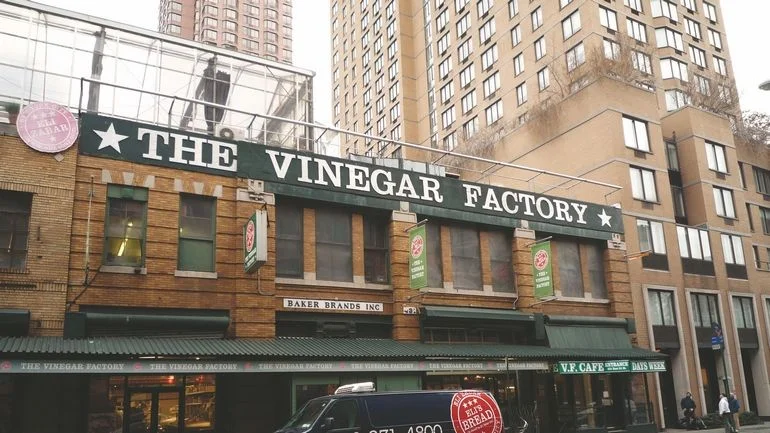
The Vinegar Factory To Close Its Doors To Retail
On top of two of the buildings are 22,000 square feet of greenhouse space, where Zabar has been experimenting with hydroponic tomatoes, vertically grown strawberries and greens since 1995
Real Estate NEWS › REAL ESTATE
November 18, 2016 1:30 p.m. Updated 11/18/2016
The Vinegar Factory To Close Its Doors To Retail
Eli Zabar will convert brunch spot to food production and groceries-on-demand
After a renovation, the Vinegar Factory will reopen as a commissary kitchen to stock Zabar's other ventures.
The easternmost outpost of Eli Zabar’s uptown foodie empire will shut down as a retailer on Nov. 23. Behind the change is a need to accommodate increased demand for home grocery delivery as well as prepared foods.
After a renovation, the Vinegar Factory, which has served Yorkville as a grocer, a brunch spot and an event space since 1993, will reopen as a commissary kitchen to stock Zabar’s other ventures. (Thanksgiving catering won’t be affected, and the site will still have an event space.) Vinegar Factory employees will find jobs at the other branches.
Zabar was looking at necessary repairs at the former mustard and vinegar factory, which was built in the 1890s.He considered how the space could best serve an operation that now includes a flagship market, four Eli’s Essentials prepared-foods stores—one of which morphs into a wine bar at night—a wine store, the café and shop E.A.T., the restaurant Eli’s Table, grocery delivery, catering, gift baskets, a kosher bakery, a wholesale bread business and more than 700 employees.
“All these things take space,” he said. “We’d have to move out to the boroughs and we’re not going to do that.”
Zabar’s longevity in the neighborhood—he opened his first venture, E.A.T., more than 40 years ago—made it possible for him to buy a collection of properties, including the former vinegar factory, that he is now able to modify to suit the needs of a changing business.
“By owning the site, I can do what I want there,” he said, adding area rents are “beyond what food operations can pay.”
The increased production space will allow him to bolster the offerings and staff at the flagship Eli’s Market at East 80th Street and Third Avenue, and to satisfy the growing demand for grocery delivery. He sees both retail and delivery as quintessential businesses at a time when people are too busy to shop during the week.
Zabar also believes that in both of those ventures his markets have an advantage over the larger grocery chains. “We’re not anonymous,” he explained. “There’s a sense of trust.” To use the home shopping service, “you call on the phone and speak to Milton,” he said. Home shopping has been growing 10% to 20% each year, and a large portion of the Vinegar Factory’s customers already use home shopping exclusively, he said.
By revenue, retail is the largest part of Zabar’s business. Increasing production space will allow him to open more locations, he said.
“Now when sites are brought to my attention, I don’t have to say, ‘I wish I could consider that, but I can’t,’ ” he said. He thinks the area below East 76th Street is still underserved, but he draws the line at expanding his business to the foodie haven of Brooklyn. “It’s too far from my production facility to make it fresh and deliver it that day,” he said.
The Vinegar Factory is one of four sites Zabar owns on the block of East 91st Street between First and York Avenues. That’s where bakers turn out baguettes and croissants, decorated cookies, rugelach, and babka. Up on the second floor of what’s now the Vinegar Factory, big pots simmer stock and soup and a designated fryer makes potato chips sold at Eli’s Essentials and Eli’s Table. On top of two of the buildings are 22,000 square feet of greenhouse space, where Zabar has been experimenting with hydroponic tomatoes, vertically grown strawberries and greens since 1995.
Zabar has enlisted an architect to renovate the Vinegar Factory, but the exact plans are still in flux. He intends to keep the factory charm intact but acknowledges “there will be disappointed customers.”
Correction: Soups are made on the second floor of the Vinegar Factory building. One Eli's Essentials location becomes a wine bar after hours. These facts were misstated in an earlier version of this story, published online Nov. 18, 2016.
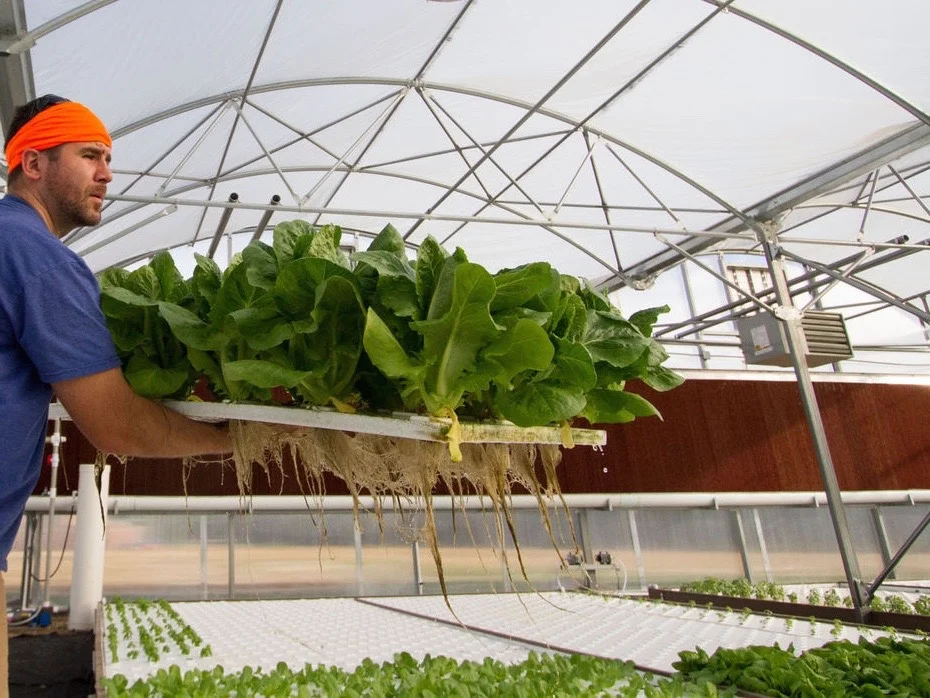
Tucson Business Aims To Harvest Produce, Deliver The Same Day
Chaz Shelton admits that what he’s doing looks suspiciously like lettuce-farming. What makes his business, Merchant’s Farm, unique is the concept, Shelton said.He wants to bring the farm to the city — to vacant lots and rooftops
Tucson Business Aims To Harvest Produce, Deliver The Same Day
Chaz Shelton admits that what he’s doing looks suspiciously like lettuce-farming.
What makes his business, Merchant’s Farm, unique is the concept, Shelton said.
He wants to bring the farm to the city — to vacant lots and rooftops. He wants to provide restaurants, stores and single consumers with fresh, nutritious produce that is delivered the same day it is harvested, by commercializing the latest advances in aquaponics.
Shelton grows edible plants and fish in a soil-less, symbiotic system that uses a tenth of the water of standard agriculture.
Ultimately, he envisions an “Uber-like” model of quick supply upon demand for fresh produce in urban settings.
He’s starting on the fallowed fields of Howenstine High Magnet School on South Tucson Boulevard, which Tucson Unified School District closed in 2013.
The vacant field north of the school now holds a 10,000-square-foot greenhouse. It’s capable of growing nearly a half-million pounds of produce per year, Shelton said.
Inside the climate-controlled greenhouse, the roots of plants floating in water tanks are fed a nitrogen-rich stream of water fertilized by thousands of tilapia.
“It’s a very effective way to grow food,” said Kevin Fitzsimmons, a University of Arizona professor in the Department of Soil, Water and Environmental Science.
Fitzsimmons is an international expert on aquaculture (fish farming), hydroponics (growing plants without soil) and aquaponics, which combines the two concepts.
He has helped set up agricultural systems from Myanmar to Marana.
Nelson apprenticed with Fitzsimmons for a time at the University of Arizona’s Controlled Environment Agriculture Center, which is developing new growing systems and customizing them for locations as extreme as Antarctica and Mars.
The concept is simple, said Fitzsimmons.
“The fish supply the fertilizer and nutrients. The plants remove the nutrients and clear the water,” he said.
Naturally occurring bacteria, meanwhile, convert the fish waste into plant nutrients.
The process is not necessarily simple in execution.
“It’s a complex microbial community that you need to keep healthy,” said Fitzsimmons. “If the fish get sick, the plants get sick, and if the microbes get sick, you’ve got real problems.”
For now, Shelton, his partner/father Bill Shriver and one part-time employee perform all the labor at Merchant’s Garden — planting seeds in a “rock wool” medium to germinate, transferring seedlings to the floating beds, harvesting plants and delivering them to customers.
Customers include a number of area restaurants where freshness and quality are valued, he said.
Chef Janos Wilder has been using the farm’s romaine lettuce to prepare Caesar salads at his Downtown Kitchen & Cocktails and has been pleased with its crispness and freshness. “I really like the product we’ve been getting from him so far,” Wilder said.
Wilder said he’s working on a long-term contract for romaine and watercress from Merchant’s Farm.
“It means a lot to me to have local options. I’ve been working on (local food sources) for 30 years and now there are so many farmers and producers around. It just reinforces the ethos we have,” he said.
Shelton said he can tailor his inventory to a restaurant’s needs — watercress for Wilder; Thai basil for an Asian restaurant and big-leafed lettuce for a gourmet burger joint.
He doesn’t see himself competing with local farmers, so much as filling a need for a consistent supply that isn’t interrupted by growing seasons. He can grow summer vegetables in winter, and lettuce during Tucson’s summer heat.
Shelton’s idea began in college where he studied, at first, in the public health field. While attending the University of Pennsylvania, he worked at a a clinic in Philadelphia, encountering cases of “extreme obesity and extraordinary malnutrition.”
Those contradictory pathologies resulted from a variety of causes, but diet was definitely one of them, he said. “I’m not sure there is a single answer, but access to healthy foods is a big one.”
“I started wondering ‘How do we bring healthy food into the city?’ and thought ‘How about we just bring the farm into the city?’”
In furtherance of that goal, Shelton switched majors and schools to study finance and entrepreneurship at Indiana University.
His parents, Bill and Cindy Shriver, had moved to Tucson and connected him to Fitzsimmons and the Controlled Environment Agriculture Center at the University of Arizona, where he apprenticed for a while.
He competed for and won a spot in Thryve, a business accelerator program run by Startup Tucson, during his summer break from classes.
“They made phenomenal connections for me. Tucson just seemed like the place,” he said.
When he went back to Indiana to complete his MBA, he put together a business plan that won IU Bloomington’s 2015 BEST competition, which came with a prize of $100,000 in investment in his future company.
More than that, he said, it connected him with investors who have since tripled that total.
A couple of other things came together for him at the same time, Shelton said.
Tucson city government was working on urban agriculture amendments to its zoning code that made it possible to open a growing operation in a neighborhood not formerly zoned for it.
“We were the first applicant,” he said.
He worked simultaneously with the school district and its board to lease land at the Howenstine site. “We took a vacant piece of land and turned it into a food machine,” he said. The plan includes educational trips to the farm by TUSD schools.
Shelton is planning a second investment round to expand into the Phoenix area and he has his eye on a rooftop in downtown Tucson.
He said he also plans to continue working with the UA to commercialize the many innovations of the Controlled Environment Agriculture Center.
“We need to commercialize and advance some of the innovations out there right now,” he said.
“I’m not going to be a great farmer or researcher or whatever, but I’ve worked in venture capital. I’ve already commercialized other technologies.
“I can take existing technology from UA and bring it to market,” he said.
Contact reporter Tom Beal at tbeal@tucson.com or 520-573-4158. Follow on Facebook or @bealagram on Twitter.
Live Recap from the Chicago Summit
This is the third in a series of three Summits in 2016 which are bringing together some of the world’s most impactful food system leaders
Live Recap from the Chicago Summit
Follow along at our Chicago Summit with a live recap of highlights from each panel discussion.
We are live today from the Gleacher Center at the University of Chicago Booth School of Business, with the Chicago Council on Global Affairs for the 1st annual Chicago Food Tank Summit. This is the third in a series of three Summits in 2016 which are bringing together some of the world’s most impactful food system leaders. Click Here to watch the Live Stream, brought to you by Organic Valley.
9:00 am:
An exciting day has begun. Stacey Kole started our morning with an enthusiastic introduction to the Food Tank Summit. The University of Chicago Booth School of Business is excited to co-host and partner with so many leading experts and institutions during this summit. Kole is excited about all the great speakers and panelists, such David MacLennan, Chairman and CEO of Cargill, who work hard to find innovations to feed the world. As Kole said, it is a great time to convene a group like this so we can “shake our communities and help disseminate knowledge”.
9:05 am:
Alesha Black, Director of the Global Food and Agriculture Program at the Chicago Council on Global Affairs shared some of the goals and work of the CCGA. By 2050 we will have at least 9 billion people, with 2 billion living in cities. We need to transform our food system to address these challenges. As Black wrapped up her introduction by encouraging us to remember how great it is that we have “likeminded people with lots of great ideas coming together today”. These conversations will helps us find the best ways to transform our food system.
9:10 am:
Danielle Nierenberg, President of Food Tank has heartily welcomed both the live and online audience. She is excited to see the summit take place in Chicago, the city where the Food Tank was born. “This is one of the greatest food cities in the world” she said, a city that is "cultivating the next generation of entrepreneurs that are making food more affordable and accessible". She also warmly welcomed all students who will inherit our “problems but also enormous opportunity”. She eagerly reminded the audience of how important it is to convene all many “different ingredients’ or as she put it, “different tastes and opinions will help create dialogue and conversation…let’s stop preaching to the choir”. Five topics will be covered during the conversations at the Food Tank Summit today, from future farming, to unusual (sometimes uncomfortable) alliances and collaborations, transparency to the future of food. We do not have time to waste. We need to start now.
9:20 am:
Kevin Cleary, CEO of Clif Bar & Company, gave a sincere introduction to what marked the beginning of a food journey and interest in a sustainable food system. There is now so much interest and concern and food and a great demand for improved food systems. As a parent, some of these issues are really concerning, such as the amount of pesticides in our food system. It is not an inconsequential amount. Pesticides are not only concerning to consumers but also for the farmers who are constantly exposed to these harmful chemicals and suffer the consequences of such exposure. As CEO of a food company, he feels like he can make a difference, but there is a long way to go. For example, organic farming is still a small percentage of the total, just 1% in the US! Shouldn’t we be able to find organic macadamia nuts? Our supply chain should increase organic options.
Cleary had three recommendations for improving our food system:
- Provide farmers transitioning to organic farming longer contracts
- Invest in organic research and extension services
- Create policies that provide financial incentives for sustainable agricultural practices
We need to have a dialogue about these now. “We can do better than less than 1%” – Kevin Cleary
9:30 am:
The first panel of the day, moderated by Roger Thurow, Author, Journalist, and Senior Fellow, Chicago Council on Global Affairs, was a lively discussion about farming the future. The discussion started out by talking about local, Chicago-based transformations and changes in the food system. Harry Rhodes, Executive Director of Growing Home, the first certified organic farm in Chicago discussed farm production and training programs. Growing Home successfully produces30,000 pounds of food on an acre of land. They have trained over 400 people topics ranging from indoor farming to distribution centers, to understanding the food chain. “Food is at the center of building a healthy community” – Harry Rhodes. Billy Burdett followed-up by talking about the importance of urban agriculture. More and more people have been interested in “hyperlocal food production”. For example, Mayor Rahm Emanuel has been instrumental in the local food movement, making room for urban farms and community gardens. There has been both growth in number of urban agricultural projects and in the types of projects, such as aquaponics and vertical farming operations, and commercializing of innovative projects. As Burdett put it, “different approaches to sustainable foods are what will help us obtain a more resilient food system”. Emily Zack, Farm Operations Manager at the Loyola University Retreat and Ecology Campus (LUREC) chimed in toshare some of their experiences with organic farming. Hands-on learning experiences, particularly with women and their children, have been especially rewarding. Simply things, such as teaching women and children to grow pomegranates, have a lasting impact on the food system and on nutrition.
Thurow then posed a question about the state of family farms and cooperatives. Ben Burkett, President of the National Family Farm Coalition and a fourth generation farmer with a great Mississippi accent, talked about both the many innovations and long-lasting practices that are being used in farming. As Burkett summed it up, “the future looks bright”.
The conversation then shifted to how we can we breach the gap between producers and consumers. Randy Krotz, CEO of US Farmers and Ranchers Alliance (USFRA), a Cardinals and Blues fan from St. Louis (and a Cubs fan too!), mentioned a few ways their organization tries to breach gaps between farmers and consumers. He optimistically reminded us the food system is not broken, we are on a path of continuous growth and improvement. Innovation in the food industry is largely around food sourcing (organic, GMO, carbon footprints). To build credibility with consumers, farmers need to make sure consumers hear from the producers themselves. Greg Kearns, vice-president of Institutional Partnerships at Heifer International chimed in to then talk about the importance of social capital development and living incomes, two core values of Heifer International. Although some of their efforts are not direct nutrition interventions, there is a lot of potential for improving nutrition outcomes through their agricultural programs. There is also a lot of potential in scaling up programs without breaking budgets. This can be done through improved value chains in which relationships are strengthened, jobs are created, knowledge skills and assets are shared. Similar models are being used in the US too.
Before the Q&A, panelists discussed who should be responsible for nutritious foods. Should the farmers be leaders in creating a more nutritious food system? Is it consumer behaviors and practices that need to change? Krotz began the conversation by reminding us how consumers influence demand. Burkett agreed and reminded us of how “two years ago everybody was on kale”. Burdett talked about this from a city living perspective. He mentioned how a lot is consumer driven demand but at the same time also generations of folks who don’t have a connection to food and where it comes from. As a result, there is less cooking, more pre-packaged foods. He believes we need to pay closer attention to our education efforts. We need to inform consumers of the importance of fresh, local produce for a healthy life. This will help drive the consumer demand. Rhodes wrapped it up by reminding us to try to predict what is the next thing people will be looking to buy and to educate the consumers about products they have never tried before.
Q&A
What are farmers thinking about in terms of soil health?
Zack – “soil is alive”, we need to be thinking about this. Amending soil after growth is needed and it isimportant to do it in a sustainable way (e.g. compost)
Krotz- “soil is a farmers life”, no matter how big or small, preserving the soil is key.
Burkett – you learn early on that you must take care of the soil.
Rhodes – local sourcing of compost would be ideal
How can restaurateurs build relationships with farmers?
Zack – growing specialty items for restaurants, farmers often seek out restaurants and see what they want to serve and the farmers can grow quality product for them
Burdett – “Green restaurants and caterers” can build interest in the community and help farmers build relationships with restaurants and even innovative relationships such as co-branding with distilleries. Or listen to the comment about processed foods not necessarily being the enemy.
Krotz - Not all food is local, there are markets that can’t sell all their product locally, should not lose sight of the importance of that larger scale production too.
Sometimes restaurants drive consumer behaviors by showing them something new, demanding new things from local farmers.
Suggestion – do not shun processed foods – food science can be part of the solution!
Recent study on pesticides going up and GMOS not necessarily increasing yield. How do we reduce pesticide use?
Can we incentivize polyculture more (e.g. trees/hedges)?
Krotz - rain is needed for trees. Many parts of the country don’t have enough rain to sustain that. NYT times article was highly discredited – there were increased yields, decreased insecticides. GMO do help address a lot of our main issues.
Rhodes – transparency is needed, consumers should know if it is GMO, regardless of the literature.
10:00 am:
The second panel of the day started out with some fun connections between the 2016 elections and the Cubs World Series win. According to word on the street and Ambassador Quinn, there are two things that can bring unlikely alliances together – A Cubs win and the World Food Prize. We all care about the food system, regardless of our sports or political inclinations. Efforts to improve our food system resonate with many sides of the equation. The conversation was focus on how many opportunities, rather than challenges, there are when building alliances. For example, although we face many economic restraints, return on investment is high when it comes to food waste. Also, as Pereira put it, we have the opportunity to look into more ways to keep materials and nutrients flowing within our system. This can be done in large part via improved collaboration between business, non-profits and government. O’Neill followed-up with a great example of how you can find thing in common with others, rather than focusing on differences. As a hunger organization they see a lot of diet related issues among those who suffer from hunger. To address this, they created a model helps collect the type of food these people need, similar to a wedding registry.
MacLennan introduced some of the hardships when building unlikely alliances. When building new relationships there are often also contentious conversations. For example, when investing more efforts in reducing global deforestation, there were questions about profit loss. “If focusing on sustainability is more complicated and expensive, that is fine”, said MacLellan, it is part of Cargill’s mission. “We need a constructive rather that destructive contention to make a difference”. On a similar note, Black mentioned how ending hunger is a US interest. Food security leads to international security. Also, with increasing middle-income families and transitioning food demands globally, the market will grow.
The conversation was then open up to the audience. Some asked how we reduce food waste by using end products for new products (e.g. coffee). What are some innovative food waste strategies? What can we do with “ugly produce” and unlikely alliances? Vared alluded to the fact that retailers and food service shine a lot of opportunity for decreasing food waste by using the “ugly products” and Pereira reminded us of the importance of technologies such as anaerobic digestion, fuel sources and composting. With opportunities often come challenges. For example, legal issues continue to be a big challenge.
More from the Q&A:
What are food organizations doing about transparency in these unlikely alliances?
MacLennan – when it comes to transparency about GMOs for example, we have some consumer products, and the new national labeling law will support the importance of knowing where food comes from.
Does educating women play a role in food security and international security?
“Countries that succeed will be those that use all their human resources” – Ambassador Quinn
How do we tackle food waste with innovative partnerships?
Vared - We need better supply and demand forecasting. This is a key opportunity to reduce food waste. And when there is waste at the farm level, we need to ask how can we capture that food and re-package and re-purpose it so it does not go to waste.
Ambassador Quinn – Farm to markets roads are key. Gives farmers the certainty they will be able to transport their crop to market and sell. Distribution is so important.
What aspects can be done on a policy level to create more alliances for fewer pesticides and more organics in our food system?
Black - Private sector has a huge opportunity to get involved- e.g. Aflasafe, made by the private sector, now manufactured locally in Kenya.
Ambassador Quinn - More money to public research is needed. Funding has been reduced but it is critical to deal with the challenges during the next 30 years.
Now we are at the table, how do we make sure people at the table can be “trusted” and heard?
Vared – try a data driven approach to bring everybody to the table. Some folks want to focus on prevention and some others on cost-effectiveness. Data centered conversations help stay focused and find a common ground.
Ambassador Quinn – difficult process but measure successes in small increments.
Black – speaking in regards to the international stage, civil society organizations provide a voice to those often not heard.
Do we need legislation or can we depend on good Samaritans for food waste reductions?
Pereira – we need both. Also, making an economic case helps. Food waste is energy and monetary waste. All of us are advocates.
What would you advice be to president elect to improve our food system?
After some giggles…
Ambassador Quinn – clarity of what agricultural and food system should be aimed at. Borlaug would say ensure 900 million food insecure people be elevated to be food secure.
Pereira - Need someone “intellectually aware” to advise the president elect on these issues
MacLennan – intelligent policy for agricultural and food trade is necessary
Ambassador Quinn – “Make America healthy again!”
And that comment wrapped up the conversation with general agreement and laughter!
1:15 pm: Afternoon Keynote: Rick Bayless, Chef and Owner, Frontera
Bayless, a renowned chef started out the second half of the summit with a little history of he fell in love with Mexico and its culture. In Mexico, where there was great food, there was great local agriculture. He wanted to see that in the US too. While trying to source local strawberries there were some laughs. But they still sourced strawberries from Michigan and were able to make a great assortment of strawberry desserts. This is when local sourcing and sustainable agriculture became a reality for him. And now? He has the Frontera Foundation, a non-profit that gives grants and invests in small farmers around the region to enhance the quality of life of people in the area. He strives on being both sustainable but also transparent regarding food sources.
1:25 pm: Panel: Transparency in the Food System
Keynote: Juliette Majot, Executive Director, Institute for Agriculture and Trade Policy (IATP)
Although focusing on the positive and what we are doing right is often preferred, it is equally important to talk about what we are not doing right. As Majot bravely put it: Why aren’t we hearing more about the election results? Why did our presidential candidates avoid talking about agriculture and our food systems? We lack courage to speak about where we find ourselves now. For example, our potential head of EPA saying pesticides are not an issue? Many saying climate change a hoax? Agriculture about to surpass transportation as a major source of pollution, yet very few people talking about this? To be more direct, “Caution breeds the status quo”, said Majot. For example, “Sarah Palin should not be the Secretary of the Interior!”. Two weeks ago we would have openly said that. Now we aren’t. Where is our transparency? Where is the transparency in our food system (e.g. clear labels that are accessible to all (i.e. no smartphone needed!)). “Our self-censoring is getting in the way of transparency”. Loud applause and a true wake-up call to us all. This is the time to use our voices.
2:00 pm:
The third panel of the day was a great example of how the summit is addressing the some real food systems concerns, such as transparency, while also delivering concrete proposals to address some our main food system issues. One major transparency challenge is the unfortunate disconnect between reality and what labels suggest. An example of how labels are misinterpreted is “free range”. Consumers often think these animals permanently roaming around outside when it instead this may just mean the chickens roam freely for some part of the day. Lehman talked about food labels and how they help us get to know farmers a bit better. She also brought up labor issues, a contentious and complicated topic within the food system. Many farm laborers are what we call “invisible” in the US. Farm laborers work long hours, at low wages and are often directly exposed to dangerous compounds such as pesticides. She encouraged us to consider the other side, to really think across the board when it comes to food production.
Singh posed a follow-up question to all – is there a lack of transparency in agricultural labor?
According to Mason, yes, there is a lack of transparency. We need to de-mystify food. Should we bring back Home Ec? We need to target children earlier in life. If children understand what it takes to grow food, living wages will be more likely to become a reality. Singh then brought in the social media aspect of transparency. In the age of social media is it easier or harder to be transparent? Some expects such as Mason thinks social media not a main source for food info, while others such as Friedrich think social media could, and to some extent does, play an important role in food production transparency. He used “clean meat” as an example. You may be wondering, what is “clean meat”? It is meat grown in a petri dish, antibiotics resistance gone, microbial issues not a problem, energy and environment (1/3 of inputs, can reduce climate change). Should this be live streamed?! What an exciting world we live in!
The conversation then covered additional challenges and accomplishment in our food system transparency. A major accomplishment according to Biannuci: We are all together here having this conversation! All panelists and the audience agreed this is anotable accomplishment. Friedrich then continued the conversation by mentioning how the public wants to know how food is produced and what is in their food. Twenty years ago, social media did not play a big role but now a lot of the organizations in this space use social media to mobilize the public. Mason talked about how we have made great progress getting the USDA and others on board. We are talking more about disadvantaged farmers and de-mystifying the food system. Lehman mentioned how we have made so much progress with organic food. It shows that transparency takes a lot of work. Organics require farmers to work hard to get certified and the consumer to pay more. There was a demand and it is driving the food system. As Baur nicely put it, we are both creatures of habit (sometimes fear change) and social animals (do what those around us do). Therefore, there is more potential to grow organic! Existing infrastructures can be re-purposed at the grassroots level (e.g. rooftop gardens in the Hamptons). Bahador wrapped up the question by reminding us of the double food pyramid – food on one side, environmental effect on the other. This type of tools helps de-mystifying sustainability. So do food sustainability indices. We can use these tools to measure sustainability goals across multiple countries. Lastly, dissemination of information is also important. Let’s consider partnering with journalists who want to cover these important, yet underreported issues.
Q&A
Why don’t we talk about including “purpose” in the labels?
Friedrich - That would be great but there is also an issue of too much information.
Baur – What is our relationship to other animals/plants? The more invasive we get, the more concerned we should get. We tend to be an “arrogant species”.
Transparency is increasing but environmental impact is not. How can we increase that without shaming?
Friedrich – must compete with the resource intensive foods. We all consider price, taste and convenience. People don’t buy based on sustainability. Would take a lot of education but probably more successful if we find ways to have sustainable products compete and appeal in terms of price, taste and convenience.
Bianucci – some organizations and entities already focus on educating consumers on supporting farmers who implement sustainable practices.
Should we focus on nutrition versus yield? Nutrition versus calories? Yield of the seed versus overall farm yield? Many questions to still consider.
Water glass if half full – this is where the leadership is. What are the returns and where are the opportunities to collectively talk about transparency? Deterrents and opportunities to this
Baur – changing out of our patterns of behavior is really difficult. But we are so social we can influence each other. For example, kids growing food together, making cooking a pleasurable experience. Once the patterns start shifting into healthier patterns we will see and uptake in the momentum. Being social is both our obstacle and opportunity.
Land grabs – lots of advocacy and commitment (e.g. zero deforestation, zero land grabs) also requires a lot of transparency but this is challenging for global supply chains.
Biannucci – lots of organizations you can support (e.g. ICCR) that support this exact kind of transparency.
Lehman – it takes a lot of money to monitor these types of changes. We need a way to finance these types of monitoring systems.
4:15 pm:
No better way to end the day than to talk about the future of food. Where do we stand and what do we need to ensure our food system continues to be improved? Slama started out by mentioning some potential food policy changes we could expect from the incoming US administration. Some of our food movements and environmental policies could be in jeopardy, therefore we must speak up! Harris agreed there may be policy implications with the new administration but that we have momentum and should not lose sight of that. Borschow agreed demand will not fluctuate much. Technologies, such as hydroponics, are changing the landscape and are often more sustainable (think lettuce!). Have to look into the best investments down the road. Harris spoke about the many advantages of shortening supply chains and strengthening regional supply chains. Supply chain changes can help consumers gain a better understanding of what is on their plate. Coleman mentioned how “even though organic is small in number it is big in thought”. There is a lot of potential in organic food production. Starmer mentioned one of the biggest challenges and opportunities we are already seeing in the food system: there is a massive exodus of farmers, yet we also have a large interest in agriculture from a completely new group of people. Most importantly, she made us realize the word “rural” was left out of the conversation today. Although urban agriculture technologies are important, agriculture is still fundamentally a rural enterprise and we cannot forget that. As she wonderfully put it, “We rise and fall with the success of rural America”.
Warshauer then transitioned the conversation to how we can approach, recognize and nurture innovation. Borschow and Slama chimed in to respond to this question . We have such a diverse group from uncommon backgrounds (e.g. doctors, engineers) joining agricultural efforts and bringing in a very different perspective. It is exciting to have fresh eyes and new perspectives on potential solutions to today’s problems.
Q&A
Seeds are often an issue, particularly amongst farmers in Africa, what can we do help local farmers acquire high quality seed?
Moon – financing is crucial to getting a hold of the right types of inputs. There are some organizations that function as lenders and special financing (low interest) loans. She also encouraged involving third parties in the negations to help with transparency and equality.
Borschow – coops often more attractive to lenders.
Harris – aggregation points help but financial literacy needs to be part of it too.
How can we help farmers in poor countries deal with effects of climate change?
Borschow – their barriers to change are often lower. They can leverage technology, e.g. cell phone use for better information (e.g. climate, temperature, rainfall). Real time information helps them make more informed decisions.
Slama – incorporating crop diversity and using the right type of agricultural system can help the health of the people and the planet.
Coleman – soil quality can be a challenge, and one way to regenerate grasslands is with livestock, management practices are also vital.
How do we concurrently scale-up and support biodiversity?
Harris – we should consider creating a menu around what the farmer is growing. Part of the future is bringing in imperfect products in larger volumes.
Coleman – help land grant universities go back to the days when they focused on helping local agriculture.
Slama – Embracing wholesale where there is opportunity is key (like farmers market). They often run CSAs too.
What are the opinions on approaches to agricultural development in Africa?
Borschow – transportation/distribution is one of the biggest barriers in Africa but that also means there is a lot of potential and room for improvement. We should also the other side of things, developing smallholder farmers, which have huge impacts in feeding small, local communities. Both large scale distribution and smallholder farming are important.
Moon – on one side we want to leverage the land in Africa, maximize its use, but at the same time we want to be thoughtful and consider livelihoods and incomes, in addition to the land itself. We need to focus on infrastructure such as storage. High yields have shown to be possible but without proper storage farmers often sell immediately at lower prices.
Harris – We need to get rid of the “companies versus farmers” mentality. There needs to be collaboration.
How do we educate people from the next generation on agriculture and sustainability?
Harris – cooking demonstrations
Starmer – local sourcing, bringing farmers in to talk to students, also taking students out to farms
Coleman – more exposure to farms
by Daniel Stein
Daniel Stein is the content manager for Food Tank. Daniel received his B.A in Political Science from Lehigh University, with a focus on non-profit management, community development and participatory democracy. After a decade long journey through the local food system, mostly in New England, and recently in Virginia, Daniel has found a niche in using digital and social media to advance a message of sustainable food.

Some Growers Say Organic Label Will Be Watered Down If It Extends To Hydroponic
This week, the National Organic Standards Board is set to vote on whether foods grown hydroponically can be sold as "certified organic."
Some Growers Say Organic Label Will Be Watered Down If It Extends To Hydroponic
November 16, 20163:31 PM ET
REBECCA SANANES
Baby basil are planted in PVC piping through which nutrient-infused water flows at regular intervals at a hydroponics farm in Nevada. This week, the National Organic Standards Board is set to vote on whether foods grown hydroponically can be sold as "certified organic."
The National Organic Standards Board this week plans to decide if hydroponically grown foods – a water-based model of cultivation – can be sold under the label "certified organic."
But some organic farmers and advocates are saying no – the organic label should be rooted in soil. The decision at stake for the $40 billion-a-year industry will have impacts that reach from small farms to global corporations.
Farmer Eliot Coleman is among those who oppose giving hydroponic produce the organic label. He recently joined other farmers in Thetford, Vermont, at a rally. They were holding signs saying "soil is the soul of organic."
"As far as we're concerned," Coleman says, "if it's not grown in soil with all the wonderful features that soil puts into the plants , there's no way you can call it organic."
Coleman's peers call him an "elder of the organic movement." The calluses on his hands are stained with soil. Coleman thinks that the central principle in growing organic produce is the farmer feeds the soil – not the plant.
Part of the legal qualification of organic farming – and, in Coleman's opinion, the label consumers have come to trust – is about the healthfulness and stewardship of the land.
But Mark Mordasky, who owns Whipple Hollow Hydroponic Farm, says a sustainable model is important to him, too.
"We're in a greenhouse," Mordasky says. "We're not doing anything with the land, good or bad. We're not irresponsibly using land. We're simply choosing not to use land at all. Does that make us not organic?"
His greenhouse looks like it could have been designed by the late Steve Jobs – sleek and clean – with rows upon rows of identical tomato plants stabilized in organic coconut fibers.
These plants are fed liquid fertilizers – which could be made from organic materials. But Vermont's organic certifiers bar Mordasky from labeling his produce as organic.
Mordasky thinks that, on a planet with fewer places to grow food and more mouths to feed, different growth methods should be accepted under the organic label.
"If we had all of our nutrients organic, all of our pesticides and herbicides — whatever we're doing to control disease was organic, and the medium itself that the roots are growing in is also organic, all the inputs are organic. The outcome, it seems to me, would be organic," he argues.
The National Organic Standards Board plans to vote this week. But both hydroponic producers and soil-growing advocates will be parsing lucrative labels into the future.

Governor Of West Flanders Visits Urban Crops
On Monday the governor of the Belgian province West Flanders, Carl Decaluwé, visited the headquarters of the agtech company Urban Crops in Beveren-Leie (Waregem). Urban Crops combines the farming knowledge on cultivation of the region that is situated in the heart of the Western European vegetable industry with the technical knowledge of some of the global leading machine building companies of this region to develop innovative agricultural plant growth solutions for its international portfolio of customers.
On Monday the management of Urban Crops welcomed the governor of the Belgian Province West Flanders, Carl Decaluwé, together with a delegation of the leadership of the city of Waregem for an extensive visit of the plant research labs, the pilot installation of its plant factory technology and the offices of the Urban Crops headquarters. The different technologies and techniques Urban Crops uses for its innovative solutions were explained and demonstrated during the visit. Urban Crops has international patent applications pending for several of these techniques. The diverse challenges Urban Crops faces as a young and ambitious company were also discussed in an open conversation with the provincial leadership.
“Having our roots in this knowledge-rich region is an enormous advantage compared to many companies that want to take up a role in the closed environment vertical farming industry by mainly pursuing their goals from a sole scientific point of view.”, says Maarten Vandecruys, founder and managing director of Urban Crops. “We are proud having created some kind of micro climate for all kinds of local companies and local educational institutions that want to invest further with us in innovation and knowledge in this newest level of farming.”
“Our province has a history of many international companies active in the agriculture, machine building and food industry and of which the knowledge centre has been situated in our province for years”, says governor Decaluwé. “It gives me great pleasure to see that Urban Crops uses all these local competencies to become a global leading player as a turnkey solution provider in their fast emerging international market of the closed environment indoor farming.”
Urban Crops was also pleased at the occasion of this visit to announce the plans for the extension of its research lab infrastructure in the following months with eight new units. This extension has to be realized by the summer of 2017 and will be built in two phases at the same site of the currentUrban Crops headquarters in Beveren-Leie (Belgium). The extra research lab capacity will be used for further optimizing the plant growth recipes and to test and validate additional (special) crops. The additional lab capacity will also be used to perform tests with own developed automation software and hardware components, such as its newest series of plant growth LED lights or its own developed robotics.
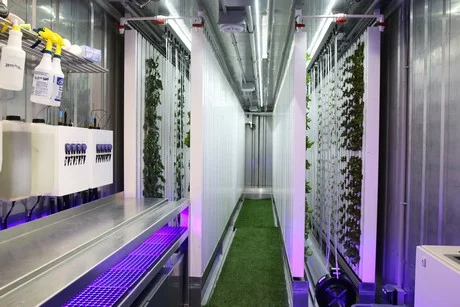
First Freight Farm Up And Running In Holland
Today's farmer only needs a smartphone:
First Freight Farm up and running in Holland
He did not go to horticultural college, doesn't have a green thumb and has no clue about produce marketing. Yet Dutchman Patrick Stoffer is about to harvest 1,000 heads of lettuce every week. He is the proud owner of the first Freight Farm in the Netherlands.
Stoffer is the first European that has bought the Leafy Green Machine from Dutch greenhouse supply company Horticoop. The container farm has been developed in the U.S. by Freight Farms and comprises of a shipping container (12.2 x 2.44 x 2.6m) that has 256 ZipGrow cultivation towers for the hydroponic cultivation of leafy greens and herbs. The vertical farms allows a total of 7,000m2 of production.
Stoffer is a proud owner of the idiot-proof farm. He is using an app that keeps him up-to-date on the conditions in the container and through the app he receives tips about what kind of actions to take during cultivation.
Freight Farms has about 150 of these containers installed in the U.S. and the popularity of the system is steadily growing. Kimbal Musk, brother of Paypal and Tesla founder Elon Musk, recently bought 20 to start his own vertical farm. In his blog, he explains the importance of cultivating in urban locations and being in contact with the consumer.
Leafy Green Machine
Stoffers has no knowledge of the traditional fresh produce trade, and did not attend horticultural college. The youngster is studying Facility Management and uses his entrepreneurship with the Leafy Green Machine as part of his final thesis.
The container is installed near residential care centre Humanitas in the town of Deventer. “Part of the lettuce ends up in the salad bar at the home,” the young entrepreneur explains. “The idea is to also involve residents in the project, to show how the lettuce grows and what happens in the container. At a later time it will become a part of the community as a social project.”
Cost price
Stoffer finds other buyers in local restaurants. “Salad bars and food service companies are intersting parties.” says Stoffer. He needs such companies which see the added value of this, because the cost price of the Leafy Green Machine means he cannot compete with traditional greenhouse horticulture. “We can not compete with the lettuce you find in a Dutch supermarket. However, our product has a story to tell and comes fresher and healthier.”
Horticoop offers the Leafy Green Machinefor a few months now. Interest has already been expressed from countries such as Norway, Sweden and the UK. Freight Farms expects sales will increase in the US next year and also hopes to find a good market in Europe.
Publication date: 11/16/2016
Author: Arlette Sijmonsma
Copyright: www.hortidaily.com